July 7, 1798  The X-Y-Z Affair

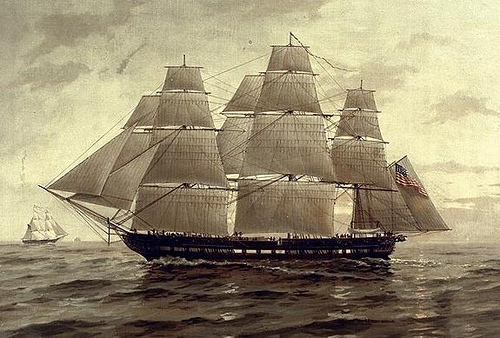
America’s “quasi-war” with France, begun this day in 1798, would see the first combat service of the heavy frigate USS Constitution, better known as “Old Ironsides” and today, the oldest commissioned warship in the world, still afloat. 

Imagine that you’ve always considered your own beliefs to be somewhere in the political center.  Maybe a little to the left. Now imagine that, in the space of two years, your country’s politics have shifted so radically that you find yourself on the “Reactionary Right”, on the way to execution by your government.

And your personal convictions have never changed.

America’s strongest Revolution-era ally lost its collective mind in 1792, when France descended into a revolution of its own.    17,000 Frenchmen were officially tried and executed during the 1793-94 “Reign of Terror” (la Terreur) alone, including King Louis XVI himself and his queen, Marie Antoinette.  Untold thousands died in prison or without benefit of trial.  The monarchical powers of Europe were quick to intervene.  For the 32nd time since the Norman invasion of 1066, England and France once again found themselves at war.

the-reign-of-terror-french-revolution-17931794-1-638

France had been the strongest ally the Americans had during the late revolution, yet the United States remained neutral in the later conflict, straining relations between the former allies.  Making matters worse, America repudiated its war debt in 1794, arguing that it owed the money to “l’ancien régime”, and not to the French First Republic which had overthrown it, and executed its King.

Lafayette_Prison_reunion
The Marquis de Lafayette was shocked on October 15, 1795, when his cell door opened and in walked his wife and three daughters. The four women would remain with him in his prison cell, for another two years

By this time, Revolution-era America’s most important French allies were off the stage, the Comte de Grasse dead, the Marquis de Lafayette and the Comte de Rochambeau languishing, in prison.

Both sides in the European conflict seized neutral ships which were trading with their adversary.  The “Treaty of Amity, Commerce, and Navigation” with Great Britain, ratified in 1795 and better known as the “Jay Treaty”, put an end for now to such conflict with Great Britain, but destroyed relations with the French Republic.

French privateers cruised the length of the Atlantic seaboard preying on American merchant shipping, seizing 316 civilian ships in one eleven-month period, alone.

At this point, the United States had virtually no means of fighting back.  The government had disbanded the Navy along with its Marine contingent at the end of the Revolution, selling the last warship in 1785 and retaining only a handful of “revenue cutters” for customs enforcement.  The Naval Act of 1794 had established a standing Navy for the first time in American history and begun construction on six heavy frigates, the first three of which would launch in 1797:  the USS United States, USS Constellation, and USS Constitution.

In 1796, France formally broke diplomatic relations with the United States by rejecting the credentials of President Washington’s representative, Ambassador Charles Cotesworth Pinckney.

The following year, President John Adams dispatched a delegation of two, with instructions to join with Pinckney in negotiating a treaty with France, on terms similar to those of the Jay treaty with Great Britain.

Pinckney
Charles Cotesworth Pinckney

These were the future Chief Justice of the Supreme Court John Marshall, and future Massachusetts Governor Elbridge Gerry, a man who later became the 5th Vice President and lent his name to the term “Gerrymander”.

The American commission arrived in Paris in October 1797, requesting a meeting with French Foreign Minister Charles Maurice de Talleyrand.  Talleyrand, unkindly disposed toward the Adams administration to begin with, demanded bribes before meeting with the American delegation.  The practice was not uncommon in European diplomacy of the time, but the Americans refused.

Documents later released by the Adams administration describe Nicholas Hubbard, an English banker identified only as “W”.  W introduced “X” (Baron Jean-Conrad Hottinguer) as a “man of honor”, who wished an informal meeting with Pinckney.  Pinckney agreed and Hottinguer reiterated Talleyrand’s demands, specifying the payment of a $12 million “loan” to the French government, and a personal bribe of some $250,000 to Talleyrand himself.  Met with flat refusal by the American commission, X then introduced Pierre Bellamy (“Y”) to the American delegation, followed by Lucien Hauteval (“Z”), sent by Talleyrand to meet with Elbridge Gerry.  X, Y and Z, each in their turn, reiterated the Foreign Minister’s demand for a loan, and a personal bribe.

Believing that Adams sought war by exaggerating the French position, Jeffersonian members of Congress joined with the more warlike Federalists in demanding the release of the commissioner’s communications.  It was these dispatches, released in redacted form, which gave the name “X-Y-Z Affair” to the diplomatic and military crisis which followed.

American politics were sharply divided over the European war.  President Adams and his Federalists, always the believers in strong, central government, took the side of the Monarchists.  Thomas Jefferson and his “Democratic-Republicans” found more in common with the liberté, égalité and fraternité espoused by French revolutionaries.

In the United Kingdom, the ruling class appeared to enjoy the chaos.  A British political cartoon of the time depicted the United States, represented by a woman being groped by five Frenchmen while John Bull, the fictional personification of all England, looks on in amusement from a nearby hilltop.

XYZ cartoon

Adams’ commission left without entering formal negotiations, their failure leading to a political firestorm in the United States.  Congress rescinded all existing treaties with France on July 7, 1798, the date now regarded as the beginning of the undeclared “Quasi-War” with France.

Four days later, President John Adams signed “An Act for Establishing and Organizing a Marine Corps,” permanently establishing the United States Marine Corps as an independent service branch, in order to defend the American merchant fleet.

quasi-war-1798-1801

Talleyrand himself raised the stakes, saying that attacks on American shipping would cease if the United States paid him $250,000 and gave France 50,000 pounds sterling and a loan for $100 million. At a 1798 Philadelphia dinner in honor of John Marshall, South Carolina Congressman Robert Goodloe Harper’s toast, spoke for the American side: “Millions for defense but not one cent for tribute.”

America’s “quasi-war” with France, begun this day in 1798, would see the first combat service of the heavy frigate USS Constitution, better known as “Old Ironsides” and today, the oldest commissioned warship in the world, still afloat.  The undeclared war would be fought across the world’s oceans, from the Atlantic to the Caribbean, to the Indian Ocean, and the Mediterranean Sea.

United_States_Marine_escorting_French_prisoners
20th century illustration depicts American Marines escorting French prisoners

The Convention of 1800 ended the Quasi-War on September 30, nullifying the Franco-American alliance of 1778 and ensuring American neutrality in the Napoleonic wars. $20,000,000 in American “Spoliation Claims” would remain, unpaid.

For the United States, military escalation proved decisive.  Before naval intervention, the conflict with France resulted in the loss of over 2,000 merchant ships captured, with 28 Americans killed and another 42 wounded.   Military escalation with the French First Republic cost the Americans 54 killed and 43 wounded, and an unknown number of French.  Only a single ship was lost, the aptly named USS Retaliation, and that one was later recaptured.

If you enjoyed this “Today in History”, please feel free to re-blog, “like” & share on social media, so that others may find and enjoy it as well. Please click the “follow” button on the right, to receive email updates on new articles.  Thank you for your interest, in the history we all share.

July 3, 1947 The May Incident

History is replete with examples of what power concentrated in the hands of a few, leads to.

Two hundred and forty-two years ago, our founding fathers bequeathed to us a nation unique in all history. A nation founded on an idea, that all men are created equal, and government derives its powers from the just consent of the governed. A Federal, Constitutional Republic in which our politicians are not our ‘leaders’ but rather our Representatives, operating within a system of diffuse powers with checks and balances, periodically accountable through democratic processes to their bosses – the people who put them there.

In modern times, it has become fashionable to point to the flaws in such a system. Howard Zinn and others present a victim’s-eye narrative of American history.  Smug, faculty iconoclasts and a pop culture Commentariat, decrying the ‘sugar coated fairy tales’, of our past.  Yet, the Great Winston Churchill may have had the final word, describing ‘Democracy” as the worst form of government there is…except for all the others.

o-WINSTON-CHURCHILL-facebook

For many among us, most I should think, some form of that Constitutional, self-governing Republic envisioned by our founders, remains preferable to all other forms of government.  Warts and all.

History is replete with examples of what power concentrated in the hands of a few, leads to.

Ambrose+bierce+majorityIndeed, such a system has imperfections, not least among them those who would ascend to political office.

Hearst columnist Ambrose Bierce, a social satirist of his day and my favorite curmudgeon, once defined politics as ‘A strife of interests, masquerading as a contest of principles. The conduct of public affairs for private advantage.

In the late 19th century, Democrat William “Boss” Tweed owned New York politics, fleecing city taxpayers at the head of the Tammany Hall political machine. New York debt levels soared by over $100 million between 1868 and 1870 alone, a figure equivalent to over a Billion dollars, today.

As Governor of Tennessee, Democrat Ray Blanton ran a ‘pay for play’ operation selling pardons, paroles and commutations, until drawing the attention of the eye of Sauron, at the FBI.  Blanton’s corruption was extensive enough to spawn a book and a later movie, and launched the political career of prosecutor and sometime actor, Fred Thompson.

And, lest I be accused of picking on Democrats, Pennsylvania Republican and Representative in Congress R. Budd Dwyer faced up to 55 years in prison and a $300,000 fine for racketeering and mail fraud, when he took a .357 Magnum revolver out of a manila envelope and blew his brains out.  On live television, no less.

R.-Budd-Dwyer-suicide-660x330

There are so many more and we all have our ‘favorites’, in this parade of horribles.  Yet, for insensate cupidity and pure boneheadedness, it would be hard to outdo the attorney, circuit court judge and member of the United States House of Representatives, Andrew Jackson May.

The Kentucky Democrat was a staunch supporter of the ‘New Deal’ policies of President Franklin Delano Roosevelt, serving in seven succeeding Congresses between 1931 and 1947. As Chairman of the powerful Committee on Military Affairs, May became involved with New York businessmen Murray and Henry Garsson, a relationship which would lead to war profiteering allegations.

Congressman-Andrew-May
Congressman Andrew Jackson May

After the war, a Senate investigating committee discovered evidence of substantial kickbacks from the Garsson brothers. Making matters worse, their munition business took excessive profits, while producing shoddy product. May’s bribery scandal revealed evidence that the Garsson factory produced defective fuses for their 4.2-inch mortar shells, detonating prematurely and leading to the death of no fewer than 38 American soldiers.

Andrew May would serve nine months in Federal prison for accepting bribes in exchange for securing munitions contracts during WW2.

Yet, even that pales in comparison with the ‘May incident’, for which the man has earned eternal infamy. As an influential member of an important committee, Andrew May was necessarily entrusted with highly confidential information, among them deficiencies in Imperial Japanese Navy anti-submarine depth-charge tactics.

Depth Charge
Imperial Japanese Navy light Crusier using Depth Charges against an American submarine, South Pacific 1942 H/T ww2incolor

For some time, the American submarine service had enjoyed considerable success in its war on Japanese shipping. Imperial Japanese naval planners held some bad assumptions about American submarine specifications, among them maximum depth capabilities.

Japanese depth charges were set to detonate at too shallow a depth, leading to a high survival rate for American subs. Congressman May took care of that problem, in 1943.

Returning home from a junket, the Congressman revealed this highly sensitive information, before a press conference. Various press associations ran with the story and some were bright enough to ‘sit on it’, but not all. Several newspapers published the information, including one in Hololulu.

Vice Admiral Charles A Lockwood
Vice Admiral Charles A. Lockwood

Japanese naval ASW (Antisubmarine Warfare) forces were quick to adjust depth charge settings. Vice Admiral Charles A. Lockwood, commander of the U.S. submarine fleet in the Pacific, estimated that May’s indiscretion killed as many as 800 American crewman, with the loss of ten submarines. “I hear Congressman May said the Jap depth charges are not set deep enough”, he said. “He would be pleased to know that the Japs set them deeper now.”

Andrew Jackson May was convicted by a federal jury on this day in 1947, for accepting cash bribes from Murray and Henry Garsson, to use his position as Chairman of the Military Affairs Committee to secure munitions contracts for the Garsson firm.  The Garsson brothers also received prison terms.

President Harry Truman granted May a full pardon in 1952, though his political career was finished. Andrew May returned home to Kentucky to resume the practice of law, until his death in 1959.  We are left only to contemplate, what the man or the press could be thinking, to divulge information more safely left in the hands of a stupid child.  That, and the horrifying realization that the democratic process might actually work, and the government we elect is just…like…Us.

If you enjoyed this “Today in History”, please feel free to re-blog, “like” & share on social media, so that others may find and enjoy it as well. Please click the “follow” button on the right, to receive email updates on new articles.  Thank you for your interest, in the history we all share.

June 22, 1807 Impressed

British envoys delivered proclamations reaffirming the practice of impressment, amounting to the kidnapping of sailors and forcing their labor aboard British ships. In total, the Royal Navy impressed over 9,000 sailors claiming to be American citizens, becoming the driving force behind the United States going to war with England, in 1812.

The Napoleonic Wars took place between 1799 and 1815, pitting a series of seven international coalitions against the forces of Napoleon Bonaparte and his Grande Armée.  The former American colonies benefited from the European conflict, remaining on the sidelines and doing business with both sides.  Within a ten-year period, the fledgling United States had become one of the world’s largest neutral shippers.

In 1807, two third-rate French warships were penned up in Maryland’s Chesapeake Bay, blockaded by a number of English warships outside of the harbor.

4467229436_5635b36a0a
The American frigate, USS Chesapeake

London born Jenkin Ratford was an English sailor who deserted the British Navy and defected to the neutral United States.  This story might have ended better for him had he not run his mouth, but that wasn’t this guy.  Ratford couldn’t resist taunting British officers, boasting of his escape to the “land of liberty”

The USS Chesapeake was preparing for a Mediterranean cruise with Ratford aboard, when she emerged from Norfolk, Virginia.  Her decks were laden with supplies and stores of every kind, and her guns unwisely stored.  Chesapeake was nowhere near combat ready when she was approached by the HMS Leopard on June 22.

The Chesapeake’s commander, Commodore James Barron, was unconcerned when the Leopard, under the command of Captain Salusbury Pryce Humphreys, asked permission to board.  Lieutenant John Meade of Her Majesty’s Navy presented Barron with a search warrant.  Barron declined to submit, and the officer returned to the Leopard.

Chesapeake_LeopardHumphreys then used a hailing trumpet and ordered the American ship to comply, to which Barron responded “I don’t hear what you say”. Humphreys fired two rounds across Chesapeake’s bow, followed immediately by four broadsides.
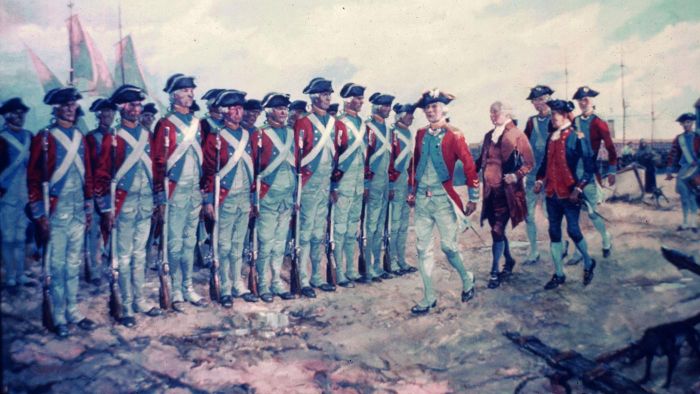
Chesapeake fired a single shot before striking colors and surrendering.  Humphreys refused the surrender and boarded, taking Ratford and three American born sailors with them when they left.

There was little resistance, yet the “Chesapeake-Leopard Affair” had left three American crewmembers dead, and 18 wounded.

American public opinion was outraged over the humiliation, as the four men were transported to Halifax for trial.   Federalists and Democratic-Republicans were united as never before.  President Thomas Jefferson remarked “Never since the Battle of Lexington have I seen this country in such a state of exasperation as at present, and even that did not produce such unanimity.”

The English court found all four guilty of desertion and hanged Ratford by the fore yardarm of his former vessel, HMS Halifax.  The three Americans, David Martin, John Strachan, and William Ware, were sentenced to 500 lashes.

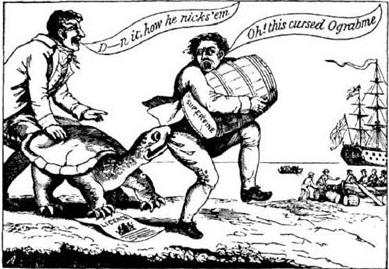
With the puny American navy deployed to the Mediterranean to check the Barbary pirates, President Jefferson’s options were limited to economic retaliation.  The Embargo Act of 1807 intended to extract concessions from France and Great Britain, instead had the effect of imposing crippling setbacks on some industries, while others railed against government interference in the private economy.  Many came to the conclusion that the only solution, lay in violence.

2661E817-FD9D-331B-F65F29408EE37509
Political cartoon depicting merchants harassed cursing the “Ograbme”—“embargo” spelled backwards.

British envoys delivered proclamations reaffirming the practice of impressment,  amounting to the kidnapping of sailors and forcing their labor aboard British ships.  In total, the Royal Navy impressed over 9,000 sailors claiming to be American citizens, becoming the driving force behind the United States going to war with England, in 1812.

Despite being wounded, Barron was blamed for the “Chesapeake-Leopard Affair”.  A court-martial suspended him from service for five years, without pay.   Commodore Stephen Decatur was one of the presiding officers at the court-martial. In 1820, Barron challenged Decatur to a duel, killing his fellow Commodore over comments concerning the 1807 incident.

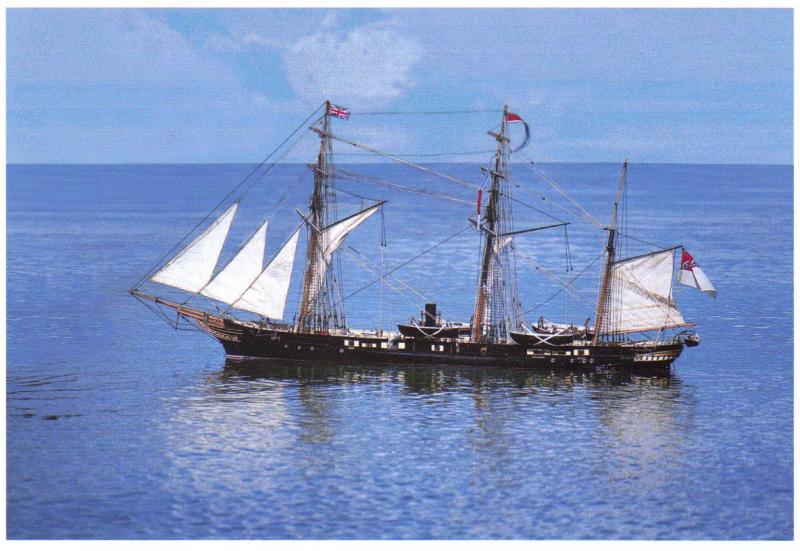
Undergoing a refit in Boston Harbor in 1813, USS Chesapeake was challenged to single combat by Captain Philip Broke, commanding the British frigate HMS Shannon.

Chesapeake_MillUnited States Naval Captain James Lawrence was eager to comply, confident in the wake of a number of American victories in single-ship actions.

It was a Big mistake.

All of Boston turned out that June day, to watch the fight.  Cheers went out across the docks and from scores of private vessels across Boston Harbor, as Chesapeake slipped her moorings and glided out of the harbor.

Boston authorities reserved dock space in expectation of a guest.  The arrival of a captured British frigate, so it was thought, was a foregone conclusion. Rooftops, hills and trees from Lynn to Malden and Cohasset to Scituate were crowded with spectators, come to watch the show.

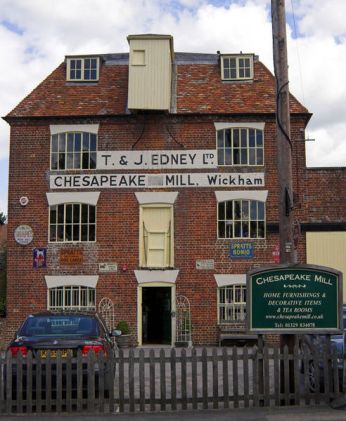
The tale of the Battle of Boston Harbor must be a story for another day.  Suffice it to say that USS Chesapeake ended her career as the British frigate HMS Chesapeake, before being sold for scrap, in 1819.  Two-hundred years later, the ship’s timbers live on.  Part of the Chesapeake Mill in the historic village of Wickham, in Hampshire, England.

If you enjoyed this “Today in History”, please feel free to re-blog, “like” & share on social media, so that others may find and enjoy it as well. Please click the “follow” button on the right, to receive email updates on new articles.  Thank you for your interest, in the history we all share.

June 19, 1864 Single Combat

USS Kearsarge steamed further to sea as the Confederate vessel approached.  There would be no one returning to port until the issue was decided.

Hull #290 was launched from the John Laird & Sons shipyard in Birkenhead, Cheshire, England as the screw sloop HMS Enrica on May 15, 1862. She sailed in secret to the Terceira Island in the Azores, where she was met by Raphael Semmes, her new captain. Three days, 8 cannon and 350 tons of coal later, the Enrica was transformed into the 220′, 1,500-ton sloop of war and Confederate States of America commerce raider, CSS Alabama.

CSS Alabama
CSS Alabama

Alabama’s mission was to wage economic war on the Union, attacking commercial shipping from the Pacific to the Indian Ocean, from Newfoundland to Brazil. In her two-year career as commerce raider, Alabama claimed 65 prizes valued at nearly $123 million in today’s dollars.  She was the most successful, and most notorious, commerce raider of the Civil War.

portsmouth nh-uss kearsarge-civil war steam sloop
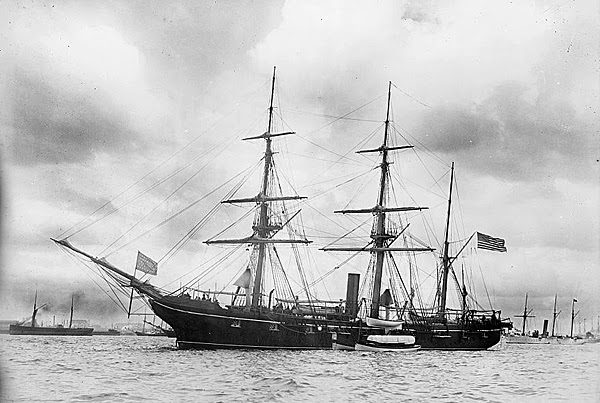
Civil War Steam Sloop USS Kearsarge

Alabama was in sore need of a refit when she put into Cherbourg France, on the 11th of June, 1864. The Mohican-class Union steam sloop-of-war USS Kearsarge, then on patrol near Gibralter, hurried to Cherbourg, arriving on the 14th.

Captain_Raphael_Semmes_and_First_Lieutenant_John_Kell_aboard_CSS_Alabama_1863
Captain Raphael Semmes and 1st Lieutenant John Kell aboard CSS Alabama 1863

Seeing himself blockaded, Alabama’s Captain challenged Kearsarge Captain John Winslow to a ship-to-ship duel, saying “my intention is to fight the Kearsarge as soon as I can make the necessary arrangements. I hope these will not detain me more than until to-morrow or the morrow morning at farthest. I beg she will not depart until I am ready to go out. I have the honor to be your obedient servant, R. Semmes, Captain“.  That suited Winslow just fine, who took up station in international waters, and waited for Alabama to come out.

h86059CSS Alabama steamed out of Cherbourg harbor on the morning of June 19, 1864, escorted by the French ironclad Couronne, which remained nearby to ensure that the combat remained in international waters. Kearsarge steamed further to sea as the Confederate vessel approached.  There would be no one returning to port until the issue was decided.

Kearsarge v AlabamaCaptain Winslow put his ship around and headed for his adversary at 10:50am. Alabama fired first from a distance of a mile, and continued to fire as the range decreased.
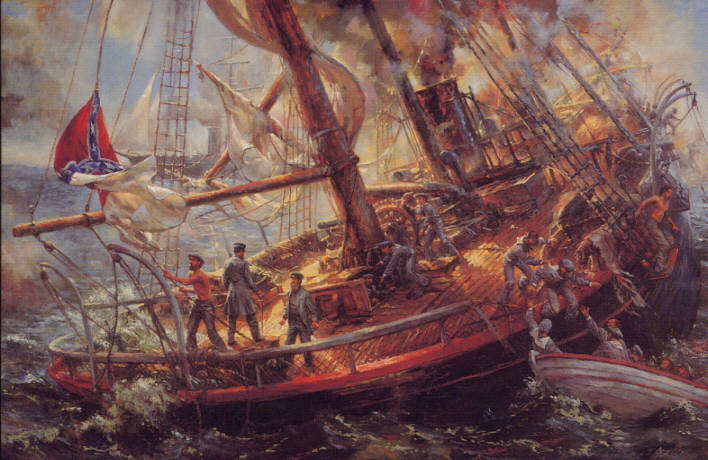
Sinking_of_the_CSS_Alabama, by Andy Thomas
Sinking of the CSS Alabama, by Andy Thomas

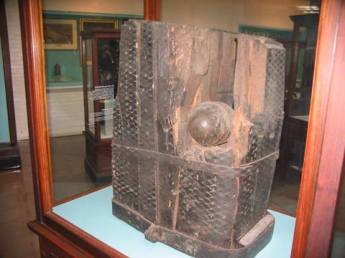
The engagement followed a circular course at a range of a half mile; the ships steaming in opposite directions and firing at will.  One ball from Alabama lodged in Kearsarge’s sternpost, but failed to explode.  Within an hour, Kearsarge’s 11″ Dahlgren smooth bore pivot cannons reduced the most successful commerce raider in history to a sinking wreck. Alabama turned and tried to run back to port, but Kearsarge headed her off as rising water stopped her engines.

Kearsarge Stern Post
USS Kearsarge Sternpost

Semmes struck his colors and sent a boat to Kearsarge with a message of surrender and an appeal for help.

For those rescued by Kearsarge, the Civil War was over. These would spend the rest of the war as prisoners of the Federal government.  Captain Semmes escaped along with 41 others, being plucked from the water and taken to neutral ports by the British steam yacht Deerhound, and the private sail yacht Hornet.

If you enjoyed this “Today in History”, please feel free to re-blog, “like” & share on social media, so that others may find and enjoy it as well. Please click the “follow” button on the right, to receive email updates on new articles.  Thank you for your interest, in the history we all share.

June 11, 1775 The Lexington of the Sea

Called by some the “Lexington of the Sea”, the little-known episode was the first naval battle of the American Revolution, and ended in victory for the Patriot side. 

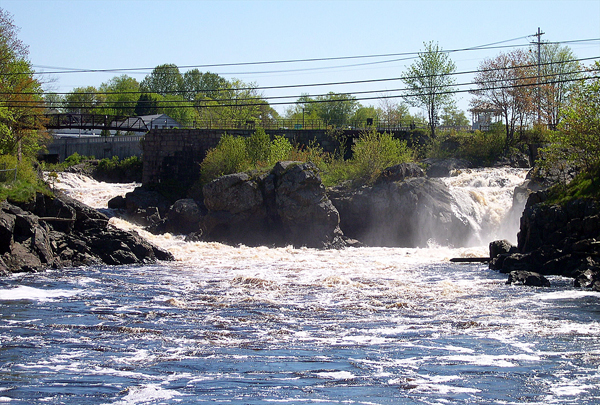
In the Passamaquoddy tongue, “Machias” roughly translates into “bad little falls”, after the river that runs through the place. Five hours and 15 minutes drive-time from Boston, Machias Maine sports a campus for the University of Maine, a municipal airport and, even today, a year-round population barely exceeding 2,000.

BAD LITTLE FALLS KC.JPG
Machias-area residents who discussed downtown revitalization Tuesday evening said the Bad Little falls was the town’s most distinctive element. (KATHERINE CASSIDY PHOTO)

Not necessarily a place where you’d expect the first naval combat of the American Revolution.

In 1775, the modern state of Maine was still part of Massachusetts. Machias itself, a small fishing village on the “Downeast” New England coast, had been a thorn in the British side, since the earliest days of the Revolution.   A local pilot intentionally grounded the coastal patrol schooner HMS Halifax that February, in Machias Bay.  The place also served as a base from which privateers preyed on British merchant shipping.

In April, a British foray from the occupied city of Boston had culminated in the Battle at Lexington Green.  While the King’s troops held the ground in the wake of the early morning skirmish, the decision of the afternoon’s battle at nearby Concord was quite different.  The colonial’s response to the column of “Regulars” was that of a swarming behive, resulting in a Patriot victory and a British retreat under fire, all the way back to Boston.

Siege-of-Boston-1-ABBoston was all but an island in those days, connected to the mainland only be a narrow “neck” of land.  A Patriot force some 20,000 strong took positions in the days and weeks that followed, blocking the city and trapping four regiments of British troops (about 4,000 men) inside of the city.
For General Thomas Gage, in charge of all those troops, the best hope for resupply was by water.

British Royal Navy Admiral Samuel Graves wanted the guns from the wreck of the Halifax, concerned they would otherwise fall into rebel hands.  Gage wanted lumber, with which to build barracks.  So it was that the wealthy merchant and Tory loyalist Ichabod Jones was enlisted to help, blissfully unaware of the dim view in which his activities were held by fellow colonials.

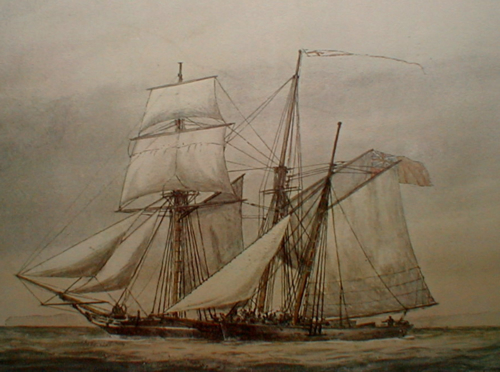
Jones arrived at Machias on June 2 aboard the merchant ships Unity and Polly, under guard of the armed schooner HMS Margaretta, commanded by Midshipman James Moore.  They had come to trade food for lumber but the townspeople were split, and voted against doing business with Jones.  This provoked a threat from the Margaretta, which moved into range to bombard the town.  The action resulted in a second vote and the trade was approved, but Jones’ response was ham-fisted.   The merchant would only do business, with those who had voted with him in the first place.

margaretta
HMS Margaretta

Local militia leader Colonel Benjamin Foster conceived a plan to seize the merchant, and saw his opportunity on June 11, when Jones and Moore were in church.  They almost had the pair too, but Jones saw some twenty men approaching, and fled for the woods.  Moore was able to get back to the Margaretta, but events soon spun out of control.

Colonel Foster and his brother, a man with the delightful name of Wooden Foster, seized the Unity.  A group of thirty began to construct breastworks to serve as protection, while others commandeered the coastal packet Falmouth.   There was gong to be a fight.

machias_meA group of Machias men approached Margaretta from the land and demanded her surrender, but Moore lifted anchor and sailed off in attempt to recover the Polly.  A turn of his stern through a brisk wind resulted in a boom and gaff breaking away from the mainsail, crippling the vessel’s navigability. Unity gave chase followed by Falmouth.
Musket fire was exchanged from both sides and hand grenades were thrown onto the decks of the Unity.   Soon, the Margaretta was boarded from both sides, the fighting hand to hand.

Called by some the “Lexington of the Sea”, the little-known episode was the first naval battle of the American Revolution, and ended in victory for the Patriot side.  Four Royal Navy seamen were killed outright and another ten wounded including Moore himself, who received a musket ball to the chest and died the following day.

Patriot losses amounted to ten killed and another three wounded.

HMS Margaretta served out the remainder of the Revolution as the renamed Machias Liberty.  British payback came on October 18 when Falmouth Massachusetts, the modern-site of Falmouth Maine and not to be confused with either of the modern-day towns of  Falmouth Massachusetts, or Falmouth Maine, was burned to the ground.

British forces attempted a second assault on Machias, with an amphibious landing of 1,000 troops over the 13th – 14th of August, 1777.  The attempt was beaten back by local militia and their Passamaquoddy and Penobscot allies, with both sides claiming victory.  The nearby village of Castine would be occupied in 1779 as would Machias itself during the War of 1812.  On both occasions, captured territories were re-dubbed the Crown Colony of “New Ireland”, a refuge for Loyalists and a base for future military operations.

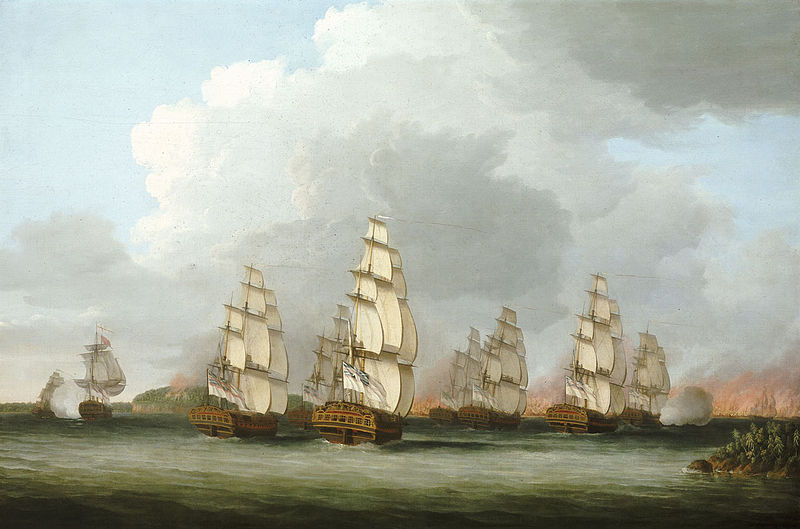
The Crown Colonies of New Ireland survived for four years in the first instance and eight months in the second.  The failed Penobscot expedition of 1779 to retake the colony would result in the most catastrophic defeat suffered by American Naval forces until the Japanese attack on Pearl Harbor 162 years later, but that must be a story for another day.

800px-PenobscotExpeditionBySerres
Britain defending New Ireland from the Penobscot Expedition by Dominic Serres
If you enjoyed this “Today in History”, please feel free to re-blog, “like” & share on social media, so that others may find and enjoy it as well. Please click the “follow” button on the right, to receive email updates on new articles.  Thank you for your interest, in the history we all share.

June 4, 1629 A Real-Life ‘Lord of the Flies’

Rescue arrived three months after the original shipwreck, to discover a horror for the ages.

VOC Logo
VOC Logo

During the colonial period, joint-stock companies were established by European powers to carry out foreign trade and exploration, to colonize distant lands and conduct military operations against foreign adversaries.

Such organizations may have been chartered for a single voyage or for an extended period of time, and were much more than what we currently associate with the word “company”. In their day these organizations could raise their own armies, enforce the law up to and including trial and execution of accused wrong doers, and largely functioned outside the control of the governments which formed them.

The Vereenigde Oostindische Compagnie (VOC), better known as the Dutch East India Company, founded in 1602, was the world’s first formally listed public company, an early multi-national corporation paving the way to the corporate-led globalization of the early modern period.

Batavia
Batavia Replica

On October 27, 1628, a Dutch East India Co. merchant fleet departed the Dutch West Indies bound for the south Pacific Moluccan Islands to trade for spices. Among these vessels was the 650-ton ship Batavia, embarked on her maiden voyage.

On board were enormous stockpiles of gold and silver coinage and a complement of 341 passengers and crew, including men, women and children.

Among ship’s officers were the bankrupt pharmacist Onderkoopman (junior merchant) Jeronimus Cornelisz, in flight from the Netherlands due to his heretical religous beliefs, and skipper Ariaen Jacobsz. While underway, the two conceived a plan to mutiny, and start a new life somewhere else. All that specie in the hold would have given the pair a very nice start.

A small group of men were recruited and a plot was hatched to molest a ranking female member of the passenger list. The plotters hoped to provoke a harsh act of discipline against the crew, which could then be used to recruit more men to the mutineers. Lucretia Jans was assaulted as planned but, for whatever reason, Opperkoopman (senior merchant) Francisco Pelsaert never made any arrests.

bat7Perhaps the man was ill at the time but, be that as it may, the die was cast. The conspirators now needed only the right set of circumstances, to put their plans in motion.
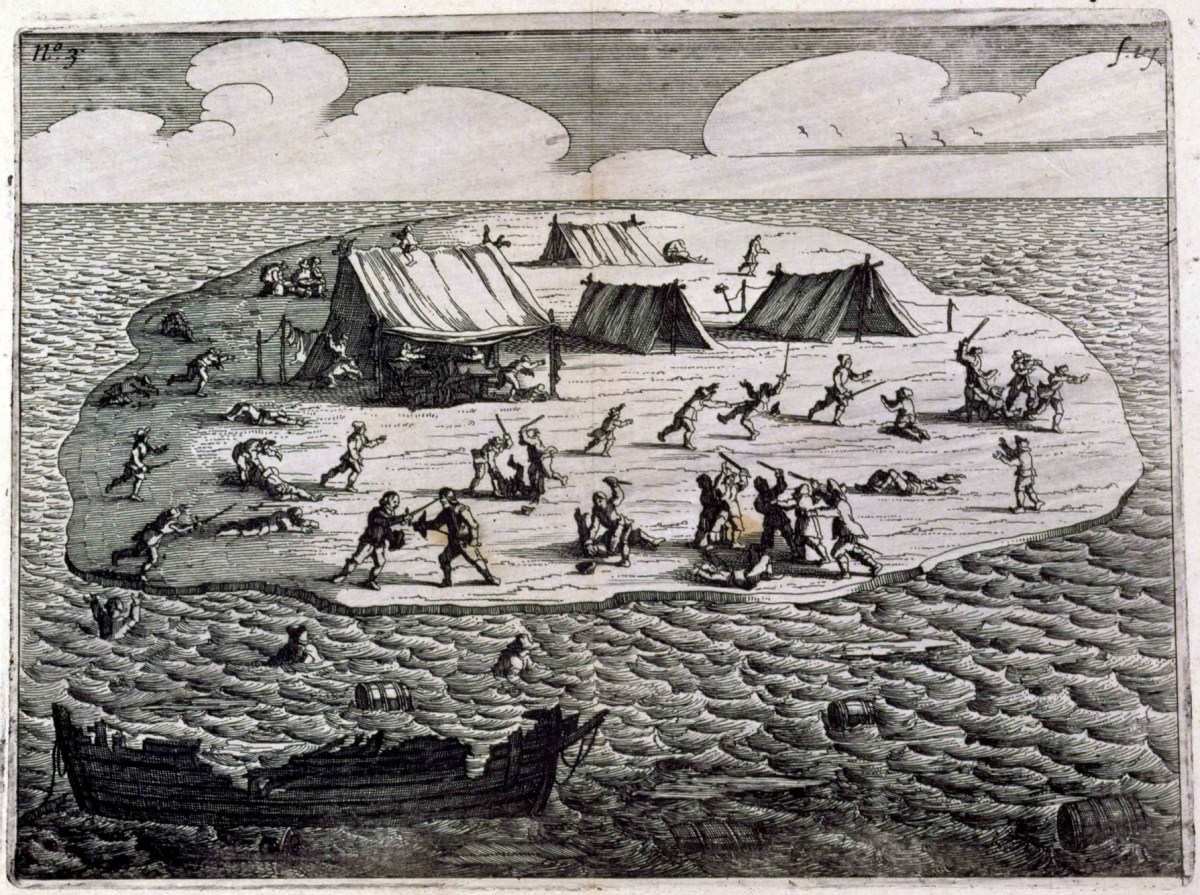
Jacobsz deliberately steered the ship off course and away from the rest of the fleet. He got his ‘right set of circumstances’ on the morning of June 4, 1629, when Batavia struck a reef off the west coast of Australia.

Forty people drowned before the rest could be gotten safely to shore, swimming or transferred to nearby islands in the ship’s longboat and yawl.

220px-Wiebbe_Hayes_Statue
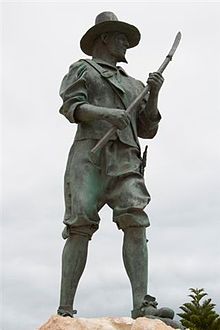
Statue of Wiebbe Hayes at Geraldton, Western Australia.

With no source of fresh drinking water, the situation was dire. A group comprising Captain Jacobsz, Francisco Pelsaert, several senior officers and crew members plus a few passengers set out in a 30-foot longboat.  The group performed one of the great feats of open boat navigation in all history, arriving after 33 days at the port of Batavia in modern-day Jakarta, Indonesia.

Boatswain Jan Evertsz was arrested and executed for negligence in the wreck of the Batavia, his role in the conspiracy never suspected.

Pelsaert was immediately given command of the Sardam by Batavia’s Governor General, Jan Coen.

Pelsaert’s rescue arrived three months after the original shipwreck, to discover a horror for the ages.

Left alone in charge of the survivors, Cornelisz and several co-conspirators took control of all the weapons and food supplies, then carried out plans to eliminate potential opposition.

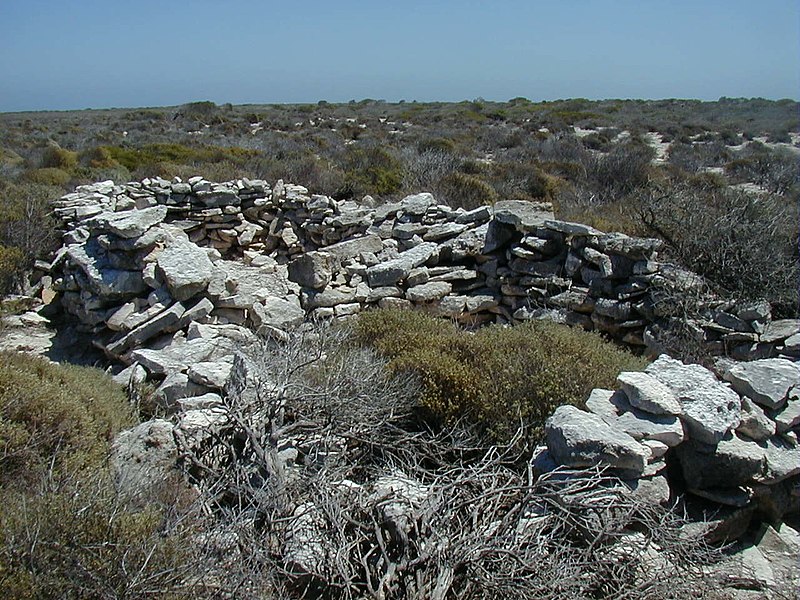
A group of soldiers led by Wiebbe Hayes was tricked into being moved to West Wallabi Island, under the false pretense of looking for water. Convinced there was none, Cornelisz abandoned the group on the island to die.  The psychopath and his dedicated band of followers,  was now free to murder the rest at their leisure .

Author Mike Dash writes in Batavia’s Graveyard: The True Story of the Mad Heretic Who Led History’s Bloodiest Mutiny: “With a dedicated band of murderous young men, Cornelisz began to systematically kill anyone he believed would be a problem to his reign of terror, or a burden on their limited resources. The mutineers became intoxicated with killing, and no one could stop them. They needed only the smallest of excuses to drown, bash, strangle or stab to death any of their victims, including women and children”.

Like some prototype Charles Manson, Cornelisz left the actual killing to others, though he did attempt to poison one infant who was later strangled.  No fewer than 110 men, women and children were murdered during this period.  Those women left alive were confined to ‘rape tents’.

Meanwhile, Wiebbe Hayes and his soldiers found water and, unaware of the butchery taking place on Beacon island, began to send smoke signals, according to a prearranged plan.  The group would only learn of the ongoing massacre from survivors, who escaped to swim for their lives.

800px-The_Fort_-_West_Wallabi_Island_-_Colour
Makeshift ‘fort’ built by Wiebbe Hayes and his soldiers, on West Wallabi Island

With their own supplies dwindling, Cornelisz & Co. assaulted the soldiers on West Wallabi Island, now in possession of crude handmade weapons and manning makeshift fortifications. Pitched battles ensued, pitting muskets against sticks and spears. The bad guys almost won too, but the better trained and (by this time) better fed soldiers, prevailed.

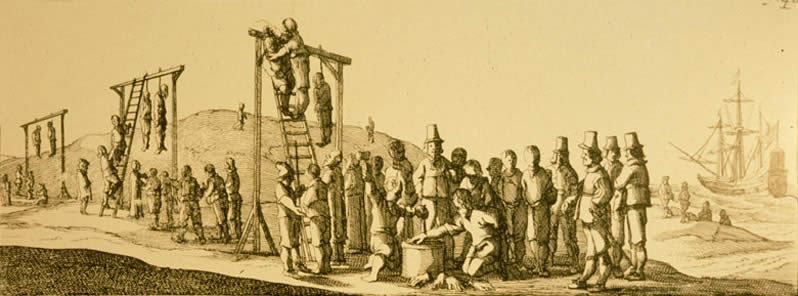
Pelsaert’s arrival triggered a furious race between Cornelisz’s men and the soldiers. Fortunately for all, Hayes won the race. A brief but furious battle ensued before Cornelisz and his company were captured. After a brief trial, Cornelisz and the worst of the conspirators were brought to Seal Island, their hands chopped off, and hanged.

Two judged only to be minor players were brought to the Australian mainland and marooned, never to be seen again.

Image-bat-hist-04b
The hangings on Long Island as illustrated in the Lucas de Vries 1649 edition of Ongeluckige Voyagie.

The remaining conspirators were brought back to Batavia and tried. Five of them were hanged. Jacop Pietersz, second-in-command, was broken on the wheel, a hideous remnant of medieval justice and the worst form of execution available, at that time. Captain Jacobsz resisted days of torture and never did confess. What became of him is unknown.

Francisco Pelsaert was judged partly responsible for the disaster, due to his failure to exercise command. Senior Merchant Pelsaert’s assets were confiscated.  He would die penniless in less than a year, a broken man.

The exact number of those buried in mass graves on Beacon Island, is unknown.  Of the 341 who departed the West Indies that day in 1628, 68 lived to tell the tale.  Archaeologists labor an land and at sea but, three centuries later, the Wallabi Islands are jealous of their secrets

http_o.aolcdn.comhssstoragemidas922be7ce080e004b9894e39c2f52e3db204025152batavia+3
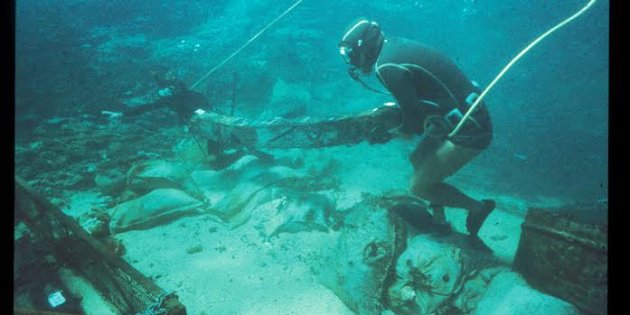
“Archaeologists recovering Batavia timbers from the wreck site”.  H/T, HuffPo for this image
If you enjoyed this “Today in History”, please feel free to re-blog, “like” & share on social media, so that others may find and enjoy it as well. Please click the “follow” button on the right, to receive email updates on new articles.  Thank you for your interest, in the history we all share.

May 21, 1944 That Other Disaster, at Pearl Harbor

Details of the West Loch disaster would remain classified until 1960, explaining why the incident is so little known, today.

Between June and November 1944, forces of the United States Marine Corps and Army conducted Operation Forager with support from the United States Navy, an offensive intended to dislodge Imperial Japanese forces from the Mariana Islands and the island nation of Palau.

Part of the island-hopping strategy employed during the last two years of WW2, Operation Forager followed the Gilbert and Marshall Islands campaign and had as its objective the neutralization of Japanese bases in the central Pacific, support for the Allied drive to retake the Philippines, and to provide bases for strategic bombing raids against the Japanese home islands.

pearlharbor_sm-640x533
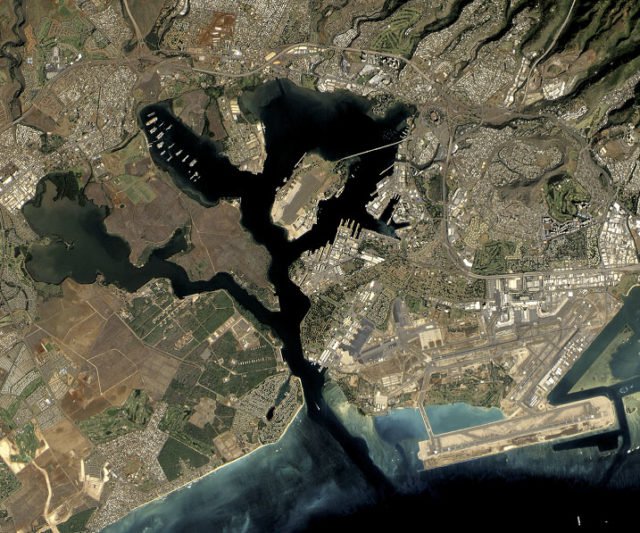
A NASA image of Pearl Harbor. The disaster occurred in West Loch which is to the left side of the photo, where the water is lighter in color.

In May 1944, the Pacific naval anchorage at Pearl Harbor was a rush of activity, building up for the planned invasion.  Seventy-four years ago today, twenty-nine Landing Ships, Tank (LSTs) were tied beam-to-beam on six piers, loading munitions, high octane gasoline and other equipment.

LST_Sicily
LST in Sicily

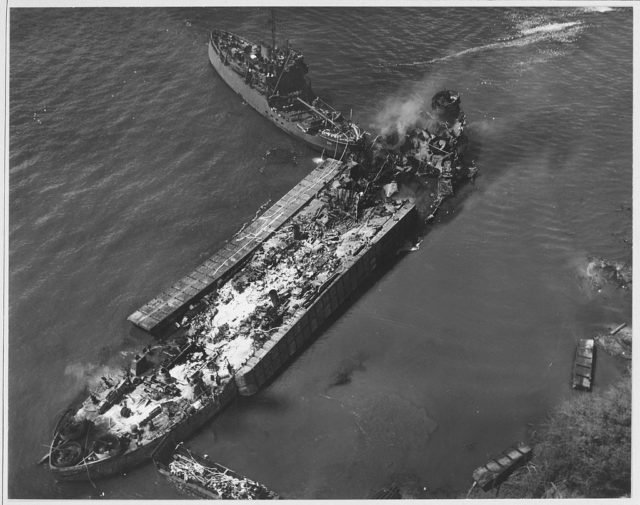
LST-353 exploded shortly after three in the afternoon, causing an incendiary chain reaction down the line of LSTs. 200 men were blown into the water in the first few minutes, in explosions powerful enough to knock vehicles on their sides. Eleven buildings on the shore were destroyed altogether and another nine, damaged.

Firefighting efforts were slow to get underway, due to the heat and the inexperience of many of the crew. Some LSTs began to move away under their own power or with the assistance of tugs, others were abandoned and left adrift and burning, before sinking in the channel.

Burning gasoline spread across the water and ignited other ships, left unharmed by the initial explosions. Fires continued to burn for the next twenty-four hours.

Casualty figures are surprisingly inexact. Most sources report 163 personnel killed in the incident and another 396, wounded. Some sources put the number of dead as high as 392.  Eleven tugboats were damaged while engaged in fire control efforts.  Six LSTs were sunk, two already carrying smaller, fully loaded Landing Craft Tanks (LCT) lashed to their decks.  Several others were heavily damaged and/or run aground.

A press blackout was ordered immediately after the incident, and military personnel were ordered not to talk. A Naval Board of Inquiry was opened the following day. The disaster at West Loch was initially believed to be caused by Japanese submarines, but the idea was dismissed due to the shallow depth of the harbor, and the presence of anti-submarine nets.

lst-480_following_west_loch_disaster-640x505
The wreckage of the LST 480 following the West Loch Disaster.

The precise cause of the accident remained elusive, as everyone near the initial explosion was killed. Army stevedores were unloading mortar ammunition at the time, using an elevator just fifteen feet from 80 drums of fuel. Some believe that a mortar round was accidentally dropped and exploded, others that fuel vapors were ignited by a cigarette or welder’s torch.

Subsequent salvage and removal efforts on the West Loch brought up the remains of a Japanese midget submarine, now believed to be the fifth such sub used in the attack of two years earlier.

Details of the West Loch disaster would remain classified until 1960, explaining why the incident is so little known, today.

1000w_q95

The last fatality from the disaster at West Loch occurred nine months later, during salvage operations for a sunken LST.

330px-Owen_F_P_Hammerberg

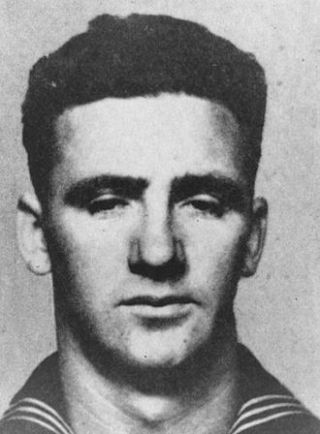
Boatswain’s Mate 2nd Class Owen Francis Patrick Hammerberg

On February 17, 1945, two divers were using jet nozzles to tunnel under a sunken LST, when the steel wreckage above them caved in. Buried alive with lifelines and air hoses hopelessly tangled with jagged pieces of steel, the pair was trapped under 40′ of water and another 20′ of mud.  There seemed no chance of survival, when fellow Navy diver Owen Francis Patrick Hammerberg went into the water.

Working in the swirling mud and pitch blackness beneath the bottom of Pearl Harbor, the diver worked desperately to wash another tunnel under the sunken LST.  Hammerberg reached the first man after hours of exhausting labor, freeing his lines and enabling the man to reach the surface.

Let Owen Hammerberg’s Medal of Honor citation, the one he would not live to read, tell what happened next.

Cmoh_army“…Venturing still farther under the buried hulk, he held tenaciously to his purpose, reaching a place immediately above the other man just as another cave-in occurred and a heavy piece of steel pinned him crosswise over his shipmate in a position which protected the man beneath from further injury while placing the full brunt of terrific pressure on himself. Although he succumbed in agony 18 hours after he had gone to the aid of his fellow divers, Hammerberg, by his cool judgment, unfaltering professional skill and consistent disregard of all personal danger in the face of tremendous odds, had contributed effectively to the saving of his 2 comrades…”.

Navy diver and Boatswain’s Mate 2nd Class Owen Francis Patrick Hammerberg was the only service member in WW2 and the last person ever, to receive the Medal of Honor as the result of heroism performed outside of combat.

If you enjoyed this “Today in History”, please feel free to re-blog, “like” & share on social media, so that others may find and enjoy it as well. Please click the “follow” button on the right, to receive email updates on new articles.  Thank you for your interest, in the history we all share.

May 15, 1718 Rapid Fire

The lightly armed merchant vessel of the 18th century was ill equipped to oppose the swarming attack of a hundred or more pirates.  Enter history’s first, machine gun.

A story comes to us from the Revolution, of a battle near Boonesborough, Kentucky. A British officer dared to poke his head out from behind a tree. A split-second later he was dead, a lead ball in his head. It was a near-miraculous shot for the day, nearly 250-yards distant from the shooter. The man with the rifle was Daniel Boone.  The weapon was his famous Kentucky long rife.

It was a good thing that the man could shoot that weapon, because it took about a minute to load, aim and fire.  The smooth-bore weapons of the age were a little quicker. A skilled shooter could could get off 3 rounds per minute, but aimed fire was all but impossible at any kind of distance.

Kentucky Rifle Vignette_6-10-13
Kentucky Long Rifle

Military tactics on land evolved toward massed firepower.  When large groups of men fired at one another, something was going to get hit.  Defending yourself at sea, was another matter.

Long before the revolt in Great Britain’s American colony, European navies abandoned oar-powered vessels in favor of sailing ships carrying tons of powerful cannon.  Not so the corsairs of the North African coast.

d6170-4
Ottoman privateer Murat Reis, the Elder


The “Barbary pirates” of the Ottoman provinces of Algeria, Tunisia & Tripolitania and the independent sultanate of Morocco favored small, fast galleys, powered by combinations of sail and oar and carrying a hundred or more fighting men armed with flintlock, axe and cutlass.

Barbary navies never formed battle fleets, and would flee at the sight of European frigates.  These people were looking for lightly armed merchantmen.  They came to take hostages for the Arab slave markets.

The Arab slave trade was never racialized in the way of trans-Atlantic, chattel slavery.  Black Africans and white Europeans alike, were fair game.  Some historians assert that as many as 17 million entered the Arab slave markets, from Western Asia, North Africa, the Horn of Africa, Southeast Africa and Europe.

It was the enslaved mercenary armies of the Ayyubid dynasty of Egypt and Syria, the Mamālīk (singular Mamlūk), who expelled the last Christian armies from the Levant in 1302, ending the era of the Crusades. For five-hundred years, elite slave armies called “Janissaries” formed the bulwark of Ottoman power from southeastern Europe to western Asia and north Africa.

Ohio State University history Professor Robert Davis estimates that Barbary corsairs captured as many as 1 – 1¼ million Europeans between the 16th and 19th centuries alone, kidnapped from seaside villages along the Mediterranean coast, England, and as far away as the Netherlands, Ireland and Iceland. Some 700 Americans were held in conditions of slavery in North Africa, between the period of the American Revolution and the War of 1812.

The lightly armed merchant vessel of the 18th century was ill equipped to oppose the swarming attack of a hundred or more pirates.  Enter history’s first machine gun.

PuckleGun
The “Puckle Gun”, patented this day in 1718

James Puckle (1667–1724) was a British inventor, barrister and author. The Puckle Gun, also called the “defence gun”, was a tripod-mounted, single-barreled flintlock fitted with a revolving cylinder.  At a time when a trained shooter could load and fire no more than three times per minute, James Puckle’s weapon was capable of  nine.

The Puckle gun was intended for naval use, to prevent the boarding of ships at sea.  There were two variations, the first intended for use against Christian adversaries.  This one fired round balls. The second version was considered to be the more lethal of the two and fired square bullets, intended for use against Muslim Turks. According to the patent, square bullets would persuade the Turks of the “benefits of Christian civilization”. The weapon could also fire shot, with each discharge containing up to sixteen musket balls.

Among investors, there was little interest in the Puckle Gun, and the weapon never gained wide acceptance. Before the era of mass production,  gunsmiths had trouble reliably producing its small, complicated parts. One newspaper quipped that the gun “only wounded those who hold shares therein”.

In time, humankind would become much more adept at killing itself. Dr. Richard Gatling invented his multi-barrel, crank fired “Gatling Gun” in 1861, writing that his creation would reduce the size of armies and so reduce the number of deaths by combat and disease. With a rate of fire of up to 900 rounds per minute in the .30 caliber model, Gatling’s gun was popular from the Great Railroad Strike of 1877 to the Anglo-Zulu war of two years later, and the “Rough Riders” assault up San Juan Hill.

American-British inventor Hiram Maxim invented the first true “machine gun” in 1884, by harnessing  the weapon’s recoil.  The Hiram gun was a favorite of colonial wars from 1886–1914, and variants entered the trenches of WW1.

It would take about a hot minute with the search engine of your choice, to realize that the practice of Muslim slavery, primarily (though not exclusively) at the expense of black Africans, continues to this day.

May 7, 1915 Lusitania

American public opinion was outraged at the loss of life in a war in which the United States was neutral. Imperial Germany, for her part, maintained that Lusitania was illegally transporting munitions intended to kill German boys on European battlefields.

By Spring of 1915, WWI had already devolved into the slugfest of trench warfare that would bleed nation states white and destroy empires. Imperial Germany had held off of unrestricted submarine warfare, believing the tactic would bring the United States into the war against them. Yet this war could not be won on the battlefield alone. They had to make it a war on commerce, to choke of their adversary’s lifeline. Besides, the German view was that ostensibly peaceful shipping was being used to ferry war supplies to the allies, which were going on to kill Germans on the battlefield.

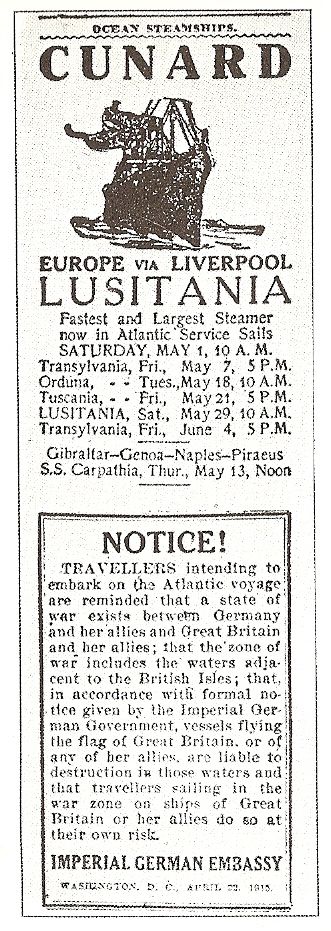
Lusitania warningGermany adopted a policy of unrestricted submarine warfare on February 18, 1915. The German embassy took out ads in American newspapers, warning that ships sailing into the war zone, did so at their own risk. That didn’t seem to bother anyone as they boarded RMS Lusitania.
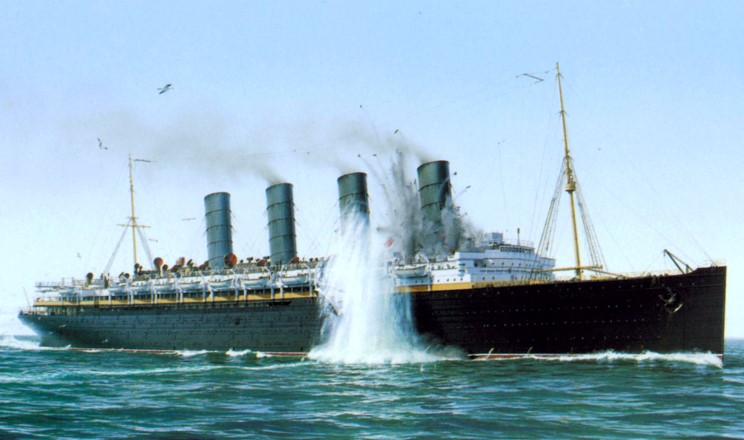
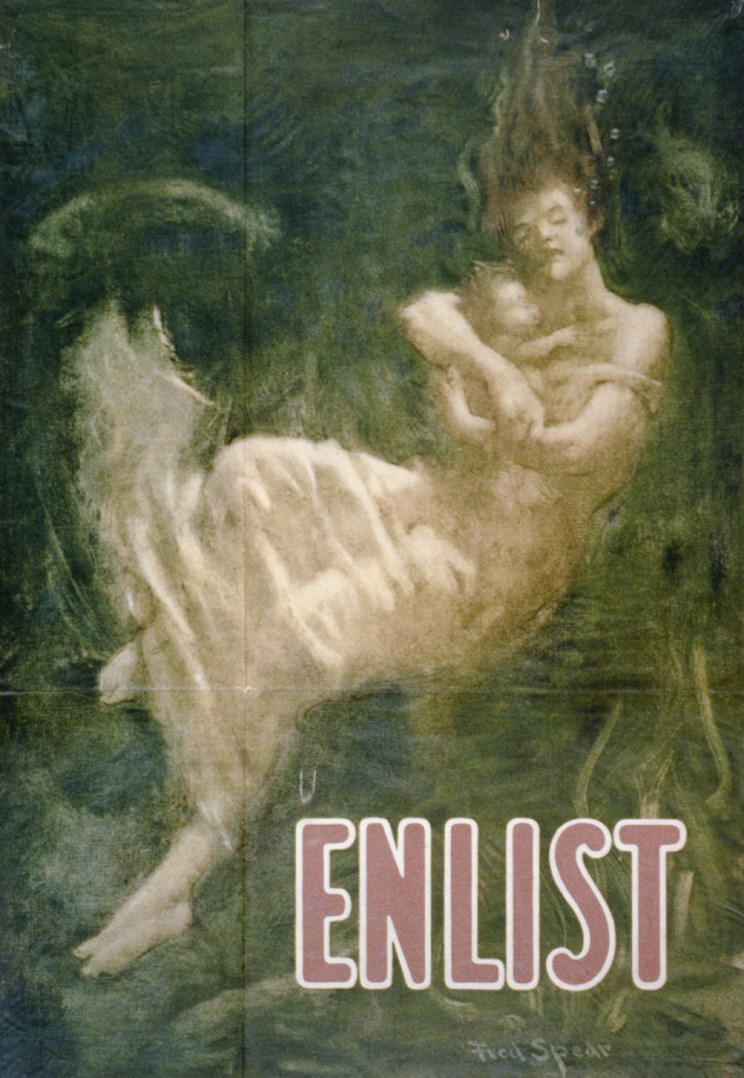
Lusitania was the largest and fastest ship afloat when she was christened in 1904. They called her the “Greyhound of the Seas”, in 1915 she could still outrun almost anything big enough to pose a threat. Lusitania left New York for her 202nd trans-Atlantic crossing on May 1, 1915, carrying 1,959 passengers and crew, 159 of whom were Americans.

All ships heading for Great Britain at this time were instructed to travel at full speed in zigzag patterns, and to be on the lookout for U-boats, but fog forced Captain William Turner to slow down as Lusitania rounded the south coast of Ireland on May 7.

The German U-boat U-20 commanded by Captain Walther Schwieger had targeted Lusitania by early afternoon.  At 1:40pm the U-boat fired a single torpedo. The weapon struck Lusitania on her starboard side. Some believe a second explosion was caused by the ignition of ammunition hidden in the cargo hold, others say that coal dust had ignited. Whatever the cause, there is near universal agreement that a second explosion rocked the ship. The damage from this second explosion was catastrophic.

13_lusitania

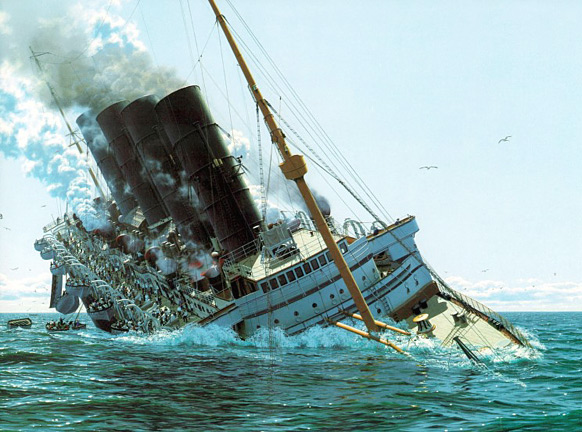
Lusitania quickly began to list, and sank in 18 minutes. There had been enough lifeboats for all the passengers, but the severe list prevented most of them from being launched. Of the 1,959 people on board, 1,198 died, including 128 Americans. 100 of the Americans, were children.

lusitania-sinking-color

American public opinion was outraged at the loss of life in a war in which the United States was neutral. Imperial Germany, for her part, maintained that Lusitania was illegally transporting munitions intended to kill German boys on European battlefields. Furthermore, the embassy pointed out that ads had been taken out in the New York Times and other newspapers, specifically warning that the liner was subject to attack.

poster_4

In what’s been called his “too proud to fight” speech three days later, President Woodrow Wilson said “The example of America must be the example not merely of peace because it will not fight, but of peace because peace is the healing and elevating influence of the world and strife is not. There is such a thing as a man being so right it does not need to convince others by force that it is right”.

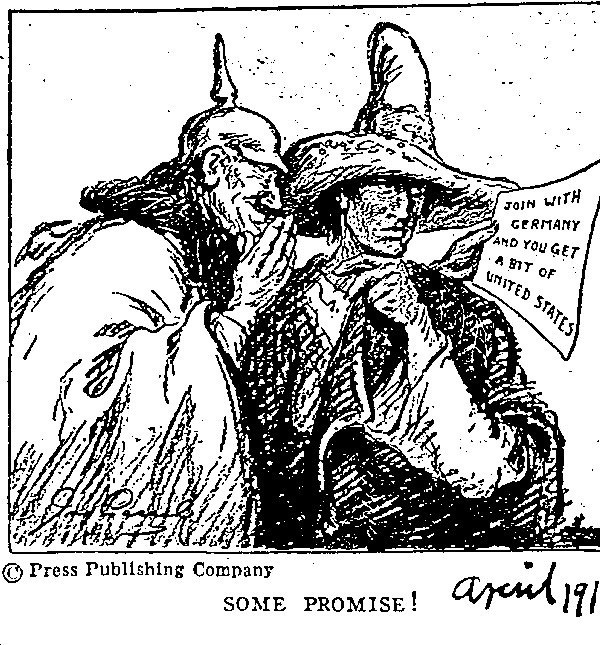
Unrestricted submarine warfare was suspended for a time, and American entry into WWI was averted. The final provocation to war came in January 1917, when the “Zimmermann Telegram” came to light. A communication from the German Foreign Minister to his ambassador in Mexico, the Zimmerman telegram proposed a military alliance between Germany and Mexico in the event of war with the United States, in exchange for “an understanding on our part that Mexico is to reconquer the lost territory in Texas, New Mexico, and Arizona”.

Zimmerman noteUnrestricted submarine warfare was resumed the same month. In February a German U-boat fired two torpedoes at the SS California off the Irish coast, killing 43 of her 205 passengers and crew. President Wilson asked for a declaration of war in a speech to a joint session of Congress on April 2. From the text of the speech, it seems the Germans were right. It was the resumption of unrestricted submarine warfare which provoked the United States to enter the war against Germany, which it did when Congress declared war on April 6.
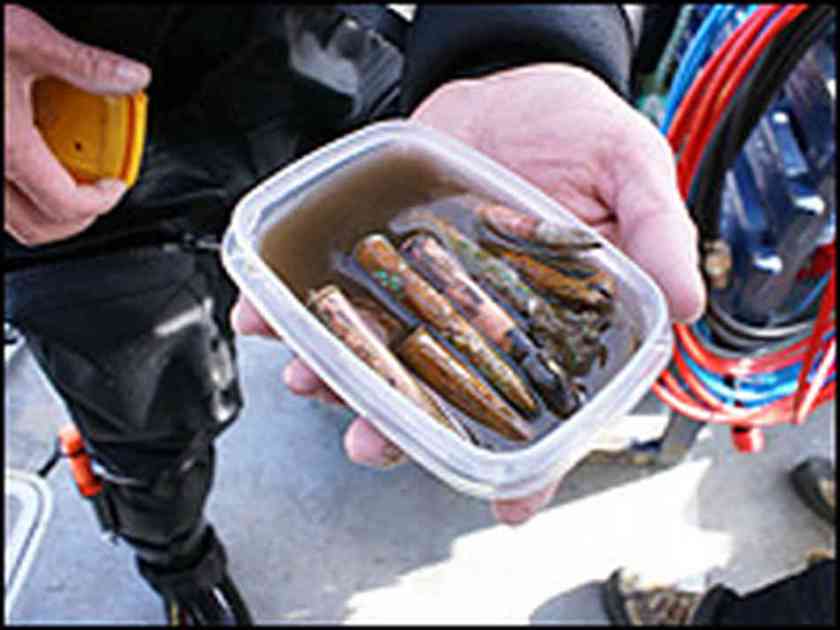
The German view that Lusitania carried contraband ammunition was vindicated as well, but at the time that was far into their future. Decades later, formerly secret British papers revealed the presence of contraband ammunition in the holds of the passenger liner. Divers explored the wreck in 2008, located under 300′ of water off the Head of Kinsale. On board, they found four million US made Remington .303 bullets, stored in unrefrigerated compartments in crates marked “butter”, “lobster” and “eggs”.

Lusitania, ammunition

A personal postscript to this story:  On several occasions, my folks hired an elderly Irish woman to babysit my brothers and me when we were kids, back in the ’60s.   As a little girl, Mrs. Crozier was living in Kinsale, back in 1915. Like the rest of her village, she ran out to the cliffs that morning to watch the great liner sink.  It was only nine miles off the coast and could be seen, clearly.  She must have thought I was a strange kid, but I couldn’t get enough of that story.

If you enjoyed this “Today in History”, please feel free to re-blog, “like” & share on social media, so that others may find and enjoy it as well. Please click the “follow” button on the right, to receive email updates on new articles.  Thank you for your interest, in the history we all share.

April 27, 1865 Sultana

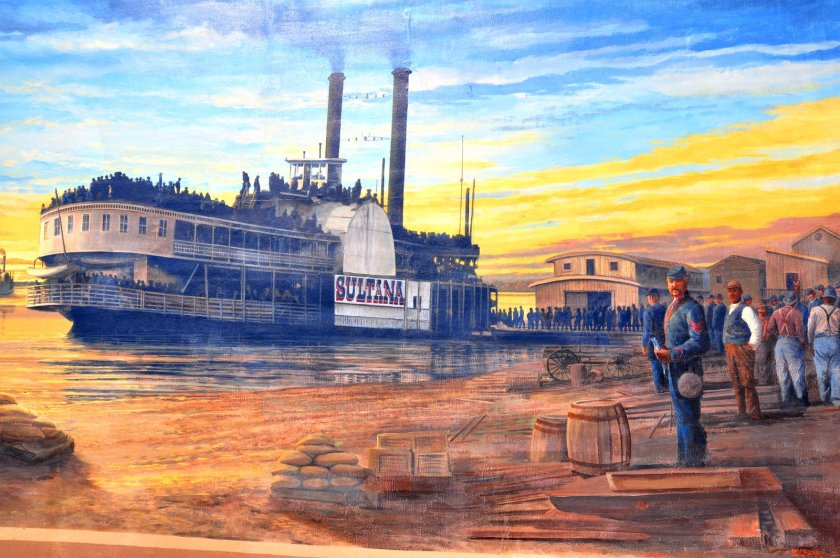
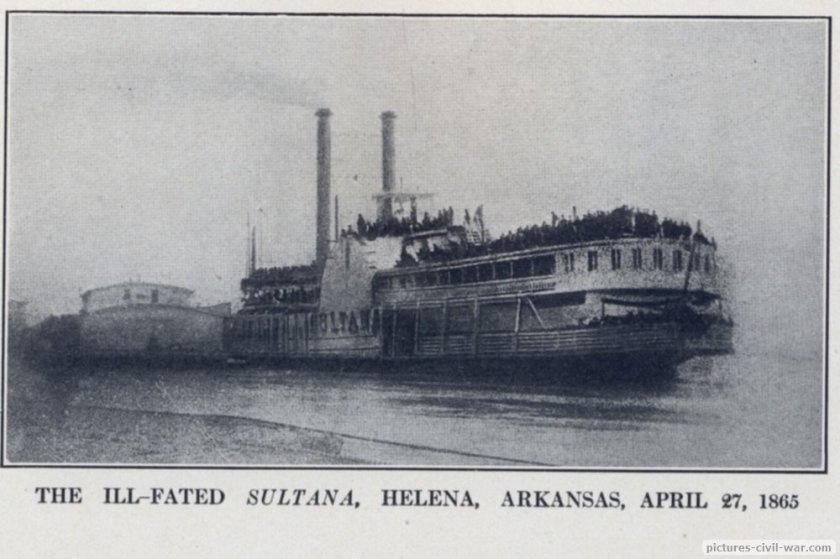
Sultana was the worst maritime disaster in United States history, though its memory was mostly swept away in the tide of events that April.  The United States Customs Service records an official count of 1,800 killed, though the true number will never be known.  Titanic went down in the North Atlantic 47 years later, taking 1,512 with her.

In April 1865, the Civil War was all but ended.  General Robert E. Lee surrendered to General Ulysses S. Grant on the 9th.  President Abraham Lincoln was assassinated five days later, and John Wilkes Booth run to ground and killed on the 26th.  Thousands of former POWs were being released from Confederate camps in Alabama and Georgia, and held in regional parole camps.

The sidewheel steamboat Sultana left New Orleans with about 100 passengers and a few head of livestock, pulling into Vicksburg Mississippi on the 21st to repair a damaged boiler and to pick up a promised load of passengers.

The mechanic wanted to cut a bulging seam out of the boiler and install a new plate, easily three day’s work.  Captain J. Cass Mason declined, for fear of losing his passengers.  He wanted the seam hammered back into place and covered with a patch, and he wanted it done in a day.

download (88)

The passengers Mason was so afraid of losing were former prisoners of the Confederacy, and Confederate parolees, returning to their homes in Kentucky and Tennessee.

The Federal government was paying $5 each to anyone bringing enlisted guys home, and $10 apiece for officers.  Lieutenant Colonel Reuben Hatch, chief quartermaster at Vicksburg and one of the sleazier characters in this story, had approached Captain Mason with a deal.  Hatch would guarantee a minimum of 1,400 passengers, and they’d both walk away with a pocketful of cash.

As it was, there were other riverboats in the vicinity.  Mason didn’t have time to worry about boiler repairs.

The decks creaked and sagged, as beams were installed to shore up the load.  Sultana backed away from the dock on April 24, with 2,427 passengers.  More than six times her legal limit of 376.

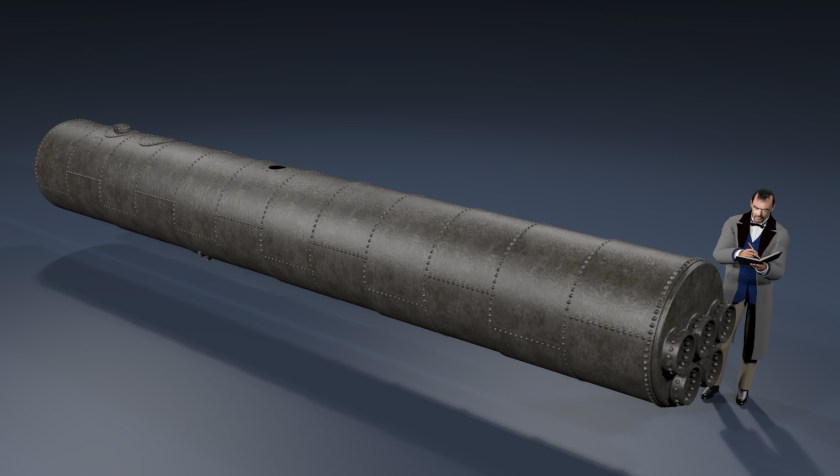
BoilerBlue
This animation gives a sense of the size, of Sultana’s boilers

Sultana spent two days traveling upstream, fighting one of the heaviest spring floods in the history of the Mississippi River.  She arrived at Memphis on the evening of the 26th, unloading 120 tons of sugar from her holds.  Already massively top heavy, the riverboat now lurched from side to side with every turn.

Sultana (1)
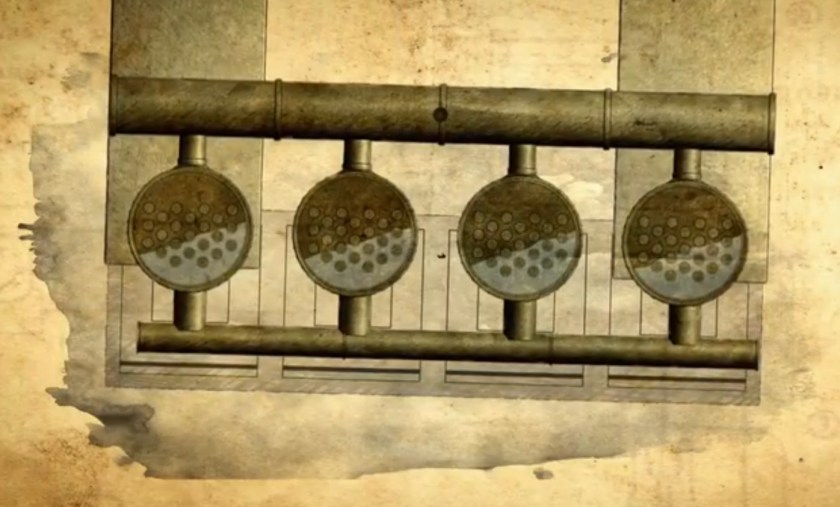
SS Sultana was equipped with four such boilers, mounted from side-to-side.  Massively top heavy, water would run from left to right as she lurched from side to side, water then flashing to steam and creating enormous surges in pressure

The crew must have exceeded allowable steam pressure, pushing all that load against the current.  Pressure varied wildly inside Sultana’s four giant boilers, as water sloshed from one to the next with every turn, boiling water flashing to superheated steam and back to water.

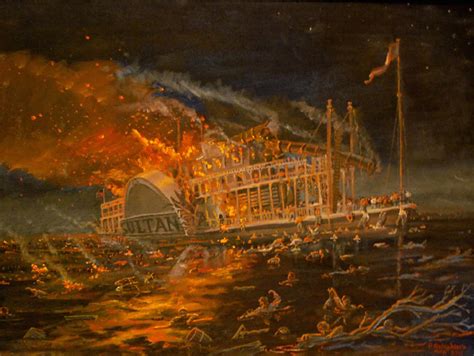
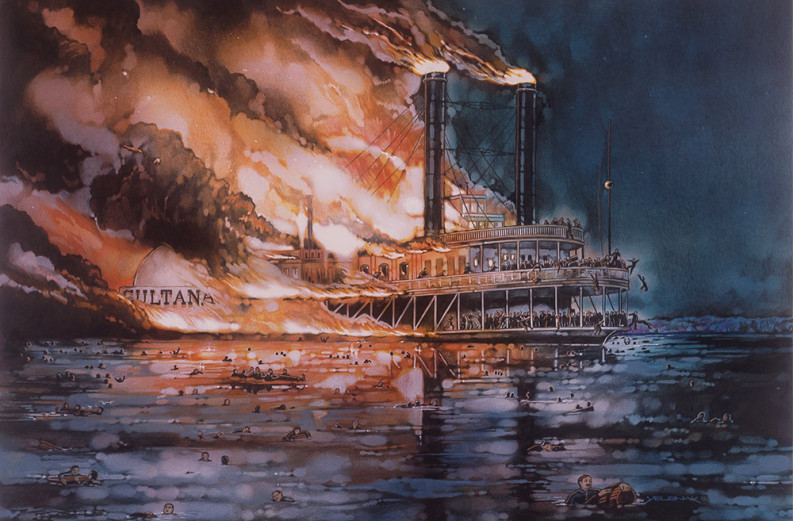
The temporary boiler patch exploded at 2:00am on April 27, detonating two more boilers a split second later.  The force of the explosion hurled hundreds into the icy black water.  The top decks soon gave way, as hundreds tumbled into the gaping maw of the fire boxes below.

download (90)

Within moments, the entire riverboat was ablaze.  Those who weren’t incinerated outright now had to take their chances in the swift moving waters of the river.  Already weakened by terms in captivity, they died by the hundreds of drowning or hypothermia.

The drifting and burnt out hulk of the Sultana sank to the bottom, seven hours later.  The steamers Silver Spray, Jenny Lind, and Pocohontas joined the rescue effort, along with the navy tinclad Essex and the sidewheel gunboat USS Tyler.  700 were plucked from the water and taken to Memphis hospitals, of whom 200 later died of burns or exposure.  Bodies would continue to wash ashore, for months.

Sultana was the worst maritime disaster in United States history, though its memory was mostly swept away in the tide of events that April.  The United States Customs Service records an official count of 1,800 killed, though the true number will never be known.  Titanic went down in the North Atlantic 47 years later, taking 1,512 with her.

download (91)

Despite the enormity of the disaster, no one was ever held accountable.  One Union officer, Captain Frederick Speed, was found guilty of grossly overcrowding the riverboat.  It was he who sent 2,100 prisoners from their parole camp into Vicksburg, but his conviction was later overturned.  It seems that higher ranking officials may have tried to make him into a scapegoat, since he never so much as laid eyes on Sultana herself.

Captain Williams, the officer who actually put all those people onboard, was a West Point graduate and regular army officer.  The army didn’t seem to want to go after one of its own.  Captain Mason and all of his officers were killed in the disaster.  Reuben Hatch, the guy who concocted the whole scheme in the first place, resigned shortly after the disaster, thereby putting himself outside the reach of a military tribunal.

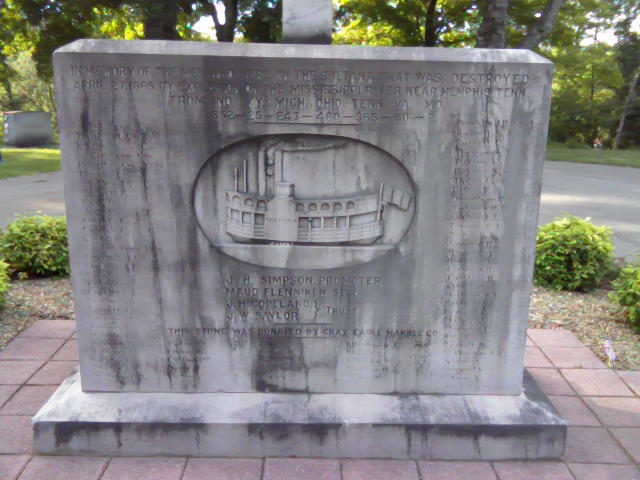
Sultana Memorial at the Mount Olive Baptist Church Cemetery in Knoxville, Tennessee in 2010
Sultana Memorial at the Mount Olive Baptist Church Cemetery in Knoxville, Tennessee, 2010

The last survivor of the Sultana disaster, Private Charles M. Eldridge of the 3rd (Confederate) Tennessee Cavalry, died at his home at the age of 96 on September 8, 1941. Three months before the Imperial Japanese attack on Pearl Harbor.

If you enjoyed this “Today in History”, please feel free to re-blog, “like” & share on social media, so that others may find and enjoy it as well. Please click the “follow” button on the right, to receive email updates on new articles.  Thank you for your interest, in the history we all share.