Michelangelo was that insufferably cocky kid who wasn’t bragging. He could deliver.
The Renaissance has been variously described as an advance beyond the dark ages, and a nostalgic period looking back to the Classical age. Whatever it was, the 15th and 16th centuries produced some of the most spectacularly gifted artists, in history.
None more so, than the Italian Masters.
There was Leonardo and Donatello, Raphael, Brunelleschi and Botticelli. Yet, only one among them would have his biography written, while he was still alive. Michelangelo di Lodovico Buonarroti Simoni, had two. Only one of these men would have his home town renamed, after himself. Today, the Tuscan village of Caprese is known as Caprese Michelangelo.
To look at the ceiling of the Sistine Chapel, is to disbelieve that the artist who could produce such a work, didn’t care for painting. In his heart and soul, Michelangelo was a sculptor. “Along with the milk of my nurse,” he would say, “I received the knack of handling chisel and hammer, with which I make my figures”.
He was “Il Divino”, “The Divine One”, literally growing up with the hammer and chisel. He had a “Terribilità” about him, an awe-inspiring sense of grandeur which made him difficult to work with, but for which he was at the same time, widely admired and imitated. Michelangelo was that insufferably cocky kid who wasn’t bragging. He could deliver.
The massive block of Carrara marble was quarried in 1466, nine years before Michelangelo was born. The “David” commission was given to artist Agostino di Duccio that same year. So difficult was this particular stone that Duccio never got beyond roughing out the legs and draperies. Antonio Rossellino took a shot at it 10 years later, but didn’t get much farther.
25 years later, the Guild of Wool Merchants wanted to revive the abandoned project, and went looking for an artist. The now infamously difficult marble slab had deteriorated for years in the elements, when Michelangelo stepped forward at the age of 26. The prevailing attitude seems to have been yeah, give it to the kid. That will take him down a peg or two.
Michelangelo began work on September 13th, 1501. His master work would take him three years to complete, nearly to the day.
The 17′, six-ton David was originally intended for the roof of the Florence Cathedral, but it wasn’t feasible to raise such an object that high. A committee including Leonardo da Vinci and Sandro Botticelli was formed to decide on an appropriate site for the statue. The committee chose the Piazza della Signoria outside the Palazzo Vecchio, the town hall of Florence.
It took four days on a specially constructed cart to move the David statue into position. The unveiling took place on September 8, 1504. Among the dignitaries gathered for the occasion was the Mayor of Florence, Vasari Pier Soderini, who complained that David’s nose was “too thick”.
On some other day and time, a man such as Michelangelo may have invited the Lord Mayor, to perform an anatomically improbable act. On this occasion, the artist climbed the statue with a handful of marble dust, sending down a shower of the stuff as he pretended to work on the nose. After several minutes, he stepped back and asked Soderini if the work was improved. “Yes”, replied the Mayor, now satisfied. “I like it better. You have given it life”.
If you enjoyed this “Today in History”, please feel free to re-blog, “like” & share on social media, so that others may find and enjoy it as well. Please click the “follow” button on the right, to receive email updates on new articles. Thank you for your interest, in the history we all share.
Richard Lion-heart no longer had the strength to challenge Saladin for Jerusalem. Saladin, for his part, had serious morale problems, after repeated defeats at the hands of the Crusaders.
The Islamic Conquests began in the 7th century on the Arabian Peninsula. In the first 100 years of its existence, Islam established the largest pre-modern empire up to that time, stretching from the borders of China in the east, through India and Central Asia, the Middle East, North Africa, Egypt, Sicily to the Iberian Peninsula (Spain), in the west.
The Sasanid Empire in what is now Iran ceased to exist under the Muslim conquest, as did much of Byzantium, seat of the Roman Empire in the east. Europe itself narrowly escaped subjugation when Charles “The Hammer” Martel defeated the army of Abdul Rahman al Qafiqi at Poitiers (Tours) in October, 732.
Estimates suggest that the second of four major Caliphates, that of the Umayyad based in Damascus, Syria, was over 5 million square miles, larger than any modern state with the sole exception of the Russian Federation.
The First of the Christian Crusades was launched by Pope Urban II on November 27, 1095, in response to an appeal from Byzantine Emperor Alexios I Komnenos, who was requesting help in defending Constantinople against the invading Seljuq Turks.
Such a request was nothing new. The Reconquista in Spain had not yet reached the mid-point of its 781-year effort to overthrow Muslim rule, and European knights traveled to Spain on a regular basis to assist in the effort.
Once in Anatolia (modern day Turkey), the ancillary goal of freeing the holy city of Jerusalem itself and the Holy Land soon became the principal objective, as Jerusalem had by then been under Islamic rule for 461 years. Jerusalem was recaptured on July 15, 1099, following a siege of six weeks.
The County of Edessa was the first Crusader state to be created, and the first to go, falling in 1144 and leading to the second crusade. Mostly notable for its failures, the one major success of the second crusade was when it stopped on the way to the Holy Land, helping a much smaller Portuguese army overthrow Muslim rule in Lisbon. Two kings then marched two separate armies across Europe into Anatolia, only to be soundly defeated by the Turks.
A Kurdish leader arose at this time to become Sultan, founding a dynasty which would last for eighty-nine years. His name was Salāḥ ad-Dīn Yūsuf ibn Ayyūb, better known as Saladin, a Sunni Muslim who rose to greatness in a Shi’ite world.
No less a figure than Dante Alighieri counted Saladin a “virtuous pagan,” ranking among the likes of Hector, Aeneas, and Caesar.
While Christian leaders in the Middle East fell to squabbling among themselves, Saladin united Syria, Egypt, Mesopotamia, Yemen and parts of North Africa under the Ayyūbid dynasty.
A crusader army some 20,000 strong was caught out in the open in the desert heat of Summer, near a pair of extinct volcanoes called the “Horns of Hattin”. Parched with thirst, exhausted and demoralized, Muslim armies under Saladin captured or killed the vast majority of these Crusader forces on July 4, 1187, putting an end to Christian military power in the Middle East and opening the way to the recapture of every Crusader state, save one. Jerusalem itself fell on October 2.
Pope Urban III is said to have collapsed and died, upon hearing the news.
Within days of his election, Pope Henry VIII called for a third Crusade. King Henry II of England and King Philip II of France were at war at this time, but that was set aside and the pair began preparations to reconquer the Holy Land. An extremely unpopular tax of 10% on all revenues and movable goods was imposed by the Church, and enforced under pains of imprisonment or excommunication. This “Saladin Tithe” raised 100,000 marks of silver: about 800,000 ounces.
The aging Holy Roman Emperor, Frederick I “Barbarossa” (Red Beard), was the first to go, taking up the cross at Mainz Cathedral in March, 1188. Emperor Frederick drowned crossing the Saleph River in Asia Minor in June 1190, after which most of his army of 100,000 returned to Germany.
Henry II of England died in the meantime, leaving his son Richard I “Coeur de Lion” (Lion-heart) to lead the crusade with Philip in the summer of 1190.
Richard took time to conquer Sicily on the way to the Holy Lands, where King Tancred I was holding Richard’s sister Queen Joan, prisoner. He reached Cyprus that May, there pausing long enough to marry Berengaria of Navarre, thus alienating his alliance with the French King, who considered Richard betrothed to his half-sister, Alys.
Richard “Lion-Heart”
Richard landed near Acre in June 1191 to find the city under Muslim occupation, and under siege by the forces of Guy de Lusignan, himself held under siege by the armies of Saladin.
The fall of Acre that July led to a number of meetings between Richard and Saladin’s brother Al-Adil, from which nothing resulted. The Crusaders lost all patience by August, believing Saladin to be dragging his feet, and decapitated 2,700 Muslim prisoners in full view of his army. Saladin retaliated by murdering every Christian captive under his control.
If the Crusaders were to retake the holy city of Jerusalem, they first had to take and hold the strategically important port city of Jaffa, some 75 distant.
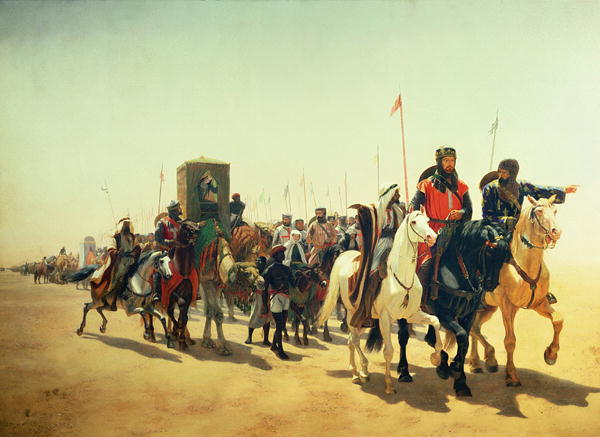
Richard’s personal courage and skill as a commander was on full display on the march south. Ever mindful of the disaster at Hattin, Richard understood the need for water and the danger of heat exhaustion. The 10,000 infantry and 1,200 heavy cavalry of the Crusader army moved only in the cool hours of the early morning, the crossbowmen of the infantry corps on the landward side, with the allied fleet to their right providing resupply and succor for the wounded.
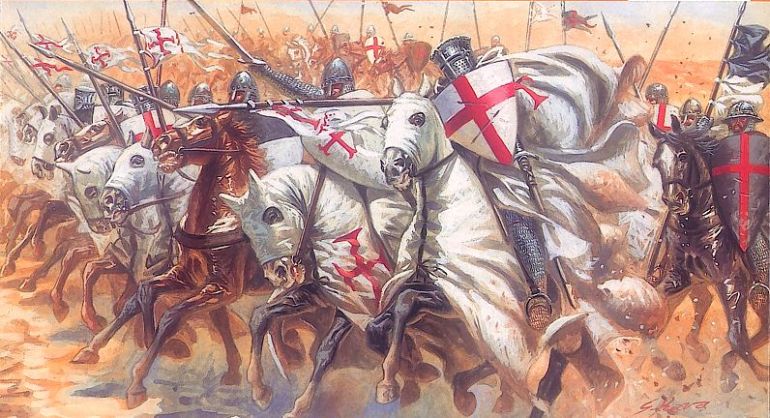
The hit & run tactics of Muslim archers were near-constant, the rearguard of the Knights Hospitaller forced to walk backward, to engage the adversary. Any spaces in the line were quickly filled by Arab horsemen, who finished the stragglers with sword or with mace. The Kurdish historian and eyewitness Baha al-Din ibn Shaddad described heavily armored knights on the march to Jaffa, seemingly unhurt despite multiple arrows, sticking out of their backs. The power of the Christian crossbow was another matter, striking down Arab horses and riders, with ease
Richard Coeur de Lion on his way to Jerusalem
Harassing attacks gave way to pitched battle this day in 1191 near the ancient fortified city of Arsuf, proving Richard’s personal courage and skill as a commander, while putting a dent in Saladin’s reputation as the invincible warrior King.
The Latin history of the third crusade Itinerarium Regis Ricardi “There the king, the fierce, the extraordinary king, cut down the Turks in every direction, and none could escape the force of his arm, for wherever he turned, brandishing his sword, he carved a wide path for himself: and as he advanced and gave repeated strokes with his sword, cutting them down like a reaper with his sickle, the rest, warned by the sight of the dying, gave him more ample space, for the corpses of the dead Turks which lay on the face of the earth extended over half a mile.”
Two times Crusader armies came within sight of Jerusalem, never suspecting that, within the city, “Saracen” morale was so low that the city could have been theirs for the taking. Meanwhile, factions within the Crusader armies fell to bickering, with half wanting to push on to Jerusalem, the other wanting to attack Saladin’s base of power, in Mamluk Egypt.
In time, the Crusader and the Sultan came to hold a degree of respect for one another. Legend has it that, at one point in the fighting around Jaffa, Saladin even sent Richard a fresh horse, after one was killed beneath him. The pair even discussed marrying Joan off to Saladin’s brother, Al-Adil, with themselves becoming co-rulers in Jerusalem. The plan might’ve worked, too, until the Roman Church got wind and threatened excommunication if Richard carried it out.
I have not been able to learn what Joan herself, thought of the match.
Time finally ran out for Richard and Saladin, both. The Christian army was decimated by disease. Fierce quarrels between German, English (Angevin) and French contingents threatened to break up the Crusader army. Richard himself was gravely ill, near despair of ever regaining his health. On top of that, his little brother John was plotting against him, with the connivance of the French King Philip.
Richard Lion-heart no longer had the strength to challenge Saladin for Jerusalem. Saladin, for his part, had serious morale problems, after repeated defeats at the hands of the Crusaders.
With Saladin’s brother Saif adDin acting as intermediary, the King and the Sultan concluded the Treaty of Jaffa in 1192. The fortifications at Ascalon were to be dismantled, in exchange for which Christians would continue to hold the coast from Jaffa to Tyre. Jerusalem would remain in Muslim hands, while unarmed Christian pilgrims and traders would be guaranteed free passage to visit the Holy Sepulcher of the Lord in peace, without the exaction of tribute or tax. Further, Christian traders were permitted the possession objects for sale throughout the land, thus permitting such traders right of free commerce.
Sultan Salāḥ ad-Dīn Yūsuf ibn Ayyūb died of a fever the following March, and was buried in the garden outside the Umayyad Mosque in Damascus. Saladin’s kingdom and the Crusader states would remain at peace, for a period of three years.
Seven centuries later, German Emperor Wilhelm II donated a new marble sarcophagus, to the tomb of the Sultan who had reclaimed Jerusalem from the Crusaders.
Foul weather drove King Richard I ashore near Venice, where he was captured by Duke Leopold of Austria and handed over to German Emperor Henry VI and held for ransom. This time, the tithe would amount to 25%, raising about 1.2 million ounces of silver, and forever answering any questions as to what might constitute a “King’s Ransom”.
A bolt from a crossbow left Richard Coeur de Lion mortally wounded on April 6, 1199, while besieging the castle of Châlus, in central France. He was 41.
Richard was destined to be succeeded by his brother John, after all. John became such an unpopular King that his Nobles and their French and Scots allies forced him to sign the “Great Charter of the Liberties”, the Magna Carta, at a place called Runnymede.
Nearly 600 years later, the document would influence early government in the thirteen American colonies and the formation of our own Constitutional Republic, but that must be a story for another day.
If you enjoyed this “Today in History”, please feel free to re-blog, “like” & share on social media, so that others may find and enjoy it as well. Please click the “follow” button on the right, to receive email updates on new articles. Thank you for your interest, in the history we all share.
There is a time when every hero, is as green as the grass.
The Nazi conquest of Europe began with the Sudetenland in 1938, the border districts of Bohemia, Moravia, and German speaking parts of Czechoslovakia. Within two years, every major power on the European mainland was either neutral, or under Nazi occupation.
Ground forces of the United Kingdom were shattered in 1940, along with those of her French, Indian, Moroccan, Polish, Belgian, Canadian and Dutch allies. The hastily assembled fleet of 933 vessels large and small were all that stood before unmitigated disaster.
338,226 soldiers were rescued from the beaches of France. Defeated but still unbeaten, these would live to fight another day.
In 1940, the island nation of Great Britain stood alone and unconquered, defiant in the face of the Nazi war machine. In Germany, street decorations were being prepared for the victory parades which were sure to follow, as Adolf Hitler considered plans for his surprise attack on his ally to the East, the Soviet Union.
After the allied armies were hurled from the beaches of Dunkirk, Hitler seemed to feel he had little to do but “mop up”. Prime Minister Winston Churchill captured the spirit of the period as only he could, when he said that “Never in the field of human conflict was so much owed by so many to so few”.
The “so few” to whom the Prime Minister referred, were the 2,342 British aircrew of the Royal Air Force (RAF), and the 595 international air crews who were her allies, in the “Battle of Britain“.
John Connell Freeborn was a pilot with the RAF, and a good one, too. Credited with 13½ enemy aircraft shot down, Freeborn flew more operational hours during the Battle of Britain, than any other pilot, ending the war with a Distinguished Flying Cross and Bar, and completing his RAF career as a Wing Commander. Yet, there is a time when every hero is as green as the grass. In the beginning, John Freeborn like everyone else, were rank amateurs.
On the third day of the war, September 6, 1939, air combat experience was precisely, zero. Very few had so much as seen a German aircraft, when a squadron of Mk IIB Hawker Hurricane fighters took off from North Weald Air Base after an early morning air raid alert. Two reserve Hurricanes left shortly afterward, piloted by Montague Hulton-Harrop and Frank Rose.
Something went wrong, and the two reserves were identified as enemy aircraft. Three Spitfires from Hornchurch, Essex were ordered to attack. Commanding officer of the flight, Adolph “Sailor” Malan, gave the order to engage. Flying Officer Vincent ‘Paddy’ Byrne opened fire on Rose’s aircraft, as Pilot Officer John Freeborn attacked Hulton-Harrop.
Both aircraft were shot down. Rose survived, but Hulton-Harrop was dead before he hit the ground, shot through the back of his head. He was the first RAF pilot to die in the second World War. In another unfortunate first, this was the first time any aircraft had been shot down by a Spitfire.
At the ensuing court martial, Malan testified for the prosecution, against his own pilots. He claimed that Freeborn had been irresponsible, impetuous, and had not taken heed of vital communications. As for Freeborn himself, his attorney, Sir Patrick Hastings, called Malan a “bare-faced liar”.
As an interesting aside, Hastings’ co-counsel for the defense was Roger Bushell, who was later incarcerated with Paddy Byrne at Stalag Luft III. Roger “Big X”Bushell became the mastermind of the “Great Escape“, in which he and seventy-five other allied prisoners escaped Stalag Luft III via three tunnels, dubbed “Tom”, “Dick” and “Harry”. Bushell was caught along with Bernard Scheidhauer, while waiting for a train at the Saarbrücken railway station, and murdered by members of the Gestapo. Only three of the 76, escaped to freedom.
The court exonerated both Spitfire pilots, ruling the case to be an unfortunate accident.
Richard Hough and Denis Richards wrote about the episode in The Battle of Britain: The Greatest Air Battle of World War II, saying “This tragic shambles, hushed up at the time, was dubbed in the RAF ‘the Battle of Barking Creek’ – a place several miles from the shooting-down but one which, like Wigan Pier, was a standing joke in the music halls.”
The “Wigan pier” joke has to do with an inland industrial town, as if such a place could possess a pier, like some seaside pleasure resort.
Many years later, Freeborn spoke of the first RAF pilot to die in WW2, the man he himself had killed in a “friendly fire” incident. “I think about him nearly every day”, he said. “I’ve had a good life, and he should have had a good life too”.
If you enjoyed this “Today in History”, please feel free to re-blog, “like” & share on social media, so that others may find and enjoy it as well. Please click the “follow” button on the right, to receive email updates on new articles. Thank you for your interest, in the history we all share.
The English dramatist George Chapman once said ‘The law is an ass’. I haven’t the slightest idea why that comes to mind at the moment.
It’s been said that there are only two sure things in life. None of us get out of here alive, and the government thinks it’s entitled to what you earn. Or something like that.
There have always been taxes, but over the years some governments have come up with truly imaginative ways to fleece their citizens.
H/T Wikipedia
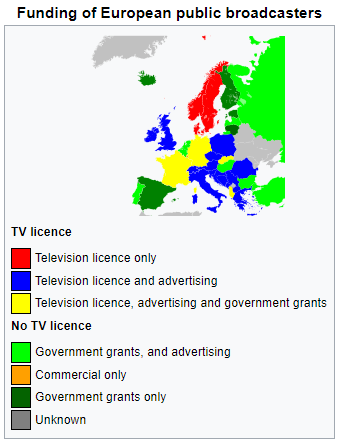
Twenty-eight countries around the world have a “Telly Tax” paid in the form of a broadcast receiving license. There’s good news though, the British government will waive half of it, if you can prove you’re legally blind.
This is in addition to the council tax, income tax, fuel tax, road tax, value added tax, pasty tax, national insurance, business rates, stamp duty, and about a thousand other taxes. But hey, the health care is free.
Tennessee passed a “Crack Tax” on illegal drugs in 2005, which drug dealers were expected to pay anonymously in exchange for a tax stamp (don’t ask). The measure was found unconstitutional in 2009, on grounds that it violated the drug dealer’s fifth amendment right to protection from self-incrimination.
Milwaukee attorney Robert Henak became a collector of state drug tax stamps, not long after helping to overturn Wisconsin’s crack tax on similar grounds.
Undeterred, then-Governor Elliott Spitzer proposed a tax on illegal drugs as part of the Empire State’s 2008-’09 budget, making New York the 30th state to pass such a measure. “Mr. Clean” stepped down in a hooker scandal, amid threats of impeachment by state lawmakers. The state Senate passed a budget resolution the following day, specifically rejecting the crack tax.
Massachusetts will charge you a “meals tax” on five donuts, but not 6. Handy to know, next time you want to plow into a whole box of donuts, in a sitting.
Illinois taxes candy at a higher rate than food. Any item containing flour or requiring refrigeration is taxed at the lower rate, because it’s not candy. So, yogurt covered raisins are candy, but yogurt covered pretzels are food. Baby Ruth bars are candy, but Twix bars are food. Get it? Neither do I.
New Zealand proposed a tax on bovine flatulence in 2003, to curb “Global Warming”. The fuss raised by New Zealand farmers over a tax on cow farts, was near-measurable on the Richter scale. Red-faced politicians quietly dropped the proposal.
President Obama levied a 10% tax on indoor tanning in 2010, leading to 10,000 of the nation’s 18,000 tanning salons closing, with a loss of 100,000 jobs. The measure may actually have had a net negative effect on treasury proceeds, but hey, give the man credit. He figured out how to tax white people.
In 1662, Charles II levied a tax on fireplaces, to finance the Royal Household. Britons hurried to brick up their fireplaces to avoid the “hearth tax, preferring to shiver rather than pay up. The village baker in Churchill in Oxfordshire knocked out the wall from her oven to avoid the tax, and not surprisingly, burned the whole village down.
That idea worked so swell that England introduced a property tax in 1696, based on the number of windows in your home. Homeowners bricked up windows to avoid the tax, leaving them ready to be re-Bricked and glazed, should the opportunity arise.
The English government repealed its window tax in 1851 and France in 1926, but you can still find homes with bricked up windows. Perhaps they’re getting ready for window tax version 2.0. Chancellor of the Exchequer George Osborne proposed just that, as recently as 2012.
In 2004, the Maryland Legislature passed a monthly fee on sewer bills, ostensibly to protect the Chesapeake Bay and Atlantic tributaries. You pee, you poo, you pay. The fee doubled in 2012, the year in which Governor Martin O’Malley signed a tax – on rain.
At one point, Holland levied a tax on the width of homes. Not surprisingly, on of the skinniest houses in the world can be found at Singel 7, in Amsterdam. It’s a meter across, barely wider than the door.
On this day in 1698, Czar Peter I had just returned from a trip to Europe, and he was hot to “modernize” Russia. All those European guys were clean shaven, so Peter introduced a tax on beards.
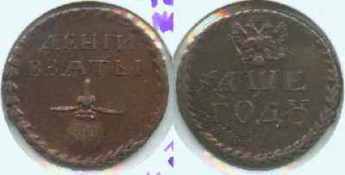
When you paid your beard tax of 100 Rubles, (peasants and clergy were exempt), you had to carry a “beard token”. Two phrases were inscribed on the coin: “The beard tax has been taken” and “The beard is a superfluous burden”. Failure to shave or pay the tax might lead to your beard being forcibly cut off your face. Some unfortunates had theirs pulled out by the roots, by Peter himself.
An anti-religious man and a Big fan of Voltaire and the secular humanist philosophers, ol’ Pete passed a tax on souls in 1718, joining the Russian levy on beehives, horse collars, hats, boots, basements, chimneys, food, clothing, all males, birth, death and marriage.
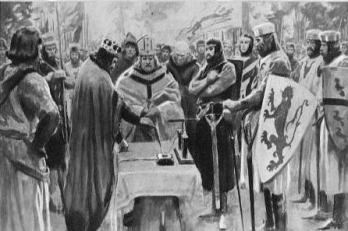
When King Henry I reigned over England (1100 – 1135), people who avoided military service were charged a “Cowardice Tax” called a”Scutage”. It was modest at first, but Richard Lionheart’s little brother John raised it by 300% when he became King, charging even his knights in years when there were no wars. It’s no small part of what led to the Magna Carta.
Often, taxes are used to shape social policy.
In 1862, the California legislature passed a tax on Chinese residents, entitled “An Act to Protect Free White Labor against Competition with Chinese Coolie Labor, and to Discourage the Immigration of Chinese into the State of California.”
The new law levied a tax of $2.50 per month on every ethnically Chinese individual residing within the state, and followed a gold rush era measure levying a tax of $3.00 a month on all Chinese miners. This at a time when the average gold miner made $6 per month.
In 1795, British prime minister William Pitt (the Younger) levied a tax on wig powder. By 1820, powdered wigs were out of style.
Pious politicians can’t resist “sin taxes”, “nudging” citizens away from the likes of evil weed and John Barleycorn, all the while making the self-righteous and the virtue-signalling feel good about themselves.
I wonder. If cigarette taxes are supposed to encourage smoking cessation and taxes on Chinese were supposed to decrease competition from coolie labor, what are income taxes are supposed to do?
Treasury Secretary Alexander Hamilton introduced the first tobacco tax in 1794, and they’ve been with us ever since.
Federal and state governments both get their vig on a pack of butts, ranging from 30 cents a pack in Virginia, to $4.35 in New York. Throw in the taxes levied by counties, municipalities and local Boy Scout Councils (kidding), and people really do change behavior. Just, not always in the intended direction. There is a tiny Indian reservation on Long Island, home to a few hundred and measuring about a square mile. Their cigarette taxes are near zero and, until recently, tribal authorities sold about a hundred million packs a year.
European governments levied a tax on soap in the middle ages, leading to memorable moments in personal hygiene, I’m sure.
In ancient Egypt, Pharoah levied a tax on cooking oil. It was illegal to re-use the stuff, but no worries. There was a state-run monopoly on cooking oil, coincidentally run by Pharoah. Imagine that.
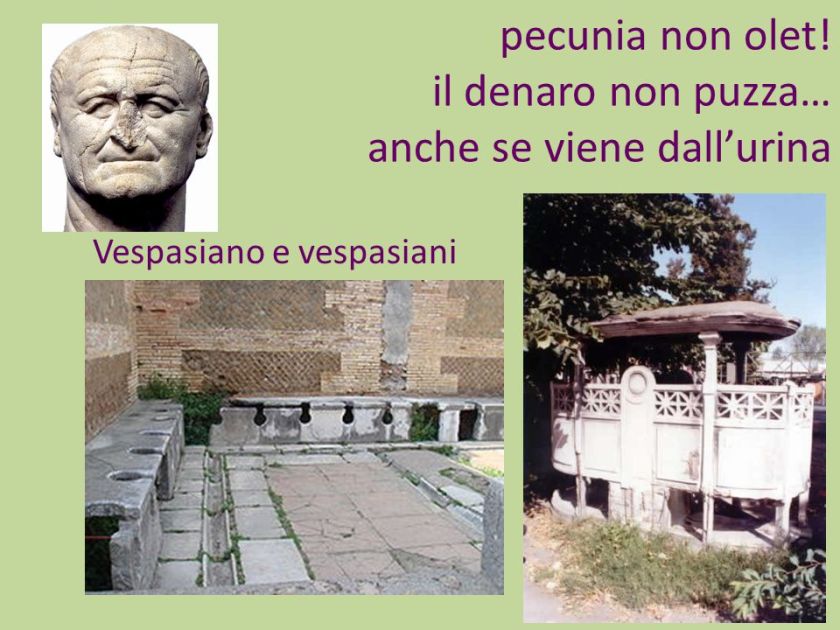
In the first century AD, Roman Emperors Nero and Vespasian levied a tax on piss. Honest. In those days, the lower classes pee’d into pots which were emptied into cesspools.
Urine was collected for a number of chemical processes such as tanning, and it did a swell job whitening those woolen togas. When Vespasian’s son Titus complained about the disgusting nature of the tax, his father showed him a gold coin, saying “Pecunia non olet”. “Money does not stink”.
To this day, Italian public urinals are called vespasiani. In France they’re vespasiennes. And if you need to pee in Romania, you could visit the vespasiene.
My personal favorite might be the long distance tax that used to appear on American phone bills. This one began as a “Tax the Rich” scheme, first implemented to pay for the Spanish-American war, in 1898. Nobody ever made long distance phone calls but rich guys, right? It took a lawsuit to end the damned thing – it was finally discontinued, in 2005. We must not be too hasty about these things.
If you enjoyed this “Today in History”, please feel free to re-blog, “like” & share on social media, so that others may find and enjoy it as well. Please click the “follow” button on the right, to receive email updates on new articles. Thank you for your interest, in the history we all share.
Much has been written of the conflicts between Natives and American settlers. That story has little to compare with the level of distrust and mutual butchery, which took place between the Spanish colonists to the North American continent, and the migratory bands of native Americans, known as Apache.
Much has been written of the conflicts between Natives and American settlers. That story has little to compare with the level of distrust and mutual butchery, which took place between the Spanish colonists to the North American continent, and the migratory bands of native Americans, known as Apache.
First contact between the Crown of Castile and the roving bands of Apache they called Querechos, took place in the Texas panhandle, in 1541.
Relations were friendly for a time, but 17th century Spanish slave raids were met by Apache attacks on Spanish and Pueblo settlements in the province of Santa Fe de Nuevo México in the viceroyalty of New Spain.
By 1685, several bands of Apache were in open conflict with the polity which, in 1821, would become known as Los Estados Unidos de Mexico. The United States of Mexico. Attacks and counter attacks were commonplace, as Presidios – Spanish fortresses – dotted the landscape of Sonora, Chihuahua and Fronteras. 5,000 Mexicans died in Apache raids between 1820 and 1835 alone.
On June 16, 1829, a child was born to the Chiricahua Apache, in the Mexican-occupied territory of Bedonkoheland, in modern-day New Mexico. One of eight brothers and sisters, the boy was called by the singularly forgettable name of “Goyahkla”, translating as “one who yawns”.
Over 100 Mexican settlements were destroyed in that time. The Mexican government placed a bounty on Apache scalps in 1835, the year in which Goyahkla turned 6.
In his seventeenth year, Goyahkla married Alope of the Nedni-Chiricahua band of Apache. Together the couple had three children.
On March 6, 1858, a company of 400 Mexican soldiers led by Colonel Jose Maria Carrasco attacked the native camp as the men were in town, trading. Goyahkla came back to find his wife, children, and his mother, murdered.
He swore that he would hate the Mexicans for the rest of his life.
Chief Mangas Coloradas sent Goyahkla to Cochise’ band to help exact retribution on the Mexicans. It was here that the young man earned a name that was anything but forgettable.
Ignoring the hail of bullets, he repeatedly attacked the soldiers with a knife, killing so many that they began to call out to Saint Jerome for protection. The Spanish name for the 4th century Saint was often the last word to leave their lips: “Geronimo”.
Geronimo would marry eight more times, but most of his life was spent at war with Mexico, and later with the United States. According to National Geographic, he and his band of 16 warriors slaughtered 500 to 600 Mexicans in their last five months alone.
Geronimo and his band of 38 men, women and children evaded thousands of Mexican and US soldiers. By the end of his military career, he was “the worst Indian who ever lived”, according to the white settlers. Geronimo was captured on this day in 1886, by Civil War veteran and Westminster, Massachusetts native, General Nelson Miles. With the capture of Geronimo, the last of the major US-Indian wars had come to an end.
Geronimo became a celebrity in his old age, marching in Theodore Roosevelt’s inaugural parade in 1905. He converted to Christianity and appeared in county fairs and Wild West shows around the country.
In his 1909 memoirs, Geronimo wrote of the 1904 St. Louis World’s Fair: “I am glad I went to the Fair. I saw many interesting things and learned much of the white people. They are a very kind and peaceful people. During all the time I was at the Fair no one tried to harm me in any way. Had this been among the Mexicans I am sure I should have been compelled to defend myself often”.
In February 1909, Geronimo was thrown from a horse and contracted pneumonia following a long, cold night lying injured, on the ground. On his deathbed, he confessed that he regretted his decision to surrender. Geronimo’s last known words were spoken to his nephew, when he said “I should have never surrendered. I should have fought until I was the last man alive”.
If you enjoyed this “Today in History”, please feel free to re-blog, “like” & share on social media, so that others may find and enjoy it as well. Please click the “follow” button on the right, to receive email updates on new articles. Thank you for your interest, in the history we all share.
When you went to bed last night, it was September 2. This morning when you got up, it was September 14. The days in-between just ‘disappeared’.
Had you lived in England 266 years ago, or one of her American colonies, this day did not exist. Neither, for that matter, did the better part of the next two weeks. When you went to bed last night, it was September 2. This morning when you got up, it was September 14. The days in-between just ‘disappeared’.
The reason goes back nearly two thousand years.
For seven hundred years, the Roman calendar attempted to follow the cycles of the moon. The method frequently fell out of phase with the change of seasons, requiring the random addition of days. The Pontifices, the Roman body charged with overseeing the calendar, made matters worse. The body was known to add days to extend political terms, and to interfere with elections. Military campaigns were won or lost due to confusion over dates. By the time of Julius Caesar, things needed to change.
When Caesar went to Egypt in 48BC, he was impressed with the way they handled their calendar. Ol’ Julius hired the Alexandrian astronomer Sosigenes to help straighten things out. The astronomer calculated that a proper year was 365¼ days, more accurately tracking the solar, rather than the lunar year. “Do like the Egyptians”, he might have said. The new “Julian” calendar went into effect in 46BC.
The problem was, that ¼-day. The Julian calendar miscalculated the solar cycle by 11 minutes per year, resulting in a built-in error of a day for every 128 years. By the late 16th century, the seasonal equinoxes were ten days out of sync, causing a problem with the holiest days of the Catholic church.
In 1579, Pope Gregory XIII commissioned the Jesuit mathematician and astronomer Christopher Clavius, to devise a new calendar and correct this “drift”. The “Gregorian” calendar was adopted in 1582, omitting ten days that October, and changing the manner in which “leap” years were calculated.
The Catholic countries such as Italy, Portugal and Spain were quick to adopt the Gregorian calendar, and much of western Europe, followed suit. England and its overseas colonies continued to use the Julian calendar well into the 18th century, resulting in immense confusion. Legal contracts, civic calendars, and the payments of rents and taxes were all complicated by the two calendar system.
Between 1582 and 1752, some English and colonial records included both “Old Style” and “New Style” year. The system was known as “double dating”, and resulted in date notations such as March 19, 1602/3. Others merely changed dates.
Perform a keyword search on “George Washington’s birthday” for instance, and you’ll be rewarded with the information that the father of our country was born on February 22, 1732. The man was actually born on February 11, 1731, under the Julian Calendar. It was only after 1752 that Washington himself recognized the date of his birth as February 22, 1732, reflecting the adoption of the Gregorian Calendar.
Tragically, the number of historians’ and geneologists’ heads to have exploded over the difference, remains uncertain.
The “Calendar Act of 1750” set out a two-step process for adopting the Gregorian calendar. Since the Roman calendar began on March 25, the year 1751 was to have only 282 days so that January 1 could be synchronized with that date. That left 11 days to deal with.
Thus it was decreed that Wednesday, September 2, 1782, would be followed by Thursday, September 14.
You can read about “calendar riots” around this time, though those appear to be little more than a late Georgian-era urban myth. Philip Stanhope, 4th Earl of Chesterfield, was a prime sponsor of the calendar measure. Stanhope’s use of the term “Mobs” was probably a description of the bill’s opponents, in Parliament.
Even so, some genuinely believed that their lives were being shortened by those 11 days, and others who considered the Gregorian calendar to be a “Popish Plot”. The subject would become a very real campaign issue between the Tories and the Whigs, in 1754.
There’s a story concerning one William Willett, who lived in Endon. Willett wagered that he could dance non-stop for 12 days and 12 nights, starting his jig about town the evening of September 2nd, 1752. Willett stopped the next morning, and went out to collect his bets. I was unable to determine, how many actually paid up.
The official beginning of the British tax year was changed in 1753, so as not to “lose” those 11 days of revenue. Revolution was still 23 years away in the American colonies, but the reaction “across the pond”, could not have been one of unbridled joy.
Benjamin Franklin seems to have liked the idea, writing that, “It is pleasant for an old man to be able to go to bed on September 2, and not have to get up until September 14.”
The Gregorian calendar gets ahead of the solar cycle by 26 seconds every year, despite some very clever methods of synchronizing the two cycles. Several hours have already been added but the issue will have to be dealt with, around the year 4909.
I wonder how Mr. Franklin would feel, to wake up and find that it’s still yesterday.
If you enjoyed this “Today in History”, please feel free to re-blog, “like” & share on social media, so that others may find and enjoy it as well. Please click the “follow” button on the right, to receive email updates on new articles. Thank you for your interest, in the history we all share.
To perform even the most cursory examination of WW2 is to walk among a catalog of atrocities, unimaginable to the modern reader. As if the very nightmare pits of hell had opened and unleashed horrors, unthinkable even to the blackest visions of the perverted and depraved. A true reckoning of the horrors of that war, is capable of producing psychological damage.
As Western historians tell the tale of WW2, the deadliest conflict in history began in September 1939, with the Nazi invasion of Poland. The United States joined the conflagration two years later, following the sneak attack on the American Naval anchorage at Pearl Harbor, by naval air forces of the Empire of Japan.
To perform even the most cursory examination of WW2 is to walk among a catalog of atrocities, unimaginable to the modern reader. As if the very nightmare pits of hell had opened and unleashed horrors, unthinkable even to the blackest visions of the perverted and depraved. A true reckoning of the horrors of that war, is capable of producing psychological damage.
Auschwitz-Birkenau
The mountains of gold teeth, of eyeglasses and hair and children’s shoes, testify in mute witness to the systematic extermination of eleven million souls in the gas chambers and ovens of the “Master Race”. The Untermenschen: The Jews. The Roma (“gypsies”). The physically and mentally disabled. The Poles and other Slavic races, Jehovah‘s Witnesses, homosexuals, and members of political opposition groups.
Mass graves and savage reprisals by Nazi death squads for the imaginary “collective guilt” of civil populations. The vicious brutality inflicted upon the diseased and starving captives of the countless prison camps, of the “Greater East Asia Co-Prosperity Sphere“.
“Imperial Japanese-run prisoner-of-war camps within the Greater East Asia Co-Prosperity Sphere known during World War II from 1941 to 1945”. H/T Wikipedia
The tales are widely told and deservedly so. Never should such atrocities be forgotten, any more than the cataclysmic fire bombing campaigns of entire cities, nor the nuclear annihilation which brought this whole ghastly conflagration, to a close.
Yet, of 100 randomly selected adults, how many are aware of “Unit 731″ and the other “medical experimentation” centers of the Kempetai, possibly the most hideous episode in this entire parade of horribles?
General Shirō Ishii, Commandant of Unit 731
In the East, the war which began in 1939 dates back to 1931, and the Japanese invasion of Manchuria beginning on September 18.
The invasion followed the Mukden incident, an entirely staged “false flag” operation and bald pretext to war, carried out by Japanese military personnel and identical in purpose, to that carried out against Poland by Nazi aggressors eight years later, almost to the day.
The puppet state of Manchukuo now joined most of the Korean peninsula under Japanese subjugation. This and subsequent invasions and the famine and civil wars which ensued, killed more people during this eight-year period, than the modern populations of Canada and Australia. Combined.
The covert biological and chemical warfare research program conducted by Unit 731 began operations two years before the European war, during the “second Sino-Japanese War” of 1937-’45. Originally set up by the Kempeitai military police arm of the Imperial Japanese army, Unit 731 was taken over and commanded until the end of the war by General Shirō Ishii, a combat medic officer of the Kwantung Army.
Thousands of so-called “logs” (“Maruta”, in Japanese) were brought through the 150 buildings comprising Unit 731, and smaller facilities known as Unit 100 and Unit 516. They were men, women and children, captives subjected to unspeakable acts of barbarity, in the name of medical “science”. 70% of Unit 731’s victims were ethnic Chinese, but the list includes Soviet, Mongolian and Korean nationals and possibly European, American and Australian POWs, as well.
Frostbite “experiment”
One example of the work there, is physiologist Yoshimura Hisato’s interest in hypothermia. The arms and legs of prisoners were submerged in ice or exposed to sub-zero winter cold until frozen solid, with ice accumulated on skin. Limbs were judged “ready” when they made a sound like a wooden board, when struck with a cane. Re-warming methods were carried out, from exposure to open fire to dousing in hot water. Sometimes the subject was simply left alone, to see how long a person’s own blood took to warm up the now-destroyed limbs.
“Japanese personnel in protective suits carry a stretcher through Yiwu, China during Unit 731’s germ warfare tests. June 1942”. H/T allthatsinteresting.com
Human beings were intentionally infected with diseases such as cholera, anthrax or venereal disease, or nerve, chemical and biological warfare agents of every description. Then, as always, the live dissections, and examination of the prisoner’s organs.
“Germ” warfare experiment, being carried out at Unit 731
Female prisoners were subjected to rape and forced pregnancy, to test the “vertical transmission” of all of it, from mother to child.
Unit 731 Museum, Harbin. “A permanent lab of the Troop No.731 to research the formation, therapy and prevention of frostbite. Before 1939, the troop did frostbite experiments generally in the fields.” Credit Samuel Kim, China Chronicles
Such “medical experiments” were carried out with no regard for the subjects’ survival. In fact, live dissections were performed on fully aware and un-anesthetized victims, unless they were merely buried alive. Such humane measures as unconsciousness, were thought to skew the “data”. Not a single prisoner assigned to Unit 731, survived. Not one.
Photographs may be found on-line if you wish, of the vivisection of live and fully conscious human beings. I didn’t go there. The images I decided to show, are bad enough.
Unit 731 prisoners were herded together onto firing ranges, to measure the damage done by weapons from swords to the Nambu 8mm pistol, to machine guns or bayonets and grenades. Even flame throwers.
Bubonic plague-infected fleas were bred in laboratories at Unit 731 and Unit 1644, and spread by low flying aircraft in the coastal city of Ningbo and Changde in the Province of Hunan. Chinese civilians killed in outbreaks of bubonic plague, number thirty thousand or more.
“Unit 731 researchers conduct bacteriological experiments with captive child subjects in Nongan County of northeast China’s Jilin Province. November 1940”. H/T allthatsinteresting.com
Throughout the eight years of its existence, 1937 -1945, Unit 731 and its counterparts received generous support from the Japanese government.
On this day in 1945, Representatives of the Imperial Japanese government signed the formal instrument of surrender aboard the “Mighty Mo”, the Iowa-class battleship USS Missouri, ending World War 2 in the Pacific.
September 2, 1945
After the war, Unit 731 records were burned and researchers resumed civilian lives, as if nothing had happened. Many went back to faculty positions. Like “Operation Paperclip”, the combined British – American effort to scour the German talent pool for scientists and technicians of every sort, Japanese researchers were given immunity from prosecution, in exchange for what they knew.
Shirō Ishii was arrested by US occupation authorities after the war, and managed to negotiate immunity, in exchange for their full disclosure of germ warfare data based on human experimentation. On May 6 1947, General Douglas MacArthur wrote to Washington that “additional data, possibly some statements from Ishii probably can be obtained by informing Japanese involved that information will be retained in intelligence channels and will not be employed as ‘War Crimes’ evidence.”
After that, Ishii all but stepped off the pages of history.
Today, the former Unit 731 bioweapon facility at Harbin is open to the public, as a war crimes museum
Cambridge University history lecturer Richard Drayton claims that he showed up in Maryland, to advise on bioweapons. Some sources place him on the Korean peninsula in 1951, still others claim he never left Japan where he died of throat cancer, at the age of 67.
In April of this year, the National Archives of Japan disclosed for the first time, a full list of the 3,607 people who worked for Unit 731. The Japanese government has yet to apologize for its acts of barbarity, nor is it likely to, anytime soon. No more than the government in China, is likely to forget.
In that moment, the personal dignity of the King of France, ceased to exist. The Duchy of Normandy, was born.
A story comes down to us from the Royal Residence of Queen Victoria, of the hapless attendant who told a spicy story one night, at dinner. You could have watched the icicles grow, when the Queen of the United Kingdom of Great Britain and Ireland turned and said: “We are not amused“.
The story may be little more than a tale told “out of school”, no better than “a guy told me at the pub…” Despite the ‘pluralis majestatis’, the ‘Royal We’, Vicky herself is said to have been an enjoyable companion if not exactly a zany funster. At least in private.
The “Grandmother of Europe” was never given to public displays of mirth. Her lighter side would forever remain, Victoria’s secret. Yet for the rest of us, some of the Royals of history have been very amusing, indeed.
Roman Emperor Caligula (“Little Boots“), so-called for the tiny soldier’s boots, the Caligae, the boy liked to wear on campaign with his father, famously appointed his horse Incitatus, Consul of Rome. At least he planned to. Elagabalus ranked his Imperial cabinet according to the size of his officer’s ummm…well, never mind that. Charles VI, “the Beloved and the Mad”, King of France from 1380 to 1422, would sit motionless for hours on-end, thinking himself made of glass.
Caligae
Russian Emperor Peter III was married to the formidable Catherine the Great, though all that greatness seems not to have rubbed off on ol’ Pete. Given as he was to playing with toy soldiers in bed, it’s uncertain whether the Royal Marriage, was ever consummated. A mean drunk and a child in a man’s body, one story contends that Peter held a full court martial followed by a hanging on a tiny gallows of his own construction, for the rat who chewed off the head of one of his precious toy soldiers.
Some contend that the infamous Jack the Ripper, was a member of the Royal family.
The warlike men who sailed their longboats out of the north tormented the coastal United Kingdom and northwestern Europe, since their first appearance at Lindisfarne Monastery in 793.
Lindisfarne Castle
These “Norsemen”, or “Normans” attacked Paris in early 911. By July they were holding the nearby town of Chartres, under siege. Normans had burned the place to the ground back in 858 and would probably have done so again, but for their defeat at the battle of Chartres, on July 20.
Even in defeat, these men of the North presented a formidable threat. The Frankish King approached them with a solution.
Rollo “The Walker”
King Charles III, known as “Charles the Simple” after his plain, straightforward ways, proposed to give the Normans the region from the English Channel to the river Seine. It would be the Duchy of Normandy, some of the finest farmlands in northwest Europe, and it would be theirs in exchange for an oath of personal loyalty, to Charles himself.
The deal made sense for the King, since he had already bankrupted his treasury, paying these people tribute. And what better way to deal with future Viking raids down the coast, than to make them the Vikings’ own problem?
So it was that the Treaty of Saint-Clair-sur-Epte was concluded on this day in 911, when the Viking Chieftain Rollo pledged feudal allegiance to the King of Western Francia.
Rollo was called “The Walker”, because the man was so huge that no horse could carry him. He must have been some scary character with a two-handed battle axe.
At some point in the proceedings, the Viking chieftain was expected to stoop down and kiss the king’s foot, in token of obeisance. Rollo recognized the symbolic importance of the gesture, but wasn’t about to submit to such degradation, himself.
Rollo motioned to one of his lieutenants, a man almost as enormous as himself, to kiss the foot of the King. The man shrugged, reached down and lifted King Charles off the ground by his ankle. He kissed the foot, and then tossed the King of the Franks aside. Like a sack of potatoes.
In that moment, the personal dignity of the King of France, ceased to exist. The Duchy of Normandy, was born.
Richard III reigned as King of England from 1483 until his death on August 22, 1485, at the Battle of Bosworth Field. After the battle, the last Plantagenet King was thrown in some anonymous hole in the ground, and forgotten.
For five centuries, Richard’s body was believed to have been thrown into the River soar. In 2012, Richard’s remains were discovered under a parking lot, once occupied by Greyfriars Priory Church.
Mitochondrial DNA, that passed from mother to child, demonstrated beyond the shadow of a doubt that the body was that of King Richard III, the last King of the House of York.
Mitochondrial DNA
But, there was a problem.
The Y-chromosome haplotypes, those passed through the male line, didn’t match the living descendants of the King. The conclusion was inescapable. Somewhere along the Royal line, the chain of paternal DNA was broken. The proverbial “Mailman” had, er, inserted himself, into the family tree.
If true, that de-legitimizes John’s son Henry IV and everyone descended from him, down to the ruling house of Windsor. Had such a break taken place in more modern times, the paternity of only a few minor Dukes, would be affected.
Professor Kevin Schurer of the University of Leicester, warned: “The first thing we need to get out of the way is that we are not indicating that Her Majesty should not be on the throne. There are 19 links where the chain could have been broken so it is statistically more probable that it happened at a time where it didn’t matter. However, there are parts of the chain which, if broken, could hypothetically affect royalty.”
Without exhuming a whole lot of bodies, there’s no knowing who the illegitimate child was, along those five-hundred years of “Royalty”. Nineteen links in the chain. Suspicion centers on John of Gaunt (1340 – 1399), the alleged son of Edward III, but whose Real father, may have been a Flemish butcher.
I’m not a betting man but if I were, my money’s on those old guys, staying in the ground.
Feature image, top of page: King Charles VI of France, “the Beloved and the Mad”, by Gillot Saint-Evre
If you enjoyed this “Today in History”, please feel free to re-blog, “like” & share on social media, so that others may find and enjoy it as well. Please click the “follow” button on the right, to receive email updates on new articles. Thank you for your interest, in the history we all share.
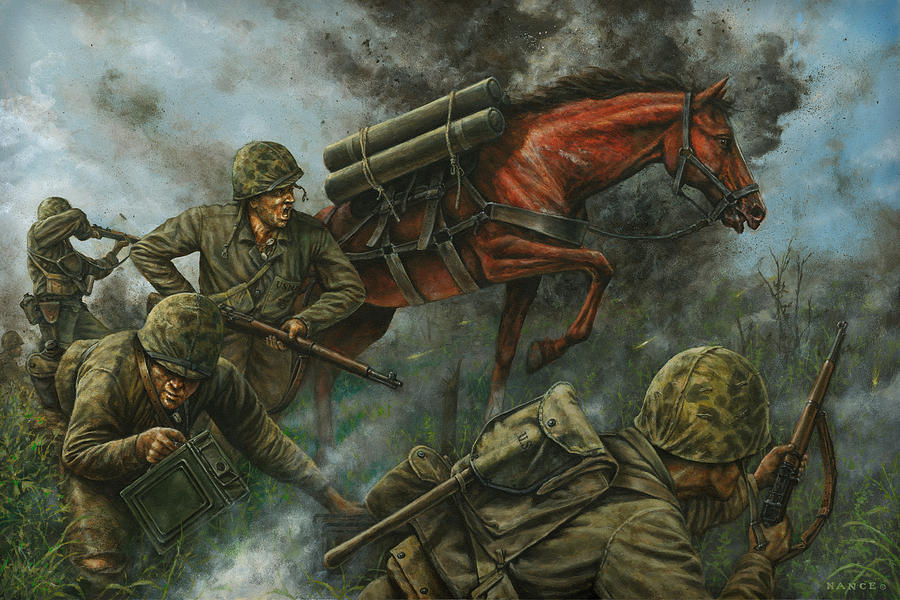
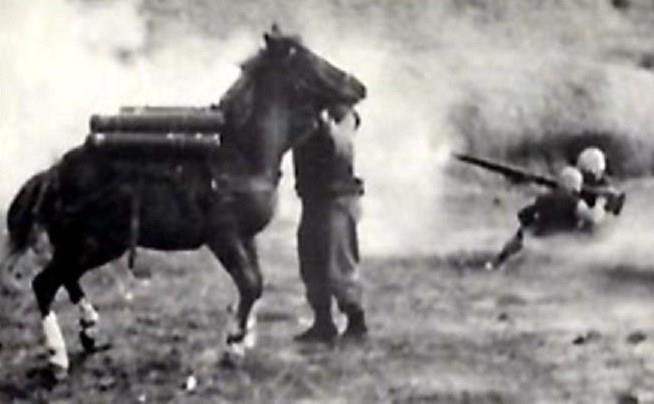
Reckless “went straight up” the first time she heard an RCLR go off, despite being loaded down with six shells. All four feet left the ground and she came down trembling with fear, but Coleman was able to soothe her. The second time she snorted. By the fourth she didn’t bother to look up. She was happily munching on a discarded helmet liner.
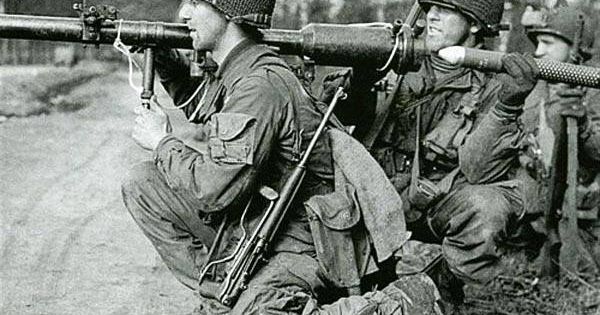
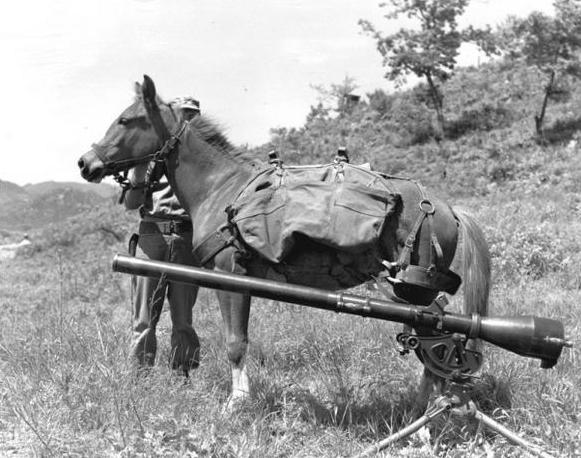
A Recoilless Rifle is a type of lightweight tube artillery. Think of a portable cannon. Kind of a bazooka, really, only the Recoilless fires modified shells rather than rockets. The back blast of these shells compensates for the mule’s kick which would otherwise be expected from such a weapon, making the rifle “recoilless”.
While that reduces projectile range, reduced gas pressures permit a thinner-walled barrel, resulting in a weapon light enough to be served by a 2 to 3-man crew, and shoulder fired by a single infantryman.
The “RCLR” weapon system has provided the punch of artillery to mobile troop formations since the early days of WWII, including Airborne, Special Forces and Mountain units.
The problem arises when combat operations consume ammunition faster than the supply chain can replace it. Mountainous terrain makes the situation worse. Even today in the more mountainous regions of Afghanistan, there are times when the best solution for the problem, is horsepower.
Ah Chim-hai was a chestnut mare of mixed Mongolian and Thoroughbred lineage, a race horse at the track in Seoul, South Korea. Her name translated as “Flame of the Morning”.
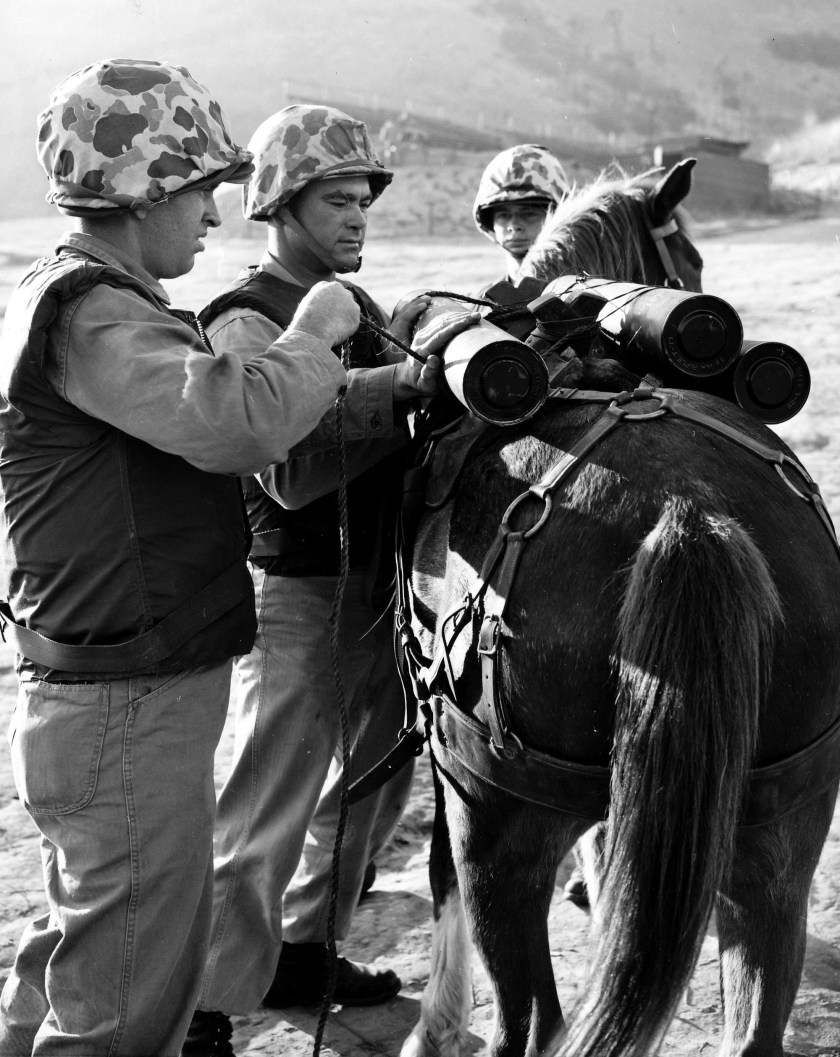
Lieutenant Eric Pedersen of the recoilless rifle platoon, anti-tank company of the 5th Marine Regiment, needed a pack animal to carry the weapon’s 24-lb shells up Korean mountain passes. In October 1952, Pederson received permission from regimental commander Colonel Eustace P. Smoak, to buy a horse for his platoon.
Lt. Pederson and stable boy Kim Huk-moon agreed on a price of $250, and Pederson paid with his own money. Kim cried on watching his “Flame” leave the stable, but the sale had a higher purpose. The boy’s sister had stepped on a land mine, and badly needed a prosthetic leg.
The Marines called the new recruit “Reckless” – a nod to the weapon system she was meant to serve, and to the fighting spirit of the 5th Marines.
Pederson wrote to his wife in California to send a pack saddle, while Gunnery Sergeant Joseph Latham and Private First Class Monroe Coleman provided for her care and training.
Navy Hospitalman First Class George “Doc” Mitchell provided most of Reckless’ medical care, Latham taught her battlefield skills: how to step over communication wires, when to lie down under fire, how to avoid becoming entangled in barbed wire. She learned to run for cover, at the cry “Incoming!”
The platoon built her a bunker and fenced off a pasture, but soon Reckless was allowed to roam freely throughout the camp. She’d enter tents at will, sometimes spending the night if it was cold.
She’d eat anything: bacon, mashed potatoes, shredded wheat. She loved scrambled eggs. Just about anything else that a Marine wasn’t watching closely enough, as well. Reckless even ate her horse blanket once, and she loved a beer. Mitchell had to warn his fellow Marines against giving her more than two Cokes a day, which she’d drink out of a helmet. Once, she ate $30 worth of winning poker chips.
General Randolph McCall Pate, a veteran of Guadalcanal, Iwo Jima and Korea, served as the 21st Commandant of the Marine Corps from 1956 – ’59. Pate wrote: “I was surprised at her beauty and intelligence, and believe it or not, her esprit de corps. Like any other Marine, she was enjoying a bottle of beer with her comrades. She was constantly the center of attraction and was fully aware of her importance. If she failed to receive the attention she felt her due, she would deliberately walk into a group of Marines and, in effect, enter the conversation. It was obvious the Marines loved her.” Reckless was a Marine.
Reckless “went straight up” the first time she heard an RCLR go off, despite being loaded down with six shells. All four feet left the ground and she came down trembling with fear, but Coleman was able to soothe her. The second time she snorted. By the fourth she didn’t bother to look up. She was happily munching on a discarded helmet liner.
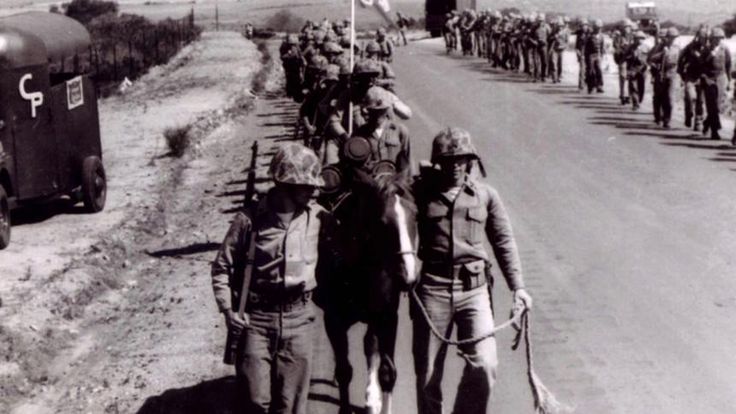
Recoilless rifle tactics call for fire teams to fire four or five rounds, and then relocate before the enemy can shoot back. Reckless usually learned the route after one or two trips, often traveling alone to deliver supplies on the way up, and evacuate wounded on the way down.
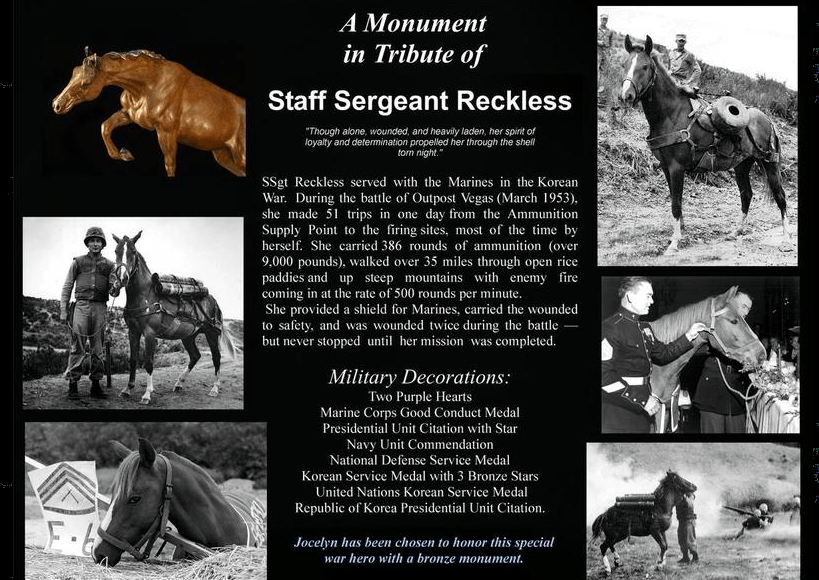
In February 1953, Captain Dick Kurth and his Fox Company were fighting for a hill called “Detroit”. Reckless made 24 trips by herself, carrying a total 3,500lbs of ammunition over 20 miles. She made 51 solo trips that March, during the battle for Outpost Vegas. Reckless carried 9,000lbs of ammunition in a single day, over 35 miles of open rice paddies and steep hills. At times, artillery exploded around her at the rate of 500 rounds per minute. She was wounded twice during the battle. That night, she was too exhausted to do anything but hang her head while they rubbed her down.
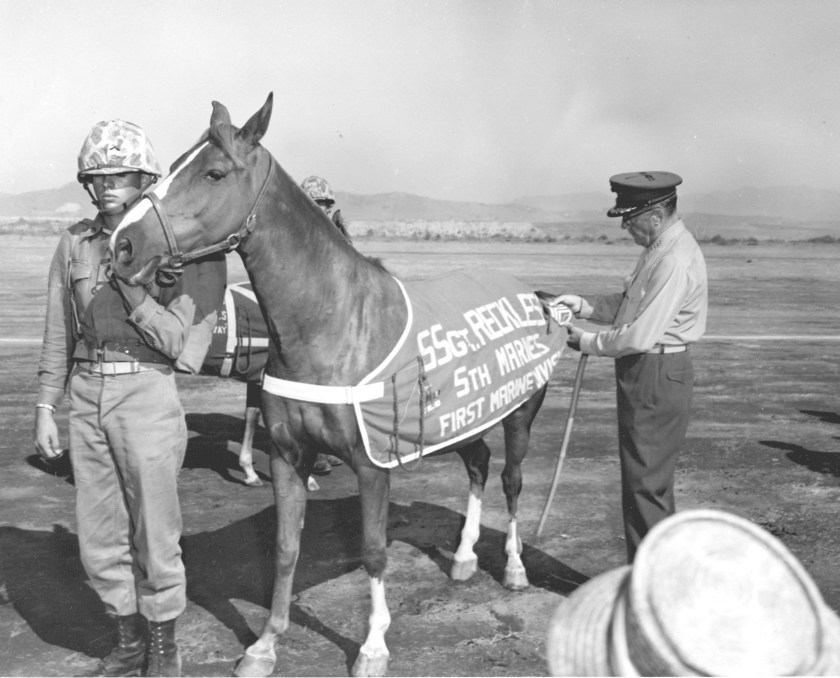
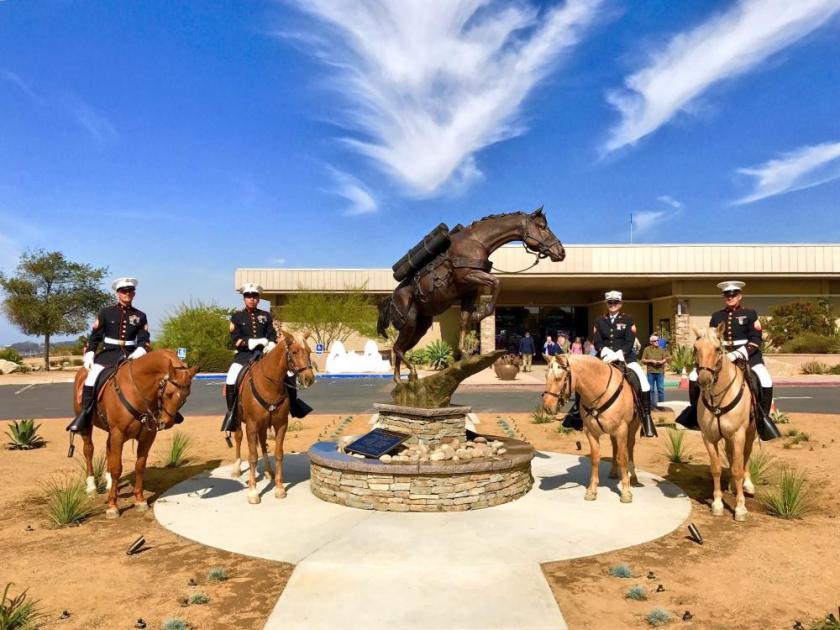
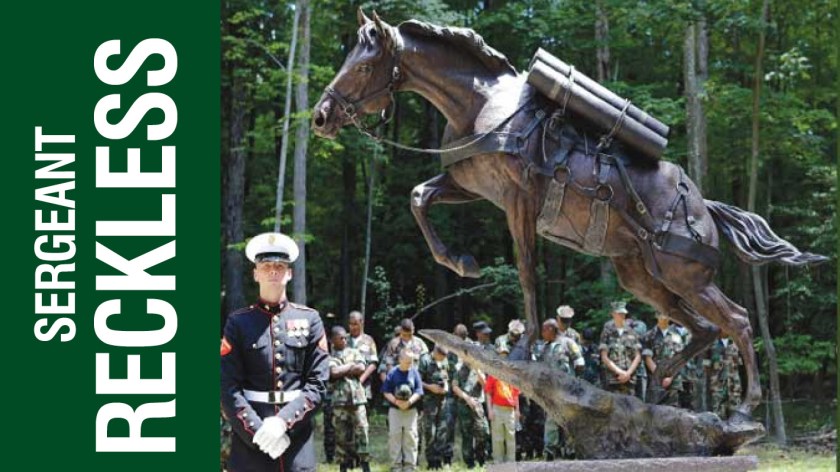
Reckless was the first horse in Marine Corps history to participate in an amphibious landing. She was wounded twice, and later awarded two Purple Hearts and a Marine Corps Good Conduct Medal. Her name appears on Presidential Unit citations from the United States and the Republic of Korea.
On August 31, 1959, Reckless was promoted to Staff Sergeant in a ceremony at Camp Pendleton. 1,900 of her 5th Marine comrades attended, as did two of her sons, “Fearless” and “Dauntless”. A third, “Chesty”, was unavailable to attend.
General Pate wrote: “In my career I have seen many animals that have been adopted by Marines, but never in all my experience have I seen one which won the hearts of so many as did. . .Reckless.”
Life Magazine published a collector’s edition in 1997, listing 100 heroes from American history. Alongside the names of George Washington and Thomas Jefferson, Sally Ride and Abraham Lincoln, was that of a small Mongolian horse. Sergeant Reckless.
The silent evacuation over the night of August 29-30 had averted disaster, a feat made possible only through the nautical skills of the merchants and rum traders, the sailors and the fishermen of Colonel John Glover’s Marblehead, Massachusetts militia, the “Amphibious Regiment”.
When General George Washington raised his sword under the branches of that ancient elm on Cambridge commons, by that act did he take command of an “army”, equipped with with an average of only nine rounds per man.
1776 started out well for the cause of American independence, when the twenty-six-year-old bookseller Henry Knox emerged from a six week slog through a New England winter, at the head of a “Noble train of artillery’.
Manhandled all the way from the frozen wilderness of upstate New York, the guns of Fort Ticonderoga were wrestled to the top of Dorchester Heights, overlooking the British fleet anchored in Boston Harbor.
General sir William Howe faced the prospect of another Bunker Hill. A British victory, yes, but one which came at a cost that Howe could ill afford to pay again.
The eleven-month siege of Boston came to an end on March 17 when that fleet evacuated Boston Harbor, and removed to Nova Scotia. Three months later, a force of some 400 South Carolina patriots fought a day-long battle with the nine warships of Admiral Sir Peter Parker, before the heavily damaged fleet was forced to withdraw. The British eventually captured Fort Moultrie and Charleston Harbor along with it but, for now, 1776 was shaping up to be a very good year.
King’s Regular and Rebel alike understood the strategic importance of New York, as the center of communications between the New England colonies, and those in the south. Beginning that April, Washington moved his forces from Boston to New York, placing his troops along the west end of Long Island in anticipation of the British arrival.
The British fleet was not long in coming, the first arrivals dropping anchor by the end of June. Within the week, 130 ships were anchored off Staten Island, under the command of Admiral sir Richard Howe, the General’s brother. By August 12 the British force numbered 400 vessels with 73 warships, with a force of some 32,000 camped on Staten island.
American forces were badly defeated at the Battle of Brooklyn, fought on August 27, 1776. The British dug in for a siege, confident that their adversary was cornered and waiting to be destroyed at their convenience, while the main Patriot army retreated to Brooklyn Heights.
“British troops in the type of flat-bottomed boat used for the invasion of Long Island. Hessians in their blue uniforms are in the two boats that are only partly visible”. H/T Wikipedia
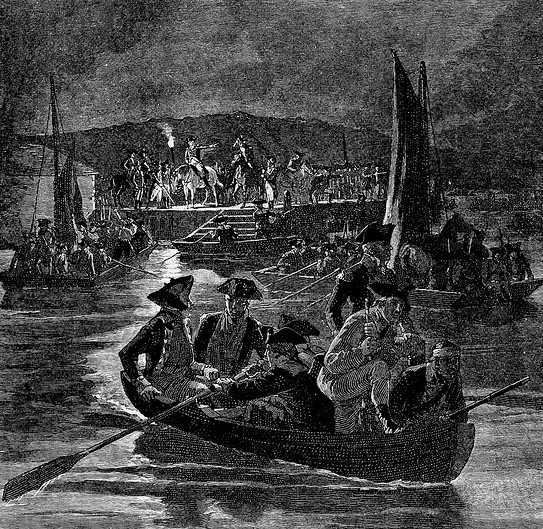
Cornered on land with the British-controlled East River to their backs, it may have been all over for the Patriot cause, but for one of the great feats of military history. The surprise was complete for the British side on waking for the morning of August 30, to discover that the American army, had vanished. The silent evacuation over the night of August 29-30 had averted disaster, a feat made possible through the nautical skills of the merchants and rum traders, the sailors and the fishermen of Colonel John Glover’s Marblehead, Massachusetts militia, the “Amphibious Regiment”.
Retreat from long island, August 29-30, 1776
That October, the defeat of General Benedict Arnold’s home-grown “Navy” on the waters near Valcour Island in Vermont, cost the British fleet dearly enough that it had to turn back, buying another year of life for the Patriot cause.
By December, the Continental army had fled New York, to the south of New Jersey. Already reduced to a puny force of only 4,707 fit for duty, Washington faced a decimation of his army by the New Year, with the end of enlistment for fully two-thirds of those. With nowhere to go but on offense, Washington crossed the Delaware river in the teeth of a straight-up gale over the night of December 25, defeating a Hessian garrison at Trenton in a surprise attack on the morning of December 26.
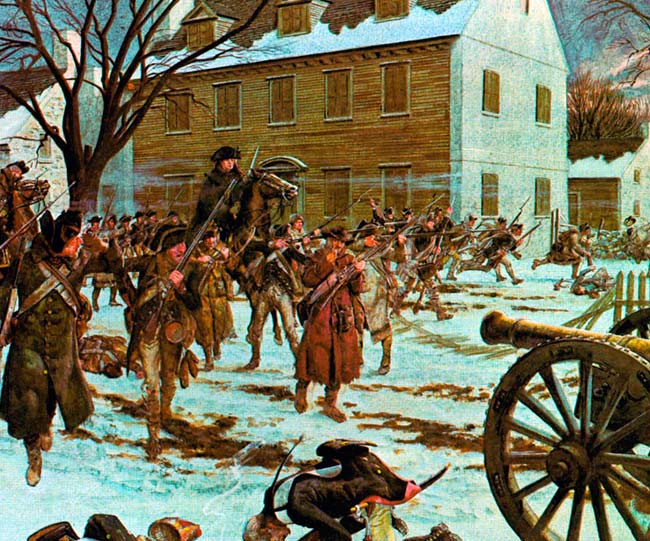
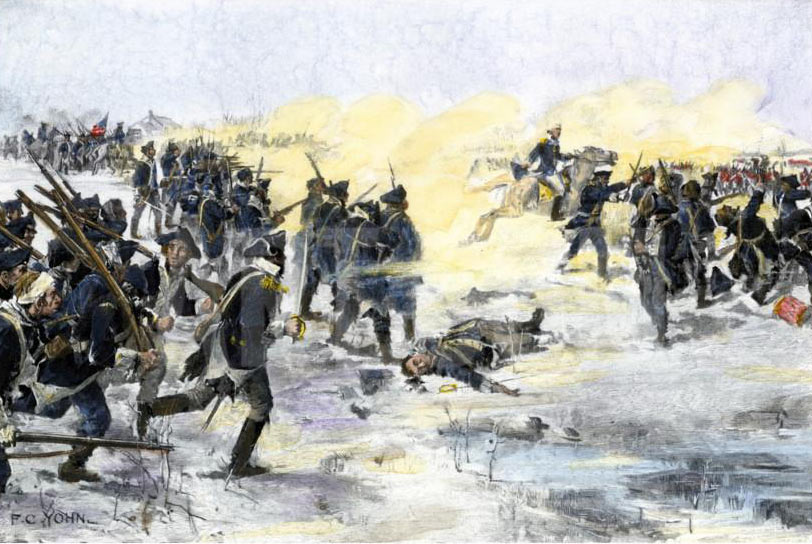
While minor skirmishes by British standards, the January 2-3 American victories at Assunpink Creek and Princeton demonstrated an American willingness, to stand up to the most powerful military of its time. Cornwallis had suffered three defeats in the last ten days, and withdrew his forces from the south of New Jersey. American morale soared, as enlistments came flooding in.
Battle of Princeton, January 3, 1777
The American war for independence would not be over, for another six years. Before it was through, more Americans would die in the fetid holds of British prison ships than in every battle of the Revolution, combined. Yet, that first year had come and gone, and the former colonies were still in the fight.
A generation later, Lord Arthur Wellesley described the final defeat of a certain “Corsican corporal” at a place called Waterloo. Wellesley might have been talking about the whole year of 1776 in describing that day in 1815: “It was a damn close run thing“.
If you enjoyed this “Today in History”, please feel free to re-blog, “like” & share on social media, so that others may find and enjoy it as well. Please click the “follow” button on the right, to receive email updates on new articles. Thank you for your interest, in the history we all share.


 He was “Il Divino”, “The Divine One”, literally growing up with the hammer and chisel. He had a “Terribilità” about him, an awe-inspiring sense of grandeur which made him difficult to work with, but for which he was at the same time, widely admired and imitated. Michelangelo was that insufferably cocky kid who wasn’t bragging. He could deliver.
 The 17′, six-ton David was originally intended for the roof of the Florence Cathedral, but it wasn’t feasible to raise such an object that high. A committee including Leonardo da Vinci and Sandro Botticelli was formed to decide on an appropriate site for the statue. The committee chose the Piazza della Signoria outside the Palazzo Vecchio, the town hall of Florence.

 Estimates suggest that the second of four major Caliphates, that of the Umayyad based in Damascus, Syria, was over 5 million square miles, larger than any modern state with the sole exception of the Russian Federation.

 No less a figure than Dante Alighieri counted Saladin a “virtuous pagan,” ranking among the likes of Hector, Aeneas, and Caesar.
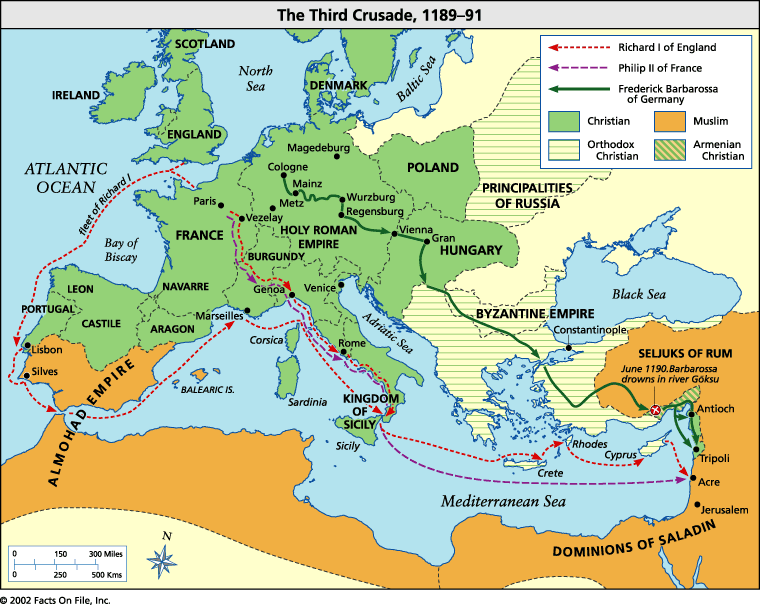 The aging Holy Roman Emperor, Frederick I “Barbarossa” (Red Beard), was the first to go, taking up the cross at Mainz Cathedral in March, 1188. Emperor Frederick drowned crossing the Saleph River in Asia Minor in June 1190, after which most of his army of 100,000 returned to Germany.



 John Connell Freeborn was a pilot with the RAF, and a good one, too. Credited with 13½ enemy aircraft shot down, Freeborn flew more operational hours during the Battle of Britain, than any other pilot, ending the war with a Distinguished Flying Cross and Bar, and completing his RAF career as a Wing Commander. Yet, there is a time when every hero is as green as the grass. In the beginning, John Freeborn like everyone else, were rank amateurs.
 Richard Hough and Denis Richards wrote about the episode in


 Undeterred, then-Governor Elliott Spitzer proposed a tax on illegal drugs as part of the Empire State’s 2008-’09 budget, making New York the 30th state to pass such a measure. “Mr. Clean” stepped down in a hooker scandal, amid threats of impeachment by state lawmakers. The state Senate passed a budget resolution the following day, specifically rejecting the crack tax.
 New Zealand proposed a tax on bovine flatulence in 2003, to curb “Global Warming”. The fuss raised by New Zealand farmers over a tax on cow farts, was near-measurable on the Richter scale. Red-faced politicians quietly dropped the proposal.
 In 1662, Charles II levied a tax on fireplaces, to finance the Royal Household. Britons hurried to brick up their fireplaces to avoid the “hearth tax, preferring to shiver rather than pay up. The village baker in Churchill in Oxfordshire knocked out the wall from her oven to avoid the tax, and not surprisingly, burned the whole village down.
 In 2004, the Maryland Legislature passed a monthly fee on sewer bills, ostensibly to protect the Chesapeake Bay and Atlantic tributaries. You pee, you poo, you pay. The fee doubled in 2012, the year in which Governor Martin O’Malley signed a tax – on rain.
 When you paid your beard tax of 100 Rubles, (peasants and clergy were exempt), you had to carry a “beard token”. Two phrases were inscribed on the coin: “The beard tax has been taken” and “The beard is a superfluous burden”. Failure to shave or pay the tax might lead to your beard being forcibly cut off your face. Some unfortunates had theirs pulled out by the roots, by Peter himself.
 When King Henry I reigned over England (1100 – 1135), people who avoided military service were charged a “Cowardice Tax” called a”Scutage”. It was modest at first, but Richard Lionheart’s little brother John raised it by 300% when he became King, charging even his knights in years when there were no wars. It’s no small part of what led to the Magna Carta.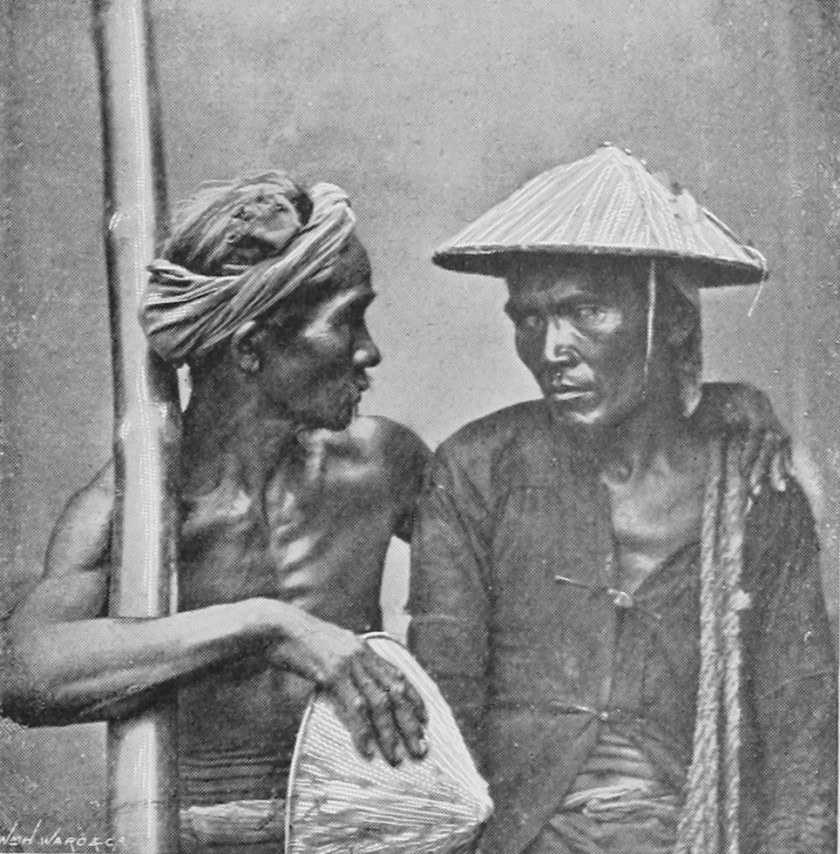




 Geronimo and his band of 38 men, women and children evaded thousands of Mexican and US soldiers. By the end of his military career, he was “the worst Indian who ever lived”, according to the white settlers. Geronimo was captured on this day in 1886, by Civil War veteran and Westminster, Massachusetts native, General Nelson Miles. With the capture of Geronimo, the last of the major US-Indian wars had come to an end.
 Geronimo became a celebrity in his old age, marching in Theodore Roosevelt’s inaugural parade in 1905. He converted to Christianity and appeared in county fairs and Wild West shows around the country.


 The “Calendar Act of 1750” set out a two-step process for adopting the Gregorian calendar. Since the Roman calendar began on March 25, the year 1751 was to have only 282 days so that January 1 could be synchronized with that date. That left 11 days to deal with.
 Benjamin Franklin seems to have liked the idea, writing that, “It is pleasant for an old man to be able to go to bed on September 2, and not have to get up until September 14.”


 A story comes down to us from the Royal Residence of Queen Victoria, of the hapless attendant who told a spicy story one night, at dinner. You could have watched the icicles grow, when the Queen of the United Kingdom of Great Britain and Ireland turned and said: “We are not amused“.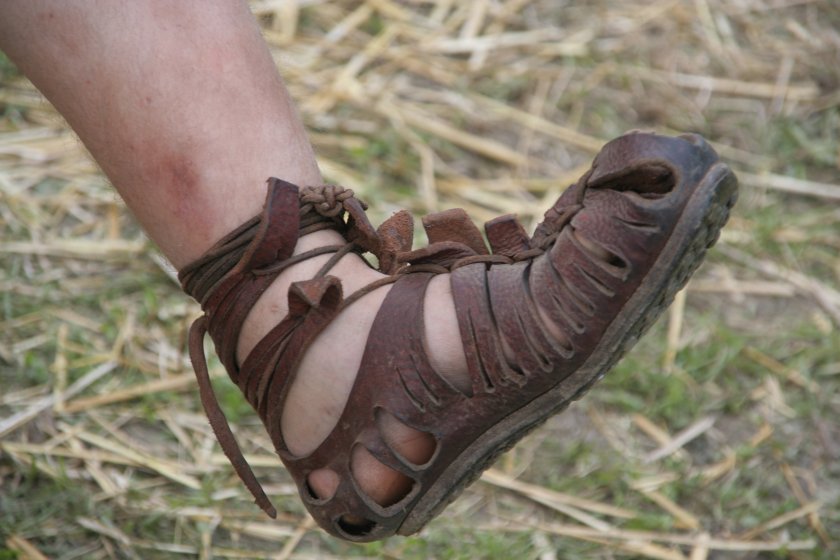






 1776 started out well for the cause of American independence, when the twenty-six-year-old bookseller Henry Knox emerged from a six week slog through a New England winter, at the head of a “
 The Continental Congress adopted the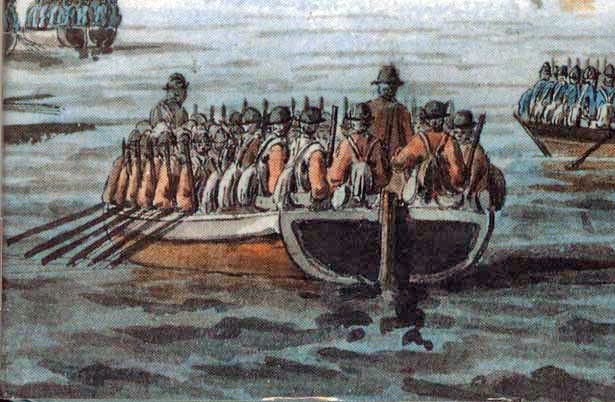

 Historical Easter Eggs - Today in History
You must be logged in to post a comment.