Bad as it was, Buckner’s Bungle at first had nothing on a Flub that will live for the Ages, Fred Merkle’s Screw-up at Second, a Blooper that would always be known as “Merkle’s Boner”.
For Boston sports fans, there is little to match for pure unhappiness of memory, with the 86-year World Series Championship drought known as the “Curse of the Bambino”.
Babies grew up and had babies of their own during that time. There were grandchildren and great grandchildren, and sometimes even great-greats, and still the drought wore on. It was 86 years. One of the longest World Series championship droughts in Major League Baseball history.
The third longest, actually, behind those of the Chicago White Sox (87 games) and the Chicago Cubs, (107 games). Pity the long suffering baseball fans, of Chicago.
It’s the worst moment in Boston baseball, unless you count the ball that lost the 1986 world series, the one that dribbled through Bill Buckner’s legs at First Base and snatched defeat from the jaws of victory in game six, against the New York Mets.
And that after defeating the Arch Nemesis New York Yankees by 5½ games, for the championship of the American League East.
An unfortunate joke emerged from that game, about Bill Buckner’s most regrettable moment. A joke unbefitting the caliber of the man’s career in Major League Baseball.
Bad as it was though, Buckner’s Bungle at first had nothing on a Flub that will live for the Ages, Fred Merkle’s Screw-up at Second, a Blooper that will always be known, as “Merkle’s Boner”.
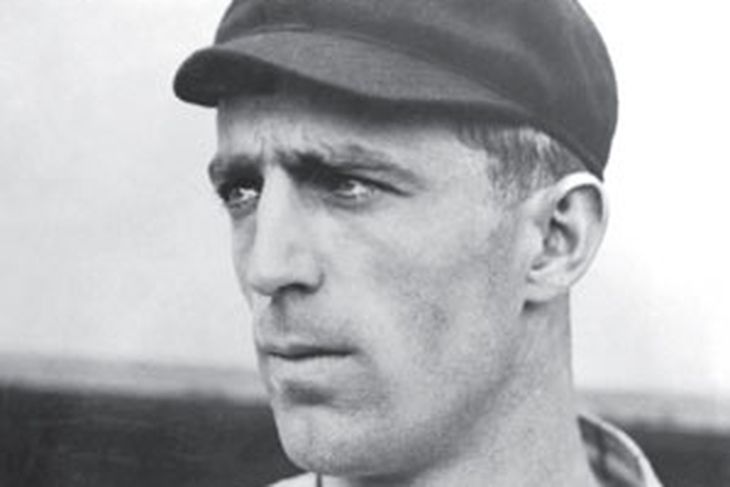
Fred “Bonehead” Merkle
On this day in 1908, the New York Giants faced off with the Chicago Cubs in the last of a three-game series at the Polo Grounds, in upper Manhattan.
The Giants held a slim lead at this time for the National League pennant, but the Cubbies had managed to hold on to a 2-0 series lead. This game was going to be a Big Deal.
Fred Merkle was 19 years old that day, the youngest player in the National League.
In the bottom of the 9th, Merkle came to the plate with two outs, the score tied 1–1, and Harry “Moose” McCormick on first.
Merkle singled and McCormick advanced to third. Al Bridwell, followed with a single of his own and McCormick crossed the plate, with the winning run.
Except, that’s not the way it happened.
The fans poured onto the field, convinced that the game was over. Fans did that, in those days.
Merkle thought so too, and ran to the Giants’ clubhouse, never touching second base.
Cubs second baseman Johnny Evers noticed and, after fielding the ball and touching second, appealed to umpire Hank O’Day to call the out.
The Ump called Merkle out on a force play. The run didn’t count.
With the winning run nullified, the Giants’ victory was erased and the score tied, 1-all. There was no hope of resuming play, with thousands of fans on the field.
The game was declared a tie, and the two teams finished regular season, tied for first.
The Cubs won the 1908 National League pennant with a 4-2 victory on the rematch, also played at the Polo Grounds, on October 8.
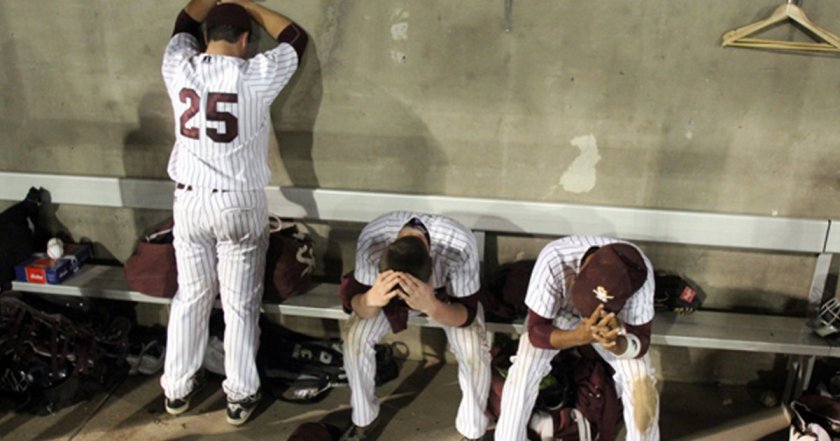
A game that never should have been played, but for a nineteen-year-olds screwup at second, for which Fred Merkle would always be known as “Bonehead”.
Oh. The joke. I almost forgot. Question: What do Bill Buckner and Michael Jackson, have in common? Answer: They both wear one glove, for no apparent reason.
If you enjoyed this “Today in History”, please feel free to re-blog, “like” & share on social media, so that others may find and enjoy it as well. Please click the “follow” button on the right, to receive email updates on new articles. Thank you for your interest, in the history we all share.
In the following ten years, 800 young French women immigrated to New France under the filles du roi program, sponsored by King Louis XIV and his colonial advisors.
Around 1523, the Florentine navigator Giovanni da Verrazzano convinced the French King Francis I to fund an expedition to find a western water route to “Cathay” (China). Some of the earliest French presence in the New World began ten years later, with Jacques Cartier’s exploration of the Gulf of St. Lawrence in present-day Canada. In 1534, Cartier planted his flag on the Gaspé Peninsula in present-day Quebec City, claiming the territory in the name of Francis I.
The first French settlement was attempted in 1541 when some 400 individuals put down in Fort Charlesbourg-Royal. That effort would come to an end two years later but, there would be others.
As early English colonists to North America struggled to put down roots in places like Roanoke and Jamestown, the Spanish developed toeholds in Florida and the American southwest. To the north, French fishing fleets sailed the Atlantic coast and into the St. Lawrence waterways, making alliances with Canadian First Nations and developing a rich trade in furs, particularly beaver, which were at that time becoming rare in Europe.
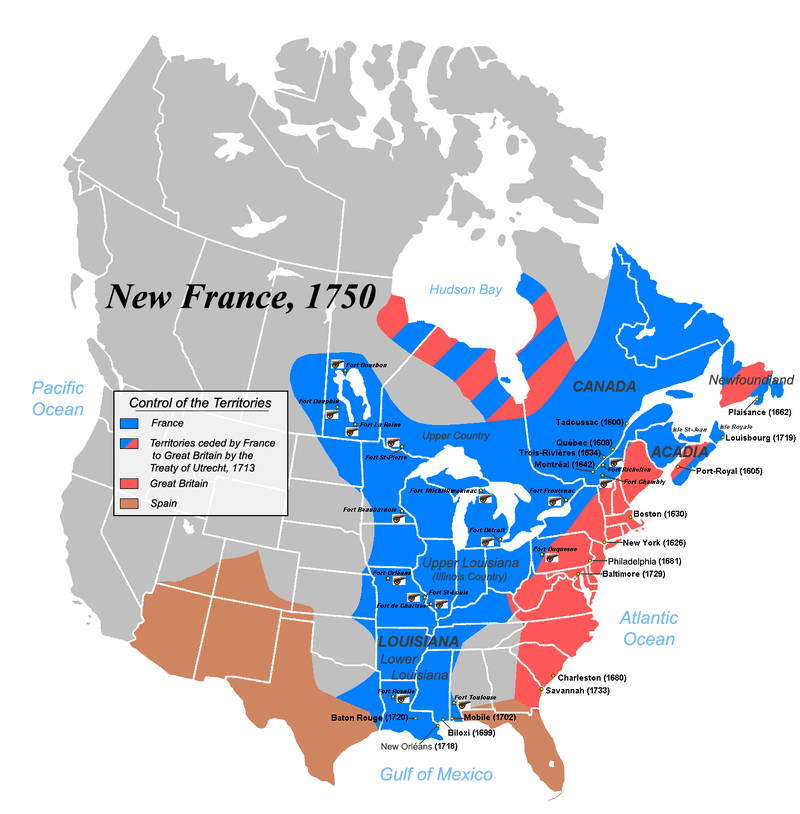
By its peak in 1712, the territory of Nouvelle-France (New France) consisted of five colonies, stretching from Canada to the Gulf of Mexico, and from Newfoundland to the Great Lakes.
English settlers developed a farming economy, and men brought wives and families along, from the earliest days. Not so French settlers. New France was a man’s world, a world of soldiers and fur traders, of missionaries, sailors and fishermen. A world with little to offer women.
Well into the 17th century, a great number of marriageable males would return to France following three-year terms of service. If there was to be permanent French settlement in the New World, that would have to change.
In the thirty years beginning in 1634, private individuals and religious groups recruited a mere 262 filles à marier (marriageable girls) between Québec and Montréal, an area with some 2,500 men.
Marguerite Bourgeoy set sail for the New World in 1653 aboard the Saint-Nicholas, along with another hundred or so colonists. There Bourgeoys lived in Fort Ville-Marie (now Montreal) where she educated young girls, the poor, and the native population. Bourgeoys developed one of the first uncloistered religious communities in the Catholic Church and went on to found the Congregation of Notre Dame of Montreal.
Today, Bourgeoy is a Saint of the Roman Catholic Church. It was she who first used the term filles du roi (King’s Daughters).
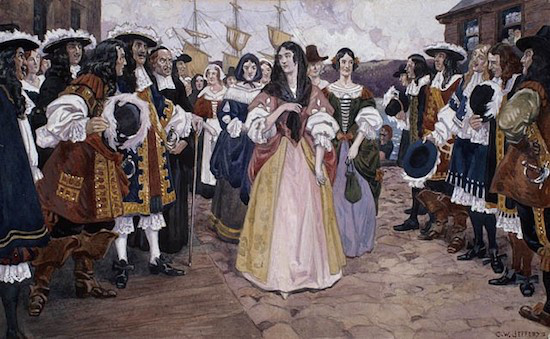
The term “King’s Daughters” referred not to parentage, but to sponsorship. In 1663, King Louis XIV took over direct control of governing New France, and initiated a system for recruiting and transporting marriageable women into the colony.
Recruiting took place in the northern cities, carried out by merchants and ship’s outfitters. Each girl was expected to be of appropriate age for giving birth, and to present a birth certificate and recommendation from her parish priest or local magistrate, stating that she was free to marry.
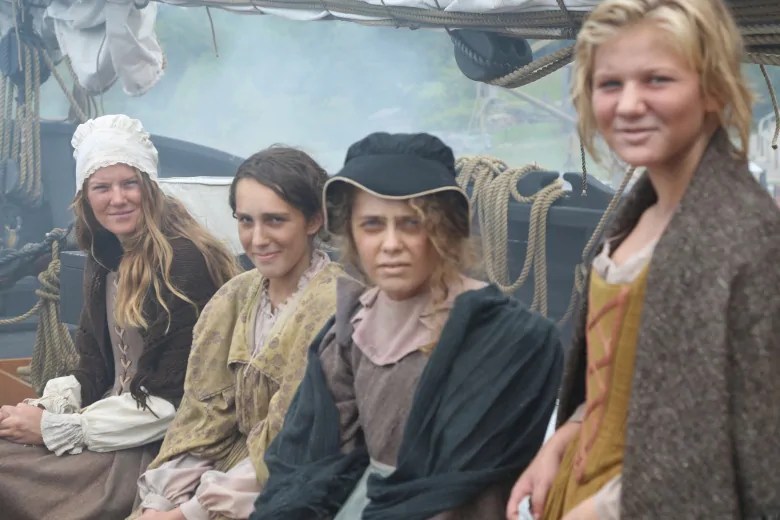
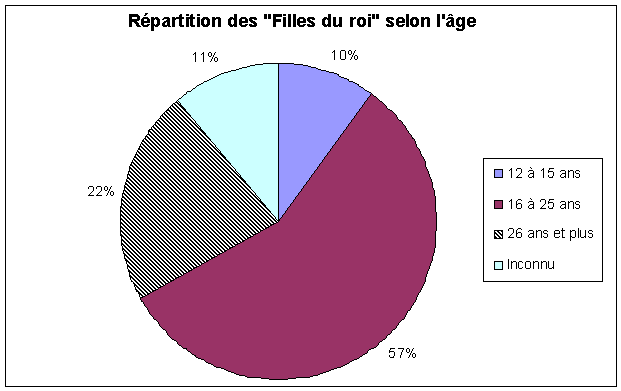
The majority of the filles du roi were aged 16 to 25
Each girl was equipped with an assortment of practical items: a coiffe, bonnet, taffeta handkerchief, pair of stockings, pair of gloves, ribbon, four shoelaces, white thread, 100 needles, 1,000 pins, a comb, pair of scissors, two knives and two livres in cash along with suitable clothing and a few provisions. The cost including passage came to 100 livres, equivalent to $1,425 in the year 2000, a cost which was paid by the French state.
On September 22, the first thirty-six Filles du Roi arrived in Québec.
While awaiting proposals of marriage, women were lodged in dormitory-style houses, under the supervision of a female chaperone or directress. Suitors would come to the house to make their selection, under the supervision of the Directress. Outward appearance was less important in this world, than that these women be equipped for the hardships of the New World.
It quickly emerged that city girls were too “lightheaded and lazy”. Good, strong peasant stock was needed. Marie de l’Incarnation, mother superior of the Ursuline convent at Québec City requested in 1668: “From now on, we only want to ask for village girls who are as fit for work as men, experience having shown that those who are not raised [in the country] are not fit for this country.”
In the following ten years, 800 young French women immigrated to New France under the filles du roi program, sponsored by King Louis XIV and his colonial advisors. Unsurprisingly, Canada experienced a baby boom, such as never seen before, or since. The average family had five children during this period, about twice as many as the “Baby Boom”, following WW2. Families with more than 10 children got a bonus from the Crown: an additional annual pension of 300 livres ($6,000).
According the Canadian Broadcasting Corporation (CBC), two-thirds of modern French Canadians can trace their lineage back to one of those 800 women, including Hillary Clinton, Madonna and Angelina Jolie.
If you enjoyed this “Today in History”, please feel free to re-blog, “like” & share on social media, so that others may find and enjoy it as well. Please click the “follow” button on the right, to receive email updates on new articles. Thank you for your interest, in the history we all share.
Precise identification of the Beast of Gévaudan has baffled cryptozoologists, from that day to this.
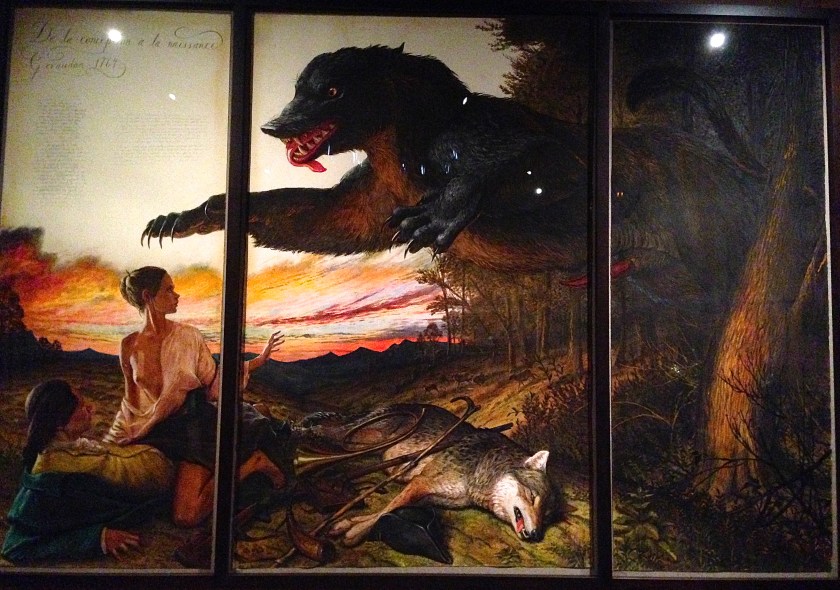
In the summer of 1764, a young woman was tending cattle near the Mercoire forest in the Gévaudan region of south-central France, when a large animal emerged from the forest. She later described the creature as wolf-like in appearance, but much larger. The size of a calf, or a donkey.
Twice the animal attacked, only to be driven off by the bulls in the herd. Twenty-nine days later, Janne Boule was not so lucky. The 14-year-old is officially recorded as the first victim of La Bête du Gévaudan. The “Beast of Gévaudan”. Over the following three years, there would be many more.
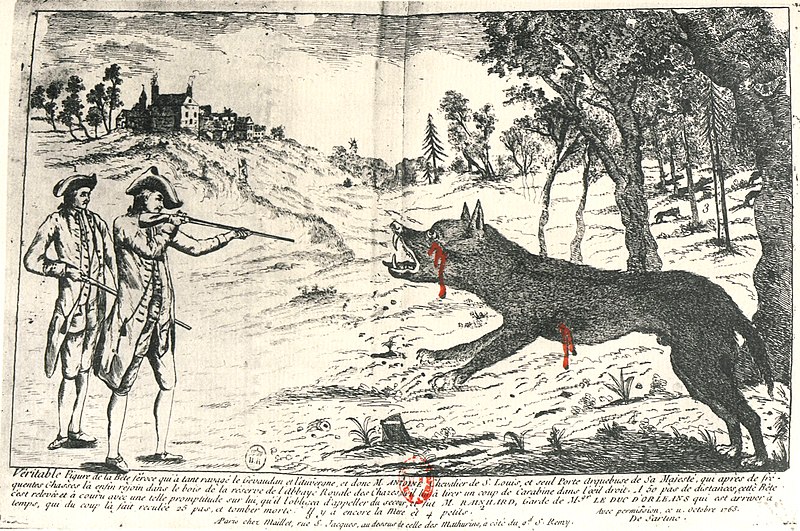
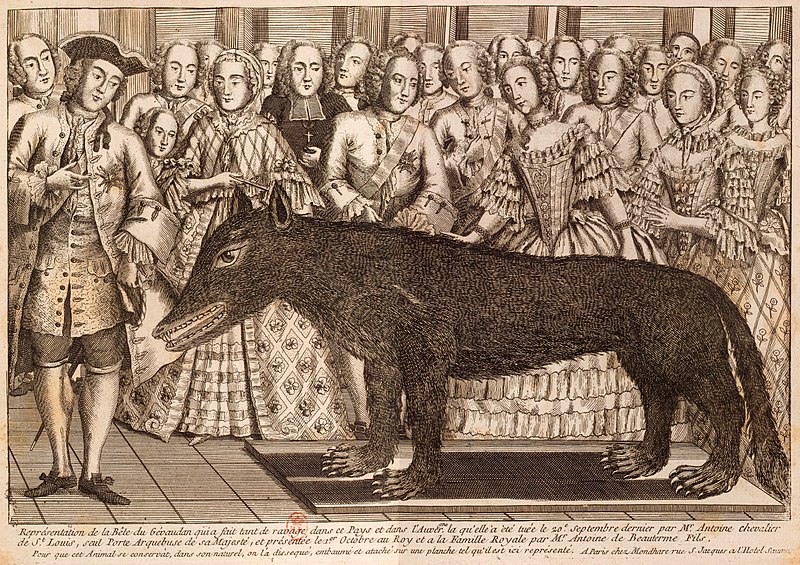
Contemporary illustration depicts the Beast as a large wolf, or wolf hybrid.
A 1987 study of contemporary sources estimates 210 such attacks over the three-year period, resulting in 113 fatalities and another 49 injuries. Victims were most often killed, by having their throats ripped out. Ninety-eight of those, were partially eaten.
Precise identification of the Beast of Gévaudan has baffled cryptozoologists, from that day to this. Eyewitness accounts describe a large animal with a long tail, about the size of a calf, or a donkey. With reddish fur and a flat head, the Beast was said to be exceptionally powerful, able to leap distances of 30-feet and more, and capable of carrying off a grown adult, in its jaws.
Terror gripped the region in the later months of 1764, as the Beast attacked women, men and children. Usually while alone, and often while tending livestock.
Suspicion centered on an unusually large wolf, dog, or some hybrid combination of the two. Stories went to the supernatural, laying bare our most primordial fear, that of a shape shifter. A Werewolf.
The Epic of Gilgamesh comes to us from the second millennium BC, telling the tale of such creatures. The 1st-century BC Roman poet Ovid, was the first to write of shape-shifting as a conscious act of will.
In January 1765, the Beast came to the attention of King Louis XV, who decreed that the French state would help to find and destroy the Beast. First captain Duhamel of the Clermont-Ferrand dragoons was brought out with his troops, and sent to Le Gévaudan. The professional wolf-hunters Jean Charles Marc Antoine Vaumesle d’Enneval and his son Jean-François, arrived with eight bloodhounds, trained in wolf-hunting.
“Officer of the Royal Bedchamber” Antoine De Beauterne Marques Argents, Knight Equerry of the Royal Military Order of Saint Louis and Gun-Bearer to Louis XV of France (now, there’s a title) announced on this day in 1765 that he had killed the Beast of Gévaudan, to great rejoicing.
The animal was a large grey wolf measuring 5-feet, 7-inches and weighing 130-pounds. Eyewitnesses claimed to have recognized scars on the animal’s body and Beauterne himself swore that this was the Beast. “We declare by the present report signed from our hand”, he said, “we never saw a big wolf that could be compared to this one. Hence, we believe this could be the fearsome beast that caused so much damage.”
The animal was stuffed and brought to Versailles, but the joy was short-lived.
Two boys were attacked on December 2 but managed to fight off the Beast. A dozen more fatal attacks were reported to have followed, near La Besseyre-Saint-Mary.
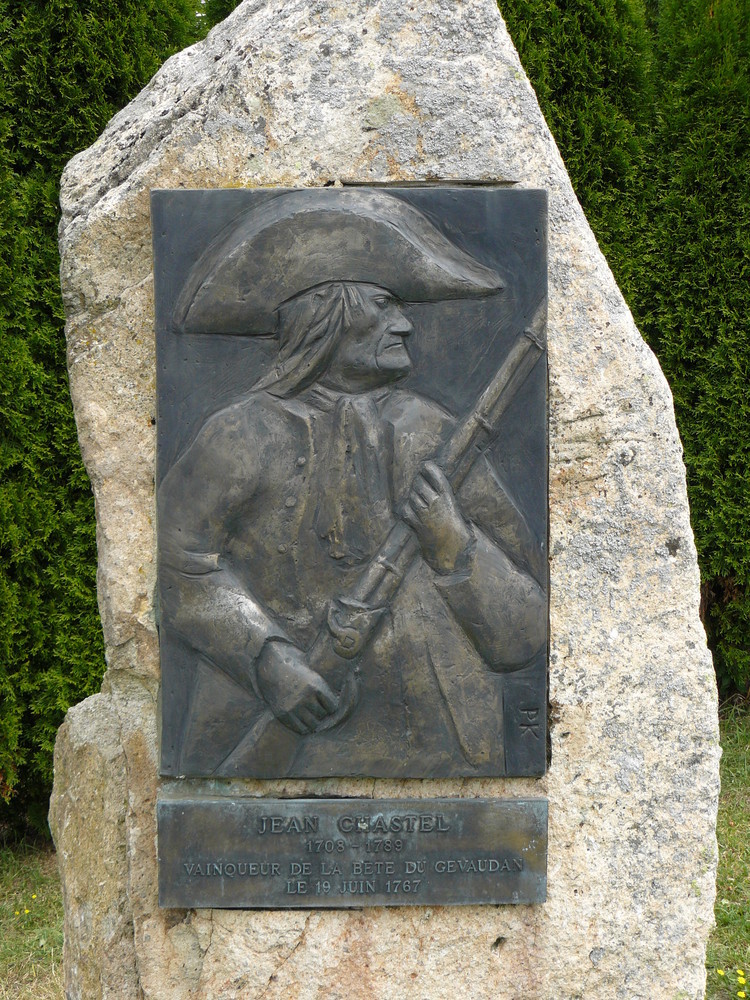
The animal disappeared around the middle of 1767. It is believed to have been shot a dozen or more times by this time, and poison baits were widespread. A local farmer and inn-keeper named Jean Chastel is credited with killing the Beast of Gévaudan on June 19, 1767, with a bullet which he himself had cast, in silver.
Jean Chastel
The silver bullet meme did much to feed into werewolf mythology. Chastel himself is depicted as a werewolf in Patricia Briggs’ novel, Hunting Ground. Here, the hunter and the hunted are one and the same, and some random wolf was shot, to throw everyone off the scent.
National Geographic posits that the Beast of Gévaudan was in fact, a subadult male lion. African lions were by no means unknown at this place and time, though images of the era were usually quite stylized, depicting the full mane of the adult male.
Exotic animal menageries were common among the upper classes. It is quite possible that such an animal could’ve been on the loose. Physical descriptions of the Beast including it’s reddish hair, flat head and furry ridge-line, match up with those of such an animal. This combined with descriptions of the hunting and killing methods of the animal, make the lion theory quite plausible.
The Beast of Gévaudan may have been a wolf, or maybe a lion. Perhaps it was several animals. Or maybe Jean Chastel is a werewolf, after all. A clever one who threw half a nation off his scent, and now only does his killing, in the dark. Just another thing that goes BUMP, in the night.
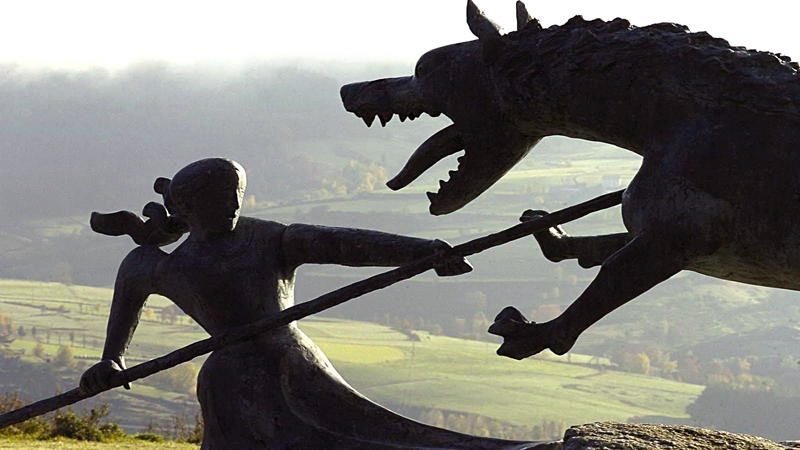
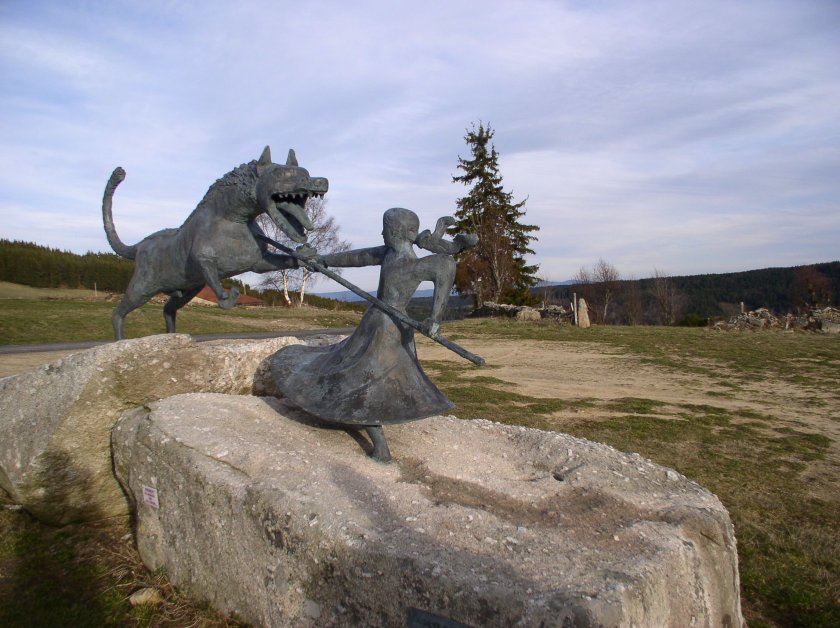
A monument was erected in the village of Auvers to honour those who fought against the beast.
If you enjoyed this “Today in History”, please feel free to re-blog, “like” & share on social media, so that others may find and enjoy it as well. Please click the “follow” button on the right, to receive email updates on new articles. Thank you for your interest, in the history we all share.
How different were those last thousand years, but for this one day’s outcome, at a place called Fulford Gate.
Edward the Confessor, King of England, went into a coma in December 1065, having expressed no clear preference for a successor. Edward died on January 5 after briefly regaining consciousness, and commending his wife and kingdom to the protection of Harold, second son of Godwin, the powerful Earl of Wessex, and Gytha Thorkelsdóttir.
The Anglo-Saxon Kings didn’t normally pick their own successors, but their wishes carried import. Nobles of the Witenagemot, the early Anglo-Saxon predecessor to the modern parliament, were in Westminster to observe the Feast of the Epiphany. Convening the following day, the council elected Harold Godwinson, crowning him King Harold II on January 6.
For some, Harold’s quick ascension was a matter of administrative convenience and good fortune, that everyone just happened to be at the right place, at the right time. Others saw shades of conspiracy. A brazen usurpation of the throne. Edward’s death touched off a succession crisis which would change the course of history.
H/T By Amitchell125 at English Wikipedia
Harold’s younger brother Tostig, third son of Godwin, was himself a powerful Earl of Northumbria, and thoroughly detested by his fellow northern Earls. Tostig was deposed and outlawed by King Edward in October 1065, with support from much of the local ruling class as well as that of Tostig’s own brother, Harold.
King Edward’s death a short two months later, left the exile believing he had his own claim to the throne. Tostig’s ambition and animosity for his brother, would prove fatal to them both.
After a series of inconclusive springtime raids, Tostig went to a Norman Duke called William “The Bastard”, looking for military support. William had his own claim to the English throne, and had already declared his intention to take it. The Norman Duke had little use for King Harold’s younger brother, so Tostig sought the assistance of King Harald of Norway, also known as Harald Hardrada (“harðráði” in the Old Norse), the name translating as”hard ruler”.
Harald Hardrada. The Last Great Viking
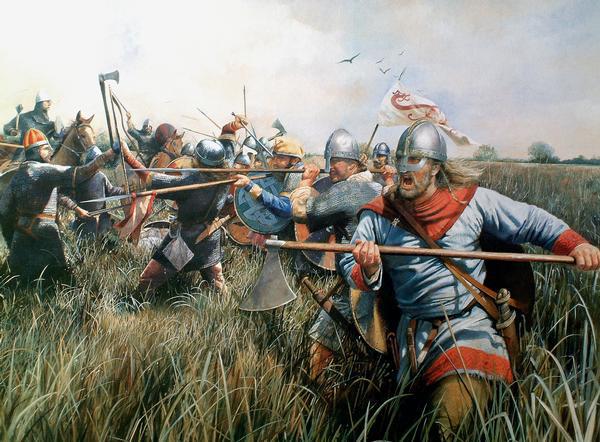
Tostig sailed for England with King Harald and a mighty force of some 10,000 Viking warriors, arriving in September, 1066. Six thousand were deployed on September 20, to meet 5,000 defenders on the outskirts of the village of Fulford, near the city of York. Leading the defenders were those same two brothers, Edwin of Mercia, and Morcar of Northumbria.
The Anglo-Saxons were first to strike, advancing on a weaker section of the Norwegian line and driving Harald’s vikings into a marsh. With fresh invaders hurrying to the scene, the tide turned as the English charge found itself cut off and under attack, wedged between the soft ground of the marsh and the banks of an adjoining river. The encounter at Fulford Gate was a comprehensive defeat for the English side. It was over in an hour. On this day in 1066, two of the seven Great Kingdoms of Anglo-Saxon England, were decimated.
Perhaps not wanting to have his capital city looted, Tostig agreed to take a number of hostages, and retired seven miles south to Stamford Bridge to await formal capitulation. Harald went along with the plan, believing he had nothing further to fear from the English.
Meanwhile, King Harold awaited with an army in the south, anticipating William’s invasion from Normandy. Hearing of the events at Fulford, Harold marched his army north, traveling day and night and covering 190 miles in four days, on foot, completely surprising the Viking force waiting at Stamford Bridge.
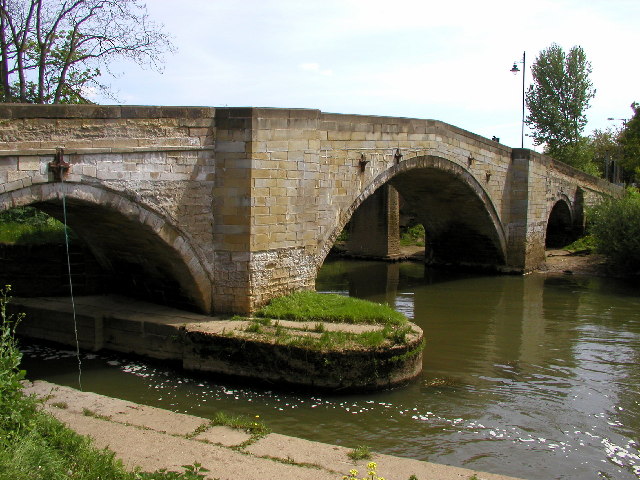
The new Stamford Bridge over the River Derwent, built in 1727
Believing they had come to accept submission, the Norwegians must have looked at the horizon and wondered, how a peace party could raise that much dust. This was no peace party. With their forces spread out and separated on opposite sides of the River Derwent, Harald Hardrada and his ally Tostig now faced a new army.
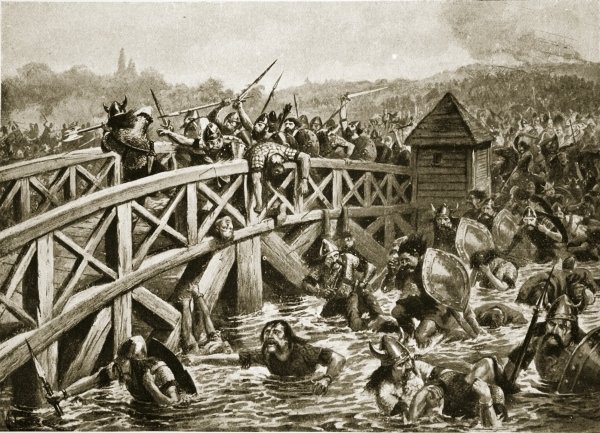
At the height of the battle, one Berserker stood alone at the top of Stamford Bridge, wielding the great two-handed Dane Axe. Alone and surrounded, this giant of a man slew something like 40 English soldiers when one of Harold’s soldiers floated himself under the bridge, spearing the Viking warrior from below.
The savagery of the battle at Stamford Bridge, can only be imagined. Before the age of industrialized warfare, every injury was personally administered with sword, axe or mace. Before it was over 5,000 of King Harold’s soldiers lay dead, about a third of his entire force. Two-thirds of King Harald’s Vikings died at Stamford Bridge, about 6,000 including Harald himself and the would-be King, Tostig Godwinson.
So many died in that small area that, 50 years later, the site was said to have been white with the sun bleached bones of the slain. Of 300 ships arriving that September, the battered remnants of Harald’s Viking army needed only 24, to sail away.
Stamford Bridge is often described as the end of the Viking invasions of England, but that isn’t quite so. There would be others, but none so powerful as this. The Last of the Great Vikings, was dead.
The Norman landing King Harold had been waiting, for took place three days later at Pevensey Harbor, just as his battered army was disbanding and heading home for the Fall harvest. The Anglo Saxon army would march yet again, meeting the Norman invader on October 14 near the East Sussex town of Hastings. King Harold II was killed that day, with an arrow to his eye. He was the Last of the Anglo Saxon Kings.
Twenty years later, William “The Conqueror” would commission the comprehensive inventory of his new Kingdom, the “Domesday Book“.
Alternate histories are fraught with peril. It’s hard to tell the story of events, which never occurred. Even so, I have to wonder. Some of the best men in the England of 1066 were killed under King Harold‘s banner, in the clash at Stamford Bridge. Surely every last man among them faced some degree of exhaustion to say nothing of wounds, the day they faced Duke William’s Norman force on that Hastings hillside.
Those who survived Stamford Bridge performed a round-trip march of some 380-miles, in the three weeks since Fulford.
Those three weeks in 1066 altered the next 1,000 years of British history and with it, her former colonies in America. How different were those last thousand years, but for this one day’s outcome, at a place called Fulford Gate.
Feature image, top of page” One scene from the Bayeux Tapestry. At 20-inches tall and nearly 230-feet long, the 11th-century textile tells the story of the Norman conquest of England, in 1066.
If you enjoyed this “Today in History”, please feel free to re-blog, “like” & share on social media, so that others may find and enjoy it as well. Please click the “follow” button on the right, to receive email updates on new articles. Thank you for your interest, in the history we all share.
In the 1850s, then-Secretary of War Jefferson Davis was convinced that camels were the military super weapon of the future.
Due west of the Mississippi capital of Jackson and across the river from New Orleans lies the city of Vicksburg, at the confluence of the Mississippi and Yazoo Rivers. In 1863, Vicksburg was the last major stronghold of the Confederacy, along the Mississippi River. Surrounded and vastly outnumbered, the “Gibraltar of the Confederacy” held out for forty days against a far larger Union army, surrendering on July 4, 1863. The city would not celebrate another Independence Day, for 81 years.
The Cedar Hill Cemetery in Vicksburg contains some 5,000 stone markers in ‘the soldier’s rest‘, each placed in memory of one who died in defense of the city. Even the one with the camel on it.
This story begins with Jefferson Davis, in the 1840s. Today, we remember Davis as the one President of the Confederate States of America. Then, he was a United States Senator from Mississippi, with a pet project of introducing camels into the United States.
Re-introducing them might be more like it. Today, the distribution of these animals is almost the inverse of their area of origin. According to the fossil record, the earliest camelids first appeared on the North American continent, these even-toed ungulates ancestor to the Alpaca, Llama, Guanaco and Vicuña of today.
Jefferson Davis’ experiment was to be the first large-scale re-introduction of these animals on the North American continent, in geologic history.
Davis envisioned the day when every southern planter would have a stable full of camels. In the kind of pork barrel tit-for-tat spending deal beloved of Congressmen to this day, the Senator slid $30,000 into a highway appropriations bill, to get the support of a colleague from Illinois.
The measure failed but, in the 1850s, then-Secretary of War Davis persuaded President Franklin Pierce that camels were the military super weapons of the future. Able to carry greater loads over longer distances than any other pack animal, Davis saw camels as the high tech weapon of the age. Hundreds of horses and mules were dying in the hot, dry conditions of Southwestern Cavalry outposts, when the government purchased 75 camels from Algeria, Tunisia and Egypt. Several camel handlers came along in the bargain, one of them a Syrian named Haji Ali, who successfully implemented a camel breeding program. Haji Ali became quite the celebrity within the West Texas outpost. The soldiers called him “Hi Jolly”.
When Civil War broke out, Camp Verde Texas had about 60 camels. The King of Siam, (now Thailand), saw the military advantage to the Confederacy, and wrote to President Abraham Lincoln. “Here”, he wrote, “we use elephants”. The King went on to propose bringing elephants into the Northwest, to help the Union war effort. This “animal arms race” appears to have gotten no further than the King’s letter to the President, but the imagination runs wild at the idea of War Elephants at Gettysburg.
The horse lobby did a lot to kill the camel project, and the animal’s unpleasant personality traits didn’t help. A camel will not passively accept a riding crop or a whip. They are vengeful, and can spit stinking wads of phlegm with great accuracy over considerable distances. If they’re close enough, they will rake the skin off your face with their front teeth. Camels have been known to trample people to death.
Cut loose, one of those Texas camels somehow made its way to Mississippi, where he was taken into service with the 43rd Infantry Regiment, who named him “Douglas”.
“Two Civil War re-enactors discuss the use of camels by the U.S. Army and recall the story of ” Old Douglas,” the camel that was killed during the Siege of Vicksburg, during a visit by the Texas Camel Corps to the Vicksburg National Military Park in 2016″ H/T Vicksburg Post
Douglas wouldn’t permit himself to be tethered, but he always stuck around so he was allowed to graze on his own. Southern soldiers became accustomed to the sight of “Old Douglas”. The 43rd Mississippi became known as the “Camel Regiment,” but the horses never did get used to their new companion. On this day in 1862, Major General Sterling Price was preparing to face two Union armies at Iuka, when the sight of Old Douglas spooked the regimental horses. One horse’s panic turned into a stampede, injuring several of them and possibly killing one or two.
The 43rd Infantry was ordered to Vicksburg during General Ulysses S. Grant’s siege of the city, when Douglas was shot and killed by a Union sharpshooter. Enraged by the murder of their prized camel, the 5th Missouri’s commander Lieutenant Colonel Robert S. Bevier enlisted six of his best snipers, who stalked the killer until one of them had his revenge. Bevier later said of Douglas’ killer, “I refused to hear his name, and was rejoiced to learn that he had been severely wounded.”
So it is that there is a camel at the Cedar Hill Cemetery in Vicksburg, Mississippi. He is not forgotten. Douglas and other camels of the era are remembered by the Texas Camel Corps, a cross between a zoo and a living history exhibit.
The organization’s websitebegins with: “Texas Camel Corps was established to educate the public about the historic use of camels in America in the 19th century”. I just might have to check that out.
If you enjoyed this “Today in History”, please feel free to re-blog, “like” & share on social media, so that others may find and enjoy it as well. Please click the “follow” button on the right, to receive email updates on new articles. Thank you for your interest, in the history we all share.
The “Mukden incident” was entirely staged, a “false flag” operation and bald pretext to war, carried out by Japanese military personnel and identical in purpose to that carried out against Poland by Nazi aggressors some eight years later, nearly to the day.
As Japan emerged from the medieval period into the early modern age, the future Nippon Empire transformed from a period characterized by warring states, to the relative stability of the Tokugawa Shōgunate. Here, a feudal military government ruled from the Edo castle in the Chiyoda district of modern-day Tokyo, over some 250 provincial domains called han. The military and governing structure of the time was based on a rigid and inflexible caste system, placing the feudal lords or daimyō at the top, followed by a warrior-caste of samurai, and a lower caste of merchants and artisans. At the bottom of it all stood some 80% of the population, the peasant farmer forbidden to engage in non-agricultural activities, and expected to provide the income that made the whole system work.
Into this world stepped the “gunboat diplomats” of President Millard Filmore in the person of Commodore Matthew Calbraith Perry, determined to open the ports of Japan to trade with the west. By force, if necessary.
Gunboat Diplomacy, Commodore Perry
The system led to a series of peasant uprisings in the 18th and 19th centuries, and extreme dislocation within the warrior caste. In time, these internal Japanese issues and the growing pressure of western encroachment led to the end of the Tokugawa period and the restoration of the Meiji Emperor, in 1868.
Many concluded as did feudal Lord (daimyō) Shimazu Nariakira, that “if we take the initiative, we can dominate; if we do not, we will be dominated”. In the following decades, Japanese delegations and students traveled around the world to learn and assimilate Western arts, sciences and technologies. As the 19th century gave way to the 20th, Japan was transform from a feudal society into a modern industrial state.
The Korean peninsula remained backward and “uncivilized” during this period, little more than a tributary state to China, and easy prey for foreign domination. A strong and independent Korea would have represented little threat to Japanese security but, as it was, Korea was a “a dagger pointed at the heart of Japan” in the words of German military adviser to the Meiji government, Major Jacob Meckel.
The first Sino-Japanese war of July 1894 – April 1895, was primarily fought over control of the Korean peninsula. The outcome was never in doubt, with the Japanese army and navy by this time patterned after those of the strongest military forces of the day.
The Japanese 1st Army Corps was fully in possession of the Korean peninsula by October, and of the greater part of Manchuria, in the following weeks. The sight of the mutilated remains of Japanese soldiers in the port city of Lüshunkou (Port Arthur) drove their comrades to a frenzy of shooting and slashing. When it was over, numbers estimated from 1,000 to 20,000 were murdered in the Port Arthur Massacre. It was a sign of things to come.
An illustration of Japanese soldiers beheading 38 Chinese POWs as a warning to others by Utagawa Kokunimasa.
Russian desire for a warm-water port to the east brought the two into conflict in 1904 – ’05, the Russo Japanese War a virtual dress rehearsal for the “Great War” ten years later, complete with trench lines and fruitless infantry charges into interlocking fields of machine gun fire.
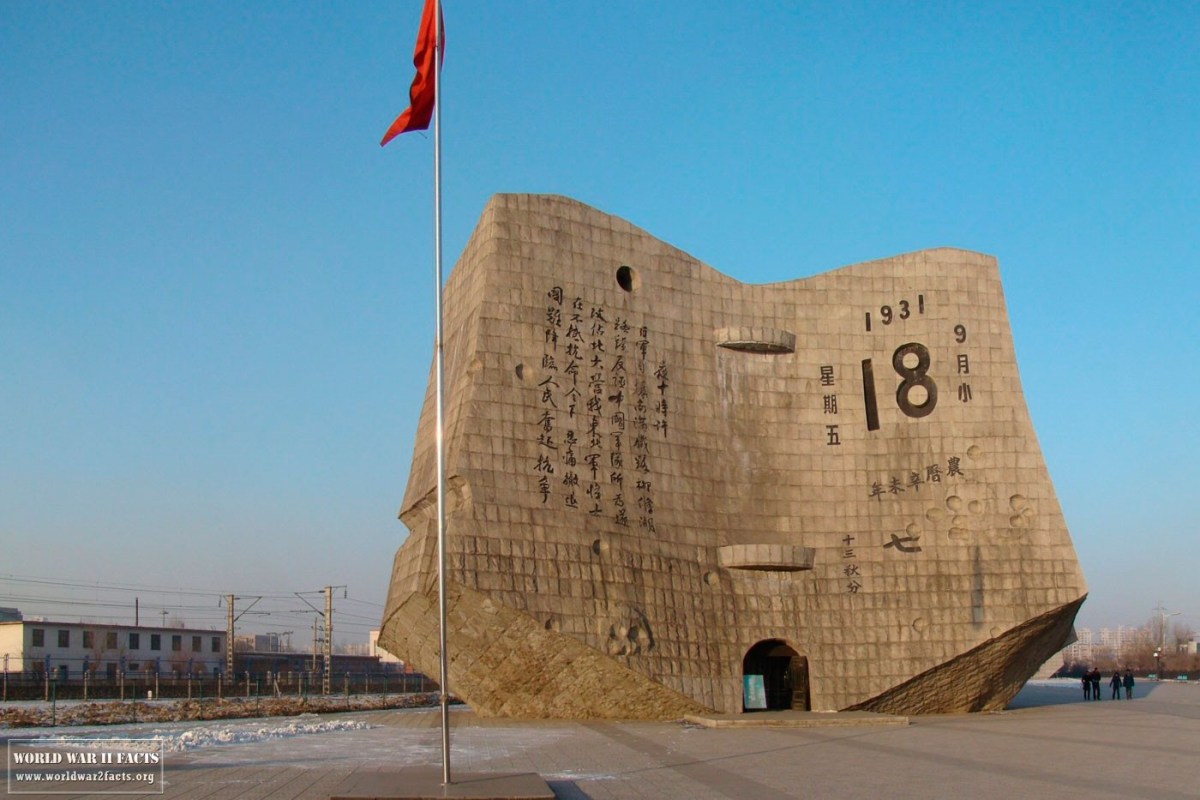
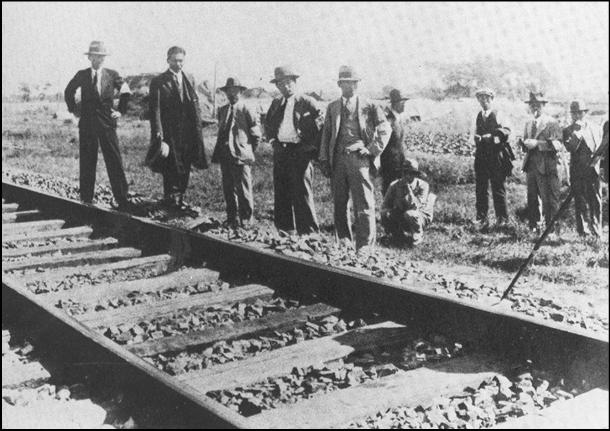
Subsequent treaties left Japanese forces in nominal control of Manchurian railroads when, on September 18, 1931, a minuscule dynamite charge was detonated by Japanese Lt. Kawamoto Suemori, near a railroad owned by Japan’s South Manchuria Railway near Mukden, in modern Shenyang, China. The explosion was so weak that it barely disturbed the tracks. A train passed harmlessly over the site just minutes later, yet, the script was already written.
The Imperial Japanese Army accused Chinese dissidents of the incident, launching a full scale invasion and installing the puppet emperor Puyias Emporer Kangde of the occupied state of “Manchukuo”, one of the most brutal and genocidal occupations of the 20th century.
The “Mukden incident” was entirely staged, a “false flag” operation and bald pretext to war, carried out by Japanese military personnel and identical in purpose to that carried out against Poland by Nazi aggressors some eight years later, nearly to the day.
As Western historians tell the tale of WW2, the deadliest conflict in history began in September 1939, with the Nazi invasion of Poland. The United States joined the conflagration two years later, following the sneak attack on the American Naval anchorage at Pearl Harbor, by naval air forces of the Empire of Japan.
Eastern historians are more likely to point to a day eight years earlier, when this and subsequent invasions and the famine and civil wars which ensued, killed more people than the modern populations of Canada and Australia, combined.
Feature image, top of page: Mukden Incident Memorial and Museum, Shenyang, China
If you enjoyed this “Today in History”, please feel free to re-blog, “like” & share on social media, so that others may find and enjoy it as well. Please click the “follow” button on the right, to receive email updates on new articles. Thank you for your interest, in the history we all share.
A February 7 lecture celebrating the bicentennial birthday of Emperor Norton I, invited participants to arrive in their best 1860s – ’70s attire, and “party like it’s 1859”!
Joshua Abraham Norton was born somewhere around 1818, in England. He lived most of his early life in South Africa, immigrating to the United States in 1849 following an inheritance of some $40,000 from his father, equivalent to about $1½ million, today.
As a successful San Francisco businessman, Norton parlayed his inheritance into an astounding fortune of $250,000, then blew it all on a bad Peruvian rice deal. A lawsuit followed, which the now-formerly wealthy businessman, lost. Somewhere along the line, Joshua Norton lost his mind, as well.
For a time, Norton disappeared from the public eye. He returned on September 17, 1859, proclaiming himself Emperor of the United States, his Royal Ascension announced to the public in a letter to the editor of the San Francisco Bulletin:
“At the peremptory request and desire of a large majority of the citizens”, it read, “I, Joshua Norton…declare and proclaim myself Emperor of these United States.” The letter went on to command representatives from all the states to convene in San Francisco, “to make such alterations in the existing laws of the Union as may ameliorate the evils under which the country is laboring.”
The edict was signed NORTON I, Emperor of the United States.”
To many of his “subjects”, “Emperor Norton” was an amusing eccentric. A harmless kook. Most were pleased to go along with the gag.
On October 12, Emperor Norton abolished the United States Congress, declaring “fraud and corruption prevent a fair and proper expression of the public voice…in consequence of which, we do hereby abolish Congress.”
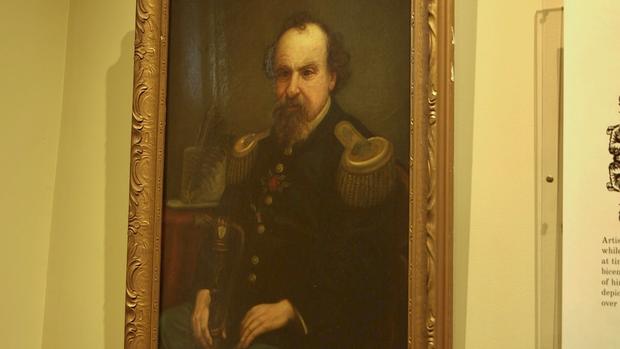
A portrait of Emperor Norton in the Society of California Pioneers is the only portrait he’s believed to have posed for. Photo credit: Joe Rosato Jr.
When the Congress failed to disperse, Norton issued a second edict, ordering General Winfield Scott to Washington to rout the rascals. “WHEREAS, a body of men calling themselves the National Congress are now in session in Washington City, in violation of our Imperial edict of the 12th of October last, declaring the said Congress abolished; WHEREAS, it is necessary for the repose of our Empire that the said decree should be strictly complied with; NOW, THEREFORE, we do hereby Order and Direct Major-General Scott, the Command-in-Chief of our Armies, immediately upon receipt of this, our Decree, to proceed with a suitable force and clear the Halls of Congress”.
That December, Norton fired Virginia Governor Henry Wise for hanging abolitionist John Brown, appointing then-vice President John C. Breckinridge in his stead.
The United States teetered on the brink of disunion in 1861, as Norton abolished the Union altogether and established an absolute monarchy, with himself at the helm. With the French military intervention in Mexico of that same year, Norton added to his already considerable titles, “Protector of Mexico”.
Norton wore an elaborate blue uniform with gold epaulettes, and carried a cane or saber and topped it off with beaver hat with peacock feather. By day, Emperor Norton “inspected” the streets and public works of San Francisco. By night he would dine in the finest establishments in the city. No play or musical performance would dare open in San Francisco, without reserved balcony seats for Emperor Norton.
Mark Twain, who lived for a time in Emperor Norton’s San Francisco, patterned the King in Huckleberry Finn, on Joshua Norton. Among his many proposals, Norton envisioned flying machines, the League of Nations, and the construction of the San Francisco Bay Bridge.
Though he was penniless, the “Official Norton Seal of Approval” was good for business. Some restaurants even put them out on brass plaques, declaring the prestigious “Appointment to his Imperial Majesty, Emperor Norton I of the United States”.
Most of the time, Norton was accompanied by two stray dogs. “Bummer” and “Lazarus” themselves became quite the celebrities, and usually dined for free along with the Emperor.
In 1867, police officer Armand Barbier arrested Norton, attempting to have the man involuntarily committed to an insane asylum. The public backlash was so vehement that Police Chief Patrick Crowley was forced to order Norton’s release, with profuse apologies. The episode ended well, when Emperor Norton magnanimously pardoned the police department. After that, San Francisco cops saluted Emperor Norton whenever meeting him in the street.
The 1870 California census records one Joshua Norton, age 50, occupation, Emperor, along with a note, declaring him to be insane.
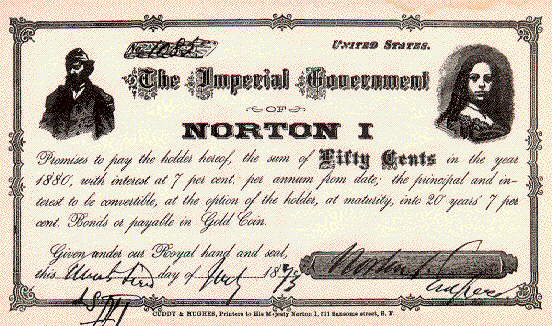
Admiring supporters gave Norton financial aid, in the guise of “paying taxes”. A local printer even printed “Imperial bonds”, emblazoned with Norton’s likeness and official seal. To this day, Norton’s Notes are highly prized collector’s items.
The San Francisco Board of Supervisors once bought Norton a new uniform, when the old one became shabby and threadbare. Norton responded with a very nice thank you note, issuing each of them a “Patent of Nobility in Perpetuity”.
On the evening of January 8, 1880, Norton collapsed on a sidewalk and died before help could arrive. The San Francisco Chronicle published his obituary on the front page, under the headline “Le Roi est Mort” (“The King is Dead”). “On the reeking pavement”, began another obituary, “in the darkness of a moon-less night under the dripping rain…, Norton I, by the grace of God, Emperor of the United States and Protector of Mexico, departed this life.”
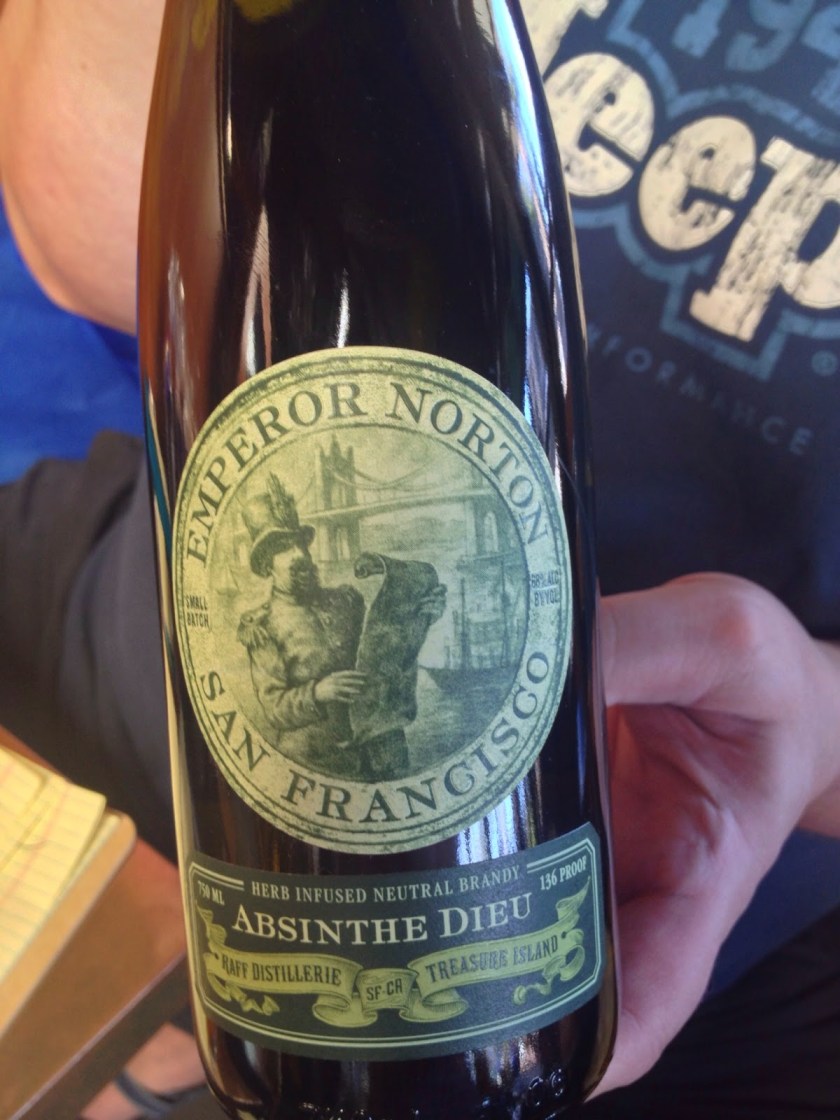
In a city which may be described as idiosyncratic, Norton remains the Patron Saint of eccentrics, to this day. The Bay area kicked off a month-long celebration of Norton’s bicentennial birthday on February 4, 2018, with walking tours, exhibitions and period nostalgia.
Joseph Amster in character as Emperor Joshua Norton for walking tours in San Francisco. Photo credit: Joe Rosato Jr. H/T NBC Bay Area
On its website, the Mechanic’s Institute Library and Chess Room proclaims “Emperor Norton at 200, a series of exhibits, talks, toasts and other special events organized by The Emperor’s Bridge Campaign, in partnership with Bay Area institutions, to mark the bicentennial of Emperor Norton’s birth“.
A February 7 lecture invited participants to arrive in their best 1860s – ’70s attire, and “party like it’s 1859! Join us at the Mechanics’ Institute on February 7th for cake and bubbly to celebrate the 200th birthday of Joshua Abraham Norton, the businessman who one day in 1859 declared himself Emperor of the United States and (in 1862) Protector of Mexico”.
The event sold out, in hours.
Emperor Norton’s funeral was attended by 10,000 loyal “subjects”, roughly 5% the entire population of San Francisco City and County, at that time. The reign of Emperor Norton I lasted for twenty-one years.
If you enjoyed this “Today in History”, please feel free to re-blog, “like” & share on social media, so that others may find and enjoy it as well. Please click the “follow” button on the right, to receive email updates on new articles. Thank you for your interest, in the history we all share.
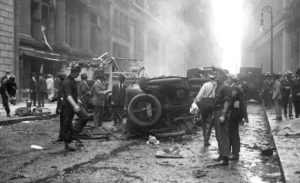
At a minute past noon, moments after the driver left the scene, the timer-set bomb exploded. The wagon and horse were blasted to bits, as automobiles were hurled through the air and iron weights tore through the late Summer crowd. Thirty-eight people were killed in the blast, mostly young people – messengers, stenographers, clerks and brokers. Hundreds more were maimed, 143 of those, grievously.
In the heart of the Financial District in Manhattan, at the corner of Wall Street & Broad stands an office building, commonly known as “The Corner”.
Once owned by J.P. Morgan & Co., 23 Wall Street was designated a New York City landmark in 1965, and later added to the National Register of Historic Places.
On this day in 1920, the horse-drawn wagon passed by lunchtime crowds and stopped outside the Financial District’s busiest corner. Inside the wagon was one-hundred pounds of dynamite, and five-hundred pounds of cast iron sash weights, designed to act as shrapnel.
At a minute past noon, moments after the driver left the scene, the timer-set bomb exploded. The wagon and horse were blasted to bits, as automobiles were hurled through the air and iron weights tore through the late Summer crowd. Thirty-eight people were killed in the blast, mostly young people – messengers, stenographers, clerks and brokers. Hundreds more were maimed, 143 of those, grievously.
Property damage was estimated at two million dollars, equivalent to $24.4 million, today. Suspicion for the blast centered on radical leftists, followers of the Italian anarcho-terrorist, Luigi Galleani.
A life-long anarchist and radical subversive, the 40-year-old Luigi Galleani was repeatedly incarcerated and/or deported from his native Italy, Switzerland, France and Egypt, before emigrating to the United States in 1901.
Settling in Paterson NJ and later Barre, Vermont, Galleani became editor of the largest Italian anarchist newsletter of the time, La Questione Sociale, as well as founding editor of the anarchist newsletter Cronaca Sovversiva (Subversive Chronicle)
Luigi Galleani
There, Galleani harangued and criticized “timid” socialists, organizing immigrant labor communities and agitating for the “propaganda of the deed”, direct action to overthrow the institutions of civil society and the market economy.
Luigi Galleani was specific. He wanted violence, and the man was every bit the fire-breather in person, as he was in his writing. Carlo Buda, brother of Galleanist bombmaker Mario Buda, said of Galleani, “You heard Galleani speak, and you were ready to shoot the first policeman you saw“.
Mario Buda was responsible for the Milwaukee Police Station bombing in 1917, an event which accounted for the largest single-incident loss of life in the history of United States law enforcement, until 9/11.
Historians believe that Galleanists began their bombing campaign in 1914, after police forcibly dispersed a protest outside the home of John D. Rockefeller, in Tarrytown, New York. A series of bombs over the next several months, destroyed churches, police stations and businesses.
A bomb was placed under the seat of a judge that November, who’d sentenced an anarchist for inciting to riot. Two months later, New York police uncovered a plot to blow up St. Patrick’s Cathedral.
In 1916, Chicago police hunted for Chef Nestor Dondoglio, who’d poisoned 100 guests at a banquet to honor Archbishop George Mundelein. Quick thinking and a hastily prepared emetic by a physician among the guests prevented any fatalities, but Dondoglio himself was never apprehended.
Bombings occurred at dozens of sites throughout late 1917 and into 1918, in New York, San Francisco, Washington, D.C., Boston, and Milwaukee, and always accompanied by the leaflets, denouncing “the priests, the exploiters, the judges and police, and the soldiers” whose time was coming to an end.
Palmer home, following the explosion
Galleani spoke before an anarchist group in Taunton, Massachusetts in February 1919. The following night, four of them attempted to place a bomb at the American Woolen Company’s mill in nearby Franklin, where workers were on strike. That time, the bomb went off prematurely, and killed all four of them.
That April, Galleani followers attempted to assassinate Woodrow Wilson’s Attorney General Alexander Mitchell Palmer, with a bomb mailed to his home in Washington, DC. The package was intercepted and defused but, not to be deterred, the group tried again that June. This time, the bomb was delivered in person by anarchist Carlo Valdinoci, who screwed something up and died in a blast so powerful, that it hurled the neighbors from their beds..
AG Palmer and his family were shaken but unhurt, though the blast mostly destroyed their home. Valdinoci’s remains rained down over an area of several city blocks.
In that one month alone, Italian anarchists mailed no fewer than 36 dynamite bombs to prominent political and business leaders.
One package was discovered because plotters had failed to add sufficient postage. Fortunately, most of the others were found out, as the packaging was identical. Most were never delivered but one blew off the hands of a housekeeper, working at the home of Senator Thomas W. Hardwick, a sponsor of the Immigration Act of 1918.
That June, another nine far more powerful bombs used up to twenty-five pounds of dynamite, for the first time introducing the use of metal slugs, to add to the bomb’s lethality. The intended victims were all political figures who’d supported anti-sedition or deportation legislation including AG Palmer himself, or judges who’d sentenced anarchists to long prison terms. None were successful, though one killed a 70-year-old night watchman, who stopped to check a suspicious package on the doorstep of judge Charles Nott.
Today, the period is derisively referred to as the first “Red Scare”. At the time, the American public clamored for action. Attorney General Palmer attempted to suppress these radical organizations in 1919-’20, but his “Palmer Raids” were often illegal, his arrests and detentions without warrant, and many of his deportations, questionable.
The 1920 arrest and subsequent execution of Italian-born American anarchists Nicola Sacco and Bartolomeo Vanzetti for the robbery and murder of two men in Braintree Massachusetts, remains controversial, to this day. Many blamed “anti-Italian” and “anti’immigrant” bias for the executions. Fifty years later, Massachusetts Governor Michael Dukakis proclaimed that Sacco and Vanzetti had been unfairly tried and convicted and that “any disgrace should be forever removed from their names”.
The Governor’s proclamation failed to note the 1927 attempts on the lives of Sacco & Vanzetti’s executioner Robert Elliott, nor that of Webster Thayer, trial judge in the Sacco-Vanzetti case. A second explosions at the Thayer home in 1932 destroyed the front of the house, and injured judge Thayer’s wife and housekeeper. Judge Thayer himself lived the rest of his life at a club at Boston University, under 24-hour guard.
The Wall Street bombing, carried out ninety-eight years ago today, was never solved.
Signs may still be seen of the 1920 bombing, at #23 Wall Street
If you enjoyed this “Today in History”, please feel free to re-blog, “like” & share on social media, so that others may find and enjoy it as well. Please click the “follow” button on the right, to receive email updates on new articles. Thank you for your interest, in the history we all share.
At first code-named “Water Carriers”, no self-respecting Brit wanted to be riding around in a “WC”, (“Water Closet”), so it was that these contraptions were destined to be known as “Water Tanks”, or just plain Tanks.
Leonardo da Vinci drew sketches of a man-powered, wheeled vehicle encased in armor and bristling with cannon, as early as the 15th century. The design was limited, since no human crew could generate enough power to move it for long, and the use of animals in such confined spaces was fraught with problems..
H.G. Wells’ December 1903 short story “The Land Ironclads”, depicted huge military land vessels, capable of disrupting military defenses and clearing the way for infantry. Wells’ machine was equipped with 8 giant pedrail wheels, each 10′ in height, and armed with cannon and machine-guns.
Early armored cars were fine for moving personnel over smooth roads, but there was a need for a vehicle capable of navigating the broken terrain of no man’s land. In the run-up to WWI, several soon-to-be belligerents were conducting experiments with “land ships”, with varying degrees of success.
A French captain named Levavasseur proposed a crawler-tracked armored vehicle equipped with artillery as early as 1903, but the project was abandoned by the Artillery Technical Committee. Later French attempts included the Breton-Pretot machine, sporting huge 10’ x 13’ tracks and the Aubriot-Gabet “Fortress”. Electrically powered, each of these things required its own power supply cable. Needless to say, the idea was not widely imitated.
In 1911, Austrian engineering officer Günther Burstyn and Australian civil engineer Lancelot de Mole independently developed working models of such vehicles, but both designs were rejected by their governments. They too would never be built.
The most unusual tank of WWI was the tricycle designed “Lebedenko” or “Tsar Tank”. Developed by pre-Soviet Russia, the armament and crew quarters on this thing were 27′ from the ground, making them irresistible targets for enemy artillery.
Russian shipyard engineer Vasily Mendeleev designed a 170-ton monster while aero-engineer Aleksandr Porokhovschikov developed a small cross-country vehicle running on a single rubber track called the “Vezdekhod”, translating as “He who goes anywhere“.
The Russian Revolution would overtake the project before the thing got out of prototype, but post-revolutionary Russian propagandists would seize on the vehicle as “proof” that Russia had designed the first Tank.
The British had the greatest degree of success, after a failed experiment with the “Tritton Trench-Crosser” in May, 1915. This beast had 8′ tractor wheels carrying 15’ girders on a chain, which were lowered into a trench so that the back wheels could roll over it. Girders would then drag behind, until the machine could back over them and rewind.
Finally, British work with the Holt Manufacturing Company of Stockton, California paid off with the most consistently successful track design. These “Caterpillar” treads had long been used on tractors. By 1916, the British army was using about 1,000 of Holt’s Caterpillar tractors on the Western Front.
These were the pet project of Winston Churchill, First Lord of the Admiralty, who described them as “Water Carriers” to mask their intended purpose.
No self-respecting Brit wanted to be riding around in a “WC”, (“Water Closet”), so it was that these contraptions were destined to be known as “Water Tanks”, or just plain Tanks. The name stuck. The “No1 Lincoln Machine” gave way to “Little Willie” and finally the Mark I “Big Willie”, the familiar Rhomboid shaped caterpillar track design which first appeared on the Somme Front on this day in 1916.
49 Mark Is were committed in that first tank battle, of which 32 were mechanically sound enough to take part in the advance. German lines fell back in confusion before “der Wagen des Teufels“, “the Devil’s Wagon”, but they were too few to hold.
With no suspension, the bone jarring ride on one of these monsters was just the beginning of what crews were forced to endure.
The interior was so loud that communication was only possible via hand signal. When bullets stuck the metal plates, splinters called “spall” would break away from the interior and fly about the cabin, requiring crew members to protect themselves with thick leather clothing and chain mail masks.
Interior temperatures rose to 122° Fahrenheit and more, making me wonder if these things weren’t as dangerous to their own crews as they were to the other side.
It was not until November 20 the following year at Cambrai, that the British Tank Corps had their first major success. Over 400 tanks penetrated 6 miles on a 7-mile front. The infantry failed to exploit the tanks’ gains, and almost all territory was recaptured by the Germans. The British scored a far more significant victory on August 8, 1918, with 600 tanks at the Battle of Amiens. General Erich Ludendorff called it a “Black Day” for the German Army.
In all, the French fielded about 3,600 light Renault FT tanks in WWI, the British over 2,500 of their heavy Mark I-Vs.
The German General Staff was slow to adopt the tank, concentrating instead on anti-tank weapons. The majority of the 50+/- tanks fielded by Germany in WWI, were captured British vehicles.
The only German project to be produced and fielded in WWI was the A7V. They only made 20 of these things in the armored, “Sturmpanzerwagen Oberschlesien“, “Upper Silesia Assault Armored Vehicle” version, and a few more in the unarmored “Überlandwagen”, “Over-land vehicle”, used for cargo transport.
It would be very different, in the next war.
If you enjoyed this “Today in History”, please feel free to re-blog, “like” & share on social media, so that others may find and enjoy it as well. Please click the “follow” button on the right, to receive email updates on new articles. Thank you for your interest, in the history we all share.
The political process fails us when those we trust to provide the “news” act as advocates, instead of honest conduits of information.
On September 8, 2004, CBS News aired a 60 Minutes™ program hosted by News Anchor Dan Rather, centered on four documents critical of President George W. Bush’s National Guard service in 1972-‘73. It was less than two months before the 2004 Presidential election.
The documents were supposed to have been written by Bush’s commander, Lieutenant Colonel Jerry B. Killian, who was unavailable for comment. Lt. Col. Killian passed away, in 1984.
The documents came from Lt. Col. Bill Burkett, a former Texas Army National Guard officer who had received publicity back in 2000, when he claimed to have been transferred to Panama after refusing to falsify then-Governor Bush’s personnel records. Burkett later retracted the claim, but popped up again during the 2004 election cycle. Many considered the man to be an “anti-Bush zealot”.
Within hours of the broadcast, the documents were criticized as forgeries. Internet fora and blogs challenged the terminology and typography of the memos. Within days it came out that the font used in the memos didn’t even exist, at the time the documents were supposed to have been written.
That didn’t stop the Boston Globe from running a story entitled “Authenticity Backed on Bush Documents”, a story it was later forced to retract.
Criticism of the 60 Minutes’ piece intensified, as CBS News and Dan Rather dug in and defended their story. Within the week, Rather was talking to a Daily Kos contributor and former typewriter repairman who claimed that the documents could have been written in the 70s.
Meanwhile, the four “experts” used in the original story were publicly repudiating the 60 Minutes piece.
Other aspects of the documents were difficult to authenticate without the originals. CBS had nothing but faxes and photocopies. Burkett claimed to have burned the originals after faxing them to the network.
The New York Times interviewed Marian Carr Knox, then-secretary to the squadron in 1972, running a story dated September 14 under the bylines of Maureen Balleza and Kate Zernike. The headline read “Memos on Bush Are Fake but Accurate, Typist Says“.
The story went on to describe the 86 year-old Carr’s recollections that she never typed the memos, but they accurately reflected Lt. Col. Killian’s sentiments. “I think he was writing the memos”, she said, “so there would be some record that he was aware of what was going on and what he (Bush) had done.”
Yet Killian’s wife and son had cleared out his office after his death, and neither found anything so much as hinting at the existence of such documents. Others who claimed to know Carr well described her as a “sweet old lady”, but said they had “no idea” where those comments had come from.
CBS News would ultimately retract the story, as it came out that Producer Mary Mapes collaborated on it with the Kerry campaign. Several network news people lost their jobs, including Dan Rather himself, and Mapes.
Public confidence in the “Mainstream Media” plummeted. Many saw the episode as a news network lying, and the “Newspaper of Record” swearing by it.
“Conservative” news sources like PJ Media rose from the ashes of the scandal, a tongue-in-cheek reference to the fact that a bunch of bloggers “in their jammies”, had uncovered in a matter of hours, what the vaunted news gathering apparatus of CBS News failed to figure out in weeks.
That the mainstream media “filters” the news, is neither a revelation, nor is it new. In 1932-’33, New York Times reporter Walter Duranty reported on Josef Stalin’s deliberate starvation of millions of Ukrainians, known as “Holodomor”. “Extermination by hunger”. With 25,000 starving to death every day, Duranty won a Pulitzer with such gems as: “There is no famine or actual starvation nor is there likely to be.” – (Nov. 15, 1931), and, “Any report of a famine in Russia is today an exaggeration or malignant propaganda.” – (Aug. 23, 1933).
The 1993 NBC Dateline “Exploding Truck” edition didn’t get the desired effect when it crash tested General motor’s pickup truck, so the network rigged another with a pyrotechnic device. Sure enough, that one exploded, right on cue. The “Exposé” was pure BS masquerading as “News”, but hey. The explosion made for good television.
In a transparent attack on an administration with which it had political disagreements, the New York Times ran the Abu Ghraib story on the front page, above the fold, for 32 days straight. Just in case anyone might have missed the first 31.
And who can forget that racially incendiary, edited audio from George Zimmermann’s 911 call, or those photoshopped images, of the man’s head. Thank you, NBC.
If the point requires further proof, watch ABC News Charlie Gibson’s 2008 interview with Sarah Palin, then read the transcript. Whether you like or don’t like Ms. Palin is irrelevant to the point. The transcript and the interview as broadcast, are two different things.
As I write, Hurricane Florence makes landfall, on the North Carolina coast. A storm in which, three days ago, the Washington Post declared President Trump, to be “complicit”.
The political process fails us when those we trust to provide the “news” act as advocates, instead of honest conduits of information. The American system of self-government operates within a marketplace of ideas. Such a system cannot properly function when those who would be its “watchdogs”, must themselves, be watched. That may be the worst part of this whole sorry story.
If you enjoyed this “Today in History”, please feel free to re-blog, “like” & share on social media, so that others may find and enjoy it as well. Please click the “follow” button on the right, to receive email updates on new articles. Thank you for your interest, in the history we all share.


 Merkle thought so too, and ran to the Giants’ clubhouse, never touching second base.



 Terror gripped the region in the later months of 1764, as the Beast attacked women, men and children. Usually while alone, and often while tending livestock.




 Jefferson Davis’ experiment was to be the first large-scale re-introduction of these animals on the North American continent, in geologic history.


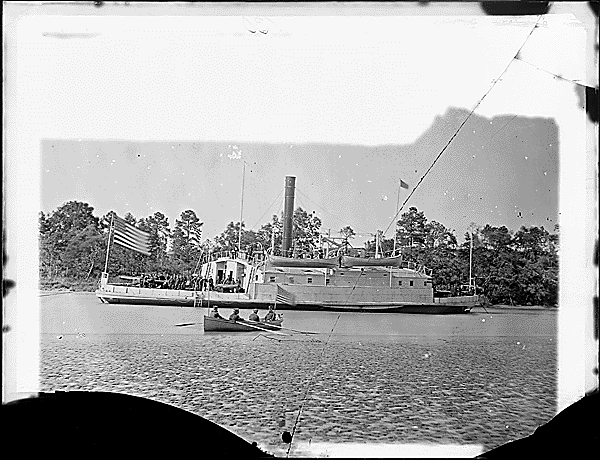
 The first Sino-Japanese war of July 1894 – April 1895, was primarily fought over control of the Korean peninsula. The outcome was never in doubt, with the Japanese army and navy by this time patterned after those of the strongest military forces of the day.
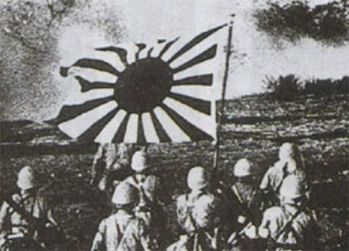 As Western historians tell the tale of WW2, the deadliest conflict in history began in September 1939, with the Nazi invasion of Poland. The United States joined the conflagration two years later, following the sneak attack on the American Naval anchorage at Pearl Harbor, by naval air forces of the Empire of Japan.


 WHEREAS, it is necessary for the repose of our Empire that the said decree should be strictly complied with; NOW, THEREFORE, we do hereby Order and Direct Major-General Scott, the Command-in-Chief of our Armies, immediately upon receipt of this, our Decree, to proceed with a suitable force and clear the Halls of Congress”.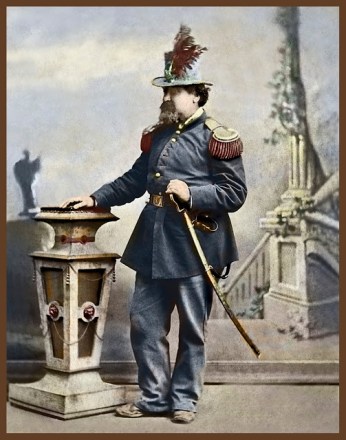




 In the heart of the Financial District in Manhattan, at the corner of Wall Street & Broad stands an office building, commonly known as “The Corner”.


 That June, another nine far more powerful bombs used up to twenty-five pounds of dynamite, for the first time introducing the use of metal slugs, to add to the bomb’s lethality. The intended victims were all political figures who’d supported anti-sedition or deportation legislation including AG Palmer himself, or judges who’d sentenced anarchists to long prison terms. None were successful, though one killed a 70-year-old night watchman, who stopped to check a suspicious package on the doorstep of judge Charles Nott.


 Early armored cars were fine for moving personnel over smooth roads, but there was a need for a vehicle capable of navigating the broken terrain of no man’s land. In the run-up to WWI, several soon-to-be belligerents were conducting experiments with “land ships”, with varying degrees of success.

 The most unusual tank of WWI was the tricycle designed “Lebedenko” or “Tsar Tank”. Developed by pre-Soviet Russia, the armament and crew quarters on this thing were 27′ from the ground, making them irresistible targets for enemy artillery.


 Interior temperatures rose to 122° Fahrenheit and more, making me wonder if these things weren’t as dangerous to their own crews as they were to the other side.
 The only German project to be produced and fielded in WWI was the A7V. They only made 20 of these things in the armored, “Sturmpanzerwagen Oberschlesien“, “Upper Silesia Assault Armored Vehicle” version, and a few more in the unarmored “Überlandwagen”, “Over-land vehicle”, used for cargo transport.
 It would be very different, in the next war.

 The documents came from Lt. Col. Bill Burkett, a former Texas Army National Guard officer who had received publicity back in 2000, when he claimed to have been transferred to Panama after refusing to falsify then-Governor Bush’s personnel records. Burkett later retracted the claim, but popped up again during the 2004 election cycle. Many considered the man to be an “anti-Bush zealot”.
 Meanwhile, the four “experts” used in the original story were publicly repudiating the 60 Minutes piece.
 Yet Killian’s wife and son had cleared out his office after his death, and neither found anything so much as hinting at the existence of such documents. Others who claimed to know Carr well described her as a “sweet old lady”, but said they had “no idea” where those comments had come from.
 Public confidence in the “Mainstream Media” plummeted. Many saw the episode as a news network lying, and the “Newspaper of Record” swearing by it.


You must be logged in to post a comment.