April 23, 1982 Conch Republic

The variety of flora and fauna – rich though they are – do not approach the variety of people on the island. Pirates, fighter pilots, smugglers and cops. Shrimpers and singers. Sculptors and sword-swallowers. Bone carvers, body painters and musicians of every sort. A small fleet of commercial fisherman and more Pulitzer Prize winners per capita than any other city. – The Tennesseean

The competition is fierce every December 31, for intergalactic bragging rights. Who will go home with that coveted title, “where the weird go pro”? New York drops that famous ball on New Year’s Eve and Miami drops an orange, but that stuff’s JV. Bethlehem Pennsylvania drops a 450-pound “peep”, that yellow marshmallow treat that only comes around at Easter. Not to be outdone, Eastover North Carolina drops a 39-pound, ceramic flea (don’t ask). Mobile Alabama has a 600-pound Moon Pie (ya got an RC Cola for that?). Prairie du Chiens Wisconsin drops a live (dead) carp called “lucky”, selected by, I kid you not, a carp committee. In Eastport Maine it’s a sardine. Others have their apples and pinecones and olives, but nothing the likes of “Sushi”, a live Drag Queen descending in a 13-foot stiletto heel.

“Weird” is no mere annual occurrence in a place where businessmen in suits ride about on electric skateboards. Where crowds cheer dachshund parades and bed races down the main, err, drag. Where the most famous headstone in the town cemetery says: “I told you I was sick!”

spidey1991-edit

From “Robert” the evil doll of Fort East Martello to the wild chickens roaming the streets, where conch fritters are considered a food group and history is literally built on salvaging shipwrecks, we’re talking about Key West Florida. Where the “Weird go Pro”.

On December 5, 1937, bar owner Joe Russell faced an increase in rent. From three dollars a week to a whopping four bucks. Lucky for Joe, the former Victoria Restaurant owned by one Juan Farto (I didn’t make that up), was available. That night, everyone in the place grabbed his chair, picked up his drink and “moved” the bar across the street.

None other than Ernest Hemingway pitched in, (yeah, That Ernest Hemingway), helping himself to the urinal. “I’ve pissed enough of my money into this thing to pay for it” he said, bringing the object home to his wife Pauline, who converted it to a fountain. The peacocks who once roamed “Papa” Hemingway’s yard are gone now but the fountain’s still there, not far from “Sloppy Joe’s Bar” on the corner of Greene and Duval Street.
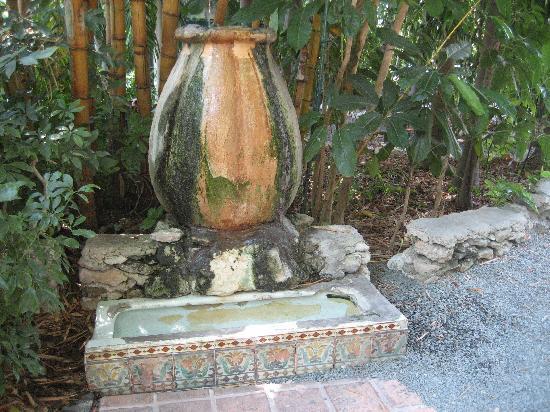
urinal-made-into-a-fountain
Papa Hemingway’s fountain

Ladies? You married guys out there? Can you imagine bringing such an object home to your wife? Mrs. Hemingway turned the thing into a fountain.

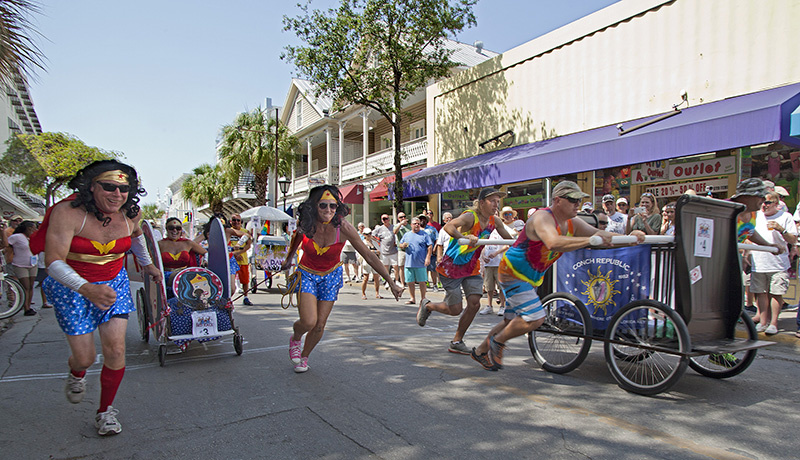
Where else but Duval Street could you watch a “bed race” pulled by teams dressed in Wonder Woman outfits and grass skirts.
kwp01web2
Duval Street Bed Races, July 2015. H/t CBS, Miami

Speaking of the town cemetery. One long-suffering wife got the last word on a philandering husband, proving you should always be careful who orders your headstone. This one says “At least I know where he’s sleeping tonight“.

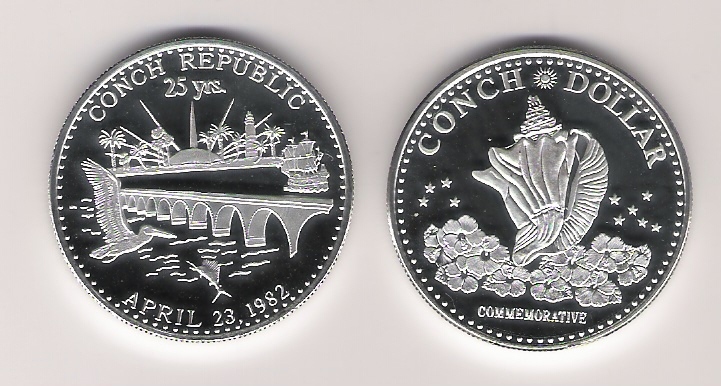
Oh.  Did I tell you the place seceded?  No, really.  It’s the “Conch Republic”, now.
ec04bba643c980a32309bc6e62e028db

Except for the Naval Air Station at Boca Chica and Coast Guard installations in Key West, Marathon and Islamorada, most of the economic activity in the Florida Keys, comes from tourism. It’s no wonder that, when the federal government shuts down the only road into the Keys, the locals are going to get cranky.

In April 1982, the Mariel boat lift was a mere two years in the past, and very much in the public memory.
CON271_-_Conch_Republic_1_Conch_Dollar_2007

On April 18, Border Patrol set up a roadblock in front of Skeeter’s Last Chance Saloon in Florida City, shutting down US Route 1, the only road in and out of the Florida Keys.  Originally intended to intercept illegals entering the country, the roadblock soon morphed into a hunt for illegal drugs, as well.

Cars waited for hours in lines stretching 19 miles. Predictably, the attitude of Federal officials was one of towering indifference. Not so local business owners. Robert Kerstein wrote in his Key West on the Edge — Inventing the Conch Republic, “No one in Key West doubted that drugs were trafficked widely in the Keys by road and by boat. But tourism’s boosters had little tolerance for interruptions to their business.”

poster1

Mayor Dennis Wardlow contacted the chief of police, the Monroe County sheriff, his State Representative and Governor Bob Graham, demanding the roadblock’s removal. With none of the above having any knowledge of the barrier and lacking the authority to pull it down, Wardlow contacted the Immigration and Naturalization Service directly. When the Border Patrol told him it was “none of his business,” the Mayor’s response may best be summed up in the words of Bugs Bunny: “Of course you know, this means war!

Suffering a blizzard of hotel cancellations, this “attack on Key West’s sovereignty” could not stand. On April 22, Mayor Wardlow, local attorney & pilot David Horan and Old Town Trolley Tours operator Ed Swift flew to Miami seeking legal remedy. When District Court Judge C. Clyde Atkins failed to issue an injunction, the Key West delegation took to the courthouse steps.

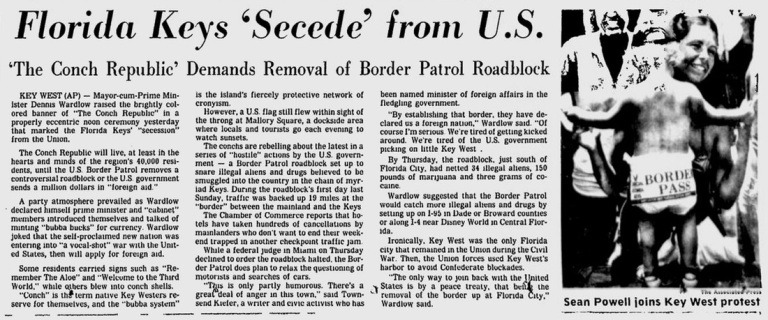
“What are you going to do, Mr. Mayor”, asked the assembled media. Swift leaned over and whispered into the Mayor’s ear, “Tell them we are going to go home and secede!” “We are going to go home and secede!”, said Wardlow. And that’s what they did.
conch-republic-secession

Over the next 24 hours, secessionist co-conspirators worked feverishly to form a new government, filling cabinet positions such as “Secretary of Underwater Affairs” and “Minister of Nutrition”.

logo-navy2

On April 23, with federal agents on scene to monitor the proceedings, a crowd gathered before the old customs building. Mayor Wardlow and a gaggle of allies mounted the back of a flatbed truck, to read the proclamation of secession. “We serve notice on the government in Washington”, Wardlow began, “to remove the roadblock or get ready to put up a permanent border to a new foreign land. We as a people, may have suffered in the past, but we have no intention of suffering in the future at the hands of fools and bureaucrats“.

With that, Mayor Wardlow declared “war” on the United States.  The “Great Battle of the Conch Republic” broke out in the harbor, when the Schooner Western Union commanded by Captain John Kraus, attacked the Coast Guard Cutter Diligence with water balloons, Conch fritters and toilet paper.  Diligence fought back with water hoses, as the new “Prime Minister” broke a stale loaf of Cuban bread over the head of a man dressed in a Navy uniform.
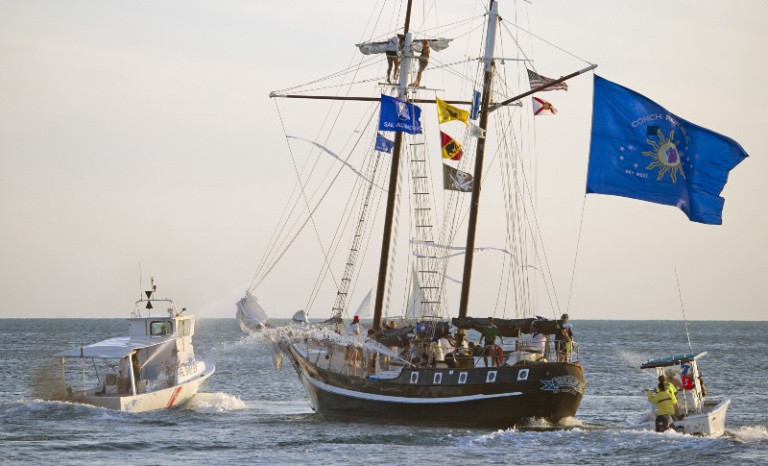
download-73
Naval History was forever changed on this day, as the “Great Battle of the Conch Republic” raged across the waters of Key West

Pandemonium broke out as onlookers launched stale bread and conch fritters at federal agents, Navy sailors and Coast Guard personnel. One minute after declaring his “verbal shot” at the Federal government, Mayor Wardlow surrendered to a nearby Naval officer, demanding a billion dollars in “foreign aid” in compensation for “the long federal siege.”

conch-republic-passports

Apparently, that’s what it takes to get the attention of a Federal government bureaucrat. The roadblock lifted.  The restaurants, stores and hotels of the Keys soon filled with tourists and, once again, happiness smiled upon the land.  Key West never did get its “foreign aid”, but secessionist leaders never received so much as a letter saying they couldn’t leave the Union, either.

ConchRepublicSpecialForces

So it is that the micro-nation of Key West celebrates its independence, every April 23.

The “Conch Republic’ issues its own passports, selling T-shirts and bumper stickers with the slogan “We seceded where others failed”.

And if the Federal government ever comes back to mess with the sovereign nation of Key West, it had best be prepared to deal with the Conch Republic’s very own “Special Forces”, the motto for which is “Sanctus Merda”.  “Holy Shit”.

Tip of the hat to the “Conch Republic Military Forces, The Official Site of the Conch Republic Military” for the “Conch Battle Hymn of the Republic”.  Lyrics by First Sea Lord, Admiral Finbar Gittelman, October 14, 2012 © Finbar Gittelman

Mine eyes have seen the glory of the sunshine and the sea
Right here upon our islands, where we love to live so free 
But in April 1982, the peace was not to be 
And we went rolling on

CHORUS
Glory glory Conch Republic 
From Key to shining Key

They were setting up a check point, tween the mainland and the Keys 
They had put a US Border, where it shouldn’t ‘oughta’ be 
So that’s when we seceded, and declared our sovereignty 
And the fun had just begun

(CHORUS)

We went forth into the harbor and a cutter we did spy 
And we sailed up along side her and we took her by surprise 
We hoisted up our battle flag, so proudly and so high 
And we went sailing on

(CHORUS)

The water and Conch fritters and the Cuban bread did fly 
Our bombers, they were raining toilet paper from the sky 
Our cannons they did thunder to proclaim our victory 
And we fought bravely on

(CHORUS)

We have faced the silly forces of misguided zealotry 
We have stood up to their foolishness for all the world to see 
And we’ve showed the other nations what America can be From
Key to shining Key

April 7, 1942 WW2 Era Internment of Japanese Americans

In the camps themselves, many were eager to prove themselves loyal Americans. Some were recruited for service in the armed forces. Many volunteered.

In January 1848, carpenter and sawmill operator James W. Marshall discovered gold in the foothills of the Sierra Nevada mountains, in California. Prospectors flocked to the Golden State from across the United States and abroad. The California Gold Rush had begun.

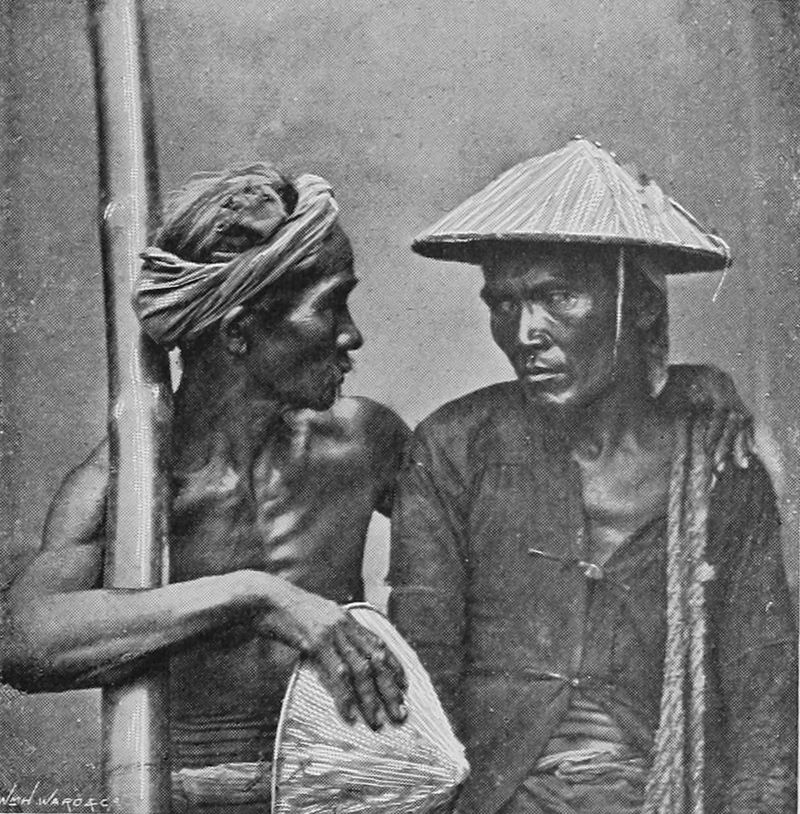
While not exactly welcoming, prospectors tolerated Chinese immigrants. At least during the early period. Surface gold was plentiful in those days. Some even found the chopsticks and broad conical hats of the Chinese mining camps, amusing. As competition increased, resentment began to build. Meanwhile in southern China, crop failures and rumors of the Golden Mountain, the Gam Saan, brought with it a tide of Chinese immigration. San Francisco saw a tenfold increase in 1852 alone. Now anything but amused, California lawmakers imposed a $3 per month tax on foreigners, explicitly aiming at Chinese miners.

Large labor projects like the trans-continental railroad and Canadian Pacific Railway fed the influx of Chinese “coolie” labor, eager to work for wages too small to be of interest to American laborers.

By 1870, a full 25% of the California state budget came from that single tax on Chinese miners. In 1882, President Chester A. Arthur signed the Chinese Exclusion Act, prohibiting the further immigration of Chinese laborers. It was the first and remains to this day the only law specifically targeted at one ethnic group.

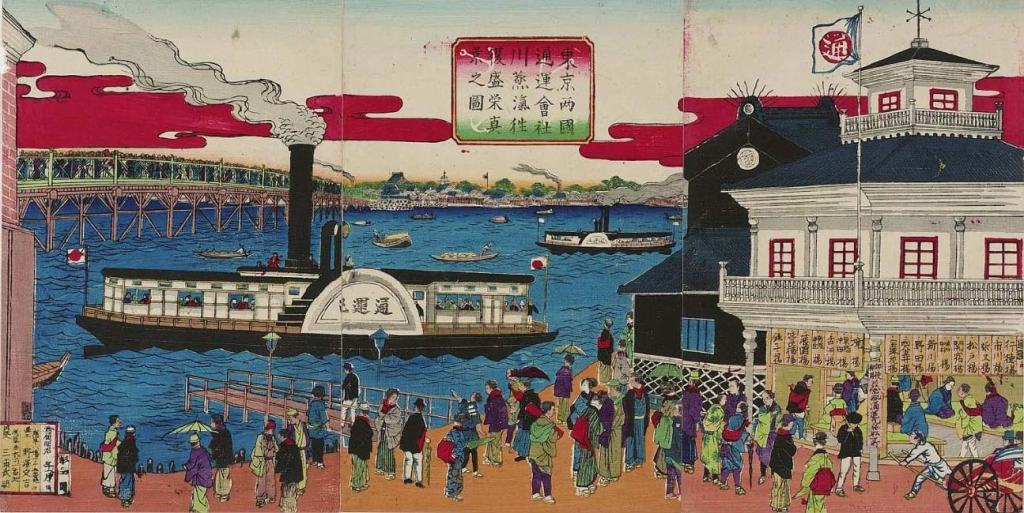
Meanwhile, the “gunboat diplomacy” of President Millard Fillmore determined to open Japanese ports to trade with the west.  By force, if necessary. By 1868, internal Japanese issues and the growing pressure of western encroachment brought about the end of the Tokugawa Shōgunate and restoration of the Meiji Emperor. 

The social changes wrought by the “Meiji Restoration” combined with abrupt opening to world trade plunged the Japanese economy into recession. Since the 15th century, Japanese emigrants had left the home islands in pursuit of new opportunities. That was nothing compared with the new “Japanese diaspora” beginning in 1868. 3.8 million “Nikkei” emigrated between 1868 and 1912 alone, bound for destinations from Brazil to mainland China, the United States, Australia, Peru, Germany and even Finland.

These were the Issei, first generation immigrants, ineligible for citizenship under US law. The immigrant generation kept to the ways of the land they had left behind forming kenjin-kai, social and aid organizations built around the prefecture from which they had come. Not so, the second generation. These were the Nisei, American-born US citizens, thoroughly assimilated in the culture to which their parents had arrived.

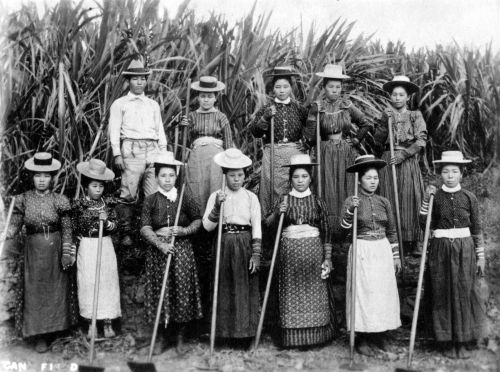
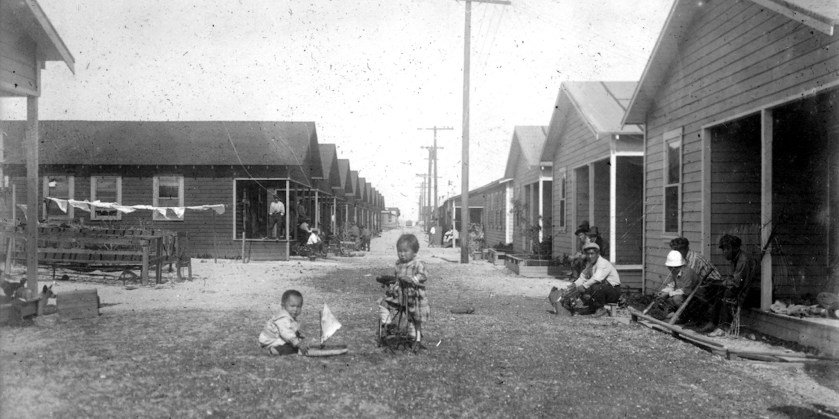
Japanese immigrants in Hawaii

As with the earlier wave of Chinese immigrants, west coast European Americans became alarmed at the tide of Japanese immigration. Laws were passed and treaties signed, attempting to slow their number.

In 1908, an informal “Gentleman’s agreement” between the US and Japan prohibited further immigration of unskilled immigrants. A loophole allowed wives to join their husbands already in the United States leading to an influx of “picture brides” – marriages arranged by friends and families and executed by proxy – many happy couples meeting for the first time on the arrival of the blushing bride. The immigration act of 1924 followed the example of the Chinese exclusion act of 1882, outright banning further immigration from “undesirable” Asian countries.

By this time some 200,000 ethnic Japanese lived in Hawaii, mostly laborers working on the island’s sugar plantations. A nearly equal number settled on the west coast, building farms and small businesses.

From 1937, the rapid conquests of the Asian Pacific raised fears that the Imperial Japanese military was unstoppable. As relations soured between Japan and America, the Roosevelt administration took to surveillance of Japanese Americans.

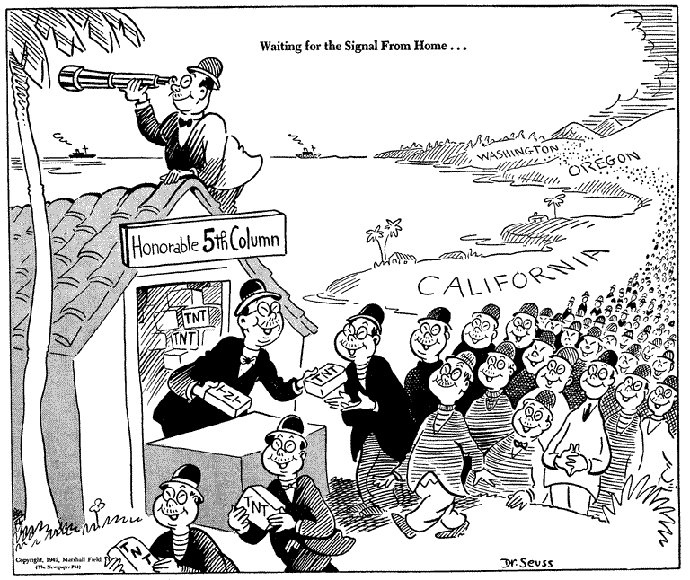
This and other images of the period leads us today, to a place where Dr. Seuss is “cancelled”.

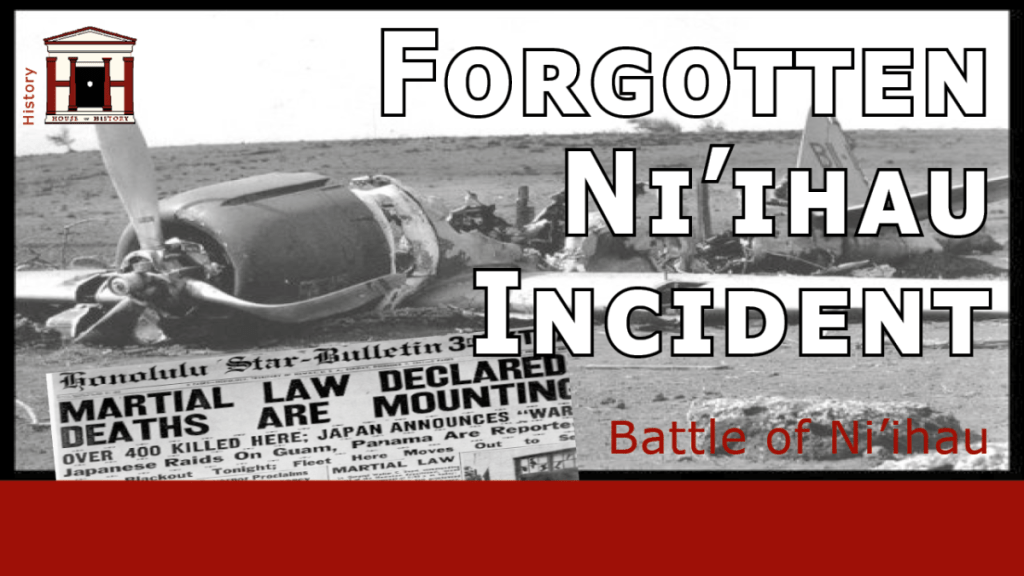
Following the surprise attack on Pearl Harbor, public sentiment came down largely on the side of Japanese Americans. The Los Angeles Times characterized them as “good Americans, born and educated as such.” That would soon change. A member of the second attack wave on December 7, “Zero” pilot Shigenori Nishikaichi downed his crippled fighter on Ni’ihau, the westernmost island of the Hawaiian archipelago. Ignorant of what had taken place, Ni’hauans showed hospitality to the downed pilot. By the time it was over the whole thing turned violent, pitting the pilot and a small number of ethnic Japanese in a deadly struggle against native Hawaiians.

The “Ni’hau incident” combined with fears of 5th column activity to turn the tide of public opinion.

General John Dewitt, a vocal proponent of what was about to happen, opined: “The fact that nothing has happened so far is more or less . . . ominous, in that I feel that in view of the fact that we have had no sporadic attempts at sabotage that there is a control being exercised and when we have it it will be on a mass basis”.

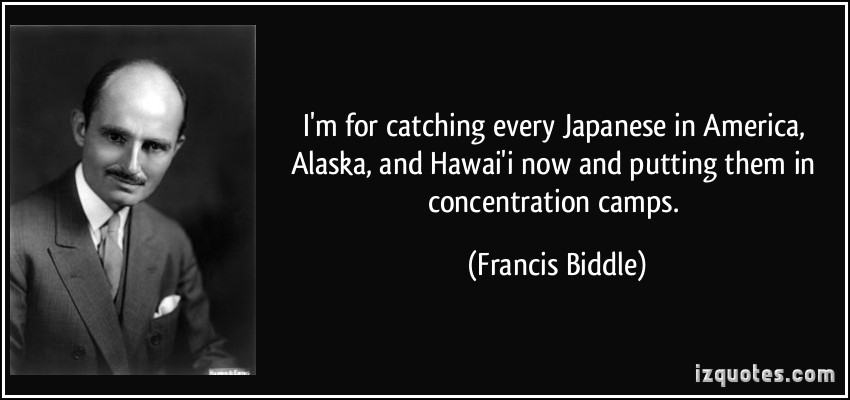
Roosevelt Attorney General Francis Beverley Biddle

On January 2, a Joint Immigration Committee of the California legislature attacked “ethnic Japanese”, citizen and non-citizen alike, as “totally unassimilable”. The presidentially appointed Roberts Committee assigned to investigate the attack on Pearl Harbor accused persons of Japanese ancestry of espionage, prior to the attack. By February, California Attorney General and future Supreme Court Justice Earl Warren was doing everything he could to persuade the federal government to remove all ethnic Japanese from the west coast.

On January 14, 1942, President Roosevelt signed Proclamation 2537 requiring “enemy aliens” to procure identification and carry it with them “at all times”. The War Department and Department of Justice were sharply divided but, no matter. Executive order 9066 signed February 19 directed the establishment of exclusion zones.

Secret Presidential commissions were appointed in early 1941 and again in 1942 to determine the likelihood of an armed uprising among Japanese Americans. Both reported no evidence of such a thing, one reporting: “the local Japanese are loyal to the United States or, at worst, hope that by remaining quiet they can avoid concentration camps or irresponsible mobs.”

None of it mattered. The Senate discussed Roosevelt’s directive for an hour and the House, thirty minutes. The President signed Public Law 77-503 on March 21 providing for enforcement of his earlier directive.

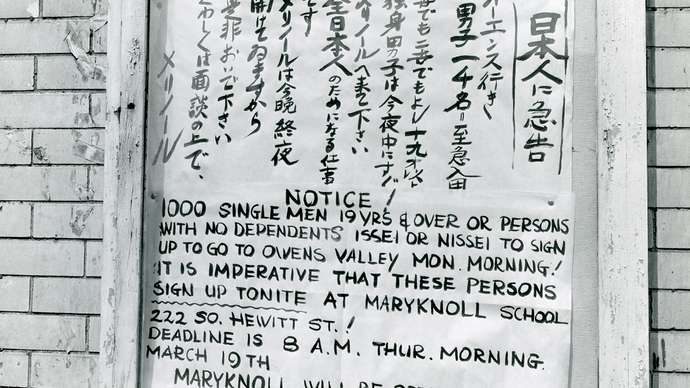
Japantown handbill: H/T Library of Congress

Roosevelt’s measure made no specific reference to ethnicity. Some 11,000 ethnic Germans and 3,000 ethnic Italians were sent away to internment camps, but the vast preponderance were of Japanese descent. Throughout the west coast some 112,000 ethnic Japanese were rounded up and held in relocation camps and other confinement areas throughout the country. Surprisingly, only a “few thousand” were detained in Hawaii itself despite a population of nearly 40% ethnic Japanese.

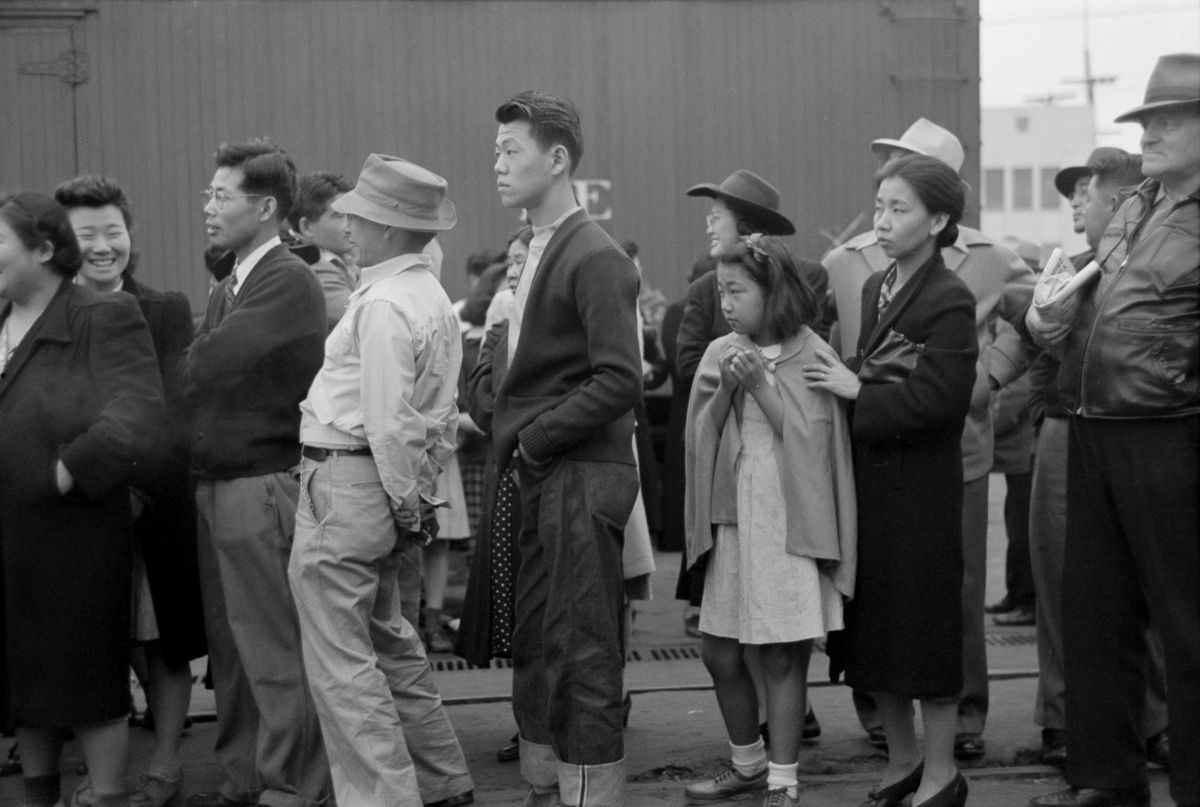
Below: “A moving van being loaded with the possessions of a Japanese family on Bush Street in San Francisco’s Japantown, April 7, 1942. At right are the offices of the Japanese American Citizens League (JACL), the oldest Asian American civil rights organization in the United States. Shortly after this photo was taken, the Wartime Civil Control Administration (WCCA) took over the JACL building and repurposed it as a Civil Control Station for the collection and processing of “people of Japanese descent” prior to their transport to detention camps”.

H/T Encyclopedia Britannica

Following the events at Peal harbor, Oakland California-born Fred Korematsu attempted to enlist in the Navy. Ostensibly rejected due to stomach ulcers, Korematsu believed the real reason was his Japanese ancestry. Korematsu refused deportation orders and went into hiding. The ACLU’s northern California director Ernest Besig brought Korematsu’s case before the courts despite opposition from Roosevelt allies in the national ACLU. Korematsu lost in federal court and the US court of appeals, becoming a pariah even among fellow detainees who felt he was nothing but a troublemaker. The US Supreme Court agreed to take the case and, on December 18, 1944, upheld the lower court verdict. A 6-3 opinion penned by Justice Hugo Black opined that, though suspect, internment was justified due to national circumstances of “emergency and peril”.

“Fourteen Days to Flatten the Curve

A second decision released that same day in the case Ex Parte Endo, unanimously declared it illegal to detain Americans, regardless of ethnicity. In effect the two rulings established that, while eviction was legal in the name of military necessity internment was not, thus paving the way to their release.

“There is but one way in which to regard the Presidential order empowering the Army to establish “military areas” from which citizens or aliens may be excluded. That is to accept the order as a necessary accompaniment of total defense”.

Washington Post, February 22, 1942

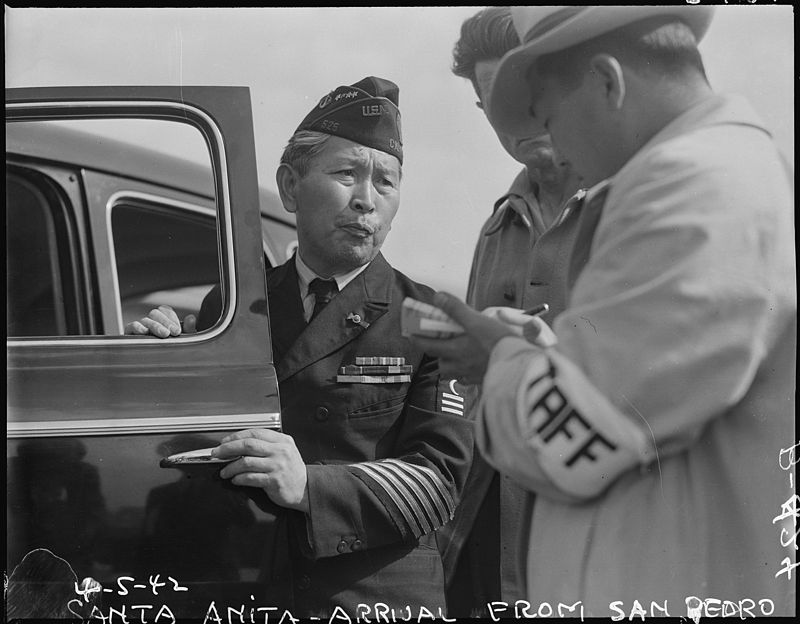
“Dressed in uniform marking his service in World War I, a U.S. Navy veteran from San Pedro enters Santa Anita Assembly Center (April 1942)”. H/T Wikipedia

The Japs in these centers in the United States have been afforded the very best of treatment, together with food and living quarters far better than many of them ever knew before, and a minimum amount of restraint. They have been as well fed as the Army and as well as or better housed. . . . The American people can go without milk and butter, but the Japs will be supplied.

Los Angeles Times, December 8, 1942

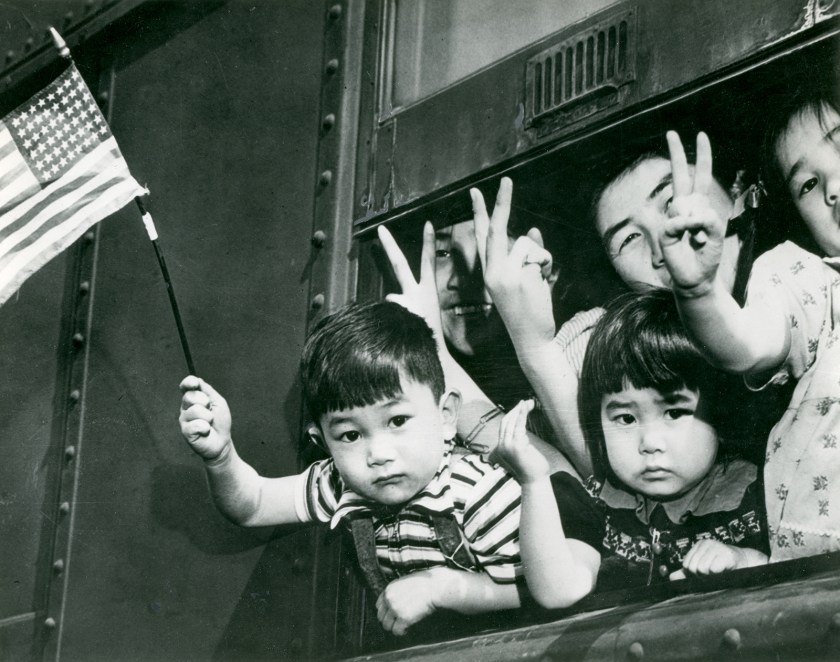
In the camps themselves, many were eager to prove themselves loyal Americans. Some were recruited for service in the armed forces. Many volunteered. In April 1943 some 2,686 Japanese Americans from Hawaii and 1,500 incarcerated in mainland camps reported for duty at camp Shelby, in Mississippi. While many still had families in internment facilities, graduates were assigned to the segregated 442nd Regimental Combat team and sent off to fight the war in Europe.

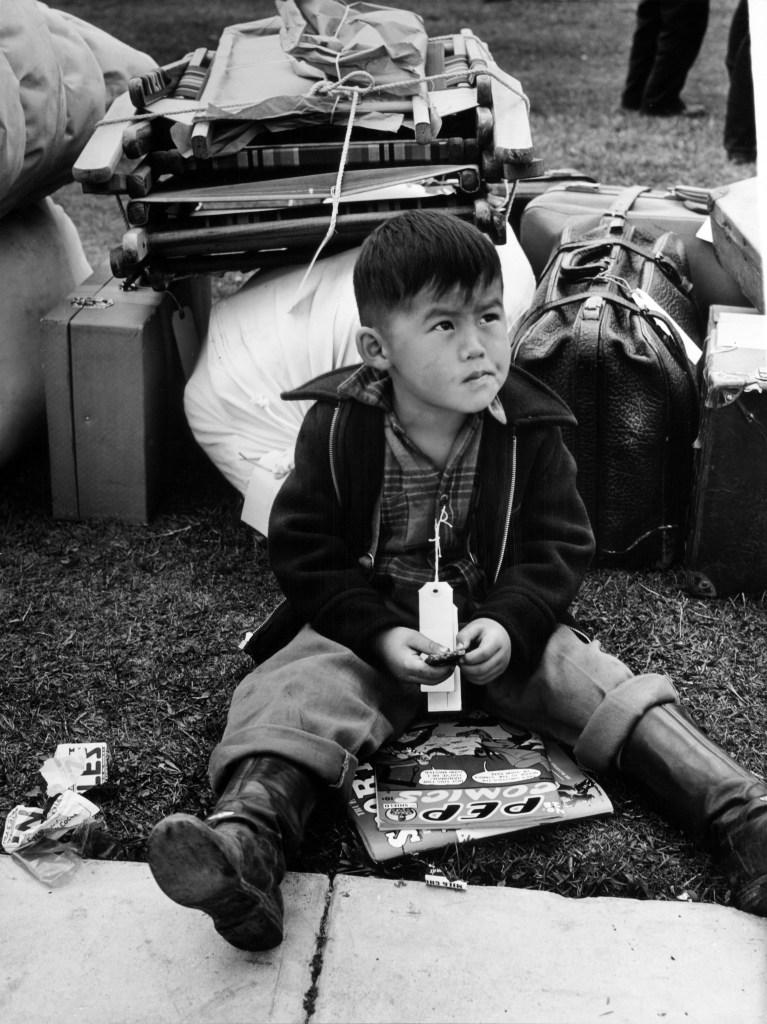
“Tagged”, and waiting for removal

Knowing they had something to prove, the 442nd fought like tigers. From Naples to Rome to the south of France to central Europe and the Po Valley, the all-Nisei 442nd infantry lived up to its own motto. “Go for Broke”. 14,000 men served in the 442nd earning more than 4,000 Purple Hearts, 4,000 Silver Stars, 4,000 Bronze Medals and 21 Medals of Honor.

With 275 Texas National Guardsmen hopelessly cut off by German forces in the Vosges Mountains of France, ‘The Lost Battalion”, the 442nd infantry was sent in to get them out. In five days of savage combat, 211 of the Texas men were rescued. The Nisei of the 442nd suffered 800 casualties. Of 185 men who entered the fray from I Company only 8 emerged unhurt. Company K sent 186 men against the Germans 169 of whom were either killed or wounded.

For its size and length of service, the 442nd was the most highly decorated unit in US military history.

Fun fact: Ralph Lazo was so angry at the forcible relocation of his friends he voluntarily joined them on the train. Deported to the Manzanar concentration camp in the foot of California’s Sierra Nevada mountains, he stayed there for two years. The only non-spouse, non-Japanese American so detained. Nobody ever asked the man about his ethnicity (half Mexican, half Irish). Lazo was inducted into the US Army in 1944 and served as a Staff Sergeant in the South Pacific where he earned a Bronze Star for valor.

By this time, many younger Nisei had left to pursue new lives east of the Rockies. Seven others were shot and killed by sentries. With former homes and business gone, many older internees had little to return to. Many were repatriated to Japan, at least some against their will. By the end of 1945, nine of the top ten War Relocation Authority (WRA) camps were shut down. Congress passed the Japanese-American claims Act in 1948 but, with the IRS having destroyed most of the detainees 1939-’42 tax records, only a fraction of claims were ever paid out.

By the late 1980s, powerful Japanese-American members of the United States Congress such as Bob Matsui, Norm Mineta and Spark Matsunaga spearheaded a measure for reparations. $20,000 paid to every surviving internee. President Ronald Reagan signed the measure into law on August 10, 1988. Over 81,800 qualified, receiving a total of $1.6 Billion.

April 6, 1933 A Fascinating History of Beer Throughout the Ages

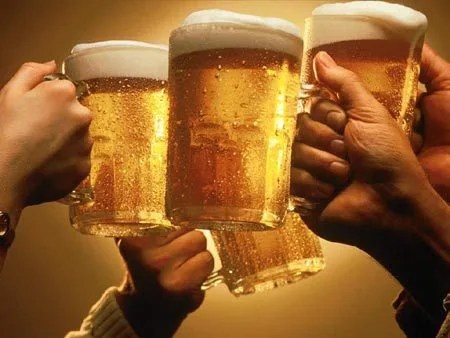
The night before Roosevelt’s law went into effect was April 6, 1933. Beer lovers lined up at the doors of their favorite watering holes waiting for their first legal beer in thirteen years.  A million and a half barrels of the stuff were consumed the following day, a date remembered to this day as “National Beer Day”.

So it is from that day to this we remember April 6, as “New Beer’s Eve”.  

Sláinte.


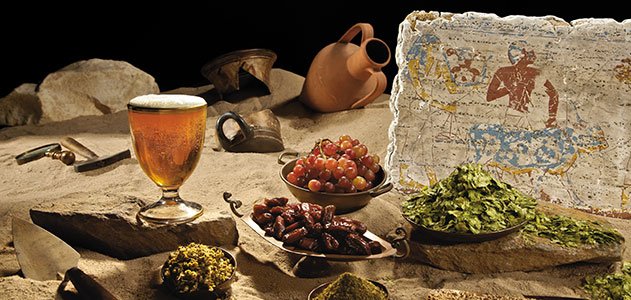
Given the right combination of sugars, nearly any cereal will undergo simple fermentation, due to the presence of wild yeasts in the air.  In all likelihood, our cave-dwelling ancestors experienced their first beer as the result of this process.

In the 18,000-year old Wadi Kubbaniya in upper Egypt, starch dusted stones and the remains of doum-palm and chamomile indicate a “very likely they were making beer there” according to University of Pennsylvania archaeologist, Dr. Patrick McGovern.

Chemical analysis of pottery shards date the earliest barley beer to 3400BC in the Zagros Mountains of Iran.

beer-ingredients

Tacitus maligned the bitter brew of the Germanic barbarians.  Wine seemed better suited to the sensibilities of the Roman palate. Even so, letters from Roman cavalry commanders of the Roman Britain period, c. 97-103 AD, include requests for more “cerevisia“ for the legionaries.

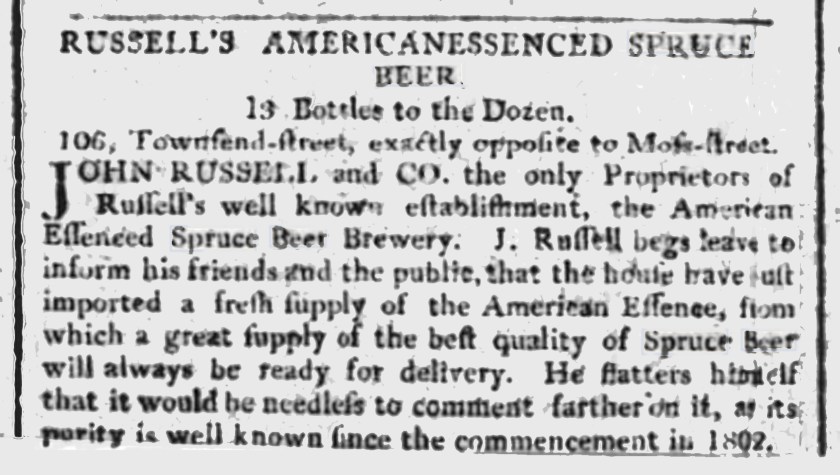
In North and South America, native peoples brewed fermented beverages from local ingredients including agave sap, the first spring tips of the spruce tree, and maize.

Pilgrims left the Netherlands city of Leiden in 1620 hoping not for the frozen, rocky soil of New England, but for rich farmland and a congenial climate in the New World.   Lookouts spotted the wind-swept shores of Cape Cod on November 9, 1620 and may have kept going, had there been enough beer.  One Mayflower passenger wrote in his diary: “We could not now take time for further search… our victuals being much spent, especially our beer…

download (67)

Prior to the invention of the drum roaster in 1817, malt was typically dried over wood, charcoal or straw fires leaving a smoky quality which would seem foreign to the modern beer drinker.  William Harrison wrote in his “Description of England” in 1577, “For the wood-dried malt, when it is brewed, beside that the drink is higher of colour, it doth hurt and annoy the head of him that is not used thereto, because of the smoke“.

Smoky flavor didn’t trouble the true aficionado of the age.  When the Meux Brewery casks let go in 1814 spilling nearly 400,000 gallons onto the street, hundreds of Brits hurried to scoop the stuff up in pots and pans.  Some got down on all fours and lapped it up off of the street, doggy-style.

2926-London-Beer-Flood1

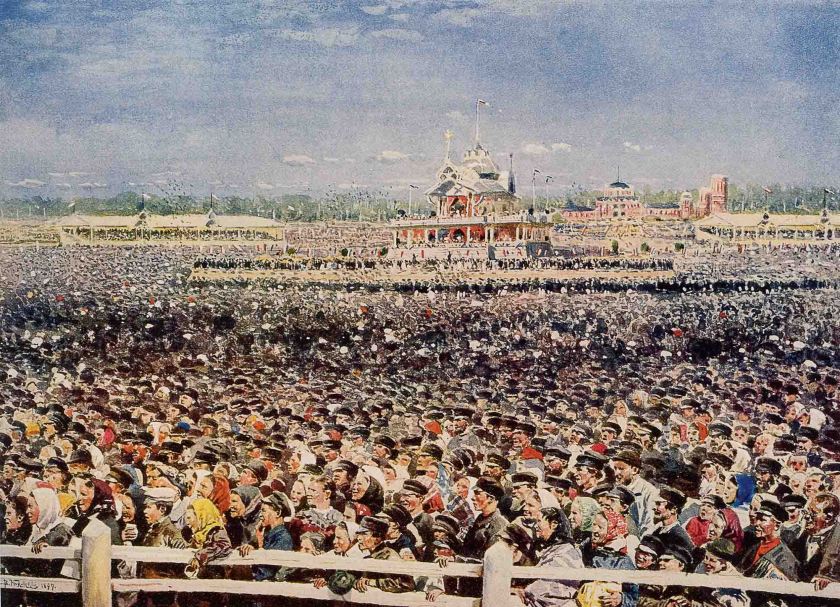
1,389 poor souls were trampled to death and another 1,300 injured in a stampede for the suds when someone thought the beer had run out at the coronation of Czar Nicholas II, in 1896.

download (66)

The 18th amendment, better known as “prohibition”, went into effect at midnight, January 16, 1920. For thirteen years it was illegal to import, export, transport or sell liquor, wine or beer in the United States.

Portable stills went on sale within a week, and organized smuggling was quick to follow. California grape growers increased acreage by over 700% over the next five years, selling dry blocks of grapes as “bricks of rhine” or “blocks of port”. The mayor of New York City sent instructions to his constituents, on how to make wine.

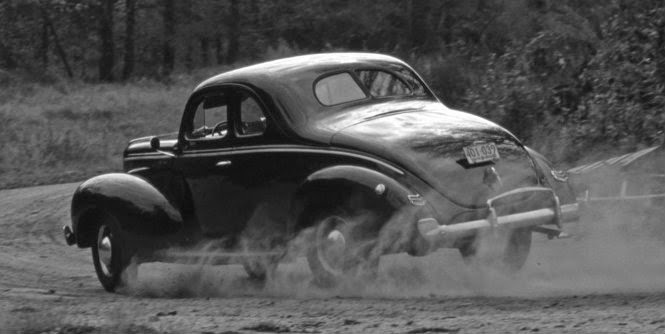
Smuggling operations became widespread as cars were souped up to outrun “the law”. This would lead to competitive car racing, beginning first on the streets and back roads and later moving to dedicated race tracks.  It’s why we have NASCAR, today.

Moonshine-Cars

Organized crime became vastly more powerful due to the influx of enormous sums of cash.  The corruption of public officials was a national scandal.

Gaining convictions became increasingly difficult for breaking a law that everyone hated. There were over 7,000 prohibition related arrests in New York alone between 1921 and 1923.  Only 27 resulted in convictions.

download (65)

The federal government went so far as to deliberately poison denatured alcohol to discourage its “renaturing” resulting in no fewer than 10,000 dead. Even so, the writing was on the wall. Not even poisonous hooch was going to keep the determined reveler, from enjoying a drink.

At last even John D. Rockefeller, Jr., the lifelong teetotaler who contributed $350,000 to the Anti-Saloon League, had to announce support for repeal.

It’s difficult to compare rates of alcohol consumption before and during prohibition.  If death by cirrhosis of the liver is any indication, alcohol consumption never decreased by more than 10 to 20 per cent.

President Franklin Delano Roosevelt signed the Cullen–Harrison Act into law on March 22, 1933 with the quip, “I think this would be a good time for a beer.”  The law went effect on April 7. For the first time in 13 years Americans could once again buy, sell and legally enjoy a beer containing up to 3.2% alcohol.

A team of draft horses hauled a wagon up Pennsylvania Avenue, delivering a case of beer to the White House. It was the first public appearance of the now-famous, Budweiser Clydesdales.

fd3cb0f1f05a3b17a69799cd32a01bcb

“Dry” leaders tried to prohibit consumption of alcohol on military bases in 1941, but authorities claimed it was good for morale. Brewers were required to allocate 15% of total annual production to be used by the armed forces. So essential were beer manufacturers to the war effort that teamsters were ordered to end a labor strike against Minneapolis breweries.  Near the end of WWII, the army made plans to operate recaptured French breweries, to ensure adequate supplies for the troops.

18 states continued prohibition at the state level after national repeal, the last state finally dropping it in 1966. Almost 2/3rds of all states adopted some form of local option, enabling residents of political subdivisions to vote for or against local prohibition. 

Some counties remain dry to this day.  Kansas and Tennessee for instance, default to dry status. Any given county must vote in the affirmative in order to become “wet”. Lynchburg County, Tennessee, home to the world-famous Jack Daniel distillery, remained dry well into the 21st century, becoming, errr, “moist”, in the early 2010s.

The night before Roosevelt’s law went into effect was April 6, 1933. Beer lovers lined up at the doors of their favorite watering holes waiting for their first legal beer in thirteen years.  A million and a half barrels of the stuff were consumed the following day, a date remembered to this day as “National Beer Day”.

So it is from that day to this we remember April 6, as “New Beer’s Eve”.  

Sláinte.

For every wound, a balm.
For every sorrow, cheer. 
For every storm, a calm.
For every thirst, a beer.

Irish toast, author unknown