

Joshua Abraham Norton was born somewhere around 1818, in England. He lived most of his early life in South Africa, immigrating to the United States in 1849 following an inheritance of some $40,000 from his father, equivalent to about $1½ million, today.
As a successful San Francisco businessman, Norton parlayed his inheritance into an astounding fortune of $250,000, then blew it all on a bad Peruvian rice deal. A lawsuit followed, which the now-formerly wealthy businessman, lost. Somewhere along the line, Joshua Norton lost his mind, as well.
For a time, Norton disappeared from the public eye. He returned on September 17, 1859, proclaiming himself Emperor of the United States, his Royal Ascension announced to the public in a letter to the editor of the San Francisco Bulletin:

“At the peremptory request and desire of a large majority of the citizens”, it read, “I, Joshua Norton…declare and proclaim myself Emperor of these United States.” The letter went on to command representatives from all the states to convene in San Francisco, “to make such alterations in the existing laws of the Union as may ameliorate the evils under which the country is laboring.”
The edict was signed NORTON I, Emperor of the United States.”
To many of his “subjects”, “Emperor Norton” was an amusing eccentric. A harmless kook. Most were pleased to go along with the gag.
On October 12, Emperor Norton abolished the United States Congress, declaring “fraud and corruption prevent a fair and proper expression of the public voice…in consequence of which, we do hereby abolish Congress.”
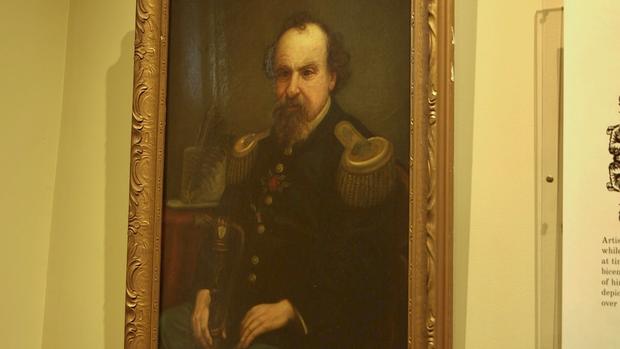
When the Congress failed to disperse, Norton issued a second edict, ordering General Winfield Scott to Washington to rout the rascals. “WHEREAS, a body of men calling themselves the National Congress are now in session in Washington City, in violation of our Imperial edict of the 12th of October last, declaring the said Congress abolished;  WHEREAS, it is necessary for the repose of our Empire that the said decree should be strictly complied with; NOW, THEREFORE, we do hereby Order and Direct Major-General Scott, the Command-in-Chief of our Armies, immediately upon receipt of this, our Decree, to proceed with a suitable force and clear the Halls of Congress”.
That December, Norton fired Virginia Governor Henry Wise for hanging abolitionist John Brown, appointing then-vice President John C. Breckinridge in his stead.
The United States teetered on the brink of disunion in 1861, as Norton abolished the Union altogether and established an absolute monarchy, with himself at the helm. With the French military intervention in Mexico of that same year, Norton added to his already considerable titles, “Protector of Mexico”.
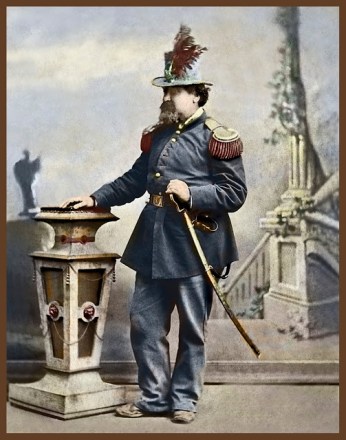
Norton wore an elaborate blue uniform with gold epaulettes, and carried a cane or saber and topped it off with beaver hat with peacock feather. By day, Emperor Norton “inspected” the streets and public works of San Francisco. By night he would dine in the finest establishments in the city. No play or musical performance would dare open in San Francisco, without reserved balcony seats for Emperor Norton.
Mark Twain, who lived for a time in Emperor Norton’s San Francisco, patterned the King in Huckleberry Finn, on Joshua Norton. Among his many proposals, Norton envisioned flying machines, the League of Nations, and the construction of the San Francisco Bay Bridge.
Though he was penniless, the “Official Norton Seal of Approval” was good for business. Some restaurants even put them out on brass plaques, declaring the prestigious “Appointment to his Imperial Majesty, Emperor Norton I of the United States”.
Most of the time, Norton was accompanied by two stray dogs. “Bummer” and “Lazarus” themselves became quite the celebrities, and usually dined for free along with the Emperor.

In 1867, police officer Armand Barbier arrested Norton, attempting to have the man involuntarily committed to an insane asylum. The public backlash was so vehement that Police Chief Patrick Crowley was forced to order Norton’s release, with profuse apologies. The episode ended well, when Emperor Norton magnanimously pardoned the police department. After that, San Francisco cops saluted Emperor Norton whenever meeting him in the street.
The 1870 California census records one Joshua Norton, age 50, occupation, Emperor, along with a note, declaring him to be insane.
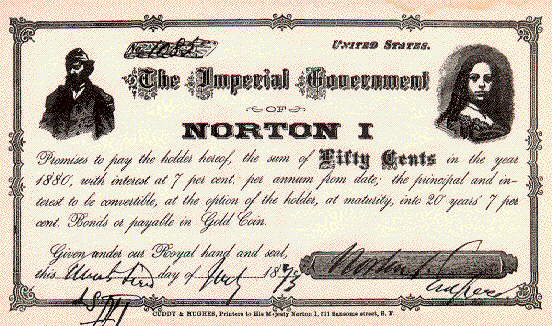
Admiring supporters gave Norton financial aid, in the guise of “paying taxes”. A local printer even printed “Imperial bonds”, emblazoned with Norton’s likeness and official seal. To this day, Norton’s Notes are highly prized collector’s items.
The San Francisco Board of Supervisors once bought Norton a new uniform, when the old one became shabby and threadbare. Norton responded with a very nice thank you note, issuing each of them a “Patent of Nobility in Perpetuity”.
On the evening of January 8, 1880, Norton collapsed on a sidewalk and died before help could arrive. The San Francisco Chronicle published his obituary on the front page, under the headline “Le Roi est Mort” (“The King is Dead”). “On the reeking pavement”, began another obituary, “in the darkness of a moon-less night under the dripping rain…, Norton I, by the grace of God, Emperor of the United States and Protector of Mexico, departed this life.”
In a city which may be described as idiosyncratic, Norton remains the Patron Saint of eccentrics, to this day. The Bay area kicked off a month-long celebration of Norton’s bicentennial birthday on February 4, 2018, with walking tours, exhibitions and period nostalgia.

On its website, the Mechanic’s Institute Library and Chess Room proclaims “Emperor Norton at 200, a series of exhibits, talks, toasts and other special events organized by The Emperor’s Bridge Campaign, in partnership with Bay Area institutions, to mark the bicentennial of Emperor Norton’s birth“.
A February 7 lecture invited participants to arrive in their best 1860s – ’70s attire, and “party like it’s 1859! Join us at the Mechanics’ Institute on February 7th for cake and bubbly to celebrate the 200th birthday of Joshua Abraham Norton, the businessman who one day in 1859 declared himself Emperor of the United States and (in 1862) Protector of Mexico”.
The event sold out, in hours.
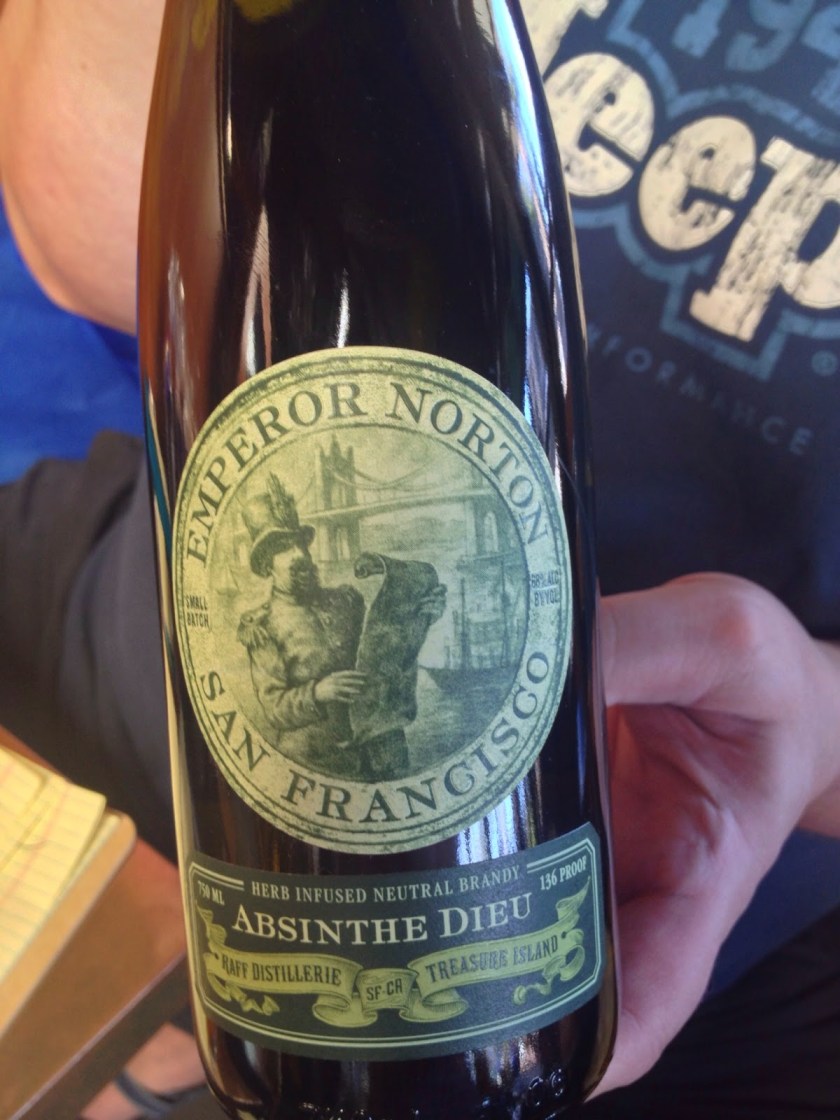
Emperor Norton’s funeral was attended by 10,000 loyal “subjects”, roughly 5% the entire population of San Francisco City and County, at that time. The reign of Emperor Norton I lasted for twenty-one years.


 In the heart of the Financial District in Manhattan, at the corner of Wall Street & Broad stands an office building, commonly known as “The Corner”.


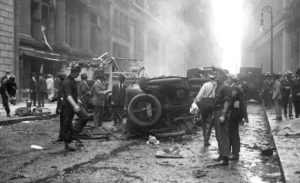 That June, another nine far more powerful bombs used up to twenty-five pounds of dynamite, for the first time introducing the use of metal slugs, to add to the bomb’s lethality. The intended victims were all political figures who’d supported anti-sedition or deportation legislation including AG Palmer himself, or judges who’d sentenced anarchists to long prison terms. None were successful, though one killed a 70-year-old night watchman, who stopped to check a suspicious package on the doorstep of judge Charles Nott.


 Early armored cars were fine for moving personnel over smooth roads, but there was a need for a vehicle capable of navigating the broken terrain of no man’s land. In the run-up to WWI, several soon-to-be belligerents were conducting experiments with “land ships”, with varying degrees of success.

 The most unusual tank of WWI was the tricycle designed “Lebedenko” or “Tsar Tank”. Developed by pre-Soviet Russia, the armament and crew quarters on this thing were 27′ from the ground, making them irresistible targets for enemy artillery.


 Interior temperatures rose to 122° Fahrenheit and more, making me wonder if these things weren’t as dangerous to their own crews as they were to the other side.
 The only German project to be produced and fielded in WWI was the A7V. They only made 20 of these things in the armored, “Sturmpanzerwagen Oberschlesien“, “Upper Silesia Assault Armored Vehicle” version, and a few more in the unarmored “Überlandwagen”, “Over-land vehicle”, used for cargo transport.
 It would be very different, in the next war.

 The documents came from Lt. Col. Bill Burkett, a former Texas Army National Guard officer who had received publicity back in 2000, when he claimed to have been transferred to Panama after refusing to falsify then-Governor Bush’s personnel records. Burkett later retracted the claim, but popped up again during the 2004 election cycle. Many considered the man to be an “anti-Bush zealot”.
 Meanwhile, the four “experts” used in the original story were publicly repudiating the 60 Minutes piece.
 Yet Killian’s wife and son had cleared out his office after his death, and neither found anything so much as hinting at the existence of such documents. Others who claimed to know Carr well described her as a “sweet old lady”, but said they had “no idea” where those comments had come from.
 Public confidence in the “Mainstream Media” plummeted. Many saw the episode as a news network lying, and the “Newspaper of Record” swearing by it.


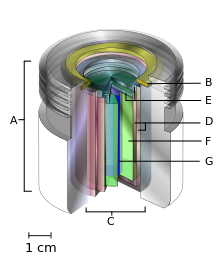 On September 13, 1987, Roberto dos Santos Alves and Wagner Mota Pereira entered the Instituto Goiano de Radioterapia (IGR), bent on theft. The private hospital was permanently closed at the time, and partly demolished. Alves and Pereira were looking for anything they might sell, for scrap.

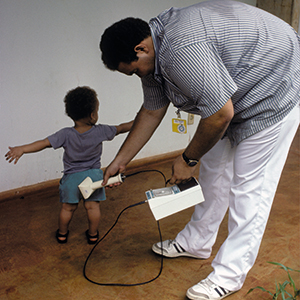 Five days after the theft, Alves sold the items he had pilfered, to a nearby scrapyard. Noticing the blue glow from the punctured capsule, the scrapyard owner thought the object might be valuable or even supernatural, and took the thing inside. Several rice-sized grains of the glowing material were pried from inside the capsule, as Devair Ferreira (the owner of the scrapyard) invited friends and family to come and see the strange, glowing substance. Ferreira’s brother Ivo brought some of the stuff home to his six-year-old daughter, about the time when Devair’s 37-year-old wife Gabriela, became ill.
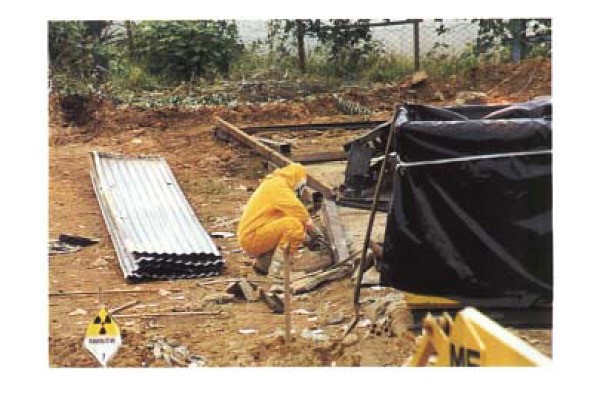 The incident was broadcast all over Brazil, and 130,000 people people flooded into area hospitals, afraid they had been exposed. One thousand individuals showed greater than background levels of radiation, 249 showed significant signs of contamination.

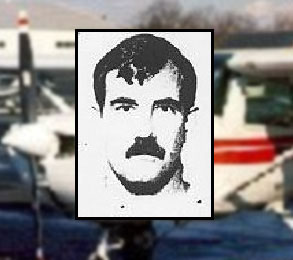 For Frank Eugene Corder, life took a turn for the worse in 1993, around the time the truck driver was fired for reasons unknown. That April, Corder was arrested for theft. Another arrest that October, this time on illegal substance charges, led to a 90-day sentence to a drug rehab center.







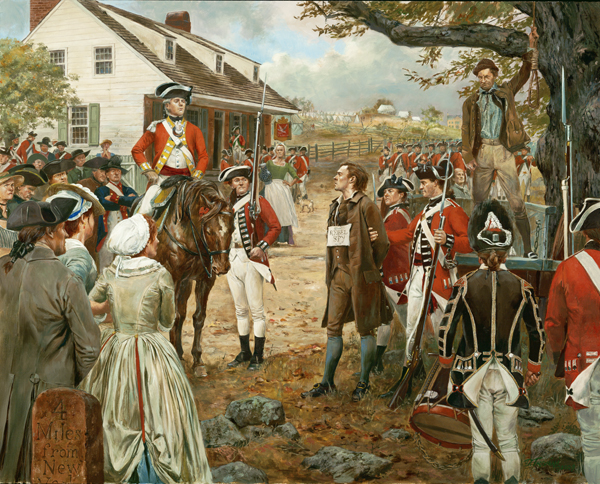


 There was no official record taken of Nathan Hale’s last words, yet we know from eyewitness statement, that the man died with the same clear-eyed personal courage, with which he had lived.






 He was “Il Divino”, “The Divine One”, literally growing up with the hammer and chisel. He had a “Terribilità” about him, an awe-inspiring sense of grandeur which made him difficult to work with, but for which he was at the same time, widely admired and imitated. Michelangelo was that insufferably cocky kid who wasn’t bragging. He could deliver.
 The 17′, six-ton David was originally intended for the roof of the Florence Cathedral, but it wasn’t feasible to raise such an object that high. A committee including Leonardo da Vinci and Sandro Botticelli was formed to decide on an appropriate site for the statue. The committee chose the Piazza della Signoria outside the Palazzo Vecchio, the town hall of Florence.
 Historical Easter Eggs - Today in History
You must be logged in to post a comment.