August 20, 1938 Lucky Man

Lou Gehrig hit his 23rd and last major league grand slam on August 20 1938, a record which would stand until fellow “Bronx Bomber” Alex Rodriquez tied it, in 2012.

The Lane Tech High school baseball team was at home on June 26, 1920. 10,000 spectators assembled to watch the game at Cubs Park, now Wrigley Field. New York’s Commerce High was ahead 8–6 in the top of the 9th, when a left handed batter hit a grand slam out of the park. No 17-year-old had ever hit a baseball out of a major league park before, and I don’t believe it’s happened, since. It was the first time the country heard the name, Lou Gehrig.

lou-gehrig-columbiaGehrig was pitching for Columbia University against Williams College on April 18, 1923, the day that Babe Ruth hit the first home run out of the brand new Yankee Stadium. Though Columbia would lose the game, Gehrig struck out seventeen batters that day, to set a team record. The loss didn’t matter to Paul Krichell, the Yankee scout who had been following Gehrig. Krichell didn’t care about the arm either, as much as he did that powerful, left-handed bat. He had seen Gehrig hit some of the longest home runs ever seen on several Eastern campuses, including a 450′ home run at Columbia’s South Field that cleared the stands and landed at 116th Street and Broadway.

lou-gehrig-97280682
Lou Gehrig played Fullback for Columbia during the 1922 season

New York Giants manager John McGraw persuaded a young Gehrig to play pro ball under a false name, Henry Lewis, despite the fact that it could jeopardize his collegiate sports eligibility. He played only a dozen games for the Hartford Senators before being found out, and suspended for a time from college ball. This period, and a couple of brief stints in the minor leagues in the ’23 and ’24 seasons, were the only times Gehrig didn’t play for a New York team.

Gehrig started as a pinch hitter with the New York Yankees on June 15, 1923. He came into his own in the ‘26 season, in 1927 he batted fourth on “Murderers’ Row”; the first six hitters in the Yankee’s batting order: Earle Combs, Mark Koenig, Babe Ruth, Lou Gehrig, Bob Meusel and Tony Lazzeri.

He had one of the greatest seasons of any batter in history that year, hitting .373, with 218 hits: 52 doubles, 18 triples, 47 home runs, a then-record 175 RBIs, with a .765 slugging percentage. Gehrig’s bat helped the 1927 Yankees to a 110–44 record, the American League pennant, and a four game World Series sweep of the Pittsburgh Pirates.

00gehrig60-superJumbo
“Gehrig with his parents, Christina and Heinrich, in 1938. The three lived together in the house until Gehrig got married in 1933”. Hat tip, New York Daily News

Gehrig was the “Iron Horse”, playing in more consecutive games than any player in history. It was an “unbreakable” record, standing for 56 years, until surpassed in 1995 by Cal Ripken, Jr.

Gehrig hit his 23rd and last major league grand slam on August 20 1938, a record which would stand until fellow “Bronx Bomber” Alex Rodriquez tied it, in 2012.

Lou Gehrig collapsed in 1939 spring training, and went into an abrupt decline early in the season. Sports reporter James Kahn wrote: “I think there is something wrong with him. Physically wrong, I mean. I don’t know what it is, but I am satisfied that it goes far beyond his ball-playing”.

lou-gehrigThe team was in Detroit on May 2 when he told manager Joe McCarthy “I’m benching myself, Joe”. It’s “for the good of the team”. McCarthy put Babe Dahlgren in at first and the Yankees won 22-2, but that was it. The Iron Horse’s streak of 2,130 consecutive games, had come to an end.

ny_50yankess_02Gehrig left the team in June, arriving at the Mayo Clinic on the 13th. The diagnosis of Amyotrophic Lateral Sclerosis (ALS) was confirmed six days later, on June 19. It was his 36th birthday. It was a cruel prognosis: rapidly increasing paralysis, difficulty in swallowing and speaking, and a life expectancy of fewer than three years.

Gehrig briefly rejoined the Yankees in Washington, D.C. He was greeted by a group of Boy Scouts at Union Station, happily waving and wishing him luck. Gehrig waved back, but leaned forward to a reporter. “They’re wishing me luck”, he said, “and I’m dying.”

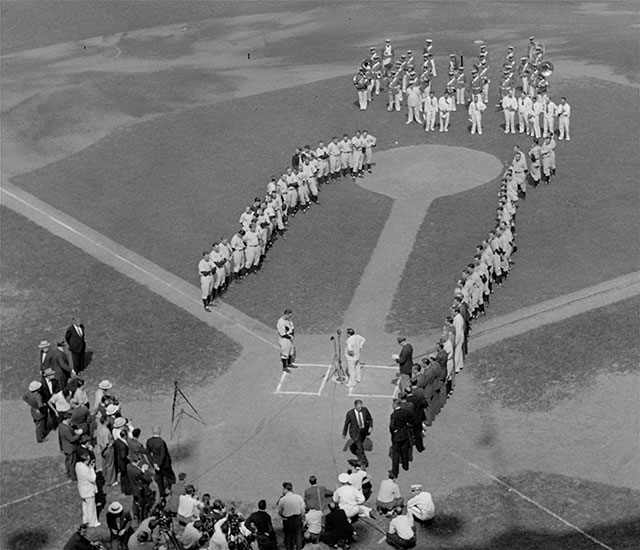
Gehrig appeared at Yankee Stadium on “Lou Gehrig Appreciation Day”, July 4, 1939, his once mighty body now so weakened by the disease which would take his name, as to barely be able to stand.  Only two months earlier, manager Joe McCarthy had asked Babe Dahlgren to take the Iron Horse’s position.  Now he asked the 1st baseman, to look out for his dying teammate.  “If Lou starts to fall, catch him.”

Gehrig was awarded a series of trophies and other tokens of affection by the New York sports media, fellow players and groundskeepers. He would place each one on the ground, already too weak to hold them.
2018_07_loug2

As the ceremony drew to a close, Master of Ceremonies Sid Mercer asked for a few words.  Overwhelmed and struggling for control, Gehrig waved him off.  The New York Times later wrote, “He gulped and fought to keep back the tears as he kept his eyes fastened to the ground”.  62,000 fans would have none of it.  The chant went up.  “We want Lou!” We want Lou!”

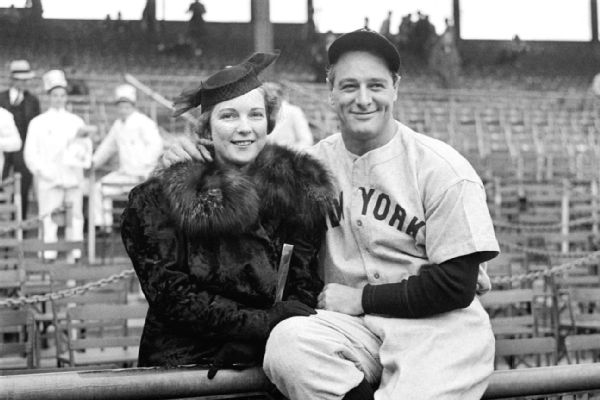
Eleanor Gehrig, a “tower of strength” throughout her husband’s ordeal, watched from a box seat.  New York Daily News reporter Rosaleen Doherty wrote that she did not cry, “although all around us, women and quite a few men, were openly sobbing.”
mlb_a_gehrig1x_600x400

At last, Lou Gehrig shuffled to the microphone, and began to speak. “For the past two weeks, you’ve been reading about a bad break.”  As if the neurodegenerative disease destroying his body, was merely a “bad break.” He looked down and paused, as if trying to remember what to say.  And then he delivered the most memorable line, of his life.

“Today, I consider myself the luckiest man on the face of the earth.”

Henry Louis Gehrig died on June 2, 1941.  He was 37.

I drove by Yankee Stadium a while back, and I thought of Lou Gehrig. It was right after the Boston Marathon bombing, in 2013. The sign out front said “United we Stand”. With it was a giant Red Sox logo. That night, thousands of Yankees fans interrupted a game with the Arizona Diamondbacks, to belt out Neil Diamond’s “Sweet Caroline,” a staple of Red Sox home games, since 1997.

Copy-of-BostonBombingNYYankeesSign

I’ve always been a Boston guy myself, I think I’m required by Massachusetts state law to hate the Yankees. But seriously.  They’re a class act..

tumblr_lxr6f2JJlc1qgg9qko1_1280

If you enjoyed this “Today in History”, please feel free to re-blog, “like” & share on social media, so that others may find and enjoy it as well. Please click the “follow” button on the right, to receive email updates on new articles.  Thank you for your interest, in the history we all share.

The Week that Was. August 12 – 18

Last Week in History. In Case you Missed It.

August 12, 1865 Wash your Hands – With young mothers dying at alarming rates of “Childbed Fever”, one doctor drew the link, to personal hygiene.  The Medical establishment yawned.

August 13, 1941 Henry Ford’s Soybean Car – For Henry Ford, it was the perfect marriage of industry and agriculture.  A car, made from soybeans.

August 14, 1945 Victory Kiss – A photographer shows up at the right time, and the right place.  The image would be as iconic, as the Flag raising on Suribachi.

August 15, 1942 Baby Vet – In 1942, Calvin Leon Graham lied about his age, and enlisted in the United States Navy.  He was twelve years old.

August 16, 1927 The Dole Air Race – The tale of the pineapple magnate, and the fatal Race across the Pacific, at the Dawn of Aviation

August 17, 1942 Makin Island Raid – One Butaritari elder would never forget the barbarity of the Japanese occupier.  Nor the United States Marines who gave their lives, attempting to throw them out.

August 18, 1587 The Lost Colony of Roanoke – Before Plymouth Colony, before the Jamestown settlement, 115 children, women and men Vanished, without a trace.

August 19, 1879 Last of the Bare Knuckle Boxers

Nineteenth century prizefighting rules were nothing like the modern “sweet science” of boxing.

In 1858, the overly crowded tenements of Roxbury Massachusetts teemed with newly arrived Irish immigrants, looked down upon as “unmannered bogtrotters” and given wide berth by the self-appointed elites, of Boston. 5-foot 2-inch Michael Sullivan, newly arrived from County Kerry, worked as “hod carrier” for bricklayers and masons, dug ditches, and did any other job, that was available.

Like many first-generation immigrants, Michael and Catherine Sullivan did whatever they had to do, always hoping for something better, for their children.

John_L._Sullivan1
John L. Sullivan

That was the year the couple’s first-born son came into the world. From the beginning, baby John Lawrence was something different. “Strong as a bear” even as an infant, one family legend described little “Sully” clocking a visiting aunt before the age of one, leaving the woman with a black eye.

Sully excelled in sports as a boy and got into plenty of fights, which he easily won. He left high school as a young teenager and made a few bucks in semi-professional baseball, while working as a tinsmith, plumber and mason.

Prize fighting was illegal in those days, looked down upon by the middle classes as “butchery for profit”. The working classes had no such qualms, reveling in the sport in the saloons and music halls of most American cities.

Nineteenth century prizefighting rules were nothing like the modern “sweet science” of boxing. The earliest recognizable form of the sport, as opposed to mere brawling, came about after a 1744 bout in which British boxer George Stevenson was fatally injured, following a fight with Jack Broughton.

Broughton’s “seven rules of boxing” were printed and framed, and posted that August at his London amphitheater.

broughton-jack
Jack Broughton

Frank Lewis Dowling wrote in Fistiana; or The Oracle of the Ring:…Results of prize battles from 1700 to December 1867, that Broughton’s rules brought about “that spirit of fair play which off ers so wide a contrast to the practices of barbarous ages…[when] It is to be lamented that, even in modern times, the inhuman practices of uncivilised periods have subsisted to a disgraceful extent, and hence we have heard of gouging, that is to say forcing out the eye of an antagonist with the thumb or finger…kicking a man with nailed shoes as he lies on the ground, striking him in vital parts below the waistband, seizing him when on his knees, and administering punishment till life be extinct…”

In 1838, William “Brighton Bill” Phelps died following a particularly savage match with the British bare-knuckle prize fighter, Owen Swift. Phelps, who had himself killed a man in the ring, died after an 85-round, ninety-five minute fight for which Swift was tried and convicted, of manslaughter. Robert Rodriguez, author of The Regulation of Boxing: A History and Comparative Analysis of Policies Among American States writes that the “London Prize Ring Rules” of that year and amended in 1853 “introduced measures that remain in effect for professional boxing to this day, such as outlawing butting, gouging, scratching, kicking, hitting a man while down, holding the ropes, and using resin, stones or hard objects in the hands, and biting.”

The London prize ring rules specified the size and shape of the ring,  and that of the spikes in the fighter’s shoes, as well as the role for each fighter’s “second”.  Nothing is said of the length or number, of rounds.  Each round ended when a fighter was knocked (or thrown) to the ground.  There followed a thirty-second break when the umpire would cry “Time!”, and an eight-second interval when each combatant was to step up to the “scratch line”.  Failure to come “up to scratch” or incapacity put an end to the match, but 70+-round fights, were commonplace.

72086-004-DDFAAC8EThis was the world of bare knuckle boxing in the age of John L. Sullivan.  He thrived in that world. The urban prize ring was his “temple of manhood”.  He intended to be its Crown Prince.

In 1879, Sullivan trounced the veteran brawler Mike Donovan in an exhibition match. The older fighter was the more skilled and experienced, but the 21-year-old made up for it with speed and power. Afterward, Donovan knew that he had “just fought the coming champion of the prize ring.”

A month later, Sullivan challenged “any man breathing” to fight for prizes ranging between $1,000 to $10,000. Sometimes, matches were fought with bare knuckles, other times, with padded gloves and timed rounds.  Over 450 fights, Sullivan seemed unbeatable. “The Hercules of the Ring.”  Gamblers and other backers were making a fortune.

The media eagerly promoted the fighter as an “urban Paul Bunyan”. Stories were told and retold, each becoming more outlandish, as Sullivan “battled wild animals with his bare hands, drank rivers of liquor, had his way with regiments of women. . . .”

The epic drunkenness and domestic violence of the man’s real life at home, went largely unreported.

cropped-john-l-sullivan-1898

Sullivan was a Rockstar, the “Boston Strongboy”, the first professional athlete to make a million dollars. He performed in vaudeville, and hung out with some of the most iconic figures of the ‘gilded age’, from Presidents and Kings to wild west gunslingers. Sullivan made countless public appearances and even considered a run for the United States Senate. A famous song of the era invited listeners to “shake the hand that shook the hand of John L. Sullivan.”

On this day in 1887, thousands of adoring fans crowded the ways to Nantasket Beach in Hull, to glimpse the Heavyweight Champion of the World with his diamond-studded, gold-plated belt.

Depending on who you read, Sullivan was first considered world heavyweight champion either in 1888 when he fought Charley Mitchell in France, or in 1889 when he knocked out Jake Kilrain in round 75 of a scheduled 80-round bout.

s-l1600 (1)
Souvenir poster, 1888

The modern sport of Boxing was born in 1867, with the twelve rules drawn up by John Graham Chambers, member of the British Amateur Athletic Club under the sponsorship of John Sholto Douglas, 9th Marquess of Queensberry.  Timed rounds and gloves remained optional until the night of July 8, 1889, a scheduled 80-round bare knuckle bout between the undefeated champion John L Sullivan, and Jake Kilrain, the last professional fight to be held under the old London Prize Ring rules.

Whiskey had taken its toll on Sullivan by this time.  It looked like he was done when he threw up in the 42nd round, but Sullivan got his second wind.  Kilrain’s second threw in the towel in round 75, afraid that his principle was about to be killed.

John-L.-Sullivan-vs.-Jake-KilrainSullivan’s unbeaten record over 44 professional fights came to an end on July 9, 1892, when “Gentleman Jim” Corbett  unloaded a smashing left in the 21st round that put the champion down, for good.  Sullivan would later say that his opponent only “gave the finishing touches to what whiskey had already done to me.”

Sullivan retired to his home in Abington Massachusetts. In his later years, the last bare knuckle champ in history became a sports reporter, celebrity baseball umpire and tavern owner. He gave up his life-long addiction to alcohol taking his last drink in 1905. Sullivan took to the temperance lecture circuit, but the prizefighting years and those “Rivers of Whiskey” had taken their toll.

s493881354368189662_p65_i5_w2463

John Lawrence Sullivan earned over a million dollars over his career, and died with an estate valued at $3,675, and ten dollars in his pocket.  He was fifty-nine. Sullivan constantly warned young men to avoid the perils of alcohol. “John L. Sullivan, champion of the world, could not lick whiskey.  What gives any one of them the notion that he can?”

john-l-sullivan-obit

If you enjoyed this “Today in History”, please feel free to re-blog, “like” & share on social media, so that others may find and enjoy it as well. Please click the “follow” button on the right, to receive email updates on new articles.  Thank you for your interest, in the history we all share.

August 18, 1587 The Lost Colony of Roanoke

Within the next twenty or so years, English colonists would put down roots in a place called Jamestown, and again in Plymouth.  These roots would take hold and grow yet, what happened to that first such outpost, remains a mystery.

The 16th century was drawing to a close when Queen Elizabeth set out to establish a permanent English settlement in the New World. The charter went to Walter Raleigh, who sent explorers Philip Amadas and Arthur Barlowe to scout out locations for a settlement.

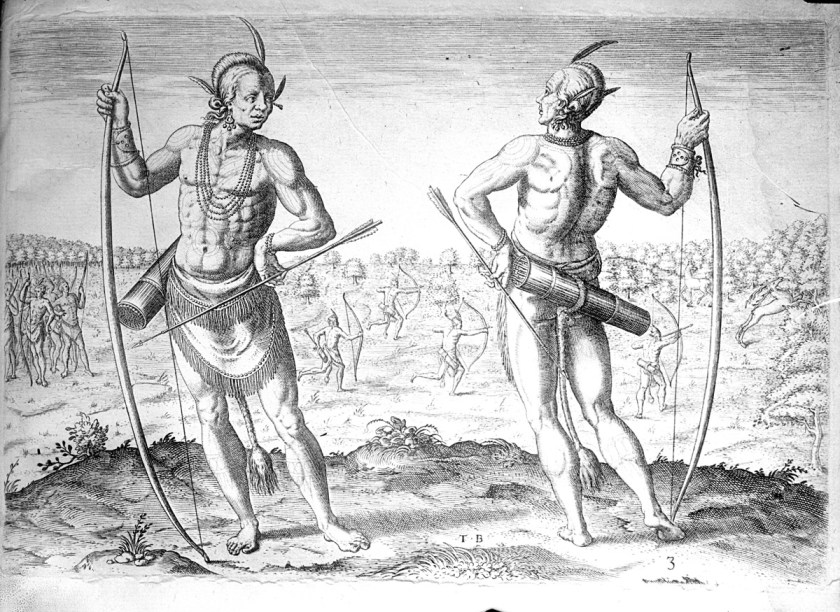
The pair landed on Roanoke Island on July 4, 1584, establishing friendly relations with local natives, the Secotans and Croatans. They returned a year later with glowing reports of what is now the Outer Banks of North Carolina. Two Native Croatans, Manteo and Wanchese, accompanied the pair back to England. All of London was abuzz with the wonders of the New World.

Queen Elizabeth was so pleased that she knighted Raleigh. The new land was called “Virginia” in honor of the Virgin Queen.

Raleigh sent a party of 100 soldiers, miners and scientists to Roanoke Island, under the leadership of Captain Ralph Lane. The attempt was doomed from the start. They arrived too late in the season for planting, and Lane alienated a neighboring indigenous tribe when a misunderstanding led to the murder of Chief Wingina. That’ll do it.

By 1586 they had had enough, and left the island on a ship captained by Sir Francis Drake. Ironically, their supply ship arrived about a week later. Finding the island deserted, that ship left 15 men behind to “hold the fort” before they too, departed.

The now knighted “Sir” Walter Raleigh was not deterred. Raleigh recruited 90 men, 17 women and 9 children for a more permanent “Cittie of Raleigh”, appointing expedition artist John White, governor. Among this first colonial expedition were White’s pregnant daughter, Eleanor and her husband Ananias Dare, and the Croatans Wanchese and Manteo.

0813Raleigh believed that the Chesapeake afforded better opportunities for his new settlement, but Portuguese pilot Simon Fernandes, had other ideas. The caravan stopped at Roanoke Island in July, 1587, to check on the 15 men left behind a year earlier. Fernandes was a Privateer, impatient to resume his hunt for Spanish shipping.  He ordered the colonists ashore on Roanoke Island.

It could not have lifted the spirits of the small group to learn that the 15 left earlier, had disappeared.

Eleanor Dare gave birth to a daughter on August 18, 1587, and named her Virginia. Fernandez departed for England ten days later, taking along an anxious John White, who wanted to return to England for supplies. It was the last time that Governor White would see his family.

dare

White found himself trapped in England by the invasion of the Spanish Armada, and the Anglo-Spanish war. Three years would come and go before White was able to return, and the Hopewell anchored off Roanoke. John White and a party of sailors waded ashore on August 18, 1590, three years to the day from the birth of his granddaughter, Virginia.  There they found – nothing – save for footprints, and the letters “CRO”, carved into a nearby tree.

It was a prearranged signal.  In case the colonists had to leave the island, they were to carve their destination into a tree or fence post.  A cross would have been the sign that they left in an emergency, yet there was no cross.

Reaching the abandoned settlement, the party found the word CROATOAN, carved into a post.  Again there was no cross, but the post was part of a defensive palisade, a defense against hostile attack which hadn’t been there when White left for England.

The word CROATOAN signified both the home of Chief Manteo’s people, the barrier island to the south, (modern-day Hatteras Island), and the indigenous people themselves.

croatoan(2)

White had hopes of finding his family but a hurricane came up, before he was able to explore much further.  Ships and supplies were damaged requiring return to England.  By this time, Raleigh was busy with a new venture in Ireland, and unwilling to support White’s return to the New World.  Without deep pockets of his own, John White was never able to raise the resources to return.

Within the next twenty or so years, English colonists would put down roots in a place called Jamestown, and again in Plymouth.  These roots would take hold and grow yet, what happened to that first such outpost, remains a mystery.  Those 115 children, women and men, pioneers all, may have died of disease or starvation.  They may have been killed by hostile natives. Perhaps they went to live with Chief Manteo’s people, after all.

One of the wilder legends has Virginia Dare, now a beautiful young maiden and example to European and Indian peoples alike, transformed into a snow white doe by a spurned and would-be suitor, the evil medicine man Chico.

The fate of the first English child born on American soil may never be known.

“An Indian girl shows off an English doll in one of many scenes painted by John White, the Lost Colony’s artist governor. White’s realistic portraits of Native American life—including ritual dances (shown here)—became one of the earliest lenses through which Europeans saw the New World”. H/T National Geographic

A personal anecdote involves a conversation I had with a woman in High Point, NC, a few years back. She described herself as having Croatoan ancestry, her family going back many generations on the outer banks of North Carolina. She described her Great Grandmother, a full blooded Croatoan. The woman looked like it, too, except for her crystal blue eyes. She used to smile at the idea of the lost colony of Roanoke. “They’re not lost“, she would say. “They are us“.

fa728a644031ae6c4a0304110bf40ab6

Afterward

Four hundred and twenty-eight years ago, the English colony at Roanoke Island vanished, along with the 115 men, women and children who lived there. Since that time, efforts to solve the mystery have concentrated on the island itself, with precious little to show for it.

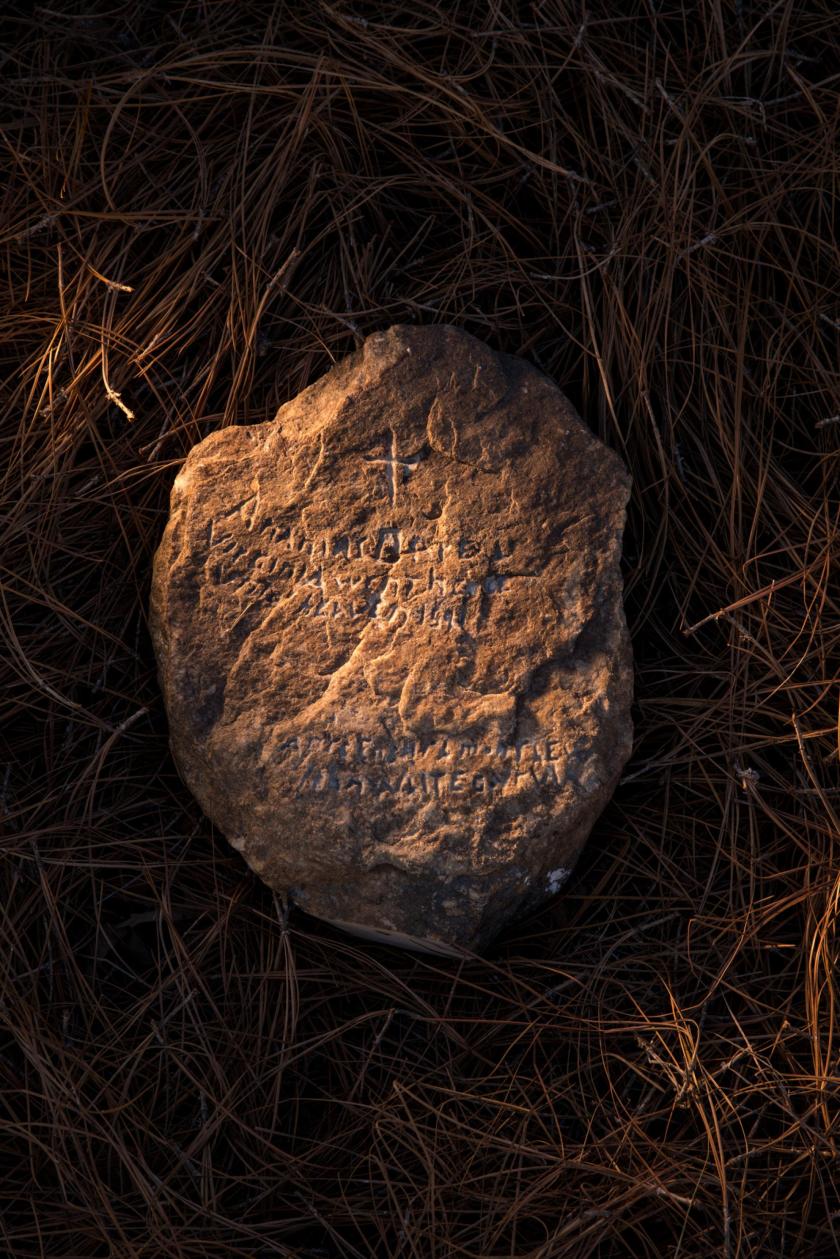
Approximately fifty “Dare Stones” have been discovered containing carved inscriptions, purporting to describe what happened to the lost colonists.  Almost all have been debunked as hoaxes, yet research continues on at least one.lost-colony-dare-stone.adapt.1900.1

Photo credit to Mark Theissen with permission of Brenau University

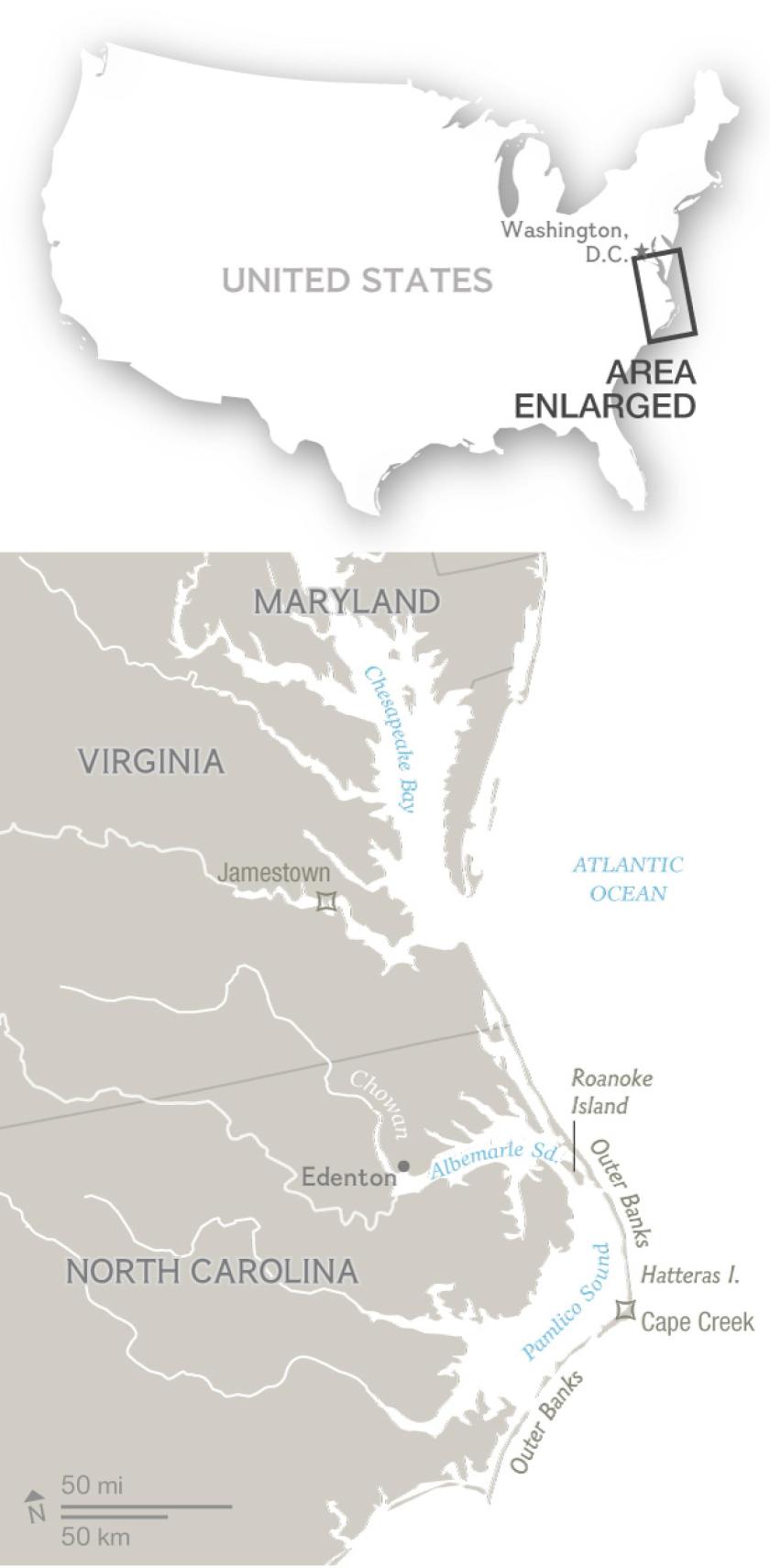
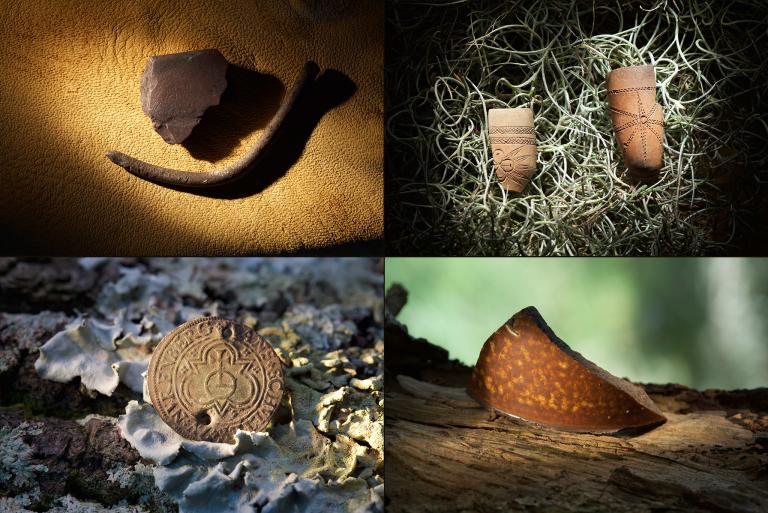
In 1993, a hurricane exposed large quantities of pottery and other remnants of a native American village, mixed with seemingly European artifacts. In the 1580s, Hatteras Island would have been an ideal spot, blessed with fertile soil for growing corn, beans and squash, and a bountiful coastline filled with scallops, oysters and fish.

Since then, two independent teams have found archaeological evidence, suggesting that the lost colonists may have split up and made their homes with native Americans. There are a number of European artifacts unlikely to be objects of trade, including a sword hilt, broken English bowls and the fragment of a writing slate, with one letter still visible. In 1998, Archaeologists discovered a 10-carat gold signet ring, a well worn Elizabethan-era object, almost certainly owned by an English nobleman.

Fifty miles to the northwest, the second team believes that they have unearthed pottery used by the lost colonists on the Albemarle Sound, near Edenton, North Carolina.

NC-VA.adapt.1900.1Research concluded at “Site X” in 2017, the cloak & dagger moniker given to deter thieves and looters.  The mystery of the lost Colony of Roanoke, remains unsolved.  “We don’t know exactly what we’ve got here,” admitted one archaeologist. “It remains a bit of an enigma.”
01lostcolonystory.adapt.768.1
Hat Tip to NationalGeographic.com, for this image
If you enjoyed this “Today in History”, please feel free to re-blog, “like” & share on social media, so that others may find and enjoy it as well. Please click the “follow” button on the right, to receive email updates on new articles.  Thank you for your interest, in the history we all share.

August 17, 1942 Makin Island Raid

The war in the Pacific continued for another three years, but the Butaritari people never forgot the barbarity of the Japanese occupier, nor the Marines who had given their lives in the attempt to throw them out.

Military forces of the Japanese Empire appeared unstoppable in the early months of WWII, attacking first Thailand, then the British possessions of Malaya, Singapore, and Hong Kong, as well as American military bases in Hawaii, Wake Island, Guam and the Philippines.

The United States was grotesquely unprepared to fight a World War in 1942, and dedicated itself to beating Adolf Hitler, first. General Douglas MacArthur abandoned the “Alamo of the Pacific” on March 11 saying “I shall return”, leaving 90,000 American and Filipino troops without food, supplies or support with which to fight off the Japanese offensive.

That April, 75,000 surrendered the Bataan peninsula, beginning a 65-mile, five-day slog into captivity through the heat of the Philippine jungle. Japanese guards were sadistic,  beating marchers at random and bayoneting those too weak to walk. Japanese tanks would swerve out of their way to run over anyone who had fallen and was too slow in getting up. Some were burned alive. Already crippled from tropical disease and starving from the long siege of Luzon, thousands perished in what came to be known as the Bataan Death March.

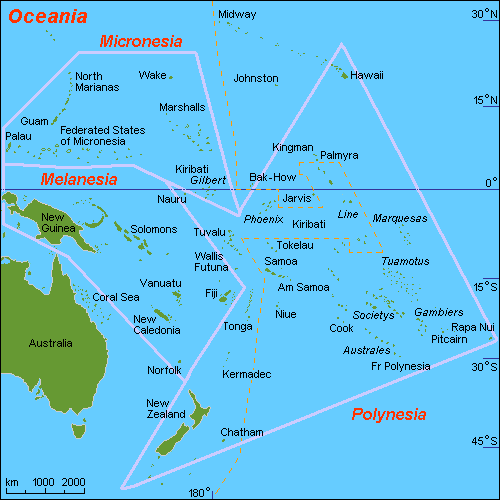
The Imperial Japanese Navy asserted control over much of the region in 1941, installing troop garrisons in the Marshall Island chain and across the ‘biogeographical region’ known as Oceana.

Map_OC-Oceania
WWF Map of the biogeographic region ‘Oceana

The “Island hopping strategy” used to wrest control of the Pacific islands from the Japanese would prove successful in the end but, in 1942, the Americans had much to learn about this style of warfare.

Today, the island Republic of Kiribati comprises 32 atolls and reef islands, located near the equator in the central Pacific, among a widely scattered group of federated states known as Micronesia. Home to just over 110,000 permanent residents, about half of these live on Tarawa Atoll.  At the opposite end of this small archipelago is Butaritari, once known as Makin Island.

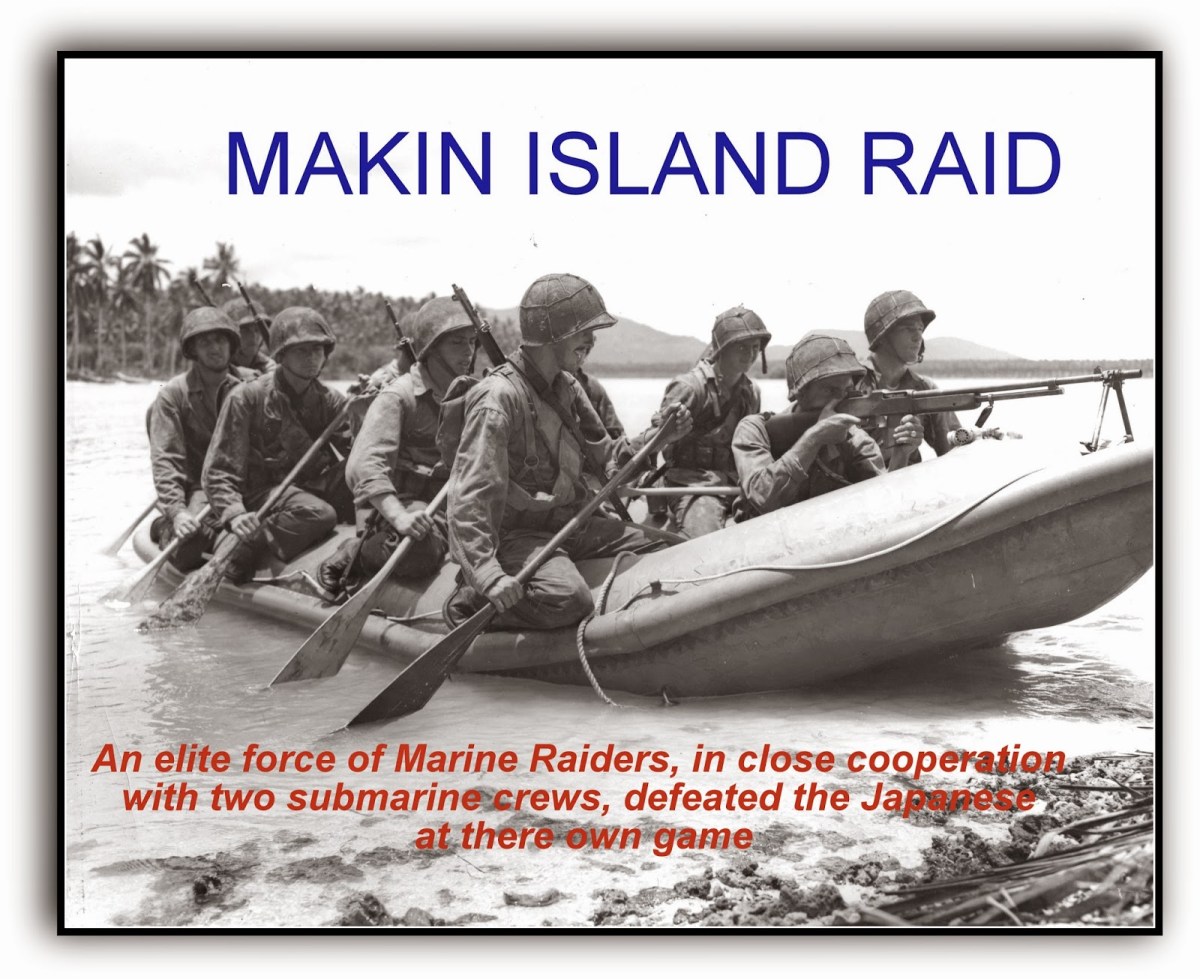
A few minutes past 00:00 (midnight) on August 17, 1942, 211 United States Marine Corps raiders designated Task Group 7.15 (TG 7.15) disembarked from the submarines Argonaut and Nautilus, and boarded inflatable rubber boats for the landing on Makin Island. The raid was among the first major American offensive ground combat operations of WW2, with the objectives of destroying Japanese installations, taking prisoners to gain intelligence on the Gilbert Islands region, and to divert Japanese reinforcement from allied landings at Guadalcanal and Tulagi.

Left), Makin Island as seen by Nautilus and, Right), Marine raiders about to embark

High surf and the failure of several outboard engines confused the night landing.  Lt. Colonel Evans Carlson in charge of the raid, decided to land all his men on one beach instead of two as originally planned, but not everyone got the word. At 5:15, a 12-man squad led by Lt. Oscar Peatross found itself isolated and alone but, undeterred by the lack of support, began to move inland in search of the enemy. Meanwhile, the balance of TG 7.15 advanced inland from the landing, encountering strong resistance from Japanese snipers and machine guns.

Two Bansai charges turned out to be a tactical mistake for Japanese forces. Meanwhile, Peatross and his small force of 12 found themselves behind the Japanese machine gun team engaging their fellow Marines.  Peatross’ unit killed eight enemy soldiers along with garrison commander Sgt. Major Kanemitsu, knocked out a machine gun and destroyed several enemy radios, while suffering three dead and two wounded of their own.

Unable to contact Carlson, what remained of Peatross’ small band withdrew to the submarines, as originally planned.  That was about the last thing that went according to plan.

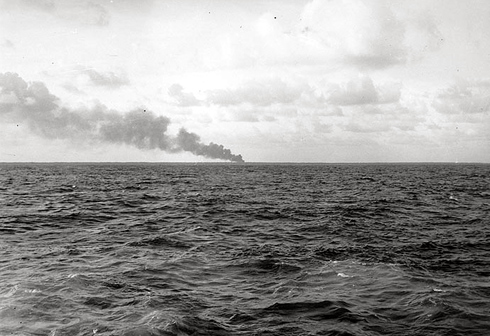
Makin Island Burning
View of Makin Island from USS Nautilus, waiting to withdraw Marine Corps raiding force

At 13:30, twelve Japanese aircraft arrived over Makin, including two “flying boats”, carrying reinforcements for the Japanese garrison. Ten aircraft bombed and strafed as the flying boats attempted to land, but both were destroyed in a hail of machine gun and anti-tank fire.

The raiders began to withdraw at 19:30, but surf conditions were far stronger than expected. Ninety-three men managed to struggle back to the waiting submarines, but eleven out of eighteen boats were forced to turn back. Despite hours of heroic effort, exhausted survivors struggled back to the beach, most now without their weapons or equipment.

Wet, dispirited and unarmed, seventy-two exhausted men were now left alone on the island, including only 20 fully-armed Marines originally left behind, to cover the withdrawal.

A Japanese messenger was dispatched to the enemy commander with offer to surrender, but this man was shot by other Marines, unaware of his purpose.  A rescue boat was dispatched on the morning of the 18th to stretch a rescue line out to the island. The craft was attacked and destroyed by enemy aircraft.  Both subs had to crash dive for the bottom where each was forced to wait out the day. Meanwhile, exhausted survivors fashioned a raft from three remaining rubber boats and a few native canoes, and battled the four miles out of Makin Lagoon, back to the waiting subs. The last survivor was withdrawn at fifty-two minutes before midnight, on August 18.

Many survivors got out with little but their underclothes, and a few souvenirs

The raid annihilated the Japanese garrison on Makin Island, but failed in its other major objectives.  In the end, Marines had asked the island people to bury their dead.  There had been no time.  Casualties at the time were recorded as eighteen killed and 12 missing in action.

The war in the Pacific continued for another three years, but the Butaritari people never forgot the barbarity of the Japanese occupier, nor the Marines who had given their lives in the attempt to throw them out.

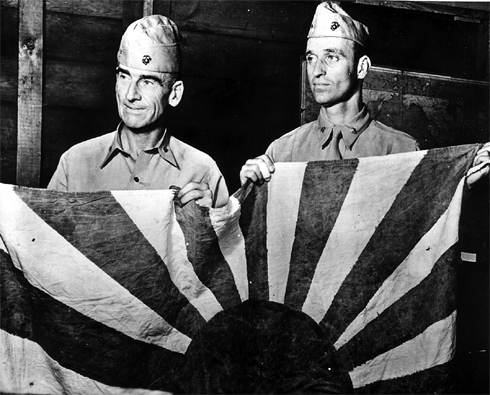
Captured Flag
Lieutenant Colonel Evans Carlson holds a souvenir with his second-in-command from the Makin Island raid, James Roosevelt.  The President’s son. 

Neither it turns out, had one Butaritari elder who, as a teenager, had helped give nineteen dead Marines a warrior’s last due.  In December 1999, representatives of the Marine Corps once again came to Butaritari island, not with weapons this time, but with caskets.

The man spoke no English, save for a single song he had memorized during those two days back in 1942, taught to him by those United States Marines:   “From the halls of Montezuma, to the shores of Tripoli…”

If you enjoyed this “Today in History”, please feel free to re-blog, “like” & share on social media, so that others may find and enjoy it as well. Please click the “follow” button on the right, to receive email updates on new articles.  Thank you for your interest, in the history we all share.

August 16, 1927 The Dole Air Race

Aviation was not for the faint of heart in 1927.  Disaster claimed the lives of competitors, before the race even began. 

In the period between the World Wars, the Wright brothers’ first flight at Kittyhawk was well within living memory. The flying Aces of the Great War seemed like some kind of modern-day knights, and many became pop-culture heroes. Wood-and-fabric biplanes gave way to sleek, metal monoplanes, while air races and daring, record-setting flights seemed a constant feature of the daily news.

The first non-stop transatlantic flight in history began on June 14, 1919, when British aviators John Alcock and Arthur Whitten Brown departed St. John’s, Newfoundland in a modified bomber, arriving in Ireland the following day.

Charles Lindbergh’s better known (and longer) New York to Ireland flight began in the early morning hours of May 20, 1927, when the custom-built, linen-skinned Ryan Aeronautical Company monoplane Spirit of St. Louis departed Roosevelt Field on Long Island, New York.

33½ hours later, thousands of spectators’ cars were caught up in “the largest traffic jam in Paris history”, to be there for the landing at Le Bourget Aerodrome.

Heavier-than-air flight, once considered an impossibility, was coming of age.

Dole-Air-Race
Oakland Field California, August 16, 1927, for the start of the Dole Air Derby

Two months after Lindbergh’s famous flight across the Atlantic, a pineapple magnate offered a prize of $25,000 to the first pilot to fly from Oakland to Honolulu, an orthodromic (Great Circle) distance of 2,406.05 miles.  A $10,000 prize was offered for a second-place finisher.

The overture from James Drummond Dole, founder of the Hawaiian Pineapple Company (now known as Dole Foods), attracted 33 entrants for the event.  14 were selected for starting positions following inspections.  By August 16, 1927, race day, the final list of starters was down to eight.

Tremaine-Humming-Bird-wreckage-10-August-1927
Wreckage of the Tremaine Hummingbird, H/T San Diego Air and Space Museum Archives

Aviation was not for the faint of heart in 1927.  Disaster claimed the lives of competitors, before the race even began.  One Pacific Aircraft Company J-30 known as the Tremaine Hummingbird crashed in heavy fog on August ten on the way to Oakland, killing Naval Lieutenants George Covell and Richard Waggener.

The pair had drawn starting position #13, for race day.

British aviator Arthur Vickers Rogers was killed the following day, just after takeoff in his Bryant Monoplane the Angel of Los Angeles.  Still another aircraft, the Miss Doran, was forced to make an emergency landing in a farm field, and the International Aircraft Corporation F-10 triplane  Pride of Los Angeles crashed into San Francisco Bay on final approach to Oakland.

International-Triplane-CF-10-Spirit-of-Los-Angeles

Happily, the occupants of neither aircraft were hurt, though the latter came away wetter for the experience.

Goddard-Special-NX5074-El-Encanto-16-August-1927
The Goddard Special, NX5074, El Encanto, favored to win the race, crashed on takeoff. (San Diego Air and Space Museum Archives)

Eight entrants remained by the morning of the 16th, but that number was whittled down, fast.

Oklahoma took off but soon returned, due to engine trouble. El Encanto and the PABCO Pacific Flyer, crashed on takeoff. Fortunately, none of the three crews were hurt.

The Golden Eagle took off without a problem, and disappeared into the west.  PABCO Pacific Flyer took her second attempt, only to crash.  Again.

Miss Doran, freshly repaired following her unscheduled landing in that farmers fieldcrashed on takeoff, but the second attempt proved successful.

On board Miss Doran were John “Auggy” Pedlar at the stick and Lieutenant Vilas Raymond Knope, U.S. Navy, Navigating. This entrant carried a passenger too, Miss Doran herself, a 22-year-old fifth-grade school teacher from Flint, Michigan.

Dallas Spirit took off, but quickly returned to Oakland. The last two entrants, a Breese-Wilde 5 Monoplane called Aloha and Woolaroc, a Travel Air 5000, took off and headed west, without a problem.

This last entrant, with Arthur Cornelius Goebel as pilot and Lieutenent (j.g.) William Virginius Davis, Jr., U.S. Navy, as navigator, won the air race, crossing the Pacific and landing in Honolulu with a time of 26 hours, 17 minutes.

GOEBEL-Arthur-C.-winner-of-1927-Dole-Air-Race-with-lei

Neither Golden Eagle nor Miss Doran were ever seen again.

Forty ships of the United States Navy scoured the ocean for Miss Doran and Golden Eagle, but to no avail. Dallas Spirit was repaired and joined in the ocean search but she too disappeared, never to be seen again.

DORAN-Mildred

Mildred Alice Doran had once said, “Life is nothing but a chance.” Miss Doran had taken her chance and lost, at the dawn of the age of aviation.

Ten years later almost to the day, another pioneering female aviator would take her chance, crossing the vast expanse of Pacific Ocean. She too would disappear without a trace, joining her sister and so many others, at the bottom of some unmarked and watery grave.

A tip of the hat to This Day in Aviation.com, for all these great photographs.

If you enjoyed this “Today in History”, please feel free to re-blog, “like” & share on social media, so that others may find and enjoy it as well. Please click the “follow” button on the right, to receive email updates on new articles.  Thank you for your interest, in the history we all share.

August 15, 1942 Baby Vet

During the WW2 era, it wasn’t unusual for boys to lie about their age in order to enlist.

Calvin Leon Graham was a child of the Great Depression, a poor East Texas farm kid born April 3, 1930, the youngest of seven.

By the time  Japanese military planners were outlining the surprise attack on the American anchorage at Pearl Harbor, the boy’s mother had become widowed and remarried. The man was by all accounts mean and abusive of his step-children. By sixth grade, Calvin had moved out with an older brother, living in a cheap rooming house and supporting himself selling newspapers and delivering telegrams on weekends and after school.

The boys’ mother continued to visit, sometimes only to sign their report cards, at the end of a semester.

CalvinLGrahamBeing around newspapers allowed the boy to keep up on events overseas, “I didn’t like Hitler to start with“, he once told a reporter. By age eleven, some of Graham’s cousins had been killed in the war, and the boy wanted to fight.

He began to shave, believing that his facial hair would come in faster and thicker that way (it didn’t), and practiced “talking deep”.

In those days, you could join up at 16 with your parents’ consent” he later said, “but they preferred 17“. Graham forged his mother’s signature and stole a notary stamp, telling his mother he was going to see some relatives for a while.

On this day in 1942, Calvin Leon Graham showed up at a Houston recruiting office, dressed in his older brother’s clothes. All five-foot-two inches of him, and 125 pounds. He was twelve years old.

Graham was less concerned with the recruiting officer spotting that forged signature, than he was with the dentist. With good reason, this was a man with a finely tuned BS detector. “When the dentist kept saying I was 12, I said I was 17“. At last, the boy played his trump card, informing the dentist that the last two boys were fourteen and fifteen, and that the dentist had already let them through. “Finally,” Graham recalled, “he said he didn’t have time to mess with me and he let me go“.

During the WW2 era, it wasn’t unusual for boys to lie about their age in order to enlist. Ray Jackson joined the United States Marine Corps at 16, and founded a group for underage military veterans in 1991, “to assure all underage veterans that there will be no retribution from the government because of their fraudulent enlistment“. Smithsonian.com reports the organization lists over 1,200 active members.  Twenty-six of them, are women.

The boy was sent to boot camp in San Diego and on to Pearl Harbor six weeks later, and assigned to the newly christened battleship USS South Dakota.

When South Dakota steamed out of Philadelphia and cleared the Panama Canal, “No ship more eager to fight ever entered the Pacific.” Under the command of Captain Thomas Leigh Gatch, the battleship was brimming with “green boys” –  cocky, inexperienced new recruits, full of fight and eager for payback against the Japanese empire.

During the October battle for the Santa Cruz islands, South Dakota was credited with downing 26 Japanese aircraft, while taking a 500-pound bomb to the #1 gun turret.

980x (1)
The USS South Dakota engages a Japanese torpedo bomber during the Battle of Santa Cruz October 26, 1942. Photo: US Navy

Standing on the bridge, Captain Gatch watched as that 500-pounder came in, striking the main gun turret.  The impact threw the skipper off his feet and severed his jugular vein, and permanently injuring ligaments in the man’s arms. Quick-thinking quartermasters saved the unconscious captain’s life, and several later asked him, why he hadn’t ducked. “I consider it beneath the dignity of a captain of an American battleship“, he said, “to flop for a Japanese bomb“.

Before the action was over, the South Dakota’s guns had fired 890 rounds of 5-inch, 4,000 rounds of 40mm, 3,000 rounds of 1.1-inch and 52,000 rounds of 20mm ammunition. One of those gunners, was twelve-year-old Calvin Graham.

Over the November 14 night battle for Guadalcanal, USS South Dakota came under attack from three Japanese warships, receiving no fewer than forty-seven hits. With her radio communications out and radar demolished, the battleship lost track of the complicated tactical situation. Calvin Graham was manning his 40mm gun when shrapnel tore through his mouth and jaw, tearing out his front teeth. Another hit burned the boy severely and threw him off his feet, and down three stories of superstructure.

Despite his injuries, Graham did what he could to take care of his fellow sailors:

“I took belts off the dead and made tourniquets for the living and gave them cigarettes and encouraged them all night. It was a long night. It aged me… I didn’t do any complaining because half the ship was dead”.

USS South Dakota was so beat up during the confused night action, that the Japanese believed her to have been sunk.  Eventually, she would limp back to new York for repairs and, not wanting the enemy to know too much, she was stripped of her insignia.

USS South Dakota would complete her WW2 service as “Battleship X”, but that must be a story for another day.

800px-_Battleship_X__-_NARA_-_513922

Graham received a Bronze Star and a Purple Heart for his actions, but such distinctions were short-lived. His mother learned what the boy had been up to and informed the Navy of his real age. Graham was thrown in the brig for lying about his age and held for nearly three months, released only when his sister threatened to go to the media. He was stripped of his medals and dishonorably discharged from the military. At thirteen, Calvin Graham was a “Baby Vet”, no longer fitting in at school and rejected by the nation he had served.

If only our politicians, could expect such stern justice.

Graham soon chose the life of an adult, marrying and fathering a child at the age of fourteen, while working as a welder.  He was divorced by seventeen and enlisted in the Marine Corps. A fall from a pier broke his back three years later, ended his military career for good and leaving him selling magazine subscriptions for a living.

517537543_c_o-300x267For the rest of his life, Calvin Graham fought for a clean service record, and for restoration of medical benefits. President Jimmy Carter personally approved an honorable discharge in 1978, and all Graham’s medals were reinstated, save for his Purple Heart. He was awarded $337 in back pay but denied medical benefits, save for the disability status conferred by the loss of one of his teeth, back in WW2.

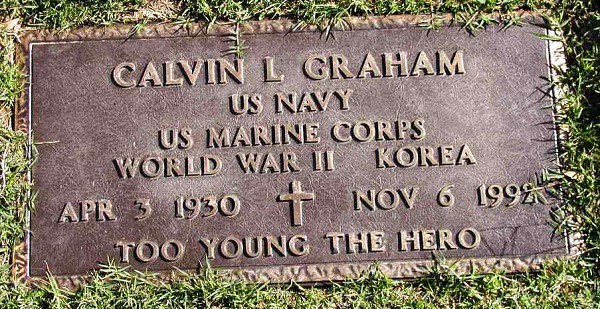
Graham came to public notice in 1988 with the made-for-TV movie Too Young the Hero starring Rick Schroder, prompting government review of his case.  Graham earned $50,000 for rights to his story, but half went to two agents and another 20% to the writer of a book, which was never published.  Graham and his wife received only $15,000, before taxes.

Calvin Graham, Medals

Calvin Leon Graham, Military Awards
1st Row: Bronze Star Medal with Combat “V”
2nd Row: Purple Heart Medal, Navy Unit Commendation with service star, American Campaign Medal
3rd Row: Asiatic-Pacific Campaign Medal with two service stars, World War II Victory Medal, National Defense Service Medal

President Ronald Reagan signed legislation granting Graham full disability benefits and increasing back pay to $4,917, and allowing $18,000 for medical expenses incurred during his military service. Lamentably, many old medical bills were permanently lost, and some of his doctors, had died. Graham received only $2,100 reimbursement for past medical expenses.

Calvin Leon Graham died at his home in Fort Worth Texas in 1992, a victim of heart failure.  He was buried at Laurel Land Memorial Park in Fort Worth, Texas.  Graham’s Purple Heart was reinstated two years later and awarded to his widow by Secretary of the Navy John Dalton. Fifty-two years after the events which led to its award.

Calvin-Leon-Graham-grave

If you enjoyed this “Today in History”, please feel free to re-blog, “like” & share on social media, so that others may find and enjoy it as well. Please click the “follow” button on the right, to receive email updates on new articles.  Thank you for your interest, in the history we all share.

August 14, 1945 Victory Kiss

When the sailor spotted Greta Zimmer, the dental assistant was dressed in the same white uniform as those Navy nurses. To him, she must have seemed like one of those white-clad angels of mercy from those earlier months.

The most destructive war in history ended this day in 1945, with the unconditional surrender of the Empire of Japan.

Rumors were flying since the small hours on the morning of August 14, but President Harry Truman had yet to receive the formal surrender. The White House’ official announcement was still hours away.

article-2138126-12DED591000005DC-157_306x402Born and raised in Austria, Greta Zimmer was 16 years old, in 1939. Fearful of the war bearing down on them, Greta’s parents sent her and her two sisters to America, not knowing if they’d ever see each other again.

Six years later Zimmer was a dental assistant, working at the Manhattan office of Dr. J. L. Berke.

Patients had been coming into the office all morning, with rumors that the war was over.  Greta’s lunch break came just after 1:00.  She set out for Times Square, knowing that the lit and moving type on the Times news zipper would give her the latest information.

Petty Officer 1st Class George Mendonça was on his last day of shore leave, spending the day with his new girlfriend, Rita Petry. The couple had heard the rumors too, but right now they were enjoying their last day together. The war could wait until tomorrow.

George-MendonsaThe couple went to a movie at Radio City Music Hall, but the film was interrupted by a theater employee who turned on the lights, announcing that the war was over. Leaving the theater, the couple joined the tide of humanity moving toward Times Square.

The pair stopped at the Childs Restaurant on 7th Ave & 49th, where bartenders were pouring anything they could get hands on into waiting glasses. Revelers were scooping them up as fast as the glasses were filled.

Mendonça’s alcohol-powered walk/run from the restaurant left Rita trailing behind, but neither one seemed to mind. Times Square was going wild.

The sailor from the USS Sullivans had seen bloodshed. He’d been there on May 11, as kamikaze planes smashed into the USS Bunker Hill. Explosions and fires killed 346 sailors that day. 43 of their bodies would never be found. Mendonça had helped to pull the survivors, some of them hideously burned, out of the water. He had watched while Navy nurses tended to the grievously wounded, and the dying.

When the sailor spotted Greta Zimmer, the dental assistant was dressed in the same white uniform as those Navy nurses. To him, she must have seemed like one of those white-clad angels of mercy from those earlier months.

V-J_Day_Times_Square_NYWTS

Reporters from the AP, New York Times, New York Daily News and others descended on Times Square, to record the spontaneous celebration.

As a German Jew in the 1930s, Alfred Eisenstaedt had photographed the coming storm. He had photographed Benito Mussolini’s first meeting with Adolf Hitler in Venice, in 1934. Alfred EisenstaedtNow Eisenstaedt and his Leica Illa rangefinder camera worked for Life Magazine, heading for Times Square in search of “The Picture™”.

The lit message running around the Times Building read, “VJ, VJ, VJ, VJ” as George Mendonça grabbed a stranger and kissed her. Two seconds later the moment was gone, but Eisenstaedt and his camera had been in the right place at the right time.

The image of the sailor kissing the nurse would become as famous as Joe Rosenthal’s photo of the flag raising at Iwo Jima, but not until years later.

tumblr_mdc6daetGK1rdtetlo1_500

After the war, Greta Zimmer learned that both of her parents had died in Nazi concentration camps. She later married and made her home in Frederick, Maryland. Greta Zimmer Friedman never returned to Austria, and passed away in September 2016, at the age of 92.

The German made camera which took the iconic image recently went to auction at the Westlicht auction house in Vienna, where it was expected to sell for $30,000. The winning bid was nearly $150,000.

George Mendonça and Rita Petry were married after the war, and put down roots in Rhode Island.  The couple, now married seventy-one years, recently celebrated George’s ninety-fifth birthday.  A framed copy of the famous photograph hangs in the hallway of the couple’s home.   Rita once pointed to herself, grinning in the background of the image.  And then she admitted:  ‘In all these years, George has never kissed me like that.’

3V2RXMYLUBHGJFFSEK2NOOVATM
“Former Navy Quartermaster 1st Class George Mendonça and his wife of 71 years, Rita, celebrate George’s 95th birthday”. H/T Navy Times
Feature image, top of page, Victory Kiss by James Laurier Fine Art, www.jimlaurier.com

August 13, 1941 Henry Ford’s Soybean Car

Henry Ford had a “thing”, for soybeans.  At the 1934 World’s Fair in Chicago, Ford invited reporters to a feast where he served soybean cheese, soybean crackers, soy bread and butter, soy milk, soy ice cream… The man was a veritable Bubba Gump, of soybeans. 

The largest museum in the United States is located in the Detroit suburb of Dearborn, the Henry Ford Museum of American Innovation. The sprawling, 12-acre indoor-outdoor complex in the old Greenfield Village is home to JFK’s Presidential limo, the Rosa Parks bus and the Wright Brothers’ bicycle shop. There you will find Abraham Lincoln’s chair from Ford’s Theater, along with Thomas Edison’s laboratory and an Oscar Mayer Wienermobile. George Washington’s camp bed is there, with Igor Sikorski’s helicopter and an enormous collection of antique automobiles, locomotives and aircraft.

Sadly, one object you will not find there, is Henry Ford’s plastic car, made from soybeans.

92MI_0003Ford left the family farm outside of modern-day Detroit as a young man, never to return. His father William thought the boy would one day own the place but young Henry couldn’t stand farm work. He later wrote, “I never had any particular love for the farm—it was the mother on the farm I loved”.

Henry Ford went on to other things, but part of him never left the farm. In 1941, the now-wealthy business magnate wanted to combine industry, with agriculture.  At least, that’s what the museum says.

Carver1web
George Washington Carver, at work in his library

Ford first gave the plastic car project to yacht designer Eugene Turenne Gregorie, but later turned to the Greenfield Village soybean laboratory. To the guy in charge over there, actually, a guy with some experience in tool & die making.  His name was Lowell Overly.

The car was made in Dearborn with help from the scientist and botanist George Washington Carver, (yeah, That George Washington Carver), a man born to slavery who rose to such prodigious levels accomplishment, that Time magazine labeled him the “Black Leonardo”.

The soybean car, introduced to the public this day in 1941, was made from fourteen ¼-inch thick plastic panels and plexiglass windows, attached to a tubular steel frame and weighing in at 1,900 pounds, about a third lighter than comparable automobiles of the era. The finished prototype was exhibited later that year at the Dearborn Days festival, and the Michigan State Fair Grounds.

The thing was built to run on fuel derived from industrial hemp, a related strain of the Cannibis Sativa plant beloved of stoners the world over and known simply, as “weed”.

soybean-car-chassis-skeleton-right-rearFord claimed he’d be able to “grow automobiles from the soil”, a hedge against the metal rationing of world War Two. He dedicated 120,000 acres of soybeans to experimentation, but to no end.  The total acreage devoted to “fuel” production, is unrecorded.

Another reason for a car made from soybeans, was to help American farmers.  Plus, Henry Ford seems to have had a “thing”, for soybeans.  At the 1934 World’s Fair in Chicago, Ford invited reporters to a feast where he served soybean cheese, soybean crackers, soy bread and butter, soy milk, soy ice cream… The man was a veritable Bubba Gump, of soybeans.  Ford was probably one of the first in this country, to regularly drink soy milk.

Henry Ford’s own car was fitted with a soybean trunk and struck with an axe to show the material’s durability, though the axe was later revealed to have a rubber boot.

Henry-Ford-Soybean-CarHenry Ford’s experiment in making cars from soybeans never got past that first prototype, and came to a halt during WW2.  The project was never revived, though several states adopted license plates stamped out of soybeans, a solution farm animals found to be quite delicious.

The car itself was destroyed long ago, the ingredients for its manufacture unrecorded, but the thing lives on in the hearts of hemp enthusiasts, everywhere.

The New York Times claimed the car body and fenders were made from soy beans, wheat and corn.  Some sources opine that the car was made from Bakelite or some variant of Duroplast, a plant-based auto body substance produced in the millions, for the East German Trabant.

One newspaper claimed that nothing ever came from Henry Ford’s soybean experiments, except whipped cream.

If you enjoyed this “Today in History”, please feel free to re-blog, “like” & share on social media, so that others may find and enjoy it as well. Please click the “follow” button on the right, to receive email updates on new articles.  Thank you for your interest, in the history we all share.

The Week that Was. August 5-11

Last Week in History. In case you missed it.

August 5, 1942 Old Doctor – The man who declined Freedom, to die with the orphans he had dedicated his life, to serve.

August 6, 1940 A different Kind of Courage – In the Funhouse Mirror world of the Soviet Union, nine scientists once starved to death, in a room full of edible plant material.

August 7, 1573 El Draque – Pirate, Mariner and Explorer, the first Englishman to sail around the world, and back.

August 8, 1974 A Third-Rate Burglary – Sometimes, the cover-up is worse than the crime

August 10, 2010 An Awful Place – Life and death in the balmy vicissitudes of Antarctica, where the coldest temperature in history was recorded at -135.8°, Fahrenheit

August 11, 1885 Liberty Enlightening the World – The Story of the Statue of Liberty