November 9, 2013 A Rare and Vintage Cognac

On November 9, 2013, a 117 year-old bottle of rare, vintage cognac was cracked open, and enjoyed among a company of heroes.  If there is a more magnificent act of tribute, I cannot at this moment think of what it might be.

On November 9, 2013, there occurred a gathering of four.  A tribute to fallen heroes. These four were themselves heroes, and worthy of tribute.  This was to be their last such gathering.

This story begins on April 18, 1942, when a flight of sixteen Mitchell B25 medium bombers took off from the deck of the carrier, USS Hornet.   It was a retaliatory raid on Imperial Japan, planned and led by Lieutenant Colonel James “Jimmy” Doolittle of the United States Army Air Forces.  It was payback for the sneak attack on Pearl Harbor, seven months earlier.  A demonstration that the Japanese home islands, were not immune from destruction.

Launching such massive aircraft from the decks of a carrier had never been attempted, and there were no means of bringing them back.  With extra gas tanks installed and machine guns removed to save the weight, this was to be a one-way mission, into territory occupied by a savage adversary.
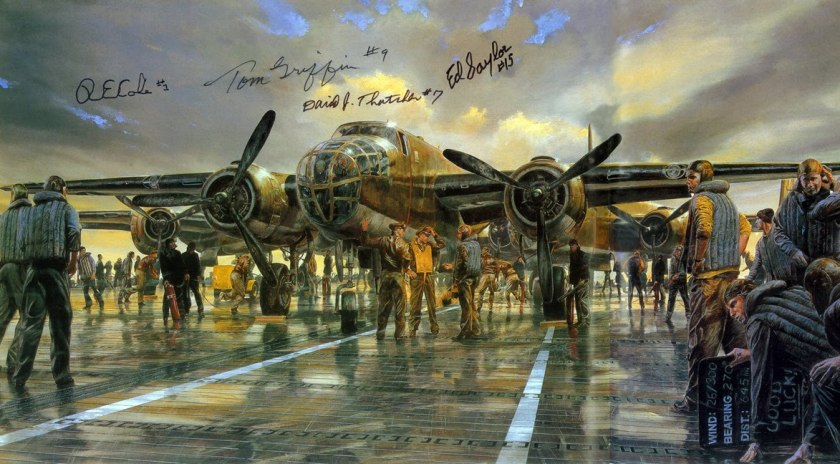
Doolittle Signatures

Fearing that mission security had been breached, the bomb run was forced to launch 200 miles before the intended departure spot.  The range made fighter escort impossible, and left the bombers themselves with only the slimmest margin of error.

Japanese Premier Hideki Tojo was inspecting military bases, at the time of the raid. One B-25 came so close he could see the pilot, though the American bomber never fired a shot.

After dropping their bombs, fifteen continued west, toward Japanese occupied China.  Unbeknownst at the time, carburetors bench-marked and calibrated for low level flight had been replaced in flight #8, which now had no chance of making it to the mainland.  Twelve crash landed in the coastal provinces.  Three more, ditched at sea.  Pilot Captain Edward York pointed flight 8 toward Vladivostok, where he hoped to refuel.  The pilot and crew were instead taken into captivity, and held for thirteen months.
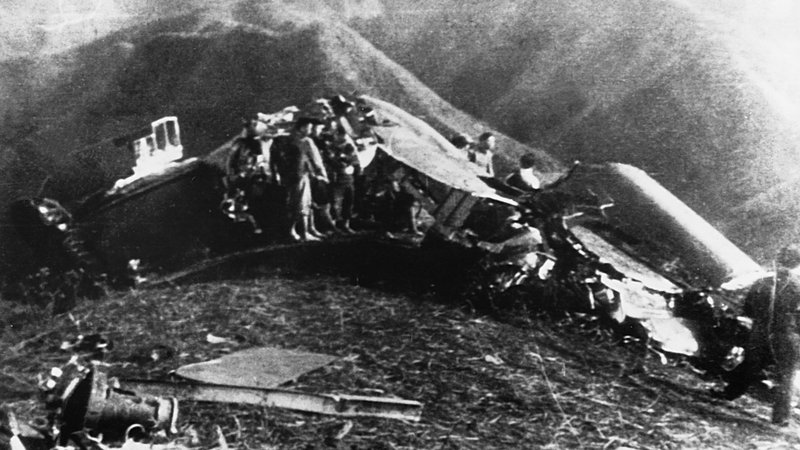
aftermath.jpg__800x450_q85_crop_upscale

Crew 3 Engineer-Gunner Corporal Leland Dale Faktor died in the fall after bailing out and Staff Sergeant Bombardier William Dieter and Sergeant Engineer-Gunner Donald Fitzmaurice bailed out of aircraft # 6 off the China coast, and drowned.

The heroism of the indigenous people at this point, is a little-known part of this story.  The massive sweep across the eastern coastal provinces, the Zhejiang-Jiangxi campaign, cost the lives of 250,000 Chinese.  A quarter-million murdered by Japanese soldiers, in the hunt for Doolittle’s raiders.  How many could have betrayed the Americans and refused, will never be known.

Amazingly, only eight were captured, among the seventy-seven survivors.

First Lieutenant Pilot “Bill” Farrow and Sergeant Engineer-Gunner Harold Spatz, both of Crew 16, and First Lieutenant Pilot Dean Edward Hallmark of Crew 6 were caught by the Japanese and executed by firing squad on October 15, 1942.  Crew 6 Co-Pilot First Lieutenant Robert John Meder died in a Japanese prison camp, on December 11, 1943.  Most of the 80 who began the mission, survived the war.

Thirteen targets were attacked, including an oil tank farm, a steel mill, and an aircraft carrier then under construction.. Fifty were killed and another 400 injured, but the mission had a decisive psychological effect.  Japan withdrew its powerful aircraft carrier force to protect the home islands. Admiral Isoroku Yamamoto attacked Midway, thinking it to have been the jump-off point for the raid. Described by military historian John Keegan as “the most stunning and decisive blow in the history of naval warfare”, the battle of Midway would be a major strategic defeat for Imperial Japan.
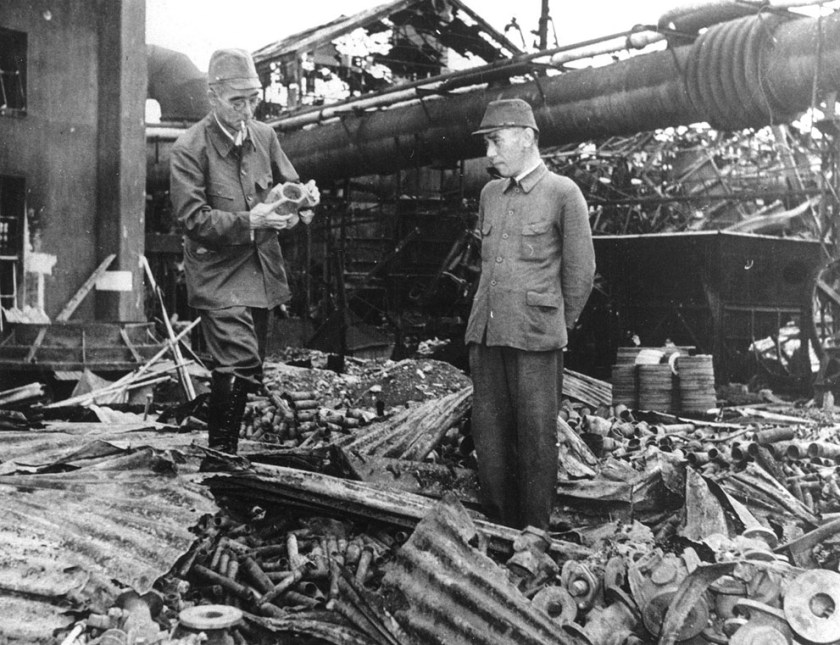
s_w07_20418042
Ryozo Asano, left, spokesman for a group of diversified Japanese family enterprises called the Zaibatsu, inspects the wreckage of his Tokyo steel plant

Every year since the late 1940s, the surviving Doolittle raiders have held a reunion.  In 1959, the city of Tucson presented them with 80 silver goblets, each engraved with a name. They are on display at the National Museum of the Air Force, in Dayton Ohio.

With those goblets is a fine bottle of vintage Cognac.  1896, the year Jimmy Doolittle was born. There’s been a bargain among the survivors that, one day, the last two would open that bottle, and toast their comrades.
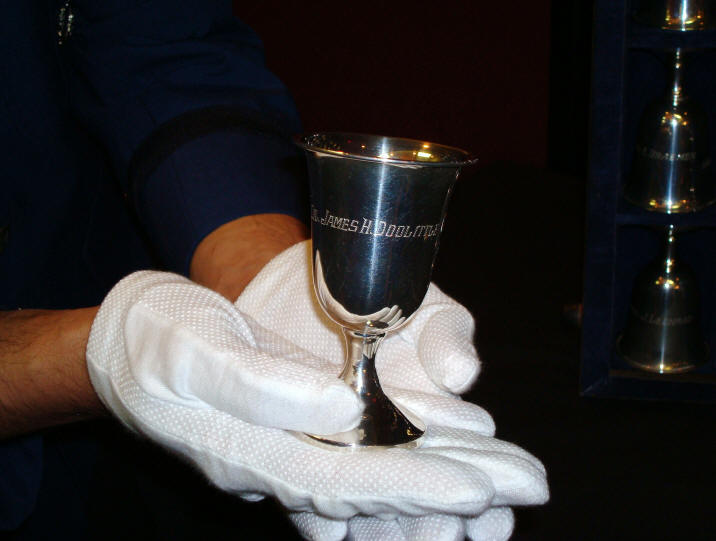
DSC00017

In 2013 they changed their bargain.  Just a little. Jimmy Doolittle himself passed away in 1993. Twenty years later, 76 goblets had been turned over, each signifying a man who had passed on.  Now, there were only four.

  1. Lieutenant Colonel Richard E. Cole* of Dayton Ohio was co-pilot of crew No. 1.  Remained in China after the Tokyo Raid until June 1943, and served in the China-Burma-India Theater from October, 1943 until June, 1944. Relieved from active duty in January, 1947 but returned to active duty in August 1947.
  2. Lieutenant Colonel Robert L. Hite* of Odell Texas was co-pilot of crew No. 16. Captured by the Japanese and held prisoner for forty months, he watched his weight drop to eighty pounds.
  3. Lieutenant Colonel Edward J. Saylor* of Brusett Montana was engineer-gunner of crew No. 15.   Served throughout the duration of WW2 until March 1945, both Stateside, and overseas.  Accepted a commission in October 1947 and served as Aircraft Maintenance Officer at bases in Iowa, Washington, Labrador and England.
  4. Staff Sergeant David J. Thatcher* of Bridger Montana was engineer-gunner of crew No. 7.  Served in England and Africa after the Tokyo raid until June 1944, and discharged in July 1945.
*H/T, http://www.doolittleraider.com

These four agreed that they would gather one last time.  It would be these four men who would finally open that bottle.
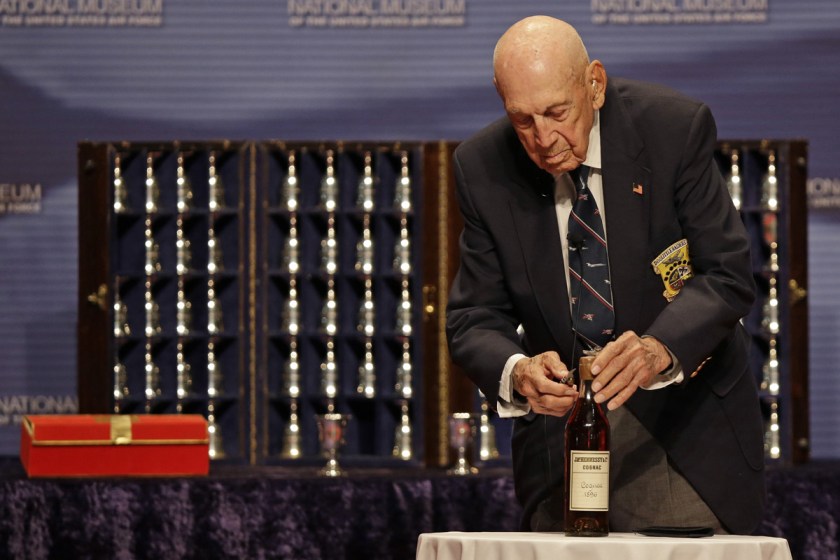
doolittle2

Robert Hite, 93, was too frail to travel in 2013.  Wally Hite, stood in for his father.

On November 9, 2013, a 117 year-old bottle of rare, vintage cognac was cracked open, and enjoyed among a company of heroes.  If there is a more magnificent act of tribute, I cannot at this moment think of what it might be.

On April 18, 2015, Richard Cole and David Thatcher fulfilled their original bargain, as the last surviving members of the Doolittle raid.  Staff Sergeant Thatcher passed away on June 23, 2016, at the age of 94.  As I write this, only one of those eighty goblets remains upright.  Lieutenant Colonel Richard Cole, co-pilot to mission leader Jimmy Doolittle himself, is 103.  He is the only living man on the planet, who has earned the right to open that rare and vintage cognac.

If you enjoyed this “Today in History”, please feel free to re-blog, “like” & share on social media, so that others may find and enjoy it as well. Please click the “follow” button on the right, to receive email updates on new articles.  Thank you for your interest, in the history we all share.

November 6, 1944 Going Home

For the first and last time in history, a man was deliberately buried at sea, inside of the aircraft he had served.

When the Great Depression fell over the nation in the 1930s, few states had a harder time of it, than Oklahoma.  Loyce Edward Deen grew up in this world, the seventh of eight children born to Grace and Allen Deen in the small town of Sulphur.

The family moved to Altus, Oklahoma where Allen worked as a schoolteacher.  Loyce would care for his younger brother Lewis, born with Down’s syndrome.  The pair became close. It must have broken Loyce’s heart when Lewis became and ill and died, while Loyce was still in Jr. High.

Loyce and his older brother Lance were busy during the High school years, caring for Grace following a debilitating stroke.

Loyce’s niece Bertha Deen Sullivan was little at the time, and still remembers.  “Loyce was a tall dark handsome young man with deep blue eyes”. He would pick her up and ask “Who loves ya?”, and then he would kiss her on the forehead.

Altus was the kind of small town, where the newspaper printed the bio of every graduating High school senior. The Times-Democrat wrote that “Loyce Deen is a young man with high ambitions. He plans to enter the US Navy aeronautical mechanics division after graduation and finds subjects such as problems of American democracy, the most interesting. He has also been active in dramatics work at school.

Loyce worked for a time with the government’s Civilian Conservation Corps (CCC), and later joined the Douglas Aircraft Company in Wichita, building wing sets for the A-26 Invader attack bomber.

Loyce_pic_Even before the Japanese attack on Pearl Harbor, Loyce had wanted to join the Navy. In October 1942, he did just that. First there was basic training in San Diego, and then gunner’s school, learning all about the weapons systems aboard a Grumman TBF Avenger torpedo bomber. Then on to Naval Air School Fort Lauderdale, before joining the new 15th Air Group, forming out of Westerly, Rhode Island.
On April 29, 1944, the Air Group reported for duty aboard the “Fightingest Ship in the Navy” at Pearl Harbor.  The aircraft carrier, USS Essex.

An Air Group consists of eighty or so aircraft, of three distinct types. First are the fighters, the fast, single seat Grumman Hellcats. Next are the two-seat dive bombers, the Curtiss Helldivers, the pilot joined by a rear-seat gunner whose job it is to lay the one-ton bomb on the target, while handling a machine gun at the same time. Third is the torpedo bomber, the Grumman Avenger, with two enlisted crewmen in addition to the pilot. The Avenger carries a ton of bombs, depth charges or aerial torpedoes and, like the Helldiver, is designed for low-level attack.

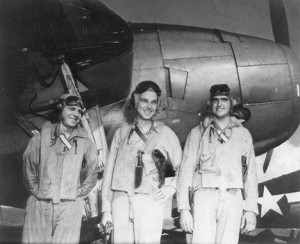
cache_3727742604Loyce was the turret gunner on one of these Avengers, assigned to protect the aircraft from above and teamed up with Pilot Lt. Robert Cosgrove from New Orleans, Louisiana and Radioman Digby Denzek, from Grand Rapids, Michigan.
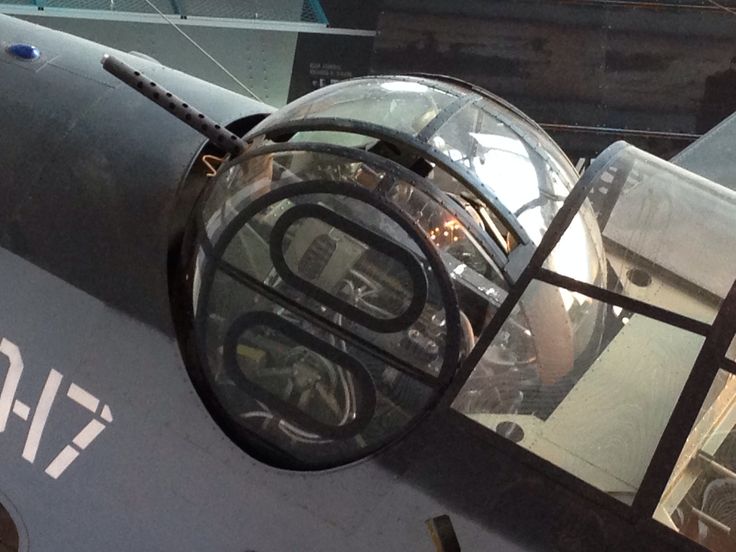
Cosgrove was a superb pilot, often returning aircraft to the carrier, so shot up as to seem unflyable. Digby had several jobs, including arming the weapons systems, and operating the radio. When the team was under fire, Digby would crawl down into a ball turret on the belly of the aircraft, his machine gun defending, from below.

The 15th Air group saw some of the most intense fighting it had ever encountered during the battle of Leyte Gulf of October 24-25, 1944. Commander Lambert, who oversaw the Avenger squadron, described “Coming in through the most intense and accurate AA yet experienced, the squadron made three hits on one battleship, two hits on another battleship, and two hits each on two different heavy cruisers“.

Dennis_Blalock
Dennis Blalock of Calhoun GA, his hands on the shoulders of shipmate, Loyce Deen. Both would be dead within ten days, of this photograph

Deen received a shrapnel wound to his foot sometime during the fighting of the 24th. He wrapped the thing up and stayed on to fight, the following day. He would receive a Purple heart medal for the wound. Posthumously.

Following rest and replenishment at Ulithi Atoll in the Caroline Islands, USS Essex was on station for the November 5 Battle of Manila Bay.  Loyce could have stayed back on a hospital ship until that foot healed, but chose to ignore the injury and rejoin his unit.

Loyce’s niece Bertha, was not surprised. On being informed of his injury, she said “I’m not surprised he stayed with his unit. Loyce would not have it any other way – he would always remain at his post to make sure his brothers came home safely with him.

Loyce Deen climbed into his gun turret for the last time on November 5. It was a two hour ride to the target zone in Manila Bay, with Japanese aircraft on the radar for most of that time, and the carriers USS Lexington and Ticonderoga, under kamikaze attack.

Lieutenant Cosgrove’s Avenger came under savage anti-aircraft fire, from a Japanese cruiser.  Loyce Deen took two direct hits and was killed, instantly.  The Avenger aircraft, tail number 93, was so smashed up as to be all but unflyable.  It took all of the pilot’s strength and skill to fly the thing back through two thunderstorms, and land on the Essex.

e281f946d5375133dd2c1afe6213dacd

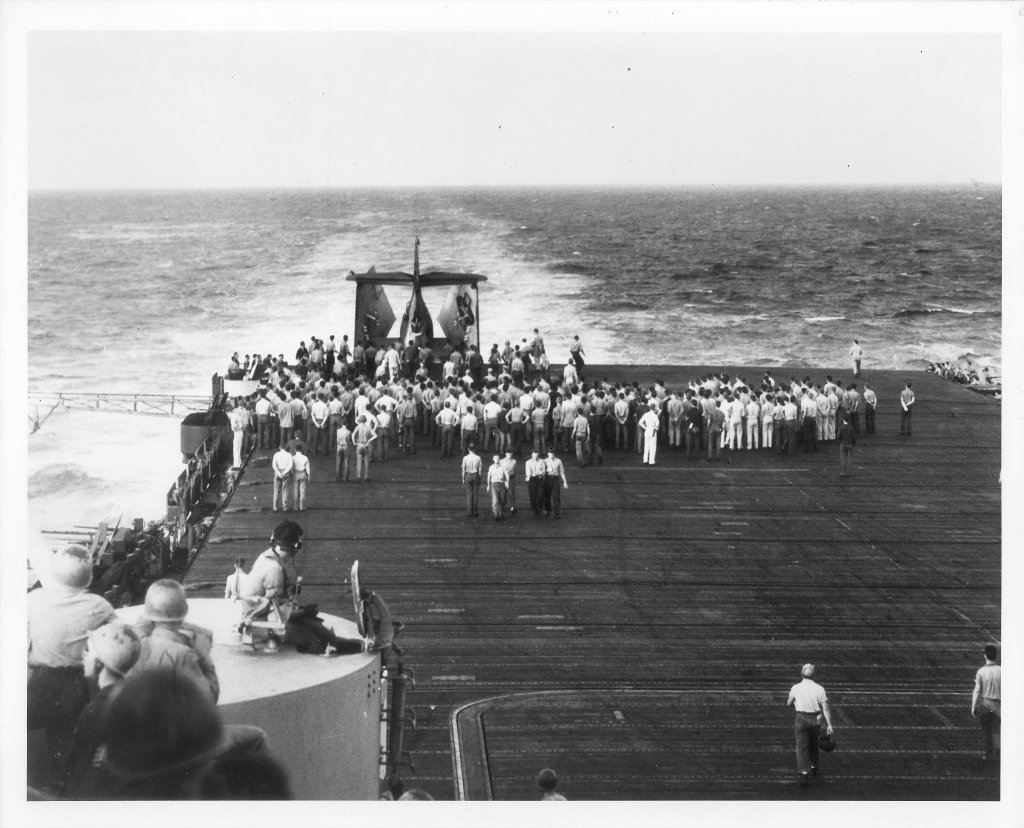
What remained of Loyce Edward Deen was so badly mangled, it was all but impossible to remove him from his smashed turret.  For the first and last time in history, a man was deliberately buried at sea, inside of the aircraft he had served.

Fingerprints were taken and dog tags removed.  This Avenger was not even scavenged, for parts.  With the crew of the USS Essex assembled on deck, the shattered aircraft was pushed over the side.  Two other Avengers flew overhead in salute, as the tail dipped beneath the waves.

Loyce Edward Deen, was going home.

Not long after the ceremony, the Essex went to General Quarters.  There were kamikazes to deal with.

Lt. Cosgrove and the rest of Air Group 15 got back into their aircraft the following day and again on the 12th, 13th and 14th, and attacked those same cruisers in Manila Bay.

The Deen family would not receive the knock on the door, until Thanksgiving week.

If you enjoyed this “Today in History”, please feel free to re-blog, “like” & share on social media, so that others may find and enjoy it as well. Please click the “follow” button on the right, to receive email updates on new articles.  Thank you for your interest, in the history we all share.

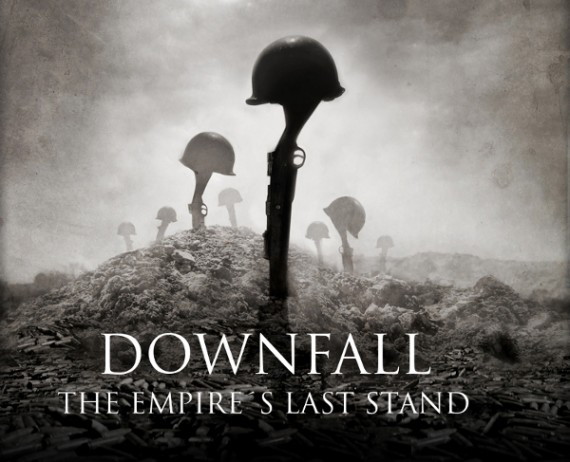
November 1, 1945 Downfall: A History that Never Was

The battle for the Japanese home islands was expected to be a fight like no other. 

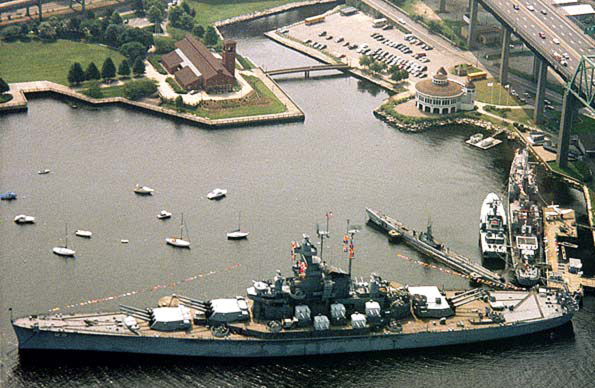
If you’re ever in southeastern Massachusetts, be sure visit Battleship Cove in Fall River, the largest collection of WW2 naval craft, in the world. The Battleship Cove museum sports some sixty exhibits, preserving the naval heritage of these iconic vessels, and the veterans who served them. To walk aboard the battleship USS Massachusetts, the attack submarine USS Lionfish, is to experience a side of WW2, fast receding from living memory.

ParkCoveBattleship

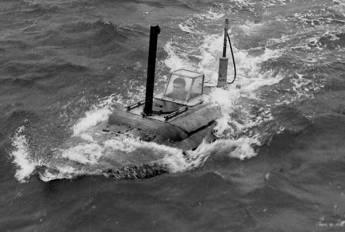
Walk among the wooden-hulled PT boats of the Pacific war, and there you will find a strange little craft.  Closed at the top and semi-submersible, a Japanese kamikaze boat, perhaps, designed for suicide missions against allied warships. Museum management thought it was just that when they acquired the thing, back in the 1970s.  CIA files declassified in 2011 revealed a very different story.  The tale of a history, that never was.

24892346711_af70d25932_b

On August 2, 1939, Hungarian physicist Leó Szilárd delivered a letter which would change history, to President Franklin Delano Roosevelt. Written in consultation with fellow Hungarian physicists Edward Teller and Eugene Wigner and signed by Albert Einstein, the letter warned that Nazi Germany was working to develop atomic weapons, and urged the American government to develop a nuclear program of its own.  Immediately, if not sooner.

The Einstein–Szilárd letter spawned the super-secret Manhattan project, culminating in the atomic bombs “Little Boy” and “Fat Man”, and ending the war in the Pacific in August, 1945.

At the time, precious few were aware of even the possibility of such a weapon.  Fewer still, the existence of a program dedicated to building one.  Vice President Harry Truman, second only to the Commander in Chief himself, was entirely ignorant of the Manhattan project, and only read in following the death of the President in April, 1945.

300px-Kokumin_Giyutai
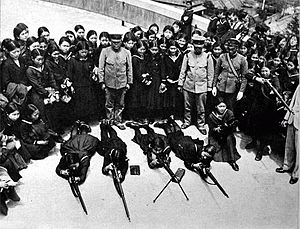
Female students with the Kokumin Giyū Sentōtai, the Volunteer Fighting Corps, prepare for the Allied projected invasion

The battle for the Japanese home islands was expected to be a fight like no other.  Casualties of a million or more, were expected.  And for good reason.  Japanese soldiers fought with such fanaticism, that hundreds continued to resist, years after the war was ended.  The last holdout wouldn’t lay down his arms until 1974.  29 years, 3 months, and 16 days after the war had ended.

Such frenzied resistance would not be isolated to Japanese military forces, either.  Japanese government propaganda warned of “American devils raping and devouring Japanese women and children.” American GIs looked on in horror in 1944, as hundreds if not thousands of Japanese soldiers and civilians hurled themselves to their death, at Laderan Banadero and “Banzai Cliff” on the northern Mariana island of Saipan.  One correspondent wrote with admiration of such mass suicides, praising them as “the finest act of the Shōwa period”… “the pride of Japanese women.”

This is what their government, taught them to believe.

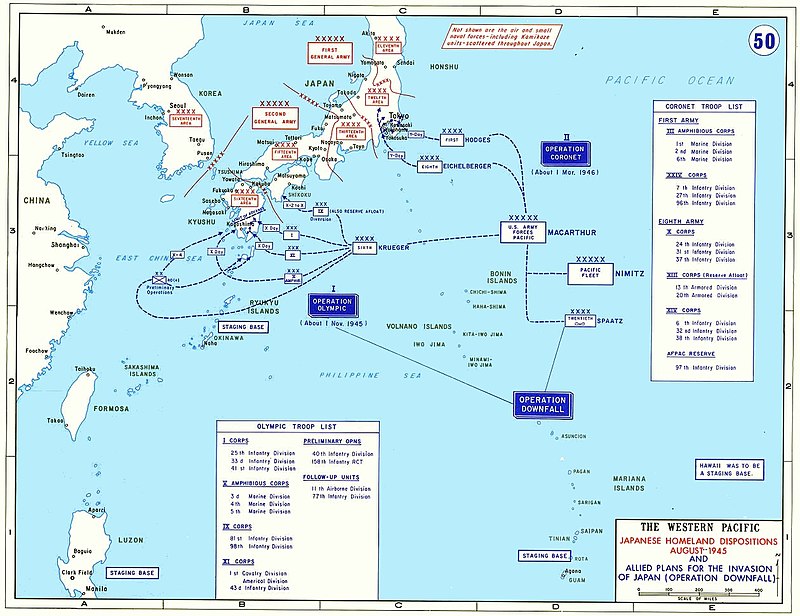
Plans for the final defeat of the Imperial Japanese Empire all but wrote themselves, phase one launched from the south against the main island of Kyūshū, and using the recently captured island of Okinawa, as staging area.  Phase two was the planned invasion of the Kantō Plain toward Tokyo, on the island of Honshu.

Adobe ImageReady

The story of the D-Day invasion begins with deception, a massive head fake intended to draw German defenders away from intended landing zones.  “Operation Downfall” offered no such options, for deceit.  Geography dictated the method of attack, and everybody knew it.  Virtually everything left of Japanese military might would be assembled for the all-out defense of Kyūshū, against what would be the largest amphibious invasion, in history.

American military planners ordered half a million Purple Hearts, in preparation for the final invasion of the Japanese home islands. To this day, military forces have yet to use them all up. As of 2003, 120,000 Purple Heart medals still remained, in inventory.

The whole thing would begin on “X-Day”.  November 1, 1945.

gimik-underwayWhich brings us back to that funny-looking boat. The Office of Strategic Services (OSS), predecessor to the modern Central Intelligence Agency (CIA), built two of these semi-submersibles, code named “Gimik”, part of a top-secret operation code named “NAPKO”.

55 Korean-Americans and Korean prisoners freed from Japanese prison labor camps were trained to infiltrate Japanese occupied Korea and possibly Japan itself, to collect intelligence and carry out sabotage against military targets in advance of Operation Downfall.

The Gimik craft, each operated by a single OSS officer with two Korean operatives secured inside, would be the means of insertion.

The mission was extremely dangerous for obvious reasons.  Training was carried out during the summer of 1945 on Catalina Island, off the California coast.  The two boats, nicknamed “Gizmos”, were tested at night against the US Naval base in Los Angeles. Even this part was dangerous, since no one was told about the trials. Should such a vessel be detected entering the American installation, it would be treated as an enemy vessel, and destroyed.

In the end, the Gizmo teams never left American waters.  Several such tests were carried out without detection, leading to a scheduled departure date of August 26, 1945.  It was never meant to be.

A parallel and equally secret plan to end the war literally burst on the scene on August 6, 1945.  The war was over, nine days later.

If you enjoyed this “Today in History”, please feel free to re-blog, “like” & share on social media, so that others may find and enjoy it as well. Please click the “follow” button on the right, to receive email updates on new articles.  Thank you for your interest, in the history we all share.


October 26, 1918 Talking in Code

In 1917, Colonel Bloor heard two of his Choctaw soldiers talking to each other, and realized he didn’t have the foggiest notion of what they were saying. If he didn’t understand their conversation, the Germans wouldn’t have a clue.

During the twentieth century, the United States and others specially recruited bilingual speakers of obscure languages, then applying those skills in secret communications based on those languages.  Among these, the story of the Navajo “Code Talkers” are probably best known.   Theirs was a language with no alphabet or symbols, a language with such complex syntax and tonal qualities as to be unintelligible to the non-speaker. The military code based on such a language proved unbreakable in WWII. Japanese code breakers never got close.

The United States Marine Corps recruited some 4-500 Navajo speakers, who served in all six Marine divisions in the Pacific theater.  Guadalcanal, Tarawa, Peleliu, Iwo Jima:  Navajo code talkers took part in every assault conducted by the United States Marine Corps, from 1942 to ‘45.

160907143620-navajo-code-talkers-3-exlarge-169.jpgThe history of the Navajo code talkers of WWII is relatively well known, but by no means, unique.  Indigenous Americans of other nations served as code talkers in WW2, including Assiniboine, Lakota and Meskwaki soldiers, who did service in the Pacific, North African, and European theaters of the war.
Fourteen Comanche soldiers took part in the Normandy landings.  As with the Navajo, these substituted phrases when their own language lacked a proper term.  Thus, “tank” became “turtle”.  “Bombers” became “pregnant airplanes”.  Adolf Hitler was “Crazy White Man”.

The information is contradictory, but Basque may also have been put to use, in areas where no native speakers were believed to be present.  Native Cree speakers served with Canadian Armed Services, though oaths of secrecy have all but blotted their contributions, from the pages of history.

The first documented use of military codes based on native American languages took place during the Second Battle of the Somme in September of 1918, employing on the language skills of a number of Cherokee troops.

The government of Choctaw nation will tell you otherwise, contending that Theirs was the first native language, used in this way.  Late in 1917, Colonel Alfred Wainwright Bloor was serving in France with the 142nd Infantry Regiment. They were a Texas outfit, constituted in May of that year and including a number of Oklahoma Choctaws.

The Allies had already learned the hard way that their German adversaries spoke excellent English, and had already intercepted and broken several English-based codes. Colonel Bloor heard two of his Choctaw soldiers talking to each other, and realized he didn’t have the foggiest notion of what they were saying. If he didn’t understand their conversation, the Germans wouldn’t have a clue.

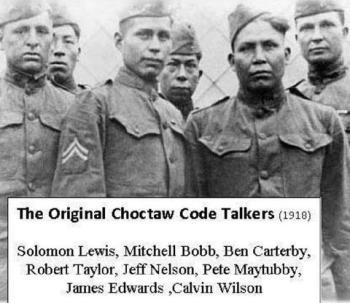
ChoctawCoders
Choctaw soldiers in training in World War I for coded radio and telephone transmissions

The first test under combat conditions took place on October 26, 1918, as two companies of the 2nd Battalion performed a “delicate” withdrawal from Chufilly to Chardeny, in the Champagne sector. A captured German officer later confirmed the Choctaw code to have been a complete success. We were “completely confused by the Indian language”, he said, “and gained no benefit whatsoever” from wiretaps.

Choctaw soldiers were placed in multiple companies of infantry. Messages were transmitted via telephone, radio and by runner, many of whom were themselves native Americans.

As in the next war, Choctaw would improvise when their language lacked the proper word or phrase. When describing artillery, they used the words for “big gun”. Machine guns were “little gun shoot fast”.

Choctaw code talkersThe Choctaw themselves didn’t use the term “Code Talker”, that wouldn’t come along until WWII. At least one member of the group, Tobias W. Frazier, simply described what they did as, “talking on the radio”.  Of the 19 who served in WWI, 18 were native Choctaw from southeast Oklahoma. The last was a native Chickasaw. The youngest was Benjamin Franklin Colbert, Jr., the son of Benjamin Colbert Sr., one of Teddy Roosevelt’s “Rough Riders” of the Spanish American War. Born September 15, 1900 in the Durant Indian Territory, he was all of sixteen, the day he enlisted.
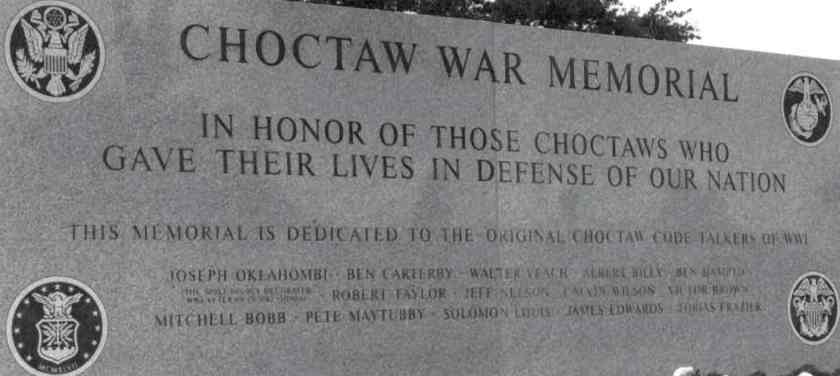
Another was Choctaw Joseph Oklahombi, whose name means “man killer” in the Choctaw language. Six days before Sergeant York’s famous capture of 132 Germans in the Argonne Forest, Joseph Oklahombi charged a strongly held German position, single-handed. Oklahombi‘s Croix de Guerre citation, personally awarded him by Marshall Petain, tells the story:

“Under a violent barrage, [Pvt. Oklahombi] dashed to the attack of an enemy position, covering about 210 yards through barbed-wire entanglements. He rushed on machine-gun nests, capturing 171 prisoners. He stormed a strongly held position containing more than 50 machine guns, and a number of trench mortars. Turned the captured guns on the enemy, and held the position for four days, in spite of a constant barrage of large projectiles and of gas shells. Crossed no man’s land many times to get information concerning the enemy, and to assist his wounded comrades”.

Unconfirmed eyewitness accounts report that 250 Germans occupied the position, and that Oklahombi killed 79 of them before their comrades decided it was wiser to surrender. Some guys are not to be trifled with.

choctawwarmemorial

October 14, 1939 Death of the Royal Oak

Captain Benn was almost alone in believing that his ship was attacked by torpedo.  The cause of the sinking was still being argued over the next day, when divers went down and found a German torpedo propeller. Only then was it understood, that the Kriegsmarine  had taken the war, into British home waters.  By that time, U-47 was gone.

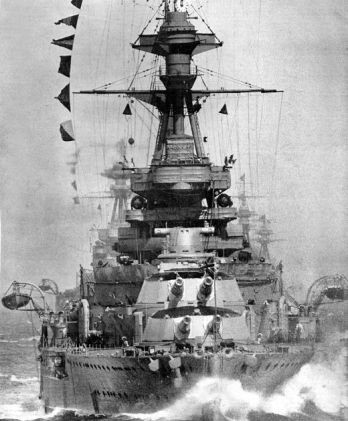
In the early days of WWII, the British Royal Navy based the main part of the Grand fleet at Scapa Flow, in the Orkney Islands north of Scotland.  Protected as it was by blocking ships and underwater cables, the anchorage considered impregnable to submarine attack.

f918c0672ea9cc256d0295ed46d0ca83The harbor at Scapa flow had been home to the British deep water fleet since 1904, a time when the place truly was, all but impregnable.  By 1939, anti-aircraft weaponry was all but obsolete, old block ships were disintegrating, and anti-submarine nets were inadequate to the needs of the new war.
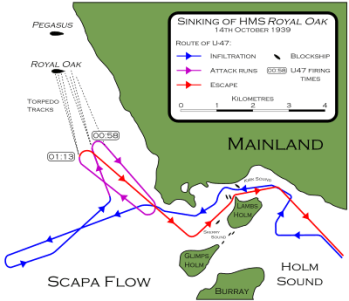
The men of the German Unterseeboot U-47 commanded by officer Günther Prien, were not impressed. U-47 entered the Royal Navy base in the evening hours of the October 13, 1939. By 12:55am on the the 14th, they were within 3,500 yards of the unmistakable silhouette of the WWI era Revenge Class Battleship, HMS Royal Oak.

Believing he had a certain kill, Prien aimed two of his four torpedoes at the Battleship, and the other two at the 6,900 ton Pegasus, which he’d mistaken in the dark for the much larger HMS Repulse. Tubes one, two and three fired successfully, torpedoes away, but #4 jammed. Only one found its mark, blowing a hole in the starboard bow of the Royal Oak, near the anchor chains.

On the battleship, Captain William Benn was told the most likely cause was an internal explosion, either that or a high flying German aircraft had dropped a bomb. Damage control teams were assembled to assess the damage, while aboard U-47, Prien thought his one hit had been against Repulse (Pegasus). He was prepared to run, but saw no threat from oncoming surface vessels.  Coming about and firing the stern torpedo, the crew worked to free the jammed #4 torpedo tube, while reloading bow tubes 1-3. That one missed as well, and the Germans cursed their luck.

400px-U-47_raid.svgThe electric torpedoes of the era were highly unreliable, and this wasn’t shaping up to be their night.
Finally, tubes one and two were reloaded, and the jammed tube #4 was serviced and ready to go. U-47 crept closer and, at 1:25am, fired all three torpedoes at the Royal Oak. All three found their target within ten seconds of one other, blasting three holes amidships on the starboard side. The explosions set off a series of fires and ignited a cordite magazine and exploding with a fiery orange blast that went right through the decks.\

Royal Oak rolled over and sank in thirteen minutes. 833 sailors and officers were lost from ship’s company of 1,234, including Rear Admiral Henry Evelyn Blagrove, commander of the 2nd Battle Squadron.

391702797d7300601188ee909566c8de

The Royal Navy considered the anchorage so secure that, even now, searchlights and anti-aircraft fire raked the sky, searching for the air attack that wasn’t there.  Captain Benn was almost alone in believing that his ship was attacked by torpedo.  The cause of the sinking was still being argued over the next day, when divers went down and found a German torpedo propeller. Only then was it understood that the Kriegsmarine had taken the war, into British home waters.

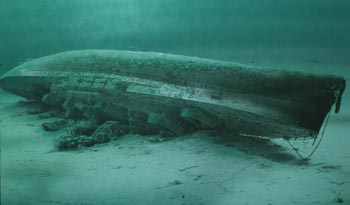
Royal Oak Wreck

The successful attack at Scapa Flow was a crushing defeat for the British, and payback for the Germans. The entire German High Seas Fleet had been interned there at the end of WWI. Admiral Ludwig von Reuter wasn’t about to let his fleet fall into allied hands, and ordered the lot of them, scuttled. British guard ships succeeded in beaching a few at the time, but 52 of 74 vessels had sunk to the bottom.

Many of those wrecks were salvaged in the interwar years, and towed away for scrap. Those which remain are popular sites for recreational divers, but not Royal Oak. As a designated war grave, Royal Oak is protected by the Military Remains Act of 1986.  Unauthorized divers are strictly, prohibited.

The wreck of the Royal Oak lies nearly upside down in 100′ of water, her hull just 16-feet beneath the surface. Each year, divers place the red St. George’s Cross with the Union Flag of the White Ensign at her stern, a solemn tribute to the honored dead of World War 2, and to the first Royal Navy battleship lost in the most destructive war in history.

Royal Oak Ensign

If you enjoyed this “Today in History”, please feel free to re-blog, “like” & share on social media, so that others may find and enjoy it as well. Please click the “follow” button on the right, to receive email updates on new articles.  Thank you for your interest, in the history we all share.

October 3, 1944 Angel from a Foxhole

Once, the small dog was able to perform a task in minutes, which would have otherwise taken an entire airstrip out of service for three days, and exposed a construction battalion to enemy fire.

The first dog may have approached some campfire, long before recorded history. It may have been hurt or it maybe it was looking for a morsel. Dogs have been by our side ever since.

Over history, the unique attributes of Canis Familiaris have often served in times of war. Ancient Egyptian artwork depicts dogs at work in multiple capacities. The ancient Greeks used dogs against Persian invaders at the Battle of Marathon.

_73412601_2001-877_smithsonian_stubby_with_robert_pro_photoThe European allies and Imperial Germany had about 20,000 dogs working a variety of jobs in WWI. Though the United States didn’t have an official “War Dog” program in those days, a Staffordshire Terrier mix called “Sgt. Stubby” was smuggled “over there” with an AEF unit training out of New Haven, Connecticut.

Stubby is credited with saving an unknown number of lives, his keen sense of hearing giving his companions early warning of incoming artillery rounds.

Once, Stubby even caught a German spy who had been creeping around, mapping allied trenches. It must have been a very bad day for that particular Bosch, to be discovered spinning in circles, a 50-pound, muscular terrier affixed to his arse.

The US War Dogs program was developed between the World Wars, and dogs have served in every conflict, since.  My own son in law Nate served in Afghanistan with “Zino”, a five-year old German Shepherd and Tactical Explosives Detection Dog (TEDD), trained to detect as many as 64 explosive compounds.

The littlest war dog first appeared in the jungles of New Guinea, when an American soldier spotted a “golden head” poking out of an abandoned foxhole. It was all of 4-pounds, a seven-inch tall, Yorkshire Terrier.  At the time, nobody had the foggiest notion of how the tiny dog had gotten there. The soldier brought her back to camp and sold her to a comrade for £2 Australian, about $6.44.  He was Corporal William Wynne, who named her “Smoky”.

2013-11-19-BillandSmokywithSmokysnewbornpupforwhichtheBillmaintainscostSmokyherGoodConductmedalforayear1944

Smoky lived a soldier’s life for the next eighteen months, traveling about in a rucksack and learning to parachute from trees.  At first, soldiers thought she might have belonged to the Japanese side, but they brought her to a POW camp and quickly learned that she understood neither Japanese nor English commands.

The little dog flew 12 air/sea rescue and photo reconnaissance missions, secured in Wynne’s backpack. She survived 150 air raids and a typhoon, often giving soldiers early warning of incoming fire.  Wynne credited Smoky with saving his life one time, on an LST transport ship.  It was around October 3, 1944 off Morotai, when the Japanese submarine RO-41 sank the American destroyer escort, USS Shelton.  The decks around them were shaking from anti-aircraft and machine gun fire, when Smoky guided Wynne to duck at the moment an incoming shell struck, killing 8 men standing next to them. She was his “angel from a foxhole.”

YorkieSmokyO

Once, the small dog was able to perform a task in minutes, a job which would have otherwise taken an airstrip out of service for three days, and expose a construction battalion to enemy fire. The air field at Lingayen Gulf, Luzon, was crucial to the Allied war effort.  The signal corps needed to run a teletype communication wire across the field.  To do so in the conventional manner would have taken days, and put the airfield out of operation.  Except, there was one possible workaround.

A 70-foot, 8” drain pipe half filled with dirt, already crossed under the air strip

Wynne credits the dog with enabling the airfield to remain open, saving 40 aircraft and 250 ground crew from exposure to Japanese fire.  Let him tell the story:

o-SMOKY5-570

“I tied a string to Smoky’s collar and ran to the other end of the culvert . . . (Smoky) made a few steps in and then ran back. `Come, Smoky,’ I said sharply, and she started through again. When she was about 10 feet in, the string caught up and she looked over her shoulder as much as to say `what’s holding us up there?’ The string loosened from the snag and she came on again. By now the dust was rising from the shuffle of her paws as she crawled through the dirt and mold and I could no longer see her. I called and pleaded, not knowing for certain whether she was coming or not. At last, about 20 feet away, I saw two little amber eyes and heard a faint whimpering sound . . . at 15 feet away, she broke into a run. We were so happy at Smoky’s success that we patted and praised her for a full five minutes”.

o-SMOKEY7-570Smoky toured all over the world after the war, appearing in over 42 television programs and licking faces & performing tricks for thousands at veteran’s hospitals.  In June 1945, Smoky toured the 120th General Hospital in Manila, visiting with wounded GIs from the Battle of Luzon. She’s been called “the first published post-traumatic stress canine”, and credited with expanding interest in what had hitherto been an obscure breed.
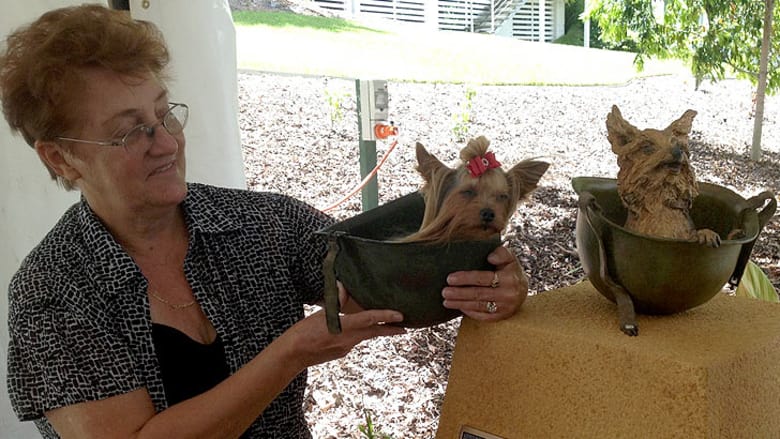
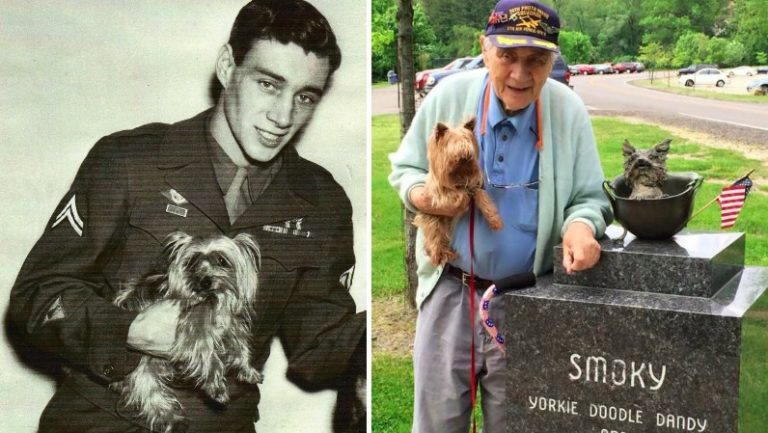
The Littlest Wardog died in her sleep in February 1957 at the age of fourteen, and buried in a .30 caliber ammunition box.  Years later,a  life-size a bronze sculpture of Smoky sitting in a GI helmet was installed over her final resting place in Rocky River Ohio, setting atop a two-ton blue granite base.

Bill Wynne was 90 years old in 2012, when he was “flabbergasted” to be approached by Australian authorities. They explained that an Australian army nurse had purchased the dog from a Queen Street pet store, and became separated in the jungles of New Guinea. sixty-eight years later, the Australian delegation had come to award his dog, a medal.

f88e3abeaa339b1ed4c15d9adbc1387b71c69549A memorial statue was unveiled on December 12 of that year, at the Australian War Memorial at the Queensland Wacol Animal Care Campus in Brisbane.
smoky-dog-1-768x433

On December 11, 2015, the Australian Royal Society for the Prevention of Cruelty to Animals (RSPCA) awarded Smoky the Purple Cross.  According to the press release, the award was “established in 1993 to recognize the deeds of animals that have shown outstanding service to humans, particularly where they have demonstrated exceptional courage, by risking their own safety or life, to save a person from injury or death. Since its inception, only nine animals have been awarded the prestigious award”.

“Yorkie Doodle Dandy” by Bill Wynne, tells the story of the dog Animal Planet has called, the first therapy dog. Originally published in 1996 by Wynnesome Press, the book is currently in its 5th edition, by Top Dog Enterprises, LLC.

As a personal aside, Nate and Zino were separated after their tour in Afghanistan. They were reunited in 2014, when the dog came to live with Nate and our daughter Carolyn in their home in Savannah. Last fall, Sheryl and I traveled to Houston with a friend, to celebrate our anniversary at the “Redneck Country Club”.  2,000 miles from home and completely by chance, who do we meet but the trainer who taught Zino to be a TEDD in the first place. Small world.

If you enjoyed this “Today in History”, please feel free to re-blog, “like” & share on social media, so that others may find and enjoy it as well. Please click the “follow” button on the right, to receive email updates on new articles.  Thank you for your interest, in the history we all share.

September 18, 1931 A Pretext for War

The “Mukden incident” was entirely staged, a “false flag” operation and bald pretext to war, carried out by Japanese military personnel and identical in purpose to that carried out against Poland by Nazi aggressors some eight years later, nearly to the day.

As Japan emerged from the medieval period into the early modern age, the future Nippon Empire transformed from a period characterized by warring states, to the relative stability of the Tokugawa Shōgunate.  Here, a feudal military government ruled from the Edo castle in the Chiyoda district of modern-day Tokyo, over some 250 provincial domains called han.  The military and governing structure of the time was based on a rigid and inflexible caste system, placing the feudal lords or daimyō at the top, followed by a warrior-caste of samurai, and a lower caste of merchants and artisans.  At the bottom of it all stood some 80% of the population, the peasant farmer forbidden to engage in non-agricultural activities, and expected to provide the income that made the whole system work.

Into this world stepped the “gunboat diplomats” of President Millard Filmore in the person of Commodore Matthew Calbraith Perry, determined to open the ports of Japan to trade with the west.  By force, if necessary.

Gunboat-commodore-perry
Gunboat Diplomacy, Commodore Perry

The system led to a series of peasant uprisings in the 18th and 19th centuries, and extreme dislocation within the warrior caste.  In time, these internal Japanese issues and the growing pressure of western encroachment led to the end of the Tokugawa period and the restoration of the Meiji Emperor, in 1868.

Many concluded as did feudal Lord (daimyō) Shimazu Nariakira, that “if we take the initiative, we can dominate; if we do not, we will be dominated”.  In the following decades, Japanese delegations and students traveled around the world to learn and assimilate Western arts, sciences and technologies. As the 19th century gave way to the 20th, Japan was transform from a feudal society into a modern industrial state.

The Korean peninsula remained backward and “uncivilized” during this period, little more than a tributary state to China, and easy prey for foreign domination.  A strong and independent Korea would have represented little threat to Japanese security but, as it was, Korea was a “a dagger pointed at the heart of Japan” in the words of German military adviser to the Meiji government, Major Jacob Meckel.

1-92-140-02The first Sino-Japanese war of July 1894 – April 1895, was primarily fought over control of the Korean peninsula.  The outcome was never in doubt, with the Japanese army and navy by this time patterned after those of the strongest military forces of the day.
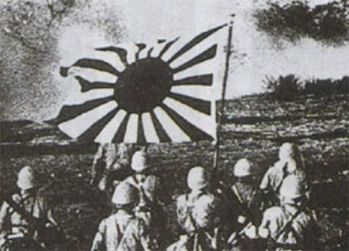
The Japanese 1st Army Corps was fully in possession of the Korean peninsula by October, and of the greater part of Manchuria, in the following weeks.  The sight of the mutilated remains of Japanese soldiers in the port city of Lüshunkou (Port Arthur) drove their comrades to a frenzy of shooting and slashing.  When it was over, numbers estimated from 1,000 to 20,000 were murdered in the Port Arthur Massacre.  It was a sign of things to come.

Japanese_Beheading_1894
An illustration of Japanese soldiers beheading 38 Chinese POWs as a warning to others by Utagawa Kokunimasa.

Russian desire for a warm-water port to the east brought the two into conflict in 1904 – ’05, the Russo Japanese War a virtual dress rehearsal for the “Great War” ten years later, complete with trench lines and fruitless infantry charges into interlocking fields of machine gun fire.

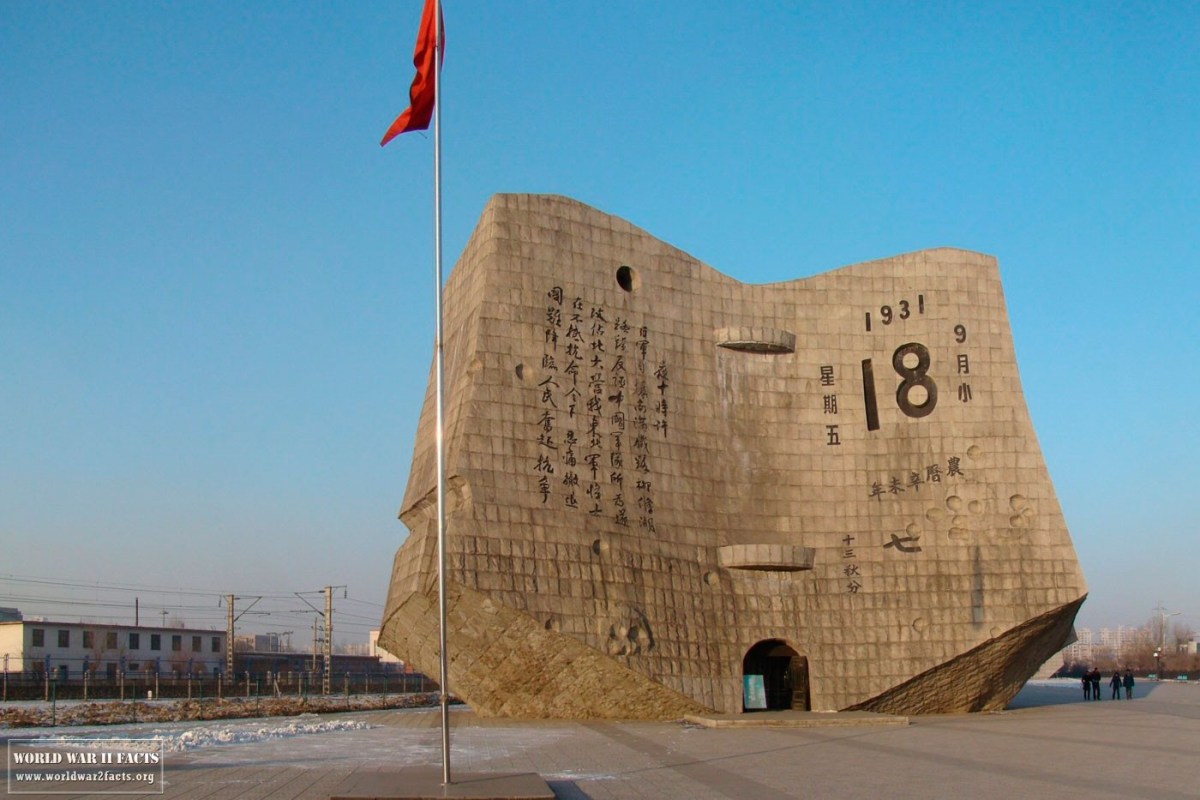
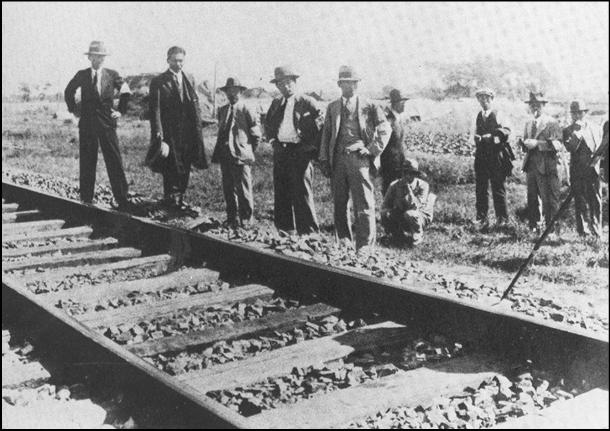
Subsequent treaties left Japanese forces in nominal control of Manchurian railroads when, on September 18, 1931, a minuscule dynamite charge was detonated by Japanese Lt. Kawamoto Suemori, near a railroad owned by Japan’s South Manchuria Railway near Mukden, in modern Shenyang, China. The explosion was so weak that it barely disturbed the tracks. A train passed harmlessly over the site just minutes later, yet, the script was already written.

Mukden (1)

The Imperial Japanese Army accused Chinese dissidents of the incident, launching a full scale invasion and installing the puppet emperor Puyi as Emporer Kangde of the occupied state of “Manchukuo”, one of the most brutal and genocidal occupations of the 20th century.

The “Mukden incident” was entirely staged, a “false flag” operation and bald pretext to war, carried out by Japanese military personnel and identical in purpose to that carried out against Poland by Nazi aggressors some eight years later, nearly to the day.

e59373baad2df0c6393fa778500d1575As Western historians tell the tale of WW2, the deadliest conflict in history began in September 1939, with the Nazi invasion of Poland. The United States joined the conflagration two years later, following the sneak attack on the American Naval anchorage at Pearl Harbor, by naval air forces of the Empire of Japan.

Eastern historians are more likely to point to a day eight years earlier, when this and subsequent invasions and the famine and civil wars which ensued, killed more people than the modern populations of Canada and Australia, combined.

Feature image, top of page: Mukden Incident Memorial and Museum, Shenyang, China

If you enjoyed this “Today in History”, please feel free to re-blog, “like” & share on social media, so that others may find and enjoy it as well. Please click the “follow” button on the right, to receive email updates on new articles.  Thank you for your interest, in the history we all share.

September 9, 1942 If we Knew each other

The old pilot never forgot a promise made to the place he had once tried to burn down.

In the months before the Japanese attack on Pearl Harbor, the B-1 type submarine I-25 quietly slipped from her dock, departing Yokusuka on November 21 and joining three other Japanese subs on patrol, in the waters north of Oahu.

The B-1 type was a fast cruiser submarine, built for long range and carrying on her bows a small aircraft hanger and deck catapult, designed to store and launch a single two-seater Yokosuka E14Y reconnaissance floatplane, known to the allies as a “Glen”.

sub2lq6

With twenty of them built, the B-1 series was the most numerous of some thirty nine distinct submarine types, employed by the Japanese in WW2.  The type was fairly successful, particularly in the beginning of the war. I-26 crippled the aircraft carrier USS Saratoga in August of 1942, and I-19 sank the aircraft carrier USS Wasp that September, at the same time damaging the battleship USS North Carolina and the destroyer USS O’Brien, which later sank.

I-25 launched the only piloted aircraft during World War II, to successfully attack the American mainland.

NobuoFujita-flightgearhistorical
Nobuo Fujita

Lieutenant Commander Meiji Tagami turned the I-25 into the winds off the Oregon coast on the morning of September 9, 1942, and launched the Yokosuka E14Y floatplane, piloted by Warrant Officer Nobuo Fujita and armed with two 168-lb thermite bombs.

Fujita had hoped the target would be Los Angeles or San Francisco, payback for the Doolittle raid that April but, no chance of that.   Lumbering along at 90MPH, such an aircraft is way too slow to attack such a heavily defended target.

Fujita’s target this day, was the vast forested region along the Oregon coast, near the California border.  With a little luck, the incendiary bombs would burn down a large section of the forest and a string of coastal towns along with it, diverting American resources from the war effort.

That day, the luck was on the American side. A recent rain in the Siskiyou National Forest had left the place wet, at low risk for fire. Howard “Razz” Gardner watched the aircraft come in, from the fire lookout tower on Mount Emily. He never saw the bombing itself but the plume of smoke, was easy enough to follow. Razz was able to hike to the scene while the Forest Service dispatched lookout Keith Johnson, from a nearby tower. The pair was able to keep the blaze contained overnight, and the crew arriving the next morning, put it out.

img069

The following day, area commander Lieutenant General John DeWitt announced “The Western Defense Command is investigating the circumstances surrounding the discovery on Sept. 9 of fragments of what appears to have been an incendiary bomb. These fragments were found by personnel of the United States Forestry Service near Mt. Emily nine miles northeast of Brookings, Or. Markings of the bomb fragments indicated that the missile was of Japanese origin”.

Fujita and his observer made a second attack on September 29, but the damage was negligible.  Not at all the regional conflagration he had hoped for.  Late in the war, Japanese authorities released hundreds of balloon bombs into the gulf stream, in a sustained attack on the continental United States.  One managed to kill a Sunday School class and its teacher but, the earlier attacks flown by Nobuo Fujita remained the only piloted attack on the US mainland, of WW2.

Years later, the junior chamber of commerce in Brookings Oregon, the “Jaycees”, got a bright idea over a few beers. Why not invite the only foreign pilot to successfully attack the American Mainland, as an honored guest.

5524241949_e7ddcb7a8a_z

It was a gesture of friendship, but the idea set off a firestorm in the coastal community. A full-page op-ed signed by 100 locals ran in the Brookings-Harbor Pilot, in 1962. Part of it read:

[Fujita’s] sole claim to fame is that he’s the only Nip pilot who bombed the mainland of the United States by airplane … Why stop with Fujita? Why not assemble the ashes of Judas Iscariot, the corpse of Atilla the Hun, a shovel full of dirt from the spot where Hitler died … .

Brookings resident Greg Jacques remembers, “There was a lot of turmoil. You gotta remember it was only like 16 years after the war. There were 30 to 40 to 50 percent of the men in the community at that time were in World War II.”   There were heated arguments in coffee shops and bars, all over town.  Then-Jaycees President Bill McChesney recalled, “I got a death threat it in the middle of the night.  This guy said, ‘If you walk with that Nip down the street we’re going to have rifles pointed at you, and your family.’”

In the end, the group of young businessmen, none over the age of 35, voted unanimously to extend the invitation. To hell with the consequences. President John F. Kennedy congratulated the group, on their efforts to promote international friendship.

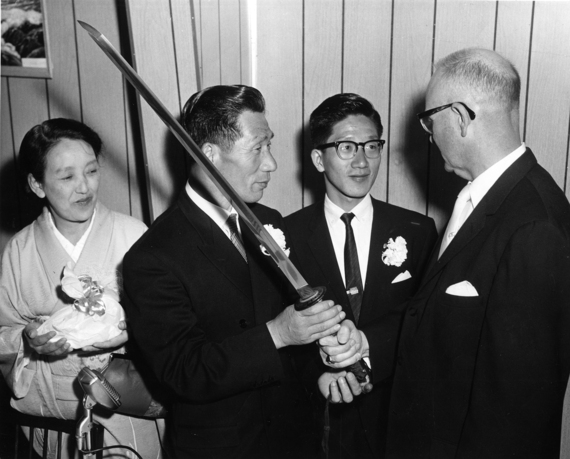
With assurances to the Japanese government that the former pilot would not be tried as a war criminal, the Fujita family left the Ibaraki Prefecture for the City of Brookings Oregon, in 1962. Nobuo, his wife Akayo, and their young son Yasuyoshi. Nobuo carried with him a prized family heirloom, a 400-year old Katana, the Samurai Sword with which he intended to perform Seppuku, ritual suicide by disembowelment, should this visit go wrong.

Nobuo Fujita presents his family's sword to the mayor of Brookin

Despite the bitterness left in the wake of that terrible war, the visit did not go wrong.
Fujita was made honorary chairman of that year’s azalea festival. The man was presented with a ceremonial key to the city, and allowed to take the controls of an aircraft, flying over the bomb site. He even tried his hand at playing a bagpipe, during a parade.

All things were not “Kumbaya” – several men were jailed during the visit, in a preemptive effort to keep the lid on.

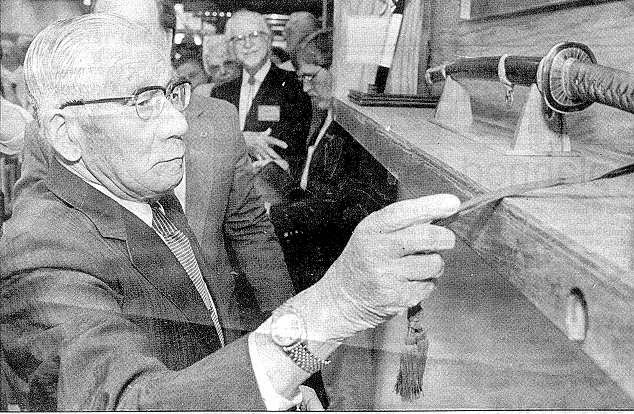
In the end, Nobuo Fujita did not open his abdomen with that sword, nor did he pass the treasured heirloom to his son, as once intended. The sword which had accompanied him on his every mission of the late war, including the one over Brookings itself, that prized object did he give to the city of Brookings, as a symbol of friendship. The sword may be seen at the Chetco Public Library, to this day.

news_sword1-3_jxo1hl

Back in Japan, the economy was tough after the war. Fujita passed the family hardware store down to his son, but the business failed. The old pilot never forgot a promise made to the place he had once tried to burn down. Fujita worked for years to earn the money, to buy a few books every month. In 1985 he kept his promise, inviting three Brookings-Harbor High School students on a cultural exchange visit to Japan, with the money he had saved. An aide to President Ronald Reagan sent him a letter, “with admiration for your kindness and generosity.”

news_tree2-6_txpz9m
Hat tip Oregon Public Broadcasting, OPB.org, for this and the sword image.

Fujita returned to Brookings in 1990, and again in 1992, and 1995. During the 1992 visit, he planted a Pacific Redwood, at the site where his bombs fell.

fujita_nobuo_3

Nobuo Fujita died in 1997 at the age of eighty-five, only days after being made an honorary citizen of the city of Brookings. In October of the following year, Fujita’s daughter Yoriko Asakura returned to the bomb site, where she buried some of her father’s ashes. Now, his spirit would fly over that place, forever.

Fujita NYT obit Oct 3 '97

At some point, the only foreign pilot to successfully attack the American mainland, confided to his diary: “If we knew each other. If we understood each other as a friend. This foolish war would never have happened. I sincerely hope that a day would come where everyone could overcome their differences through talking and not fighting”.

Yeah…What he said.

If you enjoyed this “Today in History”, please feel free to re-blog, “like” & share on social media, so that others may find and enjoy it as well. Please click the “follow” button on the right, to receive email updates on new articles.  Thank you for your interest, in the history we all share.

September 6, 1939 Battle of Barking Creek

There is a time when every hero, is as green as the grass.

The Nazi conquest of Europe began with the Sudetenland in 1938, the border districts of Bohemia, Moravia, and German speaking parts of Czechoslovakia. Within two years, every major power on the European mainland was either neutral, or under Nazi occupation.

Ground forces of the United Kingdom were shattered in 1940, along with those of her French, Indian, Moroccan, Polish, Belgian, Canadian and Dutch allies.  The hastily assembled fleet of 933 vessels large and small were all that stood before unmitigated disaster.

338,226 soldiers were rescued from the beaches of France.  Defeated but still unbeaten, these would live to fight another day.

dunkirkevacuation

In 1940, the island nation of Great Britain stood alone and unconquered, defiant in the face of the Nazi war machine.  In Germany, street decorations were being prepared for the victory parades which were sure to follow, as Adolf Hitler considered plans for his surprise attack on his ally to the East, the Soviet Union.

After the allied armies were hurled from the beaches of Dunkirk, Hitler seemed to feel he had little to do but “mop up”.  Prime Minister Winston Churchill captured the spirit of the period as only he could, when he said that “Never in the field of human conflict was so much owed by so many to so few”.

The “so few” to whom the Prime Minister referred, were the 2,342 British aircrew of the Royal Air Force (RAF), and the 595 international air crews who were her allies, in the “Battle of Britain“.

freeborn2_1715769cJohn Connell Freeborn was a pilot with the RAF, and a good one, too. Credited with 13½ enemy aircraft shot down, Freeborn flew more operational hours during the Battle of Britain, than any other pilot, ending the war with a Distinguished Flying Cross and  Bar, and completing his RAF career as a Wing Commander.  Yet, there is a time when every hero is as green as the grass.  In the beginning, John Freeborn like everyone else, were rank amateurs.

On the third day of the war, September 6, 1939, air combat experience was precisely, zero.  Very few had so much as seen a German aircraft, when a squadron of Mk IIB Hawker Hurricane fighters took off from North Weald Air Base after an early morning air raid alert. Two reserve Hurricanes left shortly afterward, piloted by Montague Hulton-Harrop and Frank Rose.

Something went wrong, and the two reserves were identified as enemy aircraft. Three Spitfires from Hornchurch, Essex were ordered to attack. Commanding officer of the flight, Adolph “Sailor” Malan, gave the order to engage.  Flying Officer Vincent ‘Paddy’ Byrne opened fire on Rose’s aircraft, as Pilot Officer John Freeborn attacked Hulton-Harrop.

Both aircraft were shot down. Rose survived, but Hulton-Harrop was dead before he hit the ground, shot through the back of his head. He was the first RAF pilot to die in the second World War. In another unfortunate first, this was the first time any aircraft had been shot down by a Spitfire.

sqldr.-roger-joyce-bushell-mid.-90120-raf-spitfire-w760

At the ensuing court martial, Malan testified for the prosecution, against his own pilots. He claimed that Freeborn had been irresponsible, impetuous, and had not taken heed of vital communications. As for Freeborn himself, his attorney, Sir Patrick Hastings, called Malan a “bare-faced liar”.

As an interesting aside, Hastings’ co-counsel for the defense was Roger Bushell, who was later incarcerated with Paddy Byrne at Stalag Luft III.  Roger “Big X”Bushell became the mastermind of the “Great Escape“, in which he and seventy-five other allied prisoners escaped Stalag Luft III via three tunnels, dubbed “Tom”, “Dick” and “Harry”.  Bushell was caught along with Bernard Scheidhauer, while waiting for a train at the Saarbrücken railway station, and murdered by members of the Gestapo.  Only three of the 76, escaped to freedom.

The court exonerated both Spitfire pilots, ruling the case to be an unfortunate accident.

RAFHurricaneRichard Hough and Denis Richards wrote about the episode in The Battle of Britain: The Greatest Air Battle of World War II, saying “This tragic shambles, hushed up at the time, was dubbed in the RAF ‘the Battle of Barking Creek’ – a place several miles from the shooting-down but one which, like Wigan Pier, was a standing joke in the music halls.”

The “Wigan pier” joke has to do with an inland industrial town, as if such a place could possess a pier, like some seaside pleasure resort.

Many years later, Freeborn spoke of the first RAF pilot to die in WW2, the man he himself had killed in a “friendly fire” incident. “I think about him nearly every day”, he said. “I’ve had a good life, and he should have had a good life too”.

churchyard1

If you enjoyed this “Today in History”, please feel free to re-blog, “like” & share on social media, so that others may find and enjoy it as well. Please click the “follow” button on the right, to receive email updates on new articles.  Thank you for your interest, in the history we all share.

September 2, 1945 Unit 731

To perform even the most cursory examination of WW2 is to walk among a catalog of atrocities, unimaginable to the modern reader. As if the very nightmare pits of hell had opened and unleashed horrors, unthinkable even to the blackest visions of the perverted and depraved. A true reckoning of the horrors of that war, is capable of producing psychological damage.

As Western historians tell the tale of WW2, the deadliest conflict in history began in September 1939, with the Nazi invasion of Poland. The United States joined the conflagration two years later, following the sneak attack on the American Naval anchorage at Pearl Harbor, by naval air forces of the Empire of Japan.

To perform even the most cursory examination of WW2 is to walk among a catalog of atrocities, unimaginable to the modern reader. As if the very nightmare pits of hell had opened and unleashed horrors, unthinkable even to the blackest visions of the perverted and depraved. A true reckoning of the horrors of that war, is capable of producing psychological damage.

auschwits-birkenau
Auschwitz-Birkenau

The mountains of gold teeth, of eyeglasses and hair and children’s shoes, testify in mute witness to the systematic extermination of eleven million souls in the gas chambers and ovens of the “Master Race”.  The Untermenschen:  The Jews.  The Roma (“gypsies”).  The physically and mentally disabled.  The Poles and other Slavic races, Jehovah‘s Witnesses, homosexuals, and members of political opposition groups.

Mass graves and savage reprisals by Nazi death squads for the imaginary “collective guilt” of civil populations. The vicious brutality inflicted upon the diseased and starving captives of the countless prison camps, of the “Greater East Asia Co-Prosperity Sphere“.

JapanesePowCamps-WWII-front
“Imperial Japanese-run prisoner-of-war camps within the Greater East Asia Co-Prosperity Sphere known during World War II from 1941 to 1945”. H/T Wikipedia

The tales are widely told and deservedly so.  Never should such atrocities be forgotten, any more than the cataclysmic fire bombing campaigns of entire cities, nor the nuclear annihilation which brought this whole ghastly conflagration, to a close.

Yet, of 100 randomly selected adults, how many are aware of “Unit 731″ and the other “medical experimentation” centers of the Kempetai, possibly the most hideous episode in this entire parade of horribles?

Shiro-ishii
General Shirō Ishii, Commandant of Unit 731

In the East, the war which began in 1939 dates back to 1931, and the Japanese invasion of Manchuria beginning on September 18.

The invasion followed the Mukden incident, an entirely staged “false flag” operation and bald pretext to war, carried out by Japanese military personnel and identical in purpose, to that carried out against Poland by Nazi aggressors eight years later, almost to the day.

The puppet state of Manchukuo now joined most of the Korean peninsula under Japanese subjugation.  This and subsequent invasions and the famine and civil wars which ensued, killed more people during this eight-year period, than the modern populations of Canada and Australia.  Combined.

The covert biological and chemical warfare research program conducted by Unit 731 began operations two years before the European war, during the “second Sino-Japanese War” of 1937-’45. Originally set up by the Kempeitai military police arm of the Imperial Japanese army, Unit 731 was taken over and commanded until the end of the war by General Shirō Ishii, a combat medic officer of the Kwantung Army.

Thousands of so-called “logs” (“Maruta”, in Japanese) were brought through the 150 buildings comprising Unit 731, and smaller facilities known as Unit 100 and Unit 516.  They were men, women and children, captives subjected to unspeakable acts of barbarity, in the name of medical “science”.   70% of Unit 731’s victims were ethnic Chinese, but the list includes Soviet, Mongolian and Korean nationals and possibly European, American and Australian POWs, as well.

unit-731-frostbite
Frostbite “experiment”

One example of the work there, is physiologist Yoshimura Hisato’s interest in hypothermia. The arms and legs of prisoners were submerged in ice or exposed to sub-zero winter cold until frozen solid, with ice accumulated on skin. Limbs were judged “ready” when they made a sound like a wooden board, when struck with a cane. Re-warming methods were carried out, from exposure to open fire to dousing in hot water. Sometimes the subject was simply left alone, to see how long a person’s own blood took to warm up the now-destroyed limbs.

germ-warfare
“Japanese personnel in protective suits carry a stretcher through Yiwu, China during Unit 731’s germ warfare tests. June 1942”. H/T allthatsinteresting.com

Human beings were intentionally infected with diseases such as cholera, anthrax or venereal disease, or nerve, chemical and biological warfare agents of every description. Then, as always, the live dissections, and examination of the prisoner’s organs.

unit-731-germs
“Germ” warfare experiment, being carried out at Unit 731

Female prisoners were subjected to rape and forced pregnancy, to test the “vertical transmission” of all of it, from mother to child.

Unit 731 museum
Unit 731 Museum, Harbin. “A permanent lab of the Troop No.731 to research the formation, therapy and prevention of frostbite. Before 1939, the troop did frostbite experiments generally in the fields.” Credit Samuel Kim, China Chronicles

Such “medical experiments” were carried out with no regard for the subjects’ survival.  In fact, live dissections were performed on fully aware and un-anesthetized victims, unless they were merely buried alive.  Such humane measures as unconsciousness, were thought to skew the “data”.  Not a single prisoner assigned to Unit 731, survived.  Not one.

Photographs may be found on-line if you wish, of the vivisection of live and fully conscious human beings.  I didn’t go there.   The images I decided to show, are bad enough.

Unit 731 prisoners were herded together onto firing ranges, to measure the damage done by weapons from swords to the Nambu 8mm pistol, to machine guns or bayonets and grenades.  Even flame throwers.

Bubonic plague-infected fleas were bred in laboratories at Unit 731 and Unit 1644, and spread by low flying aircraft in the coastal city of Ningbo and Changde in the Province of Hunan. Chinese civilians killed in outbreaks of bubonic plague, number thirty thousand or more.

children-researchers
“Unit 731 researchers conduct bacteriological experiments with captive child subjects in Nongan County of northeast China’s Jilin Province. November 1940”. H/T allthatsinteresting.com

Throughout the eight years of its existence, 1937 -1945, Unit 731 and its counterparts received generous support from the Japanese government.

On this day in 1945, Representatives of the Imperial Japanese government signed the formal instrument of surrender aboard the “Mighty Mo”, the Iowa-class battleship USS Missouri, ending World War 2 in the Pacific.

douglas-macarthur-and-hsu-yungchang-P
September 2, 1945

After the war, Unit 731 records were burned and researchers resumed civilian lives, as if nothing had happened. Many went back to faculty positions. Like “Operation Paperclip”, the combined British – American effort to scour the German talent pool for scientists and technicians of every sort, Japanese researchers were given immunity from prosecution, in exchange for what they knew.

Shirō Ishii was arrested by US occupation authorities after the war, and managed to negotiate immunity, in exchange for their full disclosure of germ warfare data based on human experimentation. On May 6 1947, General Douglas MacArthur wrote to Washington that “additional data, possibly some statements from Ishii probably can be obtained by informing Japanese involved that information will be retained in intelligence channels and will not be employed as ‘War Crimes’ evidence.”

After that, Ishii all but stepped off the pages of history.

Building_on_the_site_of_the_Harbin_bioweapon_facility_of_Unit_731
Today, the former Unit 731 bioweapon facility at Harbin is open to the public, as a war crimes museum

Cambridge University history lecturer Richard Drayton claims that he showed up in Maryland, to advise on bioweapons. Some sources place him on the Korean peninsula in 1951, still others claim he never left Japan where he died of throat cancer, at the age of 67.

In April of this year, the National Archives of Japan disclosed for the first time, a full list of the 3,607 people who worked for Unit 731. The Japanese government has yet to apologize for its acts of barbarity, nor is it likely to, anytime soon.  No more than the government in China, is likely to forget.

harbin-facility
Unit 731 facility, in Harbin