February 9, 1942 Of Hoodlums and Heroes

It didn’t last forever but, for one golden moment in history, the goons and the government were playing for the same side.

As the Great War gave way to the Roaring Twenties, operators of the great ocean-going liners began to look at a new class of vessels.

The White Star Lines’ Britannic, Olympic and the doomed Titanic. Cunard’s Carpathia, Mauretania and the ill-fated Lusitania. The Red Star Line’s Finland, Kroonland, and Lapland. These were the veterans of the trans-Atlantic trade, built around enormous numbers of immigrants and the one-way steerage class voyage from Europe, to the United States.

Normandie_poster
Normandie poster

As the US all but shut down immigration in the early 1920s, the shipping industry looked to a new class of super liner to serve an upper-crust tourist trade, particularly Americans traveling to Europe, to escape Prohibition.

The German-built Norddeutscher Lloyd company was first off the line with the SS Bremen and Europa. The British-made RMS Queen Mary was not far behind, but the Queen of this new class of super-liner, was the French-built Normandie.

SS Normandie was one-of-a-kind.  The first vessel laid in compliance with the 1929 SOLAS Convention (Safety of Life at Sea), she was enormous.  1,029-feet long and 119-feet wide and displacing 85,000 tons, she was the largest liner in the world. 1,975 berths offering seven classes of service, served by a crew of 1,300.

Despite worldwide depression, Normandie was launched in 1932, making her first Atlantic crossing, in 1935.

Normandie-under-construction
Normandie under construction

War broke out in Europe in 1939.  When France surrendered to Nazi Germany in June 1940, Normandie was tied to a dock, in New York.  Under no circumstance would such a vessel be allowed to fall into Nazi hands.  SS Normandie was immediately placed under “protective custody” by the US Navy.

There was speculation in the press, that the liner would be converted to an aircraft carrier in the event of American entry into the war.  The Navy seized the liner in the wake of Pearl Harbor, but not for a carrier.  The most luxurious liner in the world would be converted, to a troop ship.

Work began within weeks on the renamed USS Lafayette.

normandie-6-3176-default-largeThe afternoon of February 9, 1942 was cold and clear, over the West 49th Street pier. Welder Clement Derrick was removing the last of four stanchions in the Grand Salon when sparks ignited bales of burlap, covering highly flammable life vests.

Within a half-hour, much of the great liner was engulfed in flames. Black, oily smoke filled the City skyline as spectators crowded Pier 88.

Squadrons of fire boats poured a deluge of water, more than the great liner could bear. Mayor Fiorello LaGuardia and Rear Admiral Adolphus Andrews attempted to board when she suddenly lurched several feet, to port. USS Lafayette was drowning in the water, meant to save her life.

The scene was a carnival, with food vendors and  hawkers. Skycraper windows were opened, to watch the grim spectacle.

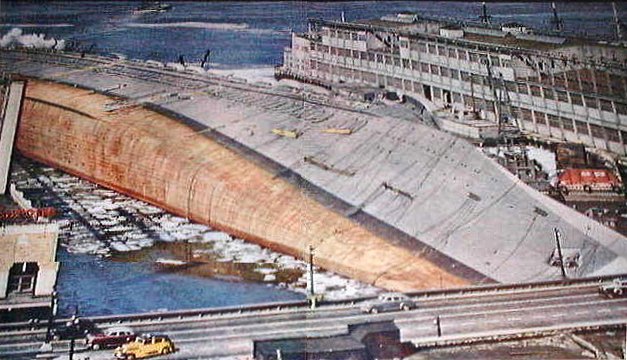
USS Lafayette continued her slow roll as, unseen within her holds, shifting water picked up speed. In twelve hours, it was over. At 2:35am on February 10, she rolled over and died.

Miki Rosen was five at the time, coming by in the family car, to gawk at the scene: “My father wanted us to see it because it was an historical event. I was terribly frightened by this enormous thing that I knew was supposed to be upright and bobbing up and down. It didn’t even look like a ship. It was a mass of iron floating in the water.”

USS_Lafayette_1942
USS Lafeyette, 1942

It wasn’t long before speculation turned to certainty. Sabotage. German spies were all over the waterfront, taking jobs as bartenders, stevedores and factory workers. Only a month earlier, 33 German agents were sentenced in a Brooklyn courtroom, to 300 years.  German U-Boats sank 20 allied vessels in January alone, a mere sixty miles off the New Jersey and Long Island shore.

main-qimg-5b28658362e63dfcf2abdc5a8709522fBBC broadcaster Alistaire Cooke, “the Twentieth Century’s de Tocqueville”, spoke of American seamen, torpedoed and picked up by a German submarine. The U-Boat commander came in and asked, in a perfect Brooklyn accent, if any were from the borough. “Maybe I worked with some o’ youse guys.  I was twelve years in the Brooklyn Navy Yard.

The FBI recreated Clement Derrick’s accident with the same dreadful result but, no matter.  By then, speculation had turned to “fact”.

Naval intelligence distrusted the official FBI version.  Hordes of uniformed personnel descended on the waterfront from Connecticut to New Jersey, to be met with a glowering brick wall of silence.  This was a rough and unaccustomed place, an underworld of sailors and gangsters,  fishermen and longshoremen.  A world of street toughs who’d long since lost any trust in uniforms, from meter maids to police officers.  Ivy-league Naval intelligence types got no information whatsoever.  Many were lucky, to escape without a beating.

The only authority in this world, was the Mob.

Naval Intelligence Director Rear Admiral Carl Espe remembered:  “The outcome of the war appeared extremely grave. In addition, there was the most serious concern over possible sabotage in the ports. It was necessary to use every possible means to prevent and forestall sabotage….” Someone on the docks was feeding the Nazis information, and only the mob had the power to hunt down the guilty party.  Policy makers fretted about doing business with the Mafia, while the Kriegsmarine U-Boats enjoyed the “Happy Time”.  

Could the Mafia even be trusted?  Vito Genovese fled New York to Italy back in 1937 to avoid a murder prosecution, where he became close friends with Fascist dictator, Benito Mussolini. So tight were the pair that the cagey gangster dispatched hit men to New York to murder newspaperman Carlo Tresca, a vocal critic of the fascist regime.

JosephLanza
Joseph “Socks” Lanza

Closer examination told a different story. Genovese was an opportunist, a double-crosser with no loyalty.  Most Sicilian gangsters were different, most of them refugees from savage Italian purges where Mafiosi were machine gunned, bombed and arrested, in droves. Thugs and gangsters yes, but almost to a man they hated the fascists with the white heat, of a thousand suns.

So it was, the United States Navy entered into one of the strangest relationships of WW2, an operation which would remain secret, until 1977. “Operation Underworld“.

The first mob boss to come on board was Joseph “Socks” Lanza, a hulking bulldozer of a man and undisputed lord of the Fulton fish market. Socks got his name because he’d “sock” anyone in the jaw, who disagreed with his pronouncements. A man with a criminal history going back to 1917, Joe Socks could order the fishing fleet from Maine to Florida to dump an entire catch to inflate prices, with a nod of his head. Fishermen failing to bribe the racketeer found their fish left rotting, on the docks. Continued disobedience resulted in arson, beatings, and death.

W-Intel-1-HT-Nov09

If anyone could ferret out a Judas passing information to German intelligence it was Joe Socks, but how to contact a gangster, sworn to the code of Omerta?

Head of the New York Rackets Bureau, Murray Gurfein and Office of Naval Intelligence (ONI) Commander Charles Radcliffe Haffenden met with Lanza in the office of the gangster’s attorney. Gurfein explained “It’s a matter of great urgency. Many of our ships are being sunk along the Atlantic coast. We suspect German U-boats are being refueled and getting fresh supplies off our coast …You can find out how and where the submarines are being refueled.”  Surprisingly, the Gangster jumped at the opportunity.

Socks provided union cards held for no-show jobs. Soon, naval intelligence agents were sailing aboard mackerel fleets from Newfoundland to Florida, ship-to-ship and ship-to-shore communications forming a valuable first-line of defense, against the Nazi submarine menace.

Important as it was, Lanza’s fishing fleet wasn’t enough, and Socks himself was disliked by the other four New York crime families.

220px-LuckyLucianoSmaller
Charles “Lucky” Luciano

The never-ending scrum of troop ships and merchant vessels crowding the New York waterfront was of life-and-death importance to the allied war effort. The only man who controlled it all, was in prison. Lucky Luciano.  The only man Luciano trusted, was the Jewish gangster, Meyer Lansky.

Unlike the Italians, no one questioned Lansky’s patriotism.  He and his Jewish mob had attacked Nazi meetings all over the city, throwing some of them out of the windows.

The meeting was arranged and, on May 12, 1942, Luciano was quietly transferred from Dannemora prison to a country club by comparison, and promised parole at the war’s end. This in exchange for the mobster’s cooperation in defeating Nazi Germany.

Cooperate, he did. The word went out from Luciano’s prison cell, from the docks to the heart of the city. Soon, every hat check girl and bartender, every longshoreman and numbers runner and the guys who serviced the vending machines, became the eyes and ears of the United States Navy. From bathroom attendants to elevator operators, the American Nazi organization known as German American Bund couldn’t so much as think out loud, without someone listening in.

It didn’t last forever but, for one golden moment in history, the goons and the government were playing for the same side.

In the end, USS Lafayette would never sail under a US Flag.  She was a total loss, sold for scrap in 1946.  The government was as good as its word. On January 3, 1946, Governor Thomas E. Dewey commuted Luciano’s sentence, on condition that he did not resist deportation. The most powerful mob boss in New York, Charles “Lucky” Luciano, was deported to Naples.  Four years to the day from the death of the USS Lafayette.

If you enjoyed this “Today in History”, please feel free to re-blog, “like” & share on social media, so that others may find and enjoy it as well. Please click the “follow” button on the right, to receive email updates on new articles.  Thank you for your interest, in the history we all share.

February 8, 1943 The Gift of Valor

The Swedish-American poet Carl Sandburg once wrote “Valor is a gift.  Those having it never know for sure whether they have it until the test comes.” 

e4fe77529e36fb9999c1c4e195929129For six hundred years, the Balkan states of Southeastern and Central Europe were conquered and unwilling subjects of foreign powers. First the Ottoman, and then the Austro-Hungarian Empires.

By the dawn of the 20th century, the dream of a single state for ethnic Serbs, Croats and Slovenes had been around for some two hundred years.

The spark that started WW1 and literally changed the world was struck by the “Black Hand”, a secret society dedicated to Serbian liberation, no matter what.

The dream of sovereignty took form and shape in the wake of WW1, the six constituent republics of the Socialist Republic (SR) of Bosnia and Herzegovina, SR Croatia, SR Macedonia, SR Montenegro, SR Serbia, and SR Slovenia merging to form the “Kingdom of Serbs, Croats and Slovenes”.  A creation of the treaty ending the Great War, the place was referred to as the “Versailles State“, for the first ten years. The name was officially changed to Yugoslavia in 1929, literally translating as the “Land of all South Slavic peoples“.

tumblr_mzl45prz011stxu8xo2_500Lepa Svetozara Radić was born into this world on December 19, 1925.

From her earliest student days, Lepa Radić was known for dedication and hard work, a smart and serious girl, dedicated and reading well above grade level.

Radić developed strong left-of-center political views, taking influence from uncle Vladeta Radić, a strong proponent of the labor movement.

By that age when young teenage girls are thinking of other things, Radić had joined the League of Communist Youth of Yugoslavia (SKOJ). By the time she turned fifteen in 1941, she was a member of the Yugoslavian Communist Party.

As World War 2 enveloped the continent, a group of disaffected Yugoslav Army Air Force officers plotted to overthrow the government in Belgrade. The Cvetković government signed the Vienna protocol on March 25, 1941, signalling its intention to join the Tri-Partite pact of Nazi Germany, Fascist Italy and Imperial Japan. The bloodless coup d’état of two days later overthrew the Prince Regency of Paul Karađorđević, installing the pro-western, seventeen-year-old King Peter II, with encouragement and support from the British Special Operations Executive (SOE).

Adolf Hitler was apoplectic, taking personal offense at the coup d’état.  Der Fuhrer had no interest in waiting to see if the new government would declare loyalty.  Hitler summoned his military advisers the same day, determined “to destroy Yugoslavia militarily and as a state” and to do so “with pitiless harshness.

The Nazi invasion of Yugoslavia was overwhelming, simultaneously launched from bases in Germany, Hungary, Romania and Bulgaria.  The Yugoslav state never had a chance.  It was all over, in eleven days.

gettyimages-92424114-612x612

The invasion was over in April, but not the Resistance.

With the German stranglehold in tight control of the towns and roadways, a Serbian resistance was quick to form in the wild mountains of the war torn nation.  Two of them really:  the Chetniks, dedicated to support of the Royal government in exile and the ferociously pro-Communist Partisans, under the leadership of Josip Broz “Tito.”

For the Radić family, there was no question of loyalty.  Lepa’s father Svetor and uncles Voja and Vladeta joined the Partisans in July, leading to the arrest of the entire family by the Ustashe, the fascist Nazi-puppet government of Yugoslavia.

lepa_radic_i_nemci__1502623485_44934-e1502623544936-780x300Resistance fighters freed the Radić family in weeks. That December, Lepa and her sister Dara officially joined the Partisans.

Though only fifteen, Lepa Radić was as fierce in her opposition to the Nazis, as any Partisan. She volunteered for the front lines, joining the 7th Partisan company of the 2nd Krajiski Detachment, transporting wounded and defenseless from the battlefield. Did I mention, she was fifteen years old.

1190617_lepa-radic_ls-sLepa was found out in February 1943, coordinating the rescue of 150 women and children attempting to flee the Nazis. She fired everything she had at attacking SS forces, but never had a chance. Lepa Radić was captured and sentenced to death by hanging, tortured for three days to extract information on Yugoslavian Resistance.

She gave up the cube root of zero.

She was brought to a hastily constructed gallows on February 8, 1943, and hanged in full view of the public.

Lepa_Radić_hangedMoments before her execution with the rope around her neck, Radić was offered a pardon. All she had to do, was give up the names of her Partisan comrades.

“I am not a traitor of my people”, she said. “Those whom you are asking about will reveal themselves when they have succeeded in wiping out all you evildoers, to the last man.”

Those were her last words.

The Swedish-American poet Carl Sandburg once wrote “Valor is a gift.  Those having it never know for sure whether they have it until the test comes.”

Were I ever to be half so egregiously tested, I hope I would prove myself half the man, as that seventeen-year-old girl.

If you enjoyed this “Today in History”, please feel free to re-blog, “like” & share on social media, so that others may find and enjoy it as well. Please click the “follow” button on the right, to receive email updates on new articles.  Thank you for your interest, in the history we all share.

January 28, 1942 The Mighty 8th Air force

On this seventy-seventh birthday of the Mighty 8th Air Force, we can all thank a teacher, that we are able to read this story. We can thank a Veteran, that we can read it in English.

The Nazi conquest of Europe began with the Sudetenland in 1938, the border districts of Bohemia, Moravia, and German speaking parts of Czechoslovakia.

The invasion of Poland brought France and Great Britain in on the side of their ally, in 1939.  Ground forces of the United Kingdom were shattered the following year, along with those of her French, Indian, Moroccan, Belgian, Canadian and Dutch allies.

The hastily assembled fleet of 933 vessels large and small were all that stood between salvation, and unmitigated disaster.  338,226 soldiers were rescued from the beaches of France.  Defeated, all but disarmed yet still unbeaten, these would live to fight another day.

dunkirkevacuation
Dunkirk

In 1940, every major power on the European mainland was either neutral, or under Nazi occupation.  The island nation of Great Britain stood alone and unconquered, defiant in the face of the Nazi war machine.  In Germany, street decorations were prepared for victory parades, as plans were laid for “Operation Sea Lion”, the planned invasion of Great Britain and final destruction of the British Isles.

After the allied armies were hurled from the beaches of Dunkirk, Hitler seemed to feel he had little to do but “mop up”.   Luftwaffe commander-in-chief Hermann Göring convinced Der Fuhrer that aircraft alone could do the job.

Hitler approved, and turned his attention to the surprise attack on his “ally” to the East. The “Battle of Britain” had begun.

Two days in August 1940 saw 3,275 sorties against the British home isles, with only 120 aircraft lost to the German side.  A single Junkers 88 or Heinkel 111 bomber carried 5,510-pounds of bombs.

heinkel-he-111-during-battle-of-britain-01

The wrath of the Luftwaffe was spent by the end of October, Operation sea Lion postponed again and again.  Great Britain would fight on alone, but for the shattered remnants of formerly allied powers, for another year and one-half.  Prime Minister Winston Churchill captured the spirit of the period as only he could, when he said: “Never in the field of human conflict was so much owed by so many to so few”.

Battle of Britain

Hitler would turn his his back and launch “Operation Barbarossa” in June, 1941.  The surprise invasion of the Soviet Union.

Under the terms of the tripartite pact with Fascist Italy and Imperial Japan, Nazi Germany was obliged to render aid in the event that either ally was attacked. On December 8, 1941, the day after the Japanese attack on the US naval anchorage at Pearl Harbor, Ambassador Hiroshi Ōshima came to German Foreign Minister Joachim von Ribbentrop, looking for  a commitment of support.

mighty-eighth-crewman
Crewman, Mighty 8th

Ribbentrop balked.  With their ally having been the aggressor, Germany was under no obligation to intervene.  Adolf Hitler thought otherwise. Hitler detested Roosevelt, and thought it was just a matter of time before the two powers were at war. He might as well beat the American President to the punch.

At 9:30am Washington time on December 11, German Chargé d’Affaires Hans Thomsen handed a note to American Secretary of State Cordell Hull. For the second time in the diplomatic history of the United States and Germany, the two nations were in a state of war.

Half a world away, one man went to bed to sleep the “sleep of the saved and thankful”.

“Silly people, and there were many, not only in enemy countries, might discount the force of the United States… But I had studied the American Civil War, fought out to the last desperate inch. American blood flowed in my veins. I thought of a remark which Edward Grey had made to me more than thirty years before—that the United States is like ‘a gigantic boiler’. Once the fire is lighted under it there is no limit to the power it can generate.  Being saturated and satiated with emotion and sensation, I went to bed and slept the sleep of the saved and thankful”. – Prime Minister Winston Churchill

8thaf-shoulder-patch48 days later, at Hunter Field in Savannah, Georgia, the Eighth Bomber Command was activated as part of the United States Army Air Forces. It was January 28, 1942.

The 8th was intended to support operation “Super Gymnast”, the invasion of what was then French North Africa.  Super Gymnast was canceled in April.  By May, the 8th Bomber Command had moved headquarters to a former girls’ school in High Wycombe, England, from where it conducted the strategic bombing campaign against Nazi Germany.

thndbrdRe-designated the Eighth Air Force on February 22, 1944, at its peak the “Mighty Eighth” could dispatch over 2,000 four engine bombers and more than 1,000 fighters on a single mission. 350,000 people served in the 8th Air Force during the war in Europe, with 200,000 at its peak in 1944.

By 1945, the Wehrmacht could tell itself a new joke:  “When we see a silver plane, it’s American. A black plane, it’s British. When we see no plane, it’s German”.  American aviation paid a heavy price for this little bit of black humor.

the-mighty-eighth-banner

Half of US Army Air Force casualties in World War II were suffered by the 8th, over 47,000 casualties, with more than 26,000 killed. By war’s end, 8th Air Force personnel were awarded 17 Medals of Honor, 220 Distinguished Service Crosses, and 442,000 Air Medals. There were 261 fighter aces in the 8th, 31 of whom scored 15 or more confirmed kills.  305 gunners were also recognized, as aces.

b-52h_static_display_arms_06

Following the allied victory in Europe, 8th AF Headquarters was reassigned to Sakugawa (Kadena Airfield), Okinawa, under the command of Lieutenant General James H. “Jimmy” Doolittle.  Tasked with organizing and training new bomber groups for the planned invasion of Japan, the 8th received its first B-29 Superfortress on August 8.  Seven days later, the atomic bomb had ended the war in the Pacific.

With the onset of the jet age and the “Cold War” at it height, the 8th Air Force moved to Westover Air Force Base in Massachusetts on June 13, 1955, the second of three Numbered Air Force groups of the newly constituted Strategic Air Command (SAC).

Since that time, the Mighty 8th has been called on to perform combat missions from Southeast Asia to the Middle East to the Federal Republic of Yugoslavia, flying out of its current headquarters at Barksdale Air Force Base, in Louisiana.

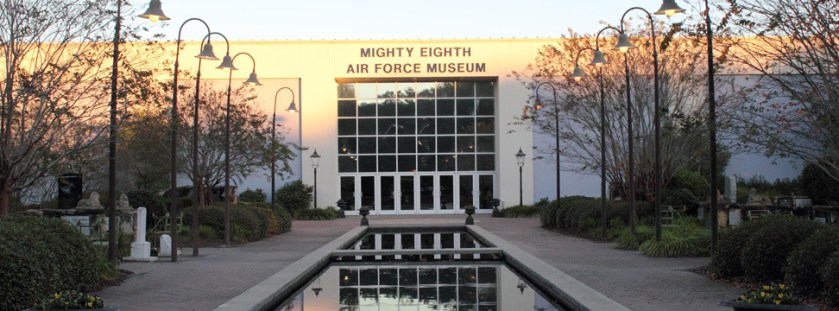
If you’re ever in Savannah, do yourself a favor and pay a visit to the National Museum of the Mighty Eighth Air Force (http://www.mightyeighth.org/). Not only will you experience an incredible story well told, but you will meet some 90+ year old veterans who walk as straight and tall today as they did, seventy years ago.

Happy Birthday, Mighty Eighth.

If you enjoyed this “Today in History”, please feel free to re-blog, “like” & share on social media, so that others may find and enjoy it as well. Please click the “follow” button on the right, to receive email updates on new articles.  Thank you for your interest, in the history we all share.

January 20, 2018 Rosie the Riveter

“She had been robbed of her part of history…It’s like the train has left the station and you’re standing there and there’s nothing you can do because you’re 95 and no one listens to your story.”

Following the German invasion of Poland in 1939 and the outbreak of general war in Europe, President Franklin Delano Roosevelt proclaimed a limited national emergency, authorizing an increase in Regular Army personnel to 227,000 and 235,000 for the National Guard. Strong isolationist sentiment kept the United States on the sidelines for the first two years, as victorious German armies swept across France.

That all changed on December 7, 1941, with the Japanese attack on the Pacific naval anchorage at Pearl Harbor. Seizing the opportunity, Nazi Germany declared war on the United States, four days later.

The Roosevelt administration had barely found the keys to the American war machine in February 1942, when disaster struck with the fall of Singapore, a calamity Prime Minister Winston Churchill called the “worst disaster” in British military history.

The mobilization of the American war machine was a prodigious undertaking. From that modest beginning in 1939, the Army alone had 5.4 million men under arms by the end of 1942. By the end of the war in 1945, American factories produced a staggering 296,000 warplanes, 86,000 tanks, 64,000 landing ships, 6,000 navy vessels, millions of guns, billions of bullets, and hundreds of thousands of trucks and jeeps. US war production exceeded that of the Axis powers of Germany, Italy, and Japan, combined.

As all that manpower mobilized to fight the war, women moved into the workforce in unprecedented numbers.  Nearly a third of a million women worked in the American aircraft industry alone in 1943:  65% of the industry’s workforce, up from just 1% in the interwar years.

rosie-the-riveter

All told, some six million women answered the call, expanding the female participation in the overall workforce from 27%, to 37%.

The mythical “Rosie the Riveter” first appeared in a song written by Redd Evans and John Jacob Loeb and made famous by swing bandleader James Kern “Kay” Kyser, in 1943.  The song told of a munitions worker who “keeps a sharp lookout for sabotage / Sitting up there on the fuselage…Rosie’s got a boyfriend, Charlie.  Charlie, he’s a Marine / Rosie is protecting Charlie Working overtime on the riveting machine”.

Norman Rockwell had almost certainly heard the song when he gave Rosie form for the cover of that year’s Memorial Day Saturday Evening Post.  Posed like the Prophet Isaiah from Michelangelo’s Sistine Chapel, Rockwell’s “Rosie” is on lunch break, riveting gun on her lap, a beat-up copy of Mein Kampf ground happily under foot.

1035x1485-gettyimages-90017379

Vermont Dental Hygienist Mary Doyle Keefe was the model for Rockwell’s Rosie.  The propaganda value of such an iconic image was unmistakable, but copyright rules limited the use of Rockwell’s portrait.  The media wasted no time in casting a real-life Rosie the Riveter, one of whom was Rose Will Monroe, who worked as a riveter at the Willow Run aircraft factory, in Ypsilanti Michigan.  Rose Monroe would go on to appear in war-bond drives, but the “Real” Rosie the Riveter, was someone else.

The year before the Rosie song came out, Westinghouse commissioned graphic artist J. Howard Miller to produce a propaganda poster, to boost company morale.  The result was the now-familiar “We Can Do It” poster, depicting the iconic figure flexing her biceps, wearing the familiar red & white polka dot bandanna.

world-war-ii-women-at-work-in-color-8
Colorized image of railroad workers on break, 1943

Though she didn’t know it, Miller’s drawing was based on a photograph of California waitress Naomi Parker Fraley, who worked in a Navy machine shop in 1942.

While Norman Rockwell’s Rosie the Riveter was the first, it is Miller’s work we remember, today.  Rosie the Riveter was larger than any one woman.  She was symbolic of her age, one of the most memorable and long lasting images of the twentieth century.

merlin_132732191_22bab46e-396e-4056-809a-2e551095a7dc-superjumbo
Naomi Parker Fraley, real-life model for Rosie the Riveter

For many years, it was believed that a Michigan woman, Geraldine Hoff Doyle, was the “real” Rosie the Riveter.  Hoff Doyle had seen the uncaptioned image, and believed it to be herself.  It was an innocent mistake. The woman bears a striking resemblance to the real subject of the photograph.

Thirty years came and went before Parker-Fraley even knew about it.  She saw herself in a newspaper clipping, and wrote to the paper around 1972, trying to set the record straight.  Too late. Hoff Doyle’s place had been cemented into popular culture, and into history.

Parker-Fraley was devastated. “I just wanted my own identity,” she says. “I didn’t want fame or fortune, but I did want my own identity.”

kimble_research_rosie-320
Professor James Kimble, Ph. D.

Another thirty-eight years would come and go before Seton Hall Communications Professor James J. Kimble, Ph.D., took an interest in the identity of the famous female from the WW2 poster. Beginning in 2010 and lasting nearly six years, the search became an obsession. It was he who discovered the long lost original picture with photographer’s notes identifying Naomi Parker-Fraley. “She had been robbed of her part of history,” Kimble said. “It’s so hurtful to be misidentified like that. It’s like the train has left the station and you’re standing there and there’s nothing you can do because you’re 95 and no one listens to your story.

rosie-the-riveter (1)Over the years there have been many Rosie the Riveters, the last of whom was Elinor Otto, who built aircraft for fifty years before being laid off at age ninety-five.  Naomi Parker-Fraley knew she was the “first”, but that battle was a long lost cause until Dr. Kimble showed up at her door, in 2015.  All those years, she had known.  Now the world knew.

Rosie the Riveter died on January 20, 2018.  She was ninety-six.

Hat tip “BoredPanda.com”, for a rare collection of colorized images from the WW2 era, of women at work.  It’s linked HERE.

December 22, 1944 The Forgotten Angel of Bastogne

The forgotten angel of Bastogne was eighty-six when the knock came on the door of that Belgian nursing home.  It took months for the Scottish historian to coax the story out of her. 

The Battle of the Bulge is a familiar tale: The massive German offensive bursting out of the frozen Ardennes forest on December 16, 1944. The desperate drive to capture the Belgian port of Antwerp, vital to German re-supply efforts.

Battle of the BulgeThe terrain was considered unsuitable for such an attack. The tactical surprise was complete, British and American forces separated and driven back, their positions forming an inward “bulge” on wartime battle maps.

The story of the “Battered Bastards” is likewise, well known. 22,800 Americans, outnumbered five to one in some places and surrounded, in the do-or-die fight to hold the indispensable crossroads, of Bastogne. The German demand to surrender, of December 22. The response from American General Anthony McAuliffe, the one word response, “Nuts”, the American slang, confusing to the German delegation.

The siege of Bastogne would last another four days, the German encirclement at last broken by elements of George S. Patton’s 3rd Army. By the end of January, the last great effort of German arms was spent and driven back behind original lines.

BastogneHistorian Stephen Ambrose wrote “Band of Brothers” nearly fifty years later, a non-fiction account later broadcast as an HBO mini-series, of the same name. The story refers to a black nurse named Anna. There is a brief appearance and then she is gone. No one knew who Anna was, or even if she was real.
Sixty-one years after Bastogne, military historian Martin King was conducting research for a book, Voices of the Bulge.  The knock on the door came in October 2007, in a geriatric home outside of Brussels.

In the months following the Great War, Henri Chiwy (pronounced “SHE-wee”) was a veterinarian, working in the Belgian colony of the Congo Free State. The name of the Congolese woman who bore his child is unrecorded, the name of their baby girl, Augusta Marie.

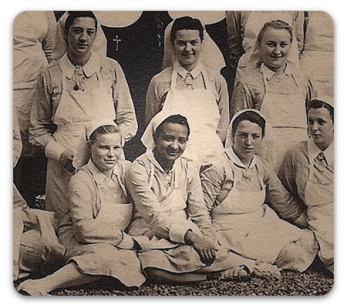
NursesAugusta Chiwy came back to Belgium when she was nine, one of the luckier of thousands born to European fathers, and African mothers. Back to the doctor’s home in Bastogne, a small town of 9,000 where Augusta was loved and cared for by her father and his sister, whom the girl knew as “aunt Caroline”.

Augusta was educated and raised a Catholic. She always wanted to teach but, due to the rancid racial attitudes of that time and place, it would not do to have a black woman teaching white children. She became a nurse instead, on the advice of her father and his brother, a well-known Bastogne physician.

Nursing school was about 100 miles north. Augusta became a qualified nurse in 1943 and returned home the following year for Christmas. She arrived on December 16, the day Adolf Hitler launched his surprise offensive.

Bastogne was soon surrounded, part of one of the fiercest and bloodiest battles, of WW2. Poorly equipped American GIs were outnumbered five to one. These guys didn’t even have winter uniforms.

Bastogne

US Army Doctor Jack Prior was desperate, the abandoned building serving as military aid station, home to some 100 wounded GIs. Thirty of those were seriously wounded. With virtually no medical equipment or medicine and the only other medical officer an Ohio dentist, Dr. Prior badly needed nursing help.

Augusta Chiwy did not hesitate to volunteer, knowing full well that she would be executed, if caught.

2BAF80BC00000578-3211358-image-a-42_1440616862244
Scene from the HBO mini series, “A Band of Brothers”

Working conditions were grisly in the weeks that followed. With no surgical instruments and no anesthesia, amputations and other procedures were performed with an army knife, with cognac to dull the patient’s pain. On Christmas eve, a direct hit from a 500-pound bomb hit one hospital building, instantly killing dozens of wounded GIs and the only other nurse, Renée Lemaire.  She would be remembered as “The Angel of Bastogne.”

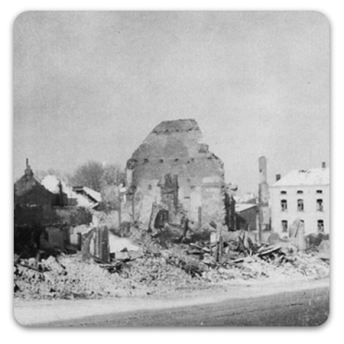
Bastogne buildingAugusta Chiwy was in a neighboring building at the time. The explosion blew the petite nurse through a wall but, unhurt, she picked herself up and went back to work.  There were grisly injuries and many died due to inadequate medical facilities, but many lived, their families reunited thanks to the tireless work of Dr. Jack Prior, and nurse Augusta Chiwy.

Given the month of hell the pair had been through, Augusta was heartbroken when Dr. Prior had to move out, in January.  The pair exchanged addresses and stayed in touch, writing letters and exchanging small gifts, of candy.  They last saw each other in 2004, when Dr. Prior returned from his home state of Vermont, for the 50th anniversary of the Battle of the Bulge.

Prior, ChiwyAugusta Chiwy suffered symptoms of post-traumatic stress disorder, a condition poorly understood at that time.  She would go long periods without speaking, becoming quiet and withdrawn even years later.  She married a Belgian soldier in 1959 and the couple had two children.  It would be twenty years, before  she resumed her nursing career.  She almost never spoke of her experience in Bastogne.
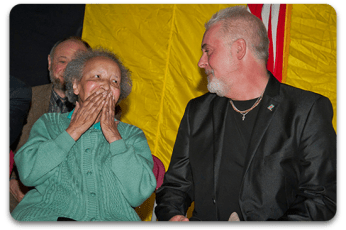
The forgotten angel of Bastogne was eighty-six when the knock came on the door of that Belgian nursing home.  It took months for the Scottish historian to coax the story out of her.

Thanks to King’s efforts, Augusta Chiwy would finally receive the recognition she had earned.

“On June 24, 2011, she was made a Knight in the Order of the Crown by King Chiwy and KingAlbert II of Belgium. Six months later she received the U.S. Army’s Civilian Award for Humanitarian Service. And on March 21, 2014, Augusta was recognized by her hometown as a Bastogne Citizen of Honor”.  http://www.augustachiwy.org

When asked about her heroism, she’d always say the same thing: “I only did what I had to do.”

Augusta Marie Chiwy died peacefully in her sleep at the age of 94, on August 23, 2015. How many lives would have been cut short, will never be known.  But for the selfless and untiring efforts, of the Forgotten Angel of Bastogne.

Hat tip to http://www.augustachiwy.org, for most of the images used in this essay

If you enjoyed this “Today in History”, please feel free to re-blog, “like” & share on social media, so that others may find and enjoy it as well. Please click the “follow” button on the right, to receive email updates on new articles.  Thank you for your interest, in the history we all share.

December 18, 1943 Bat Bomb

What if thousands of these creatures were equipped with tiny little fire bombs, and dropped on Japanese cities. All that bamboo & paper construction, the place oughtta go up like a match head.

In a letter dated January 7, 1941, Marshall Admiral Isoroku Yamamoto directed Rear Admiral Onishi Takijiro under conditions of utmost secrecy, to study the feasibility of an attack on the American Naval anchorage at Pearl Harbor.  Half a world away in Irwin Pennsylvania, American dentist Dr. Lytle S. Adams was planning a driving vacation to the Carlsbad Caverns, in New Mexico.

Dr. Adams was gripped with amazement that day in December, on witnessing millions of bats, exiting the cave.  It was December 7 and word came over the radio, of a sneak attack in Hawaii. Millions of Americans must have been thinking about payback that day, Dr. Adams among them.  His thoughts returned to those bats. What if thousands of these creatures were equipped with tiny little fire bombs, and dropped on Japanese cities. All that bamboo & paper construction, the place oughtta go up like a match head.

635830388988624957-Bats-in-Flight

Lytle Adams was a personal friend of First Lady Eleanor Roosevelt and submitted the idea, the following month.  Zoology professor Donald Griffin was conducting studies at this time of echolocation among animals, and recommended the White House approve the idea. The Presidential memorandum read: “This man is not a nut. It sounds like a perfectly wild idea but is worth looking into.” The mammalian super weapon that never was, was born.

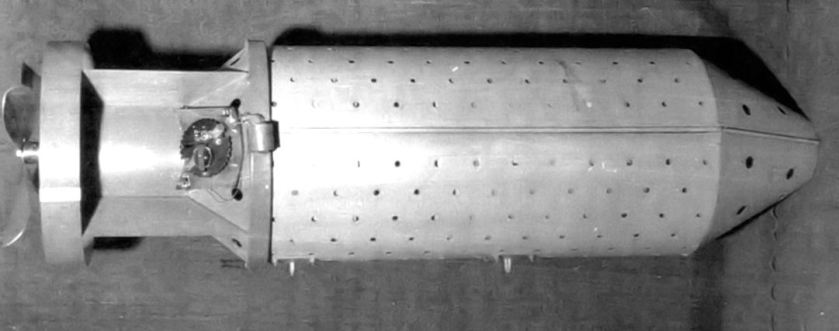
Bat_Bomb_Canister

Four biological factors lent promise to the plan. First, they’re the most plentiful mammal in North America.  A single cave can hold several million individuals. Second, load-carrying tests conducted in the dirigible hangar at Moffett Field in Sunnyvale, California, demonstrated that bats can carry more than their own weight. Third, they hibernate, making them easy to handle and, last, bats like secluded places such as buildings to hide during daylight.

Professor Louis Fieser, the inventor of military napalm, devised a tiny little canister to be carried by the bats. A suitable species was selected by March 1943, the Mexican Free-tailed Bat (Tadarida brasiliensis mexicanus).  “Bat bombs” were devised including 26 stacked trays, each containing compartments for 40 bats. Carriers would be dropped from 5,000-feet with parachutes deployed at 1,000-feet, allowing hibernating bats sufficient time to “snap out” of it.

Carlsbad_AAF_Fire_after_Bat_Bomb_Accident
Carlsbad AAF Fire, following Bat Bomb Accident

Early tests were promising. Too promising. On May 15, armed bats were accidentally released at the Carlsbad Army Airfield Auxiliary Air Base near Carlsbad, New Mexico, and incinerated the place when some of them came to roost under a fuel tank.

Despite the setback or possibly because of it, the program was handed off to the Navy that August, and code named Project X-Ray. The project was handed off once again that year, placed under control of the Marine Corps Air Station at El Centro, California, by December 18.

A “Japanese Village” was mocked up by the Chemical Warfare Service at the Dugway Proving Ground in Utah.  National Defense Research Committee (NDRC) observers were positive, one stating: “It was concluded that X-Ray is an effective weapon.” The Chief Chemist’s report was more enthusiastic: “Expressed in another way, the regular bombs would give probably 167 to 400 fires per bomb load where X-Ray would give 3,625 to 4,748 fires.”

Project X-Ray was scheduled for further tests in mid-1944 and not expected for combat readiness for another year, when the program was cancelled by Fleet Admiral Ernest J. King.  The project had already cost $2 million, equal to over $29 million today.  It was too much, for too little.

BatHouse

Die Fledermaus (“The Bat”) was a German operetta by composer Johann Strauss II, featuring a prolonged and drunken soliloquy by one Frosch, (the jailer), in act 2. Stanley Lovell was director of research and development for the OSS at the time (Office of Strategic Services), precursor to the CIA.  Ordered to evaluate the bat bomb by OSS Director “Wild Bill” Donovan, Lovell may have had the last word.  “Die Fledermaus Farce” he called it, noting that the things were dropping to the ground, like stones.

Fun Fact:
During WW2, the British Special Operations Executive (SOE) devised a “Rat Bomb”, for use against German targets. 100 rat carcasses were sewn up with plastic explosives, to be distributed near German boiler rooms and locomotives. The idea was that the carcass would be disposed of by burning, resulting in a boiler explosion. The explosive rats were never put to use as the Germans intercepted the first and only shipment. The project was deemed a success anyway, due to the enormous time and manpower resources expended by the Germans, looking for booby trapped rats.

If you enjoyed this “Today in History”, please feel free to re-blog, “like” & share on social media, so that others may find and enjoy it as well. Please click the “follow” button on the right, to receive email updates on new articles.  Thank you for your interest, in the history we all share.

December 14, 1944 Palawan Massacre

The bones of Americans captured at Bataan and Corregidor and burned alive at Palawan, were discovered soon after liberation.  Most were huddled together where they had died, trying to escape the flames.

The United States was unprepared to fight a World War in 1942, and dedicated itself to beating Adolf Hitler. General Douglas MacArthur abandoned the “Alamo of the Pacific” on March 11 saying “I shall return”, leaving 90,000 American and Filipino troops without food, supplies or support with which to fight off the Japanese offensive.

On April 9, 75,000 surrendered the Bataan peninsula, only to be herded off on a 65-mile, five-day slog into captivity through the heat of the Philippine jungle. Japanese guards were sadistic. They would beat the marchers and bayonet those too weak to walk. Japanese tanks would swerve out of their way to run over anyone who had fallen and was too slow in getting up. Some were burned alive. Already crippled from tropical disease and starving from the long siege of Luzon, some 700 Americans and more than 10,000 Filipinos perished in what came to be known as the Bataan Death March.

Palawan_Massacre_POW_Burial_Site_1945 (1)
Palawan Massacre POW Burial Site, 1945

That August, 346 men were sent 350-miles north to Palawan Island, on the western perimeter of the Sulu sea. The prisoners of “camp 10-A” were expected to build an airfield for their Japanese captors, hauling and crushing coral gravel by hand and pouring concrete, seven days a week.

The daily food ration was nothing more than a handful of wormy Cambodian rice and a thin soup made from boiling camote vines, a type of local sweet potato. Prisoners unable to work had even this thin ration, cut by 30 per cent.

The abuses these men received at the hands of the kempeitai, the Japanese army’s military police and intelligence unit, were unremitting, and savage. Prisoners were beaten with pick handles, kicked and slapped on a daily basis. Anyone who attempted to escape, was summarily executed.

Caught stealing food, six American POWs were tied to coconut trees and whipped with wire and then beaten with a wooden club, 3-inches in diameter. The six were then forced to stand at attention while a guard beat them unconscious, only to be revived to undergo further beatings. One Japanese private named Nishitani broke the left arms of two Americans with an iron bar, for taking green papayas off a tree.

Radioman 1st Class Joseph Barta described the Japanese guards at Palawan, as “the meanest bastards who ever walked the earth”.

Medical care was non-existent. One Marine, Pfc Glen McDole of Des Moines Iowa, was forced to endure an appendectomy with no anesthesia, and no infection fighting drugs.

The war was going badly for the Japanese, by late 1944.  US forces under General Douglas MacArthur landed at Leyte, that October. Morale soared for the 150 American prisoners remaining at Palawan, when a single Consolidated B-24 Liberator bomber sank two enemy ships and damaged several aircraft. More Liberators returned on October 28 and destroyed 60 enemy aircraft on the ground, as treatment of the prisoners grew even worse.

72e6168ba2

By early December, Allied aircraft were a near-constant presence overhead. Deliverance must have seemed imminent to the 150 American prisoners left on Palawan island, but it wasn’t meant to be. On December 14, some fifty to sixty soldiers under the leadership of 1st Lt. Yoshikazu Sato, prisoners called him the Buzzard, doused the remaining prisoners with gasoline and set them on fire. One hundred and thirty-nine were burned to death, or clubbed, or machine gunned as they tried to get away. The sound of screams were punctuated with shouts and laughter, from the guards.

Some closed to hand-to-hand combat with their tormentors and even managed to kill a few, but most never had a chance. Lieutenant Carl Mango of the U.S. Army Medical Corps ran toward the Japanese with his clothes on fire, pleading with them to use some sense. He too, was machine-gunned.

palawan-war-memorial-002
Palawan Massacre Memorial Marker for the American victims of December 14, 1944, Palawan Philippines

Thirty or forty managed to escape the kill zone, only to be hunted down, and murdered. From his hiding place on the beach, Eugene Nielsen of the 59th Coast Artillery observed several begging to be shot in the head, only to be bayoneted in the stomach and left to an agonizing death, by laughing guards. Erving August Evans of Nielsen’s unit stood up and said “All right, you Jap bastards, here I am and don’t miss me“.  He was shot, and his body set alight.

The killing went on until well after dark yet, somehow, some were able to escape detection and managed to swim the 5-mile bay to be picked up by friendly Filipino guerrillas, and taken to U.S. Rangers.   Rufus Smith was badly bitten on the left arm and shoulder by a shark, but manged to reach the other side.  USMC Pfc Donald Martyn reached the opposite side and turned in a direction opposite the others, and was never seen again.Glen McDole, the marine who survived the appendectomy, hid in a garbage dump, and witnessed one marine repeatedly poked with bayonets. Bleeding profusely, the man begged to be shot, only to have first one foot doused with gasoline and set on fire and then the other and finally, a hand. At last, his five or six tormentors tired of this game and he too, was set alight.

One Japanese soldier recorded the atrocity in a diary, later found in the camp:

“December 15–Due to the sudden change of situation, 150 prisoners of war were executed. Although they were prisoners of war, they truly died a pitiful death. The prisoners who worked in the repair shop really worked hard. From today on I will not hear the familiar greeting, ‘Good morning, sergeant major.’ January 9–After a long absence, I visited the motor vehicle repair shop. Today, the shop is a lonely place. The prisoners of war who were assisting in repair work are now just white bones on the beach washed by the waves. Furthermore, there are numerous corpses in the nearby garage and the smell is unbearable. It gives me the creeps”.

BurnedAtBaatan

Eugene Nielsen’s testimony sparked a series of POW rescues by American forces in 1945, including the raid on Cabanatuan of January 30, the surprise attack at Santo Tomas on February 3, 1945, the raid of Bilibid Prison on February 4 and the assault at Los Baños on February 23.  Starving prisoners were so emaciated, that Rangers were able to carry them out, two at a time.

The bones of Americans captured at Bataan and Corregidor and burned alive at Palawan, were discovered soon after.  Most were huddled together where they had died, trying to escape the flames.

Sixteen Japanese soldiers were tried and convicted of the massacre in August 1948 and several sentenced to death.  All were later released, in a general amnesty.

Of 146 enlisted men and four officers held in the Palawan prison camp, eleven survived the massacre of December 14, 1944.   Glen McDole was one of them.  Author Bob Wilbanks wrote a book if you’re interested, a biography really, entitled:  Last Man Out: Glenn McDole, USMC, Survivor of the Palawan Massacre in World War II.

In 1952, 123 of the 139 victims of the Palawan massacre were buried in a common grave.  They came from forty-two states and the Philippines, reverently interred in a mass burial site in Section 85 at the Jefferson Barracks National Cemetery, near St. Louis, Missouri. Today, their graves are visited by those who remember.  And by the deer, grazing among the stones most evenings, as the sun drops out of sight. It is the largest such group burial, at Jefferson Barracks.

0b7a90f8bc535c8d7124061f42913082

How many such massacres were carried out with no one left alive to tell the tale, remains anyone’s guess.

If you enjoyed this “Today in History”, please feel free to re-blog, “like” & share on social media, so that others may find and enjoy it as well. Please click the “follow” button on the right, to receive email updates on new articles.  Thank you for your interest, in the history we all share.

December 13, 1941 Cook’s Assistant

There is no telling, how many lives could have been lost.  But for the actions, of a sixteen-year-old cook’s assistant.

Similar to the Base Exchange system serving American military personnel, the British Navy, Army and Air Force Institutes (NAAFI) is the UK-government organization operating clubs, bars, shops and supermarkets in service to British armed forces, as well as naval canteen services (NCS) aboard Royal Navy ships.

naafiNAAFI personnel serving on ships are assigned to duty stations and wear uniforms, while technically remaining civilians.
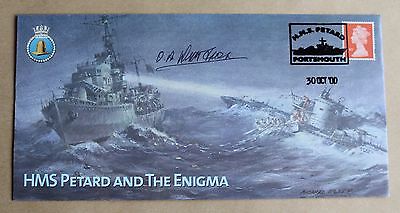
Tommy Brown was fifteen when he lied about his age, enlisting in the NAAFI on this day in 1941 and assigned as canteen assistant to the “P-class” destroyer, HMS Petard.

On October 30, 1942, Petard joined three other destroyers and a squadron of Vickers Wellesley light bombers off the coast of Port Said Egypt, in a 16-hour hunt for the German “Unterseeboot”, U–559.

Hours of depth charge attacks were rewarded when the crippled U-559 came to the surface, the 4-inch guns of HMS Petard, permanently ending the career of the German sub.

The U-559 crew abandoned ship, but not before opening the boat’s seacocks.   Water was pouring into the submarine as Lieutenant Francis Anthony Blair Fasson and Able Seaman Colin Grazier dived into the water and swam to the submarine, with Junior canteen assistant Tommy Brown close behind.

Ww2-Hms-Petard-The-Enigma-2000-Cover

With the submarine sinking fast, Fasson and Grazier made their way into the captain’s cabin.   Finding a set of keys, Fasson opened a drawer, to discover a number of documents, including two sets of code books.

With one hand on the conning ladder and the other clutching those documents, Brown made three trips up and down from the hatch, to Petard’s whaler.

war (1)

With the sub beginning to sink, the canteen assistant called for his shipmates to get out of the boat, but the other two were trapped. Brown himself was dragged under, but managed to kick free and come to the surface.  Colin Grazier and Francis Fasson, did not escape.

The episode brought Brown to the attention of the authorities, ending his posting aboard Petard with the revelation of his true age.  He never was discharged from the NAAFI, and later returned to sea on board the HMS Belfast.

grazier 2

By 1945 he was Leading Seaman Tommy Brown, home on shore leave when fire broke out at the family home in South Shields.  He died while trying to rescue his youngest sister Maureen, and was buried with full military honors in Tynemouth cemetery.

Fasson and Grazier were awarded the George Cross, the second-highest award of the United Kingdom system of military honors.  Since he was a civilian due to his NAAFI employment, Brown was awarded the George medal.

Fasson Memorial

None of the three would ever learn that their actions had helped to end the war.

For German U-boat commanders, the period between the fall of France and the American entry into WW2 was known as “Die Glückliche Zeit” – “The Happy Time” – in the North Sea and North Atlantic.  From July through October 1940 alone, 282 Allied ships were sunk off the northwest approach to Ireland, for a combined loss of 1.5 million tons of merchant shipping.

tmp791791015303315457

Tommy Brown’s Mediterranean episode took place in 1942, in the midst of the “Second Happy Time”, also known among German submarine commanders as the American shooting season. U-boats inflicted massive damage during this period, sinking 609 ships totaling 3.1 million tons with the loss of thousands of lives, against a cost of only 22 U-boats.

According to USMM.org, the United States Merchant marine suffered a higher percentage of fatalities at 3.9%, than any other American service branch during WW2.

enigma2Early versions of the German “Enigma” code were broken as early as 1932, thanks to cryptanalysts of the Polish Cipher Bureau, and French spy Hans Thilo Schmidt.
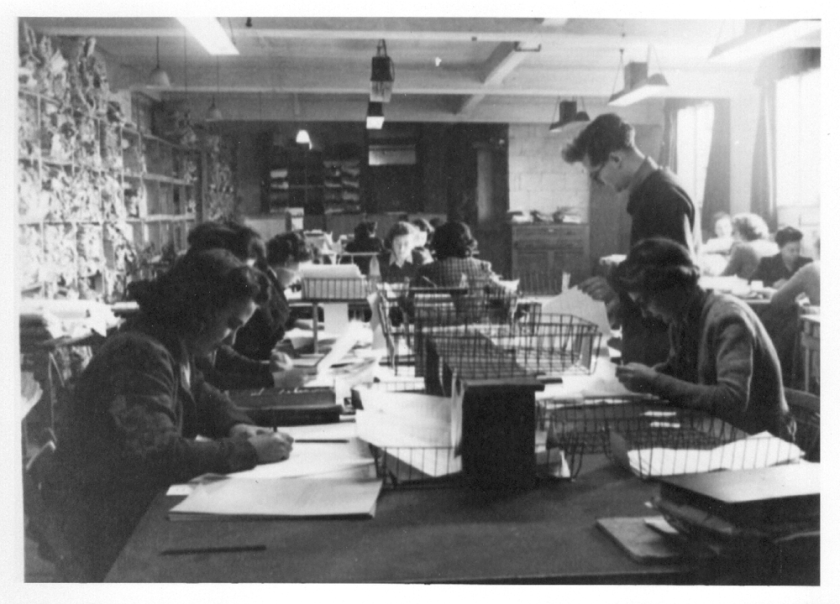
French and British military intelligence were read into Polish decryption techniques in 1939, \methods which were later improved upon by the British code breakers of Bletchley Park.  Vast numbers of messages were intercepted and decoded from Wehrmacht and Luftwaffe sources, shortening the war by at least a year, and possibly two.

The Kriegsmarine was a different story.  Maniacally jealous of security, Admiral Karl Dönitz introduced a third-generation enigma machine (M4) into the submarine service around May 1941, a system so secret that neither Wehrmacht nor Luftwaffe, were aware of its existence.  The system requires identical cipher machines at both ends of the transmission and took a while to put into place, with German subs being spread around the world.

By early 1942, all M4 machines were in place.  On February 2, German submarine communications went dark.  For code breakers at Bletchley Park, the blackout was sudden and complete.  Like the flipping of a switch.  For a period of nine months, Allies had not the foggiest notion of what the German submarine service was up to.  The result was disastrous.

BletchleyThe beginning of the end of darkness came to an end on October 30, when a ship’s cook climbed up that conning ladder.  Code sheets allowed British cryptanalysts to attack the “Triton” key used by the U-boat service.  It would not be long, before the U-boats themselves, were under attack.
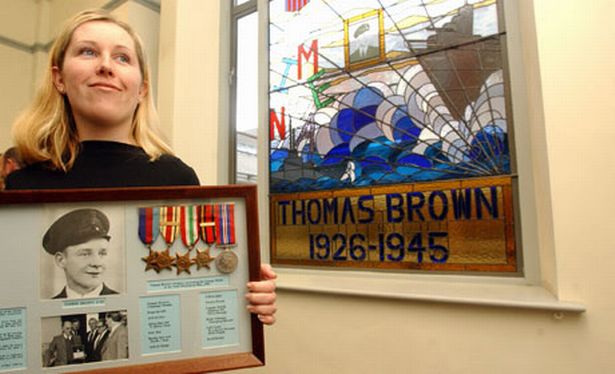
Tommy Brown never knew what was in those documents.  The entire enterprise would remain Top Secret, until years after his death.  Winston Churchill would later write, that the actions of the crew of Petard, were crucial to the outcome of the war.  There is no telling, how many lives could have been lost.  But for the actions, of a sixteen-year-old cook’s assistant.

thomas-brown-sharon-carley-462946894

If you enjoyed this “Today in History”, please feel free to re-blog, “like” & share on social media, so that others may find and enjoy it as well. Please click the “follow” button on the right, to receive email updates on new articles.  Thank you for your interest, in the history we all share.

December 7, 1941 Aftermath

The work was hellishly dangerous down there in the mud and the oil at the bottom of Pearl Harbor.  Several divers lost their lives yet, another day would come and each would descend yet again, into that black water.

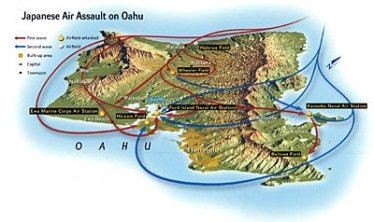
It was literally “out of the blue”, when the first wave of enemy aircraft arrived at 7:48 am local time, December 7, 1941. 353 Imperial Japanese warplanes approached in two waves out of the southeast, fighters, bombers, and torpedo planes.  Across Hickam Field and over the still waters of Pearl Harbor. Tied in place and immobile, the eight vessels moored at “Battleship Row” were easy targets.

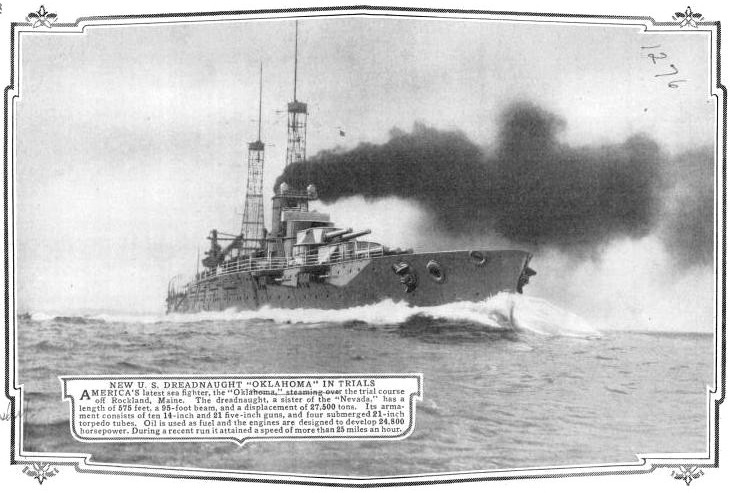
In the center of the Japanese flight path, sailors and Marines aboard the USS Oklahoma fought back furiously. She didn’t have a chance. Holes as wide as 40′ were torn into her side in the first ten minutes of the fight. Eight torpedoes smashed into her port side, each striking higher on the hull as the great Battleship began to roll.

_oahuBilge inspection plates had been removed for a scheduled inspection the following day, making counter-flooding to prevent capsize, impossible. Oklahoma rolled over and died as the ninth torpedo slammed home. Hundreds scrambled out across the rolling hull, jumped overboard into the oil covered, flaming waters of the harbor, or crawled out over mooring lines in the attempt to reach USS Maryland in the next berth.
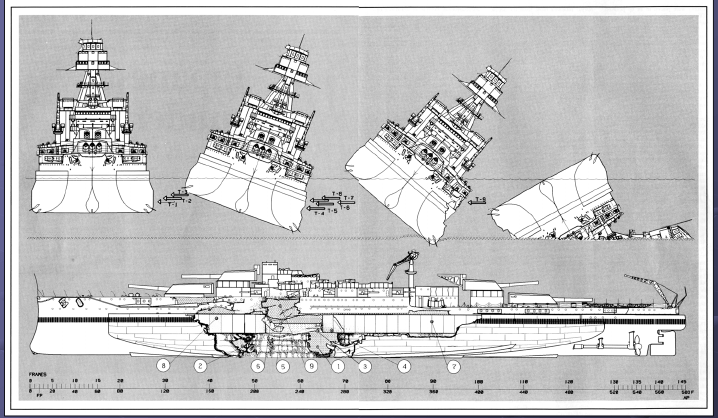
The damage was catastrophic. Once the pride of the Pacific fleet, all eight battleships were damaged, four of them sunk. Nine cruisers, destroyers and other ships were damaged, another two sunk. 347 aircraft were damaged, most caught while still on the ground. 159 of those, were destroyed altogether. 2,403 were dead or destined to die from the attack, another 1,178 wounded.

Nine Japanese torpedoes struck USS Oklahoma’s port side, in the first ten minutes.

HT John F DeVirgilio for this graphic
The last moments of USS Oklahoma.  H/T John F DeVirgilio for this graphic

Frantic around the clock rescue efforts began almost immediately, to get at 461 sailors and Marines trapped within the hull of the Oklahoma. Tapping could be heard as holes were drilled to get at those trapped inside. 32 were delivered from certain death.

14 Marines and 415 sailors aboard Oklahoma lost their lives immediately, or in the days and weeks to come. Bulkhead markings would later reveal that, at least some of the doomed would live for another seventeen days in the black, upside-down hell. The last such mark was drawn by the last survivor on Christmas Eve.

Of the sixteen ships lost or damaged, thirteen would be repaired and returned to service. USS Arizona remains on the bottom, a monument to the event and to the 1,102-honored dead who remain entombed within her hull. USS Utah defied salvage efforts. She too is a registered War Grave, 64 honored dead remaining within her hull, lying at the bottom not far from the Arizona. Repairs were prioritized and USS Oklahoma was beyond repair. She, and her dead, would have to wait.

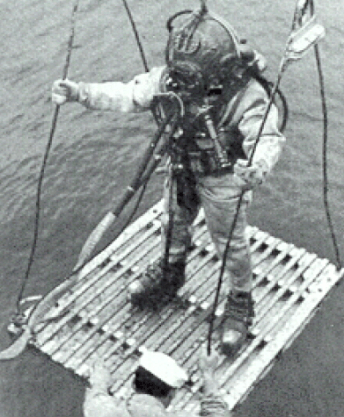
Oklahoma DiverRecovery of the USS Oklahoma was the most complex salvage operation ever attempted, beginning in March, 1943.  With the weight of her hull driving Oklahoma’s superstructure into bottom, salvage divers descended daily to separate the tower, while creating hardpoints from which to attach righting cables.
The work was hellishly dangerous down there in the mud and the oil at the bottom of Pearl Harbor.  Several divers lost their lives yet, another day would come and each would descend yet again, into that black water.

21 giant A-frames were fixed to the hull of the Oklahoma, 3″ cables connecting compound pulleys to 21 electric motors, each capable of pulling 429 tons.

Two pull configurations were used over 74 days, first attached to these massive A-frames, then direct connections once the hull had achieved 70°. In May 1943, the decks once again saw the light of day, for the first time in over two years.

rightng-strategy
USS Oklahoma, righting strategy

Fully righted, the ship was still ten-feet below water. Massive temporary wood and concrete structures called “cofferdams” closed cavernous holes left by torpedoes, so the hull could be pumped out and re-floated. A problem even larger than those torpedo holes were the gaps between hull plates, caused by the initial capsize and righting operations. Divers stuffed kapok into gaps as water was pumped out.

Individual divers spent 2-3 years on the Oklahoma salvage job. Underwater arc welding and hydraulic jet techniques were developed during this period, which remain in use to this day. 1,848 dives were performed for a total of 10,279 man hours under pressure.

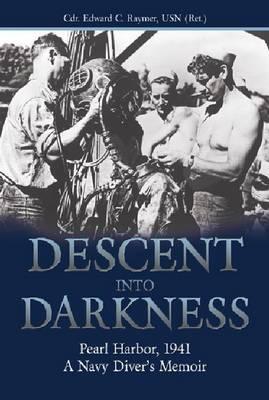
9781591147244CDR Edward Charles Raymer, US Navy Retired, was one of those divers. Raymer tells the story of these men in Descent into Darkness: Pearl Harbor, 1941 – A Navy Diver’s Memoir, if you’re interested in further reading.  Most of them are gone now, including Raymer himself.  They have earned the right to be remembered.

Salvage workers entered the pressurized hull through airlocks wearing masks and protective suits. Bodies were in advanced stages of decomposition by this time and the oil and chemical-soaked interior was toxic to life. Most victims would never be identified.

Twenty 10,000 gallon per minute pumps operated for 11 hours straight, re-floating the battleship on November 3, 1943.

Oklahoma entered dry dock the following month, a total loss to the American war effort. She was stripped of guns and superstructure, sold for scrap on December 5, 1946 to the Moore Drydock Company of Oakland, California.

The battered hulk left Pearl Harbor for the last time in May 1947, destined for the indignity of a scrapyard in San Francisco bay. She would never make it. Taken under tow by the ocean-going tugs Hercules and Monarch, the three vessels entered a storm, 540 miles east of Hawaii. On May 17, disaster struck. Piercing the darkness, Hercules’ spotlight revealed that the former battleship was listing heavily. Naval base at Pearl Harbor instructed them to turn around, when these two giant tugs suddenly found themselves slowing to a stop. Despite her massive engines, Hercules was being dragged astern with no warning, hurtling past Monarch, herself swamped at the stern and being dragged backward at 17mph.

the-tug-boat-hercules-william-havle
Ocean-going tug Hercules, photograph by William Havle

Fortunately for both tugs, skippers Kelly Sprague of Hercules and George Anderson of Monarch had both loosened the cable drums connecting 1,400-foot tow lines to Oklahoma. Monarch’s line played out and detached, but Hercules’ line didn’t do so until the last possible moment. With tow line straight down and sinking fast, Hercules’ cable drum exploded in a shower of sparks directly over Oklahoma’s final resting place, the 409-ton tug bobbing to the surface like the float of a child’s fishing line.

“Okie” had been stabbed in the back, attacked and mortally wounded before she knew her nation was at war.  The causes leading to her final descent, remain uncertain.  Most will tell you, those plates couldn’t hold.  The beating of six years earlier, was just too much.   Those who served on her decks, might tell you she preferred to die at sea.

If you enjoyed this “Today in History”, please feel free to re-blog, “like” & share on social media, so that others may find and enjoy it as well. Please click the “follow” button on the right, to receive email updates on new articles.  Thank you for your interest, in the history we all share.


December 2, 1943  A Savior of Millions

How modern chemotherapy drugs emerged form the trenches of WW1

Ancient Greek mythology depicts Hercules, poisoning arrows with the venom of the Hydra. Both sides in the battle for Troy used poisoned arrows, according to the Iliad and the Odyssey of Homer.   Alexander the great encountered poison arrows and fire weapons in the Indus valley of India, in the fourth century, BC.  Chinese chronicles describe an arsenic laden “soul-hunting fog”, used to disperse a peasant revolt, in AD178.

The French were first to use poison weapons in the modern era, firing tear gas grenades containing xylil bromide against German forces in the first month of the Great War, August 1914.

mustard1-150x150

Imperial Germany was first to give serious study to chemical weapons of war, early experiments with irritants taking place at the battle of Neuve-Chapelle in October 1914, and with tear gas at Bolimów on January 31, 1915 and again at Nieuport, that March.

The first widespread use of poison gas, in this case chlorine, came on April 22, 1915, at the second battle of Ypres.

The story of gas warfare is inextricably linked with that of WW1.  124,000 tons of the stuff was produced by all sides by the end of the war, accounting for 1,240,853 casualties, including the agonizing death of 91,198.

Had the war continued into 1919, technological advances promised a new and fresh hell, unimaginable to the modern reader.

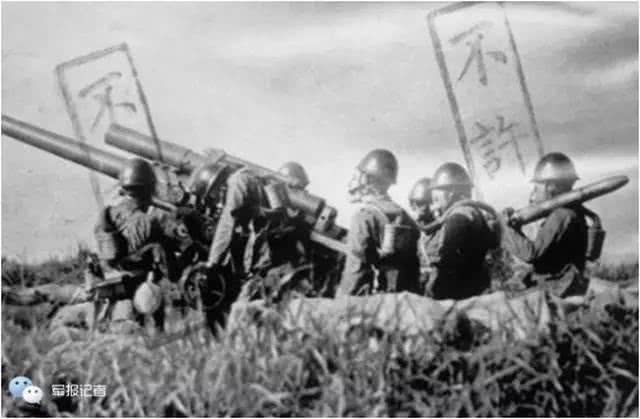
Today we think of chemical agents in WW2 as being limited to the death camps of the Nazis, but such weapons were far more widespread.  The Imperial Japanese military frequently used vesicant (blister) agents such as Lewisite and mustard gas against Chinese military and civilians, and in the hideous “medical experiments” conducted on live prisoners at Unit 731 and Unit 516.  Emperor Hirohito personally authorized the use of toxic gas during the 1938 Battle of Wuhan, on no fewer than 375 occasions.

Japanese, Gas Artillery

The Italian military destroyed every living creature in its path during the 1936 Colonial war with Ethiopia, in what Emperor Haile Selassie called “a fine, death-dealing rain”.

Nazi Germany possessed some 45,000 tons of blister and nerve agents, though such weapons were rarely used against western adversaries.  The “Ostfront” – the battle on the eastern front – was a different story.  Russian resistance fighters and Red Army soldiers were attacked, most notably during the assault on the catacombs of Odessa in 1941, the 1942 siege of Sebastopol, and the nearby caves and tunnels of the Adzhimuskai quarry, where “poison gas was released into the tunnels, killing all but a few score of the (3,000+) Soviet defenders”.

russian-soldier-in-a-rubber-gas-mask-on-the-eastern-front-russia-during-K07NJ9
Russian soldier in a rubber gas mask, ww2

None of the western allies resorted to chemical warfare in WW2, despite having accumulated over twice the chemical stockpile as that of Nazi Germany.  The policy seems to have been one of “mutually assured destruction”, where no one wanted to be first to go there, but all sides reserved the option.  Great Britain possessed massive quantities of mustard, chlorine, Lewisite, Phosgene and Paris Green, awaiting the retaliatory strike should Nazi Germany resort to such weapons on the beaches of Normandy.  General Alan Brooke, Commander-in-Chief of the Home Forces, said he “[H]ad every intention of using sprayed mustard gas on the beaches” in the event of a German landing on the British home islands.

The official American policy toward chemical weapons was enunciated by President Franklin Roosevelt, in 1937.

“I am doing everything in my power to discourage the use of gases and other chemicals in any war between nations. While, unfortunately, the defensive necessities of the United States call for study of the use of chemicals in warfare, I do not want the Government of the United States to do anything to aggrandize or make permanent any special bureau of the Army or the Navy engaged in these studies. I hope the time will come when the Chemical Warfare Service can be entirely abolished”.

The Geneva Protocols on 1925 banned the use of chemical weapons, but not their manufacture, or transport.  By 1942, the U.S. Chemical Corps employed some 60,000 soldiers and civilians and controlled a $1 Billion budget.

In August 1943, Roosevelt authorized the delivery of chemical munitions containing mustard gas, to the Mediterranean theater. Italy surrendered in early September, changing sides with the signing of the armistice of Cassibile.

The liberty ship SS John Harvey arrived at the southern Italian port of Bari in November, carrying 2000 M47A1 mustard gas bombs, each containing 60 to 70-pounds of sulfur mustard.

Bari was packed at the time, with ships waiting to be unloaded.  It would be days before stevedores could get to her. Captain John Knowles wanted to inform port authorities of his deadly cargo and request that it be unloaded immediately, but secrecy prevented him from doing so. As it was, John Harvey was still waiting to be unloaded, on December 2.

gettyimages-3276829-612x612
Air raid on Bari, December 2, 1943

For Luftwaffe Generalfeldmarschall Albert Kesselring, the traffic jam at Bari was an opportunity to slow the advance of the British 8th army on the Italian peninsula.

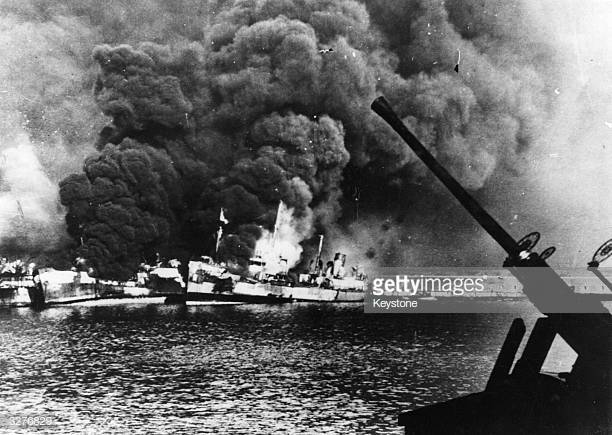
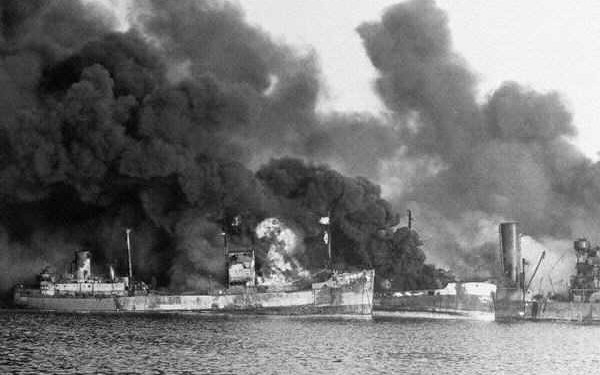
The “Little Pearl Harbor” began at 7:25PM, when 105 Junkers JU-88 bombers came out of the East.   The tactical surprise was complete, and German pilots were able to bomb the harbor with great accuracy. Two ammunition ships were first to explode, shattering windows 7 miles away. A bulk gasoline pipeline was severed, as a sheet of burning fuel spread across the harbor, igniting those ships left undamaged.

43 ships were sunk, damaged or destroyed including John Harvey, which erupted in a massive explosion.  Liquid sulfur mustard spilled into the water, as a cloud of toxic vapor blew across the port and into the city.

bari_burning-ships

Mustard gas is a cytotoxic agent, capable of entering the system via skin, eyes and respiratory tract and attacking every cell type with which it comes into contact. First comes the garlic smell, as the yellow-brown, heavier-than-air cloud creeps along the ground.  Contact first results in redness and itching, resulting 12-24 hours later in excruciating, untreatable blisters on exposed areas of the skin.  Sufferers are literally burned inside and out, as mucous membranes are stripped away from the eyes, nose and respiratory tract.

Death comes in days or weeks.  Survivors are likely to develop chronic respiratory disease and infections. DNA is altered, often resulting in certain cancers and birth defects. To this day there is no antidote.

A thousand or more died outright in the bombing.  643 military service personnel were hospitalized for gas symptoms.  83 of those were dead, by the end of the month.  The number of civilian casualties is unknown.  The whole episode remained shrouded in secrecy.

Afterward:
At the time, the nature of the chemical disaster at Bari was unknown.  Everyone with any knowledge of John Harvey’s secret cargo was killed in the explosion.  Lieutenant-Colonel Stewart Francis Alexander, an American physician from New Jersey, was sent by the Deputy Surgeon General of the US Army to find out what happened.

800px-Sidney_Farber_nci-vol-1926-300
Dr. Sidney Farber, regarded by many as the “Father of Modern Chemotherapy”

It was Dr. Alexander who figured out that mustard was the responsible agent, and from where it had come.   In the process of testing, Dr. Alexander noticed the unknown agent first went after rapidly dividing cells, such as white blood cells. Alexander wondered if it might be useful in going after other rapidly dividing cells, such as cancer.

Based on Dr. Alexander’s field work, Yale pharmacologists Louis Goodman and Alfred Gilman developed the first anti-cancer chemotherapy drug, in the treatment of lymphoma. 

Dr. Sidney Farber of Boston built on this work, producing remission in children with acute Leukemia using Aminopterin, an early precursor to Methotrexate, a chemotherapy drug still in use, today.

Writers have labeled SS John Harvey a Savior of Millions, due to the vessel’s role in the pioneering era of modern chemotherapy drugs.

The claim may be a bit of an exaggeration, but not entirely so.  The American Cancer Society estimates that there were 7,377,100 male cancer survivors in the United States as of January 1, 2016 and another 8,156,120, females.

If you enjoyed this “Today in History”, please feel free to re-blog, “like” & share on social media, so that others may find and enjoy it as well. Please click the “follow” button on the right, to receive email updates on new articles.  Thank you for your interest, in the history we all share.