

Two hundred and forty-two years ago, our founding fathers bequeathed to us a nation unique in all history. A nation founded on an idea, that all men are created equal, and government derives its powers from the just consent of the governed. A Federal, Constitutional Republic in which our politicians are not our ‘leaders’ but rather our Representatives, operating within a system of diffuse powers with checks and balances, periodically accountable through democratic processes to their bosses – the people who put them there.
In modern times, it has become fashionable to point to the flaws in such a system. Howard Zinn and others present a victim’s-eye narrative of American history. Smug, faculty iconoclasts and a pop culture Commentariat, decrying the ‘sugar coated fairy tales’, of our past. Yet, the Great Winston Churchill may have had the final word, describing ‘Democracy” as the worst form of government there is…except for all the others.

For many among us, most I should think, some form of that Constitutional, self-governing Republic envisioned by our founders, remains preferable to all other forms of government. Warts and all.
History is replete with examples of what power concentrated in the hands of a few, leads to.
 Indeed, such a system has imperfections, not least among them those who would ascend to political office.
Hearst columnist Ambrose Bierce, a social satirist of his day and my favorite curmudgeon, once defined politics as ‘A strife of interests, masquerading as a contest of principles. The conduct of public affairs for private advantage.
In the late 19th century, Democrat William “Boss” Tweed owned New York politics, fleecing city taxpayers at the head of the Tammany Hall political machine. New York debt levels soared by over $100 million between 1868 and 1870 alone, a figure equivalent to over a Billion dollars, today.
As Governor of Tennessee, Democrat Ray Blanton ran a ‘pay for play’ operation selling pardons, paroles and commutations, until drawing the attention of the eye of Sauron, at the FBI. Blanton’s corruption was extensive enough to spawn a book and a later movie, and launched the political career of prosecutor and sometime actor, Fred Thompson.
And, lest I be accused of picking on Democrats, Pennsylvania Republican and Representative in Congress R. Budd Dwyer faced up to 55 years in prison and a $300,000 fine for racketeering and mail fraud, when he took a .357 Magnum revolver out of a manila envelope and blew his brains out. On live television, no less.

There are so many more and we all have our ‘favorites’, in this parade of horribles. Yet, for insensate cupidity and pure boneheadedness, it would be hard to outdo the attorney, circuit court judge and member of the United States House of Representatives, Andrew Jackson May.
The Kentucky Democrat was a staunch supporter of the ‘New Deal’ policies of President Franklin Delano Roosevelt, serving in seven succeeding Congresses between 1931 and 1947. As Chairman of the powerful Committee on Military Affairs, May became involved with New York businessmen Murray and Henry Garsson, a relationship which would lead to war profiteering allegations.

After the war, a Senate investigating committee discovered evidence of substantial kickbacks from the Garsson brothers. Making matters worse, their munition business took excessive profits, while producing shoddy product. May’s bribery scandal revealed evidence that the Garsson factory produced defective fuses for their 4.2-inch mortar shells, detonating prematurely and leading to the death of no fewer than 38 American soldiers.
Andrew May would serve nine months in Federal prison for accepting bribes in exchange for securing munitions contracts during WW2.
Yet, even that pales in comparison with the ‘May incident’, for which the man has earned eternal infamy. As an influential member of an important committee, Andrew May was necessarily entrusted with highly confidential information, among them deficiencies in Imperial Japanese Navy anti-submarine depth-charge tactics.

For some time, the American submarine service had enjoyed considerable success in its war on Japanese shipping. Imperial Japanese naval planners held some bad assumptions about American submarine specifications, among them maximum depth capabilities.
Japanese depth charges were set to detonate at too shallow a depth, leading to a high survival rate for American subs. Congressman May took care of that problem, in 1943.
Returning home from a junket, the Congressman revealed this highly sensitive information, before a press conference. Various press associations ran with the story and some were bright enough to ‘sit on it’, but not all. Several newspapers published the information, including one in Hololulu.

Japanese naval ASW (Antisubmarine Warfare) forces were quick to adjust depth charge settings. Vice Admiral Charles A. Lockwood, commander of the U.S. submarine fleet in the Pacific, estimated that May’s indiscretion killed as many as 800 American crewman, with the loss of ten submarines. “I hear Congressman May said the Jap depth charges are not set deep enough”, he said. “He would be pleased to know that the Japs set them deeper now.”
Andrew Jackson May was convicted by a federal jury on this day in 1947, for accepting cash bribes from Murray and Henry Garsson, to use his position as Chairman of the Military Affairs Committee to secure munitions contracts for the Garsson firm. The Garsson brothers also received prison terms.
President Harry Truman granted May a full pardon in 1952, though his political career was finished. Andrew May returned home to Kentucky to resume the practice of law, until his death in 1959. We are left only to contemplate, what the man or the press could be thinking, to divulge information more safely left in the hands of a stupid child. That, and the horrifying realization that the democratic process might actually work, and the government we elect is just…like…Us.


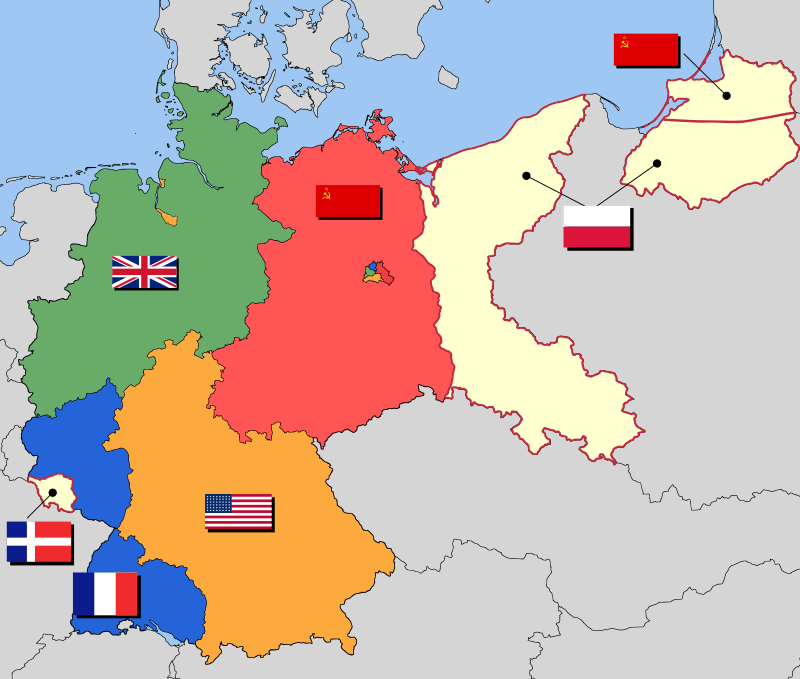
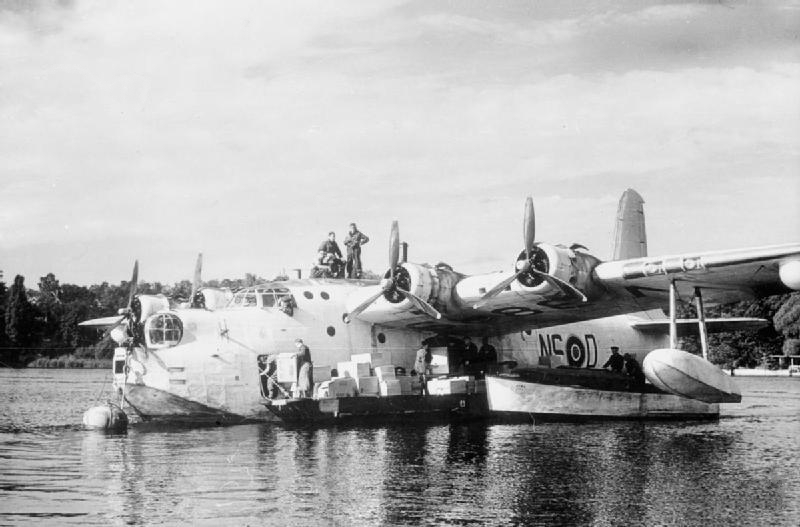
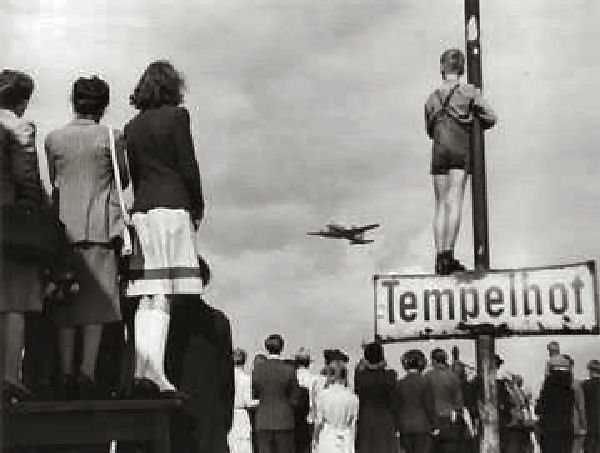
 There never was any formal agreement, concerning road and rail access to Berlin through the 100-mile Soviet zone. Western leaders were forced to rely on the “good will” of a regime which had deliberately starved millions of its own citizens to death, in consolidating power.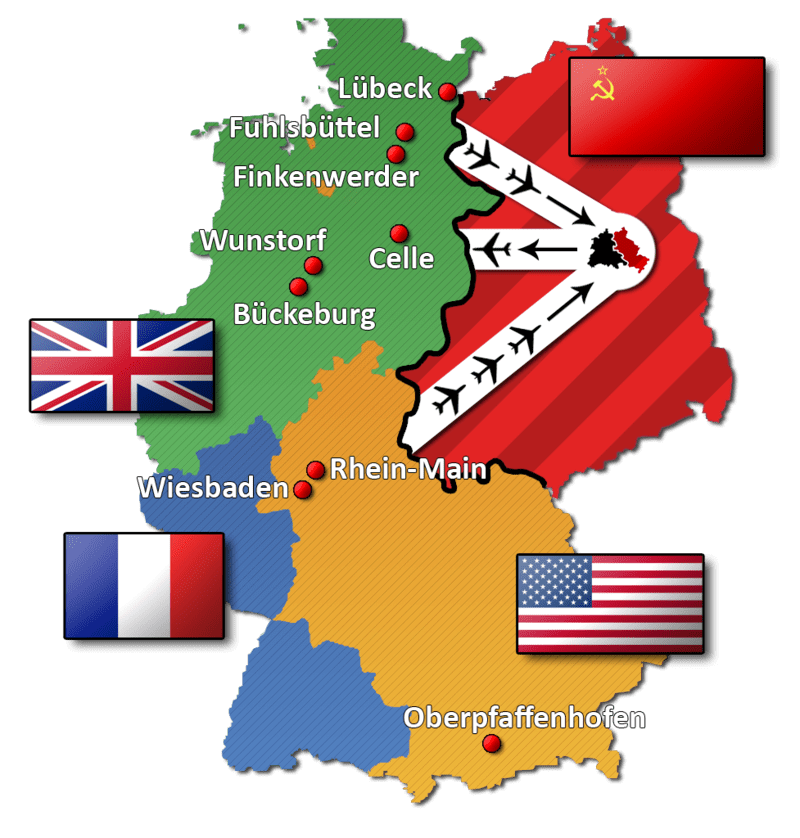
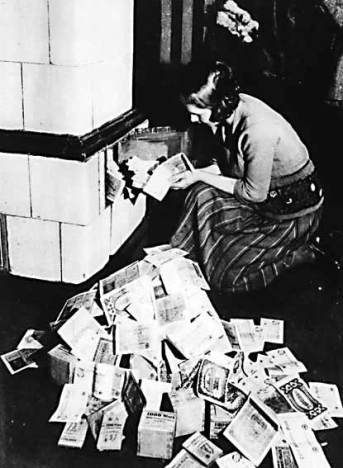



 3,662,374 military service certificates were issued to qualifying veterans, bearing a face value equal to $1 per day of domestic service and $1.25 a day for overseas service, plus interest. Total face value of these certificates was $3.638 billion, equivalent to $43.7 billion in today’s dollars and coming to full maturity in 1945.
 The Great Depression was two years old in 1932, and thousands of veterans had been out of work since the beginning. Certificate holders could borrow up to 50% of the face value of their service certificates, but direct funds remained unavailable for another 13 years.
 This had happened before. Hundreds of Pennsylvania veterans of the Revolution had marched on Washington in 1783, after the Continental Army was disbanded without pay.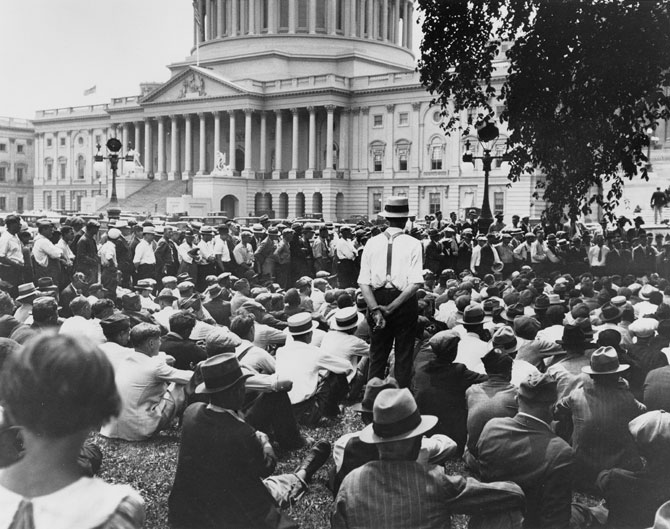
 Marchers and their families were in their camps on July 28 when Attorney General William Mitchell ordered them evicted. Two policemen became trapped on the second floor of a building when they drew their revolvers and shot two veterans, William Hushka and Eric Carlson, both of whom died of their injuries.
 President Herbert Hoover ordered the Army under General Douglas MacArthur to evict the Bonus Army from Washington. 500 Cavalry formed up on Pennsylvania Avenue at 4:45pm, supported by 500 Infantry, 800 police and six battle tanks under the command of then-Major George S. Patton. Civil Service employees came out to watch as bonus marchers cheered, thinking that the Army had gathered in their support.
 Bonus marchers fled to their largest encampment across the Anacostia River, when President Hoover ordered the assault stopped. Feeling that the Bonus March was an attempt to overthrow the government, General MacArthur ignored the President and ordered a new attack, the army routing 10,000 and leaving their camps in flames. 1,017 were injured and 135 arrested.
 Then-Major Dwight D. Eisenhower was one of MacArthur’s aides at the time. Eisenhower believed that it was wrong for the Army’s highest ranking officer to lead an action against fellow war veterans. “I told that dumb son-of-a-bitch not to go down there”, he said.
 The bonus march debacle doomed any chance that Hoover had of being re-elected. Franklin D. Roosevelt opposed the veterans’ bonus demands during the election, but was able to negotiate a solution when veterans organized a second demonstration in 1933. Roosevelt’s wife Eleanor was instrumental in these negotiations, leading one veteran to quip: “Hoover sent the army. Roosevelt sent his wife”.

 In the first half of the 19th century, 90% of federal government revenue came from tariffs on foreign manufactured goods. A lion’s share of this revenue was collected in the south, with the region’s greater dependence on imported goods. Much of this federal largesse was spent in the north, with the construction of railroads, canals and other infrastructure.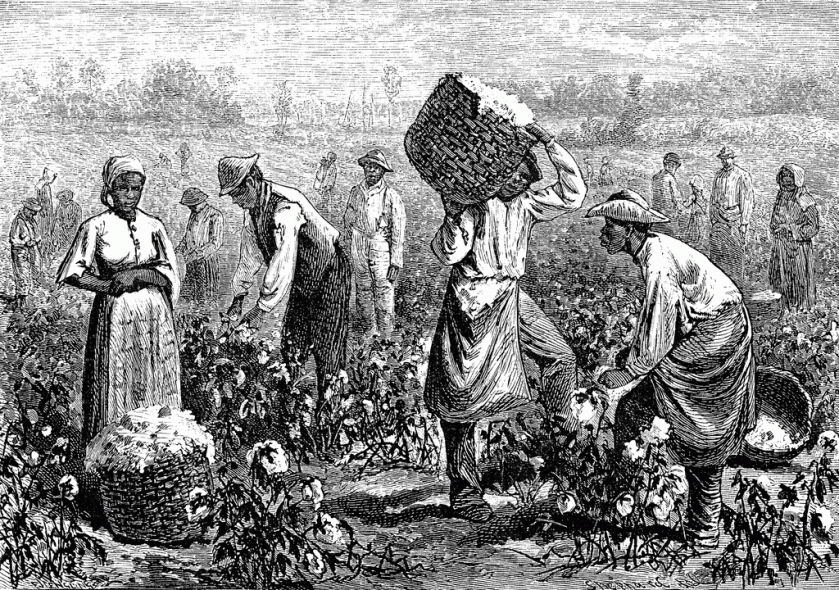
 The issue of slavery had joined and become so intertwined with ideas of self-determination, as to be indistinguishable.
 In Washington, Republicans backed the anti-slavery side, while most Democrats supported their opponents. On May 20, 1856, Massachusetts Senator Charles Sumner took to the floor of the Senate and denounced the Kansas-Nebraska Act. Never known for verbal restraint, Sumner attacked the measure’s sponsors Stephen A. Douglas of Illinois (he of the later Lincoln-Douglas debates), and Andrew Butler of South Carolina by name, accusing the pair of “consorting with the harlot, slavery”. Douglas was in the audience at the time and quipped “this damn fool Sumner is going to get himself shot by some other damn fool”.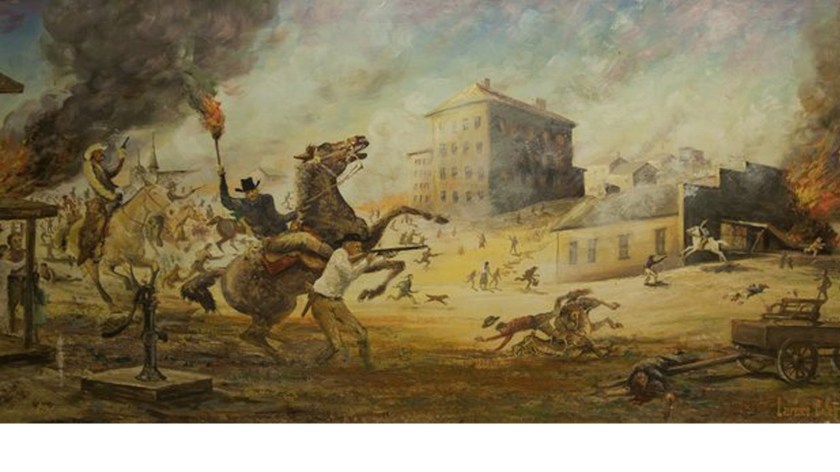


 The trio approached Sumner, who was sitting at his desk writing letters. “Mr. Sumner”, Brooks said, “I have read your speech twice over carefully. It is a libel on South Carolina, and Mr. Butler, who is a relative of mine.”
 In the next two days, a group of unarmed men will be hacked to pieces by anti-slavery radicals, on the banks of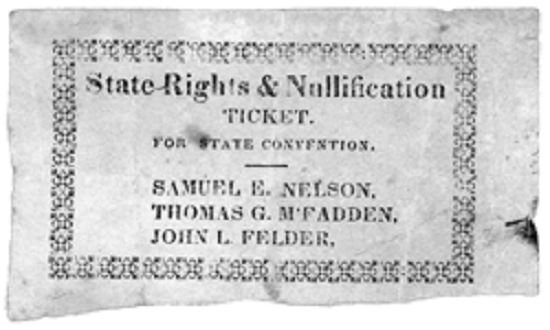


 France would leave the country following defeat by Viet Minh forces at
  Richard M. Nixon won overwhelming victory in the Presidential election of 1968, running on a platform including a “secret plan” to end the war in Vietnam.
 Students for a Democratic Society (SDS) and other “New Left” organizations staged sit-ins in the fall of 1968. Demonstrations became violent six months later, resulting in 58 arrests. Four SDS leaders spent six months in prison.
 Tear gas failed to break up the crowd and several canisters were thrown back, with near-constant volleys of rocks, bottles and other projectiles. 77 National Guardsmen advanced in line-abreast, as screaming protesters closed behind them. Guardsmen briefly assumed firing positions when cornered near a chain link fence, though no one fired.


 Mark Kurlansky, author of “Cod: A Biography of the Fish That Changed the World”, laments the 1990s collapse of the Cod fishery, saying the species finds itself “at the wrong end of a 1,000-year fishing spree.”


 Two years later, Patriot forces maintained a similar supply depot, in the southwest Connecticut town of Danbury.


 Mary Silliman was left to run the farm, and negotiate for the release of her husband. The 1993 made-for-TV movie “Mary Silliman’s War” tells a story of non-combatants, pregnant mothers and farm wives, during the Revolution.


 The United States still had a border in those days, which the Federal government attempted to enforce.
 Suffering a blizzard of hotel cancellations, this “attack on Key West’s sovereignty” could not stand. On April 22, Mayor Wardlow, local attorney & pilot David Horan and Old Town Trolley Tours operator Ed Swift flew to Miami seeking legal remedy. When District Court Judge C. Clyde Atkins failed to issue an injunction, the Key West delegation took to the courthouse steps.
 On April 23, with federal agents on scene to monitor the proceedings, a crowd gathered before the old customs building. Mayor Wardlow and a gaggle of allies mounted the back of a flatbed truck, to read the proclamation of secession. “We serve notice on the government in Washington”, he started, “to remove the roadblock or get ready to put up a permanent border to a new foreign land. We as a people, may have suffered in the past, but we have no intention of suffering in the future at the hands of fools and bureaucrats“.
 So it is that the micro-nation of Key West celebrates its independence, every April 23. The “Conch Republic’ issues its own passports, selling T-shirts and bumper stickers with the slogan “We seceded where others failed”.






You must be logged in to post a comment.