December 11, 1970 The Man who saved a Billion People

It’s hard to get the modern head around the notion of “food insecurity”.  We’re not talking about what’s in the fridge. This is the problem of acute malnutrition, of epidemic starvation, of cyclical famine and massive increases in mortality, due to starvation and hunger-induced disease.

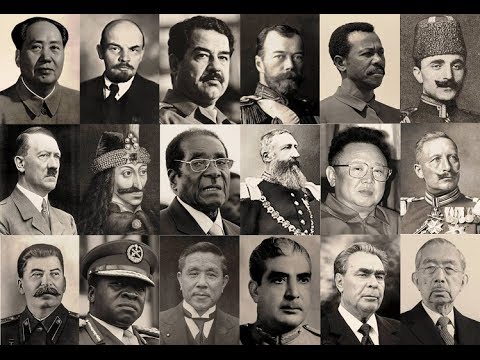
All too often, history is measured in terms of the monsters. The ten worst dictators of the last 1½ centuries account for the loss of nearly 150 million lives. Most of us remember their names. At least some of them. Who remembers the name of the man who Saved the lives of seven times the number, of this whole Parade of Horribles, put together?
3fd1fec87a98191d70a45bd887bacca8

We live in a time and place where the National Institutes of Health (NIH) can report “The U.S. is one of the wealthiest countries in the world and accordingly has high obesity rates; one-third of the population has obesity plus another third is overweight”.

It wasn’t always so. In 1820, 94% of the world’s population lived in “absolute poverty.” American economic historian and scientist Robert Fogel, winner of the 1993 Nobel Prize in Economics, wrote that: “Individuals in the bottom 20% of the caloric distributions of France and England near the end of the eighteenth century, lacked the energy for sustained work and were effectively excluded from the labor force.”

It’s hard to get the modern head around the notion of “food insecurity”.  We’re not talking about what’s in the fridge. This is the problem of acute malnutrition, of epidemic starvation, of cyclical famine and massive increases in mortality, due to starvation and hunger-induced disease.

Nels Olson Borlaug once told his grandson Norman, “You’re wiser to fill your head now if you want to fill your belly later on.” An Iowa farm kid educated during the Great Depression, Norman Ernest Borlaug periodically put his studies on hold, in order to earn money. A Civilian Conservation Corps leader working with unemployed people on CCC projects, many of his co-workers faced persistent and real, hunger. Borlaug later recalled, “I saw how food changed them … All of this left scars on me”.
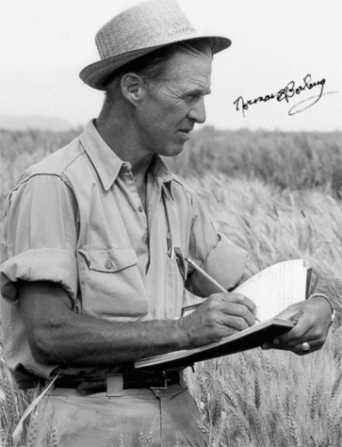
norman-borlaug1Borlaug earned his Bachelor of Science in Forestry, in 1937. Nearing the end of his undergraduate education, he attended a lecture by Professor Elvin Charles Stakman discussing plant rust disease, a parasitic fungus which feeds on phytonutrients in wheat, oats, and barley crops.

Stakman was exploring special breeding methods, resulting in rust-resistant plants. The research greatly interested Borlaug, who later enrolled at the University of Minnesota, to study plant pathology under Stakman. Borlaug earned a Master of Science degree in 1940, and a Ph.D. in plant pathology and genetics, in 1942.

Borlaug attempted to enlist in the military following the attack on Pearl Harbor, but his application was rejected under wartime labor regulations. He was put to work in a lab, doing research for the United States armed forces.

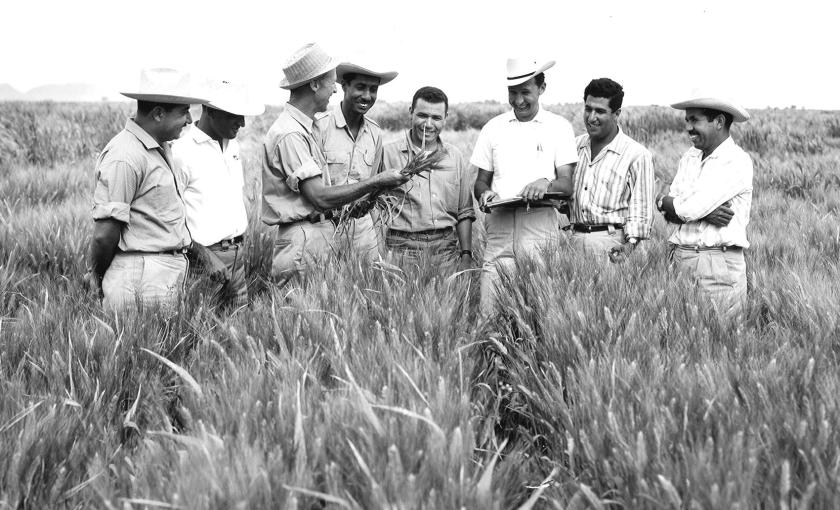
Between 1939 and ’41, Mexican farmers suffered major crop failures, due to stem rust. In July 1944, Borlaug declined an offer to double his salary, traveling instead to Mexico City where he headed a new program focusing on soil development, maize and wheat production, and plant pathology.
borlaug_2

“Pure line” (genotypically identical) plant varieties possess only one to a handful of disease-resistance genes. Random mutations of rusts and other plant diseases overcome pure line survival strategies, resulting in crop failures. “Multi-line” plant breeding involves back-crossing and hybridizing plant varieties, transferring multiple disease-resistance genes into recurrent parents. In the first ten years Borlaug worked for the Mexican agricultural program, he and his team made over 6,000 individual crossings of wheat. Mexico transformed from a net-importer of food, to a net exporter.

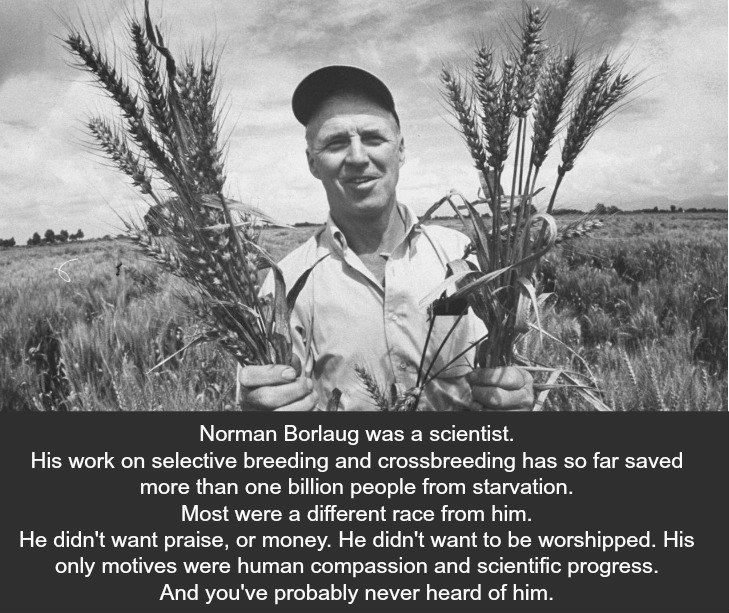
In the early sixties, Borlaug’s dwarf spring wheat strains went out for multi-location testing around the world, in a program administered by the US Department of Agriculture. In March 1963, Borlaug himself traveled to India with Dr. Robert Glenn Anderson, along with 220-pounds of seed from four of the most promising strains.
aaa

The Indian subcontinent experienced minor famine and starvation at this time, limited only by the US’ shipping 1/5th of its wheat production into the region in 1966 – ’67. Despite resistance from Indian and Pakistani bureaucracies, Borlaug imported 550 tons of seeds.

American biologist Paul Ehrlich wrote in his 1968 bestselling book The Population Bomb, “The battle to feed all of humanity is over … In the 1970s and 1980s hundreds of millions of people will starve to death in spite of any crash programs embarked upon now.” Ehrlich went on: “I have yet to meet anyone familiar with the situation who thinks India will be self-sufficient in food by 1971…India couldn’t possibly feed two hundred million more people by 1980.”

Ehrlich could not have been more comprehensively wrong.
topimg_25013_dr_norman_borlaug

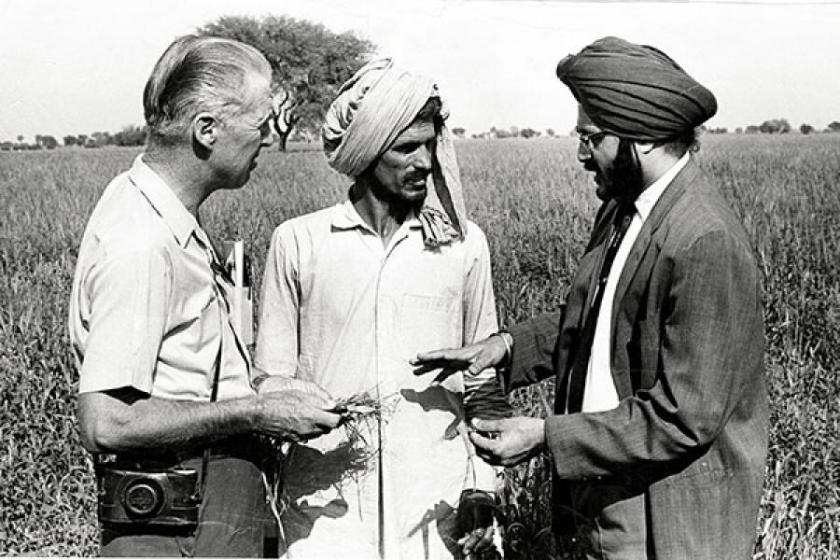
Borlaug’s initial yields were higher than any other crop, ever harvested in South Asia. Countries from Pakistan to India to Turkey imported 80,000 tons and more of seeds. By the time of Ehrlich’s book release in 1968, massive crop yields had substituted famine and starvation, with a host of new problems. There were labor shortages at harvest, and insufficient numbers of bullock carts to haul it to the threshing floor. Jute bags were needed, along with trucks, rail cars, and grain storage facilities. Local governments even closed school buildings, to use them for grain storage.

norman-borlaug-001

In three years, the world increase in cereal-grain production was nothing short of spectacular, dubbed a “Green Revolution”.   Borlaug won the Nobel Peace Prize in 1970, protesting to be only “one member of a vast team made up of many organizations, officials, thousands of scientists, and millions of farmers – mostly small and humble…”

BORLAUG ATTEND QPM MAIZE FIELD IN GUIZHOU-bf3726c08c
Norman Borlaug works with Chinese agricultural leaders, 1974

With mass starvation or widespread deforestation being the only historic alternatives, the “Borlaug Hypothesis” introduced a third option, that of increasing yields on existing farmland.  The work however, was not without critics. Environmentalists criticized what they saw as large-scale monoculture, in nations previously reliant on subsistence farming. Critics railed against “agribusiness” and the building of roads through what had once been wilderness.

David Seckler, Director General of the International Water Management Institute said “The environmental community in the 1980s went crazy pressuring the donor countries and the big foundations not to support ideas like inorganic fertilizers for Africa.”

953650D6-9A57-430E-82AE-1803733FC42E_mw1024_s_n-copy
Norman Borlaug, Nobel Prize Acceptance Speech, December 11, 1970

The Rockefeller and Ford foundations withdrew funding, along with the World Bank. Well fed environmentalist-types congratulated themselves on “success”, as the Ethiopian famine of 1984-’85 destroyed over a million lives. Millions more were left destitute, on the brink of starvation.

Borlaug fired back, “[S]ome of the environmental lobbyists of the Western nations are the salt of the earth, but many of them are elitists. They’ve never experienced the physical sensation of hunger. They do their lobbying from comfortable office suites in Washington or Brussels. If they lived just one month amid the misery of the developing world, as I have for fifty years, they’d be crying out for tractors and fertilizer and irrigation canals and be outraged that fashionable elitists back home were trying to deny them these things.

Borlaug became involved at the invitation of Ryoichi Sasakawa, chairman of the Japan Shipbuilding Industry Foundation, who wondered why methods used so successfully in Asia, were not being employed in Africa. Since that time, the Sasakawa Africa Association (SAA) has trained over 8 million farmers in SAA farming techniques. Maize crops developed in African countries have tripled, along with increased yields of wheat, sorghum, cassava, and cowpeas.

4fig7

The world population when Ehrlich released his book in 1968, was about 3.53 billion. Today, that number stands at 7.7 billion and, when we hear about starvation, such events are almost exclusively, man-made. The American magician and entertainer Penn Jillette once described Norman Borlaug as “The greatest human being who ever lived…and you’ve probably never heard of him.” Let that be the answer to the self-satisfied and well-fed, environmentalist types.

norman-borlaug-6

“I now say that the world has the technology—either available or well advanced in the research pipeline—to feed on a sustainable basis a population of 10 billion people. The more pertinent question today is whether farmers and ranchers will be permitted to use this new technology? While the affluent nations can certainly afford to adopt ultra low-risk positions, and pay more for food produced by the so-called ‘organic’ methods, the one billion chronically undernourished people of the low income, food-deficit nations cannot.” – Norman Borlaug, 2000

December 10, 1986 The Dogs of Chernobyl

The devastating Chernobyl Prayer tells the story of: “dogs howling, trying to get on the buses. Mongrels, Alsatians. The soldiers were pushing them out again, kicking them. They ran after the buses for ages.” Heartbroken families pinned notes to their doors: “Don’t kill our Zhulka. She’s a good dog.”

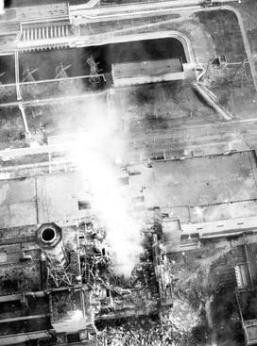
Chernobyl_burning-aerial_view_of_coreThe accident began as a test, a carefully planned series of events, intending to simulate a station blackout at the Chernobyl Nuclear Power Plant, in the Soviet Socialist Republic of Ukraine.
This most titanic of disasters, began with a series of smaller mishaps. Safety systems intentionally turned off, reactor operators failing to follow checklists, inherent design flaws in the reactor itself.

Over the night of April 25-26, 1986, a nuclear fission chain reaction expanded beyond control at reactor #4, flashing water to super-heated steam resulting in a violent explosion and open air graphite fire. Massive amounts of nuclear material were expelled into the atmosphere during this explosive phase, equaled only by that released over the following nine days by intense updrafts created by the fire.  Radioactive material rained down over large swaths of the western USSR and Europe, some 60% in the Republic of Belarus.

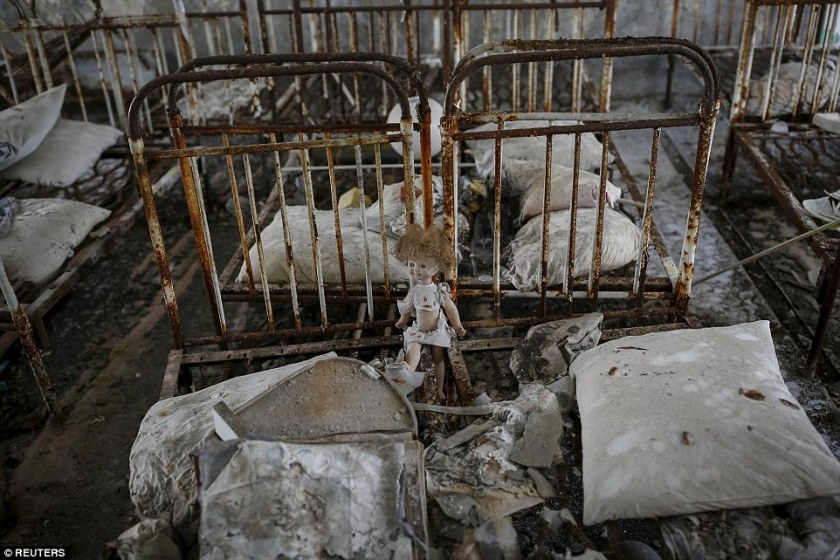
Abandoned nursery
A plastic doll lies abandoned on a rusting bed, 30 years after the town was evacuated following the Chernobyl disaster. H/T Dailymail.com

It was the most disastrous nuclear power plant accident in history and one of only two such accidents classified as a level 7, the maximum classification on the International Nuclear Event Scale.  The other was the 2011 tsunami and subsequent nuclear disaster at the Fukushima Daiichi reactor, in Japan.

20120409-3-Kiev-Chernobyl_Museum_(30)
Hat tip, Chernobyl Museum, Kiev , Ukraine

One operator died in the steam-blast phase of the accident, a second resulting from a catastrophic dose of radiation.  600 Soviet helicopter pilots risked lethal radiation, dropping 5,000 metric tons of lead, sand and boric acid in the effort to seal off the spread.

Remote controlled, robot bulldozers and carts, soon proved useless. Valery Legasov of the Kurchatov Institute of Atomic Energy in Moscow, explains: “[W]e learned that robots are not the great remedy for everything. Where there was very high radiation, the robot ceased to be a robot—the electronics quit working.”

liquidators_chernobyl4
Chernobyl “Liquidators”, permitted to spend no more than a one-time maximum of forty seconds, cleaning the rooftops of surrounding structures.

Soldiers in heavy protective gear shoveled the most highly radioactive materials, “bio-robots” allowed to spend a one-time maximum of only forty seconds on the rooftops of surrounding buildings. Even so, some of these “Liquidators” report having done so, five or six times.

In the aftermath, 237 suffered from Acute Radiation Sickness (ARS), 31 of whom died in the following three months.  Fourteen more died of radiation induced cancers, over the following ten years.

chernobyl_puppies-640x480
Photo by Chernobyl Exclusion Zone Authority

The death toll could have been far higher, but for the heroism of first responders.  Anatoli Zakharov, a fireman stationed in Chernobyl since 1980, replied to remarks that firefighters believed this to be an ordinary electrical fire.  “Of course we knew! If we’d followed regulations, we would never have gone near the reactor. But it was a moral obligation – our duty. We were like kamikaze“.

The concrete sarcophagus designed and built to contain the wreckage has been called the largest civil engineering project in history, involving no fewer than a quarter-million construction workers, every one of whom received a lifetime maximum dose of radiation.  By December 10, the structure was nearing completion. The #3 reactor at Chernobyl continued to produce electricity, until 2000.

evacuation_of_pripyat
Evacuation of Pripyat

Officials of the top-down Soviet state first downplayed the disaster.  Asked by one Ukrainian official, “How are the people?“, acting minister of Internal Affairs Vasyl Durdynets replied that there was nothing to be concerned about: “Some are celebrating a wedding, others are gardening, and others are fishing in the Pripyat River.

As the scale of the disaster became apparent, civilians were at first ordered to shelter in place.  A 10-km exclusion zone was enacted within the first 36 hours, resulting in the hurried evacuation of some 49,000.  The exclusion zone was tripled to 30-km within a week, leading to the evacuation of 68,000 more.  Before it was over, some 350,000 were moved away, never to return.

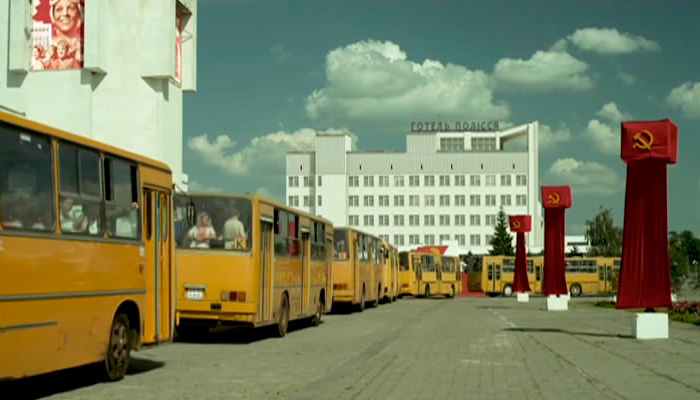
The chaos of these evacuations, can scarcely be imagined.  Confused adults.  Crying children.  Howling dogs.  Shouting soldiers, barking orders and herding the now-homeless onto waiting buses, by the tens of thousands.  Dogs and cats, beloved companion animals, were ordered left behind.  Evacuees were never told.  There would be no return. 

Abandoned amusement park
Two bumper cars lie face to face in the rusting remains of an amusement park in the abandoned town of Pripyat near Chernobyl

There were countless and heartbreaking scenes of final abandonment, of mewling cats, and whimpering dogs.  Belorussian writer Svetlana Alexievich compiled hundreds of interviews into a single monologue, an oral history of the forgotten.  The devastating Chernobyl Prayer tells the story of: “dogs howling, trying to get on the buses. Mongrels, Alsatians. The soldiers were pushing them out again, kicking them. They ran after the buses for ages.” Heartbroken families pinned notes to their doors: “Don’t kill our Zhulka. She’s a good dog.”

homeless wild dog in Pripyat

There would be no mercy.  Squads of soldiers were sent to shoot those animals, left behind.  Most died.  Some escaped discovery, and survived.

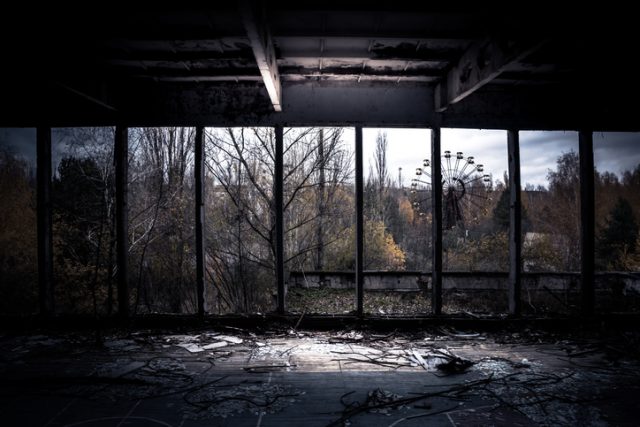
Abandoned gym
View from an abandoned gym in the Prypyat ghost town, of Chernobyl. H/T Vintagenews.com

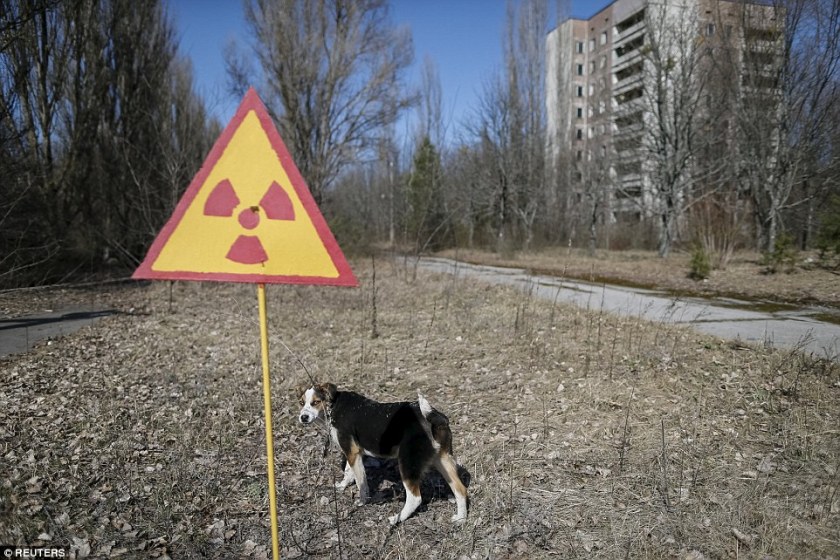
Today, untold numbers of stray dogs live in the towns of Chernobyl, Pripyat and surrounding villages, descendants of those left behind, back in 1986.  Ill equipped to survive in the wild and driven from the forests by wolves and other predators, they forage as best they can among abandoned streets and buildings, of the 1,000-mile exclusion zone.  Often, increased radiation levels can be found in their fur.  Few live beyond the age of six but, all is not bleak.

Since September 2017, a partnership between the SPCA International and the US-based 501(c)(3) non-profit CleanFutures.org has worked to provide for the veterinary needs of these defenseless creatures.  Over 450 animals have been tested for radiation exposure, given medical care, vaccinations, and spayed or neutered, to bring populations within manageable limits.  Many have been socialized for human interaction and successfully decontaminated, available for adoption into homes in Ukraine and North America, since July.

The work of rescue is ongoing, anticipated to take at least eighteen months.  A joint press release from the two organizations gives much-needed hope:  “This unprecedented event marks an important partnership with the Ukrainian government, which has been reluctant in the past 32 years to allow anything to be removed from the nuclear exclusion zone.”

The goal is to find homes for as many as 200, of the abandoned dogs of Chernobyl.

329F772A00000578-0-image-a-37_1459248391912

If you enjoyed this “Today in History”, please feel free to re-blog, “like” & share on social media, so that others may find and enjoy it as well. Please click the “follow” button on the right, to receive email updates on new articles.  Thank you for your interest, in the history we all share.

December 9, 1952 Gasping for Air

When such a weather system occurs over areas with high levels of atmospheric contaminants, the resulting ground fog can be catastrophic. 63 people perished during a similar episode in 1930, in the Meuse River Valley area of Belgium. In 1950, 22 people were killed in Poza Rica, Mexico. In 1952, the infamous “Great Smog of London” claimed the lives of thousands, over a course of five days.

schwarzenegger-ap-18337474166966
“Actor Arnold Schwarzenegger delivers a speech during the opening of COP24 UN Climate Change Conference 2018 in Katowice, Poland, Monday, Dec. 3, 2018.
Czarek Sokolowski / AP” H/T CBS News, Inc.

Last week, climate activists and world leaders gathered in Poland to discuss carbon pollution resulting from the use of fossil fuels, and ways to combat what they see as a future of anthropogenic global warming.

Adherents to current climate change theories hold onto such ideas with a fervor bordering on the religious while skeptics raise any number of questions but, one thing is certain. There was a time when the air and water around us was tainted with impunity, with sometimes deadly results.

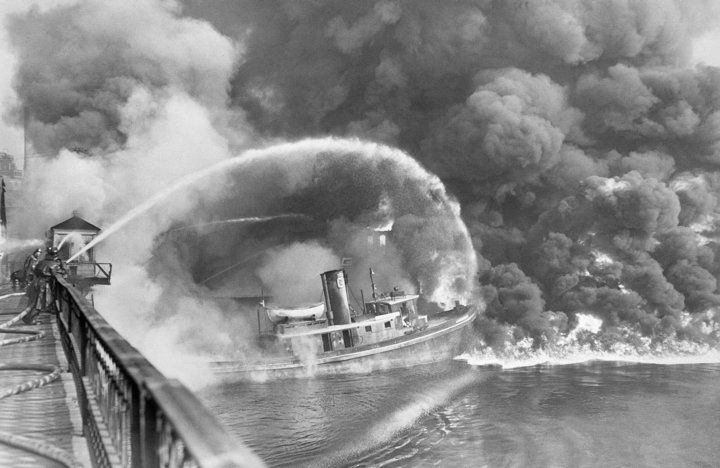
In 1969, the Cuyahoga River in Cleveland Ohio caught fire, resulting in property damage worth $100,000, equivalent to nearly $700,000, today. The fire resulted in important strategies to clean up the river, but this wasn’t the first such fire. The Cuyahoga wasn’t even the first river to catch fire. There were at least thirteen such incidents on the Cuyahoga, the first occurring in 1868. The Rouge River in Michigan caught fire in the area around Detroit in 1969, and a welder’s torch lit up the Buffalo River in New York, the year before. The Schuylkill River in Philadelphia caught fire from a match tossed into the water, in 1892.

Fire on the Cuyahoga River
Cuyahoga River burning, in 1952. H/T Getty Images

Today, the coal silts, oil and chemical contaminants at the heart of these episodes are largely under control in the developed world, but not the world over. One section of Meiyu River in Wenzhou, Zhejiang China burst into flame in the early morning of March 5, 2014. Toxic chemical pollution and other garbage dumped into Bellandur Lake in Bangalore India resulted in part of the lake catching fire the following year, the fire spreading to the nearby Sun City apartments.

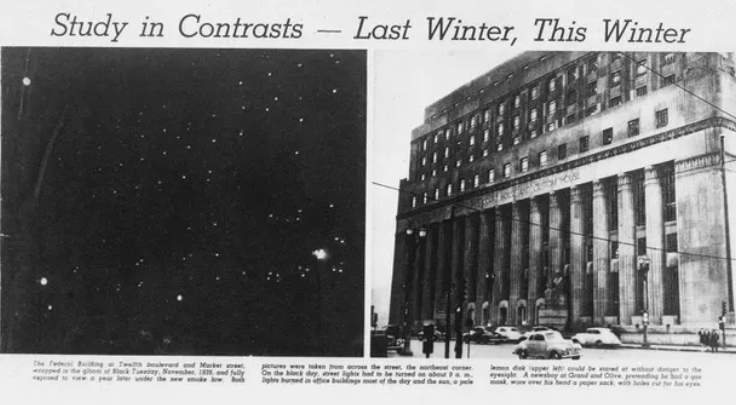
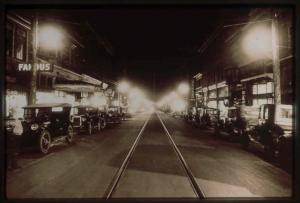
If you happen to visit the “Iron City”, Pittsburgh Pennsylvania, photographs may be found of streetlights turned on in the middle of the day. In November 1939, St. Louis brought a new meaning to the term “Black Tuesday”, when photographs of the Federal building at Twelfth Boulevard and Market Street show the sun little more than a “pale lemon disk” and streetlights on at 9:00 in the morning.

Federal Building, St. Louis

Air pollution turned deadly in the early morning hours of October 26, 1948 when an atmospheric inversion trapped flourine gases over Donora Pennsylvania, home of US Steel Corporation’s Donora Zinc Works and American Steel and Wire. By the 29th, the inversion had trapped so much grime that spectators gathered to watch a high school football game, couldn’t see the kids on the field. The “Death Fog” hung over Donora for four days, killing 22 and putting half the town, in the hospital.

mid-day
Donora Smog at Midday with streetlights on. H/T Donora Historical Society

The Donora episode was caused by an “anticyclone”, a weather event in which a large high pressure front draws air down through the system and out in a clockwise motion.

When such a weather system occurs over areas with high levels of atmospheric contaminants, the resulting ground fog can be catastrophic. 63 people perished during a similar episode in 1930, in the Meuse River Valley area of Belgium. In 1950, 22 people were killed in Poza Rica, Mexico. In 1952, the infamous “Great Smog of London” claimed the lives of thousands, over a course of five days.

Nelson's_Column_during_the_Great_Smog_of_1952
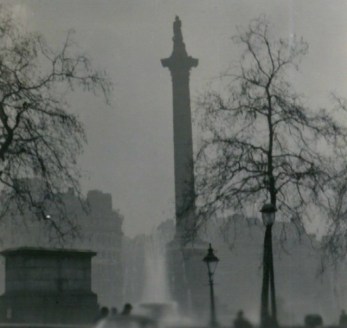
Nelson’s Column during the Great Smog of 1952

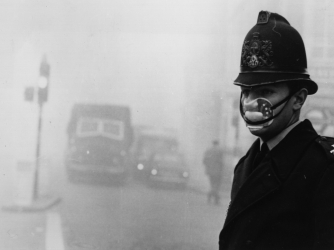
On December 5, a body of cold, stagnant air descended over a near-windless London, trapped under a “lid” of warm air. London had suffered poor air quality since the 13th century and airborne pollutants had combined to create “pea soupers” in the past, but this was unlike anything in living memory. The smoke from home and industrial chimneys and other pollutants such as sulphur dioxide combined with automobile exhaust, with nowhere to go.

Yellow-black particles of the stuff built and accumulated at an unprecedented rate. Visibility was down to a meter and driving all but impossible. Public transportation shut down, requiring those rendered sick by the fog, to transport themselves to the hospital.  Outdoor sporting events were canceled and even indoor air quality, was affected.  Weather conditions held until December 9, when the fog dispersed.

hith-london-fog-2660357-ABThere was no panic, Londoners are quite accustomed to the fog, but this one was different. Over the weeks that followed, public health authorities estimated that 4,000 people had died as a direct result of the smog by December 8, and another 100,000 made permanently ill. Research pointed to another 6,000 losing their lives in the following months, as a result of the event.
More recently, research puts the death toll of the Great Smog at 12,000.

A similar event took place about ten years later in December 1962, but without the same lethal impact. A spate of environmental legislation in the wake of the 1952 disaster began to remove black smoke from chimneys.  Financial incentives moved homeowners away from open coal fires toward less polluting alternatives such as gas or oil, or less polluting coke.

Today, the wealthier, developed nations have made great strides toward improvement in air and water quality, though problems persist in the developing world.  In the United States, the Environmental Protection Agency (EPA) reports that:

“[B]etween 1980 and 2017, gross domestic product increased 165 percent, vehicle miles traveled increased 110 percent, energy consumption increased 25 percent, and U.S. population grew by 44 percent. During the same time period, total emissions of the six principal air pollutants dropped by 67 percent”.

The same report shows that, during the same period, CO2 emissions have increased by 12 percent.  Policy makers continue to wrangle with the long-term effects of carbon.  Now, it’s hard to separate the politics from the science.

While politicians and climate activists jet around the planet to devise trillion dollar “solutions”, let us hope that cooler heads than that of Arnold Schwarzenegger, prevail.  There is scarcely a man, woman or child among us who do not want clean air and clean water, and a beautiful, natural environment around us, for ourselves and our posterity.  It’s only a matter of how we get there.

If you enjoyed this “Today in History”, please feel free to re-blog, “like” & share on social media, so that others may find and enjoy it as well. Please click the “follow” button on the right, to receive email updates on new articles.  Thank you for your interest, in the history we all share.

December 8, 1917 A Gift of Gratitude

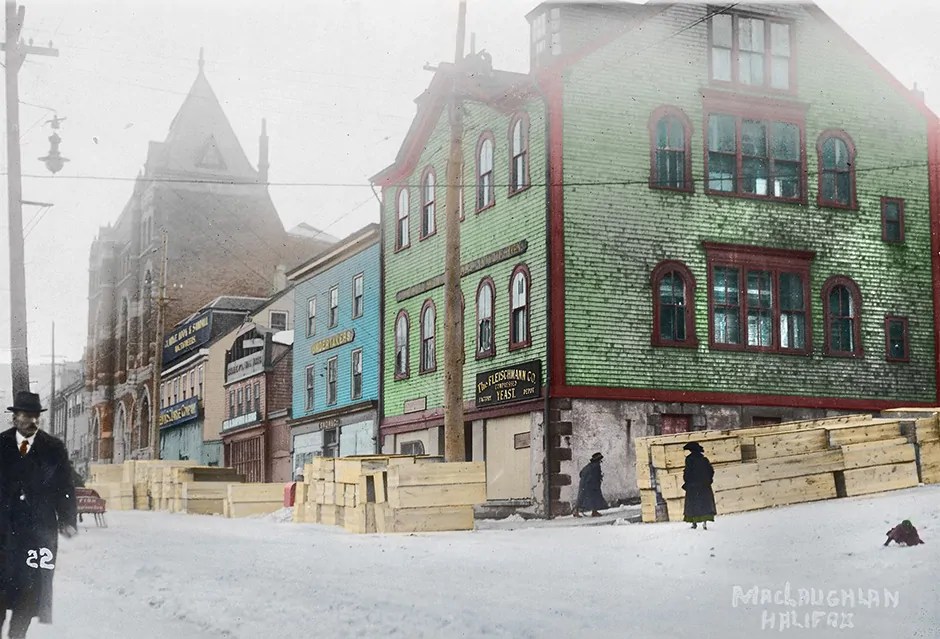
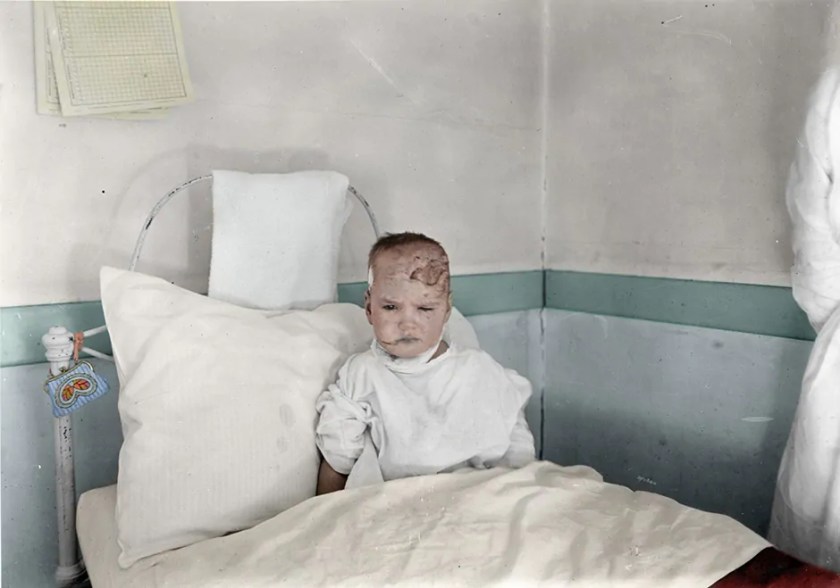
The December 7 sun rose over a scene from the apocalypse, as a blizzard descended across Nova Scotia.  1,800 were dead and another 9,000 injured, and not only homeless.  The whole town was gone. 

The participants in this story have long since passed from among us.  Every one.  It is their countrymen who remember a debt of gratitude, one-hundred years in the making.  For near-half a century, this has taken the form of a tree.  A gift, from the people of Nova Scotia, to the people of Boston.

As “The Great War” dragged on to the end of its third year in Europe, Halifax harbor in Nova Scotia was the bustling scene of supply, munition, and troop ships destined for “over there”. With a population of 50,000 at the time, Halifax was the busiest port in Atlantic Canada.

hbrships

The Norwegian vessel SS Imo slipped her moorings in Halifax harbor on the morning of December 6, destined for New York City. The French freighter Mont Blanc was entering the harbor at this time, intending to join the convoy which would form her North Atlantic escort. In her holds, Mont Blanc carried 200 tons of Trinitrotoluene (TNT), and 2,300 tons of TNP – Trinitrophenol or “Picric Acid”, a substance then in use as a high explosive.

In addition, the freighter carried 35 tons of high octane gasoline and 20,000 lbs of gun cotton. Not wanting to draw the attention of pro-German saboteurs, the freighter flew no flags warning of her cargo.  Mont Blanc was a floating bomb.

montblanc
Mont Blanc was a floating bomb

Somehow, signals became crossed as the two ships passed, colliding in the narrows at the harbor entrance and igniting the TNP on board Mont Blanc. French sailors abandoned ship as fast as they could, warning everyone who would listen of what was about to happen.

explosion

Meanwhile, the spectacle of a flaming ship was too much to resist, as crowds gathered around the harbor. The high-pitched shriek emitted by picric acid under combustion is familiar to anyone who has ever attended a public fireworks display. You can only imagine the scene as the burning freighter brushed the harbor pier, setting that ablaze, before running aground.

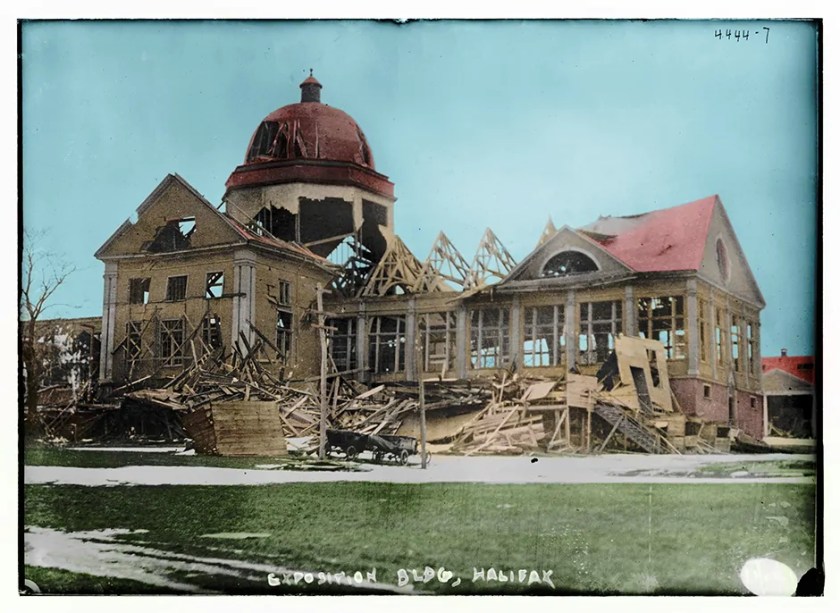
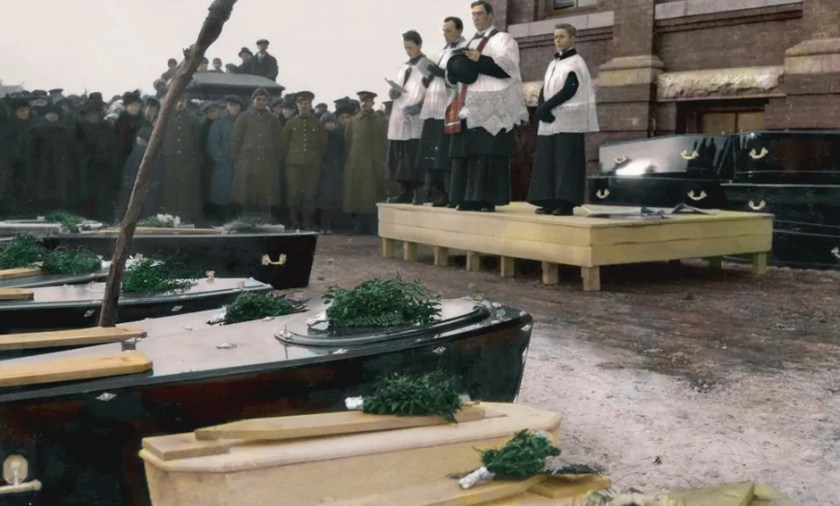
The explosion and resulting fires killed over 1,800, flattening the north end of Halifax and shattering windows as far as fifty miles away.  It was one of the largest non-nuclear explosions in history, destroying over 1,600 homes on the cusp of a Canadian winter.

Mont Blanc’s half-ton anchor landed over two miles away, one of her gun barrels, three. Later analysis estimated an output of 2.9 kilotons, an explosive force greater than many tactical nuclear weapons.

Mont_Blanc_Anchor_Site_1

The December 7 sun rose over a scene from the apocalypse, as a blizzard descended across Nova Scotia.  Over 9,000 were injured, many gravely so, and not only homeless.  Their whole town was gone.

Boston Mayor James Michael Curley wrote to the American Representative in Halifax “The city of Boston has stood first in every movement of similar character since 1822, and will not be found wanting in this instance. I am, awaiting Your Honor’s kind instruction.”

Halifax explosion, 6Curley was as good as his word. The Mayor and Massachusetts’ Governor Samuel McCall composed a Halifax Relief Committee to raise funds and organize aid. McCall reported the effort raised $100,000 in its first hour alone, equivalent to over $1.9 million, today.
President Woodrow Wilson authorized a $30,000 carload of Army blankets sent to Halifax. Within twelve hours of the explosion, the Boston Globe reported on the first train leaving North Station, with “30 of Boston’s leading physicians and surgeons, 70 nurses, a completely equipped 500-bed base hospital unit and a vast amount of hospital supplies”.

Halifax explosion, 5

Delayed by deep snow drifts, the train arrived on the morning of December 8, the first non-Canadian relief train, on the scene.

$750,000 in relief aid would arrive from Massachusetts alone, equivalent to more than $15 million today. Canadian Prime Minister Robert Borden would write to Governor McCall on December 9, “On behalf of the Government of Canada, I desire to convey to Your Excellency our very sincere and warm thanks for your sympathy and aid in the appalling calamity which has befallen Halifax”.

Halifax explosion, 7

The following year, Nova Scotia sent the city of Boston a gift of gratitude.  A very large Christmas tree.

In 1971, the Lunenburg County Christmas Tree Producers Association sent another tree to Boston, both to promote Christmas tree exports, and to once again acknowledge the support of the people and government of Boston, following the 1917 disaster. The Nova Scotia government later took over the annual gift of the Christmas tree, to promote trade and tourism.

So it is that, every year, the people of Nova Scotia send the people of Boston the official Christmas tree, to be displayed on Boston Common.   The tree even has its own  Facebook page.  More recently, the principle tree is joined by two smaller ones, donated to Rosie’s Place and the Pine Street Inn, two of Boston’s homeless shelters.

The 2018 tree begins the 600-mile journey south

This is no Charlie Brown shrub we’re talking about. The 1998 tree required 3,200 man-hours to decorate, with 17,000 lights connected by 4½ miles of wire and bedecked with 8,000 bulbs.

In 2013, the tree was accompanied by a group of runners, in recognition of the Boston Marathon bombing in April of that year.

46830929_2024306720925255_7967509700990205952_n
This year’s tree lighting ceremony on Boston Common, November 29, 2018. Hat tip http://www.facebook.com/pg/TreeForBoston/photos/ for the tree images used in this story

The 2018 tree is a white spruce standing 46-feet, for the first time selected from the Cumberland County town of Oxford, and donated by Ross McKellar and Teresa Simpson. It takes two men a day and a half to prepare for cutting, a crane holding the tree upright while the chainsaw does its work. It’s a major media event as the tree is paraded through Halifax on a 53’ flatbed trailer, before beginning the 600-mile journey south.

47574139_2040092056013388_8809205939614777344_n

For a small Canadian province, it’s been no small commitment. In 2016 Nova Scotia spent $242,000 on the program, including transportation, cutting & lighting ceremonies, and all the promotions which went with it.  The government of the province, says the program is well worth the expense.

“This is about friendship, unity and gratitude to the people of Boston,” said Deputy Premier Karen Casey on behalf of Premier Stephen McNeil. “We are forever appreciative of Boston’s immediate response of aid after the explosion. This tree embodies the spirit of our culture and is our way of saying thank you.”

Feature image, top of page:  This colorized photo only hints at the scale of the disaster.  Hat tip, CBC

If you enjoyed this “Today in History”, please feel free to re-blog, “like” & share on social media, so that others may find and enjoy it as well. Please click the “follow” button on the right, to receive email updates on new articles.  Thank you for your interest, in the history we all share.


December 7, 2018 End of an Era

The last combat veteran of WW2 to serve the office of President of the United States, has gone to his final rest on Pearl Harbor day.  

We will never go this way, again.

December 7, 1941 Aftermath

The work was hellishly dangerous down there in the mud and the oil at the bottom of Pearl Harbor.  Several divers lost their lives yet, another day would come and each would descend yet again, into that black water.

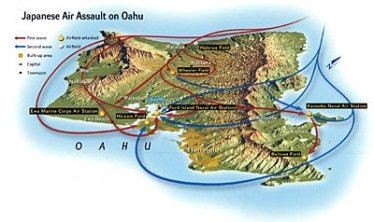
It was literally “out of the blue”, when the first wave of enemy aircraft arrived at 7:48 am local time, December 7, 1941. 353 Imperial Japanese warplanes approached in two waves out of the southeast, fighters, bombers, and torpedo planes.  Across Hickam Field and over the still waters of Pearl Harbor. Tied in place and immobile, the eight vessels moored at “Battleship Row” were easy targets.

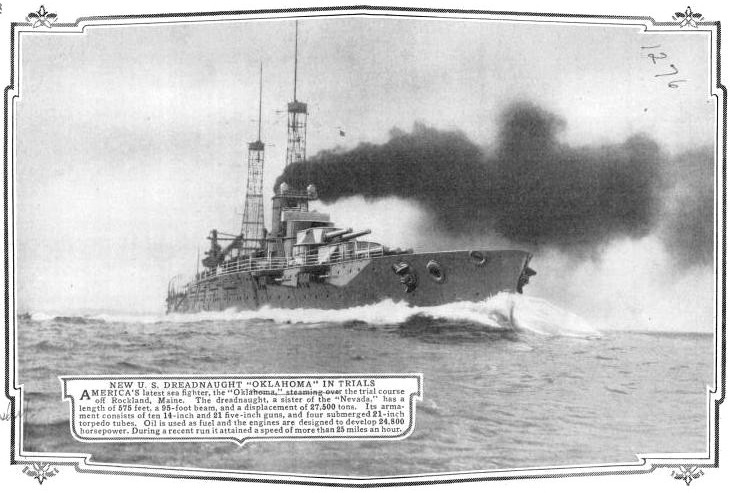
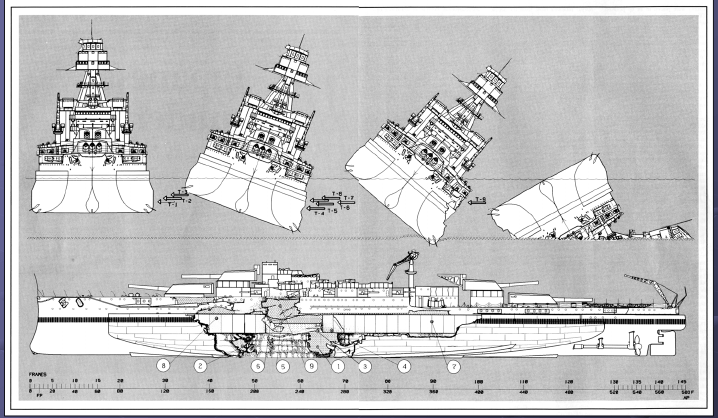
In the center of the Japanese flight path, sailors and Marines aboard the USS Oklahoma fought back furiously. She didn’t have a chance. Holes as wide as 40′ were torn into her side in the first ten minutes of the fight. Eight torpedoes smashed into her port side, each striking higher on the hull as the great Battleship began to roll.

_oahuBilge inspection plates had been removed for a scheduled inspection the following day, making counter-flooding to prevent capsize, impossible. Oklahoma rolled over and died as the ninth torpedo slammed home. Hundreds scrambled out across the rolling hull, jumped overboard into the oil covered, flaming waters of the harbor, or crawled out over mooring lines in the attempt to reach USS Maryland in the next berth.
The damage was catastrophic. Once the pride of the Pacific fleet, all eight battleships were damaged, four of them sunk. Nine cruisers, destroyers and other ships were damaged, another two sunk. 347 aircraft were damaged, most caught while still on the ground. 159 of those, were destroyed altogether. 2,403 were dead or destined to die from the attack, another 1,178 wounded.

Nine Japanese torpedoes struck USS Oklahoma’s port side, in the first ten minutes.

HT John F DeVirgilio for this graphic
The last moments of USS Oklahoma.  H/T John F DeVirgilio for this graphic

Frantic around the clock rescue efforts began almost immediately, to get at 461 sailors and Marines trapped within the hull of the Oklahoma. Tapping could be heard as holes were drilled to get at those trapped inside. 32 were delivered from certain death.

14 Marines and 415 sailors aboard Oklahoma lost their lives immediately, or in the days and weeks to come. Bulkhead markings would later reveal that, at least some of the doomed would live for another seventeen days in the black, upside-down hell. The last such mark was drawn by the last survivor on Christmas Eve.

Of the sixteen ships lost or damaged, thirteen would be repaired and returned to service. USS Arizona remains on the bottom, a monument to the event and to the 1,102-honored dead who remain entombed within her hull. USS Utah defied salvage efforts. She too is a registered War Grave, 64 honored dead remaining within her hull, lying at the bottom not far from the Arizona. Repairs were prioritized and USS Oklahoma was beyond repair. She, and her dead, would have to wait.

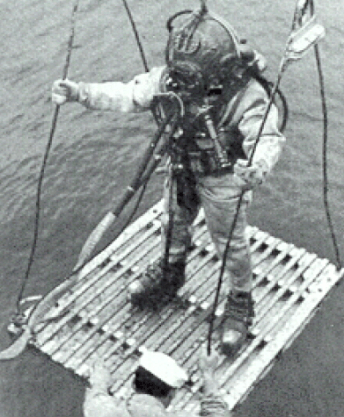
Oklahoma DiverRecovery of the USS Oklahoma was the most complex salvage operation ever attempted, beginning in March, 1943.  With the weight of her hull driving Oklahoma’s superstructure into bottom, salvage divers descended daily to separate the tower, while creating hardpoints from which to attach righting cables.
The work was hellishly dangerous down there in the mud and the oil at the bottom of Pearl Harbor.  Several divers lost their lives yet, another day would come and each would descend yet again, into that black water.

21 giant A-frames were fixed to the hull of the Oklahoma, 3″ cables connecting compound pulleys to 21 electric motors, each capable of pulling 429 tons.

Two pull configurations were used over 74 days, first attached to these massive A-frames, then direct connections once the hull had achieved 70°. In May 1943, the decks once again saw the light of day, for the first time in over two years.

rightng-strategy
USS Oklahoma, righting strategy

Fully righted, the ship was still ten-feet below water. Massive temporary wood and concrete structures called “cofferdams” closed cavernous holes left by torpedoes, so the hull could be pumped out and re-floated. A problem even larger than those torpedo holes were the gaps between hull plates, caused by the initial capsize and righting operations. Divers stuffed kapok into gaps as water was pumped out.

Individual divers spent 2-3 years on the Oklahoma salvage job. Underwater arc welding and hydraulic jet techniques were developed during this period, which remain in use to this day. 1,848 dives were performed for a total of 10,279 man hours under pressure.

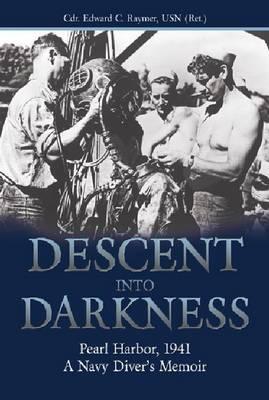
9781591147244CDR Edward Charles Raymer, US Navy Retired, was one of those divers. Raymer tells the story of these men in Descent into Darkness: Pearl Harbor, 1941 – A Navy Diver’s Memoir, if you’re interested in further reading.  Most of them are gone now, including Raymer himself.  They have earned the right to be remembered.

Salvage workers entered the pressurized hull through airlocks wearing masks and protective suits. Bodies were in advanced stages of decomposition by this time and the oil and chemical-soaked interior was toxic to life. Most victims would never be identified.

Twenty 10,000 gallon per minute pumps operated for 11 hours straight, re-floating the battleship on November 3, 1943.

Oklahoma entered dry dock the following month, a total loss to the American war effort. She was stripped of guns and superstructure, sold for scrap on December 5, 1946 to the Moore Drydock Company of Oakland, California.

The battered hulk left Pearl Harbor for the last time in May 1947, destined for the indignity of a scrapyard in San Francisco bay. She would never make it. Taken under tow by the ocean-going tugs Hercules and Monarch, the three vessels entered a storm, 540 miles east of Hawaii. On May 17, disaster struck. Piercing the darkness, Hercules’ spotlight revealed that the former battleship was listing heavily. Naval base at Pearl Harbor instructed them to turn around, when these two giant tugs suddenly found themselves slowing to a stop. Despite her massive engines, Hercules was being dragged astern with no warning, hurtling past Monarch, herself swamped at the stern and being dragged backward at 17mph.

the-tug-boat-hercules-william-havle
Ocean-going tug Hercules, photograph by William Havle

Fortunately for both tugs, skippers Kelly Sprague of Hercules and George Anderson of Monarch had both loosened the cable drums connecting 1,400-foot tow lines to Oklahoma. Monarch’s line played out and detached, but Hercules’ line didn’t do so until the last possible moment. With tow line straight down and sinking fast, Hercules’ cable drum exploded in a shower of sparks directly over Oklahoma’s final resting place, the 409-ton tug bobbing to the surface like the float of a child’s fishing line.

“Okie” had been stabbed in the back, attacked and mortally wounded before she knew her nation was at war.  The causes leading to her final descent, remain uncertain.  Most will tell you, those plates couldn’t hold.  The beating of six years earlier, was just too much.   Those who served on her decks, might tell you she preferred to die at sea.

If you enjoyed this “Today in History”, please feel free to re-blog, “like” & share on social media, so that others may find and enjoy it as well. Please click the “follow” button on the right, to receive email updates on new articles.  Thank you for your interest, in the history we all share.


December 6, 1768 The Murderer’s Dictionary

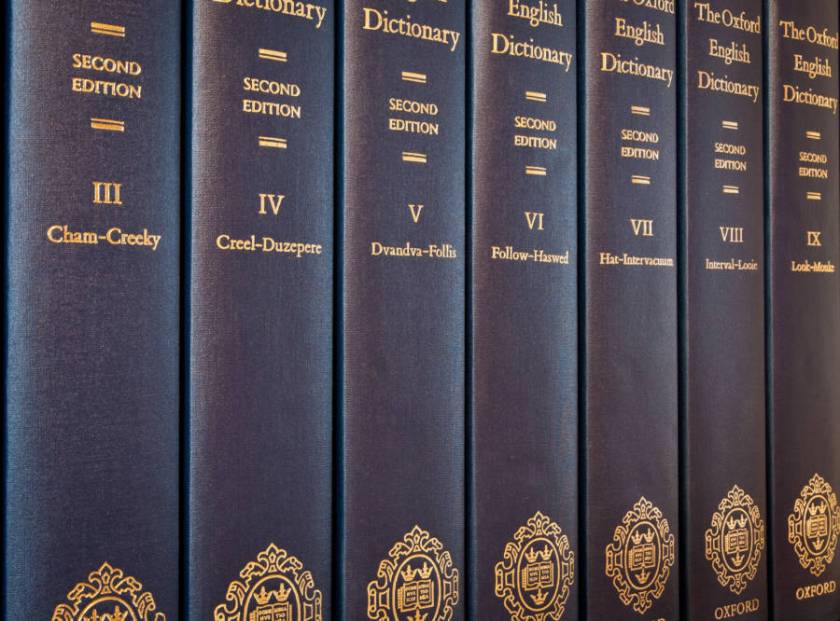
Among the entire catalog of works there is no tale so queer as the Oxford English dictionary, and the convicted murderer who helped to bring it into being.  From an insane asylum, no less.

For the great reference works of the English language, the beginnings were often surprisingly modest. Encyclopedia Britannica was first published on this day in 1768 in Edinburgh, Scotland: part of the Scottish enlightenment. Webster’s dictionary got its beginnings with a single infantrymen of the American Revolution, who went on to codify what would become the standardized system of spelling for “American English“.  In Noah Webster’s dictionary, ‘colour’ became ‘color’, and programme’ became ‘program’, a novel concept at a time when the thought of a “correct“ way of spelling, was a new and unfamiliar idea.

Among the entire catalog of works there is no tale so queer as the Oxford English dictionary, and the convicted murderer who helped bring it into being.  From an insane asylum, no less.

Dissatisfied with what were at that time a spare four reference works including Webster’s dictionary, the Philological society of London first discussed what was to become the standard reference work of the English language, in 1857. The work was expected to take 10 years in compilation and cover some 64,000 pages.  The editors were off by sixty years.  Five years into the project, the team had made it all the way to “ant“.

Minor
Dr. William Chester Minor

William Chester Minor was a physician around this time, serving the Union army during the American Civil War.   

The role of this experience in the man’s later psychosis, is impossible to know. Minor was in all likelihood a paranoid schizophrenic, a condition poorly understood in his day.

As a combat surgeon, Minor saw things that no man was ever meant to see.  Terrible mutilation was inflicted on both sides at the 1864 Battle of the Wilderness.  Hundreds were wounded and unable to get out of the way of the brush fire, burning alive those sufferers too broken to move, before the horrified eyes of comrades and enemies, alike.  One soldier would later write:  It was as though “hell itself had usurped the place of earth“.

Dr. Minor was ordered to brand the forehead of an Irish deserter, with the letter “D”.  The episode scarred the soldier, and left the doctor with paranoid delusions that the Irish were coming to ‘get him’.

As a child born to New England missionaries working in Ceylon, Minor was well adjusted to the idea of foreign travel, as a means of dealing with travail. He took a military pension and moved to London in 1871, to escape the demons who were by that time, closing in.

One day, Minor shot and killed one George Merritt, a stoker who was walking to work.  He believed the man had broken into his room.  The trial was published widely, the “Lambeth Tragedy” revealing the full extent of Minor’s delusional state, to the public.

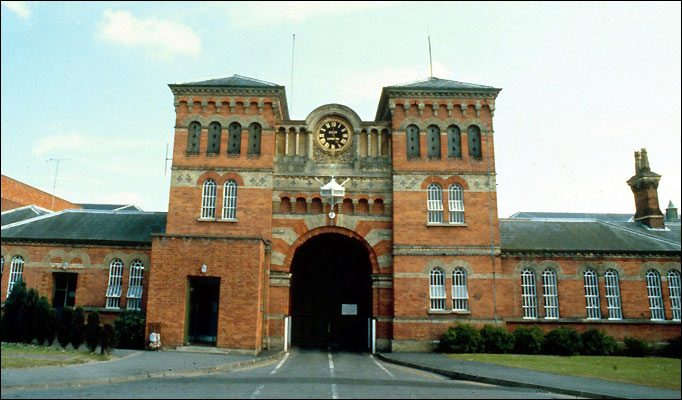
Minor was judged not guilty on grounds of insanity, and remanded “until Her Majesty’s Pleasure be known”, to the Broadmoor institution for the criminally insane. Victorian England was by no means ‘enlightened’ by modern standards, and inmates were always referred to as ‘criminals’ and ‘lunatics’. Never as ‘patients’. Yet Broadmoor, located on 290 acres in the village of Crowthorne in Berkshire was England’s newest such asylum, and a long way from previous such institutions.

Minor was housed in block 2, the “Swell Block”, where his military pension and family wealth afforded him two rooms, instead of the usual one. In time, Minor acquired so many books that one room was converted to a library.  Surprisingly, it was Merritt’s widow Eliza, who delivered many of the books.  The pair became friends, and Minor used a portion of his wealth to “pay” for his crime, and to help the widow raise her six kids.

Broadmoor-outside
Broadmoor asylum for the criminally insane

Dr. James Murray assumed editorship of the “Big Dictionary” of English in 1879, and issued an appeal in magazines and newspapers, for outside contributions. Whether this seemed a shot at redemption to William Minor or merely something to do with his time is anyone’s guess, but Minor had nothing but time. And books.

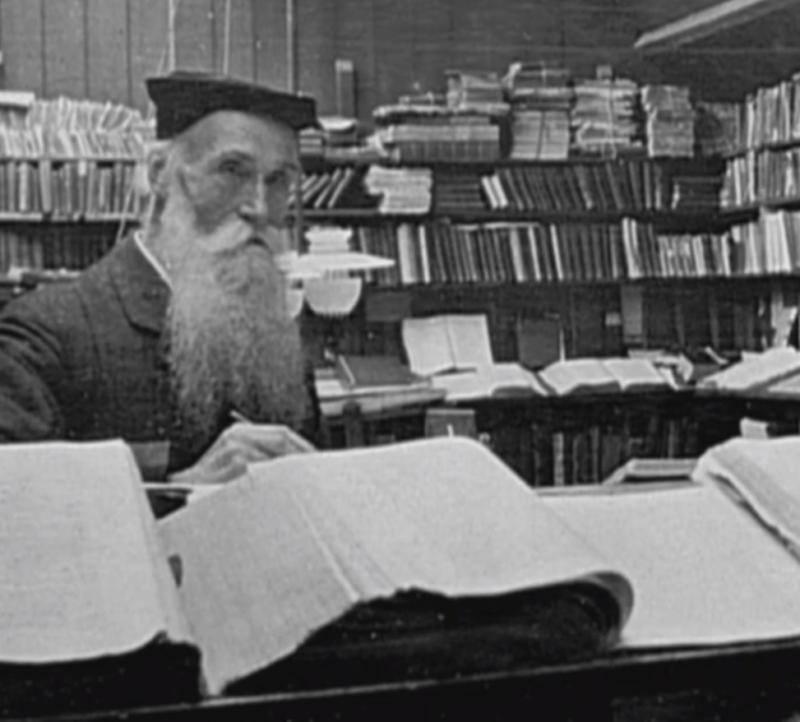
William Minor collected his first quotation in 1880 and continued to do so for twenty years, always signing his submissions: Broadmoor, Crowthorne, Berkshire.

The scope of the man’s work was prodigious, he himself an enigma, assumed to be some country gentlemen.  Perhaps one of the overseers, at the asylum.

In 1897, “The Surgeon of Crowthorne” failed to attend the Great Dictionary dinner.  Dr. Murray decided to meet his mysterious contributor in person and finally did so, four years later.  In his cell. Oh, to have been a fly on the wall, when this Oxford don was ushered into the office of Broadmoor’s director, only to learn that the man he looked for, was an inmate.

murray-at-work-scriptorium
Dr. “Murray at work in his scriptorium, a dedicated room filled with books, at Oxford University (date unknown)”. H/T allthatsinteresting.com

Dr. Minor would carefully index and document each entry, which editors compared with the earliest such word use submitted by other lexicographers. In this manner, over 10,000 of his submissions made it into the finished work, including the words ‘colander’, ‘countenance’ and ‘ulcerated’.

By 1902, Minor’s paranoid delusions had crowded out his mind.  His submissions came to an end.  What monsters lurked inside the man’s head is anyone’s guess.  Home Secretary Winston Churchill ordered Minor to be removed back home to the United States, following a 1910 episode in which Minor emasculated himself, with a knife.

The madman lived out the last ten years of his life, in various institutions for the criminally insane. William Chester Minor died in 1920 and went to his rest in a small inauspicious grave, in Connecticut.

Over seventy years in compilation, only one single individual is credited with more entries to the greatest reference work in the history of the English language, than this one murderer, working from a home for lunatics.

oed-volumes
Oxford English Dictionary

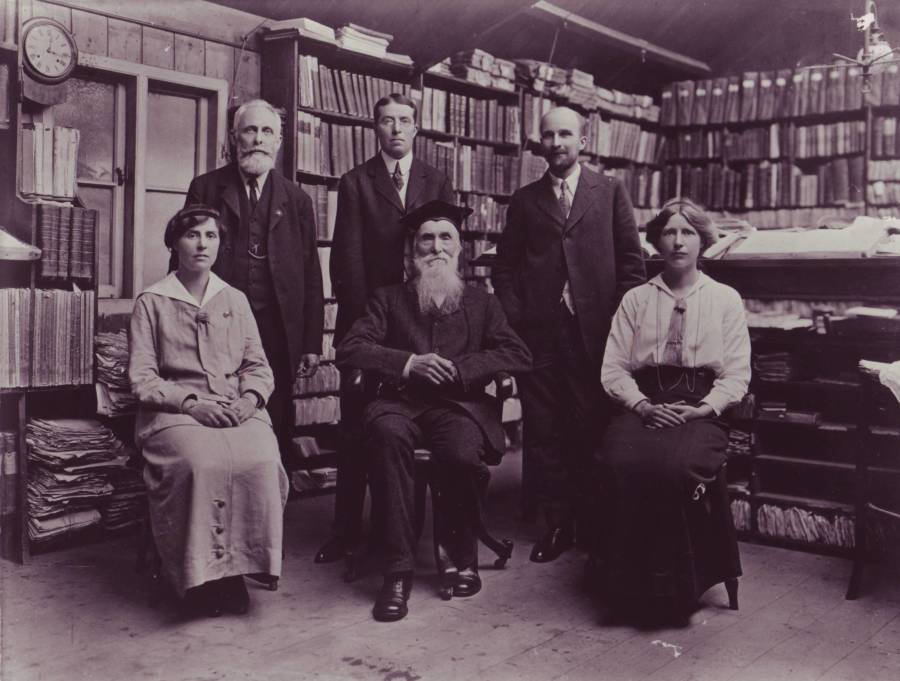
Feature image, top of page:  Dr. Murray and his Oxford University editorial team, 1915.  H/T allthatsinteresting.com

If you enjoyed this “Today in History”, please feel free to re-blog, “like” & share on social media, so that others may find and enjoy it as well. Please click the “follow” button on the right, to receive email updates on new articles.  Thank you for your interest, in the history we all share.

December 5, 63BC The Catiline Conspiracy

Lucius Sergius Catilina was a Roman Senator, best remembered for his attempt to overthrow the Republic. In particular the power of the aristocratic Senate. He seems to have been an unsavory character, having murdered first his brother in law and later his own wife, before being tried for adultery with a vestal virgin.

Following the overthrow of the  Monarchy in 509BC, the Rome of antiquity governed itself, as a Republic. The government was headed by two consuls, annually elected by the citizens and advised by a Senate. The Republic operated on a separation of powers principle, with checks and balances and a strong aversion to the concentration of power. Except in times of national emergency, no single individual was allowed to wield absolute power over his fellow citizens.

RomanRepublicFirstCenturyMap

A series of civil wars and other events took place during the first century BC, ending the republican period and leaving in its wake an Imperium, best remembered for its conga line of dictators.

medium_Lucius_Sergius_Catilina
Lucius Sergius Catilina

Lucius Sergius Catilina was a Roman Senator during this period, best remembered for his attempt to overthrow the Republic. In particular the power of the aristocratic Senate. He seems to have been an unsavory character, having murdered first his brother in law and later his own wife, before being tried for adultery with a vestal virgin.

Catilina’s second wife, the formidable Aurelia Orestilla, reputedly murdered the Senator’s grown son, for objecting to the match.  The American political commentator and Rutgers professor Leonard A. Cole once said “You are not responsible for what your friends do, but you will be judged by the company you keep“. Seems about right, to me.

The first of two conspiracies bearing his name began in 65BC. Catilina was supposed to have conspired to murder a number of Senators on their entering office, and making himself, Consul. He may or may not have been involved at this stage, but he certainly would be for the second.

Aurelia_Head_Keyshot_File.31_writing puny
H/T zbrushcentral.com for this astonishing representation, of the second wife of Catilina

In 63BC, Catilina and a group of heavily indebted aristocrats concocted a plan with a number of disaffected veterans, to overthrow the Republic. On the night of October 18, Crassus brought letters to Consul Marcus Tullius Cicero warning of the plot. Cicero read the letters in the Senate the following day, later giving a series of four speeches: the Catiline Orations, considered by many to be his best political oratory.

In his last speech, delivered in the Temple of Concordia on December 5, 63BC, Cicero established a basis for other speakers to take up the cause. As Consul, Cicero was not allowed to voice an opinion on the execution of conspirators, but this speech laid the groundwork for others to do so, primarily Cato the Younger.

corrupcion-roma--644x362

The actual Senate debates are lost to history, leaving only Cicero’s four orations, but there was considerable resistance in the Senate to executing the conspirators. They were, after all, fellow aristocrats.

Armed forces of the conspirators were ambushed at the Milvian Bridge, where the Via Flaminia crosses the Tiber River. The rest were executed by the end of December. Cicero’s actions had saved the Republic. For now.

history-catalineAt one point during this period, then-Senator Julius Caesar stepped to the rostrum to have his say. He was handed a paper and, reading it, stuck the note in his toga and resumed his speech. Cato, Caesar’s implacable foe, stood in the senate and demanded that Caesar read the note. It’s nothing, replied the future emperor, but Cato thought he had caught the hated Caesar red handed. “I demand you read that note”, he said, or words to that effect. He wouldn’t let it go.

Finally, Caesar relented. With an actor’s timing, he pulled out the note and read it to a hushed senate.  It turned out to be a love letter, a graphic one, wherein Servilia Caepionis described in detail what she wanted to do with Caesar when she got him alone. As if the scene wasn’t bad enough, Servilia just happened to be Cato’s half-sister.

Here’s where the story becomes very interesting. Caesar was a well-known lady’s man. By the time of his assassination, the Emperor had carried on with Servilia Caepionis, for years. Servilia had a son, called Marcus Brutus. He was 41 on the 15th of March, 44BC. The “Ides of March”. Caesar was 56. The Emperor’s dying words are supposed to have been “Et tu, Brute?”, as Brutus plunged the dagger in. “And you, Brutus?” But that’s not what he said. Those words were put in his mouth 1,643 years later, by William Shakespeare.

death-of-caesar-2
Ciaran Hinds plays Julius Caesar in the series Rome

Eyewitness accounts to Caesar’s last words are lost to history, but more contemporary sources recorded his dying words to be “Kai su, Teknon?” In Greek, it means “And you, my child?”

It seems unlikely that Brutus murdered his own father on the Ides of March.  The dates don’t seem to work out. Still, it makes you wonder…

If you enjoyed this “Today in History”, please feel free to re-blog, “like” & share on social media, so that others may find and enjoy it as well. Please click the “follow” button on the right, to receive email updates on new articles.  Thank you for your interest, in the history we all share.

December 4, 1950 Wingmen to the End

Flying overhead, Hudner could see his wing man below, severely injured, his leg trapped in the crumpled cockpit, struggling to get out of the burning aircraft.

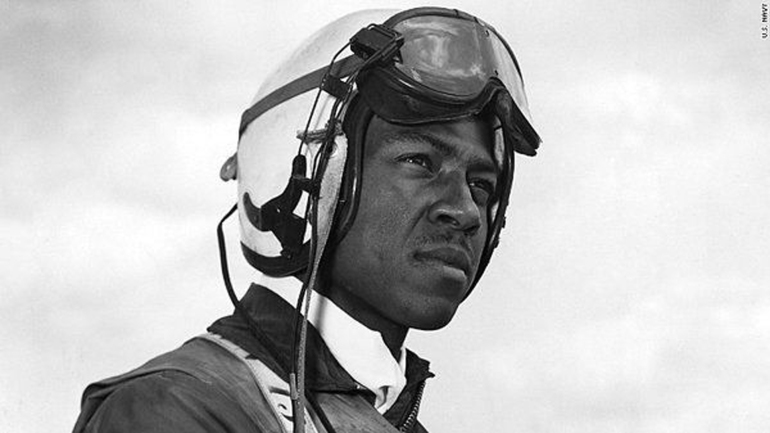
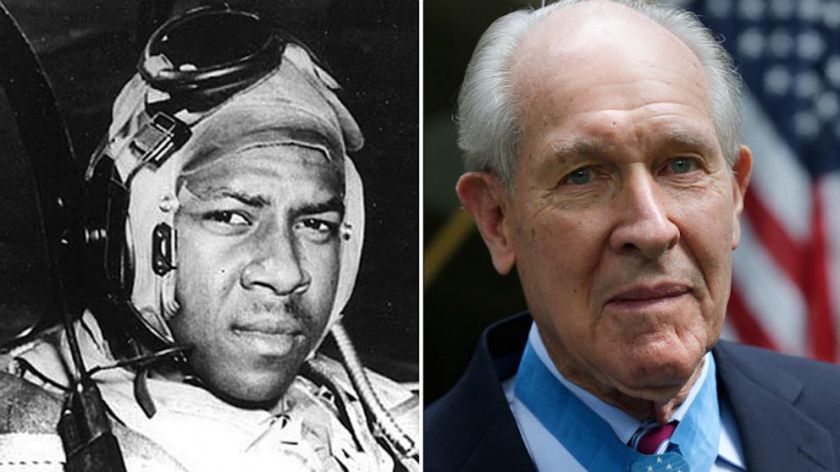
Jesse LeRoy Brown was born in 1926 in Hattiesburg, Mississippi, the son of a schoolteacher and a warehouse worker.   A mixed-race young man of African, Chickasaw and Choctaw ancestry, Jesse grew up in a time of real discrimination.  Brown had all the disadvantages of a black child growing up under depression-era segregation, but his parents kept him on the “straight & narrow”.  Julia and John Brown made sure their kids stuck with their studies.  Such parental devotion would serve them well.

jesse-leroy-brown-2

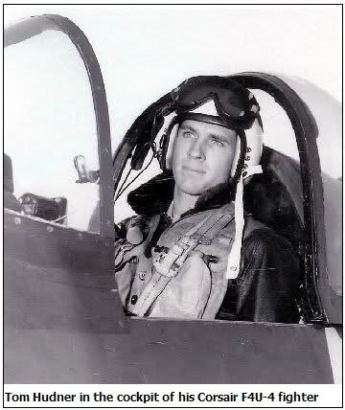
Thomas Jerome Hudner, Jr. was born in 1924, the son of a successful Irish grocer from Fall River, Massachusetts who went on to attend the prestigious Phillips Academy in Andover, in 1939.

The pair could not have come from more different backgrounds, but both men became  carrier pilots with the United States Navy, and served together during the conflict in Korea.

110kqivOn June 25, 1950, ten divisions of the North Korean People’s Army launched a surprise invasion of their neighbor to the south. The 38,000-man army of the Republic of Korea didn’t have a chance against 89,000 men sweeping down in six columns from the north. Within hours, the shattered remnants of the army of the ROK and its government, were streaming south toward the capital of Seoul.
The United Nations security council voted to send troops to the Korean peninsula. In November, the People’s Republic of China entered the conflict in support of their Communist neighbor.

By December, 120,000 troops of the Chinese People’s Volunteer Army (PVA) had all but overrun the 15,000 men of the US X Corps, who found themselves surrounded in the frozen wasteland of the Chosin Reservoir. Dozens of close air support missions were being flown every day to keep the Chinese army at bay.

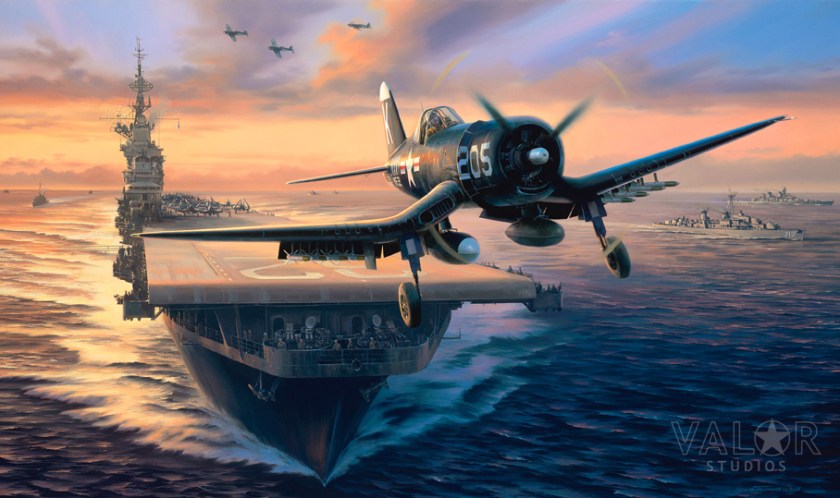
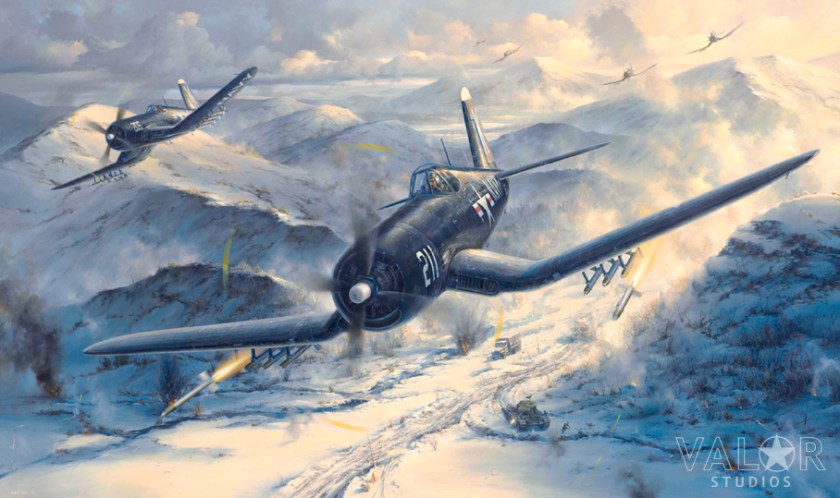
At 13:38 on December 4, Thomas “Lou” Hudner took off from the carrier USS Leyte, part of a six-aircraft flight with squadron executive officer Lieutenant Commander Dick Cevoli, Lieutenant George Hudson, Lieutenant Junior Grade Bill Koenig, Ensign Ralph McQueen and Hudner’s wingman, Ensign Jesse LeRoy Brown.

painting-off-to-the-chosin
“Off To The Chosin” by Nicolas Trudgian

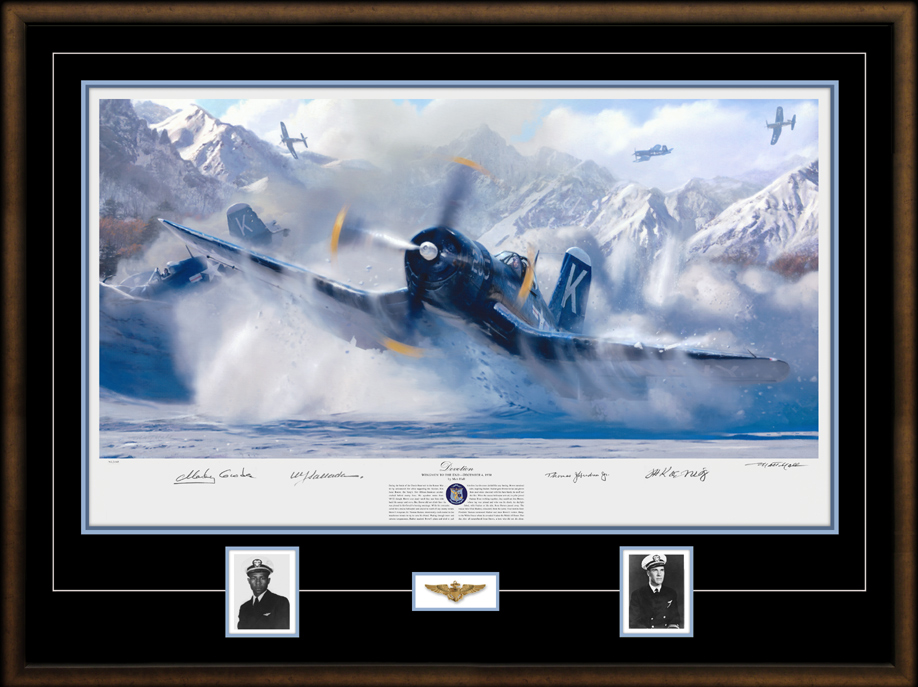
An hour later, Koenig radio’d Brown that his aircraft appeared to be trailing fuel.  Chinese infantry were known to hide in the snow, and ambush incoming aircraft.  It’s likely that Brown was hit by small arms fire, from the ground.  Losing oil pressure with the aircraft all but impossible to control, Brown had no choice but to crash land on a snow covered mountain side. Flying overhead, Hudner could see his wing man below, severely injured, his leg trapped in the crumpled cockpit, struggling to get out of the burning aircraft.

wingmen-to-the-end
“Wingmen to the End” by Gareth Hector Hat tip Adam Makos, author of “Devotion, an epic story of heroism, friendship and sacrifice”, https://www.adammakos.com/devotion-book.html

Hudner did the unthinkable and deliberately crash landed his own aircraft.  Now injured himself, Hudner hobbled across the snow to the aid of his trapped wing man. He scooped snow onto the fire with his bare hands in the 15° cold, burning himself in the process as Brown faded in and out of consciousness. A Marine Corps helicopter landed at 15:00, piloted by Lieutenant Charles Ward.  The two went at the stricken aircraft with an axe for 45 minutes, but could not free the trapped pilot.

The two were considering Jesse’s plea that they amputate his trapped leg with that axe, when the pilot faded away for the last time. Jesse Brown’s last words were “Tell Daisy I love her”.

ap_jesse_brown_thomas_hudner_mi_130725_16x9_992

They had to leave. “Night was coming on” Hudner later explained, “and the helicopter was not equipped to fly in the dark. We’ll come back for you”, he said.  Jesse Brown could no longer hear.

Hudner pleaded the following day to be allowed to go back to the crash site, but his superiors were unwilling to risk further loss of life. Two days later, the site was bombed with napalm, to prevent the aircraft and the body from falling into Chinese or North Korean hands.  Jesse Brown’s body was still stuck in the cockpit though, by this time, his clothes had been removed.

23561321_1671529152912193_50553384345769687_n
H/T Sierra Hotel Aeronautics

American pilots recited the Lord’s prayer, as they watched his body being consumed by the flames.

Jesse LeRoy Brown, the first Black Naval Aviator in American history, became the first to die, sixty-eight years ago, today.  He was awarded the Distinguished Flying Cross and Purple Heart,  posthumously.

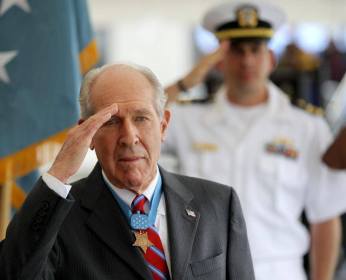
Thomas Hudner was awarded the Medal of Honor for his actions on that frozen mountainside. One of eleven to be so honored following the battle of the Chosin Reservoir, Hudner would remain the only Naval aviator awarded the Medal of Honor, during the entire conflict in Korea.

In July of 2013, Thomas Hudner returned to the North Korean capital of Pyongyang, in fulfillment of a 63-year-old promise.  “We’ll come back for you“.

Political relations with the “Hermit Kingdom” of North Korea were as frigid at that time as the frozen mountains of the Chosin Reservoir, yet Hudner received permission to return to the site. He was 88 at the time. In the end, wretched weather hampered the effort.  North Korean authorities told him to return when the weather was more cooperative.

Recently, American President Donald Trump has worked toward a thaw in relations on the Korean peninsula, in cooperation with South Korean President Moon Jae-in and North Korean Supreme Leader Kim Jong-un. Less than a week ago, a South Korean train crossed the demilitarized zone into North Korea, a move which would have been unheard of, for much of the last seventy years.

636463693852708011-hudner.scherry.10
“Retired U.S. Navy Capt. Thomas Hudner, left, meets Commander Nathan Scherry following the christening of the USS Thomas Hudner in Bath, Maine, on April 1, 2017. Scherry will command the new guided-missile destroyer”.  H/T, KDSK.com

The future is uncertain, but Korean rapprochement comes too late for Lou Hudner and Jesse Brown.  Thomas Jerome “Lou” Hudner passed away at his home in Concord, Massachusetts, on November 13, 2017, and was buried a with honors, at Arlington National Cemetery.  He was 93.  The remains of Jesse LeRoy Brown were never recovered from that North Korean mountainside.

Three days ago, Hudner’s wife of fifty years Georgea was on-hand to witness the United States Navy commission its newest naval warship in Boston.  The Arleigh Burke-class guided missile destroyer, USS Thomas Hudner.

Afterward – Do you believe in Ghosts?

December 3, 1979 Iranian Revolution

If you want a fun read sometime, download the constitution of the Islamic Republic of Iran. Khomeini is personally named in the document. Three times.

Ruhollah Mousavi, the name translates as “inspired of God”, was born in the Iranian village of Khomein, on September 24, 1902. Born into a family of Shi’ite religious scholars, Mousavi was raised by his mother and aunt after his father was murdered while the boy was still an infant. The mother and the aunt died in a cholera outbreak when he was 16. After that, the boy was raised by his brother, Seyed Mourteza.

The family claimed to be directly descended from Muhammad, and both brothers were avid religious scholars, attaining the status of Ayatollah: Shi’ite scholars of the highest knowledge.

As King of Persia (Iran) since the 1920s, Rezā Shāh Pahlavi weakened the powers of religious leaders and pushed for a more secularized country.  Pahlavi’s reign was largely a force for modernization, but was often despotic, and failure to modernize a large peasant population did much to pave the way for Iranian Revolution.

608shahMohammad Reza Pahlavi came to power in 1941, following the Commonwealth/Soviet invasion of the Empire of Iran which forced the abdication of his father.

The years following WW2 saw a “growing nationalist mobilization against foreign domination” across the Middle East. In Iran, increasingly politicized Shiʿite “Islamic Fundamentalist” sentiment took the form of the Fadā’iyān-e Islam, literally “Self-Sacrificers of Islam”, an activist organization founded by theology student Navvab Safavi and dedicated to “purifying” Islam through the assassinations of leading intellectual and political leaders.

Prime Minister Haj Ali Razmara was assassinated by Fadā’iyān-e Islam radicals in 1951, the organization’s spiritual leader Ayatollah Abol-Qassem Kashani becoming Speaker of the National Parliament.

In the early ’50’s, secular Prime Minister Mohammad Mosaddegh enjoyed an alliance of convenience with the hard-liner Kashani, mentor to the future Ayatollah Khomeini, at the same time seeking to blunt the political power of the Shah, believing that the Persian King should “reign, but not rule” in the manner of the constitutional monarchies of Europe.

In 1901, Mozzafar al-Din Shah Qajar, King of Persia, granted a 60-year petroleum search concession to British investor William Knox D’Arcy for £20,000, equivalent to $166 million in 2016. By the WW2 period, support was building for state control of foreign-owned oil assets, many believing such policies to be the way forward to greater wealth and self-determination. Mossadegh attempted to negotiate a 50/50 split of oil profits, but the British controlled Anglo-Iranian Oil Company (AIOC) balked.

Contrary to the American position at that time, the UK government began plans to undermine and overthrow the Iranian government.

AIOC refusal to submit to audit of its books led to the “Nationalization Crisis” of 1951, and the near-unanimous vote in the majlis to nationalize Iranian oil assets. Foreign oil executives were expelled from the country, the British government enforcing an Iranian oil embargo while Prime Minister Mossadegh talked of a “cruel and imperialistic country” stealing from a “needy and naked people.”

With the United States fighting a war in Korea, the American government was deeply entrenched in a cold war mindset. Mossadegh had lost the support of Islamist hardliners by this time, for his failure to move the nation toward sharia-based theocratic government.

1953 coup
“A communist newspaper’s office equipment is burned in the streets of Tehran on August 19, 1953, during the pro-Shah riots that swept through the nation’s capital”. H/T CNN

The communist-supporting Tudeh party began to infiltrate the Iranian military, persuading American Secretary of State John Foster Dulles that the Iranian government was “falling” to the Soviet Union.

Before long, economic and political isolation severely weakened the Mossadegh government, as the American government switched sides on the question of Iranian overthrow. Two UK/US-backed coup attempts followed in 1953, along with the temporary expulsion of the Shah. The government was done for good that August. Mohammad Mossadegh was sentenced to death but the sentence was never carried out.  He spent the rest of his life under house arrest and died in Tehran, in 1967.

Ayatollah Khomeini had formed very different views by this time from those of his teachers, concerning the separation of church and state. Khomeini dedicated himself to teaching, cultivating a group of dedicated students who would one day become his staunchest supporters. By the time of JFK’s election to the Presidency, Shi’ite Iranians regarded Khomeini as “Marja-e Taqlid”. A person to be imitated.

Khomeini gained prominence in 1962, opposing a law which would remove the requirement that elected officials be sworn in on the Qu’ran. In 1963, he gave a speech suggesting the Shah could leave if he didn’t like the political direction of the country, a speech which earned him a stay in prison.

iranian-revolution

Khomeini was arrested again in 1964, after pronouncing his belief that Jews would take over Iran, and that the US considered all Iranians to be little more than slaves. Khomeini was deported to Turkey, later taking up residence in Iraq because Turkish law prevented him from wearing the traditional clothes of a Shi’ite cleric and scholar.

During his years in exile, Khomeini developed his ideas on the structure of an Islamic state, which he called “Velayat-e faqeeh”. He would lecture on his religious theories, videotapes of which were smuggled into Iran and sold at bazaars, making Khomeini the leader of Iranian opposition to the Shah’s government.

Military force had to be called out in 1975, to dispel crowds at a religious school in Qom. Khomeini declared it the beginning of “Freedom and liberation from the bonds of imperialism”. By this time Khomeini was too hot to handle even for the Iraqis, and he moved to Paris. It was only a few short months before his triumphant return.

Thousands were killed in riots and demonstrations throughout 1978, which the Shah first tried to quell, and later to embrace. “As Shah of Iran as well as an Iranian citizen”, Pahlavi said on November 5, “I cannot but approve your revolution”.

iranian-revolution-3

It was too little, too late. Weeks later the Shāhanshāh, the “King of Kings”, left his country for good.

Khomeini re-entered Iran in February, as the Shah went from country to country, looking for a place to stay. With the now-former King of Kings suffering from a form of non-Hodgkins Lymphoma, President Jimmy Carter reluctantly allowed the Shah into the US for surgery.

Pahlavi left for Panama less than two weeks later, as “Grand Ayatollah” Khomeini denounced what he saw as an American plot. Student followers of the Ayatollah stormed the American embassy on November 4 and seized 90 hostages. 13 women and Americans of African ancestry were later released as was Richard Queen, a white man sick with Multiple Sclerosis. The remaining 52 hostages would be 444 days in captivity, paraded before television cameras in blindfolds as Khomeini denounced “The Great Satan”.

141027153923-01-iran-hostage-crisis-restricted-super-169The Iranian constitution of 1906 was supplanted by popular referendum on this day in 1979, when Ayatollah Ruhollah Khomeini was proclaimed rahbar-e mo’azzam-e irān, Supreme Leader of the Islamic Revolution.

The US attempted a rescue on April 24, 1980. “Operation Eagle Claw” ended in collision between aircraft and the death of eight American servicemen, an Iranian civilian, and the destruction of two aircraft.

Aside from some of the most dismal economic conditions in American history, the Iranian hostage crisis did more than anything else to doom the Carter Presidency, to a single term.

Iranian revolutionaries wanted the Shah to stand trial for atrocities committed by his secret police, the SAVAK, but the Islamic Republic of Iran would easily match the worst of the Shah’s reign when it came to brutality.

2000px-Flag_of_Iran_in_map.svg_Ayatollah Ruhollah Khomeini is gone now, but his influence is very much alive. If you want a fun read sometime, download the constitution of the Islamic Republic of Iran. Khomeini is personally named in the document. Three times.

There is a quote, attributed to the Ayatollah, which says “We do not worship Iran, we worship Allah. For patriotism is another name for paganism. I say let this land burn. I say let this land go up in smoke, provided Islam emerges triumphant in the rest of the world”.

A 2007 article in The Economist calls the authenticity of this quote into question, noting that the Mullahs like to build up bank accounts in Dubai and Switzerland, behavior hardly consistent with such an apocalyptic world view.

The American State Department designated the Islamic Republic of Iran a state sponsor of terrorism in 1984, a classification which holds, to this day.  As the previous administration saw fit to fly three planeloads of cash on pallets into the Islamic Republic for a total of $1.3 Billion, it would be nice to settle the authenticity question on that Khomeini quote, once and for all.

If you enjoyed this “Today in History”, please feel free to re-blog, “like” & share on social media, so that others may find and enjoy it as well. Please click the “follow” button on the right, to receive email updates on new articles.  Thank you for your interest, in the history we all share.