May 21, 1944 That Other Disaster, at Pearl Harbor

Details of the West Loch disaster would remain classified until 1960, explaining why the incident is so little known, today.

Between June and November 1944, forces of the United States Marine Corps and Army conducted Operation Forager with support from the United States Navy, an offensive intended to dislodge Imperial Japanese forces from the Mariana Islands and the island nation of Palau.

Part of the island-hopping strategy employed during the last two years of WW2, Operation Forager followed the Gilbert and Marshall Islands campaign and had as its objective the neutralization of Japanese bases in the central Pacific, support for the Allied drive to retake the Philippines, and to provide bases for strategic bombing raids against the Japanese home islands.
pearlharbor_sm-640x533
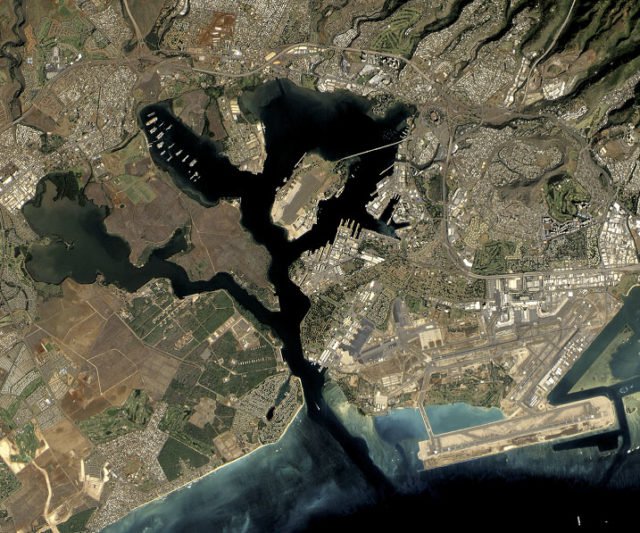
A NASA image of Pearl Harbor. The disaster occurred in West Loch which is to the left side of the photo, where the water is lighter in color.

In May 1944, the Pacific naval anchorage at Pearl Harbor was a rush of activity, building up for the planned invasion.  Seventy-four years ago today, twenty-nine Landing Ships, Tank (LSTs) were tied beam-to-beam on six piers, loading munitions, high octane gasoline and other equipment.

LST_Sicily
LST in Sicily

LST-353 exploded shortly after three in the afternoon, causing an incendiary chain reaction down the line of LSTs. 200 men were blown into the water in the first few minutes, in explosions powerful enough to knock vehicles on their sides. Eleven buildings on the shore were destroyed altogether and another nine, damaged.

Firefighting efforts were slow to get underway, due to the heat and the inexperience of many of the crew. Some LSTs began to move away under their own power or with the assistance of tugs, others were abandoned and left adrift and burning, before sinking in the channel.

Burning gasoline spread across the water and ignited other ships, left unharmed by the initial explosions. Fires continued to burn for the next twenty-four hours.

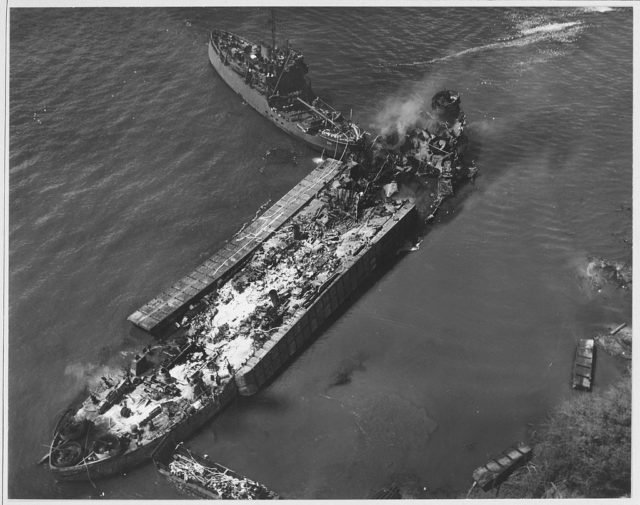
Casualty figures are surprisingly inexact. Most sources report 163 personnel killed in the incident and another 396, wounded. Some sources put the number of dead as high as 392.  Eleven tugboats were damaged while engaged in fire control efforts.  Six LSTs were sunk, two already carrying smaller, fully loaded Landing Craft Tanks (LCT) lashed to their decks.  Several others were heavily damaged and/or run aground.

A press blackout was ordered immediately after the incident, and military personnel were ordered not to talk. A Naval Board of Inquiry was opened the following day. The disaster at West Loch was initially believed to be caused by Japanese submarines, but the idea was dismissed due to the shallow depth of the harbor, and the presence of anti-submarine nets.
lst-480_following_west_loch_disaster-640x505
The wreckage of the LST 480 following the West Loch Disaster.

The precise cause of the accident remained elusive, as everyone near the initial explosion was killed. Army stevedores were unloading mortar ammunition at the time, using an elevator just fifteen feet from 80 drums of fuel. Some believe that a mortar round was accidentally dropped and exploded, others that fuel vapors were ignited by a cigarette or welder’s torch.

Subsequent salvage and removal efforts on the West Loch brought up the remains of a Japanese midget submarine, now believed to be the fifth such sub used in the attack of two years earlier.

Details of the West Loch disaster would remain classified until 1960, explaining why the incident is so little known, today.

1000w_q95

The last fatality from the disaster at West Loch occurred nine months later, during salvage operations for a sunken LST.
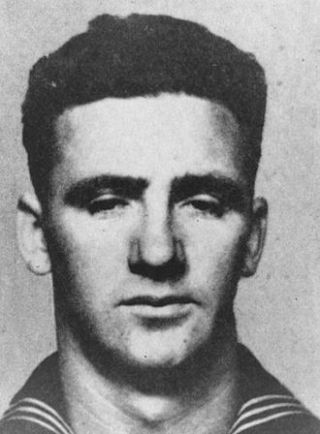
330px-Owen_F_P_Hammerberg

Boatswain’s Mate 2nd Class Owen Francis Patrick Hammerberg

On February 17, 1945, two divers were using jet nozzles to tunnel under a sunken LST, when the steel wreckage above them caved in. Buried alive with lifelines and air hoses hopelessly tangled with jagged pieces of steel, the pair was trapped under 40′ of water and another 20′ of mud.  There seemed no chance of survival, when fellow Navy diver Owen Francis Patrick Hammerberg went into the water.

Working in the swirling mud and pitch blackness beneath the bottom of Pearl Harbor, the diver worked desperately to wash another tunnel under the sunken LST.  Hammerberg reached the first man after hours of exhausting labor, freeing his lines and enabling the man to reach the surface.

Let Owen Hammerberg’s Medal of Honor citation, the one he would not live to read, tell what happened next.

Cmoh_army“…Venturing still farther under the buried hulk, he held tenaciously to his purpose, reaching a place immediately above the other man just as another cave-in occurred and a heavy piece of steel pinned him crosswise over his shipmate in a position which protected the man beneath from further injury while placing the full brunt of terrific pressure on himself. Although he succumbed in agony 18 hours after he had gone to the aid of his fellow divers, Hammerberg, by his cool judgment, unfaltering professional skill and consistent disregard of all personal danger in the face of tremendous odds, had contributed effectively to the saving of his 2 comrades…”.

Navy diver and Boatswain’s Mate 2nd Class Owen Francis Patrick Hammerberg was the only service member in WW2 and the last person ever, to receive the Medal of Honor as the result of heroism performed outside of combat.

If you enjoyed this “Today in History”, please feel free to re-blog, “like” & share on social media, so that others may find and enjoy it as well. Please click the “follow” button on the right, to receive email updates on new articles.  Thank you for your interest, in the history we all share.

May 20, 1942 White Feather Sniper

The elite sniper must be able to bear heat and insects and rain and a thousand other torments, all while hiding in plain sight from people who want more than life itself, to kill them.

The world of the elite sniper is different from anything most of us will ever experience. Able marksmanship (“one shot, one kill”) is only the beginning. The sniper must be expert at camouflage, field craft, infiltration, reconnaissance, ex-filtration and observation. He or she must be skilled in urban, desert and/or jungle warfare. They must be able to bear heat and insects and rain and a thousand other torments, all while hiding in plain sight from people who want more than life itself, to kill them.

carlos-hathcockCarlos Norman Hathcock, born this day in Little Rock in 1942, was a Marine Corps Gunnery Sergeant and sniper with a record of 93 confirmed and greater than 300 unconfirmed kills during the American war in Vietnam.

The Viet Cong and NVA called him “du kich Lông Trắng,” translating as “White Feather Sniper”, after the object he wore in his bush hat.

At another time and place, a white feather was bestowed as a symbol of cowardice, an often misplaced emblem of feminine patriotic zeal. Not with this guy.  Hathcock once took four days and three nights to cross 1,500 yards of open ground, stalking and killing a North Vietnamese General before withdrawing without detection. He was almost stepped on by NVA soldiers who were frantically searching for him, and nearly bitten by a deadly Bamboo Viper. It was the only time he ever removed that white feather from his bush hat.

Hathcock once took out an enemy soldier at a distance so great, the man couldn’t be seen with the naked eye. One shot, one kill.

9fa4afc0e7019de60f36f410659f4caaThe sniper’s choice of target could at times be intensely personal. One female Vietcong sniper, the platoon leader and interrogator called ‘Apache’ due to her interrogation techniques, would torture Marines and ARVN soldiers until they bled to death. Her signature was to cut the eyelids off her victims. After she skinned one Marine alive and left him emasculated within earshot of his base, Hatchcock spent weeks hunting this one sniper.
One day, Hathcock was tracking an NVA patrol, when he spotted the enemy sniper from the length of seven football fields. “We were in the midst of switching rifles,” he said. “We saw them. I saw a group coming, five of them. I saw her squat to pee, that’s how I knew it was her. They tried to get her to stop, but she didn’t stop. I stopped her. I put one extra in her for good measure.”

At a time when a typical NVA bounty for American snipers ranged from $8 to $2,000, the North Vietnamese set a  bounty of $30,000 on Hathcock’s head, so great was the damage he had done to their numbers. Whole platoons of counter snipers were sent to kill him. Marines in the area began to wear white feathers of their own, preferring to draw enemy fire on themselves rather than lose such a valuable asset.

The elite Vietcong sniper known as “The Cobra” had already taken the lives of several Marines, when he was sent specifically to kill Hathcock. The two elite snipers stalked each other for days when the Marine fired on a glint of light in the jungle, 300 yards distant. They found the enemy sniper dead, the round having traveled up the man’s scope and into his eye.

Such a shot is only possible if the two snipers were zeroed in on each other at the precise instant of the shot.  Let the man tell the story in his own words.

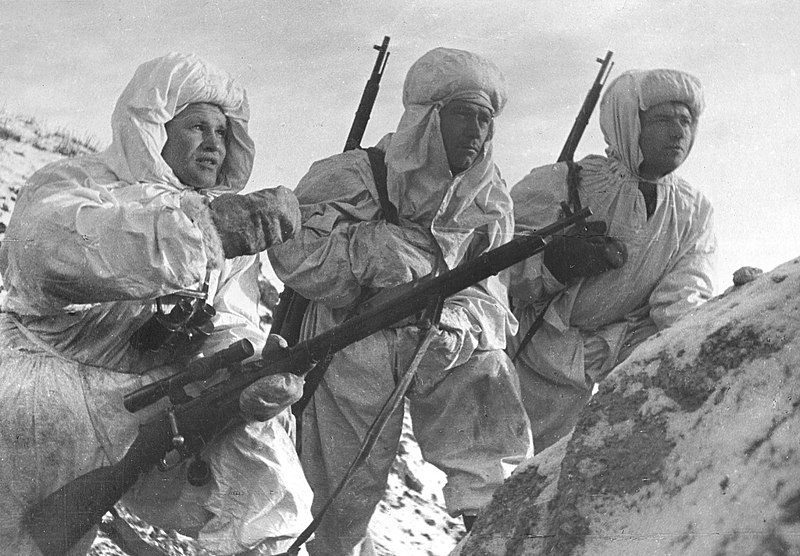
A through-the-scope shot is supposed to have taken place during the “War of the Rats” (“Rattenkrieg”) phase of the siege of Stalingrad, between Russian sniper Vasily Zaytsev and the Wehrmacht sniper school director sent to kill him, Major Erwin König.  There is some controversy as to whether such a shot ever took place.

Zaitsev
Vasily Zaytsev, left, and soviet snipers equipped with Mosin-Nagant M1891/30 with PE scope in Stalingrad, December 1942.

A 2006 episode of Mythbusters “proved” that the shot is impossible, but I enthusiastically disagree.   Adam Savage, Jamie Hyneman et.al. used a multiple-lensed scope for their test, while the Soviet made scope used by the Vietnamese sniper had only one or two internal lenses.

History.com and Marine Corps sniper Staff Seregeant Steve Reichert, USMC Retired, conducted a more realistic test at the at the T1G tactical training facility in Memphis, TN, with assistance from the appropriately-named mannequin, “Dead Fred”.  Reichert’s test (below) demonstrates that the “through the scope” shot not only Can happen under the right conditions, but that, in all probability,  it Did.

Carlos Hathcock developed Multiple Sclerosis in his later years, and passed away on February 23, 1999. He was decorated with the Silver Star, the Purple Heart and Navy and Marine Corps Commendation Medal. The honor he would perhaps have treasured most, was that of having a rifle named after him, a variant of the Springfield Armory M21 called the M25 “White Feather”.

springfield

If you enjoyed this “Today in History”, please feel free to re-blog, “like” & share on social media, so that others may find and enjoy it as well. Please click the “follow” button on the right, to receive email updates on new articles.  Thank you for your interest, in the history we all share.

May 19, 1944 The Seven Dwarves of Auschwitz

Not even concentration camp guards could resist the irony of seven dwarves. They immediately awakened Dr. Josef Mengele, the “Angel of Death”.

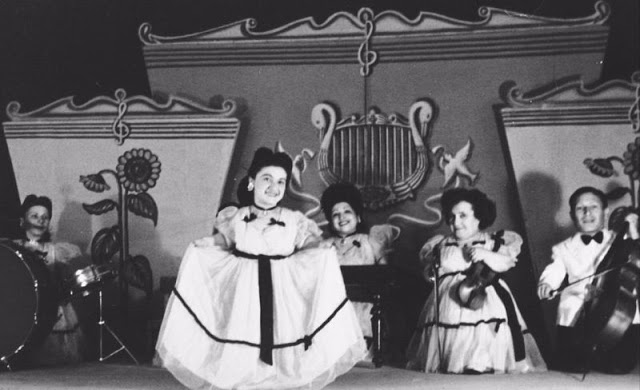
Shimson Eizik Ovitz was a Romanian rabbi, a WWI-era entertainer, and a man afflicted with pseudoachondroplasia. He was a dwarf. Ovitz fathered 10 children by two normal sized wives:  Brana Fruchter and Batia Bertha Husz. Three of those grew to normal height, the other seven were dwarves.

Batia gave the kids a piece of advice that stuck with them, all their lives: “through thick and thin” she said, “never separate. Stick together, guard each other, and live for one another”.

war2_1687882a

The dwarves were talented musicians, performing a variety show throughout the ’30s and early ’40s as the “Lilliput Troupe”. They toured Romania, Hungary and Czechoslovakia with their normal height siblings serving as road crew, until being swept up by the Nazis and deported to Auschwitz.

The train arrived around midnight on May 19th, 1944 and, accustomed to celebrity, one began to give out autographed cards. The family would soon be disabused of any notions of celebrity.

Not even concentration camp guards could resist the irony of seven dwarves. Dr. Josef Mengele was immediately awakened, knowing of his perverse fascination with the malformed, and what he called “blood” (family) experiments. The “Angel of Death”was delighted, “I now have work for 20 years”.

the-dwarves-of-auschwitz-4

The ten siblings were spared from the gas chamber that night, along with two more family members, a 15-month old boy and a 58-year old woman. Families of their handyman and a neighbor were also spared, insisting that they were close relatives. A total of 22 people.

The family was housed in horrific conditions, yet seven dwarves didn’t come along every day.  They were kept alive for further use and, as bad as it was, the food and clothing was better than that received by most camp inmates. Mengele even allowed them to keep their hair, and arranged special living quarters for them.

The bizarre and hideous “experiments” Mengele performed in the name of “science” were little more than torture rituals.  The three skeletons displayed of their dwarf predecessors, an ever-present reminder of what could be.  Boiling water was poured into their ears followed by freezing.  Eyelashes and teeth were pulled without anesthesia.  Blood was drawn until they would throw up and pass out, only to be revived to have more blood drawn.

the-ovitzs-leaving-the-ca-008

On one occasion, the Angel of Death told the family they were “going to a beautiful place”. Terrified, the siblings were given makeup, and told to dress themselves. Brought to a nearby theater and placed onstage, the family must have thought they’d be asked to perform. Instead, Mengele ordered them to undress, leaving all seven naked before a room full of SS men.  Mengele gave a speech, and then the audience was invited onstage to poke and prod the humiliated family.

One day of fresh horrors ended to reveal the next, and still they lived.  It was unusual for even two or three siblings to survive the Auschwitz death camp.  I don’t believe there was another instance where a family of twelve lived to tell the tale.

Auschwitz was liberated by the Soviet Red Army on January 27, 1945.

Traveling by foot to their Transylvanian home village of Rozavlea, the family found it ruined, though they did find a stash of gold coins where they had left it, buried for safekeeping before the war.

ba132f2b89040eef0fb0b59e29512bafThere was no future for them in this place.  Only 50 of the 650 Jewish inhabitants of the village ever returned. The family emigrated to Israel in May 1949, resuming their musical tour and performing until the group retired in 1955.
Josef Mengele never faced justice. He fled to South America after the war, and suffered a stroke while swimming in 1979.  The cause of death for one of the great monsters of history, was accidental drowning.

The youngest and last of the Ovitz dwarves, Piroska, “Perla” to her friends, passed away two days before the terrorist attack on the World Trade Towers. She spoke for the whole family, I think, when she said “I was saved by the grace of the devil”.

If you enjoyed this “Today in History”, please feel free to re-blog, “like” & share on social media, so that others may find and enjoy it as well. Please click the “follow” button on the right, to receive email updates on new articles.  Thank you for your interest, in the history we all share.

March 18, 2011 No Ordinary Donkey

For the family who now owned him, the  neglected, half-starved pack animal out back suddenly became a “beloved pet”.  They couldn’t possible let him go for anything less than $30,000.  (But, of course).

Al Taqaddum Airbase, “TQ” in military parlance, is a military airbase, 45 miles west of Baghdad, on the Habbaniyah Plateau of Iraq. In 2008, Al Taqaddum was home to the 1st Marine Logistics Group, under the command of Colonel John D. Folsom.

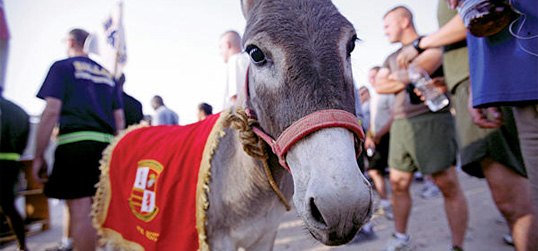
wwfs-colonel-folsom-smallEarly one August morning, Colonel Folsom awoke to a new sound. The thwap-thwap-thwap of the helicopters, the endless hum of the generators, those were the sounds of everyday life. This sound was different – the sound of braying donkey.
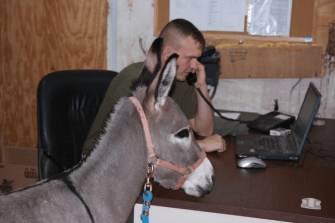
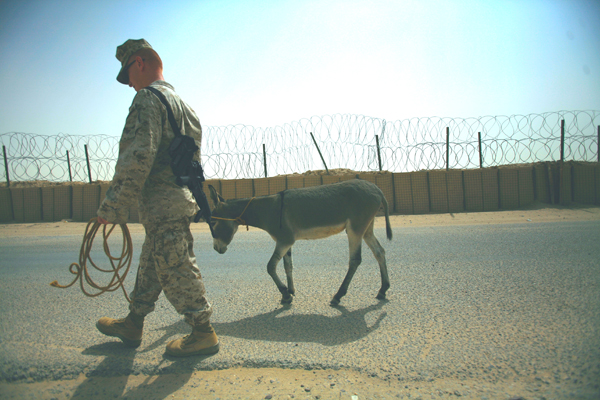
Folsom emerged from his quarters to find the small, emaciated animal, tied to a eucalyptus tree.  Standing all of 3′ tall, a sergeant had spotted the donkey roaming outside Camp Taqaddum, and thought it would be amusing to catch him.  Folsom thought it might be fun to have one around. Time would tell they were both right.

Smoke visits Sgt Lonnie Forrest

The website for a UK donkey sanctuary recommends a diet of highly fibrous plant material, eaten in small quantities throughout the day. I read the list twice and nowhere will you find bagels yet, for this little Iraqi donkey, there was nothing better.  Preferably frozen.  He’d hold them in his mouth and walk along, scraping the bagel in the dirt before eating it.  He liked to play the same game, with a deflated rubber ball.

You won’t find cigarettes on the list either, but he stole one once, and gobbled it down.  It didn’t seem to matter that the thing was lit.  For that reason and because of the color of his coat, the Marines called him “Smoke”.

Smoke-the-donkey-MattShelatoBefore long,  Smoke was a familiar sight around Camp Taqaddum.  After long walks around the wire, Smoke learned to open doors and wander around.  If you ever left that candy dish out on your desk, you were on your own.
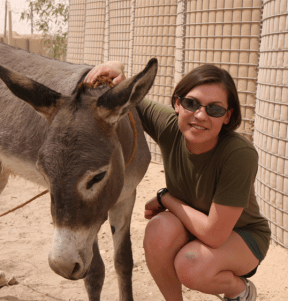
SmokeRegulations prohibit the keeping of pets in a war zone.  A Navy Captain helped get Smoke designated as a therapy animal, and he was home to stay.  As it turned out, there was more than a little truth to the label.  For young women and men thousands of miles from home in a war zone, the little animal was a welcome reminder of home.
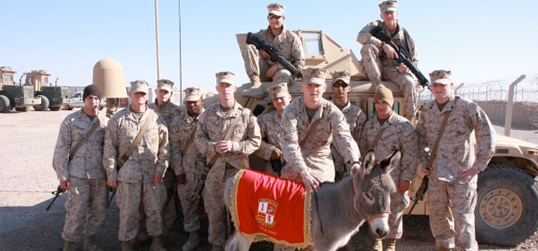
The humor of the situation was hard to resist, and the “ass jokes” all but told themselves.  (Sorry, but we’re talking about Marines, here).  Dozens of Marines laughed uproariously in that mess hall in 2009, belting out a mangled version of an old Kenny Rogers song: “Yes, he’s once, twice, three times a donkey…. I loooooovvvvvveeeeee youuuuuuuuu.”

That was the year when Folsom’s unit cycled out of Camp Taqaddum, to be replaced by another contingent of Marines.  These promised to look after the 1st MLG’s mascot, but things didn’t work out that way.  A Major gave the donkey away to a Sheikh who in turn dumped him off on an Iraqi family, and that was the end.  Except, it wasn’t.

Smoke-Home-LowerColonel Folsom couldn’t get the little animal out of his head and, learning of his plight in 2010, determined to get him back.  There were plenty of kids who had survived trauma of all kinds in his home state of Nebraska.  Folsom believed that the animal could do them some good, as well.
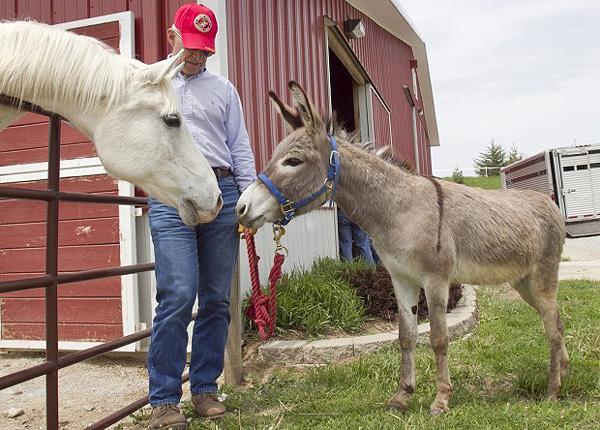
There ensued a months-long wrangle with American and Iraqi authorities, who couldn’t understand why all the fuss over a donkey.  For the family who now owned him, the  neglected, half-starved pack animal out back suddenly became a “beloved pet”.  They couldn’t possible let him go for anything less than $30,000.  (But, of course).

900 donors pitched in and, despite seemingly endless obstacles and miles of red tape, Smoke the Donkey slowly made his way from al-Anbar to Kuwait and on to Turkey and finally, to his new home in Nebraska.

smoke-donkey-omaha.600pjpg
Smoke the Marine Corps Donkey, at his new home in Omaha

ABCNews.com broadcast this announcement on May 18, 2011. Smoke the Marine Corps Donkey, “mascot, ambassador, and battle buddy”, was now, an American.  Semper Fi.

May 17, 1781 Faces of the Revolution

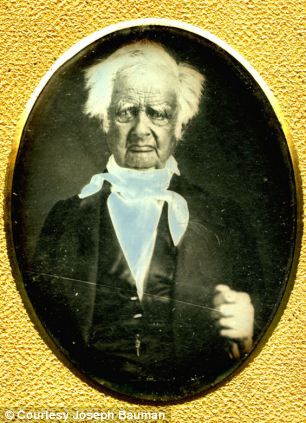
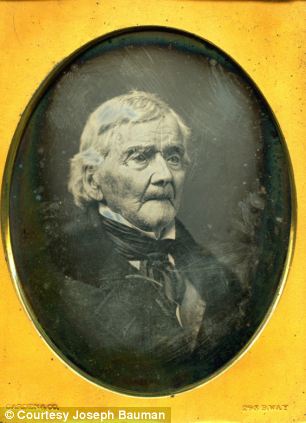
To look into the eyes of such men is to compress time, to reach back before the age of photography, and look into eyes that saw the birth of a nation.

FOTR, Dr Eneas Munson
Dr Eneas Munson

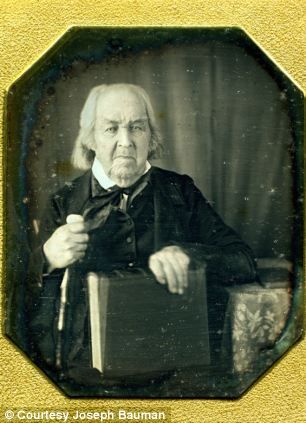
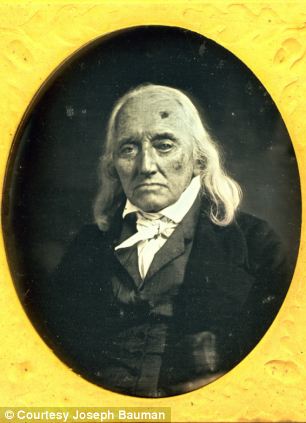
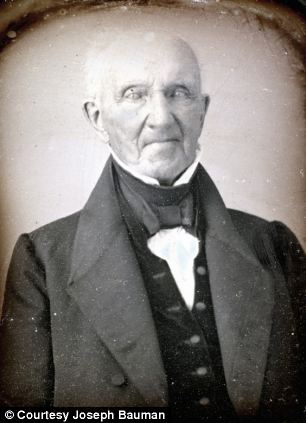
Imagine seeing the faces of the men who fought the American Revolution.  Not the paintings, there’s nothing extraordinary about that, except for the talent of the artist.  I mean their photographs – images that make it possible for you to look into their eyes.

In a letter dated May 17, 1781 and addressed to Alexander Scammell, General George Washington outlined his intention to form a light infantry unit, under Scammell’s leadership.

Comprised of Continental Line units from Connecticut, Massachusetts and New Hampshire, Milford, Massachusetts-born Colonel’s unit was among the defensive forces which kept Sir Henry Clinton penned up in New York City, as much of the Continental army made its way south, toward a place called Yorktown.

FOTR, Rev Levi Hayes
Reverend Levi Hayes was a fifer with a Connecticut regiment

Among the men under Scammell’s command was Henry Dearborn, future Secretary of War, under President Thomas Jefferson. A teenage medic was also present.  His name was Eneas Munson.

One day, the medic would go on to become Doctor Eneas Munson, professor of the Yale Medical School in New Haven Connecticut,  President of the Medical Society of that same state.  And a man who would live well into the age of photography.

The American Revolution ended in 1783.  By the first full year of the Civil War, only 12 Revolutionary War veterans remained on the pension rolls of a grateful nation.

Two years later, Reverend EB Hillard brought two photographers through New York and New England to visit, and to photograph what were believed to be the last six.  Each was 100 years or older at the time of the interview.

FOTR, Peter Mackintosh
Peter Mackintosh was apprenticed to a Boston blacksmith, the night of the Boston Tea Party

William Hutchings of York County Maine, (still part of Massachusetts at the time) was captured at the siege of Castine, at the age of fifteen.  British authorities said it was a shame to hold one so young a prisoner, and he was released.

Reverend Daniel Waldo of Syracuse, New York fought under General Israel Putnam, becoming a POW at Horse Neck.

Adam Link of Maryland enlisted at 16 in the frontier service.

Alexander Millener of Quebec was a drummer boy in George Washington’s Life Guard.

Clarendon, New York native Lemuel Cook would live to be one of the oldest surviving veterans of the Revolution, surviving to the age of 107.  He and Alexander Millener witnessed the British surrender, at Yorktown.

FOTR, Jonathan Smith
Jonathan Smith Fought in the Battle of Long Island on August 29, 1778

Samuel Downing from Newburyport, Massachusetts, enlisted at the age of 16 and served in the Mohawk Valley under General Benedict Arnold.  “Arnold was our fighting general”, he’d say, “and a bloody fellow he was. He didn’t care for nothing, he’d ride right in. It was ‘Come on, boys!’ ’twasn’t ‘Go, boys!’ He was as brave a man as ever lived…He was a stern looking man, but kind to his soldiers. They didn’t treat him right: he ought to have had Burgoyne’s sword. But he ought to have been true. We had true men then, twasn’t as it is now”.

Hillard seems to have missed Daniel F. Bakeman, but with good reason.  Bakeman had been unable to prove his service with his New York regiment.  It wasn’t until 1867 that he finally received his veteran’s pension by special act of Congress.

FOTR, James Head
James Head was only thirteen when he joined the Continental Navy. Head was taken prisoner but later released in Providence, and walked 224 miles home to Warren, Maine.

Daniel Frederick Bakeman would become the Frank Buckles of his generation, the last surviving veteran of the Revolution. The 1874 Commissioner of Pensions report said that “With the death of Daniel Bakeman…April 5, 1869, the last of the pensioned soldiers of the Revolution passed away.  He was 109.

Most historians agree on 1839 as the year in which the earliest daguerreotypes became a practical possibility.

When Utah based investigative reporter Joe Bauman came across Hillard’s photos in 1976, he believed that there must be others.  Photography had been in existence for 35 years by Reverend Hillard’s time.  What followed was 30 years’ work, first finding and identifying photographs of the right vintage, and then digging through muster rolls, pension files, genealogical records and a score of other source documents, to see if each had been involved in the Revolution.

FOTR, George Fishley
George Fishley served in the Continental army, and served in the Battle of Monmouth

There were some, but it turned out to be a small group.  Peter Mackintosh, for one, was a 16-year-old blacksmith’s apprentice, from Boston.  He was working the night of December 16, 1773, when a group of men ran into the shop scooping up ashes from the hearth and rubbing them on their faces.  It turns out they were going to a Tea Party.

James Head was a thirteen year-old Continental Naval recruit from a remote part of what was then Massachusetts.  Head would be taken prisoner but later released, walking the 224 miles from Providence to his home in what would one day be Warren, Maine.

Head was elected a Massachusetts delegate to the convention called in Boston, to ratify the Constitution.   He would die the wealthiest man in Warren, stone deaf from his service in the Continental Navy.

FOTR, Simeon Hicks
Rehoboth, Massachusetts “Minuteman” Simeon Hicks mobilized after the battles of Lexington and Concord, and help to seal off the British garrison in Boston.

George Fishley served in the Continental army and fought in the Battle of Monmouth, and in General John Sullivan’s campaign against British-allied Indians in New York and Pennsylvania.

Fishley would spend the rest of his days in Portsmouth New Hampshire, where he was known as ‘the last of our cocked hats.”

Daniel Spencer fought with the 2nd Continental Light Dragoons, an elite 120-man unit also known as Sheldon’s Horse after Colonel Elisha Sheldon.  First mustered at Wethersfield, Connecticut, the regiment consisted of four troops from Connecticut, one troop each from Massachusetts and New Jersey, and two companies of light infantry. On August 13 1777, Sheldon’s horse put a unit of Loyalists to flight in the little-known Battle of the Flocky, the first cavalry charge in history, performed on American soil

FOTR, Daniel Spencer
Daniel Spencer fought with the 2nd Continental Light Dragoons, an elite unit of 120 also known as Sheldon’s horse and known for the first cavalry charge, ever carried out on American soil

Bauman’s research uncovered another eight in addition to Hillard’s record, including a shoemaker, two ministers, a tavern-keeper, a settler on the Ohio frontier, a blacksmith and the captain of a coastal vessel, in addition to Dr. Munson.

The experiences of these eight span the distance from the Boston Tea Party to the battles at Monmouth, Quaker Hill, Charleston and Bennington.  Their eyes saw the likes of George Washington, Alexander Hamilton & Henry Knox, the battles of the Revolution and the final surrender, at Yorktown.

Bauman collected the glass plate photos of eight and paper prints of another five, along with each man’s story, and published them in an ebook entitled “DON’T TREAD ON ME: Photographs and Life Stories of American Revolutionaries”.

To look into the eyes of such men is to compress time, to reach back before the age of photography, and look into eyes that saw the birth of a nation.


If you enjoyed this “Today in History”, please feel free to re-blog, “like” & share on social media, so that others may find and enjoy it as well. Please click the “follow” button on the right, to receive email updates on new articles.  Thank you for your interest, in the history we all share.


May 16, 1938 Buddy’s Eyes

Dorothy Eustis called Frank in February 1928 and asked if he was willing to come to Switzerland. “Mrs. Eustis, to get my independence back, I’d go to hell”.

Written references to seeing eye dogs date back to the Tudor era, when a bit of children’s doggerel began “A is for Archer…B is a Blind-man/Led by a dog.”

German researchers began working with Alsatians (German Shepherd Dogs) in the 1920s, to serve as guides for WWI veterans blinded by gas.  An American breeder living in Switzerland, Dorothy Harrison Eustis, wrote an article about the work in a 1927 issue of the Saturday Evening Post.  US Senator Thomas Schall from Minnesota, who was legally blind, was paired with a German service dog that same year.

Morris Frank of Nashville lost the use of an eye in childhood.  His vision was destroyed altogether in a boxing accident, at the age of 16.  Frank hired a boy to guide him around, but the young man was easily bored and sometimes wandered off, leaving Frank to fend for himself.

SeeingEyeDog_MorrisFrank_Buddy

Frank’s father saw Eustis’ article in 1927, and read it to him.  The twenty-year old was electrified.  Morris wrote to Eustis pleading with her to train a dog for himself. “Is what you say really true? If so, I want one of those dogs! And I am not alone. Thousands of blind like me abhor being dependent on others. Help me and I will help them. Train me and I will bring back my dog and show people here how a blind man can be absolutely on his own. We can then set up an instruction center in this country to give all those here who want it a chance at a new life.

Dorothy Eustis called Frank in February 1928 and asked if he was willing to come to Switzerland. “Mrs. Eustis, to get my independence back, I’d go to hell”. She accepted the challenge and trained two dogs, leaving it to Frank himself to decide which was more suitable. Morris came to Switzerland to work with the dogs, both female German Shepherds. He chose a dog named “Kiss” but, feeling that no 20-year-old man should have a dog named Kiss, he called her “Buddy”.

Seeing Eye Dog Statue
Morris Frank was a founder of the first guide-dog school in the United States. He was the first person to be partnered with a seeing eye dog and the co-founder of The Seeing Eye, a guide-dog school.

Man and dog stepped off the ship in 1928 to a throng of reporters. There were flash bulbs, shouted questions and the din of traffic and honking horns that can only be New York City, but Buddy never wavered. At the end of the day Eustis received a single word telegram: “Success”. Morris Frank was set on the path that became his life’s mission: to get Seeing Eye Dogs accepted all over the country.

On January 29, 1929, Frank and Eustis established the first American guide dog training school in Frank’s home town of Nashville:  “The Seeing Eye“.  Frank was true to his word, becoming a tireless advocate of public accessibility for the blind and their guide dogs. In 1928, Morris was routinely told that Buddy couldn’t ride with him in the passenger compartment. Seven years later, all railroads in the United States had adopted policies allowing guide dogs to remain with their owners while on board.

By 1956, every state in the Union had passed laws guaranteeing access to public spaces for blind people and their dogs.

Frank told a New York Times interviewer in 1936 that he had logged 50,000 miles with Buddy, by foot, train, subway, bus, and boat. He was constantly meeting with people, including two Presidents and over 300 ophthalmologists, demonstrating the life-changing qualities of a guide dog.

Buddy’s health was failing toward the end of her life, but the team had one more hurdle to cross. One more barrier to break. Frank wanted to fly in a commercial aircraft with his guide dog, and did so on this day in 1938, flying from Chicago to Newark. United Airlines was the first to adopt the policy, granting “all Seeing Eye dogs the privilege of riding with their masters in the cabins of any of our regularly scheduled planes.”

DAW_SeeingEyeDogs1

Morris Frank’s seeing eye dog was all business during the day but, to the end of her life, she loved to end her work day with a roll on the floor with her “Dad”.  Buddy died a week after that plane ride, but she had made her mark. There were 250 seeing eye dogs working across the country by this time, and their number was growing fast. Buddy’s replacement was also called Buddy, as was every seeing eye dog Frank ever owned, until he passed away in 1980.

SeeingeyeToday, The Seeing Eye operates a 330-acre complex in Morris Township, New Jersey, the oldest guide dog school still in operation, in the world.  The primary breeds used for such training are German Shepherds, Labs, Golden Retrievers, and Lab/Golden mixed breeds. Boxers are occasionally used, for individuals with allergies.

SeeingEyePuppies

Since 1929, Seeing Eye, Inc. has trained some 16,000 guide dogs, pairing them with blind and vision-impaired across the United States and Canada.  There are currently 1,720 such human/canine partnerships. The organization places an average of 260 guide dogs every year.    The non-profit is primarily funded through private donations, as new students pay only $150, and returning students pay $50.  Military veterans are charged a single dollar.


If you enjoyed this “Today in History”, please feel free to re-blog, “like” & share on social media, so that others may find and enjoy it as well. Please click the “follow” button on the right, to receive email updates on new articles.  Thank you for your interest, in the history we all share.

May 15, 1718 Rapid Fire

The lightly armed merchant vessel of the 18th century was ill equipped to oppose the swarming attack of a hundred or more pirates.  Enter history’s first, machine gun.

A story comes to us from the Revolution, of a battle near Boonesborough, Kentucky. A British officer dared to poke his head out from behind a tree. A split-second later he was dead, a lead ball in his head. It was a near-miraculous shot for the day, nearly 250-yards distant from the shooter. The man with the rifle was Daniel Boone.  The weapon was his famous Kentucky long rife.

It was a good thing that the man could shoot that weapon, because it took about a minute to load, aim and fire.  The smooth-bore weapons of the age were a little quicker. A skilled shooter could could get off 3 rounds per minute, but aimed fire was all but impossible at any kind of distance.

Kentucky Rifle Vignette_6-10-13
Kentucky Long Rifle

Military tactics on land evolved toward massed firepower.  When large groups of men fired at one another, something was going to get hit.  Defending yourself at sea, was another matter.

Long before the revolt in Great Britain’s American colony, European navies abandoned oar-powered vessels in favor of sailing ships carrying tons of powerful cannon.  Not so the corsairs of the North African coast.

d6170-4
Ottoman privateer Murat Reis, the Elder


The “Barbary pirates” of the Ottoman provinces of Algeria, Tunisia & Tripolitania and the independent sultanate of Morocco favored small, fast galleys, powered by combinations of sail and oar and carrying a hundred or more fighting men armed with flintlock, axe and cutlass.

Barbary navies never formed battle fleets, and would flee at the sight of European frigates.  These people were looking for lightly armed merchantmen.  They came to take hostages for the Arab slave markets.

The Arab slave trade was never racialized in the way of trans-Atlantic, chattel slavery.  Black Africans and white Europeans alike, were fair game.  Some historians assert that as many as 17 million entered the Arab slave markets, from Western Asia, North Africa, the Horn of Africa, Southeast Africa and Europe.

It was the enslaved mercenary armies of the Ayyubid dynasty of Egypt and Syria, the Mamālīk (singular Mamlūk), who expelled the last Christian armies from the Levant in 1302, ending the era of the Crusades. For five-hundred years, elite slave armies called “Janissaries” formed the bulwark of Ottoman power from southeastern Europe to western Asia and north Africa.

Ohio State University history Professor Robert Davis estimates that Barbary corsairs captured as many as 1 – 1¼ million Europeans between the 16th and 19th centuries alone, kidnapped from seaside villages along the Mediterranean coast, England, and as far away as the Netherlands, Ireland and Iceland. Some 700 Americans were held in conditions of slavery in North Africa, between the period of the American Revolution and the War of 1812.

The lightly armed merchant vessel of the 18th century was ill equipped to oppose the swarming attack of a hundred or more pirates.  Enter history’s first machine gun.

PuckleGun
The “Puckle Gun”, patented this day in 1718

James Puckle (1667–1724) was a British inventor, barrister and author. The Puckle Gun, also called the “defence gun”, was a tripod-mounted, single-barreled flintlock fitted with a revolving cylinder.  At a time when a trained shooter could load and fire no more than three times per minute, James Puckle’s weapon was capable of  nine.

The Puckle gun was intended for naval use, to prevent the boarding of ships at sea.  There were two variations, the first intended for use against Christian adversaries.  This one fired round balls. The second version was considered to be the more lethal of the two and fired square bullets, intended for use against Muslim Turks. According to the patent, square bullets would persuade the Turks of the “benefits of Christian civilization”. The weapon could also fire shot, with each discharge containing up to sixteen musket balls.

Among investors, there was little interest in the Puckle Gun, and the weapon never gained wide acceptance. Before the era of mass production,  gunsmiths had trouble reliably producing its small, complicated parts. One newspaper quipped that the gun “only wounded those who hold shares therein”.

In time, humankind would become much more adept at killing itself. Dr. Richard Gatling invented his multi-barrel, crank fired “Gatling Gun” in 1861, writing that his creation would reduce the size of armies and so reduce the number of deaths by combat and disease. With a rate of fire of up to 900 rounds per minute in the .30 caliber model, Gatling’s gun was popular from the Great Railroad Strike of 1877 to the Anglo-Zulu war of two years later, and the “Rough Riders” assault up San Juan Hill.

American-British inventor Hiram Maxim invented the first true “machine gun” in 1884, by harnessing  the weapon’s recoil.  The Hiram gun was a favorite of colonial wars from 1886–1914, and variants entered the trenches of WW1.

It would take about a hot minute with the search engine of your choice, to realize that the practice of Muslim slavery, primarily (though not exclusively) at the expense of black Africans, continues to this day.

May 14, 1856 Red Ghost

The stories became more fantastic and more terrifying with each telling.  One man claimed that he personally saw the beast kill and eat a grizzly. Another claimed that he had chased the “Red Ghost”, only to have it vanish before his eyes.

Long before he became President of the Confederate States of America, Jefferson Davis was a young Army Officer.  At one time, Davis was approached with the idea of using camels as pack animals. To Davis, the idea made sense.  The beast’s ability to survive in the desert, its massive strength and great stamina, made him wonder if this wasn’t the weapon of the future.

Twenty years later, then-US Secretary of War Jefferson Davis ordered the creation of the 1st United States Camel Corps. Major Henry Wayne was sent to Turkey to acquire 62 of the animals, along with trainers who could teach American soldiers how to properly handle and care for them.

Camel_from_Harpers_WeeklyThe camels arrived on May 14, 1856, and set out for the newly established Camp Verde in West Texas, with elements of the US Cavalry and seven handlers.

Major Wayne became an enthusiastic salesman for the camel program, putting on demonstrations for cavalry groups. He would order what seemed an impossible load to be placed on a kneeling camel, and then step back and frown, “concerned” that he might have overdone it. Mule drivers would smile and jab each other with their elbows – now he’s done it – then he would step forward and pile on more weight. On command, the camel would stand up and stroll away, completely unconcerned.

One of the handlers, a Syrian named Hadji Ali, (“Hi Jolly” to the soldiers), established a successful breeding program while stationed at Camp Verde.  The program was not without problems. Camels don’t play well with other pack animals, and they don’t accept the whips and prods used to handle horses and mules. They tend to retaliate. A camel will spit or rake your face with its teeth if given the chance, and they can turn and charge in a manner that’s terrifying.

Camp Verde had about 60 camels when Civil War broke out in 1861. The King of Siam seems to have been the only one who grasped the military advantage to the Confederacy.  Seeing a business opportunity, the King wrote to President Abraham Lincoln, saying “here, we use elephants”. It seems that Lincoln never responded to the King’s overture, and the animal arms race got no further than this single letter. It makes the imagination run wild, though, at the idea of War Elephants at Gettysburg.

United-States-Camel-Corps
The only known surviving photo of the U.S. Camel Corps shows a camel at Drum Barracks, San Pedro, CA. Library of Congress photo

Some of Camp Verde’s camels were sold off.  One poor brute was pushed over a cliff by frustrated cavalrymen. Most were simply turned loose to fend for themselves. The fates of these animals are mostly unknown, except for one who made his way to Mississippi in 1863, where he was taken into service with the 43rd Infantry Regiment. “Douglas the Confederate Camel” was a common sight throughout the siege of Vicksburg, until being shot and killed by a Union sharpshooter. Lieutenant Colonel Robert Bevier of the 5th Regiment, Missouri Confederate Infantry was furious, enlisting six of his best snipers to rain down hell on Douglas’ killer. Bevier later said of the Federal soldier “I refused to hear his name, and was rejoiced to learn that he had been severely wounded.”

Douglas, the Confederate Camel
Marker for “Douglas The Confederate Camel”. Cedar Hill Cemetery, Vicksburg, Mississippi

The Apache wars were drawing to a close in 1883, but southeastern Arizona could still be a dangerous place. Renegade bands of Apache were on the move, and isolated ranches were in a constant state of siege.

Two men rode out to check on their livestock one day, leaving their wives at the ranch with the kids. One of the women went down to the spring for a bucket of water while the other remained in the house with the children. Suddenly there was a terrifying scream, and the dogs began to bark. The woman inside saw what she described as a huge, reddish beast, being ridden by a devil.

hqdefault (3)

She barricaded herself inside the house and hysterically prayed while she waited for the men to return. They returned that night and found the body of the other woman by the stream. She’d been trampled almost flat, with huge, cloven hoof prints in the mud around her body and a few red hairs in the brush.

Gold prospectors awakened in the night a few days later, as their tent crashed down around them to the sound of thundering hoofs. They clawed their way out of the mess and saw a huge beast, much larger than a horse, run off into the moonlight. The next day, they too found red hairs in the brush.

The stories became more fantastic and more terrifying with each telling.  One man claimed that he personally saw the beast kill and eat a grizzly. Another claimed that he had chased the “Red Ghost”, only to have it vanish before his eyes.

camelmulesA few months later, a Salt River rancher named Cyrus Hamblin spotted the animal while rounding up cows. It was a camel, and Hamblin saw that it had something that looked like the skeleton of a man tied to its back. Nobody believed his story, but a group of prospectors fired on the animal several weeks later. Though their shots missed, they saw the animal bolt and run, and a human skull with some parts of flesh and hair still attached fell to the ground.

There were further incidents over the next year, mostly at prospector camps. A cowboy near Phoenix came upon the Red Ghost while eating grass in a corral. Cowboys seem to think they can rope anything with hair on it, and this guy was no exception. He lashed the rope onto the pommel of his saddle, and tossed it over the camel’s head. The angry beast turned and charged, knocking horse and rider to the ground. As the camel galloped off, the astonished cowboy could clearly see the skeletal remains of a man lashed to its back.

The beast last appeared nine years later in the garden of a rancher. He aimed his Winchester and fired, dropping the animal with one shot. On the back of the poor, tormented beast was the body of a man, tied down with heavy rawhide straps that cruelly scarred the animal’s flesh. The story of the Red Ghost ends here. How the body of a man came to be tied to its back remains a cruel mystery.

lw2161e
The tomb of Hadji Ali in Quartzite, Arizona. The inscription reads: THE LAST CAMP OF HI JOLLY BORN SOMEWHERE IN SYRIA ABOUT 1828 DIED AT QUARTZITE DECEMBER 16, 1902 CAME TO THIS COUNTRY FEBRUARY 10, 1856 CAMELDRIVER – PACKER SCOUT – OVER THIRTY YEARS A FAITHFUL AID TO THE U.S. GOVERNMENT ARIZONA HIGHWAY DEPARTMENT 1935
If you enjoyed this “Today in History”, please feel free to re-blog, “like” & share on social media, so that others may find and enjoy it as well. Please click the “follow” button on the right, to receive email updates on new articles.  Thank you for your interest, in the history we all share.


May 13, 1864 A House on the Hill

The unsurprising and probably intended result was massively increased forfeiture auctions of real property, and General Lee’s home was no exception.

Shortly after the outbreak of Civil War in 1861, Robert E. and Mary Custis Lee were forced to evacuate their home overlooking the Potomac.  “Arlington House”, as they called it, was soon occupied by Federal troops.

As the financial costs of the Civil War mounted, the United States Congress passed a special property tax on “insurrectionary” districts, in order to pay for it. A subsequent amendment required in-person payment of the tax, though clearly, no southern property owner was going to show up in the Union capital to pay the tax.

Arlington-House6
Arlington House

The unsurprising and probably intended result was massively increased forfeiture auctions of real property, and General Lee’s home was no exception. Mary, who had by this time fled to Fairfax Virginia, was confined to a wheelchair, the victim of rheumatoid arthritis. A Lee cousin was sent with the payment, amounting to $92.07, but tax collectors refused the money.  The government auctioned off the property and sold it, to itself, for the sum of $26,800.  Somewhat below the currently assessed value of $34,100.

With Washington, D.C. running out of burial space, Quartermaster General Montgomery Meigs proposed that the Lee property be used as a military cemetery.  To ensure that the house would never again be inhabited by the Lee family, Meigs directed that graves to be placed as close to the mansion as possible.

dsc00153

The first three military graves at Arlington were dug on May 13, 1864, by James Parks, a former slave who had been freed by his owner and stayed on as a grave digger. 65 years later, “Uncle Jim” would receive special dispensation to be buried there, becoming the first and only person to be buried at Arlington who was also born there.

james-parks-photo-01In 1866, the Quartermaster ordered the remains of 2,111 unknown Civil War dead to be exhumed and placed inside a vault in the Lees’ rose garden.

General Lee seems to have resigned himself to the loss of the property, writing to Mary early in the war that “It is better to make up our minds to a general loss. They cannot take away the remembrance of the spot, and the memories of those that to us rendered it sacred. That will remain to us as long as life will last, and that we can preserve“. He never returned, and never attempted to restore title after the war. Mary visited once, but left without entering the house, so upset was she at what had been done to the place.

After their passing, the Lee’s eldest son George Washington Custis Lee sued for payment for the estate, claiming the seizure to have been illegal. A jury sided with Lee and the United States Supreme Court agreed, in a 5-4 decision handed down in 1882. Arlington House once again belonged to the Lee family, and the Federal government faced the daunting task of disinterring 17,000 graves.

Lengthy negotiations with the heirs resulted in the Lee family selling the home for $150,000, equivalent to $3,221,364 today.  The new title was officially recorded on May 14, 1883. Arlington National Cemetery would remain for all time, our nation’s most hallowed ground.

If you enjoyed this “Today in History”, please feel free to re-blog, “like” & share on social media, so that others may find and enjoy it as well. Please click the “follow” button on the right, to receive email updates on new articles.  Thank you for your interest, in the history we all share.

May 12, 1975  The Mayaguez Incident

For a century, French colonial rulers had looted the mineral wealth of Cambodia, leaving a countryside riddled with mines.  After four years of Communist rule, those mines were filled with bones.

Between AD790 and 1431, the Khmere Empire founded by Prince Jayavarman II occupied much of what today includes Cambodia, Thailand, Laos, and southern Vietnam.  Now extinct, this powerful civilization was in its day, home to the largest city in the world.

Until recently overrun by Jungle, the capital city of Angkor, whose original name was Yashodharapura (“Glory-bearing city”), was nearly the size of modern day Los Angeles, and home to a million people.  Even today, the Hindu temple complex of Angkor Wat, built circa 1122, remains the largest religious monument in the world.

Angkor-Wat1
Temple complex at Angkor Wat

During the 1950s, a group of some 200 middle-class Cambodian kids were educated at French Universities.  The greater part of them formed a student group of Marxist-Leninist intellectuals, dreaming of an agrarian utopia on the Indo-Chinese peninsula.

1024px-Flag_of_Democratic_Kampuchea.svg
Flag of Democratic Kampuchea

What began as a small leftist insurgency in Cambodia, grew in power thanks to support from Communist China and North Vietnam.  From only a few hundred individuals in 1960, these “Red Khmeres” (Khmere Rouge) grew into an effective insurgency against the Khmere Republic government of Norodom Sihanouk and Lon Nol.

By early 1975, the Khmere Rouge had overwhelmed Khmer National Armed Forces.  The Khmere Rouge captured the Cambodian capital of Phnom Penh on April 17, 1975, overthrowing the government and executing its officers.

3e54356b7ac5930c35671ae3cc70223d
Pol Pot

Unlike the cult of personality grown up around the Kim family of North Korea or that of the Stalinist USSR or Maoist China, the Communist Party of (the newly re-christened) “Kampuchea” (CPK) was led by a secretive, eight-member group of those same leftist intellectuals from the Paris student days, calling itself the the “Angkar”, (pronounced ahng-kah, translating as ‘The Organization’).

The Khmere Rouge and the Angkar, led by Communist General Secretary Saloth Sar (better known as ‘Pol Pot’), set to work creating an agrarian peasant’s utopia by exterminating political opponents in “Democratic Kampuchea”, including monks, teachers and business owners.  Anyone possessing so much as a whiff of an education, a pair of eyeglasses even, was deemed an “enemy of the people” and clubbed to death on the spot.

For a century, French colonial rulers had looted the mineral wealth of Cambodia, leaving a countryside riddled with mines.  After four years of Communist rule, those mines were filled with bones.

p1140644At the height of its depravity, the Khmere Rouge smashed the heads of infants and children against Chankiri (Killing) Trees so that they “wouldn’t grow up and take revenge for their parents’ deaths”. Soldiers laughed as they carried out these grim executions.  Failure to do so would have shown sympathy, making the killer him/herself, a target.

212

As the war in neighboring Vietnam drew a close, the “Killing Fields” of Cambodia remained part of an unknown and terrible future.   Representatives of the United States, North & South Vietnam, and the Vietcong signed the Paris Peace Treaty in January, 1973. The last Americans airlifted out of Saigon on April 30, 1975 as the capital fell to Communist forces.

9820114_origOn May 12, the American flagged container ship SS Mayaguez passed the coast of Cambodia bound for Sattahip, in southwest Thailand.  At 2:18pm, two fast patrol craft of the Khmere Rouge approached the vessel, firing machine guns and then rocket-propelled grenades across its bows.

Captain Charles Miller ordered Mayaguez to a stop, but not before broadcasting SOS and Mayday messages.   39 Americans were now hostages of the Khmere Rouge.  Some of the most savage killers, of the 20th century.

time - mayaguezThe cargo vessel was being towed to Kompong Som on the Cambodian mainland, as word of the incident reached the White House.  A government made to look weak and indecisive by what President Ford himself called the “humiliating withdrawal” of only days earlier, could ill afford another drawn-out hostage drama, similar to that of the USS Pueblo.  Massive force would be brought to bear against the Khmere Rouge, and time was of the essence.

Two destroyers and an aircraft carrier were ordered to proceed at full speed to the Gulf of Thailand, along with a contingent of Air Force fighters, bombers, and helicopters. A Navy P-3 Orion surveillance aircraft located Mayaguez anchored off Kho-Tang Island, 40 miles from the Cambodian mainland.

At least some of the Mayaguez crew were (mistakenly)  believed to be held on the island. Air force units air lifted a battalion-sized Marine rescue team to rescue the crew.  Meanwhile, the destroyer USS Holt was ordered to seize the Mayaguez, as the aircraft carrier Coral Sea launched bombing strikes against military targets in Cambodia.

usmckohtangExpecting only light resistance, US forces were met with savage force on May 15, from a heavily armed contingent of some 150-200 Khmere Rouge. Three of the nine helicopters participating in the operation were shot down, and another four too heavily heavily damaged to continue

US bombing raids accomplished their purpose on the Cambodian mainland. A fishing boat soon approached the destroyer USS Wilson under flag of truce.  Onboard were the 39 crewmen of the Mayaguez.

The situation was different on Kho-Tang Island. US forces were ordered to withdraw, as Khmere Rouge commanders pressed the attack. Air Force helicopter crews and Marine riflemen moved through heavy fire throughout the 15th, their defensive perimeter becoming smaller with the departure of every over-loaded chopper.

mayagtowThe cost of the Mayaguez Incident, officially the last battle of the Vietnam war, was heavy.  Eighteen Marines, Airmen and Navy corpsmen were killed or missing in the assault and evacuation of Kho-Tang Island.  Another twenty-three were killed in a helicopter crash.  The last of 230 Marines would not get out until well after dark.

No United States Marine would leave one of their own behind, either dead or alive. Not intentionally, but such discipline was impossible in the chaos of that night.  LCpl Joseph Hargrove, Pfc Gary Hall and Pvt Danny Marshall formed a machine gun team, guarding the right flank of the evacuation as darkness fell.

The team was last seen by Sgt. Carl Anderson Jr.. Later reports described the three as being out of ammunition and “scared”.  Anderson ordered the three to evacuate and they were preparing to do so, when last seen. Navy SEALs and Marines asked permission to go back and attempt a rescue, but permission was denied.

The government in Washington, touted the operation as a victory.

image (3)
From left, Lance Cpl. Joseph Hargrove, Pfc. Gary Hall and Pvt. Danny Marshall H/T Stars and Stripes, for this image

Joseph Nelson Hargrove turned twenty-four, the day he was last seen on that beach. In 2012, Khmere Rouge commander Em Son told Stars & Stripes that Hargrove was captured a week later, trying to steal food. He was shot and killed the following day, while attempting to escape. Gary Hall and Danny Marshall were captured a short time later, brought to the mainland and beaten to death by the Khmere Rouge.  Both were 18.

In 2011, Khmer Rouge platoon commander Mao Run claimed to have killed a US service man with a grenade, several days after the battle. Alone and exhausted, this may have been a fourth man left behind alive. The name of this man and the details of his final days, remain uncertain.

The last official battle of the War in Vietnam, etched the last 41 names on the Vietnam Veterans Memorial wall in Washington.

This is a long clip – about 28 minutes – but well worth watching.

If you enjoyed this “Today in History”, please feel free to re-blog, “like” & share on social media, so that others may find and enjoy it as well. Please click the “follow” button on the right, to receive email updates on new articles.  Thank you for your interest, in the history we all share.