November 10, 1775 Always Faithful

Historians differ on the location of the first recruiting station. Some will tell you that it was the “Conestoga Waggon” tavern in Philadelphia. Tradition holds it to have been the “Tun Tavern”, a name coming from the Olde English “Tun”, meaning a barrel or a keg of beer.

The Navy had been in existence for less than a month and the Battles of Lexington and Concord a mere seven months in the past, when the Continental Marines were formed by an act of the 2nd Continental Congress, convened on November 10, 1775.

“Resolved, That two Battalions of Marines be raised, consisting of one Colonel, two Lieutenant Colonels, two Majors, and other officers as usual in other regiments; and that they consist of an equal number of privates with other battalions; that particular care be taken, that no persons be appointed to office, or inlisted into said Battalion, but such are good seamen, or so acquainted with maritime affairs as to be able to serve to advantage by sea when required: that they be inlisted and commissioned to serve for and during the present war between Great Britain and the colonies, unless dismissed by order of Congress: that they be distinguished by the names of the first and second battalion of American Marines, and that they be considered as part of the number which the continental Army before Boston is ordered to consist of.”

First Recruits
“The First Recruits” by Col Charles Waterhouse, USMCR (Ret)

Historians differ on the location of the first recruiting station. Some will tell you that it was the “Conestoga Waggon” tavern in Philadelphia. Tradition holds it to have been the “Tun Tavern”, a name coming from the Olde English “Tun”, meaning a barrel or a keg of beer.

Continental Marines served a number of important functions during the Revolution, including ship-board security, amphibious assault and ship-to-ship combat. Then as now, Marines were riflemen first. During naval engagements they could be found in the masts and rigging, their sharpshooters’ skills taking out opposing helmsmen, gunners and ship’s officers.

No less a figure than Admiral David G. Farragut wrote in 1862, “A ship without Marines is like a garment without buttons.”

The first Marine landing on a hostile shore took place in March 1776, when a Marine force under the former Quaker, Captain Samuel Nicholas, captured New Province Island in the Bahamas. Nicholas was the first commissioned officer in the Continental Marines, and is now remembered as the first commandant of the Marine Corps.

The Continental Congress disbanded the Marines in 1783, following their help in winning American independence. Increasing conflict and the coming “quasi-war” with revolutionary France would soon bring them back.

images (12)President John Adams signed a bill establishing the United States Marine Corps as a permanent military force under Navy jurisdiction on July 11, 1798.

The most famous action of the early period occurred during the Tripolitan War of 1801–’05, against the Barbary states of Tripoli, Algiers, Tunis, and the independent Sultanate of Morocco. US Army Lieutenant William Eaton and United States Marine Corps 1st Lieutenant Presley O’Bannon led eight Marines and 500 mercenaries on a 600-mile forced march through the desert, against a much larger force defending the city of Derna, in Libya. Ottoman viceroy Prince Hamet awarded a Mameluke sword to O’Bannon on December 8, 1805, in a gesture of respect for the Marines’ conduct. That curved, cross-hilted scimitar became the model for swords worn by Marine officers to this day, the victory at Derna memorialized in a line from the Marine Corps Hymn “From the halls of Montezuma, to the shores of Tripoli”.

ChestySince then, the Marine Corps has participated in virtually every conflict ever fought by the United States. They’re usually the first ones in. To date, United States Marines have executed over 300 landings on foreign shores.

The USMC has 182,000 active duty members as of 2016, with 38,500 in reserve. They are separated into three divisions, headquartered at Camp Lejeune, North Carolina, Camp Pendleton in California; and Okinawa, Japan. Each division maintains one or more expeditionary units, prepared for major operations anywhere in the world on two weeks’ notice.

The original Tun Tavern burned down in 1781, shortly before the end of the Revolution. Today, the site is part of Interstate 95, where it passes Penn’s landing. You can still visit the Tun Tavern styled restaurant at the National Marine Corps Museum in Quantico, where a beer and a bread pudding is always part of the lunch menu.

Happy 241st birthday, United States Marine Corps. Thank you.

Semper Fidelis.

0811061-M-3189M-001
Camp Lejeune celebrated the 233rd Marine Corps birthday with its annual Joint Daytime Ceremony at Liversedge Field, Friday. Pageant Marines wore period uniforms representing major conflicts. Attendees were reminded that throughout history, Marines continue to distinguish themselves on battlefields and foreign shores, in both war and peace.

November 9, 2013 In the Company of Heroes

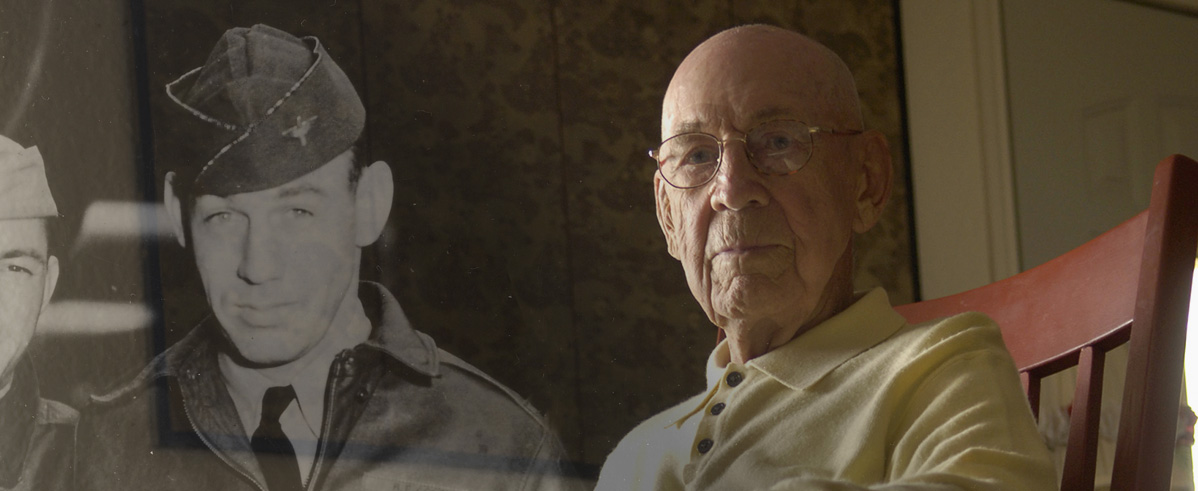
On April 18, 2015, Richard Cole and David Thatcher fulfilled their original bargain, as the last two surviving members of the Doolittle raid.  Staff Sergeant Thatcher passed in June of last year, at the age of 94.  As I write this, Lieutenant Colonel Richard Cole age 102, Jimmy Doolittle’s co-pilot, is the only man in the world who has earned the right to open that bottle.

On November 9, 2013, there occurred a gathering of four, a tribute to fallen heroes. These four are themselves heroes, and worthy of tribute. It was to be their last such gathering.

This story begins on April 18, 1942, when a flight of 16 Mitchell B25 medium bombers took off from the deck of the carrier USS Hornet.   It was a retaliatory raid on Japan, planned and led by Lieutenant Colonel James “Jimmy” Doolittle of the U.S. Army Air Forces.  It was payback for the sneak attack on Pearl Harbor, seven months earlier.  A demonstration that the Japanese home islands were not immune from attack.

doolittle-raid

Launching such large aircraft from the decks of a carrier had never been attempted, and there were no means of bringing them back. This was to be a one-way mission, into enemy occupied territory.

Fearing a breach in operational security, the mission was forced to launch 200 miles before the intended departure spot.  The range now made fighter escort impossible, and left the bombers themselves with the slimmest margin of error.

Japanese Premier Hideki Tojo was inspecting military bases at the time of the raid. One B-25 came so close that he could see the pilot, though the American bomber never fired a shot.

After dropping their bombs, all but one aircraft was able to continue west into Japanese occupied China. That one landed in Vladivostok, where the pilot and crew were interned for a year by our Soviet “allies”.

A quarter of a million Chinese were murdered by Japanese soldiers, as they hunted for Doolittle’s raiders. Eight of them were captured, three were executed and one died in captivity, but most of the 80 who began the mission survived the war.

There was little serious damage done to the Japanese home islands, but the raid had a decisive effect. Japan withdrew its powerful aircraft carrier force to protect the home islands. Admiral Isoroku Yamamoto attacked Midway, thinking it to have been the jump-off point for the raid. Described by military historian John Keegan as “the most stunning and decisive blow in the history of naval warfare”, the battle of Midway would be a major strategic defeat for Imperial Japan.

The Doolittle raiders have held a reunion every year, from the late 40’s, until 2013. In 1959, the city of Tucson presented them with 80 silver goblets, each engraved with the name of one of their number. They are on display at the National Museum of the Air Force, in Dayton Ohio.

Goblets

With those goblets is a fine bottle of vintage Cognac, 1896, the year Jimmy Doolittle was born. There’s been a bargain among the Doolittle raid survivors that, one day, the last two of their number would open that bottle, and toast their comrades.

In 2013 they changed their bargain, just a bit. Jimmy Doolittle himself passed away in 1993. Twenty years later, 76 goblets had been turned over, each signifying a man who had passed on. The last four were Lieutenant Colonel Richard E. Cole, co-pilot of crew No. 1; Lieutenant Colonel Robert L. Hite, co-pilot of crew No. 16; Lieutenant Colonel Edward J. Saylor, engineer-gunner of crew No. 15; and Staff Sergeant David J. Thatcher, engineer-gunner of crew No. 7. These four agreed that they would gather one last time. It would be they who would finally open that bottle.

Doolittle_70th

Robert Hite, 93, was too frail to travel, so his son stood in for him.  So it was that a 117 year-old bottle of cognac was cracked open on this date in 2013, and enjoyed in the company of heroes. If there is a more magnificent act of tribute, I cannot at this moment think of what it might be.

On April 18, 2015, Richard Cole and David Thatcher fulfilled their original bargain, as the last two surviving members of the Doolittle raid.  Staff Sergeant Thatcher passed in June of last year, at the age of 94.  As I write this, Lieutenant Colonel Richard Cole age 102, Jimmy Doolittle’s co-pilot, is the only man in the world who has earned the right to open that bottle.

November 8, 1965 Operation Hump

Outnumbered in some places six to one, it was a desperate fight for survival as parts of B and C companies were isolated in the shoulder to shoulder, hand to hand battle.

Operation hump, 3Fifty-two years ago today, the 173rd Airborne Brigade was halfway through its year of service in Vietnam.  “Operation Hump”, so named in recognition of that mid-point, was a search and destroy mission inserted by helicopter on November 5.

Vietcong fighters had taken up positions on several key hills near Bien Hoa, with the objective of driving them out.

Operation hump, 2There had been little contact through the evening of the 7th, when B and C Companies of the 1/503rd took up a night defensive position in the triple canopied jungle near Hill 65.
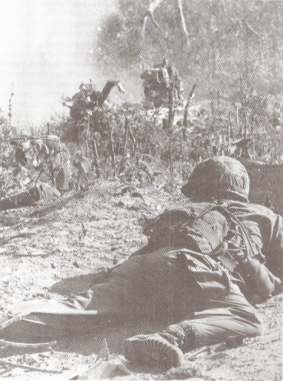
On the morning of the 8th, the Brigade found itself locked in combat with an entire main line Vietcong Regiment, pouring out of their trenches and onto the Americans’ position.

The VC were well aware of the Americans’ superior artillery and air cover capabilities.  Their strategy was to get in so close that it nullified the advantage.  “Grab Their Belts to Fight Them”, they would say.

Operation hump, 4Outnumbered in some places six to one, it was a desperate fight for survival as parts of B and C companies were isolated in shoulder to shoulder, hand to hand fighting.
Shot through the right thigh and calf with his medical supplies depleted, Army Medic Lawrence Joel hobbled about the battlefield on a makeshift crutch, tending to the wounded.  Though wounded himself, Specialist 4 Randy Eickhoff ran ahead, providing covering fire. Eickhoff was later awarded the Silver Star and Purple Heart for his actions.

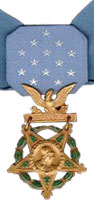
Specialist 5 Joel received the Medal of Honor.  Let his citation, tell his part of the story:

Cmoh_armyFor conspicuous gallantry and intrepidity at the risk of life above and beyond the call of duty. Specialist 5 Joel demonstrated indomitable courage, determination, and professional skill when a numerically superior and well-concealed Viet Cong element launched a vicious attack which wounded or killed nearly every man in the lead squad of the company. After treating the men wounded by the initial burst of gunfire, he bravely moved forward to assist others who were wounded while proceeding to their objective. While moving from man to man, he was struck in the right leg by machine gun fire. Although painfully wounded his desire to aid his fellow soldiers transcended all personal feeling. He bandaged his own wound and self-administered morphine to deaden the pain enabling him to continue his dangerous undertaking. Through this period of time, he constantly shouted words of encouragement to all around him. Then, completely ignoring the warnings of others, and his pain, he continued his search for wounded, exposing himself to hostile fire; and, as bullets dug up the dirt around him, he held plasma bottles high while kneeling completely engrossed in his life saving mission. Then, after being struck a second time and with a bullet lodged in his thigh, he dragged himself over the battlefield and succeeded in treating 13 more men before his medical supplies ran out. Displaying resourcefulness, he saved the life of one man by placing a plastic bag over a severe chest wound to congeal the blood. As 1 of the platoons pursued the Viet Cong, an insurgent force in concealed positions opened fire on the platoon and wounded many more soldiers. With a new stock of medical supplies, Specialist 5 Joel again shouted words of encouragement as he crawled through an intense hail of gunfire to the wounded men. After the 24 hour battle subsided and the Viet Cong dead numbered 410, snipers continued to harass the company. Throughout the long battle, Specialist 5 Joel never lost sight of his mission as a medical aid man and continued to comfort and treat the wounded until his own evacuation was ordered. His meticulous attention to duty saved a large number of Operation hump, 1lives and his unselfish, daring example under most adverse conditions was an inspiration to all. Specialist 5. Joel’s profound concern for his fellow soldiers, at the risk of his life above and beyond the call of duty are in the highest traditions of the U.S. Army and reflect great credit upon himself and the Armed Forces of his country“.

48 Americans lost their lives in the battle, with many more wounded.  Two Australian paratroopers were recorded as MIA.  Their remains were discovered years later, and repatriated in 2007.

The country music duo Big and Rich did a song in tribute to that day.  It’s called the 8th of November.

November 7, 1940 Galloping Gertie

The men who built the Tacoma Narrows Bridge used to suck lemons on the job site, to keep from becoming seasick. It was probably one of these “boomers” who first noticed how the bridge rippled in the wind. Someone  called it “Galloping Gertie”, and the name stuck.

The name “Galloping Gertie” was first used to describe a 900′ bridge over the Ohio River in Wheeling, West Virginia. Built in 1849, it was the longest suspension bridge in the world at the time, until collapsing in a windstorm in May, 1854.

Ninety years later, the 5,939′ bridge over Puget Sound earned the same name.

The Tacoma Narrows Bridge had been designed by one of the most respected bridge engineers of its time. Federal and state experts all approved the plans, when construction began in 1937. When finished, it was the third longest suspension bridge in the world.

historical11

The deck’s vertical wave motions, or “bounce”, were noted as early as May 1940, as workmen finished the bridge’s floor system. As with the 790’ John Hancock Tower in Boston, the bridge would literally twist in the wind. The solution was similar in both cases.  Engineers installed hydraulic buffers, pistons called “Tuned Mass Dampers,” to act as shock absorbers. The tactic worked for the John Hancock building, which, mercifully, no longer ejects 4’x11’, 500lb glass panels onto the street below.

The tactic made little to no improvement on the bridge.

historical16The men who built it used to suck lemons on the job site, to keep from becoming seasick. It was probably one of these “boomers” who first noticed how the bridge rippled in the wind. Someone  called it “Galloping Gertie”, and the name stuck.

Carol Peacock, a student at nearby Fife High School, sat down to do her homework on the evening of November 6, 1940. She was taking a journalism class.  Her assignment was to write an essay beginning with, “Just suppose . . .” She called her essay, “Tacoma Narrows Bridge Collapses.” Nostradamus could not have called it better. The bridge came down the next day.

Leonard Coatsworth, a Tacoma News Tribune editor, entered the span some time before 11:00am on November 7, the last person to drive onto the bridge. “Just as I drove past the towers”, he said, “the bridge began to sway violently from side to side. Before I realized it, the tilt became so violent that I lost control of the car…I jammed on the brakes and got out, only to be thrown onto my face against the curb…Around me I could hear concrete cracking…The car itself began to slide from side to side of the roadway. On hands and knees most of the time, I crawled 500 yards or more to the towers…Toward the last, I risked rising to my feet and running a few yards at a time…Safely back at the toll plaza, I saw the bridge in its final collapse and saw my car plunge into the Narrows.”

collapse6The bridge was bucking so violently that at times, one sidewalk rose as high as 28’ above its opposite.
Frederick Bert Farquharson was a professor of civil engineering at the University of Washington. He’d been retained to help fix the bridge, and was on the span on the morning of the 7th. Professor Farquharson noticed “Tubby”, a black Cocker Spaniel, cowering in the back of Coatsworth’s abandoned car. He tried to rescue the terrified dog, but all he got was a bite on the hand. Driven by the desire to record the engineering science and delayed by the failed rescue attempt, Professor Farquharson was the last to leave the span. Tubby went down with the bridge, the only life lost in the incident.

The bridge remains at the bottom of Puget Sound to this day, one of the largest artificial reefs, in the world.

Photographer Howard Clifford and reporter Bert Brintnall covered the story for the Tacoma News Tribune. The pair had noticed a billboard ad that morning, for the Pacific National Bank. “As secure as the Narrows Bridge,” it read. They returned fewer than two hours after the collapse, wanting to photograph the billboard for their story. Workmen had already covered the sign with white paper.

Feature Image Credit:  By Barney Elliott; The Camera Shop – Screenshot taken from 16MM Kodachrome motion picture film by Barney Elliott., Fair use, https://en.wikipedia.org/w/index.php?curid=23093518

November 6, 1860 A Peculiar Institution

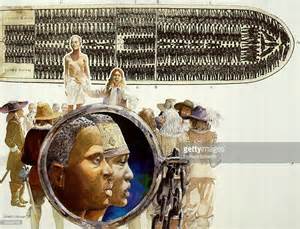
From the earliest years of the “new world”, every economy from Canada to Argentina was, to varying degrees, involved with slavery.  Spanish and Portuguese settlers brought the first African slaves to the new world in 1501, establishing the new world’s first international slave port in Santo Domingo, modern capital city of the Dominican Republic.

From the earliest years of the “new world”, every economy from Canada to Argentina was, to varying degrees, involved with slavery.  Spanish and Portuguese settlers brought the first African slaves to the new world in 1501, establishing the new world’s first international slave port in Santo Domingo, modern capital city of the Dominican Republic.

Hundreds of thousands of African slaves entered the Americas through the sister ports of Veracruz, Mexico, and Portobelo, Panama, “products” of the “Asiento” system, wherein the contractor (asientista) was awarded a monopoly in the slave trade to Spanish colonies, in exchange for royalties paid to the crown.

The first such contractor was a Genoese company who agreed to supply 1,000 slaves over an 8-year period, beginning in 1517.  A German company entered into such a contract eight years later, with a pledge of 4,000.

Richard Schlecht
Painting by Richard Schlecht, National Geographic

By 1590, as many as 1.1 million Africans had come through the port of Cartagena, Colombia, sorted and surnamed under the “casta de nación” classification system.  To this day, black residents of the Colombian interior bear names like Kulango & Fanti, indicating their origins on the Ivory Coast or Ghana:  Musorongo, Loango & Congo, (Congo Region), or Matamba, Anchico & Ambuila (Angola).

In the American colonies, 17th century racial attitudes appear to have been more fluid than they would later become.  The first black Africans, 19 of them, came to the Virginia Colony in 1619 not as slaves, but as indentured servants. Their passage, involuntary as it was,  was paid for by a term of indenture, a sort of ‘temporary slavery’, usually lasting seven years.

John Punch ran away from his term of indenture in 1640, along with two Europeans. The trio was captured in Maryland and sentenced to extended terms of indenture. Alone among the three, Punch was punished with indenture for life, effectively making him the first ‘slave’ in the American colonies.

Born in Angola in 1600, Anthony Johnson was one of that original 19, captured by an enemy tribe and sold to an Arab slave trader.  Johnson was sold to a Virginia planter at the age of 21, paying off the cost of his passage with a seven-year term of indenture.  As a free man, Johnson himself became a successful planter, going on to “own” indentured servants of his own.

One of them, John Casor, sued for his freedom in 1655, claiming to have completed his indenture of “seaven or Eight years”, plus seven more.  The court ruled that Casor himself was considered “property” and not his contract, making him the first person arbitrarily ruled a slave for life.

Map-of-Slave-Trade

The unthinking view of history holds American slavery to have been a strictly southern-states phenomenon, but it isn’t so.  As late as the eve of the Civil War, “northern” slavery was more widespread than you might expect. The 1860 census reported 236 slaves in New Jersey, 90,368 in Maryland, 2,290 in Delaware, and 3,680 in Washington, DC. There were slaves as far north as New Hampshire as late as 1840. New York wouldn’t legally emancipate its last slave until the following year.

Massachusetts became the first American colony to legalize slavery in 1641, with the passage of the ironically named “Massachusetts Body of Liberties”.  Slavery was legal at one time or another, in all 13 original colonies and even before, when slavery of and by native Americans, was commonplace.

In 1637, the Pequot tribe of southeastern Connecticut was all but wiped out in a bloody war with an alliance of English colonists from the Massachusetts Bay, Plymouth and Saybrook colonies, and their native American allies of the Narragansett, Mohegan, Niantic and Montauk tribes. Surviving Pequots were forced to become slaves in English households, or shipped to Bermuda or the West Indies, and exchanged for Africans.

Indigenous and African slave populations in northern climates were small compared with the more agricultural economies of the south, which were themselves a drop in a bucket compared with the slave economies of central and south America.

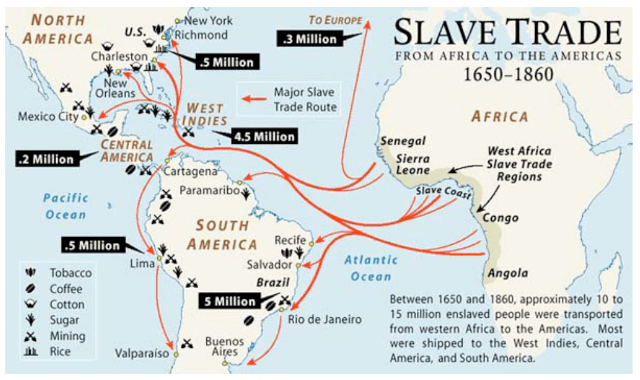
An essay from the New York Public Library (nypl.org) gives a sense of scale to the transatlantic slave trade. “As a whole, the transatlantic slave trade displaced an estimated 12.5 million people, with about 10,650,000 surviving the Atlantic crossing. Thus, even though a substantial number of Africans actually reached the United States, they were only a small proportion, about 3.6 percent, of the total number of Africans who were brought to the Americas. More Africans went to Barbados (435,000), while almost three times as many went to Jamaica (1,020,000). The number of Africans arriving in North America was considerably less than those who were taken to Brazil (4,810,000)“.

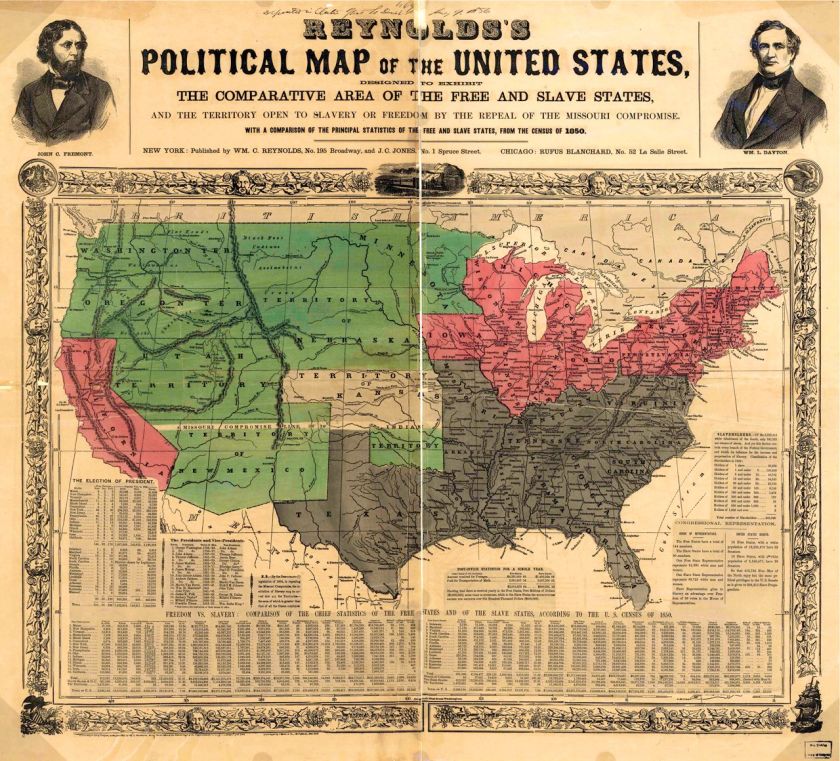
The Louisiana Purchase of 1803 opened vast new territories. The fight for which would be free and which would permit slavery, would go on for years.

The philosophical underpinnings of southern secession was borne of the Hartford Convention of December 1814 – January 1815.  There, delegates from Massachusetts, Connecticut and Rhode Island, along with “unofficial” delegates from New Hampshire and Vermont, met to discuss New England’s secession over the War of 1812. The convention reported that New England had a “duty” to assert its authority over unconstitutional infringements on its sovereignty, putting forth a legal position very similar to the later nullification position taken by South Carolina.

reynolds-political-map

Protective tariffs were instituted in the wake of the War of 1812, intending to help domestic manufacturers compete with foreign imported goods. Instead, they tended to help northern manufacturing economies, while increasing the cost of manufactured goods to the southern states, and making it more difficult to export cotton.

By this time, cotton was becoming the chief cash crop in most southern economies, and tariffs hit South Carolina particularly hard. Throughout the colonial and early national periods, the Palmetto state climate sustained a strong agricultural economy. South Carolina’s fortunes were hit hard with the panic of 1819, and slow to recover as the gulf states increasingly entered the cotton markets.

The Tariffs of 1828 – ’32 lead to a nullification crisis in South Carolina, where the state told the federal government to pound sand, and mobilized military assets to defend itself against federal enforcement measures sure to follow.

That time the crisis was averted, but a pattern had been established for events to come.

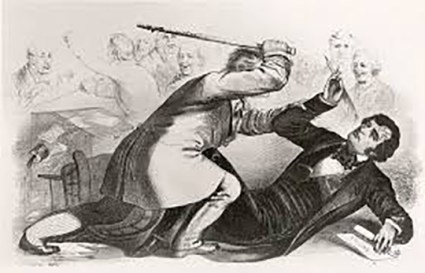
CaningSectional differences grew and sharpened in the years that followed. A member of Congress from Kentucky killed a fellow congressman from Maine.  A Congressman from South Carolina all but beat a Massachusetts Senator to death with a cane, on the floor of the Senate. A fist fight involving at least 30 Congressman broke out on the floor of the US House of Representatives.

Southern states talked about secession as early as 1850. Senator Stephen A Douglas proposed the Kansas-Nebraska Bill, in theory allowing a territory to determine its own free or slave status. This effort to “democratize” the issue led to the brutality of the “Bleeding Kansas” period, where pro-slavery Missouri “Border Ruffians” and anti-slavery Kansas “Jayhawkers” crossed one another’s borders, primarily to murder each others civilians and burn out one another’s towns.

Abraham Lincoln delivered his “House Divided” speech on June 16, 1858, in which he said “A house divided against itself cannot stand”.  A year later, John Brown was holed up at Harper’s Ferry, trying to start a slave insurrection.

After 57 ballots, the Democrat’s convention of 1859 adjourned without selecting a candidate for the Presidential election. Northern Democrats nominated Stephen A Douglas, while southern Democrats nominated John Breckenridge.

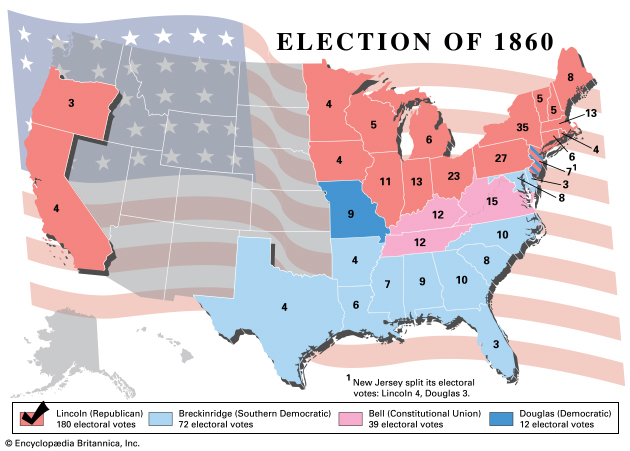
Republican Abraham Lincoln was elected 16th President of the United States on November 6, 1860, on a platform confusingly specifying “That all men are created equal”, an “abhorrence of all schemes of disunion”, and “The maintenance inviolate of the rights of the states, and especially the right of each state to order and control its own domestic institutions according to its own judgment exclusively”.

One year later, to the day, former United States Senator and Secretary of War Jefferson Davis was elected to a six-year term as the first President of the Confederate States of America.


November 5, 1605 The Gunpowder Plot

So it is that today, November 5th, is “Guy Fawkes Day”. People all over England will “remember, remember, the 5th of November, gunpowder, treason and plot.” Effigies of Guy Fawkes will be burned throughout the land.

The Tudor King Henry VIII began to take control of the English church in 1533, barely 16 years after Martin Luther is said to have nailed his 95 theses to the church door. The Protestant Reformation was barely underway, and both sides would come to regard the other as heretical.

Henry fell out with Pope Clement VII over the latter’s refusal to grant him an annulment from Catherine of Aragon. By 1540, the break between the Church of England and the Church of Rome was complete.

henryviiiEnglish Catholics became increasingly marginalized for the remainder of Henry’s reign, and that of his daughter, Elizabeth I, who died in 1603 without issue. There were several assassination attempts against Protestant rulers in Europe and England, including a failed plot to poison Elizabeth I, and the assassination of French King Henry III, who was stabbed to death by a Catholic fanatic in 1589.
King James VI of Scotland succeeded the “Virgin Queen” in 1603, to the great disappointment of English Catholics. The moderates among them favored James’ and Elizabeth’s cousin Arbella Stuart, a woman thought to have Catholic sympathies. More radical Catholics looked to the infant daughter of Phillip II of Spain, the Infanta Isabella.

There had already been at least two plots to remove the King from office, when James discovered that his wife, Queen Anne, had secretly received a rosary from the Pope. James responded by denouncing the Catholic Church, ordering Jesuit and all other Catholic priests to leave the country. He re-imposed “recusancy fees”, which had earlier been implemented by Elizabeth. The sum of these fines soon rose to £5,000 a year, equivalent to well over £10 million today.

Among those who believed that ‘faith did not need to be kept with heretics’, regicide seemed the only way out.

The “Gunpowder Plot”, also known as the “Jesuit Treason”, was inspired by Robert Catesby, a man of “ancient, historic and distinguished lineage”.

Catesby, along with about a dozen others, planned to blow up the House of Lords on November 5, 1605, killing King James along with several relatives and members of his Privy Council. This would lead, they thought, to a popular revolt in the Midlands, ending in the installation of James’ 9-year-old daughter, Princess Elizabeth, as the Catholic head of state.

gfawkesGuy Fawkes, who had 10 years of military experience fighting for the King of Spain in the Netherlands, was put in charge of the explosives.

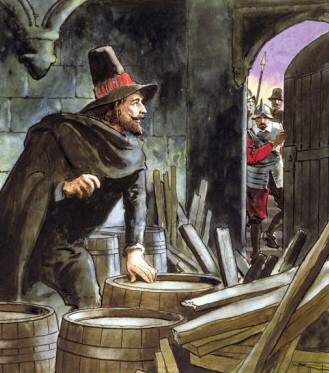
At least 36 barrels of powder were installed in a room under the House of Lords, when a letter came to light warning of the plot. Two separate searches on the evening of the 4th revealed the gunpowder barrels, hidden under piles of sticks and coal. Guy Fawkes was discovered nearby, carrying slow matches and touchwood.

Fawkes endured several days of torture, increasing in severity, until finally being “broken” on the rack. In January, all but two of the 13 conspirators were hanged, drawn and quartered for their treason. Those two, who had died in their attempt to flee, were dug up and decapitated. Fawkes, though weakened by torture and weeks of confinement in the tower of London, managed to jump off the scaffold and break his neck, sparing himself the ordeal of being cut down and dismembered while still alive.

Guy Fawkes MaskSo it is that today, November 5th, is “Guy Fawkes Day”. People all over England will “remember, remember, the 5th of November, gunpowder, treason and plot.” Effigies of Guy Fawkes will be burned throughout the land.

A stylized version of the “Guy Fawkes Mask” came to be in the 1980s, with a comic book series and its later film adaptation, “V for Victory”. The story depicts a vigilante effort to destroy an authoritarian government in a dystopian future Great Britain.

Since that time, groups ranging from the hacker/activist group Anonymous to Occupy, even radical Libertarians have used the Guy Fawkes mask. A symbol of protest against what they see as out of control, tyrannical government, political and banking institutions.

November 4, 1914 Battle of the Bees

Paul von Lettow-Vorbeck came to loathe Adolf Hitler, and tried to establish a conservative opposition to the Nazi political machine. When offered the ambassadorship to the Court of St. James in 1935, he apparently did more than merely decline the job. He told Der Fuehrer to perform an anatomically improbable act.  Years later, Charles Miller asked the nephew of a Schutztruppe officer about the exchange. “I understand that von Lettow told Hitler to go f**k himself”.   “That’s right”, came the reply, “except that I don’t think he put it that politely”.

When WWI broke out in 1914, a map of Africa looked nothing like it does today. From the Belgian Congo to Italian Somaliland, most of the continent was carved into colonies of the various European powers. France, Britain, Germany, Italy, Portugal, Belgium and Spain.  All administered parts of the African continent.

The 2nd Battalion of the Loyal North Lancashire Regiment was stationed in Bangalore, southern India, at the outbreak of war.  By mid-October, the more experienced of their Indian allies had shipped off to France, Egypt and Mesopotamia.  Little but leftovers were assigned to the German East African invasion.  Many had never even fired a rifle, let alone a machine gun.

Since August, there had been an informal agreement that the African territories would be left alone. That changed on November 2, when an allied force of 8,000 British troops and their Indian allies arrived at the seaport town of Tanga, in what is now Tanzania.

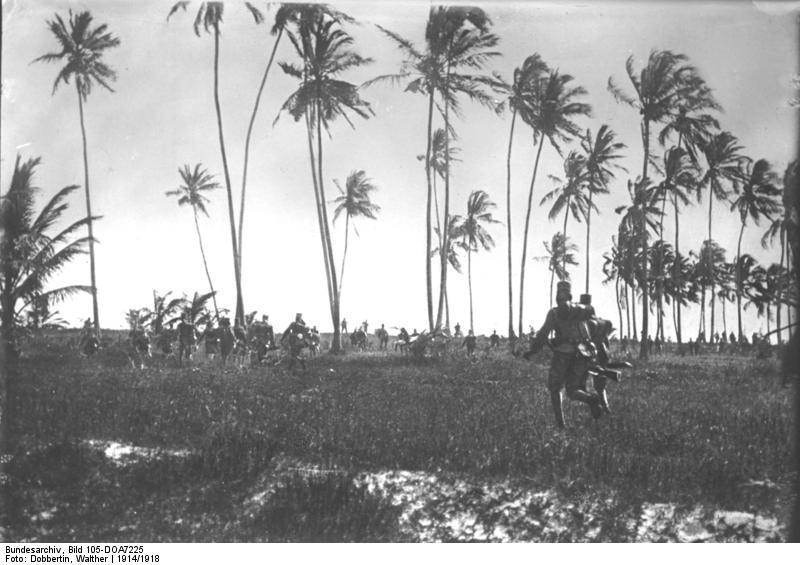
Deutsch-Ostafrika, Askari im KampfThis invasion force, commanded by General Arthur Aitkin, spent that first day and most of the second sweeping for non-existent mines, before finally assembling an assault force on the beaches late on November 3rd. It was a welcome break for the German Commander, Colonel Paul Emil von Lettow-Vorbeck, who had assembled and trained a force of Askari warriors around a core of white German commissioned and non-commissioned officers.

The Germans used those 2 days to bring in more defenders, increasing their number from two companies to almost a thousand individuals. The German and Ascari defenders were well situated and very familiar with the terrain, unlike the British-led allied forces, who had conducted no reconnaissance whatsoever.

The fighting of November 4 met with mixed results. Several columns bogged down in the swamps approaching town, leaving much of their lines in disarray. The harbor contingent had some successes in the fighting that followed, with Gurkhas of the Kashmiri Rifles and the 2nd Loyal North Lancashire Regiment capturing the customs house and Hotel Deutscher Kaiser.

Though outnumbered 8 to 1, the defenders managed to turn their attackers when they got some help from an unexpected direction. Millions of bees, agitated by the gunfire, had joined in the fight.

bengallancerscharge
Charge of the Bengal Lancers

“Killer” bees are a strain of western honey bees that have been “Africanized”; cross bred with larger, more aggressive African bees, in order to produce more honey in tropical conditions.

The honey producers who crossed these creatures in the 1950s quickly learned what Aitken’s men could have told them in 1914. These things are aggressive, they swarm, and, if angered, they will chase you for a mile and more.

The Germans got some of it, but the bees spent most of their wrath on the British and the Indians, who found themselves pelting for the beaches at maximum speed. I don’t know if it’s true or just a story, but I’ve heard of one radio man who stayed at his post, directing the beach withdrawal as he was stung to death by thousands of bees. According to the story, he received the Victoria Cross, posthumously, for gallantry “while sustaining aerial attack”.

The Battle for Tanga was a humiliating defeat for the British. The Royal Navy refused to carry heavy machine guns back, fearing that they might damage their small landing craft. The guns would be left behind, for future allied forces to deal with.  It was a gift for Lettow-Vorbeck, whose forces found enough modern rifles for three Askari companies, along with 600,000 rounds of ammunition, 16 machine guns, several field telephones and enough clothing to last the Schutztruppe for a year.

Askari-on-MarchColonel, and later General Lettow-Vorbeck, was called “Der Löwe von Afrika“, the Lion of Africa. He never once had more than 3,000 Germans and 11,000 Askaris under his command, yet he wore the allies out, leading no fewer than 300,000 British, Belgian, and Portuguese troops in a four-years long wild goose chase all over equatorial Africa.

The Lion of Africa returned to Germany a conquering hero at the end of WW1.  Of all German field commanders in all theaters of the war, von Lettow alone was undefeated in the field, acclaimed as leading “the greatest single guerrilla operation in history, and the most successful”.

lettowvorbeckportraitPaul von Lettow-Vorbeck came to loathe Adolf Hitler, and tried to establish a conservative opposition to the Nazi political machine. When offered the ambassadorship to the Court of St. James in 1935, he apparently did more than merely decline the job. He told Der Fuehrer to perform an anatomically improbable act.  Years later, Charles Miller asked the nephew of a Schutztruppe officer about the exchange. “I understand that von Lettow told Hitler to go f**k himself”.   “That’s right”Came the reply, “except that I don’t think he put it that politely”.
Persecuted by the Nazis, the Lion of Africa was a broken man by the end of WWII, surviving only due to his former hero status. His home was bombed out and his two sons Rüdiger and Arnd, were dead.

Lettow-Vorbeck would get back on his feet, but for a time he had to depend on food packages from England, sent to him from Sir Richard Meinertzhagen and General Jan Smuts.  Two who took to feeding the man, so great was their respect for their former adversary in the earlier war.

November 3, 1954 Godzilla

Godzilla is a “Kaiju”, a Japanese word meaning “strange creature”. More specifically a “daikaiju”, meaning a really, really big one. He is the best known, but not the only such creature. You may remember other kaiju, including Gamera, Mothra, King Ghidorah, Mechagodzilla and Rodan.

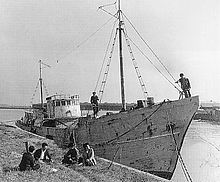
In 1954, the Daigo Fukuryū Maru (“Lucky Dragon No.5”) was fishing near the Marshall Islands, in the northern Pacific. On March 1, 23 fishermen were witness to a western sky that “lit up like a sunrise”.  For eight minutes, they watched the mushroom cloud rise into the sky.  And then came the sound of the explosion. Next came the fallout, the fine white dust, calcinated coral of the Bikini atoll, falling like snow from the sky.

Daigo Fukuryū Maru
Daigo Fukuryū Maru

The fishermen returned to Yaizu, Japan two weeks later, all 23 suffering from nausea, headaches, bleeding from the gums, and other symptoms.  They were now “hibakusha”.   “Explosion-effected people”.

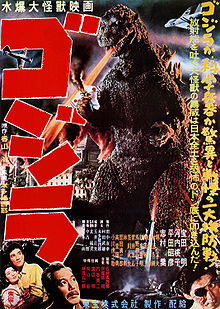
The atomic explosions at Hiroshima and Nagasaki were only nine years in the past, and a fierce anti-nuclear sentiment was building in Japan. In this context, there arose a metaphor for all that destruction.  Literally rising from the sea, this product of the Japanese entertainment industry took the form of a monster,  “Godzilla”, the first film released this day, in 1954..

220px-Gojira_1954_Japanese_poster
Theatrical Release Poster, 1954

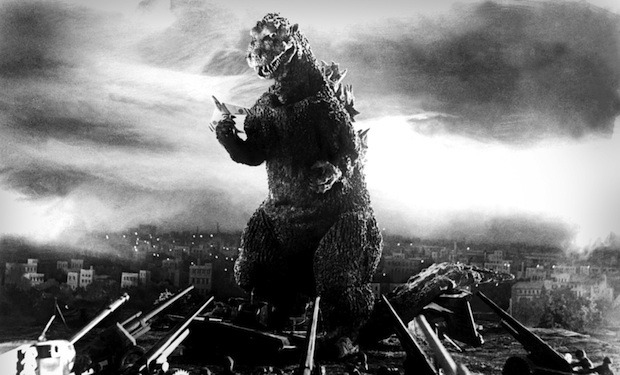
The name is a portmanteau, two words combined to form a third, of the Japanese word “gorira”, meaning gorilla, and “kujira”, meaning whale. Godzilla was the Gorilla Whale, with the head of a Tyrannosaur, Stegasaur-like plates on its back and skin modeled after the keloid scarring of the hibakusha.

The original Godzilla (“ɡodʑiɽa”) was awakened by atomic testing and impervious to any but a nuclear weapon. Emerging from the depths with its atomic breath, havoc and destruction was always accompanied by the distinctive roar, a sound effect made by rubbing a resin glove down the strings of a bass violin, then changing the speed at playback.

The actor who played Godzilla in the original films, Haruo Nakajima, was a black belt in Judo. His expertise was used to choreograph the monster’s movements, defining the standard for most of the Godzilla films.

Originally an “it”, Godzilla was usually depicted as a “he”, although that became a little confusing in the 1998 American remake “Zilla”, when he started laying eggs.

He was a Kaiju, a Japanese word meaning “strange creature”, more specifically a “daikaiju”, meaning a really, really big one. He is the best known, but certainly not the only such creature. You may remember other kaiju, including Gamera, Mothra, King Ghidorah, Mechagodzilla and Rodan.

Godzilla has appeared in 28 original films, with more in the works. Over the course of his existence he has been a hero, a villain, and a destructive but values-neutral force of nature.

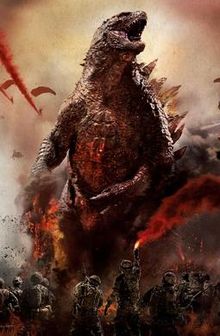
Godzilla_Empire_RevealGodzilla got his own star on the Hollywood “Walk of Fame” in 2004, timed to coincide with the release of the 29th movie, “Godzilla: Final Wars.” Instead of nuclear weapons testing, this version was spawned by “environmental pollution”.  It takes the superheroes of the “Earth Defense Organization” (but, of course) to freeze him back into the ice of the South Pole. The film was a flop, grossing less than $12 million after a production budget of $19 million.
The franchise came roaring back ten years later, when Godzilla was released in 2014, grossing $200 million domestically and $529.1 million on worldwide sales.

A film franchise 63 years in the making is still going strong, and will continue to do so, for the forseeable future.  Godzilla: King of the Monsters is set to be released in 2019 and Godzilla vs. Kong, in 2020..

November 2, 1950 A Shepherd in Combat Boots

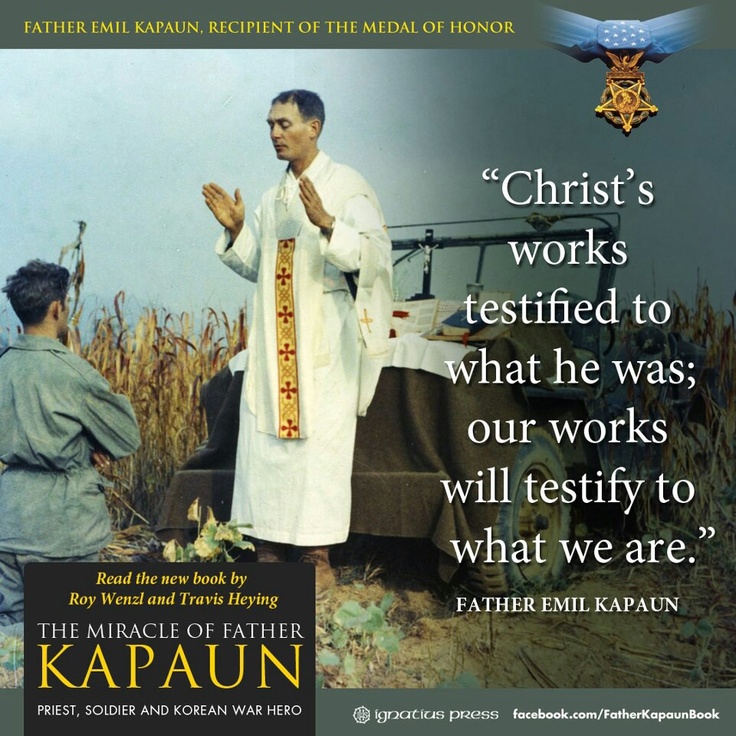
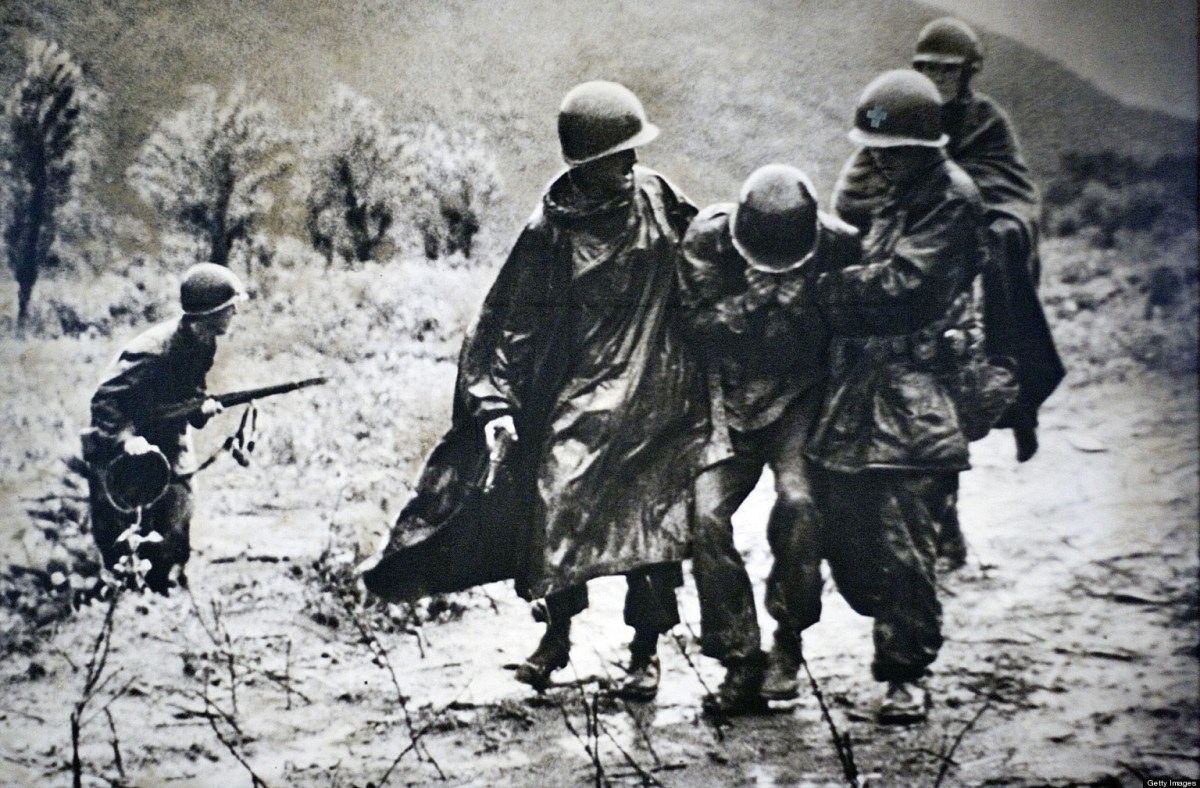
Reporting on Kapaun’s Medal of Honor, the NY Times wrote “The chaplain “calmly walked through withering enemy fire” and hand-to-hand combat to provide medical aid, comforting words or the last rites of the Roman Catholic Church to the wounded, the citation said. When he saw a Chinese soldier about to execute a wounded comrade, Sgt. First Class Herbert A. Miller, he rushed to push the gun away. Mr. Miller, now 88, was at the White House for the ceremony with other veterans, former prisoners of war and members of the Kapaun family”.

image (1)Emil Joseph Kapaun was the son of Czech immigrants, a farm kid who grew up in 1920s Kansas. Graduating from Pilsen High, class of 1930, Kapaun spent much of the 30s in theological seminary, becoming an ordained priest of the Roman Catholic faith on June 9, 1940.
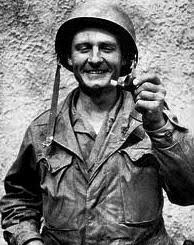
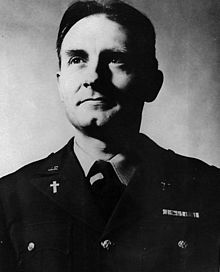
Kapaun served as military chaplain toward the end of WWII, before leaving the army in 1946 and rejoining in 1948.

Chaplain Kapaun was ordered to Korea a month after the North invaded the South, joining the 8th Cavalry Regiment of the 1st Cavalry Division, out of Fort Bliss.

The 8th Cav. entered combat at the Pusan perimeter, moving steadily northward through the summer and fall of 1950.  Father Kapaun would minister to the dead and dying, performing baptisms, hearing first confessions and offering holy communion.  He would celebrate mass from an improvised altar, set up on the hood of a jeep.Kapaun2

Kapaun once lost his mass kit to enemy fire. He earned a Bronze Star in September that year, running through intense enemy fire to rescue a wounded soldier. His was no rear-echelon ministry.

A single regiment was attacked by the entire 39th Chinese Corps on November 1, and completely overrun the following day.  For the US 8th Cavalry, the battle of Unsan was one of the most devastating defeats of the Korean War. Father Kapaun was ordered to evade, an order he deliberately defied. He was performing last rites for a dying soldier, when he was seized by Chinese communist forces.

Prisoners were force marched 87 miles to a Communist POW camp near Pyoktong, in North Korea. Conditions in the camp were gruesome. 1st Lieutenant Michael Dowe was among the prisoners.  Through him that we know much of what happened there. Dowe later described Father Kapaun trading his watch for a blanket, only to cut it up to fashion socks for the feet of prisoners.

Kapaun4
Fr. Kapaun holds a pipe, shot out of his mouth by an enemy sniper

Father Kapaun would risk his life, sneaking into the fields around the prison compound to look for something to eat. He would always bring it back to the communal pot.

Chinese Communist guards would taunt Kapaun, during daily indoctrination sessions, “Where is your god now?” Before and after these sessions, he would move through the camp, ministering to Catholic and non-Catholic alike. Kapaun would slip in behind every work detail, cleaning latrines while other prisoners argued over who’d get the job. He’d wash the filthy laundry of those made weak and incontinent with dysentery.

Starving, suffering from a blood clot in his leg and a severe eye infection, Father Kapaun led Easter services in April, 1951. He was incapacitated a short time later. Guards carried him off to a “hospital”, a fetid, stinking part of the camp known to prisoners as the “death house”, from which few ever returned. “If I don’t come back”, he said, “tell my Bishop that I died a happy death.”Kapaun1

Scores of men credit their survival at Pyoktong, to Chaplain Kapaun.

In the end, Father Kapaun was too weak to lift the plate holding the meager meal his guards left him. US Army records report that he died of pneumonia on May 6, 1951.  His fellow POWs will tell you that he died on May 23, of malnutrition and starvation. He was 35.

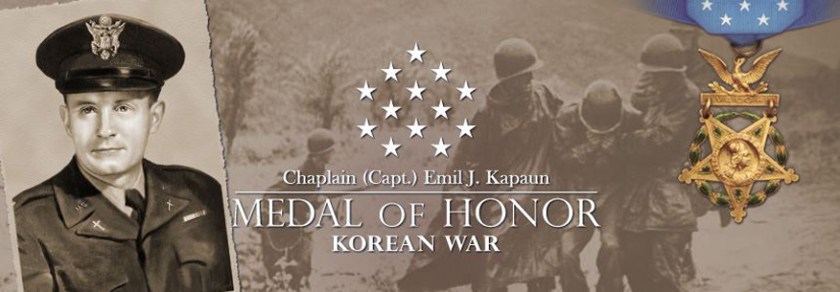
In 2013, President Barack Obama presented Kapaun’s family with a posthumous Medal of Honor for his heroism at Unsan. The New York Times reported that April, “The chaplain “calmly walked through withering enemy fire” and hand-to-hand combat to provide medical aid, comforting words or the last rites of the Roman Catholic Church to the wounded, the citation said. When he saw a Chinese soldier about to execute a wounded comrade, Sgt. First Class Herbert A. Miller, he rushed to push the gun away. Mr. Miller, now 88, was at the White House for the ceremony with other veterans, former prisoners of war and members of the Kapaun family“.

KapaunBanner

The naming of a Saint of the Roman Catholic church is not a process taken lightly.  Pope John Paul II named Father Kapaun a “Servant of God” in 1993, the first step toward Sainthood. On November 9, 2015, the Catholic Diocese of Wichita submitted a 1,066 page report on the life of Chaplain Kapaun, to the Roman Curia at the Vatican.

A team of six historians reviewed the case for beatification. On June 21, 2016, the committee unanimously approved the petition. Two days later, the Wichita Eagle newspaper reported that Father Kapaun was one step closer to sainthood.  At the time I write this, Father Emil Joseph Kapaun’s supporters continue working to have him declared a Saint of the Roman Catholic Church, for his lifesaving ministrations at Pyoktong.

Emil Kapaun

November 1, 1959 Goalie Mask

On this day in 1959, Jacques Plante decided that he’d had enough. It was three minutes into a game with the New York Rangers, when he took a puck to the nose on a shot fired by Andy Bathgate. The puck broke his nose, opening a wound which required seven stitches to close.  When Plante returned to the ice, he was wearing a fiberglass mask.

Jacques Plante-original maskStanley CupIn the Netherlands, ice hockey began sometime in the 16th century.  North Americans have played the sport since 1855.   For all that time, flying hockey pucks have collided with the faces of goalies.  The results could not have been pretty.

The name of Montreal Canadien goal tender Jacques Plante is engraved five times on Lord Stanley’s cup, once for each of their five consecutive championships between 1956 and ‘60.  For a lifelong Bruins fan, that isn’t easy to say.

Jacques Plante Putting on Mask
Original caption: 11/1/1959-New York, NY- His face and shirt bloodied, Montreal Canadiens goalie Jacques Plante puts on a special plastic mask after being treated for a facial cut received in the opening period of the Rangers-Canadiens hockey game. Plante suffered a severe gash on the left side of his face when he was struck by a shot off the stick of Andy Bathgate of the New York Rangers. After donning the mask, which he had designed himself, Plante returned to the game. November 1, 1959 New York, New York, USA

Plante literally wrote the book on NHL goal tending. He was the first to take the position outside of the crease, making himself the third defenseman. He was the first to take the puck behind the net, and the first to bring anything like stick handling to the position. Before Plante, a Goalie’s job was pretty much to deflect the puck and let the defenders take it from there.

On this day in 1959, Jacques Plante decided that he’d had enough. It was three minutes into a game with the New York Rangers, when he took a puck to the nose on a shot fired by Andy Bathgate. The puck broke his nose, opening a wound which required seven stitches to close.  When Plante returned to the ice, he was wearing a fiberglass mask.

Coach Toe Blake was furious. He had allowed the mask during practice, but this was regulation.  Nobody wore a mask.  Coaches believed they cut the goaltender’s field of vision, and, besides.  These were supposed to be the “fearless” guys, who jumped in front of the puck.

Easy for him to say.  It wasn’t his face.  Plante was adamant, and Blake wasn’t about to bench the best goalie in the NHL. There would be one more game when Plante played without the mask, the only game the Canadiens lost in that series, and that was the end of it.  For Jacques Plante, the mask had now become standard equipment.

terry_sawchuk_face_of_goalie_1966
NHL Goalie Terry Sawchuk

In 1966, Life Magazine published an image of Toronto Maple Leafs goalie Terry Sawchuk, “a face only a hockey puck could love“. “Re-created here, by a professional make-up artist and a doctor” read the accompanying article, “are some of the more than 400 stitches he had earned during 16 years in the National Hockey League. Terry Sawchuk’s face was bashed over and over, but not all at one time. His wounds healed. The scars weren’t easily seen – except for a few of them. The re-creation of his injuries was done to help show the extent of his injuries over a span of years”.

Gerry Cheevers
Gerry Cheevers

During a 1968-’69 season playoff game against the Boston Bruins, a puck fired by Phil Esposito hit Plante in the forehead, knocking him out, cold.  He later said that the mask saved his life.  He’s probably right.

Gerry Cheevers, who played for the 1970-’72 Bruins, famously had his mask marked up with stitches. That started when a puck hit him in the face during practice. When Bruins coach Harry Sinden followed Cheevers to the dressing room, he found him enjoying a beer and smoking a cigarette. Sinden sent Cheevers back out on the ice, and John Forestall, the team trainer, painted stitches on his mask. Every time Cheevers was hit after that, he would have new stitches painted on. The mask became one of the most recognizable symbols of the era, and now hangs on the wall of his grandson’s bedroom.

clint-benedict
Montreal Maroon’s goaltender Clint Benedict, 1930

Jacques Plante wasn’t the first NHL goaltender to wear a face mask.  Montreal Maroons’ Clint Benedict wore a crude leather mask in 1929, to protect a broken nose.

It was Plante who introduced the face mask as everyday equipment, now a mandatory fixture for all goaltenders.

I’m not sure if NHL goalies are any prettier these days, but I do believe they have a lot more teeth.