February 5, AD 62, The lost City of Pompeii

Most were killed where they stood in the pyroclastic surge, that ground-hugging pressure wave seen in test films of nuclear explosions.  Gasses and pulverized stone dust race outward at 400 MPH in the “base surge” phase, super-heated to 1000° Fahrenheit, instantaneously converting all bodily fluids, to steam.

On February 5 in the year AD 62, an earthquake estimated at 7.5 on the Richter scale shook the Bay of Naples, spawning a tsunami and leveling much of the coastal Italian towns of Pompeii and Herculaneum, and surrounding communities.

Massive though the damage had been, the region around Mt. Vesuvius and the Bay of Naples had long been a favorite vacation destination for the upper crust of Roman society, with crowds of tourists and slaves adding to some ten to twenty thousand townspeople, bustling in and out of the city’s bath houses, artisans’ shops, taverns and brothels.

pompeii-2

Reconstruction began almost immediately and continued for the next seventeen years.  Until that day, the world came to an end.

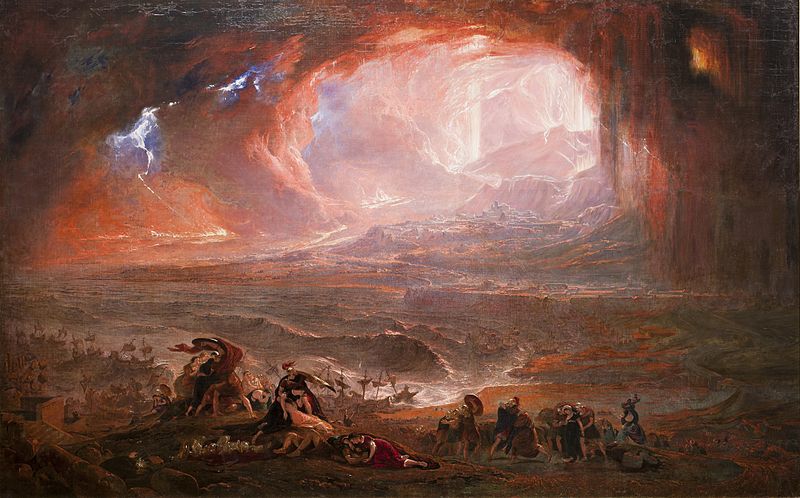
Long dormant and believed extinct, nearby Mount Vesuvius had been quiet for hundreds of years.  The mountain erupted on August 24 in the year 79,  propelling a scorching plume of ash, pumice and super-heated volcanic gases so high as to be seen for hundreds of miles.

The Melbourne Museum has created a stunning, eight-minute animation, of the event.

For the next eighteen hours, the air was thick with hot, poisonous gases, as volcanic ash rained down with pumice stones the size of baseballs.  No one who stayed behind stood a chance, nor did countless animals, both wild and domestic.

Most were killed where they stood in the pyroclastic surge, that ground-hugging pressure wave seen in test films of nuclear explosions.  Gasses and pulverized stone dust race outward at 400 MPH in the “base surge” phase, super-heated to 1000° Fahrenheit, instantaneously converting all bodily fluids, to steam.

Pompeii 2
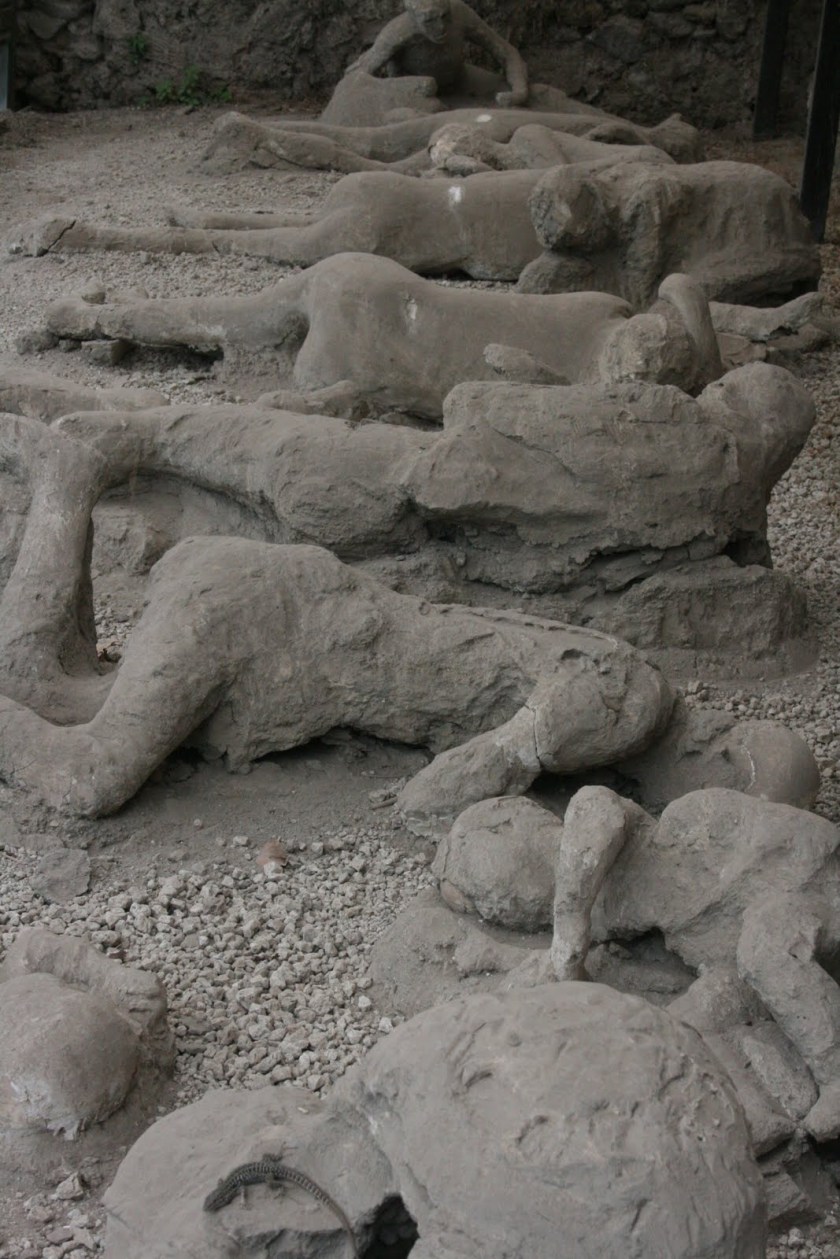
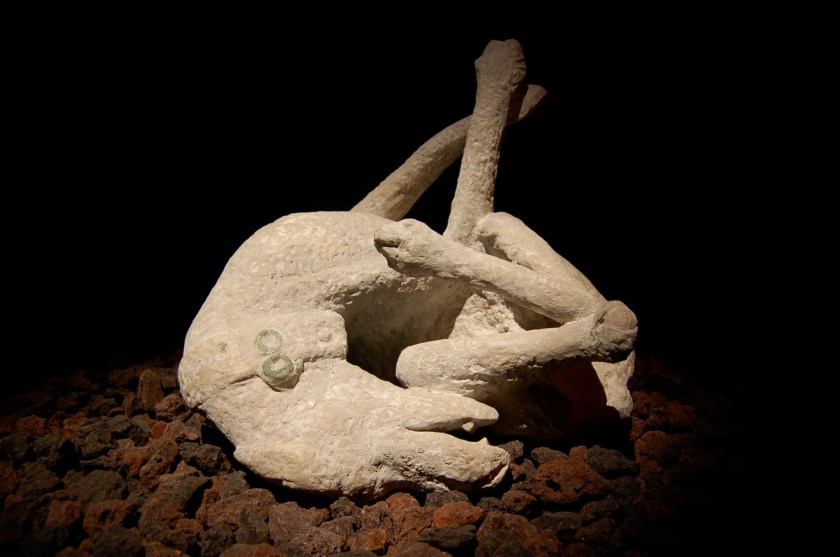
The victims of Mt. Vesuvius’ wrath left their imprints in the ash and rock which would be their tomb.  2,000 years later, remarkably life-like plaster casts, depict the final moments of these unfortunate men, women and children.

For those left alive, the suffocating, poisonous clouds of vapor and rock dust pouring into the city, soon  put and end to all that remained.  Imagine putting your head in a bag of cement, with someone pounding the sides.  Walls collapsed and roofs caved in, burying the dead under fourteen feet or more of ash, rock and dust. Neither Herculaneum, Pompeii nor their surrounding communities would see the light of day, for nearly two thousand years.

dsc_0128

Today, we remember the Roman author, naturalist and military commander Gaius Plinius “Pliny’ Secundus for his work Naturalis Historia (Natural History). We see his work in the editorial model of the modern encyclopedia.

With the cities of Pompeii and Herculaneum already destroyed, Pliny raced to the port of Stabiae some 4½km to the southwest, to rescue a friend and his family. The sixth and largest pyroclastic surge trapped his ship in port, killing the author and everyone in the vicinity. That we have an eyewitness to the event is thanks to two letters written by Gaius Plinius Caecilius Secundus (Pliny the Younger), Pliny’s nephew and a man he had helped to raise, from boyhood.

800px-Destruction_of_Pompeii_and_Herculaneum
Destruction of Pompeii and Herculaneum

Property owners and thieves returned over time to retrieve such valuables as statues. The words “house dug” can still be found, scrawled on the walls.  And then the place was forgotten, for fifteen hundred years.

15

An underground channel was dug in 1562 to redirect waters from the river Samo, when workers ran into city walls.  The architect Domenico Fontana was called in and further excavation revealed any number of paintings and frescoes, but there was a problem.

According to the Annus Mirabilis written by English poet Philip Larkin, sex was invented in the British Isles, in 1963.

“…So life was never better than
In nineteen sixty-three
(Though just too late for me) –
Between the end of the Chatterley ban
And the Beatles’ first LP…”

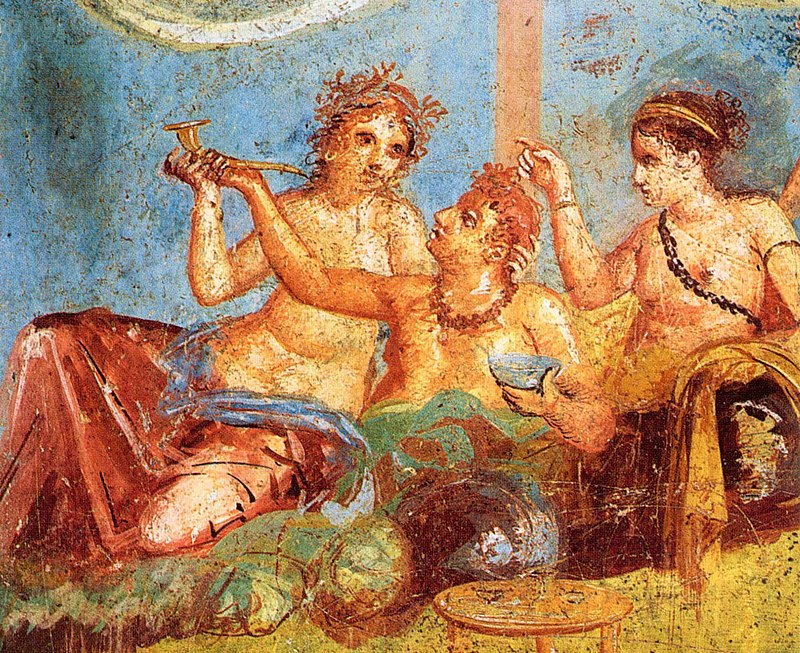
800px-Pompeii_-_Casa_dei_Casti_Amanti_-_Banquet
Pompeian artwork ranges from the merely hedonistic, to the pornographic

The ancients seem to have been somewhat less, “uptight”.   Life in Pompeii was nothing if not hedonistic.  The place has been described by some, as the “red-light district” of antiquity.  I’m not sure about that, but the erotic art of Pompeii and Herculaneum were WAY too much for counter reformation-era sensibilities.  The place was quietly covered up and forgotten, for another two hundred years.

Pompeii was first excavated in earnest in 1748, but it took another hundred years for archaeologists’ findings to be cataloged, and brought to museums.  In 1863, archaeologist Giuseppe Fiorelli realized that occasional voids in the ash layer were left by the long since decomposed bodies of the doomed victims, of Vesuvius.

A technique was developed of injecting plaster.  Today we can see them in excruciating detail, exactly where they fell.  Men, women and children, the dogs, even the fresh-baked bread, left out on the counter to cool.

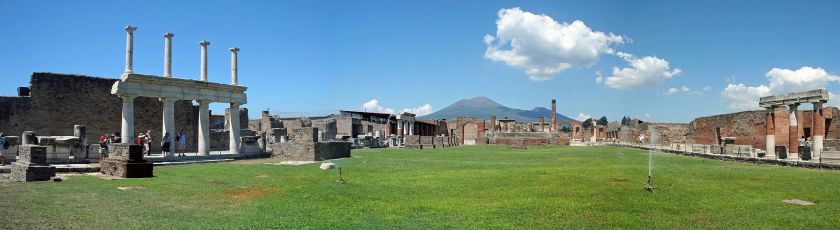
Today you can tour the lost city of Pompeii, from the baths to the forum, to the Lupanar Grande, where the prostitutes of Pompeii once “entertained” clients.  Ongoing excavation is all but a race with time, between uncovering what remains, and preserving what is.  Walls surrounding the “House of the Moralist” collapsed in 2010, so-called because its wealthy wine merchant owners posted rules of behavior, for guests to follow: “Do not have lustful expressions and flirtatious eyes for another man’s wife“.

Heavy rains were blamed for the collapse of the Schola Armatorium in 2010, the House of the Gladiators.  Fierce recriminations have followed and doubt has been cast on local authorities’ abilities, to properly preserve what has become a UNESCO World Heritage site.

Be that as it may, 2,000-year-old buildings do not come along every day.  There is no replacement for antiquity.

Pompeii_Forum

If you enjoyed this “Today in History”, please feel free to re-blog, “like” & share on social media, so that others may find and enjoy it as well. Please click the “follow” button on the right, to receive email updates on new articles.  Thank you for your interest, in the history we all share.

January 6, 1842 I Am the Army

That afternoon, a single mangled soldier rode into Jalalabad on a wounded horse. He was Dr. William Brydon. When asked where the army was, Brydon replied “I am the Army”.

The British East India Company was a British joint stock company, chartered by Queen Elizabeth in 1600 with a trade monopoly in Southeast Asia and India. It was the first of several such companies established by European powers, followed closely by the East India Companies of the Dutch, Danish, Portuguese, French and Swedish, and associated with the valuable trade in such commodities as cotton, silk, indigo, salt, saltpeter, tea and opium.

India means British troops on the Kabul Plain

These organizations were much more than what we associate with the word “company”. In their day they could raise their own armies, enforce the law up to and including trial and execution of accused wrong doers, and largely functioned outside the control of the governments that formed them. By the early 19th century, the British East India Company ruled over large areas of India with its own private armies.

Firmly entrenched by the 1830s and wary of Russian encroachment south through Afghanistan, the British tried without success to form an alliance with the Emir of Afghanistan, Dost Mohammad Khan.

Lord Auckland’s “Simla Manifesto” of October 1838 laid out a justification for British intervention in Afghanistan, based on the need for a trustworthy ally on India’s western frontier. The pro-British, Shuja Shah Durrani was installed as ruler, backed up by an army of 21,000 British and Indian troops under the command of Lieutenant General John Keane, 1st Baron Keane, veteran of the Peninsular War, and the battle of New Orleans.

Afghan Tribesmen

Most of these troops returned to India the following year, as Dost Mohammad unsuccessfully attacked the British and their Afghan protégé, only to be defeated and exiled to India in late 1840.

By 1841, disaffected Afghan tribesmen were flocking to support Dost Mohammad’s son, Akbar Khan, against what they saw as an occupying force. There were warning signs of the deteriorating situation as the spring of 1841 turned to summer, and British freedom of movement around Kabul became increasingly restricted. The British government in India was dismayed at the cost of keeping the Kabul Garrison, when they cut off funds, ending the stream of bribes that all but kept the tribes in check.

It was around this time that Sir William Elphinstone stepped in as commander of the Kabul Garrison. Described by fellow General William Nott as “the most incompetent soldier who ever became General”, Elphinstone found himself in charge of 4,800 Indian and British troops, along with 16,000 camp followers: families, servants and civilian workers.

Akbar Khan

On November 2 1841, Akbar Khan proclaimed a general revolt. Several British officers were murdered along with their families, servants and staff. Afghan leaders invited Civil servant Sir William Hay MacNaghten for tea in December to discuss the situation; only to seize and murder them as the delegation dismounted their horses.

On January 1, Elphinstone agreed to hand over all powder, his newest muskets and most of his cannon, in exchange for “safe passage” out of Kabul, guaranteed by Akbar Khan along with the protection of the sick, wounded and infirm left behind. 16,000 soldiers and civilians moved out on January 6, heading for Jalalabad, 90 miles away.

Akbar Khan’s “safe passage” lasted about as long as it took the column to get out in the open, when Afghans moved in firing at retreating troops while setting fire to garrison buildings containing those left behind.

At one point Akbar Khan met with Elphinstone, claiming ignorance of any betrayal. He claimed that he had been unable to provide the promised escort because they had left earlier than expected, and then asked Elphinstone to wait while he went ahead and negotiated safe passage with local tribesmen.

The delay accomplished nothing more than to allow Akbar Khan time to set up the next ambush. By the evening of the 9th, the column was only 25 miles outside of Kabul. 3,000 people were dead, mostly killed while fighting or frozen to death, while a few had taken their own lives. By January 12, the column was reduced to only 200 soldiers and 2,000 camp followers

Last stand

The last stand took place on a snow-covered hill near the village of Gandamak, on the morning of January 13, 1842. 20 officers and 45 British soldiers were surrounded, with an average of two rounds apiece. That afternoon, one mangled soldier rode into Jalalabad on a wounded horse. He was Dr. William Brydon. Brydon had part of his skull sheared off by an Afghan sword. He was only alive because of a Blackwood’s Magazine, stuffed into his hat to fight off the cold of the Hindu Kush. When asked where the army was, Brydon replied “I am the Army”.

In the end, 115 captured officers, soldiers, wives and children lived long enough to be released. Around 2,000 Sepoys and Indian camp followers eventually made their way back to India, while others were sold into slavery, or abandoned to a life of beggary.

The 1842 Kabul expedition was the most egregious loss to British arms in history, eclipsed only by the fall of Singapore 100 years later, nearly to the day.

According to legend, Brydon’s horse lay down on arrival in Jalalabad, and never got up again.

January 5, 1976 The Killing Fields of Cambodia

Imagine feeling so desperate, so fearful of this alien ideology invading your country, that you convert all your worldly possessions and those of your family to a single diamond, bite down on that stone so hard it embedded in your shattered teeth, and fled with your family to open ocean in a small boat.  All in the faint and desperate hope, of getting out of that place.  That is but one story among millions.  Those were the lucky ones.

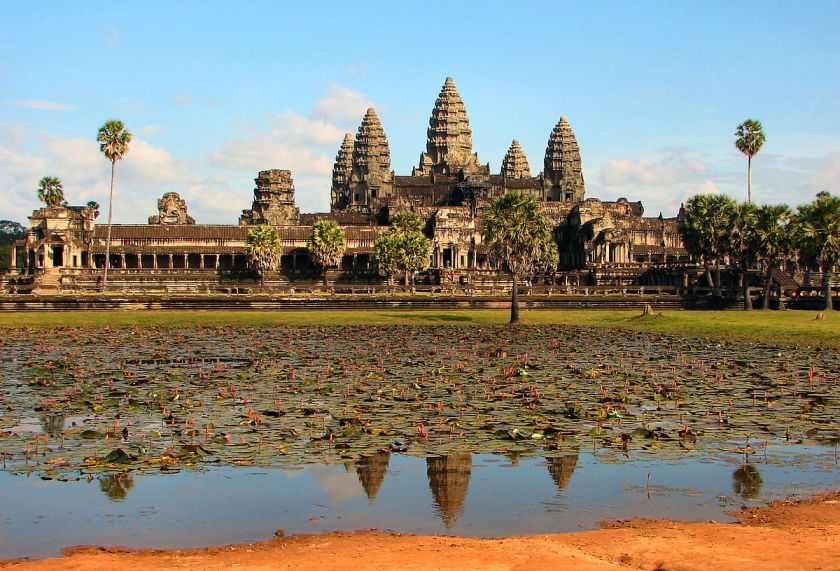
Between the 7th and 14th centuries, the Khmer Empire occupied much of modern-day Cambodia, Thailand, Laos, and southern Vietnam.  Now extinct, this powerful civilization was once home to the largest city in the world.  Until recently overrun by Jungle, the capital city of Angkor, whose original name was Yashodharapura (“Glory-bearing city”), was nearly the size of modern day Los Angeles, and home to roughly a million people.

Even today, the Hindu temple complex of Angkor Wat, built circa 1122, remains one of the largest religious monuments in the world.

1200px-angkor_wat
Temple Complex at Angkor Wat

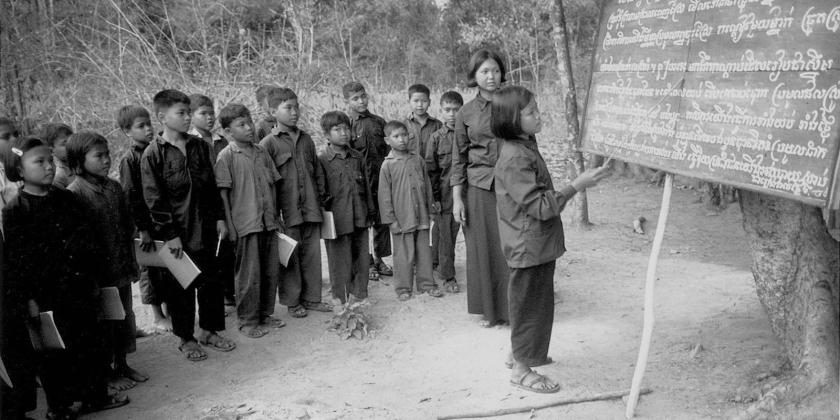
During the 1950s, a group of some 200 middle-class Cambodian kids were educated at French Universities.  The greater part of that group formed a student organization of Marxist-Leninist intellectuals, dreaming of an agrarian utopia on the Indo-Chinese peninsula.

What began as a small leftist insurgency grew in power, thanks to support from Communist China and North Vietnam.  From only a few hundred individuals in 1960, these “Red Khmers” (Khmer Rouge) grew into an effective insurgency against the Khmer Republic’s government of King Norodom Sihanouk and Prime Minister Lon Nol.  By early 1975, the Khmer Rouge had overwhelmed Khmer National Armed Forces.

khmerrougeimage1600_i002653_-1

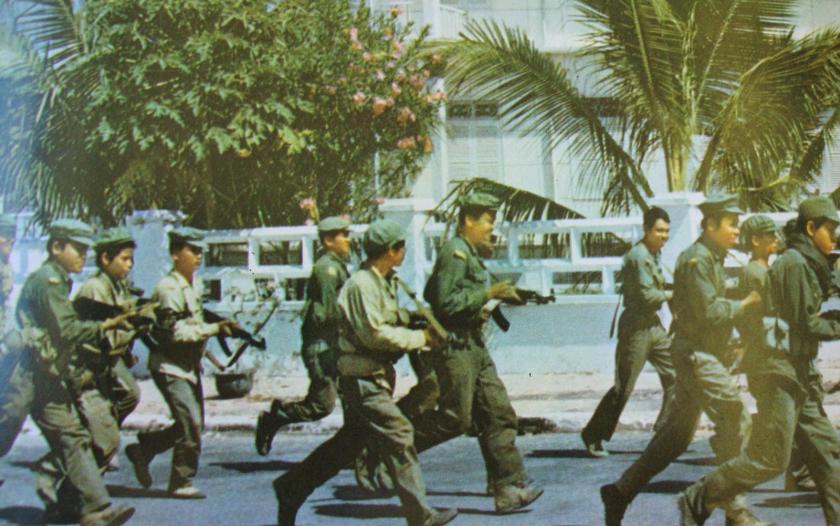
As the last, humiliating scenes of America’s war in neighboring Vietnam played themselves out in the capital of Saigon, Khmer Rouge forces captured the Cambodian capital at Phnom Penh, overthrowing the Khmer Republic and executing its officers.

This was to be “Democratic Kampuchea”, the name representing a local pronunciation of the word as it comes into English, as Cambodia.

The Kampuchean constitution, formally approved this day in 1976, theoretically vested power in a 250-member, directly elected “Kampuchean People’s Representative Assembly”.  This body met once in April, and never again.  Unlike the cult of personality grown up around the Kim family of North Korea or that of the Stalinist USSR or Maoist China, all power in the CPK (Communist Party of Kampuchea) belonged to “The Center”, a shadowy, nine-member standing committee of those same leftist intellectuals from the Paris student days, led by Prime Minister and Communist General Secretary Saloth Sar, better known as ‘Pol Pot’.

This nine-member “Angkar”, (pronounced ahng-kah), meaning ‘The Organization’, ushered in one of the great horrors of the twentieth century, a four-year genocide remembered as the “Killing Fields”, of Cambodia.

800px-khmer_rouge_clothing
Khmer Rouge Uniforms

The “Khmer Rouge”, self-described as “The one authentic people capable of building true communism”, murdered or caused the deaths of an estimated 1.4 to 2.2 million of their own people, out of a population of 7 million. All to build the perfect, agrarian “Worker’s Paradise”.

Imagine feeling so desperate, so fearful of this alien ideology invading your country, that you convert all your worldly possessions and those of your family to a single diamond, bite down on that stone so hard it embedded in your shattered teeth, and fled with your family to open ocean in a small boat.  All in the faint and desperate hope, of getting out of that place.  That is but one story among millions.  Those were the lucky ones.

The very embodiment of the “ivory tower intellectual”, the Angkar was detached and incapable of connection with the masses.  Theirs was a radicalized ideology, heavily influenced by French communists and the writings of Lenin and Mao, and heavily tinged with ideas of racial superiority.  Paradoxically, it was a creed altogether averse to an educated or merchant class and determined to use violence in pursuit of “class struggle”.

41109936b62749119d222b13e85b9a66

The Khmer rouge set out to create a peasant’s utopia.  An agrarian, atheist state.  Among the first to go were the Buddhist monks, nearly 25,000 of them murdered, most often with a rock, or a club.  All religion was banned, repression of Christians and Muslims, extensive.

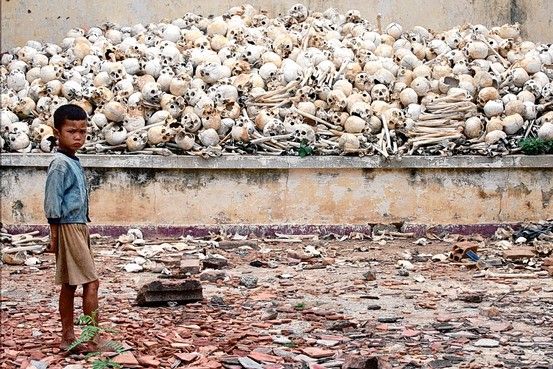
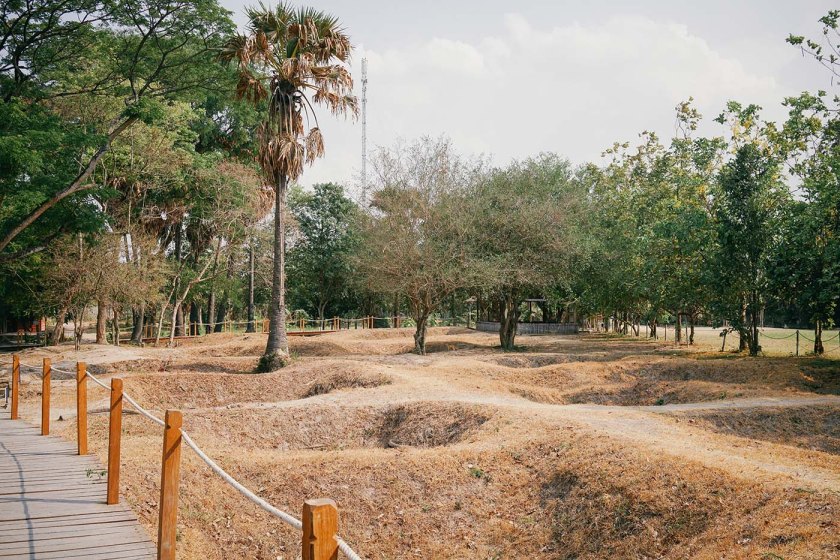
For generations, European colonists exploited the mineral resources of “French Indochina”.  Now, abandoned mine shafts filled with the bones of the slain.

Whole cities were liquidated as “parasitic” and “corrupt”.  Shop owners, business people and educators.  Police officers, government employees and ethnic minorities such as Chinese, Vietnamese and Cham.  All were driven from their homes and murdered as “class enemies”.  Anyone who so much as wore eyeglasses or owned a wristwatch, was as good as dead.

killingfields-ft-1.m

Today, the Tuol Sleng (“Hill of Poisonous Trees”) Genocide Museum occupies the former  Chao Ponhea Yat High School, operated during the Cambodian Genocide as Security Prison 21.  In its day, “S-21” held and estimated 20,000 people at one time or another – no one knows for sure.   Between 1976 and ’79, only seven adults survived this place.

The Khmer Rouge operated at least 150 such torture and execution facilities.

There, Khmer interrogators extracted “confessions” by torture.  After two to three months, victims would eagerly agree to anything, thousand-word “confessions” weaving true stories into outlandish tales of conspiracy with Vietnamese, KGB and CIA operatives.  Friends, families and acquaintances would be identified in such narratives as they in turn, would be brought in for “interrogation”.

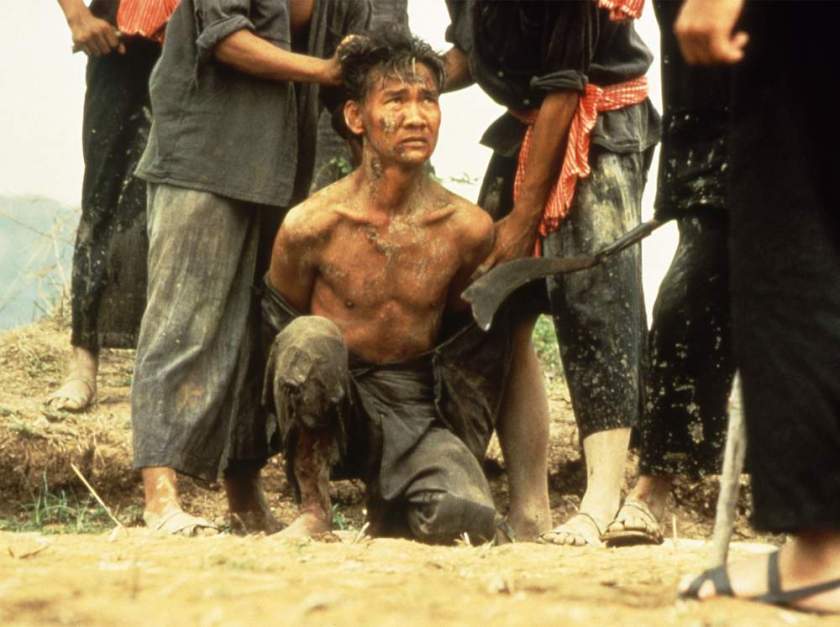
All were turned over to extermination centers, where squads of blank-eyed teenagers awaited with machetes, pick axes and iron bars.  Ammunition was too expensive.

The vast majority of victims were Cambodian, but not all.  488 Vietnamese passed through S-21, as did 31 Thai, one Laotian, an Arab, one Brit, four French, two Americans, a Canadian, one New Zealander, two Australians, and an Indonesian. An unknown number of Indians and Pakistanis also passed through the facility.  Not one foreigner survived.

greenculturaltravel-cambodia-tours-killing-fields-1
One among 20,000 mass grave sites, in Cambodia

The Khmer Rouge is estimated to have executed over 1.38 million people in this way, with death by starvation, torture, overwork and disease accounting for some 2½ million more.  Twenty-five per cent, of the entire nation.

The last straw came on April 18, 1978, four miles over the border into Vietnamese territory.  Khmer Rouge troops took a page out of their own playbook, murdering 3,000 Vietnamese civilians in what came to be known as the Ba Chuc Massacre.

The New York Times reported:

“The Khmer Rouge then used the same formula for execution as in Cambodia. ‘They pointed their weapons and ordered us to come to a meeting with their superiors,’ said Nga, a dignified, soft-spoken woman.

She was forced toward the border with parents, siblings, husband and six children. Suddenly, their escorts began clubbing the children. Her youngest daughter was struck violently on the head three times and cried ‘Mother, Mother.'”

Four years earlier, North Vietnam had helped the Khmer Rouge take power.  Now the Vietnamese government staged a massive invasion of its neighbor.  By January 7, 1979 it was over, the Khmer regime toppled and a new government installed in Phnom Penh.

k5

Cambodian journalist Dith Pran managed to escape the regime, one among millions swept up in the humanitarian disaster in the wake of the war in Vietnam, and the “Killing Fields” of Cambodia.   It was he who coined the term.

Justice was slow in coming.  Most senior Khmer officials would not be tried, until well into the twenty-first century.  Pol Pot died quietly in his bed, in 1998.

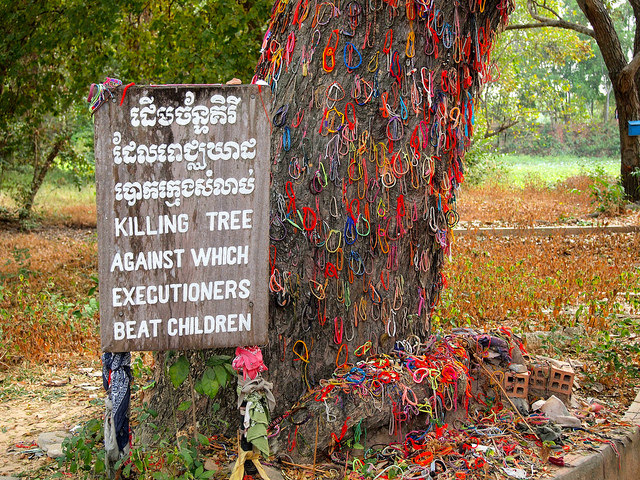
Feature image, top of page:  At least 10,000 children were bashed to death against “killing trees”, of which this is but one.

January 4, 1903 Electrocuting an Elephant

In the six years I’ve been writing “Today in History”, I’ve written about 700 of these stories. A father isn’t supposed to have favorites among his “children”, but I have to confess. I do. This is not one of those. This story, I detest.

Thomas Edison didn’t invent the light bulb.  The first platinum filament bulb arrived some forty years earlier. What he did was to make the thing commercially viable, earlier versions being too expensive, and too quick to burn out. Edison went through thousands of materials before discovering the right filament, finally landing on carbonized bamboo leading to his famous quip, “I have not failed. I’ve just found 10,000 ways that won’t work.”

topsy
Topsy

Half a world away from Edison’s workshop, an elephant was born in the jungles of Southeast Asia, captured by elephant traders and smuggled into the United States.

Adam John Forepaugh, owner of the Forepaugh Circus, bought the animal and named her “Topsy”, after a slave girl from Harriet Beecher Stowe’s novel, Uncle Tom’s Cabin.

Circuses of the era were known for sleazy business practices. Adam Forepaugh was at home in this environment. The Forepaugh circus claimed Topsy was the first elephant born in America, a hoax publicly exposed when the elephant trader who sold the animal, tipped off arch-rival circus operator, P.T. Barnum.

Edison opened his first electrical power plant in 1882, in New York city. Two years later, a young Serbian immigrated to America, and went to work for Edison. His name was Nikola Tesla. Tesla was himself a brilliant inventor and helped his boss improve his Direct-Current generators, while simultaneously developing a different method of electrical distribution: Alternating Current.

Tesla tried to convince Edison the future belonged to AC, but the “Wizard of Menlo Park” was adamant. AC had no future he claimed, Edison would not budge. Tesla quit his job in 1885 and applied for several patents for his work in AC technology. In 1888, he sold his patents to industrialist George Westinghouse, and the Westinghouse Electric Company. The “War of the Currents” had begun.

edison-first-bulb
Edison’s first bulb

Topsy grew to be 10-feet tall and twenty-feet long, and worked for the circus for 27 years.  She gained a reputation for being a “bad” elephant, but it’s hard to separate circus hype, from reality.  Newspapers of course, were happy to play along.   These were the days of Yellow Journalism, and circulation wars were red hot.  Newsies hawked lurid headlines, on the streets. Anything to sell papers – extra extra, read all about it.

forepaugh-elephants-(no-dat

Topsy was supposed to have killed twelve men by 1900.  More common accounts claim she had killed two Forepaugh & Sells Brothers’ Circus workers: one in Paris, Texas and one in Waco.  Journalist Michael Daly wrote in 2013 there is no record of anyone killed by an elephant in Waco.  The handler attacked in Paris received injuries, but there is no record of his being killed.

No matter, the story sold papers.  It was great for attendance too.  People crowded into the circus to see the “man-killing elephant”.

Topsy and the other elephants were being unloaded from a train in June 1902, when one Louis Dodero thought he’d”tickle” her, behind the ear. Topsy seized him around the waist and lifted him high, before hurling him to the ground. It could have been worse but a handler stepped in and savaged her, with a fork.

topsy_the_elephant
An illustration of Topsy from the St. Paul Globe on June 16, 1902. H/T Smithsonian.com

Meanwhile, Edison felt threatened by the rise of AC, which could be distributed over long distances far more cheaply, that DC.  Edison launched a propaganda campaign, publicly executing several dogs and even a horse, to demonstrate the dangers of AC.

When New York came looking for a more humane way to execute the condemned, the one-time opponent of capital punishment recommended an electric chair. In 1890, convicted murder William Kimmler was the first person to die in an electric chair, the apparatus powered by a Westinghouse AC generator designed by a salesman secretly on Edison’s payroll.

Despite such propaganda, Tesla’s low-cost alternative won out. Westinghouse won the contract to power the 1893 World’s Fair in Chicago, and the all-important generators, at Niagara Falls. The War of the Currents was over by 1896. AC has remained dominant in the power industry, to this day.

the current war

In March 1902, one James Fielding Blount entered the elephant’s tent, possibly drunk.  Accounts vary as to what happened next.  The common story is that Blount began teasing the animals each in turn, offering the elephants a bottle of whiskey. He reportedly threw sand in Topsy’s face and then burned the tip of her trunk with a cigar.  Topsy hurled the fool to the ground and crushed the life out of him

320px-topsy_elephant_electrocution_luna_park,_coney_island_january_1903
Being led to the place of execution

Forepaugh sold their “bad” elephant in June, when she was added to the animal menagerie at Coney Island’s Sea Lion Park. William “Whitey” Alt, Topsy’s handler, came along.

A bad summer season and heavy competition convinced owner Paul Boynton to get out of the business. New owners Frederick Thompson and Elmer Dundy decided to expand the park, and Topsy was put to work moving timbers and heavy equipment.

Newspapers and publicity shots characterized the work as “penance” for Topsy’s rampaging ways.

Meanwhile Alt, an habitual drunk and the only person who could handle her (albeit brutally), stabbed Topsy with a pitchfork and then set her loose to run free in the streets. The episode led to Alt’s arrest as did another, in which the drunk handler rode the elephant through the streets of Coney Island and into a local police station, causing the officers to dive for the cells for protection.

Alt was fired after that episode, and the owners claimed they had no way of handling the park’s elephant.  Thompson and Dundy tried to give her away without success, before hitting on an idea.  They would execute their problem elephant by hanging, and charge admission to witness the spectacle.

electrocuting_an_elephant_edison_film_1903_frame_shot

President of the American Society for the Prevention of Cruelty to Animals John Peter Haines got wind of the plan, and objected to the “needlessly cruel” means of execution. Weeks of negotiations ensued, in which the owners offered to give Topsy to the SPCA, before settling on an “all of the above” means of execution including poison, strangulation by means of ropes tied to a steam powered winch, and electrocution.

The execution was carried out on August 4, 1903 and recorded by an Edison film crew, one of many “actuality” films produced by the Edison Mfg. Co. from 1897, on.  The short film “Executing an Elephant” runs for 74 seconds. You can find it on Youtube if you are so inclined. I don’t want to see it again.

In the following years, Thomas Edison was blamed for staging the spectacle, to discredit his rival. The story is repeated from that day to this, but it’s a myth.

Edison lost his battle to supply the world’s electricity, years before. There’s no evidence he was even there on the date of execution, and his written correspondence contains no mention of it.  This then, is the story of an innocent animal, caught between ignorance and a changing business climate.  I do not think I could hate this story, more.


January 3, 2000 Peanuts

Over fifty years, Schulz drew nearly 18,000 strips, taking vacation only once in 1997, to celebrate his 75th birthday.  In all that time, that five-week stretch was the only time the papers ever had Peanuts reruns.

Schutz-LetterCharles Monroe Schulz was one of the brighter kids at Central High School in Saint Paul, Minnesota, but that didn’t help his social life. He was already a shy boy and skipped two half-grades, graduating as the youngest student in the class of 1940.

The boy loved to draw. He was good at it, too. The family once owned a hunting dog called “Spike”, with the cringe-worthy habit of eating sharp objects. It didn’t seem to bother him much, and the boy sent a drawing to Ripley’s Believe It or Not! who ran it, complete with a description of Spikes unusual predilections.

The drawing was signed, “Sparky”.  Even with Schulz later celebrity, you could always Charles_Schulz_HS_Yearbookweed out those who merely claimed to know him, if they called him “Charles”, or “Chuck”.  Schulz’ uncle called him “Sparky” as a boy, after the horse Spark Plug in Billy DeBeck’s comic strip, Barney Google.  He always signed the strip “Schulz”, but friends and family knew him as Sparky, until the day he died.

Schulz was drafted into the Army in 1943, a Staff Sergeant with the 20th Armored Division in Europe and squad leader on a .50-caliber machine gun team.

He never got a chance to fire his weapon, though he did come face-to-face with a Wehrmacht soldier, once.  His blood must’ve turned cold in his veins when he realized he’d forgotten to load, but the man he faced was no Nazi fanatic.  This was just a guy, who wanted to go home. The German surrendered, happily.  I hope he did get to go home.

Schulz returned to Minneapolis after the war where he did lettering for a Catholic comic magazine, Timeless Topix. He took a job in 1946 at Art Instruction, Inc., reviewing and grading lessons submitted by students, a job he held for several years while developing his talents as comic creator.

1392261715-0

Charlie Brown, that little boy who was always close but never quite succeeded, first appeared in a series of single-panel jokes called “Li’l Folks“, along with a dog who looked something like Snoopy. It was published in the local papers from June 1947 to January ’50, and later syndicated.  The first strip was published in seven newspapers on October 2, 1950, but United Features thought the name was too close to two strips already in syndication, Li’l Abner, and “Little Folks“.

They called it “Peanuts” after the peanut gallery of the old Vaudeville days, the cheapest and rowdiest seats in the theater. Schulz didn’t like the name, saying it “made it sound too insignificant,” but the name, stuck.

Peanuts

Schulz took pride in his service during the war, and his strip paid tribute to Rosie the Riveter and Ernie Pyle.  More than any other, he’d honor “Willy & Joe”, those two GIs from the imagination of war correspondent and cartoonist Bill Mauldin, a man to whom Schulz always referred as “My Hero”.  Over the years, Snoopy visited with Willie & Joe no fewer than 17 times. Always on Veterans Day.

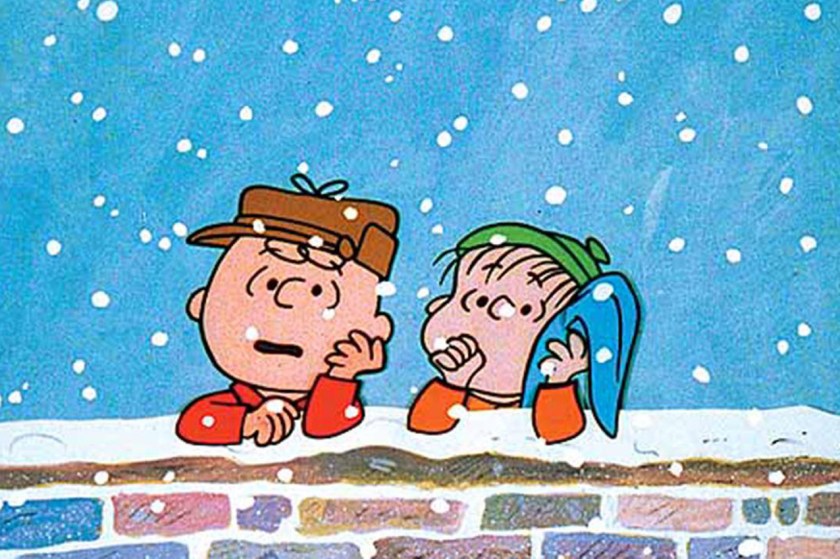
A Charlie Brown Christmas has been a staple of the Christmas season since 1965, but Linus almost didn’t get to tell his famous story of the baby Jesus. ABC executives thought Linus’ recitation of the birth of Christ too overtly religious.  They wanted a laugh track too, but Schulz refused. “If we don’t do it, who will?” So it was that the scene remained, perhaps the most memorable moment in cartoon history. The laugh track version was produced, but never aired.

a-charlie-brown-christmas-abc-11302015

Charlie Brown’s love interest in some of the TV specials, the “Little Red-Haired Girl”, was based on an accountant from that old job at Art Instruction, Donna Mae Johnson.  The two had an office romance, but she turned him down when he proposed they marry.

She wasn’t the only character based on a real person.  Linus and Shermy were patterned after Schulz’ close friends Linus Maurer and Sherman Plepler.  Peppermint Patty was inspired by a cousin on his mother’s side, Patricia Swanson.  Snoopy himself resembles that old family dog Spike, though he was a Pointer, not a Beagle.

American opinion polls showed a sharp drop in support for the war in Vietnam over 1967.  1968 was a wretched year in American politics, beginning with the Tet Offensive in January.   Media reporting turned the American military victory over the Vietnamese New Year, into a thing of despair.  President Johnson withdrew from the Presidential election, that March.  Martin Luther King, Jr. was assassinated in April and riots swept through cities across the country.  Robert F. Kennedy was assassinated that June, after winning the critical California primary.  The Democratic National Convention that August more closely resembled a riot, than a political convention.

Franklin_(Peanuts)
Franklin Armstrong

Race relations were particularly vile, when Los Angeles schoolteacher Harriet Glickman wrote to the cartoonist, asking if he could add a black character.  Glickman never expected a response from the now-famous Charles M. Schulz, but respond he did.  He said he liked the idea, but expressed a concern about seeming “condescending”, to black families.  With Schulz’ permission, Glickman asked friends of African ancestry, how to make such a character “more relatable”.

Franklin Armstrong made his first appearance on July 31, 1968.  What was remarkable for the time, was how unremarkable, he was.  Just another little boy, at first confused about the strange stuff in Charlie Brown’s neighborhood.  Particularly Linus’ obsession with the ‘Great Pumpkin’.  Franklin first met Charlie Brown on a beach.  He said his father was a soldier, off fighting in Vietnam.  “My dad’s a barber,” said Charlie Brown.  “He was in a war too, but I don’t know which one.”

One newspaper editor wrote saying he didn’t mind a “negro” character, but please don’t show them in school together.  Schulz didn’t bother to respond.

Universal Studios Japan

I wonder if Donna Mae Johnson ever regretted turning down that marriage proposal.  Peanuts went on to become a pop culture phenomenon, with countless animated specials combining with merchandise sales to produce revenues in the Billions.  At it’s peak, Peanuts ran in 2,600 papers in 75 countries and 21 languages.  Schulz himself is estimated to have earned $30 to $40 million, a year.

Snoopy-Believe-It-Or-Not-560x290

The command module for the 1969 Apollo 11 mission to the moon was named Charlie Brown and the lunar module, Snoopy.  President Ronald Reagan was a fan, and once wrote to Schulz that he identified with Charlie Brown.

Imitation of Charles Schulz cartoon, mad

Over fifty years, Schulz drew nearly 18,000 strips, taking vacation only once in 1997, to celebrate his 75th birthday.  In all that time, that one five-week stretch was the only time the papers ever had Peanuts reruns.

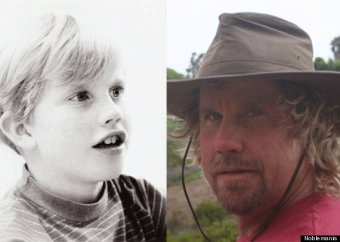
o-STEPHEN-SHEA-570
Stephen Shea, H/T Huffington Post

Fun fact: Former child actor Stephen Shea inherited the speaking role for Linus van Pelt when his older brother Chris’ voice changed, and went on to perform in eight animated specials. Chris went to summer camp with a boy who happened to be President of The Doors fan club. It turns out that Jim Morrison was a big Peanuts fan, and invited Chris and his father to be his special guests, at a concert.

Schulz’ health began to deteriorate in the late 1990s, his once-firm hand, now developing a tremor. He never really recovered from the stroke that hit him in November 1999 and announced his intention to retire, on December 14.  The last original Peanuts strip was published on January 3, 2000. This son of a barber and a housewife, just like Charlie Brown himself, passed away just over a month later, a victim of colon cancer.

There will never be another.

470fb32d30dce0ef207d56ab998cf9c8--the-peanuts-peanuts-snoopy

If you enjoyed this “Today in History”, please feel free to re-blog, “like” & share on social media, so that others may find and enjoy it as well. Please click the “follow” button on the right, to receive email updates on new articles.  Thank you for your interest, in the history we all share.


January 2, 1492 La Reconquista

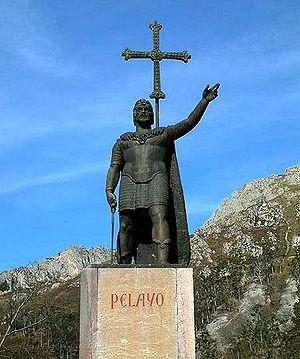
A Christian military force under Pelagius,(aka “Pelayo”), the future first King of Asturias, met the invaders at “Covadonga”, meaning “Cavern of the Lady”.  The Arabic name for the place is “Sakhrat Bilāy” “the Rock of the Affliction”.  The two names tell the tale about the outcome, of the battle.

The manner by which Roderic ascended to the throne of the Visigothic Empire is unclear. His history as any other, was written by the victors.  Unbiased contemporary sources do not appear to exist. What Is known is that someone in the early 8th century Iberian Peninsula, thought Roderic an illegitimate King.

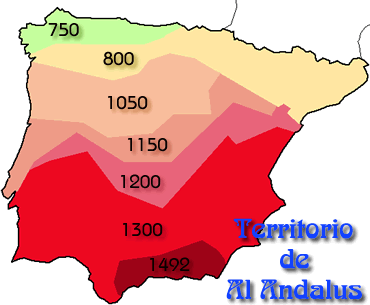
al-andalusThat someone appears to have gone to Mecca looking for help from the BanūʾUmayya, the “Sons of Umayya”, the second such center of Islamic power since the time of Muhammad and known to history as the Umayyad Caliphate.

In 711AD, a force of some 1,700 Arab and North African horsemen, the Berbers, landed on the Iberian Peninsula led by Tariq Ibn Ziyad.  384 years before the first Christian Crusade, the Umayyad conquest of Hispania was on.  Within ten years, most of what we now know as Portugal and Spain had become “al-Andalus”; five administrative districts under Muslim rule, save for the fringes of the Pyrenean mountains, and the highlands along the northwest coastline.

The first significant Christian victory and what may constitute the beginning of reconquest, “La Reconquista”, took place along that northern fringe. That sliver of Christianity was the Kingdom of Asturias. The refusal to pay the Jizya, the Muslim tax on “unbelievers”, brought them into conflict with an Umayyad force in the summer of 722.

A Christian military force under Pelagius, (aka “Pelayo”), the future first King of Asturias, met the invaders at a place called “Covadonga”, meaning “Cavern of the Lady”.  The Arabic name for the place is “Sakhrat Bilāy” “the Rock of the Affliction”.  The two names tell a tale about the outcome, of the battle.

covadonga
Covadonga

The Arab chronicles record Covadonga as a small skirmish while the Spanish record a great victory, but two things are near certain. In 770 years, no Muslims force ever returned to Asturias.  Without Pelagius’ victory at Covadonga, we’d almost certainly never have heard of Ferdinand and Isabella, let alone a certain Italian explorer whom the pair sent off in 1492, in search of a sea route to China.

It was close to 400 years before the crusading knights of Europe came to the aid of the Iberian Kings. With help from the Knights Templar and Hospitaller. Alfonso VI captured Toledo in 1085, beginning a long period of gradual Muslim decline.

don_pelayo

The Portuguese nation was a mere county in the early 12th century, dependent on the Crown of León and Castile, one Alfonso VII. His cousin, three year old Alfonso Henriques, followed his father as the Count of Portugal in 1122.

At the age of 14, the age of majority in the 12th century, the boy proclaimed himself a knight and raised an army against his cousin. The county’s people, church and nobles were demanding independence when, his cousin vanquished, Alfonso Henriques declared himself Prince of Portugal. Following ten years of near-constant fighting against Moors and rival Christian Kingdoms alike, Alfonso was unanimously proclaimed the King of an Independent Portugal on July 25, 1139.

Portugal would be annexed to Spain in 1580, regaining its independence sixty years later and leading many to believe that Portugal is the younger between the two countries. It isn’t so. Portugal was an independent, self-governing nation, more that 350 years before her Spanish neighbor.

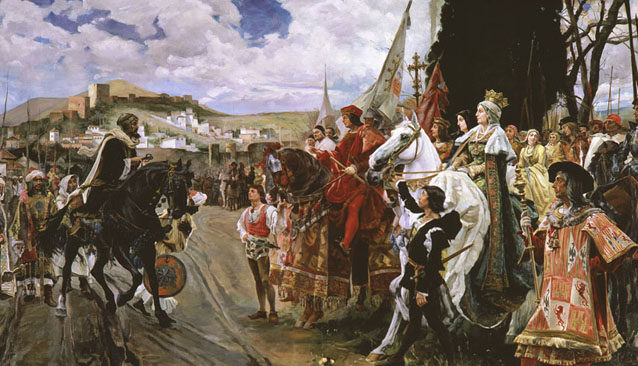
Following the Christian re-conquest of Córdoba in 1236, the Emirate of Granada was all that was left of al-Andalus. Granada became a tributary state to the Kingdom of Castile two years later.  Finally, on this day in 1492, Emir Muhammad XII surrendered the Emirate of Granada to Queen Isabella I of Castile, and her husband King Ferdinand II of Aragon.

jhr-16-1-chalmers1-l
Ferdinand & Isabella. March 31, 1492 Edict of Expulsion

For the six years I’ve written “Today in History”, the first thing I do is search on a date, and select an interesting topic from the list.  To date, I’ve written about seven hundred. 

As I review these lists, I am perpetually surprised and not a little horrified, at the never ending recurrence of barbarity against the Jews of the world. It’s not the pogroms and the massacres which surprise me, but rather their appalling frequency, over 2,000 years.

The paroxysm of cruelty and paranoia now known as the Spanish Inquisition begun in 1478, was not a standalone event. In part, this passion for religious unity was the result of 700+ years of Muslim domination of the Iberian Peninsula. One of the early results of this manic drive for ideological purity was the Edict of Expulsion of 1492, resulting in the forced conversion of some quarter-million Spanish Jews, the “conversos“, and the expulsion of as many as 100,000 more.

Untold numbers lived lives of “marranos” (from the Hebrew marit ayin: “the appearance of the eye”), secretly practicing Jews forced on pain of death, to adopt the outward signs of Christianity.

Maimon-Marrans

This date, originally selected to signify Ferdinand and Isabella’s final defeat of the Islamic conquest of Spain, has yet another significance. It is only within living memory that descendants of Spanish Jews, the Sephardim, have returned in any significant numbers to their homeland. The first native Jewish child born in Spain since Christopher Columbus discovered America, was born on this day, January 2, 1966.

If you enjoyed this “Today in History”, please feel free to re-blog, “like” & share on social media, so that others may find and enjoy it as well. Please click the “follow” button on the right, to receive email updates on new articles.  Thank you for your interest, in the history we all share.

January 1, 45 BC Happy New Year

A time ball is a marine time signaling device, a large painted ball which is dropped at a predetermined rate, enabling mariners to synchronize shipboard marine chronometers for purposes of navigation. The first one was built in 1829 in Portsmouth, England, by Robert Wauchope, a Captain in the Royal Navy. Time balls were obsolete technology by the 20th century, but it fit the Times’ purposes.

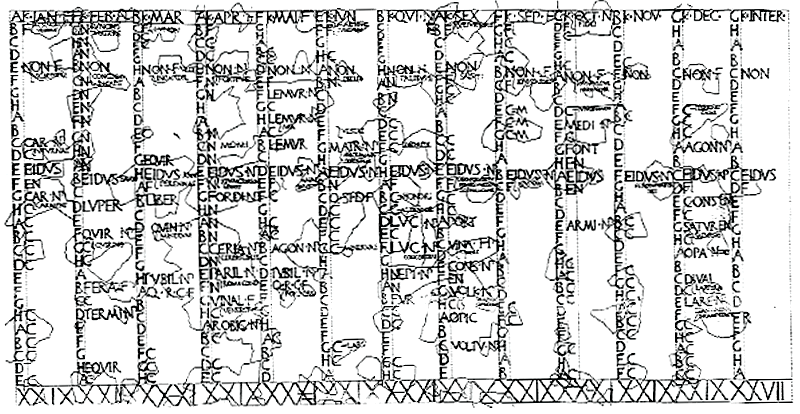
From the 7th century BC, the Roman calendar attempted to follow the cycles of the moon. The method frequently fell out of phase with the change of seasons, requiring the random addition of days. The Pontifices, the Roman body charged with overseeing the calendar, made matters worse. They were known to add days to extend political terms, and to interfere with elections. Military campaigns were won or lost due to confusion over dates. By the time of Julius Caesar, things needed to change.

When Caesar went to Egypt in 48BC, he was impressed with the way the Egyptians handled their calendar. Caesar hired the Alexandrian astronomer Sosigenes to help straighten things out. The astronomer calculated that a proper year was 365¼ days, which more accurately tracked the solar, and not the lunar year. “Do like the Egyptians”, he might have said, the new “Julian” calendar going into effect in 46BC. Caesar decreed that 67 days be added that year, moving the New Year’s start from March to January 1. The first new year of the new calendar was January 1, 45BC.

Caesar synchronized his calendar with the sun by adding a day to every February, and changed the name of the seventh month from Quintilis to Julius, to honor himself. Rank hath its privileges.

Not to be outdone, Caesar’s successor changed the 8th month from Sextilis to Augustus. As we embark on the third millennium, we still have July and August.

Roman-calendar (1)
Roman Calendar

Sosigenes was close with his 365¼ day long year, but not quite there. The correct value of a solar year is 365.242199 days. By the year 1000, that 11 minute error had added seven days. To fix the problem, Pope Gregory XIII commissioned Jesuit astronomer Christopher Clavius to come up with yet another calendar. The Gregorian calendar was implemented in 1582, omitting ten days and adding a day on every fourth February.

Most of the non-Catholic world took 170 years to adopt the Gregorian calendar. Britain and its American colonies “lost” 11 days synchronizing with it in 1752. The last holdout, Greece, would formally adopt the Gregorian calendar in 1923. Since then, we’ve all gathered to celebrate New Year’s Day on the 1st of January.

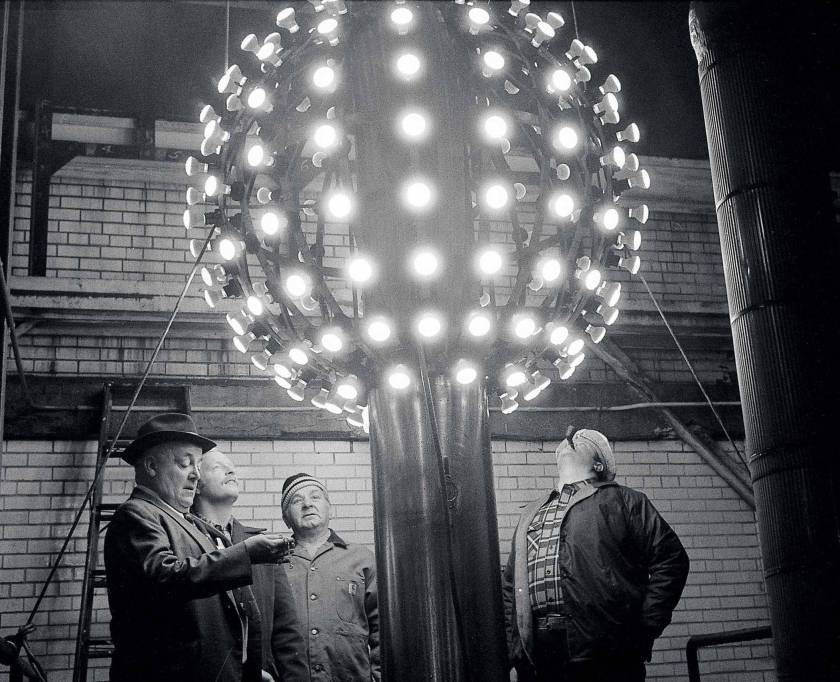
The NY Times Newspaper moved into “Longacre Square” just after the turn of the 20th century. For years, New Years’ eve celebrations had been held at Trinity Church. Times owner Adolph Ochs held his first fireworks celebration on December 31, 1903, with almost 200,000 people attending the event. Four years later, Ochs wanted a bigger spectacle to draw attention to the newly renamed Times Square. He asked the newspaper’s chief electrician, Walter F. Painer for an idea. Painer suggested a time ball.

83_big.jpg

A time ball is a marine time signaling device, a large painted ball which is dropped at a predetermined rate, enabling mariners to synchronize shipboard marine chronometers for purposes of navigation. The first one was built in 1829 in Portsmouth, England, by Robert Wauchope, a Captain in the Royal Navy. Time balls were obsolete technology by the 20th century, but it fit the Times’ purposes.

The Artkraft Strauss sign company designed a 5′ wide, 700lb ball covered with incandescent bulbs. The ball was hoist up the flagpole by five men on December 31, 1907. Once it hit the roof of the building, the ball completed an electric circuit, lighting up a sign and touching off a fireworks display.

best_4d32a97cf1505d8dca5f_sompixnyctimessquareballvintage.jpg

The newspaper no longer occupies the building at 1 Times Square, but the tradition continues. The ball used the last few years is 12′ wide, weighing 11,875lbs; a great sphere of 2,688 Waterford Crystal triangles, illuminated by 32,256 Philips Luxeon Rebel LED bulbs and producing more than 16 million colors. It used to be that the ball only came out for New Year. The last few years, you can see the thing, any time you like.

times-square-ball (1).jpg

In most English speaking countries, the traditional New Year’s celebration ends with the singing of “Auld Lang Syne”, a poem written by Robert Burns in 1788 and set to the tune of an old pentatonic Scots folk melody. The original verse, phonetically spelled as a Scots speaker would pronounce it, sounds something like this:

“Shid ald akwentans bee firgot, an nivir brocht ti mynd?
Shid ald akwentans bee firgot, an ald lang syn?
CHORUS
“Fir ald lang syn, ma jo, fir ald lang syn,
wil tak a cup o kyndnes yet, fir ald lang syn.
An sheerly yil bee yur pynt-staup! an sheerly al bee myn!
An will tak a cup o kyndnes yet, fir ald lang syn”.
“We twa hay rin aboot the braes, an pood the gowans fyn;
Bit weev wandert monae a weery fet, sin ald lang syn”.
CHORUS
“We twa hay pedilt in the burn, fray mornin sun til dyn;
But seas between us bred hay roard sin ald lang syn”.
CHORUS
“An thers a han, my trustee feer! an gees a han o thyn!
And we’ll tak a richt gude-willie-waucht, fir ald lang syn”.

If you enjoyed this “Today in History”, please feel free to re-blog, “like” & share on social media, so that others may find and enjoy it as well. Please click the “follow” button on the right, to receive email updates on new articles.  Thank you for your interest, in the history we all share.  Happy New Year

December 30, 1951 Chief Dog Sinbad, USCG

Sinbad’s breed was best described as “liberty-rum-chow-hound, with a bit of Bulldog, Doberman, Pinscher, and what-not. Mostly what-not”- Martin Sheridan Life Magazine, December 1943.

In times of peace, the United States Coast Guard is charged with protecting the security of the nation’s borders, maritime law enforcement and rescue operations. One of seven uniformed military service branches, Coast Guard operations may be expanded in time of conflict, or by order of the Commander-in-Chief.

During WW2, the Coast Guard operated hundreds of vessels from patrol frigates to troop ships, performing convoy escort, anti-submarine and replenishment operations. Many of the landing craft used in amphibious operations were operated by Coast Guardsmen. There may be no group in the employ of the United States government, better qualified to navigate the shoals, surf and strong currents encountered by small boats, in shallow water.

Semper Paratus. Always Ready.

Sinbad_pawprint-517x640In the winter of 1937, the Coast Guard cutter USCGC George W. Campell steamed out of New York harbor, patrolling the east coast with a mission of life-saving and national defense. The night before, Chief Boatswain’s Mate A. A. “Blackie” Roth (the name is also given as “Rother”) had given his girlfriend, a puppy. She couldn’t keep him, the landlord wouldn’t allow it. No other crewman could take the small dog. It was either leave him astray and hope for the best, or smuggle the puppy on board.

The Captain addressed the assembled crew on the first day of the cruise. Oh, to have been a fly on the wall, when one of them, barked back.

They called him “Sinbad”, and gave him a uniform, a service record and a rank.  Dog, 1st class.

Sinbad quickly learned ship’s routine, and often “racked” with other sailors.  He could always be found near the galley knowing that’s where the food comes from, and he loved himself a cup of black coffee.

Sinbad_2Sinbad’s favorite toys were the large metal washers which he’d hide, until someone came to play with him.  They even built him a hammock, much more comfy to sleep in, in those long Atlantic swells.

Sinbad was possessed of the best qualities of the sailor and of his own kind, and of the worst.  In 1940, he nearly set off an international incident.

With the dark clouds of WW2 already over Europe, Denmark was overrun and occupied, by Nazis.  Greenland was once a Danish territory, and the allies hoped to keep the place out of German hands.  Campbell was sent to secure diplomatic ties with the Danes and the Greenlanders, who lived there.

Greenland is thinly populated, a place where locals mainly fish and raise sheep, for a living.  On shore for a week, Sinbad was quick to discover the pastures and the great fun of chasing sheep.  The sheep themselves were not amused and some died of exhaustion. Others became too nervous to go out and eat.  The owners weren’t amused either, and one demanded that Sinbad be shot.

The captain thought that too severe a punishment and Sinbad was banished, never to set foot on Greenland, again.  There was no end of amusement among the crew of the Campbell, that Sinbad had been brought before a Captain’s mast. It would not be his last.

Campaign_ribbon
Sinbad was awarded the American Defense Service Medal, American Campaign Medal, European-African-Middle-Eastern Campaign Medal, Asiatic-Pacific Campaign Medal, World War II Victory Medal and Navy Occupation Service Medal, which he wore, attached to his collar.

When war came, the cutter was transferred to the Navy, and the patrols became longer.

Sinbad_Statue_on_909
“Sinbad’s statue in Campbell’s mess hall watching over the ship. Captain James Hirschfield believed the WWII Campbell would survive after being disabled in combat so long as Sinbad stayed aboard”.

In the winter of 1943, Campbell was assigned to convoy protection, defending the vital north Atlantic supply route from roving “wolf packs” of German submarines.  Sinbad never did get used to the sound of gunfire or depth charges, and would hide below decks, his paws over his ears.  On February 22, the German submarine U-606 unleashed a barrage of torpedoes, against an allied convoy.

A day-long game of cat & mouse ensued in which the sub would pop up for another attack, only to be swarmed and driven into yet another crash dive.  A periscope was spotted at 7:26 pm and Campbell charged in with a string of depth charges, colliding with the sub at the end of the run.  U-606 was destroyed and Campbell badly damaged, disabled and without power, due to flooding.

All but “essential personnel” were evacuated  Captain James Hirschfield felt that Sinbad was good luck.  No harm could befall the cutter while he was on board, and so he remained, essential personnel, taken under tow for repairs by the Polish destroyer, Burza.  Sinbad had remained on deck with “his boys”, throughout the action.

Sinbad’s breed was best described as “liberty-rum-chow-hound, with a bit of Bulldog, Doberman, Pinscher, and what-not. Mostly what-not”- Martin Sheridan Life Magazine, December 1943.

Sinbad was promoted in 1943 to the rank of K9C, “Chief Dog” – equivalent to Chief Petty Officer – the second of only two dogs to be classified as non-commissioned officers.  Since that time, ‘regulations’ have transformed all subsequent animals into “property” rather than personnel.

Fun fact:  The first was Sergeant Stubby, the Staffordshire Terrier who was smuggled “over there” during the Great War, and once caught a German spy by the arse while he was prowling about allied trenches.

Campbell served the duration of WW2, with Sinbad on board, the entire time.  In 1948, he was ready to retire.  Sinbad had been at sea for eleven years.   He was finally ready for shore detail.

Sinbad_1-640x463
After eleven years at sea, Sinbad was “retired” to enjoy the comfortable life of a mascot, at the Barnegat shore station.,

The assembled media and photographers were too much that day, and Sinbad bolted across the gang plank, and down the dock.  To be AWOL from a United States Coast Guard cutter is a serious offense, and Sinbad was busted in rank, back to Dog, 1st class.  He was probably just as happy to be back with the enlisted guys.

Sinbad was transferred to the Barnegat Light Small Boat Station in New Jersey, where he served as station mascot for the duration of his military career.

Sinbad_Retirement
Sinbad is welcomed aboard by the crew of the Barnegat light station

Chief Dog Sinbad served all of his fourteen years with the United States Coast Guard.  He passed away on this day in 1951 at the Barnegat light station and is buried there, at the base of the flagpole.  A sailor always, Sinbad could drink with the best of them, and always enjoyed that cuppa black coffee.  Irrespective of his latest rank, he was many years, a media celebrity.  Life magazine may have said it best:  “An Old Sea Dog Has Favorite Bars and Plenty of Girls in Every Port.”

Throughout her 46 years of service, USCGC Campbell was referred to as “The Queen of the Seas”.  She was sunk as a training target in November 1984, a single harpoon missile leaving her nearly intact, as she went out of sight.  The final radio message, broadcast as she disappeared beneath the waves:  The Queen is dead.  Long live the Queen.

Today, the USCGC Campbell (WMEC-909) patrols the east coast out of the Portsmouth Naval Shipyard in Kittery, Maine, the sixth Coast Guard Cutter to bear the name.

sinbadgr

If you enjoyed this “Today in History”, please feel free to re-blog, “like” & share on social media, so that others may find and enjoy it as well. Please click the “follow” button on the right, to receive email updates on new articles.  Thank you for your interest, in the history we all share.

December 29, 1778 The Siege of Savannah

For the Americans and their allies, the frontal assault of October 9 was one of the bloodiest engagements, of the Revolution.  It could have been worse.  As battered American and French soldiers fell back, 500 free men of color known as the Chasseurs Volontaires de Saint-Domingue stepped up, to cover their retreat.

Many of these Haitian soldiers went on to win their own war of independence, and credited their military experience, to Savannah.

As 1778 drew to a close, British military planners could look back on five years of trying to suppress rebellion in the American colonies, with little to show for it.   In March of that year, the British defeat at Saratoga had brought France into the war, on the side of the Rebels.

Two years of open warfare had centered mostly on the north.   Now, a “southern strategy” was devised to conquer rebellious colonies in the south, while isolating those to the north. Key to the Southern Strategy was Georgia and the colonial capital at Savannah, the southernmost commercial port of the thirteen Colonies.

General sir Henry Clinton dispatched a force of some 3,100 from New York under Lieutenant Colonel Archibald Campbell, along with an unknown quantity of artillery. Campbell arrived outside Tybee Island on December 23.

Georgia was defended by two separate forces at this time, units of the Continental Army under the command of General Robert Howe, and state militia under the command of Governor John Houstoun.  The two men had a history of squabbling for control and most of their troops, had yet to be tried.

ArchibaldCampbell-by-George-Romney-239x300
Lieutenant Colonel Archibald Campbell, British commander at the capture of Savannah in December 1778

The 850 under General Howe never really had a chance, against the battle hardened Regulars, Hessian auxiliaries and Loyalist militia, coming ashore on December 29.  Defeat turned to rout when Howe’s forces threw down their weapons and ran.  Campbell reported that “It was scarcely possible to come up with them, their retreat was rapid beyond conception.

Patriot forces suffered 83 killed, 11 wounded and 453 captured. Campbell suffered 7 killed and 17 wounded.

Howe was court-marshaled for the disaster, while Campbell bragged about being “the first British officer to [rend] a star and stripe from the flag of Congress

Brigadier General Augustine Prevost arrived from St. Augustine Florida two weeks later, with a mixed force of Regulars and Creek and Cherokee allies.   Campbell and a force of 1,000 would take the provisional capital at Augusta that February but soon retreated to Savannah, citing insufficient support among Loyalist and Native American populations.

American hopes soon fell back on their new-found alliance with France. During the following summer, French Admiral Count Charles-Hector Theodat d’Estaing captured St. Vincent and Grenada in the British West Indies, clearing the way to the Georgia coast. The powerful 47-ship French fleet arrived with 4,000 troops on September 1, surprising and capturing several British ships outside the mouth of the Savannah River.

french-shipsD’Estaing sent an ultimatum to British Commander Augustine Prevost on September 16, 1779. He was to surrender the city “To the arms of his Majesty the King of France”, or he would be personally answerable for what was about to happen. It could not have pleased General Benjamin Lincoln or his Patriot allies when d’Estaing added “I have not been able to refuse the army of the United States uniting itself with that of the King. The junction will probably be effected this day. If I have not an answer therefore immediately, you must confer with General Lincoln and me”.

“Bullet Head Prevost”, so called because of a circular scar on his temple, stalled for 24 hours, using the time in furiously building up his defenses and calling up 800 reinforcements from South Carolina.

Lincoln joined d’Estaing on September 23 with an army of 3,000 militia and Continental soldiers, laying siege to Savannah and the 2,500 British and Loyalist troops in occupation.

On October 1, a British relief column under one Captain French was coming to the city’s aid, camped on the banks of the Ogeechee River. Georgia Continental Colonel John White had two officers, a sergeant and three privates with him, when he tricked French into surrendering. These guys ran through the woods lighting so many fires that the British thought the entire continental Army was bivouacked around them. Captain French was unavailable for comment but, it must be a special feeling, knowing that you just surrendered 111 guys to six, without firing a shot.

Scene-of-Savannah
View of the siege works against the town at the Siege of Savannah September and October 1779 in the American Revolutionary War: contemporary picture by a French officer

Lack of horses and artillery carriages delayed the allies’ moving their cannon ashore, so French warships bombarded the city from the sea. At one point shortly after Midnight on October 3, with rum rations flowing far too freely, fire from French gunners became more dangerous to themselves than to the city itself.

For the Americans and their allies, the frontal assault of October 9 was one of the bloodiest engagements, of the Revolution.  It could have been worse.  As battered American and French soldiers fell back, 500 free men of color known as the Chasseurs Volontaires de Saint-Domingue stepped up, to cover their retreat.

Many of these Haitian soldiers went on to win their own war of independence, and credited their military experience, to Savannah.

Franklin-Sq-Monument
Franklin Square Monument remembers the contributions of the Haitian militia, in the Siege of Savannah

 The siege of Savannah inflicted untold misery among the population, but Patriot forces and their French allies, never did break the city’s defenses. The siege broke a short time later, amidst recriminations on both sides.   D’Estaing returned to France, where he lost his head to the guillotine in 1794.

Savannah would remain in British hands until the end of the war, finally evacuated on July 11, 1782. A coquina marker in a small Savannah park; that soft, seashell limestone common throughout the Caribbean basin to Florida and beyond, bears a small brass plaque, darkened with the patina of age.

COMMEMORATIVE OF THE BRITISH EVACUATION OF SAVANNAH 1782
PRESENTED TO THE CITY OF SAVANNAH
BY THE
LACHLAN McINTOSH CHAPTER
DAUGHTERS OF THE AMERICAN REVOLUTION
1904

british-attack-on-american-forces-in-savannah-georgia-in-the-revolutionary-adw8m3-1
Attack of 2nd South Carolina Continentals on the Spring Hill Redoubt at the Siege of Savannah on 9th October 1779 in the American Revolutionary War: picture by A.I. Keller