November 13, 1985 The Awful Story of Omayra Sánchez

Omayra Sánchez Garzón was a little girl on this day in 1985, a typical thirteen-year-old and one among many, living in Armero.  There is not enough meanness in all the world, to wish on anyone what this one little girl would endure for the next three days.

Fifty miles from the Colombian capital of Bogotá, the municipality of Armero was once home to 30,000 souls.  Long known as “Colombia’s White City”, Armero was at one time a major cotton producer, seat of the prosperous agricultural region located in the northern Tolima Department, of Colombia.

Today, the place is a ghost town.

Omayra Sanchez Armero_lahar
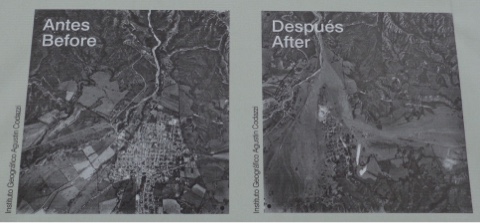
the “Armero Tragedy’, before and after

Some forty miles from Armero, the Nevado del Ruiz Stratovolcano in the Central Andes, is the site of three major eruptive periods since the early Pleistocene era.  The present volcanic cone formed some 150,000 years ago during the present eruptive period.  Known to locals as the “Sleeping Lion”, Nevado del Ruiz had not experienced a major eruption, since 1845.  140 years later, it was hard to imagine the thing presented much of a threat.

The eruption of November 13, 1985 was small by volcanic standards.  For its unsuspecting victims, it was a distinction without a difference.  Much as the ant may fail to notice.  He was crushed by a very small elephant.

Nevado del Ruiz armero(1).png
Nevado del Ruiz Stratovolcano

The eruption of Mount Vesuvius in 79AD was later described in a letter written by Pliny the Younger, describing the catastrophe that killed the philosopher’s uncle.  The “Plinian Eruption” which killed the Roman author and naturalist Pliny the Elder would be repeated half a world away and some 2,000 years later, as a sleeping lion came to life.

The fast moving clouds of gas and volcanic material came in the dead of night, the “pyroclastic flow” super-heated to 1,000° Fahrenheit and racing  away from the cone at speeds as high as 430 miles-per-hour.  Next came the Lahars, the violent and terrifying mud flow of pyroclastic material, rocky debris and vast quantities of water released by the near-instantaneous melting of the Nevado del Ruiz glacier.  Imagine a wall of rocky mud coming at you at 22mph, only a little slower than Jamaican sprinter Usain Bolt’s best 100-meter dash.  Usain Bolt just happens to be the fastest man who ever lived.

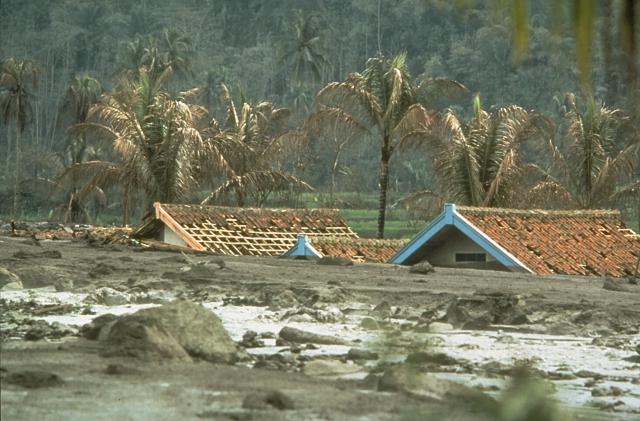
Mount Merapi Lahar, Central Java

Lahars flow at depths as great as 460-feet.  Vast, hideous walls of  mud, rock and debris the consistency of wet concrete, speeding down rivers and valleys.  The first of three lahars and the most powerful of that night wiped fourteen towns and villages from the face of the earth, killing as many as 20,000 in Armero, alone.

Galunggung_lahar.jpg
Galungung Lahar, Indonesia

Omayra Sánchez Garzón was a little girl on this day in 1985, a typical thirteen-year-old and one among many, living in Armero.  There is not enough meanness in all the world, to wish on anyone what this one little girl would endure for the next three days.

Many years ago, I found myself pinned under a car while working on the engine.  The motor and transmission assembly, free of its mount, swung down and pinned my hand underneath.  It obviously hurt but, more than that, there was the strangest feeling of being…trapped.  Permanently pinned in place like an insect in a child’s science project, entirely denied the power of voluntary movement.  It may as well have been a locomotive, sitting there on my fingers.

Omayra Sánchez suffered her legs to be so trapped, pinned under the collapsed stony structure of her own home, legs entangled in the dead arms of her aunt and submerged up to her neck, in water.

Omayra Sanchez Vignette

The nation of Colombia was a basket case at this time, engaged in a fight for its life with Leftist guerrilla organizations such as the M-19 Democratic Alliance (19th of April Movement), and the FARC.  The Palace of Justice siege of less than a week earlier resulted in the murder of fully half the 25-member Colombian Supreme Court, as the Colombian military mobilized across the capital city of Bogotá.

Rescue efforts on the ground in Armero were frantic, disorganized and mostly local.  Official government assistance was all but, non-existent, pumps altogether unavailable.  Soon even supplies of simple hand tools such as stretchers, shovels and cutting tools, began to give out.  Foreign aid rushed in from nations from around the world but, for most victims, such well-intended help arrived, too late..

ARMER06_1303158240

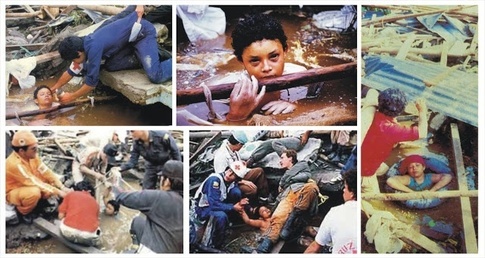
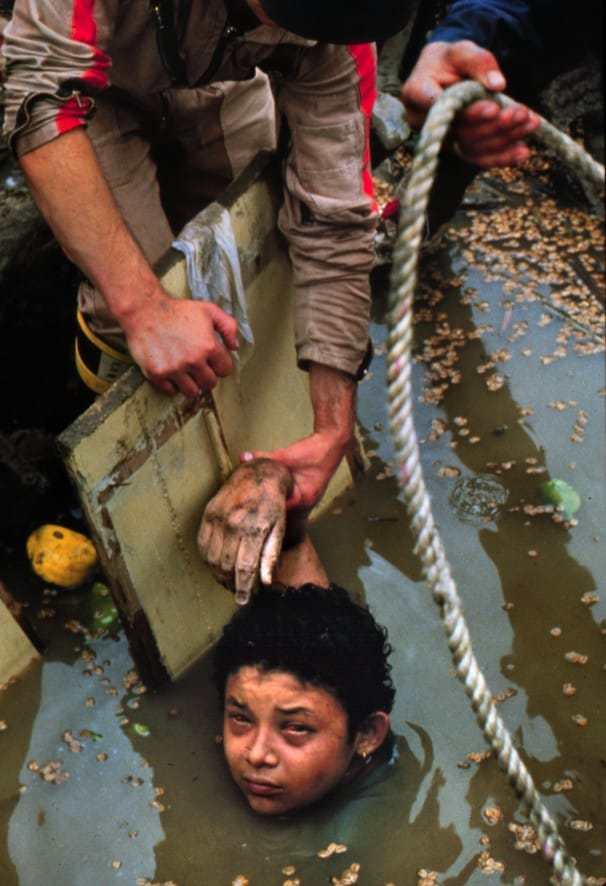
After the lahar passed, Sánchez found herself buried in rubble. She managed to get one hand out of the wreckage as rescuers desperately worked to clear the wood, stone and debris from her upper body.  As the water rose, a tire was placed around her body to keep her from drowning.  Divers attempted to free her legs, but without success.  She was trapped.  Bilateral amputation was considered but there were no means, even to remove the water.  In the end, doctors determined the most humane course was to comfort this child as much as humanly possible, and let her die.

Colombian Ambassador to Portugal Germán Santa María Barragán was at that time a journalist and volunteer in the Armero rescue.  Barragán was with Omayra for much of her last three days.  Sánchez herself remained relatively positive throughout the ordeal, sometimes asking for sweets or soda, sometimes even singing to the journalist.  Some times she cried and others, she prayed.  Stuck there as she was she agreed to be interviewed, her face and her desperate plight quickly becoming known, around the world.

“Colombia and half of the world remained with the bitter sensation that Omayra Sánchez could have been able to continue living after remaining for almost 60 hours trapped from head to toe amidst the rubble of Armero. Her face, her words, and her courage, which streamed throughout the world on television and were a heartbreaking image in the largest newspapers and magazines of the United States and Europe, remained a testimony of accusation against those who could have at the very least made the tragedy less serious. – Germán Santa María Barragán in El Tiempo, November 23, 1985

Omaira_Sanchez_2.jpg
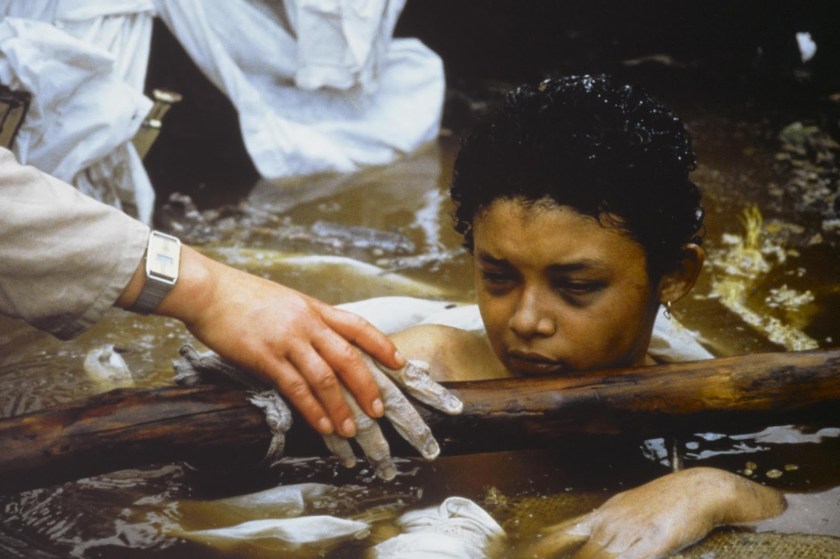
The color of her hands make it appear, as Sánchez is wearing gloves.  She isn’t.

French photographer Frank Fournier arrived at dawn on the 16th.  Omayra Sánchez had been in the water for nearly three days and nights by this time.  She was all but abandoned when Fournier first saw her, the whole place eerily silent, save for the occasional scream.

Fournier received vehement backlash for his pictures.  How could he do that, just taking pictures like that, without trying to help.  What are you, some kind of ghoul?  A “vulture”!?  Fournier himself had no means to help this girl, save to use his skill and his camera, to bring her story to the world.  He was a photographer.

Omayra Sanchez3

In her final hours, Sánchez began to hallucinate.  She asked the photographer to bring her to school.  She didn’t want to miss her lessons.  She had a math exam.  At one point she even told her rescuers, to go get some rest.

Omayra Sánchez was trapped for sixty hours with only head and shoulders above water, caught in a kneeling position and pinned under massive and impenetrable piles of bricks and masonry.  Her eyes reddened toward the end as her face swelled and her usually brown hands turned from pale, to white.

Two years later, the world held its breath for fifty-eight hours as scores of frantic volunteers worked ’round the clock, to free Baby Jessica from a West Texas well.  Omayra Sánchez waited sixty hours for a rescue, that never arrived.

Omayra Sanchez2

Red Cross workers desperately appealed to the Colombian government for a pump, and for help in freeing the trapped girl.  In the end there was no alternative but to stay by her side, and pray.   She died at 10:05am local time, from a combination of gangrene and hypothermia.  Three hours after Fournier took the picture above.

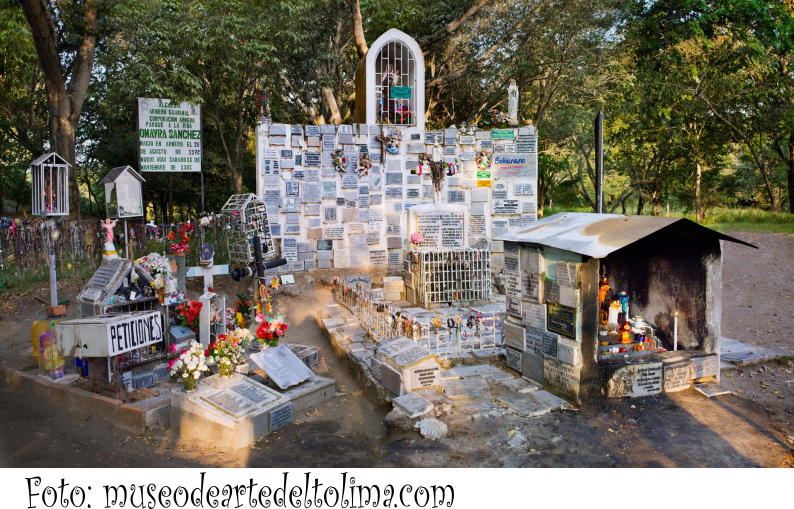
In time, the water subsided.  Those left alive moved away, to Bogotá or to Cali or a few kilometers north to the new town of Armero-Guayabal.  Armero itself is a dead place now, save for a few memorials marking important places such as hospitals, parks, and theaters.  And a small shrine, dedicated to one little girl.

Armero-26-Salon-Tolimense-de-Fotografia.png

Little was left of Omayra’s family.  Her father was killed in the collapse.  Her aunt was dead.  Two-thirds of the town in which she had spent her short life, were gone.  85% of Armero itself, had ceased to exist.  From that day to this, the once prosperous “White City” of Colombia, remains a ghost town.

Omayra’s brother survived the disaster, with only the loss of a single digit.  Her mother expressed the forlorn anguish only the parent of a dead child, will ever experience: “It is horrible, but we have to think about the living … I will live for my son, who only lost a finger.”

November 11, 1921 Tomb of the Unknown Soldier

Passing between two lines of French and American officials, Sgt. Younger entered the room, alone.  Slowly, he circled the four caskets, three times, before at last stopping at the third from the left.  “What caused me to stop” he later said, “I don’t know.  It was as though something had pulled me”.  Younger placed the roses on the casket, drew himself to attention, and saluted.  This was the one.

Many years ago, Prussian Chancellor Otto von Bismarck said “If a general war begins, it will be because of some damn fool thing in the Balkans“.

The Chancellor got his damn fool thing on a side street in Sarajevo, when a tubercular 19-year old leveled his revolver and murdered the heir-apparent to the Austro-Hungarian throne and his wife on June 28, 1914.

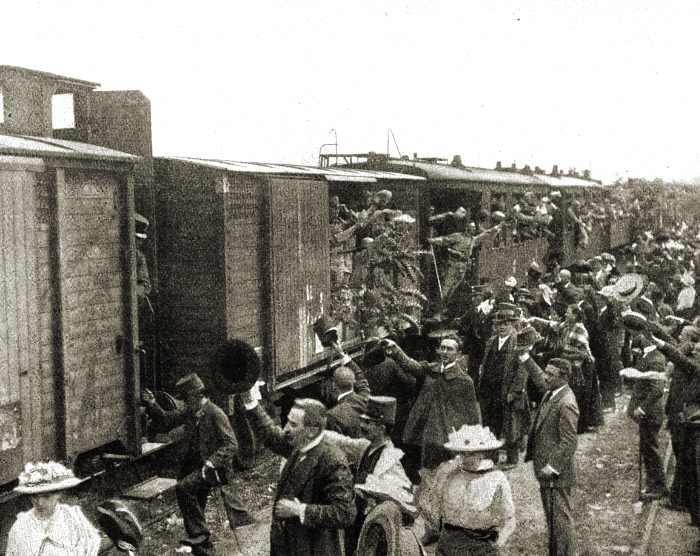
In another time and place, such an event could have led to limited conflict. A policing action, in the Balkans.  Instead, mutually entangling national alliances brought mobilization timetables into effect, dictating the movement of men and equipment according to precise and predetermined schedules.

roads_mobil_2.jpg

German troops, leaving for the front

The hippie subculture of the 1960s produced an antiwar slogan based on the title of a McCall’s Magazine article by Charlotte E. Keyes. “Suppose They Gave a War and No One Came.”  In 1914, the coming war Had to happen.  If only because everyone was there.

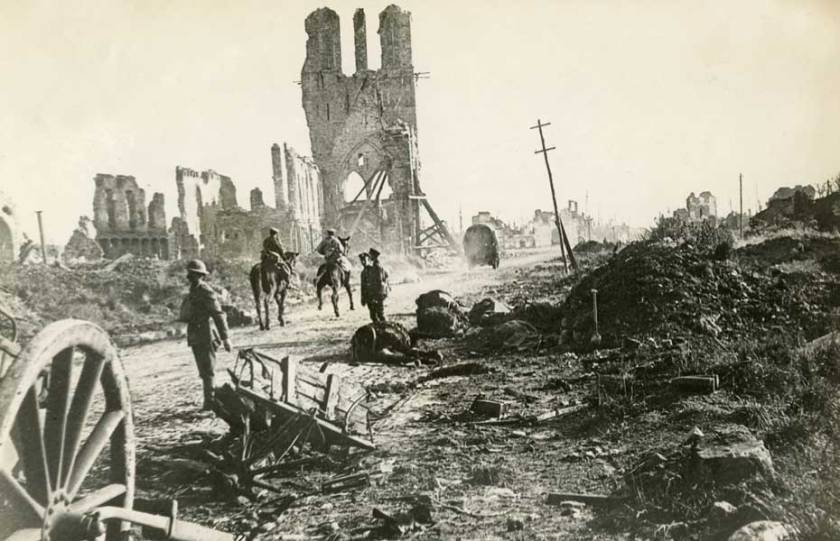
The cataclysm could have been averted, as late as the last day of July. By the first of August, mutual distrust had brought events past the point of no return. By the time it was over a generation was shattered, a continent destroyed and a new century, set on a difficult and dangerous course.ruins.jpgSome 40 million were killed in the Great War, either that or maimed or simply, vanished.  It was a mind bending number, equivalent to the entire population in 1900 of either France, or the United Kingdom. Equal to the combined populations of the bottom two-thirds of every nation on the planet.  Every woman, man, puppy, boy and girl.
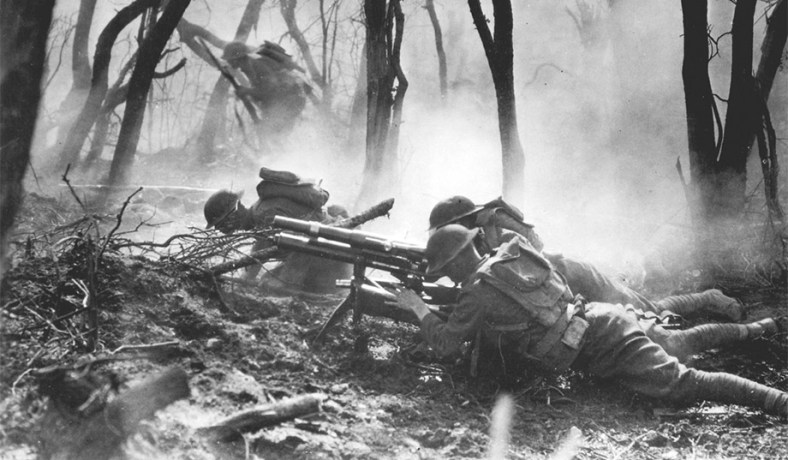
The United States entered the conflict in 1917, suffering casualties of 320,518 in only a few short months.world-war-i-100-year-anniversary-american-entry-legacy-1The idea of honoring the unknown dead from the “War to end all Wars” originated in Europe. Reverend David Railton remembered a rough cross from somewhere on the western front, with the words written in pencil:  “An Unknown British Soldier”.

In November 1916, an officer of the French war memorial association Le Souvenir Français proposed a national-level recognition for the unknown dead of the Great War.  Across the English Channel, Reverend Railton proposed the same.

The two nations performed ceremonies on the first anniversary of Armistice Day, the Unknown Warrior laid to rest at Westminster Abbey on November 11, 1920.  La Tombe du Soldat Inconnu was simultaneously consecrated under the Arc de Triomphe with the actual burial taking place, the following January.

Left to Right:  Tomb of the Unknown Warrior, Westminster Abbey, London.  La Tombe du Soldat Inconnu. lArc de Triomphe, Paris.

That was the year, the United States followed Great Britain and France in honoring her own, unknown dead. Four unidentified bodies were selected from the Aisne-Marne, Meuse-Argonne, Somme and St. Mihiel cemeteries and carefully examined, lest there be any clues to identity. The four were then transported to the Hôtel de Ville at Châlons-sur-Marne, and placed in a makeshift chapel.

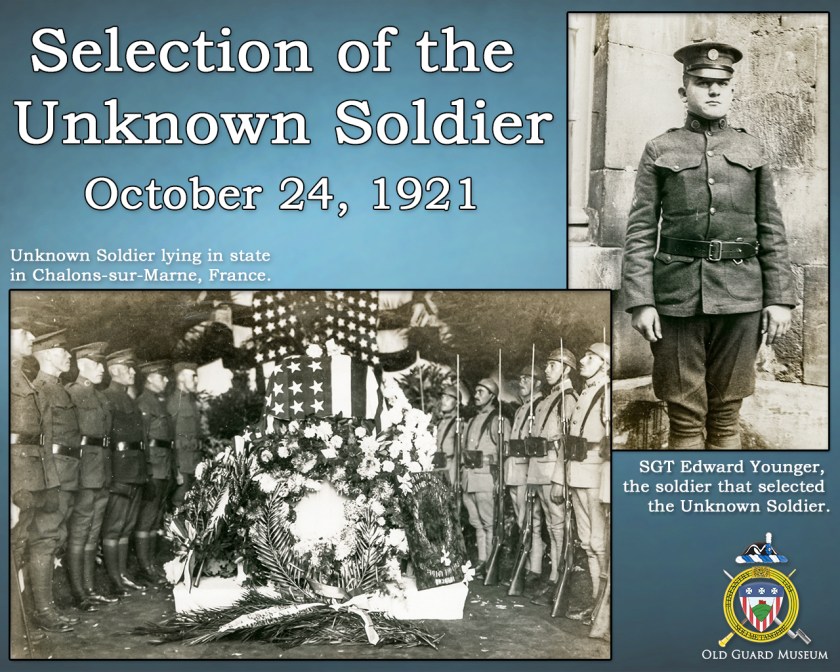
Six soldiers were invited to act as pallbearers, each man a highly decorated and respected member of his own unit.  Outside the chapel, Major Harbold of the Graves Registration Office handed a large spray of pink and white roses to twice-wounded Sergeant Edward F. Younger, of the American Expeditionary Force (AEF).  It was he who would perform the final selection.9664b-10-24-selection2bof2bworld2bwar2bi2bunknown2bsoldierPassing between two lines of French and American officials, Sgt. Younger entered the room, alone.  Slowly, he circled the four caskets, three times, before at last stopping at the third from the left.  “What caused me to stop” he later said, “I don’t know.  It was as though something had pulled me“.  Younger placed the roses on the casket, drew himself to attention, and saluted.  This was the one.
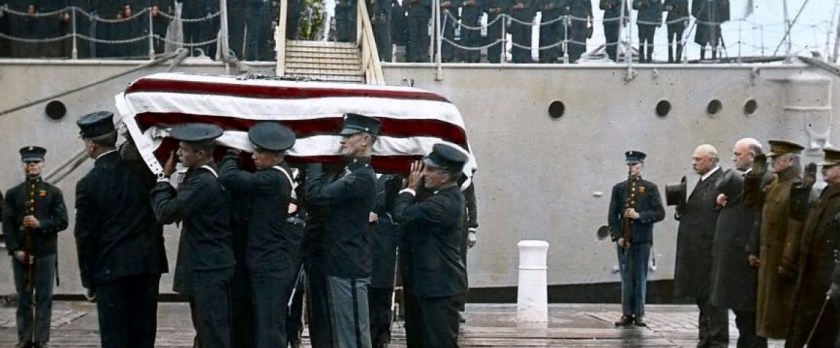
The body was transferred to a black casket bearing the inscription:  “An Unknown American who gave his life in the World War” and transported to the protected cruiser USS Olympia.

Flags at half-mast with stern bedecked with flowers, Commodore George Dewey’s former flagship during the Battle of Manila Bay, received the precious cargo and returned to the United States, arriving in the Navy Yard in Washington DC on November 9, 1921. There the flag draped casket was solemnly transferred to the United States Army, and placed under guard of honor on the catafalque which had borne the bodies of three slain Presidents: Abraham Lincoln, James Garfield, and William McKinley.Unknown_Soldier_at_the_Washington_Navy_Yard.jpgOn November 11, the casket was removed from the Rotunda of the Capitol and escorted under military guard to the amphitheater at Arlington National Cemetery. In a simple ceremony, President Warren G. Harding bestowed upon this unknown soldier of the Great War, the nation’s highest military decorations.  The Medal of Honor.  The Distinguished Service Cross.
Special representatives of foreign nations then bestowed, each in turn, his nation’s highest military decoration.  The Croix de Guerre of Belgium.  The English Victoria Cross. Le Medaille Militaire & Croix de Guerre of France.  The Italian Gold Medal for Bravery. The Romanian Virtutes Militara.  The Czechoslavak War Cross.  The Polish Virtuti Militari.

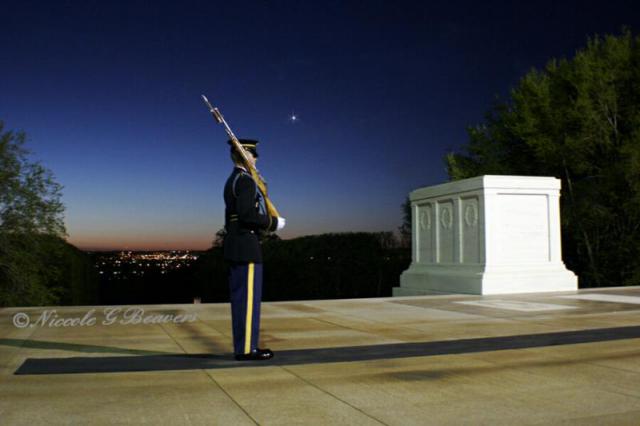
tomb-soldier-in-snowWith three salvos of artillery, the rendering of Taps and the National Salute, the ceremony was brought to a close and the 12-ton marble cap placed over the Tomb of the Unknown Soldier.  The west facing side bears this inscription:
“Here Rests In
Honored Glory
An American Soldier
Known But To God”

Two years later, a civilian guard was placed at the tomb of the unknown.  A permanent Military guard took its place in 1926 and there remains, to this day.

In 1956, President Dwight David Eisenhower signed a bill to select and pay tribute to the unknown dead of WW2 and the American war in Korea. Selection and interment of these Unknowns took place in 1958.

5d72471c15d3e.image
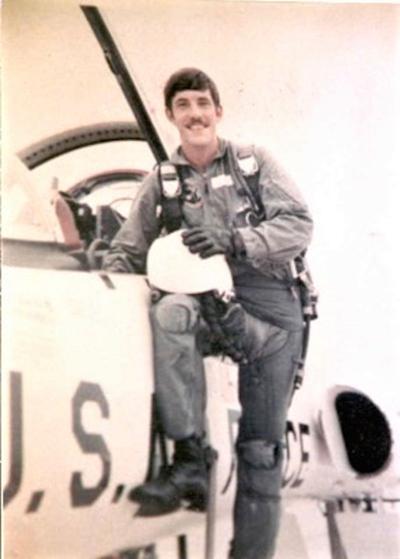
United States Air Force 1st Lt. Michael Joseph Blassie

The Unknown from the American war in Vietnam was selected on May 17, 1984, but wouldn’t remain unknown, for long.

Advances in mitochondrial DNA led to the exhumation and identification of Air Force 1st Lt. Michael Joseph Blassie of St. Louis, Missouri, shot down near An Lộc, in 1972.

The Tomb of the Unknown from the Vietnam conflict remains empty.  It is unlikely any future war is capable of producing a truly “Unknown”.

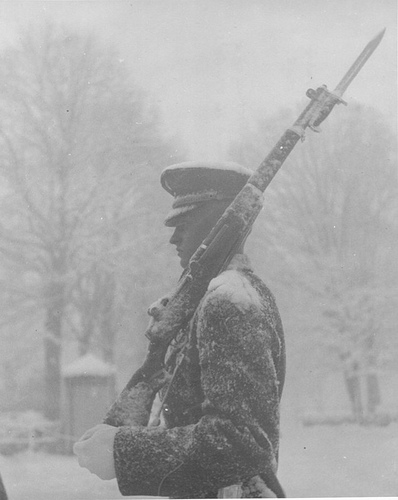
So it is through bitter cold and scorching heat, through hurricanes and blizzards and irrespective of day or night or whether Arlington is open or closed, the Tomb of the Unknown Soldier stands under guard.

This Guard of Honor is performed by a carefully selected elite body of the 3rd Infantry Division.  The “Old Guard”.  In service since 1784, the Tomb Guard is part of the longest-serving active infantry unit in the United States military.

Since the 14th-century, the cannon salute signified the recognition of a sovereign state and a peaceful intent, among nations.  The 21-gun salute is the highest military honor, a nation can bestow.   The Tomb Sentinel who “walks the mat” walks precisely 21 steps down the 63-foot black mat laid across the Tomb of the Unknown, signifying that 21-gun salute.   The Guard then turns east to face the Tomb, pauses another 21-seconds, before beginning the return walk of 21-steps.

The Tomb Sentinel will continue in this manner for a half-hour, one hour or two depending on the time of day, and the season of the year.  If you have witnessed the Changing of the Guard, you are not likely to forget it.  My brother and I were once privileged to experience the moment, in the company of an Honor Flight of WW2 veterans. If you’ve never seen the ceremony, I recommend the experience.

Back in 1919, AEF commander General John Pershing and Allied Supreme Commander Marshall Ferdinand Foch of France were adamantly opposed to the treaty, at Versailles. Germany had been defeated they argued, but not Beaten. Without destroying the German war machine on its own soil, Pershing believed the two nations would once again find themselves at war. Marshall Foch agreed, reading the treaty with the remark: “This isn’t a peace. It’s a cease-fire for 20 years!

He got that wrong.  By 36 days._MG_0016_1466631465932.jpg

November 8, 1965 The 8th of November

Outnumbered in some places six to one, it was a desperate fight for survival as parts of B and C companies were isolated in fighting that was shoulder to shoulder, hand to hand.

operation-hump-1On this day in 1965, the 173rd Airborne Infantry Brigade was halfway through a one-year term of service, in Vietnam.  “Operation Hump”, so named in recognition of that mid-point, was a search and destroy mission inserted by helicopter on November 5.

Vietcong fighters occupied positions on several key hills near Bien Hoa, with the objective of driving the Americans out.

Operation hump, 2There was little contact through the evening of the 7th, when B and C Companies of the 1/503rd took up a night defensive position in the triple canopied jungle near Hill 65.
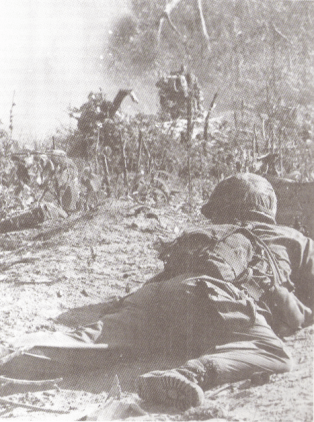
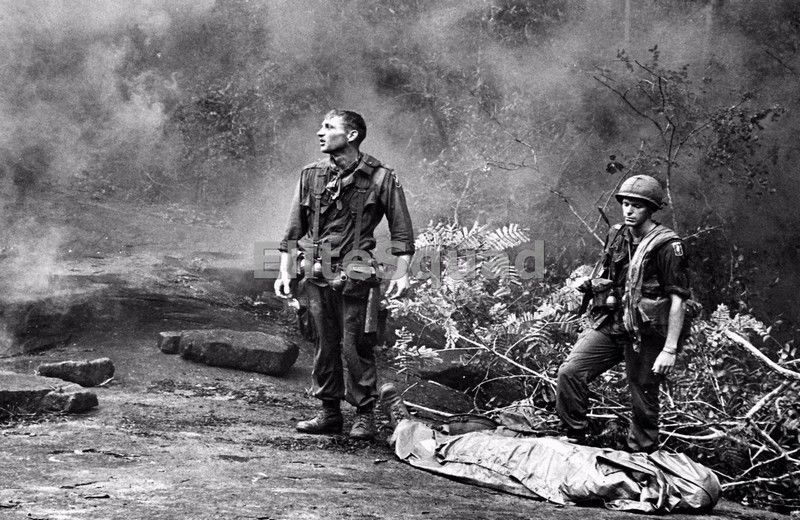
On the morning of the 8th, the Brigade found itself locked in combat with an entire main line Vietcong Regiment, pouring out of entrenched positions and onto the American defenses.

The Vietcong were well aware of American superiority when it came to artillery and air cover.  The VC strategy was to get in so close that it nullified the advantage.  “Grab Their Belts to Fight Them”.

Operation hump, 4Outnumbered in some places six to one, it was a desperate fight for survival as parts of B and C companies were isolated in fighting that was shoulder to shoulder, hand to hand.
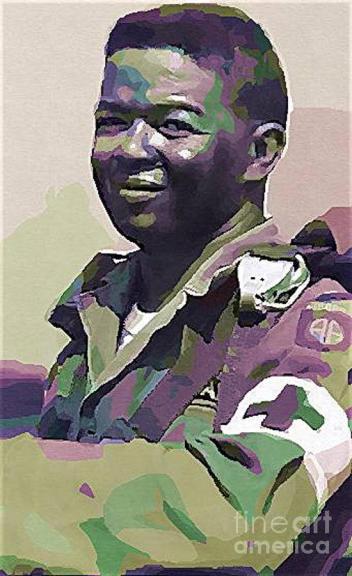
Shot through the right thigh and calf with his medical supplies depleted, Army Medic Lawrence Joel hobbled about the battlefield on a makeshift crutch, tending to the wounded.

Though wounded himself, Specialist 4 Randy Eickhoff ran ahead, providing covering fire. Eickhoff was later awarded the Silver Star and Purple Heart for his actions.

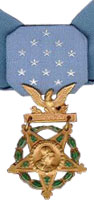
Specialist 5 Joel received the Medal of Honor for his actions that day, near hill 65.  Let Joel’s citation, tell his part of the story:

Cmoh_armyFor conspicuous gallantry and intrepidity at the risk of life above and beyond the call of duty. Specialist 5 Joel demonstrated indomitable courage, determination, and professional skill when a numerically superior and well-concealed Viet Cong element launched a vicious attack which wounded or killed nearly every man in the lead squad of the company. After treating the men wounded by the initial burst of gunfire, he bravely moved forward to assist others who were wounded while proceeding to their objective. While moving from man to man, he was struck in the right leg by machine gun fire. Although painfully wounded his desire to aid his fellow soldiers transcended all personal feeling. He bandaged his own wound and self-administered morphine to deaden the pain enabling him to continue his dangerous undertaking. Through this period of time, he constantly shouted words of encouragement to all around him. Then, completely ignoring the warnings of others, and his pain, he continued his search for wounded, exposing himself to hostile fire; and, as bullets dug up the dirt around him, he held plasma bottles high while kneeling completely engrossed in his life saving mission. Then, after being struck a second time and with a bullet lodged in his thigh, he dragged himself over the battlefield and succeeded in treating 13 more men before his medical supplies ran out. Displaying resourcefulness, he saved the life of one man by placing a plastic bag over a severe chest wound to congeal the blood. As 1 of the platoons pursued the Viet Cong, an insurgent force in concealed positions opened fire on the platoon and wounded many more soldiers. With a new stock of medical supplies, lawrence-joel-popart-lawrence-joelSpecialist 5 Joel again shouted words of encouragement as he crawled through an intense hail of gunfire to the wounded men. After the 24 hour battle subsided and the Viet Cong dead numbered 410, snipers continued to harass the company. Throughout the long battle, Specialist 5 Joel never lost sight of his mission as a medical aid man and continued to comfort and treat the wounded until his own evacuation was ordered. His meticulous attention to duty saved a large number of lives and his unselfish, daring example under most adverse conditions was an inspiration to all. Specialist 5. Joel’s profound concern for his fellow soldiers, at the risk of his life above and beyond the call of duty are in the highest traditions of the U.S. Army and reflect great credit upon himself and the Armed Forces of his country“.
48 Americans lost their lives in the battle.  Many more were wounded.  Two Australian paratroopers were recorded as MIA.  Their remains were discovered years later, and repatriated in 2007.

The country music duo Big and Rich wrote a musical tribute to that day.  It’s called the 8th of November.

November 7, 1957 Nuking the Moon

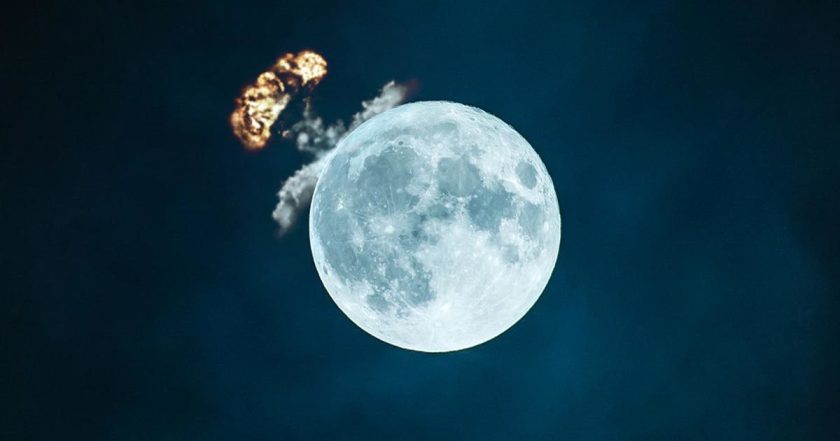
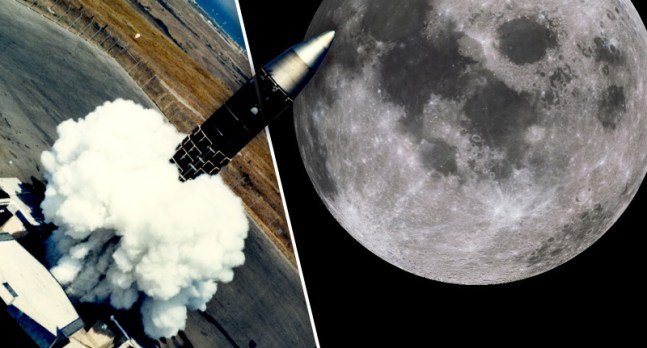
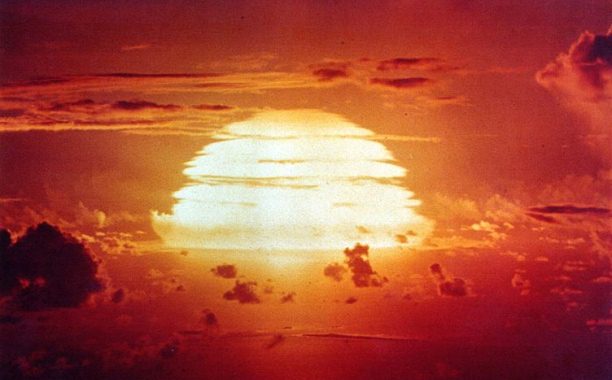
Out of the mess of the Space race emerged an idea destined to go down in the Hare-Brain Hall of fame, if there is ever to be such a place. A show of force sufficient to boost domestic morale, while showing the Russkies, we mean business. It was the top-secret “Project A119”, also known as A Study of Lunar Research Flights.

We were going to detonate a nuclear weapon.  On the moon.

As World War II drew to a close in 1945, there arose a different sort of conflict, a contest of wills, between the two remaining Great Powers of the world. The “Cold War” pitted the free market economy and constitutional republicanism of the United States against the top-down, authoritarian governing and economic models of the Soviet Union. The stakes could not have been higher, as each side sought to demonstrate its own technological and military superiority and, by implication, the dominance of its own economic and political system.

American nuclear preeminence lasted but four short years, coming to an end with the first successful Soviet atomic weapon test code named “First Lightning”, carried out on August 29, 1949. Mutual fear and distrust fueled the Soviet-American “arms race”, a buildup of nuclear stockpiles beyond any rational purpose. A generation grew up under the shadow of nuclear annihilation.  A single mistake, misunderstanding or one fool in the wrong place at the wrong time, initiating a sequence and bringing about the extinction of life on this planet.

nuclear

The arms race acquired the dimensions of a Space Race on July 29, 1956, when the United States announced its intention to launch an artificial satellite, into earth orbit. Two days later, the Soviet Union announced that it aimed to do the same.

The early Space Race period was a time of serial humiliation for the American side, as the Soviet Union launched the first Inter-Continental Ballistic Missile (ICBM) on August 21, 1957, and the first artificial satellite “Sputnik 1” on October 4.

Laika and capsuleThe first living creature to enter space was the dog Laika“, launched aboard the spacecraft Sputnik 2 on November 3 and labeled by the more smartass specimens among the American commentariat, as “Muttnik”.

Soviet propaganda proclaimed “the first traveler in the cosmos”, replete with heroic images printed on posters, stamps and matchbook covers. The American news media could do little but focus on the politics of the launch, as animal lovers the world over questioned the ethics of sending a dog to certain death, in space.

On the American side, the giant Vanguard rocket was scheduled to launch a grapefruit-sized test satellite into earth orbit that September, but the program was plagued by one delay after another.  The December 6 launch was a comprehensive disaster, the rocket lifting all of four-feet from the pad before crashing to the ground in a sheet of flame, the satellite rolling free where it continued to beep, only feet from the burning wreck.

The second Vanguard launch was nearly as bad, exploding in flames only seconds after launch.  Chortling Soviet leaders were beside themselves with joy, stamping the twin disasters as “Kaputnik”, and “Flopnik”.

Out of this mess emerged an idea destined to go down in the Hare-Brain Hall of fame, if there is ever to be such a place. A show of force sufficient to boost domestic morale, while showing the Russkies, we mean business. It was the top-secret “Project A119”, also known as A Study of Lunar Research Flights.

We were going to detonate a nuclear weapon.  On the moon.

In 1957, newspapers reported a rumor.  The Soviet Union planned a nuclear test explosion on the moon, timed to coincide with the lunar eclipse of November 7.  A celebration of the anniversary of the Glorious October Revolution.

Edward Teller himself, the ‘Father of the H-Bomb” is said to have proposed such an idea as early as February, to test the effects of the explosion in a vacuum, and conditions of zero gravity.

Today, we take for granted the massively complex mathematics, involved in hitting an object like the moon. In 1957 there was a very real possibility of missing the thing and boomerang effect, returning the bomb from whence it came.

While the information is still classified, the project was revealed in 2000 by former NASA executive Leonard Reiffel, who said he was asked to “fast track” the program in 1958, by senior Air Force officials. A young Carl Sagan was all for the idea, believing at the time that living microbes may inhabit the moon, and a nuclear explosion may help in detecting such organisms.

Reiffel commented in a Guardian newspaper interview:  “It was clear the main aim of the proposed detonation was a PR exercise and a show of one-upmanship. The Air Force wanted a mushroom cloud so large it would be visible on earth. The US was lagging behind in the space race.” The now-retired NASA executive went on to explain that “The explosion would obviously be best on the dark side of the moon and the theory was that if the bomb exploded on the edge of the moon, the mushroom cloud would be illuminated by the sun.”

The Air Force canceled the A119 program in 1959, apparently out of concern that a ‘militarization of space’ would create public backlash, and that nuclear fallout may hamper future research and even colonization efforts, on the moon.

moon-nuke_wikimedia-commons_fb

Previously secret reports revealed in 2010 that Soviet leaders had indeed contemplated such a project, part of a multi-part program code named “E”.  Project E-1 involved reaching the moon, while E-2 and E-3 focused on sending a probe around the far side of the celestial body. The final stage, project E-4, involved a nuclear strike on the moon as a “display of force”.

Construction plans for the aforementioned Hare-Brain Hall of Fame have yet to be announced but, it already appears the place may need another wing.

IS00561-What-If-We-Detonated-a-Nuke-on-the-Moon-thumbnail-image-16X9.jpg

October 30, 1773 Hannah’s Rock

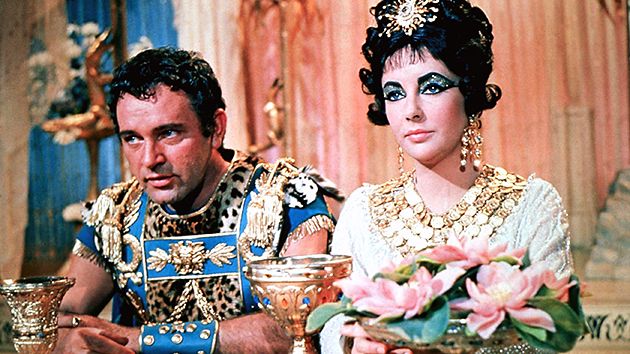
From the 1997 film Titanic to the fictional Shakespearean lovers Romeo and Juliet to the very real Roman General Marc Antony and his Greek Princess turned Egyptian Pharoah Cleopatra VII. The appeal of the Tragic Romance is as old as history and as new, as popular culture.

Arjumand Banu was the daughter of a wealthy Persian noble, third wife of Emperor Shah Jahan of the Mughal Empire, who ruled the lands of South Asia from modern-day Afghanistan to Kashmir and south to the Deccan plateau of South India.

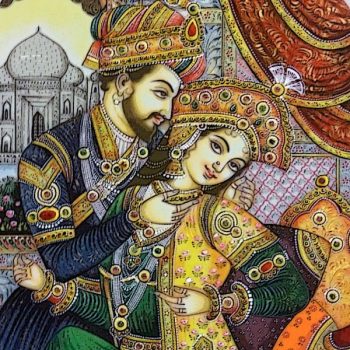
Sha-Jahan-and-Mumtaz-Mahal-600x600As Empress consort and beloved by the Emperor above all his wives, Arjumand was better known by the title “Mumtaz Mahal”, translating from the Persian as “the exalted one of the palace”.   Jahan called her ‘Malika-i-Jahan’.  She was his “Queen of the World”.

The labor and delivery of a daughter, the couple’s 14th child was a terrible trial for the Empress Consort, a 30-hour ordeal resulting in postpartum hemorrhage leading to  her death on June 17, 1631.

The Emperor went into secluded mourning, emerging a year later with his back bent, his beard turned white.  There followed a 22-year period of design and construction for a mausoleum and funerary garden, suitable to the Queen of the World.

This was no ordinary building, this grand edifice to the undying love of an Emperor.  The English poet Sir Edwin Arnold described the place as “Not a piece of architecture, as other buildings are, but the proud passion of an emperor’s love wrought in living stones.”  Today the palace is known among the 7 “Modern Wonders of the World” or simply, the Taj Mahal.

taj-mahal-visitor-limits.jpg

The “Pillarization” of northern European society constituted a separation along religious and political lines, so strict that many individuals had little to no contact, with people outside their own pillar.  19th century Belgian society divided along three such cohorts,  segregating itself largely along Catholic, Protestant and Social-Democratic strata.

The worst days of the South African Apartheid system had nothing over the European society of the age, when it came to social segregation.  Pillars possessed their own institutions: universities, hospitals and social organizations. Each even had its own news apparatus.

The romance between Colonel J.W.C van Gorkum of the Dutch Cavalry and Lady J.C.P.H van Aefferden was a social outrage. The 22-year old noblewoman was a Catholic.  33-year old Colonel van Gorkum was a Protestant and not a part of the nobility.  The couple’s marriage in 1842 was the scandal of Roermond but, despite all that taboo, theirs was a happy marriage lasting 38-years.

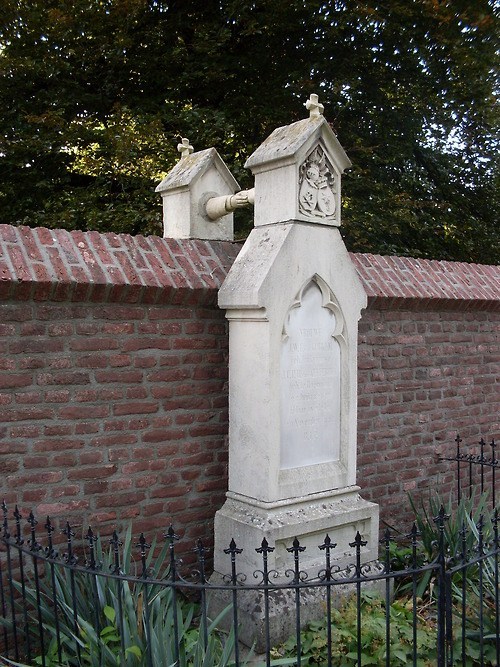
The Colonel died in 1880 and was buried next to the wall, separating the Catholic and Protestant parts of the cemetery.  Van Gorkum’s Lady died some eight years later, wishing to be buried next to her husband. Such a thing was impossible.  She would be buried opposite the wall in the Catholic part of the cemetery, as close as she could get to her beloved husband.

Such was The Law for this time and place, but neither custom nor law said anything about a little creative stonework.  So it is the couple joins hands in death as in life, together and inseparable, for all eternity.

Oud-Kerkhof-graves-with-hands2.jpg
 Oud Kerkhof cemetery in Hasselt, Belgium

From the 1997 film Titanic to the fictional Shakespearean lovers Romeo and Juliet to the very real Roman General Marc Antony and his Greek Princess turned Egyptian Pharoah Cleopatra VII, the appeal of the Tragic Romance is as old as history and as new, as popular culture.

MCDCLEO-FE002-H-jpg_160608

Few such tales have anything over the tragic love affair, of the unfortunate Hannah Robinson.

Hannah Robinson was one of the most beautiful women in all Colonial Rhode Island, the privileged daughter of the wealthy Narragansett planter Rowland and Anstis (Gardiner) Robinson. Years later during the time of the American Revolution, the opulent Robinson mansion entertained the likes of the Marquis de Lafayette and the Comte de Rochambeau, but I’m getting ahead of the story.

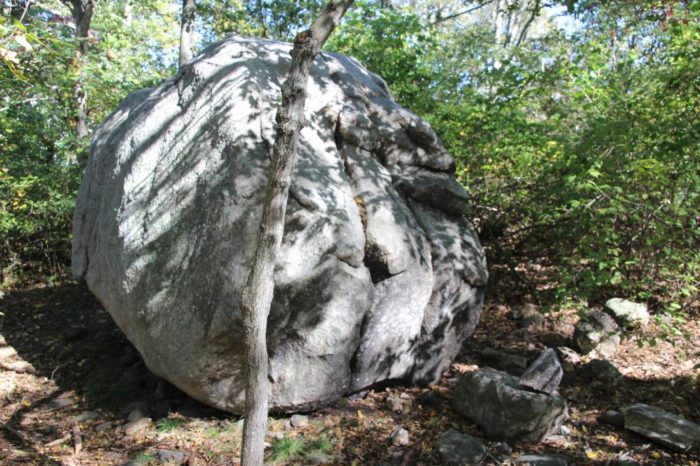
As a young girl, Hannah had nary a care in the world and spent countless hours on a large rock, enjoying the view overlooking Narragansett Bay.

Hannah_Robinson_Tower
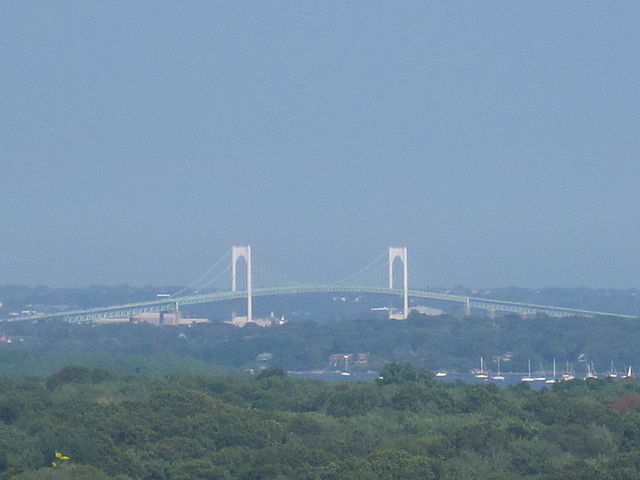
The view as it looks today, from Hannah Robinson tower

When she grew older, Hannah attended Madame Osborn’s finishing school in Newport. There she fell in love with the French and Dancing instructor Pierre Simond, the son of an old family of French Huguenot ancestry who liked to go by the name, Peter Simon.

The degree to which the penniless Simond reciprocated the young woman’s feelings is difficult to know, but Hannah fell hard.

Peter took a position as private tutor to one of the Robinison cousins, a short two miles away.  It wasn’t long before Simond was secretly visiting Hannah, at home. He’d hide out in a large cabinet in Hannah’s room.  The pair called it the “Friendly Cupboard”.  At night, Simond would hide out in a large lilac bush where the couple would talk for hours, and exchange letters.  Anstil was quick to get wise but she never let on, to her husband.

Then came the night Rowland spied the white paper, fluttering to the ground. He rushed to the lilac and beat at the bush with a stick, until there emerged a ragged French teacher.  After that, Rowland kept his eldest on a very short leash.

The apple doesn’t fall far from the tree.  If Hannah Robinson was stubborn, she came by it honestly.  In a rare moment of weakness, Rowland allowed Hannah and young sister Mary to attend a ball at Smith’s Castle some ten miles up the road, accompanied by a black “servant” called “Prince” who really was, it turns out, an African prince.

So it was, the trap was sprung.

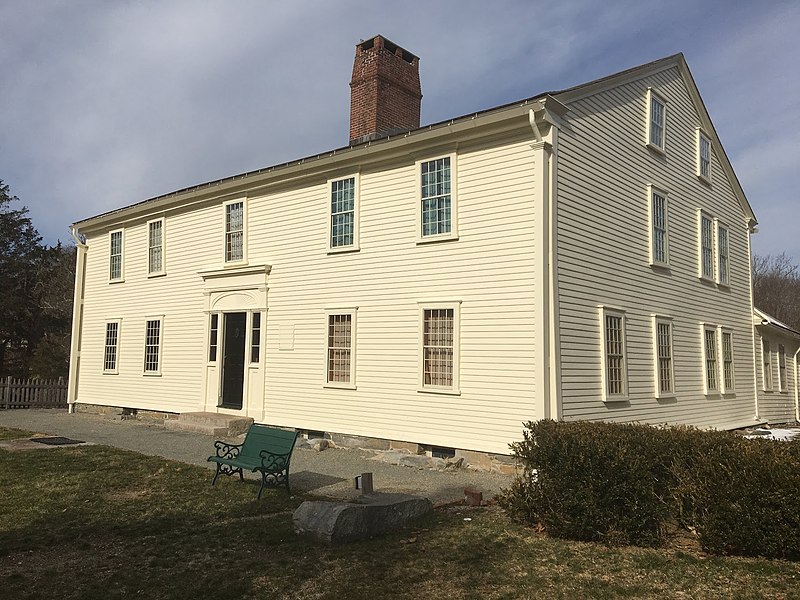
Smith's_castle_2018
Smith’s Castle house, one of the oldest homes, in Rhode Island, is now a National Historic Landmark

The trio came to a place on horseback, where there awaited a carriage.  Peter’s carriage.  Mary cried and Prince begged her not to go but, to no avail.  This was the couple’s elopement.  Hannah would have it no other way.

Rowland was apoplectic and cut off his daughter, from her allowance.  The happy couple moved to Providence, but Dad proved to be right.  Now penniless, Simon soon lost interest in his young wife and left her.  Sometimes for days on end.  Others for weeks at a time.

Hannah’s health went into a steep decline.  Not even the little dog sent by her mother, nor her childhood maid – a woman also named Hannah, could bring back her spirits.  The young woman wasted away in Providence as, just 35-miles to the south, Mary contracted tuberculosis, and died.  Anstis’ health, failed.

Rowland Robinson would come to relent, but too late.  Hannah’s health was destroyed.  The fast sloop from Providence delivered a sickly shadow of her former self.

The four strong servants carrying the litter were asked to stop by the rock, where Hannah had passed all those happy hours as a girl.  Watching the bay.  She picked a flower.  “Everlasting Life”.

Life-Everlasting
Everlasting Life

A sad reunion followed between the two women, the sick mother and the sick daughter.  Anstis would recover and live to see a Revolution bring Independence to the American colonies.  Not so the unfortunate daughter.  Hannah Robinson died at home on this day in 1773.  She was 27.

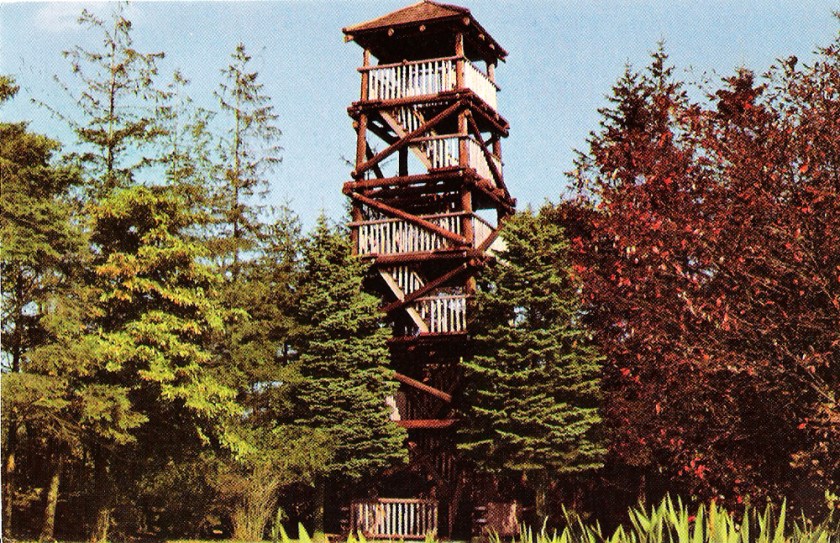
The Civilian Conservation Corps (CCC) built an observation tower in 1938, at the place where Hannah used to watch the Bay.  At four stories in height the thing was used for coastal watch, during World War 2.  The tower was rebuilt in 1988, using timbers from the original construction.

You can climb the Hannah Robinson tower to this day if you want, there in North Kingstown, not far from the rock where that little girl spent a happy childhood.  Watching the bay, all those many years ago.

wooden-tower

Hannah Robinson Tower, North Kingstown Rhode Island


October 20, 1952 Get Out! Get Out!

Colonial Governor Evelyn Baring declared a state of emergency on this day in 1952, arresting hundreds of suspected leaders of the uprising. Reason and restraint seemed to have fled the land of Kenya, judging by the events that followed.

By the mid 1940s, British Colonial rule over the Kikuyu people of Kenya stretched out, for nearly fifty years.  Politically, Kenyan Africans broke into three blocs in those days.  First came the conservatives, who tended to support the status quo.  Next were moderate nationalists, those who sought an orderly return to indigenous rule over African soil. Last were the radical nationalists. This last group stood for African rule, Right Now, no matter the cost.

The first attempt to form a country-wide political party began in 1944, with the formation of the KASU, the Kenya Africa Study Union.  KASU was anti-colonial from the beginning, becoming increasingly radicalized through the World War 2 period and into the late 1940s.

The violent uprising of the early 1950s was called “Mau Mau”, an anagram of Uma Uma, roughly translating as “Get out, Get out”.

p04l8ppg

The first “blow against the Colonial regime” was struck on October 3, 1952, when a white woman was stabbed to death near her home in Thika, in the Kiambu County of Kenya.  Senior Chief Waruhiu wa Kungu was shot to death in his car less than a week later.

Governor Evelyn Baring declared a state of emergency on October 20, arresting hundreds of suspected leaders of the uprising.

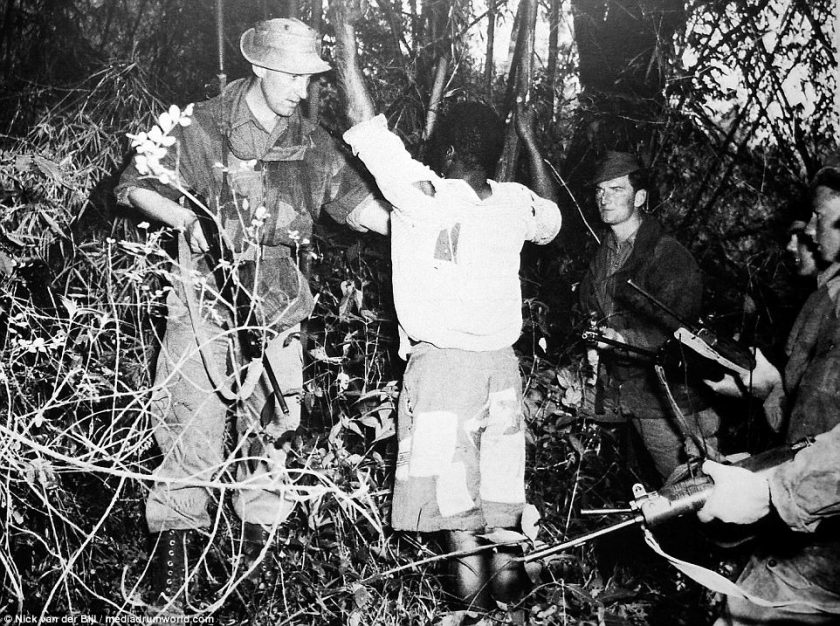
Reason and restraint seemed to have fled the land, judging by the events that followed. Thousands of black Africans were hacked, burned or shot to death by Mau Mau militants, many mutilated and horribly tortured before death. Militants attacked the settlement of Lari on the night of March 25-26, herding Kikiyu men, women and children into huts before setting the whole thing, on fire.  Anyone who tried to escape was hacked with machetes, and thrown back into the flames.

The scene played out on dozens of occasions. Massacres were met with retaliatory raids by African security forces, at least partially overseen by British commanders.  There was even an instance biological warfare, when Mau Mau radicals used the poisonous milk of the African milk bush, to kill cattle.

Displeased with the government’s response to the uprising, settler groups formed their own “Kenya Police Reserve’s Special Branch”. God help the unlucky militant who fell into Their hands.

Black Africans were victims of most of the violence, with fatalities numbering into the thousands. Combined with those who simply “disappeared”, the number ran into the tens of thousands by the time the violence subsided in 1956. 62 Asians, predominantly Indians, were also killed, along with 58 whites.

3EECA77200000578-4378158-image-a-31_1491295237197.jpgBarack Obama wrote in his memoir “Dreams from my Father”, that his grandfather Hussein Onyango Obama was captured and tortured by British authorities during the Mau Mau uprising. The now-former President wrote that his father was “selected by Kenyan leaders and American sponsors to attend a university in the United States, joining the first large wave of Africans to be sent forth to master Western technology and bring it back to forge a new, modern Africa“.

The elder Obama’s real history seems to differ from the public version, though the American media is remarkably quiet on the subject. The UK Daily Mail reports, under the headline “Obama’s grandfather tortured by the British? A fantasy (like most of the President’s own memoir)“, that Onyango was inclined to create “[H]istory to conform with the image he wished for himself…Following on from his forebears on both sides”.

DnMaumau1209kdIf you’re interested in a little pop culture sauce to go with this turkey, the Mau Mau uprising inspired a number of similar rebellions throughout the region. One of them occurred in the East African coastal city of Zanzibar.
Thousands of Arabs and Indians were murdered in the 1964 Zanzibar rebellion, while thousands more fled for their lives.

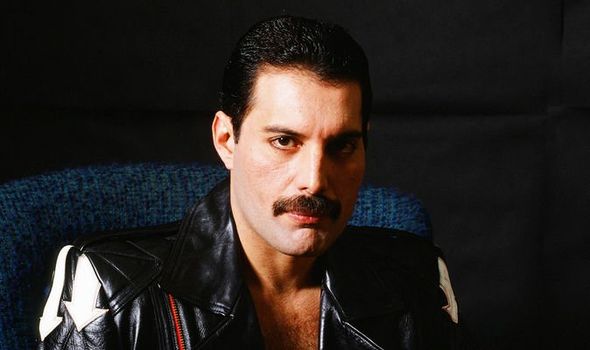
Among those to escape were Bomi and Jer Bulsara, along with their 17-year-old son, Farrokh. The Bulsaras were Parsis from the Gujarat region of India, who had sent Farrokh to piano lessons from the age of 7. By the time he was 12, the boy had formed a school band, called “The Hectics”.

Farrokh was attending St. Peter’s boarding school at the time of the rebellion, and calling himself “Freddie”.

After fleeing Zanzibar, the family settled in Feltham, Middlesex, in England. Freddie Bulsara resumed his studies while joining in a series of bands throughout the late sixties. First “Ibex”, then “Wreckage” and finally, “Sour Milk Sea”.

In April 1970, Bulsara changed his name to “Mercury”, forming a band with guitarist Brian May, bassist John Deacon and drummer Roger Taylor. The group went on to record 18 #1 rock music albums, 18 #1 singles and 10 #1 DVDs. The group sold close to 300 million albums, being inducted into the Rock & Roll Music Hall of Fame in 2001, as “Queen”.

Freddie-Mercury-1192903


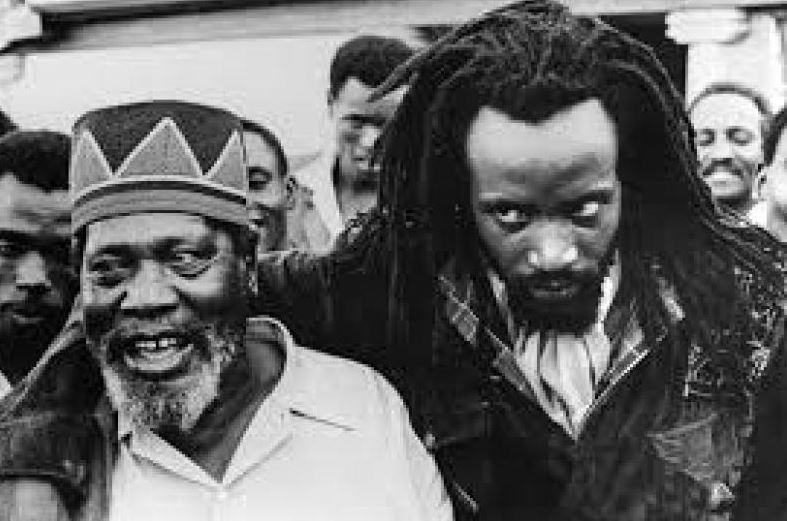
Feature image, top of page:  Kenyan revolutionary leader Musa Mwariama (Right), the highest-ranking Mau Mau leader to survive the war, celebrates Independence with Prime minister Jomo Kenyatta. ca May, 1963.

October 14, 1987 Well of Darkness

3309 Tanner Drive quickly became, a circus.  Television trucks arrived, to cover the ordeal.   Baby Jessica’s rescue was carried from the Netherlands to Brazil, from Germany to Hong Kong and mainland China. Well wishers called in to local television stations, from the Soviet Union. Telephone linemen installed extra lines, to handle the traffic. 

baby-jessica-11.jpgJessica McClure Morales is 33-years old.  A typical West Texas Mom, with two kids and a dog.  Her life is normal in every way.  She’s a teacher’s aide.  Her husband Danny, works for a piping supply outfit.

Thirty-two years ago, Jessica McClure’s day was anything but normal.

October 14, 1987 began like any other, just an eighteen-month-old baby girl, playing in the back yard of an Aunt.  That old well pipe shouldn’t have been left open, but what harm could it do. Standing there only three inches above the grass, the thing was only eight inches wide.

And then the baby disappeared.  Down the well.

My command of the language fails to produce a word, adequate to describe the horror that young mother must have felt, looking down that pipe.

wellMidland, Texas first responders quickly devised a plan. A second shaft would be dug, parallel to the well.  Then it was left only to bore a tunnel, until rescuers reached the baby.  The operation would be over, by dinnertime.
Except, the rescue proved far more difficult than first imagined. The tools first brought on-scene, were inadequate to get through the hard rock surrounding the well.  What should have taken minutes, was turning to hours.

3309 Tanner Drive quickly became, a circus.  Television trucks arrived, to cover the ordeal.   Baby Jessica’s rescue was carried from the Netherlands to Brazil, from Germany to Hong Kong and mainland China. Well wishers called in to local television stations, from the Soviet Union. Telephone linemen installed extra lines, to handle the traffic.

"Baby Jessica" McClure Rescue
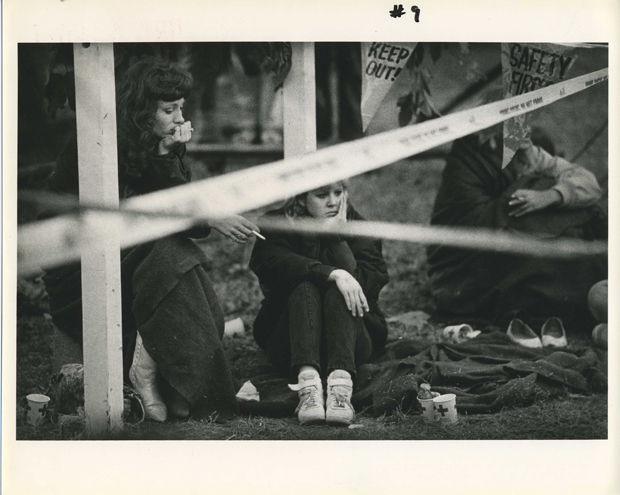
Local and national news reporters watch from ladders overlooking a fenceline as rescue crews attempt to free Jessica McClure. (October 1987)

The whole world it seemed, held its breath.

Midland police officer Andy Glasscock spent much of those fifty-eight hours on his belly next to that hole, concentrating on every sound to come up from the well.   Hard-eyed veteran though he was, the man could be brought to tears at the sound of that little voice, drifting up from deep in that hole in the ground…”Mama“.  “How does a kitten go?” Officer Glasscock would ask, into the darkness.  The little voice would respond…”Meow“.

'Baby Jessica' McClure Rescue
Supporters wait outside the barricade line as workers attempt to rescue Jessica from the well. (October 1987)

Watching the evening news, it’s sometimes easy to believe the world is going to hell.  It’s not.  What we saw for those fifty-eight hours was the True heroism and fundamental decency of every-day women and men.  Fathers, sons and brothers, straining each fiber and sinew, inching closer to the bottom of that well.  Mothers sisters and wives, pitching in and doing whatever it was, that needed to be done.  We’d see it again in a New York Minute, should circumstances require it.

"Baby Jessica" McClure Rescue
Rescue crews worked through the night to pump warm air into the well where Jessica had become trapped (October 1987)

You could watch it happen, around the clock. Many of us did. I remember it.  Each man would dig until he’d drop, and then another guy would take his place. These were out-of-work oil field workers and everyday guys. Mining engineers and paramedics. The work was frenetic, desperate, and at the same time, agonizingly slow.

Anyone who’s used a jackhammer, knows it’s not a tool designed to be used, sideways. Even so, these guys tried.  A waterjet became a vital part of the rescue, a new and unproven technology, in 1987.

"Baby Jessica" McClure Rescue
Jessica’s father Chip McClure speaks to a cadre of reporters. (October 1987)

The sun went down that Wednesday and rose the following day and then set again.  Still, the nightmare dragged on.

A microphone was lowered down, so doctors could hear that baby girl breathe. She would cry.  Sometimes she would sing. A small voice drifting up from that hole in the ground.  The words of “Winnie the Pooh”.

billresclThese were good signs. A baby could neither sing nor cry, if she could not breathe.
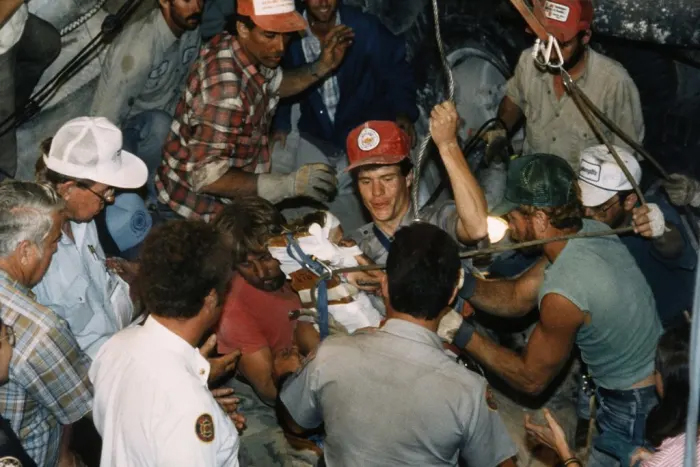
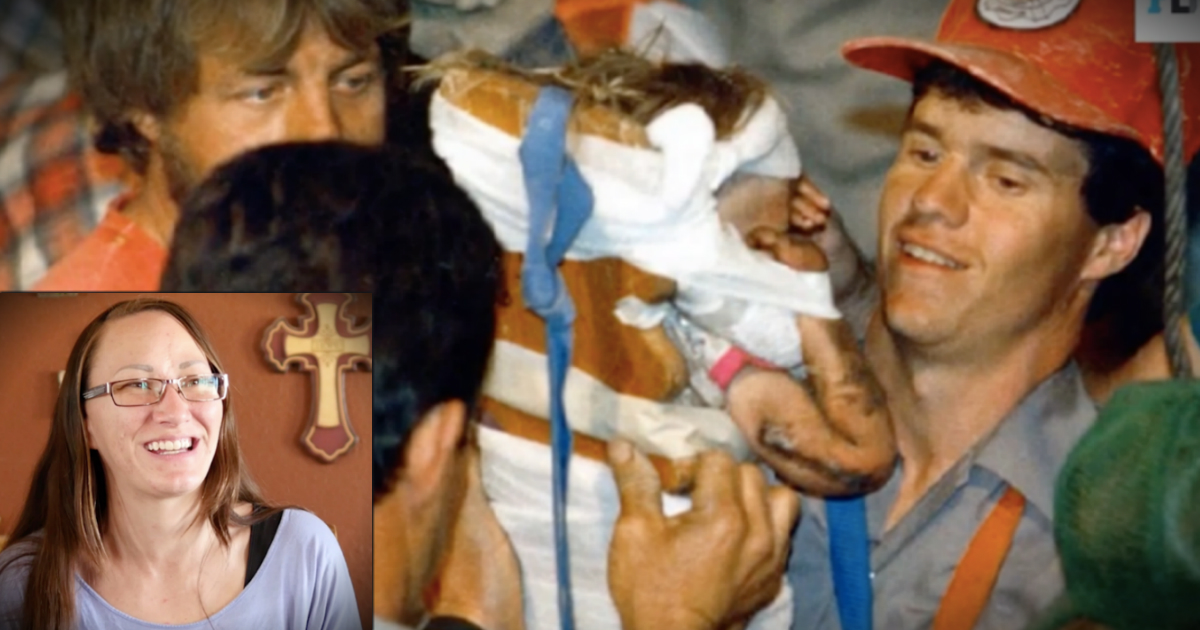
The final tunneling phase of the operation could only be described, as a claustrophobic nightmare. An unimaginable ordeal. Midland Fire Department paramedic Robert O’Donnell was chosen because of his tall, wiry frame. Slathered all over with K-Y jelly and stuffed into a space so tight it was hard to breathe, O’Donnell inched his way through that black hole that Thursday night and into the small hours of Friday morning until finally, he touched her leg.

The agony of those minutes dragging on to hours, can only be imagined. What O’Donnell was trying to do, could not be done.  In the end, the paramedic was forced to back out of the hole, one agonizing inch at a time, defeated. Empty handed.  As men went back to work enlarging the tunnel, the paramedic sat on a curb, and wept.

On the second attempt, O’Donnell was able wrestle the baby out of that tiny space, handing her to fellow paramedic Steve Forbes, who carried her to safety.

Jessica McClure rescueBaby Jessica came out of that well with her face deeply scarred and toes black with gangrene, for lack of blood flow.  She required fifteen surgeries before her ordeal was over, but she was alive.

nintchdbpict000307656606 (1)The story has a happy ending for baby Jessica.  Not so, for many others.  The New York Times wrote:

“The little girl’s parents moved her out of town, to a three-bedroom house that they never could have afforded before she was rescued, to hide from the world that embraced them so hard they couldn’t breathe. Eventually, they were divorced. Others who helped to save the child — O’Donnell was just the most visible of hundreds — found themselves drinking, or in marriage counseling, or in legal tangles, all because of the fickle, seductive, burning spotlight”.

baby-jessica-17175736-1-402President Ronald Reagan quipped, “Everybody in America became godmothers and godfathers of Jessica while this was going on.” Baby Jessica appeared with her teenage parents Reba and Chip on Live with Regis and Kathie Lee, to talk about the incident. Scott Shaw of the Odessa American won the Pulitzer prize for The photograph. ABC made a television movie:  Everybody’s Baby: The Rescue of Jessica McClure. USA Today ranked her 22nd on a list of “25 lives of indelible impact.”  Everyone in the story became famous. Until they weren’t.
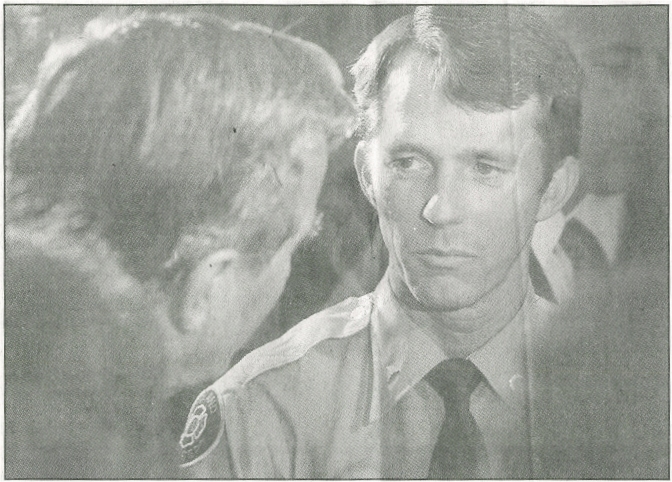
For paramedic Robert O’Donnell, the nightmare never ended.  Already claustrophobic, those hours spent alone in a black hole so tight as to all but prevent breath, were pure agony.   The failure and that agonizing inchworm’s crawl out of that hole, empty handed.  The ultimate success.   The fame and celebrity.  The Oprah show.  The relentless pursuit, of media.  “For a year afterward everyone wanted a piece of him” said his older brother, Ricky. “Then all of a sudden one day it seemed like everyone dropped him.”

"Baby Jessica" McClure Rescue
Lee High Rebelettes hold up a sign during halftime of the Lee-Odessa Permian football game showing their support for Jessica. (October 1987)

The Paramedic had rescued lots of people but, somehow, his life stopped in 1987. Transfixed in the bright lights and the fame of those last fifteen minutes of The Rescue.  Everywhere he went, he was “The man who Saved Baby Jessica™”.

Post-traumatic stress is a strange and incomprehensible thing.  The next seven years were a downward spiral.  There were marital problems.  That humiliating episode with that made-for-TV movie.  The whole family watching to see his part, but no one bothered to tell them.  The scene had been cut.  The 11-year career with the Midland Fire Department, collapsing amidst allegations of prescription drug abuse.  Divorce.

22272348_124421455985In April 1995, O’Donnell’s mother noticed the missing shotgun at the family ranch, in Stanton Texas.  The 410 buckshot, loaded with larger pellets intended for bigger game, or self defense.  They found the body some 20-miles away, slumped over the wheel of the new Ford pickup.  This was no accident.  You don’t put a barrel that long into your mouth, without meaning to.

Those of us of a certain age remember the baby Jessica episode, well.  I suspect Robert O’Donnell’s story is less well known, and that’s a shame.  The man is an American hero.  He has earned the right to be remembered.


October 13, 1926 We’ll Come Back for you

A Naval story for this October 13, the day we celebrate as the birthday, of the United States Navy.

A boy was born this day in Hattiesburg Mississippi, the son of poor tenant farmers.  Jesse LeRoy Brown had all the disadvantages of a poor black child growing up under depression-era segregation, but Julia and John Brown kept their son on the “straight & narrow”, insisting he stuck with his studies.

Thomas Jerome Hudner, Jr. was born in 1924, son of the Irish American owner of a chain of grocery stores from Fall River Massachusetts, who went on to attend the prestigious Phillips Andover Academy, in 1939.

Jesse Brown and Thomas Hudner could not have come from more different backgrounds.  The lives of the two came together with the United States Navy, the two men becoming pilots and serving together during the conflict in Korea.

image (9)
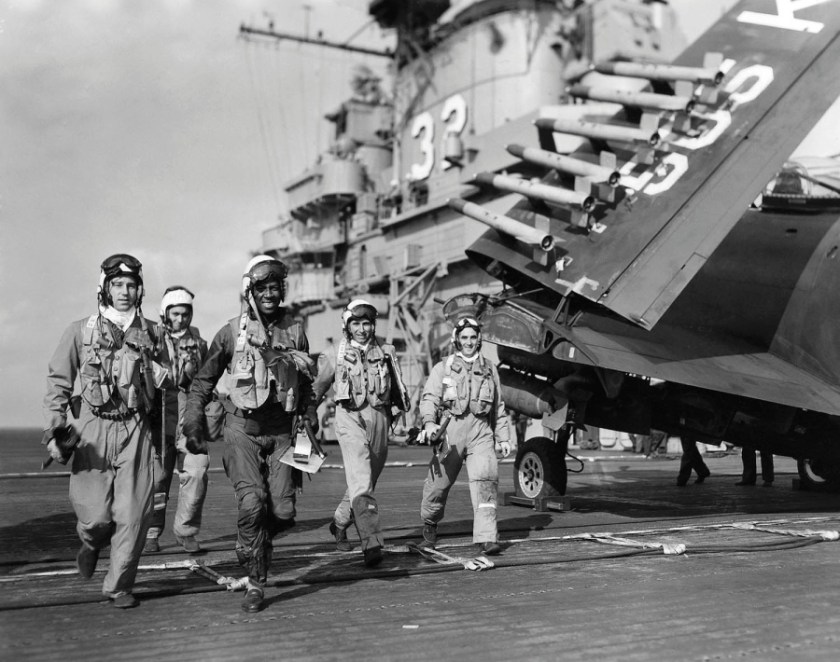
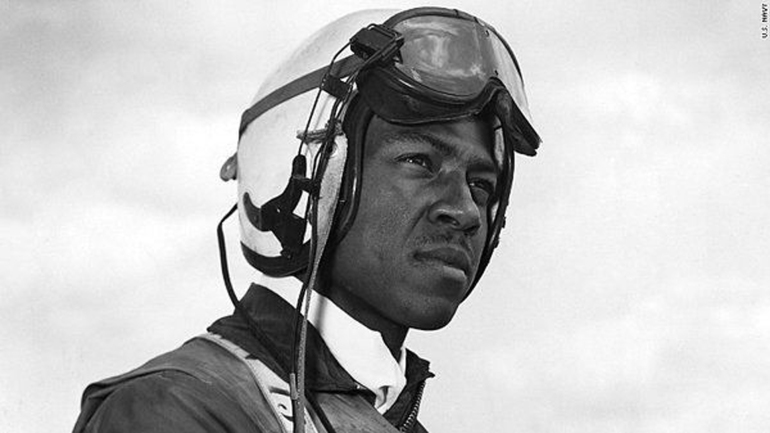
“Ensign Jesse L. Brown, the first African-American Navy aviator, walks across the flight deck of the USS Leyte in November 1950, about a month before he was shot down and died in North Korea.” – H/T Stars & Stripes

On June 25, 1950, ten divisions of the North Korean People’s Army launched a surprise invasion of their neighbor to the south. The 38,000 man army of the Republic of Korea didn’t have a chance against 89,000 men sweeping down in six columns from the north. Within hours, the shattered remnants of the army of the ROK and its government, were retreating south toward the capital of Seoul.

The United Nations security council voted to send troops to the Korean peninsula. In November, the People’s Republic of China entered the conflict in support of their Communist neighbor.

By December, nearly 100,000 troops of the People’s Volunteer Army had all but overrun the 15,000 men of the US X Corps, who found themselves surrounded in the frozen wasteland of the Chosin Reservoir. Dozens of close air support missions were being flown every day to keep the Chinese army at bay. On December 4, Jesse Brown and Thomas Hudner were flying one of those missions.

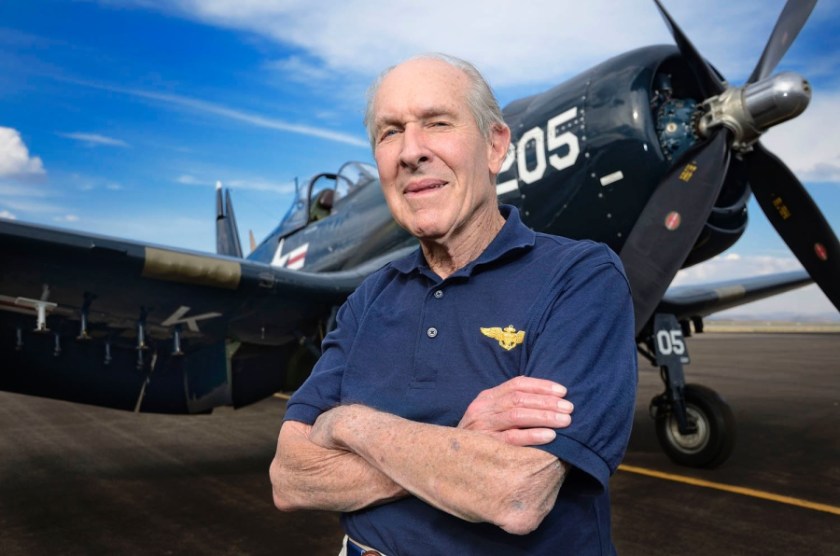
The two were part of a 6-plane formation of F4U Corsairs, each pilot flying “wing man” for the other. Brown’s aircraft was hit by small arms fire from the ground, leaving him no alternative but a crash landing on a snow covered mountain. Flying overhead, Hudner could see his wing man below, severely injured and struggling to get out of the burning aircraft, his leg trapped in the crumpled cockpit.

airplanepictures_2272_51351289Hudner acted on instinct, deliberately crash landing his own aircraft and, now injured, running across the snow to the aid of his friend and wing man.  Hudner scooped snow onto the fire with his bare hands in the bitter 15° cold, burning himself in the progress while Brown faded in and out of consciousness.  Soon, a Marine Corps helicopter pilot landed, to help out.  The two tore into the stricken aircraft with an axe for 45 minutes, but could not free the trapped pilot.
The Marine and the Navy Pilot were considering Jesse’s plea that they amputate his trapped leg with the axe, when the pilot faded away for the last time. Jesse Leroy Brown’s final words were “Tell Daisy I love her”.

They had to leave. “Night was coming on” Hudner would later explain, “and the helicopter was not equipped to fly in the dark. We’ll come back for you”, he said.

Jesse Brown could no longer hear him.

image (10)
Korean War veteran and Medal of Honor recipient Thomas Hudner stands in front of a vintage Corsair in this undated photo. H/T Stars & Stripes, COURTESY OF JOSE RAMOS

Hudner pleaded with authorities to go back to the crash site, but they were unwilling to risk further loss of life. They would napalm the crash site so that the Chinese couldn’t get to the aircraft or the body, though pilots reported that it looked like the Brown’s body had already been disturbed.

Captain Hudner expected a court-martial for intentionally downing his aircraft.  USS Leyte commander Captain Thomas Upton Sisson told him, “Personally, I’ve never heard of a more wonderful act than what you pulled out there.”

Jesse LeRoy Brown was the first Naval Aviator of African ancestry, earning his wings only months after President truman, integrated the military. He was first to die in the Korean War, recipient of the Distinguished Flying Cross and Purple Heart, both awarded, posthumously. Thomas Hudner was awarded the Medal of Honor for his actions on that frozen mountainside. One of eleven to be so honored following the battle of the Chosin Reservoir, Hudner was the only Naval aviator awarded the Medal of Honor, during the entire conflict in Korea.

Thomas Hudner visited the North Korean capital of Pyongyang in July 2013, where he received permission to return to the site. He was 88 at the time, but weather hampered the effort. North Korean authorities told him to return when the weather was more cooperative.

In May 2012, Secretary of the Navy Ray Mabus announced an Arleigh Burke-class guided missile destroyer to be named USS Thomas Hudner. Four years later, 91-year-old Thomas Hudner wrote to the Secretary, on behalf of his wingman:

“It pains me to ask for any favor, but there is one last cause to which I must attend”.

Hudner requested that a ship be named after his wingman.

XJSWIDFYANETPJCBHARCCKD7DE

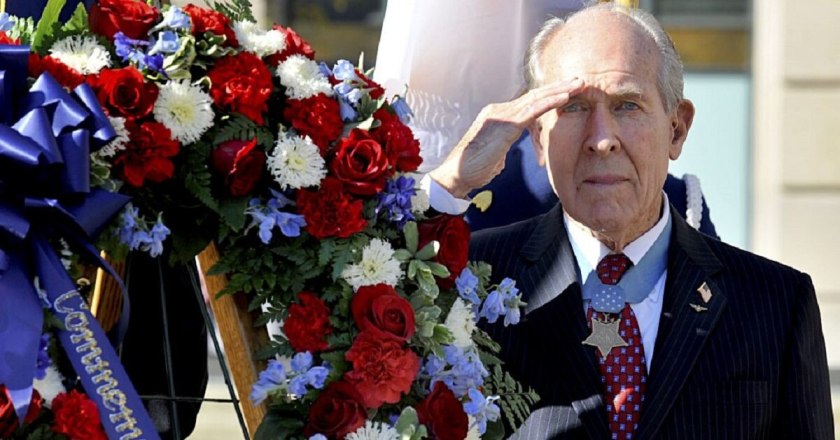
Retired Navy Capt. Thomas Hudner salutes while “Taps” is played during the Centennial of Naval Aviation wreath-laying ceremony at the Navy Memorial in Washington D.C., in 2011. H/T Military Times

Captain Hudner lived out the last years of his life with his wife Georgea, at the couple’s home in Concord Massachusetts.  He passed away on November 13, 2017 at the age of 93.

A year later nearly to the day, December 1, 2018, the USS Thomas Hudner (DDG-116) was commissioned in Boston Harbor, members of both families, in attendance.

Jessica Knight Henry, Brown’s granddaughter and namesake, summed up the meaning of this day.  “Jesse and Tom’s stories have been intertwined since that fateful day”.

Jesse LeRoy Brown’s remains were never recovered.

jesse-leroy-brown-2

October 12, 1968 The Fosbury Flop

“Success is not the absence of failure. It’s the persistence through failure”. Aisha Taylor

“Never give in–never, never, never, never, in nothing great or small, large or petty, never give in except to convictions of honor and good sense. Never yield to force; never yield to the apparently overwhelming might of the enemy.” ― Winston Churchill

“Nothing great or small, large or petty…”

Imagine for a moment, you are sixteen. A High School student and quite tall, no longer a boy but not having reached that level of seasoning and experience, to make you a man. Richard Douglas “Dick” Fosbury found himself at this stage in 1963, sixteen years old and not entirely in control of his own 6-foot, 4-inch frame.

Despite his towering height, young Fosbury failed to make the cut, for basketball.  So it was he joined the North Medford High Track & Field team, in Medford Oregon. Fosbury eventually settled on the high jump as his best hope of success.  There was only one problem. By his own description, Dick Fosbury was the worst high jumper in North Medford High.  Possibly the worst, in all of Oregon.

In track & field, the High Jump is an event in which competitors must clear a horizontal bar, without aid and without dislodging the bar. Rules dictate that the jumper must take off from one foot.   There is no rule describing how the jumper, must clear the bar.


Counter-clockwise, from top left:  Konstantinos Tsiklitiras during the standing high jump competition at the 1912 Summer Olympics, Platt Adams during the same competition, and Gold medal winner Ethel Catherwood of Canada, scissoring over the bar at the 1928 Summer Olympics. Her winning result was 1.59 m (5 ft 2 1⁄2 in). H/T Wikipedia

Since the earliest such events in mid-19th century Scotland, jumpers have employed a number of methods.  There were standing starts and running approaches, both head-on, and diagonal.  Jump techniques included everything from a scissoring of the legs to a “straddle technique” to a belly-down “Western Roll”.

Dick Fosbury tried every one of them and then some, and never cleared five-feet.  Sometimes he’d start his approach with no idea of what came next, and always the same conclusion.  First the collision and then the ignominious descent into the sawdust, with the bar in hot pursuit.  Some would stop to chortle, as one humiliating failure followed another.  He was “The Fosbury Flop”.

And still, Fosbury labored on.

Then came the day this lanky teenager no one ever heard of, revolutionized his sport.  Instead of jumping face forward with the intention of landing on his feet, Fosbury took his leap off the “wrong foot” and hit the bar, backwards.  Coaches criticized his unconventional technique.  One newspaper called him the “World’s Laziest High Jumper.” 

Those who can, Do, those who can’t, Criticize.  Right? The kid beat his own best jump that day, by six inches.

Despite the criticism, Fosbury worked on his technique.  The other kids still stopped to watch, but no one was chortling, any more.

Oregon State University (Corvallis) track & field coach Berny Wagner insisted that Fosbury stick to the old-school Western Roll technique during practice but left him some leeway, during meets.  That debate ended in Fosbury’s sophomore year with a 6-foot, 10-inch jump that destroyed the school record.

Fosbury won the NCAA championship and qualified for the Olympic squad, for the Summer Games of 1968.  Then came the Games themselves, the 1968 Summer Olympics, begun October 12 in Mexico city.

Three men had cleared the bar using the old “straddle” technique when a lanky Civil Engineering student from OSU, took to the mat.  His shoes were mismatched, his technique so outlandish, newspapers said he looked like a two-legged camel.  It was October 20, 1968.

s-l300 (1)80,000 spectators witnessed for the first time, the “wrong foot” ascent. The perfect arch. The body mechanics leaving the jumper’s center of gravity, below the bar. 

At the 2.2 meter mark, only three competitors remained. Fosbury performed the winning leap for the gold medal at 2.24 meters: over 7 & 1/3rd-feet. It was a new Olympic record.

So it was, a gangly kid who once lost a bet he could jump over a chair and broke his hand in the process, came to be the best in the world, at his chosen sport.

Since 1972, the high jump world has adopted the Fosbury Flop, and never looked back.  No one is laughing, anymore.


“Nothing in this world can take the place of persistence. Talent will not; nothing is more common than unsuccessful men with talent. Genius will not; unrewarded genius is almost a proverb. Education will not; the world is full of educated derelicts. Persistence and determination alone are omnipotent.”  ― Calvin Coolidge

October 11, 1776 Buying Time. The Battle of Valcour Island

It was a hastily built and in some cases incomplete fleet that slipped into the water in the summer and autumn of 1776. In just over two months, the American shipbuilding effort produced eight 54-foot Gondolas (gunboats), and four 72-foot′ Galleys. Upon completion, each hull was rowed to Fort Ticonderoga, there to be fitted with masts, rigging, guns, and supplies. By October 1776, the American fleet numbered 16 vessels, determined to stop the British fleet heading south.

In the early days of the American Revolution, the 2nd Continental Congress looked north, to the Province of Quebec. The region was lightly defended at the time.  Congress was alarmed at the potential of a British base from which to attack and divide the colonies.

The Continental army’s expedition to Quebec ended in disaster on December 31, as General Benedict Arnold was severely injured with a bullet wound to his left leg. Major General Richard Montgomery was killed and Colonel Daniel Morgan captured, along with some 400 fellow Patriots.

000-War-of-Independence-Invasion-of-Canada-1.jpg

The nightmare took on a life of its own in the String of 1776, with the massive reinforcement of Quebec.   10,000 British and Hessian soldiers. By June, the remnants of the Continental army were driven south to Fort Ticonderoga and Fort Crown Point.

The continental Congress was correct about the British intention of splitting the colonies. General Sir Guy Carleton, provincial Governor of Quebec, set about doing so, almost immediately.

Retreating colonials took with them or destroyed nearly every boat along the way, capturing and arming four vessels in 1775: the Liberty, Enterprise, Royal Savage, and Revenge. Determined to take back the crucial waterway, the British set about disassembling warships along the St. Lawrence and moving them overland to Fort Saint-Jean on the uppermost navigable waters leading to Lake Champlain, the 125-mile long lake dividing upstate New York from Vermont.

1200px-Champlainmap.svg.png

There they spent the summer and early fall of 1776, literally building a fleet of warships along the upper reaches of the lake. 120 miles to the south, colonials were doing the same.

The Americans possessed a small fleet of shallow draft bateaux used for lake transport, but needed something larger and heavier to sustain naval combat.

In 1759, British Army Captain Philip Skene founded a settlement on the New York side of Lake Champlain, built around saw mills, grist mills, and an iron foundry.  Today, the former village of Skenesborough is known as “Whitehall”, considered by many to be the birthplace of the United States Navy.  In 1776, Major General Horatio Gates put the American ship building operation into motion on the banks of Skenesborough Harbor.

Skenesborough Sawmill.jpgHermanus Schuyler oversaw the effort, while military engineer Jeduthan Baldwin was in charge of outfitting. Gates asked General Benedict Arnold, an experienced ship’s captain, to spearhead the effort, explaining “I am intirely uninform’d as to Marine Affairs”.

200 carpenters and shipwrights were recruited to the wilderness of upstate New York. So inhospitable was this duty that workmen were paid more than anyone else in the Navy, with the sole exception of Commodore Esek Hopkins. Meanwhile, foraging parties scoured the countryside looking for guns.  There was going to be a fight on Lake Champlain.

It is not widely known, that the American Revolution was fought in the midst of a smallpox pandemic. General George Washington was an early proponent of vaccination, an untold benefit to the American war effort. Notwithstanding, a fever broke out among the shipbuilders of Skenesborough, which almost brought their work to a halt.

It was a hastily built and in some cases incomplete fleet that slipped into the water in the summer and autumn of 1776. In just over two months, the American shipbuilding effort produced eight 54-foot Gondolas (gunboats), and four 72-foot′ Galleys. Upon completion, each hull was rowed to Fort Ticonderoga, there to be fitted with masts, rigging, guns, and supplies. By October 1776, the American fleet numbered 16 vessels, determined to stop the British fleet heading south.

download - 2019-10-11T070000.649.jpgAs the two sides closed in the early days of October, General Arnold knew he was at a disadvantage. The element of surprise was going to be critical. Arnold chose a small strait to the west of Valcour Island, where he was hidden from the main part of the lake. There he drew his small fleet into a crescent formation, and waited.

Carleton’s fleet, commanded by Captain Thomas Pringle, entered the northern end of Lake Champlain on October 9.

Sailing south on the 11th under favorable winds, some of the British ships had already passed the American position behind Valcour island, before realizing they were there. Some of the British warships were able to turn and give battle, but the largest ones were unable to turn into the wind.

Fighting continued for several hours until dark.  Both sides did some damage. On the American side, Royal Savage ran aground and burned. The gondola Philadelphia was sunk. On the British side, one gunboat blew up. The two sides lost about 60 men, each. In the end, the larger ships and more experienced seamanship of the English, made it an uneven fight.

Battle-of-Valcour-Island-Painting-by-Ernie-Haas.jpg

Only a third of the British fleet was engaged that day, but the battle went badly for the Patriot side. That night, the battered remnants of the American fleet slipped through a gap in the lines, limping down the lake on muffled oars. British commanders were surprised to find them gone the next morning, and gave chase.

One vessel after another was overtaken and destroyed on the 12th, or else, too damaged to go on, abandoned. The cutter Lee was run aground by its crew, who then escaped through the woods. Four of sixteen American vessels escaped north to Ticonderoga, only to be captured or destroyed by British forces, the following year.

YJGPQUCAKJAPPN7X2N4G76WCMA.jpg

On the third day, the last four gunboats and Benedict Arnold’s flagship Congress were run aground in Ferris Bay on the Vermont side, following a 2½-hour running gun battle. Today, the small harbor is called Arnold’s Bay.

200 escaped to shore, the last of whom was Benedict Arnold himself, personally torching his own flagship before leaving her for the last time, flag still flying.

Benedict-Arnold-Valcour-memorial.jpg

British forces would retain control of Lake Champlain, through the end of the war.
The American fleet never had a chance and everyone knew it. Yet it had been able to inflict enough damage at a point late enough in the year, that Carlton’s fleet was left with no choice but to return north for the winter.

One day, Benedict Arnold would enter history as turncoat.  A traitor to his country.  For now, the General had bought his infant nation, another year in which to fight.


Afterward

221 years later, maritime surveyors from the Survey Team of the Lake Champlain Maritime Museum located the last vessel left unaccounted for, from the October 11, 1776 Battle of Valcour Island.  With mast yet standing and her bow gun at the ready, the wreck lies upright at a depth inaccessible to recreational divers, protected and preserved by the cold, dark, fresh waters of Lake Champlain.

Over the next two years, careful examination of source documents eliminated one patriot gunboat after another from consideration as the identity of the “missing gunboat”. In the end, the Pristine wreck was identified as the Spitfire, sister ship to Benedict Arnold’s seven other 54-foot gunboats constructed over the Summer of 1776, in the wilderness of Skenesborough.

Today, the Spitfire site is protected by the Sunken Military Craft Act, providing that “No person may possess, disturb, remove, or injure” any part of this precious underwater shrine, to our shared American history.

Haas-Spitfire-2014-800x1200.png

Painting of the Spitfire by Ernie Haas.  Hat tip https://www.lcmm.org/explore/shipwrecks/revolutionary-war-gunboat-spitfire/