Over fifty years, Schulz drew nearly 18,000 strips, taking vacation only once in 1997, to celebrate his 75th birthday. In all that time, that five-week stretch was the only time the papers ever had Peanuts reruns.
Charles Monroe Schulz was one of the brighter kids at Central High School in Saint Paul, Minnesota, but that didn’t help his social life. He was already a shy boy and skipped two half-grades, graduating as the youngest student in the class of 1940.
The boy loved to draw. He was good at it, too. The family once owned a hunting dog called “Spike”, with the cringe-worthy habit of eating sharp objects. It didn’t seem to bother him much, and the boy sent a drawing to Ripley’s Believe It or Not! who ran it, complete with a description of Spikes unusual predilections.
The drawing was signed, “Sparky”. Even with Schulz later celebrity, you could always weed out those who merely claimed to know him, if they called him “Charles”, or “Chuck”. Schulz’ uncle called him “Sparky” as a boy, after the horse Spark Plug in Billy DeBeck’s comic strip, Barney Google. He always signed the strip “Schulz”, but friends and family knew him as Sparky, until the day he died.
Schulz was drafted into the Army in 1943, a Staff Sergeant with the 20th Armored Division in Europe and squad leader on a .50-caliber machine gun team.
He never got a chance to fire his weapon, though he did come face-to-face with a Wehrmacht soldier, once. His blood must’ve turned cold in his veins when he realized he’d forgotten to load, but the man he faced was no Nazi fanatic. This was just a guy, who wanted to go home. The German surrendered, happily. I hope he did get to go home.
Schulz returned to Minneapolis after the war where he did lettering for a Catholic comic magazine, Timeless Topix. He took a job in 1946 at Art Instruction, Inc., reviewing and grading lessons submitted by students, a job he held for several years while developing his talents as comic creator.
Charlie Brown, that little boy who was always close but never quite succeeded, first appeared in a series of single-panel jokes called “Li’l Folks“, along with a dog who looked something like Snoopy. It was published in the local papers from June 1947 to January ’50, and later syndicated. The first strip was published in seven newspapers on October 2, 1950, but United Features thought the name was too close to two strips already in syndication, Li’l Abner, and “Little Folks“.
They called it “Peanuts” after the peanut gallery of the old Vaudeville days, the cheapest and rowdiest seats in the theater. Schulz didn’t like the name, saying it “made it sound too insignificant,” but the name, stuck.
Schulz took pride in his service during the war, and his strip paid tribute to Rosie the Riveter and Ernie Pyle. More than any other, he’d honor “Willy & Joe”, those two GIs from the imagination of war correspondent and cartoonist Bill Mauldin, a man to whom Schulz always referred as “My Hero”. Over the years, Snoopy visited with Willie & Joe no fewer than 17 times. Always on Veterans Day.
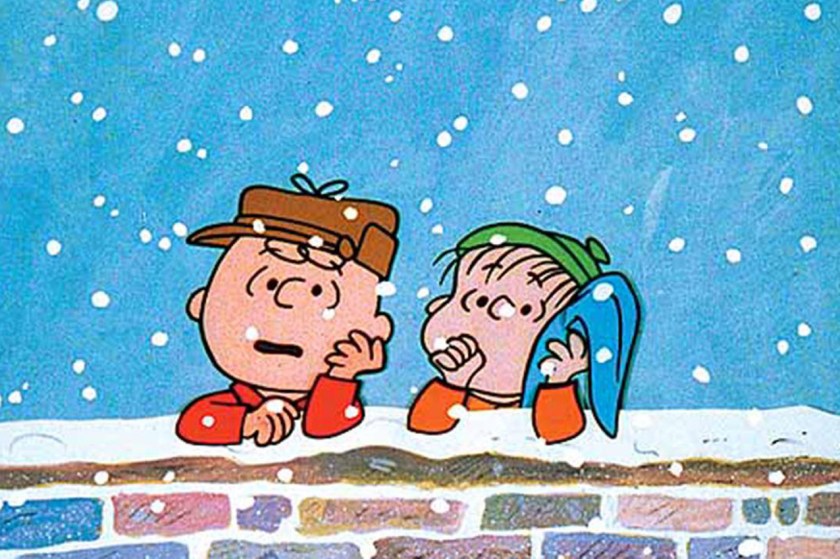
A Charlie Brown Christmas has been a staple of the Christmas season since 1965, but Linus almost didn’t get to tell his famous story of the baby Jesus. ABC executives thought Linus’ recitation of the birth of Christ too overtly religious. They wanted a laugh track too, but Schulz refused. “If we don’t do it, who will?” So it was that the scene remained, perhaps the most memorable moment in cartoon history. The laugh track version was produced, but never aired.
Charlie Brown’s love interest in some of the TV specials, the “Little Red-Haired Girl”, was based on an accountant from that old job at Art Instruction, Donna Mae Johnson. The two had an office romance, but she turned him down when he proposed they marry.
She wasn’t the only character based on a real person. Linus and Shermy were patterned after Schulz’ close friends Linus Maurer and Sherman Plepler. Peppermint Patty was inspired by a cousin on his mother’s side, Patricia Swanson. Snoopy himself resembles that old family dog Spike, though he was a Pointer, not a Beagle.
American opinion polls showed a sharp drop in support for the war in Vietnam over 1967. 1968 was a wretched year in American politics, beginning with the Tet Offensive in January. Media reporting turned the American military victory over the Vietnamese New Year, into a thing of despair. President Johnson withdrew from the Presidential election, that March. Martin Luther King, Jr. was assassinated in April and riots swept through cities across the country. Robert F. Kennedy was assassinated that June, after winning the critical California primary. The Democratic National Convention that August more closely resembled a riot, than a political convention.
Franklin Armstrong
Race relations were particularly vile, when Los Angeles schoolteacher Harriet Glickman wrote to the cartoonist, asking if he could add a black character. Glickman never expected a response from the now-famous Charles M. Schulz, but respond he did. He said he liked the idea, but expressed a concern about seeming “condescending”, to black families. With Schulz’ permission, Glickman asked friends of African ancestry, how to make such a character “more relatable”.
Franklin Armstrong made his first appearance on July 31, 1968. What was remarkable for the time, was how unremarkable, he was. Just another little boy, at first confused about the strange stuff in Charlie Brown’s neighborhood. Particularly Linus’ obsession with the ‘Great Pumpkin’. Franklin first met Charlie Brown on a beach. He said his father was a soldier, off fighting in Vietnam. “My dad’s a barber,” said Charlie Brown. “He was in a war too, but I don’t know which one.”
One newspaper editor wrote saying he didn’t mind a “negro” character, but please don’t show them in school together. Schulz didn’t bother to respond.
I wonder if Donna Mae Johnson ever regretted turning down that marriage proposal. Peanuts went on to become a pop culture phenomenon, with countless animated specials combining with merchandise sales to produce revenues in the Billions. At it’s peak, Peanuts ran in 2,600 papers in 75 countries and 21 languages. Schulz himself is estimated to have earned $30 to $40 million, a year.
The command module for the 1969 Apollo 11 mission to the moon was named Charlie Brown and the lunar module, Snoopy. President Ronald Reagan was a fan, and once wrote to Schulz that he identified with Charlie Brown.
Over fifty years, Schulz drew nearly 18,000 strips, taking vacation only once in 1997, to celebrate his 75th birthday. In all that time, that one five-week stretch was the only time the papers ever had Peanuts reruns.
Stephen Shea, H/T Huffington Post
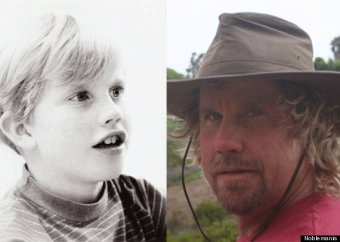
Fun fact: Former child actor Stephen Shea inherited the speaking role for Linus van Pelt when his older brother Chris’ voice changed, and went on to perform in eight animated specials. Chris went to summer camp with a boy who happened to be President of The Doors fan club. It turns out that Jim Morrison was a big Peanuts fan, and invited Chris and his father to be his special guests, at a concert.
Schulz’ health began to deteriorate in the late 1990s, his once-firm hand, now developing a tremor. He never really recovered from the stroke that hit him in November 1999 and announced his intention to retire, on December 14. The last original Peanuts strip was published on January 3, 2000. This son of a barber and a housewife, just like Charlie Brown himself, passed away just over a month later, a victim of colon cancer.
There will never be another.
If you enjoyed this “Today in History”, please feel free to re-blog, “like” & share on social media, so that others may find and enjoy it as well. Please click the “follow” button on the right, to receive email updates on new articles. Thank you for your interest, in the history we all share.
Sinbad’s breed was best described as “liberty-rum-chow-hound, with a bit of Bulldog, Doberman, Pinscher, and what-not. Mostly what-not”- Martin Sheridan Life Magazine, December 1943.
In times of peace, the United States Coast Guard is charged with protecting the security of the nation’s borders, maritime law enforcement and rescue operations. One of seven uniformed military service branches, Coast Guard operations may be expanded in time of conflict, or by order of the Commander-in-Chief.
During WW2, the Coast Guard operated hundreds of vessels from patrol frigates to troop ships, performing convoy escort, anti-submarine and replenishment operations. Many of the landing craft used in amphibious operations were operated by Coast Guardsmen. There may be no group in the employ of the United States government, better qualified to navigate the shoals, surf and strong currents encountered by small boats, in shallow water.
Semper Paratus. Always Ready.
In the winter of 1937, the Coast Guard cutter USCGC George W. Campell steamed out of New York harbor, patrolling the east coast with a mission of life-saving and national defense. The night before, Chief Boatswain’s Mate A. A. “Blackie” Roth (the name is also given as “Rother”) had given his girlfriend, a puppy. She couldn’t keep him, the landlord wouldn’t allow it. No other crewman could take the small dog. It was either leave him astray and hope for the best, or smuggle the puppy on board.
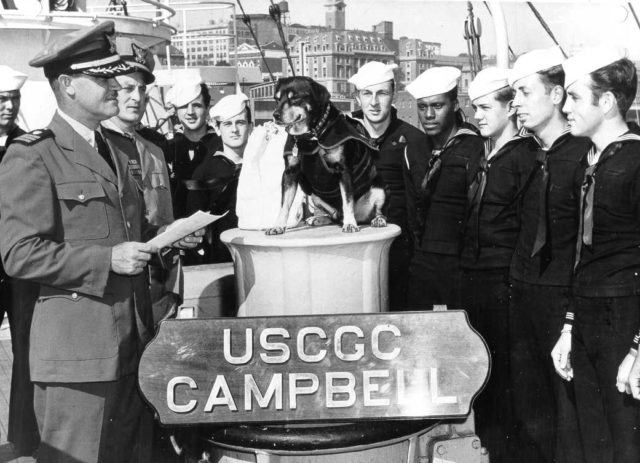
The Captain addressed the assembled crew on the first day of the cruise. Oh, to have been a fly on the wall, when one of them, barked back.
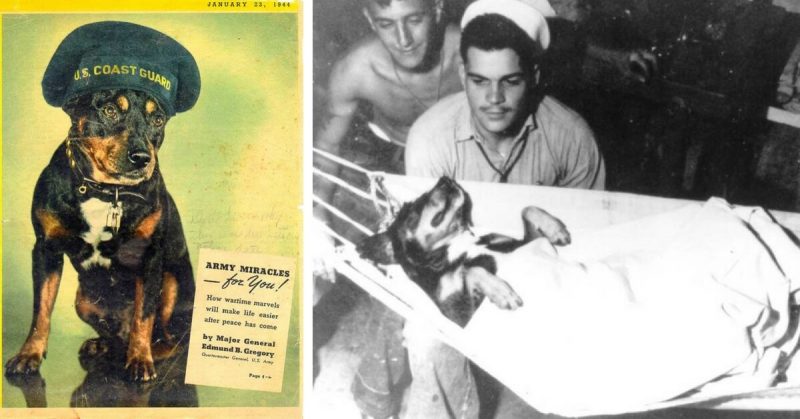
They called him “Sinbad”, and gave him a uniform, a service record and a rank. Dog, 1st class.
Sinbad quickly learned ship’s routine, and often “racked” with other sailors. He could always be found near the galley knowing that’s where the food comes from, and he loved himself a cup of black coffee.
Sinbad’s favorite toys were the large metal washers which he’d hide, until someone came to play with him. They even built him a hammock, much more comfy to sleep in, in those long Atlantic swells.
Sinbad was possessed of the best qualities of the sailor and of his own kind, and of the worst. In 1940, he nearly set off an international incident.
With the dark clouds of WW2 already over Europe, Denmark was overrun and occupied, by Nazis. Greenland was once a Danish territory, and the allies hoped to keep the place out of German hands. Campbell was sent to secure diplomatic ties with the Danes and the Greenlanders, who lived there.
Greenland is thinly populated, a place where locals mainly fish and raise sheep, for a living. On shore for a week, Sinbad was quick to discover the pastures and the great fun of chasing sheep. The sheep themselves were not amused and some died of exhaustion. Others became too nervous to go out and eat. The owners weren’t amused either, and one demanded that Sinbad be shot.
The captain thought that too severe a punishment and Sinbad was banished, never to set foot on Greenland, again. There was no end of amusement among the crew of the Campbell, that Sinbad had been brought before a Captain’s mast. It would not be his last.
Sinbad was awarded the American Defense Service Medal, American Campaign Medal, European-African-Middle-Eastern Campaign Medal, Asiatic-Pacific Campaign Medal, World War II Victory Medal and Navy Occupation Service Medal, which he wore, attached to his collar.
When war came, the cutter was transferred to the Navy, and the patrols became longer.
“Sinbad’s statue in Campbell’s mess hall watching over the ship. Captain James Hirschfield believed the WWII Campbell would survive after being disabled in combat so long as Sinbad stayed aboard”.
In the winter of 1943, Campbell was assigned to convoy protection, defending the vital north Atlantic supply route from roving “wolf packs” of German submarines. Sinbad never did get used to the sound of gunfire or depth charges, and would hide below decks, his paws over his ears. On February 22, the German submarine U-606 unleashed a barrage of torpedoes, against an allied convoy.
A day-long game of cat & mouse ensued in which the sub would pop up for another attack, only to be swarmed and driven into yet another crash dive. A periscope was spotted at 7:26 pm and Campbell charged in with a string of depth charges, colliding with the sub at the end of the run. U-606 was destroyed and Campbell badly damaged, disabled and without power, due to flooding.
All but “essential personnel” were evacuated. Captain James Hirschfield felt that Sinbad was good luck. No harm could befall the cutter while he was on board, and so he remained, essential personnel, taken under tow for repairs by the Polish destroyer, Burza. Sinbad had remained on deck with “his boys”, throughout the action.
Sinbad’s breed was best described as “liberty-rum-chow-hound, with a bit of Bulldog, Doberman, Pinscher, and what-not. Mostly what-not”- Martin Sheridan Life Magazine, December 1943.
Sinbad was promoted in 1943 to the rank of K9C, “Chief Dog” – equivalent to Chief Petty Officer – the second of only two dogs to be classified as non-commissioned officers. Since that time, ‘regulations’ have transformed all subsequent animals into “property” rather than personnel.
Fun fact: The first was Sergeant Stubby, the Staffordshire Terrier who was smuggled “over there” during the Great War, and once caught a German spy by the arse while he was prowling about allied trenches.
Campbell served the duration of WW2, with Sinbad on board, the entire time. In 1948, he was ready to retire. Sinbad had been at sea for eleven years. He was finally ready for shore detail.
After eleven years at sea, Sinbad was “retired” to enjoy the comfortable life of a mascot, at the Barnegat shore station.,
The assembled media and photographers were too much that day, and Sinbad bolted across the gang plank, and down the dock. To be AWOL from a United States Coast Guard cutter is a serious offense, and Sinbad was busted in rank, back to Dog, 1st class. He was probably just as happy to be back with the enlisted guys.
Sinbad was transferred to the Barnegat Light Small Boat Station in New Jersey, where he served as station mascot for the duration of his military career.
Sinbad is welcomed aboard by the crew of the Barnegat light station
Chief Dog Sinbad served all of his fourteen years with the United States Coast Guard. He passed away on this day in 1951 at the Barnegat light station and is buried there, at the base of the flagpole. A sailor always, Sinbad could drink with the best of them, and always enjoyed that cuppa black coffee. Irrespective of his latest rank, he was many years, a media celebrity. Life magazine may have said it best: “An Old Sea Dog Has Favorite Bars and Plenty of Girls in Every Port.”
Throughout her 46 years of service, USCGC Campbell was referred to as “The Queen of the Seas”. She was sunk as a training target in November 1984, a single harpoon missile leaving her nearly intact, as she went out of sight. The final radio message, broadcast as she disappeared beneath the waves: The Queen is dead. Long live the Queen.
Today, the USCGC Campbell (WMEC-909) patrols the east coast out of the Portsmouth Naval Shipyard in Kittery, Maine, the sixth Coast Guard Cutter to bear the name.
If you enjoyed this “Today in History”, please feel free to re-blog, “like” & share on social media, so that others may find and enjoy it as well. Please click the “follow” button on the right, to receive email updates on new articles. Thank you for your interest, in the history we all share.
What if thousands of these creatures were equipped with tiny little fire bombs, and dropped on Japanese cities. All that bamboo & paper construction, the place oughtta go up like a match head.
In a letter dated January 7, 1941, Marshall Admiral Isoroku Yamamoto directed Rear Admiral Onishi Takijiro under conditions of utmost secrecy, to study the feasibility of an attack on the American Naval anchorage at Pearl Harbor. Half a world away in Irwin Pennsylvania, American dentist Dr. Lytle S. Adams was planning a driving vacation to the Carlsbad Caverns, in New Mexico.
Dr. Adams was gripped with amazement that day in December, on witnessing millions of bats, exiting the cave. It was December 7 and word came over the radio, of a sneak attack in Hawaii. Millions of Americans must have been thinking about payback that day, Dr. Adams among them. His thoughts returned to those bats. What if thousands of these creatures were equipped with tiny little fire bombs, and dropped on Japanese cities. All that bamboo & paper construction, the place oughtta go up like a match head.
Lytle Adams was a personal friend of First Lady Eleanor Roosevelt and submitted the idea, the following month. Zoology professor Donald Griffin was conducting studies at this time of echolocation among animals, and recommended the White House approve the idea. The Presidential memorandum read: “This man is not a nut. It sounds like a perfectly wild idea but is worth looking into.” The mammalian super weapon that never was, was born.
Four biological factors lent promise to the plan. First, they’re the most plentiful mammal in North America. A single cave can hold several million individuals. Second, load-carrying tests conducted in the dirigible hangar at Moffett Field in Sunnyvale, California, demonstrated that bats can carry more than their own weight. Third, they hibernate, making them easy to handle and, last, bats like secluded places such as buildings to hide during daylight.
Professor Louis Fieser, the inventor of military napalm, devised a tiny little canister to be carried by the bats. A suitable species was selected by March 1943, the Mexican Free-tailed Bat (Tadarida brasiliensis mexicanus). “Bat bombs” were devised including 26 stacked trays, each containing compartments for 40 bats. Carriers would be dropped from 5,000-feet with parachutes deployed at 1,000-feet, allowing hibernating bats sufficient time to “snap out” of it.
Carlsbad AAF Fire, following Bat Bomb Accident
Early tests were promising. Too promising. On May 15, armed bats were accidentally released at the Carlsbad Army Airfield Auxiliary Air Base near Carlsbad, New Mexico, and incinerated the place when some of them came to roost under a fuel tank.
Despite the setback or possibly because of it, the program was handed off to the Navy that August, and code named Project X-Ray. The project was handed off once again that year, placed under control of the Marine Corps Air Station at El Centro, California, by December 18.
A “Japanese Village” was mocked up by the Chemical Warfare Service at the Dugway Proving Ground in Utah. National Defense Research Committee (NDRC) observers were positive, one stating: “It was concluded that X-Ray is an effective weapon.” The Chief Chemist’s report was more enthusiastic: “Expressed in another way, the regular bombs would give probably 167 to 400 fires per bomb load where X-Ray would give 3,625 to 4,748 fires.”
Project X-Ray was scheduled for further tests in mid-1944 and not expected for combat readiness for another year, when the program was cancelled by Fleet Admiral Ernest J. King. The project had already cost $2 million, equal to over $29 million today. It was too much, for too little.
Die Fledermaus (“The Bat”) was a German operetta by composer Johann Strauss II, featuring a prolonged and drunken soliloquy by one Frosch, (the jailer), in act 2. Stanley Lovell was director of research and development for the OSS at the time (Office of Strategic Services), precursor to the CIA. Ordered to evaluate the bat bomb by OSS Director “Wild Bill” Donovan, Lovell may have had the last word. “Die Fledermaus Farce” he called it, noting that the things were dropping to the ground, like stones.
Fun Fact:
During WW2, the British Special Operations Executive (SOE) devised a “Rat Bomb”, for use against German targets. 100 rat carcasses were sewn up with plastic explosives, to be distributed near German boiler rooms and locomotives. The idea was that the carcass would be disposed of by burning, resulting in a boiler explosion. The explosive rats were never put to use as the Germans intercepted the first and only shipment. The project was deemed a success anyway, due to the enormous time and manpower resources expended by the Germans, looking for booby trapped rats.
If you enjoyed this “Today in History”, please feel free to re-blog, “like” & share on social media, so that others may find and enjoy it as well. Please click the “follow” button on the right, to receive email updates on new articles. Thank you for your interest, in the history we all share.
The bones of Americans captured at Bataan and Corregidor and burned alive at Palawan, were discovered soon after liberation. Most were huddled together where they had died, trying to escape the flames.
The United States was unprepared to fight a World War in 1942, and dedicated itself to beating Adolf Hitler. General Douglas MacArthur abandoned the “Alamo of the Pacific” on March 11 saying “I shall return”, leaving 90,000 American and Filipino troops without food, supplies or support with which to fight off the Japanese offensive.
On April 9, 75,000 surrendered the Bataan peninsula, only to be herded off on a 65-mile, five-day slog into captivity through the heat of the Philippine jungle. Japanese guards were sadistic. They would beat the marchers and bayonet those too weak to walk. Japanese tanks would swerve out of their way to run over anyone who had fallen and was too slow in getting up. Some were burned alive. Already crippled from tropical disease and starving from the long siege of Luzon, some 700 Americans and more than 10,000 Filipinos perished in what came to be known as the Bataan Death March.
Palawan Massacre POW Burial Site, 1945
That August, 346 men were sent 350-miles north to Palawan Island, on the western perimeter of the Sulu sea. The prisoners of “camp 10-A” were expected to build an airfield for their Japanese captors, hauling and crushing coral gravel by hand and pouring concrete, seven days a week.
The daily food ration was nothing more than a handful of wormy Cambodian rice and a thin soup made from boiling camote vines, a type of local sweet potato. Prisoners unable to work had even this thin ration, cut by 30 per cent.
The abuses these men received at the hands of the kempeitai, the Japanese army’s military police and intelligence unit, were unremitting, and savage. Prisoners were beaten with pick handles, kicked and slapped on a daily basis. Anyone who attempted to escape, was summarily executed.
Caught stealing food, six American POWs were tied to coconut trees and whipped with wire and then beaten with a wooden club, 3-inches in diameter. The six were then forced to stand at attention while a guard beat them unconscious, only to be revived to undergo further beatings. One Japanese private named Nishitani broke the left arms of two Americans with an iron bar, for taking green papayas off a tree.
Radioman 1st Class Joseph Barta described the Japanese guards at Palawan, as “the meanest bastards who ever walked the earth”.
Medical care was non-existent. One Marine, Pfc Glen McDole of Des Moines Iowa, was forced to endure an appendectomy with no anesthesia, and no infection fighting drugs.
The war was going badly for the Japanese, by late 1944. US forces under General Douglas MacArthur landed at Leyte, that October. Morale soared for the 150 American prisoners remaining at Palawan, when a single Consolidated B-24 Liberator bomber sank two enemy ships and damaged several aircraft. More Liberators returned on October 28 and destroyed 60 enemy aircraft on the ground, as treatment of the prisoners grew even worse.
By early December, Allied aircraft were a near-constant presence overhead. Deliverance must have seemed imminent to the 150 American prisoners left on Palawan island, but it wasn’t meant to be. On December 14, some fifty to sixty soldiers under the leadership of 1st Lt. Yoshikazu Sato, prisoners called him the Buzzard, doused the remaining prisoners with gasoline and set them on fire. One hundred and thirty-nine were burned to death, or clubbed, or machine gunned as they tried to get away. The sound of screams were punctuated with shouts and laughter, from the guards.
Some closed to hand-to-hand combat with their tormentors and even managed to kill a few, but most never had a chance. Lieutenant Carl Mango of the U.S. Army Medical Corps ran toward the Japanese with his clothes on fire, pleading with them to use some sense. He too, was machine-gunned.
Palawan Massacre Memorial Marker for the American victims of December 14, 1944, Palawan Philippines
Thirty or forty managed to escape the kill zone, only to be hunted down, and murdered. From his hiding place on the beach, Eugene Nielsen of the 59th Coast Artillery observed several begging to be shot in the head, only to be bayoneted in the stomach and left to an agonizing death, by laughing guards. Erving August Evans of Nielsen’s unit stood up and said “All right, you Jap bastards, here I am and don’t miss me“. He was shot, and his body set alight.
The killing went on until well after dark yet, somehow, some were able to escape detection and managed to swim the 5-mile bay to be picked up by friendly Filipino guerrillas, and taken to U.S. Rangers. Rufus Smith was badly bitten on the left arm and shoulder by a shark, but manged to reach the other side. USMC Pfc Donald Martyn reached the opposite side and turned in a direction opposite the others, and was never seen again.Glen McDole, the marine who survived the appendectomy, hid in a garbage dump, and witnessed one marine repeatedly poked with bayonets. Bleeding profusely, the man begged to be shot, only to have first one foot doused with gasoline and set on fire and then the other and finally, a hand. At last, his five or six tormentors tired of this game and he too, was set alight.
One Japanese soldier recorded the atrocity in a diary, later found in the camp:
“December 15–Due to the sudden change of situation, 150 prisoners of war were executed. Although they were prisoners of war, they truly died a pitiful death. The prisoners who worked in the repair shop really worked hard. From today on I will not hear the familiar greeting, ‘Good morning, sergeant major.’ January 9–After a long absence, I visited the motor vehicle repair shop. Today, the shop is a lonely place. The prisoners of war who were assisting in repair work are now just white bones on the beach washed by the waves. Furthermore, there are numerous corpses in the nearby garage and the smell is unbearable. It gives me the creeps”.
Eugene Nielsen’s testimony sparked a series of POW rescues by American forces in 1945, including the raid on Cabanatuanof January 30, the surprise attack at Santo Tomas on February 3, 1945, the raid of Bilibid Prison on February 4 and the assault at Los Baños on February 23. Starving prisoners were so emaciated, that Rangers were able to carry them out, two at a time.
The bones of Americans captured at Bataan and Corregidor and burned alive at Palawan, were discovered soon after. Most were huddled together where they had died, trying to escape the flames.
Sixteen Japanese soldiers were tried and convicted of the massacre in August 1948 and several sentenced to death. All were later released, in a general amnesty.
Of 146 enlisted men and four officers held in the Palawan prison camp, eleven survived the massacre of December 14, 1944. Glen McDole was one of them. Author Bob Wilbanks wrote a book if you’re interested, a biography really, entitled: Last Man Out: Glenn McDole, USMC, Survivor of the Palawan Massacre in World War II.
In 1952, 123 of the 139 victims of the Palawan massacre were buried in a common grave. They came from forty-two states and the Philippines, reverently interred in a mass burial site in Section 85 at the Jefferson Barracks National Cemetery, near St. Louis, Missouri. Today, their graves are visited by those who remember. And by the deer, grazing among the stones most evenings, as the sun drops out of sight. It is the largest such group burial, at Jefferson Barracks.
How many such massacres were carried out with no one left alive to tell the tale, remains anyone’s guess.
If you enjoyed this “Today in History”, please feel free to re-blog, “like” & share on social media, so that others may find and enjoy it as well. Please click the “follow” button on the right, to receive email updates on new articles. Thank you for your interest, in the history we all share.
There is no telling, how many lives could have been lost. But for the actions, of a sixteen-year-old cook’s assistant.
Similar to the Base Exchange system serving American military personnel, the British Navy, Army and Air Force Institutes (NAAFI) is the UK-government organization operating clubs, bars, shops and supermarkets in service to British armed forces, as well as naval canteen services (NCS) aboard Royal Navy ships.
NAAFI personnel serving on ships are assigned to duty stations and wear uniforms, while technically remaining civilians.
Tommy Brown was fifteen when he lied about his age, enlisting in the NAAFI on this day in 1941 and assigned as canteen assistant to the “P-class” destroyer, HMS Petard.
On October 30, 1942, Petard joined three other destroyers and a squadron of Vickers Wellesley light bombers off the coast of Port Said Egypt, in a 16-hour hunt for the German “Unterseeboot”, U–559.
Hours of depth charge attacks were rewarded when the crippled U-559 came to the surface, the 4-inch guns of HMS Petard, permanently ending the career of the German sub.
The U-559 crew abandoned ship, but not before opening the boat’s seacocks. Water was pouring into the submarine as Lieutenant Francis Anthony Blair Fasson and Able Seaman Colin Grazier dived into the water and swam to the submarine, with Junior canteen assistant Tommy Brown close behind.
With the submarine sinking fast, Fasson and Grazier made their way into the captain’s cabin. Finding a set of keys, Fasson opened a drawer, to discover a number of documents, including two sets of code books.
With one hand on the conning ladder and the other clutching those documents, Brown made three trips up and down from the hatch, to Petard’s whaler.
With the sub beginning to sink, the canteen assistant called for his shipmates to get out of the boat, but the other two were trapped. Brown himself was dragged under, but managed to kick free and come to the surface. Colin Grazier and Francis Fasson, did not escape.
The episode brought Brown to the attention of the authorities, ending his posting aboard Petard with the revelation of his true age. He never was discharged from the NAAFI, and later returned to sea on board the HMS Belfast.
By 1945 he was Leading Seaman Tommy Brown, home on shore leave when fire broke out at the family home in South Shields. He died while trying to rescue his youngest sister Maureen, and was buried with full military honors in Tynemouth cemetery.
Fasson and Grazier were awarded the George Cross, the second-highest award of the United Kingdom system of military honors. Since he was a civilian due to his NAAFI employment, Brown was awarded the George medal.
None of the three would ever learn that their actions had helped to end the war.
For German U-boat commanders, the period between the fall of France and the American entry into WW2 was known as “Die Glückliche Zeit” – “The Happy Time” – in the North Sea and North Atlantic. From July through October 1940 alone, 282 Allied ships were sunk off the northwest approach to Ireland, for a combined loss of 1.5 million tons of merchant shipping.
Tommy Brown’s Mediterranean episode took place in 1942, in the midst of the “Second Happy Time”, also known among German submarine commanders as the American shooting season. U-boats inflicted massive damage during this period, sinking 609 ships totaling 3.1 million tons with the loss of thousands of lives, against a cost of only 22 U-boats.
According to USMM.org,the United States Merchant marine suffered a higher percentage of fatalities at 3.9%, than any other American service branch during WW2.
Early versions of the German “Enigma” code were broken as early as 1932, thanks to cryptanalysts of the Polish Cipher Bureau, and French spy Hans Thilo Schmidt.
French and British military intelligence were read into Polish decryption techniques in 1939, \methods which were later improved upon by the British code breakers of Bletchley Park. Vast numbers of messages were intercepted and decoded from Wehrmacht and Luftwaffe sources, shortening the war by at least a year, and possibly two.
The Kriegsmarine was a different story. Maniacally jealous of security, Admiral Karl Dönitz introduced a third-generation enigma machine (M4) into the submarine service around May 1941, a system so secret that neither Wehrmacht nor Luftwaffe, were aware of its existence. The system requires identical cipher machines at both ends of the transmission and took a while to put into place, with German subs being spread around the world.
By early 1942, all M4 machines were in place. On February 2, German submarine communications went dark. For code breakers at Bletchley Park, the blackout was sudden and complete. Like the flipping of a switch. For a period of nine months, Allies had not the foggiest notion of what the German submarine service was up to. The result was disastrous.
The beginning of the end of darkness came to an end on October 30, when a ship’s cook climbed up that conning ladder. Code sheets allowed British cryptanalysts to attack the “Triton” key used by the U-boat service. It would not be long, before the U-boats themselves, were under attack.
Tommy Brown never knew what was in those documents. The entire enterprise would remain Top Secret, until years after his death. Winston Churchill would later write, that the actions of the crew of Petard, were crucial to the outcome of the war. There is no telling, how many lives could have been lost. But for the actions, of a sixteen-year-old cook’s assistant.
If you enjoyed this “Today in History”, please feel free to re-blog, “like” & share on social media, so that others may find and enjoy it as well. Please click the “follow” button on the right, to receive email updates on new articles. Thank you for your interest, in the history we all share.
The work was hellishly dangerous down there in the mud and the oil at the bottom of Pearl Harbor. Several divers lost their lives yet, another day would come and each would descend yet again, into that black water.
It was literally “out of the blue”, when the first wave of enemy aircraft arrived at 7:48 am local time, December 7, 1941. 353 Imperial Japanese warplanes approached in two waves out of the southeast, fighters, bombers, and torpedo planes. Across Hickam Field and over the still waters of Pearl Harbor. Tied in place and immobile, the eight vessels moored at “Battleship Row” were easy targets.
In the center of the Japanese flight path, sailors and Marines aboard the USS Oklahoma fought back furiously. She didn’t have a chance. Holes as wide as 40′ were torn into her side in the first ten minutes of the fight. Eight torpedoes smashed into her port side, each striking higher on the hull as the great Battleship began to roll.
Bilge inspection plates had been removed for a scheduled inspection the following day, making counter-flooding to prevent capsize, impossible. Oklahoma rolled over and died as the ninth torpedo slammed home. Hundreds scrambled out across the rolling hull, jumped overboard into the oil covered, flaming waters of the harbor, or crawled out over mooring lines in the attempt to reach USS Maryland in the next berth.
The damage was catastrophic. Once the pride of the Pacific fleet, all eight battleships were damaged, four of them sunk. Nine cruisers, destroyers and other ships were damaged, another two sunk. 347 aircraft were damaged, most caught while still on the ground. 159 of those, were destroyed altogether. 2,403 were dead or destined to die from the attack, another 1,178 wounded.
Nine Japanese torpedoes struck USS Oklahoma’s port side, in the first ten minutes.
The last moments of USS Oklahoma. H/T John F DeVirgilio for this graphic
Frantic around the clock rescue efforts began almost immediately, to get at 461 sailors and Marines trapped within the hull of the Oklahoma. Tapping could be heard as holes were drilled to get at those trapped inside. 32 were delivered from certain death.
14 Marines and 415 sailors aboard Oklahoma lost their lives immediately, or in the days and weeks to come. Bulkhead markings would later reveal that, at least some of the doomed would live for another seventeen days in the black, upside-down hell. The last such mark was drawn by the last survivor on Christmas Eve.
Of the sixteen ships lost or damaged, thirteen would be repaired and returned to service. USS Arizona remains on the bottom, a monument to the event and to the 1,102-honored dead who remain entombed within her hull. USS Utah defied salvage efforts. She too is a registered War Grave, 64 honored dead remaining within her hull, lying at the bottom not far from the Arizona. Repairs were prioritized and USS Oklahoma was beyond repair. She, and her dead, would have to wait.
Recovery of the USS Oklahoma was the most complex salvage operation ever attempted, beginning in March, 1943. With the weight of her hull driving Oklahoma’s superstructure into bottom, salvage divers descended daily to separate the tower, while creating hardpoints from which to attach righting cables.
The work was hellishly dangerous down there in the mud and the oil at the bottom of Pearl Harbor. Several divers lost their lives yet, another day would come and each would descend yet again, into that black water.
21 giant A-frames were fixed to the hull of the Oklahoma, 3″ cables connecting compound pulleys to 21 electric motors, each capable of pulling 429 tons.
Two pull configurations were used over 74 days, first attached to these massive A-frames, then direct connections once the hull had achieved 70°. In May 1943, the decks once again saw the light of day, for the first time in over two years.
USS Oklahoma, righting strategy
Fully righted, the ship was still ten-feet below water. Massive temporary wood and concrete structures called “cofferdams” closed cavernous holes left by torpedoes, so the hull could be pumped out and re-floated. A problem even larger than those torpedo holes were the gaps between hull plates, caused by the initial capsize and righting operations. Divers stuffed kapok into gaps as water was pumped out.
Individual divers spent 2-3 years on the Oklahoma salvage job. Underwater arc welding and hydraulic jet techniques were developed during this period, which remain in use to this day. 1,848 dives were performed for a total of 10,279 man hours under pressure.
CDR Edward Charles Raymer, US Navy Retired, was one of those divers. Raymer tells the story of these men in Descent into Darkness: Pearl Harbor, 1941 – A Navy Diver’s Memoir, if you’re interested in further reading. Most of them are gone now, including Raymer himself. They have earned the right to be remembered.
Salvage workers entered the pressurized hull through airlocks wearing masks and protective suits. Bodies were in advanced stages of decomposition by this time and the oil and chemical-soaked interior was toxic to life. Most victims would never be identified.
Twenty 10,000 gallon per minute pumps operated for 11 hours straight, re-floating the battleship on November 3, 1943.
Oklahoma entered dry dock the following month, a total loss to the American war effort. She was stripped of guns and superstructure, sold for scrap on December 5, 1946 to the Moore Drydock Company of Oakland, California.
The battered hulk left Pearl Harbor for the last time in May 1947, destined for the indignity of a scrapyard in San Francisco bay. She would never make it. Taken under tow by the ocean-going tugs Hercules and Monarch, the three vessels entered a storm, 540 miles east of Hawaii. On May 17, disaster struck. Piercing the darkness, Hercules’ spotlight revealed that the former battleship was listing heavily. Naval base at Pearl Harbor instructed them to turn around, when these two giant tugs suddenly found themselves slowing to a stop. Despite her massive engines, Hercules was being dragged astern with no warning, hurtling past Monarch, herself swamped at the stern and being dragged backward at 17mph.
Ocean-going tug Hercules, photograph by William Havle
Fortunately for both tugs, skippers Kelly Sprague of Hercules and George Anderson of Monarch had both loosened the cable drums connecting 1,400-foot tow lines to Oklahoma. Monarch’s line played out and detached, but Hercules’ line didn’t do so until the last possible moment. With tow line straight down and sinking fast, Hercules’ cable drum exploded in a shower of sparks directly over Oklahoma’s final resting place, the 409-ton tug bobbing to the surface like the float of a child’s fishing line.
“Okie” had been stabbed in the back, attacked and mortally wounded before she knew her nation was at war. The causes leading to her final descent, remain uncertain. Most will tell you, those plates couldn’t hold. The beating of six years earlier, was just too much. Those who served on her decks, might tell you she preferred to die at sea.
If you enjoyed this “Today in History”, please feel free to re-blog, “like” & share on social media, so that others may find and enjoy it as well. Please click the “follow” button on the right, to receive email updates on new articles. Thank you for your interest, in the history we all share.
How modern chemotherapy drugs emerged form the trenches of WW1
Ancient Greek mythology depicts Hercules, poisoning arrows with the venom of the Hydra. Both sides in the battle for Troy used poisoned arrows, according to the Iliad and the Odyssey of Homer. Alexander the great encountered poison arrows and fire weapons in the Indus valley of India, in the fourth century, BC. Chinese chronicles describe an arsenic laden “soul-hunting fog”, used to disperse a peasant revolt, in AD178.
The French were first to use poison weapons in the modern era, firing tear gas grenades containing xylil bromide against German forces in the first month of the Great War, August 1914.
Imperial Germany was first to give serious study to chemical weapons of war, early experiments with irritants taking place at the battle of Neuve-Chapelle in October 1914, and with tear gas at Bolimów on January 31, 1915 and again at Nieuport, that March.
The first widespread use of poison gas, in this case chlorine, came on April 22, 1915, at the second battle of Ypres.
The story of gas warfare is inextricably linked with that of WW1. 124,000 tons of the stuff was produced by all sides by the end of the war, accounting for 1,240,853 casualties, including the agonizing death of 91,198.
Had the war continued into 1919, technological advances promised a new and fresh hell, unimaginable to the modern reader.
Today we think of chemical agents in WW2 as being limited to the death camps of the Nazis, but such weapons were far more widespread. The Imperial Japanese military frequently used vesicant (blister) agents such as Lewisite and mustard gas against Chinese military and civilians, and in the hideous “medical experiments” conducted on live prisoners at Unit 731 and Unit 516. Emperor Hirohito personally authorized the use of toxic gas during the 1938 Battle of Wuhan, on no fewer than 375 occasions.
The Italian military destroyed every living creature in its path during the 1936 Colonial war with Ethiopia, in what Emperor Haile Selassie called “a fine, death-dealing rain”.
Nazi Germany possessed some 45,000 tons of blister and nerve agents, though such weapons were rarely used against western adversaries. The “Ostfront” – the battle on the eastern front – was a different story. Russian resistance fighters and Red Army soldiers were attacked, most notably during the assault on the catacombs of Odessa in 1941, the 1942 siege of Sebastopol, and the nearby caves and tunnels of the Adzhimuskai quarry, where “poison gas was released into the tunnels, killing all but a few score of the (3,000+) Soviet defenders”.
Russian soldier in a rubber gas mask, ww2
None of the western allies resorted to chemical warfare in WW2, despite having accumulated over twice the chemical stockpile as that of Nazi Germany. The policy seems to have been one of “mutually assured destruction”, where no one wanted to be first to go there, but all sides reserved the option. Great Britain possessed massive quantities of mustard, chlorine, Lewisite, Phosgene and Paris Green, awaiting the retaliatory strike should Nazi Germany resort to such weapons on the beaches of Normandy. General Alan Brooke, Commander-in-Chief of the Home Forces, said he “[H]ad every intention of using sprayed mustard gas on the beaches” in the event of a German landing on the British home islands.
The official American policy toward chemical weapons was enunciated by President Franklin Roosevelt, in 1937.
“I am doing everything in my power to discourage the use of gases and other chemicals in any war between nations. While, unfortunately, the defensive necessities of the United States call for study of the use of chemicals in warfare, I do not want the Government of the United States to do anything to aggrandize or make permanent any special bureau of the Army or the Navy engaged in these studies. I hope the time will come when the Chemical Warfare Service can be entirely abolished”.
The Geneva Protocols on 1925 banned the use of chemical weapons, but not their manufacture, or transport. By 1942, the U.S. Chemical Corps employed some 60,000 soldiers and civilians and controlled a $1 Billion budget.
In August 1943, Roosevelt authorized the delivery of chemical munitions containing mustard gas, to the Mediterranean theater. Italy surrendered in early September, changing sides with the signing of the armistice of Cassibile.
The liberty ship SS John Harvey arrived at the southern Italian port of Bari in November, carrying 2000 M47A1 mustard gas bombs, each containing 60 to 70-pounds of sulfur mustard.
Bari was packed at the time, with ships waiting to be unloaded. It would be days before stevedores could get to her. Captain John Knowles wanted to inform port authorities of his deadly cargo and request that it be unloaded immediately, but secrecy prevented him from doing so. As it was, John Harvey was still waiting to be unloaded, on December 2.
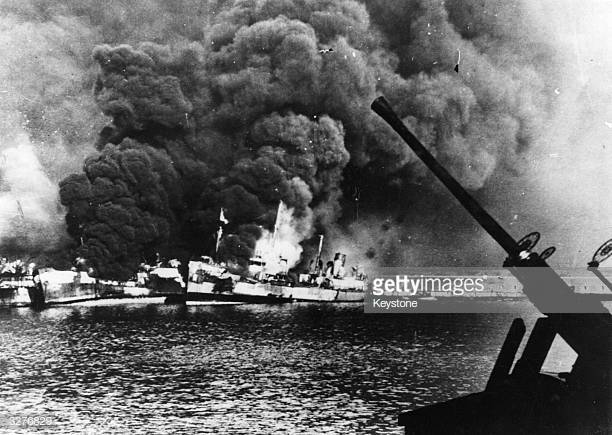
Air raid on Bari, December 2, 1943
For Luftwaffe Generalfeldmarschall Albert Kesselring, the traffic jam at Bari was an opportunity to slow the advance of the British 8th army on the Italian peninsula.
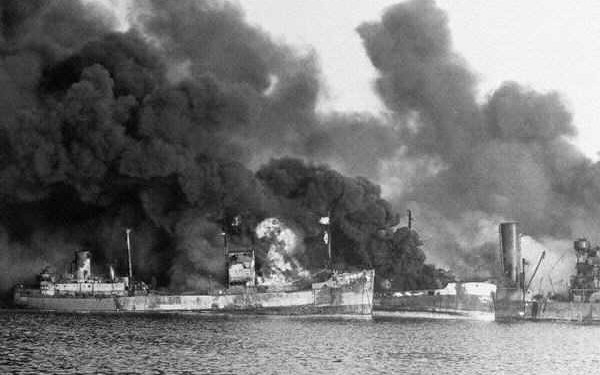
The “Little Pearl Harbor” began at 7:25PM, when 105 Junkers JU-88 bombers came out of the East. The tactical surprise was complete, and German pilots were able to bomb the harbor with great accuracy. Two ammunition ships were first to explode, shattering windows 7 miles away. A bulk gasoline pipeline was severed, as a sheet of burning fuel spread across the harbor, igniting those ships left undamaged.
43 ships were sunk, damaged or destroyed including John Harvey, which erupted in a massive explosion. Liquid sulfur mustard spilled into the water, as a cloud of toxic vapor blew across the port and into the city.
Mustard gas is a cytotoxic agent, capable of entering the system via skin, eyes and respiratory tract and attacking every cell type with which it comes into contact. First comes the garlic smell, as the yellow-brown, heavier-than-air cloud creeps along the ground. Contact first results in redness and itching, resulting 12-24 hours later in excruciating, untreatable blisters on exposed areas of the skin. Sufferers are literally burned inside and out, as mucous membranes are stripped away from the eyes, nose and respiratory tract.
Death comes in days or weeks. Survivors are likely to develop chronic respiratory disease and infections. DNA is altered, often resulting in certain cancers and birth defects. To this day there is no antidote.
A thousand or more died outright in the bombing. 643 military service personnel were hospitalized for gas symptoms. 83 of those were dead, by the end of the month. The number of civilian casualties is unknown. The whole episode remained shrouded in secrecy.
Afterward:
At the time, the nature of the chemical disaster at Bari was unknown. Everyone with any knowledge of John Harvey’s secret cargo was killed in the explosion. Lieutenant-Colonel Stewart Francis Alexander, an American physician from New Jersey, was sent by the Deputy Surgeon General of the US Army to find out what happened.
Dr. Sidney Farber, regarded by many as the “Father of Modern Chemotherapy”
It was Dr. Alexander who figured out that mustard was the responsible agent, and from where it had come. In the process of testing, Dr. Alexander noticed the unknown agent first went after rapidly dividing cells, such as white blood cells. Alexander wondered if it might be useful in going after other rapidly dividing cells, such as cancer.
Based on Dr. Alexander’s field work, Yale pharmacologists Louis Goodman and Alfred Gilman developed the first anti-cancer chemotherapy drug, in the treatment of lymphoma.
Dr. Sidney Farber of Boston built on this work, producing remission in children with acute Leukemia using Aminopterin, an early precursor to Methotrexate, a chemotherapy drug still in use, today.
Writers have labeled SS John Harvey a Savior of Millions, due to the vessel’s role in the pioneering era of modern chemotherapy drugs.
The claim may be a bit of an exaggeration, but not entirely so. The American Cancer Society estimates that there were 7,377,100 male cancer survivors in the United States as of January 1, 2016 and another 8,156,120, females.
If you enjoyed this “Today in History”, please feel free to re-blog, “like” & share on social media, so that others may find and enjoy it as well. Please click the “follow” button on the right, to receive email updates on new articles. Thank you for your interest, in the history we all share.
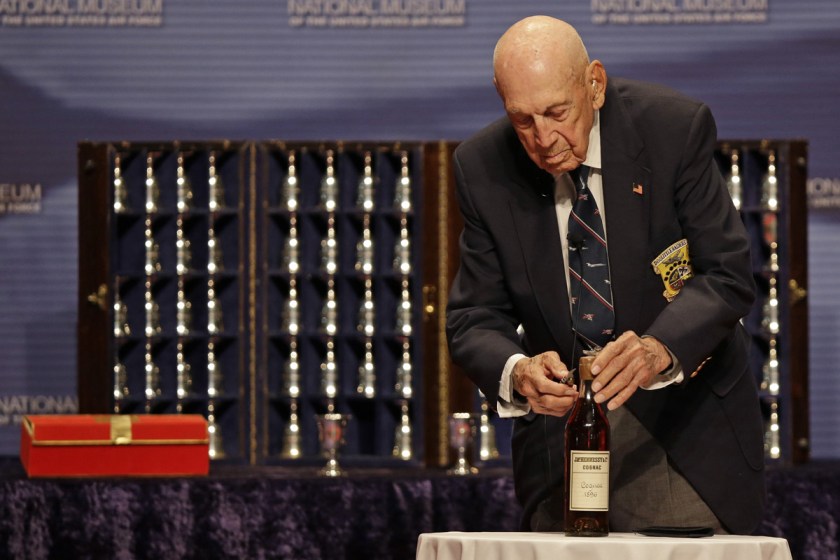
On November 9, 2013, a 117 year-old bottle of rare, vintage cognac was cracked open, and enjoyed among a company of heroes. If there is a more magnificent act of tribute, I cannot at this moment think of what it might be.
On November 9, 2013, there occurred a gathering of four. A tribute to fallen heroes. These four were themselves heroes, and worthy of tribute. This was to be their last such gathering.
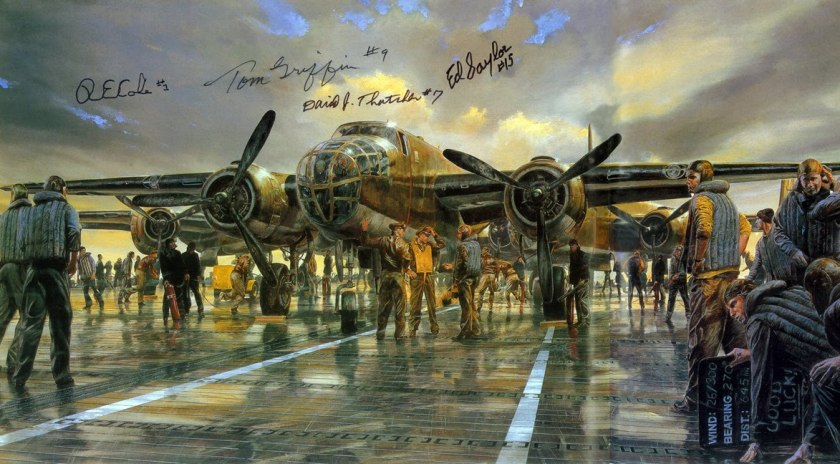
This story begins on April 18, 1942, when a flight of sixteen Mitchell B25 medium bombers took off from the deck of the carrier, USS Hornet. It was a retaliatory raid on Imperial Japan, planned and led by Lieutenant Colonel James “Jimmy” Doolittle of the United States Army Air Forces. It was payback for the sneak attack on Pearl Harbor, seven months earlier. A demonstration that the Japanese home islands, were not immune from destruction.
Launching such massive aircraft from the decks of a carrier had never been attempted, and there were no means of bringing them back. With extra gas tanks installed and machine guns removed to save the weight, this was to be a one-way mission, into territory occupied by a savage adversary.
Fearing that mission security had been breached, the bomb run was forced to launch 200 miles before the intended departure spot. The range made fighter escort impossible, and left the bombers themselves with only the slimmest margin of error.
Japanese Premier Hideki Tojo was inspecting military bases, at the time of the raid. One B-25 came so close he could see the pilot, though the American bomber never fired a shot.
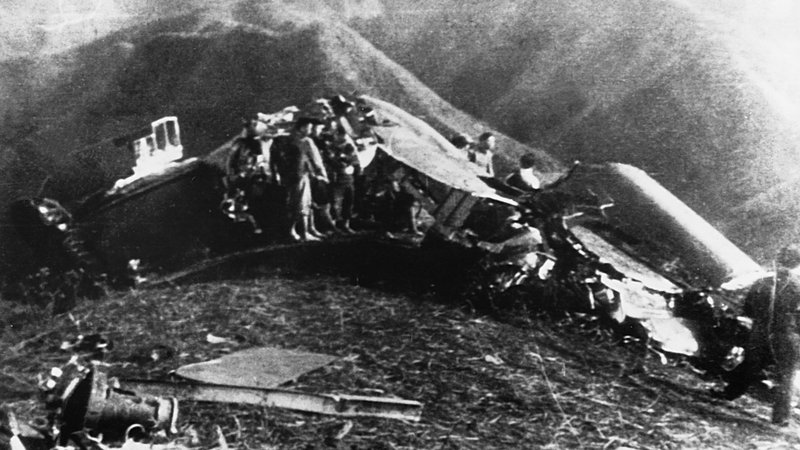
After dropping their bombs, fifteen continued west, toward Japanese occupied China. Unbeknownst at the time, carburetors bench-marked and calibrated for low level flight had been replaced in flight #8, which now had no chance of making it to the mainland. Twelve crash landed in the coastal provinces. Three more, ditched at sea. Pilot Captain Edward York pointed flight 8 toward Vladivostok, where he hoped to refuel. The pilot and crew were instead taken into captivity, and held for thirteen months.
Crew 3 Engineer-Gunner Corporal Leland Dale Faktor died in the fall after bailing out and Staff Sergeant Bombardier William Dieter and Sergeant Engineer-Gunner Donald Fitzmaurice bailed out of aircraft # 6 off the China coast, and drowned.
The heroism of the indigenous people at this point, is a little-known part of this story. The massive sweep across the eastern coastal provinces, the Zhejiang-Jiangxi campaign, cost the lives of 250,000 Chinese. A quarter-million murdered by Japanese soldiers, in the hunt for Doolittle’s raiders. How many could have betrayed the Americans and refused, will never be known.
Amazingly, only eight were captured, among the seventy-seven survivors.
First Lieutenant Pilot “Bill” Farrow and Sergeant Engineer-Gunner Harold Spatz, both of Crew 16, and First Lieutenant Pilot Dean Edward Hallmark of Crew 6 were caught by the Japanese and executed by firing squad on October 15, 1942. Crew 6 Co-Pilot First Lieutenant Robert John Meder died in a Japanese prison camp, on December 11, 1943. Most of the 80 who began the mission, survived the war.
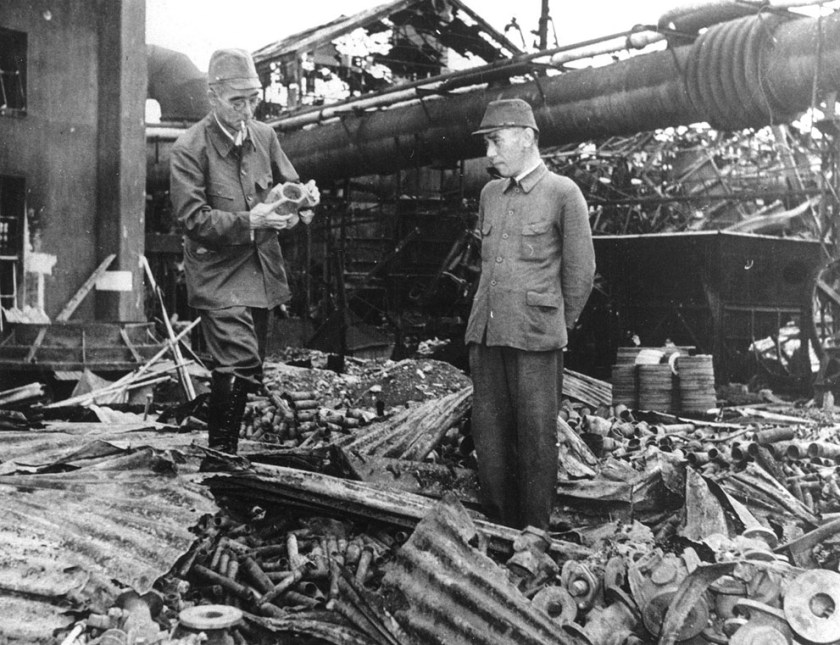
Thirteen targets were attacked, including an oil tank farm, a steel mill, and an aircraft carrier then under construction.. Fifty were killed and another 400 injured, but the mission had a decisive psychological effect. Japan withdrew its powerful aircraft carrier force to protect the home islands. Admiral Isoroku Yamamoto attacked Midway, thinking it to have been the jump-off point for the raid. Described by military historian John Keegan as “the most stunning and decisive blow in the history of naval warfare”, the battle of Midway would be a major strategic defeat for Imperial Japan.
Ryozo Asano, left, spokesman for a group of diversified Japanese family enterprises called the Zaibatsu, inspects the wreckage of his Tokyo steel plant
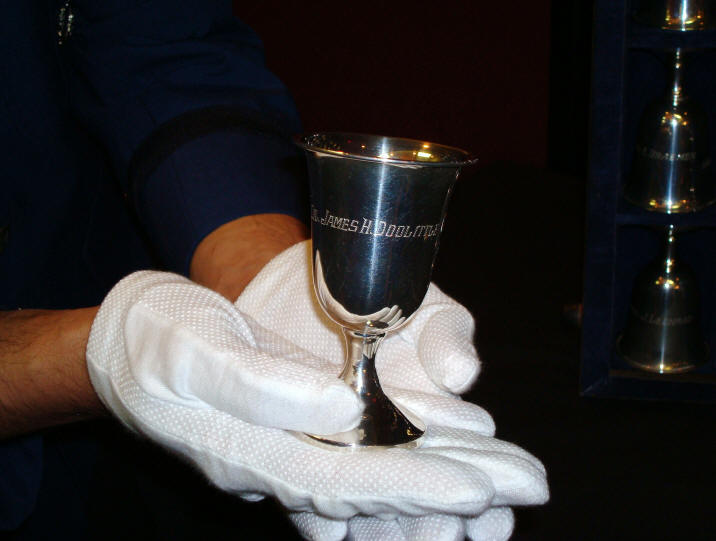
Every year since the late 1940s, the surviving Doolittle raiders have held a reunion. In 1959, the city of Tucson presented them with 80 silver goblets, each engraved with a name. They are on display at the National Museum of the Air Force, in Dayton Ohio.
With those goblets is a fine bottle of vintage Cognac. 1896, the year Jimmy Doolittle was born. There’s been a bargain among the survivors that, one day, the last two would open that bottle, and toast their comrades.
In 2013 they changed their bargain. Just a little. Jimmy Doolittle himself passed away in 1993. Twenty years later, 76 goblets had been turned over, each signifying a man who had passed on. Now, there were only four.
Lieutenant Colonel Richard E. Cole* of Dayton Ohio was co-pilot of crew No. 1. Remained in China after the Tokyo Raid until June 1943, and served in the China-Burma-India Theater from October, 1943 until June, 1944. Relieved from active duty in January, 1947 but returned to active duty in August 1947.
Lieutenant Colonel Robert L. Hite* of Odell Texas was co-pilot of crew No. 16. Captured by the Japanese and held prisoner for forty months, he watched his weight drop to eighty pounds.
Lieutenant Colonel Edward J. Saylor* of Brusett Montana was engineer-gunner of crew No. 15. Served throughout the duration of WW2 until March 1945, both Stateside, and overseas. Accepted a commission in October 1947 and served as Aircraft Maintenance Officer at bases in Iowa, Washington, Labrador and England.
Staff Sergeant David J. Thatcher* of Bridger Montana was engineer-gunner of crew No. 7. Served in England and Africa after the Tokyo raid until June 1944, and discharged in July 1945.
These four agreed that they would gather one last time. It would be these four men who would finally open that bottle.
Robert Hite, 93, was too frail to travel in 2013. Wally Hite, stood in for his father.
On November 9, 2013, a 117 year-old bottle of rare, vintage cognac was cracked open, and enjoyed among a company of heroes. If there is a more magnificent act of tribute, I cannot at this moment think of what it might be.
On April 18, 2015, Richard Cole and David Thatcher fulfilled their original bargain, as the last surviving members of the Doolittle raid. Staff Sergeant Thatcher passed away on June 23, 2016, at the age of 94. As I write this, only one of those eighty goblets remains upright. Lieutenant Colonel Richard Cole, co-pilot to mission leader Jimmy Doolittle himself, is 103. He is the only living man on the planet, who has earned the right to open that rare and vintage cognac.
If you enjoyed this “Today in History”, please feel free to re-blog, “like” & share on social media, so that others may find and enjoy it as well. Please click the “follow” button on the right, to receive email updates on new articles. Thank you for your interest, in the history we all share.
For the first and last time in history, a man was deliberately buried at sea, inside of the aircraft he had served.
When the Great Depression fell over the nation in the 1930s, few states had a harder time of it, than Oklahoma. Loyce Edward Deen grew up in this world, the seventh of eight children born to Grace and Allen Deen in the small town of Sulphur.
The family moved to Altus, Oklahoma where Allen worked as a schoolteacher. Loyce would care for his younger brother Lewis, born with Down’s syndrome. The pair became close. It must have broken Loyce’s heart when Lewis became and ill and died, while Loyce was still in Jr. High.
Loyce and his older brother Lance were busy during the High school years, caring for Grace following a debilitating stroke.
Loyce’s niece Bertha Deen Sullivan was little at the time, and still remembers. “Loyce was a tall dark handsome young man with deep blue eyes”. He would pick her up and ask “Who loves ya?”, and then he would kiss her on the forehead.
Altus was the kind of small town, where the newspaper printed the bio of every graduating High school senior. The Times-Democrat wrote that “Loyce Deen is a young man with high ambitions. He plans to enter the US Navy aeronautical mechanics division after graduation and finds subjects such as problems of American democracy, the most interesting. He has also been active in dramatics work at school.”
Loyce worked for a time with the government’s Civilian Conservation Corps (CCC), and later joined the Douglas Aircraft Company in Wichita, building wing sets for the A-26 Invader attack bomber.
Even before the Japanese attack on Pearl Harbor, Loyce had wanted to join the Navy. In October 1942, he did just that. First there was basic training in San Diego, and then gunner’s school, learning all about the weapons systems aboard a Grumman TBF Avenger torpedo bomber. Then on to Naval Air School Fort Lauderdale, before joining the new 15th Air Group, forming out of Westerly, Rhode Island.
On April 29, 1944, the Air Group reported for duty aboard the “Fightingest Ship in the Navy” at Pearl Harbor. The aircraft carrier, USS Essex.
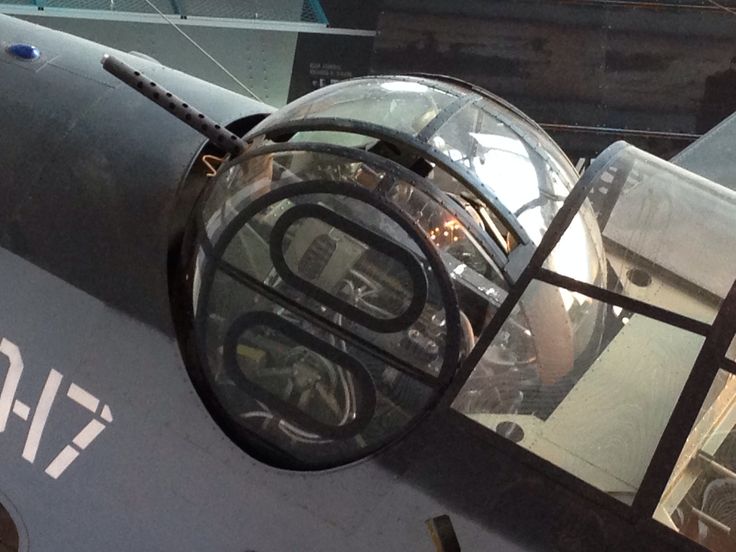
An Air Group consists of eighty or so aircraft, of three distinct types. First are the fighters, the fast, single seat Grumman Hellcats. Next are the two-seat dive bombers, the Curtiss Helldivers, the pilot joined by a rear-seat gunner whose job it is to lay the one-ton bomb on the target, while handling a machine gun at the same time. Third is the torpedo bomber, the Grumman Avenger, with two enlisted crewmen in addition to the pilot. The Avenger carries a ton of bombs, depth charges or aerial torpedoes and, like the Helldiver, is designed for low-level attack.
Loyce was the turret gunner on one of these Avengers, assigned to protect the aircraft from above and teamed up with Pilot Lt. Robert Cosgrove from New Orleans, Louisiana and Radioman Digby Denzek, from Grand Rapids, Michigan.
Cosgrove was a superb pilot, often returning aircraft to the carrier, so shot up as to seem unflyable. Digby had several jobs, including arming the weapons systems, and operating the radio. When the team was under fire, Digby would crawl down into a ball turret on the belly of the aircraft, his machine gun defending, from below.
The 15th Air group saw some of the most intense fighting it had ever encountered during the battle of Leyte Gulf of October 24-25, 1944. Commander Lambert, who oversaw the Avenger squadron, described “Coming in through the most intense and accurate AA yet experienced, the squadron made three hits on one battleship, two hits on another battleship, and two hits each on two different heavy cruisers“.
Dennis Blalock of Calhoun GA, his hands on the shoulders of shipmate, Loyce Deen. Both would be dead within ten days, of this photograph
Deen received a shrapnel wound to his foot sometime during the fighting of the 24th. He wrapped the thing up and stayed on to fight, the following day. He would receive a Purple heart medal for the wound. Posthumously.
Following rest and replenishment at Ulithi Atoll in the Caroline Islands, USS Essex was on station for the November 5 Battle of Manila Bay. Loyce could have stayed back on a hospital ship until that foot healed, but chose to ignore the injury and rejoin his unit.
Loyce’s niece Bertha, was not surprised. On being informed of his injury, she said “I’m not surprised he stayed with his unit. Loyce would not have it any other way – he would always remain at his post to make sure his brothers came home safely with him.”
Loyce Deen climbed into his gun turret for the last time on November 5. It was a two hour ride to the target zone in Manila Bay, with Japanese aircraft on the radar for most of that time, and the carriers USS Lexington and Ticonderoga, under kamikaze attack.
Lieutenant Cosgrove’s Avenger came under savage anti-aircraft fire, from a Japanese cruiser. Loyce Deen took two direct hits and was killed, instantly. The Avenger aircraft, tail number 93, was so smashed up as to be all but unflyable. It took all of the pilot’s strength and skill to fly the thing back through two thunderstorms, and land on the Essex.
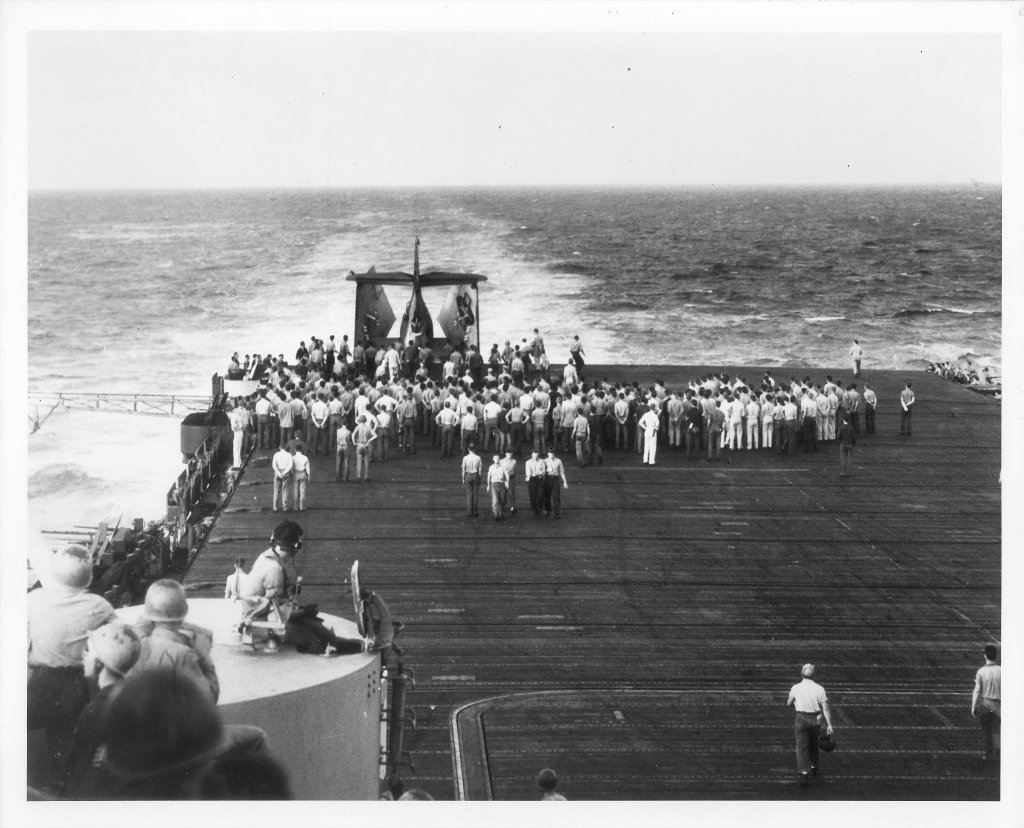
What remained of Loyce Edward Deen was so badly mangled, it was all but impossible to remove him from his smashed turret. For the first and last time in history, a man was deliberately buried at sea, inside of the aircraft he had served.
Fingerprints were taken and dog tags removed. This Avenger was not even scavenged, for parts. With the crew of the USS Essex assembled on deck, the shattered aircraft was pushed over the side. Two other Avengers flew overhead in salute, as the tail dipped beneath the waves.
Loyce Edward Deen, was going home.
Not long after the ceremony, the Essex went to General Quarters. There were kamikazes to deal with.
Lt. Cosgrove and the rest of Air Group 15 got back into their aircraft the following day and again on the 12th, 13th and 14th, and attacked those same cruisers in Manila Bay.
The Deen family would not receive the knock on the door, until Thanksgiving week.
If you enjoyed this “Today in History”, please feel free to re-blog, “like” & share on social media, so that others may find and enjoy it as well. Please click the “follow” button on the right, to receive email updates on new articles. Thank you for your interest, in the history we all share.
The battle for the Japanese home islands was expected to be a fight like no other.
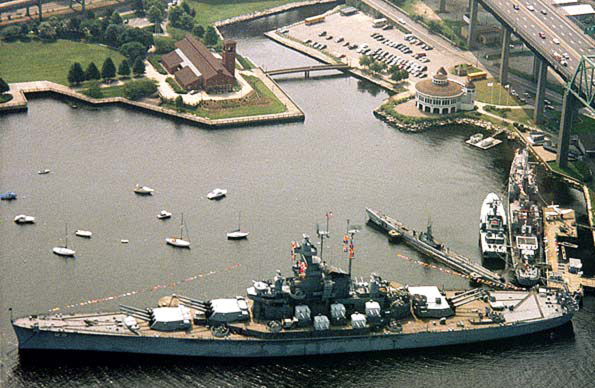
If you’re ever in southeastern Massachusetts, be sure visit Battleship Cove in Fall River, the largest collection of WW2 naval craft, in the world. The Battleship Cove museum sports some sixty exhibits, preserving the naval heritage of these iconic vessels, and the veterans who served them. To walk aboard the battleship USS Massachusetts, the attack submarine USS Lionfish, is to experience a side of WW2, fast receding from living memory.
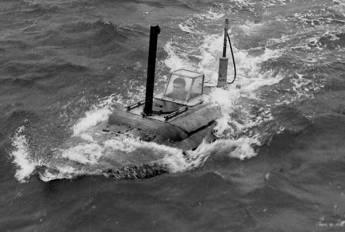
Walk among the wooden-hulled PT boats of the Pacific war, and there you will find a strange little craft. Closed at the top and semi-submersible, a Japanese kamikaze boat, perhaps, designed for suicide missions against allied warships. Museum management thought it was just that when they acquired the thing, back in the 1970s. CIA files declassified in 2011 revealed a very different story. The tale of a history, that never was.
On August 2, 1939, Hungarian physicist Leó Szilárd delivered a letter which would change history, to President Franklin Delano Roosevelt. Written in consultation with fellow Hungarian physicists Edward Teller and Eugene Wigner and signed by Albert Einstein, the letter warned that Nazi Germany was working to develop atomic weapons, and urged the American government to develop a nuclear program of its own. Immediately, if not sooner.
The Einstein–Szilárd letter spawned the super-secret Manhattan project, culminating in the atomic bombs “Little Boy” and “Fat Man”, and ending the war in the Pacific in August, 1945.
At the time, precious few were aware of even the possibility of such a weapon. Fewer still, the existence of a program dedicated to building one. Vice President Harry Truman, second only to the Commander in Chief himself, was entirely ignorant of the Manhattan project, and only read in following the death of the President in April, 1945.
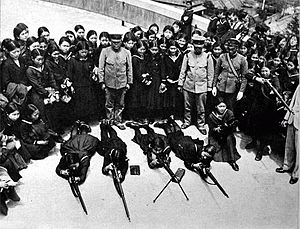
Female students with the Kokumin Giyū Sentōtai, the Volunteer Fighting Corps, prepare for the Allied projected invasion
The battle for the Japanese home islands was expected to be a fight like no other. Casualties of a million or more, were expected. And for good reason. Japanese soldiers fought with such fanaticism, that hundreds continued to resist, years after the war was ended. The last holdoutwouldn’t lay down his arms until 1974. 29 years, 3 months, and 16 days after the war had ended.
Such frenzied resistance would not be isolated to Japanese military forces, either. Japanese government propaganda warned of “American devils raping and devouring Japanese women and children.” American GIs looked on in horror in 1944, as hundreds if not thousands of Japanese soldiers and civilians hurled themselves to their death, at Laderan Banadero and “Banzai Cliff” on the northern Mariana island of Saipan. One correspondent wrote with admiration of such mass suicides, praising them as “the finest act of the Shōwa period”… “the pride of Japanese women.”
This is what their government, taught them to believe.
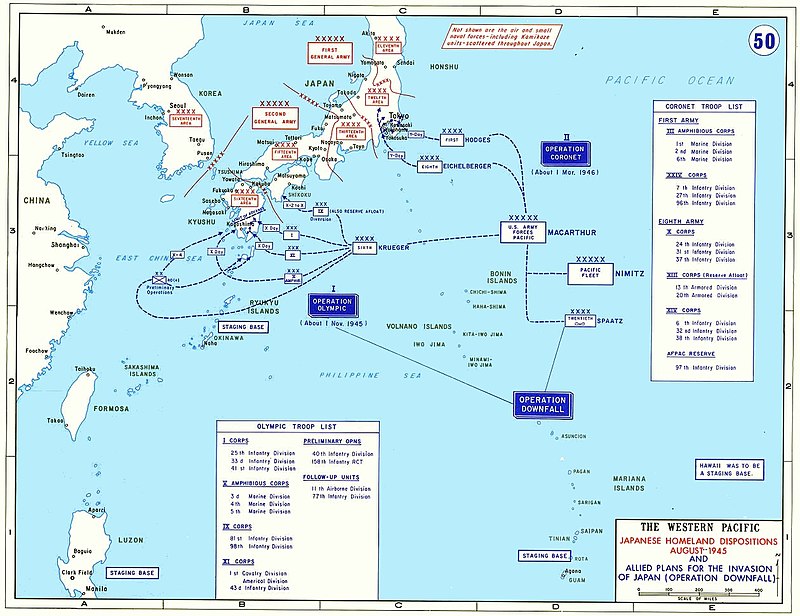
Plans for the final defeat of the Imperial Japanese Empire all but wrote themselves, phase one launched from the south against the main island of Kyūshū, and using the recently captured island of Okinawa, as staging area. Phase two was the planned invasion of the Kantō Plain toward Tokyo, on the island of Honshu.
The story of the D-Day invasion begins with deception, a massive head fake intended to draw German defenders away from intended landing zones. “Operation Downfall” offered no such options, for deceit. Geography dictated the method of attack, and everybody knew it. Virtually everything left of Japanese military might would be assembled for the all-out defense of Kyūshū, against what would be the largest amphibious invasion, in history.
American military planners ordered half a million Purple Hearts, in preparation for the final invasion of the Japanese home islands. To this day, military forces have yet to use them all up. As of 2003, 120,000 Purple Heart medals still remained, in inventory.
The whole thing would begin on “X-Day”. November 1, 1945.
Which brings us back to that funny-looking boat. The Office of Strategic Services (OSS), predecessor to the modern Central Intelligence Agency (CIA), built two of these semi-submersibles, code named “Gimik”, part of a top-secret operation code named “NAPKO”.
55 Korean-Americans and Korean prisoners freed from Japanese prison labor camps were trained to infiltrate Japanese occupied Korea and possibly Japan itself, to collect intelligence and carry out sabotage against military targets in advance of Operation Downfall.
The Gimik craft, each operated by a single OSS officer with two Korean operatives secured inside, would be the means of insertion.
The mission was extremely dangerous for obvious reasons. Training was carried out during the summer of 1945 on Catalina Island, off the California coast. The two boats, nicknamed “Gizmos”, were tested at night against the US Naval base in Los Angeles. Even this part was dangerous, since no one was told about the trials. Should such a vessel be detected entering the American installation, it would be treated as an enemy vessel, and destroyed.
In the end, the Gizmo teams never left American waters. Several such tests were carried out without detection, leading to a scheduled departure date of August 26, 1945. It was never meant to be.
A parallel and equally secret plan to end the war literally burst on the scene on August 6, 1945. The war was over, nine days later.
If you enjoyed this “Today in History”, please feel free to re-blog, “like” & share on social media, so that others may find and enjoy it as well. Please click the “follow” button on the right, to receive email updates on new articles. Thank you for your interest, in the history we all share.


 Charles Monroe Schulz was one of the brighter kids at Central High School in Saint Paul, Minnesota, but that didn’t help his social life. He was already a shy boy and skipped two half-grades, graduating as the youngest student in the class of 1940.
 weed out those who merely claimed to know him, if they called him “Charles”, or “Chuck”. Schulz’ uncle called him “Sparky” as a boy, after the horse Spark Plug in Billy DeBeck’s comic strip, Barney Google. He always signed the strip “Schulz”, but friends and family knew him as Sparky, until the day he died.





 In the winter of 1937, the Coast Guard cutter USCGC George W. Campell steamed out of New York harbor, patrolling the east coast with a mission of life-saving and national defense. The night before, Chief Boatswain’s Mate A. A. “Blackie” Roth (the name is also given as “Rother”) had given his girlfriend, a puppy. She couldn’t keep him, the landlord wouldn’t allow it. No other crewman could take the small dog. It was either leave him astray and hope for the best, or smuggle the puppy on board.
 Sinbad’s favorite toys were the large metal washers which he’d hide, until someone came to play with him. They even built him a hammock, much more comfy to sleep in, in those long Atlantic swells.



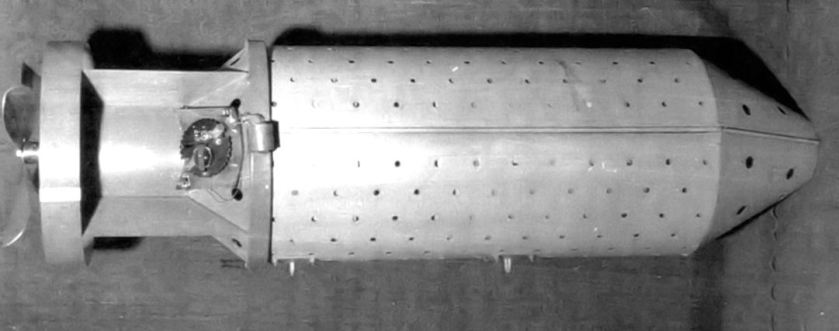


 NAAFI personnel serving on ships are assigned to duty stations and wear uniforms, while technically remaining civilians.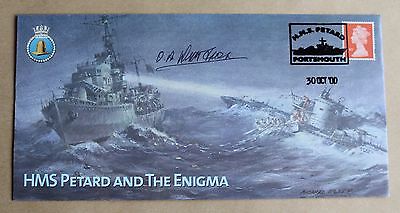


 Early versions of the German “Enigma” code were broken as early as 1932, thanks to cryptanalysts of the Polish Cipher Bureau, and French spy Hans Thilo Schmidt.
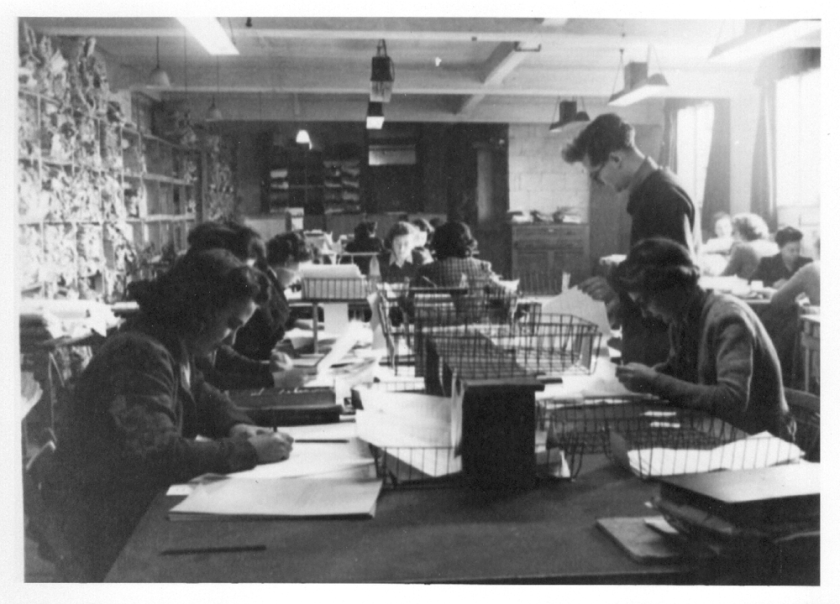 The beginning of the end of darkness came to an end on October 30, when a ship’s cook climbed up that conning ladder. Code sheets allowed British cryptanalysts to attack the “Triton” key used by the U-boat service. It would not be long, before the U-boats themselves, were under attack.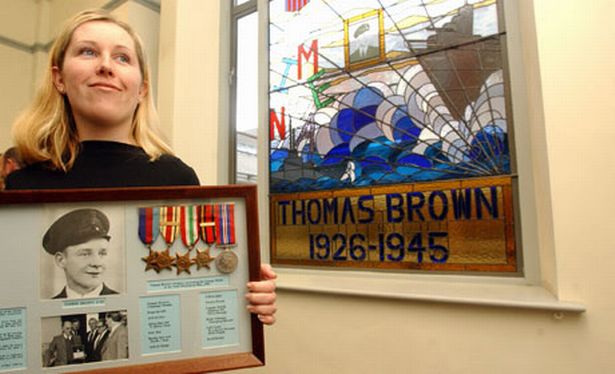

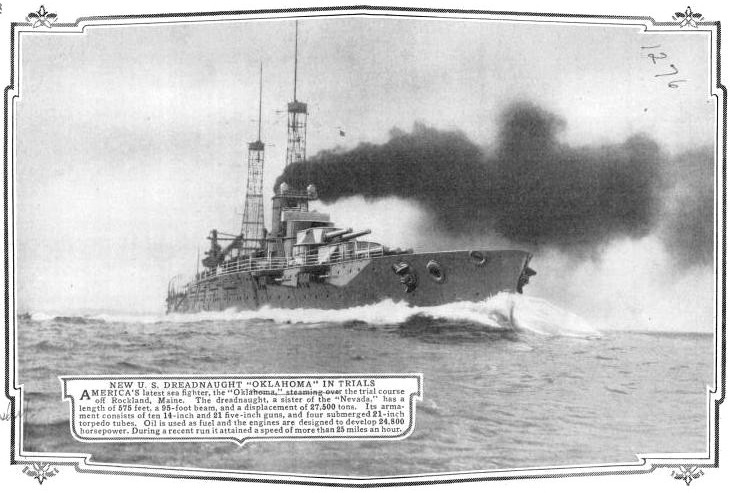
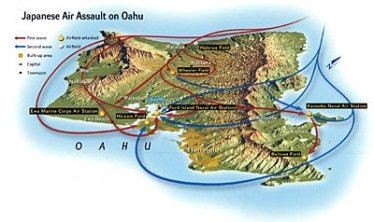 Bilge inspection plates had been removed for a scheduled inspection the following day, making counter-flooding to prevent capsize, impossible. Oklahoma rolled over and died as the ninth torpedo slammed home. Hundreds scrambled out across the rolling hull, jumped overboard into the oil covered, flaming waters of the harbor, or crawled out over mooring lines in the attempt to reach USS Maryland in the next berth.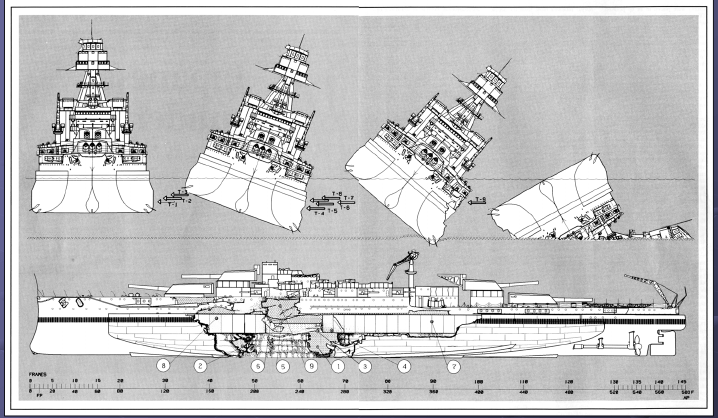
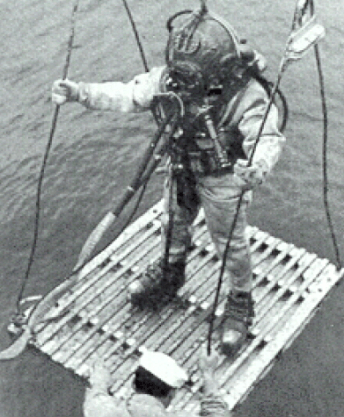 Recovery of the USS Oklahoma was the most complex salvage operation ever attempted, beginning in March, 1943. With the weight of her hull driving Oklahoma’s superstructure into bottom, salvage divers descended daily to separate the tower, while creating hardpoints from which to attach righting cables.
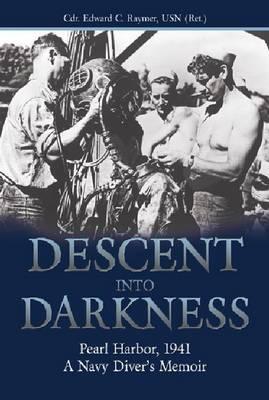 CDR Edward Charles Raymer, US Navy Retired, was one of those divers. Raymer tells the story of these men in






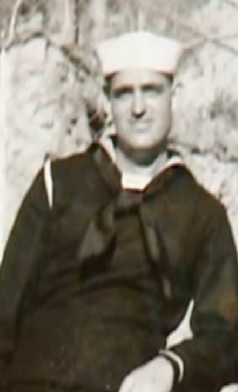 Even before the Japanese attack on Pearl Harbor, Loyce had wanted to join the Navy. In October 1942, he did just that. First there was basic training in San Diego, and then gunner’s school, learning all about the weapons systems aboard a Grumman TBF Avenger torpedo bomber. Then on to Naval Air School Fort Lauderdale, before joining the new 15th Air Group, forming out of Westerly, Rhode Island.
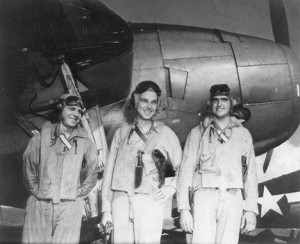 Loyce was the turret gunner on one of these Avengers, assigned to protect the aircraft from above and teamed up with Pilot Lt. Robert Cosgrove from New Orleans, Louisiana and Radioman Digby Denzek, from Grand Rapids, Michigan.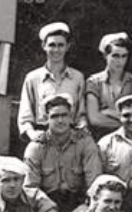


 Which brings us back to that funny-looking boat. The Office of Strategic Services (OSS), predecessor to the modern Central Intelligence Agency (CIA), built two of these semi-submersibles, code named “Gimik”, part of a top-secret operation code named “NAPKO”.
 Historical Easter Eggs - Today in History
You must be logged in to post a comment.