

There’s an old cliché that, if you speak with those who are convicted of a crime, all of them say they are innocent. It’s an untrue statement on its face, but there are only two possible conclusions in the alternative. Either all convicts are guilty as charged, or someone, at some time, has been wrongly convicted.
To agree with the former is to accept the premise that what government does is 100% right, 100% of the time.
Iva Ikuko Toguri was born in Los Angeles on July 4, 1916, the daughter of Japanese immigrants. She attended schools in Calexico and San Diego, returning to Los Angeles where she enrolled at UCLA, graduating in January, 1940 with a degree in zoology.
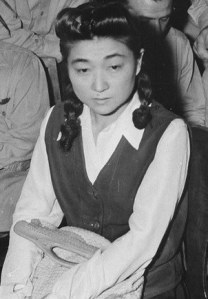
In July of the following year, Iva sailed to Japan without an American passport. She variously described the purpose of the trip as the study of medicine, and going to see a sick aunt. In September, Toguri appeared before the US Vice Consul in Japan to obtain a passport, explaining that she wished to return to permanent residence in the United States. Because she had left without a passport, her application was forwarded to the State Department for consideration. It was still on someone’s desk when Imperial Japan attacked Pearl Harbor, fewer than three months later.
Iva later withdrew the application, saying that she’d remain in Japan voluntarily for the duration of the war. She enrolled in a Japanese language and culture school to improve her language skills, taking a typist job for the Domei News Agency. In August 1943, she began a second job as a typist for Radio Tokyo.
In November of that year, Toguri was asked to become a broadcaster for Radio Tokyo on the “Zero Hour” program, part of a Japanese psychological warfare campaign designed to lower the morale of US Armed Forces. The name “Tokyo Rose” was in common use by this time, applied to as many as 12 different women broadcasting Japanese propaganda in English. Toguri DJ’d a program with American music punctuated by Japanese slanted news articles for 1¼ hours, six days a week, starting at 6:00pm Tokyo time. Altogether, her on-air speaking time averaged 15-20 minutes for most broadcasts.
Toguri called herself “Orphan Annie,” earning 150 yen per month (about $7.00 US). She wasn’t a professional radio personality, but many of those who later recalled hearing her enjoyed the program, especially the music.
Shortly before the war ended, Toguri married Felipe Aquino, a Portuguese citizen of Japanese-Portuguese ancestry. The marriage was registered with the Portuguese Consulate, though she didn’t renounce her US citizenship, continuing her Zero Hour broadcast until after the war was over.
 After the war, a number of reporters were looking for the mythical “Tokyo Rose”, and two of them found Iva Aquino. They were Henry Brundidge and Clark Lee, and they offered her a significant sum for her story. The money never materialized, but she signed a contract giving the two rights to her story, and identifying herself as Tokyo Rose.
FBI.gov states on its “Famous Cases” website that, “As far as its propaganda value, Army analysis suggested that the program had no negative effect on troop morale and that it might even have raised it a bit. The Army’s sole concern about the broadcasts was that “Annie” appeared to have good intelligence on U.S. ship and troop movements”.
US Army authorities arrested her in September, while FBI and the Army Counterintelligence investigated her case. By the following October, authorities decided that the evidence did not merit prosecution, and she was released.
Matters may have ended there, except for the public outcry that accompanied Aquino’s return to the US. Several groups, along with the noted broadcaster Walter Winchell, were outraged that the woman they knew as “Tokyo Rose” wanted to return to this country, instead demanding her arrest on treason charges.
Department of Justice sent attorneys to Japan to interview witnesses, one of whom was the reporter, Henry Brundidge. Once again quoting FBI.gov, “Problematically, Brundidge enticed a former contact of his to perjure himself in the matter”.
The trial began on July 5, 1949, lasting just short of three months. The jury found Aquino guilty on one of fifteen treason charges, ruling that “[O]n a day during October, 1944, the exact date being to the Grand Jurors unknown, said defendant, at Tokyo, Japan, in a broadcasting studio of the Broadcasting Corporation of Japan, did speak into a microphone concerning the loss of ships.”
Aquino was sentenced to ten years and fined $10,000 for the crime of treason, only the seventh person in US history to be so convicted. She was released from the Federal 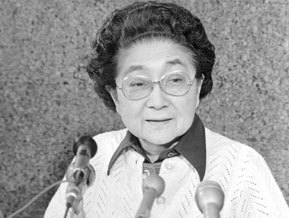 Reformatory for Women at Alderson, West Virginia in 1956, having served six years and two months of her sentence.
President Gerald Ford pardoned her on January 19, 1977, 21 years almost to the day after her release from prison. Iva Toguri Aquino passed away in 2006, at the age of 90. Neither perjury nor suborning charges were ever brought against Brundidge or his witness.


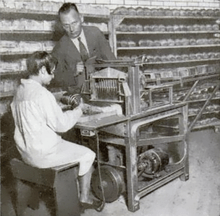 The project almost ended in a fire in 1917, when the prototype was destroyed along with the blueprints. Rohwedder soldiered on, by 1927 he had scraped up enough financing to rebuild his bread slicer.
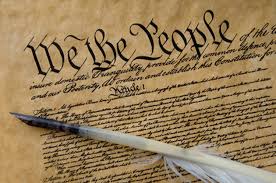 Article 1, Section 8 of the Constitution includes the “Commerce Clause”, permitting the Congress “To regulate Commerce with foreign Nations, and among the several States, and with the Indian Tribes”. That’s it. The Federal District Court sided with the farmer, but the Federal government appealed to the US Supreme Court, arguing that, by withholding his surplus from the interstate wheat market, Filburne was effecting that market, and therefore fell under federal government jurisdiction under the commerce clause.
 government had a billion bushels of wheat stockpiled at the time, about two years’ supply, and the amount of steel saved by not making bread slicers has got to be marginal, at best.


 were pulled on May 28, 1941, while the liner was at Saint Thomas in the US Virgin Islands. The ship had been called into service by the United States Navy, and ordered to return to Newport News.
 During her service to the United States Navy, West Point was awarded the American Defense Service Medal, American Campaign Medal, European-African-Middle Eastern Campaign Medal, Asiatic-Pacific Campaign Medal, and World War II Victory Medal.
 adrift in foul seas, running aground in the Canary Islands the following day.


 For two days, a desperate defense of the nearby villages of Noville and Foy held back the 2nd Panzerdivision, as 11,000 men and 800 officers of the 101st joined a combined force of 11,000 converging on Bastogne. By the 21st, Bastogne’s field hospital was overrun, they were surrounded by forces outnumbering them 2½ to one. Poorly supplied for the cold winter conditions with air supply made all but impossible by weather conditions, the citizens of Bastogne gave their blankets to the American soldiers, along with white linens which they used for camouflage.
 later, ending the German encirclement.
 entire siege tending to the wounded, along with Dr. Jack Prior. Once, she even ran through enemy fire to collect the wounded from the field. On Christmas eve, she was blown off her feet and through a wall. She got up and went back to it, despite the direct hit that killed 30 American wounded, along with the only other nurse at the Rue Neufchatel aid station, Renée Lemaire.
  Bastogne. Chiwy married after the war, and rarely talked about her experience in Bastogne. It took King a full 18 months to coax the story out of her. The result was the 2015 Emmy award winning historical documentary, “Searching for Augusta, The Forgotten Angel of Bastogne”.
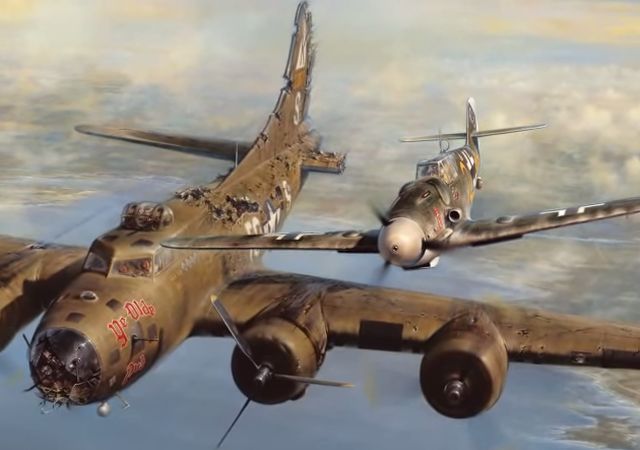
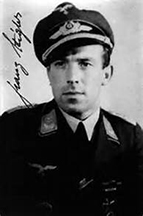 At the age of 26, Franz Stigler was an Ace. The Luftwaffe pilot of a Messerschmitt Bf-109 fighter, some of his kills had been revenge, payback for the death of his brother August earlier in the war. But this man was no Nazi. He was a German Patriot with 22 confirmed kills. On December 20, 1943, he needed one more for a Knight’s Cross. He tossed his cigarette aside and climbed into his fighter as the crippled American B17 bomber lumbered overhead. This was going to be an easy kill.
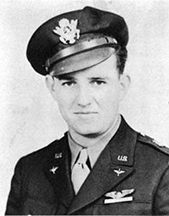 named “Ye Olde Pub”. The earlier attack on the munitions factory in Bremen had been a success, but the pilot and crew paid a heavy price for it. Their aircraft had been savaged by no fewer than 15 German fighters. Great parts of the air frame were torn away, one wing severely damaged and part of the tail torn away. The aircraft’s Plexiglas nose was shattered and the #2 engine seized. Six of the ten-man crew were wounded and the tail gunner dead, his blood frozen in icicles over silent machine guns. Brown himself had been knocked out at one point, coming around just in time to avert a fatal dive.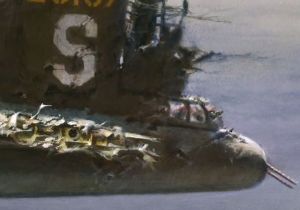
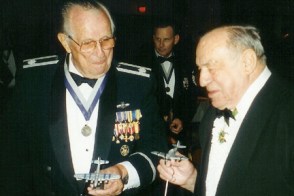 took out an ad in a fighter pilots’ newsletter. It said that he was searching for the man ‘who saved my life on Dec. 20, 1943.’ Stigler saw the ad, and the two met for the first time in 1987. “It was like meeting a family member”, Brown said at their first meeting, “like a brother you haven’t seen for 40 years”.
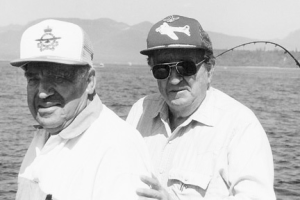 The two became close friends and occasional fishing buddies until their passing in 2008, six months apart. Stigler was age 92 and Brown 87. Their story is told in a book called “A Higher Call”, if you want to know more about it. In their obituaries, both were mentioned as the other man’s “special brother”.
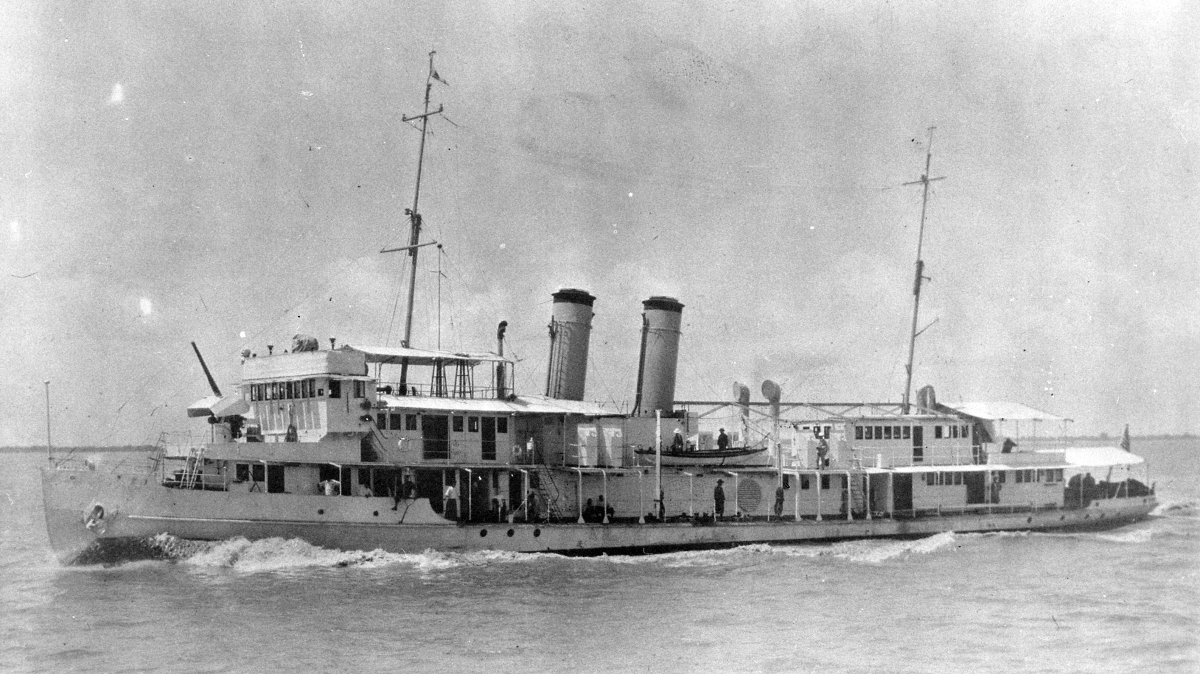
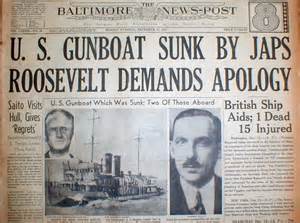 than old enough to remember how the sinking of the Maine in Havana Harbor brought the US into war with Spain in 1898. Grew hoped to avoid a similar outcome following the Panay sinking, though Japanese authorities were less than helpful. US cryptographers uncovered information shortly after the attack indicating that aircraft were operating under orders, while the Japanese government continued to insist that the attack had been accidental.

 problem. Roosevelt was fond of his 1939 Lincoln V12 Convertible. Roosevelt called it the “Sunshine Special,” but the car was anything but secure. Armored Presidential cars would not come into regular use for another 20 years, after the assassination of President Kennedy.
 making sure that it would safely get the Commander in Chief the few short blocks to Capitol Hill. It apparently did, because Roosevelt continued to use it until his old car could be fitted with the same features. To this day, Presidential limousines have flashing police lights hidden behind their grilles.
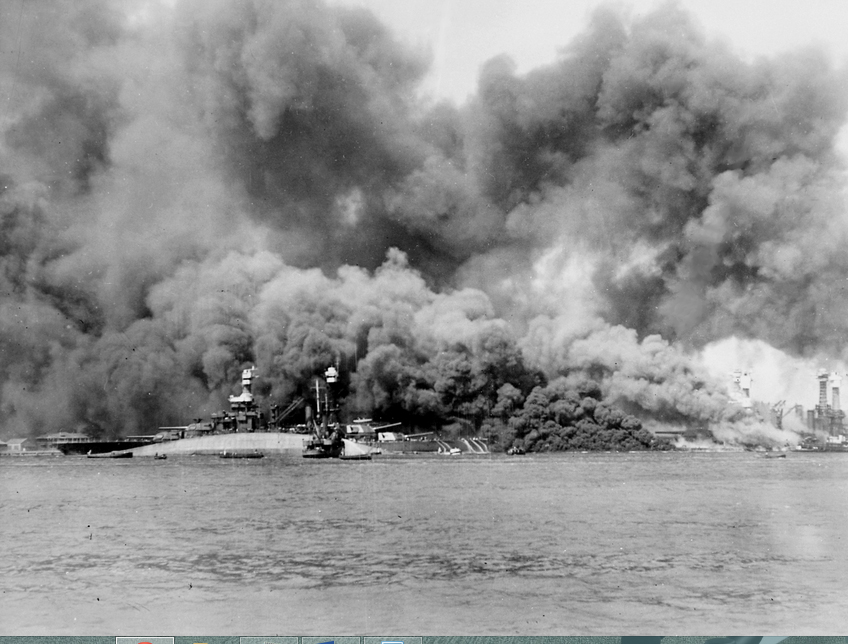
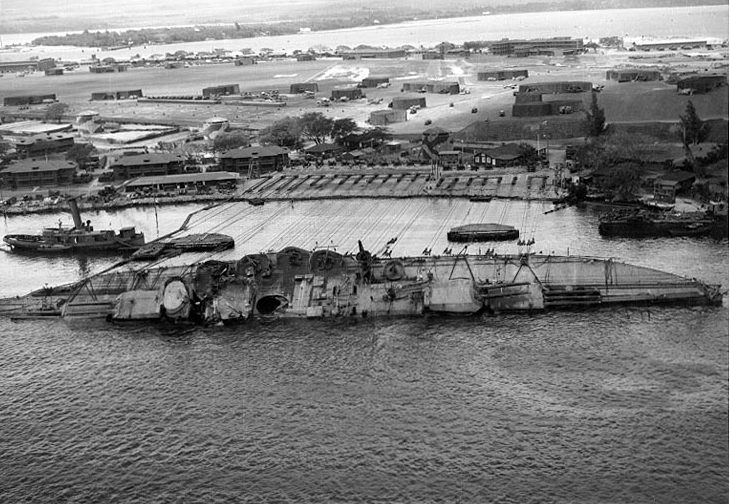 battleship USS Oklahoma was raised from the bottom, but was never repaired. In 1947 she would sink under tow to the mainland, very nearly taking two ocean going tugs to the bottom, with her.


You must be logged in to post a comment.