
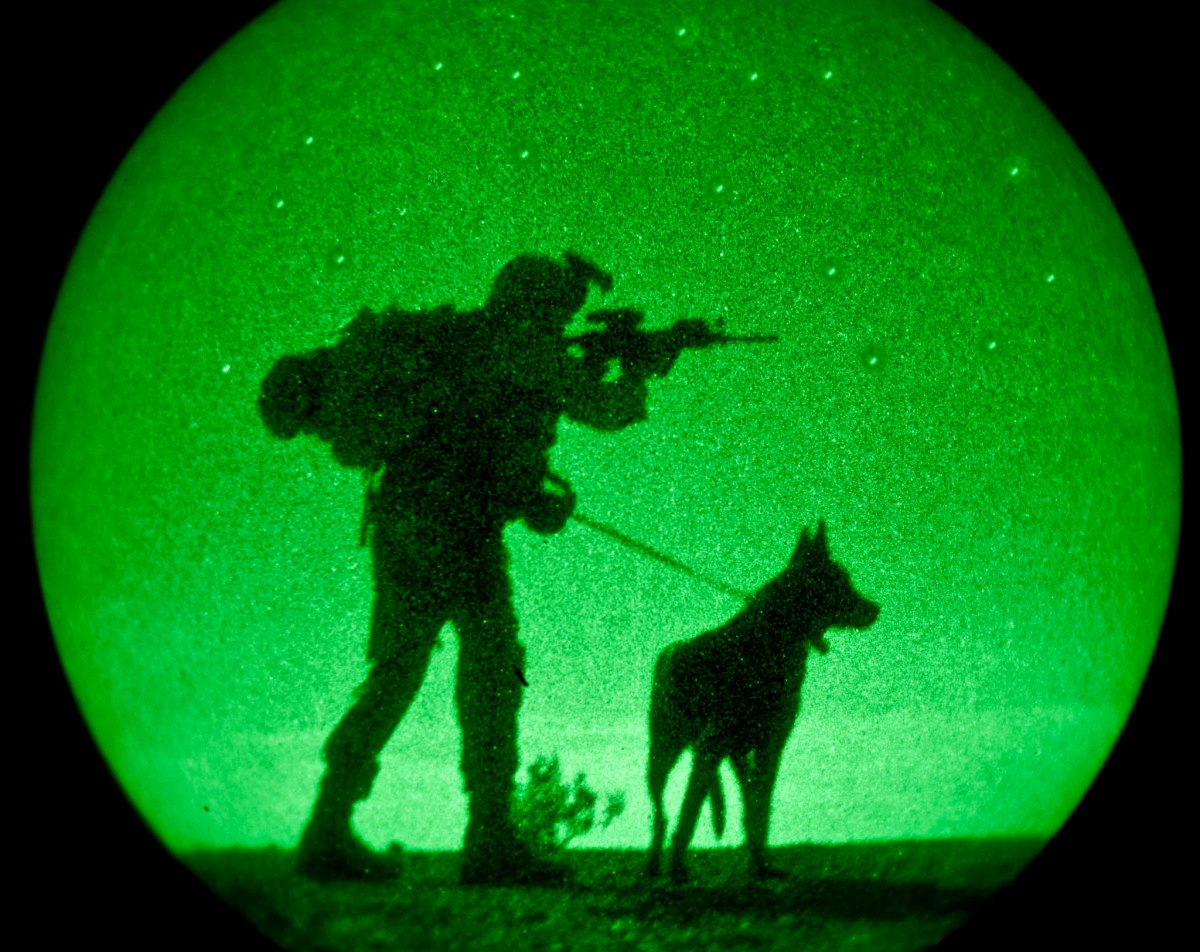
The history of war dogs is as old as history itself. The  dogs of King Alyattes of Lydia killed some of his Cimmerian adversaries and routed the rest around 600BC, permanently driving the invader from Asia Minor in the earliest known use of war dogs in battle.
King Molossus of Epirus, grandson of the mighty Achilles, used a large, powerfully built breed specifically trained for battle. Today, “molosser” describes a body type more than any specific breed. Modern molossers include the Mastiff, Bernese Mountain Dog, Newfoundland and Saint Bernard.
Ancient Greeks, Romans and Egyptians often used dogs as sentries or on patrol. In late antiquity, Xerxes I, the Persian King who faced the Spartan King Leonidas across the pass at Thermopylae, was accompanied by a pack of Indian hounds.
Attila the Hun went to war with a pack of hounds, as did the Spanish Conquistadors of the 1500s.
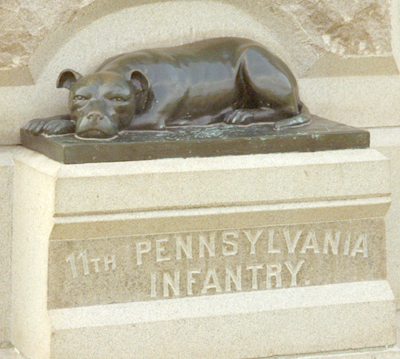
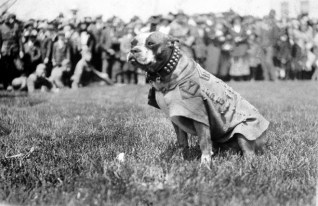
A Staffordshire Bull Terrier named Sallie “joined up” in 1861, serving the rest of the Civil War with the 11th Pennsylvania Volunteer Infantry. At Cedar Mountain, Antietam, Fredericksburg, Chancellorsville, and Spotsylvania, Sallie would take her position alongside the colors, barking ferociously at the adversary.
Abraham Lincoln spotted Sallie from a reviewing stand in 1863, and tipped his hat.
Sallie was killed at Hatcher’s Run in February 1865. Several of “her” men laid down their arms then and there to bury her, despite being under Confederate fire.

Dogs performed a variety of roles in WWI, from ratters in the trenches, to sentries, scouts and runners. “Mercy” dogs were trained to seek out the wounded on the battlefield, carrying medical supplies with which the stricken could treat themselves.
Sometimes, these dogs simply provided the comfort of another living soul, so that the gravely wounded should not die alone.
By the end of the “Great War”, France, Great Britain and Belgium had at least 20,000 dogs on the battlefield, Imperial Germany over 30,000. Some sources report that over a million dogs served over the course of the war.
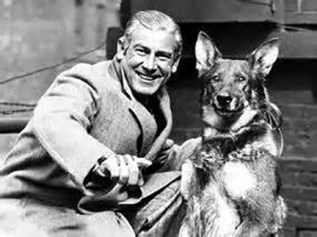
The famous Rin Tin Tin canine movie star of the 1920s was rescued as a puppy, from the bombed out remains of a German Army kennel, in 1917. (Read more about him, Here).
GHQ of the American Expeditionary Force recommended using dogs as sentries, messengers and draft animals in the spring of 1918, however the war was over before US forces put together any kind of a War Dog program.
America’s first war dog, “Sgt. Stubby”, went “Over There” by accident, serving 18 months on the Western Front before coming home to a well-earned retirement.
On March 13, 1942, the Quartermaster Corps began training dogs for the US Army “K-9 Corps.” In the beginning, the owners of healthy dogs were encouraged to “loan” their dogs to the Quartermaster Corps, where they were trained for service with the Army, Navy, Marine Corps and Coast Guard.
The program initially accepted over 30 breeds of dog, but the list soon narrowed to German Shepherds, Belgian Sheep Dogs, Doberman Pinschers, Collies, Siberian Huskies, Malamutes and Eskimo Dogs.
WWII-era Military Working Dogs (MWDs) served on sentry, scout and patrol missions, in addition to performing messenger and mine-detection work. The keen senses of scout dogs saved countless lives, by alerting to the approach of enemy forces, incoming fire, and hidden booby traps & mines.
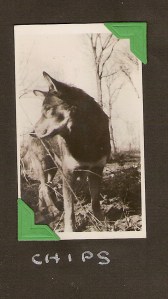 The most famous MWD of WWII was “Chips”, a German Shepherd assigned to the 3rd Infantry Division in Italy. Trained as a sentry dog, Chips broke away from his handler and attacked an enemy machine gun nest. Wounded in the process, his singed fur demonstrated the point-blank fire with which the enemy fought back. To no avail. Chips single-handedly forced the surrender of the entire gun crew.
Chips was awarded the Distinguished Service Cross, Silver Star and Purple Heart, the honors later revoked due to an Army policy against the commendation of animals. It makes me wonder if the author of such a policy ever saw service beyond his own desk.
Of the 549 dogs who returned from service in WWII, all but four were able to return to civilian life.
Over 500 dogs died on the battlefields of Vietnam, of injuries, illnesses, and combat wounds. 10,000 servicemen served as dog handlers during the war, with an estimated 4,000 Military Working Dogs. 261 handlers paid the ultimate price. K9 units are estimated to have saved over 10,000 human lives.
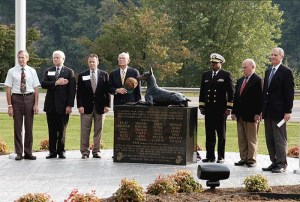
It’s only a guess, but, having an MWD handler in the family, I believe I’m right: hell would freeze before any handler walked away from his dog. The military bureaucracy, is another matter. The vast majority of MWDs were left behind during the Vietnam era. Only about 200 dogs survived the war to be assigned to other bases. The remaining dogs were either euthanized or left behind as “surplus equipment”.
In 2011, a Belgian Malinois named “Cairo” accompanied the Navy SEAL “Neptune Spear” operation that took out Osama bin Laden.
Today there are about 2,500 dogs in active service. Approximately 700 deployed overseas. The American Humane Association estimates that each MWD saves an average 150-200 human lives over the course of its career.
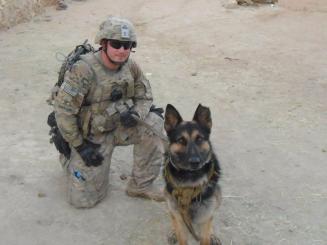
NPR’s “Here & Now” broadcast an excellent segment out of their Boston affiliate WBUR in 2014, when our son-in-law Nate was reunited with “Zino”, the Tactical Explosives Detection Dog (TEDD) with whom he served in Afghanistan.
Their story ends well, but that isn’t always the case. Many have been left behind, no longer qualified to travel on military transport after being “retired” on foreign soil.
In 2015, Congressman Frank LoBiondo (R-NJ) and Senator Claire McCaskill (D-MO) introduced language in their respective bodies, mandating that MWDs be returned to American soil upon retirement, and that their handlers and/or handlers’ families be given first right of adoption.
LoBiondo’s & McCaskill’s language became law on November 25, when the President signed the 2016 National Defense Authorization Act (NDAA). It’s a small step in recognizing what we owe to those who have stepped up in defense of our nation, both two legged and four.
Boston’s NPR Station WBUR broadcast a segment on Nate & Zino’s reunion, if you’re interested in listening to it. It’s a great story.
http://hereandnow.wbur.org/2014/03/21/soldier-dog-reunion

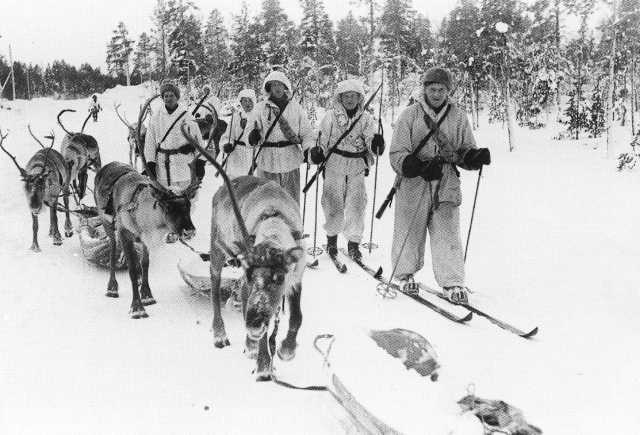
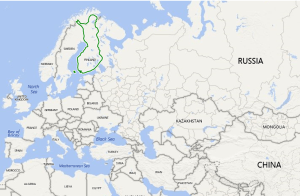 With Sweden to the west and Russia to the east, the region has been a zone of conflict since the early 12th century, finally gaining independence as the result of the first World War and collapse of the Russian Empire.
 The Battle of Kollaa took place in temperatures ranging from −4° to −40°, Fahrenheit. In February, the temperature averages only 18.5°. Dressed in white camouflage, Häyhä would surround himself with hard-packed snow, his mouth filled with snow so no one would see his breath.
 take several years to recover from his wound, but Häyhä went on to become a successful dog breeder and moose hunter, once hunting with Finnish President Urho Kekkonen.
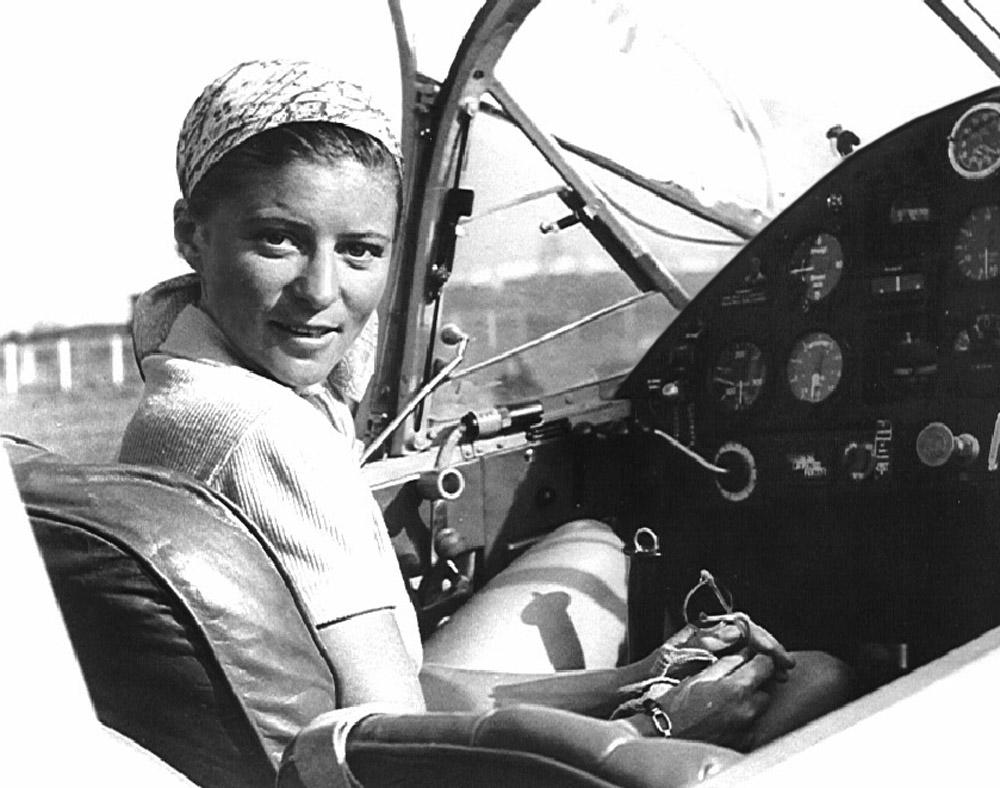
 As a test pilot, Reitsch won an Iron Cross, Second Class, for risking her life trying to cut British barrage-balloon cables. On one test flight of the rocket powered Messerschmitt 163 Komet in 1942, she flew the thing at speeds of 500 mph, a speed nearly unheard of at the time. She spun out of control and crash-landed on her 5th flight, leaving her with severe injuries. Her nose was all but torn off, her skull fractured in four places. Two facial bones were broken, and her upper and lower jaws out of alignment. Even then, she managed to write down what had happened before passing out.
 Gold Medal for Military Flying on this day in 1944. Adolf Hitler personally awarded her an Iron Cross, First Class.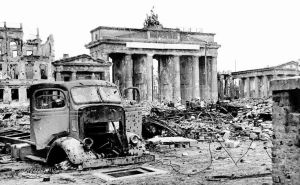


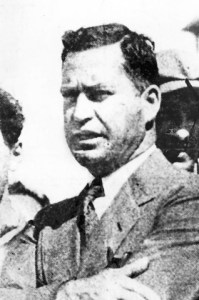 and joined a law firm. Operating dog tracks in Chicago, Boston and Miami, O’Hare made a considerable fortune working for Owen Smith, the high commissioner for the International Greyhound Racing Association, who patented the mechanical rabbit used in dog racing. EJ and Selma Anna (Lauth) O’Hare had three children between 1914 and 1924, – Edward (“Butch”), Patricia, and Marilyn.
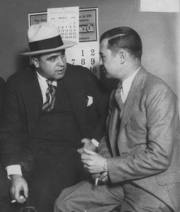 EJ and Selma divorced in 1927. He left St. Louis for good, moving to Chicago while Butch attended WMA. It was there that the elder O’Hare met Al Capone, later earning his second fortune working as the gangster’s business manager and lawyer.
 eligible for early release in 1939 due to syphilitic dementia. On November 8 of that year, EJ left his office at Sportsman’s Park racetrack in Cicero in his black ’39 Lincoln Zephyr. Two shotgun wielding gunmen pulled alongside, firing a volley of big game slugs and killing O’Hare, instantly. No arrest was ever made.
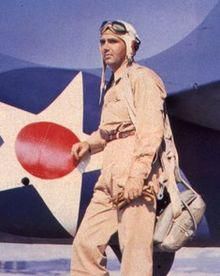 It was February 20, 1942, when Butch O’Hare became the first American flying Ace of WWII. The carrier Lexington was discovered by Japanese reconnaissance aircraft, 450 miles outside of Rabaul. Six Grumman F4F Wildcat fighters and Lexington’s anti-aircraft guns were engaged with an incoming formation of nine Japanese bombers, when nine more bombers were reported incoming.
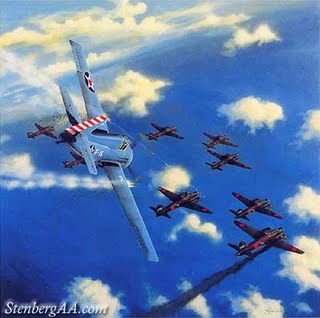 34 seconds. What followed was so close to the Lexington, that pilots could hear the carrier’s AA guns. Full throttle and diving from the high side, O’Hare fired short, accurate bursts, the outermost bomber’s right-hand engine literally jumping from its mount. Ducking to the other side and smashing the port engine on another “Betty”, O’Hare’s Wildcat attacked one bomber after another, single handedly taking out five bombers with an average of only 60 rounds apiece.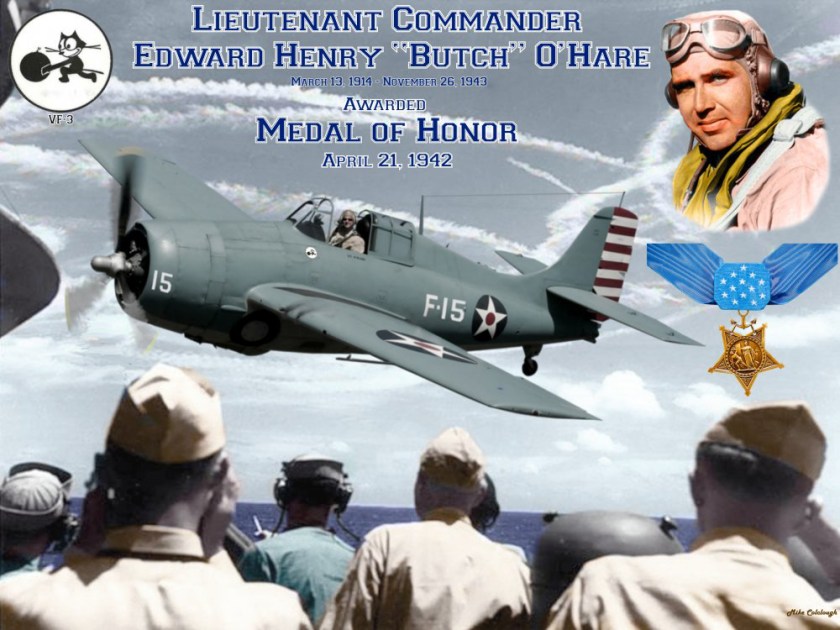

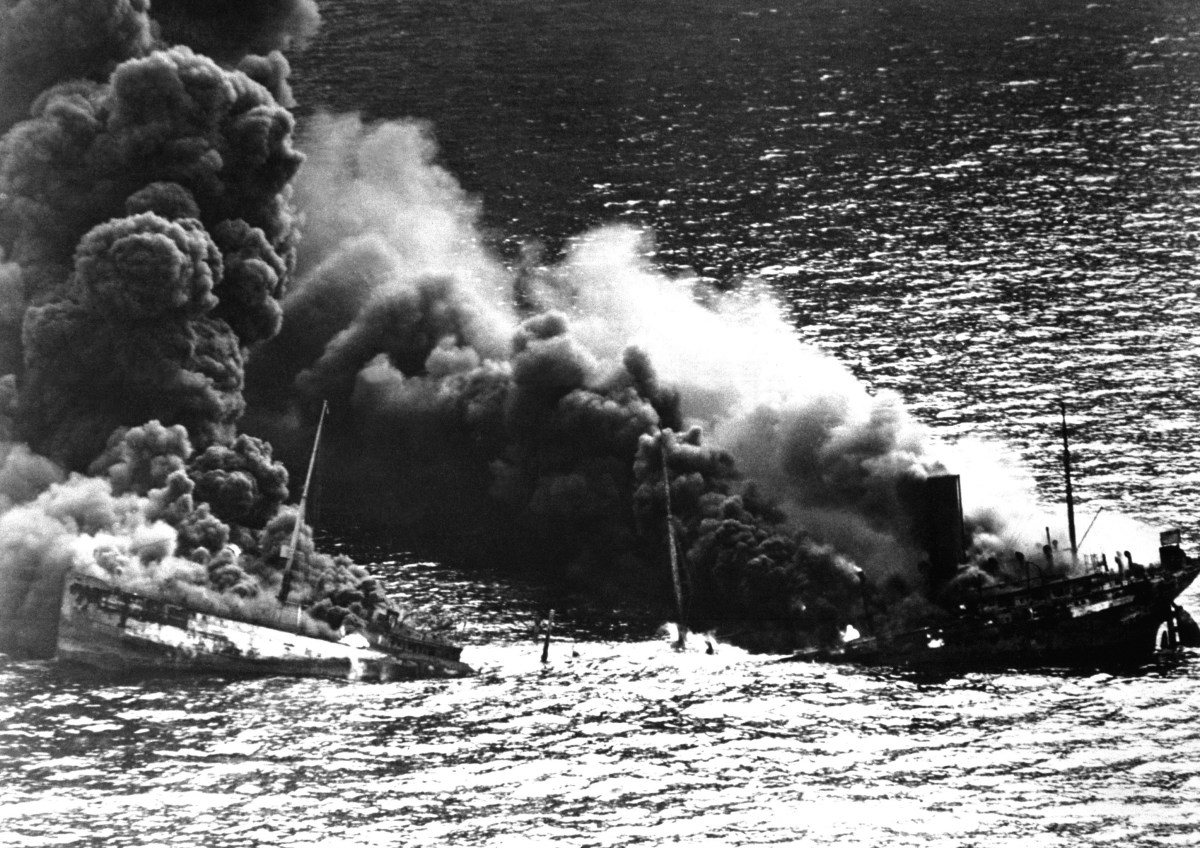
 Atlantic. On the 25th the Polish-British Common Defense Pact was added to the Franco-Polish Military Alliance. Should Poland be invaded by a foreign power, England and France were now committed to intervene.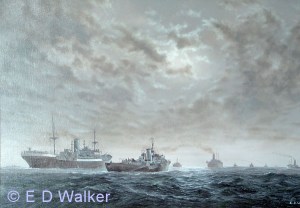
 ship encounters unfolding across a theater thousands of miles wide. According to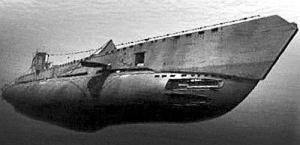
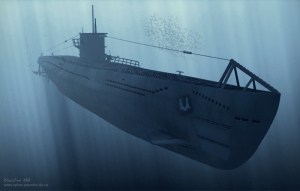
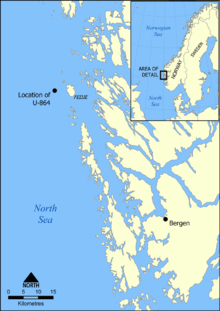 Norway, for repairs after running aground in the Kiel Canal. The sub was able to clear the island of Fedje off the Norway coast undetected on February 6. By this time British MI6 had broken the German Enigma code. They were well aware of Operation Caesar.
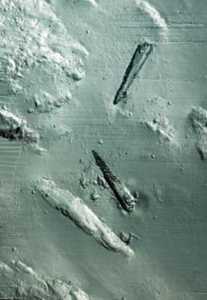 A four dimensional firing solution accounting for time, distance, bearing and target depth was theoretically possible, but had rarely been attempted under combat conditions. Plus, there were unknown factors which could only be approximated.
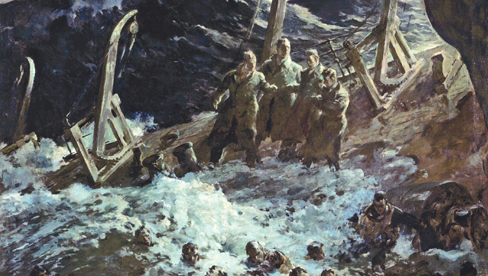
 The Troop Transport USAT Dorchester sailed out of New York Harbor on January 23, 1943, carrying 902 service members, merchant seamen and civilian workers. They were headed for the Army Command Base in southern Greenland, part of a six-ship convoy designated SG-19, together with two merchant ships and escorted by the Coast Guard Cutters Comanche, Escanaba and Tampa.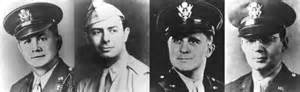
 more were killed in the blast, or in the clouds of steam and ammonia vapor pouring from ruptured boilers. Suddenly pitched into darkness, untold numbers were trapped below decks. With boiler power lost, there was no longer enough steam to blow the full 6 whistle signal to abandon ship, while loss of power prevented a radio distress signal. For whatever reason, there never were any signal flares.
 Private William Bednar found himself floating in 34° water, surrounded by dead bodies and debris. “I could hear men crying, pleading, praying,” he recalled. “I could also hear the chaplains preaching courage. Their voices were the only thing that kept me going.”
 The United States Congress attempted to confer the Medal of Honor on the four chaplains for their selfless act of courage, but strict requirements for “heroism under fire” prevented them from doing so. Congress authorized a one time, posthumous “Chaplain’s Medal for Heroism”, awarded to the next of kin by Secretary of the Army Wilber M. Brucker at Fort Myer, Virginia on January 18, 1961.

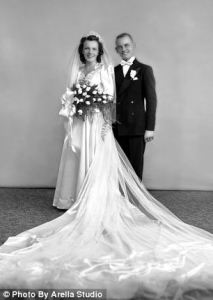 Edward Donald “Eddie” Slovik was paroled in 1942, his criminal record making him 4F. “Registrant not acceptable for military service”. He took a job at the Montella Plumbing and Heating company in Dearborn, Michigan, where he met bookkeeper Antoinette Wisniewski, the woman who would later become his wife.
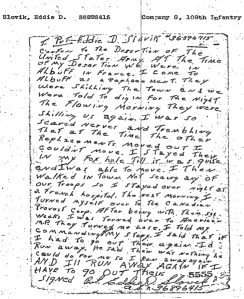 of my desertion we were in Albuff [Elbeuf] in France. I came to Albuff as a replacement. They were shelling the town and we were told to dig in for the night. The following morning they were shelling us again. I was so scared, nerves and trembling, that at the time the other replacements moved out, I couldn’t move. I stayed there in my fox hole till it was quiet and I was able to move. I then walked into town. Not seeing any of our troops, so I stayed over night at a French hospital. The next morning I turned myself over to the Canadian Provost Corp. After being with them six weeks I was turned over to American M.P. They turned me loose. I told my commanding officer my story. I said that if I had to go out there again I’d run away. He said there was nothing he could do for me so I ran away again AND I’LL RUN AWAY AGAIN IF I HAVE TO GO OUT THERE. — Signed Pvt. Eddie D. Slovik A.S.N. 36896415”.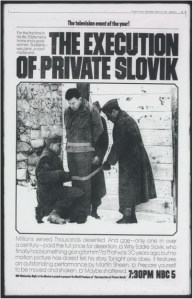
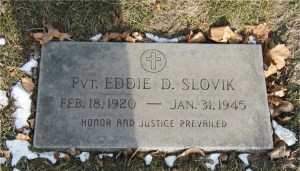 In 1987, President Ronald Reagan ordered the repatriation of Slovik’s remains. He was re-interred at Detroit’s Woodmere Cemetery next to Antoinette, who had gone to her final rest eight years earlier.

 was obliged to render aid in the event that either ally was attacked. On December 8, 1941, the day after the Japanese attack on Pearl Harbor, Ambassador Hiroshi Ōshima came to Joachim von Ribbentrop, looking for a commitment of support from the German Foreign Minister.
 48 days later, at Hunter Field in Savannah, the Eighth Bomber Command was activated as part of the United States Army Air Forces. It was January 28, 1942.
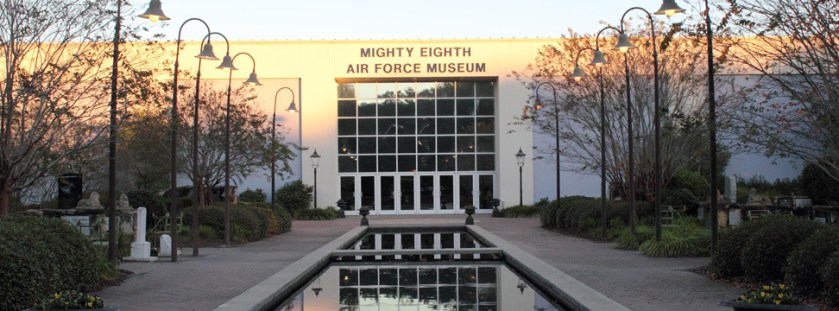
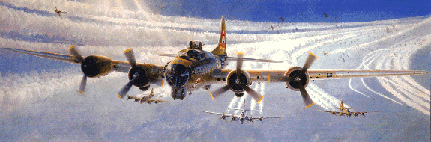 Re-designated the Eighth Air Force on February 22, 1944, at its peak the “Mighty Eighth” could dispatch over 2,000 four engine bombers and more than 1,000 fighters on a single mission. 350,000 people served in the 8th AF during the war in Europe, with 200,000 at its peak in 1944.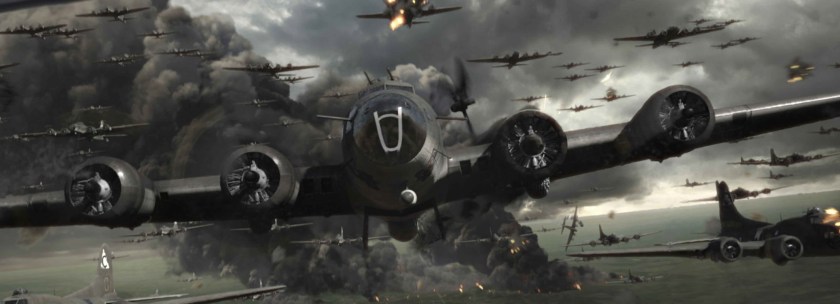
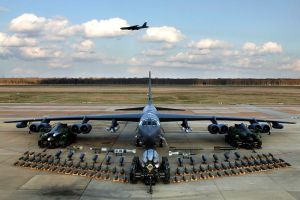


 1942 was a bad year for the allied war in the Pacific. The Battle of Bataan alone resulted in 72,000 prisoners being taken by the Japanese, marched off to POW camps designed for 10,000 to 25,000.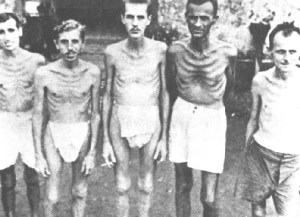




 Joining the 3rd Infantry Division of George S. Patton’s 7th Army, Murphy participated in amphibious landings in Sicily in July, fighting in nearly every aspect of the Italian campaign. From Palermo to Messina and on to Naples, Anzio and Rome, the Germans were driven out of the Italian peninsula in savage and near continuous fighting that killed a member of my own family. By mid-December, the 3rd ID suffered 683 dead, 170 missing, and 2,412 wounded. Now Sergeant Murphy was there for most of it, excepting two periods when he was down with malaria.
 “Colmar Pocket” was an 850 square mile area held by German troops: Murphy described it as “a huge and dangerous bridgehead thrusting west of the Rhine like an iron fist. Fed with men and materiel from across the river, it is a constant threat to our right flank; and potentially it is a perfect springboard from which the enemy could start a powerful counterattack.”
 Let Murphy’s Medal of Honor Citation describe what happened next: “Second Lieutenant Audie L. Murphy, 01692509, 15th Infantry, Army of the United States, on 26 January 1945, near Holtzwihr, France, commanded Company B, which was attacked by six tanks and waves of infantry. Lieutenant Murphy ordered his men to withdraw to a prepared position in a woods while he remained forward at his command post and continued to give fire directions to the artillery by telephone. Behind him to his right one of our tank destroyers received a direct hit and began to burn. Its crew withdrew to the woods. Lieutenant Murphy continued to direct artillery fire which killed large numbers of the advancing enemy infantry. With the enemy tanks abreast of his position, Lieutenant Murphy climbed on the burning tank destroyer which was in danger of blowing up any instant and employed its .50 caliber machine gun against the enemy. He was alone and exposed to the German fire from three sides, but his deadly fire killed dozens of Germans and caused their infantry attack to waver. The enemy tanks, losing infantry support, began to fall back. For an hour the Germans tried every available weapon to eliminate Lieutenant Murphy, but he continued to hold his position and wiped out a squad which was trying to creep up unnoticed on his right flank. Germans reached as close as 10 yards only to be mowed down by his fire. He received a leg wound but ignored it and continued the single-handed fight until his ammunition was exhausted. He then made his way to his company, refused medical attention, and organized the company in a counterattack which forced the Germans to withdraw. His directing of artillery fire wiped out many of the enemy; he personally killed or wounded about 50. Lieutenant Murphy’s indomitable courage and his refusal to give an inch of ground saved his company from possible encirclement and destruction and enabled it to hold the woods which had been the enemy’s objective”.
 Hollywood and, until his death in a plane crash in 1971, his post-war life was never free of it.


You must be logged in to post a comment.