Henry Ford had a “thing”, for soybeans. At the 1934 World’s Fair in Chicago, Ford invited reporters to a feast where he served soybean cheese, soybean crackers, soy bread and butter, soy milk, soy ice cream… The man was a veritable Bubba Gump, of soybeans.
The largest museum in the United States is located in the Detroit suburb of Dearborn, the Henry Ford Museum of American Innovation. The sprawling, 12-acre indoor-outdoor complex in the old Greenfield Village is home to JFK’s Presidential limo, the Rosa Parks bus and the Wright Brothers’ bicycle shop. There you will find Abraham Lincoln’s chair from Ford’s Theater, along with Thomas Edison’s laboratory and an Oscar Mayer Wienermobile. George Washington’s camp bed is there, with Igor Sikorski’s helicopter and an enormous collection of antique automobiles, locomotives and aircraft.
Sadly, one object you will not find there, is Henry Ford’s plastic car, made from soybeans.
Ford left the family farm outside of modern-day Detroit as a young man, never to return. His father William thought the boy would one day own the place but young Henry couldn’t stand farm work. He later wrote, “I never had any particular love for the farm—it was the mother on the farm I loved”.
Henry Ford went on to other things, but part of him never left the farm. In 1941, the now-wealthy business magnate wanted to combine industry, with agriculture. At least, that’s what the museum says.
George Washington Carver, at work in his library
Ford first gave the plastic car project to yacht designer Eugene Turenne Gregorie, but later turned to the Greenfield Village soybean laboratory. To the guy in charge over there, actually, a guy with some experience in tool & die making. His name was Lowell Overly.
The car was made in Dearborn with help from the scientist and botanist George Washington Carver, (yeah, That George Washington Carver), a man born to slavery who rose to such prodigious levels accomplishment, that Time magazine labeled him the “Black Leonardo”.
The soybean car, introduced to the public this day in 1941, was made from fourteen ¼-inch thick plastic panels and plexiglass windows, attached to a tubular steel frame and weighing in at 1,900 pounds, about a third lighter than comparable automobiles of the era. The finished prototype was exhibited later that year at the Dearborn Days festival, and the Michigan State Fair Grounds.
The thing was built to run on fuel derived from industrial hemp, a related strain of the Cannibis Sativa plant beloved of stoners the world over and known simply, as “weed”.
Ford claimed he’d be able to “grow automobiles from the soil”, a hedge against the metal rationing of world War Two. He dedicated 120,000 acres of soybeans to experimentation, but to no end. The total acreage devoted to “fuel” production, is unrecorded.
Another reason for a car made from soybeans, was to help American farmers. Plus, Henry Ford seems to have had a “thing”, for soybeans. At the 1934 World’s Fair in Chicago, Ford invited reporters to a feast where he served soybean cheese, soybean crackers, soy bread and butter, soy milk, soy ice cream… The man was a veritable Bubba Gump, of soybeans. Ford was probably one of the first in this country, to regularly drink soy milk.
Henry Ford’s own car was fitted with a soybean trunk and struck with an axe to show the material’s durability, though the axe was later revealed to have a rubber boot.
Henry Ford’s experiment in making cars from soybeans never got past that first prototype, and came to a halt during WW2. The project was never revived, though several states adopted license plates stamped out of soybeans, a solution farm animals found to be quite delicious.
The car itself was destroyed long ago, the ingredients for its manufacture unrecorded, but the thing lives on in the hearts of hemp enthusiasts, everywhere.
The New York Times claimed the car body and fenders were made from soy beans, wheat and corn. Some sources opine that the car was made from Bakelite or some variant of Duroplast, a plant-based auto body substance produced in the millions, for the East German Trabant.
One newspaper claimed that nothing ever came from Henry Ford’s soybean experiments, except whipped cream.
If you enjoyed this “Today in History”, please feel free to re-blog, “like” & share on social media, so that others may find and enjoy it as well. Please click the “follow” button on the right, to receive email updates on new articles. Thank you for your interest, in the history we all share.
Even the inebriates stepped up, when a Brooklyn home for alcoholics donated fifteen dollars. Not to be outdone, collection boxes were put out in bars and saloons all over New York City.
In the late 1860s, French sculptor Frédéric Auguste Bartholdi conceived a great work of neoclassical sculpture. An enormous statue depicting a female figure in robes, this latter-day colossus holding high her Torch of Progress and standing by the water’s edge to greet the weary traveler – to Egypt.
Today, the 120-mile Suez canal connecting the Mediterranean with the Red Sea handles nearly fifty ships per day. Around Bartholdi’s time, Ottoman authorities were just getting around to digging the thing. Bartholdi had visited Egypt as a young man, and came away captivated by the Sphinxes, the Great Pyramids, and now this.
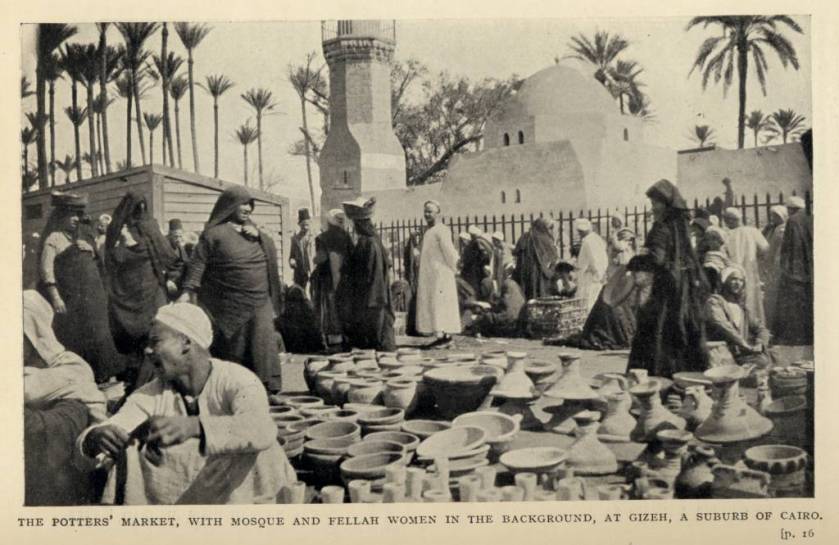
Bartholdi pitched his idea to the Khedive of Egypt in 1867, while attending the World’s Fair, in Paris. An enormous lighthouse in the form of a woman, holding high the lamp of welcome and dressed in the flowing cotton robe of the fellah, the “True Egyptian”, the peasant farmer and agricultural laborer of Egypt and North Africa.
The Egypt deal fell through, when Bartholdi came to a land where he’d never been before, to sell his colossus.
The idea was originally that of French attorney Édouard René de Laboulaye. An observer of American civic culture and passionate supporter for the Union side of the Civil War, Laboulaye wrote a three-volume work on the political history of the United States and considered the gift of “Liberty Enlightening the World” to be symbolic of values repressed at that time, by the 2nd Republique of Napoleon III.
Bartholdi pitched the idea from Niagara Falls to Washington, D.C., from Chicago to Los Angeles, but Americans were slow to appreciate the idea of a lighthouse, in the shape of a woman. Back in Paris, the sculptor put on spectacles of every kind to raise money, charging visitors admission to the dusty workshop to watch the torch’s construction, and selling souvenirs. At one point, Bartholdi even petitioned the French government, to let him hold a national lottery.
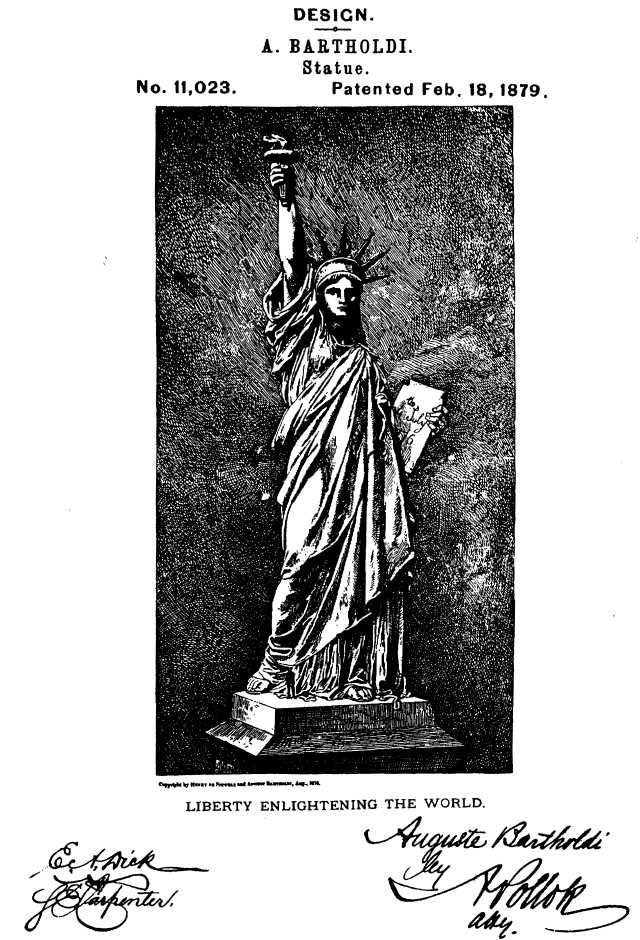
U.S. Patent D11023
The torch arrived late for the centennial festivities of 1876, celebrating the 100th birthday of the young nation. Nevertheless, the “colossal arm” proved popular with Philadelphia fairgoers, where visitors paid admission to climb up into the arm and take in the view from the balcony. The sculptor was so pleased that, for a time, he considered installing the finished statue in Philadelphia.
Fundraising committees were formed in New York, Philadelphia and Boston, to raise money for the foundation and pedestal. On his last full day in office, March 3, 1877, President Ulysses S Grant signed a joint resolution authorizing the President to accept the statue when presented by France, and to select a site for it. President Rutherford B. Hayes accepted Bartholdi’s suggestion and selected Bedloe’s Island, in New York Harbor.
Stereoscopic Image from the Centennial Exposition of 1876
Even then, fundraising went slowly for the New York committee.
With the full statue under construction in Paris, Boston made a play for the statue in 1882, offering to pay the full cost of installation provided that the statue was installed in Boston Harbor. The New York Times was miffed as only the “Newspaper of Record” can be. One editorial sniffed:
“[Boston] proposes to take our neglected statue of Liberty and warm it over for her own use and glory. Boston has probably again overestimated her powers. This statue is dear to us, though we have never looked upon it, and no third rate town is going to step in and take it from us. Philadelphia tried to do that in 1876, and failed. Let Boston be warned . . . that she can’t have our Liberty … that great light-house statue will be smashed into … fragments before it shall be stuck up in Boston Harbor”.
And here I thought that New York/Boston thing started with the Red Sox and the Yankees.
Fundraising toward the $100,000 required to complete the project was a constant and seemingly insurmountable challenge. New York Governor Grover Cleveland vetoed a bill in 1884, providing $50,000 for the effort. A bill to have the United States Congress pick the full tab the following year, was likewise defeated.
Head on display at the p 1878
With only $3,000 in the bank, the American committee organized a number of fund drives. Poet Emma Lazarus was asked to donate an original work for auction, but declined the request. At the time, Lazarus was involved in aiding Jewish refugees from the anti-Semitic pogroms of Eastern Europe. In time, Lazarus came to see the request as a way to help the cause. The resulting sonnet, The New Colossus, included the iconic lines “Give me your tired, your poor/Your huddled masses yearning to breathe free.”
New York World publisher Joseph Pulitzer pushed the project over the top, offering to print names and brief notes from contributors of every size down to a single penny. It was a brilliant marketing scheme. Newspaper circulation went through the ceiling, as readers scooped up papers to see their names in print.
One kindergarten class in Davenport, Iowa raised $1.35. A group of children sent a dollar as “the money we saved to go to the circus with.” Another dollar was sent by a “lonely and very aged woman.” Even the Big Apple’s inebriates stepped up, when a Brooklyn home for alcoholics donated fifteen dollars. Not to be outdone, collection boxes were put out in bars and saloons all over New York City. (The two cities wouldn’t be merged until 1898).
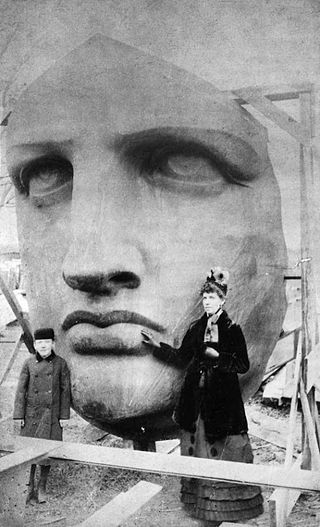
Unpacking the face, 1885
Hundreds of crates containing the disassembled Liberty Enlightening the World arrived in New York on June 17, 1885, aboard the French steamer Isère. Two months later, the final piece fell into place. On August 11, the World announced that $102,000 had been raised from 120,000 donors. 80% of the total arrived in sums of a dollar or less.
Despite the fundraising success, the pedestal wasn’t complete until April of the following year. With no room to erect scaffolding, workers descended down ropes to install skin sections to an iron armature designed by none other than Gustave Eiffel.
The formal dedication was held on the afternoon of October 28, 1886, with former New York Governor and now-President of the United States Grover Cleveland, presiding. As many as a million turned out for the parade held that morning through the streets of the city. At the New York Stock Exchange, traders showered marchers with paper strips containing stock quotes, beginning an American tradition called the ticker-tape parade.
Festivities on the future Liberty Island were for dignitaries only that day, no member of the public was allowed. Ironically, no women were permitted at all for the dedication of the world’s tallest female, save for the Sculptor’s wife, and the granddaughter of French diplomat, Ferdinand de Lesseps. It was believed that women might be injured, in all that crush of humanity.
That didn’t keep a group of offended suffragists from chartering a boat, and getting as close to the island as possible. I wonder what that sounded like.
Liberty Enlightening the World has opened and closed to the public, since that time. She has turned from a dull copper red to the rich green patina you see today. She was injured in a World War, in the Black Tom explosion of 1916. She was there to witness Annie Moore’s arrival at Ellis Island, that 15-year-old “rosy-cheeked Irish girl” from County Cork, the first of some twenty-five million immigrants who arrived at that place legally between 1892 and 1924, helping to transform this nation into the international all-star team, of the world. She witnessed that Kiss on Times Square, ending another World War in Europe. Built in the wake of the Civil War, she has watched over a nation sometimes torn along lines of race and color, as her people learned to get along with others, unlike themselves.
She has witnessed the worst terror attack of modern history and that brief, shining moment where we all seemed to be “One Nation, Under God”. Throughout it all she has remained iconic. Torch held high, the chain at her feet lying broken as she walks forward. The stone tablet in her hand is inscribed “JULY IV MDCCLXXVI”. July 4, 1776.
If you enjoyed this “Today in History”, please feel free to re-blog, “like” & share on social media, so that others may find and enjoy it as well. Please click the “follow” button on the right, to receive email updates on new articles. Thank you for your interest, in the history we all share.
The Roman Rebublic built on and improved what the Greeks had begun, creating their own God of Wine and calling him Bacchus. It was the ancient Romans who first developed the concept of Terroir, “tare WAHr”, the notion that regional climate, soils and aspect (terrain) can effect the taste of wine.
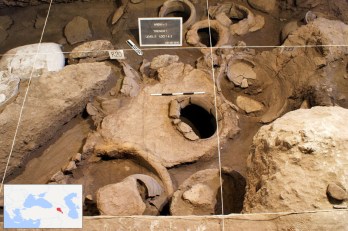
The oldest winery for which archaeological evidence exists was established around BC4100, in present-day Armenia. The Egyptian Pharoahs were producing a wine-like substance from 3100BC for use in public ceremonies, due to its resemblance to blood.
Archaeologists discovered a 3,700 year old wine cellar in the north of Israel. Phoenecian traders plied the Mediterranean from the shores of the Middle East to Gibraltar, transporting grapevines and wine in ceramic jugs. Traders introduced wine to the ancient Greeks sometime around BC800, who then began to perfect the beverage, even naming a God of the grape harvest: Dionysus.
Sounds like a great job, as Greek Gods go.
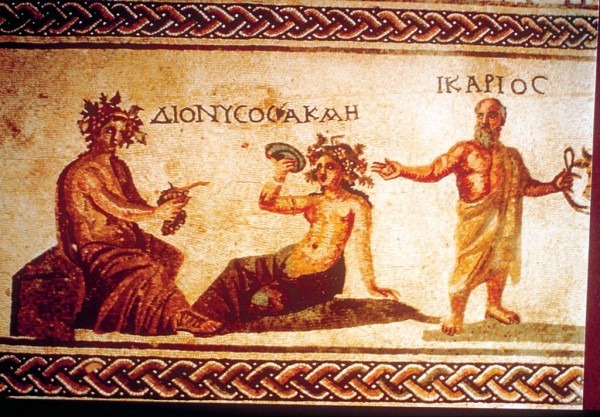
As the Greek city-states rose in power, viticulture and wine making traveled the eastern Mediterranean with Greek armies, into Sicily and the boot of Italy, and north toward Rome.
The Roman Republic built on and improved what the Greeks had begun, creating their own God of Wine and calling him Bacchus. It was the ancient Romans who first developed the concept of Terroir, “tare WAHr”, the notion that regional climate, soils and aspect (terrain) can effect the taste of wine.
The legions of Rome expanded the Empire across Europe from modern day France and Germany into Portugal and Spain. Everywhere the Legions went, vineyards were soon to follow. To this day, some regions are said to have more ‘Terroir’, than others.
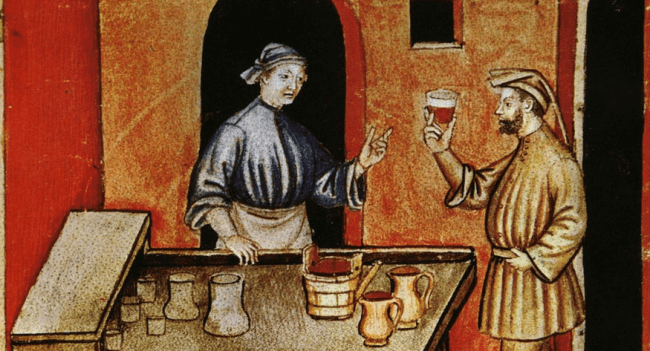
Wine seemed better suited to the sensibilities of the Roman palate, and Tacitus maligned the bitter brew of Germanic barbarians. Nevertheless, letters home from cavalry commanders of the Roman Britain period (ca AD97-103), include requests for more “cerevisia”.
Muhammad directed the “Righteous” to abstain from alcohol sometime in the seventh century, but promised “[R]ivers of water unaltered, rivers of milk the taste of which never changes, rivers of wine delicious to those who drink…” in heaven. (Surah 47.15 of the Qur’an.)
Local production of rustic beers continued well beyond the collapse of the Roman empire, while the monasteries of Europe became prime repositories of viticulture and wine making technique.
The wines of medieval and renaissance-era Europe tended to be almost universally red and almost always, still. The in-bottle refermentation that gives “sparkling” wine its ‘fizz’ was a problem. Fermentable sugars were frequently left over when weather began to cool in the fall, particularly with the white grape varietals. Refermentation would set in with the warm spring weather, converting bottles into literal time bombs. Caps would pop off and wine would spoil. Sometimes the whole batch would explode, one pressurized bottle going off in sympathetic detonation with the other.
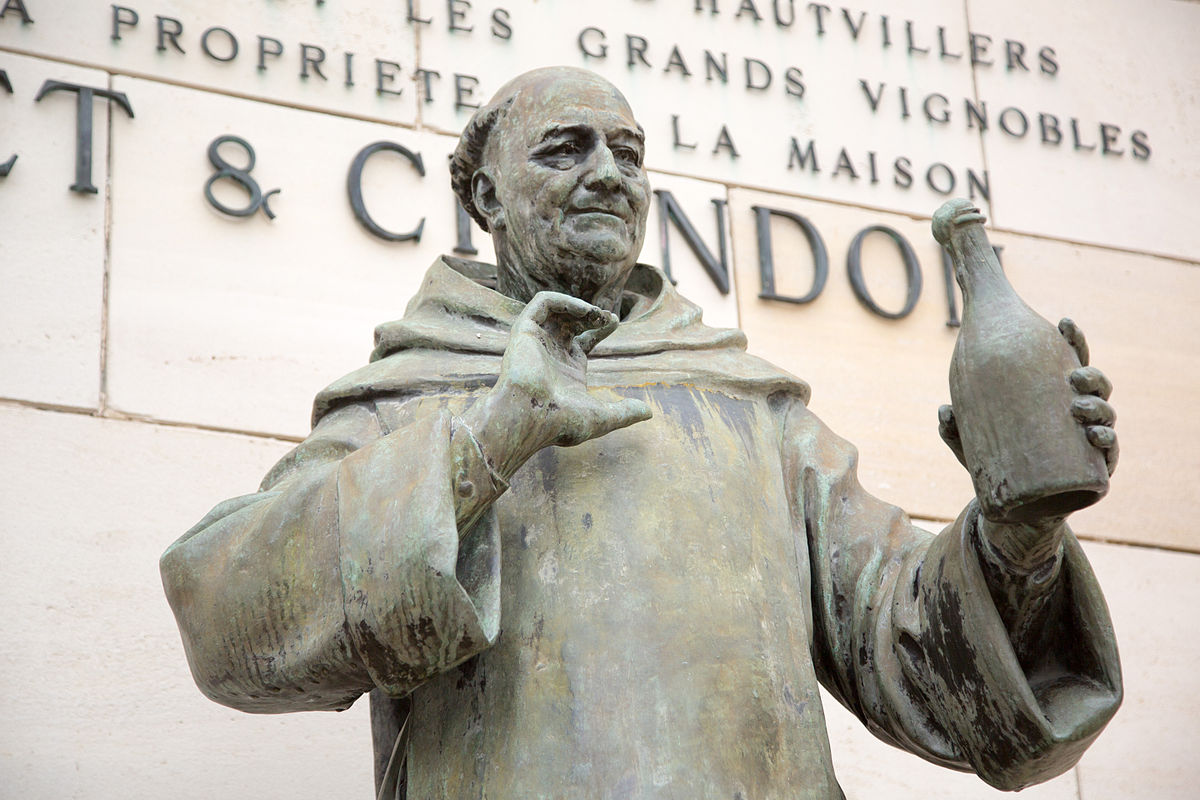
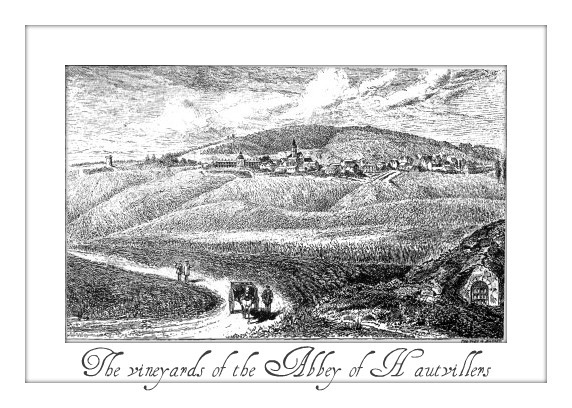
Pierre Perignon entered the Benedictine Order at the age of 19, doing his novitiate at the abbey of Saint-Vannes near Verdun and transferring to the abbey of Hautvillers in 1668.
On August 4, 1693, the date traditionally ascribed to Brother (Dom) Pérignon’s invention of Champagne, the monk is supposed to have said “Come quickly, I am drinking the stars!”.
The story is almost certainly a myth, a later embellishment to the story. During his 47 year career, Pérignon went to considerable lengths to eliminate bubbles from his wine. Dom Pérignon never succeed in that goal, yet he did make bubbly wine a whole lot better, using corks for the first time to prevent the escape of carbon dioxide, and perfecting a ‘gentle’ pressing technique which left out the murkiness of the skins.
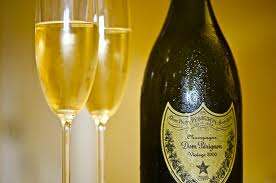
It is almost certainly Dom Pérignon who perfected the double fermentation process. He was an early advocate of natural farming methods we would call “organic”, today. Pérignon insisted on “blind” tasting, not wanting to know what vineyard a grape came from prior to selection, and strictly avoiding the addition of foreign substances, insisting that all blending take place at the grape stage.
Pérignon didn’t like white grapes because of their tendency to enter refermentation. He preferred the Pinot Noir, and would aggressively prune the plants so that vines grew no higher than three feet and produced a smaller crop. The harvest was always in the cool, damp early morning hours, and Pérignon took every precaution to avoid bruising or breaking his grapes. Over-ripe and overly large fruit was always thrown out. Pérignon never permitted grapes to be trodden upon, always preferring the use of multiple presses.
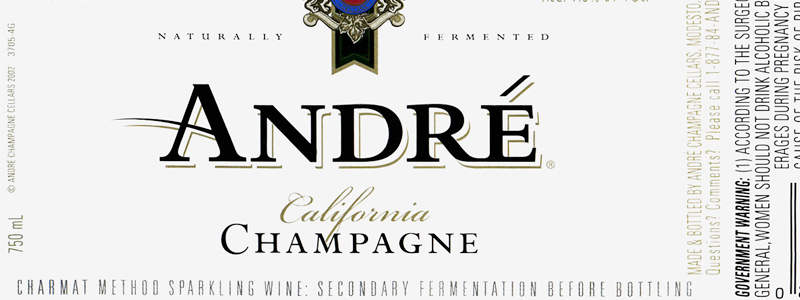
In 1891, the Madrid Agreement established among the European powers, that only sparkling wines from a certain region in northeast France may be labeled “Champagne”. The principle was re-asserted in the Treaty of Versailles ending WW1, providing protections for a French wine industry which had, ironically, been saved and literally rebuilt from the ground up by grafting “inferior” American root stock onto French vines.
But that must remain a story for another day.
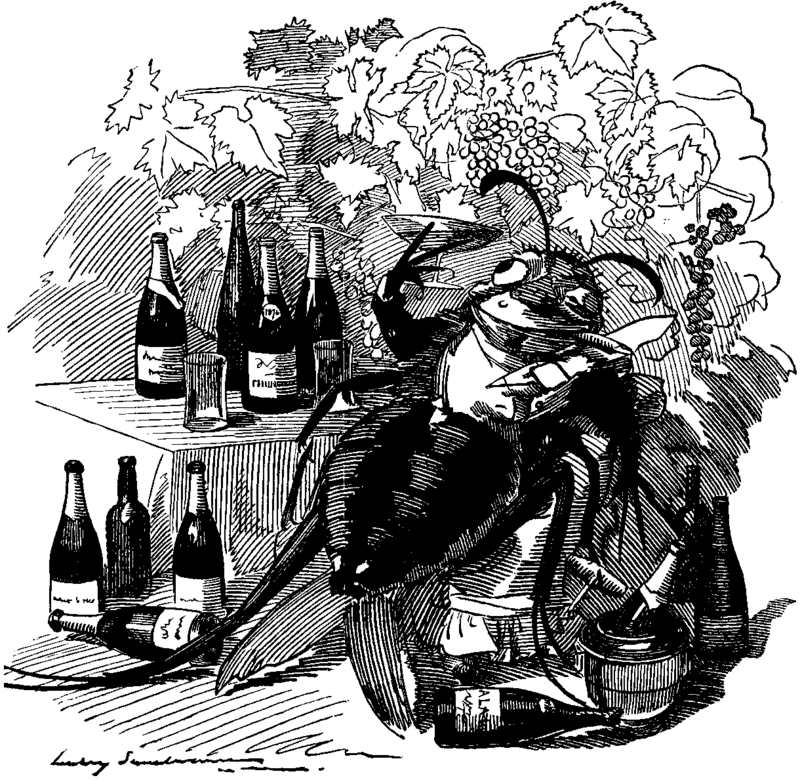
1890 cartoon from Punch depicting the Phylloxera aphid, which all but obliterated the French wine industry.
That American companies like Korbel, Cook’s and others may continue to call their bubbly wines Champagne is due to the United States’ Senate never having ratified the treaty formally ending WW1, back in 1920. The United States entered the Madrid system in 2003, but the Champagne name dispute, remains unsettled.
Benjamin Franklin, born nine years before brother Pérignon’s death in 1715, is supposed to have said “Beer is proof that God loves us and wants us to be happy.” That’s close, but the quote seems to come from a letter to André Morellet dated 1779, in which the Founding Father wrote “Behold the rain which descends from heaven upon our vineyards; there it enters the roots of the vines, to be changed into wine; a constant proof that God loves us, and loves to see us happy“.
Either way, I enthusiastically approve Mr. Franklin’s message. Cheers.
If you enjoyed this “Today in History”, please feel free to re-blog, “like” & share on social media, so that others may find and enjoy it as well. Please click the “follow” button on the right, to receive email updates on new articles. Thank you for your interest, in the history we all share.
Workers at the Flint Michigan plant assembled the first Corvette on this day in 1953. The first production car rolled off the assembly line two days later. 300 hand-built Corvettes came off the line that model year, all white.
For two years, General Motors designer Harley Earl labored to build an affordable American sports car, to compete with the MGs, Jaguars and Ferraris coming out of Europe. The first convertible concept model appeared in early 1953, part of the GM Motorama display at the New York Auto Show held at the Waldorf-Astoria Hotel.
Chevrolet wanted to give the new model a “non-animal” name, starting with ‘C’. Newspaper photographer Myron Scott suggested the name of a small class of warship, the “trim, fleet naval vessel that performed heroic escort and patrol duties during World War II.” They called this new model a Corvette.
Workers at the Flint Michigan plant assembled the first Corvette on this day in 1953. The first production car rolled off the assembly line two days later. 300 hand-built Corvettes came off the line that model year, all white.
To keep costs down, off-the-shelf components were used whenever possible. The body was made of fiberglass to keep tooling expenses low. The chassis and suspension came from the 1952 Chevy sedan. The car featured an increased compression-ration version of the same in-line six “Blue Flame” block used in other models, coupled with a two-speed Power glide automatic transmission. No manual transmission of the time could reliably handle an output of 150 HP and a 0-60 time of 11½ seconds.
GM moved production to St. Louis, Missouri the following year. Since 1974, the car has been manufactured in Bowling Green, Kentucky, where the Corvette has become the official sports car of the Commonwealth of Kentucky.
Sales were disappointing in the first couple years, compared with those of European competitors. GM refined the early design and added a V-8 in 1955, greatly improving the car’s performance. By 1961, the Corvette had established itself as a classic American muscle car.
The second generation (C2) introduced the “Stingray” name in 1963. Still sporting fiberglass body panels, the car was smaller and lighter than previous models with a maximum output of 360 HP. The sleek, tapered design was said to be patterned after the Mako shark caught by lead designer Bill Mitchell, on a deep sea fishing trip.
The third generation (1968–1982) featured a radically new body and interior design, and Chevy’s first use of T-top removable roof panels. The “Stingray” name was dispensed with in 1976, in 1978, the C3 became the first of 12 Corvettes to be used as Pace Cars for the Indy 500.
The radical redesign of the fourth generation Corvette was intended for the 1983 model year but, quality issues and delays from parts suppliers resulted in only 43 prototypes being built. None of them were ever sold. Only one of the 1983 prototypes survives; it’s on display at the National Corvette Museum in Bowling Green, Kentucky.
When it came to quality and styling, many felt that the C4 compared poorly with Japanese competitors like the Nissan 300ZX and Mazda RX-7. The 5th generation introduced in 1997 addressed many of these issues. The production C5 had a top speed of 181 mph, while the lower drag coefficient and new, aerodynamic styling resulted in 28 mpg on the highway.
Twenty-first century updates exposed headlights for the first time since 1962, the 7th generation becoming the first to bear the Stingray name since the 1976 model year. Air intake grills were exposed for the first time in four generations, as the all-important 0-60 times approached the four-seconds mark.
Corvette enthusiasts criticized the aggressive, angular lines of the C7, claiming the rear end looks more like a C5 Camaro. Others complained about the front end; with an air intake grill exposed for the first time in four generations.
The supercharged 6.2L V8 power plant of the 2019 Z06 develops 650 horsepower, capable of accelerating from 0-60 mph in 2.95 seconds with a top end of 207.4 mph. Ain’t nobody fussing about that.
If you enjoyed this “Today in History”, please feel free to re-blog, “like” & share on social media, so that others may find and enjoy it as well. Please click the “follow” button on the right, to receive email updates on new articles. Thank you for your interest, in the history we all share.
The golden age of the automobile, had arrived. All manner of roadside attractions popped up to serve the burgeoning tourist business. There were teepee-shaped motels and frozen custard stands. Indian curio shops and reptile farms.
In 1857, President James Buchanan appointed Lieutenant Edward Beale to survey and build a 1,000-mile wagon road from Fort Defiance, New Mexico to the Arizona/California border. The survey continued an experiment first suggested by Secretary of War and future President of the Confederate States of America Jefferson Davis, in the use of camels as draft animals.
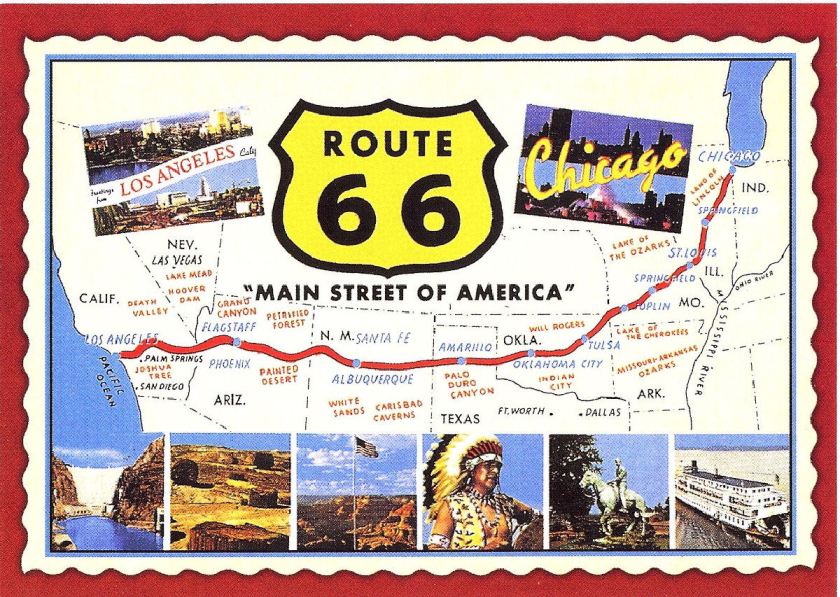
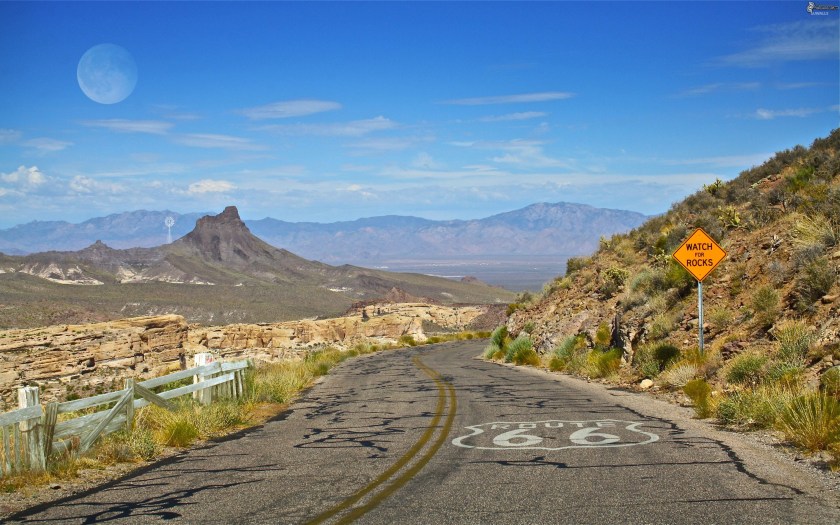
The camel part turned out to be a flop, but the road building was not. Beale’s wagon trail went on to become the western end of “America’s Main Street”. Route 66.
The “Mother Road” became an official part of the national highway system in 1927. It was yet to be paved, when the US Highway 66 Association held a “Bunion Derby” in 1928. It was a footrace from Los Angeles to Madison Square Garden, a distance of 3,423½ miles. Naturally, the LA to Chicago leg ran along Route 66.
Andy Hartley Payne, an Oklahoma Cherokee runner won the race in 573 hours, 4 minutes and 34 seconds. 11th place finisher Harry Abrams ran the race in the opposite direction the following year, becoming the only person to twice run across the continental United States.
In 1914, a Model T sold for $490. As the 20s drew to a close, the number of registered drivers had tripled to 23 million.
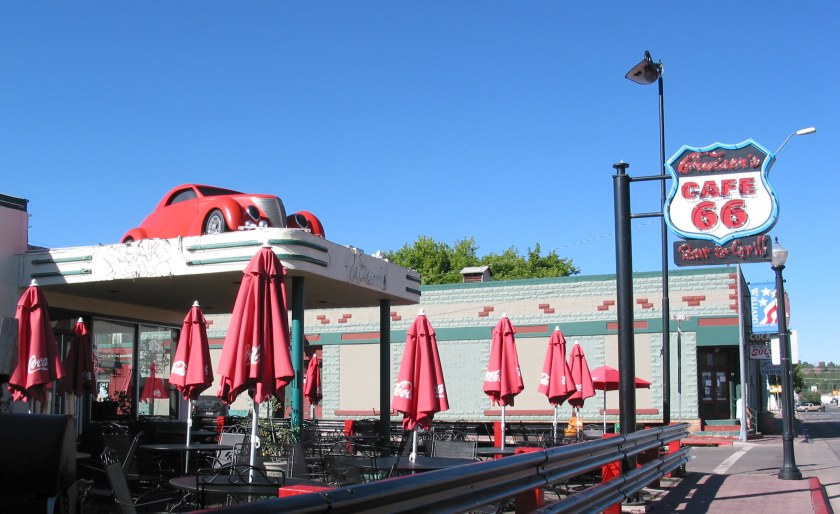
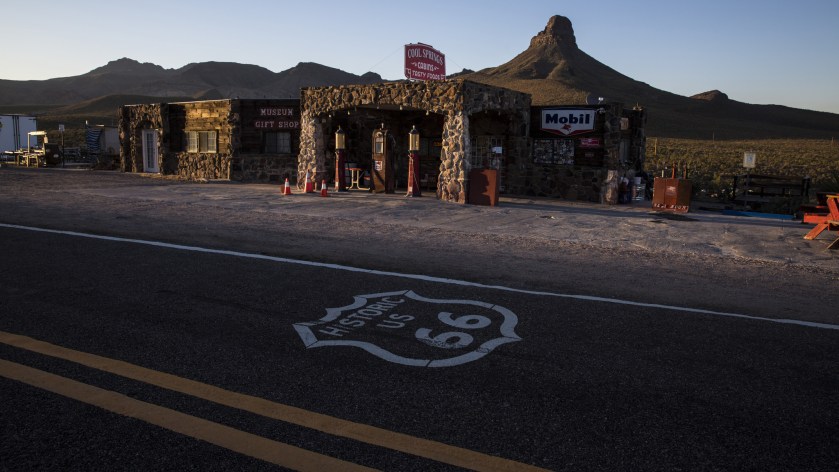
The 1932 Summer Olympics in Los Angeles and the westward migration of the “Dust Bowl” era increased the number of “Mom & Pop” service stations, restaurants, and motor courts, springing up to serve the needs of passing motorists.
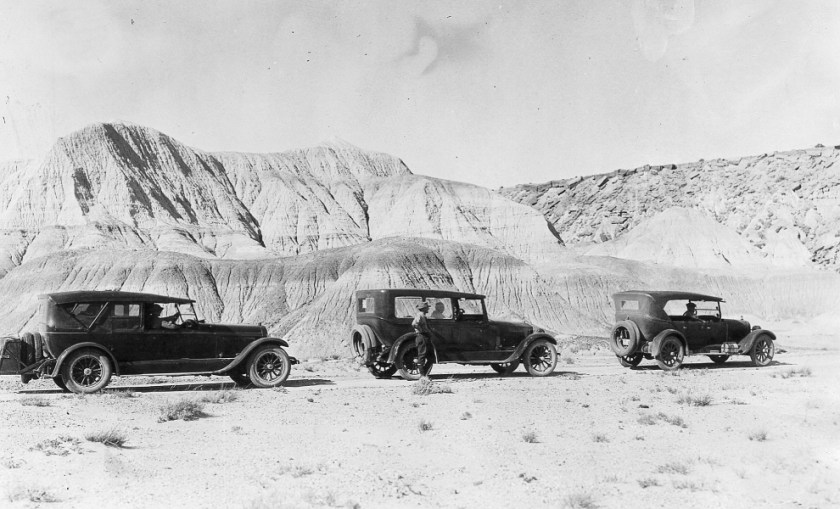
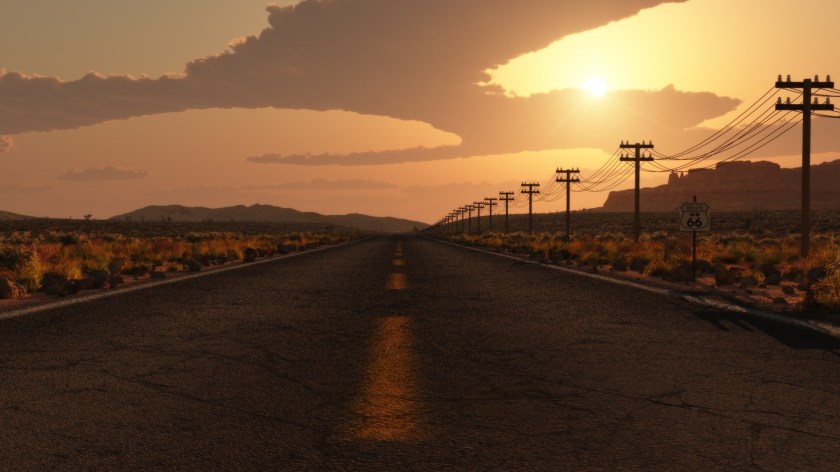
The road was fully paved by 1938, passing through the Painted Desert on the way by the Grand Canyon and Meteor Crater in Arizona.
The golden age of the automobile, had arrived. All manner of roadside attractions popped up to serve the burgeoning tourist business. There were teepee-shaped motels and frozen custard stands. Indian curio shops and reptile farms.
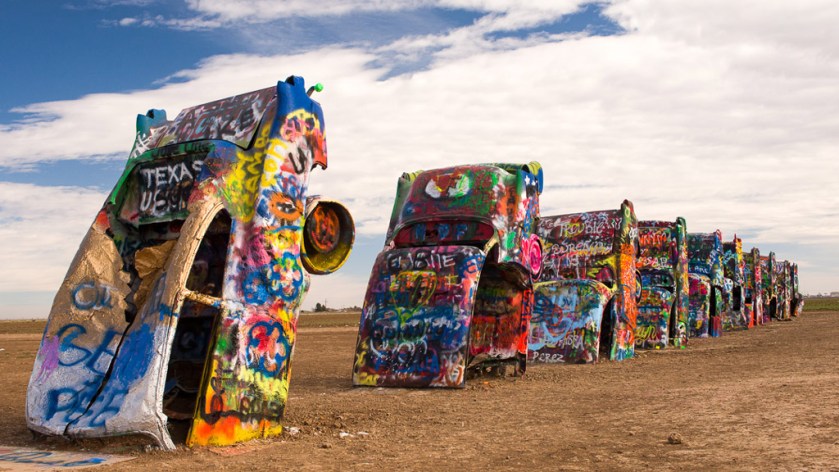
Meramec Caverns outside of St. Louis painted billboards on barns, calling themselves “Jesse James hideout”. The Big Texan sold a 72-ounce steak dinner, making it free to anyone who could eat the whole thing in an hour.
The fast-food industry was born on Route 66, when Sheldon “Red” Chaney built Red’s Giant Hamburg in Springfield, Missouri. Believed to be the first drive-through restaurant in the country, the name was supposed to be “Red’s Giant Hamburger“. Chaney had to cut the two bottom letters off his sign, when the city refused to raise the telephone wires.
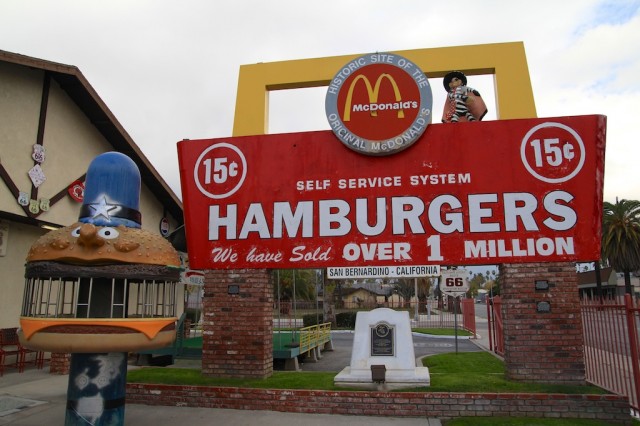
Patrick McDonald opened “The Airdrome” restaurant on Route 66 in 1937, years before the world knew anything about Ray Kroc. Hot dogs were some of the first items he ever sold. Ten cent hamburgers were added later, along with all-you-can-drink orange juice for five cents. Three years later, McDonald’s two sons Maurice and Richard (“Mac” and “Dick”) moved the entire building 40 miles east, to San Bernardino, calling the place “McDonald’s Bar-B-Que”.
General Eisenhower came out of WWII with an appreciation for the German highway system, the Autobahn, and signed the Interstate Highway Act as President in 1956. It was the beginning of the end for Route 66. New highway construction began to bypass town centers, and once-thriving Mom & Pops began to die off.
By the mid-’50s, Missouri upgraded its sections of US 66 to four lanes, by-passing town centers and the businesses that went with them.
Illinois widened US 66 from Chicago to the Mississippi River. By 1957, virtually the entire Missouri-Kansas-Oklahoma stretch was replaced by 4 lane toll roads. You could see the old 66 as you drove parallel to it, but travelers rarely stopped.
The last parts of Route 66 were decertified by state highway and transportation officials on this day in 1985. In some cities, the old road is now the “Business Loop”.
The Mother Road has been carefully preserved in some areas, abandoned in others.
Today, most of the old attractions are gone. You couldn’t drive the old Route 66 from Chicago to LA if you wanted to. But you could get close. If you plan ahead.
If you enjoyed this “Today in History”, please feel free to re-blog, “like” & share on social media, so that others may find and enjoy it as well. Please click the “follow” button on the right, to receive email updates on new articles. Thank you for your interest, in the history we all share.
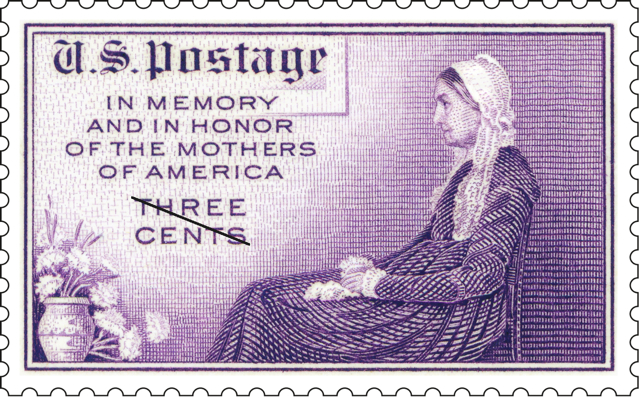
We have a tendency in this culture, to make a big deal of our own birthday. What would it be like if our birthdays became “Mother’s Day”, instead? Why not, she did all the work. All any of the rest of us did, was to show up on cue, and scream.
The earliest discernible Mother’s day comes from 1200-700BC, descending from the Phrygian rituals of modern-day Turkey and Armenia. “Cybele” was the great Goddess of nature, mother of the Gods, of humanity, and of all the beasts of the natural world. Her cult would spread throughout Eastern Greece with colonists from Asia Minor.
Much of ancient Greece looked to the Minoan Goddess Rhea, daughter of the Earth Goddess Gaia and the Sky God Uranus, mother of the Gods of Olympus. Over time the two became closely associated with the Roman Magna Mater, each developing her own cult following and worshiped through the period of the Roman Empire.
In ancient Rome, women partook of a festival, strictly forbidden to Roman men. So strict was this line of demarcation that only women were permitted even to know the name of the deity. For everyone else she was simply the “Good Goddess”. The Bona Dea.
In the sixteenth century, it became popular for Protestants and Catholics alike to return to their “mother church” whether that be the church of their own baptism, the local parish church, or the nearest cathedral. Anyone who did so was said to have gone “a-mothering”. Domestic servants were given the day off and this “Mothering Sunday”, the 4th Sunday in Lent, was often the only time when whole families could get together. Children would gather wild flowers along the way, to give to their own mothers or to leave in the church. Over time the day became more secular, but the tradition of gift giving continued.
Ann Maria Reeves Jarvis was a social activist in mid-19th century western Virginia. Pregnant with her sixth child in 1858, she and other women formed “Mother’s Day Work Clubs”, to combat the health and sanitary conditions which were leading at that time to catastrophic levels of infant mortality. Jarvis herself gave birth between eleven and thirteen times in a seventeen year period. Only four of those would live to adulthood.
Jarvis had no patience for the sectional differences which led to the Civil War, or those which led her own locality to secede and form the state of West Virginia in order to rejoin the Union. Jarvis refused to support a measure to divide the Methodist church into northern and southern branches. She would help Union and Confederate soldier alike if she could. It was she alone who offered a prayer when others refused, for Thornsbury Bailey Brown, the first Union soldier killed in the vicinity.
Following her death in 1905, Jarvis’ daughter Anna conceived of Mother’s Day as a way to honor her legacy and to pay respect for the sacrifices that all mothers make on behalf of their children.
Obtaining financial backing from Philadelphia department store owner John Wanamaker, Anna Jarvis organized the first official Mother’s Day celebration at a Methodist church in Grafton, West Virginia.
Anna Jarvis resolved that Mother’s Day be added to the national calendar, and formed the International Mother’s Day Association, in 1912. She took out a patent on the name, the singular “Mother’s” expressive of her desire that each of us honor our own mother, and not some anonymous parade of “Mothers'”.
A massive letter writing campaign ensued and, on May 9, 1914, President Woodrow Wilson signed a measure declaring the second Sunday of May, to be Mother’s Day.
Anna Jarvis believed Mother’s Day to be a time of personal celebration, a time for families to gather to love and honor their mother. In the early days, Jarvis worked with the floral industry to help raise the profile of Mother’s Day, but she came to resent what she saw as over-commercialization. Greeting cards seemed a pale substitute for the hand written personal notes she envisioned. In 1923, Jarvis protested a Philadelphia candy maker’s convention, deriding confectioners, florists and even charities as “profiteers”.
Anna Jarvis
Carnations had by this time become symbolic of Mother’s Day, and Jarvis resented that they were being sold at fundraisers. She protested at a meeting of the American War Mothers in 1925 where women were selling carnations, and got herself arrested for disturbing the peace.
She was soon filing lawsuits against those she felt had used the “Mother’s Day” name in vain.
During the last years of her life, Anna Jarvis lobbied the government to take her creation off of the calendar, gathering signatures door-to-door to get the holiday rescinded. The effort was obviously unsuccessful. The mother of mother’s day died childless in a sanitarium in 1948, her personal fortune squandered on legal fees.
So it is that the creator of Mother’s Day turned against her own holiday, but her creation lives on. Today, Mother’s Day is celebrated in over 40 countries. In the United States, Mother’s Day is one of the biggest days of the year for flower and greeting card sales, and the busiest day of the year for the phone company. Church attendance is the third highest of the year, behind only Christmas and Easter. Many celebrate the day with carnations: colored if the mother is still living and white if she has passed on.
Happy Mother’s Day, Mom. May this be the first of many more.
If you enjoyed this “Today in History”, please feel free to re-blog, “like” & share on social media, so that others may find and enjoy it as well. Please click the “follow” button on the right, to receive email updates on new articles. Thank you for your interest, in the history we all share.
The United States still had a border in those days, which the Federal government attempted to enforce.
Except for the Naval Air Station at Boca Chica and Coast Guard installations in Key West, Marathon and Islamorada, most of the economic activity in the Florida Keys, comes from tourism. It’s no wonder that, when the federal government shuts down the only road into the Keys, the locals are going to get cranky.
In April 1982, the Mariel boatlift was a mere two years in the past, and very much in the public memory.
The United States still had a border in those days, which the Federal government attempted to enforce.
On April 18, Border Patrol set up a roadblock in front of Skeeter’s Last Chance Saloon in Florida City, shutting down US Route 1, the only road in and out of the Florida Keys. Originally intended to intercept illegals entering the country, the roadblock soon morphed into a hunt for illegal drugs, as well.
Cars waited for hours, in lines stretching 19 miles. Predictably, the attitude of Federal officials was one of towering indifference. Not so local business owners. Robert Kerstein wrote in his Key West on the Edge — Inventing the Conch Republic, “No one in Key West doubted that drugs were trafficked widely in the Keys by road and by boat. But tourism’s boosters had little tolerance for interruptions to their business.”
Dennis Wardlow, then-Mayor of Key West, contacted the chief of police, the Monroe County sheriff, his State Representative and then-Governor Bob Graham, demanding the roadblock’s removal. With none of the above having any knowledge of the barrier and lacking the authority to pull it down, Wardlow contacted INS directly. When the Border Patrol told him it was “none of his business,” the Mayor’s response could best be summed up in the words of Bugs Bunny: “Of course you know, this means war!”
Suffering a blizzard of hotel cancellations, this “attack on Key West’s sovereignty” could not stand. On April 22, Mayor Wardlow, local attorney & pilot David Horan and Old Town Trolley Tours operator Ed Swift flew to Miami seeking legal remedy. When District Court Judge C. Clyde Atkins failed to issue an injunction, the Key West delegation took to the courthouse steps.
“What are you going to do, Mr. Mayor”, asked the assembled media. Swift leaned over and whispered into the Mayor’s ear, “Tell them we are going to go home and secede!” “We are going to go home and secede!”, said Wardlow, and that’s what they did.
Over the next 24 hours, secessionist co-conspirators worked feverishly to form a new government, filling cabinet positions such as “Secretary of Underwater Affairs” and “Minister of Nutrition”.
On April 23, with federal agents on scene to monitor the proceedings, a crowd gathered before the old customs building. Mayor Wardlow and a gaggle of allies mounted the back of a flatbed truck, to read the proclamation of secession. “We serve notice on the government in Washington”, he started, “to remove the roadblock or get ready to put up a permanent border to a new foreign land. We as a people, may have suffered in the past, but we have no intention of suffering in the future at the hands of fools and bureaucrats“.
With that, Mayor Wardlow declared “war” on the United States. The “Great Battle of the Conch Republic” broke out in the harbor, when the Schooner Western Union commanded by Captain John Kraus, attacked the Coast Guard Cutter Diligence with water balloons, Conch fritters and toilet paper. Diligence fought back with water hoses, as the new “Prime Minister” broke a stale loaf of Cuban bread over the head of a man dressed in a Navy uniform.
Naval History was forever changed on this day, as the “Great Battle of the Conch Republic” raged across the waters of Key West
Pandemonium broke out as others launched stale bread and conch fritters at federal agents, Navy sailors and Coast Guard personnel. One minute after declaring his “verbal shot” at the Federal government, Mayor Wardlow surrendered to a nearby Naval officer, demanding a billion dollars in “foreign aid” in compensation for “the long federal siege.”
Apparently, that’s what it takes to get the attention of a Federal government bureaucrat. The roadblock lifted. The restaurants, stores and hotels of the Keys soon filled with tourists and, once again, there was happiness upon the land. Key West never got its “foreign aid”, but “secesh” leaders never received so much as a letter, saying they couldn’t leave the Union, either.
So it is that the micro-nation of Key West celebrates its independence, every April 23. The “Conch Republic’ issues its own passports, selling T-shirts and bumper stickers with the slogan “We seceded where others failed”.
And if the Federal government ever comes back to mess with the sovereign nation of Key West, it had better be prepared to deal with the Conch Republic’s very own “Special Forces”, the motto for which is “Sanctus Merda”. “Holy Shit”.
Tip of the hat to
“Conch Republic Military Forces, The Official Site of the Conch Republic Military”
Mine eyes have seen the glory of the sunshine and the sea Right here upon our islands, where we love to live so free But in April 1982, the peace was not to be And we went rolling on
CHORUS Glory glory Conch Republic Glory glory Conch Republic Glory glory Conch Republic From Key to shining Key
They were setting up a check point, tween the mainland and the Keys They had put a US Border, where it shouldn’t ‘oughta’ be So that’s when we seceded, and declared our sovereignty And the fun had just begun
(CHORUS)
We went forth into the harbor and a cutter we did spy And we sailed up along side her and we took her by surprise We hoisted up our battle flag, so proudly and so high And we went sailing on
(CHORUS)
The water and Conch fritters and the Cuban bread did fly Our bombers, they were raining toilet paper from the sky Our cannons they did thunder to proclaim our victory And we fought bravely on
(CHORUS)
We have faced the silly forces of misguided zealotry We have stood up to their foolishness for all the world to see And we’ve showed the other nations what America can be From Key to shining Key
(CHORUS)
If you enjoyed this “Today in History”, please feel free to re-blog, “like” & share on social media, so that others may find and enjoy it as well. Please click the “follow” button on the right, to receive email updates on new articles. Thank you for your interest, in the history we all share.
“Let no neglect, no ravages of time, testify to the present or to the coming generations that we have forgotten as a people the cost of a free and undivided republic.”
On April 16, 1866, the American Civil War was barely a year in the past. An unknown widow brought her children to the Hiller Cemetery, near Carbondale, Illinois. She and the children placed flowers on an unmarked grave, as several veterans watched from the steps of the nearby Crab Orchard Christian Church.
The group was struck by her simple gesture. When the family left, the men gathered up wild flowers and so decorated the graves of their fallen comrades, as she and the kids had done. Word of the gesture soon spread, and it was agreed that a more formal act of Memorial should be carried out. A community wide event took place at Carbondale’s Woodlawn Cemetery on April 29, 1866.
212 veterans took part in that first ceremony, among them Major General John A. Logan, invited to give the keynote address.
Two years later, General Logan was Commander-in-Chief of the Grand Army of the Republic, in Washington DC. In March of that year, General Logan’s wife Mary visited several battlefields of the late war, in Virginia. While there, Mary Logan noticed a number of small flags, wilting flowers and other decorations, marking Confederate graves at the Blandford Cemetery, near Petersburg.
On her return, Mary expressed the opinion that the North should so decorate the graves of its fallen. Perhaps reminded of that earlier occasion near Carbondale, General Logan issued General Order No. 11, setting aside a date in May as an annual date “for the purpose of strewing flowers, or otherwise decorating the graves of Comrades who died in the defense of their country.”
Some two dozen communities claim the honor of having held that first Memorial Day, though it wouldn’t be called that until much later. For now, it was “Decoration Day”. The first large-scale observance was held that year at Arlington National Cemetery, across the Potomac River from Washington, D.C.
The veranda of the Arlington mansion, once the home of General Robert E. Lee, was draped in mourning. A number of officials attended the event, including General Ulysses S. Grant and his wife, Julia. There were speeches and hymns, and then children from the Soldiers’ and Sailors’ Orphan Home joined with members of the GAR, in laying flowers on the graves of Union and Confederate alike.
General Logan’s order instructed all posts to decorate the graves of the fallen “with the choicest flowers of springtime”. “We should guard their graves with sacred vigilance“, he wrote, “Let pleasant paths invite the coming and going of reverent visitors and fond mourners. Let no neglect, no ravages of time, testify to the present or to the coming generations that we have forgotten as a people the cost of a free and undivided republic.”
So may it always be.
If you enjoyed this “Today in History”, please feel free to re-blog, “like” & share on social media, so that others may find and enjoy it as well. Please click the “follow” button on the right, to receive email updates on new articles. Thank you for your interest, in the history we all share.
The night before Prohibition was repealed, April 6, 1933, beer lovers lined up at the doors of their favorite public houses, waiting for their first legal beer in thirteen years.
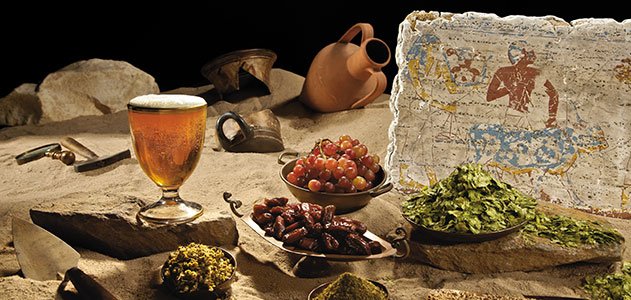
Given the right combination of sugars, almost any cereal will undergo simple fermentation, due to the presence of wild yeasts in the air. It seems likely that our cave-dwelling ancestors experienced their first beer, as the result of this process.
Starch dusted stones were found with the remains of doum-palm and chamomile in the 18,000-year old Wadi Kubbaniya in upper Egypt. While it’s difficult to confirm, University of Pennsylvania archaeologist Dr. Patrick McGovern says, “it’s very likely they were making beer there”.
Chemical analysis of pottery shards date the earliest barley beer to 3400BC, in the Zagros Mountains of Iran.
Tacitus maligned the bitter brew of Germanic barbarians. Wine seemed better suited to the sensibilities of the Roman palate. Nevertheless, the letters of Roman cavalry commanders from the Roman Britain period, c. 97-103 AD, include requests for more “cerevisia“, for the legionaries.
In North and South America, native peoples brewed fermented beverages from local ingredients, including agave sap, the first spring tips of the spruce tree, and maize.
Pilgrimsleft the Netherlands city of Leiden in 1620, hoping not for the frozen, rocky soil of New England, but for rich farmland and a congenial climate in the New World. Lookouts spotted the wind-swept shores of Cape Cod on November 9, 1620, and may have kept going, had there been enough beer. One Mayflower passenger wrote in his diary: “We could not now take time for further search… our victuals being much spent, especially our beer…”
Prior to the the drum roaster’s invention in 1817, malt was typically dried over wood, charcoal, or straw fires, leaving a smoky quality which would seem foreign to the modern beer drinker. William Harrison wrote in his “Description of England” in 1577, “For the wood-dried malt, when it is brewed, beside that the drink is higher of colour, it doth hurt and annoy the head of him that is not used thereto, because of the smoke“.
Smoky flavor didn’t trouble the true aficionado of the age. When the Meux Brewery casks let go in 1814 spilling nearly 400,000 gallons onto the street, hundreds of Britons hurried to scoop it up in pots and pans. Some even lapped it up off of the street, doggy-style.
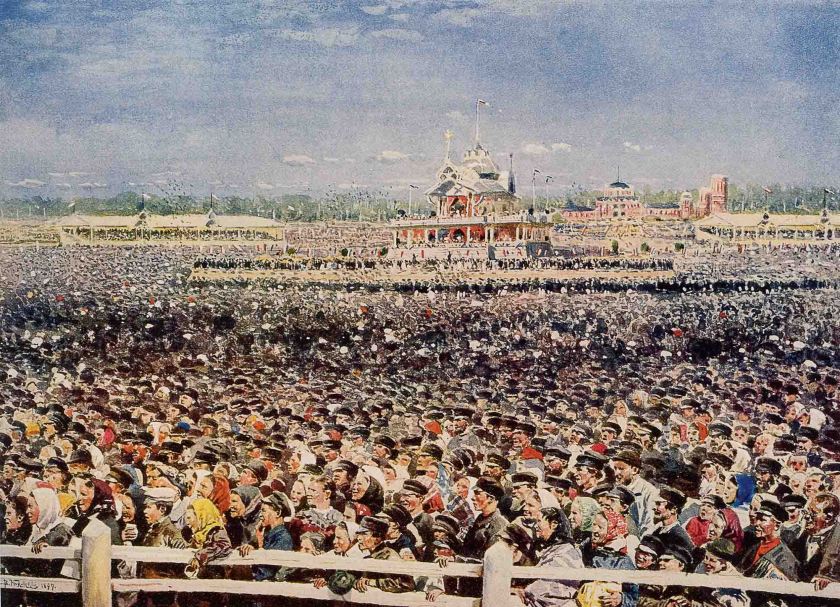
1,389 were trampled to death and another 1,300 injured in a stampede for the suds, when someone thought the beer had run out at the coronation of Czar Nicholas II, in 1896.
The 18th amendment, better known as “prohibition”, went into effect at midnight, January 16, 1920. For thirteen years it was illegal to import, export, transport or sell liquor, wine or beer in the United States.
Portable stills went on sale within a week, and organized smuggling was quick to follow. California grape growers increased acreage by over 700% over the first five years, selling dry blocks of grapes as “bricks of rhine” or “blocks of port”. The mayor of New York City sent instructions on wine making, to his constituents.
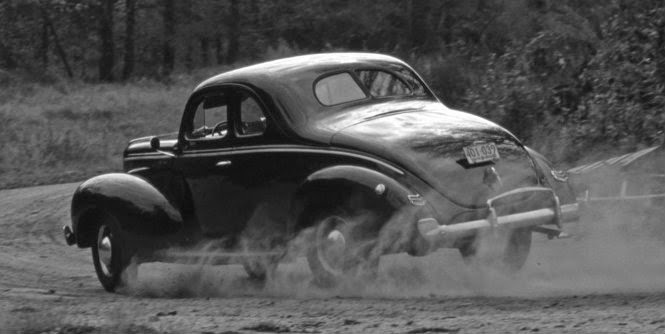
Smuggling operations became widespread, as cars were souped up to outrun “the law”. This would lead to competitive car racing, beginning first on the streets and back roads and later moving to dedicated race tracks. It’s why we have NASCAR, today.
Organized crime became vastly more powerful due to the influx of enormous sums of cash. The corruption of public officials was a national scandal.
Gaining convictions for breaking a law that everyone hated became increasingly difficult. There were over 7,000 prohibition related arrests in New York alone between 1921 and 1923. Only 27 resulted in convictions.
Finally, even John D. Rockefeller, Jr., a lifelong teetotaler who contributed $350,000 to the Anti-Saloon League, had to announce his support for repeal.
It’s difficult to compare rates of alcohol consumption before and during prohibition. If death by cirrhosis of the liver is any indication, alcohol consumption never decreased by more than 10 to 20 per cent.
FDR signed the Cullen–Harrison Act into law on March 22, 1933, commenting “I think this would be a good time for a beer.” The law went effect on April 7, allowing Americans to buy, sell and drink beer containing up to 3.2% alcohol.
A team of draft horses hauled a wagon up Pennsylvania Avenue, delivering a case of beer to the White House – the first public appearance of the Budweiser Clydesdales.
“Dry” leaders tried to prohibit consumption of alcohol on military bases in 1941, but military authorities claimed it was good for morale. Brewers were required to allocate 15% of total annual production to be used by the armed forces. So essential were beer manufacturers to the war effort, that teamsters were ordered to end a labor strike against Minneapolis breweries. Near the end of WWII, the army made plans to operate recaptured French breweries, to ensure adequate supplies for the troops.
18 states continued prohibition at the state level after the national repeal, the last state finally dropping it in 1966. Almost 2/3rds of all states adopted some form of local option, enabling residents of political subdivisions to vote for or against local prohibition. Some counties remain dry to this day. Ironically, Lynchburg County, Tennessee, home to the Jack Daniel distillery, is one such dry county.
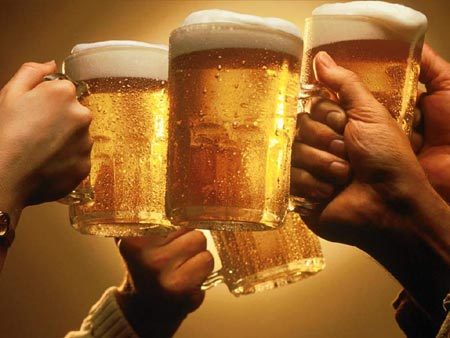
The night before Roosevelt’s law went into effect, April 6, 1933, beer lovers lined up at the doors of their favorite public houses, waiting for their first legal beer in thirteen years. A million and a half barrels of the stuff were consumed the following day, a date remembered today as “National Beer Day”.
So it is that, from that day to this, April 6 is celebrated as “New Beer’s Eve”. Sláinte.
For every wound, a balm. For every sorrow, cheer. For every storm, a calm. For every thirst, a beer. – Irish toast, author unknown
If you enjoyed this “Today in History”, please feel free to re-blog, “like” & share on social media, so that others may find and enjoy it as well. Please click the “follow” button on the right, to receive email updates on new articles. Thank you for your interest, in the history we all share.
So it is that Emperor Napoleon Bonaparte, a General who fought and won more battles than Hannibal Barca, Alexander the Great, Julius Caesar and Frederick the Great, combined, was defeated and driven out of town…by bunnies.
In Christian tradition, Jesus of Nazareth was crucified on Good Friday, arising from the dead two days later to reveal himself to his disciples, before finally ascending to heaven.
So where did the Easter Bunny come from?
Many of the secular symbols associated with Easter trace back to the pagan goddess of spring and the dawn, Ēostre or Ostara, from the Old English Ēastre. History fades into mythology in the pre-Christian usage and accounts differ, but this Teutonic deity was frequently depicted with eggs symbolizing the rebirth of Spring. And rabbits.
It’s small wonder that the latter symbolized fertility. A female Hare, called a “Jill” has a 42-day gestation period, and is capable of conceiving while still pregnant. Kriss Kringle and an egg laying Easter Hare called “Osterhase” or “Oschter Haws” came to America in the 1700s, with German immigrants who settled in Pennsylvania. Children would make nests of clothing and blankets, in which the creature could lay its colored eggs. This is the origin of the Easter basket.
Hares and rabbits are different species of the same family, like sheep and goats. Until the 18th century, rabbits were called Coneys, after the Latin “cuniculus”. The word has all but disappeared from American English vernacular, its only use today relates to Coney Island, in New York.
It was around that time that the diminutive, fuzzier “bunny” came to replace the Easter Hare.
History gives us a tale about rabbits having nothing whatever to do with Easter, but it’s way too good not to tell it here. I swear it’s not an April Fool.
The story involves no less a figure than Napoleon Bonaparte. In July 1807, Napoleon had just signed the Treaty of Tilsit, ending the war between the French Empire and Imperial Russia. Looking to celebrate, Napoleon suggested a rabbit hunt, and ordered his Chief of Staff Alexandre Berthier to make it happen.
Berthier put together an outdoor luncheon, inviting the highest brass from the French military. Meanwhile, Napoleon’s men ranged far and wide, collecting rabbits for the hunt. As many as 3,000 of them.
Napoleon arrived at one side of a grassy field with his beaters and gun bearers, with all those caged rabbits lined up on the other side. Rabbits and Hares are predictably shy and retiring creatures, but Berthier’s soldiers had found it easier to purloin domesticated rabbits instead of flushing out the wild variety, and these things were hungry.
The hunt was supposed to start when all those cages opened up but, instead of scattering, a swarm of rabbits thought it was dinner time and pelted straight across the field.
The most powerful man in the world thought it was funny at first, until all those rabbits started coming up his legs. Coachmen cracked bullwhips and men grabbed sticks. There was shooting and shouting and pandemonium, everywhere. Still, the bunny horde came on.
Baron Paul Thiébault was there, let him tell the story. “The intrepid rabbits turned to the Emperor’s flank, attacked him frantically in the rear, refused to quit their hold, piled themselves up between his legs till they made him stagger, and forced the conqueror of conquerors, fairly exhausted, to retreat and leave them in possession of the field”.
Napoleon retreated to his carriage, but still the attack continued. Historian David Chandler picks up the story. “With a finer understanding of Napoleonic strategy than most of his generals, the rabbit horde divided into two wings and poured around the flanks of the party and headed for the imperial coach.” The tide of bunnies continued. Some even got into the carriage. The assault finally ebbed away, only as the Royal Conveyance, drove out of sight.
So it is that Emperor Napoleon Bonaparte, a General who fought and won more battles than Hannibal Barca, Alexander the Great, Julius Caesar and Frederick the Great, combined, was defeated and driven out of town…by bunnies.
If you enjoyed this “Today in History”, please feel free to re-blog, “like” & share on social media, so that others may find and enjoy it as well. Please click the “follow” button on the right, to receive email updates on new articles. Thank you for your interest, in the history we all share.
You must be logged in to post a comment.