August 6, 1940 A Different Kind of Courage

By the siege’s end in the Spring of 1944, nine of them had starved to death, standing watch over all that food.  For twenty-eight months these guys guarded their seed bank, without eating so much as a grain.

In 21st century America, “diversity” is often seen as that overly PC tendency, leading the backdrop of every political speech and college recruiting poster to feature all those smiling faces, in just the right mix of race, sex and color.

In the world of plant biology, diversity can literally mean the difference between feast and famine.

The Irish Potato Famine of the mid-19th century resulted from the failure of a single crop. The direct cause was the water mold Phytophthora infestans, but the real culprit might have been the over reliance on a single strain of potato. A million Irish starved to death and another two million departed, never to return, in a country starting out with barely 8.4 million in 1844.
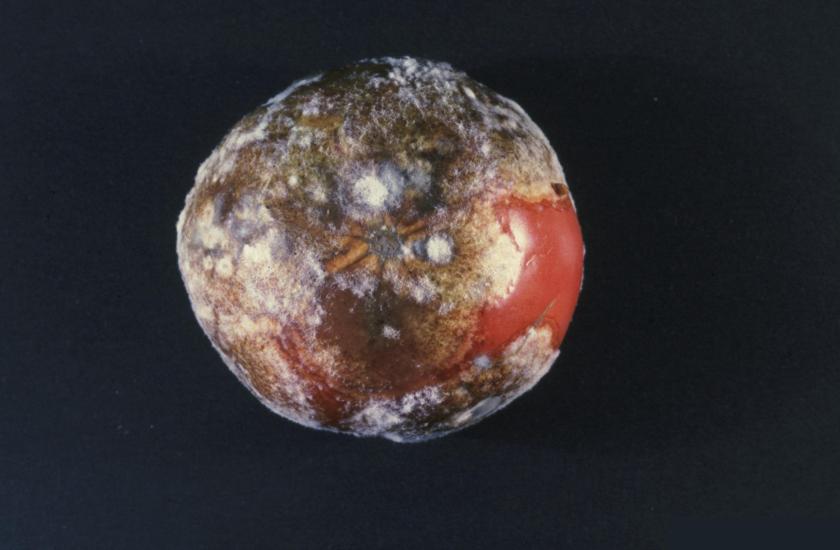
Phytophthora_infestans_(late_blight)_on_tomato
Phytophthora_ nfestans (late blight) on tomato

The Irish potato famine was just one of 120 such calamities to afflict humanity in modern times, resulting in the starvation death of hundreds of millions. Blight, climate disruption and insects are but a few of the causes. Often, the only solution was having enough food-source variety that no single crop failure could lead to starvation.

Nikolai Ivanovic Vavilov was a Russian botanist and plant biologist.  Vavilov witnessed the death of millions of Russians in three such famines, and devoted his life’s work to the improvement of wheat, corn and other food crops necessary to sustain a global population.

220px-Nikolai_Vavilov_NYWTS
Nikolai Vavilov

Over a lifetime of study of phytopathology and plant immunity, Vavilov organized expeditions and collected plant specimens from every corner of the world. Traveling over 5 continents and 64 countries, “The world’s greatest plant explorer” taught himself no fewer than 15 languages so that he could speak with native farmers, collecting more seeds, edible roots, tubers and fruit specimens than any person in human history.


There is hardly any part of our modern day understanding of crop diversity, that doesn’t go back to the work of this one man.

Nikolai Vavilov was a man of pure science.  Not so his young protege, Trophim Denisovich Lysenko. The younger man was a political opportunist, an apparatchik and crackpot who rejected the natural selection and plant genetics of Gregor Mendel, in favor of a cockamamie theory which came to be called “Lysenkoism”.
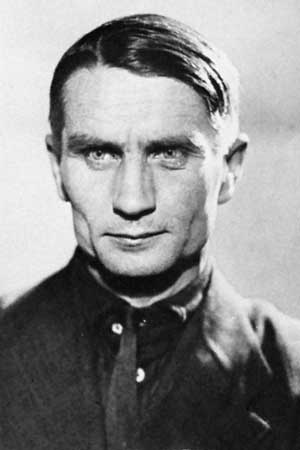
ilysenk001p1
Trophim Lysenko

Lysenko placed great confidence in the pseudo-scientific theory of environmentally acquired inheritance, by which parent plants pass down to their offspring,  characteristics acquired through use or disuse during their life cycle.  By this theory, rye could transform into wheat, wheat into barley, and weeds somehow transmuted into edible food grains.


In 1928, the previously unknown agronomist from peasant background performed experiments in “vernalization“, claiming to triple or quadruple wheat crop yield by accelerating the life cycle of Autumn-seeded winter wheat varieties.

Intense exposures to cold and humidity including direct seeding into snow-covered, frozen fields were known since 1854 to produce marginal increases in crop yield, but nothing remotely similar to Lysenko’s claims.  Nevertheless, Lysenko was hailed as a hero of Soviet agriculture, particularly in light of the disastrous collectivization efforts of the late 1920s.
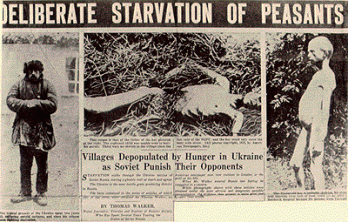
echist1As Stalin’s Soviet Union imposed the “terror famine” of 1932-’33, the deliberate starvation of millions of Ukrainian peasant farmers known as the Holodomor.

Lysenko dove into a variety of agriculture issues with “helpful” solutions such as plucking leaves from cotton plants, cluster planting trees and outlandish & unusual fertilizer mixes. A shameless sycophant and toady to Communist ideology, Lysenko gained status among party officials with one harebrained proposition after another, following one after another, far too quickly to be disproven by the patient observation of reputable scientific method.

At this time, the hottest ideas in plant genetics were emerging from biological studies of Drosophila melanogaster, the common fruit fly. Lysenko used his increasing influence in party circles to denounce such scientists as “fly-lovers and people haters”, denouncing the lot of them as “wreckers” who were purposely trying to bring about the downfall of the Soviet government.

Scientific research into plant genetics was dead in Stalin’s Soviet Union.

855c4322c0bca57a84dde41308bad993As director of the Soviet Academy of Agricultural Sciences, Lysenko put his theories to work, with unsurprisingly dismal results.  He’d force Soviet farmers to plant WAY too close together, on the theory that plants of the same “class” would “cooperate” with one another, and that “mutual assistance” takes place within and even across plant species.

There had to be a reason why Stalin’s agricultural program wasn’t working. There had to be scapegoats.  In a 1935 speech, Lysenko compared dissenting biologists to peasants continuing to resist Soviet collectivization policies, denouncing traditional geneticists as being “against Marxism”.  Josef Stalin himself was in the audience, and jumped up clapping enthusiastically, calling out “Bravo, Comrade Lysenko. Bravo.”

The gloves were now off. Lysenko and his chief ally Isaak Izrailevich Prezent savaged Lysenkoism’s opponents, including his former mentor, himself.  Over 3,000 mainstream biologists were fired, “disappeared” or even executed, among them Nikolai Vavilov.

800px-Vavilov_in_prison
Botanist Nikolai Vavilov’s mugshot. Note the several deep scars on his right cheek, indicating severe beatings sustained by the scientist in prison

On August 6, 1940, Vavilov was on expedition in Ukraine, collecting specimens when he was snatched up and driven away in a black sedan, his staff helpless to intervene. Vavilov was sentenced to death in 1941 with sentence later commuted to twenty years.  It didn’t matter. In January 1943, this man whose scientific work was at least as important as that of Norman Borlaug, starved to death in a Soviet Gulag.

Nikolai Vavilov had collected some 220,000 specimens of edible fruits, seeds and tubers over the years, which now sat in a Leningrad basement. 120,000 additional specimens were added to the hoard from other collectors, bringing the entire cache well into the tons of edible plant material.

baldaev-gulag-001
‘Third Degree Interrogation’ from Drawings from Stalin’s Gulag Illustration: Danzig Baldaev

On September 8, 1941 the German Wehrmacht completed its encirclement of the city.  The siege of Leningrad lasted for twenty-eight months.  Hunger soon took hold and, before it was over, more than a million Leningrad residents starved to death.

Soviet authorities had ordered the removal of art from the Hermitage prior to the siege, but not these botanical specimens.  Scientists couldn’t know where their leader was, or even whether he yet lived.  They locked themselves in the basement with their trove and took turns standing guard, protecting future food crops and the survival of untold millions, yet unborn.

USSR-Stamp-1977-NIVavilovBy the siege’s end in the Spring of 1944, nine of them had starved to death, standing watch over all that food.  These guys had stood guard over their seed bank for twenty-eight months, without eating so much as a grain.

The verdict against Nikolai Vavilov was set aside in 1955, one of thousands of reversals of Stalin era death sentences. Vavilov’s reputation was publicly rehabilitated by the 1960s.  In time he would come to be seen as a hero of Soviet-era science.


Trofim Lysenko would outlive his benefactor Stalin, and retained influence into the era of Nikita Khruschchev.  Lysenkoism was officially renounced in 1964, the bureaucrat denounced by physicist and human rights activist, Andrei Sakharov. “He is responsible for the shameful backwardness of Soviet biology and of genetics in particular, for the dissemination of pseudo-scientific views, for adventurism, for the degradation of learning, and for the defamation, firing, arrest, even death, of many genuine scientists“.  The disgraced apparatchik died in 1976.  It took Soviet media two days to so much as mention his passing, with a small notice printed in the broadsheet, Izvestia.

In the funhouse mirror world of the Soviet Union, the future was always known.  It was the past, that was subject to change.

Still home to the largest collection of plant genetic material in the world, the N.I. Vavilov Institute of Plant Industry in St. Petersburg was scheduled to be razed in 2010, to make way for luxury housing.  Scientists from around the world petitioned Russian President Dmitri Medvedev to rethink the decision, and not destroy the largest collection of European fruits and berries in the world.  At this time, the decision is undergoing “further study”.

For all the good it did the institute’s namesake, long-since murdered by the malignant ideology he had spent his life’s work, attempting to serve.

But hell, he got himself a postage stamp, in 1977.

Lysenko_image.svg
Timeline of Genetics and Science in the Soviet Union
Feature image, top of page:  Soviet Propaganda, Arkady Alexandrovich Plastov Threshing on the collective farm

August 5, 1942 Old Doctor

The children’s author was offered sanctuary on the “Aryan side” but the man refused, saying that he would stay with his children. Janusz Korczak and his orphaned children were last seen boarding the train to the Treblinka extermination camp on August 5 or 6.

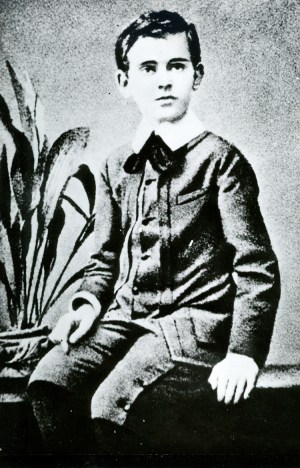
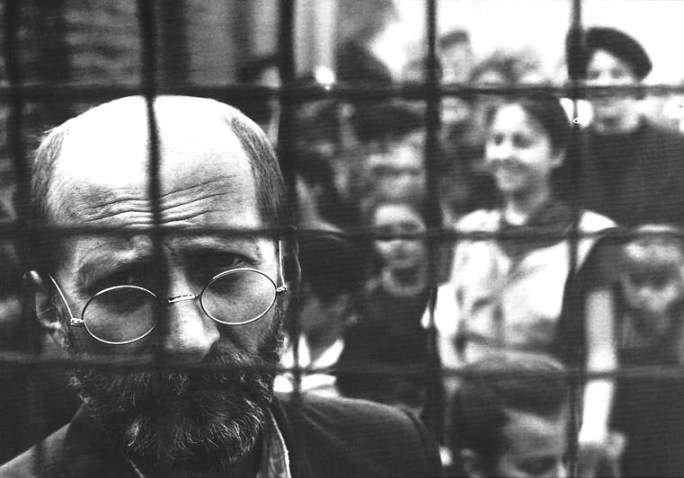
Janusz Korczak was a children’s author and pediatrician, a teacher and himself a lifelong learner, a student of pedagogy, the art of science of education, and how children learn.

Korczak10lat0001Born Henryk Goldszmit into the Warsaw family of Józef Goldszmit, in 1878 or ’79 (the sources vary), Korczak was the pen name by which he wrote children’s books.

Henryk was an exceptional student, of above-average intelligence. His father fell ill when the boy was only eleven or twelve and was admitted into a mental hospital, where he died, six years later. As the family’s situation worsened, the boy would tutor other students, to help with household finances.

Goldszmit was a Polish Jew, though not particularly religious, who never believed in forcing religion on children.

He wrote his first book in 1896, a satirical tome on child-rearing, called Węzeł gordyjski (The Gordian Knot). He adopted the pen name Janusz Korczak two years later, writing for the Ignacy Jan Paderewski Literary Contest.

220px-Janusz_KorczakKorczak wrote for several Polish language newspapers while studying medicine at the University of Warsaw, becoming a pediatrician in 1904. Always the writer, Korczak received literary recognition in 1905 with his book Child of the Drawing Room (Dziecko salonu), while serving as medical officer during the Russo-Japanese war.

He went to Berlin to study in 1907-’08 and worked at the Orphan’s Society in 1909, where he met Stefania “Stefa” Wilczyńska, an educator who would become his associate and close collaborator.

In the years before the Great War, Korczak ran an orphanage of his own design, hiring Wilczyńska as his assistant. There he formed a kind of quasi-Republic for Jewish orphans, complete with its own small parliament, court, and newspaper. The man was born to be an educator.

1307809-Janusz-Korczak-Quote-I-am-well-versed-in-reading-the-pages-of-war

In early modern European Royalty, 15th – 18th century, a “whipping boy” was the friend and constant companion to the boy prince or King, whose job it was to get his ass kicked, for the prince’s transgressions. The Lord was not the be struck by his social inferior. It was thought that, to watch his buddy get whipped for his misdeeds would have the same instructional effect, as the beating itself.

The extent of the custom is open to debate and it may be a myth altogether, but one thing is certain.  Poland has been described as the “whipping boy of Europe”, for good reason.

JK2The Polish nation, the sixth largest in all Europe, was sectioned and partitioned for over a century, by Austrian, Prussian, and Russian imperial powers. Korczak volunteered for military service in 1914, serving as military doctor during WW1 and the series of Polish border wars between 1919-’21.
The “Second Polish Republic” emerging from all this in 1922 was roughly two-thirds Polish, the rest a kaleidoscope of ethnic, linguistic and religious minorities.  Relations were anything but harmonious between ethnic Russians, Germans, Lipka Tatars and others, and most especially Poland’s Jewish minority, the largest in pre-WW2 Europe.

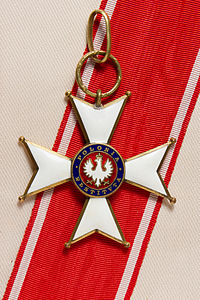
Polonia_Restituta_-_Commander's_Cross_pre-1939_w_rib
Silver Cross of the Polonia Restituta

Janusz Korczak returned to his life’s work in 1921 of providing for the children of this Jewish community, all the while writing no fewer than thirteen children’s books, along with another seven on pedagogy and other subjects.

In the inter-war years, Korczak put together a children’s newspaper, the Mały Przegląd (Little Review), as a weekly supplement to the daily Polish-Jewish newspaper, Nasz Przegląd (Our Review).

Korczak had his own radio program promoting the rights of children, to whom he was known as Pan Doktor (“Mr. Doctor”) or Stary Doktor (“Old Doctor”).

The Polish government awarded “Old Doctor” the Polonia Restituta in 1933, a state order bestowed on individuals for outstanding achievements in the fields of education, science and other civic accomplishments.

Yearly visits to Mandatory Palestine, the geopolitical entity partitioned from the Ottoman Empire in 1923 and future Jewish state of Israel, led to anti-Semitic crosscurrents in the Polish press, and gradual estrangement from non-Jewish orphanages.

165210

The second Republic’s brief period of independence came to an end in September 1939, with the Nazi invasion of Poland.  Korczak volunteered once again but was refused, due to his age.

Tales of Polish courage in the face of the Wehrmacht are magnificent bordering on reckless, replete with images of horse cavalry riding out to meet German tanks. Little Poland never had a chance, particularly when the Soviet Union piled on, two weeks later.

As an independent nation-state the Sovereign Republic of Poland was dead, though Polish air crews went on to make the largest contribution to the Battle of Britain, among the United Kingdom’s thirteen non-British defenders.  Polish Resistance made significant contributions to the Allied war effort, throughout WW2.

janusz-korczak

Warsaw became the largest Jewish ghetto in Nazi-occupied Europe within the following year.  The Jews of Poland were herded into the city, barely existing on meager rations while awaiting the death squads of the SS.  Old Doctor and his orphans were forced into the Ghetto, in 1939.

There were nearly 200 of them on this day in 1942, when soldiers of the Gross-Aktion (Great Action) Warsaw, came for their “Resettlement to the East”.

ŚmierćMiasta
The Pianist, by Władysław Szpilman

The extermination camp at Treblinka, awaits.

Polish-Jewish composer and musician Władysław Szpilman, one of precious few survivors of the Jewish ghetto, describes the scene in his 1946 memoir, The Pianist:

“He told the orphans they were going out into the country, so they ought to be cheerful. At last they would be able to exchange the horrible suffocating city walls for meadows of flowers, streams where they could bathe, woods full of berries and mushrooms. He told them to wear their best clothes, and so they came out into the yard, two by two, nicely dressed and in a happy mood. The little column was led by an SS man…”

Eyewitness Joshua Perle states that:  Janusz Korczak was marching, his head bent forward, holding the hand of a child… A few nurses were followed by two hundred children, dressed in clean and meticulously cared for clothes, as they were being carried to the altar.

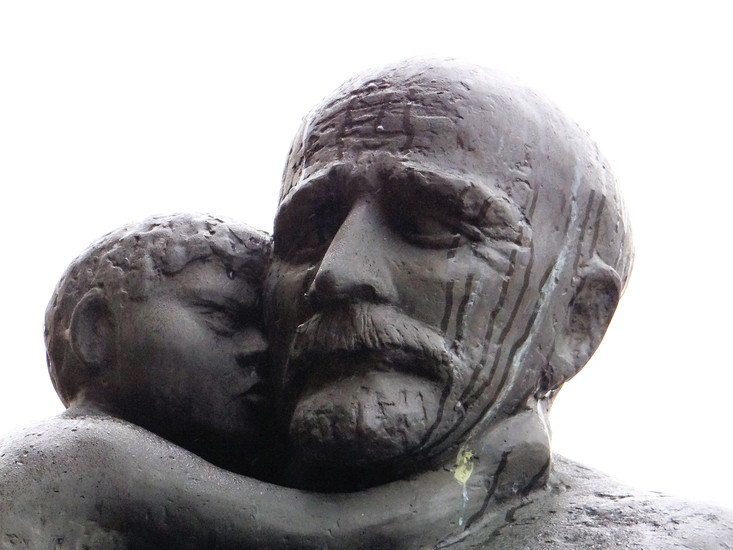
251012_Janusz_Korczak_monument_at_Jewish_Cemetery_in_Warsaw_-_03

At the Umschlagplatz, the rail-side assembly area on the way to Treblinka, an SS officer recognized Korczak, and called him aside.  The children’s author was offered sanctuary on the “Aryan side” but the man refused, saying that he would stay with his children.  Stary Doktor was offered deportation to the Theresienstadt concentration camp instead, but again he refused.

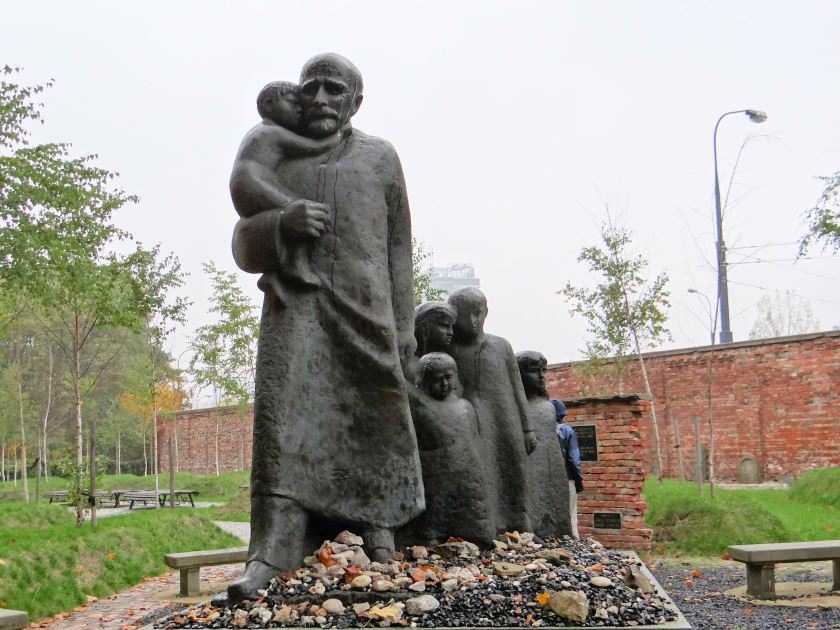
The man who refused freedom to die with his orphaned children was last seen boarding the train to Treblinka on August 5 or 6, where all 200 were murdered, the following day.

800px-פולין_001
Janusz Korczak memorial stone, Treblinka

“Dr. Janusz Korczak’s children’s home is empty now. A few days ago we all stood at the window and watched the Germans surround the houses. Rows of children, holding each other by their little hands, began to walk out of the doorway. There were tiny tots of two or three years among them, while the oldest ones were perhaps thirteen. Each child carried the little bundle in his hand”. — Mary Berg, The Diary

August 3, 1908 The Old Man of La Chappelle

Research suggests that we all carry Neanderthal genes and that these may have changed our immune systems, leaving us vulnerable to diseases such diabetes and cancer.

In the 17th century, the German Reformed Church teacher and hymn writer Joachim Neander liked to hike a valley outside of Düsseldorf. The beauty of nature was inspirational, clearing his mind and inspiring verses like “See how God this rolling globe/swathes with beauty as a robe…Forests, fields, and living things/each its Master’s glory sings.”  The theologian contracted tuberculosis and died at the age of thirty but lived on in a way, in the valley which came to bear his name.

Nearly 200 years later, three years before Charles Darwin published the Origin of Species, workers quarrying limestone in the Neander Valley discovered an unusual skull.  This was no ordinary head, elongated and nearly chinless as it was, with heavy ridges over the eyes.  Heavy bones were found alongside,  which fitted together, oddly.

From top, clockwise:  a) Neander Valley by Friedrich Wilhelm Schreiner, oil on cardboard, 1855, b) original bones discovered the following year, and c)Artist’s conception of what he looked like, H/T Artist: Kennis & Kennis Reconstructions

The state of archaeological science had much to learn in 1856.  Who knows, 22nd century historians and scientists may look back at our time, and say we had a long way to go.  At the time, even to discern fossils from ordinary rock was beyond the ability of many scientists. One common method involved licking the fossil. If the thing had animal material, it would stick to your tongue.

Despite such misconceptions, scholars of the day had no shortage of theories. This was a lost Cossack, a bowlegged rider suffering from rickets, a painful condition resulting in weak and misshapen bones. To some, the life of pain resulting from such a condition made perfect sense, the bony eye ridges resulting from perpetually furrowed brow.

British geologist William King suspected something different. Something more radical. This was no aberrant human being nor even a lost ancestor. This was a member of a long lost alternate humanity.   An extinct but parallel species to our own.  King published a paper in 1864 hypothesizing his idea of an evolutionary dead end, naming the long lost species after the poet who had once wandered the valley in which it was discovered. He called it Homo Neanderthalensis: Neanderthal Man.

Neanderthal mother and child
“Neanderthal sculptures, named Nana and Flint, at the Gibraltar Museum”. H/T Jaap Scheeren, New York Times

Having no context from which to draw conclusions, King fell back on the pseudo science of phrenology to describe Neanderthal man, along with preconceptions of “primitive” and “savage” races. The image of a stupid and grunting brute emerged from this analysis. King opined that “The thoughts and desires which once dwelt within it never soared beyond those of a brute.” Today we may look at such thinking as itself savage and primitive, but applying modern ideas to earlier times is a dangerous undertaking. Ideas of Eugenics survived well after King’s time, and into the modern era.

On this day in 1908, the brothers Amadee and Jean Bouyssonie found the most complete Neanderthal skeleton to date in a small cave near La Chapelle-aux-Saints, in France.  This skeleton includes the skull, jaw, most of the vertebrae and several ribs, along with most of the long bones of his arms and legs, plus a number of smaller bones from the hands and feet.

Sarlat and sites 402
The Old Man of La Chapelle-Aux-Saints reconstructed burial in the Musée de l’Homme de Néandertal, France

French palaeontologist Marcellin Boule studied the remains and envisioned a brutish, hairy and gorilla-like beast with opposable toes and bent spine, walking on bowed legs with bent knees.  Boule’s reconstruction was influential. Decades later, scientists and popular culture viewed Neanderthal as bent and stupid brutes. Boule got it wrong that time but, to his credit, was one of the first to recognize Piltdown Man, as a paleoanthropological hoax.

Subsequent analysis of the “Old Man of La Chappelle” revealed not the bent-over beast of Boule’s imagination, but a fully erect biped, bent with advanced osteoarthritis.

What’s more, massive tooth loss and lack of mobility revealed that this specimen could neither hunt nor scavenge with ease, and would have had great difficulty in chewing his food. This and the unmolested state of the skeleton compared with animal bones found nearby suggest a man greatly cared for by his contemporaries, as well as deliberate burial of the body.

This wasn’t even an “old man” by our standards.  The skeleton is currently estimated to have been that of a man between 25 and 40 years, demonstrating the Hobbesian adage that life was once indeed, “Nasty, Brutish and Short”.

Today, to call someone a “Neanderthal” is to insult him as a stupid savage.  It appears that our cousin was nothing of the sort.

Skeleton_and_restoration_model_of_Neanderthal_La_Ferrassie_1

The hyoid bone situated at the floor of the mouth serves as a connecting-point for the tongue and other musculature, giving humans the ability to speak. A delicate structure likely to be lost in most fossilized remains, the first Neanderthal hyoid was only discovered in 1989.

An international team of researchers analysed this fossil Neanderthal bone using 3D x-ray imaging and mechanical modelling and, yes.  Neanderthal could not only speak, but was capable of highly complex speech not unlike ourselves, though his voice was likely high and grating.  Certainly not the base grunting commonly associated with “cave-men”.

img_1054neanderthalsmShorter in stature and considerably more powerful than Cro-Magnon, our direct ancestor and all but indistinguishable from ourselves, Neanderthal bodies were suited to the ice age of the early and middle Paleolithic era.

Neanderthal emerged on the Eurasian landmass between 100,000 and 200,000 years ago.  Possessed of a brain only slightly smaller than Cro-Magnon, Neanderthals walked upright, formed and used simple tools and controlled fire.  They even buried their own dead, at least sometimes, and some researchers theorize that they built boats and sailed the Mediterranean.  Imperfectly formed tools and weapons found alongside more sophisticated specimens even suggest that he educated his children.

He might even fit in if you brought him back today, provided you dressed him right.

Despite all that, Neanderthal man is an evolutionary dead end and not our ancestor, though he did “coexist” for a time, with our Cro-Magnon forebears.  It’s even possible if not probable that the two bred together and produced children, though this was likely your random hookup rather than any long-term cross-breeding.

Modern DNA analysis suggests that the two species even shared some genetic disorders, such as psoriasis, Crohn’s disease and a variety of auto-immune conditions such as Lupus.

image_1481e-Neanderthal

Research even suggests that we  carry Neanderthal genes, every one of us, and that these may have changed our immune systems leaving us vulnerable to diseases such diabetes and cancer.

The idea is not as strange as it sounds. Last year, Sir Richard Branson was in the news, claiming that he had looked into his family ancestry. Forty generations back, it turns out that Branson is related to Charlemagne.  That’s no big deal, according to Genetecist Adam Rutherford. Speaking at the Chalke Valley History Festival, Rutherford explained that “Literally every person in Europe is directly descended from Charlemagne. Literally, not metaphorically. You have a direct lineage which leads to Charlemagne,” adding “Looking around this room, every single one of you … is directly descended between 21 and 24 generations from Edward III.”  The only difference between celebrities and the rest of us it turns out, is the means to prove it.

0506-Neanderthal-woman-genes

So, maybe calling someone ‘Neanderthal’ isn’t such an insult, after all.  Perhaps there’s one in there somewhere, peering back at us from our bathroom mirror.

If you enjoyed this “Today in History”, please feel free to re-blog, “like” & share on social media, so that others may find and enjoy it as well. Please click the “follow” button on the right, to receive email updates on new articles.  Thank you for your interest, in the history we all share.

July 28, 1914 Four Horsemen of the Apocalypse

Few could imagine a war in which a single day’s fighting, could produce casualties equal to that of every war of the preceding 100 years, combined. 

In 1869, Germany had yet to come into its own as an independent nation. Forty-five years later, she was one of the Great Powers, of Europe.

Great Powers, 1914

Alarmed by the aggressive growth of her historic adversary, the French government had by that time increased compulsory military service from two years to three, in an effort to offset the advantage conferred by a German population of some 70 million, contrasted with a French population of 40 million.

Joseph Caillaux was a left wing politician, once Prime Minister of France and, by 1913, a cabinet minister under the more conservative administration of French President Raymond Poincare.

Never too discreet with his personal conduct, Caillaux paraded through public life with a succession of women, who were not Mrs Caillaux. One of them was Henriette Raynouard.  By 1911, Madame Raynouard had become the second Mrs Caillaux.

A relative pacifist, many on the French right considered Caillaux to be too “soft” on Germany. One of them was Gaston Calmette, editor of the leading right-wing newspaper Le Figaro, who regularly excoriated the politician.

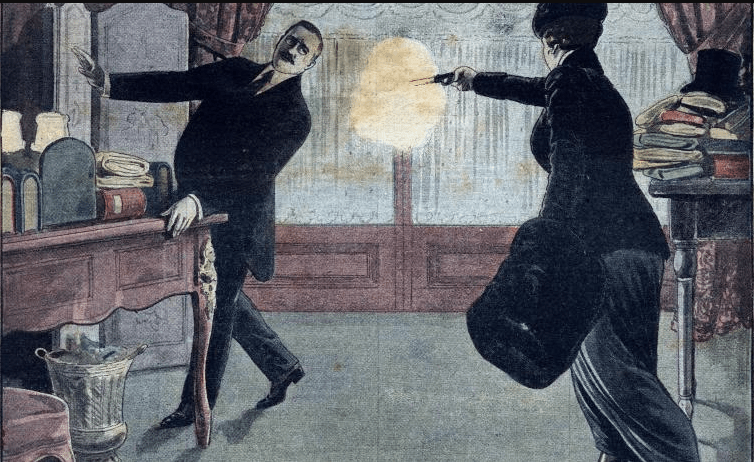
On March 16, 1914, Madame Caillaux took a taxi to the offices of Le Figaro. She waited for a full hour to see the paper’s editor, before walking into his office and shooting him at his desk. Four out of six rounds hit their mark.  Gaston Calmette was dead before the night was through.

Cailloux Affair

It was the crime of the century.  This one had everything: Left vs. Right, the fall of the powerful, and all the salacious details anyone could ever ask for. It was the OJ trial, version 1.0, and the French public was transfixed.

The British public was similarly distracted, by the latest in a series of Irish Home Rule crises.

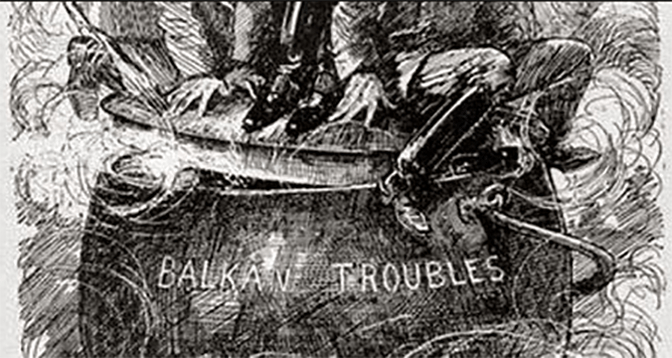
The Austro-Hungarian Empire, a sprawling amalgamation of 17 nations, 20 Parliamentary groups and 27 political parties, desperately needed to bring the Balkan peninsula into line, following the June 28 assassination of the heir apparent to the dual monarchy. That individual Serbians were complicit in the assassination is beyond doubt, but so many government records of the era have disappeared that, it’s impossible to determine official Serbian complicity. Nevertheless, Serbia had to be brought to heel.

Balkan Troubles

Having given Austria his personal assurance of support in the event of war with Serbia, even if Russia entered in support of her Slavic ally, Kaiser Wilhelm of Germany left on a summer cruise in the Norwegian fjords. The Kaiser’s being out of touch for those critical days in July has been called the most expensive maritime disaster in naval history.

The Austro-Hungarian Empire delivered a deliberately unacceptable ultimatum to Serbia on the 23rd, little more that a bald pretext for war.  Czar Nicholas wired Vienna as late as the 27th proposing an international conference concerning Serbia, but to no avail. Austria responded that same day.  It was too late for such a proposal.

The Austro-Hungarian Empire declared war on Serbia the following day, the day on which Madame Caillaux was acquitted of the murder of Gaston Calmette, on the grounds of being a “crime of passion”.

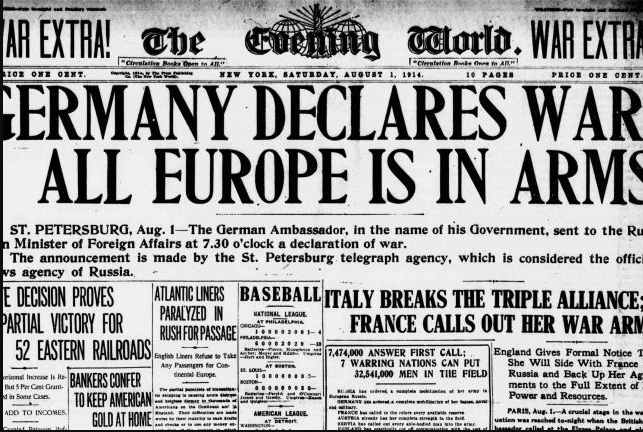
As expected, Russia mobilized in support of Serbia.  For her part, Imperial Germany feared little more than a two-front war, with the “Russian Steamroller” to the east, and the French Republic to the west.  Germany invaded neutral Belgium in pursuit of the one-two punch strategy by which she sought first to defeat France, before turning to face the far larger Russian adversary.

russ-mob

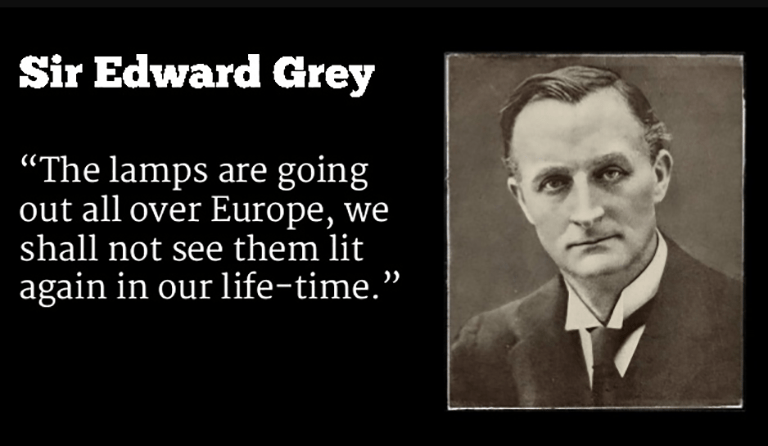
On August 3, British Foreign Secretary Sir Edward Grey announced before Parliament, his government’s intention to defend Belgian neutrality, a treaty obligation German diplomats had dismissed as a “scrap of paper”.

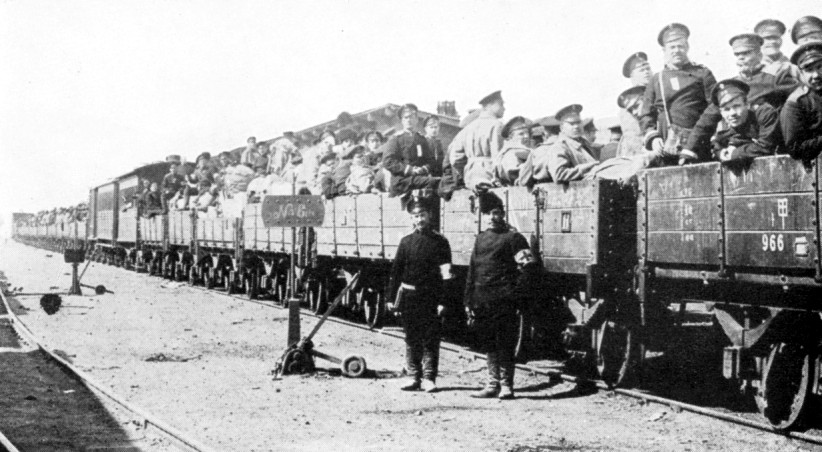
Pre-planned timetables took over – France alone would have 3,781,000 military men under orders before the middle of August, arriving at the western front on 7,000 trains arriving as often as every eight minutes.

Declaration

This time there would be no “Phoney War”, no “Sitzkreig”, as some wags were wont to call the early days of WWII.   Few could imagine a cataclysm to rock a century and beyond, a war in which a single day’s fighting could produce casualties equal to that of every war of the preceding 100 years, combined.  Fewer still understood on this date, one-hundred and four years ago, today.  The four horsemen of the Apocalypse, were only days away.

Sir Edward Grey

If you enjoyed this “Today in History”, please feel free to re-blog, “like” & share on social media, so that others may find and enjoy it as well. Please click the “follow” button on the right, to receive email updates on new articles.  Thank you for your interest, in the history we all share.

July 22, 1937 Stacking the Deck

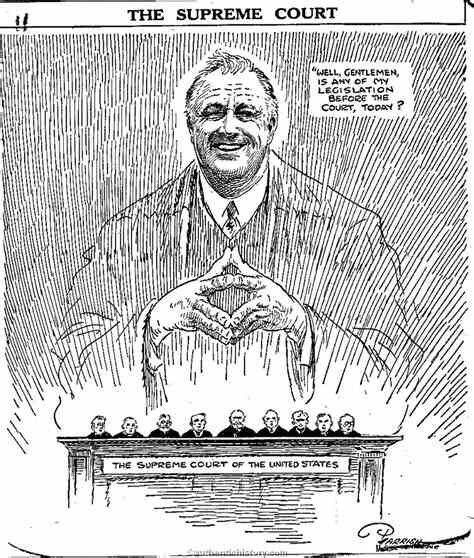
To Roosevelt, President Wilson’s age-70 provision was the answer to his problems, and the end to Supreme Court opposition to his policies.

United States ConstitutionArticle III, Section 1 of the United States Constitution creates the highest court in the land.  The relevant clause states that “The judicial power of the United States, shall be vested in one Supreme Court, and in such inferior courts as the Congress may from time to time ordain and establish“.  Nowhere does the document specify the number of justices.
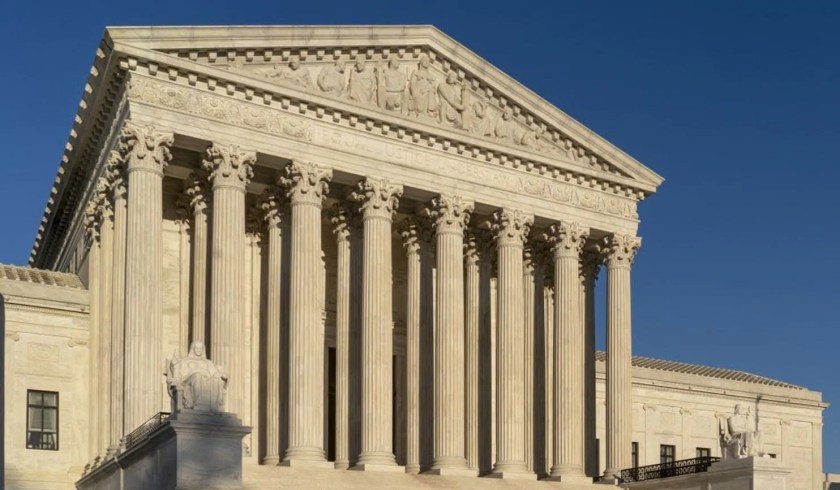
The United States was in the midst of the “Great Depression” in 1932, when President Franklin Delano Roosevelt came to office. Roosevelt had promised a “New Deal” for America, and immediately began a series of sweeping legislative reforms designed to counter the devastating effects of the Depression. Roosevelt’s initiatives faced many challenges in the courts, with the Supreme Court striking down several New Deal provisions as unconstitutional in his first term.

The Supreme Court was divided along ideological lines in 1937, as it is today. “Judicial Realist” or “Liberal” legal scholars and judges argued that the constitution was a “living document”, allowing for judicial flexibility and legislative experimentation. Justice Oliver Wendell Holmes, Jr. first referred to a “living constitution” in 1920 in speaking of  Missouri v. Holland, a case which overrode state concerns about abrogation of states’ rights arising under the Tenth Amendment.  The “case before us” Holmes wrote, “must be considered in the light of our whole experience and not merely in that of what was said a hundred years ago”.

3NIUJFURFI2WDD32OYOSNUMQJQ

“Judicial Formalists”, today we call them “Conservatives” or “Originalists”, seek to discover the original meaning or intent of the framers, of the Constitution. Formalist legal scholars and judges argue that the judiciary is not supposed to create, amend or repeal law; that is for the legislative branch. The role of the court is to interpret and uphold any given law, or strike it down in light of the original intent of the framers and the ratifiers.

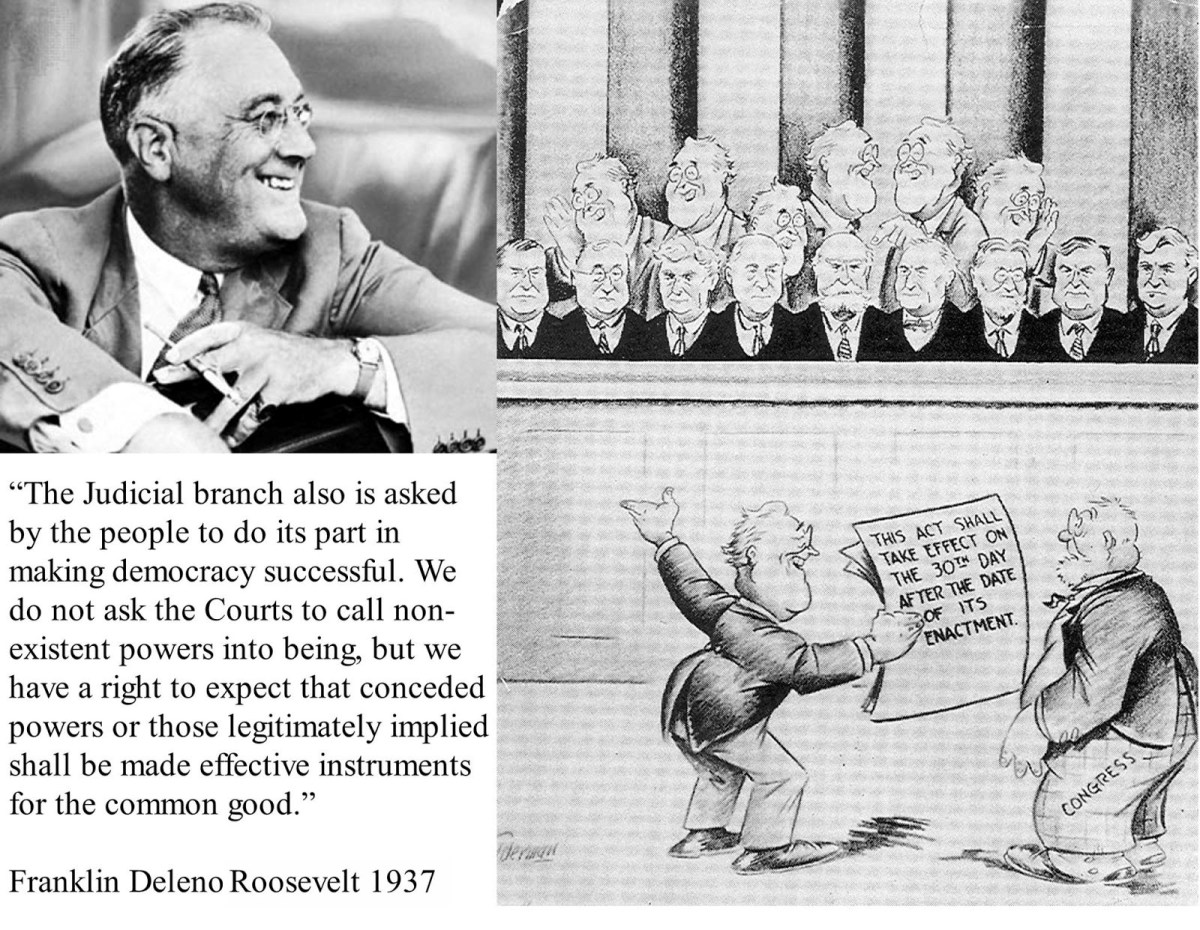
In 1937, SCOTUS was divided along ideological lines, with three Liberals, four Conservatives, and two swing votes.

Woodrow Wilson’s Attorney General, James Clark McReynolds, made a proposal in 1914 that: “(When) any judge of a federal court below the Supreme Court fails to avail himself of the privilege of retiring now granted by law (at age 70), that the President be required, with the advice and consent of the Senate, to appoint another judge, who would preside over the affairs of the court and have precedence over the older one. This will insure at all times the presence of a judge sufficiently active to discharge promptly and adequately the duties of the court”.

To the President, this was the answer. The age 70 provision allowed Roosevelt to nominate 6 more handpicked justices, effectively ending Supreme Court opposition to his policies.

img_1085

Roosevelt’s “Judiciary Reorganization Bill of 1937” immediately came under sharp criticism from legislators, bar associations, and the public. Senate Judiciary Committee began hearings on the bill on March 10, 1937, reporting it “adversely” by a committee vote of 10 to 8. The full senate took up the matter on July 2, 1937, with the Roosevelt administration suffering a disastrous setback when Senate Majority Leader Joseph T. Robinson, a powerful supporter of the legislation, died of a heart attack.

1-new-deal-supreme-court-grangerThe full Senate voted on July 22, 1937, to send the bill back to the Senate Judiciary Committee, where provisions for additional justices were stripped from the bill. A modified version passed in August, but Roosevelt’s “Court Packing” scheme was dead.

In the end, the President would have the last word. Over the course of an unprecedented four terms, Roosevelt would eventually appoint eight out of the nine justices, serving on the Court.

If you enjoyed this “Today in History”, please feel free to re-blog, “like” & share on social media, so that others may find and enjoy it as well. Please click the “follow” button on the right, to receive email updates on new articles.  Thank you for your interest, in the history we all share.

July 19, 1969, Chappaquiddick

“I could have had her out of that car twenty-five minutes after I got the call. But he [Ted Kennedy] didn’t call”.

The Saturn V rocket departed Florida’s Kennedy Space Center on July 16, 1969, carrying Apollo 11 mission members Neil Armstrong, Buzz Aldrin and Michael Collins. The Command/Service Module passed behind the moon at 12:21 Eastern Standard Time on July 19, firing its service propulsion engine and inserting the craft into lunar orbit. Armstrong became the first man to step foot on the moon on July 21, descending the last stair to the lunar surface at 11:56EST. “That’s one small step for [a] man, one giant leap for mankind.”

On the evening of July 18, most of the country was focused on the unfolding drama.

Mary_Jo_KopechneEdward M. “Ted” Kennedy, Senior Senator from Massachusetts, was focused on a former secretary and volunteer with his brother’s 1968 Presidential campaign, 28-year-old Mary Jo Kopechne.

The pair left a house party on Chappaquiddick island off Martha’s Vineyard, shortly after 11:00pm.  The two claimed to be going back to the ferry then on to their hotel rooms in Edgartown, but it’s not clear how many believed the story.

Mary Jo left her purse and room keys, on the table.

Kennedy drove his Oldsmobile Delmont 88 in the opposite direction from the ferry, finally turning off the road and onto the unpaved Dike Road.  He later claimed to have been disoriented in the dark, but both of them knew the road, and the secluded ocean beach to which it led.

It’s not there anymore, but there was an old wooden bridge at the time, over a tidal inlet called Poucha Pond.  The Olds entered the bridge at an odd angle, veering off and plunging into the water, coming to rest upside down in the shallow, tide swept channel.

Kennedy managed to swim free but Mary Jo did not.  In later testimony, he claimed to have swum down several times trying to free her from the car, before swimming to the shore and calling her name.

Chappaquiddick-kennedy-car-bridge-gty-ps-180406_hpMain_4x3_992

It’s impossible to know the man’s state of mind at this time, but one can hazard a guess.  Ted Kennedy was a married man.  He had driven off a bridge with a woman not his wife, in the middle of the night.  Recently elected Senate Majority Whip, Kennedy was considered the odds-on favorite for nomination as the Democratic candidate, for the 1972 presidential election.  The murder of his two brothers, one at the hands of a leftist and the other by a Muslim extremist, had barely faded from current events into memory.  The sympathy factor alone would have made him difficult to beat.

Kennedy walked back to the house party, returning once more to the scene of the accident, before finally swimming back to Edgartown, and his hotel room.

Senator Kennedy emerged from his room on the morning of July 19, cleaned up, sobered up and lawyered up.  It was ten full hours before he finally got around to reporting the accident.

Edward Kennedy

The Oldsmobile had been discovered by this time.  Captain of the Edgartown Fire Rescue unit John Farrar arrived with scuba gear at 8:45am, and recovered Mary Jo’s body within ten minutes.  She was wedged and contorted into the back seat, in a manner indicating that she may have found an air bubble, and used it until the small space could no longer sustain life.  Her body was buried the next day, without benefit of autopsy to determine exact cause of death.

Legally, Mary Jo Kopechne’s cause of death was recorded as drowning.  Farrar swore at the inquest that she died of slow asphyxiation, a process which would have taken hours.

“It looked as if she were holding herself up to get a last breath of air. It was a consciously assumed position…. She didn’t drown. She died of suffocation in her own air void. It took her at least three or four hours to die. I could have had her out of that car twenty-five minutes after I got the call. But he [Senator Kennedy] didn’t call”.  Rescue diver John Farrar

In his official report from the inquest, Judge James A. Boyle concluded that:

1.  “The accident occurred “between 11:30 p.m. on July 18 and 1:00 a.m. on July 19.”
2.  “Kopechne and Kennedy did not intend to drive to the ferry slip and his turn onto Dike Road had been intentional.”
3.  “A speed of twenty miles per hour as Kennedy testified to operating the car as large as his Oldsmobile would be at least negligent and possibly reckless.”
4.  “For some reason not apparent from [Kennedy’s] testimony, he failed to exercise due care as he approached the bridge.”
5.  “There is probable cause to believe that Edward M. Kennedy operated his motor vehicle negligently… and that such operation appears to have contributed to the death of Mary Jo Kopechne.”

Boyle’s report was impounded, and never shown to the grand jury.   Farrar told People Magazine in July 1989 “I was told outright by the D.A.’s office that I would not be allowed to testify on how long Kopechne was alive in the car.  They were not interested in the least in anything that would hurt Ted Kennedy.”

Kennedy_Institute_-0be75Kennedy’s driver’s license was suspended for a time.   There would be no further penalty. Joan Kennedy, who was pregnant at the time, attended Mary Jo Kopechne’s funeral, and stood by her husband’s side at the courthouse, three days later.   She miscarried a short time later, a personal tragedy she always blamed on the events at Chappaquiddick.

The Commonwealth of Massachusetts would continue to elect and re-elect the “Liberal Lion of the Senate”, for the rest of his life.  Edward Kennedy’s Senate career, begun in 1962, ended only with his death of brain cancer, in 2009.

“Progressive” blogger for the Huffington Post Melissa Lafske reflected in a now-deleted editorial, on what Mary Jo Kopechne might have felt had she lived long enough to witness the accomplishments of Senator Kennedy’s long career.  “So it doesn’t automatically make someone (aka, me) a Limbaugh-loving, aerial-wolf-hunting NRA troll for asking what Mary Jo Kopechne would have had to say about Ted’s death, and what she’d have thought of the life and career that are being (rightfully) heralded”.

“Who knows — maybe she’d feel it was worth it”.

If you enjoyed this “Today in History”, please feel free to re-blog, “like” & share on social media, so that others may find and enjoy it as well. Please click the “follow” button on the right, to receive email updates on new articles.  Thank you for your interest, in the history we all share.

July 11, 1804 A Dual at Weehawken

Dueling was illegal in both New York and New Jersey by this time, though enforcement was far more aggressive in NY.  The two rowed across the Hudson River from Manhattan to Weehawken, New Jersey in the early morning hours of July 11, 1804, dueling pistols tucked safely in a leather bag.

naduel_t180What would it be like to turn on CNN or Fox News, to learn that Former Secretary of the Treasury Jacob (‘Jack’) Lew was party to a duel and that he was near death, after being shot by the sitting Vice President of the United States, Mike Pence.

The year was 1804, and President Jefferson’s Vice President, Aaron Burr, had a long standing personal conflict with one of the Founding Fathers. Alexander Hamilton had been Secretary of the Treasury under George Washington; the first Secretary of the Treasury, and the only signer of the US Constitution from the state of New York.

The animosity between the two began in 1791, when Burr defeated Hamilton’s father-in-law Philip Schuyler in a US Senate election. Hostilities escalated when the Electoral College deadlocked in the 1800 Presidential election, moving the selection of President and Vice President to the House of Representatives. Hamilton exerted his influence on behalf of Jefferson, who was elected on the 36th ballot, making Burr his VP.

Burr knew that Jefferson wouldn’t keep him on as VP for the 1804 election, and so he ran for Governor of New York. He blamed Hamilton for his defeat, and challenged the man to a duel over comments made during the election.

Alexander-Hamilton-Aaron-Burr-Duel-Pistols-JP-Morgan-Chase-Bank-270-Park-Avenue-NYC-2

Dueling was illegal in both New York and New Jersey by this time, though enforcement was far more aggressive in NY.  The two rowed across the Hudson River from Manhattan to Weehawken, New Jersey in the early morning hours of July 11, 1804, dueling pistols tucked safely in a leather bag.

Both men’s “seconds” stood with their backs to the duelists, enabling both to later state under oath that they didn’t see either the weapons or the duel itself.   “Plausible deniability” was preserved, but it’s hard to have a first-hand account when the only witnesses have turned their backs. Accounts vary, but it seems that Hamilton fired first, apparently “throwing away his shot” as he had once advised his son Philip to do when the younger man was in this position.

This account is supported by a letter that Hamilton wrote the night before the duel, stating that he was “strongly opposed to the practice of dueling” for both religious and practical reasons. The letter went on, “I have resolved, if our interview is conducted in the usual manner, and it pleases God to give me the opportunity, to reserve and throw away my first fire, and I have thoughts even of reserving my second fire”.

hamilton burr

Aaron Burr had no such reservations.  The Vice President fired with intent to kill, the shot hitting Hamilton in the lower abdomen.  The wound was clearly fatal, even to Hamilton himself, who said “This is a mortal wound, doctor”.

The man whose likeness appears on the $10 bill died the next day. Among his last words were “Pendleton knows,” (Judge Nathaniel Pendleton, his second), “that I did not intend to fire at him”.

Weehawken today
Weehawken, today
If you enjoyed this “Today in History”, please feel free to re-blog, “like” & share on social media, so that others may find and enjoy it as well. Please click the “follow” button on the right, to receive email updates on new articles.  Thank you for your interest, in the history we all share.

July 7, 1798  The X-Y-Z Affair

America’s “quasi-war” with France, begun this day in 1798, would see the first combat service of the heavy frigate USS Constitution, better known as “Old Ironsides” and today, the oldest commissioned warship in the world, still afloat. 

Imagine that you’ve always considered your own beliefs to be somewhere in the political center.  Maybe a little to the left. Now imagine that, in the space of two years, your country’s politics have shifted so radically that you find yourself on the “Reactionary Right”, on the way to execution by your government.

And your personal convictions have never changed.

America’s strongest Revolution-era ally lost its collective mind in 1792, when France descended into a revolution of its own.    17,000 Frenchmen were officially tried and executed during the 1793-94 “Reign of Terror” (la Terreur) alone, including King Louis XVI himself and his queen, Marie Antoinette.  Untold thousands died in prison or without benefit of trial.  The monarchical powers of Europe were quick to intervene.  For the 32nd time since the Norman invasion of 1066, England and France once again found themselves at war.

the-reign-of-terror-french-revolution-17931794-1-638

France had been the strongest ally the Americans had during the late revolution, yet the United States remained neutral in the later conflict, straining relations between the former allies.  Making matters worse, America repudiated its war debt in 1794, arguing that it owed the money to “l’ancien régime”, and not to the French First Republic which had overthrown it, and executed its King.

Lafayette_Prison_reunion
The Marquis de Lafayette was shocked on October 15, 1795, when his cell door opened and in walked his wife and three daughters. The four women would remain with him in his prison cell, for another two years

By this time, Revolution-era America’s most important French allies were off the stage, the Comte de Grasse dead, the Marquis de Lafayette and the Comte de Rochambeau languishing, in prison.

Both sides in the European conflict seized neutral ships which were trading with their adversary.  The “Treaty of Amity, Commerce, and Navigation” with Great Britain, ratified in 1795 and better known as the “Jay Treaty”, put an end for now to such conflict with Great Britain, but destroyed relations with the French Republic.

French privateers cruised the length of the Atlantic seaboard preying on American merchant shipping, seizing 316 civilian ships in one eleven-month period, alone.

At this point, the United States had virtually no means of fighting back.  The government had disbanded the Navy along with its Marine contingent at the end of the Revolution, selling the last warship in 1785 and retaining only a handful of “revenue cutters” for customs enforcement.  The Naval Act of 1794 had established a standing Navy for the first time in American history and begun construction on six heavy frigates, the first three of which would launch in 1797:  the USS United States, USS Constellation, and USS Constitution.

In 1796, France formally broke diplomatic relations with the United States by rejecting the credentials of President Washington’s representative, Ambassador Charles Cotesworth Pinckney.

The following year, President John Adams dispatched a delegation of two, with instructions to join with Pinckney in negotiating a treaty with France, on terms similar to those of the Jay treaty with Great Britain.

Pinckney
Charles Cotesworth Pinckney

These were the future Chief Justice of the Supreme Court John Marshall, and future Massachusetts Governor Elbridge Gerry, a man who later became the 5th Vice President and lent his name to the term “Gerrymander”.

The American commission arrived in Paris in October 1797, requesting a meeting with French Foreign Minister Charles Maurice de Talleyrand.  Talleyrand, unkindly disposed toward the Adams administration to begin with, demanded bribes before meeting with the American delegation.  The practice was not uncommon in European diplomacy of the time, but the Americans refused.

Documents later released by the Adams administration describe Nicholas Hubbard, an English banker identified only as “W”.  W introduced “X” (Baron Jean-Conrad Hottinguer) as a “man of honor”, who wished an informal meeting with Pinckney.  Pinckney agreed and Hottinguer reiterated Talleyrand’s demands, specifying the payment of a $12 million “loan” to the French government, and a personal bribe of some $250,000 to Talleyrand himself.  Met with flat refusal by the American commission, X then introduced Pierre Bellamy (“Y”) to the American delegation, followed by Lucien Hauteval (“Z”), sent by Talleyrand to meet with Elbridge Gerry.  X, Y and Z, each in their turn, reiterated the Foreign Minister’s demand for a loan, and a personal bribe.

Believing that Adams sought war by exaggerating the French position, Jeffersonian members of Congress joined with the more warlike Federalists in demanding the release of the commissioner’s communications.  It was these dispatches, released in redacted form, which gave the name “X-Y-Z Affair” to the diplomatic and military crisis which followed.

American politics were sharply divided over the European war.  President Adams and his Federalists, always the believers in strong, central government, took the side of the Monarchists.  Thomas Jefferson and his “Democratic-Republicans” found more in common with the liberté, égalité and fraternité espoused by French revolutionaries.

In the United Kingdom, the ruling class appeared to enjoy the chaos.  A British political cartoon of the time depicted the United States, represented by a woman being groped by five Frenchmen while John Bull, the fictional personification of all England, looks on in amusement from a nearby hilltop.

XYZ cartoon

Adams’ commission left without entering formal negotiations, their failure leading to a political firestorm in the United States.  Congress rescinded all existing treaties with France on July 7, 1798, the date now regarded as the beginning of the undeclared “Quasi-War” with France.

Four days later, President John Adams signed “An Act for Establishing and Organizing a Marine Corps,” permanently establishing the United States Marine Corps as an independent service branch, in order to defend the American merchant fleet.

quasi-war-1798-1801

Talleyrand himself raised the stakes, saying that attacks on American shipping would cease if the United States paid him $250,000 and gave France 50,000 pounds sterling and a loan for $100 million. At a 1798 Philadelphia dinner in honor of John Marshall, South Carolina Congressman Robert Goodloe Harper’s toast, spoke for the American side: “Millions for defense but not one cent for tribute.”

America’s “quasi-war” with France, begun this day in 1798, would see the first combat service of the heavy frigate USS Constitution, better known as “Old Ironsides” and today, the oldest commissioned warship in the world, still afloat.  The undeclared war would be fought across the world’s oceans, from the Atlantic to the Caribbean, to the Indian Ocean, and the Mediterranean Sea.

United_States_Marine_escorting_French_prisoners
20th century illustration depicts American Marines escorting French prisoners

The Convention of 1800 ended the Quasi-War on September 30, nullifying the Franco-American alliance of 1778 and ensuring American neutrality in the Napoleonic wars. $20,000,000 in American “Spoliation Claims” would remain, unpaid.

For the United States, military escalation proved decisive.  Before naval intervention, the conflict with France resulted in the loss of over 2,000 merchant ships captured, with 28 Americans killed and another 42 wounded.   Military escalation with the French First Republic cost the Americans 54 killed and 43 wounded, and an unknown number of French.  Only a single ship was lost, the aptly named USS Retaliation, and that one was later recaptured.

If you enjoyed this “Today in History”, please feel free to re-blog, “like” & share on social media, so that others may find and enjoy it as well. Please click the “follow” button on the right, to receive email updates on new articles.  Thank you for your interest, in the history we all share.

July 4, 1826 Friends and Rivals

In an ending no fiction writer would dare put to paper, both men died on the same day, July 4, 1826.  Fifty years to the day from the birth of the Republic, they had helped to create. 

Delegates to the 2nd Continental Congress originally pushed for Richard Henry Lee to write the Declaration of Independence.  It was he who delivered the all-important resolution on June 1, 1776:  “Resolved, that these United Colonies are, and of right ought to be, free and independent States...”

committLee was appointed to the Committee of Confederation, assigned to write the Articles by which the fledgling nation would govern itself.  Lee believed that two such committees were too much and, soon, he would be called home to care for a critically ill wife.
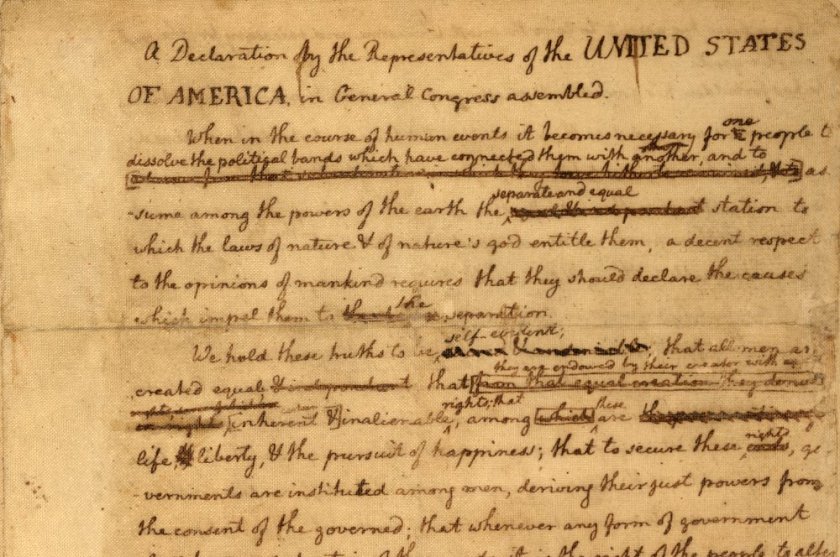
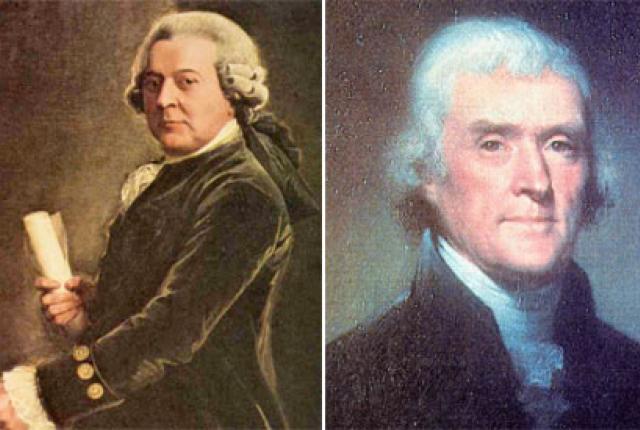
So it is that a committee of five were appointed to write the Declaration of Independence, including Massachusetts attorney John Adams, and a young Virginia delegate named Thomas Jefferson.

Jefferson had no interest in writing the Declaration of Independence and suggested that Adams pen the first draft. Adams declined, and described the following conversation, in a letter to Massachusetts politician Timothy Pickering:

“Jefferson proposed to me to make the draft. I said, ‘I will not,’ ‘You should do it.’ ‘Oh! no.’ ‘Why will you not? You ought to do it.’ ‘I will not.’ ‘Why?’ ‘Reasons enough.’ ‘What can be your reasons?’ ‘Reason first, you are a Virginian, and a Virginian ought to appear at the head of this business. Reason second, I am obnoxious, suspected, and unpopular. You are very much otherwise. Reason third, you can write ten times better than I can.’ ‘Well,’ said Jefferson, ‘if you are decided, I will do as well as I can.’ ‘Very well. When you have drawn it up, we will have a meeting.”

Thomas Jefferson would spend the following seventeen days, writing the first draft.  He and Adams had only just met during the Continental Congress in Philadelphia.  The two would develop a close personal friendship which would last for most of their lives.

6cadd6d5f50e0e581e4e0fb6f9db974a

The friendship between the two men came to an ugly ending during the Presidential election of 1800, in which the mudslinging from both sides rose to levels never before witnessed in a national election.

Jefferson defeated one-term incumbent Adams and went on to serve two terms as President of the United States.  Upon Jefferson’s retirement in 1809, one of the Declaration’s signers, Dr. Benjamin Rush, took it upon himself to patch up the broken friendship between the two founding fathers.

Dr. Rush worked on this personal diplomatic mission for two years.  In 1811, he finally succeeded.

JeffersonSeal2
Jefferson Seal

There followed a series of letters between John Adams and Thomas Jefferson, which together constitute one of the most comprehensive historical and philosophical assessments ever written about the American founding.

The correspondence between the pair touched on a variety of topics, from the birth of a self-governing Constitutional Republic, to then-current political issues, to matters of philosophy and religion and issues related to their advancing years.

Both men understood that they were writing not only to one another, but also to generations yet unborn.  Each went to great lengths to explain the philosophical underpinnings of his views, Adams the firm believer in strong, centralized government, Jefferson advocating a smaller federal government which was more deferential to the states.

By 1826, Jefferson and Adams were among the very last survivors among the founding generation.  James Monroe alone, would survive these two.

In an ending no fiction writer would dare put to paper, both men died on the same day, July 4, 1826.  Fifty years to the day from the birth of the Republic, they had helped to create.  Adams was 90 as he lay on his deathbed, suffering from congestive heart failure.  His last words were “Thomas Jefferson still survives”.  There was no way of knowing.  The author of the Declaration of Independence had died of a fever,  five hours earlier at his Monticello home near Charlottesville, Virginia.  Jefferson was 82.

adams-jefferson_6

John Adams son John Quincy was himself President at the time of the two men’s passing, and remarked that the coincidence was among the “visible and palpable remarks of Divine Favor”.

A month after the two men passed, Daniel Webster spoke of the pair at Faneuil Hall, in Boston.

“No two men now live, (or) any two men have ever lived, in one age, who (have) given a more lasting direction to the current of human thought. No age will come, in which the American Revolution will appear less than it is, one of the greatest events in human history. No age will come, in which it will cease to be seen and felt, on either continent, that a mighty step, a great advance, not only in American affairs, but in human affairs, was made on the 4th of July 1776″.


If you enjoyed this “Today in History”, please feel free to re-blog, “like” & share on social media, so that others may find and enjoy it as well. Please click the “follow” button on the right, to receive email updates on new articles.  Thank you for your interest, in the history we all share.

July 3, 1947 The May Incident

History is replete with examples of what power concentrated in the hands of a few, leads to.

Two hundred and forty-two years ago, our founding fathers bequeathed to us a nation unique in all history. A nation founded on an idea, that all men are created equal, and government derives its powers from the just consent of the governed. A Federal, Constitutional Republic in which our politicians are not our ‘leaders’ but rather our Representatives, operating within a system of diffuse powers with checks and balances, periodically accountable through democratic processes to their bosses – the people who put them there.

In modern times, it has become fashionable to point to the flaws in such a system. Howard Zinn and others present a victim’s-eye narrative of American history.  Smug, faculty iconoclasts and a pop culture Commentariat, decrying the ‘sugar coated fairy tales’, of our past.  Yet, the Great Winston Churchill may have had the final word, describing ‘Democracy” as the worst form of government there is…except for all the others.

o-WINSTON-CHURCHILL-facebook

For many among us, most I should think, some form of that Constitutional, self-governing Republic envisioned by our founders, remains preferable to all other forms of government.  Warts and all.

History is replete with examples of what power concentrated in the hands of a few, leads to.

Ambrose+bierce+majorityIndeed, such a system has imperfections, not least among them those who would ascend to political office.

Hearst columnist Ambrose Bierce, a social satirist of his day and my favorite curmudgeon, once defined politics as ‘A strife of interests, masquerading as a contest of principles. The conduct of public affairs for private advantage.

In the late 19th century, Democrat William “Boss” Tweed owned New York politics, fleecing city taxpayers at the head of the Tammany Hall political machine. New York debt levels soared by over $100 million between 1868 and 1870 alone, a figure equivalent to over a Billion dollars, today.

As Governor of Tennessee, Democrat Ray Blanton ran a ‘pay for play’ operation selling pardons, paroles and commutations, until drawing the attention of the eye of Sauron, at the FBI.  Blanton’s corruption was extensive enough to spawn a book and a later movie, and launched the political career of prosecutor and sometime actor, Fred Thompson.

And, lest I be accused of picking on Democrats, Pennsylvania Republican and Representative in Congress R. Budd Dwyer faced up to 55 years in prison and a $300,000 fine for racketeering and mail fraud, when he took a .357 Magnum revolver out of a manila envelope and blew his brains out.  On live television, no less.

R.-Budd-Dwyer-suicide-660x330

There are so many more and we all have our ‘favorites’, in this parade of horribles.  Yet, for insensate cupidity and pure boneheadedness, it would be hard to outdo the attorney, circuit court judge and member of the United States House of Representatives, Andrew Jackson May.

The Kentucky Democrat was a staunch supporter of the ‘New Deal’ policies of President Franklin Delano Roosevelt, serving in seven succeeding Congresses between 1931 and 1947. As Chairman of the powerful Committee on Military Affairs, May became involved with New York businessmen Murray and Henry Garsson, a relationship which would lead to war profiteering allegations.

Congressman-Andrew-May
Congressman Andrew Jackson May

After the war, a Senate investigating committee discovered evidence of substantial kickbacks from the Garsson brothers. Making matters worse, their munition business took excessive profits, while producing shoddy product. May’s bribery scandal revealed evidence that the Garsson factory produced defective fuses for their 4.2-inch mortar shells, detonating prematurely and leading to the death of no fewer than 38 American soldiers.

Andrew May would serve nine months in Federal prison for accepting bribes in exchange for securing munitions contracts during WW2.

Yet, even that pales in comparison with the ‘May incident’, for which the man has earned eternal infamy. As an influential member of an important committee, Andrew May was necessarily entrusted with highly confidential information, among them deficiencies in Imperial Japanese Navy anti-submarine depth-charge tactics.

Depth Charge
Imperial Japanese Navy light Crusier using Depth Charges against an American submarine, South Pacific 1942 H/T ww2incolor

For some time, the American submarine service had enjoyed considerable success in its war on Japanese shipping. Imperial Japanese naval planners held some bad assumptions about American submarine specifications, among them maximum depth capabilities.

Japanese depth charges were set to detonate at too shallow a depth, leading to a high survival rate for American subs. Congressman May took care of that problem, in 1943.

Returning home from a junket, the Congressman revealed this highly sensitive information, before a press conference. Various press associations ran with the story and some were bright enough to ‘sit on it’, but not all. Several newspapers published the information, including one in Hololulu.

Vice Admiral Charles A Lockwood
Vice Admiral Charles A. Lockwood

Japanese naval ASW (Antisubmarine Warfare) forces were quick to adjust depth charge settings. Vice Admiral Charles A. Lockwood, commander of the U.S. submarine fleet in the Pacific, estimated that May’s indiscretion killed as many as 800 American crewman, with the loss of ten submarines. “I hear Congressman May said the Jap depth charges are not set deep enough”, he said. “He would be pleased to know that the Japs set them deeper now.”

Andrew Jackson May was convicted by a federal jury on this day in 1947, for accepting cash bribes from Murray and Henry Garsson, to use his position as Chairman of the Military Affairs Committee to secure munitions contracts for the Garsson firm.  The Garsson brothers also received prison terms.

President Harry Truman granted May a full pardon in 1952, though his political career was finished. Andrew May returned home to Kentucky to resume the practice of law, until his death in 1959.  We are left only to contemplate, what the man or the press could be thinking, to divulge information more safely left in the hands of a stupid child.  That, and the horrifying realization that the democratic process might actually work, and the government we elect is just…like…Us.

If you enjoyed this “Today in History”, please feel free to re-blog, “like” & share on social media, so that others may find and enjoy it as well. Please click the “follow” button on the right, to receive email updates on new articles.  Thank you for your interest, in the history we all share.