Michelangelo was that insufferably cocky kid who wasn’t bragging. He could deliver.
The Renaissance has been variously described as an advance beyond the dark ages, and a nostalgic period looking back to the Classical age. Whatever it was, the 15th and 16th centuries produced some of the most spectacularly gifted artists, in history.
None more so, than the Italian Masters.
There was Leonardo and Donatello, Raphael, Brunelleschi and Botticelli. Yet, only one among them would have his biography written, while he was still alive. Michelangelo di Lodovico Buonarroti Simoni, had two. Only one of these men would have his home town renamed, after himself. Today, the Tuscan village of Caprese is known as Caprese Michelangelo.
To look at the ceiling of the Sistine Chapel, is to disbelieve that the artist who could produce such a work, didn’t care for painting. In his heart and soul, Michelangelo was a sculptor. “Along with the milk of my nurse,” he would say, “I received the knack of handling chisel and hammer, with which I make my figures”.
He was “Il Divino”, “The Divine One”, literally growing up with the hammer and chisel. He had a “Terribilità” about him, an awe-inspiring sense of grandeur which made him difficult to work with, but for which he was at the same time, widely admired and imitated. Michelangelo was that insufferably cocky kid who wasn’t bragging. He could deliver.
The massive block of Carrara marble was quarried in 1466, nine years before Michelangelo was born. The “David” commission was given to artist Agostino di Duccio that same year. So difficult was this particular stone that Duccio never got beyond roughing out the legs and draperies. Antonio Rossellino took a shot at it 10 years later, but didn’t get much farther.
25 years later, the Guild of Wool Merchants wanted to revive the abandoned project, and went looking for an artist. The now infamously difficult marble slab had deteriorated for years in the elements, when Michelangelo stepped forward at the age of 26. The prevailing attitude seems to have been yeah, give it to the kid. That will take him down a peg or two.
Michelangelo began work on September 13th, 1501. His master work would take him three years to complete, nearly to the day.
The 17′, six-ton David was originally intended for the roof of the Florence Cathedral, but it wasn’t feasible to raise such an object that high. A committee including Leonardo da Vinci and Sandro Botticelli was formed to decide on an appropriate site for the statue. The committee chose the Piazza della Signoria outside the Palazzo Vecchio, the town hall of Florence.
It took four days on a specially constructed cart to move the David statue into position. The unveiling took place on September 8, 1504. Among the dignitaries gathered for the occasion was the Mayor of Florence, Vasari Pier Soderini, who complained that David’s nose was “too thick”.
On some other day and time, a man such as Michelangelo may have invited the Lord Mayor, to perform an anatomically improbable act. On this occasion, the artist climbed the statue with a handful of marble dust, sending down a shower of the stuff as he pretended to work on the nose. After several minutes, he stepped back and asked Soderini if the work was improved. “Yes”, replied the Mayor, now satisfied. “I like it better. You have given it life”.
If you enjoyed this “Today in History”, please feel free to re-blog, “like” & share on social media, so that others may find and enjoy it as well. Please click the “follow” button on the right, to receive email updates on new articles. Thank you for your interest, in the history we all share.
In that moment, the personal dignity of the King of France, ceased to exist. The Duchy of Normandy, was born.
A story comes down to us from the Royal Residence of Queen Victoria, of the hapless attendant who told a spicy story one night, at dinner. You could have watched the icicles grow, when the Queen of the United Kingdom of Great Britain and Ireland turned and said: “We are not amused“.
The story may be little more than a tale told “out of school”, no better than “a guy told me at the pub…” Despite the ‘pluralis majestatis’, the ‘Royal We’, Vicky herself is said to have been an enjoyable companion if not exactly a zany funster. At least in private.
The “Grandmother of Europe” was never given to public displays of mirth. Her lighter side would forever remain, Victoria’s secret. Yet for the rest of us, some of the Royals of history have been very amusing, indeed.
Roman Emperor Caligula (“Little Boots“), so-called for the tiny soldier’s boots, the Caligae, the boy liked to wear on campaign with his father, famously appointed his horse Incitatus, Consul of Rome. At least he planned to. Elagabalus ranked his Imperial cabinet according to the size of his officer’s ummm…well, never mind that. Charles VI, “the Beloved and the Mad”, King of France from 1380 to 1422, would sit motionless for hours on-end, thinking himself made of glass.
Caligae
Russian Emperor Peter III was married to the formidable Catherine the Great, though all that greatness seems not to have rubbed off on ol’ Pete. Given as he was to playing with toy soldiers in bed, it’s uncertain whether the Royal Marriage, was ever consummated. A mean drunk and a child in a man’s body, one story contends that Peter held a full court martial followed by a hanging on a tiny gallows of his own construction, for the rat who chewed off the head of one of his precious toy soldiers.
Some contend that the infamous Jack the Ripper, was a member of the Royal family.
The warlike men who sailed their longboats out of the north tormented the coastal United Kingdom and northwestern Europe, since their first appearance at Lindisfarne Monastery in 793.
Lindisfarne Castle
These “Norsemen”, or “Normans” attacked Paris in early 911. By July they were holding the nearby town of Chartres, under siege. Normans had burned the place to the ground back in 858 and would probably have done so again, but for their defeat at the battle of Chartres, on July 20.
Even in defeat, these men of the North presented a formidable threat. The Frankish King approached them with a solution.
Rollo “The Walker”
King Charles III, known as “Charles the Simple” after his plain, straightforward ways, proposed to give the Normans the region from the English Channel to the river Seine. It would be the Duchy of Normandy, some of the finest farmlands in northwest Europe, and it would be theirs in exchange for an oath of personal loyalty, to Charles himself.
The deal made sense for the King, since he had already bankrupted his treasury, paying these people tribute. And what better way to deal with future Viking raids down the coast, than to make them the Vikings’ own problem?
So it was that the Treaty of Saint-Clair-sur-Epte was concluded on this day in 911, when the Viking Chieftain Rollo pledged feudal allegiance to the King of Western Francia.
Rollo was called “The Walker”, because the man was so huge that no horse could carry him. He must have been some scary character with a two-handed battle axe.
At some point in the proceedings, the Viking chieftain was expected to stoop down and kiss the king’s foot, in token of obeisance. Rollo recognized the symbolic importance of the gesture, but wasn’t about to submit to such degradation, himself.
Rollo motioned to one of his lieutenants, a man almost as enormous as himself, to kiss the foot of the King. The man shrugged, reached down and lifted King Charles off the ground by his ankle. He kissed the foot, and then tossed the King of the Franks aside. Like a sack of potatoes.
In that moment, the personal dignity of the King of France, ceased to exist. The Duchy of Normandy, was born.
Richard III reigned as King of England from 1483 until his death on August 22, 1485, at the Battle of Bosworth Field. After the battle, the last Plantagenet King was thrown in some anonymous hole in the ground, and forgotten.
For five centuries, Richard’s body was believed to have been thrown into the River soar. In 2012, Richard’s remains were discovered under a parking lot, once occupied by Greyfriars Priory Church.
Mitochondrial DNA, that passed from mother to child, demonstrated beyond the shadow of a doubt that the body was that of King Richard III, the last King of the House of York.
Mitochondrial DNA
But, there was a problem.
The Y-chromosome haplotypes, those passed through the male line, didn’t match the living descendants of the King. The conclusion was inescapable. Somewhere along the Royal line, the chain of paternal DNA was broken. The proverbial “Mailman” had, er, inserted himself, into the family tree.
If true, that de-legitimizes John’s son Henry IV and everyone descended from him, down to the ruling house of Windsor. Had such a break taken place in more modern times, the paternity of only a few minor Dukes, would be affected.
Professor Kevin Schurer of the University of Leicester, warned: “The first thing we need to get out of the way is that we are not indicating that Her Majesty should not be on the throne. There are 19 links where the chain could have been broken so it is statistically more probable that it happened at a time where it didn’t matter. However, there are parts of the chain which, if broken, could hypothetically affect royalty.”
Without exhuming a whole lot of bodies, there’s no knowing who the illegitimate child was, along those five-hundred years of “Royalty”. Nineteen links in the chain. Suspicion centers on John of Gaunt (1340 – 1399), the alleged son of Edward III, but whose Real father, may have been a Flemish butcher.
I’m not a betting man but if I were, my money’s on those old guys, staying in the ground.
Feature image, top of page: King Charles VI of France, “the Beloved and the Mad”, by Gillot Saint-Evre
If you enjoyed this “Today in History”, please feel free to re-blog, “like” & share on social media, so that others may find and enjoy it as well. Please click the “follow” button on the right, to receive email updates on new articles. Thank you for your interest, in the history we all share.
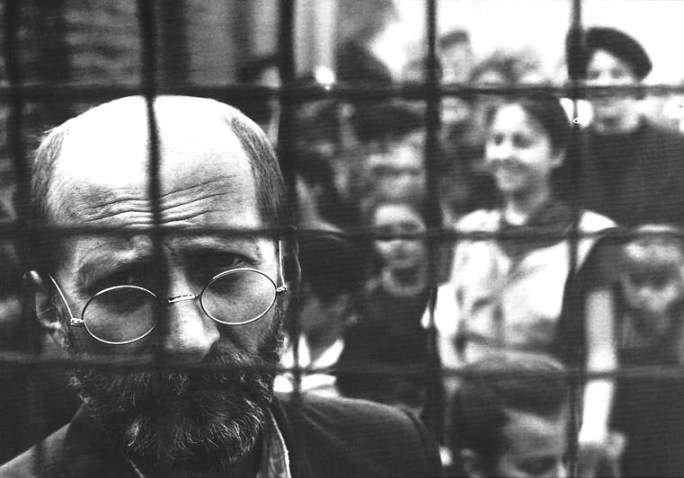
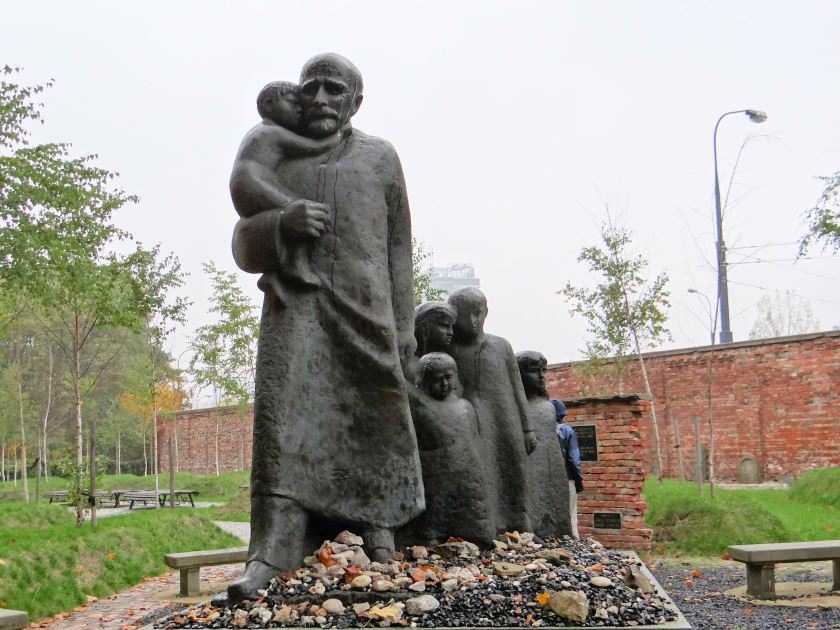
The children’s author was offered sanctuary on the “Aryan side” but the man refused, saying that he would stay with his children. Janusz Korczak and his orphaned children were last seen boarding the train to the Treblinka extermination camp on August 5 or 6.
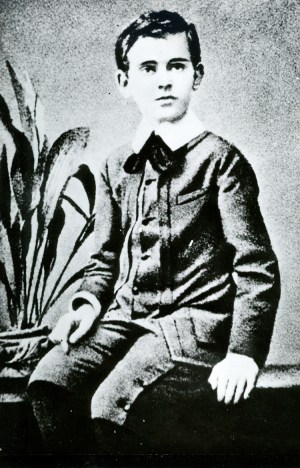
Janusz Korczak was a children’s author and pediatrician, a teacher and himself a lifelong learner, a student of pedagogy, the art of science of education, and how children learn.
Born Henryk Goldszmit into the Warsaw family of Józef Goldszmit, in 1878 or ’79 (the sources vary), Korczak was the pen name by which he wrote children’s books.
Henryk was an exceptional student, of above-average intelligence. His father fell ill when the boy was only eleven or twelve and was admitted into a mental hospital, where he died, six years later. As the family’s situation worsened, the boy would tutor other students, to help with household finances.
Goldszmit was a Polish Jew, though not particularly religious, who never believed in forcing religion on children.
He wrote his first book in 1896, a satirical tome on child-rearing, called Węzeł gordyjski (The Gordian Knot). He adopted the pen name Janusz Korczak two years later, writing for the Ignacy Jan Paderewski Literary Contest.
Korczak wrote for several Polish language newspapers while studying medicine at the University of Warsaw, becoming a pediatrician in 1904. Always the writer, Korczak received literary recognition in 1905 with his book Child of the Drawing Room (Dziecko salonu), while serving as medical officer during the Russo-Japanese war.
He went to Berlin to study in 1907-’08 and worked at the Orphan’s Society in 1909, where he met Stefania “Stefa” Wilczyńska, an educator who would become his associate and close collaborator.
In the years before the Great War, Korczak ran an orphanage of his own design, hiring Wilczyńska as his assistant. There he formed a kind of quasi-Republic for Jewish orphans, complete with its own small parliament, court, and newspaper. The man was born to be an educator.
In early modern European Royalty, 15th – 18th century, a “whipping boy” was the friend and constant companion to the boy prince or King, whose job it was to get his ass kicked, for the prince’s transgressions. The Lord was not the be struck by his social inferior. It was thought that, to watch his buddy get whipped for his misdeeds would have the same instructional effect, as the beating itself.
The extent of the custom is open to debate and it may be a myth altogether, but one thing is certain. Poland has been described as the “whipping boy of Europe”, for good reason.
The Polish nation, the sixth largest in all Europe, was sectioned and partitioned for over a century, by Austrian, Prussian, and Russian imperial powers. Korczak volunteered for military service in 1914, serving as military doctor during WW1 and the series of Polish border wars between 1919-’21.
The “Second Polish Republic” emerging from all this in 1922 was roughly two-thirds Polish, the rest a kaleidoscope of ethnic, linguistic and religious minorities. Relations were anything but harmonious between ethnic Russians, Germans, Lipka Tatars and others, and most especially Poland’s Jewish minority, the largest in pre-WW2 Europe.
Silver Cross of the Polonia Restituta
Janusz Korczak returned to his life’s work in 1921 of providing for the children of this Jewish community, all the while writing no fewer than thirteen children’s books, along with another seven on pedagogy and other subjects.
In the inter-war years, Korczak put together a children’s newspaper, the Mały Przegląd (Little Review), as a weekly supplement to the daily Polish-Jewish newspaper, Nasz Przegląd (Our Review).
Korczak had his own radio program promoting the rights of children, to whom he was known as Pan Doktor (“Mr. Doctor”) or Stary Doktor (“Old Doctor”).
The Polish government awarded “Old Doctor” the Polonia Restituta in 1933, a state order bestowed on individuals for outstanding achievements in the fields of education, science and other civic accomplishments.
Yearly visits to Mandatory Palestine, the geopolitical entity partitioned from the Ottoman Empire in 1923 and future Jewish state of Israel, led to anti-Semitic crosscurrents in the Polish press, and gradual estrangement from non-Jewish orphanages.
The second Republic’s brief period of independence came to an end in September 1939, with the Nazi invasion of Poland. Korczak volunteered once again but was refused, due to his age.
Tales of Polish courage in the face of the Wehrmacht are magnificent bordering on reckless, replete with images of horse cavalry riding out to meet German tanks. Little Poland never had a chance, particularly when the Soviet Union piled on, two weeks later.
As an independent nation-state the Sovereign Republic of Poland was dead, though Polish air crews went on to make the largest contribution to the Battle of Britain, among the United Kingdom’s thirteen non-British defenders. Polish Resistance made significant contributions to the Allied war effort, throughout WW2.
Warsaw became the largest Jewish ghetto in Nazi-occupied Europe within the following year. The Jews of Poland were herded into the city, barely existing on meager rations while awaiting the death squads of the SS. Old Doctor and his orphans were forced into the Ghetto, in 1939.
There were nearly 200 of them on this day in 1942, when soldiers of the Gross-Aktion (Great Action) Warsaw, came for their “Resettlement to the East”.
The Pianist, by Władysław Szpilman
The extermination camp at Treblinka, awaits.
Polish-Jewish composer and musician Władysław Szpilman, one of precious few survivors of the Jewish ghetto, describes the scene in his 1946 memoir, The Pianist:
“He told the orphans they were going out into the country, so they ought to be cheerful. At last they would be able to exchange the horrible suffocating city walls for meadows of flowers, streams where they could bathe, woods full of berries and mushrooms. He told them to wear their best clothes, and so they came out into the yard, two by two, nicely dressed and in a happy mood. The little column was led by an SS man…”
Eyewitness Joshua Perle states that: Janusz Korczak was marching, his head bent forward, holding the hand of a child… A few nurses were followed by two hundred children, dressed in clean and meticulously cared for clothes, as they were being carried to the altar.
At the Umschlagplatz, the rail-side assembly area on the way to Treblinka, an SS officer recognized Korczak, and called him aside. The children’s author was offered sanctuary on the “Aryan side” but the man refused, saying that he would stay with his children. Stary Doktor was offered deportation to the Theresienstadt concentration camp instead, but again he refused.
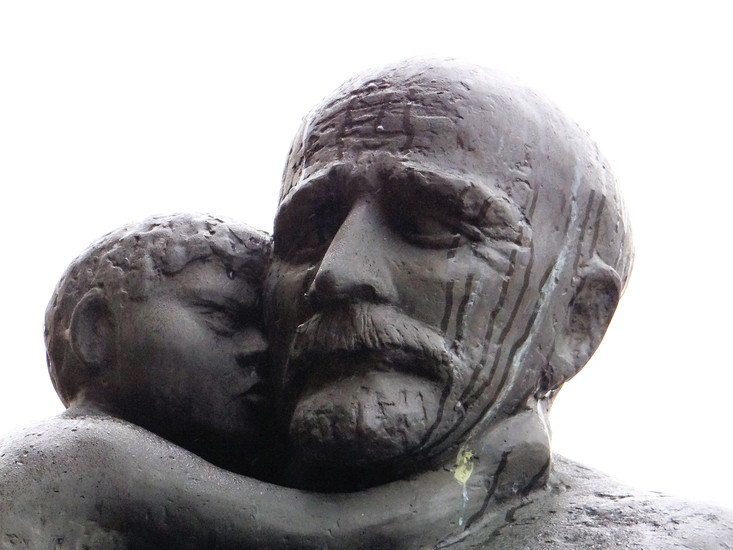
The man who refused freedom to die with his orphaned children was last seen boarding the train to Treblinka on August 5 or 6, where all 200 were murdered, the following day.
Janusz Korczak memorial stone, Treblinka
“Dr. Janusz Korczak’s children’s home is empty now. A few days ago we all stood at the window and watched the Germans surround the houses. Rows of children, holding each other by their little hands, began to walk out of the doorway. There were tiny tots of two or three years among them, while the oldest ones were perhaps thirteen. Each child carried the little bundle in his hand”. — Mary Berg, The Diary
The Roman Rebublic built on and improved what the Greeks had begun, creating their own God of Wine and calling him Bacchus. It was the ancient Romans who first developed the concept of Terroir, “tare WAHr”, the notion that regional climate, soils and aspect (terrain) can effect the taste of wine.
The oldest winery for which archaeological evidence exists was established around BC4100, in present-day Armenia. The Egyptian Pharoahs were producing a wine-like substance from 3100BC for use in public ceremonies, due to its resemblance to blood.
Archaeologists discovered a 3,700 year old wine cellar in the north of Israel. Phoenecian traders plied the Mediterranean from the shores of the Middle East to Gibraltar, transporting grapevines and wine in ceramic jugs. Traders introduced wine to the ancient Greeks sometime around BC800, who then began to perfect the beverage, even naming a God of the grape harvest: Dionysus.
Sounds like a great job, as Greek Gods go.
As the Greek city-states rose in power, viticulture and wine making traveled the eastern Mediterranean with Greek armies, into Sicily and the boot of Italy, and north toward Rome.
The Roman Republic built on and improved what the Greeks had begun, creating their own God of Wine and calling him Bacchus. It was the ancient Romans who first developed the concept of Terroir, “tare WAHr”, the notion that regional climate, soils and aspect (terrain) can effect the taste of wine.
The legions of Rome expanded the Empire across Europe from modern day France and Germany into Portugal and Spain. Everywhere the Legions went, vineyards were soon to follow. To this day, some regions are said to have more ‘Terroir’, than others.
Wine seemed better suited to the sensibilities of the Roman palate, and Tacitus maligned the bitter brew of Germanic barbarians. Nevertheless, letters home from cavalry commanders of the Roman Britain period (ca AD97-103), include requests for more “cerevisia”.
Muhammad directed the “Righteous” to abstain from alcohol sometime in the seventh century, but promised “[R]ivers of water unaltered, rivers of milk the taste of which never changes, rivers of wine delicious to those who drink…” in heaven. (Surah 47.15 of the Qur’an.)
Local production of rustic beers continued well beyond the collapse of the Roman empire, while the monasteries of Europe became prime repositories of viticulture and wine making technique.
The wines of medieval and renaissance-era Europe tended to be almost universally red and almost always, still. The in-bottle refermentation that gives “sparkling” wine its ‘fizz’ was a problem. Fermentable sugars were frequently left over when weather began to cool in the fall, particularly with the white grape varietals. Refermentation would set in with the warm spring weather, converting bottles into literal time bombs. Caps would pop off and wine would spoil. Sometimes the whole batch would explode, one pressurized bottle going off in sympathetic detonation with the other.
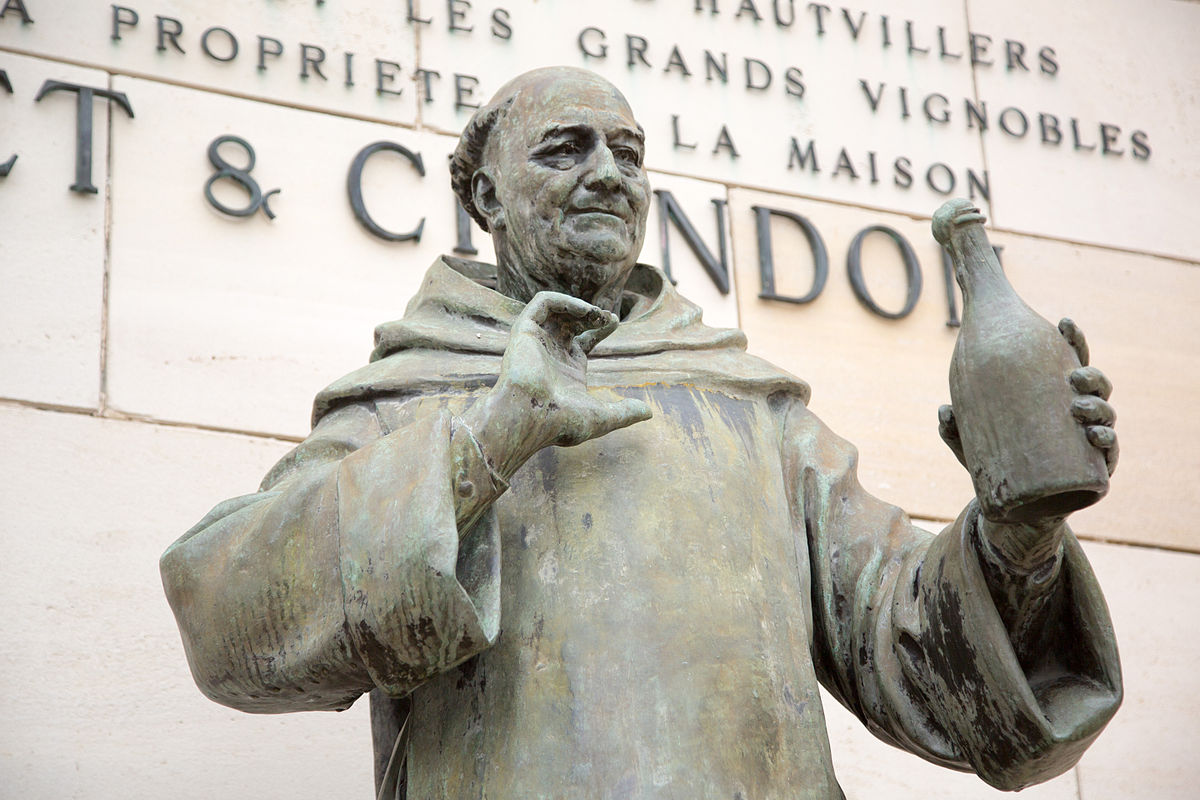
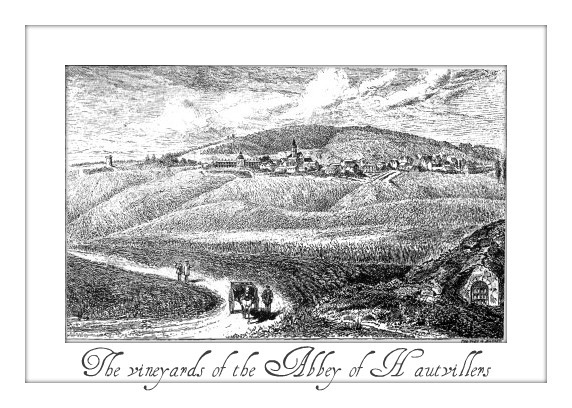
Pierre Perignon entered the Benedictine Order at the age of 19, doing his novitiate at the abbey of Saint-Vannes near Verdun and transferring to the abbey of Hautvillers in 1668.
On August 4, 1693, the date traditionally ascribed to Brother (Dom) Pérignon’s invention of Champagne, the monk is supposed to have said “Come quickly, I am drinking the stars!”.
The story is almost certainly a myth, a later embellishment to the story. During his 47 year career, Pérignon went to considerable lengths to eliminate bubbles from his wine. Dom Pérignon never succeed in that goal, yet he did make bubbly wine a whole lot better, using corks for the first time to prevent the escape of carbon dioxide, and perfecting a ‘gentle’ pressing technique which left out the murkiness of the skins.
It is almost certainly Dom Pérignon who perfected the double fermentation process. He was an early advocate of natural farming methods we would call “organic”, today. Pérignon insisted on “blind” tasting, not wanting to know what vineyard a grape came from prior to selection, and strictly avoiding the addition of foreign substances, insisting that all blending take place at the grape stage.
Pérignon didn’t like white grapes because of their tendency to enter refermentation. He preferred the Pinot Noir, and would aggressively prune the plants so that vines grew no higher than three feet and produced a smaller crop. The harvest was always in the cool, damp early morning hours, and Pérignon took every precaution to avoid bruising or breaking his grapes. Over-ripe and overly large fruit was always thrown out. Pérignon never permitted grapes to be trodden upon, always preferring the use of multiple presses.
In 1891, the Madrid Agreement established among the European powers, that only sparkling wines from a certain region in northeast France may be labeled “Champagne”. The principle was re-asserted in the Treaty of Versailles ending WW1, providing protections for a French wine industry which had, ironically, been saved and literally rebuilt from the ground up by grafting “inferior” American root stock onto French vines.
But that must remain a story for another day.
1890 cartoon from Punch depicting the Phylloxera aphid, which all but obliterated the French wine industry.
That American companies like Korbel, Cook’s and others may continue to call their bubbly wines Champagne is due to the United States’ Senate never having ratified the treaty formally ending WW1, back in 1920. The United States entered the Madrid system in 2003, but the Champagne name dispute, remains unsettled.
Benjamin Franklin, born nine years before brother Pérignon’s death in 1715, is supposed to have said “Beer is proof that God loves us and wants us to be happy.” That’s close, but the quote seems to come from a letter to André Morellet dated 1779, in which the Founding Father wrote “Behold the rain which descends from heaven upon our vineyards; there it enters the roots of the vines, to be changed into wine; a constant proof that God loves us, and loves to see us happy“.
Either way, I enthusiastically approve Mr. Franklin’s message. Cheers.
If you enjoyed this “Today in History”, please feel free to re-blog, “like” & share on social media, so that others may find and enjoy it as well. Please click the “follow” button on the right, to receive email updates on new articles. Thank you for your interest, in the history we all share.
Following the battle of Passchendaele, staff officer Sir Launcelot Kiggell is said to have broken down in tears. “Good God”, he said, “Did we really send men to fight in That”?!
The “War to end all Wars” exploded across the European continent in the summer of 1914, devolving into the stalemate of trench warfare, by October.
The ‘Great War’ became Total War, the following year. 1915 saw the first use of asphyxiating gas, first at Bolimow in Poland, and later (and more famously) near the Belgian village of Ypres. Ottoman deportation of its Armenian minority led to the systematic extermination of an ethnic minority, resulting in the death of ¾ of an estimated 2 million Armenians living in the Empire at that time, and coining the term ‘genocide‘.
Battle of Passchendaele
Kaiser Wilhelm responded to the Royal Navy’s near-stranglehold of surface shipping with a policy of unrestricted submarine warfare, as the first zeppelin raids were carried out against the British mainland. German forces adopted a defensive strategy on the western front, developing the most sophisticated defensive capabilities of the war and determined to “bleed France white”, while concentrating on the defeat of Czarist Russia.
Russian Czar Nicholas II took personal command that September, following catastrophic losses in Galicia and Poland. Austro-German offensives resulted in 1.4 million Russian casualties by September with another 750,000 captured, spurring a “Great Retreat” of Russian forces in the east, and resulting in political and social unrest which would topple the Imperial government, fewer than two years later. In December, British and ANZAC forces broke off a meaningless stalemate on the Gallipoli peninsula, beginning the evacuation of some 83,000 survivors. The disastrous offensive had produced some 250,000 casualties. The Gallipoli campaign was remembered as a great Ottoman victory, a defining moment in Turkish history. For now, Turkish troops held their fire in the face of the allied withdrawal, happy to see them leave.
Passchendaele, 1917
A single day’s fighting in the great battles of 1916 could produce more casualties than every European war of the preceding 100 years, civilian and military, combined. Over 16 million were killed and another 20 million wounded, while vast stretches of the Western European countryside were literally torn apart.
1917 saw the resumption of unrestricted submarine warfare, and a German invitation to bring Mexico into the war, against the United States. As expected, these policies brought America into the war on the allied side. The President who won re-election for being ‘too proud to fight’ asked for a congressional declaration of war, that April.
Massive French losses stemming from the failed Nivelle offensive of that same month (French casualties were fully ten times what was expected) combined with irrational expectations that American forces would materialize on the western front led to massive unrest in the French lines. Fully one-half of all French forces on the western front mutinied. It’s one of the great miracles of WW1 that the German side never knew, else the conflict may have ended, very differently.
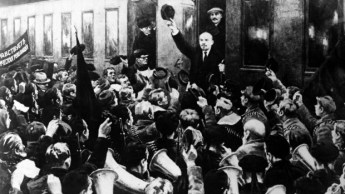
The “sealed train‘ carrying the plague bacillus of communism had already entered the Russian body politic. Nicholas II, Emperor of all Russia, was overthrown and murdered that July, along with his wife, children, servants and a few loyal friends, and their dogs.
This was the situation in July 1917.
For eighteen months, British miners worked to dig tunnels under Messines Ridge, the German defensive works laid out around the Belgian town of Ypres. Nearly a million pounds of high explosive were placed in some 2,000′ of tunnels, dug 100′ deep. 10,000 German soldiers ceased to exist at 3:10am local time on June 7, in a blast that could be heard as far away, as London.
Buoyed by this success and eager to destroy the German submarine bases on the Belgian coast, General Sir Douglas Haig planned an assault from the British-held Ypres salient, near the village of Passchendaele.
British Prime Minister David Lloyd George opposed the offensive, as did the French Chief of the General Staff, General Ferdinand Foch, both preferring to await the arrival of the American Expeditionary Force (AEF). Historians have argued the wisdom of the move, ever since.
The third Battle of Ypres, also known as the Battle of Passchendaele, began in the early morning hours of July 31, 1917. The next 105 days would be fought under some of the most hideous conditions, of the entire war.
In the ten days leading up to the attack, some 3,000 guns fired an estimated 4½ million shells into German lines, pulverizing whole forests and smashing water control structures in the lowland plains. Several days into the attack, Ypres suffered the heaviest rainfall, in thirty years.
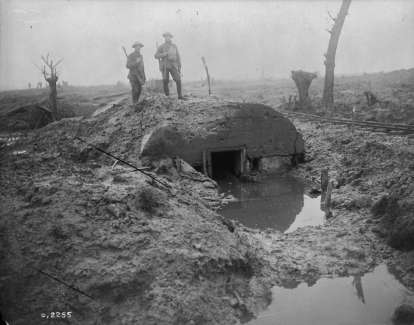
German pillbox, following capture by Canadian soldiers.
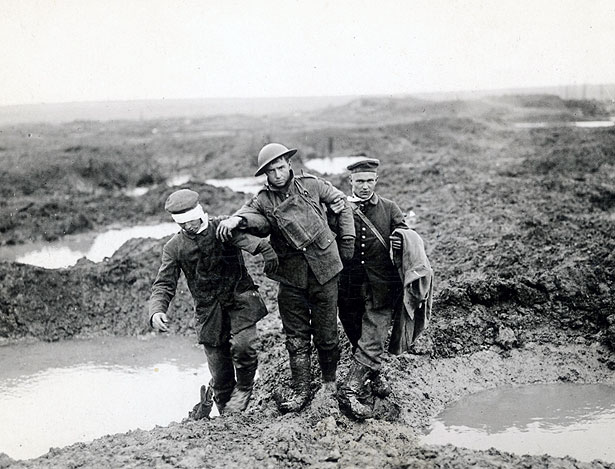
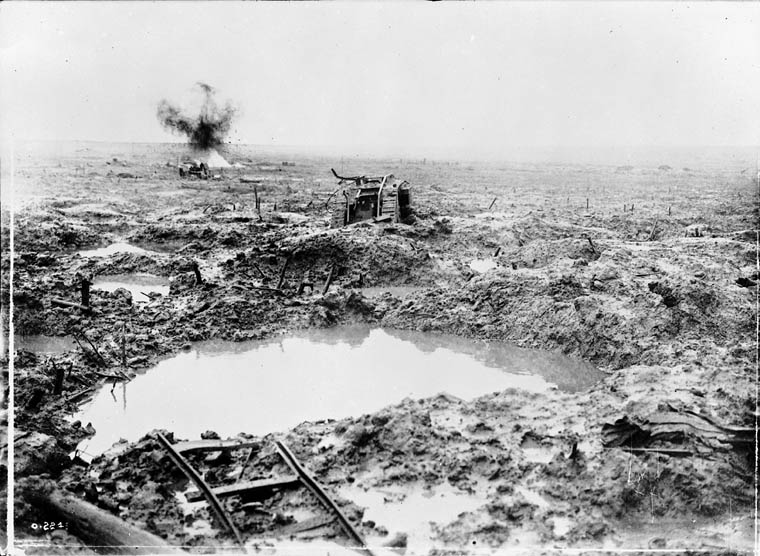
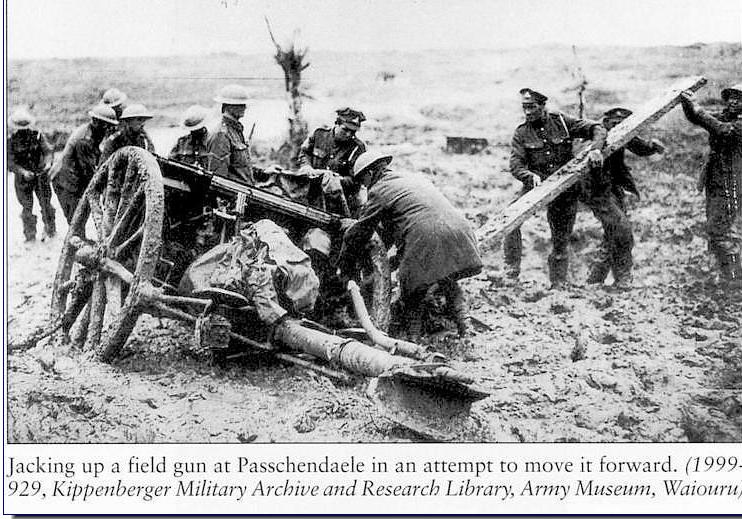
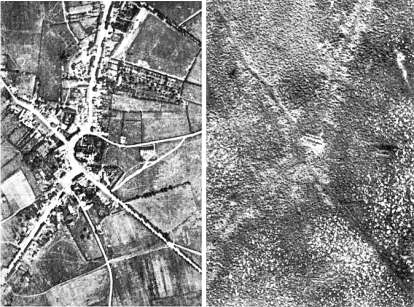
Conditions defy description. Time and again the clay soil, the water, the shattered remnants of once-great forests and the bodies of the slain were churned up and pulverized, by shellfire. You couldn’t call the stuff these people lived and fought in mud – it was more like a thick slime, a clinging, sucking ooze, capable of claiming grown men, even horses and mules. Most of the offensive took place across a broad plain formerly crisscrossed with canals, but now a great, sucking mire in which the only solid ground seemed to be German positions, from which machine guns cut down sodden commonwealth soldiers, as with a scythe.
Soldiers begged for their friends to shoot them, rather than being left to sink in that muck. One sank up to his neck and slowly went stark raving mad, as he died of thirst. British soldier Charles Miles wrote “It was worse when the mud didn’t suck you down; when it yielded under your feet you knew that it was a body you were treading on.”
Passchendaele, before and after the offensive. H/T Imperial War Museums/Wikimedia Commons
In 105 days of this hell, Commonwealth forces lost 275,000 killed, wounded and missing. The German side another 200,000. 90,000 bodies were never identified. 42,000 were never recovered and remain there, to this day. All for five miles of mud, and a village barely recognizable, after its capture.
Following the battle of Passchendaele, staff officer Sir Launcelot Kiggell is said to have broken down in tears. “Good God”, he said, “Did we really send men to fight in That”?! The soldier turned war poet Siegfried Sassoon reveals the bitterness of the average “Joe Squaddy” whom his government had sent sent to fight and die, at Passchendaele. The story is told in the first person by a dead man, in all the bitterness of which the poet is capable. It’s called:
Memorial Tablet – by Siegfried Sassoon “Squire nagged and bullied till I went to fight, (Under Lord Derby’s Scheme). I died in hell (They called it Passchendaele). My wound was slight, And I was hobbling back; and then a shell Burst slick upon the duck-boards: so I fell Into the bottomless mud, and lost the light.
At sermon-time, while Squire is in his pew, He gives my gilded name a thoughtful stare; For, though low down upon the list, I’m there; ‘In proud and glorious memory’…that’s my due. Two bleeding years I fought in France, for Squire: I suffered anguish that he’s never guessed. Once I came home on leave: and then went west… What greater glory could a man desire?”
If you enjoyed this “Today in History”, please feel free to re-blog, “like” & share on social media, so that others may find and enjoy it as well. Please click the “follow” button on the right, to receive email updates on new articles. Thank you for your interest, in the history we all share.
“This is the decisive weapon of the war. Humanity will never be able to endure it,” Hitler said, “If I had this weapon in 1939 we would not be at war now.”
In the early years of WWII, Nazi Germany fired 10,000 V1″Doodlebug” rockets at England, killing over 6,000 Londoners alone, by 1943. The subsonic V1 was an effective terror weapon but, bad as it was to be the target of one of these things, the “low and slow” trajectory and the weapon’s short range lacked the strategic punch needed by Nazi Germany to end the war in its favor.
The V2 was a different story. This was the dawn of the ballistic missile era, and Nazi Germany was first off the starting line.
The Peenemünde Aggregat A4 V2 was an early predecessor of the Cruise Missile, delivering a 2,148 pound payload at 5 times the speed of sound over a 236-mile range. While you could hear the V1 coming and seek shelter, victims of the V2 didn’t know they were under attack, until the weapon had exploded.
When Wernher von Braun showed Adolf Hitler the launch of the V2 on color film, Hitler jumped from his seat and shook Braun’s hand with excitement. “This is the decisive weapon of the war. Humanity will never be able to endure it,” Hitler said, “If I had this weapon in 1939 we would not be at war now.”
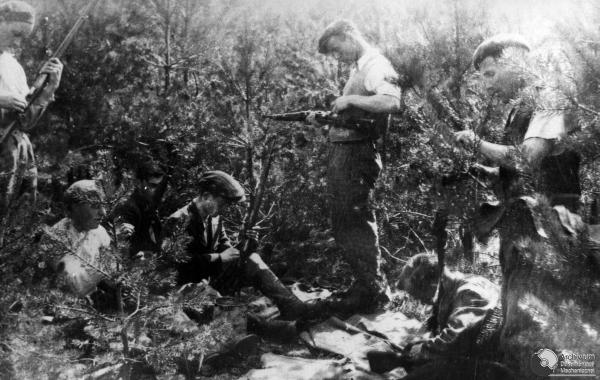
Allies were anxious to get their hands on the secret weapon and, in early 1944, they had their chance. A V2 had crashed into a muddy bank of the Bug River in Nazi-occupied Poland, without exploding. The Polish underground had been waiting for such an opportunity and quickly descended on the rocket, covering it with brush. Desperate to retrieve it, Germans conducted a week long aerial and ground search for the weapon, but failed find it under all that camouflage.
Polish Partisans preparing for battle, WW2
After what must have seemed an eternity, the search came to an end and partisans returned to the site. This time they brought four Polish scientists who carefully disassembled the weapon, packing the pieces in barrels. The parts were then shipped to a barn in Holowczyce, just a few miles away.
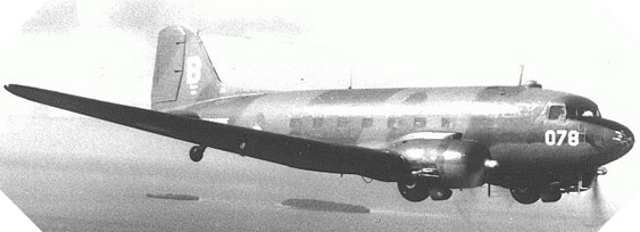
The allied effort to retrieve the stolen missile, code named “Most III”, got underway on this day in 1944, when Royal New Zealand Air Force 1st Lt Stanley George Culliford landed his Dakota C47 in the early morning darkness, at a secret air strip near Tarnow.
Home Army intelligence on V1 & V2
The V2 chassis and several technical experts were loaded on board, but it was too much weight. The overloaded C47 couldn’t move on the wet, muddy field – the port wheel stuck fast in the mud. Everything had to be offloaded, Polish partisans working desperately to free the aircraft as dawn approached. They stuffed the wheel track with straw, and then laid boards in the trench. Nothing worked.
Co-pilot Kazimierz “Paddy” Szrajer thought the parking brake must be stuck, so the hydraulic leads supplying the brake, were cut. That didn’t work, either. In the end, partisans were frantically digging trenches under the aircraft’s main wheel. Two attempts failed to get the aircraft off the ground, and Culliford was thinking about blowing up the plane and burning all the evidence. There would be one last attempt.
The aircraft lumbered off the ground on the third try. The last of the partisans scattered into the night, as the headlights of Nazi vehicles could be seen, approaching in the early morning darkness.
There would be 5 hours of unarmed, unescorted flight through Nazi-controlled air space and an emergency landing with no brakes, before those V2 rocket components finally made it to England.
Today, few remember the names of these heroes, struggling in the dark to defeat the forces of Nazi Tyranny. We are left only to imagine a world, in which Nazi Germany remained in sole possession of the game changing super weapons, of WWII.
If you enjoyed this “Today in History”, please feel free to re-blog, “like” & share on social media, so that others may find and enjoy it as well. Please click the “follow” button on the right, to receive email updates on new articles. Thank you for your interest, in the history we all share.
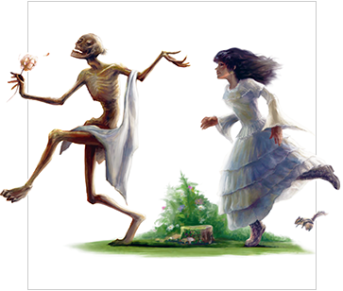
Most such outbreaks coincided with periods of extreme hardship such as crop failure, famine and floods, and involved between dozens and tens of thousands of individuals.
Amidst our people here is come The madness of the dance. In every town there now are some Who fall upon a trance. It drives them ever night and day, They scarcely stop for breath, Till some have dropped along the way And some are met by death. – Straussburgh Chronicle of Kleinkawel, 1625
A legend of the medieval Christian church had it that, if anyone were to provoke the wrath of St. Vitus, the Sicilian saint martyred in 303AD, he would send down plagues of compulsive dancing. One of the first outbreaks of St. Vitus’ Dance, occurred sometime in the 1020s in Bernburg, Germany. 18 peasants disturbed a Christmas Eve service, singing and dancing around the church.
In a story reminiscent of the Pied Piper of Hamelin, a large group of children jumped and danced all the way from Erfurt to Arnstadt in 1237, a distance of some sixteen miles. In 1238, 200 people jumped, twitched and convulsed on a bridge over the River Meuse, until the span collapsed.
A major outbreak St. Vitus’ Dance occurred on June 24, 1374. The population writhed and jerked through the streets of Aachen, screaming of visions and hallucinations until, one by one, each collapsed. There, victims continued to tremble and twitch on the ground, too exhausted to stand.
Most such outbreaks coincided with periods of extreme hardship such as crop failure, famine and floods, and involved between dozens and tens of thousands of individuals.
This “choreomania”, more commonly referred to as dancing mania, spread throughout Europe, fanning out to Cologne, Flanders, Franconia, Hainaut, Metz, Strasbourg, Tongeren and Utrecht. Further outbreaks were reported in England and the Netherlands.
One Frau Troffea began to dance in a street in Strasbourg in July 1518, going at it somewhere between four to six days. 34 joined in by the end of a week. Within the month there were 400 more. Many of this primarily female group actually danced themselves to death, succumbing to heart attack or stroke. Others collapsed in exhaustion, their bloody feet no longer able to hold them up.
According to one report, the dancing plague was killing fifteen people every day.
Reactions varied. Some thought those suffering from dance mania were possessed by the devil, others by ‘hot blood’. Doctors were called, who advised that the Dance be allowed to run its course. Bands were hired and one town even built a dance floor, to contain the phenomenon.
There were no fewer than seven distinct outbreaks of the dancing plague during the medieval period, and one in Madagascar as late as 1840.
Even today there is little consensus about what caused the phenomenon. Some have blamed “St Anthony’s Fire”, a toxic and psychoactive fungus of the Claviceps genus, also known as ergot. Often ingested with infected rye bread, symptoms of ergot poisoning are not unlike those of LSD, and include nervous spasms, psychotic delusions, spontaneous abortion, convulsions and gangrene resulting from severe vasoconstriction.
Many associate the Salem witchcraft hysteria of 1692 with ergot poisoning but, for others, such explanations are wanting. Both the dancing episodes of earlier centuries and the witchcraft chapter involved lucid and deliberate action, far more than the convulsions and involuntary spasms associated with ergotism.
Others describe the Dancing Plague phenomenon as some kind of mass psychosis, brought on by the Bubonic Plague. The Black Death, a pandemic which killed 75-100 million people around the earth, in a world with a population of 450 million. The explanation seems as plausible as any. The modern mind is incapable of understanding (at least mine is) what it is to live in a world where one in every four-to-five people on the planet is dead, killed by a horror not one of them understands.
Long before germ theory was commonly understood, disease was thought to be borne of odors. Medieval plague doctors donned head-to-toe waxed canvas gowns and leather hats, with the distinctive beak-like mask filled with aromatic herbs.
Today, a calamity of such magnitude would kill over 1.5 Billion souls.
If you enjoyed this “Today in History”, please feel free to re-blog, “like” & share on social media, so that others may find and enjoy it as well. Please click the “follow” button on the right, to receive email updates on new articles. Thank you for your interest, in the history we all share.
Strong men, bareback riders, trapeze performers and acrobats were killed instantly and others horribly maimed, as wooden circus cars telescoped into one another. Confused and bleeding survivors stumbled from the wreckage, as gas-fed lanterns began to set fire to all that wood.
There is an oft-repeated but mistaken notion that the circus goes back to Roman antiquity. The panem et circenses, (bread and circuses)” of Juvenal, ca AD100, refers more to the ancient precursor of the racetrack, than to anything resembling a modern circus. The only common denominator is the word itself, the Latin root ‘circus’, translating into English, as “circle”.
The father of the modern circus is the British Sergeant-Major turned showman, Philip Astley. A talented horseman, Astley opened a riding school near the River Thames in 1768, where he taught in the morning and performed ‘feats of horsemanship’ in the afternoon. Equestrian and trick riding shows were gaining popularity all over Europe at this time, performers riding in circles to maintain balance while standing on the backs of galloping horses. It didn’t hurt matters, that the “ring” made it easier for spectators to view the event.
These afternoon shows gained overwhelming popularity by 1770, and Astley hired acrobats, rope-dancers, and jugglers to fill the spaces between equestrian events. The modern circus, was born.
From that day to this, the “Fancy Pants” dresses in red tailcoat and top hat, evocative of British fox hunting garb. This “Announcer” is commonly (and mistakenly) called the “ringmaster”, while the true ring master is the “equestrian director”, standing in the center of the ring and pacing horses for the riding acts.
In 1825, Joshuah Purdy Brown of Somers New York replaced the wooden structure common to European circuses with a canvas tent, around the time when cattle dealer Hachaliah Bailey bought a young African elephant, and began to exhibit the animal all over the country.
The exotic animal angle was a great success. Other animals were added, and farmers were soon leaving their fields to get into the traveling menagerie business. The unique character of the American traveling circus emerged in 1835, when 135 such farmers and menagerie owners combined with three affiliated circuses to form the American Zoological Institute.
Phineas Taylor Barnum and William Cameron Coup launched P.T. Barnum’s Museum, Menagerie & Circus in 1871, where the “museum” part was a separate exhibition of human and animal oddities. It wouldn’t be long, before the ‘sideshow” became a regular feature of the American circus.
There have been no fewer than 81 major circuses in American history, and countless “Dog & Pony” shows, programs so small as to include only a few family members and an assistant or two, with a couple of trained animals. And all this time, I thought ‘Dog & Pony Show’ referred to the United States Congress.
The ‘Greatest Show on Earth’ closed for the last time on Sunday, May 21 2017, when ‘animal rights activists’ and changing tastes in entertainment finished the Ringling Brothers, Barnum & Bailey Circus, ending a 146-year run.
In the mid-19th century, German animal trainer Carl Hagenbeck toured Europe with “ethnographical” spectacles, combining animals with native peoples such as the Sámi of the Scandinavian peninsula, complete with reindeer and sleds. Hagenbeck was among the first to develop animal training methods based on trust and reward rather than pain and fear, his demonstrations emphasizing the animal’s intelligence and tractability over ferocity.
In 1906, Hagenbeck sold his traveling animal show to American circus operator Benjamin Wallace, before going on to develop open zoological gardens and native panoramas which would be familiar to today’s zoo enthusiast, rather than the barred cells of his day.
The American war machine was spinning up to peak operational capacity in 1918, as the industrial might of the nation pursued an end to the war ‘over there’.
Hagenbeck-Wallace was one of the premier circuses of the day, moving about the country on three trains and employing no fewer than 1,000 roustabouts and assorted performers.
In the small hours of June 22, an engineer with the Michigan Central Railroad was at the wheel of Train No. 41, an empty 21-car troop train. Automatic signals and flares and at least one frantic signalman should have warned the driver that a stalled train lay on the track ahead, but he missed them all. Alonzo Sargent was asleep at the wheel.
The following day, newspapers across the country told the story of what happened next.
On June 22, the circus was scheduled to appear at the Show Grounds at 150th and Calumet Avenue in Hammond, Indiana. In the early morning darkness, an overheated axle box required one train to make an unscheduled stop. It was 4am and most of the circus’ employees were asleep, when the Michigan Central locomotive smashed into the rear of the stalled train.
The Hammond circus train wreck was one of the worst such accidents, in history. Strong men, bareback riders, trapeze performers and acrobats were killed instantly and others horribly maimed, as wooden circus cars telescoped into one another. Confused and bleeding survivors stumbled from the wreckage, as gas-fed lanterns began to set fire to all that wood.
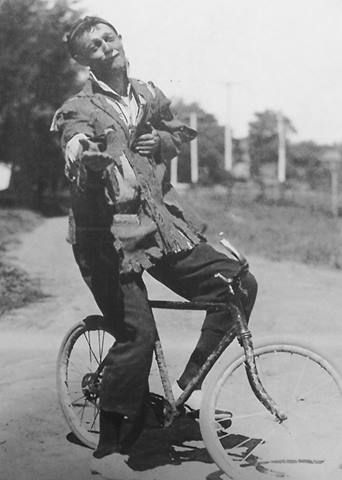
Hagenbeck-Wallace clown “Big Joe” Coyle
Those lucky enough to escape the horror were forced to watch in disbelief as friends, families and co-workers were incinerated alive.
Hours later a clown, “Big Joe” Coyle, could be seen weeping, beside the mangled bodies of his wife and two small boys.
127 were injured and an estimated 86 crushed or burned to death in the wreck. The rumor mill went berserk. Wild lions and tigers had escaped and were roaming the streets and back yards of Gary, Indiana. Elephants died in an heroic attempt to put out the flames, spraying water on the burning wreckage with their trunks.
None of the stories were true. The animals had passed through hours before on an earlier caravan, and now awaited a train which would never come.
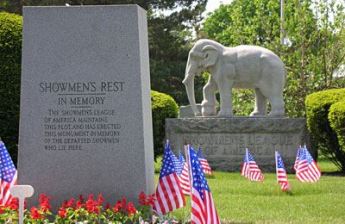
The Showmen’s League of America was formed in 1913, with Buffalo Bill Cody its first President. The group had recently purchased a 750-plot parcel at the Woodlawn Cemetery in Forest Park, Illinois and called it “Showmen’s Rest”, having no idea their investment would be used so soon.
A mass grave was dug for the unidentified and unidentifiable. Some of the dead were roustabouts or temporary workers, hired only hours or days earlier. Some performers were known only by stage names, their gravestones inscribed with names like “Four-Horse Driver”, “Baldy” and “Smiley”.
The Hagenbeck-Wallace circus was a big deal in those days. Famed lion tamer Clyde Beatty was a member, as was a young Red Skelton, tagging along with his father, who worked as a clown.
Only two shows had to be canceled, as erstwhile ‘competitors’ Barnum & Bailey and others lent workers, performers and equipment. The show would go on.
In the world of elephants, an upraised trunk carries connotations of joy, while a lowered trunk symbolizes mourning. At the Woodlawn cemetery of Chicago, five elephant statues circumscribe the mass grave of clowns, trapeze artists, strongmen and other circus performers. Each has a foot raised with a ball underneath. Every trunk, hangs low. The largest of the five bears the inscription, “Showmen’s League of America.” On the other four are inscribed the words “Showmen’s Rest”.
The Napoleonic Wars began in 1799, pitting the Grand Armée of Emperor Napoleon Bonaparte against a succession of international coalitions. The first five such coalitions formed to oppose him would go down to defeat.
The empire of Czar Alexander I had long traded with Napoleon’s British adversary. Napoleon invaded Russia in 1812 intending to cut off that trade, but made the same mistake which Adolf Hitler would make, 130 years later. He failed to account for Russia’s greatest military asset – General Winter.
The Night Bivouac of the Great Army, by Vasily Vereshchagin
For months, Napoleon’s army pressed ever deeper into Russian territory, as Cossack cavalry burned out villages and fields to deny food or shelter to the advancing French army. Napoleon entered the Russian capital of Moscow that September, with expectations of capitulation. Instead, he got more scorched earth.
French invasion of Russia
With the dread Russian winter coming fast, there was no choice but to turn about. Starving and exhausted with no winter clothing, stragglers were frozen in place or picked off by villagers or pursuing Cossacks. From Moscow to the frontiers you could follow their retreat, by the bodies they left in the snow. 685,000 had crossed the Neman river on June 24. By mid-December, barely 27,000 straggled home from Russian soil.
The War of the 6th Coalition ended in 1814 with Bonaparte’s defeat and exile to the Mediterranean island of Elba, and the restoration to the throne of the Bourbon King Louis VXIII. The Emperor returned at the head of another army, in 111 days.
The Congress of Vienna declared Napoleon an outlaw on March 13, 1815, when Austria, Prussia, Russia and the United Kingsom bound themselves to put 150,000 men apiece into the field to end his reign.
Napoleon struck first, taking 124,000 men of l’Armee du Nord on a pre-emptive strike against the Allies in Belgium. Intending to attack Coalition armies before they combined, he struck and defeated the Prussian forces of Gebhard von Blücher near the town of Ligny.
Napoleon then turned his attention to the coalition forces under Lord Arthur Wellesley, Duke of Wellington, who fell back to a carefully selected position on a long east-west ridge at Mont St Jean, a few miles south of the village of Waterloo.
It rained all day and night, that Saturday. Napoleon waited for the ground to dry on the morning of June 18, launching his first attack before noon. Wellington’s Prussian allies were still five hours away. The 80 guns of the Grande batterie opened fire at 11:50, while Wellington’s reserves sheltered out of sight on the reverse slope of the Mont St. Jean ridge. French infantry swarmed the stone buildings of the Château Hougomont on Wellington’s right, and La Haye Sainte on his left.
Most French infantry reserves were committed by 4:00pm, when Marshall Ney ordered the massed cavalry assault. Colonel Cornelius Frazer watched the mass of riders and thought to himself: “They are going to roll over us.” In a flash, Frazer ordered: “Form squares!” 9,000 cuirassiers charged up the hill as Wellington’s artillery responded with canister and shot, turning their cannon into giant shotguns tearing holes in the French ranks.
It was common practice of the time to “spike” enemy cannon, driving a nail into the touchhole and disabling the weapon. Marshal Ney’s aide Colonel Pierre-Agathe Heymès, frantically cried out “Les clous!” “Nails! Spike the guns!”
Not one rider had thought to bring them.
Eleven times French cavalry gained the hill and surrounded those guns. Eleven times the gunners retreated into defensive infantry squares, bristling with spears. Eleven times they returned to their pieces, to fire into French cavalry as it withdrew.
Newly arrived Prussians were pouring in from the right at 7:30 when Napoleon committed his 3,000 man Imperial Guard. These were Napoleon’s elite soldiers, almost seven feet tall in their high bearskin hats. Never defeated in battle, they came up the hill intending to roll up Wellington’s center, away from their Prussian allies. 1,500 British Foot Guards were lying down to shelter from French artillery. As the French lines neared the top of the ridge, the English stood up, appearing to rise from the ground and firing point blank into the French line.
The furious counter assault which followed caused the Imperial Guard to waver, and then retreat. Someone shouted “La Garde recule. Sauve qui peut!” (“The Guard retreats. Save yourself if you can!”), as the Allied army rushed forward and threw themselves on the retreating French.
There is a story, possibly apocryphal, concerning Henry Paget, 2nd Earl of Uxbridge. One of the last cannon balls fired that day hit Uxbridge just above the knee, all but severing the limb. Lord Uxbridge was close to Wellington at the time, exclaiming “By God, sir, I’ve lost my leg!”. Wellington replied “By God, sir, so you have!” There’s another version in which Wellington says “By God, sir, you’ve lost your leg!”. Looking down, Uxbridge replied “By God, sir, so I have!”
As night fell, hundreds of locals emerged with hammers, pliers and chisels, combing the battlefield to remove the teeth of tens of thousands of dead and dying soldiers. Demand for human teeth was high and looters sold them by the tens of thousands, to dentists, who formed them into dentures. According to England’s National Army Museum, British dentists did nothing to conceal where they came from, advertising their appliances as “Waterloo teeth.” As late as the American Civil War, English dentists continued to do a brisk trade in “Waterloo ivory.”
Estimates of the total killed and wounded in the Napoleonic wars range from 3.5 to 6 million. Until Waterloo, Napoleon Bonaparte participated in, and won, more battles than Julius Caesar, Hannibal, Frederick the Great, and Alexander the Great. Combined.
Austrian military history professor Erik Durschmied wrote in his excellent book`The Hinge Factor‘, of the times when serendipity, ‘chance and stupidity have changed history.’ According to Wellington, the Battle of Waterloo was “the nearest-run thing you ever saw in your life.” The French defeat was comprehensive. Bonaparte was captured and exiled, this time to a speck in the North Atlantic called Saint Helena. All, for a handful of nails.
If you enjoyed this “Today in History”, please feel free to re-blog, “like” & share on social media, so that others may find and enjoy it as well. Please click the “follow” button on the right, to receive email updates on new articles. Thank you for your interest, in the history we all share.
In a time and place remembered for near-cartoonish levels of violence, Vlad Țepeș stands out for extraordinary cruelty.
Count Dracula, favorite of Halloween costume shoppers from time immemorial, has been with us since the 1897 publication of Bram Stoker’s novel, of the same name. Stoker’s working titles for the manuscript were “The Un-dead”, and “Count Wampyr”. He nearly kept one of them too, until stumbling into the real-life story of Vlad Țepeș (TSE·pesh), a Wallachian Prince and front-line warrior, against the Jihad of his day.
In modern Romanian, “Dracul” means “the Devil”. In the old language, it meant “the Dragon”, the word “Dracula” (Drăculea) translating as “Son of the Dragon”.
Stoker wrote in his notes, “in Wallachian language means DEVIL”. In a time and place remembered for near-cartoonish levels of violence, Vlad Țepeș stands out for his extraordinary cruelty. There are tales of Țepeș disemboweling his own mistress. That he collected the noses of vanquished adversaries. Some 24,000 of them. That he dined among forests of victims, spitted on poles. That he even impaled the donkeys they rode in on.
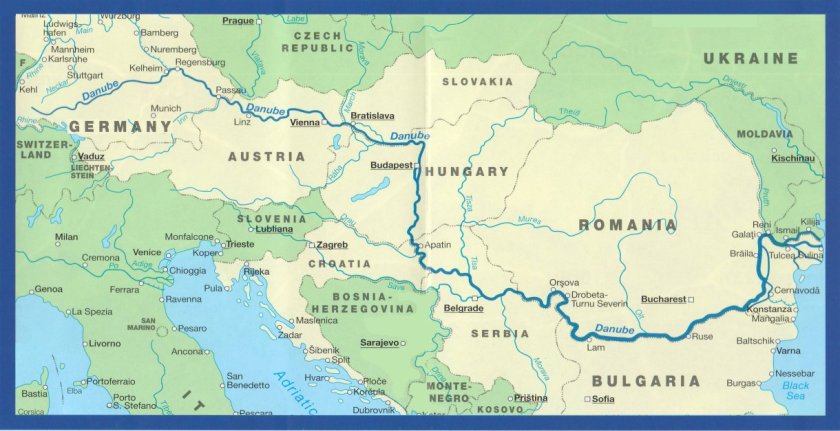
In 1436, Vlad II became voivode (prince) of Wallachia, a region in modern-day Romania situated between the Lower Danube river and the Carpathian Mountains. The sobriquet “Dracul” came from membership in the “Order of the Dragon” (literally “Society of the Dragonists”), a monarchical chivalric order founded by Holy Roman Emperor Sigismund in 1408, and dedicated to stopping the Ottoman advance into Europe.
A crossroads between East and West, the region was scene to frequent bloodshed, as Ottoman forces pushed westward into Europe, and Christian forces pushed back..
A weakened political position left Vlad II no choice but to pay homage to Ottoman Sultan Murad II, in the form of an annual Jizya (tax on non-Muslims) and a contribution of 500 Wallachian boys to serve as Janissariesin the elite slave army of the Ottoman Empire.
Vlad was taken hostage by the Sultan in 1442, along with his two younger sons, Vlad III and Radu. The terms of the boys’ captivity were relatively mild by the standards of the time and both became skilled horsemen and warriors. Radu went over to the Turkish side, but Vlad hated captivity, developing an incandescent hate for his captors which would last all his life.
Following the fall of Constantinople in 1453, Sultan Mehmed II set his sights on the invasion of all Europe.
Fall of Constantinople
The younger Vlad gained the Wallachian throne three years later and immediately stopped all tribute to Sultan Mehmed II, by now risen to 10,000 ducats per year, and 1,000 boys. When a group of visiting Ottoman envoys declined to remove their turbans in Vlad’s court, the Prince ordered the turbans nailed to their skulls.
Vlad now consolidated power as his reputation for savagery, grew. According to stories circulated after his death, hundreds of disloyal boyars (nobles) and their allies met their end, impaled on spikes.
Mehmed II, conqueror of Constantinople, now amassed power of his own, setting his sights on campaigns against Anatolia, the Greek Empire of Trebizond and the White Sheep Turkomans of Uzun Hasan. Throughout this period, Romanian control of the Danube remained a thorn in his side.
Danube River
Pope Pius II declared a new Crusade against the Ottoman in 1460, but Vlad Țepeș was the only European leader to show any enthusiasm. The Hungarian General and Ţepeş’ only ally Mihály Szilágyi was captured by the Turks, his men tortured to death and Szilágyi himself sawed in half.
Țepeș invaded the Ottoman Empire the following year. In a letter to Hungarian king Matthias Corvinus dated February 11, 1462, Țepeș wrote: I have killed peasants men and women, old and young, who lived at Oblucitza and Novoselo, where the Danube flows into the sea, up to Rahova, which is located near Chilia, from the lower Danube up to such places as Samovit and Ghighen. We killed 23,884 Turks without counting those whom we burned in homes or the Turks whose heads were cut by our soldiers…Thus, your highness, you must know that I have broken the peace with him (Sultan Mehmed II).
The Sultan invaded Wallachia at the head of a massive army, only to find a “forest of the impaled”. The Byzantine Greek historian Laonikos Chalkokondyles writes: “The sultan’s army entered into the area of the impalements, which was seventeen long and seven stades wide”.
To give a sense of scale to such a horror, a “stade” derives from the Greek “stadeon” – the dimensions of an ancient sports arena.
Outnumbered five-to-one, Ţepeş employed a scorched earth policy, poisoning the waters, diverting small rivers to create marshes and digging traps covered with timber and leaves. He would send sick people among the Turks, suffering lethal diseases such as leprosy, tuberculosis and bubonic plague.
From his years in captivity, Ţepeş understood Ottoman language and customs as well as the Turks themselves. Fearless, he would disguise himself as a Turk and freely walk about their encampments, gaining valuable intelligence on the Sultan’s organization.
On this day in 1462, the Son of the Dragon launched a night attack on the Ottoman camp near the capital city of Târgoviște, in an effort to assassinate Mehmed himself. Knowing that the Sultan forbade his men from leaving their tents at night, a force of some 7,000 to 10,000 horsemen fell on Mehmed’s camp three hours after sunset. The skirmish lasted all that night until 4 the next morning, killing untold numbers of Turks, their horses and camels. Ţepeş himself aimed for the Sultan’s tent, but mistook it for that of two grand viziers, Ishak Pasha and Mahmud Pasha.
The Battle With Torches by Romanian painter Theodor Aman. It depicts the The Night Attack of Târgovişte,
Mehmed II “The Conqueror” survived the Night Attack at Târgovişte. In the end, the Romanian principalities had little with which to oppose the overwhelming force of the Ottoman Empire. Vlad III Țepeș would twice be deposed only to regain the throne but never able to defeat his vastly more powerful adversary.
“Vlad the Impaler” was exiled to Hungary where he spent much of his time, in prison. He died fighting against the Ottomans in December 1476 or January 1477, his body cut into pieces and his head delivered to the Sultan. Drăculea is buried in an unknown grave, stories of his cruelty told and retold in Russian, German and a hundred other languages. Five hundred years later, the Son of the Dragon is remembered as the un-dead vampire, Count Dracula.
If you enjoyed this “Today in History”, please feel free to re-blog, “like” & share on social media, so that others may find and enjoy it as well. Please click the “follow” button on the right, to receive email updates on new articles. Thank you for your interest, in the history we all share.


 He was “Il Divino”, “The Divine One”, literally growing up with the hammer and chisel. He had a “Terribilità” about him, an awe-inspiring sense of grandeur which made him difficult to work with, but for which he was at the same time, widely admired and imitated. Michelangelo was that insufferably cocky kid who wasn’t bragging. He could deliver.
 The 17′, six-ton David was originally intended for the roof of the Florence Cathedral, but it wasn’t feasible to raise such an object that high. A committee including Leonardo da Vinci and Sandro Botticelli was formed to decide on an appropriate site for the statue. The committee chose the Piazza della Signoria outside the Palazzo Vecchio, the town hall of Florence.

 A story comes down to us from the Royal Residence of Queen Victoria, of the hapless attendant who told a spicy story one night, at dinner. You could have watched the icicles grow, when the Queen of the United Kingdom of Great Britain and Ireland turned and said: “We are not amused“.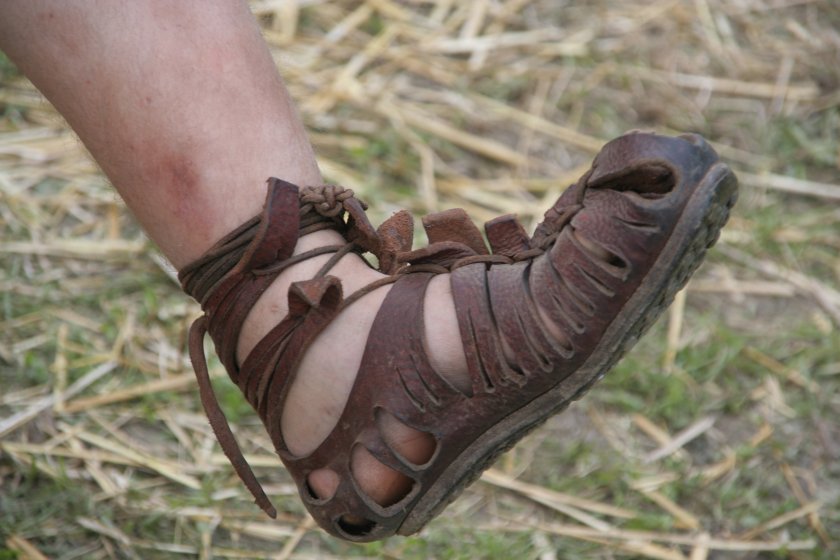





 Born Henryk Goldszmit into the Warsaw family of Józef Goldszmit, in 1878 or ’79 (the sources vary), Korczak was the pen name by which he wrote children’s books.
 Korczak wrote for several Polish language newspapers while studying medicine at the University of Warsaw, becoming a pediatrician in 1904. Always the writer, Korczak received literary recognition in 1905 with his book Child of the Drawing Room (Dziecko salonu), while serving as medical officer during the Russo-Japanese war.
 The Polish nation, the sixth largest in all Europe, was sectioned and partitioned for over a century, by Austrian, Prussian, and Russian imperial powers. Korczak volunteered for military service in 1914, serving as military doctor during WW1 and the series of Polish border wars between 1919-’21.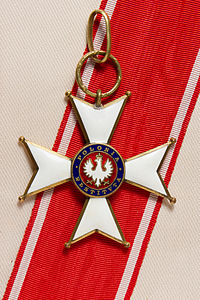



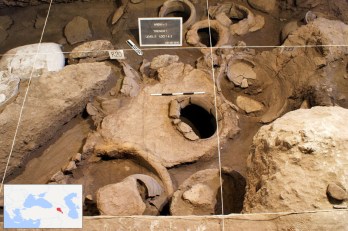 The oldest winery for which archaeological evidence exists was established around BC4100, in present-day Armenia. The Egyptian Pharoahs were producing a wine-like substance from 3100BC for use in public ceremonies, due to its resemblance to blood.
 Sounds like a great job, as Greek Gods go.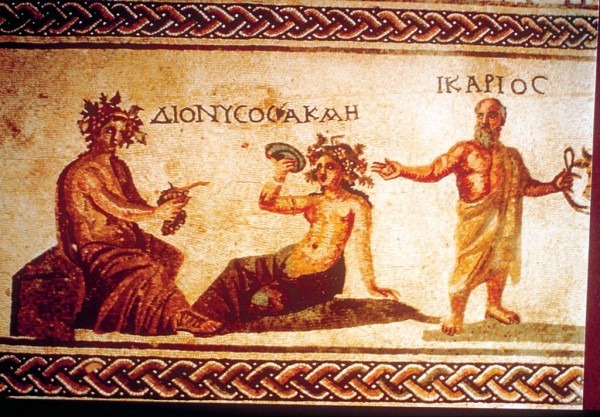
 The legions of Rome expanded the Empire across Europe from modern day France and Germany into Portugal and Spain. Everywhere the Legions went, vineyards were soon to follow. To this day, some regions are said to have more ‘Terroir’, than others.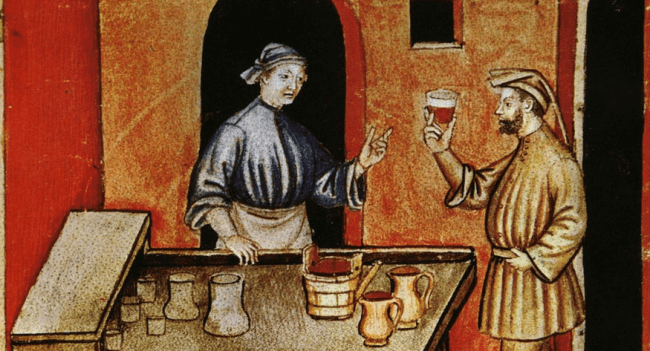
 The story is almost certainly a myth, a later embellishment to the story. During his 47 year career, Pérignon went to considerable lengths to eliminate bubbles from his wine. Dom Pérignon never succeed in that goal, yet he did make bubbly wine a whole lot better, using corks for the first time to prevent the escape of carbon dioxide, and perfecting a ‘gentle’ pressing technique which left out the murkiness of the skins.
 Pérignon didn’t like white grapes because of their tendency to enter refermentation. He preferred the Pinot Noir, and would aggressively prune the plants so that vines grew no higher than three feet and produced a smaller crop. The harvest was always in the cool, damp early morning hours, and Pérignon took every precaution to avoid bruising or breaking his grapes. Over-ripe and overly large fruit was always thrown out. Pérignon never permitted grapes to be trodden upon, always preferring the use of multiple presses.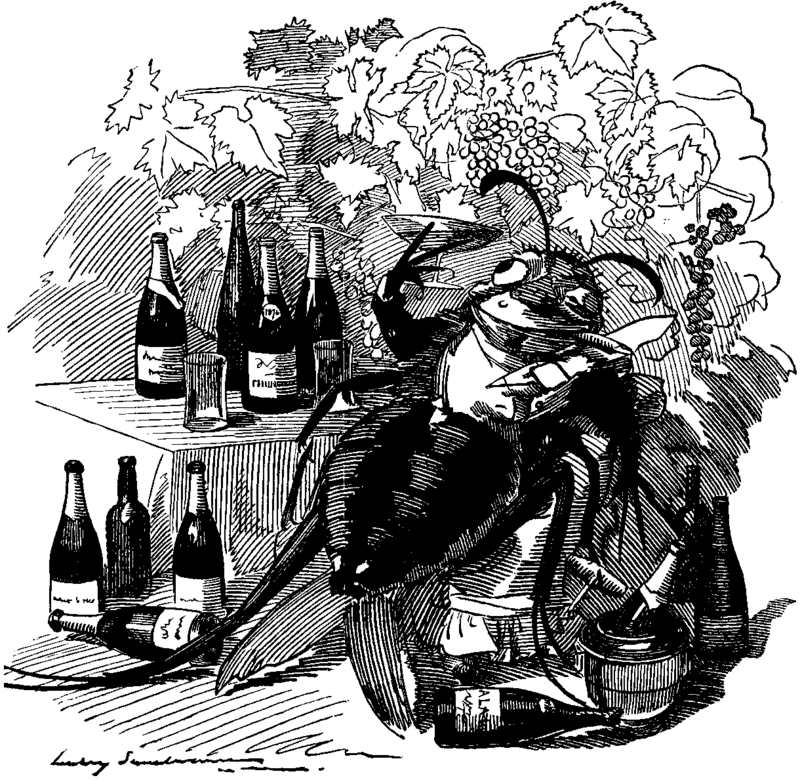



 Massive French losses stemming from the failed Nivelle offensive of that same month (French casualties were fully ten times what was expected) combined with irrational expectations that American forces would materialize on the western front led to massive unrest in the French lines. Fully one-half of all French forces on the western front mutinied. It’s one of the great miracles of WW1 that the German side never knew, else the conflict may have ended, very differently.
 For eighteen months, British miners worked to dig tunnels under Messines Ridge, the German defensive works laid out around the Belgian town of Ypres. Nearly a million pounds of high explosive were placed in some 2,000′ of tunnels, dug 100′ deep. 10,000 German soldiers ceased to exist at 3:10am local time on June 7, in a blast that could be heard as far away, as London.
 “Squire nagged and bullied till I went to fight,


 There would be 5 hours of unarmed, unescorted flight through Nazi-controlled air space and an emergency landing with no brakes, before those V2 rocket components finally made it to England.



 Most such outbreaks coincided with periods of extreme hardship such as crop failure, famine and floods, and involved between dozens and tens of thousands of individuals.
 Even today there is little consensus about what caused the phenomenon. Some have blamed “St Anthony’s Fire”, a toxic and psychoactive fungus of the Claviceps genus, also known as ergot. Often ingested with infected rye bread, symptoms of ergot poisoning are not unlike those of LSD, and include nervous spasms, psychotic delusions, spontaneous abortion, convulsions and gangrene resulting from severe vasoconstriction.


 There is an oft-repeated but mistaken notion that the circus goes back to Roman antiquity. The panem et circenses, (bread and circuses)” of Juvenal, ca AD100, refers more to the ancient precursor of the racetrack, than to anything resembling a modern circus. The only common denominator is the word itself, the Latin root ‘circus’, translating into English, as “circle”.
 These afternoon shows gained overwhelming popularity by 1770, and Astley hired acrobats, rope-dancers, and jugglers to fill the spaces between equestrian events. The modern circus, was born.
 and fear, his demonstrations emphasizing the animal’s intelligence and tractability over ferocity.





 Austrian military history professor Erik Durschmied wrote in his excellent book`

 Stoker wrote in his notes, “in Wallachian language means DEVIL”. In a time and place remembered for near-cartoonish levels of violence, Vlad Țepeș stands out for his extraordinary cruelty. There are tales of Țepeș disemboweling his own mistress. That he collected the noses of vanquished adversaries. Some 24,000 of them. That he dined among forests of victims, spitted on poles. That he even impaled the donkeys they rode in on.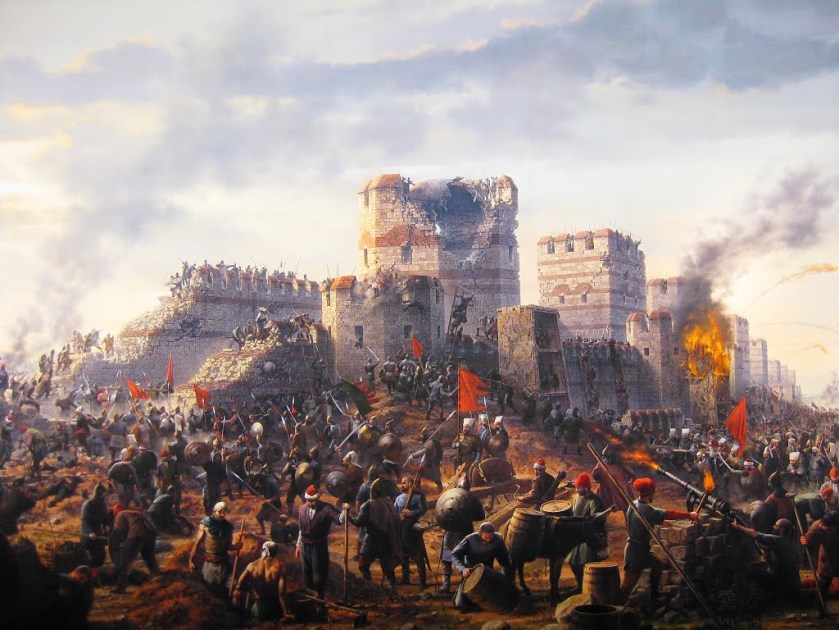
 Outnumbered five-to-one, Ţepeş employed a scorched earth policy, poisoning the waters, diverting small rivers to create marshes and digging traps covered with timber and leaves. He would send sick people among the Turks, suffering lethal diseases such as leprosy, tuberculosis and bubonic plague.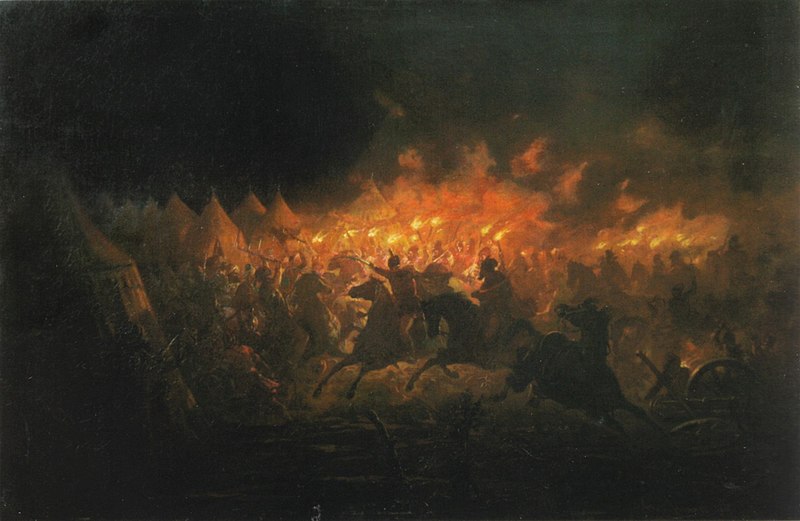

 Historical Easter Eggs - Today in History
You must be logged in to post a comment.