"Tell me a factand I'll learn. Tell me a truth, and I'll believe. But tell me a story, and it will live in my heart forever." – Steve Sabol, NFL Films
Author: Cape Cod Curmudgeon
I'm not an academic "Historian". I'm a father, a son and a grandfather. A history geek and sometimes curmudgeon who still likes to learn new things. I make every effort to get my facts straight but I'm as good at being wrong as the next guy. I offer these stories hoping you'll enjoy them as much as I do. This is the history we all share. I'm glad you're here.
Rick Long, the “Cape Cod Curmudgeon”
Midway between Winter Solstice and Spring Equinox and well before the first crocus of spring has peered out across the frozen tundra, there is a moment of insanity which helps those of us living in northern climes get through to that brief, blessed moment of warmth when the mosquitoes once again have their way with us.
Here on Sunny Cape Cod™, we have a joke about the four seasons. There’s “Almost Winter”, “Winter”, “Still Winter” and “Bridge Construction”.
Midway between Winter Solstice and Spring Equinox and well before the first crocus of spring has peered out across the frozen tundra, there is a moment of insanity which helps those of us living in northern climes get through to that brief, blessed season of warmth when the mosquitoes once again have their way with us.
Groundhog Day.
The ancient Romans observed a mid-season festival on February 5, the pagan Irish on February 1. For Christians, it was February 2, Candlemas day, a Christian holiday celebrating the ritual purification of Mary. For reasons not entirely clear, early Christians believed there would be six more weeks of winter if the sun came out on Candlemas Day.
Clergy would bless and distribute candles needed for winter, their length representing how long and cold the winter would be. Germans expanded on the idea by selecting an animal, a hedgehog, as a means of predicting weather. Once a suitable number of Germans had come to America, they switched over to a more local rodent: Marmota monax. The common Groundhog.Groundhogs hibernate for the winter, an ability some people of my acquaintance, would love to master. During that time, the animal’s heart rate drops from 80 beats per minute to 5 as the slumbering rodent lives off stored body fat. Another ability some of us could learn to appreciate, very much.
The male couldn’t care less about the weather; he comes out of his burrow in February in search of a mate. If uninterrupted, he will fulfill his groundhog mission of love and return to earth, not coming out for good until sometime in March.But then there is the amorous woodchuck’s worst nightmare in a top hat, the groundhog hunter.
Groundhogs are something of a regional delicacy, said to taste like a cross between pork, and chicken. In the 1880s, groundhog hunters hosted annual Groundhog day festivals in addition to summer hunts, followed by picnics featuring steaming dishes like Country-Style Groundhog, Groundhog and Sweet Potatoes and Waco Groundhog in Sour Cream, all of it washed down with “groundhog punch” consisting ofvodka, milk, eggs, orange juice “and other ingredients.” Yumm.
One group of groundhog hunters in Punxsutawney, Pennsylvania, imaginatively called themselves the Punxsutawney Groundhog Club. One of them, a newspaper editor, declared on February 2, 1887, that their groundhog “Punxsutawney Phil, Seer of Seers, Sage of Sages, Prognosticator of Prognosticators, and Weather Prophet Extraordinary“, was the only true weather forecasting rodent.There are those who would dispute the Gobbler’s Knob crowd and their claims to Punxsutawney Phil’s weather forecasting prowess. Alabama has “Birmingham Bill”, and Canada has Shubenacadie Sam. New York can’t seem to decide between Staten Island Chuck and New York City’s very own official groundhog, “Pothole Pete”.
Today, Phil himself is no longer on the menu. Groundhog punch has given way to a magic elixir said to give Punxatawney’s hundred-year-old rodent, seven more years of life. Since 2010, Punxatawney Faithful can get text message alerts concerning the prognostications of their favorite rodent. (Text “Groundhog” to 247365, if you’re interested).
There is no word for groundhog in Arabic. Accounts of this day in the Arab press translate the word as جرذ الأرض or, “Ground Rat”. If that’s not enough to make us all the life of the party, I don’t know what is.
If anyone were to bend down and ask Mr. Ground Rat his considered opinion on the matter, he would probably cast a pox on all our houses. It’s been a long winter. Mr. Ground Rat’s all dressed up for a date. He has other things on his mind.
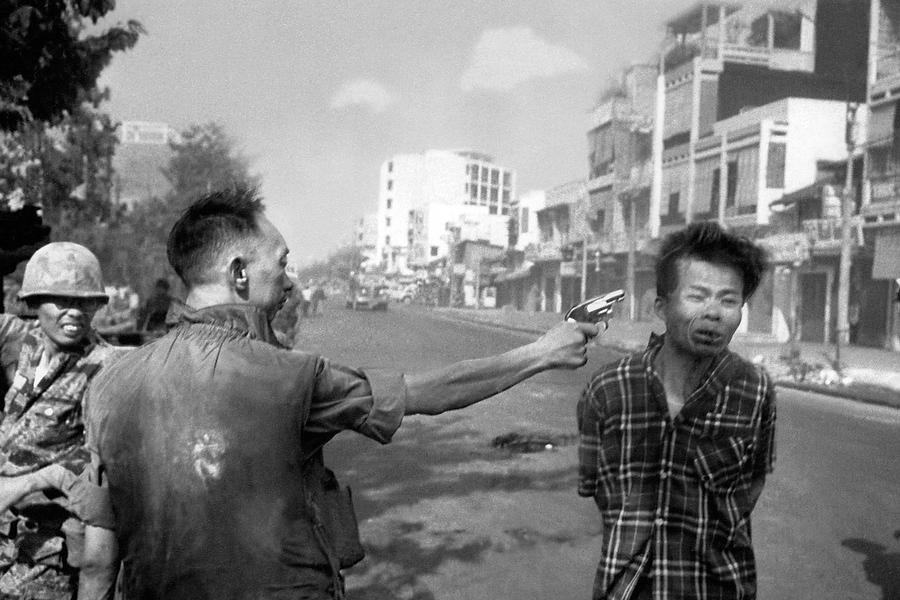
Years later the photographer wrote in Time Magazine. ‘The general killed the Viet Cong; I killed the general with my camera. Still photographs are the most powerful weapon in the world. People believe them, but photographs do lie, even without manipulation.
During WW2, the average infantry soldier saw 40 days of combat, in 4 years. In Vietnam, the average combat infantryman saw 240 days of combat, in a year.
By 1967, the Johnson administration was coming under increasing criticism, for what many of the American public saw as an endless and pointless stalemate in Vietnam.
Opinion polls revealed an increasing percentage believed it was a mistake to send more troops into Vietnam, their number rising from 25% in 1965, to 45% by December, 1967.
The Johnson administration responded with a “success offensive”, emphasizing “kill ratios” and “body counts” of North Vietnamese and Viet Cong fighters. Vice President Hubert Humphrey stated on NBC’s Today Show that November, “We are on the offensive. Territory is being gained. We are making steady progress.”
In Communist North Vietnam, the massive battlefield losses of 1966-’67 combined with the economic devastation wrought by US Aerial bombing, causing moderate factions to push for peaceful coexistence with the south. More radical factions favoring military reunification on the Indochina peninsula, needed to throw a “hail Mary” pass. Plans for a winter/spring offensive began, in early 1967. By the New Year, some 80,000 Communist fighters had quietly infiltrated the length and breadth of South Vietnam.One of the largest military operations of the war launched on January 30, 1968, coinciding with the Tết holiday, the Vietnamese New Year. In the first wave of attacks, North Vietnamese troops and Viet Cong Guerillas struck over 100 cities and towns including Saigon, the South Vietnamese capitol.
Initially taken off-guard, US and South Vietnamese forces regrouped and beat back the attacks, inflicting heavy losses on North Vietnamese forces. The month-long battle for Huế (“Hway”) uncovered the massacre of as many as 6,000 South Vietnamese by Communist forces, 5-10% of the entire city. Fighting continued for over two months at the US combat base at Khe Sanh.While the Tết offensive was a military defeat for the forces of North Vietnam, the political effects on the American public, were profound. Support for the war effort plummeted, leading to demonstrations. Jeers could be heard in the streets. “Hey! Hey! LBJ! How many kids did you kill today?”Lyndon Johnson’s Presidency, was finished. The following month, Johnson appeared before the nation in a televised address, saying “I shall not seek, and I will not accept, the nomination of my party for another term as your president.”
In the early morning darkness of February 1, 1968, Nguyễn Văn Lém led a Viet Cong sabotage unit in an assault on the Armor base in Go Vap. After taking control of the camp, Nguyễn arrested Lieutenant Colonel Nguyen Tuan with his family, demanding the officer show his guerrillas how to drive tanks. The officer refused and the Viet Cong slit his throat, along with those of his wife, six children and his 80-year-old mother.
The only survivor was a grievously injured, 10-year-old boy.
Nguyễn himself was captured later that morning, near the mass grave of 34 civilians. He said he was “proud” to have carried out orders to kill them.AP photographer Eddie Adams was out on the street with NBC News television cameraman Võ Sửu, looking for something interesting. The pair saw a group of South Vietnamese soldiers dragging what appeared to be an ordinary man into the road, and filmed the event.
Adams “…followed the three of them as they walked towards us, making an occasional picture. When they were close – maybe five feet away – the soldiers stopped and backed away. I saw a man walk into my camera viewfinder from the left. He took a pistol out of his holster and raised it. I had no idea he would shoot. It was common to hold a pistol to the head of prisoners during questioning. So I prepared to make that picture – the threat, the interrogation. But it didn’t happen. The man just pulled a pistol out of his holster, raised it to the VC’s head and shot him in the temple. I made a picture at the same time.”
Composite sequence published by the Dolph Briscoe Center for American History of the University of Texas, at Austin.
The man with the pistol was Nguyễn Ngọc Loan, Chief of the National Police. Loan had personally witnessed the murder of one of his own officers, along with the man’s wife and three small children.
Nguyễn Văn Lém was the perpetrator of major war crimes. He was out of uniform and not involved in combat when he murdered the General’s own subordinates and their families. The man was a war criminal and terrorist with no protections under the Geneva Conventions, legally eligible for summary execution.
Photo credit, Eddie Adams, Associated Press
Loan drew his .38 Special Smith & Wesson “Bodyguard” revolver and fired. The execution was barely a blip on the man’s radar screen.
Photo credit, Eddie Adams, Associated Press
Loan was a devoted Patriot and South Vietnamese Nationalist. An accomplished pilot who had led an airstrike on Việt Cộng forces at Bo Duc in 1967, Loan was loved and admired by his soldiers.
In February 1968, hard fighting yet remained to retake the capitol. As always, Nguyễn Ngọc Loan was leading from the front when a machine gun burst tore into his leg.
Meanwhile, Adams’ “Saigon Execution” photograph and Võ’s film footage made their way into countless papers and news broadcasts. With events thus stripped of context, General Nguyễn came to be seen as a bloodthirsty, sadistic killer, the Viet Cong terrorist his unarmed, innocent victim.
Adams was well on his way to winning a Pulitzer prize for that photograph, while an already impassioned anti-war movement, lost the faculty of reason.
The political outcry reached all the way to Australia, where General Nguyễn was recuperating from his amputation. Australian hospitals refused the man treatment and he traveled to America, to recover.
The Watergate scandal burst on the scene in 1972 as American politics looked inward. The Nixon administration sought the “Vietnamization” of the war. By January 1973, direct US involvement in the war in Southeast Asia, had come to an end.
Military aid to South Vietnam was $2.8 billion in fiscal year 1973. The United States Congress placed a Billion dollar ceiling on that number the following year, cutting that to $300 million, in 1975. The Republic of Vietnam collapsed, some fifty-five days later.
Scenes from the final evacuation of Saigon
General Nguyễn had been forced to flee the nation he had served. American immigration authorities sought deportation on his arrival, in part because of Eddie Adams’ picture. The photographer was recruited to testify against the General, but Adams spoke on his behalf.
Nguyễn was permitted to stay. He and his wife opened a pizza shop in the Rolling Valley Mall of Virginia, “Les Trois Continents”. The restaurant thrived for a time, until word got out about the owner’s identity. Knowing nothing about Nguyễn except for that image, locals began to make trouble. Business plummeted as the owner was assaulted in his own restaurant, his life threatened. The last time Adams visited Nguyễn’s pizza shop, the words “We know who you are, fucker“, were scrawled across a toilet wall.The couple was forced to close the restaurant in 1991. Nguyễn Ngọc Loan died of cancer, seven years later.
Eddie Adams won his Pulitzer in 1969 but came to regret that he had ever taken that picture. Years later the photographer wrote in Time Magazine. ‘The general killed the Viet Cong; I killed the general with my camera. Still photographs are the most powerful weapon in the world. People believe them, but photographs do lie, even without manipulation. They are only half-truths. What the photograph didn’t say was, “What would you do if you were the general at that time and place on that hot day, and you caught the so-called bad guy after he blew away one, two or three American soldiers?”‘
Before Nguyễn died, Adams apologized to the General and his family, for what that image had done to the man’s reputation. “The guy was a hero”, he said, after his death. “America should be crying. I just hate to see him go this way, without people knowing anything about him.”
From the Civil War to this day, the execution of Private Slovik was the only time a death sentence was carried out for the crime of desertion.
When he was little, his neighbors must have thought he was a bad kid. His first arrest came at age 12, when he and some friends were caught stealing brass from a foundry. There were other episodes between 1932 and ’37: petty theft, breaking & entering, and disturbing the peace. He was sent to prison in 1939, for stealing a car.
Edward Donald “Eddie” Slovik was paroled in 1942, his criminal record rendering him 4F. “Registrant not acceptable for military service”. He took a job at the Montella Plumbing & Heating company in Dearborn, Michigan, where he met bookkeeper Antoinette Wisniewski, the woman who would later become his wife.
There the couple may have ridden out WWII, but the war was consuming manpower at a rate unprecedented in history. Shortly after the couple’s first anniversary, Slovik was re-classified 1A, fit for service, and drafted into the Army. Arriving in France on August 20, 1944, he was part of a 12-man replacement detachment, assigned to Company G of the 109th Infantry Regiment, US 28th Infantry Division.
Slovik and a buddy from basic training, Private John Tankey, became separated from their detachment during an artillery attack and spent the next six weeks with Canadian MPs. It was around this time that Private Slovik decided he “wasn’t cut out for combat”.
The rapid movement of the army during this period caused difficulty for many replacements attempting to find their units. Edward Slovik and John Tankey finally caught up with the 109th on October 7. The following day, Slovik asked his company commander Captain Ralph Grotte for reassignment to a rear unit, saying he was “too scared” to be part of a rifle company. Grotte refused, confirming that, were he to run away, such an act would constitute desertion.
And desert, he did. Eddie Slovik left his unit on October 9, despite Private Tankey’s protestations that he should stay. “My mind is made up”, he said. Slovik walked several miles until he found an enlisted cook, to whom he presented the following note.
“I, Pvt. Eddie D. Slovik, 36896415, confess to the desertion of the United States Army. At the time of my desertion we were in Albuff [Elbeuf] in France. I came to Albuff as a replacement. They were shelling the town and we were told to dig in for the night. The following morning they were shelling us again. I was so scared, nerves and trembling, that at the time the other replacements moved out, I couldn’t move. I stayed there in my fox hole till it was quiet and I was able to move. I then walked into town. Not seeing any of our troops, so I stayed over night at a French hospital. The next morning I turned myself over to the Canadian Provost Corp. After being with them six weeks I was turned over to American M.P. They turned me loose. I told my commanding officer my story. I said that if I had to go out there again I’d run away. He said there was nothing he could do for me so I ran away again AND I’LL RUN AWAY AGAIN IF I HAVE TO GO OUT THERE. — Signed Pvt. Eddie D. Slovik A.S.N. 36896415”.
Slovik was repeatedly ordered to tear up the note and rejoin his unit, and there would be no consequences. Each time, he refused. The stockade didn’t scare him. He’d been in prison before and it was better than the front lines. Beside that, he was already an ex-con. A dishonorable discharge was hardly going to change anything in an already dim future. Finally, instructed to write a second note on the back of the first acknowledging the legal consequences of his actions, Eddie Slovik was taken into custody.
1.7 million courts-martial were held during WWII, 1/3rd of all the criminal cases tried in the United States during the period. The death penalty was rarely imposed. When it was, it was almost always in cases of rape or murder.
2,864 US Army personnel were tried for desertion between January 1942 and June 1948. Courts-martial handed down death sentences to 49 of them, including Eddie Slovik. Division commander Major General Norman Cota approved the sentence. “Given the situation as I knew it in November, 1944,” he said, “I thought it was my duty to this country to approve that sentence. If I hadn’t approved it–if I had let Slovik accomplish his purpose–I don’t know how I could have gone up to the line and looked a good soldier in the face.”
On December 9, Slovik wrote to Supreme Allied Commander Dwight D. Eisenhower, pleading for clemency. Desertion was a systemic problem at this time. Particularly after the surprise German offensive coming out of the frozen Ardennes Forest on December 16, an action that went into history as the Battle of the Bulge. Eisenhower approved the execution order on December 23, believing it to be the only way to discourage further desertions.
His uniform stripped of all insignia with an army blanket draped over his shoulders, Slovik was brought to the place of execution near the Vosges Mountains of France. “They’re not shooting me for deserting the United States Army”, he said, “thousands of guys have done that. They just need to make an example out of somebody and I’m it because I’m an ex-con. I used to steal things when I was a kid, and that’s what they are shooting me for. They’re shooting me for the bread and chewing gum I stole when I was 12 years old.”
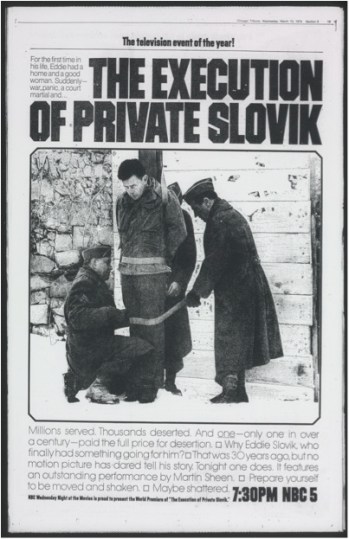
Movie poster from the film: “The Execution of Private Slovik”
Army Chaplain Father Carl Patrick Cummings said, “Eddie, when you get up there, say a little prayer for me.” Slovik said, “Okay, Father. I’ll pray that you don’t follow me too soon”. Those were his last words. A soldier placed the black hood over his head. The execution was carried out by firing squad. It was 10:04am local time, January 31, 1945.
Edward Donald Slovik was buried in Plot E of the Oise-Aisne American Cemetery, his marker bearing a number instead of his name. Antoinette Slovik received a telegram informing her that her husband had died in the European Theater of the war and a letter, instructing her to return a $55 allotment check. She wouldn’t learn about the execution for another nine years.
In 1987, President Ronald Reagan ordered the repatriation of Slovik’s remains. He was re-interred at Detroit’s Woodmere Cemetery next to Antoinette who had gone to her final rest, eight years earlier.
In all theaters of WWII, the United States military executed 102 of its own, almost always for the unprovoked rape and/or murder of civilians. From the Civil War to this day, the execution of Private Slovik was the only time a death sentence was carried out for the crime of desertion. At least one member of the tribunal which condemned him to death, would come to see it as a miscarriage of justice.
Nick Gozik of Pittsburg passed away in 2015, at the age of 95. He was there in 1945, a fellow soldier called to witness the execution. “Justice or legal murder”, he said, “I don’t know, but I want you to know I think he was the bravest man in that courtyard that day…All I could see was a young soldier, blond-haired, walking as straight as a soldier ever walked. I thought he was the bravest soldier I ever saw.”
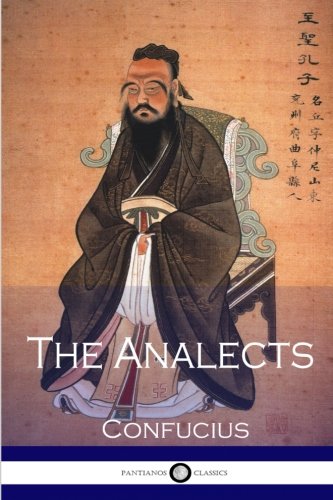
The Confucian maxim may have crossed from China to Japan with a Tendai-Buddhist legend, sometime around the 8th century. Up to this time, the story had nothing to do with monkeys.
The Analects of Confucius is a written record of the sayings of the philosopher and his contemporaries, compiled between 475 and 221BC.
In it, a follower called Yen Yüan asked the Master about perfect virtue.

Confucius answered, “To subdue one’s self and return to propriety, is perfect virtue. If a man can for one day subdue himself and return to propriety, all under heaven will ascribe perfect virtue to him”.
“I beg to ask the steps of that process”, asked the student. Confucius replied, “Look not at what is contrary to propriety. Listen not to what is contrary to propriety. Speak not what is contrary to propriety. Make no movement which is contrary to propriety”.
Even in the age of Confucius, this was an ancient idea. Zarathrusta, also known as Zoroaster is in some respects the father of the world’s first monotheistic religion. It was sometime around 1200BC when Zoroaster taught his followers on the high Iranian Plateau “Humata, Hukhta, Hvarshta”. Good Thoughts, Good Words, Good Deeds.
The Confucian maxim may have crossed from China to Japan with a Tendai-Buddhist legend, sometime around the 8th century. Up to this time, the story had nothing to do with monkeys.In medieval Japanese, mi-zaru, kika-zaru, and iwa-zaru translate as “don’t see, don’t hear, and don’t speak”, –zaru being an archaic negative verb conjugation and pronounced similarly to “saru”, the word for monkey.
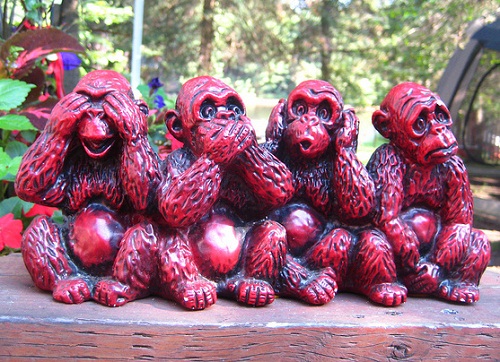
The visual play on words then, depicts Iwazaru covering his mouth, Kikazaru covering his ears and Mizaru covering his eyes.
Though it’s unusual to see him anymore, there is a fourth monkey. Shizaru is generally depicted with his arms crossed or covering his privates, his name variously translated as “do no evil”, or “know no evil”.The first known depiction of the “Three Mystic Apes” appears over the doors of the Tōshō-gū shrine in Nikkō, Japan, carved sometime in the 17th century.Mohandas Karamchand Gandhi was a Hindu lawyer, a member of the merchant caste from coastal Gujarat, in western India. Today he is known by the honorific “Mahatma”, from Gandhithe Sanskrit meaning “high-souled”, or “venerable”.

Ghandi is recognized as the Father of modern India, who brought Independence to his nation through non-violent protest. Mohandas Gandhi lived a life of poverty and simplicity, owning almost no material possessions at the time of his assassination at the hands of Hindu nationalist Nathuram Vinayak Godse on January 30, 1948.
Beside the clothes on his back, Gandhi owned a tin cup and a spoon, a pair of sandals, his spectacles and a set of three carved monkeys. A reminder to the high-souled one to hear no evil, see no evil, and speak no evil.
This weekend, Superbowl LIV will be played at the Hard Rock Stadium in Miami Gardens Florida, in front of an expected crowd of 65,326. In 1938, forty-five times that number were mobilized in the first four days alone, primarily children, relocated from cities and towns across Great Britain to the relative safety of the countryside.
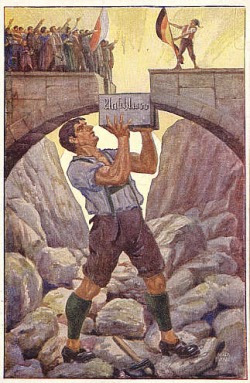
Nazi propaganda depicting German “Anschluss” with Austria
Intent on avoiding war with Nazi Germany, Italy, France and Great Britain convened in Munich in September 1938, to resolve German claims on western Czechoslovakia. The “Sudetenland”. Representatives of the Czech and Slovak peoples, were not invited.
For the people of the modern Czech Republic, the Munich agreement was a betrayal. “O nás bez nás!” “About us, without us!”
On September 30, British Prime Minister Neville Chamberlain returned to London declaring “Peace in Our Time”. The piece of paper Chamberlain held in his hand bore the signatures of Adolf Hitler, Benito Mussolini and Édouard Daladier as well as his own, annexing enormous swaths of the Sudetenland, to Nazi Germany.
To Winston Churchill, the Munich agreement was an act of appeasement. Feeding the proverbial crocodile (Hitler), in hopes that he will eat you last.
For much of Great Britain, the sense of relief was palpable. In the summer of 1938, the horrors of the Great War were a mere twenty years in the past. Hitler swallowed up Austria only six months earlier as British planners divided the home islands into “risk zones”: “Evacuation,” “Neutral,” and “Reception.”
In some of the most gut wrenching decisions of the age, these people were planning the evacuation of millions of their own children, in the event of war. “Operation Pied Piper”
When Nazi Germany invaded Poland the following September, London Mayor Herbert Morrison was at 10 Downing Street, meeting with Chamberlain’s aide, Sir Horace Wilson. Morrison believed that the time had come for Operation Pied Piper. Only a year to the day from the Prime Minister’s “Peace in our Time” declaration, Wilson protested. “But we’re not at war yet, and we wouldn’t want to do anything to upset delicate negotiations, would we?”
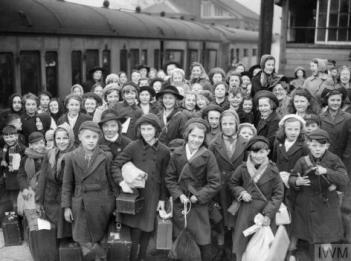
Morrison was done with the Prime Minister’s dilatory response to Hitler’s aggression, practically snarling in his thick, East London accent “Look, ’Orace, go in there and tell Neville this from me: If I don’t get the order to evacuate the children from London this morning, I’m going to give it myself – and tell the papers why I’m doing it. ’Ow will ’is nibs like that?”
Thirty minutes later, Morrison had the document. The evacuation, had begun.
This weekend, Superbowl LIV will be played at the Hard Rock Stadium in Miami Gardens Florida, in front of an expected crowd of 65,326. In 1938, forty-five times that number were mobilized in the first four days alone, primarily children, relocated from cities and towns across Great Britain to the relative safety of the countryside.
BBC History reported that, “within a week, a quarter of the population of Britain would have a new address”. Imagine for a moment, what that looked like. What that sounded like.
This was no mindless panic. Zeppelin raids had killed 1,500 civilians in London alone during the ‘Great War’. Since then, governments had become infinitely better at killing each other’s citizens.
As early as 1922, Prime Minister Lord Arthur Balfour had spoken of ‘unremitting bombardment of a kind that no other city has ever had to endure.’ As many as four million civilian casualties were predicted, in London alone.
BBC History describes the man in charge of the evacuation, Sir John Anderson, as a “cold, inhuman character with little understanding of the emotional upheaval that might be created by evacuation”.
Children were labeled ‘like luggage’, and sent off with gas masks, toothbrushes and fresh socks & underwear. None of them had the slightest idea of where, or for how long.
All things considered, the evacuation of all that humanity ran relatively smoothly. James Roffey, founder of the Evacuees Reunion Association, recalls ‘We marched to Waterloo Station behind our head teacher carrying a banner with our school’s name on it. We all thought it was a holiday, but the only thing we couldn’t work out was why the women and girls were crying.’
Arrivals at the billeting areas, were another matter. Many kids were shipped off to the wrong places, and rations were insufficient. Geoffrey Barfoot, billeting officer in the seaside town of Weston-super-Mare, said ‘The trains were coming in thick and fast. It was soon obvious that we just didn’t have the bed space.’
Kids were lined up against walls and on stages, and potential hosts were invited to “take their pick”.
For many, the terrors and confusion of those first few days grew into love and friendships, which lasted a lifetime. Others entered a hell of physical and/or sexual abuse, or worse.
\
For the first time, “city kids” and country folks were finding out how the “other half” lived, with sometimes amusing results. One boy wrinkled his nose on seeing carrots pulled out of muddy fields, saying “Ours come in tins”. Richard Singleton recalled the first time he asked his Welsh ‘foster mother’ for directions to the toilet. “She took me into a shed and pointed to the ground. Surprised, I asked her for some paper to wipe our bums. She walked away and came back with a bunch of leaves.”
John Abbot, evacuated from Bristol, had his rations stolen by his host family. He was horsewhipped for speaking out while they enjoyed his food while he himself was given nothing more than mashed potatoes. Terri McNeil was locked in a birdcage and left with a piece of bread and a bowl of water.
In the 2003 BBC Radio documentary “Evacuation: The True Story,” clinical psychologist Steve Davis described the worst cases, as “little more than a pedophile’s charter.”
Eighty-odd years later, the words “I’ll take that one”, are seared into the memories of more than a few.
Hundreds of evacuees were killed because of relocation, while en route or during stays at “safe havens”. Two boys were killed on a Cornish beach, mined to defend against German amphibious assault.
Apparently, no one had thought to put up a sign.
Irene Wells, age 8, was standing in a church doorway when she was crushed by an army truck. One MP from the house of Commons said “There have been cases of evacuees dying in the evacuation areas. Fancy that type of news coming to the father of children who have been evacuated”.
When German air raids failed to materialize, many parents decided to bring the kids back home. By January 1940, almost half of evacuees had returned.
Authorities produced posters urging parents to leave the kids where they were and a good thing, too. The Blitz against London itself began on September 7. The city experienced the most devastating attack to-date on December 29, in a blanket fire-bombing that killed almost 3,600 civilians.
Sometimes, refugees from relatively safe locations were shipped into high-risk target areas. Hundreds of refugees from Gibraltar were sent into London, in the early days of the Blitz. None of them could have been happy to leave London Station, to see hundreds of locals pushing past them, hurrying to get out.
This story doesn’t only involve the British home islands, either. American Companies like Hoover and Eastman Kodak took thousands of children in, from employees of British subsidiaries. Thousands of English women and children were evacuated to Australia, following the Japanese attack on Singapore.
By October 1940, the “Battle of Britain” had devolved into a mutually devastating battle of attrition in which neither side was capable of striking the death blow. Hitler cast his gaze eastward the following June, with a surprise attack on his “ally”, Josef Stalin.
“Operation Steinbock”, the Luftwaffe’s last large-scale strategic bombing campaign of the war against southern England, was carried out three years later. On this day in 1944, 285 German bombers attacked London in what the Brits called, a “Baby Blitz”.
You’d have to be some tough cookie to call 245 bombers, a Baby Blitz.Late in the war, the subsonic “Doodle Bug” or V1 “flying bomb” was replaced by the terrifying supersonic V2. 1,000 or more of these, the world’s first rocket, were unleashed against southern England, primarily London, killing or wounding 115,000. With a terminal velocity of 2,386mph, you never saw or heard this thing coming, until the weapon had done its work.
In the end, many family ‘reunions’ were as emotionally bruising as the original breakup. Years had come and gone and new relationships had formed. The war had turned biological family members, into all but strangers.
Richard Singleton remembers the day his mother came, to take him home to Liverpool. “I had been happily living with ‘Aunty Liz and Uncle Moses’ for four years,” he recalled. “I told Mam that I didn’t want to go home. I was so upset because I was leaving and might never again see aunty and uncle and everything that I loved on the farm.”
Douglas Wood tells a similar story. “During my evacuation I had only seen my mother twice and my father once. On the day that they visited me together, they had walked past me in the street as they did not recognize me. I no longer had a Birmingham accent and this was the subject of much ridicule. I had lost all affinity with my family so there was no love or affection.”
The Austrian-British psychoanalyst Anna Freud, daughter of Sigmund Freud, commissioned an examination of the psychological effects of the separation. After a 12-month study, Freud concluded that “separation from their parents is a worse shock for children than a bombing.”
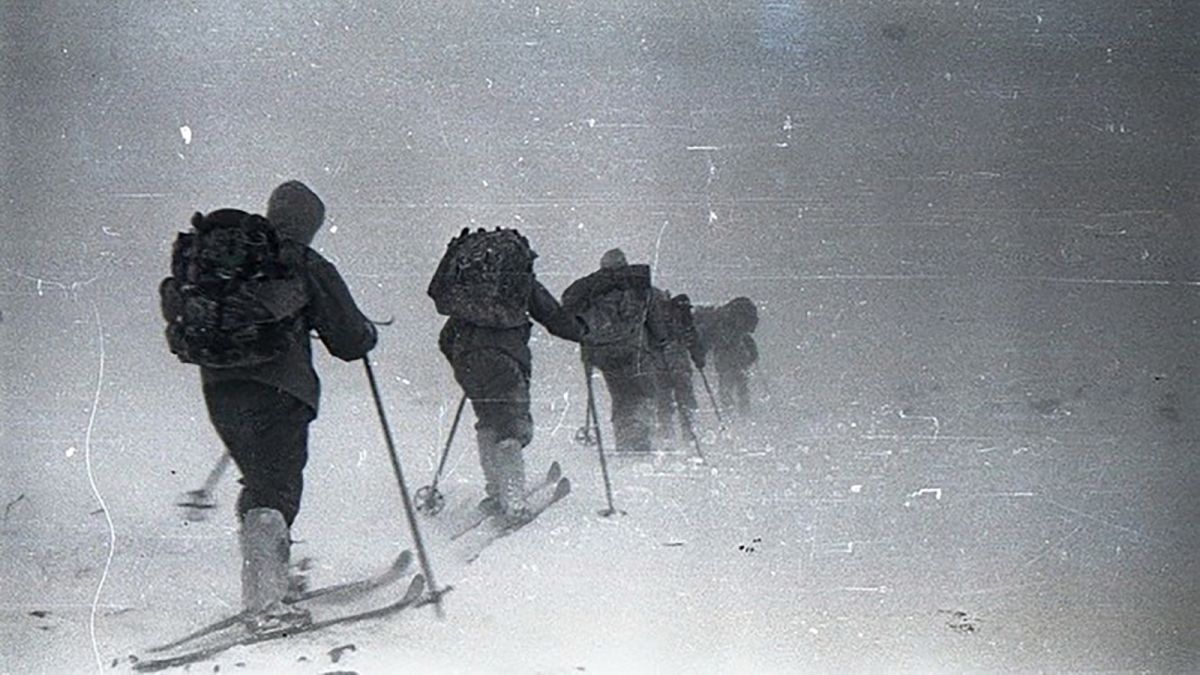
Their bodies were found under a large Siberian Pine, broken branches up to thirty feet suggesting that someone had climbed the thing, to look around. Or to get away from something.
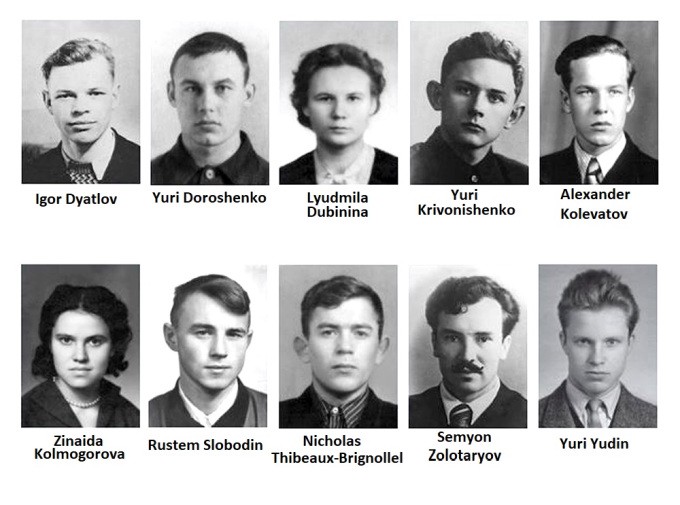
In the world of mountaineering, climbers assign a grade to a boulder or climbing route, describing the degree of difficulty and danger, in the ascent. The group assembled in January 1959 were experienced Grade II hikers, off on a winter trek which would earn them a Grade III certification, upon their safe return. They were ten in number, colleagues from the Ural Polytechnic Institute in Sverdlovsk (now Yekaterinburg) Russia, bent on conquering Mount Otorten, in the northern Ural Mountains.The Northern Ural is a remote and frozen place, the Ural Mountains forming the barrier between the European and Asian continents and ending in an island chain, in the Arctic Ocean. Very few live there, mostly a small ethnic minority called the Mansi people.

In the Mansi tongue, Otorten translates as “Don’t Go There”.
No matter. This was going to be an adventure.The eight men and two women made it by truck as far as the tiny village of Vizhai, on the edge of the wilderness. There the group learned the ancient and not a little frightening tale of a group of Mansi hunters, mysteriously murdered on what came to be called “Dead Mountain”.
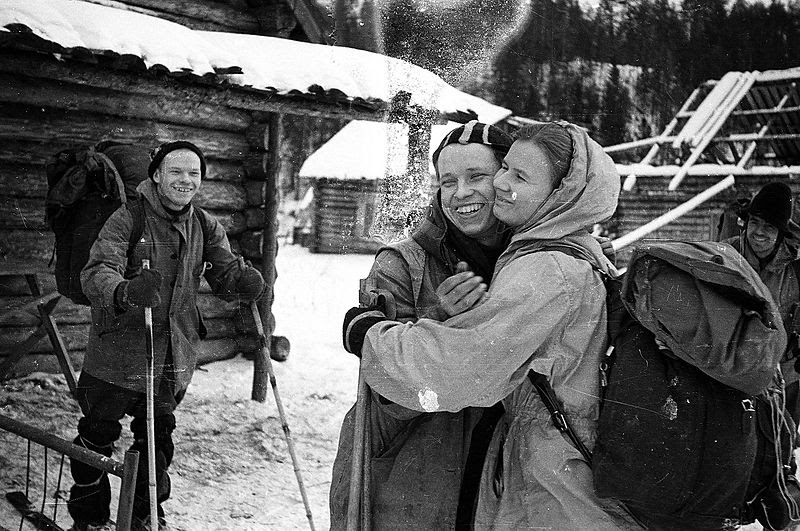
Nothing like a good, scary mystery when you’re heading into the woods. Right?On January 28, Yuri Yudin became ill, and had to back out of the trek. The other nine agreed to carry on. None of them knew at the time. Yudin was about to become the sole survivor of a terrifying mystery.
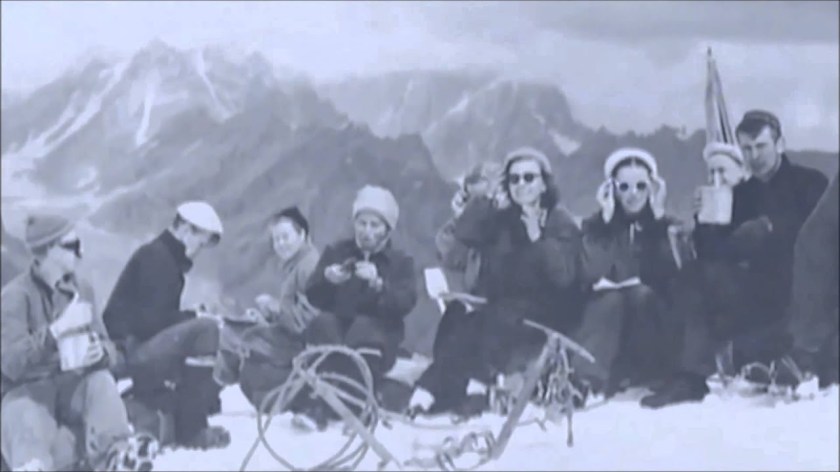
The leader of the expedition, Igor Dyatlov, left word that he expected to return, on February 12. The day came and went with no sign of the group but, no big deal. It was common enough to come back a few days late, from the frozen wilds of the Ural Mountains.By February 20. friends and relatives were concerned Something was wrong. Rescue expeditions were assembled, first from students and faculty of the Ural Polytechnic Institute and later by military and local police.
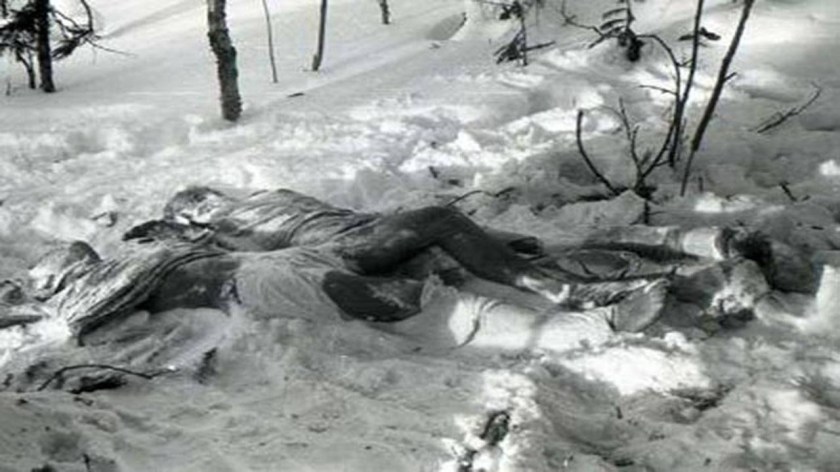
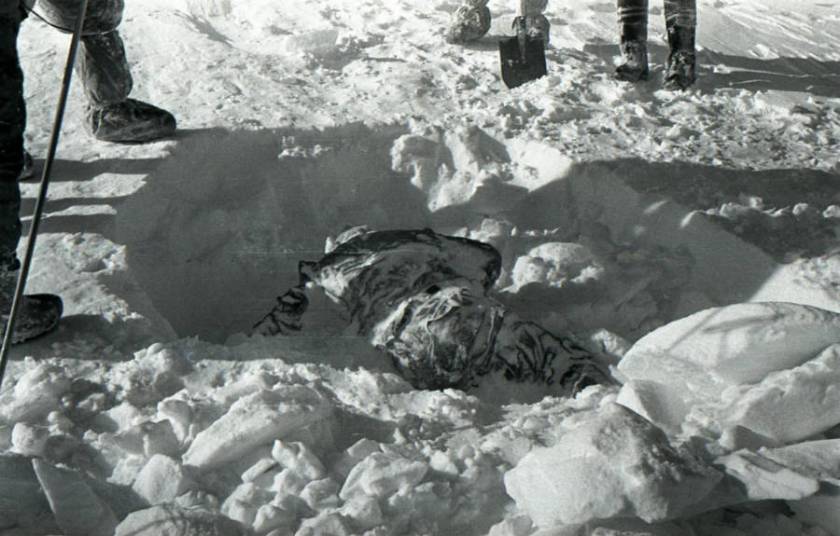
There were airplanes and helicopters, and skiers on the ground. On February 26, searchers found an abandoned tent on the flanks of Kholat Syakhl. Dead Mountain.
Mikhail Sharavin, the student who found the tent, described the scene: “the tent was half torn down and covered with snow. It was empty, and all the group’s belongings and shoes had been left behind.” The tent was cut up the back from the inside, eight or nine sets of footprints in the snow, leading away some 1,600 feet until disappearing, under a fresh fall of snow.
“A view of the tent as the rescuers found it on 26 February 1959: the tent had been cut open from inside, and most of the skiers had fled in socks or barefoot”.
Despite winter temperatures of -13° to -30° Fahrenheit, most of these prints showed feet clad only in socks. Some were barefoot. One had a single shoe. Two bodies were found clad only in underwear, those of Yuri (Georgiy) Krivonischenko and Yuri Doroshenko, near the remains of a small fire.
Their bodies were found under a large Siberian Pine, broken branches up to thirty feet suggesting that someone had climbed the thing, to look around. Or perhaps to get away?Three more bodies were found leading back to the tent, frozen in postures suggesting they were trying to return. Medical investigators examined the bodies. One, that of Rustem Slobodin showed a small skull fracture, probably not enough to threaten his life. Cause of death was ruled, hypothermia.
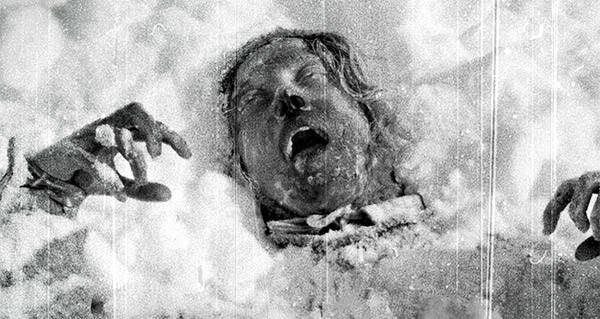
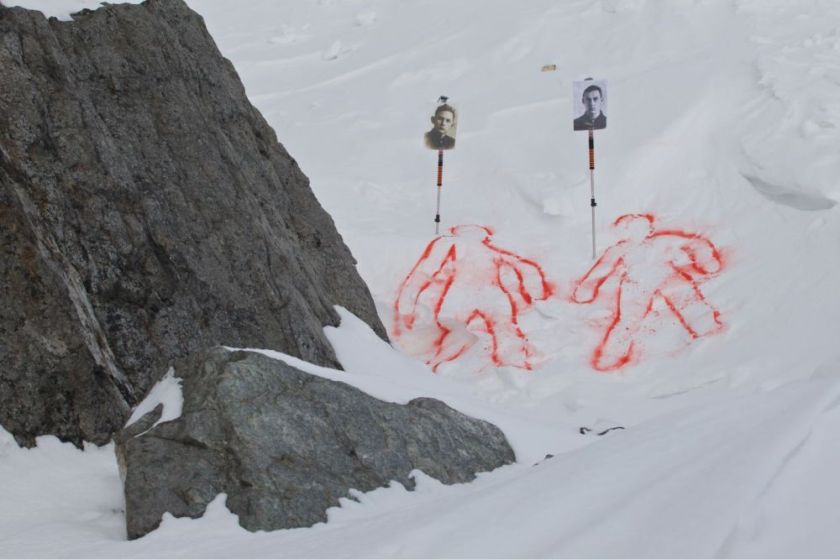
It took two more months to find the last four bodies, buried under twelve feet of snow some 75-feet away. These were better dressed than the other five, indicating they were already outside when something went wrong. The condition of these last four, would change this whole story. There were unexplained traces of radiation on their clothes. The body of Nikolai Thibeaux-Brignolles showed massive skull fractures, with no external injury. Lyudmila Dubinina and Semyon (Alexander) Zolotaryov showed extensive chest fractures, as if hit by a car. Again, there were no external injuries. Both were missing their eyes. Dubinina was missing her tongue, and part of her face.With volumes of questions and no answers, the inquiry was closed in May, 1959. Cause of death was ruled “A spontaneous force which the hikers were unable to overcome“. Dead Mountain was ruled off limits, the files marked confidential. Case closed.
“A spontaneous force which the hikers were unable to overcome“.
Explanations have been offered from the mundane to the supernatural, but none made sense. Mansi hunters had killed them for encroaching on their territory. Except, there were no other footprints. This was the work of a Menk, a mythical Siberian Yeti, or an avalanche, or a super-secret parachute mine exercise, carried out by the Soviet military. There were reports of orange glowing orbs, in the sky. Some believe it was aliens.
How nine experienced mountaineers got caught out in a frozen wilderness or why their tent was cut from the inside, remains a mystery. Missing eyes and tongues may be explained away by small animals. Maybe. The massive internal injuries suffered by three of the victims, defy explanation. The place where it all happened has come to be known as Dyatlov Pass. What happened in that place remains an enigma, to this day.
Five children had already died by January 25, while Dr. Welch suspected more in the remote native camps. A telegram went out and an Anchorage hospital came up with 300,204 units of serum. Enough for 30 patients. A million units would be needed but this might be enough to stave off an epidemic until the larger shipment arrived, in February.
Diphtheria is a highly contagious infection caused by the bacterium Corynebacterium diphtheriae, with early symptoms resembling a cold or flu. Fever, sore throat, and chills lead to bluish skin coloration, painful swallowing, and difficulty breathing.
Later symptoms include cardiac arrhythmia with cranial and peripheral nerve palsies, as proteins form a leathery, white “pseudo membrane” on the throat and nasal tissues.
The disease is all but eradicated today in the United States, but diphtheria was once a major killer of children.
Spain experienced an outbreak of the condition in 1613. The year is remembered to this day, as “El Año de los Garotillos”. The Year of Strangulations.
A severe outbreak swept through New England in 1735. In one New Hampshire town, one of every three children under the age of 10 died of the disease. In some cases entire families were wiped out. Noah Webster described the outbreak, saying “It was literally the plague among children. Many families lost three of four children—many lost all”.
Dr. Curtis Welch practiced medicine in Nome, Alaska, in 1925. Several children became ill with what he first diagnosed as tonsillitis. More came down with sore throats, early sufferers beginning to die as Welch observed the white pseudo membrane of diphtheria. He had ordered fresh antitoxin the year before, but the shipment hadn’t arrived by the time the ports froze over. By January, all the serum in Nome was expired.
Nome as it looked, in 1916
There were 10,000 living in and around Nome at the time, 2° south of the Arctic Circle. Welch expected a high mortality rate among the 3,000 or so white inhabitants, but the 7,000 area natives: Central Yupik, Inupiaq, St. Lawrence Island Yupik and American Indians with lineage tied to tribes in the Lower 48, had no immunity whatsoever. Mortality among these populations could be expected to approach 100%.
Five children had already died by January 25, while Dr. Welch suspected more in the remote native camps. A telegram went out and an Anchorage hospital came up with 300,204 units of serum. Enough for 30 patients. A million units would be needed but this might be enough to stave off an epidemic until the larger shipment arrived, in February.
The 300,000 units shipped as far as they could by rail, arriving at Nenana, 674 miles from Nome. Three vintage biplanes were available, but all were in pieces, and none would start in the sub-arctic cold. The antitoxin would have to go the rest of the way, by dog sled.
It was 9:00pm and −50°F on January 27, when “Wild Bill” Shannon and his nine dog team received the 20-pound cylinder of serum. The temperature was −62°F when Shannon reached Minto at 3:00am, hypothermic, with parts of his face blackened by frostbite.
Leonhard Seppala and his dog team took their turn, departing in the face of gale force winds and zero visibility, with a wind chill of −85°F.
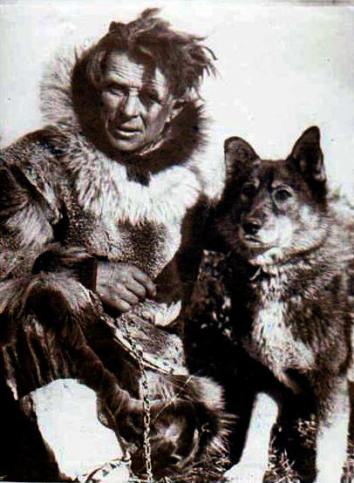
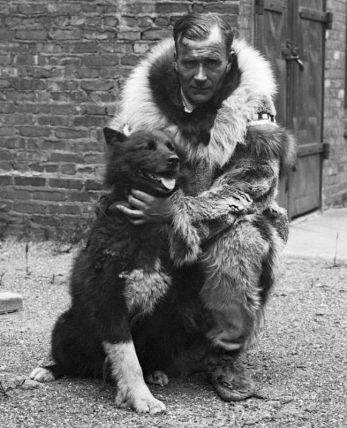
Most sled dogs are retired by age twelve, especially team leaders, but Seppala trusted twelve-year-old “Togo” with the lead. Up the 5,000-foot “Little McKinley” and across the unstable ice of Norton Sound, visibility was so poor that Seppala couldn’t see the “wheel dog” – the dog nearest his sled. Much of the time, navigation in that frozen wilderness was entirely up to his lead dog.
Leonhard Seppala with Togo
With Seppala’s 8-year-old daughter and only child Sigrid at risk for the disease, stakes could not have been higher. Seppala and Togo ran a round-trip of 261 miles to make the next handoff on February 1, including 91 miles with the serum capsule.
Together the pair had covered twice as much ground as any other team, over the most dangerous terrain of the “serum run”.
Gunnar Kaasen and his team took the handoff, hitting the trail at 10:00 at night. At one point, hurricane force winds upended the sled, pitching musher and serum alike into the snow. Already frostbitten, Kaasen searched in the dark with bare hands, until he found the cylinder. Covering the last 53 miles overnight, the team reached Front Street, Nome, at 5:30am on February 2. The serum was thawed and ready by noon.
20 mushers and 150+ dogs had covered 674 miles in 5 days, 7½ hours, a distance that normally took the mail relay 2-3 weeks. Not a single serum ampule was broken.
Gunnar Kaasen with Balto
With 28 confirmed cases and enough serum for 30, the “Great Race of Mercy” had held the death toll at 5, 6 or 7, depending on which version you accept. Doctor Welch suspected as many as 100 or more deaths in the native camps, but the real number will never be known. An untold number of dogs died before completing the run. Several mushers were severely frostbitten.
Gunnar Kaasen and his lead dog “Balto” were hailed as heroes of the serum run, becoming the most popular canine celebrity in the country after Rin Tin Tin.
It was a source of considerable bitterness for Leonhard Seppala, who felt that Kaasen’s 53-mile run was nothing compared with his own 91, Kaasen’s lead dog little more than a “freight dog”.
A statue of Balto was erected in New York’s Central Park in 1925 where it stands to this day, though he is depicted wearing Togo’s “colors” (awards). Togo lived another four years, though he was never again able to run. He spent his last years in Poland Spring, Maine, and passed away on December 5, 1929 at the ripe old age of 16.
Seppala was in his old age in 1960, when he recalled “I never had a better dog than Togo. His stamina, loyalty and intelligence could not be improved upon. Togo was the best dog that ever traveled the Alaska trail.”
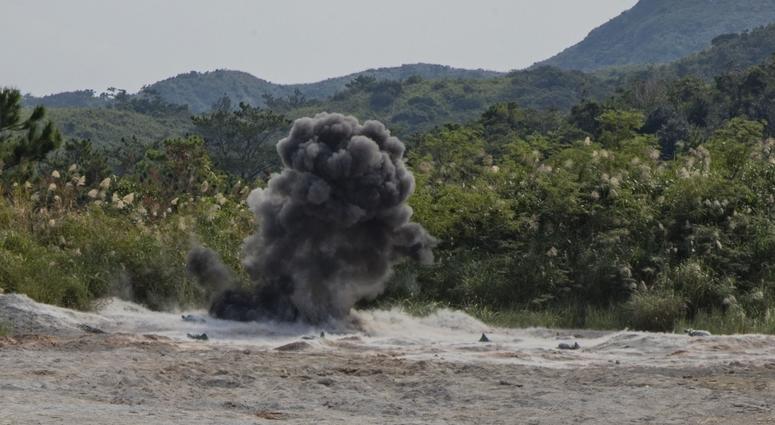
A month ago, near-100 years after serum run, Disney Film Productions released the film Togo, starring Willem Dafoe as Leonhard Seppala and “Diesel” as Togo, telling the story of two heroes of the serum run, of 1925.
Togo himself is stuffed and mounted, standing watch over the Iditarod museum headquarters in Wasilla, Alaska.
A whale washed ashore in Denmark sometime in 1991, when some bright bulb decided a poke here and a prod there would release the highly pressurized gasses of decomposition. Did I mention, Highly pressurized? Few among us can ever imagine how lucky we are, we were somewhere else and not in that time and place.
On November 12, 1970, a 45 foot, 8-ton, dead sperm whale washed up on the beaches near Florence, Oregon. State beaches came under the jurisdiction of the Department of Transportation at that time, and officials came down, to have a look.
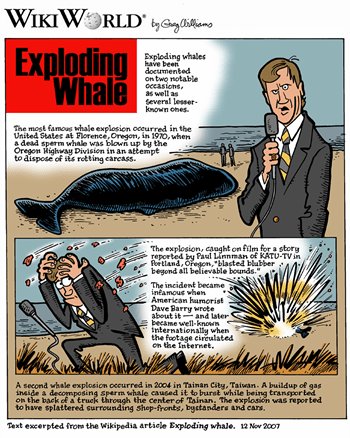
Administrators discussed the matter with the US Navy and someone came up with a bright idea. It wasn’t every day they had to remove 16,000 lbs of rotting whale meat, from the beach. They’d remove the carcass the same way any self-respecting DOT would deal with a large boulder. They’d blow the thing to pieces.
H/T, Offbeat Oregon History
The gulls and crabs could take care of cleanup if the pieces were small enough. The only trick was to use enough dynamite.
No one could know it at the time, but the incident had already reached its high water mark. From here on it would only be, downhill.
By sheer coincidence, there happened to be an ex-military guy around, Walter Umenhofer, who had explosives training. Ol’ Walt tried to tell the Sages of Florence that 20 sticks of dynamite would do the trick if they were put in the right place, but no one wanted to listen.
Someone had decided to use a half-ton of the stuff, and that’s what they were going to do.
It may have been the worst idea, since Rudolph Hess flew that plane into Scotland.
The appointed day was a “blast” in more ways than one. Spectators assembled in their hundreds, TV cameras rolling. There was a sense of anticipation. No one had ever seen a whale explode.
Spectators were backed off a quarter-mile and at last, the appointed hour had arrived. The plunger was pushed, the resulting detonation tearing through the whale like the proverbial hot knife, through butter. Thousands of reeking chunks soared trough the air, raining down over a square mile of buildings, houses and streets. Spectators ran for their lives through the evil, pelting rain.
Umenhofer was among the crowd that day. A great slab of the stuff the size of a coffee table came down from the sky, and landed on his brand new Oldsmobile 88. He’d just bought the car from a dealer running a “Whale of a Sale” deal. You can’t make this stuff up.
It turns out that exploding whales aren’t even that unusual. Iceland, Australia and South African authorities routinely blow up whale carcasses to avoid hazards to navigation. They’re usually towed out to sea, first.
There are even spontaneously exploding whales, when gasses build to a point of ripeness which can no longer be contained. It happened on Salt Spring Island, British Columbia, where locals reported that blubber “hung in the trees for weeks”.
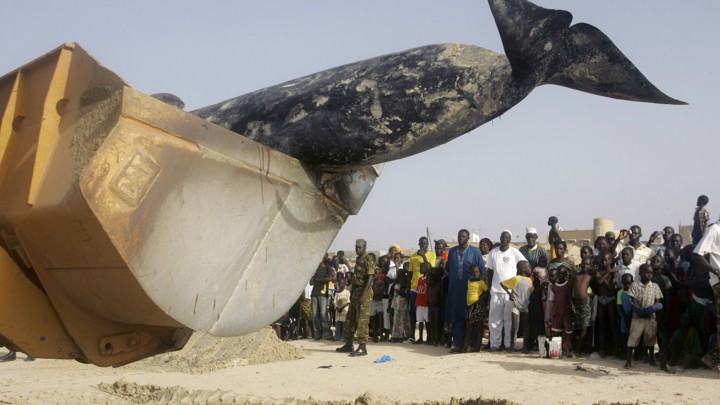
Neighborhood residents look on as the body of a whale is removed with a bulldozer, on Yoff beach in Dakar, Senegal Wednesday, May 21, 2008. The bodies of at least 38 whales have washed up on a Dakar beach and wildlife officials say as many as 100 swam up close to shore. (AP Photo/Rebecca Blackwell)
A whale washed ashore in Denmark sometime in 1991, when some bright bulb decided a poke here and a prod there would release the highly pressurized gasses of decomposition. Did I mention, Highly pressurized? Few among us can ever imagine how lucky we are, we were somewhere else and not in that time and place.
Exploding whale, Denmark, 1991
In 2014, reporters for The Atlantic spoke with Canadian fisheries scientist Jack Lawson, who warned: “The worst thing would be for a person to get too close to the whale and fall inside it: “The [whale] skin is starting to lose its integrity and if someone were to walk along, say, the chin — that is full of all that gas — they could fall in the whale. The insides will be liquefied. Retrieving them would be very difficult.”” “I have fallen through the side of a whale up to my chest,” Lawson added. “It’s not very nice.”
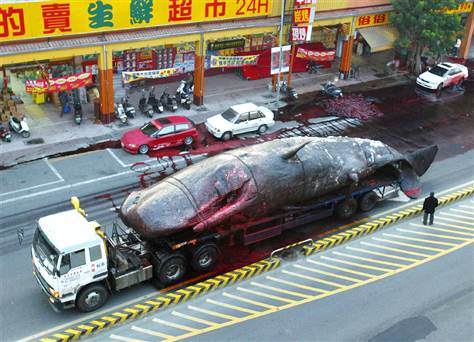
On this day in 2004, a ripened sperm whale exploded in the streets of Tainan City, in Taiwan. That time, they’d managed to get the thing onto a flatbed and were hauling it through town when the whale, went off. A memorable day was had by all, including passing pedestrians, nearby traffic and local shop keepers.Nigh on fifty years ago, folks in the Pacific Northwest learned an important lesson on the beaches of Florence. Nine years later, 41 dead sperm whales washed ashore on the nearby coast. This time, the things were burned and buried, where they lay.
By November, what had begun as a trickle had turned to a confectionery avalanche. College student Mary Connors of Chicopee Massachusetts stepped up and offered to take charge of the flood. By now, this was a national project. Volunteers were assembled in their hundreds to collect candy and tie them to little cloth parachutes.
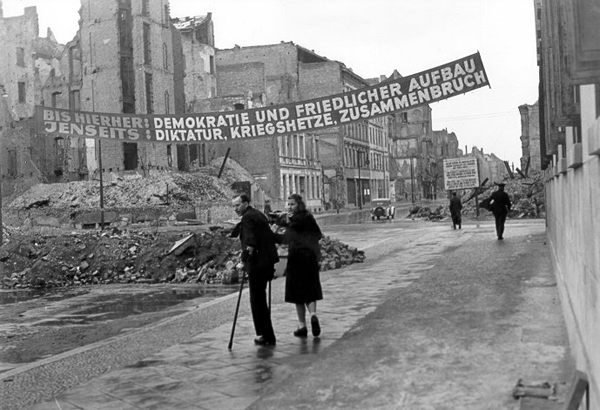
World War II ended on May 8, 1945 in Europe, leaving the three major allied powers (United States, United Kingdom and the Soviet Union) in place, in and around the former Nazi capital of Berlin. Representatives of the 3 met at Potsdam, capital of the German federal state of Brandenburg between July-August, hammering out a series of agreements known as the Potsdam agreement.
Built on earlier accords reached through conferences at Tehran, Casablanca and Yalta, the agreement addressed issues of German demilitarization, reparations, de-nazification and the prosecution of war criminals.
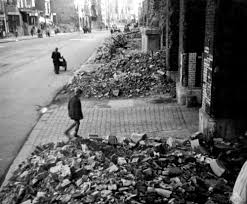
The Potsdam agreement called for the division of defeated Germany into four zones of occupation, roughly coinciding with then-current locations of the allied armies. The former capital city of Berlin was itself partitioned into four zones of occupation. A virtual island located 100 miles inside of Soviet-controlled eastern Germany.
During the war, ideological fault lines were suppressed in the drive to destroy the Nazi war machine. Such differences were quick to reassert themselves in the wake of German defeat. In Soviet-occupied east Germany, factories and equipment were disassembled and transported to the Soviet Union, along with technicians, managers and skilled personnel.
The former Nazi capital quickly became the focal point of diametrically opposite governing philosophies. Leaders on both sides believed that Europe itself, was at stake. Soviet Foreign Minister Vyacheslav Molotov put it succinctly, “What happens to Berlin, happens to Germany; what happens to Germany, happens to Europe.”
West Berlin, a city utterly destroyed by war, was home to some 2.3 million at that time, roughly three times the city of Boston.
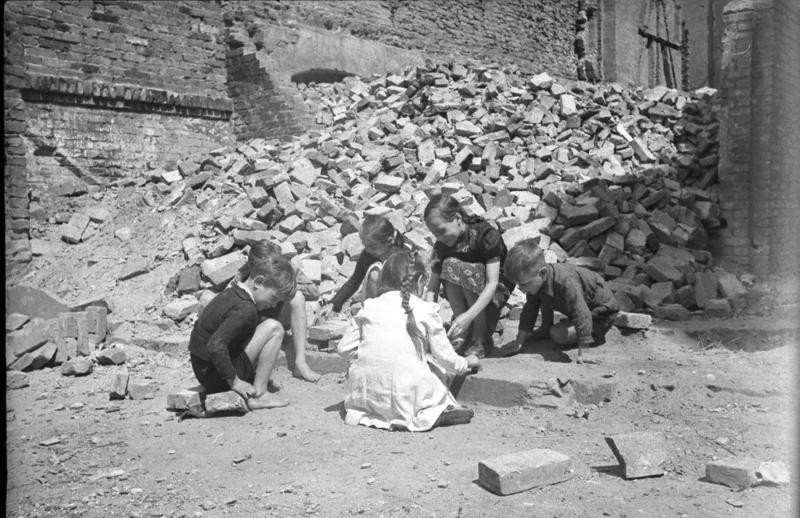
Differences grew and sharpened between the former allies, coming to a crisis in 1948. On June 26, Soviets blocked access by road, rail and water, to western occupation zones.
This was no idle threat. Of all the malignant governing ideologies of history, Josef Stalin’s Soviet Union has to be counted among the worst. These people had no qualms about using genocide by starvation as a political tool. They had proven as much during the Holodomorof 1932 – ’33, during which this evil empire had murdered millions of its own citizens, by deliberate starvation. To Josef Stalin, two million dead civilians was nothing more than a means to an end.
At the time, West Berlin had only 36 days’ worth of food, and 45 days’ supply of coal.With that many lives at stake, allied authorities calculated a daily ration of only 1,990 calories would require 646 tons of flour and wheat, 125 tons of cereal, 64 tons of fat, 109 tons of meat and fish, 180 tons of dehydrated potatoes, 180 tons of sugar, 11 tons of coffee, 19 tons of powdered milk, 5 tons of whole milk for the children, 3 tons of fresh yeast for baking, 144 tons of dehydrated vegetables, 38 tons of salt and 10 tons of cheese.
With electricity shut off by Soviet authorities, heat and power for such a population would require 3,475 tons of coal, diesel and gasoline.
All of this and more was going to be needed. Every. Single. Day.
What followed is known to history, as the Berlin Airlift. At the height of the operation, a cargo aircraft landed every thirty seconds, in West Berlin. Altogether, the USAAF delivered 1,783,573 tons and the RAF 541,937 on a total of 278,228 sorties. The Royal Australian Air Force delivered 7,968 tons of freight in over 2,000 flights.

Added together, the Berlin Airlift covered nearly the distance from Earth to the Sun, at a cost of 39 British and 31 American lives.
US Army Air Force Colonel Gail “Hal” Halvorsen was one of those pilots, flying C-47s and C-54 aircraft deep inside of Soviet controlled territory. On his days off, Halvorsen liked to go sightseeing, often bringing a small movie camera.
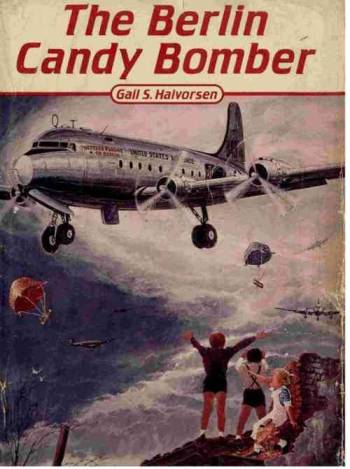
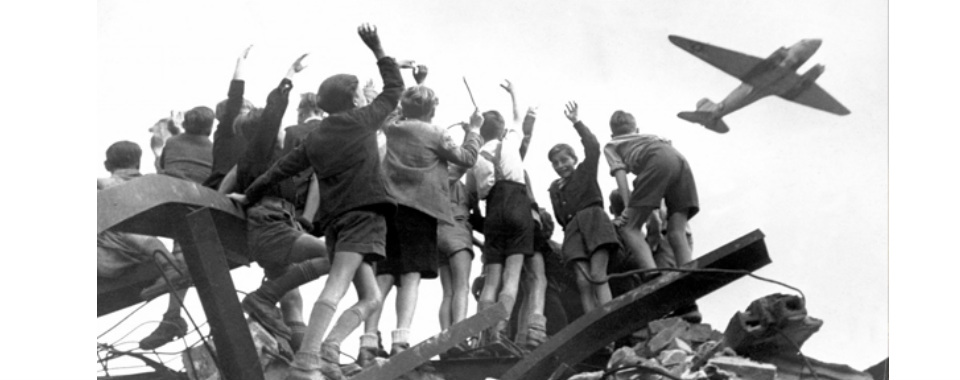
One day in July, Hal was filming take-offs and landings at the Templehof strip when he spotted some thirty children, on the other side of a barbed wire fence. He went over to speak with them, and felt impressed. It was normal for children to ask GIs “Any gum, chum?” or “Any bon-bon?” Not these kids. Dirty, half starved and possessed of nothing whatsoever, these kids had spirit. Halvorsen remembers:
“I met about thirty children at the barbed wire fence that protected Tempelhof’s huge area. They were excited and told me that ‘when the weather gets so bad that you can’t land, don’t worry about us. We can get by on a little food, but if we lose our freedom, we may never get it back.'”
Reaching in his pocket, Halvorsen found two sticks of gum. Wrigley’s Doublemint gum. Breaking them each into four pieces he gave them to the nearest children, only to watch them break the gum into smaller pieces, to share with their friends. Those who got none received tiny slivers of the wrappers themselves, small faces shining with joy at just a whiff of mint from the wrapper.
Halvorsen told the kids he’d be back tomorrow, on one of those planes. He’d have enough for them all, he said. You’ll know it’s my plane because I’ll wiggle my wings.
That night, Halvorsen, his co-pilot and engineer, pooled their candy rations. Even small boxes can’t simply be tossed out of a moving aircraft, and so, the three rigged handkerchiefs. Tiny little “parachutes”, for tiny little packages.
Halvorsen made such drops three times over the next three weeks and noticed each time, the group of children waiting by the wire, grew larger.
Newspapers got wind of what was going on. Halvorsen thought he’d be in trouble, but no. Lieutenant General William Henry Tunner liked the idea. A lot. “Operation Little Vittles” became official, on September 22.
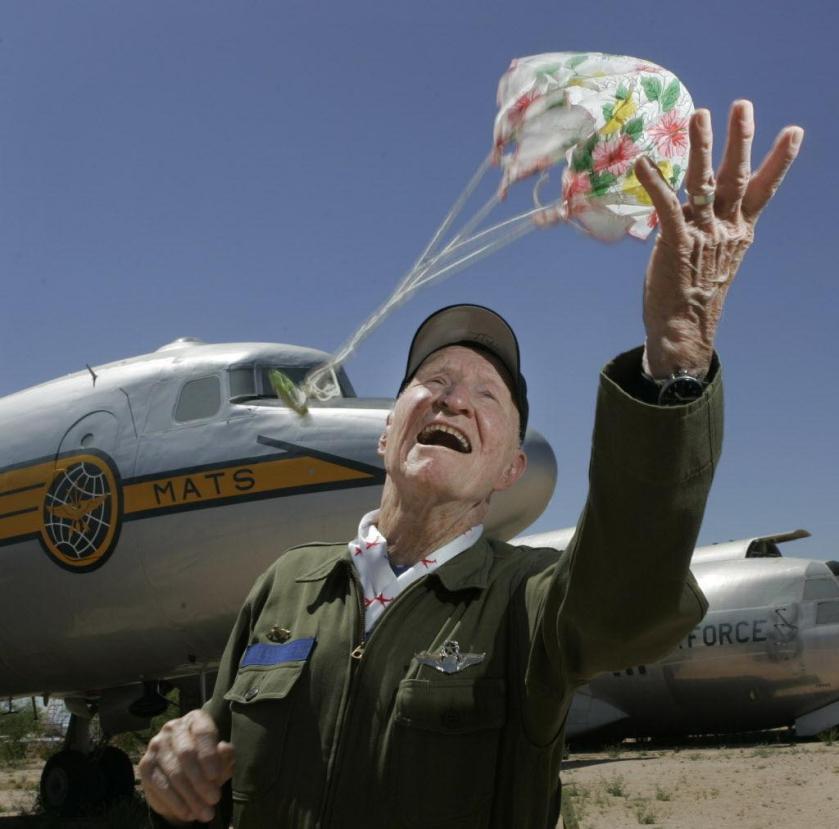
What had begun between Halvorsen and his friends spread to the whole squadron. Word quickly crossed the ocean and children all over the United States gave up their own, for kids who had less. Soon, candy manufacturers themselves joined in.
By November, what had begun as a trickle had turned to a confectionery avalanche. College student Mary Connors of Chicopee Massachusetts stepped up and offered to take charge of the flood. By now, this was a national project. Volunteers were assembled in their hundreds to collect candy and tie them to little cloth parachutes.
“Christmas from Heaven: The Candy Bomber Story” with the Mormon Tabernacle Choir and Orchestra, Narrated by Tom Brokaw
Before long, pilots were dropping little packages, all over Berlin. They were the Rosinenbombers. Raisin Bombers. Halvorsen himself came to be known by many names, to the children of Berlin. “Uncle Wiggly Wings”. “The Chocolate Uncle”. “The Gum Drop Kid”. “The Chocolate Flier”.
Colonel Halvorsen’s work even earned him two letters, proposals of marriage, but he turned them both down. He was carrying on a romance by letter at this time, with Miss Alta Jolley. The couple would go on to marry in April of 1949, a marriage which would last, for fifty years. Alta Jolley Halvorsen passed away on this day in 1999 leaving her husband, 5 adult children and 24 grandchildren.
On this day in 1949, the Berlin Airlift had barely cleared the mid-point. The largest humanitarian airlift in aviation history would last until the blockade was lifted on May 12, 1949, and then some. Operation Little Vittles continued throughout the period, dropping an estimated 23 tons of candy from a quarter-million tiny little parachutes.
Over the years, many of those now-grown children have sought Halvorsen out, to say thank you and to tell stories. Tales of hope, and fun, of fond anticipation. All in a time and place when such things were very hard to find.
You never know, he said. “The small things you do turn into great things.”
In 1929, Little was known of the first known burial, at Arlington National Cemetery. Journalist Margaret Husted wrote about Randolph in the Washington Star newspaper. Descendants came forward and, piece by piece, the story of the first person buried at Arlington, came to light.
As the Civil War ground on to a fourth dreadful year, the church yards and burial plots of the formerly united states strained under the weight of carnage, produced by that war.
The former home of Mary Anna Randolph Custis Lee and Robert Edward Lee (yeah, that Robert E. Lee) was made forfeit for non-payment of tax by the 37th Congress, the Mansionon the hill and surrounding grounds auctioned to the Federal government.
One day, the United States Supreme Court would rule the act an unlawful taking and compensate Lee family descendants.
For now, that’s a story for another day. As 1863 drew to a close, the property was destined to become the nation’s most hallowed ground and known to posterity, as Arlington National Cemetery.
The first interment on the Custis-Lee property was that of Private William Henry Christman of 67th Pennsylvania Infantry, laid to rest on May 13, 1864.
Custis-Lee Mansion now Arlington House, at Arlington National Cemetery
Two more joined Christman before the day was done, fine young men cut down in the prime of life and laid to rest, never to know the triumphs and the tragedies of growing old. Before long, the trickle turned to a flood. By the end of the war between the states, their number exceeded 17,000 and rising.
Private Christman was the first military burial, but not the first. One had come before. When Private Christman went to his rest in our nation’s most hallowed ground, his grave joined that of Mary Randolph, laid to rest some thirty-six years earlier.
In 1929, cemetery workers were performing renovations on the Lee-Custis Mansion now known as the Arlington House, at the top of the hill. They couldn’t help but be aware of a solitary grave some 100-feet to the north, but little was known of its occupant.
Marked with the name of Mary Randolph, the stone was inscribed with these words:
“In the memory of Mrs. Mary Randolph,
Her intrinsic worth needs no eulogium.
The deceased was born
The 9th of August, 1762
at Amphill near Richmond, Virginia
And died the 23rd of January 1828
In Washington City a victim to maternal love and duty.”
“A victim to maternal love and duty”. It was a curious phrase but little else was known about Mary Randolph.
In 1929, journalist Margaret Husted wrote about Randolph in the Washington Star newspaper. Descendants came forward and, piece by piece, the story of the first person buried at Arlington, came to light.
Mary Randolph, a direct descendant of Pocahontasand John Rolfe, cousin to Thomas Jefferson, was the cousin of George Washington Parke Custis, adopted step-grandson of George Washington and the godmother of Custis’ daughter, Mary Anna Randolph Custis, wife of Robert E. Lee.
The last line of the inscription, “a victim to maternal love and duty” refers to Mary’s youngest surviving son, Midshipman Burwell Starke Randolph, who’d suffered a high fall from the mast in 1817, while serving in the US Navy. Both of his legs were broken and never healed properly. When Mary passed away in 1828, Randolph remarked that his mother had sacrificed her own life in care of his.
Mary Randolph is best known as the author of America’s first regional cookbook, “The Virginia House-wife” and known to some, as “The Methodical Cook”.
The Virginia Culinary Thymes writes “It is interesting to note that all the cookery at that time was done in kitchens that had changed little over the centuries. In Virginia, the kitchen was typically a separate building for reasons of safety, summer heat and the smells from the kitchen. The heart of the kitchen was a large fireplace where meat was roasted and cauldrons of water and broth simmered most of the day. Swinging cranes and various devices made to control temperature and the cooking processes were used. The Dutch oven and the chafing dish were found in most kitchens. The brick oven used for baking was located next to the fireplace. A salamander was used to move baked products around in the oven and it could also be heated and held over food for browning“.
Mary Randolph, wife of David Meade Randolph, was an early advocate of the now-common use of herbs, spices and wines in cooking.
Mrs Randolph’s recipe for apple fritters calls for slices of apple marinated in a combination of brandy, white wine, sugar, cinnamon, and lemon rind.
Randolph was well known as a Virginia cook and hostess, so much so that, during an 1800 slave insurrection near Richmond, the leader “General Gabriel” said that he would spare her life, if she would become his cook.
I’m thinking of those apple fritters. I believe ol’ Gabriel might have been onto something.
You must be logged in to post a comment.