June 24, 1374 The Madness of the Dance

Most such outbreaks coincided with periods of extreme hardship such as crop failure, famine and floods, and involved between dozens and tens of thousands of individuals.

Amidst our people here is come
The madness of the dance.
In every town there now are some
Who fall upon a trance.
It drives them ever night and day,
They scarcely stop for breath,
Till some have dropped along the way
And some are met by death.
– Straussburgh Chronicle of Kleinkawel, 1625

girl-1349269_1280-950x550

A legend of the medieval Christian church had it that, if anyone were to provoke the wrath of St. Vitus, the Sicilian saint martyred in 303AD, he would send down plagues of compulsive dancing.  One of the first outbreaks of St. Vitus’ Dance, occurred sometime in the 1020s in Bernburg, Germany. 18 peasants disturbed a Christmas Eve service, singing and dancing around the church.

In a story reminiscent of the Pied Piper of Hamelin, a large group of children jumped and danced all the way from Erfurt to Arnstadt in 1237, a distance of some sixteen miles. In 1238, 200 people jumped, twitched and convulsed on a bridge over the River Meuse, until the span collapsed.

maxresdefault (10)

A major outbreak St. Vitus’ Dance occurred on June 24, 1374. The population writhed and jerked through the streets of Aachen, screaming of visions and hallucinations until, one by one, each collapsed.  There, victims continued to tremble and twitch on the ground, too exhausted to stand.
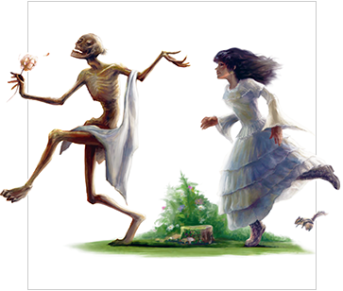
dancing-plague1Most such outbreaks coincided with periods of extreme hardship such as crop failure, famine and floods, and involved between dozens and tens of thousands of individuals.

This “choreomania”, more commonly referred to as dancing mania, spread throughout Europe, fanning out to Cologne, Flanders, Franconia, Hainaut, Metz, Strasbourg, Tongeren and Utrecht. Further outbreaks were reported in England and the Netherlands.

One Frau Troffea began to dance in a street in Strasbourg in July 1518, going at it somewhere between four to six days. 34 joined in by the end of a week.  Within the month there were 400 more. Many of this primarily female group actually danced themselves to death, succumbing to heart attack or stroke.  Others collapsed in exhaustion, their bloody feet no longer able to hold them up.

According to one report, the dancing plague was killing fifteen people every day.

Reactions varied. Some thought those suffering from dance mania were possessed by the devil, others by ‘hot blood’. Doctors were called, who advised that the Dance be allowed to run its course. Bands were hired and one town even built a dance floor, to contain the phenomenon.

There were no fewer than seven distinct outbreaks of the dancing plague during the medieval period, and one in Madagascar as late as 1840.

ErgotonRyeEven today there is little consensus about what caused the phenomenon. Some have blamed “St Anthony’s Fire”, a toxic and psychoactive fungus of the Claviceps genus, also known as ergot.  Often ingested with infected rye bread, symptoms of ergot poisoning are not unlike those of LSD, and include nervous spasms, psychotic delusions, spontaneous abortion, convulsions and gangrene resulting from severe vasoconstriction.

Many associate the Salem witchcraft hysteria of 1692 with ergot poisoning but, for others, such explanations are wanting.  Both the dancing episodes of earlier centuries and the witchcraft chapter involved lucid and deliberate action, far more than the convulsions and involuntary spasms associated with ergotism.

Others describe the Dancing Plague phenomenon as some kind of mass psychosis, brought on by the Bubonic Plague.  The Black Death, a pandemic which killed 75-100 million people around the earth, in a world with a population of 450 million.  The explanation seems as plausible as any.  The modern mind is incapable of understanding (at least mine is) what it is to live in a world where one in every four-to-five people on the planet is dead, killed by a horror not one of them understands.

64bd5682ba71e36ac5e47fa2ad7790b8
Long before germ theory was commonly understood, disease was thought to be borne of odors. Medieval plague doctors donned head-to-toe waxed canvas gowns and leather hats, with the distinctive beak-like mask filled with aromatic herbs.

Today, a calamity of such magnitude would kill over 1.5 Billion souls.

If you enjoyed this “Today in History”, please feel free to re-blog, “like” & share on social media, so that others may find and enjoy it as well. Please click the “follow” button on the right, to receive email updates on new articles.  Thank you for your interest, in the history we all share.

June 23, 1918 The Day the Clowns Cried

Strong men, bareback riders, trapeze performers and acrobats were killed instantly and others horribly maimed, as wooden circus cars telescoped into one another.  Confused and bleeding survivors stumbled from the wreckage, as gas-fed lanterns began to set fire to all that wood.

rome_hbo_image__3___medium_There is an oft-repeated but mistaken notion that the circus goes back to Roman antiquity.  The panem et circenses, (bread and circuses)” of Juvenal, ca AD100, refers more to the ancient precursor of the racetrack, than to anything resembling a modern circus. The only common denominator is the word itself, the Latin root ‘circus’, translating into English, as “circle”.

The father of the modern circus is the British Sergeant-Major turned showman, Philip Astley.  A talented horseman, Astley opened a riding school near the River Thames in 1768, where he taught in the morning and performed ‘feats of horsemanship’ in the afternoon.  Equestrian and trick riding shows were gaining popularity all over Europe at this time, performers riding in circles to maintain balance while standing on the backs of galloping horses.  It didn’t hurt matters, that the “ring” made it easier for spectators to view the event.

s-l1600These afternoon shows gained overwhelming popularity by 1770, and Astley hired acrobats, rope-dancers, and jugglers to fill the spaces between equestrian events.  The modern circus, was born.

From that day to this, the “Fancy Pants” dresses in red tailcoat and top hat, evocative of British fox hunting garb. This “Announcer” is commonly (and mistakenly) called the “ringmaster”, while the true ring master is the “equestrian director”, standing in the center of the ring and pacing horses for the riding acts.

In 1825, Joshuah Purdy Brown of Somers New York replaced the wooden structure common to European circuses with a canvas tent, around the time when cattle dealer Hachaliah Bailey bought a young African elephant, and began to exhibit the animal all over the country.

The exotic animal angle was a great success.  Other animals were added, and farmers were soon leaving their fields to get into the traveling menagerie business.  The unique character of the American traveling circus emerged in 1835, when 135 such farmers and menagerie owners combined with three affiliated circuses to form the American Zoological Institute.

Phineas Taylor Barnum and William Cameron Coup launched P.T. Barnum’s Museum, Menagerie & Circus in 1871, where the “museum” part was a separate exhibition of human and animal oddities.  It wouldn’t be long, before the ‘sideshow” became a regular feature of the American circus.

37bb48cc8d.jpg

There have been no fewer than 81 major circuses in American history, and countless “Dog & Pony” shows, programs so small as to include only a few family members and an assistant or two, with a couple of trained animals.  And all this time, I thought ‘Dog & Pony Show’ referred to the United States Congress.

The ‘Greatest Show on Earth’ closed for the last time on Sunday, May 21 2017, when ‘animal rights activists’ and changing tastes in entertainment finished the Ringling Brothers, Barnum & Bailey Circus, ending a 146-year run.

In the mid-19th century, German animal trainer Carl Hagenbeck toured Europe with “ethnographical” spectacles, combining animals with native peoples such as the Sámi of the Scandinavian peninsula, complete with reindeer and sleds. Hagenbeck was among the first to develop animal training methods based on trust and reward rather than pain Hagenbeck-Wallace_Circusand fear, his demonstrations emphasizing the animal’s intelligence and tractability over ferocity.

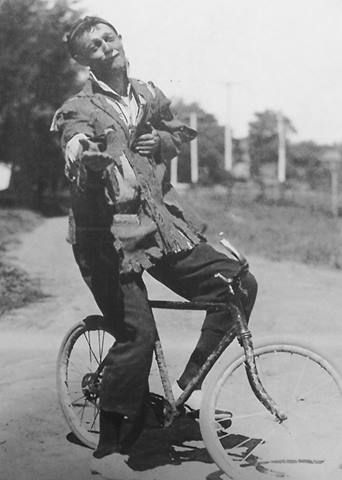
In 1906, Hagenbeck sold his traveling animal show to American circus operator Benjamin Wallace, before going on to develop open zoological gardens and native panoramas which would be familiar to today’s zoo enthusiast, rather than the barred cells of his day.

The American war machine was spinning up to peak operational capacity in 1918, as the industrial might of the nation pursued an end to the war ‘over there’.

Hagenbeck-Wallace was one of the premier circuses of the day, moving about the country on three trains and employing no fewer than 1,000 roustabouts and assorted performers.

In the small hours of  June 22, an engineer with the Michigan Central Railroad was at the wheel of Train No. 41, an empty 21-car troop train.  Automatic signals and flares and at least one frantic signalman should have warned the driver that a stalled train lay on the track ahead, but he missed them all.  Alonzo Sargent was asleep at the wheel.

The following day, newspapers across the country told the story of  what happened next.

Hammond-Circus-Train-Wreck-Indiana-IN-in-1918-Newspaper

On June 22, the circus was scheduled to appear at the Show Grounds at 150th and Calumet Avenue in Hammond, Indiana.  In the early morning darkness, an overheated axle box required one train to make an unscheduled stop.  It was 4am and most of the circus’ employees were asleep, when the Michigan Central locomotive smashed into the rear of the stalled train.

hammond-circus-train-wreck

The Hammond circus train wreck was one of the worst such accidents, in history.  Strong men, bareback riders, trapeze performers and acrobats were killed instantly and others horribly maimed, as wooden circus cars telescoped into one another.  Confused and bleeding survivors stumbled from the wreckage, as gas-fed lanterns began to set fire to all that wood.

4dee9b19c401dfa3811d694a5d3196bb
Hagenbeck-Wallace clown “Big Joe” Coyle

Those lucky enough to escape the horror were forced to watch in disbelief as friends, families and co-workers were incinerated alive.

Hours later a clown, “Big Joe” Coyle, could be seen weeping, beside the mangled bodies of his wife and two small boys.

127 were injured and an estimated 86 crushed or burned to death in the wreck.  The rumor mill went berserk.  Wild lions and tigers had escaped and were roaming the streets and back yards of Gary, Indiana.  Elephants died in an heroic attempt to put out the flames, spraying water on the burning wreckage with their trunks.

None of the stories were true.  The animals had passed through hours before on an earlier caravan, and now awaited a train which would never come.

3133e09bf2315ec8f09333b75c3b6913

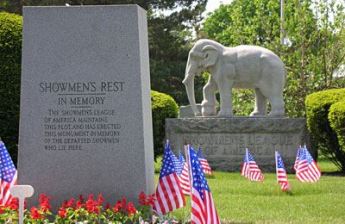
The Showmen’s League of America was formed in 1913, with Buffalo Bill Cody its first President.  The group had recently purchased a 750-plot parcel at the Woodlawn Cemetery in Forest Park, Illinois and called it “Showmen’s Rest”, having no idea their investment would be used so soon.

A mass grave was dug for the unidentified and unidentifiable.  Some of the dead were roustabouts or temporary workers, hired only hours or days earlier.  Some performers were known only by stage names, their gravestones inscribed with names like “Four-Horse Driver”,  “Baldy” and “Smiley”.

showmans-rest-circus-mass-grave

The Hagenbeck-Wallace circus was a big deal in those days.  Famed lion tamer Clyde Beatty was a member, as was a young Red Skelton, tagging along with his father, who worked as a clown.

sla-memorial2

Only two shows had to be canceled, as erstwhile ‘competitors’ Barnum & Bailey and others lent workers, performers and equipment.  The show would go on.

In the world of elephants, an upraised trunk carries connotations of joy, while a lowered trunk symbolizes mourning.  At the Woodlawn cemetery of Chicago, five elephant statues circumscribe the mass grave of clowns, trapeze artists, strongmen and other circus performers.  Each has a foot raised with a ball underneath.  Every trunk, hangs low.  The largest of the five bears the inscription, “Showmen’s League of America.”  On the other four are inscribed the words “Showmen’s Rest”.


June 22, 1807 Impressed

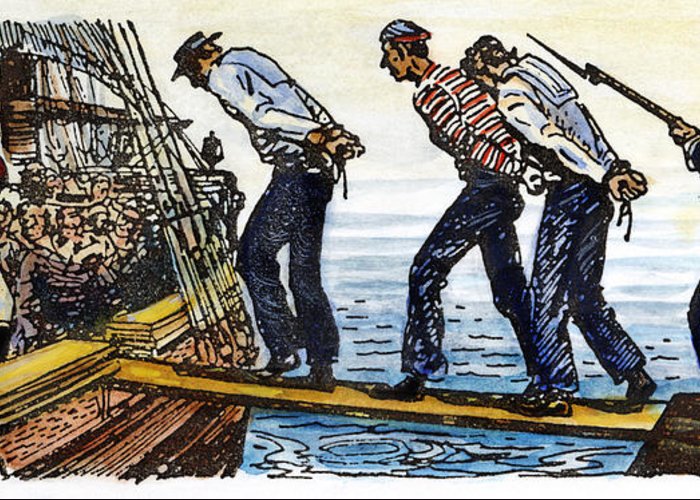
British envoys delivered proclamations reaffirming the practice of impressment, amounting to the kidnapping of sailors and forcing their labor aboard British ships. In total, the Royal Navy impressed over 9,000 sailors claiming to be American citizens, becoming the driving force behind the United States going to war with England, in 1812.

The Napoleonic Wars took place between 1799 and 1815, pitting a series of seven international coalitions against the forces of Napoleon Bonaparte and his Grande Armée.  The former American colonies benefited from the European conflict, remaining on the sidelines and doing business with both sides.  Within a ten-year period, the fledgling United States had become one of the world’s largest neutral shippers.

In 1807, two third-rate French warships were penned up in Maryland’s Chesapeake Bay, blockaded by a number of English warships outside of the harbor.

4467229436_5635b36a0a
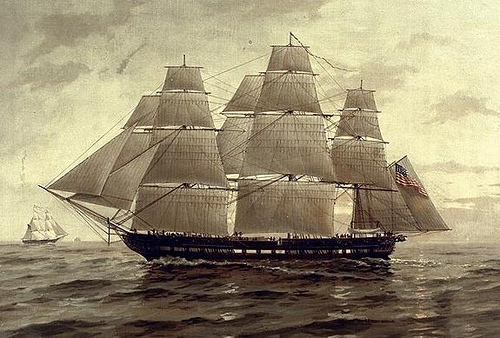
The American frigate, USS Chesapeake

London born Jenkin Ratford was an English sailor who deserted the British Navy and defected to the neutral United States.  This story might have ended better for him had he not run his mouth, but that wasn’t this guy.  Ratford couldn’t resist taunting British officers, boasting of his escape to the “land of liberty”

The USS Chesapeake was preparing for a Mediterranean cruise with Ratford aboard, when she emerged from Norfolk, Virginia.  Her decks were laden with supplies and stores of every kind, and her guns unwisely stored.  Chesapeake was nowhere near combat ready when she was approached by the HMS Leopard on June 22.

The Chesapeake’s commander, Commodore James Barron, was unconcerned when the Leopard, under the command of Captain Salusbury Pryce Humphreys, asked permission to board.  Lieutenant John Meade of Her Majesty’s Navy presented Barron with a search warrant.  Barron declined to submit, and the officer returned to the Leopard.

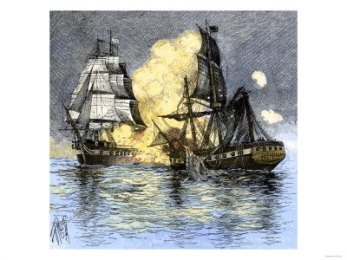
Chesapeake_LeopardHumphreys then used a hailing trumpet and ordered the American ship to comply, to which Barron responded “I don’t hear what you say”. Humphreys fired two rounds across Chesapeake’s bow, followed immediately by four broadsides.
Chesapeake fired a single shot before striking colors and surrendering.  Humphreys refused the surrender and boarded, taking Ratford and three American born sailors with them when they left.

There was little resistance, yet the “Chesapeake-Leopard Affair” had left three American crewmembers dead, and 18 wounded.

American public opinion was outraged over the humiliation, as the four men were transported to Halifax for trial.   Federalists and Democratic-Republicans were united as never before.  President Thomas Jefferson remarked “Never since the Battle of Lexington have I seen this country in such a state of exasperation as at present, and even that did not produce such unanimity.”

The English court found all four guilty of desertion and hanged Ratford by the fore yardarm of his former vessel, HMS Halifax.  The three Americans, David Martin, John Strachan, and William Ware, were sentenced to 500 lashes.

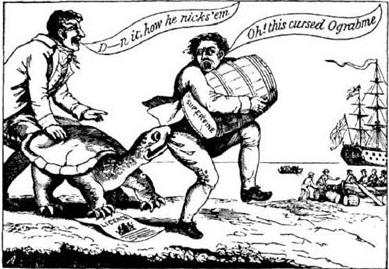
With the puny American navy deployed to the Mediterranean to check the Barbary pirates, President Jefferson’s options were limited to economic retaliation.  The Embargo Act of 1807 intended to extract concessions from France and Great Britain, instead had the effect of imposing crippling setbacks on some industries, while others railed against government interference in the private economy.  Many came to the conclusion that the only solution, lay in violence.

2661E817-FD9D-331B-F65F29408EE37509
Political cartoon depicting merchants harassed cursing the “Ograbme”—“embargo” spelled backwards.

British envoys delivered proclamations reaffirming the practice of impressment,  amounting to the kidnapping of sailors and forcing their labor aboard British ships.  In total, the Royal Navy impressed over 9,000 sailors claiming to be American citizens, becoming the driving force behind the United States going to war with England, in 1812.

Despite being wounded, Barron was blamed for the “Chesapeake-Leopard Affair”.  A court-martial suspended him from service for five years, without pay.   Commodore Stephen Decatur was one of the presiding officers at the court-martial. In 1820, Barron challenged Decatur to a duel, killing his fellow Commodore over comments concerning the 1807 incident.

Undergoing a refit in Boston Harbor in 1813, USS Chesapeake was challenged to single combat by Captain Philip Broke, commanding the British frigate HMS Shannon.

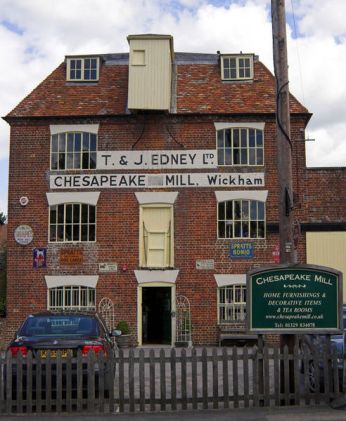
Chesapeake_MillUnited States Naval Captain James Lawrence was eager to comply, confident in the wake of a number of American victories in single-ship actions.

It was a Big mistake.

All of Boston turned out that June day, to watch the fight.  Cheers went out across the docks and from scores of private vessels across Boston Harbor, as Chesapeake slipped her moorings and glided out of the harbor.

Boston authorities reserved dock space in expectation of a guest.  The arrival of a captured British frigate, so it was thought, was a foregone conclusion. Rooftops, hills and trees from Lynn to Malden and Cohasset to Scituate were crowded with spectators, come to watch the show.

The tale of the Battle of Boston Harbor must be a story for another day.  Suffice it to say that USS Chesapeake ended her career as the British frigate HMS Chesapeake, before being sold for scrap, in 1819.  Two-hundred years later, the ship’s timbers live on.  Part of the Chesapeake Mill in the historic village of Wickham, in Hampshire, England.

If you enjoyed this “Today in History”, please feel free to re-blog, “like” & share on social media, so that others may find and enjoy it as well. Please click the “follow” button on the right, to receive email updates on new articles.  Thank you for your interest, in the history we all share.

June 21, 1633 And Yet, it Moves

There is a story about Galileo, which may or may not be true. After his conviction, the astronomer is said to have muttered “Eppur si muove” — “And yet it moves”.

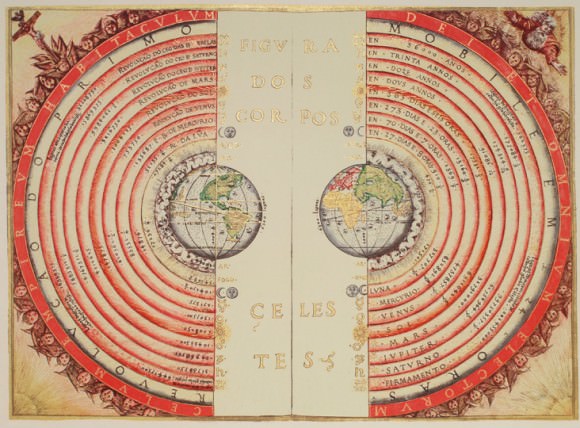
Planet Earth exists at the center of the solar system, the sun and other celestial bodies revolving around it. That was the “geocentric” model of the solar system, from the time of antiquity.

The perspective was by no means unanimous.  The Greek astronomer and mathematician Aristarchus of Samos put the Sun in the center of the universe, in the third century BC.  Later Greek astronomers Hipparchus and Ptolemy agreed, refining Aristarchus’ methods to arrive at a fairly accurate estimate for the distance to the moon, but theirs remained the minority view.

Bartolomeu_Velho_1568_br-580x428
Earth is at the center of this model of the universe created by Bartolomeu Velho, a Portuguese cartographer, in 1568. H/T: NASA/Bibliothèque Nationale, Paris

In the 15th century, Polish mathematician and astronomer Nicolaus Copernicus parted ways with the orthodoxy of his time, describing a “heliocentric” model of the universe placing the sun at the center.  The Earth and other bodies, according to this model, revolved around the sun.

Copernicus resisted publishing his ideas until the end of his life, fearing to offend the religious sensibilities of the time. Legend has it that he was presented with an advance copy of his “De revolutionibus orbium coelestium” (On the Revolutions of the Heavenly Spheres) as he awakened on his death bed from a stroke-induced coma. He took one look at his book, closed his eyes, and never opened them again.

b148cfbc5e4edde112d92494ff235d4e
Copernicus’ ‘heliocentric’ view of the universe.

The Italian physicist, mathematician, and astronomer Galileo Galilei came along, about a hundred years later. Galileo has been called the “Father of Modern Observational Astronomy”, his improvements to the telescope and resulting astronomical observations supporting the Copernican heliocentric view.

They also brought him to the attention of the Roman Inquisition.

Biblical references such as, “The Lord set the Earth on its Foundations; it can Never be Moved.” (Psalm 104:5) and “And the Sun Rises and Sets and Returns to its Place.” (Ecclesiastes 1:5) were taken at the time as literal and immutable fact, becoming the basis for religious objection to the heliocentric model.

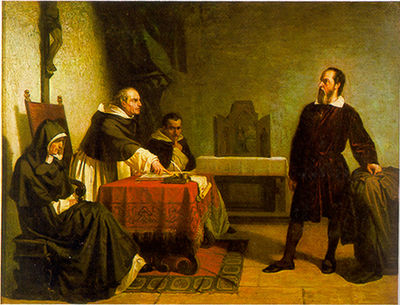
Galileo_facing_the_Roman_Inquisition
Galileo faces the Roman Inquisition

Galileo was brought before inquisitor Vincenzo Maculani for trial in 1633. The astronomer backpedaled before the Inquisition, but only to a point, testifying in his fourth deposition on this day in 1633, that “I do not hold this opinion of Copernicus, and I have not held it after being ordered by injunction to abandon it. For the rest, here I am in your hands; do as you please”.

There is a story about Galileo, which may or may not be true. After his conviction, the astronomer is said to have muttered “Eppur si muove” — “And yet it moves”.

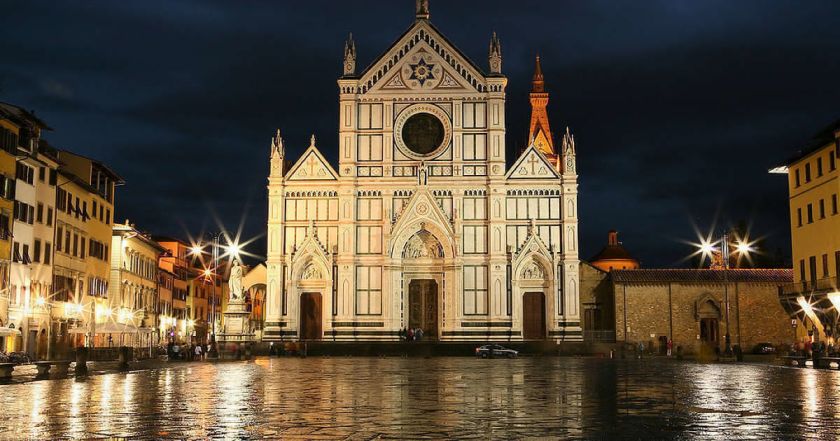
The Inquisition condemned the astronomer to “abjure, curse, & detest” his Copernican heliocentric views, returning him to house arrest at his villa in 1634, there to spend the rest of his life. Galileo Galilei, the Italian polymath who all but orchestrated the transition from late middle ages to  scientific Renaissance, died on January 8, 1642, desiring to be buried in the main body of the Basilica of Santa Croce, next to the tombs of his father and ancestors.  His final wishes were ignored at the time, though they would be honored some ninety-five years later, when Galileo was re-interred in the basilica, in 1737.

1200x630px-Basilica_of_Santa_Croce_Florence_1
Basilica of Santa Croce, in Florence

Often, atmospheric conditions in these burial vaults lead to a natural mummification of the corpse. Sometimes, they look almost lifelike. When it came to the saints, believers took this to be proof of the incorruptibility of these individuals, and small body parts were taken as holy relics.

Such a custom seems ghoulish to us today, but the practice was was quite old by the 18th century.  Galileo is not now and never was a Saint of the Catholic church, quite the opposite.  The Inquisition had judged the man an enemy of the church, a heretic.

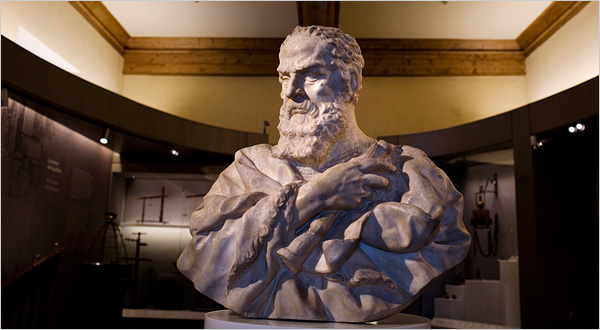
23galileospan-cnd-articleLarge
“A bust of Galileo at the Galileo Museum in Florence, Italy. The museum is displaying recovered parts of his body”. H/T New York Times

Possibly, the condition of Galileo’s body made him appear thus “incorruptible”.  Be that as it may, Anton Francesco Gori removed the thumb, index and middle fingers on March 12, 1737, the digits with which Galileo wrote down his theories of the cosmos. The digits with which he adjusted his telescope.

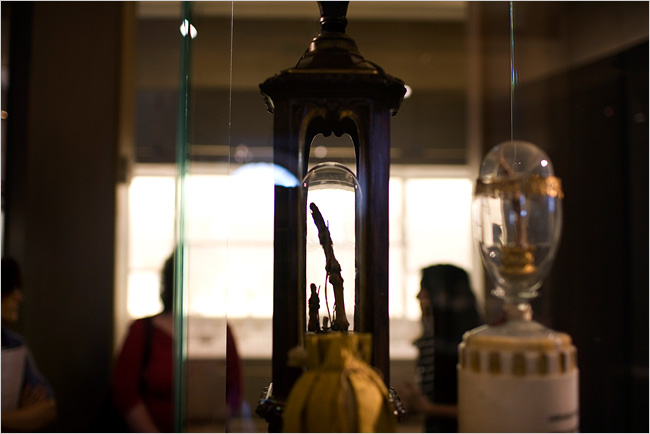
The other two fingers and a tooth disappeared in 1905, leaving the middle finger from Galileo’s right hand on exhibit at the Museo Galileo in Florence, Italy.  Locked in a glass case, the finger points upward, toward the sky.

23galileo2-cnd-popupSome 100 years later, two fingers and a tooth were purchased at auction, and have since rejoined their fellow digit at the Museo Galileo. To this day, these remain the only human body parts, in a museum otherwise devoted to scientific instrumentation.
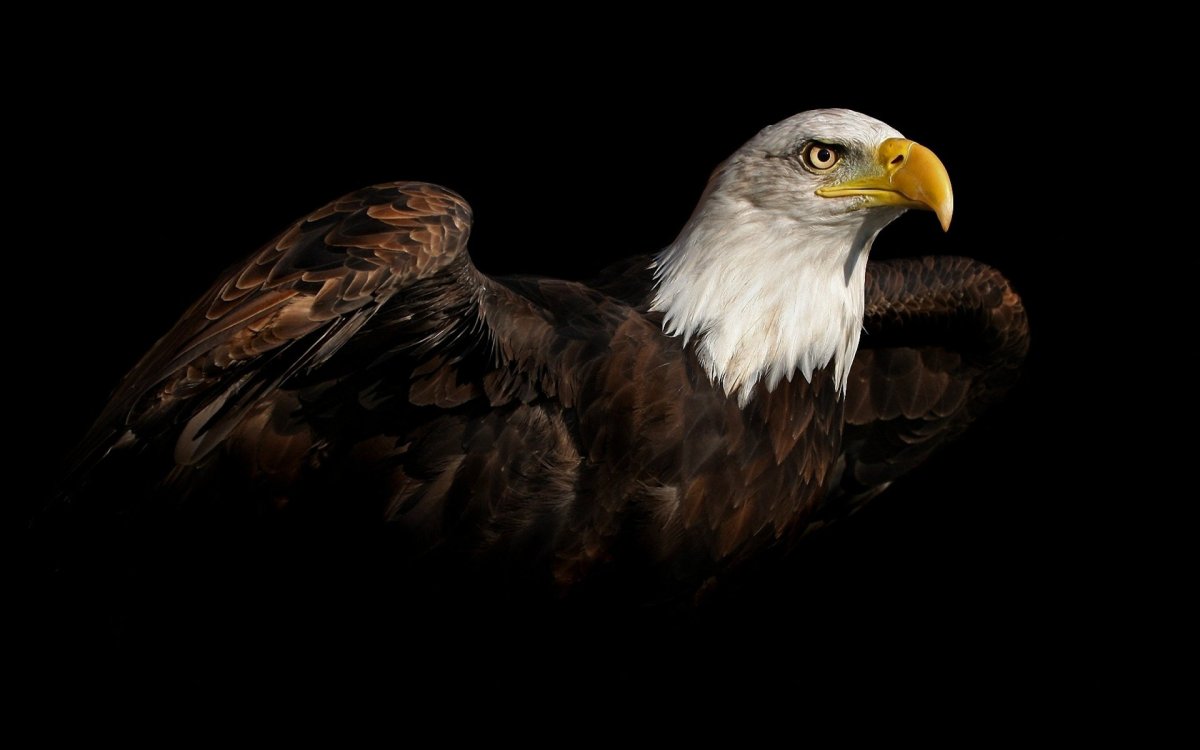
Nearly four-hundred years after his death, Galileo’s extremity points upward, toward the glory of the cosmos.  Either that, or the finger rises in eternal defiance, flipping the bird to the church which had condemned him.

If you enjoyed this “Today in History”, please feel free to re-blog, “like” & share on social media, so that others may find and enjoy it as well. Please click the “follow” button on the right, to receive email updates on new articles.  Thank you for your interest, in the history we all share.

June 20, 1782 American Eagle

Benjamin Franklin objected to the selection of the eagle, preferring the national symbol be the turkey.  He complained that the eagle tended to steal its dinner from other birds, and that he’d seen one driven away by a tiny Kingbird, no larger than a sparrow.

Since the age of the Greek phalanx and before, individuals, institutions and nation-states have distinguished among themselves by means of heraldic symbols.  From medieval times and lasting to this day, such symbols are incorporated into elaborate coats of arms, used to identify individual persons and families, government organizations, corporations and other entities.

Town seal, 1570
Town seal from the Czech Republic town of Náchod, 1570

Eighteen states in addition to the United States itself have officially adopted coats of arms, in addition to the formerly independent republics of Texas and Hawaii. These and other symbols are incorporated into official seals, to authenticate passports, certificates, proclamations, and other documents.

Every state in the union has its own seal, as well as the federal district, the five inhabited territories of the United States and the three largest Native American tribes.

seals-state

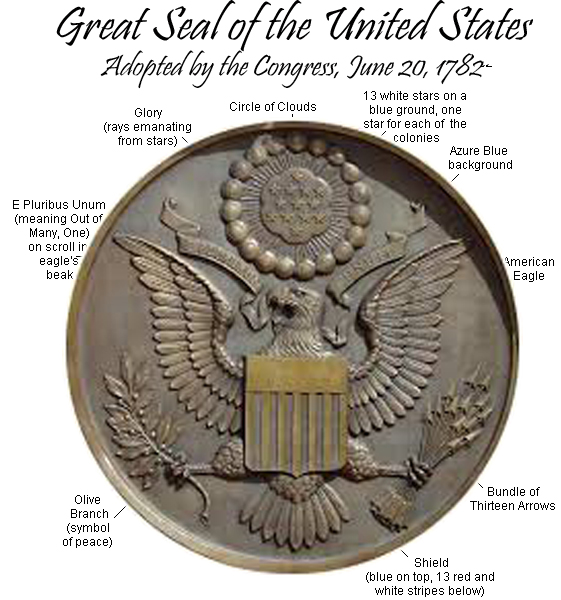
When the 2nd Continental Congress declared independence from Great Britain in 1776, there remained several pieces of unfinished business.  Benjamin Franklin, Thomas Jefferson and John Adams were appointed to a committee of three to take care of one such detail – the creation of an official seal.   The Congress rejected their first draft, approving only the “E pluribus Unum“, (of the many, one), attributed to Thomas Jefferson.

Six years and two such committees later, it was May of 1782.  The brother of a Philadelphia naturalist provided a drawing showing an eagle displayed as a symbol of “supreme power and authority.”  An earlier submission used a phoenix instead of an eagle, representing a nation risen from the ashes of the Revolution.  That bird would be replaced in the final design, by the bald eagle.

Greatseal

Individual states adopted the eagle as their own symbols, as early as 1778.  The Continental Congress officially adopted the current design on this day in 1782.  The final design of the obverse (front) side of the seal, depicts a Bald Eagle, symbolic of liberty and freedom.  The eagle grasps thirteen arrows in its right talons, symbolizing a strong defense.  An olive branch symbolizing peace is held in the other claw.  A banner containing Jefferson’s E pluribus Unum, is held in the eagle’s beak.

Prominently displayed on its breast is a shield, the thirteen red and white stripes symbolizing the states, arranged in support of the federal government, symbolized in blue.

great-sealFinally, a constellation of thirteen stars breaks out of the clouds above, signifying a new people, now ready to take its place among the sovereign nations of earth.
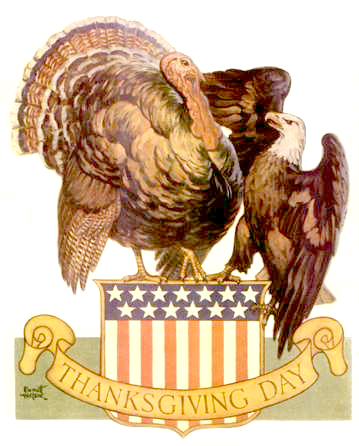
Benjamin Franklin objected to the the eagle’s selection, preferring the national symbol be the turkey.  He complained of the eagle stealing its dinner from other birds.  He said that he’d seen one driven away by a tiny Kingbird, no larger than a sparrow.

eagle-turkey-vintage

Franklin later wrote a letter to his daughter, saying, “For the Truth the Turkey is in Comparison a much more respectable Bird, and withal a true original Native of America . . . He is besides, though a little vain & silly, a Bird of Courage, and would not hesitate to attack a Grenadier of the British Guards who should presume to invade his Farm Yard with a red Coat on.”

Some versions of the symbol used between 1916 and 1945 showed an eagle facing to its left, toward the arrows, giving rise to the urban legend that the seal is changed to have the eagle face towards the olive branch in peace, and towards the arrows in wartime.

On the reverse (back) side of the Great Seal, the pyramid represents strength and duration, like the great Pyramids at Giza.  The Roman numeral MDCCLXXVI at its base translates as 1776. The Latin phrase “Novus ordo seclorum” refers to a “New Order of the Ages.”  The pyramid itself has thirteen levels, atop which is the Eye of God, with the Latin phrase “Annuit Cœptis,” loosely translating as “favors undertakings.”

The hand of Providence would favor the United States and its endeavors, for all time.

the-reverse-side-of-the-great-seal-of-the-united-states-in-sepia_mediumThe militant atheist type wishing to divest himself of all that “church & state” stuff may, at his convenience, feel free to send those dollar bills, to me.  I’m in the book.
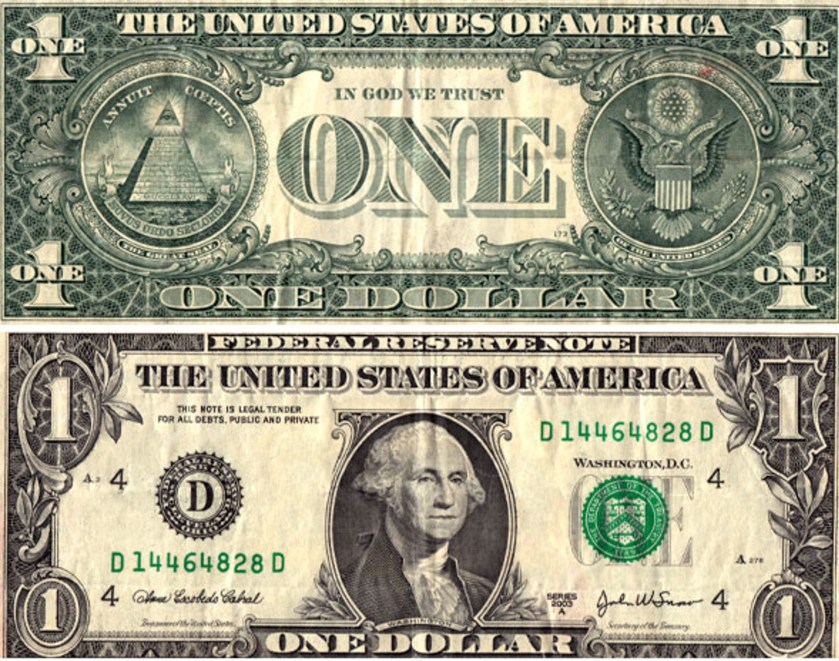
dollar12

If you enjoyed this “Today in History”, please feel free to re-blog, “like” & share on social media, so that others may find and enjoy it as well. Please click the “follow” button on the right, to receive email updates on new articles.  Thank you for your interest, in the history we all share.

June 19, 1864 Single Combat

USS Kearsarge steamed further to sea as the Confederate vessel approached.  There would be no one returning to port until the issue was decided.

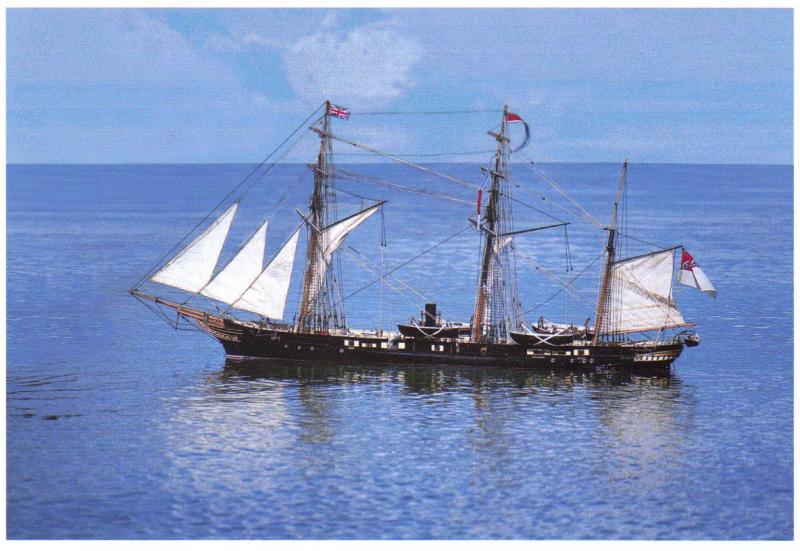
Hull #290 was launched from the John Laird & Sons shipyard in Birkenhead, Cheshire, England as the screw sloop HMS Enrica on May 15, 1862. She sailed in secret to the Terceira Island in the Azores, where she was met by Raphael Semmes, her new captain. Three days, 8 cannon and 350 tons of coal later, the Enrica was transformed into the 220′, 1,500-ton sloop of war and Confederate States of America commerce raider, CSS Alabama.

CSS Alabama
CSS Alabama

Alabama’s mission was to wage economic war on the Union, attacking commercial shipping from the Pacific to the Indian Ocean, from Newfoundland to Brazil. In her two-year career as commerce raider, Alabama claimed 65 prizes valued at nearly $123 million in today’s dollars.  She was the most successful, and most notorious, commerce raider of the Civil War.

portsmouth nh-uss kearsarge-civil war steam sloop
Civil War Steam Sloop USS Kearsarge

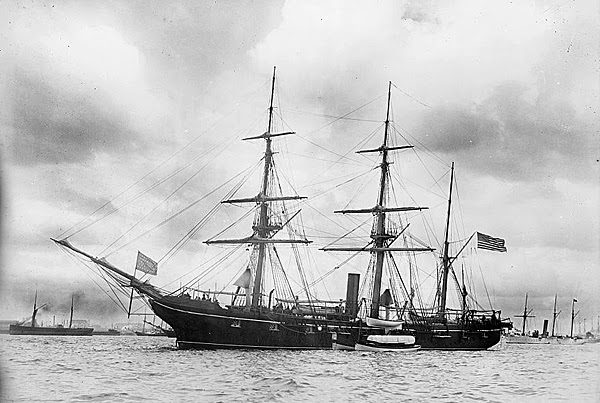
Alabama was in sore need of a refit when she put into Cherbourg France, on the 11th of June, 1864. The Mohican-class Union steam sloop-of-war USS Kearsarge, then on patrol near Gibralter, hurried to Cherbourg, arriving on the 14th.

Captain_Raphael_Semmes_and_First_Lieutenant_John_Kell_aboard_CSS_Alabama_1863
Captain Raphael Semmes and 1st Lieutenant John Kell aboard CSS Alabama 1863

Seeing himself blockaded, Alabama’s Captain challenged Kearsarge Captain John Winslow to a ship-to-ship duel, saying “my intention is to fight the Kearsarge as soon as I can make the necessary arrangements. I hope these will not detain me more than until to-morrow or the morrow morning at farthest. I beg she will not depart until I am ready to go out. I have the honor to be your obedient servant, R. Semmes, Captain“.  That suited Winslow just fine, who took up station in international waters, and waited for Alabama to come out.

h86059CSS Alabama steamed out of Cherbourg harbor on the morning of June 19, 1864, escorted by the French ironclad Couronne, which remained nearby to ensure that the combat remained in international waters. Kearsarge steamed further to sea as the Confederate vessel approached.  There would be no one returning to port until the issue was decided.

Kearsarge v AlabamaCaptain Winslow put his ship around and headed for his adversary at 10:50am. Alabama fired first from a distance of a mile, and continued to fire as the range decreased.
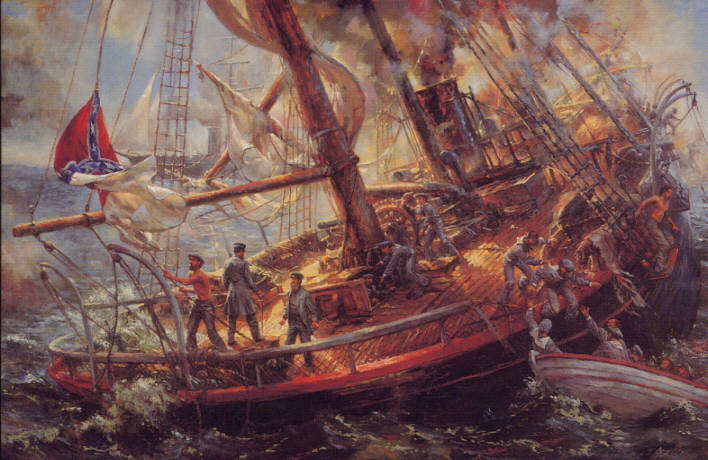
Sinking_of_the_CSS_Alabama, by Andy Thomas
Sinking of the CSS Alabama, by Andy Thomas

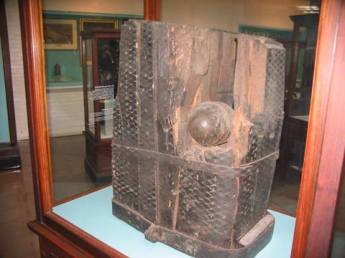
The engagement followed a circular course at a range of a half mile; the ships steaming in opposite directions and firing at will.  One ball from Alabama lodged in Kearsarge’s sternpost, but failed to explode.  Within an hour, Kearsarge’s 11″ Dahlgren smooth bore pivot cannons reduced the most successful commerce raider in history to a sinking wreck. Alabama turned and tried to run back to port, but Kearsarge headed her off as rising water stopped her engines.

Kearsarge Stern Post
USS Kearsarge Sternpost

Semmes struck his colors and sent a boat to Kearsarge with a message of surrender and an appeal for help.

For those rescued by Kearsarge, the Civil War was over. These would spend the rest of the war as prisoners of the Federal government.  Captain Semmes escaped along with 41 others, being plucked from the water and taken to neutral ports by the British steam yacht Deerhound, and the private sail yacht Hornet.

If you enjoyed this “Today in History”, please feel free to re-blog, “like” & share on social media, so that others may find and enjoy it as well. Please click the “follow” button on the right, to receive email updates on new articles.  Thank you for your interest, in the history we all share.

June 18, 1815 A Handful of Nails

For want of a nail the battle was lost…

The Napoleonic Wars began in 1799, pitting the Grand Armée of Emperor Napoleon Bonaparte against a succession of international coalitions. The first five such coalitions formed to oppose him would go down to defeat.

The empire of Czar Alexander I had long traded with Napoleon’s British adversary. Napoleon invaded Russia in 1812 intending to cut off that trade, but made the same mistake which Adolf Hitler would make, 130 years later. He failed to account for Russia’s greatest military asset – General Winter.

Night_Bivouac_of_Great_Army
The Night Bivouac of the Great Army, by Vasily Vereshchagin

For months, Napoleon’s army pressed ever deeper into Russian territory, as Cossack cavalry burned out villages and fields to deny food or shelter to the advancing French army. Napoleon entered the Russian capital of Moscow that September, with expectations of capitulation.  Instead, he got more scorched earth.

French_invasion_of_Russia_collage
French invasion of Russia


With the dread Russian winter coming fast, there was no choice but to turn about. Starving and exhausted with no winter clothing, stragglers were frozen in place or picked off by villagers or pursuing Cossacks. From Moscow to the frontiers you could follow their retreat, by the bodies they left in the snow. 685,000 had crossed the Neman river on June 24. By mid-December, barely 27,000 straggled home from Russian soil.

The War of the 6th Coalition ended in 1814 with Bonaparte’s defeat and exile to the Mediterranean island of Elba, and the restoration to the throne of the Bourbon King Louis VXIII. The Emperor returned at the head of another army, in 111 days.

Tuscan_archipelago

The Congress of Vienna declared Napoleon an outlaw on March 13, 1815, when Austria, Prussia, Russia and the United Kingsom bound themselves to put 150,000 men apiece into the field to end his reign.

Napoleon struck first, taking 124,000 men of l’Armee du Nord on a pre-emptive strike against the Allies in Belgium. Intending to attack Coalition armies before they combined, he struck and defeated the Prussian forces of Gebhard von Blücher near the town of Ligny.

Napoleon then turned his attention to the coalition forces under Lord Arthur Wellesley, Duke of Wellington, who fell back to a carefully selected position on a long east-west ridge at Mont St Jean, a few miles south of the village of Waterloo.

waterloo_battle

It rained all day and night, that Saturday. Napoleon waited for the ground to dry on the morning of June 18, launching his first attack before noon.  Wellington’s Prussian allies were still five hours away. The 80 guns of the Grande batterie opened fire at 11:50, while Wellington’s reserves sheltered out of sight on the reverse slope of the Mont St. Jean ridge. French infantry swarmed the stone buildings of the Château Hougomont on Wellington’s right, and La Haye Sainte on his left.

Waterloo, Chateau Battle

Most French infantry reserves were committed by 4:00pm, when Marshall Ney ordered the massed cavalry assault. Colonel Cornelius Frazer watched the mass of riders  and thought to himself: “They are going to roll over us.” In a flash, Frazer ordered: “Form squares!”  9,000 cuirassiers charged up the hill as Wellington’s artillery responded with canister and shot, turning their cannon into giant shotguns tearing holes in the French ranks.

waterloo-cavalry-charge

It was common practice of the time to “spike” enemy cannon, driving a nail into the touchhole and disabling the weapon. Marshal Ney’s aide Colonel Pierre-Agathe Heymès, frantically cried out “Les clous!” “Nails! Spike the guns!”

Not one rider had thought to bring them.

Eleven times French cavalry gained the hill and surrounded those guns. Eleven times the gunners retreated into defensive infantry squares, bristling with spears. Eleven times they returned to their pieces, to fire into French cavalry as it withdrew.

Waterloo_Cavalry

Newly arrived Prussians were pouring in from the right at 7:30 when Napoleon committed his 3,000 man Imperial Guard. These were Napoleon’s elite soldiers, almost seven feet tall in their high bearskin hats. Never defeated in battle, they came up the hill intending to roll up Wellington’s center, away from their Prussian allies. 1,500 British Foot Guards were lying down to shelter from French artillery. As the French lines neared the top of the ridge, the English stood up, appearing to rise from the ground and firing point blank into the French line.

The furious counter assault which followed caused the Imperial Guard to waver, and then retreat. Someone shouted “La Garde recule. Sauve qui peut!” (“The Guard retreats. Save yourself if you can!”), as the Allied army rushed forward and threw themselves on the retreating French.

There is a story, possibly apocryphal, concerning Henry Paget, 2nd Earl of Uxbridge. One of the last cannon balls fired that day hit Uxbridge just above the knee, all but severing the limb. Lord Uxbridge was close to Wellington at the time, exclaiming “By God, sir, I’ve lost my leg!”. Wellington replied “By God, sir, so you have!” There’s another version in which Wellington says “By God, sir, you’ve lost your leg!”. Looking down, Uxbridge replied “By God, sir, so I have!”

waterloo

As night fell, hundreds of locals emerged with hammers, pliers and chisels, combing the battlefield to remove the teeth of tens of thousands of dead and dying soldiers. Demand for human teeth was high and looters sold them by the tens of thousands, to dentists, who formed them into dentures. According to England’s National Army Museum, British dentists did nothing to conceal where they came from, advertising their appliances as “Waterloo teeth.” As late as the American Civil War, English dentists continued to do a brisk trade in “Waterloo ivory.”

Estimates of the total killed and wounded in the Napoleonic wars range from 3.5 to 6 million. Until Waterloo, Napoleon Bonaparte participated in, and won, more battles than Julius Caesar, Hannibal, Frederick the Great, and Alexander the Great.  Combined.

51FJajZqFIL._SL300_Austrian military history professor Erik Durschmied wrote in his excellent book`The Hinge Factor‘, of the times when serendipity,  ‘chance and stupidity have changed history.’  According to Wellington, the Battle of Waterloo was “the nearest-run thing you ever saw in your life.” The French defeat was comprehensive.  Bonaparte was captured and exiled, this time to a speck in the North Atlantic called Saint Helena.  All, for a handful of nails.

If you enjoyed this “Today in History”, please feel free to re-blog, “like” & share on social media, so that others may find and enjoy it as well. Please click the “follow” button on the right, to receive email updates on new articles.  Thank you for your interest, in the history we all share.

June 17, 1462 Son of the Dragon

In a time and place remembered for near-cartoonish levels of violence, Vlad Țepeș stands out for extraordinary cruelty.

Count Dracula, favorite of Halloween costume shoppers from time immemorial, has been with us since the 1897 publication of Bram Stoker’s novel, of the same name.  Stoker’s working titles for the manuscript were “The Un-dead”, and “Count Wampyr”. He nearly kept one of them too, until stumbling into the real-life story of Vlad Țepeș (TSE·pesh), a Wallachian Prince and front-line warrior, against the Jihad of his day.

In modern Romanian, “Dracul” means “the Devil”. In the old language, it meant “the Dragon”, the word “Dracula” (Drăculea) translating as “Son of the Dragon”.

166-vlad-tepes_246_9379154c5086651cL.jpgStoker wrote in his notes, “in Wallachian language means DEVIL”. In a time and place remembered for near-cartoonish levels of violence, Vlad Țepeș stands out for his extraordinary cruelty. There are tales of Țepeș disemboweling his own mistress. That he collected the noses of vanquished adversaries.  Some 24,000 of them. That he dined among forests of victims, spitted on poles. That he even impaled the donkeys they rode in on.
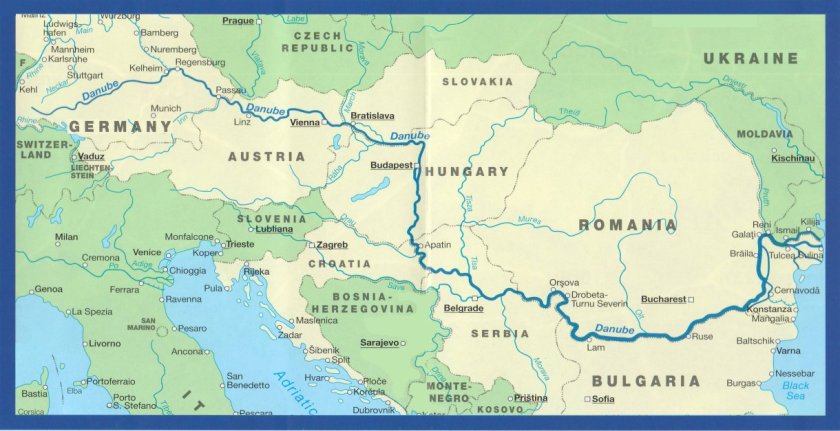
In 1436, Vlad II became voivode (prince) of Wallachia, a region in modern-day Romania situated between the Lower Danube river and the Carpathian Mountains.  The sobriquet “Dracul” came from membership in the “Order of the Dragon” (literally “Society of the Dragonists”), a monarchical chivalric order founded by Holy Roman Emperor Sigismund in 1408, and dedicated to stopping the Ottoman advance into Europe.

A crossroads between East and West, the region was scene to frequent bloodshed, as Ottoman forces pushed westward into Europe, and Christian forces pushed back..

A weakened political position left Vlad II no choice but to pay homage to Ottoman Sultan Murad II, in the form of an annual Jizya (tax on non-Muslims) and a contribution of 500 Wallachian boys to serve as Janissaries in the elite slave army of the Ottoman Empire.

Vlad was taken hostage by the Sultan in 1442, along with his two younger sons, Vlad III and Radu.  The terms of the boys’ captivity were relatively mild by the standards of the time and both became skilled horsemen and warriors. Radu went over to the Turkish side, but Vlad hated captivity, developing an incandescent hate for his captors which would last all his life.

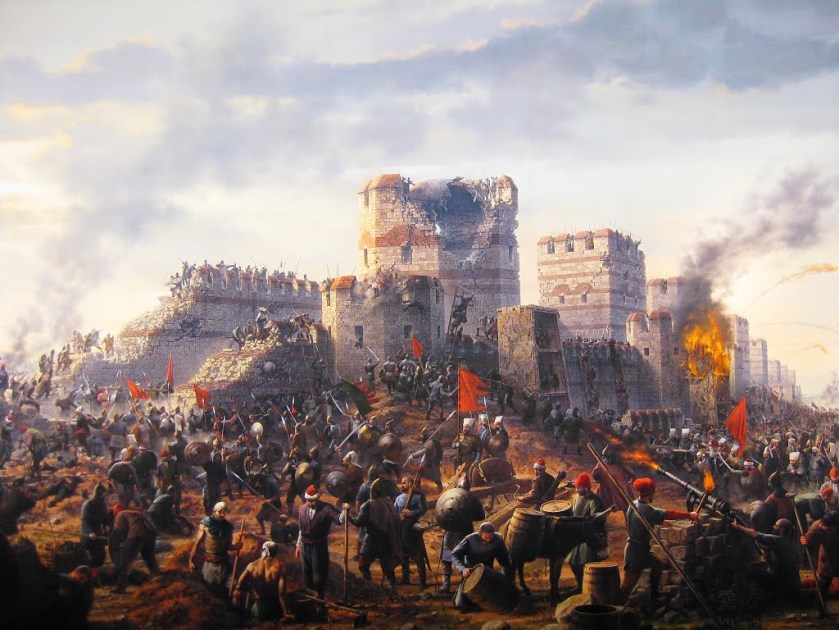
Following the fall of Constantinople in 1453, Sultan Mehmed II set his sights on the invasion of all Europe.

84086982
Fall of Constantinople

The younger Vlad gained the Wallachian throne three years later and immediately stopped all tribute to Sultan Mehmed II, by now risen to 10,000 ducats per year, and 1,000 boys.  When a group of visiting Ottoman envoys declined to remove their turbans in Vlad’s court, the Prince ordered the turbans nailed to their skulls.

Vlad now consolidated power as his reputation for savagery, grew.  According to stories circulated after his death, hundreds of disloyal boyars (nobles) and their allies met their end, impaled on spikes.

Mehmed II, conqueror of Constantinople, now amassed power of his own, setting his sights on campaigns against Anatolia, the Greek Empire of Trebizond and the White Sheep Turkomans of Uzun Hasan.   Throughout this period, Romanian control of the Danube remained a thorn in his side.

danuberiver2016x007
Danube River

Pope Pius II declared a new Crusade against the Ottoman in 1460, but Vlad Țepeș was the only European leader to show any enthusiasm.  The Hungarian General and Ţepeş’ only ally Mihály Szilágyi was captured by the Turks, his men tortured to death and Szilágyi himself sawed in half.

Țepeș invaded the Ottoman Empire the following year.  In a letter to Hungarian king Matthias Corvinus dated February 11, 1462, Țepeș wrote:  I have killed peasants men and women, old and young, who lived at Oblucitza and Novoselo, where the Danube flows into the sea, up to Rahova, which is located near Chilia, from the lower Danube up to such places as Samovit and Ghighen. We killed 23,884 Turks without counting those whom we burned in homes or the Turks whose heads were cut by our soldiers…Thus, your highness, you must know that I have broken the peace with him (Sultan Mehmed II).

The Sultan invaded Wallachia at the head of a massive army, only to find a “forest of the impaled”.  The Byzantine Greek historian Laonikos Chalkokondyles writes: “The sultan’s army entered into the area of the impalements, which was seventeen long and seven stades wide”.

To give a sense of scale to such a horror, a “stade” derives from the Greek “stadeon” – the dimensions of an ancient sports arena.

Vlad DraculaOutnumbered five-to-one, Ţepeş employed a scorched earth policy, poisoning the waters, diverting small rivers to create marshes and digging traps covered with timber and leaves. He would send sick people among the Turks, suffering lethal diseases such as leprosy, tuberculosis and bubonic plague.
From his years in captivity, Ţepeş understood Ottoman language and customs as well as the Turks themselves.  Fearless, he would disguise himself as a Turk and freely walk about their encampments, gaining valuable intelligence on the Sultan’s organization.

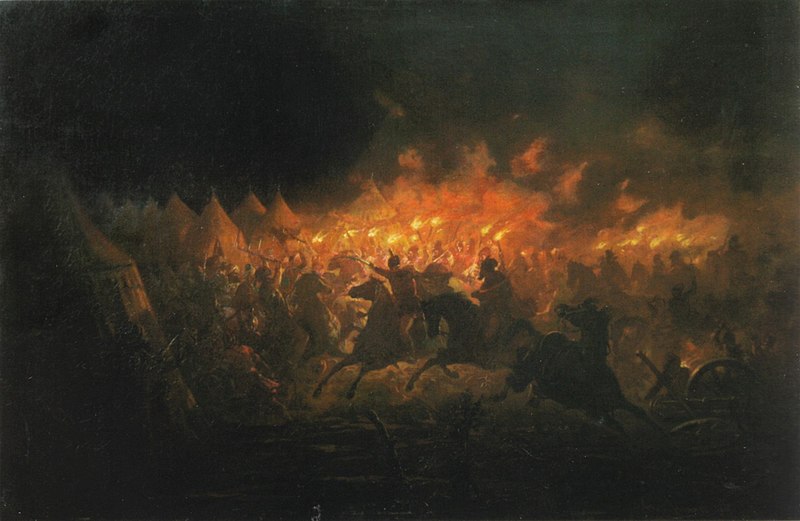
On this day in 1462, the Son of the Dragon launched a night attack on the Ottoman camp near the capital city of Târgoviște, in an effort to assassinate Mehmed himself.  Knowing that the Sultan forbade his men from leaving their tents at night, a force of some 7,000 to 10,000 horsemen fell on Mehmed’s camp three hours after sunset.  The skirmish lasted all that night until 4 the next morning, killing untold numbers of Turks, their horses and camels.  Ţepeş himself aimed for the Sultan’s tent, but mistook it for that of two grand viziers, Ishak Pasha and Mahmud Pasha.

800px-AtaculdeNoapte
The Battle With Torches by Romanian painter Theodor Aman. It depicts the The Night Attack of Târgovişte,

Mehmed II “The Conqueror” survived the Night Attack at Târgovişte.  In the end, the Romanian principalities had little with which to oppose the overwhelming force of the Ottoman Empire. Vlad III Țepeș would twice be deposed only to regain the throne but never able to defeat his vastly more powerful adversary.

“Vlad the Impaler” was exiled to Hungary where he spent much of his time, in prison.  He died fighting against the Ottomans in December 1476 or January 1477, his body cut into pieces and his head delivered to the Sultan.  Drăculea is buried in an unknown grave, stories of his cruelty told and retold in Russian, German and a hundred other languages.  Five hundred years later, the Son of the Dragon is remembered as the un-dead vampire, Count Dracula.


If you enjoyed this “Today in History”, please feel free to re-blog, “like” & share on social media, so that others may find and enjoy it as well. Please click the “follow” button on the right, to receive email updates on new articles.  Thank you for your interest, in the history we all share.

June 16, 1775 Act Worthy of Yourselves

“You are to decide the important question, on which rest the happiness and liberty of millions yet unborn.  Act worthy of yourselves.”

The city of Charlestown, Massachusetts occupies a hilly peninsula to the north of Boston, at the point where the Mystic River meets the Charles. Like Boston itself, much of what is now Charlestown was once Boston Harbor.  In 1775 the town was a virtual island, joined to the mainland only by a thin “neck” of land.

bunkerhilllg

Thousands of Patriot Militia poured into the area following the April battles of Lexington and Concord, blocking British forces in control of Boston and its surrounding waterways.

The Massachusetts Provincial Congress received word on June 13 that a massive assault was planned for the 18th, intending to take the high ground at Dorchester Heights to the south, and Charlestown to the north. Major General Israel Putnam was directed to set up defenses on Bunker Hill, on the northwest end of Charlestown.

Col. William Prescott led 1,200 men onto the peninsula on the night of the 16th, with orders to construct fortifications on Bunker Hill.  Some work was performed on the hill which gives the battle its name, but it was farmer Ephraim Breed’s land 1/3rd of a mile closer to Boston, which offered the more tenable hill from which to defend the peninsula.

Shovels could be heard throughout the night.  The sun rose on the morning of June 17 to reveal a six-foot-high defensive earthwork running the length of Breed’s hill.  Peering through the early morning fog, General Howe was astonished at what he saw. “The rebels,” he said, “have done more work in one night than my whole army would have done in one month.”

The warship HMS Lively opened fire on the redoubt shortly after 4am, with little effect, as Prescott’s men continued work on the entrenchment. 128 guns joined in as the morning bore on, including incendiary shot, setting fire to the town.

hms-somerset-bunker-hill

Ten miles to the south, a 7-year-old future President of the United States stood atop a hill with his mother Abigail, listening to the thunder of the guns and watching the smoke rise above Charlestown. John Quincy Adams would later write that he “witnessed the tears of my mother and mingled with them my own.”

Militia continued to reinforce the high ground throughout the morning hours, as Regulars commanded by Major General William Howe and Brigadier General Robert Pigot crossed the Charles River and assembled for the assault.

Battle_of_Bunker_HillThe British line advanced up Breed’s Hill twice that afternoon, Patriot fire decimating their number and driving the survivors back down the hill to reform and try again.

Militia supplies of powder and shot began to give out as the Redcoats advanced up the hill for the third assault. “Don’t fire until you see the whites of their eyes”. The quote is attributed to Prescott, but the order seems to have originated with General Putnam and passed along by Prescott, Seth Pomeroy, John Stark and others, in a desperate attempt to conserve ammunition.

BunkerHill2

Finally, there was nothing left with which to oppose the British bayonets.  In desperate hand to hand fighting, the Militia was forced to retreat.

Most of the colonists’ casualties occurred at this time, including Boston physician and President of Massachusetts’ Provincial Congress, Dr. Joseph Warren. Warren had been appointed Major General on June 14, but declined command, believing Putnam and Prescott to be more experienced soldiers.  On this day, Dr. Warren fought as a private soldier.

Two months before the battle, Joseph Warren had spoken to his men. “On you depend the fortunes of America”, he said. “You are to decide the important question, on which rest the happiness and liberty of millions yet unborn.  Act worthy of yourselves.”

That they did. The Americans had gone toe-to-toe with the most powerful military of its time, suffering 452 killed and wounded.  Lieutenant Lord Rawdon recognized Dr. Warren on the third assault, and killed him with a musket ball to the head.  Warren’s body was bayoneted beyond recognition and thrown into a ditch.

Dr. Warren’s body was exhumed some ten months later after the British evacuation of Boston, and identified by a false tooth made for him by the amateur dentist, Paul Revere.  It may be the first instance of forensic dentistry, in American history.

800px-The_Death_of_General_Warren_at_the_Battle_of_Bunker's_Hill
The Death of General Warren at the Battle of Bunker Hill, by John Trumbull

The Battle of Bunker Hill was a military victory for the British side, but it was a Pyrrhic victory.  Howe lost 226 men killed and 828 wounded, over a third of his number and over twice that of the Militia. One-eighth of all the British officers killed and one-sixth of those injured during the entire Revolution, occurred on Breed’s Hill.

General Thomas Gage wrote after battle, “The loss we have sustained is greater than we can bear.”  Private Nathanael Greene, destined to become one of the Continental Army’s most important Generals, quipped “I wish [we] could sell them another hill at the same price.”


If you enjoyed this “Today in History”, please feel free to re-blog, “like” & share on social media, so that others may find and enjoy it as well. Please click the “follow” button on the right, to receive email updates on new articles.  Thank you for your interest, in the history we all share.

June 15 1904 A Community, no More

The General Slocum disaster killed fewer than one per cent of the overall population of Little Germany, yet these were the women and children of some of the community’s most established families.  

In the first full century of American independence, three great waves of European and later Asian immigrants left their homes in the ‘old country’, headed for a life in the new world.

The-Scotch-Irish-the-Eighteenth-Century-Irish-Diaspora-1Starvation, shipwreck and disease killed no fewer than 1 in 10 during the period 1790 – 1820, without any so much as setting foot in the new world. And still they came.
The largest non-English speaking minority were the ethnic Germans, escaping economic hardship and in search of political freedom.  At the time of the Civil War, nearly one-quarter of all Union troops were German Americans, some 45% of whom were born in Europe.

German migration rose faster than any other immigrant group through the latter part of the 19th century and into the 20th, many in pursuit of agricultural opportunity while others settled in major cities such as New York and Philadelphia.

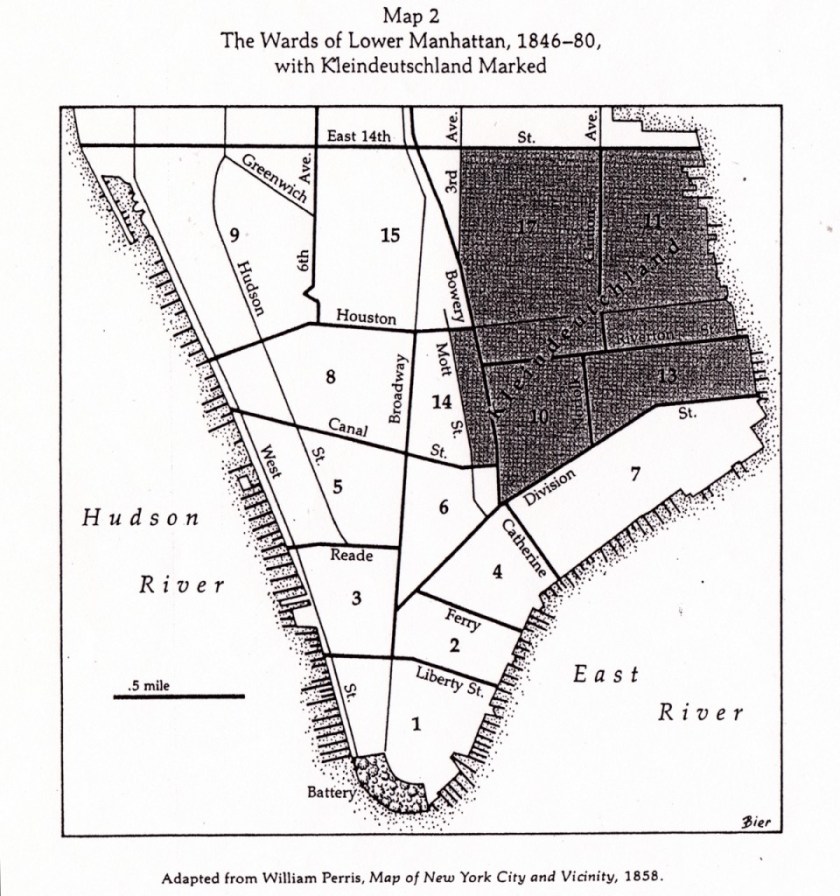
Kleindeutschland, or “Little Germany”, occupied some 400 blocks on the Lower East Side of Manhattan, in what is now the East Village. “Dutchtown”, as contemporary non-Germans called the area, was home to New York’s German immigrant community since the 1840s, when they first began to arrive in significant numbers. By 1855, New York had the largest ethnically German community in the world, save for Berlin and Vienna.

Little Germany

June 15, 1904 dawned bright and beautiful on Little Germany, a beautiful late spring morning when the sidewheel Passenger Steamboat General Slocum left the dock and steamed into the East River.

PS General Slocum was on a charter this day, carrying German-American families on an outing from St. Mark’s Lutheran Church on a harbor cruise and picnic. Over a thousand tickets were sold, not counting 300+ children who were sailing for free.

general_slocum_1

There were 1,342 people on board, mostly women and children, including band, crew and catering staff.

The fire probably started when someone tossed a cigarette or match into the forward section lamp room. The flames spread quickly, fueled by lamp oil and oily rags.  A 12-year old boy first reported the fire, but the Captain didn’t believe him.  The fire was first noticed at around 10:00am.

The ships’ operators had been woefully lax in maintaining safety equipment. Now it began to show. Fire hoses stored in the sun for years were uncoiled, only to break into rotten bits in the hands of the crew. Life preservers manufactured in 1891 had hung unprotected in the sun for 13 years, their canvas covers splitting apart pouring useless cork powder onto the floor. Survivors reported inaccessible life boats, wired and painted into place.

slo-345x180

Crew members reported to Captain William van Schaick that the blaze “could not be conquered.” It was “like trying to put out hell itself.” The captain ran full steam into the wind trying to make it to the 134th Street Pier, but a tug boat waved them off, fearing the flames would spread to nearby buildings.

The wind and the speed of the ship itself whipped the flames into an inferno as Captain van Schaick changed course for North Brother Island, just off the Bronx’ shore.
Many jumped overboard to escape the inferno, but the heavy women’s clothing of the era quickly pulled them under.

Slocum 1

Desperate mothers put useless life jackets on children and threw them overboard, only to watch in horror as they sank. One man, fully engulfed in flames, jumped screaming over the side, only to be swallowed whole by the massive paddle wheel.

One woman gave birth in the confusion, and then jumped overboard with her newborn to escape the flames. They both drowned.

A few small boats were successful in pulling alongside in the Hell’s Gate part of the harbor, but navigation was difficult due to the number of corpses already bobbing in the waves.

general-slocum-disaster

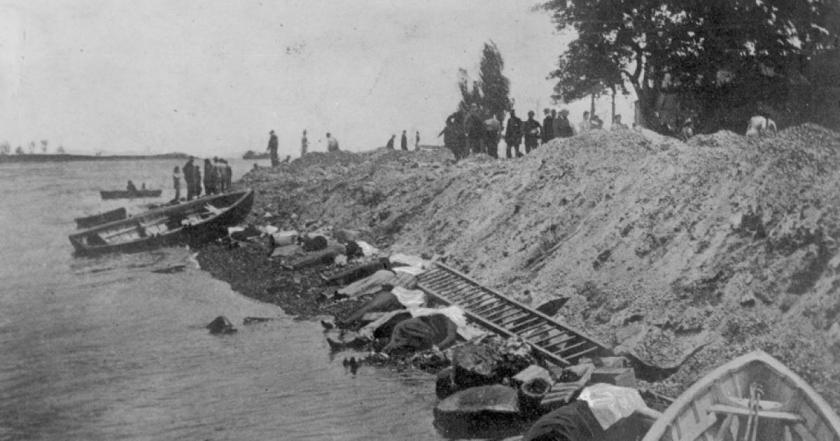
Holding his station despite the inferno, Captain van Schaick permanently lost sight in one eye and his feet were badly burned by the time he ran the Slocum aground at Brother Island.

Patients and staff at the local hospital formed a human chain to pull survivors to shore as they jumped into shallow water.

1,021 passengers and crew either burned to death, or drowned. It was the deadliest peacetime maritime disaster, in American history.

220px-Wotherspoon_01
Adella Liebenow

There were only 321 survivors.

The youngest survivor of the disaster was six-month-old Adella Liebenow. The following year at the age of one, Liebenow unveiled a memorial statue to the disaster which had killed her two sisters and permanently disfigured her mother.

The New York Times reported “Ten thousand persons saw through their tears a baby with a doll tucked under her arm unveil the monument to the unidentified dead of the Slocum disaster yesterday afternoon in the Lutheran Cemetery, Middle Village, L.I.”

Both of Liebenow’s sisters were among the unidentified dead.

The General Slocum disaster killed fewer than one per cent of the overall population of Little Germany, yet these were the women and children of some of the community’s most established families.

There were more than a few suicides.  Mutual recriminations devoured much of a once-clannish community, as the men began to move away.  2600326453_0eae4732c8

There was no longer anything for them, in that place.

Anti-German sentiment engendered by WW1 finished what the General Slocum disaster, had begun. Soon, New York’s German-immigrant community, was no more.

Deep inside the East Village, amidst the hipsters and the poets’ cafes of “Alphabet City”, stands a forgotten memorial.  A 9′ stele erected in Tompkins Square Park, sculpted from pink Tennessee Marble. The relief sculpture shows two children, beside them are inscribed these words: “They were Earth’s purest children, young and fair.

Once the youngest survivor of the disaster, Adella (Liebenow) Wotherspoon passed away in 2004, at the age of 100, the oldest survivor of the deadliest disaster in New York history.  Until September 11, 2001.


If you enjoyed this “Today in History”, please feel free to re-blog, “like” & share on social media, so that others may find and enjoy it as well. Please click the “follow” button on the right, to receive email updates on new articles.  Thank you for your interest, in the history we all share.