October 22, 1914 Massacre of the Innocents

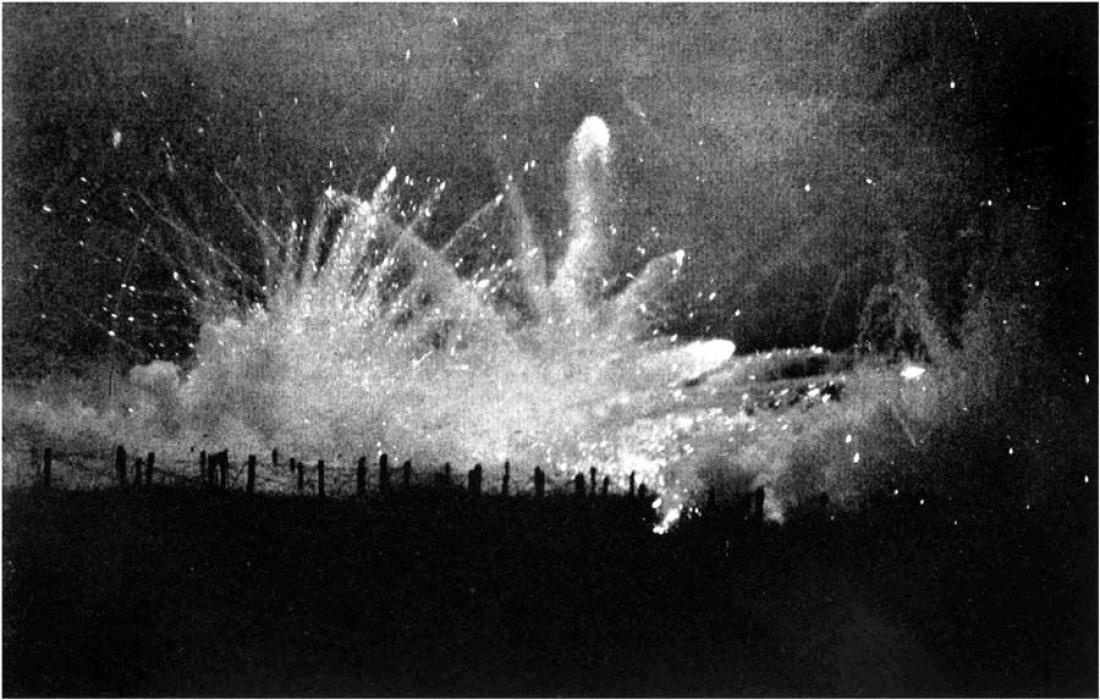
A million men had been brought to this place, for the purpose of killing each other.     The first Battle for Ypres, (there would be others), was the greatest clash in history, or one of them, bringing together more manpower and more firepower than entire wars of the previous century.

“Sitzkrieg”. “Phony War”. Those were the terms used to describe the September 1939 to May 1940 period, when neither side of what was to become World War 2, was yet prepared to launch a major ground war against the other.

The outbreak of “The Great War” twenty-five years earlier, was a different story. Had you been alive in August of 1914, you could have witnessed what might be described as the simultaneous detonation, of a continent.  France alone suffered 140,000 casualties over the four day “Battle of the Frontiers”, where the River Sambre met the Meuse.  27,000 Frenchmen died in a single day, August 22, in the forests of the Ardennes and Charleroi.

Battle-of-the-Frontiers-1914-7
Battle of the Frontiers, 1914

The British Expeditionary Force escaped annihilation on August 22-23, only by the intervention of mythic angels, at a place called Mons.  In the East, a Russian army under General Alexander Samsonov was encircled and so thoroughly shattered at Tannenberg, that German machine gunners were driven to insanity at the damage inflicted by their own guns, on the milling and helpless masses of Russian soldiers.  Only 10,000 of the original 150,000 escaped death, destruction or capture.  Samsonov himself walked into the woods, and shot himself.

The “Race to the Sea” of mid-September to late October was more a series of leapfrog movements and running combat, in which the adversaries tried to outflank one another.  This would be some of the last major movement of the Great War, ending in the apocalypse of Ypres.

When governments make war, It’s the everyday John and the Nigel down the street, the Fritz, the Ivan and the Pierre next door, who must do the fighting, and the bleeding, and the dying.

The battle for the medieval textile town of Leper, most of the battle maps were drawn in French and so we know the place as “Ypres”, began on October 20 and lasted about three weeks, pitting a massive German force of some 600,000 against a quarter-million French, 100,000 British, and 65,000 Belgians.

flanders_october_20-24

A million men had been brought to this place, for the purpose of killing each other.     The first Battle for Ypres, (there would be others), was the greatest clash in history, or one of them, bringing together more manpower and more firepower than entire wars of the previous century. The losses are hard to get your head around. The British Expeditionary Force (BEF) alone suffered 56,000 casualties, including 8,000 killed, 30,000 maimed and another 18,000 missing, of whom roughly one-third, were dead.

The breakdown is harder to get at for the other combatants but, all in, Germany suffered 135,000 casualties, France 85,000 and Belgium, 22,000. Assuming the same percentage distribution of killed, wounded and missing, the three week struggle for Ypres cost the lives of 75,000 men, enough to fill the Athens Olympic Stadium, in Greece.

A story comes down from the fighting of October 22, destined to become German and later Nazi, mythology.  French, British and Belgian troops were by this time, digging into the ground to shelter themselves from what Private Ernst Jünger later called the “Storm of Steel”.   German Generals, desperate to break through the Allied line and capture Calais and the other French ports on the English Channel, attacked.

German reserve divisions comprised of student volunteers:  inexperienced, untrained college students fired with patriotic zeal and singing songs of the Fatherland, marched to the attack against a puny British force, dug into shallow holes around the village of Langemarck.  What the BEF lacked this day in numbers, were more than made up, in firepower. Let William Robinson, a volunteer dispatch driver with the British Army, describe what came to be known as the “Kindermord bei Ypern”  The Massacre of the Innocents at Ypres.

“The enemy seemed to rise out of the ground and sweep towards us like a great tidal wave, but our machine guns poured steel into them at the rate of six hundred shots per minute, and they’d go down like grass before the scythe… The Germans were climbing over heaps of their own dead, only to meet the same fate themselves.”

Overwhelming German numbers succeeded in forcing the British back and capturing Langemarck on October 22, but the cost was appalling.  Some regiments lost 70% of their strength.

5393774889_6b9037d2a6_bDoubt has been cast on the “Myth of Langemarck”, and the tragic bravery of idealistic German boys, happily defending the Fatherland.  The numbers of dead and maimed are real enough, but most reservists were in fact comprised of older working class men, not the fresh-faced youth, of the Kindermord.  Be that as it may, a story must be told.  Excuses must be made to the home team, for the crushing failure of the War of Movement, and the four-year war of attrition, to follow.

Two short months later, some of these same men would step out of their trenches and across the frozen fields of Flanders, to shake the hand of the man he’d been sent there, to kill.  The unofficial “Christmas Truce” of 1914 would last a day or two in some sectors and a week or two in others.  And then it was back, to the business at hand.  For Four. More. Years.

Christmas Truce

The Man He Killed
BY THOMAS HARDY

“Had he and I but met
By some old ancient inn,
We should have sat us down to wet
Right many a nipperkin!
“But ranged as infantry,
And staring face to face,
I shot at him as he at me,
And killed him in his place.
“I shot him dead because —
Because he was my foe,
Just so: my foe of course he was;
That’s clear enough; although
“He thought he’d ‘list, perhaps,
Off-hand like — just as I —
Was out of work — had sold his traps —
No other reason why.
“Yes; quaint and curious war is!
You shoot a fellow down
You’d treat if met where any bar is,
Or help to half-a-crown.”

October 21, 1774 First Flag

“…Steadfast, in Freedom’s Cause, we’ll live and die,
Unawed by Statesmen; Foes to Tyranny,
But if oppression brings us to our Graves,
and marks us dead, she ne’er shall mark us Slaves”

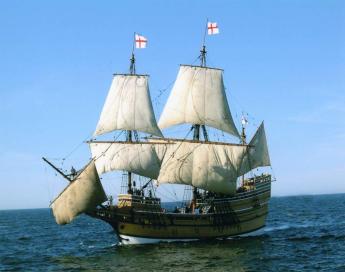
The Mayflower set sail from England on September 6, 1620, and fetched up on the outer reaches of Cape Cod in mid-November, near the present-day site of Provincetown Harbor.

5848246db1583.image
Mayflower, historic reproduction

One was born over those 66 days at sea, another died.  They were 101 in all, including forty members of the English Separatist Church, a radical Puritan faction who felt the Church of England hadn’t gone far enough, in the Protestant Reformation.

There the group drew up the first written framework of government established in the United States, 41 of them signing the Mayflower Compact on board the ship on November 11, 1620.

With sandy soil and no place to shelter from North Atlantic storms, a month in that place was enough to convince them of its unsuitability. Search parties were sent out and, on December 21, the “Pilgrims“crossed Cape Cod Bay and arrived at what we now know, as Plymouth Harbor.

Fully half of them died that first winter but the rest hung on, with assistance from the Grand Sachem Massasoit (inter-tribal chief) of the Wampanoag confederacy, in the form of the emissaries, Samoset and Squanto. The Mayflower returned to England in April 1621, with half its original crew.

british red ensign mini 2
British Red Ensign

Three more ships arrived in Plymouth over the next two years, including the Fortune (1621), the Anne and the Little James (1623). Those who arrived on these first four ships were known as the “Old Comers” of Plymouth colony, and were given special treatment in the affairs of “America’s Home Town”.

A short seventeen years later, members of the Plymouth Colony founded the town of Taunton twenty-four miles inland, and formally incorporated the place on September 3, 1639.

In 1656, the first successful iron works in Plymouth Colony and only the third in “New England” was established in Taunton, on the Two Mile River. The Taunton Iron Works operated for over 200 years, until 1876.

The town was once home to several silver smithing operations, including Reed & Barton, F.B. Rogers, and Poole Silver. To this day, Taunton is known as the “Silver City”.

Taunton also has the distinction of flying what may have been the first distinctly American flag, in history.

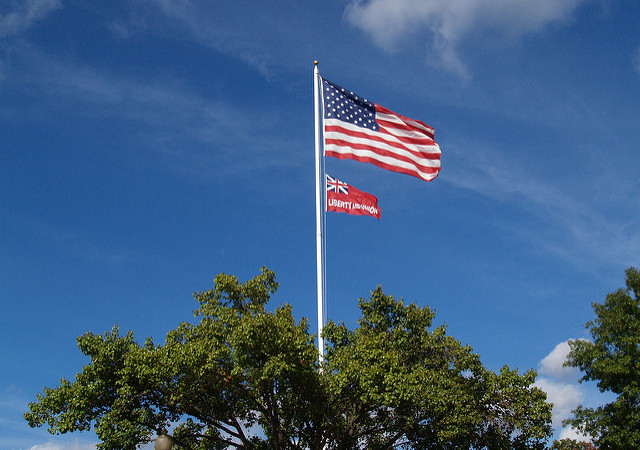
united_states_taunton_flag_liberty_and_union_1774_coffee_mug-rf4e479fc61a14108aaef1be92fcbb695_x7jgr_8byvr_512First raised above the town square on October 19, 1774, the flag’s canton featured the Union Jack, on the blood red field of the British Red Ensign. The Declaration of Independence lay two years in the future for these people.  They were, after all, still British subjects.

Between hoist and fly ends were written the words “Liberty and Union”, a solemn declaration that the colonies were going to stick together, and that their rights as British citizens, were not about to be violated.

Not so long as they had something to say about it.

On October 21, 1774, the Taunton Sons of Liberty raised the flag 112-feet high on a Liberty Pole, and tacked the following inscription on that pole:

“Be it known to the present,
And to all future generations,
That the Sons of Liberty in TAUNTON
Fired with Zeal for the Preservation of
Their Rights as Men, and as American Englishmen,
And prompted by a just Resentment of
The Wrongs and Injuries offered to the
English Colonies in general, and to
This Province in particular,
Through the unjust Claims of
A British Parliament, and the
Machiavellian Policy of their fixed Resolution
To preserve sacred and inviolate
Their Birth-Rights and Charter-Rights,
And to resist, even unto Blood,
All attempts for their Subversion or Abridgement.
Born to be free, we spurn the Knaves who dare
For us the Chains of Slavery to prepare.
Steadfast, in Freedom’s Cause, we’ll live and die,
Unawed by Statesmen; Foes to Tyranny,
But if oppression brings us to our Graves,
and marks us dead, she ne’er shall mark us Slaves”.

The Taunton flag is considered to be among the oldest distinctly American flags if not the oldest, in history. The city officially adopted it on October 19, 1974, the 200th anniversary of the day it was first raised above Taunton green. Stop and see it if you ever get by.   It’s there on the Liberty Pole, directly beneath the Stars and Stripes of the Star Spangled Banner.

AR-150926822

.If you enjoyed this “Today in History”, please feel free to re-blog, “like” & share on social media, so that others may find and enjoy it as well. Please click the “follow” button on the right, to receive email updates on new articles.  Thank you for your interest, in the history we all share.

October 20, 1937 Albert’s Swarm

Imagine a world with no grocery stores, and watching your food, All of it, disintegrate, before your eyes.

Between 1932 and 1943, children’s author Laura Ingalls Wilder published a series of eight novels, a fictionalized autobiography based on the childhood experiences of a 19th century pioneer and settler family. Third in the series is the best known, Little House on the Prairie, the subject for a television series running from 1974 to ’83.

In her fourth book, Wilder tells of the time when grasshoppers wiped out a much-anticipated and badly needed wheat crop, laying so many eggs that all hope was gone for the following year, as well.  On the Banks of Plum Creek, published  this day in 1937, told the story of “Pa” having to walk three-hundred miles east to find work on farms, which had escaped the plague of grasshoppers.

There are something like 11,000 species of grasshoppers in the world, the familiar, plant munching insects of our summer fields.  They are vegetarian creatures with polyphagous food habits, meaning they’ll eat just about anything, if the need arises.

SA4.9 r132
Rocky Mountain locust, Melanoplus spretus, photographed in 1870s, Minnesota

Usually a solitary creature, only a few species will become locusts, the “gregarious” phase of the insect’s life cycle characterized by swarming, migration, and accompanied by explosive growth in population.

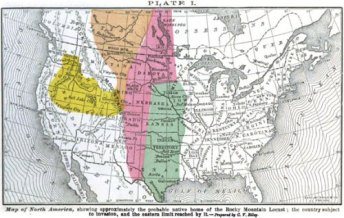
The two years in Wilder’s story, 1874 – ’75, are among the worst swarms on record for the Rocky Mountain Locust, Melanoplus spretus.  

M. Spretus finds its home in the fertile valleys of the Rocky Mountains, but outbreaks of the insect have caused farm damage as far away as Maine in the period 1743–’56, and in Vermont during the administration of President George Washington.

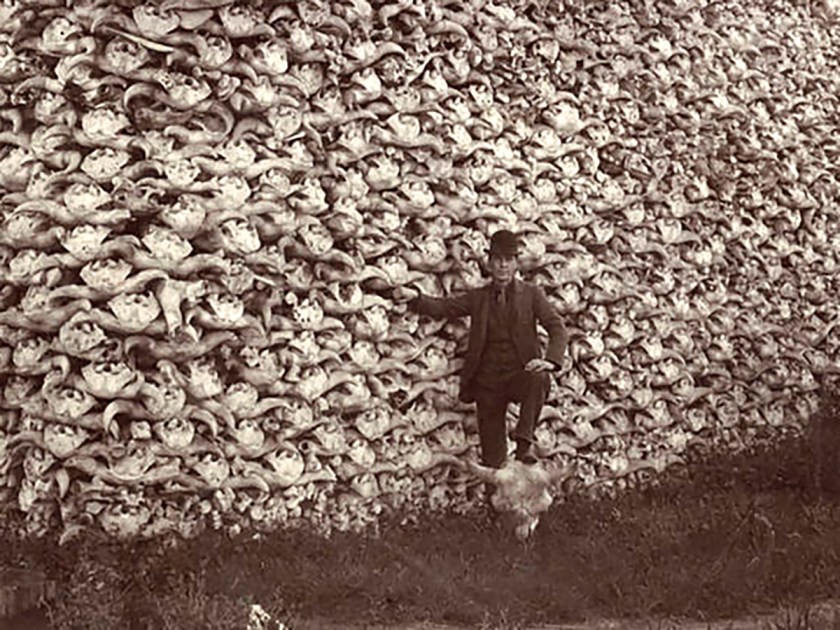
When President Thomas Jefferson sent Lewis & Clark off on the Corps of Discovery expedition, vast herds of American bison stretched from horizon to horizon, as far as the eye could see. Historians estimate 30 to 60 million of the creatures, each weighing up to 2,000 pounds and measuring twelve-feet long. A minimum of sixty billion pounds of biomass, needing something to eat.

The western artist George Catlin estimated that, by 1841, some two to three million of the creatures had been slaughtered for their hides. Bison populations came under increasing pressure as natives acquired horses and guns, but the real slaughter began with the Indian wars and “hunting by rail”, when every dead buffalo was seen as a dead Indian.  By the late 1880s, only a few hundred individuals remained alive, in Yellowstone National Park.

Mountain-of-American-Bison-Skulls-2
A mountain of bison skulls

With the bison gone and a new wave of vegetation, there arose a new and very different multitude, to feed on it.

During the 19th century, farming expanded westward into the grasshopper’s favored habitat, triggering massive outbreaks in their numbers.  Locust populations exploded to varying degrees in 1828, ’38, ’46, and ’55, affecting areas throughout the West and upper mid-west. Plagues visited Minnesota in 1856–’57 and again in the last year of the Civil War.  Nebraska suffered repeated infestations between 1856 and ’74.

Rocky_Mountain_Locust_oviposition
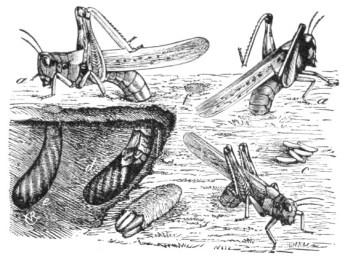
Illustration of egg-laying females, from 1877

Population blooms of two years are typical, as eggs laid in year one tend not to thrive as well as their parents.  At its height, farmers reported finding up to 150 egg cases per square inch, each containing 100 eggs or more.

In 1875, Doctor Albert L. Child of the U.S. Signal Corps watched a mile-high swarm of locusts pass overhead, for five days straight. Together with telegraph reports from neighboring towns, Child estimated the swarm to be 110 miles wide and 1,800 miles long. 198,000 square miles, one-third the size of Alaska, or the combined landmass of our thirteen smallest states.  It was a rolling flood, the size of California and Maine, put together.

The numbers are so far outside of human experience, they are hard to get your head around. For a little perspective, a million seconds is about twelve days. A Billion seconds ago, Jimmy Carter was President of the United States. A Trillion seconds ago, the oldest known clay object was fired to ceramic in the earliest oven.  It was 29,000, B.C. ”

Albert’s Swarm” was the largest such assembly of organisms in recorded history, estimated at 12½ Trillion individuals.

Exam29072013Locusts_large

It was a biological wildfire, a living blizzard that blotted out the sun, 12½ trillion insects each the size of a child’s finger, and each driven to eat its own weight.  Every day.  All in, Albert’s Swarm is estimated to have weighed 27½ million tons.

As the continuous track of a bulldozer moves ever forward, the leading edge of the swarm would alight to rest and eat, only to pick up the rear, a few days later.  In this manner, the swarm would cover ten miles or so, in a few weeks.

One farmer reported that the locusts seemed “like a great white cloud, like a snowstorm, blocking out the sun like vapor“.  Even the sound was horrific, rising to a scream and rolling over the land like some evil tide, the whirring and rasping cacophony of billions of mandibles borne aloft to eat, almost literally, everything in sight. Native populations could and did, move.  For prairie settler and pioneer families, home was on the farm.

Imagine a world with no grocery stores, and watching your food, All of it, disintegrate, before your eyes. Standing crops were the first to go, and then the root vegetables, potatoes, carrots and turnips, eaten out of the ground. Throw a blanket over your garden to protect even that little bit, and they would eat the blanket. Fence posts, saddles, nothing was off limits.  These creatures would eat the wool, right off of your sheep.  At its worst, the locust horde was known to eat the clothes off of people’s backs.

Trains were literally stopped in their tracks on uphill stretches of rail, unable to gain traction for the grease of millions of tiny bodies, ground beneath their wheels.

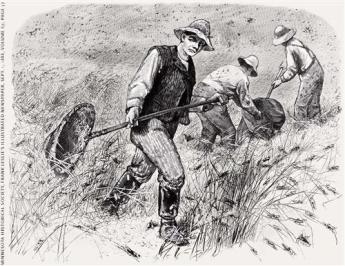
rocky-mountain-locust-1Farmers used gunpowder, fire and water, anything they could think of, to destroy what could only be seen as a plague of biblical proportion. They smeared them with “hopperdozers”, a plow-like device pulled behind horses, designed to knock jumping locusts into a pan of liquid poison or fuel, or even sucking them into vacuum cleaner-like contraptions.
Still, it was like trying to turn the tide, with a shot glass.  Missouri entomologist Charles Valentine Riley came up with a recipe to eat the damned things, seasoned with salt and pepper and pan-fried in butter. Some bought the recipe, but many felt they “would just as soon starve as eat those horrible creatures”.

In 1877, a Nebraska law required everyone between the ages of 16 and 60 to work at least two days eliminating locusts, or face a $10 fine. Missouri and other Great Plains states offered bounties: $1 a bushel for locusts gathered in March, 50¢ in April, 25¢ in May, and 10¢ in June.

map-from-the-locust-plagueAnd then the locust went away, and no one is entirely certain, why.  It is theorized that plowing, irrigation and harrowing destroyed up to 150 egg cases per square inch, in the years between swarms. Great Plains settlers, particularly those alongside the Mississippi river, appear to have disrupted the natural life cycle.  Winter crops, particularly wheat, enabled farmers to “beat them to the punch”, putting away stockpiles of food before the pestilence reached the swarming phase.

Today, the Rocky Mountain Locust is extinct.  Several grasshopper species swarm as locusts on every continent in the world, save for North America and Antarctica.   The last living specimen of the Rocky Mountain Locust was seen in Canada, in 1902.

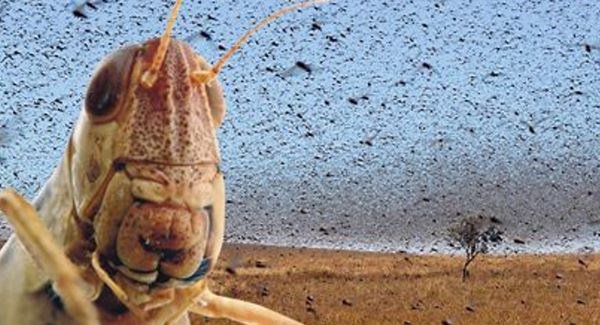
Feature image, top of page:  A child swings a broomstick at a 4-mile wide swarms of locusts, plaguing Argentina.  H/T Business Insider

October 29, 202 B.C., The Great Anxiety of the Romans

Hannibal met the Roman General Publius Cornelius Scipio on October 19, 202 B.C. near the town of Zama, in modern-day Tunisia.  Scipio had barely escaped Cannae with his life, but he had learned his lessons, well.  On this day at Zama, Hannibal was defeated by his own tactics. 

In 814 B.C., Phoenician settlers left their homeland on the coast of modern Lebanon, establishing colonial port cities along the Mediterranean coast. They built safe harbors for their merchant fleets in what is now Morocco, Algeria, Spain and Libya, among others. The largest such port city they built on the North African Gulf coast of Tunis, calling the place “Carthage”, meaning “New City”.

According to legend, the orphaned twin sons of Rhea Silvia and Mars, the god of war, were suckled by a she-wolf on the Italian Peninsula, 61 years later. Their names were Romulus and Remus. They would found a city on the site of their salvation, a city which would come to be called Rome.

800px-Phoenician_alphabet.svg
Phoenician alphabet

Carthage and Rome coexisted for hundreds of years, forming a relationship mostly based on trade. Carthaginian traders were famed in Classical Greece and Rome as ‘traders in purple’, referring to the near-monopoly in the precious Royal Purple dye derived from the Murex snail.

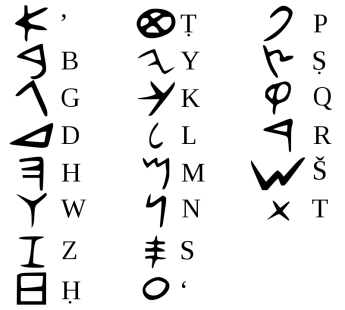
They’re known for the first “abjad”, (consonant based writing system) to gain widespread usage, the first fully developed Phoenician script dating back to the mid-11th century, BC.  The Phoenician alphabet, conventionally known as the Proto-Canaanite alphabet, is antecedent to nearly all modern phonetic alphabets in use today.

As Rome and Carthage became centers of political power and influence, it was inevitable that the two would clash. Carthage held undisputed mastery of the seas in the third century BC, while the rapid expansion of the Roman Republic brought them into conflict in Sicily, at that time partly under Carthaginian control.

roman_corvus_1b
Roman Corvus

The first of three Punic Wars, from Punicus (latin: of or relating to Carthage), began in 264BC. At the time, the Roman Legions were the most powerful land army in the region, while having little to oppose Carthage, at sea.

The Roman introduction of the Corvus, a gangway with heavy spike mounted to the underside, allowed the Romans to convert sea battles onto their own “turf”, as Roman soldiers boarded enemy ships and defeated crews in hand to hand combat. The first Punic war was over by 241 B.C., with Carthage paying heavy indemnities and ceding much of its western Mediterranean territory.

Carthage rebuilt its finances in the following years, expanding its colonial empire in Spain under the warlike Barcid family. There were several trade agreements between Rome and Carthage, even a mutual alliance against King Pyrrhus of Epirus, while Hamilcar Barca, Strategus (Military governor) of Iberia, expanded influence on the southeastern Iberian Peninsula, near what is now Cartagena (“New Carthage”), Spain.

62174894.ufgyFt6V.TunisiaMay062951
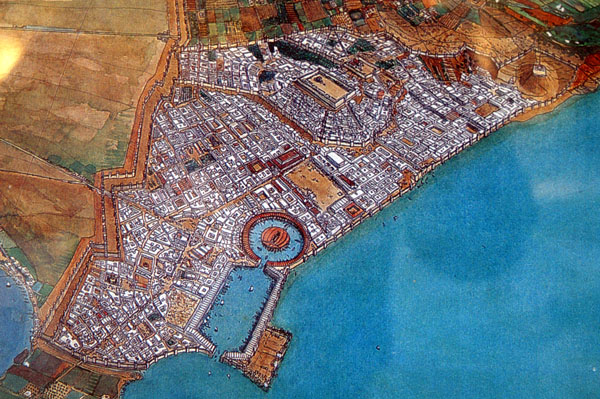
Roman-era Carthage

Eight years earlier, Hamilcar Barca made his then 12-year-old son Hannibal swear undying hatred of the Romans. In 219 B.C., Rome and Carthage found themselves in conflict over the Roman protectorate of Saguntum, in modern Spain. The Roman senate demanded that Carthage hand over Hannibal.  The Carthaginian oligarchy refused. In 218 B.C., Rome declared war.

giovanni-battista-pittoni-younger-hannibal-swearing-revenge-against-romans
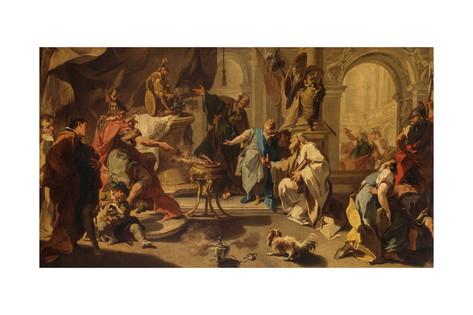
Young Hannibal swearing revenge against Rome, by Giovanni Battista Pittoni

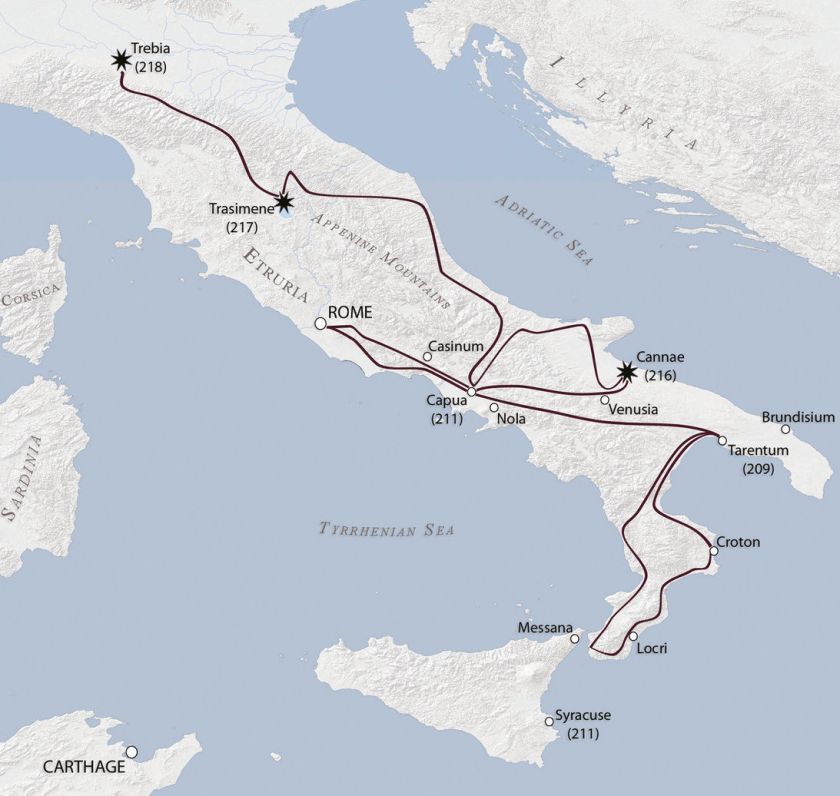
No longer a maritime power, Hannibal set out in the spring of 218 B.C., crossing into hostile Gaul (France) and arriving at the Rhône River in September with 38,000 infantry, 8,000 cavalry, and 37 war elephants. Hannibal’s crossing of the Alps that winter is one of the great feats of military history, and cost him nearly half of his force before entering Italy, that December.

The first of several major battles took place on December 18, 218 B.C. on the banks of the Trebia River. The Roman General, consul Tiberius Sempronius Longus allowed himself to be drawn into a trap and crushed. Two legions were victorious on their part of the battlefield and retreated with honor to the Province of Piacenza but, overall, Trebia was a resounding defeat for the Roman military.

The army of Hannibal was near invincible, defeating Roman legions in one major engagement after another.  Trebia, Lake Trasimene:  for sixteen years it was virtually unbeatable, devastating the Italian countryside as Rome drafted one army after another, only to be crushed, yet again.  The annihilation of Roman forces at Cannae of August 2, 216, is studied by military tacticians, to this day.

fig6

Meanwhile, Carthage itself was politically divided. Hannibal never did receive significant support from home, save for his own brother Hasdrubal, whom he summoned to join him Italy, in 209 B.C.  Hasdrubal repeated Hannibal’s feat of ten years earlier, crossing the Alps with war elephants and all, but the brothers’ reunification was never meant to be.  Hasdrubal Barca was defeated and slain in 207 B.C. near the River Metaurus, his dismembered head thrown in a sack and tossed into the camp of his brother.

It was the decisive turning point, in the second Punic War.

In the end, the General who had laid waste to the Italian peninsula was summoned to defend his homeland in North Africa.  Hannibal met the Roman General Publius Cornelius Scipio on October 19, 202 B.C. near the town of Zama, in modern-day Tunisia.  Scipio had barely escaped Cannae with his life, but he had learned his lessons, well.  On this day at Zama, Hannibal was defeated by his own tactics.  The Roman victory was decisive, ending the second Punic war under humiliating terms for Carthage.  Scipio returned to Rome triumphant, henceforward and forever to be known by the honorific, “Africanus”.

Zama-6duo1oueg9mrcgmzmaeifnsw9043jtsxsrw66goax8h

The third Punic War saw the Romans besiege Carthage itself. The city didn’t have a chance. Thousands of Carthaginians were slaughtered as the city fell in 146 B.C. The rest, as many as 70,000, were sold into slavery.  Legend has it that the ground was sewn with salt, that nothing would grow there, ever again.

Hannibal went into Carthaginian politics in the wake of the second Roman war, instituting elections for military judges and changing terms of office from life, to two years. Carthage was a thoroughly defeated power at this time, but Hannibal remained the bogey man, whom the Roman psyche could not let go.  Roman mothers told misbehaving children that Hannibal would come and get them, if they didn’t behave.  Statesman Marcus Porcius Cato, “Cato the Elder”, would end his every speech with the words “Ceterum autem censeo Carthaginem esse delendam” (“Furthermore, I consider that Carthage must be destroyed”). The sentiment is often abbreviated to “Carthago delenda est” . “Carthage must be destroyed”.

carthago
Carthago Delenda Est

Hannibal retired from politics in 195 B.C., in response to Roman concerns of his growing influence.  He journeyed first to Tyre, the mother city of Carthage, before traveling on to Antioch and later Ephesus, in modern day Turkey.  There he became military adviser and continued to clash with Roman allies, but would never threaten the Republic, as once he had done.

The Romans demanded that their old nemesis be turned over somewhere around 183 B.C., as Hannibal fled from one city to another, to escape his pursuers. Unwilling to be paraded through Rome in a cage, he poisoned himself and died sometime around 181 B.C. In a letter found after his death, Hannibal had written “Let us relieve the great anxiety of the Romans, who have found it too heavy a task to wait for the death of a hated old man”.

If you enjoyed this “Today in History”, please feel free to re-blog, “like” & share on social media, so that others may find and enjoy it as well. Please click the “follow” button on the right, to receive email updates on new articles.  Thank you for your interest, in the history we all share.

October 18, 63 B.C. The Catiline Conspiracy

The outcome of the battle was never in doubt yet, when the bodies were sorted out, the traitor and his last loyal few had received their mortal wounds, in the front. 

Ever since the overthrow of the Roman Monarchy in 509BC, Rome governed itself as a Republic.  The government was headed by two consuls, elected by the citizens to one-year terms and advised by a Senate.  The Republic operated on the principle of a separation of powers with checks and balances, and a strong aversion to the concentration of power.  Except in times of national emergency, no single individual was allowed to wield absolute power over his fellow citizens.

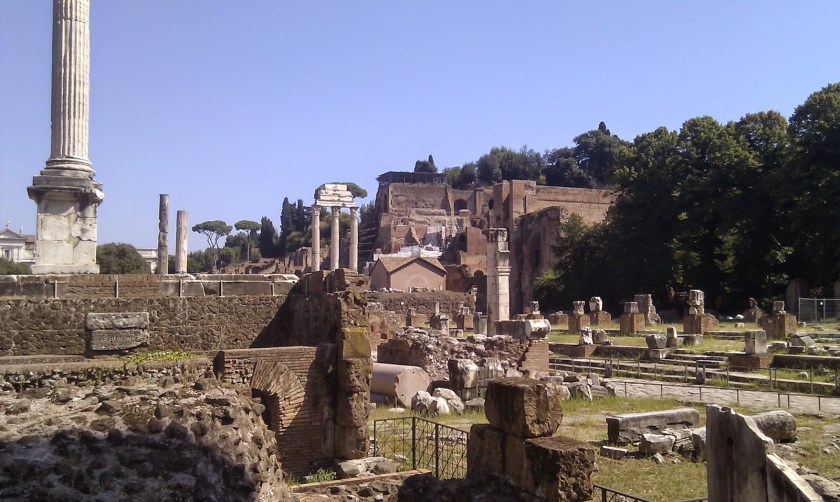
(pic - Story) Forum - From Arch of SeptimusA series of civil wars and other events took place during the first century B.C., ending the Republican period and leaving in its wake an Imperium, best remembered for its long line of dictators.
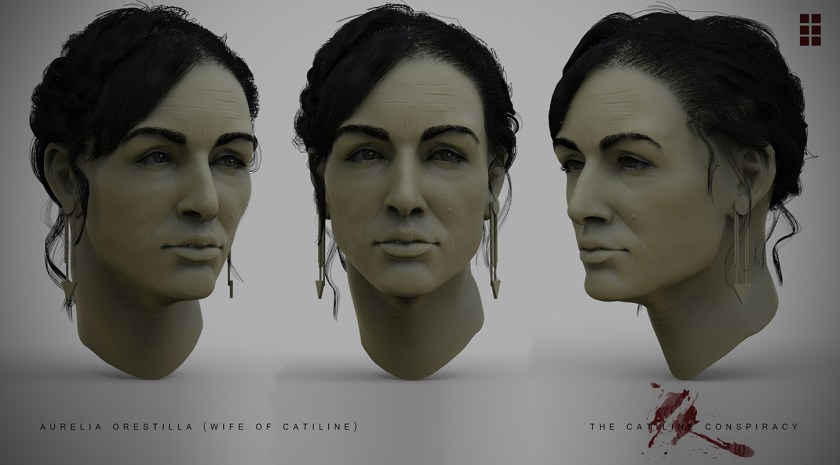
Lucius Sergius Catilina was a Roman Senator during the final period of the Republic, best remembered for his attempt to overthrow the government, particularly the power of the aristocratic Senate.  Catilina seems to have been an unsavory character, having first murdered his wife and son in order to marry the wealthy and beautiful Aurelia Orestilla, daughter of the consul of 71 B.C., Gnaeus Aufidius Orestes.  He was later tried for adultery, with a vestal virgin.

Aurelia_Head_Keyshot_File.31_writing puny
Aurelia Orestilla, wife of Catiline.  H/T James Scott 3-D Art

The first of two conspiracies bearing Catilina’s name began in 65 B.C., when he was supposed to have conspired to murder a number of Senators on their entering office, and making himself, Consul.  Catilina himself may or may not have been involved at this stage.  He would certainly be involved, in the second.

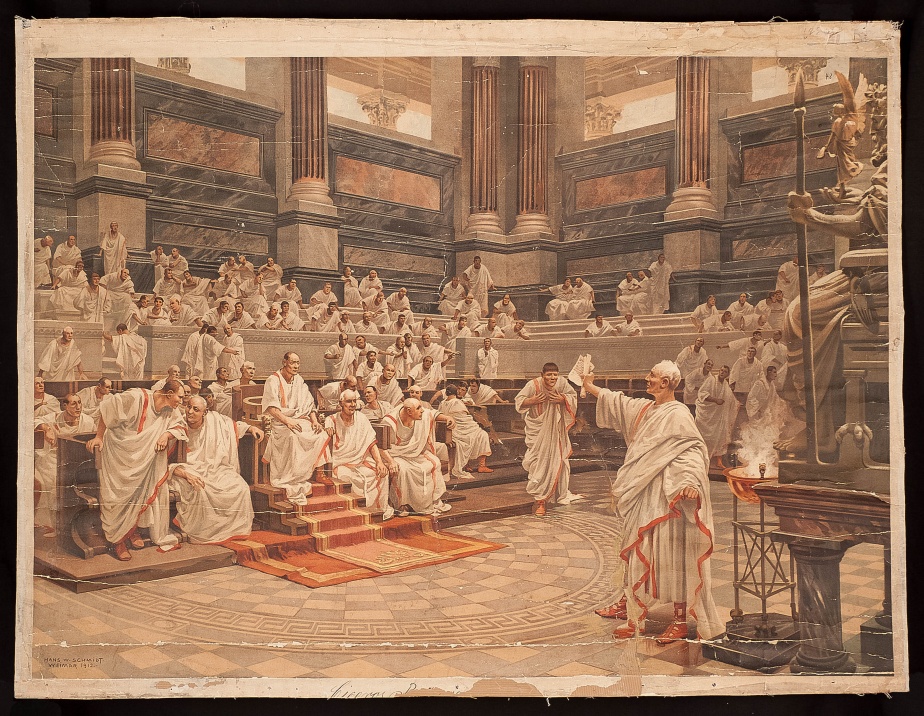
Catilina and a group of heavily indebted aristocrats concocted a plan to overthrow the Republic in 63 B.C., along with a number of disaffected veterans.  The plot was revealed on the night of October 18 in letters delivered to Consul Marcus Tullius Cicero, by General Marcus Licinius Crassus.  Cicero read these letters in the Senate the following day and later gave a series of four speeches,  the Catiline Orations.  2,000 years later, we remember Cicero as one of the most powerful public speakers, of the Roman Republic.   These Catiline Orations are held among his finest moments, as a speaker.

800px-Maccari-Cicero-56aaa5943df78cf772b45fc1

Cicero in the Senate denouncing Catiline, by Cesare Maccari

In his last speech, delivered in the Temple of Concordia on December 5, 63 B.C., Cicero established a basis for other speakers to take up the cause.  As Consul, Cicero was not himself permitted to voice an opinion regarding the execution of conspirators.  This speech laid the groundwork for others to do so, foremost, Cato the Younger.

The actual Senate debates are lost to history, leaving only Cicero’s four orations, but there was considerable resistance in the Senate to executing the conspirators.  They were, after all, fellow aristocrats.

Roma Day 1 18

Milvian Bridge

The plotters went to the Allobroges seeking military assistance, but the Gallic tribe wanted no part it and reported the proposal to their Roman patron.  Armed forces of the conspirators were ambushed at the Milvian Bridge, where the Via Flaminia crosses the Tiber River.  The rest were executed by the end of December.

Catilina himself was killed in battle the following January, near the Tuscan city of Pistoria.  By this time, Catilina’s army had dwindled from 10,000 strong, to less than a third of that.  The outcome of the battle was never in doubt yet, when the bodies were sorted out, the traitor and his last loyal few had received their mortal wounds, in the front.

The Republic was saved.  For now.

At one point during this period, then-Senator Julius Caesar stepped to the rostrum to have his say. He was handed a paper and, reading it, stuck the note in his toga and resumed his speech. Cato, Caesar’s implacable foe, stood in the senate and demanded that Caesar read the note. It’s nothing replied the future emperor, but Cato thought he had caught the hated Caesar red handed, and went in for the kill. “I demand you read that note”, he said, or words to that effect.  He wouldn’t let it go.  At last, Caesar relented. With an actor’s timing, he pulled out the note and read it to a hushed senate.

It turned out to be a love letter, a graphic one, wherein Servilia Caepionis described in detail what she wanted to do with Caesar, once she got him alone. As if the scene wasn’t bad enough, Servilia just happened to be Cato’s half-sister.

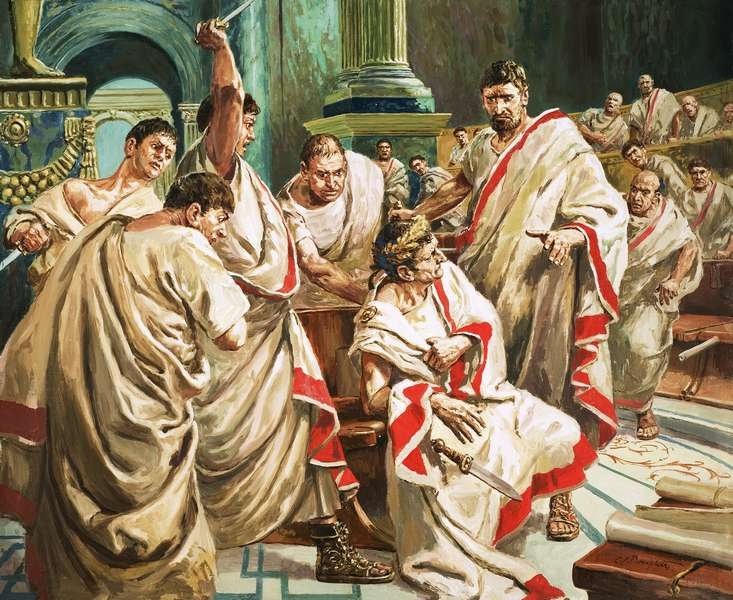
julius-caesar-assassination

Assassination of Julius Caesar

Here’s where the story becomes Very interesting. Caesar was a well-known lady’s man.  By the time of his assassination, he had carried on with Servilia for years.  Servilia Caepionis had a son, one Marcus Junius Brutus.

87d43c51c42b9204b4c26b08df2239f0Brutus was 41 on the 15th of March, 44 B.C.  The “Ides of March”.  Caesar was 56.  The Emperor’s dying words are supposed to have been “Et tu, Brute?”, as Brutus plunged the dagger in.  “And you, Brutus?”  But that’s not what he said.  Those words were put into his mouth 1,643 years later, by William Shakespeare.
Eyewitness accounts to Caesar’s last words are lost to history, but more contemporary sources recorded the Emperor’s dying words as “Kai su, Teknon?”, in Greek.  “And you, my child?”

It seems unlikely that Brutus murdered his father on the Ides of March, but not impossible.  It’s hard to make the dates work.  Still, it makes you wonder…

Feature image, top of page:  “The picture shows the politician and most famous orator of Rome, Cicero (106-43 BC).In the year 63 BC, the senator Lucius Sergius Catilina (aprox. 108-62 BC) tried to seize power. You can see Cicero in the temple of Jupiter delivering his first of four orations against Catiline. Cicero thwarted Catiline’s conspiracy and, for the moment, saved the Republic”.  H/T Historywallcharts.eu

If you enjoyed this “Today in History”, please feel free to re-blog, “like” & share on social media, so that others may find and enjoy it as well. Please click the “follow” button on the right, to receive email updates on new articles.  Thank you for your interest, in the history we all share.

October 17, 1814 The Great London Beer Flood, of 1814

Nine people lost their lives altogether, including one man who died of alcohol poisoning, apparently leading a heroic one-man effort to drink the entire flood.

On April 1, 1785, the Times of London reported: “There is a cask now building at Messrs. Meux & Co.’s brewery…the size of which exceeds all credibility, being designed to hold 20,000 barrels of porter; the whole expense attending the same will be upwards of £10,000”.

013-giant-beer-barrel-q75-1364x1616The Meux’s Brewery Co Ltd, established in 1764, was a London brewery owned by Sir Henry Meux. What the Times article was describing was a 22′ high monstrosity, held together by 29 iron hoops.

When completed, this would be one of several such vats, each designed to hold 3,500 barrels of brown porter ale.

Ministry_of_Information_First_World_War_Official_Collection_Q28331The brewery was located in the crowded slum of St. Giles, where many homes contained several people to the room.
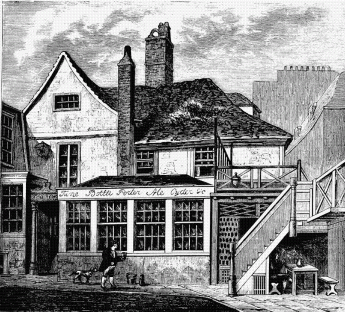
On October 17, 1814, storehouse clerk George Crick noticed one of those 700-pound iron hoops had slipped off a cask. This happened two or three times a year, and Crick thought little of it, writing a note to another employee, to fix the problem.

It was a bad decision.

The explosive release of all that hot, fermenting liquid could be heard five miles away, causing a chain reaction as the other vats went down like exploding dominoes.

323,000 imperial gallons of beer, equivalent to two-thirds of an Olympic swimming pool, smashed through the brewery’s 25-foot high brick walls and gushed into the streets, homes and businesses of St. Giles. The torrent smashed two houses and the nearby Tavistock Arms pub on Great Russell Street, where 14-year-old barmaid Eleanor Cooper was buried under the rubble.

the_manor_house_of_toten_hall_1813.gif.CROP.cq5dam_web_1280_1280_gifOne brewery worker was able to save his brother from drowning in the flood, but others weren’t so lucky.
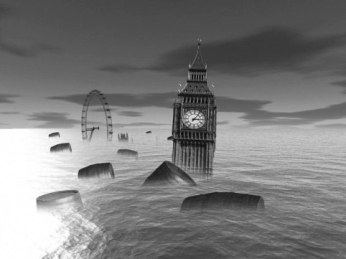
Mary Mulvey and her 3-year-old son Thomas were drowned, while Hannah Banfield and Sarah Bates, ages 4 and 3, were swept away in the flood. Both died of their injuries. Nine people lost their lives altogether, including one man who died of alcohol poisoning, apparently leading a heroic one-man effort to drink the entire flood.

As the torrent subsided, hundreds of people came outside carrying pots, pans, and kettles – whatever they had on hand to scoop up some of it. Some just bent low and lapped at it like dogs, as all that dirty, warm beer washed through the streets. Meanwhile, several injured were taken to the nearby Middlesex Hospital, where a near-riot broke out as other patients demanded to know why they weren’t getting some of it, too.

london-beer-floodIn the days that followed, the crushing poverty of the slum led some to exhibit the corpses of their family members, charging a fee for anyone who wanted to come in and see. In one house, too many people crowded in and the floor collapsed, plunging them all into a cellar full of beer.


The stink lasted for months, as the Meux Brewery Company was taken to court over the accident. Judge and jury ruled the flood to be an ‘Act of God’.  The deaths were just a ‘casualty’, leaving no one responsible. Meux & Co. survived, though the financial loss was made worse by the fact that they had already paid tax on the beer. The company successfully applied to Parliament for a refund, and continued to brew beer on the same site.

The brewery was closed in 1921 and demolished the following year. Since 2012, a London tavern called the “Holborn Whippet” (www.holbornwhippet.com) marks the event with its own vat of porter, specially brewed for this day. Cheers.


bar-holborn-whippet-montage
Holborn Whippet Pub Sicilian Ave, London
If you enjoyed this “Today in History”, please feel free to re-blog, “like” & share on social media, so that others may find and enjoy it as well. Please click the “follow” button on the right, to receive email updates on new articles.  Thank you for your interest, in the history we all share.

October 16, 1987 Everybody’s Baby

Television cameras were quick to arrive and covered the ordeal, live.  Those of us of a certain age remember it well. The rescue was carried from the Netherlands to Brazil,  from Germany to Hong Kong and mainland China.  Well wishers called in to local television stations, from the Soviet Union.  It seemed the whole world, stopped to watch.

Jessica McClure Morales is a West Texas Mother of two school-age children. Her life is normal in every way.  She’s a teacher’s aide.  Her husband Danny, works for a piping supply outfit.  Just a normal Texas Mom, with two kids and a puppy, playing in the yard.

hqdefault (6)On this day in 1987, Jessica McClure’s life was anything but normal.  Frightened and alone, “Baby Jessica” was stuck twenty-two feet down, at the bottom of a well.
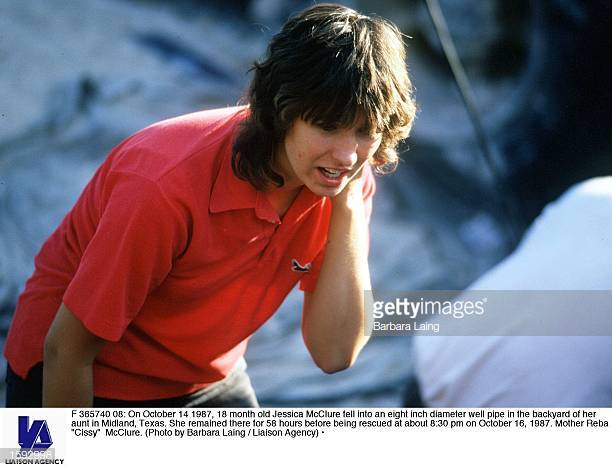
Everything seemed so normal that Wednesday, October 14, just an eighteen-month-old baby girl, playing in the back yard of an Aunt. That old well pipe shouldn’t have been left open, but what harm could it do. The thing was only eight inches wide.

And then the baby disappeared.  Down the well.

The language does not contain a word adequate to describe the horror that young mother must have felt, looking down that pipe.

1592998-612x612

Midland Fire and Police Departments devised the plan.  A second shaft would be dug, parallel to the well.  Then to bore a tunnel, until rescuers reached the baby.  The operation would be over, by dinnertime.

The rescue proved far more difficult than first imagined.  The first tools brought on-scene, were inadequate to get through the hard rock surrounding the well.  What should have taken minutes, was turning to hours.

Television cameras were quick to arrive and covered the ordeal, live.  Those of us of a certain age remember it well. The rescue was carried from the Netherlands to Brazil,  from Germany to Hong Kong and mainland China.  Well wishers called in to local television stations, from the Soviet Union.  It seemed the whole world, stopped to watch.

jessica-mcclure-rescue

Watching the evening news, it’s sometimes easy to believe that the world is going to hell.  It’s not.  What we saw for those fifty-eight hours was the True heroism and fundamental decency of every-day guys:  fathers, sons and brothers, doing what they needed to do.   We’d see it again in a New York Minute, should circumstances require.

You could watch it happen, around the clock.  Many of us did.  I remember it, each would dig until he’d drop, and then another man would take his place.  There were out-of-work oil field workers and everyday guys.   Mining engineers and paramedics.  The work was frenetic and distraught, and at the same time, agonizingly slow.

Anyone who’s used a jackhammer, knows it’s not a tool designed to be used, sideways.  Even so, they tried. A waterjet became a vital part of the rescue, a new and unproven technology, in 1987.

hqdefault (8)The sun went down that Wednesday and rose the following day and then it set, and still, the nightmare dragged on.

A microphone was lowered down, so doctors could hear her breathe.  She would cry, and sometimes she would sing.   A small voice drifting up from that hole in the ground, the words of “Winnie the Pooh”.

Both were good signs.  A baby could neither sing nor cry, if she could not breathe.

The final tunneling phase of the operation could only be described, as a claustrophobic nightmare.  An unimaginable ordeal.  Midland Fire Department paramedic Robert O’Donnell  was chosen, because of his small, wiry frame.  Slathered all over with K-Y jelly and jammed into a space so tight it was difficult to breathe, O’Donnell  inched his way through that black hole that Thursday night and into the small hours of Friday morning, until finally, he touched her leg.

The agony of those minutes that dragged on to hours can only be imagined.  What he was trying to do, could not be done.  In the end, O’Donnell was forced to back out of the hole, defeated. Empty handed.  As they went back to work enlarging the tunnel, the paramedic sat on a curb, and wept.

On the second attempt, O’Donnell was able wrestle the baby out of that tiny space, handing her to fellow paramedic Steve Forbes, who carried her to safety.

Baby Jessica came out of that well with her face deeply scarred, and toes turned to gangrene, for lack of blood flow.  She would require fifteen surgeries before it was over but, she was alive.

9e7571a21e7b9541561b67855311532b

Media saturation coverage led then-President Ronald Reagan to quip, that “everybody in America became godmothers and godfathers of Jessica while this was going on.” Baby Jessica appeared with her teenage parents on Live with Regis and Kathie Lee, to talk about the incident. Scott Shaw of the Odessa American won the Pulitzer prize for the photograph, and ABC made a television movie: Everybody’s Baby: The Rescue of Jessica McClure. USA Today ranked her 22nd on a list of “25 lives of indelible impact.” Everyone in the story became famous. Until they weren’t.

nintchdbpict000307656606

In time, the scars healed for Jessica McClure.  Today she has no recollection of those fifty-eight hours.  Not so much the hero from the bottom of that hole, Robert O’Donnell. Whatever personal hell the man went through that night, alone in that blackest of places, never left his mind.  And then there was the fame.  And the adulation. And then, nothing.

Even now, we struggle to understand Post-Traumatic Stress Disorder, (PTSD), a condition which ends the lives of twenty-two of the best among us every day, and has killed more Vietnam combat veterans, than the war itself.  It was only 1987, when the Diagnostic and Statistical Manual of Mental Disorders dropped the requirement, that stressors be outside the range of normal human experience.

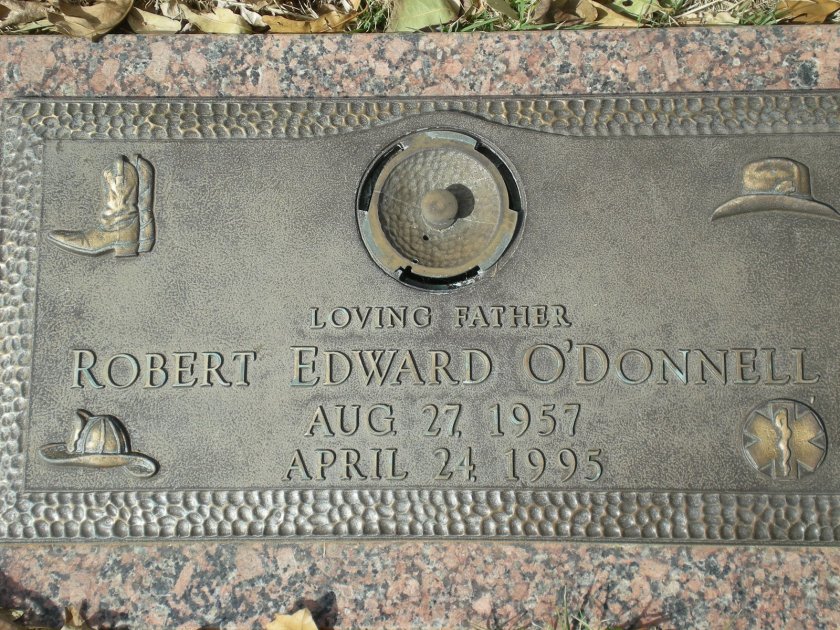
Robert O’Donnel took his own life on April 24, 1995.  The media declined to notice.  The stone above his grave bears the images of a cowboy hat and boots, and those of a fire hat, and the six-pointed Star of Life, symbol for emergency medical services, in nations the world over.  A “Loving Father,” who has earned the right to be remembered.

DSCN0128

If you enjoyed this “Today in History”, please feel free to re-blog, “like” & share on social media, so that others may find and enjoy it as well. Please click the “follow” button on the right, to receive email updates on new articles.  Thank you for your interest, in the history we all share.

October 15, 1917 Mata Hari

Historians differ whether she passed on intelligence or merely gossip, a courtesan and middle-aged debutante, and convenient excuse for French failures in the face of the German war machine. 

mata-daughterMargaretha Geertruida Zelle, “M’greet” to family and friends, was born in the Netherlands on August 7, 1876, the eldest of four children.
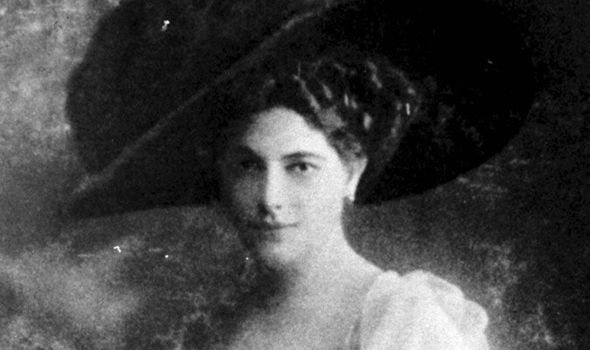
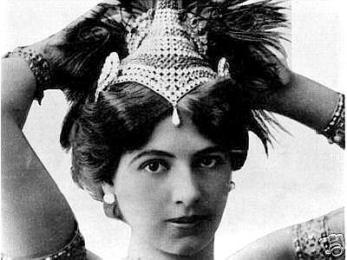
Adam Zelle, Margaretha’s father, was once a prosperous hat merchant.  By 1891, a series of bad investments had cost him his fortune.  He left the family, never to return.  Mother Antje Zelle, died.  Margaretha and her three brothers were broken up, and sent to live with relatives.  She was fifteen.

As a young woman, Margaretha answered a newspaper ad placed by Dutch Colonial Army Captain Rudolf MacLeod, then stationed in the Dutch East Indies, in modern day Indonesia.

Becoming a “mail order bride” must have seemed like the way to financial security.  Strikingly beautiful with raven hair and olive skin, she sent him a photograph, of herself.  Despite a twenty-one year age difference, the couple was wed on July 11, 1895.  She was not yet nineteen.

The marriage produced a daughter, and a son.  MacLeod was a drunk and frequently flew into rages, over the attentions his young wife received from other officers.  The boy was killed in 1899, poisoned by a household worker for reasons which remain unclear.  The marriage was dead by the early 1900s and MacLeod fled, taking the couple’s daughter with him.  The divorce became final, in 1905.

mata_hari-469562

Zelle-MacLeod moved to Paris becoming mistress to a French diplomat, who encouraged her to support herself, as an exotic dancer.  She took the name: “Mata Hari”, Indonesian for “sun” (literally, “eye of the day”), in Sanskrit.

mata-hari2All things “Oriental” were all the rage in early 1900s Paris.  Mata Hari played the more exotic aspects of her background to the hilt, projecting a bold and in-your-face sexuality that was unique and provocative for her time.
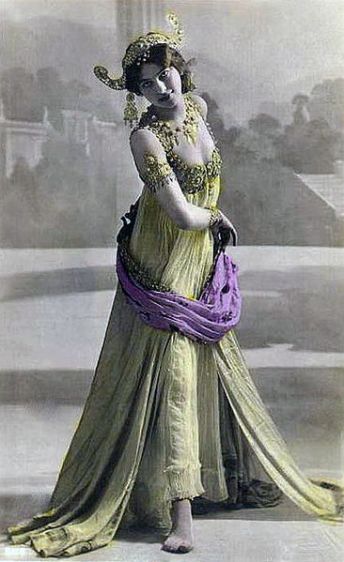
She claimed to be a Java princess of priestly Hindu birth, immersed since childhood in the sacred art of Indian dance.

One Vienna reporter described Mata Hari as “slender and tall with the flexible grace of a wild animal, and with blue-black hair.” Her face, he wrote, “makes a strange foreign impression.” Another writer described her performance as “so feline, extremely feminine, majestically tragic, the thousand curves and movements of her body trembling in a thousand rhythms.”

Carefree and thoroughly uninhibited, Mata Hari was photographed in the nude or the next thing to it on many occasions, becoming the long-time mistress of the millionaire Lyon industrialist Émile Étienne Guimet.

Mata_Hari_postcardThe world stood still at the beginning of World War I, but not Mata Hari.  Her dancing days were over by 1914, but her neutral Dutch citizenship allowed her to move about without restriction.  But not without a price. Mata Hari’s sexual conquests knew no border, naively including officers and government officials of every nationality, and both sides of the Great War.

Rumors of espionage followed and she was taken to Scotland Yard for interrogation in 1916, but later released.

That year, Mata Hari accepted a lucrative assignment to spy for France, from army captain Georges Ladoux.

She would seduce her way into the German High Command but the Germans suspected as much and set her up, releasing a cable labeling Mata Hari, as a German double agent.

She was arrested again on February 13, 1917, in her room at the Hotel Elysee Palace, in what is now the banking giant HSBC’s French headquarters. She was kept in a rat infested prison as the case was prepared against her, all the while writing to the Dutch Consul in Paris, proclaiming her innocence. “My international connections are due to my work as a dancer, nothing else”, she wrote. “I really did not spy, it is terrible that I cannot defend myself”.

In a bombshell confession which probably sealed her fate, Mata Hari admitted during interrogations by Captain Pierre Bouchardon, that a German diplomat had paid her 20,000 francs.  She said the money meant nothing, that she saw it as compensation for furs and other clothing lost on a train, while she was being hassled by German border guards.  “A courtesan, I admit it. A spy, never!” she insisted. “I have always lived for love and pleasure.”

matahariMata Hari’s elderly defense attorney and former lover Edouard Clunet, never really had a chance. He couldn’t cross examine the prosecution’s witnesses, or even directly question his own.
The trial took place during a string of French military defeats.  Spies both real and imagined, were convenient scapegoats.  By some accounts, Captain Ladoux even tampered with evidence, to put her case in the worst possible light.

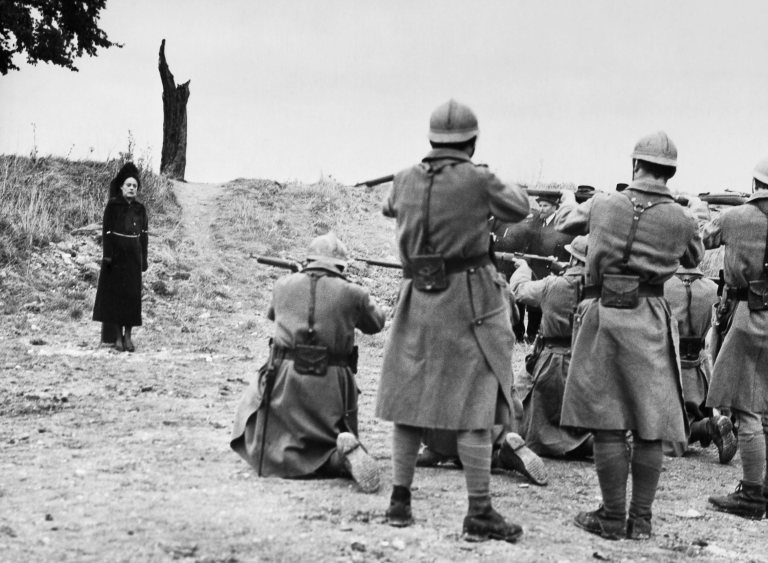
The conviction was a foregone conclusion. The military tribunal took forty-five minutes to reach a verdict of guilty.  Margaretha Geertruida Zelle was executed by firing squad on October 15, 1917.  Legend has it, that she blew them a kiss.  She was 41.

British reporter Henry Wales described the execution, based on an eyewitness account:

“Unbound and refusing a blindfold, Mata Hari stood alone to face her firing squad.  After the shots rang out, Wales reported that “Slowly, inertly, she settled to her knees, her head up always, and without the slightest change of expression on her face. For the fraction of a second it seemed she tottered there, on her knees, gazing directly at those who had taken her life. Then she fell backward, bending at the waist, with her legs doubled up beneath her.” An NCO walked up to her body, pulled out his revolver, and shot her in the head to make sure she was dead”.

MataHari

German documents unsealed in the 1970s hint that Mata Hari may have been a German spy, but many disagree with that conclusion.  Historians differ whether she passed on intelligence or merely gossip, a courtesan and middle-aged debutante, and convenient excuse for French failures in the face of the German war machine.  The whole truth may never be known but, the real-life exotic dancer who later became a lethal double agent, is a story that’s hard to resist.

If you enjoyed this “Today in History”, please feel free to re-blog, “like” & share on social media, so that others may find and enjoy it as well. Please click the “follow” button on the right, to receive email updates on new articles.  Thank you for your interest, in the history we all share.

October 14, 1939 Death of the Royal Oak

Captain Benn was almost alone in believing that his ship was attacked by torpedo.  The cause of the sinking was still being argued over the next day, when divers went down and found a German torpedo propeller. Only then was it understood, that the Kriegsmarine  had taken the war, into British home waters.  By that time, U-47 was gone.

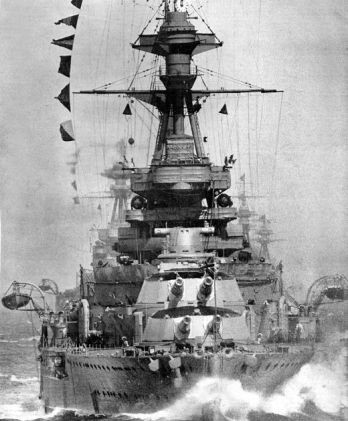
In the early days of WWII, the British Royal Navy based the main part of the Grand fleet at Scapa Flow, in the Orkney Islands north of Scotland.  Protected as it was by blocking ships and underwater cables, the anchorage considered impregnable to submarine attack.

f918c0672ea9cc256d0295ed46d0ca83The harbor at Scapa flow had been home to the British deep water fleet since 1904, a time when the place truly was, all but impregnable.  By 1939, anti-aircraft weaponry was all but obsolete, old block ships were disintegrating, and anti-submarine nets were inadequate to the needs of the new war.
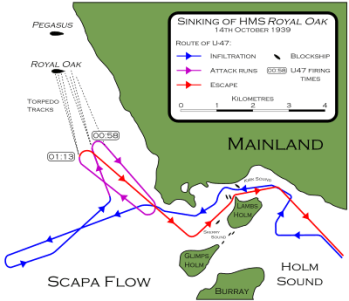
The men of the German Unterseeboot U-47 commanded by officer Günther Prien, were not impressed. U-47 entered the Royal Navy base in the evening hours of the October 13, 1939. By 12:55am on the the 14th, they were within 3,500 yards of the unmistakable silhouette of the WWI era Revenge Class Battleship, HMS Royal Oak.

Believing he had a certain kill, Prien aimed two of his four torpedoes at the Battleship, and the other two at the 6,900 ton Pegasus, which he’d mistaken in the dark for the much larger HMS Repulse. Tubes one, two and three fired successfully, torpedoes away, but #4 jammed. Only one found its mark, blowing a hole in the starboard bow of the Royal Oak, near the anchor chains.

On the battleship, Captain William Benn was told the most likely cause was an internal explosion, either that or a high flying German aircraft had dropped a bomb. Damage control teams were assembled to assess the damage, while aboard U-47, Prien thought his one hit had been against Repulse (Pegasus). He was prepared to run, but saw no threat from oncoming surface vessels.  Coming about and firing the stern torpedo, the crew worked to free the jammed #4 torpedo tube, while reloading bow tubes 1-3. That one missed as well, and the Germans cursed their luck.

400px-U-47_raid.svgThe electric torpedoes of the era were highly unreliable, and this wasn’t shaping up to be their night.
Finally, tubes one and two were reloaded, and the jammed tube #4 was serviced and ready to go. U-47 crept closer and, at 1:25am, fired all three torpedoes at the Royal Oak. All three found their target within ten seconds of one other, blasting three holes amidships on the starboard side. The explosions set off a series of fires and ignited a cordite magazine and exploding with a fiery orange blast that went right through the decks.\

Royal Oak rolled over and sank in thirteen minutes. 833 sailors and officers were lost from ship’s company of 1,234, including Rear Admiral Henry Evelyn Blagrove, commander of the 2nd Battle Squadron.

391702797d7300601188ee909566c8de

The Royal Navy considered the anchorage so secure that, even now, searchlights and anti-aircraft fire raked the sky, searching for the air attack that wasn’t there.  Captain Benn was almost alone in believing that his ship was attacked by torpedo.  The cause of the sinking was still being argued over the next day, when divers went down and found a German torpedo propeller. Only then was it understood that the Kriegsmarine had taken the war, into British home waters.

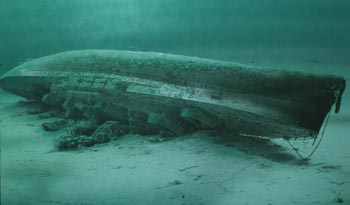
Royal Oak Wreck

The successful attack at Scapa Flow was a crushing defeat for the British, and payback for the Germans. The entire German High Seas Fleet had been interned there at the end of WWI. Admiral Ludwig von Reuter wasn’t about to let his fleet fall into allied hands, and ordered the lot of them, scuttled. British guard ships succeeded in beaching a few at the time, but 52 of 74 vessels had sunk to the bottom.

Many of those wrecks were salvaged in the interwar years, and towed away for scrap. Those which remain are popular sites for recreational divers, but not Royal Oak. As a designated war grave, Royal Oak is protected by the Military Remains Act of 1986.  Unauthorized divers are strictly, prohibited.

The wreck of the Royal Oak lies nearly upside down in 100′ of water, her hull just 16-feet beneath the surface. Each year, divers place the red St. George’s Cross with the Union Flag of the White Ensign at her stern, a solemn tribute to the honored dead of World War 2, and to the first Royal Navy battleship lost in the most destructive war in history.

Royal Oak Ensign

If you enjoyed this “Today in History”, please feel free to re-blog, “like” & share on social media, so that others may find and enjoy it as well. Please click the “follow” button on the right, to receive email updates on new articles.  Thank you for your interest, in the history we all share.

October 13, 1914 Signalman Jack

One day, a train passenger looked down and realized with horror, that a monkey was switching the tracks.

In the early days of the Great War, the formerly separate British colonies of the Cape, Natal, Transvaal and Orange River were united in the Union of South Africa, in support of the Allied war effort.

Public opinion was by no means, unanimous.  “Afrikaners” were bitterly opposed to alliance with the British.  The Jameson Raid and two Boer Wars were hard pills to swallow, and life-long friendships were cast asunder.  As former Generals of the second Boer War, Prime Minister Louis Botha and Defense Minister Jan Smuts had once fought the British.  Now, that was in the past.  Like many, the two men dreamed of a unified South Africa.

Anti-British rebellion broke out on this day in 1914, but was quickly put down by loyalist South Africans.  Before the war was over, some 136,000 of their countrymen would serve in the African, Middle East and Western Fronts of the Great War.

The story of World War 1 is intertwined with the history of rail.  The mobilization of millions in a matter of weeks, would have been impossible without the railroads which moved them.   WW1 could not  have happened the way it did, without rail.

(c) Piet Conradie Klipplaat 25-08-2009 e - SAR Class 15AR (R indicates reboilered) engine no 1840

South African recruits traveled rails begun in 1859, when early construction worked its way inland from deep-water ports and harbors. James Edwin Wide came to work for the South African railroad, about twenty years later.

Co-workers on the Cape Town–Port Elizabeth Railway service called him “Jumper” for his fondness of jumping between railway cars.  It was a regrettable habit, which would one day, cost him his legs.

After the accident, Wide’s railroad days seemed to be over.  Then a signalman’s job opened up. Wide would work the Uitenhage train station twenty-three miles outside of Port Elizabeth, switching the tracks for oncoming trains.

Trains would toot their whistle a specified number of times, telling the signalman which tracks to change.  The job suited him, pulling the levers is easy enough for a man with no legs.  Not so much, the half-mile walk to work.

jack-the-signalman3One day at an open-air market, the peg-legged signalman saw something that changed all that. It was a monkey, a Chacma baboon.
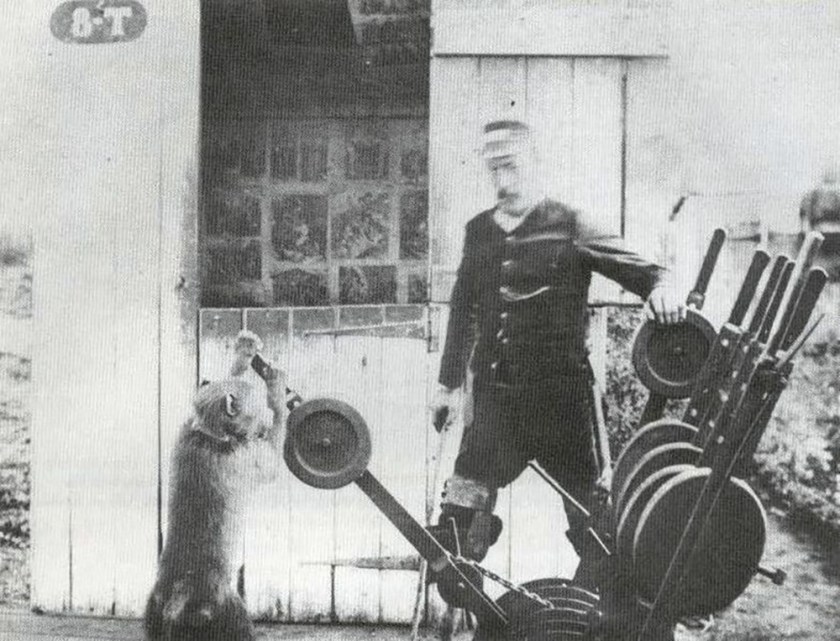
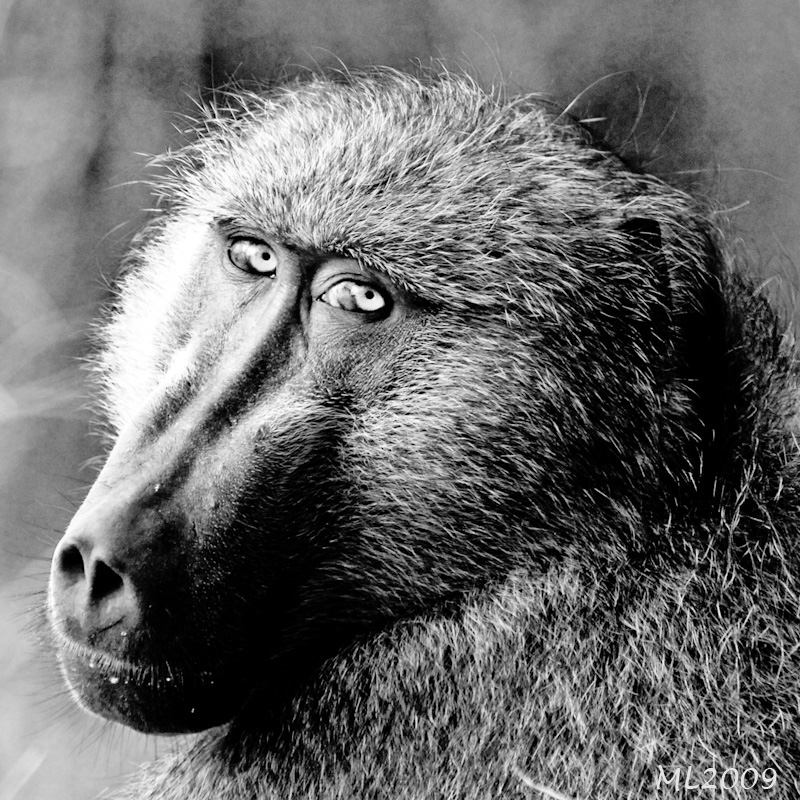
One of the largest of the “Old World” monkeys, a Chacma or “Cape” baboon is an intelligent animal. “Corporal Jackie” proved as much, during the “War to end all Wars”. This one was exceptionally so. This one was driving an oxcart.

Wide bought the animal and called him”Jack”, and taught him to pull his small trolley, up and down the line.  Jack was a help around the house, sweeping the floors and taking out the trash. He figured out the train signal and the switch thing too.  Soon, Jack was pulling on the levers, himself.

William Luff writes in The Railway Signal, that Wide “trained the baboon to such perfection that he was able to sit in his cabin stuffing birds, etc., while the animal, which was chained up outside, pulled all the levers and points.

One day, a train passenger looked down and realized with horror, that a monkey was switching the tracks. (It must have been fun to be in the complaint department, when That one came in).  Railroad managers were furious and could have fired signalman Wide, but decided to test his baboon, instead.

jack-the-signalman41

Railway superintendent George Howe came away, astounded. “Jack knows the signal whistle as well as I do, also every one of the levers…It was very touching to see his fondness for his master. As I drew near they were both sitting on the trolley. The baboon’s arms round his master’s neck, the other stroking Wide’s face.”

Jack passed with flying colors.  Managers were so impressed they gave him the job, for real. “Signalman Jack” now had an employee number, and a salary of twenty cents per day, plus a half-bottle of beer, each week.  It isn’t clear what a baboon did with the money, though one suspects it may have purchased more than a few peanuts.

Signalman Jack worked the rail until the day he died of tuberculosis, in 1890.  A keyword search for railroad accidents between 1880 and ’89, the time-frame for this story, reveals a list of sixty-one serious incidents. In the nine years in which he was on the job, Signalman Jack made not one single mistake.

jack.signalman_0

If you enjoyed this “Today in History”, please feel free to re-blog, “like” & share on social media, so that others may find and enjoy it as well. Please click the “follow” button on the right, to receive email updates on new articles.  Thank you for your interest, in the history we all share.