March 11, 1918 Pandemic

Ordinary flu strains prey most heavily on children, elderly, and those with compromised immune systems. Not this one.

In the world of virology, “Antigenic Drift” describes changes which happen slowly, the random mutation of virus DNA which takes place over months, or years. It’s why we get a new flu vaccine every year, even though there’s already some level of “herd immunity”.

“Antigenic Shift” occurs when two or more DNA strands combine, instantaneously forming a new virus sub-type. Like the dealer at some giant, cosmic poker table, this process may deal us a pair of twos. Occasionally, fate deals us aces & eights. The death hand.flu6

When the “Great War” broke out in 1914, US Armed Forces were small compared with the mobilized forces of European powers. The Selective Service Act, enacted May 18, 1917, authorized the federal government to raise an army for the United States’ entry into WWI. Two months after the American declaration of war against Imperial Germany, a mere 14,000 American soldiers had arrived “over there”. Eleven months later, that number stood at well over a million.

General “Black Jack” Pershing insisted that his forces be well trained before deployment. New recruits poured into training camps by the tens of thousands, while somewhere, some microscopic, chance recombination of surface proteins created a new virus, novel to almost every immune system in the world.

Flu pandemicOn the morning of March 11, 1918, most of the recruits at Fort Riley, Kansas, were turning out for breakfast. Private Albert Gitchell reported to the hospital, complaining of cold-like symptoms of sore throat, fever and headache. By noon, more than 100 more had reported sick with similar symptoms.

Ordinary flu strains prey most heavily on children, elderly, and those with compromised immune systems. Not this one. This flu would kick off a positive feedback loop between small proteins called cytokines, and white blood cells. This “cytokine storm” resulted in a death rate for 15-34 year olds 20 times higher in 1918, than in previous years. Perversely, it was their young and healthy immune systems that were most likely to kill them.

Physicians described the most viscous pneumonia they had ever seen, death often comingspanish_flu_death_chart-790-x-602.jpg_w=790&h=602 within hours of the first symptoms. There’s a story about four young, healthy women playing bridge well into the night. By morning, three were dead of influenza.
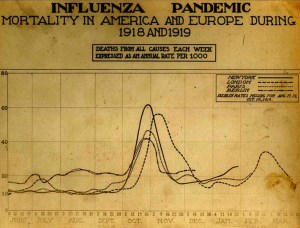
Over the next two years, this strain of flu infected one in every four people in the United States, killing an estimated 675,000 Americans. Eight million died in Spain alone, following an initial outbreak in May. Forever after, the pandemic would be known as the Spanish Flu.

In 1918, children skipped rope to a rhyme:

“I had a little bird,
Its name was Enza.
I opened the window,
and in-flu-enza”.

In the trenches, the flu cut down combatants on every side. “Operation Michael”, the final, no holds barred German offensive that would determine the outcome of the war, launched from the Hindenburg line in March. Crown Prince Rupprecht wrote in August that “poor provisions, heavy losses, and the deepening influenza have deeply depressed the spirits of men in the 3rd Infantry Division”.

Some sources indicate that as many as half of the Americans killed in WWI, died of the flu.
The parades and parties following the cease fire in November threw gasoline on the fire. The end of war was a complete disaster from a public health standpoint. Millions more contracted the flu and thousands more died. President Wilson himself fell ill, while participating in 1919 treaty negotiations in Versailles.

1918-spanishfluAround the planet, the Spanish flu infected 500 million people. A third of the population of the entire world, at that time. Estimates run as high 50 to 100 million killed. For purposes of comparison, the “Black Death” of 1347-51 killed 20 million Europeans.

History has a way of swallowing some events whole, like they never happened. Today, the Spanish flu is all but overshadowed by the Great War, even though in the end, the flu pandemic of 1918-19 proved a far deadlier adversary, than the war itself.

March 10, 1864  Who’s Buried in Grant’s Tomb?

Grant was in constant pain in his last year, as the cancer literally throttled the life from his body. He wrote at a furious pace despite his suffering, often finishing 25 to 50 pages a day. No re-writes, no edits. there was no time for that.

Hiram Grant was born in Point Pleasant, Ohio on April 27, 1822. His family called him by his middle name Ulysses, or sometimes just “Lyss”, for short.

A clerical error changed the name of the future Commander-in-Chief during his first days at the United States Military Academy at West Point. He didn’t seem to mind, though, probably thinking that “US Grant” was preferable to “H.U.G.”. Predictably, Grant became known as “Uncle Sam” or simply “Sam.”  It was as good a name as any, though, as with future President Harry S. Truman, the “S” doesn’t actually stand for anything.

Grant at WarThe 1862 Civil War Battle of Fort Donelson secured the name, when then-Brigadier General Ulysses S. Grant received a request for terms from the fort’s commanding officer, Confederate Brigadier General Simon Bolivar Buckner. Grant’s reply was that “no terms except an unconditional and immediate surrender can be accepted. I propose to move immediately, upon your works.” The legend of “Unconditional Surrender” Grant, was born.

Grant had been a light smoker before Donelson, generally preferring a pipe, if anything. A reporter spotted him holding an unlit cigar during the battle, a gift from Admiral Foote.  Soon, ten thousand cigars were sent to him in camp. He gave away as many as he could, but it started the habit of smoking cigars that became one of his trademarks, and probably led to his death of throat cancer, in 1885.

On this day in 1864, President Abraham Lincoln signed a document promoting Ulysses S. Grant to the rank of Lieutenant General of the United States Army, officially putting then-Major General Grant in charge of all Union armies.  Lincoln preferred Henry Wagner Halleck for the promotion, at the time fearing that Grant would challenge him for the 1864 Republican Presidential nomination.  Lincoln submitted to the will of Congress only after Grant publicly dismissed the idea of running for President.

46 year old U.S. Grant would be elected the 18th President of the United States four yearsulysses_s_grant_18th_president_of_the_u_s_postcard later, going on to serve two terms after becoming, at that time, the youngest man ever so elected.
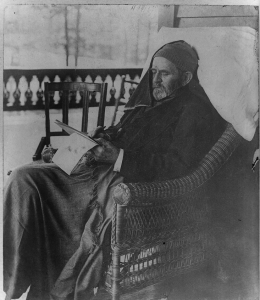
Grant was a gifted writer.  The penning of his autobiography is a story in itself. Gravely ill at the time and financially destitute, Grant knew with certainty that he was dying of throat cancer.  The proceeds from his unwritten memoirs were his only means of supporting his family after his death.

Grant was in constant pain in his last year, as the cancer literally throttled the life from his body. He wrote at a furious pace despite his suffering, often finishing 25 to 50 pages a day. No re-writes, no edits. There was no time for that. The writing of Grant’s two volume memoir was literally a race with death. Many of his wartime contemporaries felt that they received too little credit in Grant’s retelling of events, but that may be understood under the circumstances.

grantlastdaysIn June 1885, as the cancer spread through his body, the family moved to Mount MacGregor, New York, to make him more comfortable. Propped up on chairs and too weak to walk, Grant worked to finish the book as friends, admirers and even former Confederate adversaries, made their way to Mount MacGregor to pay their respects.

He finished the manuscript on July 18, 1885.  Five days later, he was gone. On release, the book received universal critical praise. Mark Twain, who published the memoir, compared them to the Commentaries of Julius Caesar. Gertrude Stein admired the book, saying she could not think of Grant without weeping. Ulysses Grant’s memoirs quickly became a best seller, his family receiving 75% of the net royalties after expenses.  The book would earn $450,000, over $10 million in today’s dollars, comfortably re-establishing the Grant family fortune.

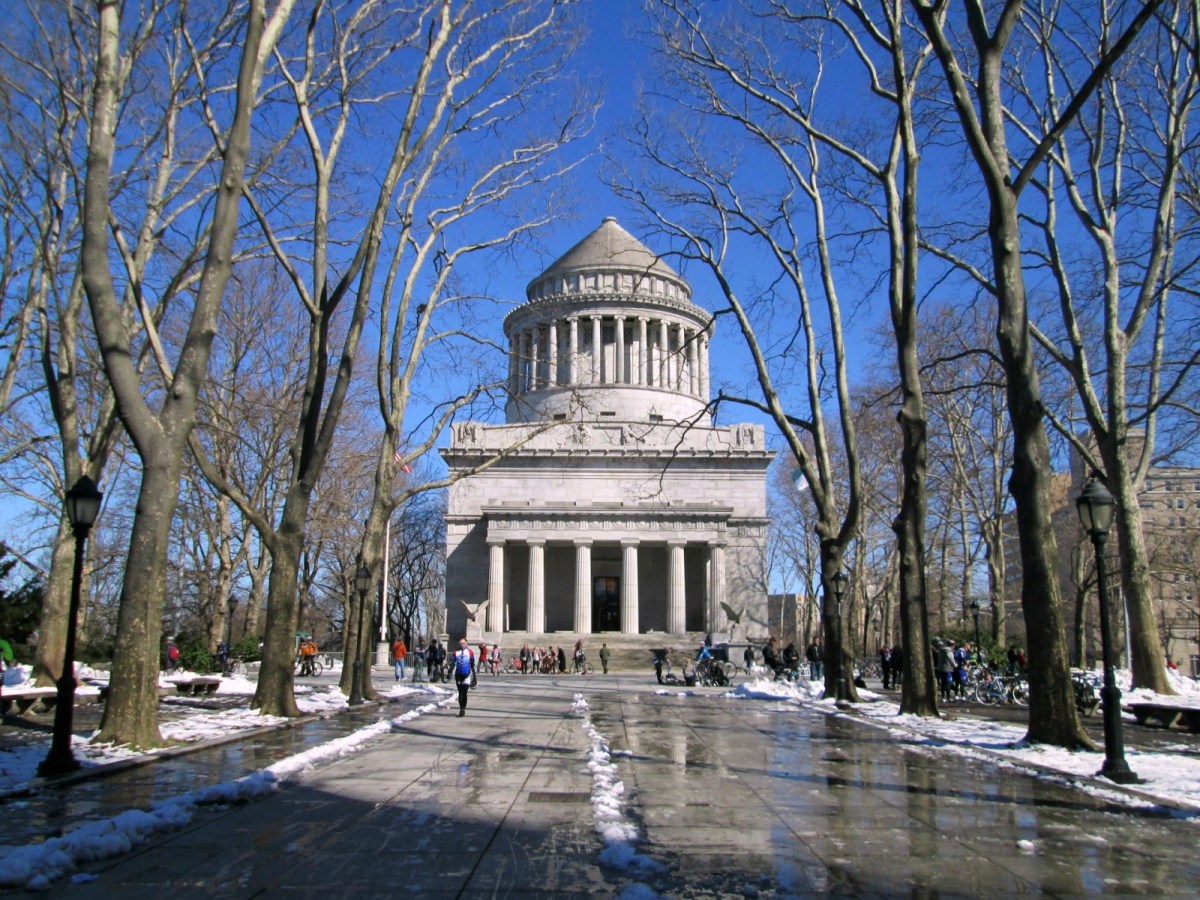
Grant’s wife Julia died on March 4, 1877, and was buried with her husband in Grant’s monumental tomb overlooking the Hudson River, in New York City.

Next time someone asks you who’s buried in Grant’s tomb, you can tell them that it’s Hiram Ulysses Grant.  If you really want to show off, don’t forget to include his wife, Julia.

March 9, 1942 The Alcan Highway

Colonel Simon Bolivar Buckner Jr., the officer in charge of the Alaska Defense Command, made the point succinctly. “If the Japanese come here, I can’t defend Alaska. I don’t have the resources.”

Discussions of a road to Alaska began as early as 1865, when Western Union contemplated plans to install a telegraph wire from the United States to Siberia. The idea picked up steam with the proliferation of automobiles in the 1920s, but it was a hard sell for Canadian authorities. Such a road would necessarily have to pass through their territory, but the Canadian government felt the project would have little impact, benefiting no more than a few thousand people in the Yukon.

Guam and Wake Island fell to the Japanese in the days following the attack on Pearl Harbor, making it clear that parts of the Pacific coast were vulnerable, and changing priorities for both the United States and Canada.

alcan_armyjeep_1942The Alaska Territory was particularly vulnerable. The Aleutian Island chain was only 750 miles from the nearest Japanese base, and there were only 12 medium bombers, 20 pursuit planes, and fewer than 22,000 troops in the entire territory. An area four times the size of Texas.

Colonel Simon Bolivar Buckner Jr., the officer in charge of the Alaska Defense Command, made the point succinctly. “If the Japanese come here, I can’t defend Alaska. I don’t have the resources.”

The US Army approved construction of the Alaska Highway in February, the project receiving the blessing of the Congress and President Roosevelt within the week. Canada agreed to allow the project, provided that the US pay the full cost, and that the roadway and all facilities be turned over to Canadian authorities at the end of the war.

Construction began on March 9 as trains moved hundreds of pieces of construction Alcan Bridgeequipment to Dawson Creek, the last stop on the Northern Alberta Railway. At the other end, 10,670 American troops arrived in Alaska that spring, to begin what their officers called “the biggest and hardest job since the Panama Canal.”

In between lay over 1,500 miles of unmapped, inhospitable wilderness.

The project got a real sense of urgency in June, when Japanese forces landed on the islands of Kiska and Attu, in the Aleutian chain. Adding to the urgency was the fact that there is no more than an eight month construction window, before the return of the deadly Alaskan winter. Construction began at both ends and the middle at once, with nothing but the most rudimentary engineering sketches.

alcan-highwayA route through the Rockies hadn’t even been identified yet.

Radios didn’t work across the mountains and there were only erratic mail and passenger runs on the Yukon Southern airline, what the locals called the “Yukon Seldom”. It was faster for construction battalions at Dawson Creek, Delta Junction and Whitehorse to talk to each other through military officials in Washington, DC.

Moving men to their assigned locations was one thing. Moving 11,000 pieces of construction equipment, to say nothing of the supplies needed by man and machine, was another.

Tent pegs were useless in the permafrost, but the body heat of sleeping soldiers meant they woke up in mud.Alcan Terrain

Partially thawed lakes meant that supply planes could use neither pontoon nor ski, as Black flies swarmed the troops by day, and bears raided camps by night, looking for food.
Engines had to run around the clock, because it was impossible to restart them in the cold.
Engineers waded up to their chests as they built pontoons across freezing lakes, battling mosquitoes in the mud and the moss laden arctic bog. Ground which had been frozen for thousands of years was scraped bare and exposed to sunlight, creating a deadly layer of muddy quicksand in which bulldozers wallowed in what otherwise seemed like stable roadbed.

Alcan_constructionOn October 25, Refines Sims Jr. of Philadelphia, with the all-black 97th Engineers was driving a bulldozer 20 miles east of the Alaska-Yukon line, when the trees in front of him toppled to the ground. He slammed his machine into reverse as a second bulldozer came into view, driven by Kennedy Texas Private Alfred Jalufka. North had met south, and the two men jumped off their machines, grinning. Their triumphant handshake was photographed by a fellow soldier and published in newspapers across the country, becoming an unintended first step toward desegregating the US military.Sims, Jalufka

They celebrated the route’s completion at Soldier’s Summit on November 21, 1942, though the “highway” remained unusable by most vehicles until 1943.

I remember hearing an interview about this story, back in the eighties. An Inuit elder was recounting his memories about growing up in a world as it had existed for a thousand years, without so much as an idea of internal combustion. He spoke of the day when he first heard the sound of an engine, and went out to see a giant bulldozer making its way over the permafrost. The bulldozer was being driven by a black soldier, probably one of the 97th Engineers Battalion soldiers. “It turned out”, he said, “that the first white person I ever saw, was a black man”.

March 8, 1863 The Gray Ghost

Entering the chamber where the General slept, Mosby lifted his nightshirt and slapped his bare backside with a sword

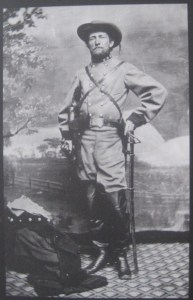
John Singleton Mosby was a Virginia lawyer, when Civil War broke out in 1861.  Like fellow Virginian Robert E. Lee, Mosby opposed secession. When it came, he left the Union along with his home state of Virginia. Small and frail as a boy, Mosby was often the target of much larger bullies. He’d write in his memoirs that he never won a fight. It seems that he never backed down from one, either.

MosbyMosby participated in the 1st Battle of Manassas (1st Bull Run) as a member of the Virginia Volunteers Mounted Rifles, later joining James Ewell Brown “Jeb” Stuart as a Cavalry Scout. A natural horseman and gifted tactician, information gathered by Mosby aided Stuart in his humiliating ride around McLellan’s Army of the Potomac in June, 1862.
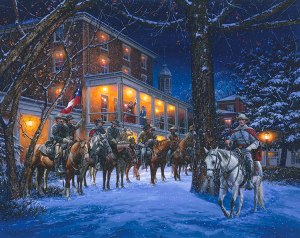
In 1863, Stuart authorized Mosby to form and take command of the 43rd Battalion of the Virginia Cavalry, a regiment sized unit operating out of north central Virginia. These “Partisan Rangers”, 1,900 of whom served between January 1863 and April 1865, were under the authority of Stuart and Lee and subject to their commands, but they were not a traditional army unit. Mosby’s Rangers shared in the spoils of war, they had no camp duties, and lived scattered among civilian populations.

Mosby himself would often reconnoiter a target himself, in disguise.  Known for lightning raids of the Virginia countryside, Mosby’s 43rd Cavalry would be called together to strike a specific target, dispersing afterward and making themselves next to impossible to run to ground.  He was the “Gray Ghost”, so successful were his Rangers, that parts of Virginia’s Piedmont region are known as “Mosby’s Confederacy”, to this day.

Late on the night of March 8, 1863, Mosby’s Rangers formed up for a raid on Fairfax Mosbys-Rangers750Courthouse, Virginia. Union Brigadier General Edwin H. Stoughton was sleeping in his headquarters there, some sources say he was “sleeping it off”. The Gray Ghost entered the Union General’s headquarters in the small hours of March 9, his rangers quickly overpowering a handful of sleepy guards.

Entering the chamber where the General slept, Mosby lifted his nightshirt and slapped his bare backside with a sword. The general sputtered awake, demanding “What is the meaning of this”. “General, did you ever hear of Mosby”, came the question. Stoughton replied, “Yes, have you caught him?” “I AM Mosby,” said the Gray Ghost, “and I have caught you. Stuart’s cavalry has possession of the Courthouse; be quick and dress.”

John Singleton Mosby and 29 Rangers had captured a Union General, two Captains, 30 enlisted men and 58 horses, without firing a shot. On hearing the story the next day, Lincoln lamented. “I can make another Brigadier in 5 minutes, but I can’t replace those horses”.

Mosby 3rd Reunion 7-1-1896
Mosby’s Rangers, Third Reunion, 1896


March 7, 1912 The Heroic Age of Polar Exploration

The final camp became their tomb, a high cairn of snow erected over it. Ship’s carpenters built a wooden cross, inscribed with a line from Alfred Lord Tennyson’s poem Ulysses: “To strive, to seek, to find, and not to yield”.

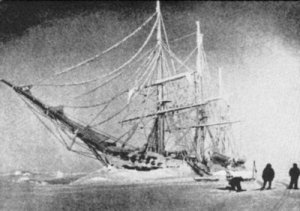
Belgica_schiff
RV Belgica frozen in the ice, 1898

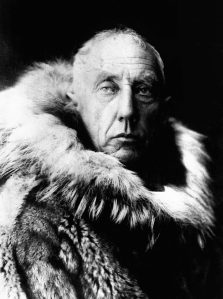
The fourth son of a family of Norwegian shipowners and captains, Roald Amundsen always wanted to go to sea. His mother wanted no such thing and made him promise he’d go to school to become a doctor. Amundsen was 21 when his mother died. He kept his promise until that day.  There would be no more school after that.

Amundsen wanted to become an explorer, taking inspiration from the doomed Franklin Arctic Expedition of 1848, and Fridtjof Nansen’s crossing of Greenland in 1888.

Roald Amundsen
Roald Amundsen

It’s been called the “Heroic Age” of polar exploration. Amundsen was drawn to it as much as he helped create it. He was part of the Antarctic expedition of 1897-99 aboard the RV Belgica, the first to winter in Antarctica. He led the first expedition to successfully navigate Canada’s Northwest Passage between the Atlantic and Pacific Oceans, in 1903–06.

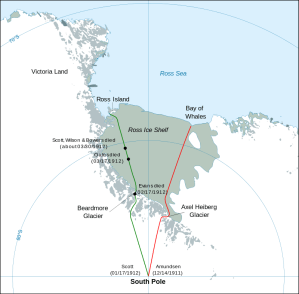
Amundsen’s attempt to reach the South Pole set out on September 8, 1911. Using skis and dog sleds, Amundsen and his men created supply depots at 80°, 81° and 82° south, along a direct line to the Pole. The effort proved to be premature and had to be abandoned due to extreme cold. A second attempt departed on October 19 with four sledges and 52 dogs, along the previously unknown Axel Heiberg Glacier.  The team of five men and 16 dogs arrived at 90° 0′ S on December 14, 1911,  the first team in history to reach the South Pole.

Aan_de_Zuidpool
Amundsen expedition plants the Norwegian flag on the South Pole, December 14, 1911.

English explorer Robert Falcon Scott had attempted the South Pole in 1901–04, and was doing so once again in 1911. Though he’d had to turn back, the earlier expedition had established the southernmost record for that time, at 88° 23′ S. 97 miles short of the pole.

Unlike Amundsen who adopted the lighter fur-skins of the Inuit, the Scott expedition wore heavy wool clothing, depending on motorized and horse-drawn transport, and man-hauling sledges for the final drive across the polar plateau. Dog teams were expected to meet them only on the way out, on March 1.

amundsen_-_scott_antarctic_expedition_map-svg
Routes taken by Scott (green) and Amundsen (red) expeditions to the South Pole.

Weak, unacclimatized ponies slowed the depot-laying part of the Scott expedition, four horses dying of cold or having to be shot because they slowed the team. When Scott decided to locate “One-Ton Depot” 35 miles short of its planned location at 80°, expedition member Lawrence Oates warned “Sir, I’m afraid you’ll come to regret not taking my advice.”

Unlike the previous attempt, Scott made it this time, only to find that Amundsen’s Norwegian expedition had beat him by five weeks. The anguish in Scott’s diary entry for January 17, 1912, is clear: “The worst has happened”; “All the day dreams must go”; “Great God! This is an awful place”.

Roald Amundsen returned safely and publicly announced his attainment of the South Pole on March 7, 1912.

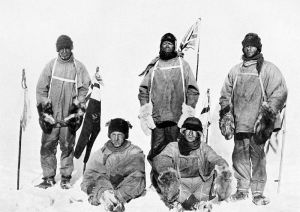
scotts_party_at_the_south_pole
The doomed Scott party used a string to take this “selfie”, the day after becoming 2nd to reach the South Pole

Defeated, the five-man Scott party began the 800-mile, frozen slog back from the Pole on January 19. Team member Edgar Evans’ condition was visibly deteriorating as early as the 23rd. A bad fall on Beardmore Glacier on February 4 left him “dull and incapable”. Another fall on the 17th left him dead at the foot of the glacier.

Dog teams failed to materialize at the appointed time.  By March 16, Lawrence Oates was severely frostbitten. He left his tent for the last time, saying “I am just going outside and may be some time”.  He never returned.

The last three made their final camp on March 19, with 400 miles to go.   A howling blizzard descended on camp the following day and lasted for days, as Scott and his companions wrote good-bye letters to mothers, wives, and others. The last words in his diary, were: “Last entry.  For God’s sake look after our people”.

robert-falcon-scott
Robert Falcon Scott

The frozen corpses of Scott and his comrades were found 8 months later, the last diary entry dated March 29, 1912.  A high cairn of snow was erected over it all, that final camp becoming their tomb. Ship’s carpenters built a wooden cross, inscribing on it the names of those lost: Scott, Edward Wilson, Henry Bowers, Lawrence Oates and Edgar Evans. A line from Alfred Lord Tennyson’s poem, Ulysses, appears on the cross: “To strive, to seek, to find, and not to yield”.

They were eleven miles from their next supply depot.

Satellites measured the coldest temperature in recorded history on August 10, 2010 at −93.2 °C (−135.8 °F), in East Antarctica.   The Amundsen-Scott weather station at the South Pole reports the average daily temperature for March, at -50.3°C (-58.54°F).    A century of ice and snow have covered bodies, camp and the cross alike. Now encased 75′ down in the Ross Ice Shelf and inching their way outward, the bodies are expected to reach the Ross Sea sometime around 2276, perhaps to float away in an iceberg.

In 1926, Amundsen and a team of 15 reached the North Pole in the airship Norge. Three previous claims to have attained the North Pole: Frederick Cook (1908), Robert Peary (1909), and Richard E. Byrd (1926), have all been disputed as being of dubious accuracy or downright frauds, leaving Amundsen the undisputed first to have reached both poles.

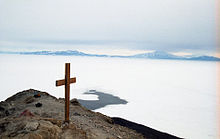
cross_on_observation_hill_mcmurdo_station
The Observation Hill cross memorial to the Scott expedition, erected 1913.

On hearing the details of Scott’s end, Roald Engelbregt Gravning Amundsen is quoted as saying “I would gladly forgo any honour or money if thereby I could have saved Scott his terrible death”.

He and a crew of five disappeared into the Arctic on June 18, 1928, lost in the search for survivors following the crash of the Airship Italia. Despite efforts to find them as late as August 2009, neither aircraft nor bodies were ever found.

Peter Markham Scott, the only child produced by the marriage of Robert Falcon and Kathleen Bruce Scott, went on to found the World Wide Fund for Nature, which operates to this day as the World Wildlife Fund (WWF).

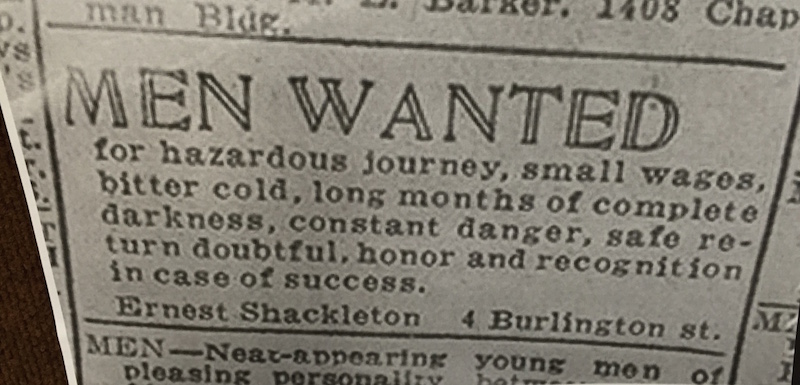
Shackleton advert

“I may say that this is the greatest factor—the way in which the expedition is equipped—the way in which every difficulty is foreseen, and precautions taken for meeting or avoiding it. Victory awaits him who has everything in order—luck, people call it. Defeat is certain for him who has neglected to take the necessary precautions in time; this is called bad luck”. —  The South Pole, by Roald Amundsen

March 6, 1940 White Death

Dressed in white camouflage, the most deadly sniper in history would surround himself with hard-packed snow, his mouth filled with snow so no one would see his breath.

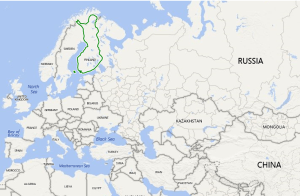
The Republic of Finland is a sovereign state in the north of Europe.  The 8th largest country on the European continent, with a population roughly equal to that of Minnesota. In 2015, the World Bank ranked the country 44th in GDP, behind Ireland, Chile and Pakistan.

finlandWith Sweden to the west and Russia to the east, the region has been a zone of conflict since the early 12th century, finally gaining independence as the result of the first World War and collapse of the Russian Empire.

In 1938, the Soviet Union demanded Finnish territory in exchange for land elsewhere, ostensibly as a security zone. Leningrad was at that time only 20 miles from the border. Finland refused, on November 30, 1939, 3 months after the outbreak of WWII, the Red Army invaded.

The “Winter War” is a David vs. Goliath story. The Soviets had three times as many troops, thirty times the number of aircraft, and a hundred times as many tanks. The Red Army officer corps, however, was dangerously inexperienced, with over 30,000 of its most experienced mid-level and senior officers imprisoned or executed following Josef Stalin’s “Great Purge” of 1937.

Expecting a short conflict, Soviet forces were poorly equipped for an extended winter war. Few if any possessed the white camouflage of the other side. For the Finnish side, morale was high, and Finnish forces inflicted far heavier casualties, than anyone had anticipated.

Simo “Simuna” Häyhä was a farmer and hunter, born in what was then the Grand Duchy of Finland, near the border with Russia. Häyhä enjoyed shooting competitions in Viipuri Province, and was quite good at it. It was said that his house was full of trophies. He joined the Finnish voluntary militia in 1925 at the age of 20. During the Winter War of 1939-40, Häyhä served as a sniper for the Finnish Army.

He was the “White Death”.  Over the 100 days of his wartime service, Simo Häyhä racked up 505 confirmed kills, more than any sniper in history. Many of his kills went unconfirmed. The true count is probably closer to 800. An average of eight per day, in a place where December daylight hours number no more than six.

simo_hayha_honorary_rifleThe Battle of Kollaa took place in temperatures ranging from −4° to −40°, Fahrenheit. In February, the temperature averages only 18.5°. Dressed in white camouflage, Häyhä would surround himself with hard-packed snow, his mouth filled with snow so no one would see his breath.

At 5’3″, he liked the shorter, White Guard version of the five shot, bolt action Mosin–Nagant, because it fit his small frame. He preferred the open “Pystykorva” or “Spitz” sight, so-called because of its resemblance to a Spitz dog. It made for a smaller target, as a shooter must raise his head ever so slightly higher, when using a telescopic sight.

The Red Army was desperate to kill this man. Russian counter-snipers and entire artillery barrages were sent to take him out. On March 6, 1940, Häyhä was hit on the left side of his jaw, by a high-explosive incendiary/armor-piercing (HEIAP) round, fired by a Russian soldier. The damage was catastrophic. Soldiers who went to pick him up, said “half his face was missing”. He regained consciousness eight days later, the day that peace was declared.

The bullet had crushed his jaw and taken away his left cheek, but he did not die. It wouldsimo_hayha_second_lieutenant_1940 take several years to recover from his wound, but Häyhä went on to become a successful dog breeder and moose hunter, once hunting with Finnish President Urho Kekkonen.

Häyhä passed away in a war veterans’ nursing home in Hamina in 2002, at the age of 96.  In 1998, someone asked how he became such a good shot. He answered “Practice.”  He must have been a man of few words.

To this day, Simo Häyhä remains the most successful sniper in history, with a confirmed kill rate three times that of Chris Kyle, and five times that of Carlos Hathcock. Asked if he regretted killing so many people, he replied “I only did my duty, and what I was told to do, as well as I could.”

March 5, 1770 The Boston Massacre

The officer ignored the insult, but Private Hugh White, on guard outside the State House on King Street, said the boy should be more respectful and struck him with his musket. Soon an angry crowd began to gather.

France and Great Britain have been allies throughout most of modern history, both in times of war and peace. This wasn’t always the case. From the Norman Invasion of 1066 to the Napoleonic Wars of 1802-1815, England and France have been in a state of war at least forty times. Throughout most of that history, the two sides would clash until one or the other ran out of money, then yet another treaty would be trotted out and signed.

New taxes would be levied to bolster the King’s treasury, and the cycle would begin all over. The change in this cycle which began in the late 17th century can be summed up in a single word: Debt.

In the time of Henry VIII, British military outlays as a percentage of central government expenses averaged 29.4%. By 1694 the Nine Years’ War had left the English Government’s finances in tatters. £1.2 million were borrowed by the national treasury at a rate of 8% from the newly formed Bank of England. The age of national deficit financing, had arrived.

chartIn one of the earliest known debt issues in history, Prime Minister Henry Pelham converted the entire national debt into consolidated annuities known as “consols”, in 1752.  Consols paid interest like regular bonds, with no requirement that the government ever repay the face value.  18th century British debt soared as high as 74.6%, and never dropped below 55%.

The Seven Years’ War alone, fought on a global scale from 1756 to 1763, saw British debt double to the unprecedented sum of £150 million, straining the national economy.

American colonists experienced the conflict in the form of the French and Indian War, for which the Crown laid out £70,000,000.  The British government saw its American colonies as beneficiary of their expense, while the tax burden on their colonists remained comparatively light.  townsend

For the colonists, the never ending succession of English wars accustomed them to running their own affairs.  The “Townshend Revenue Acts” of 1767 sought to force American colonies to pick up the tab for their own administration, a perfectly reasonable idea in the British mind. The colonists had other ideas. They didn’t object to the amount of taxation as much as whether the British had the right to tax them at all. They were deeply suspicious of the motives behind these new taxes, and were not about to be subjugated by a distant monarch.

The political atmosphere was brittle in 1768, as troops were sent to Boston to enforce the will of the King. Rioters ransacked the home of a newly appointed stamp commissioner, who resigned the post following day. No stamp commissioner was actually tarred and feathered, a barbarity which had been around since the days of Richard III “Lionheart”, though several such incidents occurred at New England seaports.  More than a few loyalists were ridden out of town on the backs of mules.

The Massachusetts House of Representatives sent a petition to King George III asking for the repeal of the Townshend Act.  A Circular Letter sent to the other colonial assemblies, called for a boycott of merchants importing those goods affected by the act.  Lord Hillsborough responded with a letter of his own, instructing colonial governors in America to dissolve those assemblies which responded to the Massachusetts body.

The fifty gun HMS Romney arrived in May.  Customs officials seized John Hancock’s “Liberty” the following month, on allegations the sloop had been involved in smuggling.  Already agitated over Romney’s captain’s impressment of local sailors, Bostonians began to riot. By October, the first of four regular British army regiments had arrived in Boston.

On February 22, 1770, 11 year old Christopher Seider joined a mob outside the shop of loyalist Theophilus Lillie.  Customs official Ebenezer Richardson attempted to disperse the crowd.  Soon the mob was outside his North End home.  Rocks were thrown and windows broken.  One hit Richardson’s wife.  Ebenezer Richardson fired into the crowd, striking Christopher Seider.  By nightfall, he was dead.  2,000 locals attended the boy’s funeral, the first victim of the American Revolution.

bostonmassacrebychampneyOn March 5, wigmaker’s apprentice Edward Garrick taunted British Captain-Lieutenant John Goldfinch, claiming he had not paid a bill owed to his master.   The officer had paid the bill and ignored the insult, but Private Hugh White, on guard outside the State House on King Street, said the boy should be more respectful, striking him with his musket.  Garrick’s companion Bartholomew Broaders argued with White, as an angry crowd began to gather.

The shouting mob soon had White backed up to the State House steps, as Officer of the Watch Captain Thomas Preston dispatched a non-commissioned officer and six privates of the 29th Regiment of Foot, bayonets fixed, to back up Private White.  The crowd began to throw stones and snowballs. Private Hugh Montgomery was knocked to the ground, and came up shooting.  Then they all fired, killing three outright, and wounding six more.  Two more lay dying.

Future President John Adams and Josiah Quincy defended the troopers in the following trial, in what would be the first time a judge used the phrase “reasonable doubt.” Two were convicted, but escaped hanging by invoking a medieval legal remnant called “benefit of clergy”. They would be branded on the thumb with “M” for murder. The others were acquitted, leaving both sides complaining of unfair treatment. The only conservative revolution in history, was fewer than six years in the future.

There is a circle of stones in front of the Old State House on what is now State Street, marking the site of the Boston Massacre. British taxpayers continue to this day, to pay interest on the debt left to them, by the decisions of their ancestors.

March 4, 1789 Founding Documents

On September 25, the first Congress adopted 12 amendments, sending them to the states for ratification. The states got rid of the first two, and so the Congress’ original 3rd amendment became 1st, of what we now call the “Bill of Rights”.

Early discussions of the American experiment in self-government began 20 years before the Revolution, with the Albany Congress of 1754, and Benjamin Franklin’s proposed Albany Plan of Union. The 2nd Continental Congress appointed a drafting committee to write our first constitution in 1776, the work beginning on July 12. The finished document was sent to the states for ratification on November 15 of the following year.

articles-of-confederation_grandeTwelve of the original thirteen states ratified these “Articles of Confederation” by February, 1779. Maryland would hold out for another two years, over land claims west of the Ohio River. In 1781, seven months before Cornwallis’ surrender at Yorktown, the 2nd Continental Congress formally ratified the Articles of Confederation. The young nation’s first governing document.

The Articles of Confederation provided for a loose confederation of sovereign states. At the center stood a congress, a unicameral legislature, and that’s about it. There was no Executive, there was no Judiciary.

In theory, Congress had the authority to govern foreign affairs, conduct war, and to regulate currency. In practice, these powers were limited because Congress had no authority to enforce the requests it made on the states, either for money or for troops.

The Union would probably have broken up if the Articles of Confederation were not amended or replaced. Twelve delegates from five states met at Mann’s Tavern in Annapolis Maryland in September 1786, to discuss the issue. The decision of the Annapolis Convention was unanimous. Representatives from all the states were invited to send delegates to a new constitutional convention in Philadelphia, the following May.

The United States had won its independence from England four years earlier, when 55 state delegates convened in Philadelphia to compose a new constitution.

Delegates from 12 of the 13 colonies, (only Rhode Island abstained) met on May 25, 1787 atconstitutional_convention_1787 Philadelphia’s Pennsylvania State House. The building is now known as Independence Hall, the same place where the Declaration of Independence and the Articles of Confederation were drafted.

The assembly immediately discarded the idea of amending the Articles, instead crafting a brilliant Federal system of checks and balances over three months of debate. The Federal Republic crafted by the framers delegates specific, limited powers to the Federal Government, with authority outside those specific powers devolving to the states.

Even at the convention, there was concern about the larger, more populous states governing at the expense of the smaller states. The “Connecticut Compromise” solved the problem, creating a bicameral legislature with proportional representation in the lower house (House of Representatives) and equal representation of the states in the upper house (Senate).

signingThe Constitution was signed by 38 of the 41 delegates on September 17, 1787. As dictated by Article VII, the document would not become binding until it was ratified by nine of the 13 states.
Five states: Delaware, Pennsylvania, New Jersey, Georgia, and Connecticut ratified the document in quick succession. Some states objected to the new document, especially Massachusetts, which wanted more protection for basic political rights such as freedom of speech, religion, and the press. They wanted it specified that powers undelegated to the Federal government, were reserved to the states. A compromise was reached in February, 1788 whereby Massachusetts and other states would ratify the document, with the assurance that such amendments would be immediately proposed.

The Constitution was ratified in Massachusetts by a two vote margin, followed by Maryland and South Carolina. New Hampshire became the ninth state to ratify on June 21. The new Constitutional Government would take effect on March 4, 1789.

On September 25, the first Congress adopted 12 amendments, sending them to the states for ratification. The states got rid of the first two, and so the Congress’ original 3rd amendment became 1st, of what we now call the “Bill of Rights”. Today, the United States Constitution is the oldest written national constitution in operation in the world.

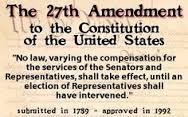
It’s interesting to note the priorities of that first Congress, as expressed in their original 1st and 2nd amendments. The ones that were thrown out. The first had to do with proportional representation, and would have led us to a 6,000 member House of Representatives, instead of the 435 we currently have. The second most important thing in the world, judging by the priorities of that first Congress, was that any future Congress could not change their own salaries. Any such change could affect only future Congresses.27th-amendment

That original 2nd amendment, reading that “No law, varying the compensation for the services of the Senators and Representatives, shall take effect, until an election of Representatives shall have intervened”, took effect in 1992 as the 27th amendment, following a ratification period stretching out to 202 years, 7 months, and 12 days. We must not be too hasty about these things.

March 3, 1920 The Craziest Pilot in the Canadian Air Force

Doohan practiced voices and accents ever since he was a kid, and he was good at it. The skills he acquired would serve him well in his later acting career.

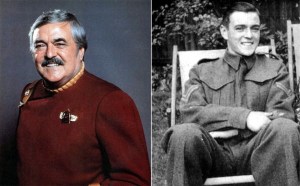
Born March 3, 1920 in Vancouver, British Columbia, James Montgomery “Jimmy” Doohan enrolled in the 102nd Royal Canadian Army Cadet Corps in 1938. By the outbreak of WWII he was commissioned a Lieutenant in the 14th Field Artillery Regiment of the 3rd Canadian Infantry Division.landing

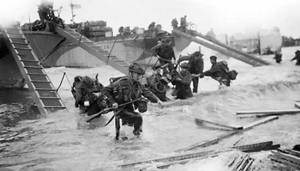
Doohan’s first taste of combat took place on D-Day, on the Normandy beach Canadian landing forces knew as “Juno”. Crossing through a field of anti-tank mines, the Canadian’s luck held.  None of them were heavy enough to set one off.  Leading his men to higher ground, Lieutenant Doohan personally shot two German snipers, before taking up positions for the night.

That night, Doohan had just finished a cigarette and was walking back to his command post.  A nervous sentry opened up on him with a Bren light machine gun, striking him four times in the leg, once in the chest and again on the middle finger of his right hand. The chest shot hit the cigarette case his brother had given him for good luck, and doctors were able to save his life.  Not so much for the finger. That had to be amputated. He would always hide the injury in his later life.

auster

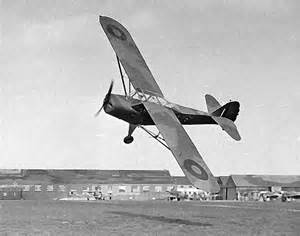
After healing up, Doohan served as courier and artillery spotter, aboard a Taylorcraft Auster Mark IV.  In the spring of 1945, he slalomed his aircraft between telegraph poles, just to prove that it could it be done.  Though the man was never an actual member of the CAF, the stunt forever marked him as “the craziest pilot in the Canadian Air Force”.

Doohan practiced voices and accents ever since he was a kid, and he was good at it. The skills he acquired would serve him well in his later acting career.

He heard a radio drama after the war. Knowing he could do it better, Doohan recorded his voice at a local radio station, winning a two year scholarship to study at the Neighborhood Playhouse in New York and studying with the likes of Leslie Nielsen, Tony Randall, and Richard Boone.

Doohan appeared in over 4,000 radio programs and 450 television shows throughout the forties and fifties. Coincidentally, Doohan played “Timber Tom”, the northern version of Buffalo Bob, in the Canadian production of Howdy Doody. About the same time that a young actor named William Shatner was playing Ranger Bill in the American version. The two would appear together on the 1950s Canadian science fiction series “Space Command”. It wasn’t the last time the two would appear together.

Auditioning before Gene Roddenberry in 1965, Doohan performed several accents. Asked which he preferred, he responded “If you want an engineer, in my experience the best engineers are Scotsmen.” He chose the name “Montgomery Scott”, after his grandfather.

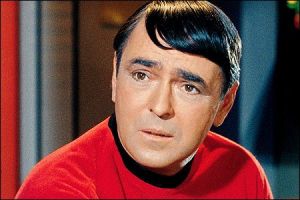
Chief Engineer aboard the Starship Enterprise was supposed to be an occasional role, but Doohan’s character proved irresistible.scotty

Soon he was #3 in command, a regular cast member playing alongside William Shatner (Captain James T. Kirk), Leonard Nimoy (Spock) and DeForest Kelley (Dr. McCoy).  Doohan’s voice talents helped behind the scenes as well.  It was he who helped develop the Klingon and Vulcan languages.

Star Trek was canceled in 1969 due to poor ratings, but returned to broadcast syndication in the 70s.  The series has since become a cult classic. There is hardly a woman, man, puppy boy or girl who isn’t steeped and marinated in the program.

The “Scotty” character was so iconic, that many fans credit him with their interest in the technical fields.  Among them was the engineer-turned-astronaut Neil Armstrong, who personally thanked him in 2004.

doohan-1Doohan’s health declined in his later years. He developed Parkinson’s disease and diabetes, along with fibrosis of the lung, blamed on his exposure to noxious chemicals during WWII. He was experiencing symptoms of Alzheimer’s by 2004, though he was able to attend the ceremony held in his honor after receiving a star on the Hollywood Walk of Fame, that August.

James Montgomery Doohan passed away on July 20, 2005, survived by third wife Wende, their three children, his four adult children from a previous marriage, and several grandchildren and great-grandchildren. His youngest daughter, Sarah, was five at the time of his death.

On April 29, 2007, a SpaceLoft XL rocket lifted off from the Spaceport America launchpad in Las Cruces.  Onboard were the ashes of astronaut Gordon Cooper, and James Montgomery Doohan.  Cooper’s wife Suzan and Wende Doohan pushed the launch button.

In Linlithgow, Scotland, there is a museum, claiming the West Lothian town as the future birthplace of chief engineer Montgomery Scott.  He will be born there, in 2222.

doohan-letter


March 2, 1977 Heeeere’s Johnny

The world’s longest running talk show began in 1954, when Steve Allen sat down at his piano on September 27. This show is gonna go on… forever”, Allen quipped. So far, he seems to have gotten that right.

carson-navy_portrait
US Navy Portrait

With Jack Parr about to sign off the “Tonight Show” for the last time, NBC executives were anxious to find a replacement. Bob Newhart, Jackie Gleason, Groucho Marx, and Joey Bishop all declined the opportunity, when a United States Navy veteran, amateur magician and amateur boxer with a 10/0 record agreed to take the job.

Johnny Carson had himself turned down the job, believing himself unequal to the task of producing 90 minutes a day of fresh content. A series of guest hosts including Merv Griffin, Art Linkletter, Joey Bishop, Jerry Lewis and Groucho Marx followed, as Carson finished out the last six months of an ABC contract. Despite misgivings, Carson started the new gig on October 1, 1962.

No sooner had NBC announced that Johnny Carson was joining “The Tonight Show,” than the national press gaggle came after him, looking for interviews. Carson resisted at first, but finally relented, providing journalists with a list of answers to which they could apply any question they liked: “Yes, I did. Not a bit of truth in that rumor. Only twice in my life, both times on Saturday. I can do either, but prefer the first. NO. Kumquats. I can’t answer that question. Toads and tarantulas. Turkestan, Denmark, Chile, and the Komandorskie Islands. As often as possible, but I’m not very good at it yet. I need much more practice. It happened to some old friends of mine, and it’s a story I’ll never forget”.carson-mcmahon-1963

Carson was joined shortly thereafter by a Marine Corps Colonel and flight instructor, from Lowell, Massachusetts. The Marine had earned his carrier landing qualifications around the time the atomic bomb ended the war in the Pacific, going on to fly 85 combat missions in Korea, and earning six air medals. His name was Ed McMahon.

When the Tonight Show first aired, everyone on the set including Carson himself, smoked. The “Public Health Cigarette Smoking Act” was introduced in Congress in 1969. Ironically, it was President Richard Nixon, an avid pipe smoker who lit up as many as eight bowls a day, who signed the measure into law on April 1, 1970. The measure included a permanent ban on television cigarette advertising, scheduled to take effect January 2 the following year. The last cigarette ad in the history of American television was a Virginia Slims ad, broadcast at 11:59p.m., January 1, 1971, on the Tonight Show, Starring Johnny Carson. Smoking on-air became a thing of the past sometime in the mid-80s, but that cigarette box remained on Carson’s desk until his final episode, in 1992. You’ve come a long way, baby.carson-monolog

For NBC, the Tonight Show was a cash cow. Many years the program grossed over $100 million, accounting for 15-20% of the profits earned by the entire network. Carson threatened to walk in 1980, ending up with a deal unprecedented in the history of American television: $5 million a year and series commitments estimated at $50 million. Just as important, show content would no longer belong to the network, but to Carson himself.

Carson began taking Mondays off in 1972, when the show moved from New York to California. There followed a period of rotating guest hosts, including George Carlin and Joan Rivers, who became permanent guest host from 1983 until 1986.

carson-carnac  The Tonight Show Starring Johnny Carson was a late-night fixture through seven US Presidents: John F. Kennedy, Lyndon Johnson, Richard Nixon, Gerald Ford, Jimmy Carter, Ronald Reagan, and George H.W. Bush. Almost every American over the age of 30 will remember “Heeeeeeeeeeere’s Johnny!”. The opening monologue, and the imaginary golf swing. “Carnac the Magnificent”, holding the envelope to his head, reciting the punchline to the joke sealed inside. “Saucepan… Who was Peter Pan’s wino brother?” When the joke bombed, there was the comedic curse. “May a bloated yak change the temperature of your jacuzzi!”
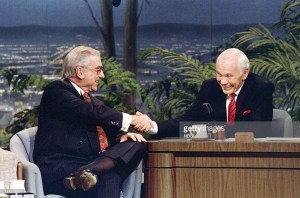
Jay Leno appeared on the Tonight Show with Johnny Carson for the first time on March 2, 1977. He would frequently guest host, and served as permanent from May 1992 to May 2009.

Five years after Carson’s final show, 10,000 taped episodes were moved to a salt mine in Kansas, to protect them from deterioration. There they remain, 54 stories underground, where the average temperature is 68 degrees, with a uniform 40% humidity.

carson-mcmahon-1992
Final episode, 1992

Excepting Conan O’Brien’s eight months in 2010, Leno remained permanent host until February 2014, recording more episodes (4,610) than even Carson himself (4,531). Saturday Night live veteran Jimmy Fallon took over the reins in February 2014, where he remains to this day.

The world’s longest running talk show began in 1954, when Steve Allen sat down at his piano on September 27. This show is gonna go on… forever”, Allen quipped. So far, he seems to have gotten that right.