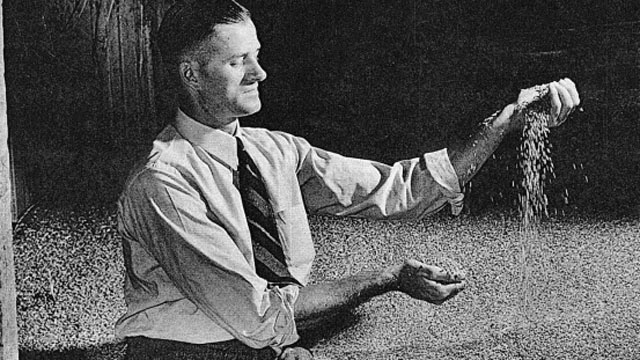
January 28, 1942 The Mighty 8th Air force

On this seventy-seventh birthday of the Mighty 8th Air Force, we can all thank a teacher, that we are able to read this story. We can thank a Veteran, that we can read it in English.

The Nazi conquest of Europe began with the Sudetenland in 1938, the border districts of Bohemia, Moravia, and German speaking parts of Czechoslovakia.

The invasion of Poland brought France and Great Britain in on the side of their ally, in 1939.  Ground forces of the United Kingdom were shattered the following year, along with those of her French, Indian, Moroccan, Belgian, Canadian and Dutch allies.

The hastily assembled fleet of 933 vessels large and small were all that stood between salvation, and unmitigated disaster.  338,226 soldiers were rescued from the beaches of France.  Defeated, all but disarmed yet still unbeaten, these would live to fight another day.

dunkirkevacuation
Dunkirk

In 1940, every major power on the European mainland was either neutral, or under Nazi occupation.  The island nation of Great Britain stood alone and unconquered, defiant in the face of the Nazi war machine.  In Germany, street decorations were prepared for victory parades, as plans were laid for “Operation Sea Lion”, the planned invasion of Great Britain and final destruction of the British Isles.

After the allied armies were hurled from the beaches of Dunkirk, Hitler seemed to feel he had little to do but “mop up”.   Luftwaffe commander-in-chief Hermann Göring convinced Der Fuhrer that aircraft alone could do the job.

Hitler approved, and turned his attention to the surprise attack on his “ally” to the East. The “Battle of Britain” had begun.

Two days in August 1940 saw 3,275 sorties against the British home isles, with only 120 aircraft lost to the German side.  A single Junkers 88 or Heinkel 111 bomber carried 5,510-pounds of bombs.

heinkel-he-111-during-battle-of-britain-01

The wrath of the Luftwaffe was spent by the end of October, Operation sea Lion postponed again and again.  Great Britain would fight on alone, but for the shattered remnants of formerly allied powers, for another year and one-half.  Prime Minister Winston Churchill captured the spirit of the period as only he could, when he said: “Never in the field of human conflict was so much owed by so many to so few”.

Battle of Britain

Hitler would turn his his back and launch “Operation Barbarossa” in June, 1941.  The surprise invasion of the Soviet Union.

Under the terms of the tripartite pact with Fascist Italy and Imperial Japan, Nazi Germany was obliged to render aid in the event that either ally was attacked. On December 8, 1941, the day after the Japanese attack on the US naval anchorage at Pearl Harbor, Ambassador Hiroshi Ōshima came to German Foreign Minister Joachim von Ribbentrop, looking for  a commitment of support.

mighty-eighth-crewman
Crewman, Mighty 8th

Ribbentrop balked.  With their ally having been the aggressor, Germany was under no obligation to intervene.  Adolf Hitler thought otherwise. Hitler detested Roosevelt, and thought it was just a matter of time before the two powers were at war. He might as well beat the American President to the punch.

At 9:30am Washington time on December 11, German Chargé d’Affaires Hans Thomsen handed a note to American Secretary of State Cordell Hull. For the second time in the diplomatic history of the United States and Germany, the two nations were in a state of war.

Half a world away, one man went to bed to sleep the “sleep of the saved and thankful”.

“Silly people, and there were many, not only in enemy countries, might discount the force of the United States… But I had studied the American Civil War, fought out to the last desperate inch. American blood flowed in my veins. I thought of a remark which Edward Grey had made to me more than thirty years before—that the United States is like ‘a gigantic boiler’. Once the fire is lighted under it there is no limit to the power it can generate.  Being saturated and satiated with emotion and sensation, I went to bed and slept the sleep of the saved and thankful”. – Prime Minister Winston Churchill

8thaf-shoulder-patch48 days later, at Hunter Field in Savannah, Georgia, the Eighth Bomber Command was activated as part of the United States Army Air Forces. It was January 28, 1942.

The 8th was intended to support operation “Super Gymnast”, the invasion of what was then French North Africa.  Super Gymnast was canceled in April.  By May, the 8th Bomber Command had moved headquarters to a former girls’ school in High Wycombe, England, from where it conducted the strategic bombing campaign against Nazi Germany.

thndbrdRe-designated the Eighth Air Force on February 22, 1944, at its peak the “Mighty Eighth” could dispatch over 2,000 four engine bombers and more than 1,000 fighters on a single mission. 350,000 people served in the 8th Air Force during the war in Europe, with 200,000 at its peak in 1944.

By 1945, the Wehrmacht could tell itself a new joke:  “When we see a silver plane, it’s American. A black plane, it’s British. When we see no plane, it’s German”.  American aviation paid a heavy price for this little bit of black humor.

the-mighty-eighth-banner

Half of US Army Air Force casualties in World War II were suffered by the 8th, over 47,000 casualties, with more than 26,000 killed. By war’s end, 8th Air Force personnel were awarded 17 Medals of Honor, 220 Distinguished Service Crosses, and 442,000 Air Medals. There were 261 fighter aces in the 8th, 31 of whom scored 15 or more confirmed kills.  305 gunners were also recognized, as aces.

b-52h_static_display_arms_06

Following the allied victory in Europe, 8th AF Headquarters was reassigned to Sakugawa (Kadena Airfield), Okinawa, under the command of Lieutenant General James H. “Jimmy” Doolittle.  Tasked with organizing and training new bomber groups for the planned invasion of Japan, the 8th received its first B-29 Superfortress on August 8.  Seven days later, the atomic bomb had ended the war in the Pacific.

With the onset of the jet age and the “Cold War” at it height, the 8th Air Force moved to Westover Air Force Base in Massachusetts on June 13, 1955, the second of three Numbered Air Force groups of the newly constituted Strategic Air Command (SAC).

Since that time, the Mighty 8th has been called on to perform combat missions from Southeast Asia to the Middle East to the Federal Republic of Yugoslavia, flying out of its current headquarters at Barksdale Air Force Base, in Louisiana.

If you’re ever in Savannah, do yourself a favor and pay a visit to the National Museum of the Mighty Eighth Air Force (http://www.mightyeighth.org/). Not only will you experience an incredible story well told, but you will meet some 90+ year old veterans who walk as straight and tall today as they did, seventy years ago.

Happy Birthday, Mighty Eighth.

If you enjoyed this “Today in History”, please feel free to re-blog, “like” & share on social media, so that others may find and enjoy it as well. Please click the “follow” button on the right, to receive email updates on new articles.  Thank you for your interest, in the history we all share.

January 27, 47,981BC I, Neanderthal

Today, to call someone “Neanderthal” is to insult him as a stupid brute.  It appears that our cousin was nothing of the sort.

In the 17th century, the German Reformed Church teacher and hymn writer Joachim Neander liked to hike a valley outside of Düsseldorf. The beauty of nature was inspirational, clearing his mind and inspiring verses like:

“See how God this rolling globe/swathes with beauty as a robe…
Forests, fields, and living things/each its Master’s glory sings.”

The theologian contracted tuberculosis and died at the age of thirty.  And yet he lived on in a way, in the valley which came to bear his name.

Some 200 years later, three years before Charles Darwin published the Origin of Species, workers quarrying limestone in the Neander Valley discovered an unusual skull.  This was no ordinary head, elongated and nearly chinless as it was, with heavy ridges over the eyes.  Heavy bones were found alongside  which fitted together, albeit oddly.

From top, clockwise: a) Neander Valley by Friedrich Wilhelm Schreiner, oil on cardboard, 1855, b) original bones discovered the following year, and c) Artist’s conception of what he looked like, H/T Artist: Kennis & Kennis Reconstructions

The state of archaeological science had much to learn in 1856.  Who knows, 22nd century historians and scientists may look back and say the same thing about us.  At the time, even to discern fossils from ordinary rock was beyond the ability of many scientists.

Scholars of the day had no shortage of theories. This was a lost Cossack, a bowlegged rider suffering from rickets, a painful condition resulting in weak and misshapen bones. To some, the life of pain resulting from such a condition made perfect sense, the bony eye ridges resulting from perpetually furrowed brow.

800px-neandertala_homo__modelo_en_neand-muzeo

British geologist William King suspected something radically different. This was no aberrant human being nor even a lost ancestor. This was a member of a long lost branch of humanity.   An extinct but parallel species to our own.  King published a paper in 1864 hypothesizing his idea of an evolutionary dead end, naming the long lost species after the poet who had once wandered the valley in which it was discovered.

bn-jj263_cavema_p_20150713194645

H/T, WSJ

He called it Homo Neanderthalensis: Neanderthal Man.

Today, to call someone “Neanderthal” is to insult him as a stupid brute.  It appears that our cousin was nothing of the sort.

thxsbryh8nThe hyoid bone at the floor of the mouth serves as a connecting-point for the tongue and other musculature, giving humans the ability to speak. A delicate structure likely to be lost in most fossilized specimens, the first Neanderthal hyoid was only discovered in 1989.

An international team of researchers analysed this fossil Neanderthal bone using 3D x-ray imaging and mechanical modelling and, yes.  Neanderthal could not only speak, but was capable of highly complex speech not unlike ourselves, though his voice was likely high and grating.  Certainly not the base grunting commonly associated with “cave-men”.

Neanderthal bodies were suited to the ice age of the early and middle Paleolithic era, shorter in stature and more robust, considerably more powerful than Cro-Magnon, our direct ancestor and all but indistinguishable from ourselves.

Neanderthal emerged on the Eurasian landmass, about 300,000 years ago.  The average female stood 5′ – 5’1″ and weighed 140-pounds, the average male about five inches taller and weighing in at 172.

neanderthal, mother and child

“Neanderthal sculptures, named Nana and Flint, at the Gibraltar Museum”. H/T Jaap Scheeren, New York Times

Neanderthal possessed  a brain only slightly smaller than Cro-Magnon, walked upright, formed and used simple tools and controlled fire.  They even buried their own dead, at least sometimes.  Some researchers theorize that they built boats and sailed the Mediterranean.  Imperfectly formed tools and weapons found alongside more sophisticated specimens even suggest he educated his children.

neanderthalchild1t
H/T Signs of the Times, Science & Technology

He might even fit in if you brought him back today, provided you dressed him right.

Despite all that, Neanderthal was an evolutionary dead end and not our ancestor, though he did “coexist” for about 5,000 years with our Cro-Magnon forebears.  The two even bred together and produced children, sometimes, the first such encounter taking place on this day, fifty thousand years ago.

Whether the happy couple had Barry White or Marvin Gaye playing in the cave, is lost to history.

Alright, I made that part up, but not the “coexist” part.  Our modern ancestors migrated from the African continent some 50,000 years ago, resulting in that first hookup somewhere on the Eurasian landmass.  It was far from the last.

range_of_neanderthalsacoloured

Known Neanderthal range, ca 300,000 years ago, to 35,000BC

Several years ago, Vanderbilt University Geneticists compared a genome-wide map of Neanderthal haplotypes, with a database of some 28,000 modern adults of European and Asian ancestry. The 2016 study published in the journal Science, reported that modern day Eurasians carry between 1½% to 4% of Neanderthal DNA.  

The study went on to postulate a range of traits relevant to disease risk in modern humans and linked back to Neanderthal DNA, including those which influence depression, obesity, mood disorders, skin disease and addiction.

20-physical-traits-you-may-have-inherited-from-a-neanderthal-300x300The idea isn’t as strange as it sounds. Last year, Sir Richard Branson was in the news, claiming  he’d looked into his family ancestry. Forty generations back, turns out Branson is related to Charlemagne.  It’s no big deal, according to Geneticist Adam Rutherford. Speaking at the Chalke Valley History Festival, Rutherford explained: “Literally every person in Europe is directly descended from Charlemagne. Literally, not metaphorically. You have a direct lineage which leads to Charlemagne,” adding “Looking around this room, every single one of you … is directly descended between 21 and 24 generations from Edward III.

Edward III of England exited this world a mere 689 years ago.  The time from which the last Neanderthal left the stage was fifty times that span.

1-occipital-bun-e1419459708298If you have European or Asian ancestry, the following traits might be a sign of your inner Neanderthal:

The “Occipital Bun” (I have one of those) is a knot of rounded bone, believed to have once anchored the massive neck and jaw muscles of Neanderthal.

c0dd5e736cc6ddebdf295b65d14c75e3The naturally large eyes of individuals such as Ukrainian model Masha Tyelna are believed to have been useful to Neanderthal, making their way in the dim light of northern latitudes.  In fact, Neanderthal may have used more brain power processing visual input:  an evolutionary disadvantage compared with early modern humans.

12-red-hair

One mutation in the main gene for hair color appears to come from Neanderthal, including a spectrum of red hair from auburn to carrot top to strawberry blond. Two to six per cent of modern Europeans have red hair, compared with 0.6%, worldwide. Red hair is much more prevalent in the British Isles. 10% to 13% of Irish and Scottish respectively have red hair, while 30% (Scotland) and 46% (Ireland) carry the gene.

I remember, before it turned gray, my beard was a screaming shade of red.

4ca8e48815353a6b541668666ebe924fFreckles?  Fair skin is more efficient at producing vitamin D from weak sunlight, an advantage for those living at northern latitudes. Freckles result from clusters of cells which overproduce melanin granules, triggered by exposure to sunlight. Freckles are found in a wide range of skin colors and ethnicity, but are most prevalent on fair complexions. It is a Neanderthal gene most common in Eurasians, among whom 70% are believed to carry the gene.

Having evolved for hundreds of thousands of years on the Eurasian landmass, Neanderthals developed the Human Leukocyte Antigen (HLA) receptor, a gene complex responsible for immune system response to local pathogens. While the HLA receptor conferred an immunity advantage on modern humans, it rendered us more susceptible to a range of autoimmune conditions from Lupus to Crohn’s disease to increased risk for cancer and type 2 Diabetes.

Perhaps calling someone ‘Neanderthal’ isn’t such an insult, after all.  Maybe, there’s one peering out from the bathroom mirror.

article-2529822-1a1bd6a7000005dc-828_634x389

Feature image, top of page: Hat tip, CBSNews.com

If you enjoyed this “Today in History”, please feel free to re-blog, “like” & share on social media, so that others may find and enjoy it as well. Please click the “follow” button on the right, to receive email updates on new articles.  Thank you for your interest, in the history we all share.

January 26, 1972 Sole Survivor

A keyword search reveals seventy-two sole survivors, defined as the only survivor of a plane crash that killed ten or more passengers and crew.

With his father suffering tuberculosis and often hospitalized, Otis Ray Redding, Jr. quit school at the age of fifteen to help support the family. He worked at a gas station, but it was the occasional musical gig that got him noticed.  From Macon (Georgia) talent contests to local bands, Redding later joined Little Richard’s band “The Upsetters” when the singer abandoned rock & roll music, for gospel.

Redding began his musical career at a time of racial segregation, touring the “chitlin circuit”:  a string of venues hospitable to black musicians, comedians and entertainers throughout the American south, northeast and upper Midwest.  Harlem’s Apollo Theater, the Regal Theater in Chicago, the Howard Theater in Washington, D.C, the Royal Peacock in Atlanta, and others.

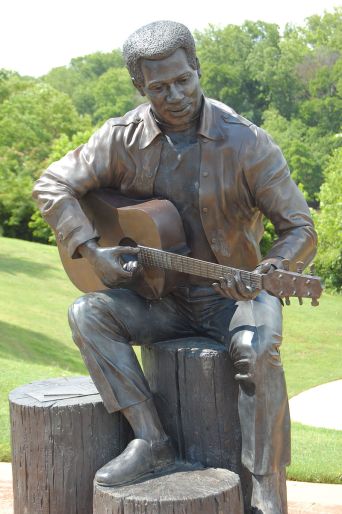
800px-otisreddingstatueRedding joined STAX Records in 1962, a portmanteau of the founding partners and siblings Jim Stewart and his sister Estelle Axton (STewart/AXton = Stax).
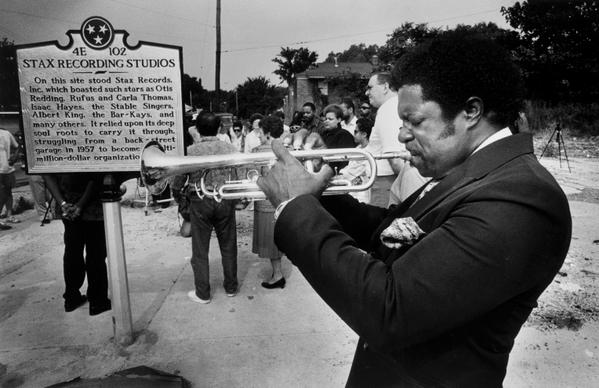
The label’s use of a single studio and a small stable of musicians and songwriters produced a readily identifiable sound based on black gospel and rhythm & blues which came to be known as Southern soul, or Memphis soul.

Singer-songwriter-musician Otis Redding became Stax Records’ biggest star in the five years before the plane crash that took his life: the “Big O”, the “King of Soul”.

Musicians from Led Zeppelin to Lynyrd Skynyrd to Janis Joplin and virtually every soul and R&B musician of the era have taken musical influence from Otis Redding. It was he who wrote the ballad R-E-S-P-E-C-T made famous by the “Queen of Soul”, Aretha Franklin.

His initial recordings were mainly popular with black audiences, but Redding (and others) crossed the “color barrier”, performing at “white owned” venues like Whisky a Go Go in LA, the Monterey Pop Festival of 1967, and venues throughout Paris, London and other European cities.

Redding’s iconic song and  #1 hit, “Sittin’ on the Dock of the bay“, became the first posthumous number-one record on both the Billboard Hot 100 and R&B charts.  Dock of the Bay was the first posthumous album to reach number one on the UK Albums Chart.

The song wasn’t intended to turn out the way it did.

Redding had taken strong influence from the Beatles, particularly the layered sounds of Sgt. Pepper’s Lonely Hearts Club Band.  He wanted to expand his musical footprint beyond the soul and R&B genre.  If you listen to the song – the seagulls, the sound of lapping waves – that’s what he was going for.  The “outro”, the twenty-five seconds’ whistling at the end, were nothing but a place holder, intended to be replaced by some yet-to-be-decided vocal effect in a second recording session, a few days later.

That second session was never meant to be.

The kid who once pumped gas to help support his family boarded his own Beechcraft H-18 aircraft on December 10, 1967, along with Bar-Kays guitarist Jimmy King, tenor saxophonist Phalon Jones, organist Ronnie Caldwell, trumpet player Ben Cauley, drummer Carl Cunningham, their valet Matthew Kelly and the pilot, Richard Fraser.

The band had played two nights in Cleveland.  The next stop was Madison, Wisconsin. The plane took off despite warnings of foul weather.  The show must go on. Ben Cauley remembers waking from a nap to see band-mate Phalon Jones look out a window and exclaim “Oh No!”  He then found himself alone, clutching a seat cushion in the 34-degree waters of Lake Monona.  He was the sole survivor.

ben-cauley
Bar-Kays trumpet player, Ben Cauley

A keyword search reveals seventy-two sole survivors, defined as the only survivor of a plane crash that killed ten or more passengers and crew.

Pilot error was ruled at fault for the wreck of Vietnam Airlines Flight 815 on September 3, 1997. The Tupolev Tu-134B-3 crashed at final approach at Phnom Penh Internatinal Airport in Cambodia, leaving Chanayuth Nim-anong the youngest on the list, at 14-months-old. The crash killed 66 passengers and crew including Taiwanese national Ho Suicheng, who was there to marry his fiancée, Cambodian Khuth Linda.  It was she who identified his body. Khuth went through with the wedding, as planned.  With his photograph.

Crew member Alexander Sizov is the oldest at 52, sole survivor of the charter plane crash of September 7, 2011 that wiped out forty-three members of the Lokomotiv Yaroslavl ice hockey team along with Canadian coach Brad McCrimmon. At the time, Lokomotiv Yaroslavl was a member of the Kontinental Hockey League (KHL), Russia’s top ice hockey league.

aeoecl55qgmcyujnx6uc7a_alexander-sizov-52-bol-mechanikom-na-palube

The old adage ‘only the good die young’ may be illustrated with Chinese national Huáng Yù, sole survivor of the hijacked Cathay Pacific aircraft Miss Macao in the 1948 crash that killed the other 27 people on board.  Huáng was the lead hijacker.  He not only escaped death, but prosecution, too.  No one could decide what jurisdiction to try him under.

Though they would never meet, the Beatles form a common bond between the Redding crash and another sole survivor, half a world away.

Serbian flight attendant Vesna Vulović grew up in the age of Beatlemania, and wanted nothing more than to learn English, and move to London. That she did for a time before moving to Stockholm, but the girl’s parents would have nothing of the drugs and sex of the Swedish capital. On returning to Belgrade, Vulović saw a friend in a stewardess uniform. That was it, she remembered: “I thought, ‘Why shouldn’t I be an air hostess? I could go to London once a month’.” Vulović joined JAT, Yugoslavia’s national flag carrier and largest airline, in 1971.

maxresdefault (19)
Vesna Vulović

JAT 367 flew from Stockholm to Belgrade with stopovers in Copenhagen and Zagreb, arrived in Denmark on January 25, 1972. Vulović wasn’t intended to be on the second leg scheduled for the following day, but JAT confused her for another flight attendant with the same name.

Croatian nationalists carried out 128 terrorist attacks against Yugoslav civilian and military targets between 1962 and 1982. JAT Flight 367 became one of them on this day in 1972, the briefcase bomb exploding at 33,330-feet and tearing the aircraft into three pieces.

jat_dc-9_(7107744587)
JAT DC-9 YU-AHL, sister ship of the aircraft involved H/T Wikipedia

Former WW2 medic Bruno Honke found Vulović screaming among the wreckage outside the Czechoslovak village of Srbská Kamenice, her turquoise uniform covered with blood, her 3-inch stiletto heels torn off by the force of the impact. Vulović herself has no recollection of the explosion, or the descent. She suffered a fractured skull with brain hemorrhage, two broken legs and three broken vertebrae. She would spend her next 27 days, in a coma. Two months later, she was offered a sedative for the flight back to Belgrade. She declined the injection, saying she had no memory of the crash. What was there to be afraid of?

Something of a Yugoslavian national hero, Vesna Vulović went back to work for JAT following sixteen months recuperation, albeit, with a limp. She wanted to go back to flying, but got a desk job, instead.  The Guinness Book of world Records officially recognized Vulović’s 1971 fall.  The title was officially awarded in 1985 in a special ceremony, personally bestowed by none other than Paul McCartney.

Feature image, top of page:  Otis Reddings aircraft is fished out of the frigid waters of Lake Monona, near Madison Wisconsin.  The band was four miles from their destination.


January 25, 1925 The Great Race of Mercy

“It was literally the plague among children. Many families lost three of four children—many lost all”.

In the 4th century BC, Hippocrates of Kos identified an upper respiratory infection, characterized by the formation of a leathery white “pseudomembrane” on the tonsils, pharynx, and/or nasal cavities of its victims.  Early symptoms resemble a cold or flu in which fever, sore throat, and chills lead to bluish skin coloration, painful swallowing, and difficulty breathing.  Late symptoms include cardiac arrhythmia with cranial and peripheral nerve palsies.

German bacteriologist Friedrich August Johannes Loeffler first identified Corynebacterium diphtheriae in the 1880s, the causal agent of the disease Diphtheria.  Within ten years, researchers had developed an effective antitoxin.

Today the disease is all but eradicated in the United States, but diphtheria was once a leading cause of death among children and adults over 40.

Diphtheria is highly contagious and spread by direct physical contact and by breathing aerosolized secretions of its victims.  Spain experienced an outbreak of the disease in 1613. To this day the year is remembered as “El Año de los Garotillos”.  The Year of Strangulations.

A severe outbreak swept through New England in 1735. In one New Hampshire town, one of every three children under the age of 10 died of the disease. In some cases entire families were wiped out. Noah Webster described the outbreak, saying “It was literally the plague among children. Many families lost three of four children—many lost all”.

download (7)Dr. Curtis Welch practiced medicine in Nome, Alaska, in 1925. Several children became ill with what he first diagnosed as tonsillitis. More came down with sore throats, early sufferers beginning to die as Welch observed the pseudomembrane of diphtheria. Dr. Welch had ordered fresh antitoxin the year before, but the shipment hadn’t arrived by the time the ports froze over. By January, all the serum in Nome was expired.
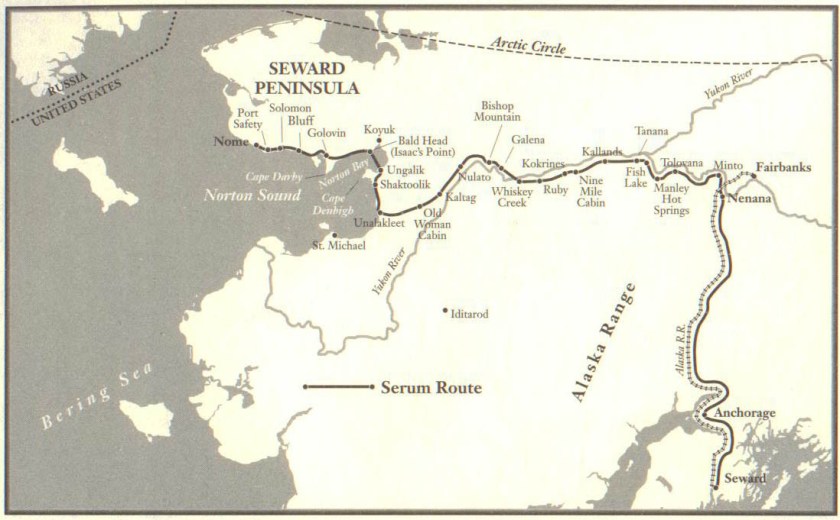

There were 10,000 living in Nome at the time, 2° south of the Arctic Circle. Welch expected a high mortality rate among the 3,000 or so white inhabitants, but the 7,000 area natives: Central Yupik, Inupiaq, St. Lawrence Island Yupik and American Indians with lineage tied to tribes in the lower 48, likely had no immunity whatsoever. Mortality among these populations could be expected to approach 100%.

Five children had already died by January 25, while Dr. Welch suspected more in the remote native camps. A plea for help went out by telegram and an Anchorage hospital came up with 300,204 units of serum. Enough for 30 patients. A million units would be required. but, perhaps this would be enough to stave off epidemic. Until a larger shipment arrived, in February.

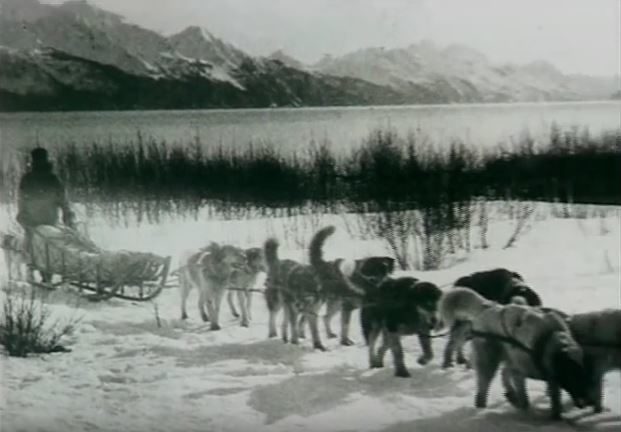
A 20-lb cylinder containing the antitoxin and wrapped in protective fur shipped as far as it could by rail, arriving at Nenana, 674 miles from Nome. Three vintage biplanes were available, but all were in pieces, and none could be started in the sub-arctic cold. The antitoxin would have to go the rest of the way, by dog sled.

On January 27, a US Marshal pounded on the door of Willard J. “Wild Bill” Shannon, begging for his help with the relay to Nome.   It was after midnight and −50° Fahrenheit , when Shannon and his nine-dog team received the serum. The temperature had dropped to −62°F by the time the team reached Tolovana, 24 hours later. Shannon himself was hypothermic, with parts of his face turned black with frostbite.  Three of his dogs had died on the way, victims of frostbitten lungs.

97baa68e7dc7b530eea4c9a84b1081d2

Leonhard Seppala and his team took their turn, departing into gale force winds and zero visibility, with a wind chill of −85°F.  With Seppala’s 8-year old-daughter and only child Sigrid at risk for the disease, the stakes could not have been higher.

Up the 5,000′ “Little McKinley”, Seppala gambled on a shortcut across the unstable ice of Norton Sound.  The howling gale threatened to break up the ice, stranding the team at sea.  Visibility was so poor that Seppala couldn’t see his own “wheel dog” – the dog nearest his sled.  The 19-dog team struggled for traction on the glassy skin of the ocean water, returning to the coastline only hours before the ice broke up.

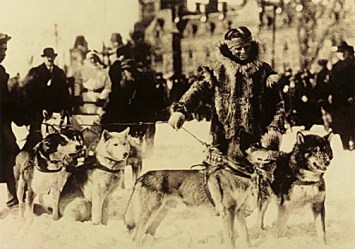
Much of the time, navigation in that black, frozen wilderness was entirely up to Seppala’s lead dog.  Most sled dogs are retired by age twelve, especially team leaders, but it was twelve-year-old “Togo”, who was trusted with the lead.

images (14)

Seppala and Togo ran 170 miles to receive the serum, returning another 91 miles to make the handoff on February 1. Together the pair covered twice as much ground as any other team, over the most dangerous terrain of the “serum run”.

Gunnar Kaasen and his team took the handoff, hitting the trail at 10:00 that night. A massive gust estimated at 80mph upended the sled, pitching musher and serum alike into the snow. Already frostbitten, Kaasen searched in the darkness with bare hands, until he found the cylinder. Covering the last 53 miles overnight, the team reached Front Street, Nome, at 5:30am on February 2. The serum was thawed and ready to use,  by noon.

seppala520 mushers and 150 dogs or more had covered 674 miles in 5 days, 7½ hours, a distance that normally took the mail relay 2-3 weeks. Not a single serum ampule was broken.
With 28 confirmed cases and enough antitoxin for 30, the serum run had held the death toll to no higher than seven.

Doctor Welch suspected as many as 100 or more deaths in the native camps, but the real number will never be known. An untold number of dogs died while completing the run.  Several mushers were severely frostbitten.

diphtheria_balto
Gunnar Kaasen and Balto

Gunnar Kaasen and his lead dog “Balto” were hailed as heroes of the serum run, the dog becoming the most popular canine celebrity in the country, after Rin Tin Tin. There was a nine-month vaudeville tour, and Hollywood produced a 30-minute silent film, “Balto’s Race to Nome,” starring himself in the lead role.

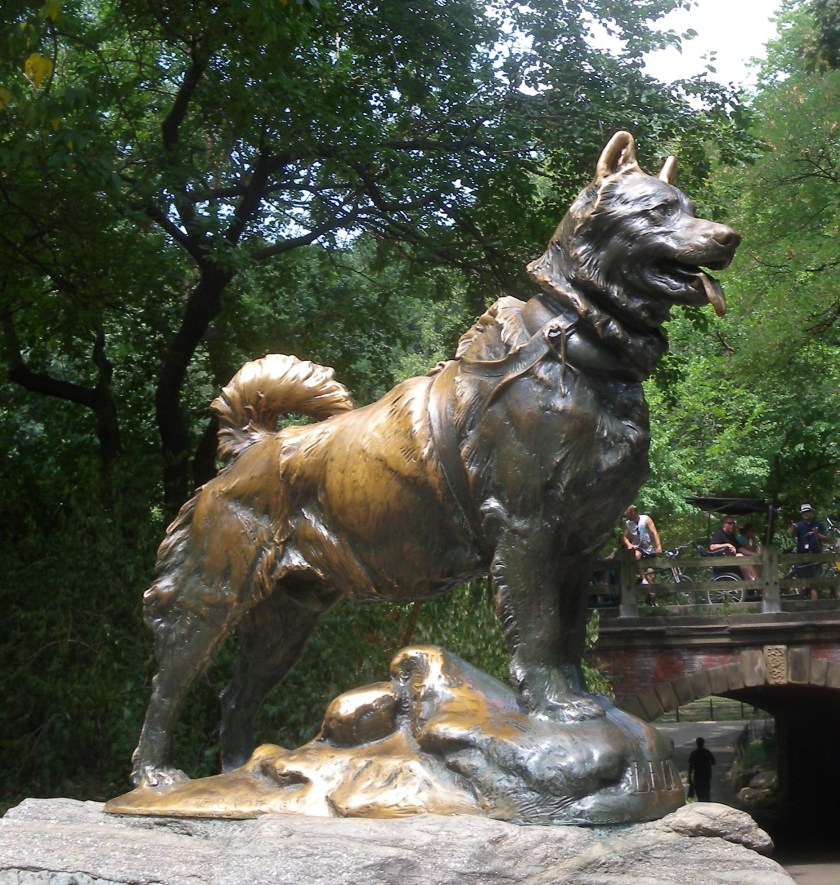
A bronze likeness was erected in New York’s Central Park in 1925, with Balto in attendance.  The statue stands there to this day, though Kaasen’s lead is depicted wearing Togo’s “colors” (awards).

Balto’s fame was a source of considerable bitterness for Leonhard Seppala, who felt that Kaasen’s 53-mile run was nothing compared with his own 261, Kaasen’s lead little more than a “freight dog”.  The statue was particularly galling.  “It was almost more than I could bear” he said, “when the ‘newspaper dog’ Balto received a statue for his ‘glorious achievements’”.

Togo lived another four years though the serum run rendered him lame, never again able to run. The real hero of the serum run spent the last years of his life in Poland Spring, Maine, and passed away at the ripe old age of 16.

Wild Bill Shannon disappeared in 1937, while prospecting for gold.  His bones were discovered four years later, perhaps a victim of exposure, or perhaps yet another “close call”, with a grizzly bear.

Togo and Seppala
Leonhard Seppala and Togo

Leonhard Seppala was in his old age in 1960, when he recalled his lead dog on the serum run.   “I never had a better dog than Togo. His stamina, loyalty and intelligence could not be improved upon. Togo was the best dog that ever traveled the Alaska trail.”

Today, the memory of the 1925 serum run lives on in the Iditarod Trail Sled Dog Race, held every March and run over much of the same terrain as the ‘Great Race of Mercy’.   Togo himself is stuffed and mounted,  standing watch at the Iditarod museum headquarters, in Wasilla, Alaska.

Afterward

Despite the decrepit condition of those three biplanes, pilots and mechanics thought they could have one ready to go, in three days.  The challenge was immense.  Ethylene Glycol wouldn’t be used as an automotive anti-freeze until the following year, and older methods such as Methyl Alcohol wrought havoc on internal engine components.

e16a10c46b80a325b8c6e8e4009c828c“The once tight fabric covering the wings and fuselage was weak from all the rough landings as well as the wind and rain. Dirt and oil caked the engine and prop. Wires for the rudders and elevators hung from the sides of the fuselage.” Even in such disrepair, the pilots and mechanics thought one of the planes could be ready to go Nome in just three days, a flight they thought would take no more than 6-hours”.

If unsuccessful, all would be lost.  Pilot, aircraft and serum.

The decision was a high stakes gamble, falling in the end to Alaska Governor Scott Bone, who decided on the twenty-team relay.  Good thing, too.  Multiple efforts to get one of those aircraft in shape for the second shipment, failed.

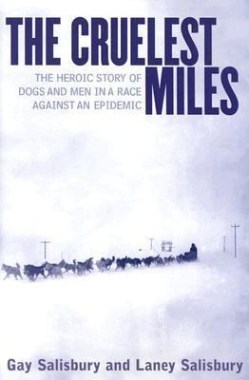
The Salisbury cousins Gay and Laney tell the tale in a harrowing account called The Cruelest Miles, if you’re interested in more reading.  I haven’t gotten to mine yet, but it sounds like a good read.

If you enjoyed this “Today in History”, please feel free to re-blog, “like” & share on social media, so that others may find and enjoy it as well. Please click the “follow” button on the right, to receive email updates on new articles.  Thank you for your interest, in the history we all share.

January 24, 1776 Seven Weeks in Winter

It must have been a sight when that noble train of artillery entered Cambridge on this day in 1776. By March, Henry Knox’ cannon would be manhandled to the top of Dorchester Heights, resulting in the British evacuation of Boston and a peculiar Massachusetts institution which exists to this day, known as “Evacuation Day”:  March 17.

The American Revolution began with the Shot Heard Round the World” on the morning of April 19, 1775. Within days of the Battles at Lexington and Concord and subsequent British withdrawal to Boston, over 20,000 men poured into Cambridge from all over New England. Abandoned Tory homes and the empty Christ Church became temporary barracks and field hospitals.  Even Harvard College shut down, its buildings becoming quarters for some 1,600 Patriots.

The Continental Congress appointed George Washington General of this “Army” on June 15, two days before the British assault on Farmer Breed’s hill. The action would take its name from that of a neighboring farmer, and went into history as the Battle of Bunker Hill.

battle-of-bunker-hill

Shortly after arriving in July, General Washington discovered that his army had enough gunpowder for nine rounds per man, and then they’d be done.

At the time, Boston was a virtual island, connected to the mainland by a narrow strip of land.  British forces were effectively penned up in Boston, by a force too weak to do anything about it.

The stalemate dragged on for months, when a 25-year-old bookseller came to General Washington with a plan. His name was Henry Knox. His plan was a 300-mile, round trip slog into a New England winter, to retrieve the guns of Forts Ticonderoga, and Crown Point.

fort ticonderoga artillery (fort ti photo)

Washington’s advisers derided the idea as hopeless, but the General approved. Henry Knox set out with a column of men on December 1.

Located on the New York banks of Lake Champlain, Fort Ticonderoga was captured by a small force led by Ethan Allen and Colonel Benedict Arnold, in May of that year. In it were brass and iron cannon, howitzers, coehorns and mortars, 30 pieces in all and another 29, from Fort Crown Point.  Arriving on December 5, Knox and his men set about disassembling the artillery, making it ready for transport. A flotilla of flat bottom boats was scavenged from all over the countryside, the guns loaded and rowed the length of Lake George, arriving barely before the water began to freeze over.

colonel-knox-bringing-the-cannons-from-fort-ticonderoga (2)Local farmers were enlisted to help and by December 17, Knox was able to report to General Washington “I have had made forty two exceedingly strong sleds & have provided eighty yoke of oxen to drag them as far as Springfield where I shall get fresh cattle to carry them to camp. . . . I hope in 16 or 17 days to be able to present your Excellency a noble train of artillery.”

Bare ground prevented the sleds from moving until Christmas morning, when a heavy snow fell and the column set out for Albany. Two attempts to cross the Hudson River on January 5 each resulted in cannon being lost to the river, but finally Knox was able to write “Went on the ice about 8 o’clock in the morning & proceeded so carefully that before night we got over 23 sleds & were so lucky as to get the Cannon out of the River, owing to the assistance the good people of the City of Albany gave.”

henry-knox-moving-canning-from-fort-ticonderoga

Continuing east, Knox and his men crossed into Massachusetts, over the Berkshires, and on to Springfield. With 80 fresh yoke of oxen, the 5,400lb sleds moved along much of what are modern-day Routes 9 and 20, passing through Brookfield, Spencer, Leicester, Worcester, Shrewsbury, Northborough, Marlborough, Southborough, Framingham, Wayland, Weston, Waltham, and Watertown.

It must have been a sight when that noble train of artillery entered Cambridge on this day in 1776. By March, Henry Knox’ cannon would be manhandled to the top of Dorchester Heights, resulting in the British evacuation of Boston and a peculiar Massachusetts institution which exists to this day:  “Evacuation Day”, March 17.

800px-henry_knox_artillery_handover_to_george_washington_marker

It is doubtful whether Washington possessed either powder or shot in quantities sufficient for a sustained campaign, but British forces occupying Boston didn’t know that. The mere presence of those guns moved British General Howe to weigh anchor and sail for Nova Scotia, but that must be a story for another day.

Afterward

During WW1, Winthrop Massachusetts artist and bronze foundry operator Henry L. Norton served with the Canadian army “over there” where he was wounded, seven times. In 1926, 150 years after Knox’s march through New York and Massachusetts, Norton and Albany sculptor Henry James Albright designed commemorative plaques to be installed on 56 stone monuments, marking the path of that noble train of artillery. The project was completed in 1927.

knoxtrailmap

Marker locations were updated in 1975 to reflect new research, concerning Knox’s route between Kinderhook New York and Alford, Massachusetts,

50581448_2298075013536100_5233603815533445120_n
Henry Knox Trail marker. Tip of the hat to Aaron Altice, for this image

A new marker was added in 2009, adjacent to a house owned by General John Thomas at the Roxbury Heritage State Park, in Boston. It was he who guided the weapons from Cambridge to their final placement on Dorchester Heights.

photo94269

If you enjoyed this “Today in History”, please feel free to re-blog, “like” & share on social media, so that others may find and enjoy it as well. Please click the “follow” button on the right, to receive email updates on new articles.  Thank you for your interest, in the history we all share.


January 23, 1795 When Cavalry bagged a Fleet

The history of human conflict is hardly a subject for humor, yet there are times when the irony rises from the ridiculous, to the sublime.

The study of warfare has rarely been a source of great mirth.  The history of human conflict is hardly a subject for humor, yet there are times when the irony rises from the ridiculous, to the sublime.

Confederate raider John Singleton Mosby, the “Grey Ghost“, once bagged Union General Edwin Stoughton while dead asleep, lifting the General’s nightshirt and slapping his bare ass, with a sword. Mosby and his 29 raiders made off with the Union General, two Captains, 30 enlisted men and 58 horses, without firing a shot. When the President heard the story, Lincoln lamented: “I can make another Brigadier in 5 minutes, but I can’t replace those horses”.

The Wonderful Story of France: Massacre of the Sicilian VespersIn the middle ages, a French soldier once saw fit to mouth off to an Italian woman on her way home from church, causing France to lose Sicily, to Spain.

At least one WWI battle was called off, on account of an amphibious landing force being attacked, by bees.

The same occurred outside Okalana, Arkansas on April 3, 1864. Union and Confederate troops got into it in a pecan orchard, overturning several hives of honeybees, in the process. If victory goes to he who holds the ground after the battle, this one must go neither to Blue nor Butternut, but to the bugs. Brave soldiers all, no doubt, prepared to take a bullet. But not a bee sting.

120,000 Chinese troops poured into North Korea between November 27 and December 13 1950, overwhelming 20,000 American and United Nations forces at the Chosin Reservoir.  Desperately low on ammunition, one Marine Corps mortar division called in re-supply, by parachute.  The battle of the “Frozen Chosin” might have ended differently, had some supply clerk understood the code-name for mortar shells was “Tootsie Rolls”.  As it was, the guy sent candy into the combat zone.  At least those Marines had something to eat, as they broke their encirclement and headed south.

chosin-few1

Speaking of sweet stuff.  Had the Romans of 48BC brushed up on their Xenophon, the Mithradatic wars may have ended sooner.  Roman troops pigged out on “Mad Honey” left for them by fleeing Persians, and were too stoned to defend themselves when they came back.  A thousand or more Romans were slaughtered, with few losses to the other side.  All of that, for a little taste of honey.

mel brooksIn 585BC, the battle between the Medes and Lydians was stopped in its tracks, on account of a solar eclipse.  In the 3rd Mithradatic War of 76-63BC, a meteor was enough to do the trick.

Who can forget that WW2 bomb disposal tech, Melvin Kaminsky.  Hearing German soldiers singing a beer hall song, Kaminsky grabbed a bullhorn and serenaded them back, crooning out an old tune that Al Jolson used to sing, in black face:  “Toot Toot Tootsie, Goodbye”.  After he was done, polite applause could be heard, drifting across the river.  In all military history, there may be one soldier who’d even think about entertaining his adversary.  Melvin Kaminsky did it.   We remember him today, as Mel Brooks.

zuiderzeeSo, yes, there is irony when men make war, if not always humor.  Yet, in all the annals of warfare, there may be no episode more amusing, than the time a naval force was defeated by men on horseback.

In early 1793, Austria, Prussia, Spain, Great Britain and the Dutch Republic formed the first of seven coalitions to oppose the French Republic.

France declared war on its neighbor to the north.  By the end of the following year, many of Holland’s provinces as well as those of the Austrian Netherlands, were overrun.

The winter of 1794-95 was brutally cold.  A number of Dutch ships sought shelter near the North Sea village of den Helder, becoming icebound near the mouth of a shallow bay called the Zuiderzee.

General Johan Willem de Winter, a former Dutch naval officer, had been in service to the Grande Armée since 1787.  On the night of January 23, de Winter arrived at the head of a regiment of “hussars”, the French light cavalry.  The following morning, a number of horsemen rode out over the ice to the Dutch ship-of-the-line “Admiraal Piet Heyn”, demanding its surrender.   The surgeon aboard another ship, the “Snelheid”, blithely wrote “On Saturday morning, my servant informed me that a French hussar stood near our ship. I looked out my porthole, and indeed, there stood an hussar.”

capture of the dutch fleet at den helder

This was a significant part of the Dutch fleet, 15 ships, 11 of which were manned and seaworthy.  The whole thing was now in the hands of French cavalry.

At least one source will tell you the event never occurred, or at least it’s embellished , as retold by the hussars themselves.   I guess you can take your pick.  A number of 19th century authors have portrayed the episode as unvarnished history, as have any number of paintings and sketches.

capture-of-the-dutch-fleet-frozen-in-at-den-helder-by-the-french-hussars

In February 1846, French Lieutenant-General Baron Lahure published a letter in the newspaper “Echo de la Frontière”, describing the event:

“I departed immediately with a company of tirailleurs in wagons and a squadron of light cavalry; before dawn I had taken position in the dunes. When the ships saw us, they prepared their defences. I sent some tirailleurs ahead, and followed with the rest of my forces. The fleet was taken. The sailors received us ‘de bonne grace’ on board… This is the true story of the capture of the Dutch fleet, devised and executed by a 23 year old Chef de Bataillion”.

Archibald Gordon Macdonell included the episode in his 1934 “Napoleon and his Marshals”.  It’s one of those stories that I Want to be true, even if it isn’t.  “(When) the ragged men” Macdonell  wrote, “thundered on their horses across the ice to capture with naked swords the battlefleet of Holland”.  The only time in recorded history, a naval fleet was captured by a cavalry charge.

frozen fleet

If you enjoyed this “Today in History”, please feel free to re-blog, “like” & share on social media, so that others may find and enjoy it as well. Please click the “follow” button on the right, to receive email updates on new articles.  Thank you for your interest, in the history we all share.

January 21, 1793 Grande Princesse

Marie Antoinette is supposed to have said “Let them eat cake” (“Qu’ils mangent de la brioche”) in response to the bread riots, but there’s no evidence she ever said such a thing.

Alliances came and went throughout 18th century Europe, and treaties were often sealed by arranged marriages. One such alliance took place in 1770 when Francis I, Holy Roman Emperor and his wife Maria Theresa, the formidable Queen of Hungary and Bohemia, married their daughter Maria Antonia to Louis-Auguste, the son of Louis XV, King of France.

10053278The happy couple had yet to meet when the marriage was performed by proxy, the bride remaining in Vienna while the groom stayed in Paris. At 12 she was now the Dauphine, Marie Antoinette, wife of the 14-year-old Dauphin, future King of France.
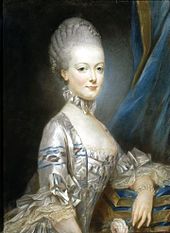
There was a second, ceremonial wedding held in May, after which came the ritual bedding. This isn’t the couple quietly retiring to their own private space. This was the bizarre spectacle of a room full of courtiers, peering down at the proceedings to make sure the marriage was consummated.

It was not, and that failure did damage to both their reputations.

The people liked their new Dauphine at first, but the Royal Court was another story. Insiders had promoted several Saxon Princesses for the match, and called Marie Antoinette “The Austrian Woman”. She would come to be called far worse.

marie_antoinette_by_joseph_ducreuxThe stories you read about 18th century Court intrigue make you wonder how anyone lived like that. Antoinette was naive of the shark tank into which she’d been thrown. Relations were especially difficult with the King’s mistress, the Comtesse du Barry.  Antoinette was somehow expected to work them out.

The King’s daughters, on the other hand, didn’t care for du Barry’s unsavory relations with their father. Antoinette couldn’t win. The sisters complained of feeling “betrayed” one time, when Antoinette commented to the King’s mistress “There are a lot of people at Versailles today”.

Court intrigues were accompanied by reports to Antoinette’s mother in Vienna, the Empress responding with her own stream of criticism. The Dauphin was more interested in lock making and hunting, she wrote, because Antoinette had failed to “inspire passion” in her husband. The Empress even went so far as to tell her daughter that she was no longer pretty. She had lost her grace. Antoinette came to fear her own mother more than she loved her.

Louis-Auguste was crowned Louis XVI, King of France, on June 11, 1775. Antoinette remained by his side, though she was never crowned Queen, instead remaining Louis’ “Queen Consort”.

With her marriage as yet unconsummated, Antoinette’s position became precarious when her sister in law gave birth to a son and possible heir to the throne. Antoinette spent her time gambling and shopping, while wild rumors and printed pamphlets described her supposedly bizarre sexual romps.

marie-antoinette over the yearsFrance had serious debt problems in the 1770s, the result of endless foreign wars, but Antoinette received more than her share of the blame.

As first lady to the French court, Antoinette was expected to be a fashion trendsetter. Her shopping was in keeping with the role, but rumors wildly inflated her spending habits. Her lady-in-waiting protested that her habits were modest, visiting village workshops in a simple dress and straw hat. Nevertheless, Antoinette was rumored to have plastered the walls of Versailles with gold and diamonds.

The difficult winter of 1788-89 produced bread shortages and rising prices as the King withdrew from public life. The marriage had produced children by this time, but the legend of the licentious spendthrift and empty headed foreign queen took root in French mythology, as government debt overwhelmed the economy.

French politics boiled over in June 1789, leading to the storming of the Bastille on July 14. Much of the French nobility fled as the newly formed National Constituent Assembly conscripted men to serve in the Garde Nationale, while the French Constitution of 1791 weakened the King’s authority.

Food shortages magnified the unrest. In October, the King and Queen were placed under house arrest in the Tuileries Palace. In June they attempted to flee the escalating violence, but were caught and returned within days. Radical Jacobins exploited the escape attempt as a betrayal, and pushed to have the monarchy abolished altogether.

Unrest turned to barbarity in September 1792, with rumors of foreign and royalist armies, coming to oppose the revolution.  Between 1,370 to 1,460 prisoners were summarily “tried” and executed by the mob, in the first twenty hours.   Antoinette’s close friend and Lady in Waiting, the Princesse de Lamballe, was taken by the Paris Commune for interrogation. She was murdered at La Force prison, her head fixed on a pike and marched through the city.

death-of-the-princess-de-lamballe-by-leon-maxime-faivre
Léon-Maxime Faivre (1908) Death of the Princess de Lamballe

There would be 65 to 75 such incidents.

Louis XVI was charged with treason against the First Republic in December, found guilty and executed by guillotine on January 21, 1793.  He was 38.

Marie-Antoinette became prisoner #280, her health deteriorating in the following months. She suffered from tuberculosis by this time and was frequently bleeding, possibly from uterine cancer.

massacre_à_la_salpêtrière
Thirty five women were dragged from the Pitié-Salpêtrière Hospital, and murdered

Antoinette was taken from her cell on October 14 and subjected to a sham trial, the outcome of which was never in doubt. She was accused of molesting her own son, a charge so outrageous that even the market women who had stormed the palace demanding her entrails in 1789, spoke in her support. “If I have not replied”, she said, “it is because nature itself refuses to respond to such a charge laid against a mother.”

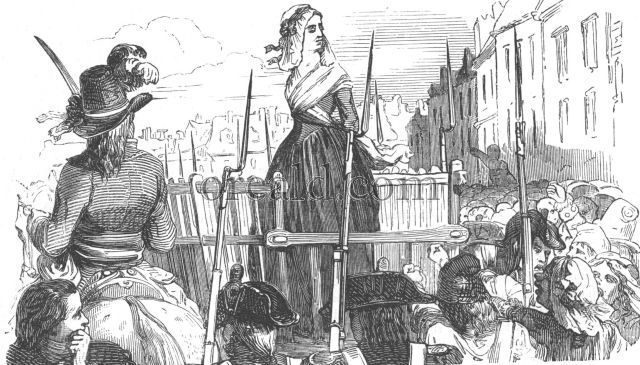
guillotineMarie-Antoinette’s hair was cut off on October 16, 1793. She was driven through Paris in an ox cart, taken to the Place de la Révolution, and executed by decapitation. She accidentally stepped on the executioner’s foot on mounting the scaffold. Her last words were “Pardon me sir, I meant not to do it”.

Marie Antoinette is supposed to have said “Let them eat cake” (“Qu’ils mangent de la brioche”) in response to the bread riots, but there’s no evidence she ever said such a thing.  It’s completely out of character and, despite her lavish lifestyle, she had always displayed sensitivity toward the poor people of France.

The phrase appears in the autobiography of Jean-Jacques Rousseau, “Les Confessions”, attributed to a “Grande Princesse” whom the book declines to name, but is probably Maria Theresa, of Spain. Considering the lifetime of cheap and mean-spirited gossip to which Marie Antoinette was subjected, it’s easy to believe that this was more of the same.

If you enjoyed this “Today in History”, please feel free to re-blog, “like” & share on social media, so that others may find and enjoy it as well. Please click the “follow” button on the right, to receive email updates on new articles.  Thank you for your interest, in the history we all share.

January 20, 2018 Rosie the Riveter

“She had been robbed of her part of history…It’s like the train has left the station and you’re standing there and there’s nothing you can do because you’re 95 and no one listens to your story.”

Following the German invasion of Poland in 1939 and the outbreak of general war in Europe, President Franklin Delano Roosevelt proclaimed a limited national emergency, authorizing an increase in Regular Army personnel to 227,000 and 235,000 for the National Guard. Strong isolationist sentiment kept the United States on the sidelines for the first two years, as victorious German armies swept across France.

That all changed on December 7, 1941, with the Japanese attack on the Pacific naval anchorage at Pearl Harbor. Seizing the opportunity, Nazi Germany declared war on the United States, four days later.

The Roosevelt administration had barely found the keys to the American war machine in February 1942, when disaster struck with the fall of Singapore, a calamity Prime Minister Winston Churchill called the “worst disaster” in British military history.

The mobilization of the American war machine was a prodigious undertaking. From that modest beginning in 1939, the Army alone had 5.4 million men under arms by the end of 1942. By the end of the war in 1945, American factories produced a staggering 296,000 warplanes, 86,000 tanks, 64,000 landing ships, 6,000 navy vessels, millions of guns, billions of bullets, and hundreds of thousands of trucks and jeeps. US war production exceeded that of the Axis powers of Germany, Italy, and Japan, combined.

As all that manpower mobilized to fight the war, women moved into the workforce in unprecedented numbers.  Nearly a third of a million women worked in the American aircraft industry alone in 1943:  65% of the industry’s workforce, up from just 1% in the interwar years.

rosie-the-riveter

All told, some six million women answered the call, expanding the female participation in the overall workforce from 27%, to 37%.

The mythical “Rosie the Riveter” first appeared in a song written by Redd Evans and John Jacob Loeb and made famous by swing bandleader James Kern “Kay” Kyser, in 1943.  The song told of a munitions worker who “keeps a sharp lookout for sabotage / Sitting up there on the fuselage…Rosie’s got a boyfriend, Charlie.  Charlie, he’s a Marine / Rosie is protecting Charlie Working overtime on the riveting machine”.

Norman Rockwell had almost certainly heard the song when he gave Rosie form for the cover of that year’s Memorial Day Saturday Evening Post.  Posed like the Prophet Isaiah from Michelangelo’s Sistine Chapel, Rockwell’s “Rosie” is on lunch break, riveting gun on her lap, a beat-up copy of Mein Kampf ground happily under foot.

1035x1485-gettyimages-90017379

Vermont Dental Hygienist Mary Doyle Keefe was the model for Rockwell’s Rosie.  The propaganda value of such an iconic image was unmistakable, but copyright rules limited the use of Rockwell’s portrait.  The media wasted no time in casting a real-life Rosie the Riveter, one of whom was Rose Will Monroe, who worked as a riveter at the Willow Run aircraft factory, in Ypsilanti Michigan.  Rose Monroe would go on to appear in war-bond drives, but the “Real” Rosie the Riveter, was someone else.

The year before the Rosie song came out, Westinghouse commissioned graphic artist J. Howard Miller to produce a propaganda poster, to boost company morale.  The result was the now-familiar “We Can Do It” poster, depicting the iconic figure flexing her biceps, wearing the familiar red & white polka dot bandanna.

world-war-ii-women-at-work-in-color-8
Colorized image of railroad workers on break, 1943

Though she didn’t know it, Miller’s drawing was based on a photograph of California waitress Naomi Parker Fraley, who worked in a Navy machine shop in 1942.

While Norman Rockwell’s Rosie the Riveter was the first, it is Miller’s work we remember, today.  Rosie the Riveter was larger than any one woman.  She was symbolic of her age, one of the most memorable and long lasting images of the twentieth century.

merlin_132732191_22bab46e-396e-4056-809a-2e551095a7dc-superjumbo
Naomi Parker Fraley, real-life model for Rosie the Riveter

For many years, it was believed that a Michigan woman, Geraldine Hoff Doyle, was the “real” Rosie the Riveter.  Hoff Doyle had seen the uncaptioned image, and believed it to be herself.  It was an innocent mistake. The woman bears a striking resemblance to the real subject of the photograph.

Thirty years came and went before Parker-Fraley even knew about it.  She saw herself in a newspaper clipping, and wrote to the paper around 1972, trying to set the record straight.  Too late. Hoff Doyle’s place had been cemented into popular culture, and into history.

Parker-Fraley was devastated. “I just wanted my own identity,” she says. “I didn’t want fame or fortune, but I did want my own identity.”

kimble_research_rosie-320
Professor James Kimble, Ph. D.

Another thirty-eight years would come and go before Seton Hall Communications Professor James J. Kimble, Ph.D., took an interest in the identity of the famous female from the WW2 poster. Beginning in 2010 and lasting nearly six years, the search became an obsession. It was he who discovered the long lost original picture with photographer’s notes identifying Naomi Parker-Fraley. “She had been robbed of her part of history,” Kimble said. “It’s so hurtful to be misidentified like that. It’s like the train has left the station and you’re standing there and there’s nothing you can do because you’re 95 and no one listens to your story.

rosie-the-riveter (1)Over the years there have been many Rosie the Riveters, the last of whom was Elinor Otto, who built aircraft for fifty years before being laid off at age ninety-five.  Naomi Parker-Fraley knew she was the “first”, but that battle was a long lost cause until Dr. Kimble showed up at her door, in 2015.  All those years, she had known.  Now the world knew.

Rosie the Riveter died on January 20, 2018.  She was ninety-six.

Hat tip “BoredPanda.com”, for a rare collection of colorized images from the WW2 era, of women at work.  It’s linked HERE.

January 19, 1945 Sibling Rivalry

Remember that familiar cat or those famous three stripes, next time you lace up.  You just might be wearing a piece of history.

In the biblical story of Genesis, Cain was born to Adam and Eve, followed by his brother Abel. The first to be born slew his own brother, the first human to die, and Cain was cast out to wander in the land of nod, east of Eden.

According to legend, the evil King Amulius ordered the twin sons of Rhea Silvia and the war god Mars drowned in the Tyber River. Instead the boys washed ashore, to be suckled by a she-wolf. Romulus and Remus founded a town on the site of their salvation, the traditional date being April 21, 753BC. Romulus later murdered his brother after some petty quarrel, making himself sole ruler of the settlement. He modestly called the place “Rome”, after himself.

Two thousand years later, two brothers come into this story. The enmity between Adolf and Rudolf Dassler never rose to fratricide but it came close, a hatred for one another which lasted, beyond the grave.  And you may be wearing one of their products, as you read this.

Oh.  Did I tell you they were both, Nazis?

The Bavarian town of Herzogenaurach is located in the Middle Franconia region of West Germany, about 14 miles from Nuremberg. In the early 20th century, the local textile economy collapsed in the face of more industrialized competitors. Many turned to shoe-making. By 1922, the small town of 3,500 boasted some 122 cobblers. Christoph Dassler was one such, specializing in felt slippers.

adolf_dassler
Adolf Dassler

Adolf “Adi” Dassler was the third son and youngest of four children born to Christoph and Paulina Dassler.  An avid sportsman and athlete, Adi engaged in a variety of sporting events including track & field, futbol, skiing and ice hockey.  Usually with close friend Fritz Zehlein, the son of a local blacksmith.

The “Great War” descended over Germany in 1914, and the elder Dassler boys were conscripted into the army. Not yet thirteen, Adi was apprenticed to a baker, but turned to his father instead to learn the intricate stitching of the cobbler. Adi was particularly interested in sports, and how the proper shoe could improve athletic performance.

Adi himself was drafted into the army in 1918, five months before his 18th birthday.

Adi returned to what he knew after the war, repairing shoes while starting a business of his own. The German economy lay in ruins.  Dassler was forced to scavenge war materials, to form his designs. Leather from bread pouches. Canvas from uniforms. And always the need to improvise, jury rigging available machinery in the absence of electricity.

Rudolf Dassler trained to become a police officer, but left to join his brother’s company, forming the Dassler Brothers Sports Shoe company, in 1924.  Dassler Brothers may have been the first to use metal spikes, fashioned by Adi’s old buddy, Fritz Zehlein.

The following year, the company was making leather Fußballschuhe with nailed studs and track shoes with hand-made spikes.

jesseowensadidasshoesFormer Olympian and coach of the German Olympic track & field team Josef Waitzer took an interest in the work, becoming a friend and consultant. Dassler brothers shoes were used in international competitions as early as the 1928 games in Amsterdam and the Los Angeles games, of 1932.


With the rise of Adolf Hitler and the Nazi party in 1933, it was hard not to see the economic self-interest, in politics. The Dassler brothers – Adi, Rudi and Fritz joined the party on May 1.

bundesarchiv_bild_183-r96374,_berlin,_olympiade,_jesse_owens_beim_weitsprung
Jesse Owens

For the family business, the big break came in 1936, when American Olympian Jesse Owens agreed to compete in Dassler Brothers shoes. This American athlete of African ancestry went on to win four gold medals, a humiliating defeat for Hitler’s Aryan “master race”, but the sporting world soon beat a path to Adi’s door.

Compared with his brothers, Rudi seems to have been the more ardent Nazi.  Adi confined himself to coaching Hitler Youth teams, while Rudi was off at rallies and political meetings.  It was much of what led to their parting of the ways.

Germany once again found itself at war and Adi switched over to producing army boots.  Christoph and Paulina lived with their two grown sons and their wives, and five grandchildren.  Käthe (Martz) Dassler, Adi’s wife, had frequent run-ins with her mother and father-in-law, and seems to have had a relationship of mutual detestation with Rudi’s wife, Friedl.

Family fault lines were already irreparable in 1943, when Adi and Käthe climbed into a bomb shelter, already occupied by his brother and his family. Adi commented “The dirty bastards are back again,” referring to Allied war planes overhead. Rudi was convinced his brother was talking about him.

Rudolf blamed his brother and his “Nazi friends” when he was called up to fight the Russians, in the east.  Adi himself was drafted but dismissed, when his civilian services were deemed indispensable to the war effort.

Stationed in Tuschin that April, Rudi wrote to his brother: “I will not hesitate to seek the closure of the factory so that you be forced to take up an occupation that will allow you to play the leader and, as a first-class sportsman, to carry a gun.”

The Soviet Red Army overran Tuschin on January 19, 1945, decimating Dassler’s unit.  Rudi fled to Herzogenaurach where a doctor certified him as militarily “incapable”, due to a frozen foot.

rudolf_dassler
Rudolf Dassler

Allied “de-nazification” efforts after the war led to a blizzard of recriminations between the two brothers, and the end of the Dassler Brothers Shoe Factory.  These two hated each other.

Adi Dassler’s new company would be known as Adidas.  Rudi tried to copy the idea and called his new company “Ruda”, but it didn’t have the same ring.  He settled on “Puma”.

Herzogenaurach became a two-factory town, a German Hatfield & McCoys.  The rivalry extended to the two football clubs in town, ASV Herzogenaurach and 1FC Herzogenaurach.  There were Adidas stores, and Puma stores. Adidas restaurants, and Puma restaurants.  And don’t even think about being served if you had the wrong shoes on your feet.  The place was so saturated with the hate these two brothers felt for each other, it came to be the “Town of Bent Necks“.   For sixty years, people ignored or talked with each other, based on whose side they were on.

The Dassler brothers never reconciled.  They are buried in the same cemetery, as far away from each other as it is possible to be.  The families are now out of the business, and so is the antagonism that held out for all those years.  So remember that familiar cat or those famous three stripes, next time you lace up.  You just might be wearing a piece of history.

071512_1035_adidasvspum1

If you enjoyed this “Today in History”, please feel free to re-blog, “like” & share on social media, so that others may find and enjoy it as well. Please click the “follow” button on the right, to receive email updates on new articles.  Thank you for your interest, in the history we all share.

January 18, 1943 Chickenfeed

The United States Supreme Court, apparently afraid of President Roosevelt and his aggressive and illegal “court packing” scheme, ruled against the farmer. Ever since, what you don’t do can be argued in a court of law to impact interstate conditions, putting what you didn’t do under the jurisdiction of the federal government.

Get it? Neither do I, but I digress.

The first bread slicer was invented by Otto Frederick Rohwedder of Davenport, Iowa, in 1912. The idea was unpopular among bakers, who feared that pre-sliced bread would go stale faster, leading to spoiled inventory and dissatisfied customers.

The project almost ended in a fire in 1917, when a fire destroyed the prototype along with the blueprints. Rohwedder soldiered on.  By 1927, he had scraped up enough financing to rebuild his bread slicer.

sliced-breadFrank Bench, a personal friend of the inventor, was the first to install the machine.  The first pre-sliced loaf was sold in July of the following year. Customers loved the convenience and Bench’s bread sales shot through the roof.

Sliced bread became a national hit when the Continental Baking Company, then-owner of the “Wonder Bread” brand, began using a modified version of Rowhedder’s machine in 1930.  Sliced bread was here to stay. Sort of.

These were the early days of the Great Depression.  Nine million savings accounts were wiped out in the first three years.  Federal agricultural officials conceived the hare brained idea that artificially introduced scarcity would raise prices and therefore wages, in the agricultural sector.  No fewer than six million hogs were destroyed in 1933, alone. Not harvested, just destroyed and thrown away at a time when a 22.9% unemployment led the way to widespread malnutrition and hunger.

470,000 cattle were shot in Nebraska alone. Vast quantities of milk were poured down sewers, and whole cotton fields, plowed under.

755px-us_employment_graph_-_1920_to_1940.svg
US unemployment, 1920-’40

Whether because of or despite government policies, unemployment dropped from 25% to 9% during Roosevelt’s first time (1933 – ’37), then more than doubled to 19%, in 1938.

250px-claude_r._wickard_2
Claude R. Wickard

The “Second New Deal” saw a blizzard of social welfare programs, all but crowding out the productive bits of the economy.  The Great Depression not so much as ended but paused, with the onset of WW2.

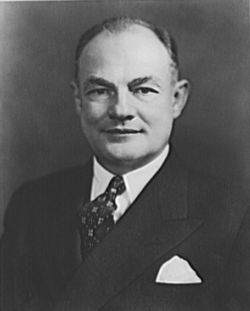
US entry into WW2 was in its second year in 1943 when Claude Wickard, head of the War Foods Administration and Secretary of Agriculture, had the hare brained idea of banning sliced bread.

Mr. Wickard was no stranger to hare brained ideas; it is he who lends his name to the landmark Supreme Court case Wickard v. Filburn.

Speaking of hare brained ideas.  The Agricultural Adjustment Act of 1938 limited the area that farmers could devote to wheat production, in an effort to stabilize the price of wheat. Ohio farmer Roscoe Filburn was producing more than his allotment, and the federal government ordered him to destroy the surplus and pay a fine, even though his “surplus” was being consumed on the farm by the Filburn family, and their chickens.

commerceclauseArticle 1, Section 8 of the Constitution includes the “Commerce Clause”,  permitting the Congress “To regulate Commerce with foreign Nations, and among the several States, and with the Indian Tribes”. That’s it.
The Federal District Court sided with the farmer, but the Federal government appealed to the Supreme Court, arguing that, by withholding his surplus from the interstate wheat market, Filburn was effecting prices and therefore fell under federal government jurisdiction under the commerce clause.

slicedbreadban-january18.1943The United States Supreme Court, apparently afraid of President Roosevelt and his aggressive and illegal “court packing” scheme, ruled against the farmer. Ever since, what you don’t do can be argued in a court of law to impact interstate conditions, putting what you didn’t do under the jurisdiction of the federal government.

Get it? Neither do I, but I digress.

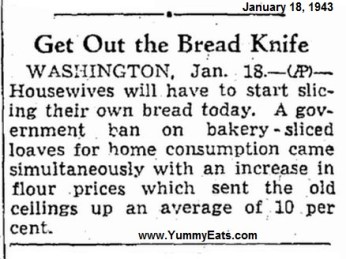
Back to Mr. Wickard, who enacted his ban against sliced bread and put it into effect on January 18, 1943. The push-back, as you might guess, was immediate and vehement. One woman took up her pen, and wrote to the New York Times: “I should like to let you know how important sliced bread is to the morale and saneness of a household. My husband and four children are all in a rush during and after breakfast. Without ready-sliced bread I must do the slicing for toast—two pieces for each one—that’s ten. For their lunches I must cut by hand at least twenty slices, for two sandwiches apiece. Afterward I make my own toast. Twenty-two slices of bread to be cut in a hurry!”

big-governmentThe stated reasons for the ban never did make sense. At various times, Wickard claimed that it was to conserve wax paper, wheat or steel, but one reason was goofier than the one before. According to the War Production Board, most bakeries had plenty of wax paper supplies on hand, even if they didn’t buy any.  Furthermore, the federal government had a billion bushels of wheat stockpiled at the time, about two years’ supply, and the amount of steel saved by not making bread slicers has got to be marginal, at best.

The ban was rescinded on March 8, 1943, and pre-sliced bread was once again available to the federal government and its subjects. There’s no telling who first used the expression “the greatest thing since sliced bread”, but a reasonable guess may be made as to why.

If you enjoyed this “Today in History”, please feel free to re-blog, “like” & share on social media, so that others may find and enjoy it as well. Please click the “follow” button on the right, to receive email updates on new articles.  Thank you for your interest, in the history we all share.