
February 5, 1637 The Day the Bubble Burst

Economic forces had combined with irrationality to bid up prices to the point of collapse. This was neither the first nor the last time

gillette-stadiumOn March 24, 2000, the New England Patriots broke ground on their new stadium home in Foxborough, Massachusetts. The internet company CMGI won naming rights, agreeing to pay $114 million over 15 years for the privilege. The 2002 season opened on September 9 in the Patriots’ new home, tickets bearing the name, CMGI Stadium.

Except by that time, the “Dot-Com” bubble had burst. CMGI had ceased to exist.  The stadium itself would open, bearing the name of a razor and shaving cream manufacturer.

Economic forces had combined with irrationality to bid up prices to the point of collapse, but this was neither the first nor the first time.  We saw it in the housing bubble of the 2000s, and the “Bull Market” of the Roaring 20s.viceroy-tulip

The oddest of these speculative bubbles may be the “Tulpenwoede” (tulip madness) gripping Holland in the 17th century.

The first tulip bulbs came from the Ottoman Empire to Vienna in 1554, introduced to Europe by Ogier de Busbecq, ambassador of the Holy Roman Emperor Ferdinand I to the Sultan of Turkey. The tulip was different from anything in Europe, the intense, saturated colors soon turning the flower into a status symbol.

By the 17th century Holland had embarked on a Golden Age. The East Indies trade Keukenhof Gardens Desktop Backgroundproduced single voyage profits of 400% and more, as merchants built grand estates surrounded by flower gardens. The hyacinth enjoyed early popularity, but the plant at the center of it all was the spectacular, magnificent, tulip.

For much of this period, tulip bulbs were primarily of interest to the wealthy. The craze began to catch on with the middle and poorer classes by the mid-1630s.  Soon, increased demand began to drive prices to irrational levels.

The market soared in late 1636, as prices bid up for bulbs planted to bloom the following spring. People mortgaged their homes and businesses, hoping to buy bulbs for resale at higher prices. At one point, “one single root of the rare species called the Viceroy”, sold for “two lasts of wheat, four lasts of rye, four fat oxen, eight fat swine, twelve fat sheep, two hogsheads of wine, four tuns (barrels) of beer, two tuns of butter, One thousands lbs. of cheese, one complete bed, a suit of clothes, and a silver drinking-cup”. In early 1637, single “Viceroy” bulbs bid between 3,000 and 4,200 guilders, at a time when skilled craftsman earned about 300 guilders a year. At one point, 5 hectares (12 acres) of land were offered for a single Semper Augustus bulb.

“Couleren” bulbs were most commonly traded, single hued flowers of yellow, red or white, followed by the multi-colored “Rosen” and “Violettin”. Rarest and most sought after weretulip_price_index the vivid streaks of yellow or white on the red, brown or purple backgrounds of the “Bizarden” (Bizarres).  Ironically, these were the most sickly specimens, victims of a “Tulip breaking virus” which “broke” petals into two or more hues.
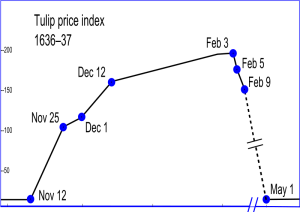
Confidence evaporated in 1637 and the market collapsed. The last recorded market data were reported on February 5, as 98 sales were recorded at wildly varying prices. Those who had taken possession of bulbs found their worth to be a fraction of the prices paid. Others were locked into futures contracts, obliged to pay ruinous sums for comparatively worthless flower bulbs.

Afterward

Today, the Federal National Mortgage Association (FNMA), and Federal Home Loan Mortgage Corporation (FHLMC), are Congressionally authorized hybrids or “GSEs” (government-sponsored enterprises), charged with “providing liquidity and stability to the U.S. housing and mortgage markets”. Better known as “Fannie Mae” and “Freddie Mac”, both entities are privately owned by shareholders and backed by taxpayers.

The US Department of Housing and Urban Development (HUD) was charged with regulating Fannie and Freddie in 1992. Before that, these organizations were required to buy only “prime” mortgages, notes which institutional investors would buy on the open market. Such standards made it too difficult for lower income, higher risk buyers to become homeowners, or so it was believed. Regulators imposed “affordable housing” liar_loansguidelines that year, imposing a 30% quota and raising it to 50% by the end of the Clinton era. By 2007 under President Bush, 55% of all mortgages purchased by the mortgage giants were “sub-prime”.

Banks and brokers were happy to sing along, issuing “NINJA” loans (No Income No Job no Assets) to anyone who asked. “Low-doc” and “no-doc” mortgages called “liar loans” sprouted up everywhere, but gone were the days when your home town bank held your mortgage.  No mortgage originator would ever be left holding the bag, should these loans turn bad.  They sold them to Fannie and Freddie.

Fannie, Freddie and others “bundled” high risk mortgages into increasingly exotic financial instruments called “mortgage backed securities”, selling them off to investors and backing transactions with “credit default swaps” (CDS), a two-party agreement impossible to distinguish between an insurance contract and a bet.

The danger signs were there for those who would see, but Barney Frank said it best inhome-made-of-dollar-on-grass 2003: “I want to roll the dice a little bit more in this situation toward subsidized housing.”

Property values doubled and doubled again. You were always going to make money in real estate. Family members sold to one another over and over at ever increasing prices, with none ever moving out of the house.  Aggregate CDS values reached $62 Trillion in 2008, equivalent to a stack of dollar bills, reaching from Earth to the moon. 18 times.

Then, the bubble burst.  Imagine waking one morning to find your entire pension or mutual fund account, was invested in that stuff.

housing-bubbleThat was the year when gas first hit $4/gallon.  Those living closest to the financial cliff began to fall off, and foreclosures went through the roof.  Highest risk mortgage holders were the first to default, people with $20,000 incomes and multiple investment properties. We all remember 2009.  I myself lost a job of 15 years when my employer went under, briefly making my family part of the “zero percent”.  Some will tell you that we haven’t emerged from the “Great Recession”, to this day.

The old subprime “MyCommunityMortgage” program is dead and buried, but not the geniuses who gave it life. Sub-prime has become a dirty word, so, until recently, regulators pushed “alt” mortgage guidelines. Once, your “income” had to be your own, whether or not you could document it. Now, you could claim other people’s income: your aunt, parents, even a roommate. They won’t be on the note, they have no responsibility to repay.  They don’t even have to live there. As long as you can augment your income enough to qualify.  What could go wrong with that?

Speaking of the Patriots, I hear there’s a game today.  I’ll have to check it out. At this point, I’d rather think about football.

Go Patriots.

February 4, 1936 Undark

Newspapers waxed rhapsodic about cities of the future, streets aglow in the light of radium lamps as smiling restaurant patrons enjoyed luminescent cocktails

In 1922, a bank teller named Grace Fryer began to feel soreness in her jaw. She was 23 at the time and too young to have her teeth falling out, yet that’s what was happening. Her doctor was able to identify the problem, but he couldn’t explain it. Grace Fryer’s jawbones were so honeycombed with holes, they looked like moth eaten fabric.

On December 21, 1898, Marie and Pierre Curie discovered the 88th element of the Periodic Table. This new and radioactive element was Radium, one of the ‘alkaline earth metals’. Curie’s work would make her the first female recipient of a Nobel Prize in 1906, and the only person of either sex to ever win two Nobels, in 1911.

There have been strange fads over the years, from goldfish swallowing to pole sitting, but none stranger than the radium craze of 1904. Newspapers waxed rhapsodic about cities of the future, streets aglow in the light of radium lamps as smiling restaurant patrons enjoyed luminescent cocktails. Serious doctors had early successes killing cancer cells, while quacks and charlatans sold radium creams, drinks and suppositories to cure everything from acne to warts.undark_ad_large

An unseen benefit of the craze, at least for a time, was that demand for radium was vastly greater than actual production. Prices skyrocketed to $84,500 per gram by 1915, equivalent to $1.9 million today. Authorities warned consumers to be on the lookout for fake radium, while the business in fake radium products soared.

When WWI began, it didn’t take long to recognize the advantages of glow in the dark instruments. A number of companies stepped up to fill the need, perhaps none larger than US Radium and their glow-in-the-dark paint, “Undark”.

Hundreds of women worked in their factories, hand painting the stuff on watches, gun sights and other instruments. Radioactivity levels were so small as to be harmless to users of these objects, but not so to the people who made them.

gracefryer
Grace Fryer

The harmful effects of radiation were relatively well understood by 1917, though the information was kept from factory workers. Camel hair brushes tended to splay out with use, supervisors encouraged the women to sharpen their brushes using their lips and tongues. The stuff was odorless and tasteless, some couldn’t resist the fun of painting nails and even teeth with the luminous paint. The only side effects of all that radium, they were told, would be rosy cheeks.

The active ingredient in Undark was a million times more active than Uranium, and company owners and scientists knew it. Company labs were equipped with lead screens, masks and tongs, while literally everything on the factory floor, glowed.

In 1925, doctors began to suspect that Grace Fryer’s condition mayradium-girls be related to her previous employment in US Radium’s Orange, New Jersey factory. By that time she was seriously ill, yet Columbia University “Specialist” Frederick Flynn and a “Colleague” pronounced her to be in “fine health”. It was only later that the two were revealed to be company executives.

These US Radium guys must have been genuine, mustache twirling, villains. In the early 20s, company officials hired physiologist and Harvard Professor Cecil Drinker to report on working conditions. Drinker’s report detailed catastrophically dangerous working conditions, with virtually every factory employee suffering blood or bone conditions.

The report filed with the New Jersey Department of Labor omitted all of it, describing conditions in glowing terms (pun not intended), claiming that “every girl is in perfect condition”.

Reports of illness among other women came flooding in. In a tactic that may sound familiar today, US Radium took to assassinating the character of these women, claiming that their symptoms resulted from syphilis.

phossyjawAttorney Raymond Berry filed suit on Fryer’s behalf in 1927, the lawsuit joined by four other dial painters seeking $250,000 apiece in damages. Soon, the newspapers were calling them “radium girls”. The health of all five plaintiffs was deteriorating rapidly, while one stratagem after another was used to delay proceedings. By their first courtroom appearance in January 1928, none could raise their arm to take the oath. Grace Fryer was altogether toothless by this time, unable to walk, requiring a back brace even to sit up.
Another dial painter, Amelia Maggia, had had to have her jaw removed in the last months of her life. Her cause of death was ruled as syphilis, but her dentist wasn’t buying it. Dr. Joseph Knef placed the jaw on a piece of dental film, the resulting image showing “absurd” levels of radiation.

The radium girls were far too sick to attend the next hearing in April, when the judge ordered a continuation to September, an accommodation to several company witnesses “summering” in Europe.

Walter Lippmann of the New York World called it a “damnable travesty of justice”. “There is no possible excuse for such a delay”, Lippmann wrote. “The women are dying. If ever a case called for prompt adjudication, it is the case of five crippled women who are fighting for a few miserable dollars to ease their last days on earth. This is a heartless proceeding. It is unmanly, unjust and cruel. This is a case which calls not for fine-spun litigation but for simple, quick, direct justice.”waterbury-mother

Delay was a deliberate and sleazy tactic, and it worked. Plaintiffs accepted a settlement of $10,000 apiece, plus legal fees and a $600 annual annuity. The deal was mediated by Judge William Clarke, himself a US Radium stockholder. None of them lived long enough to cash more than one or two annuity checks.

Marie Curie herself was dead by 1934, poisoned by radiation. With a half-life of 1,600 years, her lab notebooks remain too hot to handle, to this day.

Radium was synthesized for the first time two years later, on February 4, 1936.  Presumably, factory workers using the stuff were no longer encouraged to sharpen their brushes, by licking them.

February 3, 1943  Greater Love Hath No Man

With arms linked and leaning against the slanting deck, their voices offered prayers and sang hymns for the dead and for those about to die

usat_dorchesterThe Troop Transport USAT Dorchester sailed out of New York Harbor on January 23, 1943, carrying 902 service members, merchant seamen and civilian workers.  They were headed for the Army Command Base in southern Greenland, part of a six-ship convoy designated SG-19, together with two merchant ships and escorted by the Coast Guard Cutters Comanche, Escanaba and Tampa.

Built in 1926 as a coastal liner, Dorchester was anything but graceful, bouncing and shuddering its way through the rough seas of the North Atlantic.    Several ships had already been sunk by German U-Boats in these waters.  One of the Cutters detected a sub late on February 2, flashing the light signal “we’re being followed”.  Dorchester Captain Hans Danielson ordered his ship on high alert that night.  Men were ordered to sleep in their clothes with their life jackets on.  Many disregarded the order.  It was too hot down there in the holds, and those life jackets were anything but comfortable.

4-chaplains
The Four Chaplains

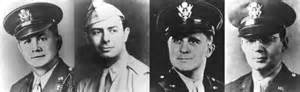
Some of those off-duty tried to sleep that night, while others played cards or threw dice, well into the night.  Nerves were understandably on edge, especially among new recruits, as four Army chaplains passed among them with words of encouragement.  They were the Jewish Rabbi Alexander D. Goode, the Catholic priest John P. Washington, the Dutch Reformed Church Minister Clark V. Poling and the Methodist Minister George L. Fox.

At 12:55am on February 3rd, the German submarine U-223 fired a spread of three torpedoes.  One struck Dorchester amidships, deep below the water line.  A hundred orgerman_submarine_wwii_by_racoonart more were killed in the blast, or in the clouds of steam and ammonia vapor pouring from ruptured boilers.  Suddenly pitched into darkness, untold numbers were trapped below decks.  With boiler power lost, there was no longer enough steam to blow the full 6 whistle signal to abandon ship, while loss of power prevented a radio distress signal.  For whatever reason, there never were any signal flares.

Those who could escape scrambled onto the deck, injured, disoriented, many still in their underwear as they emerged into the sub-arctic cold.

The four chaplains must have been a welcome sight that night, guiding the disoriented and the wounded, offering prayers and words of courage.  They opened a storage locker, and handed out life preservers until there were no more.  “Padre,” said one young soldier, “I’ve lost my life jacket and I can’t swim!”  Witnesses differ as to which of the four it was who gave this man his life jacket, but they all followed suit.  One survivor, John Ladd, said “It was the finest thing I have seen or hope to see this side of heaven.” Rabbi Goode gave his gloves to Petty Officer John Mahoney, saying “Never mind.  I have two pairs”.  It was only later that Mahoney realized, Rabbi Goode intended to stay with the ship.

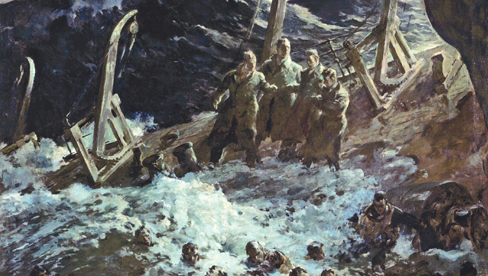
Dorchester was listing hard to starboard and taking on water fast, with only 20 minutes to live.  Port side lifeboats were inoperable due to the ship’s angle.  Men jumped across the void into those on the starboard side, overcrowding them to the point of capsize.  Only two of fourteen lifeboats launched successfully.

dorchesterPrivate William Bednar found himself floating in 34° water, surrounded by dead bodies and debris. “I could hear men crying, pleading, praying,” he recalled. “I could also hear the chaplains preaching courage. Their voices were the only thing that kept me going.”

As the ship upended and went down by the bow, survivors floating nearby could see the four chaplains.  With arms linked and leaning against the slanting deck, their voices offered prayers and sang hymns for the dead and for those about to die.

Rushing back to the scene, coast guard cutters found themselves in a sea of bobbing red lights, the water-activated emergency strobe lights of individual life jackets.  Most marked the locations of corpses.  Of the 902 on board, the Coast Guard plucked 230 from the water, alive.

four-chaplainsThe United States Congress attempted to confer the Medal of Honor on the four chaplains for their selfless act of courage, but strict requirements for “heroism under fire” prevented them from doing so.  Congress authorized a one time, posthumous “Chaplain’s Medal for Heroism”, awarded to the next of kin by Secretary of the Army Wilber M. Brucker at Fort Myer, Virginia on January 18, 1961.


John 15:13 says “Greater love hath no man than this, that a man lay down his life for his friends”.  Rabbi Goode did not call out for a Jew when he gave away his only hope for survival, Father Washington did not ask for a Catholic. Neither minister Fox nor Poling asked for a Protestant, they gave their life jackets to the nearest man.

Carl Sandburg once said that “Valor is a gift.  Those having it never know for sure whether they have it until the test comes.”  If I were ever so tested, I hope that I would prove myself half the man, as those four chaplains.

February 2, 1887 Groundhog Day

The male couldn’t care less about the weather; he comes out of his burrow in February in search of a mate. If uninterrupted, he will fulfill his groundhog mission of love and return to earth

Here on sunny Cape Cod, there is a joke about the four seasons.  We have “Almost Winter”, “Winter”, “Still Winter” and “Bridge Construction”.  And I thought I moved here for the balmy 70° weather, where a gentle breeze sways the coconut palms.jelly-donuts

Midway between Winter Solstice and Spring Equinox and well before the first crocus of spring has blinked and stretched and peered out across the frozen, windswept tundra, there is a moment of insanity which helps those of us living in northern climes get through to that brief, blessed moment of warmth when the mosquitoes once again have their way with us.

The ancient Romans observed their mid-season festival on February 5, the pagan Irish on February 1. For Christians, it was February 2, Candlemas day, a Christian holiday celebrating the ritual purification of Mary. For reasons which are not entirely clear, early Christians believed that there would be six more weeks of winter if the sun came out on Candlemas Day.

Clergy would bless and distribute candles needed for winter, their length representing how long and cold the winter would be. Germans expanded on the idea by selecting an animal, a hedgehog, as a means of predicting weather. Once a suitable number of Germans had come to America, they switched over to a more local rodent: Marmota Monax. The common Groundhog.

Groundhogs hibernate for the winter, an ability which some people I know would like to possess. During that time, their heart rate drops from 80 beats per minute to 5, and they live off their stored body fat.  Another ability some of us would appreciate, very much.Groundhog Fans Gather In Punxsutawney For Winter Prediction

The male couldn’t care less about the weather; he comes out of his burrow in February in search of a mate. If uninterrupted, he will fulfill his groundhog mission of love and return to earth, not coming out for good until sometime in March.

But then there is the amorous woodchuck’s worst nightmare in a top hat, a fiendish apparition known as the groundhog hunter.

In 1887, there was a group of groundhog hunters in Punxsutawney, Pennsylvania, imaginatively calling themselves the Punxsutawney Groundhog Club. One of them, a newspaper editor, declared on February 2, 1887, that their groundhog “Phil” was the only True weather forecasting rodent.

There are those who would dispute the Gobbler’s Knobdammit-jim crowd and their claims to Punxsutawney Phil’s weather forecasting prowess. Alabama has “Birmingham Bill”, and Canada has Shubenacadie Sam. New York can’t seem to decide between Staten Island Chuck and New York City’s very own official groundhog, “Pothole Pete”.

It appears that there is no word for groundhog in Arabic.  Accounts of this day in the Arab press translate the word as جرذ الأرض., or, “Ground Rat”.  Pretty exciting to learn that.  Thanks al Jazeera.

If anyone was to bend down and ask Mr. Ground Rat his considered opinion on the matter, he would probably cast a pox on all our houses. It’s been a long winter. Mr. Ground Rat’s all dressed up for a date.  He has other things on his mind.

February 1, 1901 The Last Doughboy

In 2003, author Richard Rubin set out to interview the last surviving veterans of WW1. The people he sought were over 101, one was 113

last-of-the-doughboysIn 2003, author Richard Rubin set out to interview the last surviving veterans of World War One. The people he sought were over 101, one was 113.

It could not have been easy, beginning with the phone call to next of kin. There is no delicate way to ask the question, “Is he still with us?” Invariably, the answer was “no”.

Sometimes, the answer was “yes”, and Rubin would ask for an interview. The memories these people sought to bring back were 80 years old and more, and some spoke only sparingly.  Others were fountains of information, speaking as clearly as if their memories were from yesterday.

Rubin writes “Quite a few of them told me that they were telling me things that they hadn’t talked about in 50, 60, 70 years. I asked a few of them why not, and the surprising response often was that nobody had asked.”

anthony-pierro-at-107
Anthony Pierro at 107

Anthony Pierro of Swampscott, Massachusetts, served in Battery E of the 320th Field Artillery, and fought in several major battles of 1918, including Oise-Aisne, St. Mihiel, and Meuse-Argonne.  Pierro recalled his time in Bordeaux, as the best time of the war. “The girls used to say, ‘upstairs, two dollars.'” His nephew Rick interrupted the interview. “But you didn’t go upstairs.”  Uncle Anthony’s response was classic.  “I didn’t have the two dollars”.

They’re not all men, either. 107-year-old Hildegarde Schan of Plymouth, Massachusetts talks about taking care of the wounded in the post-war years.

hildegarde-schan
Hildegarde Schan

Howard Ramsey started the new burial ground in France that we now know as the Meuse-Argonne American Cemetery. “So I remember one night”, he said, “It was cold, and we had no blankets, or nothing like that. We had to sleep, we slept in the cemetery, because we could sleep between the two graves, and keep the wind off of us, see?”

fialacombo
Arthur Fiala

Kewaunee, Wisconsin native Arthur Fiala traveled across France in a boxcar marked “40-8″, (40 men or eight horses).

There was J. Laurence Moffitt of Orleans, Massachusetts. Today, we see the “Yankee Division” on highway signs. At 106, this man was the last surviving member of his generation, with a memory so clear that he could recall every number from every fighting unit of the 26th Division.

briantcombo
George Briant

George Briant was caught in an open field with his battery, with German planes dropping bombs on them.  He thinks he was hit by every one of them.  After several months in the hospital, he begged to go back to the front.  On the last night of the war, November 10, 1918, Briant came upon the bodies of several men who had just been shelled.   “Such fine, handsome, healthy young men”, he said, “to be killed on the last night of the war.  I cried for their parents. I mean it’s a terrible, terrible thing to lose anyone you love in a war, but imagine knowing precisely when that war ends, and then knowing that your loved one died just hours before that moment.”

In all, Rubin interviewed dozens of these men, and a handful of women. Their stories can be found on their own You Tube channel, https://www.youtube.com/user/LastOfTheDoughboys. I highly recommend it.  Their words are far more powerful than anything I could write about them.

buckles2-obit-jumboFrank Woodruff Buckles, born Wood Buckles, is one of them. Born on this day in 1901, Buckles joined the Ambulance Corps of the American Expeditionary Force (AEF) at the age of 16. He never saw combat against the Germans, but he would escort 650 of them back home as prisoners.

Buckles was a civilian in 1940, working for the White Star Lines and the WR Grace shipping companies. His work took him to Manila, in the Philippines, where he remained after the outbreak of WWII. Buckles was helping to resupply U.S. troops when he was captured by Japanese forces in January 1942, spending the next three years and two months as a civilian prisoner in the Santo Tomas and Los Baños prison camps.

Corporal Frank Buckles passed away on February 27, 2011 at the age of 110, and was buried in Arlington National Cemetery, the President of the United States in attendance. The Last of the Doughboys, the last American veteran of WWI, was gone. The last living memory of the war to end all wars.

buckles
Frank Woodruff Buckles

January 31, 1945  The Execution of Private Slovik

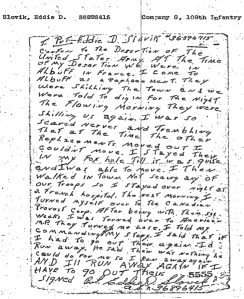
“I told my commanding officer my story. I said that if I had to go out there again I’d run away. He said there was nothing he could do for me so I ran away again AND I’LL RUN AWAY AGAIN IF I HAVE TO GO OUT THERE. — Signed Pvt. Eddie D. Slovik A.S.N. 36896415”

When he was little, his neighbors must have considered him a bad kid.  His first arrest came at the age of 12, when he and some friends were caught stealing brass from a foundry.  There were other episodes between 1932 and ’37: petty theft, breaking & entering, and disturbing the peace.  In 1939 he was sent to prison, for stealing a car.

slovik-weddingEdward Donald “Eddie” Slovik was paroled in 1942, his criminal record making him 4F.  “Registrant not acceptable for military service”.  He took a job at the Montella Plumbing and Heating company in Dearborn, Michigan, where he met bookkeeper Antoinette Wisniewski, the woman who would later become his wife.
There they might have ridden out WWII, but the war was consuming manpower at a rate unprecedented in history.  Shortly after the couple’s first anniversary, Slovik was re-classified 1A, fit for service, and drafted into the Army.  Arriving in France on August 20, 1944, he was part of a 12-man replacement detachment, assigned to Company G of the 109th Infantry Regiment, US 28th Infantry Division.

Slovik and a buddy from basic training, Private John Tankey, became separated from their detachment during an artillery attack, and spent the next six weeks with Canadian MPs.  It was around this time that Private Slovik decided he “wasn’t cut out for combat”.

The rapid movement of the army during this period caused many replacements difficulty in finding their units.  Edward Slovik and John Tankey finally caught up with the 109th on October 7.  The following day, Slovik asked his company commander Captain Ralph Grotte for reassignment to a rear unit, saying he was “too scared” to be part of a rifle company.  Grotte refused, confirming that, were he to run away, such an act would constitute desertion.

That, he did.  Eddie Slovik deserted his unit on October 9, despite Private Tankey’s protestations that he should stay.  “My mind is made up”, he said.  Slovik walked several miles until he found an enlisted cook, to whom he presented the following note.

“I, Pvt. Eddie D. Slovik, 36896415, confess to the desertion of the United States Army. At the time slovik-noteof my desertion we were in Albuff [Elbeuf] in France. I came to Albuff as a replacement. They were shelling the town and we were told to dig in for the night. The following morning they were shelling us again. I was so scared, nerves and trembling, that at the time the other replacements moved out, I couldn’t move. I stayed there in my fox hole till it was quiet and I was able to move. I then walked into town. Not seeing any of our troops, so I stayed over night at a French hospital. The next morning I turned myself over to the Canadian Provost Corp. After being with them six weeks I was turned over to American M.P. They turned me loose. I told my commanding officer my story. I said that if I had to go out there again I’d run away. He said there was nothing he could do for me so I ran away again AND I’LL RUN AWAY AGAIN IF I HAVE TO GO OUT THERE. — Signed Pvt. Eddie D. Slovik A.S.N. 36896415”.
Slovik was repeatedly ordered to tear up the note and rejoin his unit, and there would be no consequences.  Each time, he refused.  The stockade didn’t scare him.  He’d been in prison before, and it was better than the front lines.  Beside that, he was already an ex-con.  A dishonorable discharge was hardly going to change anything, in a life he expected to be filled with manual labor.  Finally, instructed to write a second note on the back of the first acknowledging the legal consequences of his actions, Eddie Slovik was taken into custody.

1.7 million courts-martial were held during WWII, 1/3rd of all the criminal cases tried in the United States during the same period.  The death penalty was rarely imposed.  When it was, it was almost always in cases of rape or murder.

2,864 US Army personnel were tried for desertion between January 1942 and June 1948.  Courts-martial handed down death sentences to 49 of them, including Eddie Slovik.  Division commander Major General Norman Cota approved the sentence. “Given the situation as I knew it in November, 1944,” he said, “I thought it was my duty to this country to approve that sentence. If I hadn’t approved it–if I had let Slovik accomplish his purpose–I don’t know how I could have gone up to the line and looked a good soldier in the face.”

On December 9, Slovik wrote to Supreme Allied Commander Dwight D. Eisenhower, pleading for clemency.  Desertion was a systemic problem at this time.  Particularly after the surprise German offensive coming out of the frozen Ardennes Forest on December 16, an action that went into history as the Battle of the Bulge.  Eisenhower approved the execution order on December 23, believing it to be the only way to discourage further desertions.

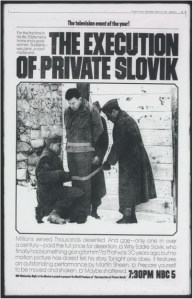
slovik-movie-poster
Slovik movie poster

His uniform stripped of all insignia with an army blanket draped over his shoulders, Slovik was brought to the place of execution near the Vosges Mountains of France. “They’re not shooting me for deserting the United States Army”, he said, “thousands of guys have done that. They just need to make an example out of somebody and I’m it because I’m an ex-con. I used to steal things when I was a kid, and that’s what they are shooting me for. They’re shooting me for the bread and chewing gum I stole when I was 12 years old.”

Army Chaplain Father Carl Patrick Cummings said, “Eddie, when you get up there, say a little prayer for me.” Slovik said, “Okay, Father. I’ll pray that you don’t follow me too soon”. Those were his last words.  A soldier placed the black hood over his head.  The execution was carried out by firing squad.  It was 10:04am local time, January 31, 1945.

Edward Donald Slovik was buried in Plot E of the Oise-Aisne American Cemetery, his marker bearing a number instead of his name.  Antoinette Slovik received a telegram informing her that her husband had died in the European Theater of war, and a letter instructing her to return a $55 allotment check.  She would not learn about the execution for nine years.

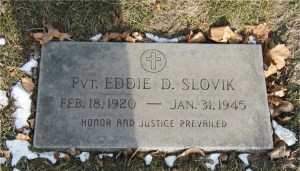
eddie-slovik-graveIn 1987, President Ronald Reagan ordered the repatriation of Slovik’s remains.   He was re-interred at Detroit’s Woodmere Cemetery next to Antoinette, who had gone to her final rest eight years earlier.
In all theaters of WWII, the United States military executed 102 of its own, almost always for the unprovoked rape and/or murder of civilians. From the Civil War to this day, Eddie Slovik’s death sentence remains the only one ever carried out for the crime of desertion. At least one member of the tribunal which condemned him to death, would come to see it as a miscarriage of justice.

Nick Gozik of Pittsburg passed away in 2015, at the age of 95.  He was there in 1945, a fellow soldier called to witness the execution.  “Justice or legal murder”, he said, “I don’t know, but I want you to know I think he was the bravest man in that courtyard that day…All I could see was a young soldier, blond-haired, walking as straight as a soldier ever walked.  I thought he was the bravest soldier I ever saw.”

January 20, 1829 An Ass for a Lion

“The history of the present King of Great Britain is a history of repeated injuries and usurpations, all having in direct object the establishment of an absolute Tyranny over these States. To prove this, let Facts be submitted to a candid world”

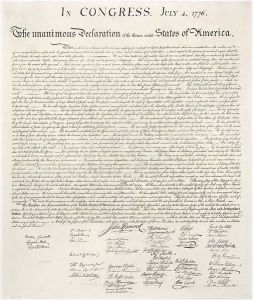
The Declaration of Independence, the birth certificate of the nation, begins with this preamble: “When in the Course of human events, it becomes necessary for one people to dissolve the political bands which have connected them with another…”.

The next paragraph leads with the phrase most commonly cited: “We hold these truths todeclaration-of-independence be self-evident, that all men are created equal, that they are endowed by their Creator with certain unalienable Rights, that among these are Life, Liberty and the pursuit of Happiness”.

The paragraph ends with a personal indictment of one man, followed by a 27 item bill of particulars against him. “The history of the present King of Great Britain is a history of repeated injuries and usurpations, all having in direct object the establishment of an absolute Tyranny over these States. To prove this, let Facts be submitted to a candid world”.

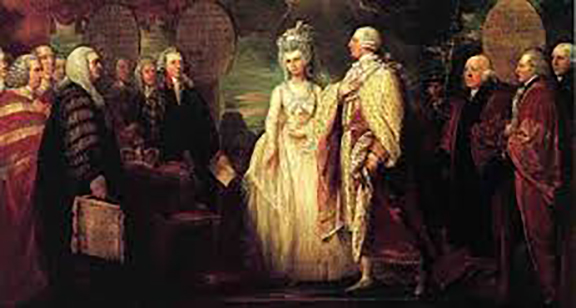
The overall tenor of the document is a personal indictment of one man, George III, King of England. The word “He” appears in the document 19 times, “tyrant” is used twice and “ruler” only once, as in: “A Prince whose character is thus marked by every act which may define a Tyrant, is unfit to be the ruler of a free people”.

Thomas Paine wrote of George III in “Common Sense”, the pamphlet which inspired a people to rise up in the summer of 1776: “One of the strongest natural proofs of the folly of hereditary right in kings, is, that nature disapproves it, otherwise she would not so frequently turn it into ridicule by giving mankind an ass for a lion”.

To be sure, the King had little or nothing to do with the policies which brought the two countries to war. The Stamp Act of 1765, the Townshend duties on tea, paper and other products in 1767; these came from Parliament, as did the “Coercive Acts” of 1774, referred to by the Patriots of Massachusetts and others as “The Intolerable Acts”.

These policies were a result of the financial burdens of garrisoning and administering the huge territories of the American colonies, the never ending wars with France and Spain, and the loans given to the East India Company, which was then responsible for administering India.

The third King of the House of Hanover was himself a creature of Parliament, his lineage having been invited to rule over Great Britain in 1714, after the fall of the House of Stuart. What Parliament gives, Parliament may take away. Yet today, George III is remembered for two things; losing the American colonies, and for losing his mind.

He is the longest reigning of any English King, ruling from 1760 until his death on January 29, 1820. Medical historians have long said that George III suffered from a genetic blood disorder called Porphyria, a term from the Greek meaning “purple pigment”. This refers to a blue discoloration in the urine of those suffering from the condition, along with symptoms primarily involving the central nervous system, and accompanied by severe abdominal pain, vomiting and mental disturbances.

The illness seems to have afflicted George III alone however, casting doubt on an hereditary condition. George III’s medical records cast further doubt on the porphyria diagnosis, showing that he was prescribed medicine based on gentian, a plant with deep blue flowers which may turn the urine blue. He seems to have been afflicted with some kind of mental illness, suffering bouts which occurred with increasing severity and longevity. At times the King of England would talk until he foamed at the mouth or go into convulsions where pages had to sit on him to keep him from injuring himself.

An ongoing research project at St George’s, University of London, has looked at thousands of King George III’s handwritten letters, and concluded that the King suffered from mental illness. His writing was erratic at times coinciding with his “spells”, with run-on sentences of 400 words or more and as many as 8 verbs with no punctuation. These are features of the writing and speech of patients as they experience the manic phase of bipolar disorder. This manic phase stands at one end of a spectrum of mood disorders, with an overwhelming sadness or depression at the other. Research is ongoing, but these types of mood swings are consistent with contemporary witnesses to George’s behavior, as well as the written record.

The last ten years of George’s reign were spent in complete seclusion, mentally unfit to rule.  His eldest son, the Prince of Wales and future King George IV, acted as Prince Regent from 1811 on.

There is an historic lesson in this story. If the country ruled by a King (or Queen) wins the lottery and gets a good and fair monarch, then that country can experience a period of peace and prosperity. If that country draws the cosmic short straw and gets a bad one, the results can be catastrophic. In the end, it’s the most powerful argument I can think of for a governmental system of diffuse power with checks and balances.

January 28, 1942 The Mighty Eighth

“Consider yourself dead. Some of you won’t come back from this. Some of you will, but you’ll be the lucky ones.” – Briefing officer, 97th BG, 15th AAF, Foggia Italy, to B-17 Navigator Lt. Mike Scorcio and crew before a mission to Germany

Under the terms of the tripartite pact with Fascist Italy and Imperial Japan, Nazi Germany mighty-eighth-crewmanwas obliged to render aid in the event that either ally was attacked. On December 8, 1941, the day after the Japanese attack on Pearl Harbor, Ambassador Hiroshi Ōshima came to  Joachim von Ribbentrop, looking for  a commitment of support from the German Foreign Minister.

Ribbentrop balked. Germany was under no obligation to intervene with their ally having been the aggressor.  Adolf Hitler thought otherwise. He couldn’t stand Roosevelt, and thought it was just a matter of time  before the two countries were at war. He might as well beat the American President to the punch.

It was 9:30am Washington time on December 11, when German Chargé d’Affaires Hans Thomsen handed the note to American Secretary of State Cordell Hull. For the second time in the diplomatic history of the United States and Germany, the two nations were in a state of war.

8thaf-shoulder-patch48 days later, at Hunter Field in Savannah, the Eighth Bomber Command was activated as part of the United States Army Air Forces. It was January 28, 1942.

The 8th was intended to support operation “Super Gymnast”, the invasion of what was then French North Africa.  Super Gymnast was canceled in April.  By May, the 8th Bomber Command had moved its headquarters to a former girls’ school in High Wycombe, England, from where it conducted the strategic bombing campaign against Nazi Germany.

thndbrdRe-designated the Eighth Air Force on February 22, 1944, at its peak the “Mighty Eighth” could dispatch over 2,000 four engine bombers and more than 1,000 fighters on a single mission. 350,000 people served in the 8th AF during the war in Europe, with 200,000 at its peak in 1944.
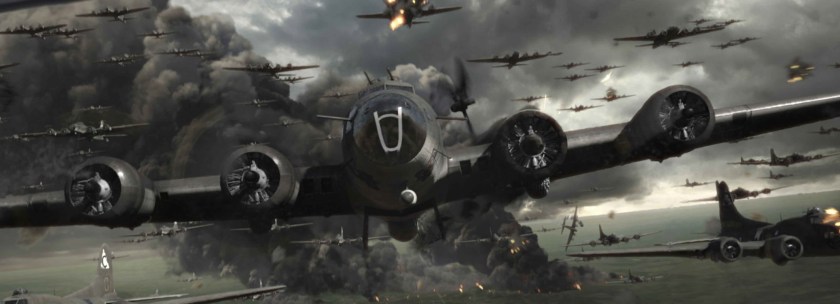


By 1945, the Wehrmacht had a new joke to tell itself:  “When we see a silver plane, it’s American. A black plane, it’s British. When we see no plane, it’s German”. American aviation paid a heavy price for it.

Half of the US Army Air Force casualties in World War II were suffered by the 8th, over 47,000 casualties, with more than 26,000 killed. By war’s end, 8th Air Force personnel were awarded 17 Medals of Honor, 220 Distinguished Service Crosses, and 442,000 Air Medals. There were 261 fighter aces in the 8th, 31 of them with 15 or more kills apiece. Another 305 gunners were also recognized as aces.the-mighty-eighth-banner

After victory in Europe, 8th AF Headquarters was reassigned to Sakugawa (Kadena Airfield), Okinawa, under the command of Lieutenant General James H. Doolittle.  Tasked with organizing and training new bomber groups for the planned invasion of Japan, the 8th received its first B-29 Superfortress on August 8.  Seven days later, the war in the pacific had come to an end..

b-52h_static_display_arms_06

With the onset of the jet age, the 8th Air Force moved to Westover Air Force Base in Massachusetts on June 13, 1955, the second of three Numbered Air Forces of the newly constituted Strategic Air Command (SAC).

Since then, the Mighty 8th has been called on to perform combat missions from Southeast Asia to the Middle East to the Federal Republic of Yugoslavia, flying out of its current headquarters at Barksdale Air Force Base, Louisiana.

mightyeightmuseum

If you’re ever in Savannah, do yourself a favor and pay a visit to the National Museum of the Mighty Eighth Air Force (http://www.mightyeighth.org/). Not only will you experience an incredible story well told, but you will meet some 90+ year old veterans who walk as straight and tall today as they did, 75 years ago. Happy Birthday, Mighty Eighth.


January 27, 1945  The Great Raid

Today, Cabanatuan calls itself the “Tricycle Capital of the Philippines”, with about 30,000 motorized “auto rickshaws”. 72 years ago, it was home to one of the worst POW camps of WWII

Today, Cabanatuan calls itself the “Tricycle Capital of the Philippines”, with about 30,000 motorized “auto rickshaws”.  72 years ago, it was home to one of the worst POW camps of WWII.

bataan1942 was a bad year for the allied war in the Pacific.  The Battle of Bataan alone resulted in 72,000 prisoners being taken by the Japanese, marched off to POW camps designed for 10,000 to 25,000.
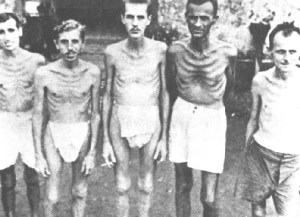
20,000 of them died from sickness or hunger, or were murdered by Japanese guards on the 60 mile “death march” from Bataan, into captivity at Cabanatuan prison and others.

Cabanatuan held 8,000 prisoners at its peak, though the number dropped considerably as the able-bodied were shipped out to work in Japanese slave labor camps.

Two rice rations per day, fewer than 800 calories, were supplemented by the occasional animal or insect caught and killed inside camp walls, or by the rare food items smuggled in by civilian visitors.  2,400 died in the first eight months at Cabanatuan, animated skeletons brought to “hospital wards”, which were nothing more than 2’x6′ patches of floor where prisoners waited to die.  A Master Sergeant Gaston saw one of these wards in July 1942, saying: “The men in the ward were practically nothing but skin and bones and they had open ulcers on their hips, on their knees and on their shoulders…maggots were eating on the open wounds. There were blow flies…by the millions…men were unable to get off the floor to go to the latrine and their bowels moved as they lay there”.

pows-cabanatuan
Cabanatuan Prisoners

The war was going badly for the Japanese by October 1944, as Imperial Japanese High Command ordered able bodied POWs removed to Japan.  1,600 were taken from Cabanatuan, leaving 500 weak and disabled prisoners.  The guards abandoned camp shortly after, though Japanese soldiers continued to pass through.  POWs were able to steal food from abandoned Japanese quarters; some even captured two water buffalo called “Carabao”, which were killed and eaten.  Many feared a trick and never dared to leave the camp.  Most were too sick and weak to leave in any case, though the extra rations would help them through what was to come.

On December 14, units of the Japanese Fourteenth Area Army in Palawan doused 150 prisoners with gasoline and burned them alive, machine gunning any who tried to escape the flames.   The atrocity sparked a series of raids at Santo Tomas Internment Camp, Bilibid Prison, Los Baños and others.  The first such behind-enemy-lines rescue, was Cabanatuan.

alamoscoutsraidoncabanatuan
Alamo Scouts, After Raid

On the evening of January 27, 1945, 14 individuals separated into two teams, beginning the 30 mile march behind enemy lines to liberate Cabanatuan. They were an advance team, formed from the 6th Ranger Battalion and a special reconnaissance group called the Alamo Scouts. The main force of 121 Rangers moved out the following day, meeting up with 200 Filipino guerrillas, who served as guides and helped in the rescue.

Other guerrillas assisted along the way, muzzling dogs and corralling chickens so that Japanese occupiers would hear nothing of their approach.  Japanese soldiers once again occupied the camp, with 1,000 more camped across the Cabo River outside the prison and as many as 7,000 deployed just a few miles away.

p61-black-widow
Northrup P-61 Black Widow

On the night of the 30th, a P-61 Black Widow piloted by Captain Kenneth Schrieber and 1st Lt. Bonnie Rucks staged a ruse.  For 45 minutes, the pair conducted a series of aerial acrobatics, cutting and restarting engines with loud backfires while seeming to struggle to maintain altitude. Thousands of Japanese soldiers watched the show, as Rangers belly crawled into positions around the camp.

Guard towers and pillboxes were wiped out in the first fifteen seconds of the assault.  Filipino guerrillas blew the bridge and ambushed the large force across the river while one, trained to use a bazooka only hours earlier, took out four Japanese tanks.

In the camp, all was pandemonium as some prisoners came out and others hid, suspecting some trick to bring them out into the open.  They were so emaciated that Rangers carried them out two at a time.cabanatuan-prison-camp

The raid was over in 35 minutes, POWs brought to pre-arranged meet-up places with dozens of carabao carts.   A long trek yet remained, one POW said “I made the Death March from Bataan, so I can certainly make this one!”  Over three days, up to 106 carts joined the procession, their plodding 2 MPH progress covered by strafing American aircraft.

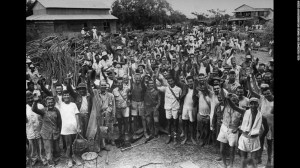
Two American Rangers and two prisoners were killed, another 4 Americans and 21 Filipinos wounded, compared with 500-1,000 Japanese killed and four tanks put out of action.  464 American military personnel were liberated, along with 22 British and 3 Dutch soldiers, 28 American civilians, 2 Norwegians and one civilian each of British, Canadian and Filipino nationalities.

cabanatuan-rescued
Rescued POWs from Cabanatuan

One POW was left behind, a British soldier named Edwin Rose.  Rose heard the firing and thought the Americans were there to stay, so he went back to sleep.  When he woke the next morning and realized he had “Cabanatuan all my own”, he shaved, put on his best clothes, and walked out of camp.  Passing guerrillas found him and passed him to a tank destroyer.  Give the man points for style.  A few days later, Rose strolled into 6th army headquarters, a cane tucked under his arm.

The Cabanatuan raid of January 30, 1945 liberated over 500 allied prisoners, from virtually every state in the Union. Begging pardon for any mistakes in rank and/or spelling, the following represents those from my home state of Massachusetts:

  • Lieutenant Commander Robert Strong, Jr., Arlington
  • Captain John Dugan, Milton
  • 2nd Lieutenant John Temple, Pittsfield
  • Sergeant Richard Neault, Adams
  • Sergeant Stanislaus Malor, Salem
  • Private, 1st Class Joseph Thibeault, Lawrence
  • Private Edward Searkey, Lynn
  • USN C/QM Martin Seliga, Fitchburg
  • USN 1/C PO J.E.A. Morin,Danvers
  • USN AC MM Carl Silverman, Wareham

I hope I didn’t leave anyone out.  These guys have earned the right to be remembered.

January 26, 1945 Audie Murphy

These days, you hear a lot about Post-Traumatic Stress Disorder (PTSD). In Murphy’s Day, they called it “Battle Fatigue”, or “Shell Shock”. Murphy would spend a 21-year post-war career in Hollywood and, until his death in a plane crash in 1971, his post-war life was never free of it

Audie Leon Murphy attempted to enlist in the Armed Services after the Japanese attack on Pearl Harbor, but the Marine Corps, Navy and the Army all turned him down for being underweight and under age. After a change in diet to “fatten” up, Murphy appeared at a Dallas recruiting station on June 30, 1942 with a sworn affidavit from his sister, inflating his age by a year. It was 10 days past his 17th birthday when Murphy, all 5’5½” and 112 lbs of him, enlisted in the US Army.

Murphy’s company commander thought he was too small for infantry service, and attempted to transfer him to cook and bakers’ school. Murphy refused.  He wanted to become a combat soldier.

amphibious-landingJoining the 3rd Infantry Division of George S. Patton’s 7th Army, Murphy participated in amphibious landings in Sicily in July, fighting in nearly every aspect of the Italian campaign. From Palermo to Messina and on to Naples, Anzio and Rome, the Germans were driven out of the Italian peninsula in savage and near continuous fighting that killed a member of my own family.  By mid-December, the 3rd ID suffered 683 dead, 170 missing, and 2,412 wounded. Now Sergeant Murphy was there for most of it, excepting two periods when he was down with malaria.

Two months after the “Overlord” landings in the north of France, elements of the 7th Army landed in southern France in an operation called “Dragoon”. By mid-September, only three of Company B’s original roster remained, the rest either killed or removed due to wounds or illness. It was around this time when Murphy received his first Purple Heart.  A mortar blast resulted in a heel wound that wasn’t very serious, but a far more dangerous hip wound followed from a sniper in December. He repaid it with a bullet between the German’s eyes.

Murphy was still in the hospital when his unit moved into the Vosges Mountains. The colmar_pocket“Colmar Pocket” was an 850 square mile area held by German troops: Murphy described it as “a huge and dangerous bridgehead thrusting west of the Rhine like an iron fist. Fed with men and materiel from across the river, it is a constant threat to our right flank; and potentially it is a perfect springboard from which the enemy could start a powerful counterattack.”

Rejoining his unit in January, now Lieutenant Murphy became Company Commander, being the only officer remaining in the Company. Disease, wounds and casualties had reduced company B’s fighting strength by this time from an original 235 to 18.

What remained of the unit was awaiting reinforcements on January 26, 1945, as a combined force of German infantry and armor assembled itself outside of town. “I see the Germans lining up for an attack”, said Murphy. “Six tanks rumble to the outskirts of Holtzwihr, split into groups of threes, and fan out toward either side of the clearing. Then wave after wave of white dots, barely discernible against the background of snow, start across the field. They are enemy infantrymen”.

audie_murphyLet Murphy’s Medal of Honor Citation describe what happened next: “Second Lieutenant Audie L. Murphy, 01692509, 15th Infantry, Army of the United States, on 26 January 1945, near Holtzwihr, France, commanded Company B, which was attacked by six tanks and waves of infantry. Lieutenant Murphy ordered his men to withdraw to a prepared position in a woods while he remained forward at his command post and continued to give fire directions to the artillery by telephone. Behind him to his right one of our tank destroyers received a direct hit and began to burn. Its crew withdrew to the woods. Lieutenant Murphy continued to direct artillery fire which killed large numbers of the advancing enemy infantry. With the enemy tanks abreast of his position, Lieutenant Murphy climbed on the burning tank destroyer which was in danger of blowing up any instant and employed its .50 caliber machine gun against the enemy. He was alone and exposed to the German fire from three sides, but his deadly fire killed dozens of Germans and caused their infantry attack to waver. The enemy tanks, losing infantry support, began to fall back. For an hour the Germans tried every available weapon to eliminate Lieutenant Murphy, but he continued to hold his position and wiped out a squad which was trying to creep up unnoticed on his right flank. Germans reached as close as 10 yards only to be mowed down by his fire. He received a leg wound but ignored it and continued the single-handed fight until his ammunition was exhausted. He then made his way to his company, refused medical attention, and organized the company in a counterattack which forced the Germans to withdraw. His directing of artillery fire wiped out many of the enemy; he personally killed or wounded about 50. Lieutenant Murphy’s indomitable courage and his refusal to give an inch of ground saved his company from possible encirclement and destruction and enabled it to hold the woods which had been the enemy’s objective”.

These days, you hear a lot about Post-Traumatic Stress Disorder (PTSD).  In Murphy’s Day, they called it “Battle Fatigue”, or “Shell Shock”.  Murphy would spend a 21-year post-war career in audie-murphy-gravesiteHollywood and, until his death in a plane crash in 1971, his post-war life was never free of it.

Data from the National Vital Statistics System, a collaboration of the National Center for Health Statistics of the Department of Health and Human Services, reveals a suicide rate among veteran populations approximately twice that in comparable civilian populations.

I wonder about the term, “Disorder”.  That makes it sound like there’s something wrong with these guys.

When a soldier experiences an event, so traumatic that the very memory of it causes pain, I don’t understand how that can be characterized as a “disorder”. To me that seems like the properly functioning conscience of a good man, recoiling in horror at what he’s seen in service to his country.

I don’t know the answer to PTSD-related suicide, I don’t even know the right question.  It seems to me that the only “disorder” belongs to that fraction of a percent who remain unaffected by the horrors of war.