


Diphtheria is highly contagious, with early symptoms resembling a cold or flu. Fever, sore throat, and chills lead to bluish skin coloration, painful swallowing, and difficulty breathing. Later symptoms include cardiac arrhythmia with cranial and peripheral nerve palsies, as proteins form a leathery, white “pseudo membrane” on the throat and nasal tissues.
Today the disease is all but eradicated in the United States, but diphtheria was once a major killer of children.
Spain experienced an outbreak of the disease in 1613. To this day the year is remembered as “El Año de los Garotillos”. The Year of Strangulations.
A severe outbreak swept through New England in 1735. In one New Hampshire town, one of every three children under the age of 10 died of the disease. In some cases entire families were wiped out. Noah Webster described the outbreak, saying “It was literally the plague among children. Many families lost three of four children—many lost all”.
Dr. Curtis Welch practiced medicine in Nome, Alaska, in 1925. Several children became ill with what he first diagnosed as tonsillitis. More came down with sore throats, early sufferers beginning to die as Welch observed the white pseudo membrane of diphtheria. He had ordered fresh antitoxin the year before, but the shipment hadn’t arrived by the time the ports froze over. By January, all the serum in Nome was expired.
There were 10,000 living in Nome at the time, 2° south of the Arctic Circle. Welch expected a high mortality rate among the 3,000 or so white inhabitants, but the 7,000 area natives: Central Yupik, Inupiaq, St. Lawrence Island Yupik and American Indians with lineage tied to tribes in the Lower 48, had no immunity whatsoever. Mortality among these populations could be expected to approach 100%.
Five children had died by January 25, while Dr. Welch suspected more in the remote native camps. A telegram went out and an Anchorage hospital came up with 300,204 units of serum. It was enough for 30 patients. A million units were needed, but this was enough to stave off an epidemic until the larger shipment arrived in February.
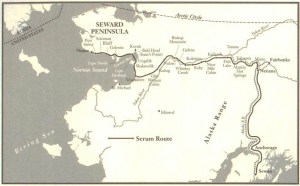 The 300,000 units shipped as far as they could by rail, arriving at Nenana, 674 miles from Nome. Three vintage biplanes were available, but all were in pieces, and none would start in the sub-arctic cold. The antitoxin would have to go the rest of the way by dog sled.
It was 9:00pm and −50°F on January 27, when “Wild Bill” Shannon and his nine dog team received the 20lb cylinder of serum. The temperature was −62°F when Shannon reached Minto at 3:00am, hypothermic, with parts of his face blackened by frostbite.
Leonhard Seppala and his dog team took their turn, departing into gale force winds and
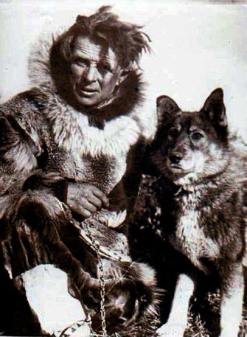
zero visibility, with a wind chill of −85°F. Most sled dogs are retired by age twelve, especially team leaders, but it was twelve year old “Togo” who was trusted with the lead. Up the 5,000′ “Little McKinley” and across the unstable ice of Norton Sound, visibility was so poor that Seppala couldn’t see the “wheel dog” – the dog nearest his sled. Much of the time, navigation in that frozen wilderness was entirely up to his lead dog.
With Seppala’s 8 year old daughter and only child Sigrid at risk for the disease, stakes could not have been higher. Seppala and Togo ran 170 miles to receive the serum, returning another 91 miles to make the next handoff on February 1. Together the pair covered twice as much ground as any other team, over the most dangerous terrain of the “serum run”.
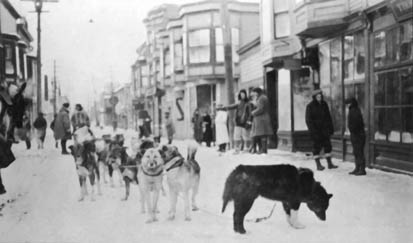
Gunnar Kaasen and his team took the handoff, hitting the trail at 10:00 at night. At one point, hurricane force winds upended the sled, pitching musher and serum alike into the snow. Already frostbitten, Kaasen searched in the dark with bare hands, until he found the cylinder. Covering the last 53 miles overnight, the team reached Front Street, Nome, at 5:30am on February 2. The serum was thawed and ready by noon.
20 mushers and 150+ dogs had covered 674 miles in 5 days, 7½ hours, a distance that normally took the mail relay 2-3 weeks. Not a single serum ampule was broken.
With 28 confirmed cases and enough serum for 30, the serum run had held the death toll at 5, 6 or 7, depending on which version you accept. Doctor Welch suspected as many as 100 or more deaths in the native camps, but the real number will never be known. An untold number of dogs died before completing the run, several mushers were severely frostbitten.
Gunnar Kaasen and his lead dog “Balto” were hailed as heroes of the serum run, the dog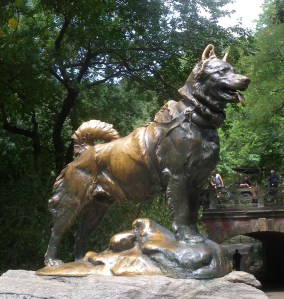 becoming the most popular canine celebrity in the country after Rin Tin Tin. It was a source of considerable bitterness for Leonhard Seppala, who felt that Kaasen’s 53 mile run was nothing compared with his own 261, Kaasen’s lead dog little more than a “freight dog”.
A statue of Balto was erected in New York’s Central Park in 1925 where it stands to this day, though he is depicted wearing Togo’s “colors” (awards). Togo lived another four years, though he was never again able to run. He spent his last years in Poland Spring, Maine, and passed away on December 5 at the ripe old age of 16.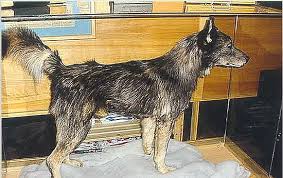
Seppala was in his old age in 1960, when he recalled “I never had a better dog than Togo. His stamina, loyalty and intelligence could not be improved upon. Togo was the best dog that ever traveled the Alaska trail.” Today, Togo is stuffed and mounted, standing watch in the Iditarod museum headquarters in Wasilla, Alaska.



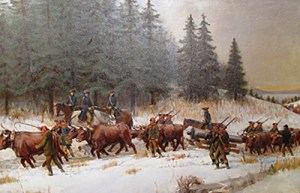 of Lake George, arriving barely before the water began to freeze over.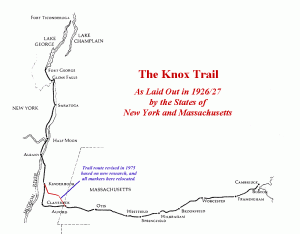


 In all the annals of warfare, there may be nothing more ironic, than the time a naval force was defeated by men mounted on horseback.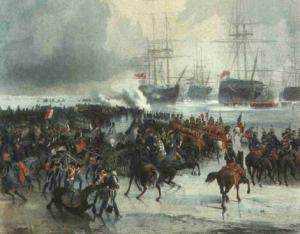
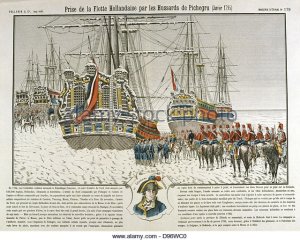 At least one source will tell you that this event never occurred, or at least it’s an embellished version, as retold by the hussars themselves. I guess you can take your pick. A number of 19th century authors have portrayed the episode as unvarnished history, as have a number of paintings and sketches.

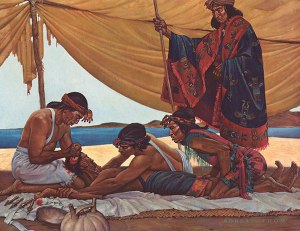 head, and seems to have begun sometime in the Neolithic, or “New Stone Age” period. One archaeological dig in France uncovered 120 skulls, 40 of which showed signs of trepanning. Another such skull was recovered from a 5th millennium BC dig in Azerbaijan. A number of 2nd millennium BC specimens have been unearthed in pre-Colombian Mesoamerica; the area now occupied by the central Mexican highlands through Belize, Guatemala, El Salvador, Honduras, Nicaragua, and northern Costa Rica.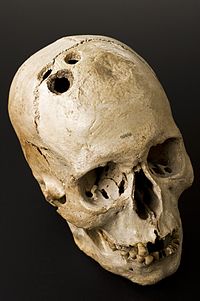
 Trepanation took on airs of pseudo-science, many would say “quackery”, when the Dutch librarian Hugo Bart Huges (Hughes) published “The Mechanism of Brainbloodvolume (‘BBV’)” in 1964. In it, Hughes contends that our brains drained of blood and cerebrospinal fluid when mankind began to walk upright, and that trepanation allows the blood to better flow in and out of the brain, causing a permanent “high”.


 Lieutenant Trung to be particularly hard core, a tough guy in a world of tough guys. A US Marine Corps Lieutenant of Korean ancestry, dressed in the uniform of the Blue Dragon Marines, and paid a visit to Lt. Trung’s cell. Not a word or gesture passed between the two, the mere presence of a Blue Dragon was enough to get this guy talking. Korean fighters are no joke.
 brained political calculations of DPRK leadership. Somehow it made sense to these guys, that to assassinate the South Korean President and hurl his head out of the official residence, would start a popular uprising leading to the re-unification of the Korean peninsula under DPRK government.
 Korean military and police personnel were killed along with two dozen civilians, and 66 wounded. Four Americans were killed in efforts to prevent Unit 124 members from re-crossing the DMZ.
 and other hardened prisoners, possibly due to the suicidal nature of their mission. The “training” they were subjected to on Silmido Island, off the coast of Inchon, was beyond brutal. Seven of them would not survive it.

 south after a brief stay in Charleston, South Carolina. Landing at Yamacraw bluff, they were greeted by Chief Tomochichi of the Yamacraws, along with two Indian traders, John and Mary Musgrove.
 originally come from its native Southeast Asia to West Africa, where the same strains were grown by European colonists. The rice industry failed in Africa, but the combination of English agricultural technology and African labor made the crop a mainstay of the early colonial economy.
 On January 20, 1788, Bryan brought official recognition to the First African Baptist Church and its 67 members, five years before the first “white” Baptist Church in Savannah. In 1802, Bryan founded the “Second Colored Baptist Church”, renamed the “Second African Baptist Church” in 1823.
 he called “I have a Dream”. Two years later, the same speaker would deliver his speech from the steps of the Lincoln memorial in Washington.

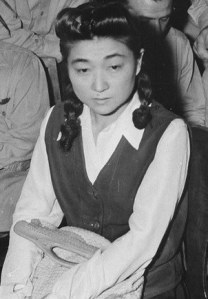
 “Zero Hour” program, part of a Japanese psychological warfare campaign designed to lower the morale of US Armed Forces. The name “Tokyo Rose” was in common use by this time, applied to as many as 12 different women broadcasting Japanese propaganda in English. Toguri DJ’d a program with American music punctuated by Japanese slanted news articles for 1¼ hours, six days a week, starting at 6:00pm Tokyo time. Altogether, her on-air speaking time averaged 15-20 minutes for most broadcasts.
 After the war, a number of reporters were looking for the mythical “Tokyo Rose”, and two of them found Iva Aquino. They were Henry Brundidge and Clark Lee, and they offered her a significant sum for her story. The money never materialized, but she signed a contract giving the two rights to her story, and identifying herself as Tokyo Rose.
 Reformatory for Women at Alderson, West Virginia in 1956, having served six years and two months of her sentence.

 The project almost ended in a fire in 1917, when the prototype was destroyed along with the blueprints. Rohwedder soldiered on, by 1927 he had scraped up enough financing to rebuild his bread slicer.
 Article 1, Section 8 of the Constitution includes the “Commerce Clause”, permitting the Congress “To regulate Commerce with foreign Nations, and among the several States, and with the Indian Tribes”. That’s it. The Federal District Court sided with the farmer, but the Federal government appealed to the US Supreme Court, arguing that, by withholding his surplus from the interstate wheat market, Filburne was effecting that market, and therefore fell under federal government jurisdiction under the commerce clause.
 government had a billion bushels of wheat stockpiled at the time, about two years’ supply, and the amount of steel saved by not making bread slicers has got to be marginal, at best.


 were pulled on May 28, 1941, while the liner was at Saint Thomas in the US Virgin Islands. The ship had been called into service by the United States Navy, and ordered to return to Newport News.
 During her service to the United States Navy, West Point was awarded the American Defense Service Medal, American Campaign Medal, European-African-Middle Eastern Campaign Medal, Asiatic-Pacific Campaign Medal, and World War II Victory Medal.
 adrift in foul seas, running aground in the Canary Islands the following day.

 Roger Bannister became the first human to run a sub-four minute mile on May 6, 1954, with an official time of 3 minutes 59.4 seconds. The Jamaican sprinter Usain Bolt is recorded as the fastest man who ever lived. At the 2009 World Track and Field Championships, Bolt ran 100 meters at an average 23.35 mph from a standing start, and the 20 meters between the 60 & 80 markers at an average 27.79 mph.
 smashing the elevated train tracks on Atlantic Ave and hurling entire buildings from their foundations. Horses, wagons, and dogs were caught up with broken buildings and scores of people as the brown flood sped across the North End. Twenty municipal workers were eating lunch in a nearby city building when they were swept away, parts of the building thrown fifty yards. Part of the tank wall fell on a nearby fire house, crushing the building and burying three firemen alive.
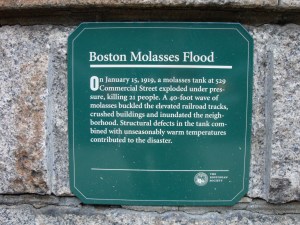 In 1983, a Smithsonian Magazine article described the experience of one child: “Anthony di Stasio, walking homeward with his sisters from the Michelangelo School, was picked up by the wave and carried, tumbling on its crest, almost as though he were surfing. Then he grounded and the molasses rolled him like a pebble as the wave diminished. He heard his mother call his name and couldn’t answer, his throat was so clogged with the smothering goo. He passed out, then opened his eyes to find three of his four sisters staring at him”.


You must be logged in to post a comment.