

In 1692, a series of “witch trials” took place in the area now occupied by Danvers, Ipswich, Andover and Salem, Massachusetts.
The familiar version of the story begins with a slave named Tituba, often described as being black or of mixed race, though court documents from her trial describe her as “Indian woman, servant.” 5 men and 14 women were hanged as witches on Gallows Hill, as many as 17 more dying in the tiny, freezing stone compartments that passed for jail cells. One man, 81 year old Giles Cory, was “pressed” to death over two full days, as rocks were heaped on his chest to extract his “confession”. Knowing that his possessions were forfeit to his tormentors should he confess, his only response was “more weight”.
Courts of “Oyer and Terminer” (to hear and determine) were disbanded by Governor Sir  William Phipps, somewhere around the time when his own wife was accused of witchcraft. This is the story as it’s commonly told, but the real origin of the late 17th century witchcraft hysteria started in Boston, four years earlier.
The conflict which took place in Ireland between 1641 and 1653 pitted native Irish Catholics against English and Scottish Protestant colonists, and their supporters. Over 500,000 Irish were killed by the English and another 300,000 sold as slaves during this period, while Ireland’s population fell from 1,500,000 to 600,000 in a single decade. By the mid 1600s, the Irish constituted most of the slaves sold to the Caribbean islands of Antigua and Montserrat. About 70% of the entire population of Montserrat at this time, were Irish slaves.
Goodwife Ann “Goody” Glover and her family were among these white slaves, shipped to Barbados in the 1650s during the Irish Confederate Wars. Her husband was apparently killed in Barbados for refusing to renounce his Catholic faith, while Ann either escaped or was released, depending on which version of the story you believe. By 1680, Ann and her daughter landed in Massachusetts, where the pair worked as housekeepers for the Boston family of John Goodwin.
In 1688, 13 year old Martha, one of the Goodwin girls, accused the younger Glover of stealing fabric. Ann’s daughter ran out in tears, which earned Martha a rebuke from Ann Glover. Four of the five Goodwin children soon began to writhe and carry on in a manner which would become familiar four years later. Their doctor concluded that “nothing but a hellish Witchcraft could be the origin of these maladies.”
There was no small amount of anti-Catholic bigotry in the trial that followed. Cotton Mather, the socially and politically influential New England Puritan minister called Glover “a scandalous old Irishwoman, very poor, a Roman Catholick and obstinate in idolatry.”
During interrogation, Glover supposedly told Mather that she prayed to a “host of spirits”, possibly representing Catholic saints. Mather argued that small doll-like figures found in her home represented these spirits, which were, in fact, demons.
Glover’s Gaelic was far better than her English, and the two “Gaelic speakers” hired to translate probably made some of it up as they went along. Most damning was Ann’s inability to complete the Lord’s Prayer. As a Catholic, she was either unable or unwilling to complete the prayer with the Protestant doxology, “For thine is the kingdom, and the power, and the glory, forever, Amen”, which doesn’t exist in the Catholic recitation.
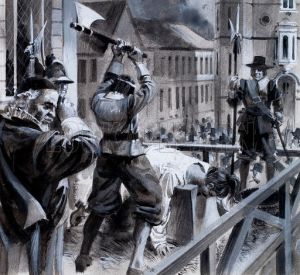
That proved to be the final straw. The court convicted Goodwife Ann Glover of witchcraft and sentenced her to be hanged, the sentence carried out before a jeering crowd on November 16th, 1688. She was the last person be hanged for witchcraft in the city of Boston.
 Robert Calef, a Boston merchant who knew her, said “Goody Glover was a despised, crazy, poor old woman, an Irish Catholick who was tried for afflicting the Goodwin children. Her behavior at her trial was like that of one distracted. They did her cruel. The proof against her was wholly deficient. The jury brought her guilty. She was hung. She died a Catholick.” After the hanging, a contemporary wrote that the crowd wanted to destroy her cat as well, “but Mr. Calef would not permit it”.
A decade after the Glover execution, Cotton Mather was still carrying on against “idolatrous Roman Catholicks.”
Goody Glover’s execution would be overshadowed by the witchcraft hysteria unfolding farther up Massachusetts’ North Shore, four years later.
Sometime in the 1830s, the writer Nathaniel Hawthorne added the “W” to his name, distancing himself from his twice-great grandfather and Salem witch trial judge, John Hathorne. None of it did a lick of good for the poor collection of oddballs and outcasts who would not survive the witchcraft hysteria of 1692.
On January 14, 1699, Massachusetts observed a day of fasting for wrongly persecuting the “witches” of the earlier period. The state formally apologized for the whole mess 258 years later, in 1957. In 1988, 300 years to the day after her hanging, Boston City Council proclaimed November 16 as “Goody Glover Day”. Apparently, we can’t be too hasty about these things.



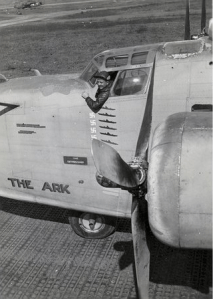
 Later in the same conflict, an Iraqi Hughes 500 helicopter was taken out by bombs dropped from an American Air Force F-15E bomber. At least one Iraqi PC-7 Turboprop pilot got spooked, bailing out of a perfectly good aircraft before a shot was fired in his direction.


 Earhart worked at a variety of jobs from photographer to truck driver, earning money to take flying lessons from pioneer female aviator Anita “Neta” Snook. She bought a second hand Kinner Airster in 1921, a bright yellow biplane she called “The Canary”, and flew it to 14,000’ the following year, a world altitude record for female pilots.
 low on fuel on July 2, 1937, and then she vanished. The four million dollar search and rescue effort which followed was the most expensive in history, but to no avail. Earhart and Noonan were never seen again.
 robber crab or palm thief, Birgus latro is the largest terrestrial hermit crab in the world, weighing up to 9lbs and measuring over 3′ from leg tip to leg tip.

 On January 8, 1790, a joint session of Congress gathered to receive the first such address. It wasn’t where you might think. A mob of angry soldiers had converged on Philadelphia’s Independence Hall in 1783, demanding payment for their service in the Revolution. The Congress fled Pennsylvania all the way to New York. It wouldn’t be until July 6 of 1790 that Congress passed the Residence Act, placing the permanent seat of the Federal Government on the “River Potomack”. For the time being, the government was conducting its business in Federal Hall, built in 1700 as New York City Hall.
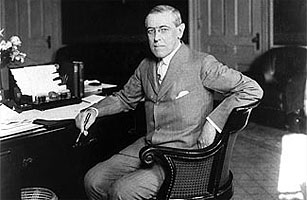 spite of initial criticism.
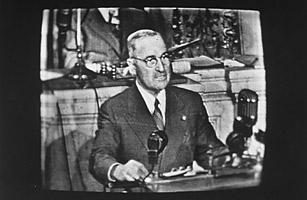 Calvin Coolidge’s 1923 address was the first to be broadcast on radio, and Harry S. Truman’s 1947 State of the Union was the first to be broadcast on television. Bill Clinton’s 1997 SOTU was the first to be broadcast live on the internet.


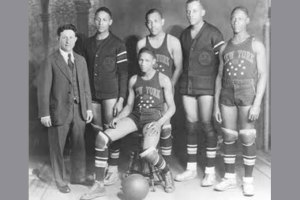
 multi-sport athlete and teammate of Satchel Paige, Tatum would entertain the crowd with comedic routines whenever he put a runner out. He was 6’4″ with an 84″ wingspan, able to touch his knees without bending. He’s credited with inventing the hook shot, an early version of the “skyhook” that would make Kareem Abdul-Jabbar famous, 30 years later.
 third Caucasian, the first-ever white player to be offered a contract, Bob Karstens. Karstens was the newest showman on the team, creating the signature pregame “Magic Circle,” the behind-the-back backhand shot, the “yo-yo” basketball and the “goofball,” a basketball filled with weights to give it a crazy bounce. It was the early 1940s and the Harlem Globetrotters were the most famous, and the most profitable, professional basketball franchise in the world.

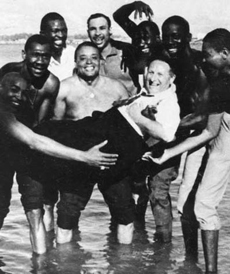 Abe Saperstein passed away in 1966, aged 63. The owner and founder of the Harlem Globetrotters, he was also founder and first Commissioner of the American Basketball League, and inventor of the three point shot. Elected to the Basketball of Fame in 1971. Here’s a great trivia question for you. At 5’3″, Saperstein is the shortest male member in the place. In 2005, he was inducted into the National Jewish Sports Hall of Fame.


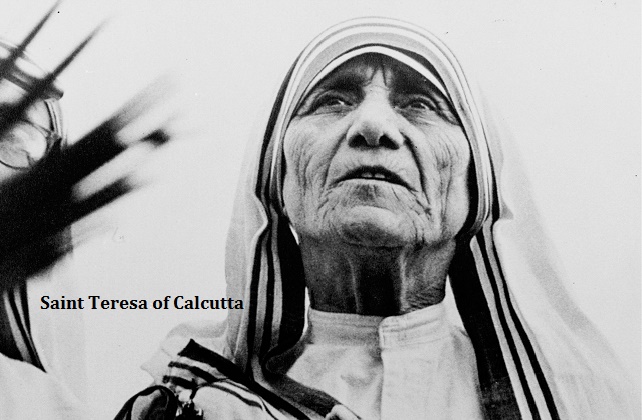
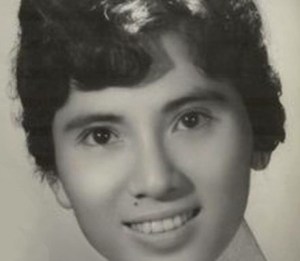 The Sisters taught English to school children in India, a language which Agnes learned in the Loreto Abbey in Rathfarnham, Ireland.
 Awarded the Nobel Peace Prize in 1979, she refused the traditional honor banquet, requesting instead that the $192K cost of the banquet be given to help the poor of India.







 When Caesar went to Egypt in 48BC, he was impressed with the way they handled their calendar. He hired the Alexandrian astronomer Sosigenes to help straighten things out. The astronomer calculated that a proper year was 365¼ days, which more accurately tracked the solar, and not the lunar year. “Do like the Egyptians”, he might have said, the new “Julian” calendar going into effect in 46BC. Caesar decreed that 67 days be added that year, moving the New Year’s start from March to January 1. The first new year of the new calendar was January 1, 45BC.

 The Artkraft Strauss sign company designed a 5′ wide, 700lb ball covered with incandescent bulbs. The ball was hoist up the flagpole by five men on December 31, 1907. Once it hit the roof of the building, the ball completed an electric circuit, lighting up a sign and touching off a fireworks display.
 continues. The ball used the last few years is 12′ wide, weighing 11,875lbs; a great sphere of 2,688 Waterford Crystal triangles, illuminated by 32,256 Philips Luxeon Rebel LED bulbs and producing more than 16 million colors. It used to be that the ball only came out for New Year. The last few years, you can see the thing, any time you like.


You must be logged in to post a comment.