Some sources report the general was “sleeping it off”, possibly following an evening’s celebration with a young lady of southern sympathies.
Small and frail as a boy, John Singleton Mosby was often the target of much larger bullies. Many years later, he’d write in his memoirs. He never won a fight. Seems that he never backed down from one, either.
Like fellow Virginian Robert E. Lee, Mosby opposed secession. When it came, he left the Union along with his home state of Virginia.
Mosby participated in the 1st Battle of Manassas (Bull Run) as a member of the Virginia Volunteers Mounted Rifles, later joining James Ewell Brown “JEB” Stuart as a Cavalry Scout. A natural horseman and gifted tactician, information gathered by Mosby aided Stuart in his humiliating ride around McLellan’s Army of the Potomac in June, 1862.
Dr William Gunnell House
In 1863, JEB Stuart authorized Mosby to form and take command of the 43rd Battalion of the Virginia Cavalry, a regiment sized unit operating out of north central Virginia. These “Partisan Rangers”, 1,900 of whom served between January 1863 and April 1865, were under the authority of Stuart and Lee and subject to their commands, but were not a traditional army unit. “Mosby’s Rangers” shared in the spoils of war but had no camp duties, and lived scattered among civilian populations.
Known for lightning raids on the Virginia countryside, Mosby’s 43rd Cavalry would be called together to strike a specific target, dispersing afterward and making themselves next to impossible to run to ground. So successful were they that parts of Virginia’s Piedmont region are known to this day, as “Mosby’s Confederacy”.
Union Brigadier General Edwin H. Stoughton
In Early March 1863, a Federal brigade was stationed near Fairfax Court House south of Washington. Mosby received word that two ranking officers, Brigadier General Edwin H. Stoughton and Colonel Sir Percy Wyndham, were headquartered in the town itself.
“Sir” Percy Wyndham was an English officer and adventurer, a professional soldier and veteran of the Italian Risorgimento, the French Navy and the Austrian Army’s 8th Lancers Regiment. In October 1861, the Englishman came to America, to offer his services in the American Civil War.
Colonel Sir Percy Wyndham
For some time now, Wyndham had chased Mosby’s rangers across the Virginia countryside. There was a special kind of hate between these two men. Sir Percy had even gone so far as to call the man, a horse thief. Mosby retorted “The only horses he had every stolen had Union troopers on their backs armed with two pistols and a saber.”
With his nemesis in sight, Mosby’s Rangers formed up for a raid on the night of March 8, 1863.
As it turned out, Wyndham was away that night, visiting in Washington city. General Stoughton was asleep in his quarters in the home of Dr. William Gunnell.
The “Gray Ghost” and a small detachment entered the Gunnell home in the small hours of March 9. Mosby’s rangers quickly overpowered a handful of sleepy guards, and crept upstairs to where the General slept.
Let Mosby’s own words, paint the picture:
The Fairfax Raid, by Civil War artist Mort Kustler
“There were signs in the room of having been revelry in the house that night. Some uncorked champagne bottles furnished an explanation of the general’s deep sleep. He had been entertaining a number of ladies from Washington in a style becoming a commanding general”.
Entering the chamber, Mosby lifted the general’s nightshirt and slapped his bare backside, with a sword. Confused, Stoughton sputtered awake, demanding “What is the meaning of this“. “General, did you ever hear of Mosby“, came the question. Stoughton replied, “Yes, have you caught him?” “I AM Mosby,” said the Gray Ghost, “he has caught you. Stuart’s cavalry has possession of the Courthouse;. Be quick and dress.”
That night, John Singleton Mosby and 29 rangers captured a Union General, two Captains, 30 enlisted men and 58 horses, all without firing a shot. On hearing the story the next day, President Lincoln lamented: “I can make another Brigadier in 5 minutes, but I can’t replace those horses“.
If you enjoyed this “Today in History”, please feel free to re-blog, “like” & share on social media, so that others may find and enjoy it as well. Please click the “follow” button on the right, to receive email updates on new articles. Thank you for your interest, in the history we all share.
Four men, each of whom played a part in the most destructive war, in American history. Without any of these four, I wouldn’t be here to tell their story.
In the early days of the Civil War, the government in Washington refused to recognize the Confederate states’ government, believing any such recognition would amount to legitimizing an illegal entity. The Union refused formal agreement regarding the exchange of prisoners. Following the capture of over a thousand federal troops at the first battle of Bull Run (Manassas), a joint resolution in Congress called for President Lincoln to establish a prisoner exchange agreement.
In July 1862, Union Major General John A. Dix and Confederate Major General D. H. Hill met under flag of truce to draw up an exchange formula, regarding the return of prisoners. The “Dix-Hill Cartel” determined that Confederate and Union Army soldiers were exchanged at a prescribed rate: captives of equivalent ranks were exchanged as equals. Corporals and Sergeants were worth two privates. Lieutenants were four and Colonels fifteen, all the way up to Commanding General, equivalent to sixty private soldiers. Similar exchange rates were established for Naval personnel.
My twice-great grandfather, Corporal Jacob Deppen of the 128th Pennsylvania Infantry, was paroled in such an exchange.
President Lincoln’s emancipation proclamation of September 1862 not only freed those enslaved in Confederate territories, but also provided for the enlistment of black soldiers. The government in Richmond responded that such would be regarded as runaway slaves and not soldiers. Their white officers would be treated as criminals, for inciting servile insurrection.
The policy was made clear in July 1863, following the Union defeat at Fort Wagner, an action depicted in the 1989 film, Glory. The Dix-Hill protocol was formally abandoned on July 30. Neither side was ready for the tide of humanity, about to come.
The US Army began construction the following month on the Rock Island Prison, built on an Island between Davenport Iowa and Rock Island, Illinois. In time, Rock Island would become one of the most infamous POW camps of the north, housing some 12,000 Confederate prisoners, seventeen per cent of whom, died in captivity.
On this day in 1864, the first prisoners had barely moved into the most notorious POW camp of the Civil War, the first Federal soldiers arriving on February 28.
The pictures at the top of this page were taken at Camp Sumter, better known as Andersonville. Conditions in this place defy description. Sergeant Major Robert H. Kellogg of the 16th Regiment Connecticut Volunteers, entered this hell hole on May 2:
“As we entered the place, a spectacle met our eyes that almost froze our blood with horror, and made our hearts fail within us. Before us were forms that had once been active and erect;—stalwart men, now nothing but mere walking skeletons, covered with filth and vermin. Many of our men, in the heat and intensity of their feeling, exclaimed with earnestness. “Can this be hell?” “God protect us!” and all thought that he alone could bring them out alive from so terrible a place. In the center of the whole was a swamp, occupying about three or four acres of the narrowed limits, and a part of this marshy place had been used by the prisoners as a sink, and excrement covered the ground, the scent arising from which was suffocating. The ground allotted to our ninety was near the edge of this plague-spot, and how we were to live through the warm summer weather in the midst of such fearful surroundings, was more than we cared to think of just then”.
Over 45,000 Union troops would pass through the verminous open sewer known as Andersonville. Nearly 13,000 died there.
Andersonville
Now all but forgotten, the ‘Eighty acres of Hell’ located in the Bronzeville neighborhood of Chicago was home to some forty thousand Confederate POWs between 1862 and 1865, seventeen per cent of whom, never left. No southern soldier was equipped for the winters at Camp Douglas, nor the filth, or the disease. Nearby Oak Woods Cemetery is home to the largest mass grave, in the western hemisphere.
Union and Confederate governments established 150 such camps between 1861 and 1865, makeshift installations of rickety wooden buildings and primitive sewage systems, often little more than tent cities. Some 347,000 human beings languished in these places, victims of catastrophically poor hygiene, harsh summary justice, starvation, disease and swarming vermin.
The training depot designated camp Rathbun near Elmira New York became the most notorious camp in the north, in 1864. 12,213 Confederate prisoners were held there, often three men to a tent. Nearly 25% of them died there, only slightly less, than Andersonville. The death rate in “Hellmira” was double that of any other camp in the north.
“Hellmira”
Historians debate the degree to which such brutality resulted from deliberate mistreatment, or economic necessity.
The Union had more experience being a “country” at this time, with well established banking systems and means of commerce and transportation. For the south, the war was an economic catastrophe. The Union blockade starved southern ports of even the basic necessities from the beginning, while farmers abandoned fields to take up arms. Most of the fighting of the Civil War took place on southern soil, destroying incalculable acres of rich farm lands.
The capital at Richmond saw bread riots as early as 1862. Southern Armies subsisted on corn meal and peanuts. The Confederate government responded by printing currency, about a billion dollars worth. By 1864, a Confederate dollar was worth 5¢ in gold. Southern inflation exceeded 9000%, by 1865.
Captain Henry Wirz, commandant of the stockade at Camp Sumter, was tried and executed after the war, only one of two men to be hanged for war crimes. Captain Wirz appeared at trial reclined on a couch, advanced gangrene preventing him from sitting up. To some, the man was a scapegoat. A victim of circumstances beyond his control. To others he is a demon, personally responsible for the hell of Andersonville prison. I make no pretense of answering such a question. The subject is capable of inciting white-hot passion, from that day to this.
Family cemetery, Scotland County, North Carolina. Note the peaked tops of Confederate stones. It’s said they were shaped that way, so no Yankee could sit on them.
On a personal note:
There are many good reasons to study history, among which is an understanding of where we come from. How do we know where we’re going, if we don’t understand where we’ve been.
Should our ancestors be towering historical figures or merely those who played a part, the principle applies on the micro, as well as a larger scale.
Among those farmers who laid down their tools were the four Tyner brothers of North Carolina: James, William, Nicholas and Benjamin. My twice-great Grandfather, Private James Tyner, 52nd North Carolina Infantry, was captured at Spotsylvania Courthouse and imprisoned at “Hellmira”. He died in captivity on March 13, 1865, less than a month before General Lee surrendered at Appomattox. Nicholas alone survived the war, to return to the Sand Hills of North Carolina.
Corporal Jacob Deppen of the 128th PA Infantry re-enlisted with the Army of the James, after his parole. He and Nicholas Tyner would lay down their weapons at Appomattox, former enemies turned countrymen, if they could only figure out how to do it.
William Christian Long was Blacksmith to the 17th Pennsylvania Cavalry, and survived the war. His name may be found on the Pennsylvania monument, at Gettysburg.
Archibald Blue of Drowning Creek North Carolina wanted no part of what he saw as a “rich man’s war” and ordered his five sons away. He was murdered for his politics in 1865. The killer was never found.
Four men, each of whom played a part in the most destructive war, in American history. Without any of these four, I wouldn’t be here to tell their story.
Major Rathbone would heal, in time, but he never came to terms with his failure to protect the President. He was tormented, distraught with guilt, unable to understand what he could have done differently. Surely there must have been…Something.
An historical ghost story, for your Halloween enjoyment. But there are no such things as ghosts…Right?
Albany, New York businessman Jared Rathbone passed away in 1845, leaving a considerable fortune to his widow Pauline, and their four children.
New York Supreme Court Justice Ira Harris, himself a widower, joined his household with hers when the couple married, in 1848. There were now eight kids. A regular 19th-century “Brady Bunch.”
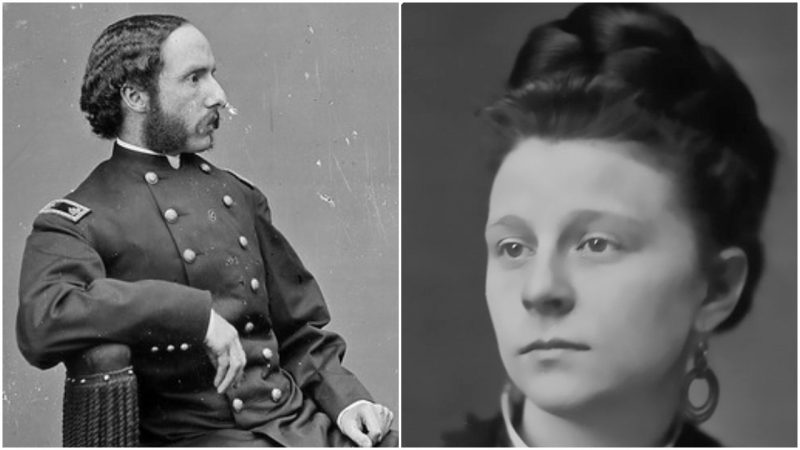
Pauline’s son Henry and Ira’s daughter Clara became close friends and later, more. Much more. They were step-siblings, yes, but there was no “blood” between them. Such a relationship seems not to have been so ‘odd’ then, as it may seem, today.
With the incoming Lincoln administration, Ira Harris was elected to the United States Senate, replacing Senator William H. Seward who’d been picked to serve in the new administration.
By the time of the War between the States, Clara Harris and Henry Rathbone were engaged to be married.
Rathbone served the Union army for the duration of the war, becoming Captain in the 12th Infantry Regiment and participating in the battles at Antietam and Fredericksburg. By the end of the war, Rathbone had attained the rank of Major.
Meanwhile, Senator Harris’ daughter Clara had conceived a friendship with the First Lady of the United States, Mary Todd Lincoln.
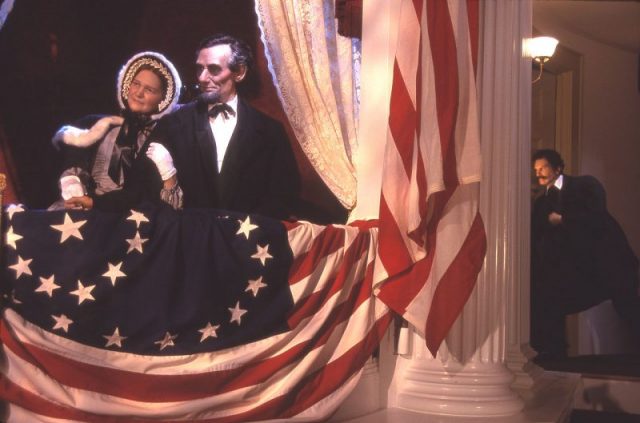
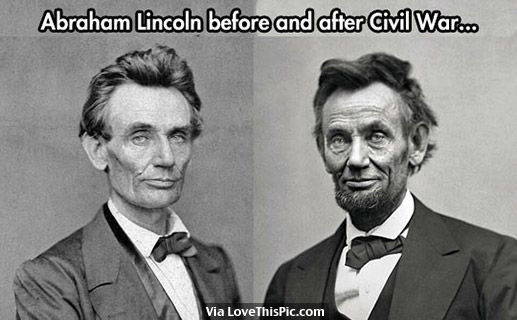
If a picture is worth a thousand words, before and after photographs tell of the burdens, born by the chief executive of a nation at war with itself. Making matters worse, the Lincolns had lost two of their four boys in childhood, by war’s end. In April 1865, a night out must have seemed like a welcome break. An evening at the theater. The play, a three-act farce by English playwright Tom Taylor. “Our American Cousin”.
The Lincoln’s companions for the evening were to be General Grant and his wife, Julia, but the General had other plans. It was probably convenient, because the ladies didn’t get along. Mary suggested her neighbor Clara Harris, of whom she was quite fond. And besides, didn’t her fiancée cut a dashing figure, in his blue uniform.
The story of that night is familiar, the assassin creeping up from behind. The mark of the coward.
John Wilkes Booth was himself one of the great actors of his day, and chose his moment, carefully. Raucous laughter and applause could be expected to follow the line “Don’t know the manners of good society, eh? Well, I guess I know enough to turn you inside out, old gal — you sockdolagizing old man-trap!”
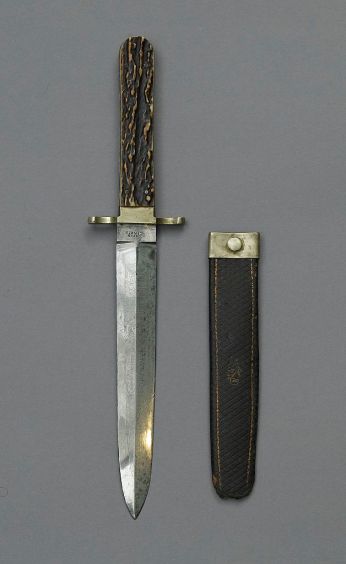
John Wilkes Booth dagger, used to attack Rathbone
The bullet was fired at point-blank range, entering the President’s skull behind the left ear and coming to rest, behind the right eye. Rathbone sprang to the attack but the assassin was ready, the dagger slashing the major nearly bone-deep, from shoulder to elbow. Rathbone made one last lunge, knocking Booth off balance as he leapt to the stage, below. Witnesses remembered that he cried out “Sic Semper Tyrannis”. Thus always, to tyrants. And then, he was gone.
In the President’s box, all was chaos. The first lady was inconsolable, sobbing and shrieking, like a wildcat. Rathbone was losing blood at a prodigious rate, a major artery slashed in the scuffle.
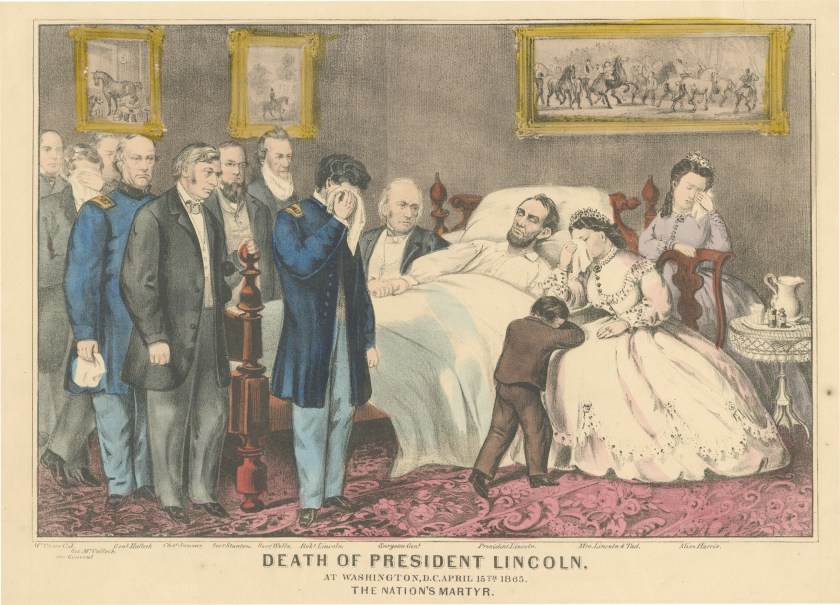
Clara’s new dress was soaked with the blood of her fiancee, her face splashed and clothing drenched through the layers of petticoats to the skin, beneath. The small group was taken across the street to the Peterson house, the President laid out on a bed. Henry Rathbone faded in and out of consciousness due to blood loss, raving in his delirium how he should have caught the assassin, his head on Clara’s lap, her handkerchief stuffed into the void where the bicep used to be.
There wasn’t even time to clean off her face. Mary Lincoln would just begin to calm down when she’d see Clara and fall apart, wailing “My husband’s blood!”. It wasn’t, but, no matter. Perception is reality. The death vigil lasted this way, for nine hours. The 16th President of the United States passed away at 7:22 the following morning, April 15, 1865.
Major Rathbone would heal, in time, but he never came to terms with his failure to protect the President. He was tormented, distraught with guilt, unable to understand what he could have done differently, but, What!? Surely there must have been…Something.
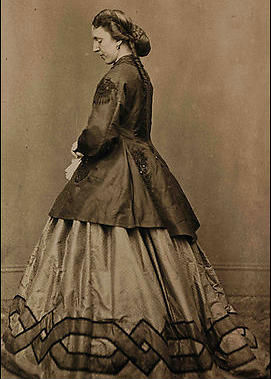
Clara Harris couldn’t bring herself to wash that dress, nor to burn it. She hung it in a guest room closet, blood and all, in the family’s vacation home in New York.
What demons afflicted the mind of Henry Rathbone can only be guessed at, as a mental illness which had no name, crept into his soul. He was possessed with that night. Was I not quick enough? Or brave enough? Or Strong enough? It was MY fault. A Better Man would have taken that bullet. Or Stopped that man. No he wouldn’t…yes he would…but…I…what, the, hell, is WRONG WITH YOU???!!!
The dress
Washington DC was saturated with All Things Lincoln in April 1866, and Clara fled to the family home in Albany, to get away. There in that closet hung the bloody dress. On the anniversary of the assassination, she heard laughter, she knew she did, coming down the hall. Lincoln’s laughter.
Others reported the same thing in the following years. The sound of laughter. A single gun shot. But there are no such things as ghosts…Right?
Major Rathbone and Clara Harris were married in July 1867 and the couple had three children, Henry rising to the rank of brevet Colonel, in 1870. That was the year he resigned from the army, but work was hard to come by, due to increasing mental instability.
Rathbone convinced himself that Clara was unfaithful, and that she planned to take the kids away. He would fly into rages and she considered divorce, but couldn’t bear the thought, nor the stigma.
Clara went so far as to have the closet bricked up with that dress inside, like Montresor bricked up Fortunato. It changed, nothing. The family traveled to Europe and back in search of a cure, but Rathbone’s condition only worsened.
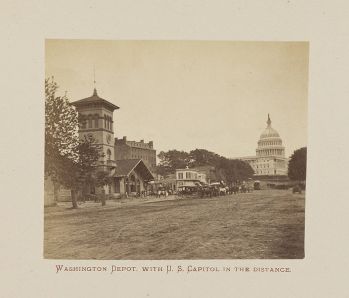
US Capitol as it looked, in 1872
Despite all this or possibly because of it, President Chester A. Arthur appointed Rathbone US Consul to the Province of Hannover in Germany, in 1882.
“Trick or Treating” had yet to take hold by this time, back in the United States. For most, October 31, 1883 passed pleasantly enough: Fall festivals, children bobbing for apples, young women consulting mirrors or tossing nuts into fires, to see whom they would marry. Not so, Henry Rathbone. He had Monsters in his head.
Two months later, December 23, Henry Rathbone shot his wife, and stabbed himself, in the chest. Six times. He lived. She died.
He claimed he was defending her, against an attacker.
The three children, Henry Riggs, Gerald Lawrence and Clara Pauline, went to live with relatives. Henry Reed Rathbone was convicted of their mother’s murder and committed to an asylum for the criminally insane in Hildesheim, Germany, there to spend the next twenty-eight years.
Henry Reed Rathbone died on August 14, 1911 and was buried, next to his wife.
In 1922, Henry Riggs Rathbone would be elected to the United States House of Representatives. Twelve years earlier he unbricked that closet and burned the hated dress, the dress which had stolen his childhood, and murdered his mother, and cursed his father. But there are no such things as ghosts…Right?
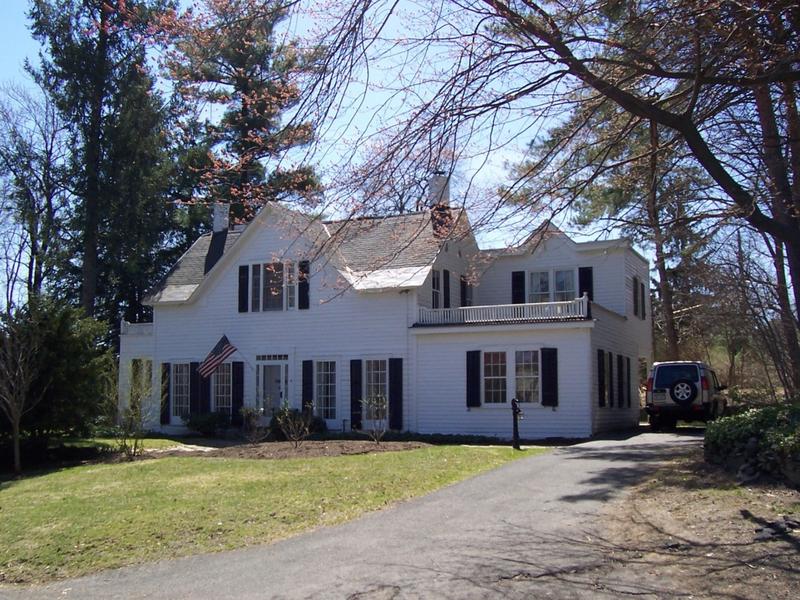
“The modern day home where Union Army Officer Henry Rathbone and Clara Harris resided”. Hat tip, HISTORIAN’S OFFICE, TOWN OF COLONIE.
Afterward
Burial customs are different in Germany, than in the United States. Grave plots are generally leased for a period of 20 – 30 years, with an option to renew. In 1952, officials with the city cemetery at Hanover/Engesohde looked over visitation records, and determined that there was no further interest, in Clara Harris or Henry Rathbone. The couple was exhumed and their remains burned, and disposed of. Like they were never even there.
But there are no such things as ghosts.
Right?
If you enjoyed this “Today in History”, please feel free to re-blog, “like” & share on social media, so that others may find and enjoy it as well. Please click the “follow” button on the right, to receive email updates on new articles. Thank you for your interest, in the history we all share.
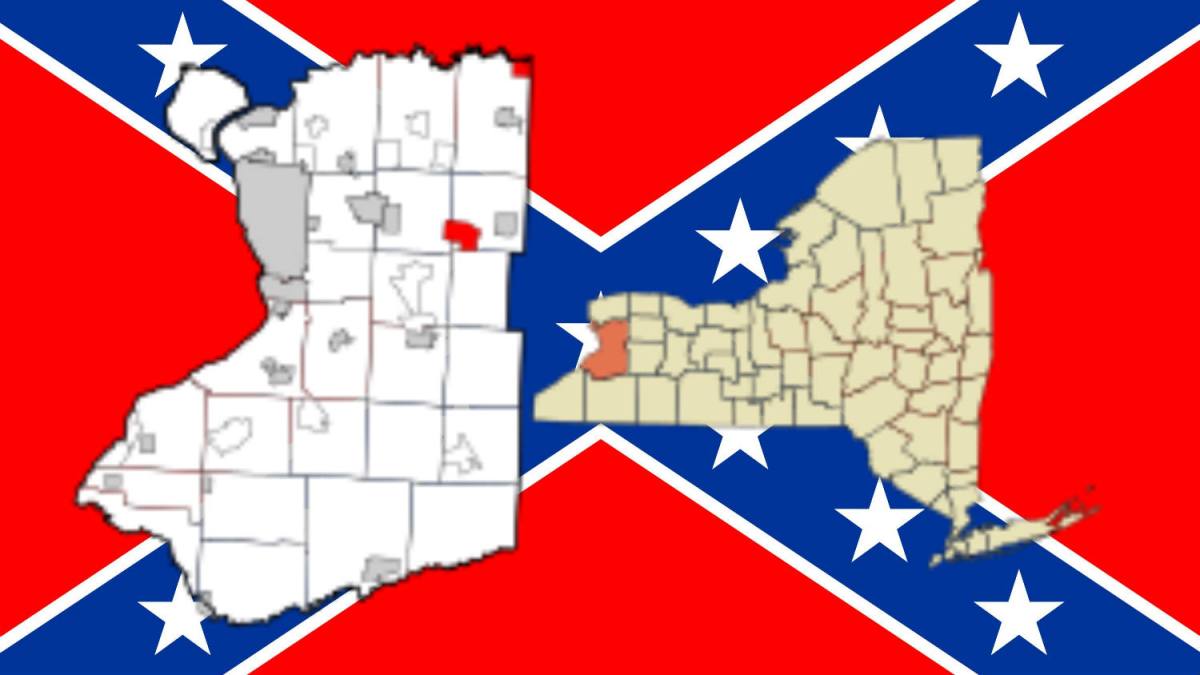
By October 1945 there legally remained only one part of the former Confederate States of America. The little hamlet of Town Line, New York.
By the early 1830s, cotton exceeded the value of all other American exports, combined. As secession loomed over the nation, a Chicago Daily Times editorial warned that if the South left “in one single blow, our foreign commerce must be reduced to less than one half of what it is now”.
South Carolina seceded in December 1860, and the world waited to see who’d follow. New York City became the next to call for secession on January 6, when Mayor Fernando Wood addressed the city’s governing body. “When Disunion has become a fixed and certain fact”, he said, “why may not New York disrupt the bands which bind her to a venal and corrupt master…and destroyed the Confederacy of which she was the proud Empire City?”
In New York city and state alike, economic ties with the south ran deep. 40¢ of every dollar paid for southern cotton stayed in New York, in the form of insurance, shipping, warehouse fees and profits.
30 minutes’ east of Buffalo, the village of Lancaster contemplated staying with the Union. 500 miles from the nearest Confederate state, George Huber remembered the time. “When war was declared, Lancaster seethed with the news, and many were the nights we stayed up as late as 12 o’clock to talk things out. I was twelve years old at the time, but I remember the stern faces of the elders and the storm of passionate and angry discussion. Soon the town split into two factions, it was a very tense situation…Often the excitement ran so high that if a man in either group had made the slightest sign, neighbors would have been at each other’s throats and fists would have taken the place of words.”
The old blacksmith shop
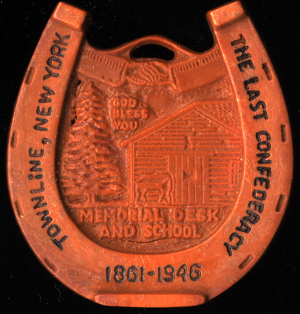
“Town Line”, a hamlet on the village’s eastern boundary, put it to a vote. In the fall of 1861, residents gathered in the old schoolhouse-turned blacksmith’s shop. By a margin of 85 to 40, Town Line voted to secede from the Union.
There was angry talk of arresting “Copperheads” for sedition, as casualty reports came back from the front. “Seceders” became quiet, afraid to meet in public amidst angry talk of lynching. A half-dozen or so more ardent secessionists went south to fight for the Confederacy. Others quietly moved north, to Canada. Outside of Lancaster, no one seemed to notice. Taxes continued to be paid. No federal force ever arrived to enforce the loyalty of the small village.
A rumor went around in 1864, that a large Confederate army was building in Canada, poised to invade from the north. Town Line became a dangerous place for the few southern sympathizers left. Most of those remaining moved to Canada and, once again, Lancaster became the quiet little village in upstate New York, that nobody ever heard of.
Impatient to get on with it, Dade County “symbolically” seceded both from Georgia as well as the Union, back in 1860. Officially, Dade County seceded with Georgia in 1861, and rejoined with the rest of the state in 1870, but the deal was sealed on July 4, 1945, when a telegram from President Harry S. Truman was read at a celebration marking Dade County’s “rejoining” the Union.
The “Confederate Gibraltar”, Vicksburg Mississippi, fell on July 4, 1863. The city wouldn’t celebrate another Independence Day for 80 years.
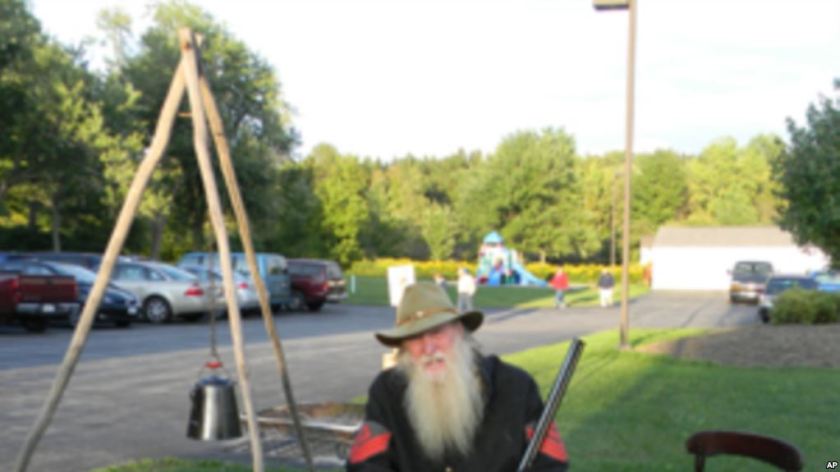
In 2011, the residents of Town Line, New York dressed up to mark the town’s sesquicentennial of secession from the Union
By October 1945 there legally remained only one part of the former Confederate States of America. The little hamlet of Town Line, New York.
Even Georgians couldn’t help themselves, from commenting. 97-year-old Confederate General T.W. Dowling said: “We been rather pleased with the results since we rejoined the Union. Town Line ought to give the United States another try“. Judge A.L. Townsend of Trenton Georgia commented “Town Line ought to give the United States a good second chance“.
A courier express note arrived on October 7, 1945. “There are few controversies that are not susceptible to a peace time resolution” read the note, “if examined in an atmosphere of tranquility and calm rather than strife and turmoil. I would suggest the possibility of roast veal as a vehicle of peace. Why don’t you run down the fattest calf in Erie County, barbecue it and serve it with fixin’s in the old blacksmith shop where the ruckus started? Who can tell? The dissidents might decide to resume citizenship.” The note was signed “Very Sincerely Yours, Harry Truman”.
Fireman’s Hall was the site of the barbecue, “The old blacksmith shop where the ruckus started” being too small for the assembled crowd. On October 28, 1945 residents adopted a resolution suspending the 1861 ordinance of secession, by a vote of 90-23. The Stars and Bars of the Confederate States of America was lowered for the last time, outside the old blacksmith shop.
Alabama member of the United States House of Representatives John Jackson Sparkman, may have had the last word: “As one reconstructed rebel to another, let me say that I find much comfort in the fact that you good people so far up in Yankee land have held out during the years. However, I suppose we grow soft as we grow older.”
If you enjoyed this “Today in History”, please feel free to re-blog, “like” & share on social media, so that others may find and enjoy it as well. Please click the “follow” button on the right, to receive email updates on new articles. Thank you for your interest, in the history we all share.
In the 1850s, then-Secretary of War Jefferson Davis was convinced that camels were the military super weapon of the future.
Due west of the Mississippi capital of Jackson and across the river from New Orleans lies the city of Vicksburg, at the confluence of the Mississippi and Yazoo Rivers. In 1863, Vicksburg was the last major stronghold of the Confederacy, along the Mississippi River. Surrounded and vastly outnumbered, the “Gibraltar of the Confederacy” held out for forty days against a far larger Union army, surrendering on July 4, 1863. The city would not celebrate another Independence Day, for 81 years.
The Cedar Hill Cemetery in Vicksburg contains some 5,000 stone markers in ‘the soldier’s rest‘, each placed in memory of one who died in defense of the city. Even the one with the camel on it.
This story begins with Jefferson Davis, in the 1840s. Today, we remember Davis as the one President of the Confederate States of America. Then, he was a United States Senator from Mississippi, with a pet project of introducing camels into the United States.
Re-introducing them might be more like it. Today, the distribution of these animals is almost the inverse of their area of origin. According to the fossil record, the earliest camelids first appeared on the North American continent, these even-toed ungulates ancestor to the Alpaca, Llama, Guanaco and Vicuña of today.
Jefferson Davis’ experiment was to be the first large-scale re-introduction of these animals on the North American continent, in geologic history.
Davis envisioned the day when every southern planter would have a stable full of camels. In the kind of pork barrel tit-for-tat spending deal beloved of Congressmen to this day, the Senator slid $30,000 into a highway appropriations bill, to get the support of a colleague from Illinois.
The measure failed but, in the 1850s, then-Secretary of War Davis persuaded President Franklin Pierce that camels were the military super weapons of the future. Able to carry greater loads over longer distances than any other pack animal, Davis saw camels as the high tech weapon of the age. Hundreds of horses and mules were dying in the hot, dry conditions of Southwestern Cavalry outposts, when the government purchased 75 camels from Algeria, Tunisia and Egypt. Several camel handlers came along in the bargain, one of them a Syrian named Haji Ali, who successfully implemented a camel breeding program. Haji Ali became quite the celebrity within the West Texas outpost. The soldiers called him “Hi Jolly”.
When Civil War broke out, Camp Verde Texas had about 60 camels. The King of Siam, (now Thailand), saw the military advantage to the Confederacy, and wrote to President Abraham Lincoln. “Here”, he wrote, “we use elephants”. The King went on to propose bringing elephants into the Northwest, to help the Union war effort. This “animal arms race” appears to have gotten no further than the King’s letter to the President, but the imagination runs wild at the idea of War Elephants at Gettysburg.
The horse lobby did a lot to kill the camel project, and the animal’s unpleasant personality traits didn’t help. A camel will not passively accept a riding crop or a whip. They are vengeful, and can spit stinking wads of phlegm with great accuracy over considerable distances. If they’re close enough, they will rake the skin off your face with their front teeth. Camels have been known to trample people to death.
Cut loose, one of those Texas camels somehow made its way to Mississippi, where he was taken into service with the 43rd Infantry Regiment, who named him “Douglas”.
“Two Civil War re-enactors discuss the use of camels by the U.S. Army and recall the story of ” Old Douglas,” the camel that was killed during the Siege of Vicksburg, during a visit by the Texas Camel Corps to the Vicksburg National Military Park in 2016″ H/T Vicksburg Post
Douglas wouldn’t permit himself to be tethered, but he always stuck around so he was allowed to graze on his own. Southern soldiers became accustomed to the sight of “Old Douglas”. The 43rd Mississippi became known as the “Camel Regiment,” but the horses never did get used to their new companion. On this day in 1862, Major General Sterling Price was preparing to face two Union armies at Iuka, when the sight of Old Douglas spooked the regimental horses. One horse’s panic turned into a stampede, injuring several of them and possibly killing one or two.
The 43rd Infantry was ordered to Vicksburg during General Ulysses S. Grant’s siege of the city, when Douglas was shot and killed by a Union sharpshooter. Enraged by the murder of their prized camel, the 5th Missouri’s commander Lieutenant Colonel Robert S. Bevier enlisted six of his best snipers, who stalked the killer until one of them had his revenge. Bevier later said of Douglas’ killer, “I refused to hear his name, and was rejoiced to learn that he had been severely wounded.”
So it is that there is a camel at the Cedar Hill Cemetery in Vicksburg, Mississippi. He is not forgotten. Douglas and other camels of the era are remembered by the Texas Camel Corps, a cross between a zoo and a living history exhibit.
The organization’s websitebegins with: “Texas Camel Corps was established to educate the public about the historic use of camels in America in the 19th century”. I just might have to check that out.
If you enjoyed this “Today in History”, please feel free to re-blog, “like” & share on social media, so that others may find and enjoy it as well. Please click the “follow” button on the right, to receive email updates on new articles. Thank you for your interest, in the history we all share.
During the “Bleeding Kansas” period, pro-slavery “Border Ruffians” and anti-slavery “Jayhawkers” crossed one another’s borders with impunity, primarily to murder each other’s civilians and burn out one another’s towns.
Lawrence, Kansas 1863
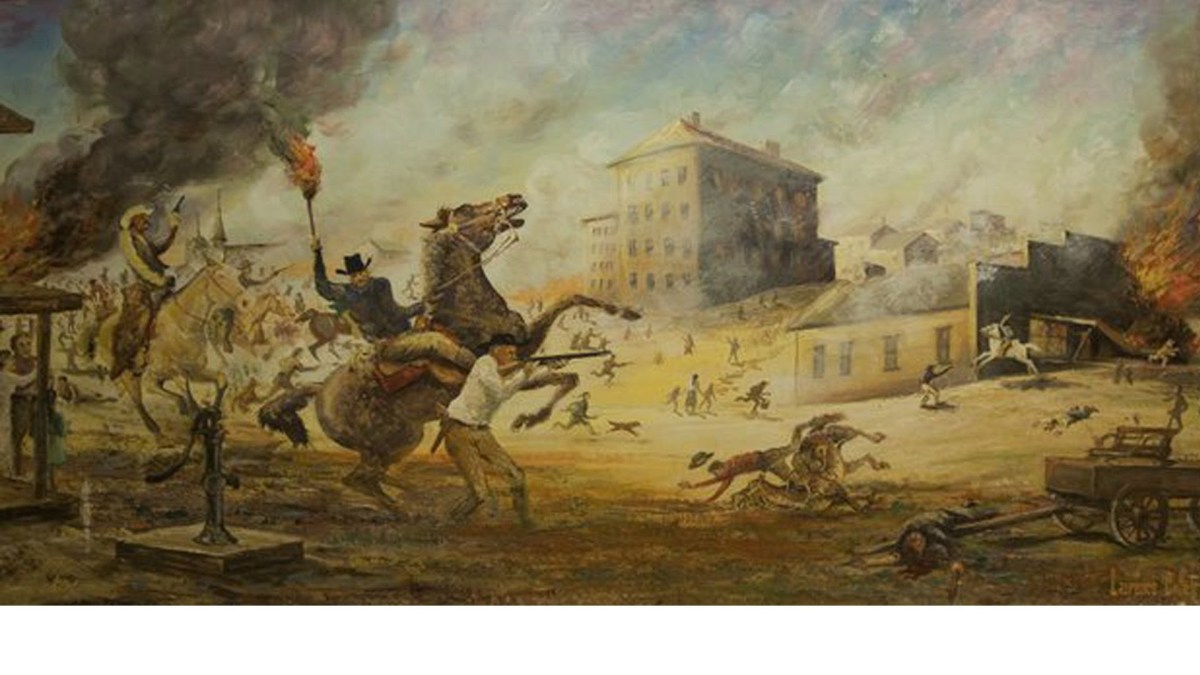
In the early morning hours of August 21, 1863, 300 to 400 riders converged in the darkness outside the city of Lawrence, Kansas.
These were a loose collection of independent “bushwacker groups”, pro-slavery and nominally Confederate, though subject to no structure of command and control.
This was a civilian group operating outside of any structured chain of command, more a gang of criminal outlaws than any military operation. There was Cole Younger and Frank James, the soon-to-be-famous Jesse’s older brother. There was William T. “Bloody Bill” Anderson, whose men were known for tying the scalps of slain Unionists to the saddles and bridles of their horses. Leading this assemblage of ruffians was a 27-year-old former schoolteacher from Ohio: William Clarke Quantrill.
Lawrence Kansas
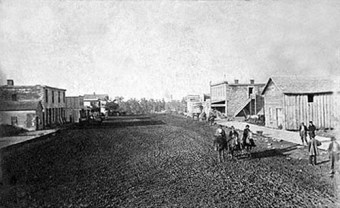
Lawrence, Kansas was mostly asleep at that hour, as several columns of riders descended on the town. It was 5:00am and pitch dark, as most of the city of 3,000 awoke to the sound of pounding hooves.
Doors were smashed in amid the sounds of gunshots and screams. Quantrill’s band went through the town, systematically shooting most of the male population.
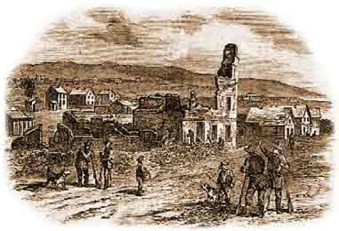
The shooting, the looting and the burning went on for four hours. Between 160 and 190 of the men and boys of Lawrence, ages 14 to 90, were murdered. Most of them had no means of defending themselves.
Intending to deprive Confederate sympathizers from their base of support, General Thomas Ewing authorized General Order No. 11 four days later, ordering that most of four counties along the Kansas-Missouri border be depopulated. Tens of thousands of civilians were forced out of their homes as Union troops came through, burning buildings, torching fields and shooting livestock.
The area was so thoroughly devastated, it would forever be known as the “Burnt District”.
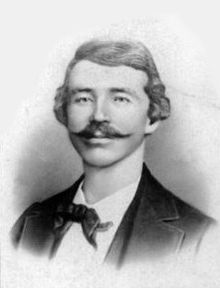
Following the raid on Lawrence, Quantrill fled to Texas and was later killed in a Union ambush, near Taylorsville Kentucky.
William Clarke Quantrill
Quantrill’s band broke up into several smaller groups, with some joining the Confederate army. Others such as Frank and Jesse James and the Younger brothers, went on to apply the hit and run tactics they had learned from Quantrill’s “army” to a career of bank and train robberies.
Quantrill himself explained the incursion as retribution, for the 1861 “Jayhawker” raid of Colonel Charles “Doc” Jennison and Senator James H. Lane, that left 9 dead in Osceola, Missouri, resulting in acres of so-called “Jennison Monuments”, the two story brick chimneys which were all that remained of the burned out homes of Union and Confederate sympathizer, alike.
Others blamed the raid on the collapse of a makeshift jail in Kansas City, that killed several female relatives of the raiders. It seems more likely that it was just one more in a series of homicidal raids carried out by both sides, such raids usually resulting in the death of innocents.
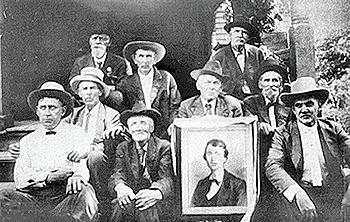
Quantrill’s Guerrillas Reunion, 1920
In 1907, newspaper articles appeared in Canada reporting that Quantrill was still alive, living on northwest Vancouver Island, under the name of John Sharp. “Quantrill” claimed to have survived that Kentucky ambush after all, despite wounds from bullet and bayonet. Sharp/Quantrill made his way south to Chile, according to the story, before drifting up north and finally become a mine caretaker at Coal Harbour at Quatsino, on the northwest coast of Vancouver Island.
The story was probably one of fiction on Mr. Sharp’s part, but the fib would prove to have unfortunate consequences. Weeks later, two men traveled north to Canada, with the apparent purpose of taking revenge. The pair took a coastal steamer out of Quatsino Sound the following morning, the day in which Sharp was found, severely beaten. John Sharp died several hours later, without identifying his attackers. The crime has never been solved.
If you enjoyed this “Today in History”, please feel free to re-blog, “like” & share on social media, so that others may find and enjoy it as well. Please click the “follow” button on the right, to receive email updates on new articles. Thank you for your interest, in the history we all share.
Named for one of it’s own private soldiers, the Mitchell Thunderbolts were not your standard military company. These guys were “organized strictly for home defense” and absolutely refused to take orders. From anyone. They recognized no superior officer and the right to criticism was reserved and freely exercised from that “splendid old gentleman” Colonel John Billups, down to the lowliest private.
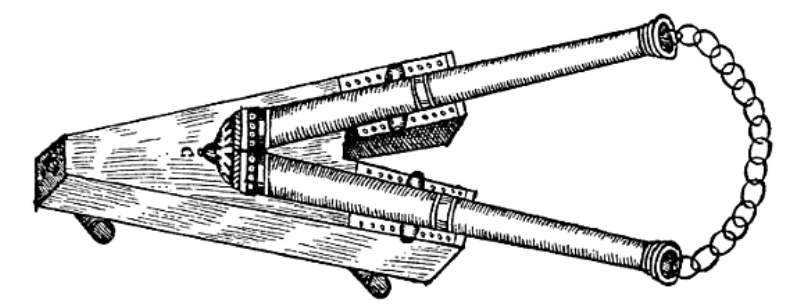
In 1642, Italian gun maker Antonio Petrini conceived a double barrel cannon, with tubes joined at 45° and firing solid shot joined together, by chain. This was the year of the “Great Rebellion“, the English Civil War, when the King and Parliament raised armies to go to war – with each other. The idea must have looked good as proposed to King Charles I of England, the weapon capable of slicing through his enemies, like grass before a scythe.
The idea was to fire both barrels simultaneously, but there was the rub. Wild ideas occur to the imagination of imperfect combustion, and a chained ball swinging around to take out the gun crew. The King himself was mute on the subject, and went on to lose his head, in 1649. Petrini’s manuscript resides to this day in the tower of London. There is no documented proof that the weapon was ever fired, save for the designer’s own description of the ‘Grandissima Ruina’ left behind, by his creation.
Two-hundred years later the former British colonies in America, found themselves embroiled in their own Civil War.
In the early days of its independence, the Confederate Congress enacted a measure, allowing local cities and towns to form semi-military companies for the purpose of local defense. As the very flower of young southern manhood was called up and sent to the front, these “home guard” units often comprised themselves of middle-age and older gentlemen, and others for various reasons, unable to leave home and hearth.
Augustus Longstreet Hull was born 1847 in “The Classic City” of Athens Georgia, and enlisted in the Confederate Army on September 8, 1864.
After the war, Hull worked twenty-seven years as a banker, before publishing the Annals of Athens, in 1906. In it, Mr. Hull writes with not a little biting wit, of his own home town home guard unit, Athens’ own, Mitchell Thunderbolts.
“From the name one might readily infer that it was a company made up of fierce and savage men, eager for the fray and ready at all times to ravage and slaughter; yet such was not the case, for in all their eventful career no harm was done to a human being, no property was seized and not one drop of blood stained their spotless escutcheon.
Thus from their patriotism sprang the “Thunderbolts”, a company whose deeds must live in order that history may be complete, whose fame, though not blazoned to the world in song and story, is yet of such a character as to entitle the names of its members to be inscribed alongside those “that were not born to die.”
Named for one of it’s own private soldiers, the Mitchell Thunderbolts were not your standard military company. These guys were “organized strictly for home defense” and absolutely refused to take orders. From anyone. They recognized no superior officer and the right to criticism was reserved and freely exercised by everyone from that “splendid old gentleman” Colonel John Billups, down to the lowliest private.
Georgia Senator Middleton Pope Barrow
General Howell Cobb sent the future United States Senator Captain Middleton Pope Barrow to Athens in 1864, to inspect the Thunderbolts. Having no intention of submitting to “inspection” by any mere stripling of a Captain, Dr. Henry Hull (Augustus’ father) “politely informed him that if he wished to inspect him, he would find him on his front porch at his home every morning at 9 o’clock“.
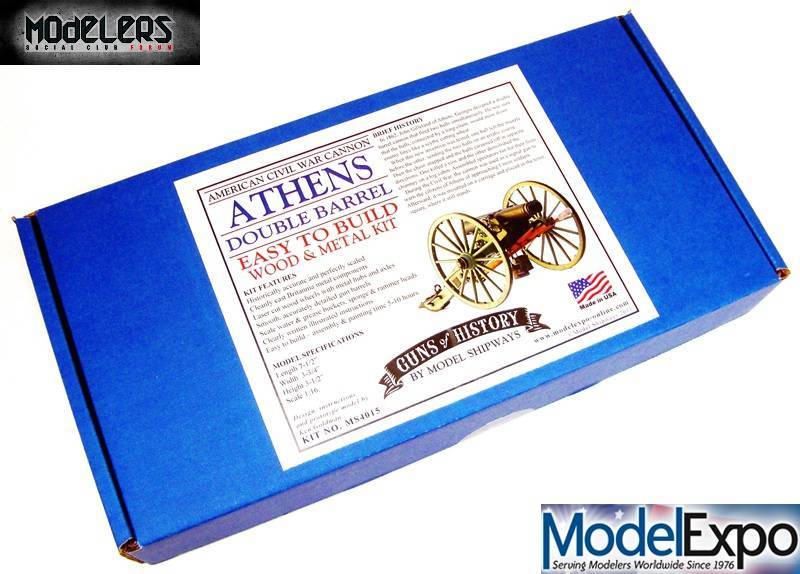
John Gilleland, 53, was a local dentist, builder and mechanic, and member in good standing of the Mitchell Thunderbolts. Gilleland must have liked Petrini’s idea because he took up a collection in 1862, and raised $350 to build the Confederate States of America’s own, double-barrel cannon.
Measuring 13 inches wide by 4-feet 8½” inches and weighing in at some 1,300 pounds, this thing had two barrels diverging at 3° and equipped with three touch holes, one for each barrel and a third should you wish to fire them, together. It was the secret “super weapon” of the age, two cannonballs connected by a chain and designed to “mow down the enemy somewhat as a scythe cuts wheat.”
As with Mr. Petrini’s invention, the insurmountable problem remained, how to fire the two, simultaneously.
The atmosphere was festive on April 22, 1862, when a crowd gathered to watch Gilleland test his creation. The weapon was aimed at two upright poles stuck into the ground, but uneven ignition and casting imperfections sent the two balls spinning wildly off to the side, where they “plowed up about an acre of ground, tore up a cornfield, mowed down saplings, and then the chain broke, the two balls going in different directions“.
Double Barrel Cannon model, H/T ModelExpo
On its second test, two chain-connected balls shot through the air and into a stand of trees. According to one witness, the “thicket of young pines at which it was aimed looked as if a narrow cyclone or a giant mowing machine had passed through“.
On the third firing, the chain snapped right out of the barrel. One ball tore into a nearby cabin and destroyed the chimney, while the other spun off and killed a cow, who wasn’t bothering anyone.
Gilleland considered all three tests successful, but the only thing that was safe, seems to have been those target posts.
The dentist went straight to the Confederate States’ arsenal in Augusta where Colonel George Rains subjected his creation to extensive testing, before reporting the thing too unreliable for military use. The outraged inventor wrote angry letters to Georgia Governor Joseph “Joe” Brown and to the Confederate government in Richmond, but to no avail.
At last, the contraption was stuck in front of the Athens town hall and used as a signal gun, to warn the citizens of approaching Yankees.
There it remained until August 2, 1864, when the gun was hauled out to the hills west of town to meet the Federal troops of Brigadier General George Stoneman. The double-barrel cannon was positioned on a ridge near Barber’s Creek and loaded with canister shot, along with several conventional guns. Outnumbered home guards did little real damage but the noise was horrendous, and Stoneman’s raiders withdrew to quieter pastures.
There were other skirmishes in the area, but all of them minor. In the end, Athens escaped the devastation of Sherman’s march to the sea, and the weapon was moved back to town.
Gilleland’s monstrosity was sold after the war and lost, for a time. The thing was recovered and restored back in 1891, and returned to the Athens City Hall, where it remains to this day, a contributing property of the Downtown Athens Historic District. Come and see it if you’re ever in Athens, right there at the corner of Hancock and College Avenue. There you will find it, pointing north, toward the Yankees. Just in case.
If you enjoyed this “Today in History”, please feel free to re-blog, “like” & share on social media, so that others may find and enjoy it as well. Please click the “follow” button on the right, to receive email updates on new articles. Thank you for your interest, in the history we all share.
There was barely a man in the regiment, who wouldn’t have walked over the proverbial “bad road & broken glass”, for that dog.
Irish Brigade Memorial sculpted by William R. O’Donovan, a former Confederate soldier who fought at Gettysburg H/T Gettysburg.stonesentinels.com
Sallie was four weeks old in 1861, when she was given as a gift to 1st Lieutenant William Terry, of the 11th Pennsylvania Volunteer Infantry. Terry made her the regimental mascot, a post she would hold for the duration of the Civil War.
Sallie was a Staffordshire Bull Terrier, or possibly a Pit Bull, brindle in color. She would tag along on long marches, and kept the men of the regiment company in their camps. She learned the drum roll announcing reveille, and loved to help wake the sleeping soldiers in the morning.
If you’ve ever had a dog in your life, you know how that goes.
There was barely a man in the regiment, who wouldn’t have walked over the proverbial “bad road & broken glass”, for that dog. Sallie’s first battle came at Cedar Mountain, in 1862. No one thought of sending her to the rear before things got hot, so Sallie took up a position along with the colors, barking ferociously at the adversary.
There she remained throughout the entire engagement, as she would do at Antietam, Fredericksburg, Chancellorsville and Spotsylvania.
Sallie, the smallest member of the 11th PA Infantry Regiment, is one of only two dogs so memorialized at Gettysburg, the only dog who was actually In the battle.
It was said that Sallie only hated three things: Rebels, Democrats, and Women.
Sallie marched with “her” soldiers in review, in the spring of 1863. Abraham Lincoln was reviewing the army at the time, when he spotted the dog from the center of the reviewing stand, and raised his famous top hat in salute.
At Gettysburg, Sallie was separated from her unit in the chaos of the first day’s fighting. They found her five days later, on July 6, parched with thirst and weakened by hunger.
She’d been standing guard over her dead and dying comrades, since July 1.
It’s been said that only a dog is capable of that kind of loyalty, yet virtue in one is capable of inspiring virtue in another. So it was on February 5, 1865. Sallie was struck in the head by a bullet at Hatcher’s Run. She was killed instantly. Several men of the 11th PA laid down their arms and buried her, right then and there. Even though they were still under fire from the Confederate side.
There is a tale about Sallie, I don’t know if it’s true. Probably not but it’s a nice story.
After the battle in which Sallie was killed, the soldiers were moving out when a small whining was heard from within a hollowed-out tree. Someone went to the tree and found several small puppies, believed to be Sallie’s. They’d had no idea that she was pregnant, or how puppies came to be in that hollowed out tree. The soldiers gave them to local civilians, so that Sallie’s bloodline might live on.
Twenty-seven years after Gettysburg, surviving veterans of the regiment returned to dedicate a memorial to those members of the 11th Pennsylvania, who lost their lives on that field of battle.
Today, 1,320 memorial statues, monuments and markers dot the landscape of the Gettysburg battlefield. Among all of them there are only two, raised in the memory of a dog. The first is a Celtic cross, erected in honor of New York’s Irish Brigade. Ironically, it is sculpted by a Confederate veteran of the battle. At the foot of the cross rests a life-sized likeness of an Irish wolfhound, symbolizing honor and fidelity..
The other includes a brindle colored Terrier, named Sallie. The only one of the two to have actually participated in the battle.
The monument depicts an upright Union soldier, rifle at the ready. By unanimous consent of the veterans themselves, Sallie’s likeness looks out from the foot of the statue, where she guards over the spirits of “her boys”, for all eternity.
“Sallie was a lady, she was a soldier too. She marched beside the colors, our own red white and blue. It was in the days of our civil war, that she lived her life so true”.
Feature image, top of page: Only known picture of Sallie, herself. Photographer unknown.
If you enjoyed this “Today in History”, please feel free to re-blog, “like” & share on social media, so that others may find and enjoy it as well. Please click the “follow” button on the right, to receive email updates on new articles. Thank you for your interest, in the history we all share.
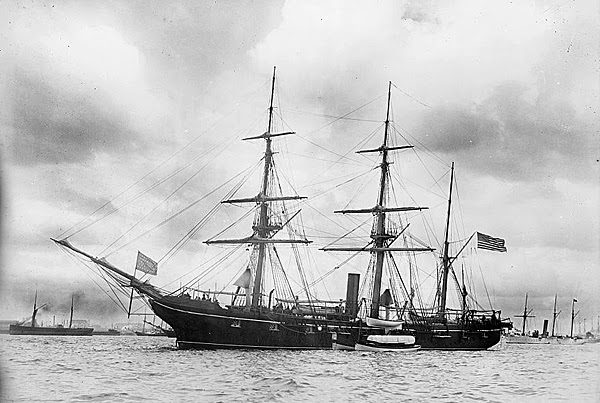
USS Kearsarge steamed further to sea as the Confederate vessel approached. There would be no one returning to port until the issue was decided.
Hull #290 was launched from the John Laird & Sons shipyard in Birkenhead, Cheshire, England as the screw sloop HMS Enrica on May 15, 1862. She sailed in secret to the Terceira Island in the Azores, where she was met by Raphael Semmes, her new captain. Three days, 8 cannon and 350 tons of coal later, the Enrica was transformed into the 220′, 1,500-ton sloop of war and Confederate States of America commerce raider, CSS Alabama.
CSS Alabama
Alabama’s mission was to wage economic war on the Union, attacking commercial shipping from the Pacific to the Indian Ocean, from Newfoundland to Brazil. In her two-year career as commerce raider, Alabama claimed 65 prizes valued at nearly $123 million in today’s dollars. She was the most successful, and most notorious, commerce raider of the Civil War.
Civil War Steam Sloop USS Kearsarge
Alabama was in sore need of a refit when she put into Cherbourg France, on the 11th of June, 1864. The Mohican-class Union steam sloop-of-war USS Kearsarge, then on patrol near Gibralter, hurried to Cherbourg, arriving on the 14th.
Captain Raphael Semmes and 1st Lieutenant John Kell aboard CSS Alabama 1863
Seeing himself blockaded, Alabama’s Captain challenged Kearsarge Captain John Winslow to a ship-to-ship duel, saying “my intention is to fight the Kearsarge as soon as I can make the necessary arrangements. I hope these will not detain me more than until to-morrow or the morrow morning at farthest. I beg she will not depart until I am ready to go out. I have the honor to be your obedient servant, R. Semmes, Captain“. That suited Winslow just fine, who took up station in international waters, and waited for Alabama to come out.
CSS Alabama steamed out of Cherbourg harbor on the morning of June 19, 1864, escorted by the French ironclad Couronne, which remained nearby to ensure that the combat remained in international waters. Kearsarge steamed further to sea as the Confederate vessel approached. There would be no one returning to port until the issue was decided.
Captain Winslow put his ship around and headed for his adversary at 10:50am. Alabama fired first from a distance of a mile, and continued to fire as the range decreased.
Sinking of the CSS Alabama, by Andy Thomas
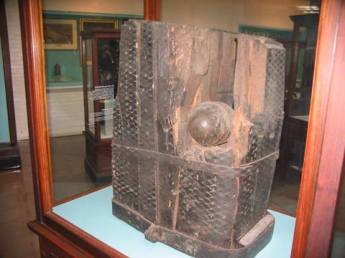
The engagement followed a circular course at a range of a half mile; the ships steaming in opposite directions and firing at will. One ball from Alabama lodged in Kearsarge’s sternpost, but failed to explode. Within an hour, Kearsarge’s 11″ Dahlgren smooth bore pivot cannons reduced the most successful commerce raider in history to a sinking wreck. Alabama turned and tried to run back to port, but Kearsarge headed her off as rising water stopped her engines.
USS Kearsarge Sternpost
Semmes struck his colors and sent a boat to Kearsarge with a message of surrender and an appeal for help.
For those rescued by Kearsarge, the Civil War was over. These would spend the rest of the war as prisoners of the Federal government. Captain Semmes escaped along with 41 others, being plucked from the water and taken to neutral ports by the British steam yacht Deerhound, and the private sail yacht Hornet.
If you enjoyed this “Today in History”, please feel free to re-blog, “like” & share on social media, so that others may find and enjoy it as well. Please click the “follow” button on the right, to receive email updates on new articles. Thank you for your interest, in the history we all share.
The issue of slavery had joined and become so intertwined with ideas of self-determination, as to be indistinguishable.
Since the earliest days of the Republic, those supporting strong federal government found themselves opposed by those favoring greater self-determination by the states. In the southern regions, climate conditions led to dependence on agriculture, the rural economies of the south producing cotton, rice, sugar, indigo and tobacco. Colder states to the north tended to develop manufacturing economies, urban centers growing up in service to hubs of transportation and the production of manufactured goods.
In the first half of the 19th century, 90% of federal government revenue came from tariffs on foreign manufactured goods. A lion’s share of this revenue was collected in the south, with the region’s greater dependence on imported goods. Much of this federal largesse was spent in the north, with the construction of railroads, canals and other infrastructure.
The debate over economic issues and rights of self-determination, so-called ‘state’s rights’, grew and sharpened with the “nullification crisis” of 1832-33, when South Carolina declared such tariffs to be unconstitutional and therefore null and void within the state. A cartoon from the time depicted “Northern domestic manufacturers getting fat at the expense of impoverishing the South under protective tariffs.”
Chattel slavery pre-existed the earliest days of the colonial era, from Canada to Brazil and around the world. Moral objections to what was really a repugnant institution could be found throughout, but economic forces had as much to do with ending the practice, as any other. The “peculiar institution” died out first in the colder regions of the US and may have done so in warmer climes as well, but for Eli Whitney’s invention of a cotton engine (‘gin’) in 1794.
It takes ten man-hours to remove the seeds to produce a single pound of cotton. By comparison, a cotton gin can process about a thousand pounds a day, at comparatively little expense.
The year of Whitney’s invention, the South exported 138,000 pounds a year to Europe and the northern states. Sixty years later, Great Britain alone was importing 600 million pounds a year from the southern states. Cotton was King, and with good reason. The stuff is easily grown, highly transportable, and can be stored indefinitely, compared with food crops. The southern economy turned overwhelmingly to the one crop, and its need for plentiful, cheap labor.
The issue of slavery had joined and become so intertwined with ideas of self-determination, as to be indistinguishable.
The first half of the 19th century was one of westward expansion, generating frequent and sharp conflicts between pro and anti-slavery factions. The Missouri compromise of 1820 attempted to reconcile the sides, defining which territories would legalize slavery, and which would be “free”.
The short-lived “Wilmot Proviso” of 1846 sought to ban slavery in new territories, after which the Compromise of 1850 attempted to strike a balance. The Kansas Nebraska Act of 1854 created two new territories, essentially repealing the Missouri Compromise and allowing settlers to determine their own direction.
This attempt to democratize the issue had the effect of drawing up battle lines. Pro-slavery forces established a territorial capital in Lecompton, while “antis” set up an alternative government in Topeka.
In Washington, Republicans backed the anti-slavery side, while most Democrats supported their opponents. On May 20, 1856, Massachusetts Senator Charles Sumner took to the floor of the Senate and denounced the Kansas-Nebraska Act. Never known for verbal restraint, Sumner attacked the measure’s sponsors Stephen A. Douglas of Illinois (he of the later Lincoln-Douglas debates), and Andrew Butler of South Carolina by name, accusing the pair of “consorting with the harlot, slavery”. Douglas was in the audience at the time and quipped “this damn fool Sumner is going to get himself shot by some other damn fool”.
In the territories, the standoff had long since escalated to violence. Upwards of a hundred or more were killed between 1854 – 1861, in a period known as “Bleeding Kansas”.
The town of Lawrence was established by anti-slavery settlers in 1854, and soon became the focal point of pro-slavery violence. Emotions were at a boiling point when Douglas County Sheriff Samuel Jones was shot trying to arrest free-state settlers on April 23, 1856. Jones was driven out of town but he would return.
Sack of Lawrence, Kansas
The day after Sumner’s speech, a posse of 800 pro-slavery forces converged on Lawrence Kansas, led by Sheriff Jones. The town was surrounded to prevent escape and much of it burned to the ground. This time there was only one fatality; a slavery proponent who was killed by falling masonry. Seven years later, Confederate guerrilla Robert Clarke Quantrill carried out the second sack of Lawrence. This time, most of the men and boys of the town were murdered where they stood, with little chance to defend themselves.
Meanwhile, Preston Brooks, Senator Butler’s nephew and a Member of Congress from South Carolina, had read over Sumner’s speech of the day before. Brooks was an inflexible proponent of slavery and took mortal insult from Sumner’s words.
Preston Brooks (left), Charles Sumner, (right)
Brooks was furious and wanted to challenge the Senator to a duel. He discussed it with fellow South Carolina Representative Laurence Keitt, who explained that dueling was for gentlemen of equal social standing. Sumner was no gentleman, he said. No better than a drunkard.
Brooks had been shot in a duel years before, and walked with a heavy cane. Resolved to publicly thrash the Senator from Massachusetts, the Congressman entered the Senate building on May 22, in the company of Congressman Keitt and Virginia Representative Henry A. Edmundson.
The trio approached Sumner, who was sitting at his desk writing letters. “Mr. Sumner”, Brooks said, “I have read your speech twice over carefully. It is a libel on South Carolina, and Mr. Butler, who is a relative of mine.”
Sumner’s desk was bolted to the floor. He never had a chance. The Senator began to rise when Brooks brought the cane down on his head. Over and over the cane crashed down, while Keitt brandished a pistol, warning onlookers to “let them be”. Blinded by his own blood, Sumner tore the desk from the floor in his struggle to escape, losing consciousness as he tried to crawl away. Brooks rained down blows the entire time, even after the body lay motionless, until finally, the cane broke apart.
In the next two days, a group of unarmed men will be hacked to pieces by anti-slavery radicals, on the banks of Pottawatomie Creek.
The 80-year-old nation forged inexorably onward, to a Civil War which would kill more Americans than every war from the American Revolution to the War on Terror, combined.
If you enjoyed this “Today in History”, please feel free to re-blog, “like” & share on social media, so that others may find and enjoy it as well. Please click the “follow” button on the right, to receive email updates on new articles. Thank you for your interest, in the history we all share.



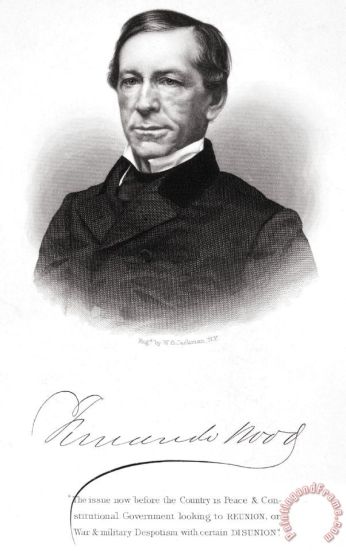 South Carolina seceded in December 1860, and the world waited to see who’d follow. New York City became the next to call for secession on January 6, when Mayor Fernando Wood addressed the city’s governing body. “When Disunion has become a fixed and certain fact”, he said, “why may not New York disrupt the bands which bind her to a venal and corrupt master…and destroyed the Confederacy of which she was the proud Empire City?”
 A courier express note arrived on October 7, 1945. “There are few controversies that are not susceptible to a peace time resolution” read the note, “if examined in an atmosphere of tranquility and calm rather than strife and turmoil. I would suggest the possibility of roast veal as a vehicle of peace. Why don’t you run down the fattest calf in Erie County, barbecue it and serve it with fixin’s in the old blacksmith shop where the ruckus started? Who can tell? The dissidents might decide to resume citizenship.” The note was signed “Very Sincerely Yours, Harry Truman”.
![4b4cf0f864c3dabcdb_IMG_7326[1]](https://todayinhistory.blog/wp-content/uploads/2018/10/4b4cf0f864c3dabcdb_img_73261.jpg?w=684&h=513)


 Jefferson Davis’ experiment was to be the first large-scale re-introduction of these animals on the North American continent, in geologic history.


 Intending to deprive Confederate sympathizers from their base of support, General Thomas Ewing authorized General Order No. 11 four days later, ordering that most of four counties along the Kansas-Missouri border be depopulated. Tens of thousands of civilians were forced out of their homes as Union troops came through, burning buildings, torching fields and shooting livestock.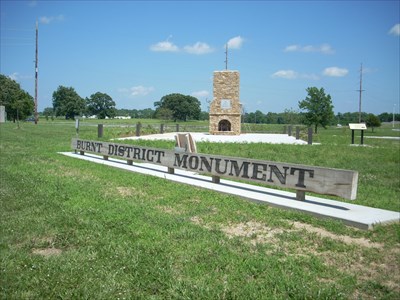


 Augustus Longstreet Hull was born 1847 in “The Classic City” of Athens Georgia, and enlisted in the Confederate Army on September 8, 1864.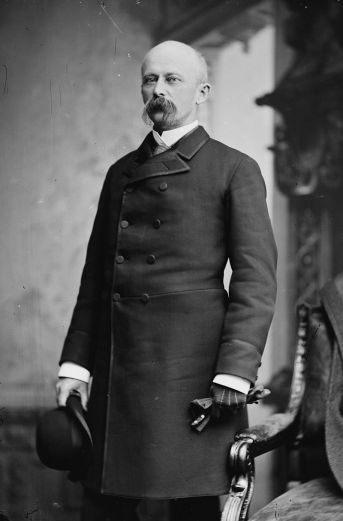
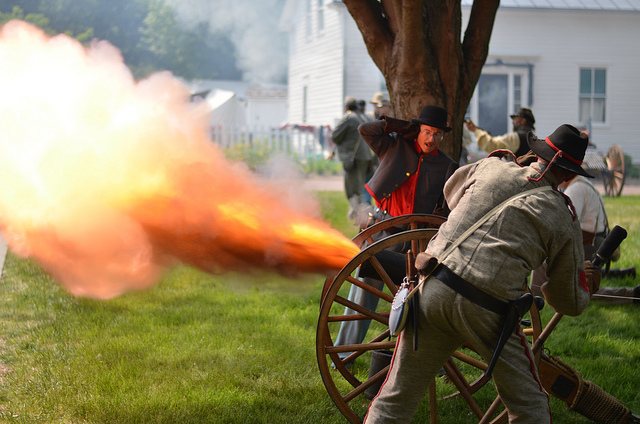


 Twenty-seven years after Gettysburg, surviving veterans of the regiment returned to dedicate a memorial to those members of the 11th Pennsylvania, who lost their lives on that field of battle.
 The other includes a brindle colored Terrier, named Sallie. The only one of the two to have actually participated in the battle.

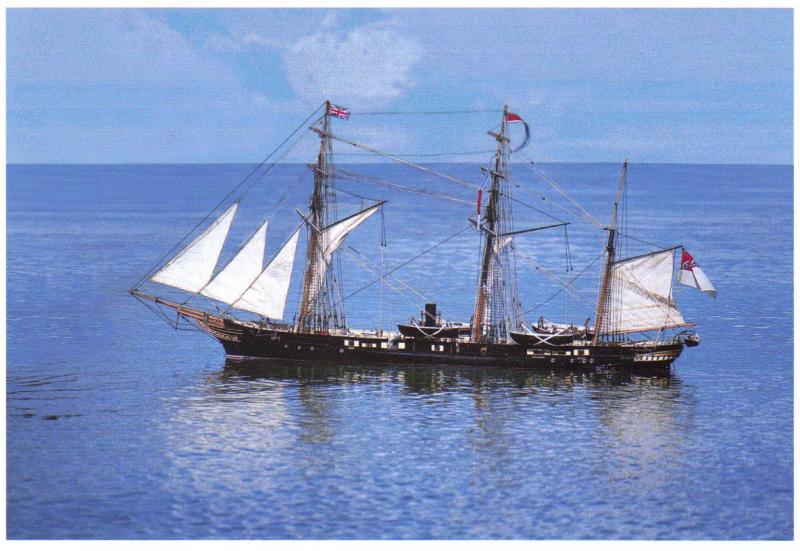

 CSS Alabama steamed out of Cherbourg harbor on the morning of June 19, 1864, escorted by the French ironclad Couronne, which remained nearby to ensure that the combat remained in international waters. Kearsarge steamed further to sea as the Confederate vessel approached. There would be no one returning to port until the issue was decided.
 Captain Winslow put his ship around and headed for his adversary at 10:50am. Alabama fired first from a distance of a mile, and continued to fire as the range decreased.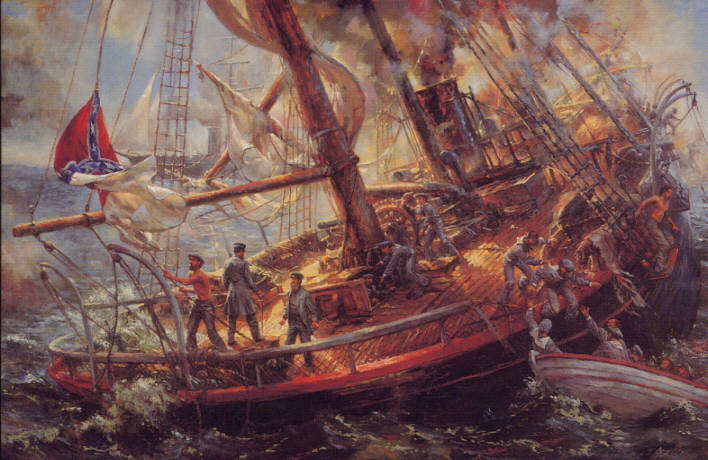


 In the first half of the 19th century, 90% of federal government revenue came from tariffs on foreign manufactured goods. A lion’s share of this revenue was collected in the south, with the region’s greater dependence on imported goods. Much of this federal largesse was spent in the north, with the construction of railroads, canals and other infrastructure.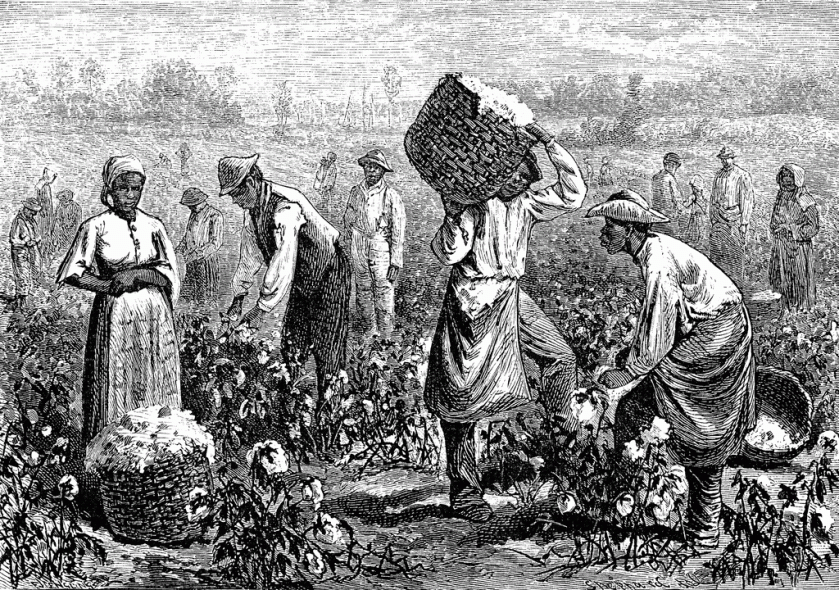
 The issue of slavery had joined and become so intertwined with ideas of self-determination, as to be indistinguishable.
 In Washington, Republicans backed the anti-slavery side, while most Democrats supported their opponents. On May 20, 1856, Massachusetts Senator Charles Sumner took to the floor of the Senate and denounced the Kansas-Nebraska Act. Never known for verbal restraint, Sumner attacked the measure’s sponsors Stephen A. Douglas of Illinois (he of the later Lincoln-Douglas debates), and Andrew Butler of South Carolina by name, accusing the pair of “consorting with the harlot, slavery”. Douglas was in the audience at the time and quipped “this damn fool Sumner is going to get himself shot by some other damn fool”.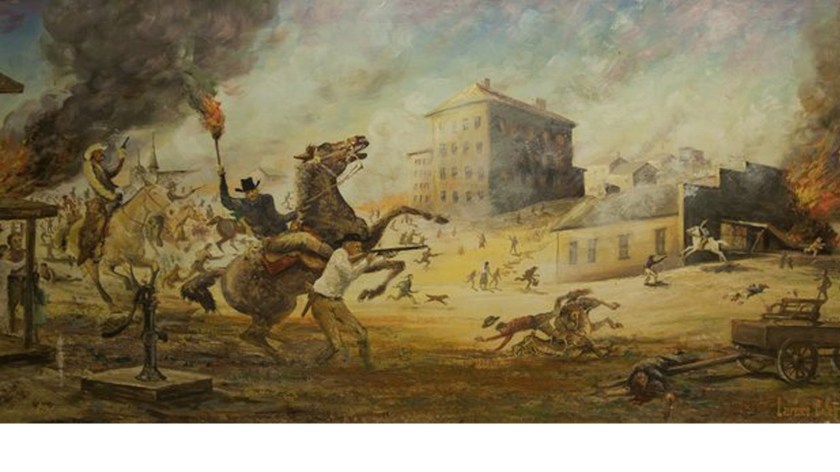


 The trio approached Sumner, who was sitting at his desk writing letters. “Mr. Sumner”, Brooks said, “I have read your speech twice over carefully. It is a libel on South Carolina, and Mr. Butler, who is a relative of mine.”
 In the next two days, a group of unarmed men will be hacked to pieces by anti-slavery radicals, on the banks of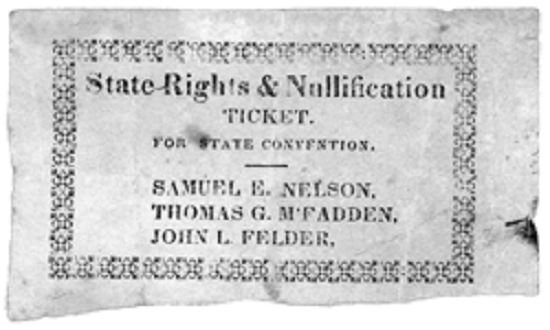

 Historical Easter Eggs - Today in History
You must be logged in to post a comment.