The business model discussed in Tom Peters’ book involves over-the-top Customer Service, in contradistinction to what so many companies put us through in our everyday lives. There is a business lesson there, for those who would learn it.
As the story goes it was 1853, at an upscale resort in Saratoga Springs New York. A wealthy and somewhat unpleasant customer sent his fried potatoes back to the kitchen, complaining that they were too soggy, and didn’t have enough salt. George Crum, the cook, wasn’t the most pleasant of guys himself, and thought he’d fix this customer. He sliced some potatoes as thin as a dime, fried them up and doused the hell out of them, with salt. Sending them out to the table and fully expecting the customer to choke, Crum was astonished to learn that the customer loved them. He ordered more, and George Crum decided to add “Saratoga Chips” to the menu. The Potato Chip was born.
Herman Lay was a brilliant marketer, even from a young age. Born on this day in 1909, Lay opened a Pepsi Cola stand on his front lawn at the age of 11. When the city ballpark across the street was charging ten cents for a Pepsi, Lay charged a nickel.
Lay became a lumberjack, a jewelry salesman, and a peanut salesman, before going to work for the Atlanta based Barrett Potato Chip Company. He traveled the Southeast during the Great Depression in his Model A Ford, selling chips to grocery stores, gas stations and soda shops. When the company’s owner died, Lay raised $60,000 and bought the company’s plants in Atlanta and Memphis.
By this time, potato farmers had developed a low moisture “chipping potato”, because other types tended to shrink too much in processing. Other inventions like the mechanical potato peeler, the continuous fryer and sealed bags helped “chippers” of the 30s and 40s ship their products farther than ever before.
Lay began buying up small regional competitors at the same time that another company specializing in corn chips, was doing the same. “Frito”, the Spanish word for “fried”, merged with Lay in 1961 to become – you got it – Frito-Lay. By 1965, Lay’s was the #1 potato chip brand sold in every state.
Procter & Gamble figured out how to put a potato chip in a can, using dehydrated potato flakes and calling them “Pringles”. Potato chip manufacturers lobbied Congress to prevent the new snacks from being called “potato chips” and Federal officials offered Pringles a compromise, allowing them to be called “chips made from dried potatoes.” Procter & Gamble said no thanks, instead branding their product “potato crisps”.
Ironically, P&G would later sue to have Pringles declared NOT to be a potato chip, to avoid millions in British Commonwealth taxes levied on products “made from the potato, or from potato flour.”
The biggest threat that Frito-Lay would ever experience came from the Beer giant Anheuser-Busch, when the company introduced their “Eagle” line of salty snacks in the 1970s. It made perfect sense at the time, a marketing and distribution giant expanding into such a complementary product category, what could go wrong? Frito-Lay profits dropped by 16% by 1991 and PepsiCo laid off 1,800 employees, but Eagle Snacks never turned a profit in 16 years. Anheuser-Busch put the company up for sale in 1995.
According to the Snack Food Association’s 2012 state of the industry report, Americans spent $9 billion on potato chips in 2010, more than the gross domestic product of the bottom 57 countries, on earth.
Tom Peters wrote about Frito-Lay in his 1982 book “In Search of Excellence”. The company will spend $150 to make a $30 delivery if that’s what they need to do. Their customer is counting on them. While a transaction like that doesn’t make economic sense, the company prides itself on a 99½% on-time delivery record. Frito-Lay has the highest profit margins in the industry and a 60% market share in an “undifferentiated commodity”, in which their closest competitor has 7%.
The business model discussed in Tom Peters’ book involves over-the-top Customer Service, in contradistinction to what so many companies put us through in our everyday lives. There is a business lesson there, for those who would learn it.
If you enjoyed this “Today in History”, please feel free to re-blog, “like” & share on social media, so that others may find and enjoy it as well. Please click the “follow” button on the right, to receive email updates on new articles. Thank you for your interest, in the history we all share.
Benjamin Franklin may have had the last word on the collectivist nonsense which afflicts to this day, when he asked “If an Indian injures me, does it follow that I may revenge that Injury on all Indians?”
The Seven Years War, experienced in the American Colonies as the French and Indian War, ended in 1763 with France ceding vast swaths of territory to the British.
Unlike their English counterparts, the French had cultivated friendships with their Indian allies. Many had married native women and been adopted into tribes. There were annual gifts of blankets, firearms and other European manufactured goods. The British under North American Governor-General Lord Jeffrey Amherst ceased such gifts, treating indigenous populations with contempt as English fortifications were built and settlers moved into traditional native lands.
The first grumblings among the tribes coalesced around a native visionary known only as the “Delaware Prophet”, who preached for a return to traditional ways and a rejection of the British. The cause was taken up by the Ottawa chieftain Pontiac (c.1720-1769). A powerful speaker, Pontiac’s message resonated with the Delaware, Seneca, Chippewa, Miami, Potawotomi and Huron, among others. The full-scale uprising known as “Pontiac’s Rebellion” broke out in May, 1763.
Indigenous nations of the time divided more along ethnic and linguistic rather than political lines, so there was no monolithic policy among the tribes. At least one British fort was taken with profuse apologies by the Indians, who explained that it was the other nations making them do it.
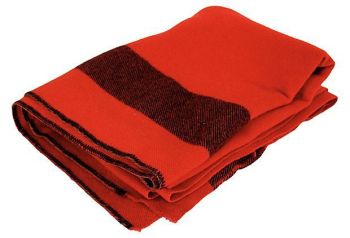
The brutality of the period was anything but one-sided. The British “gift” of smallpox-infected blankets wasn’t the first instance of biological warfare in history, but this may be one of the nastier ones.
The siege of Fort Detroit beginning on May 7 was ultimately unsuccessful, but a series of attacks on smaller fortifications beginning two weeks later would all result in Indian victories. The fifth and largest of these fortifications, Fort Michilimackinac in present-day Mackinaw City, Michigan, was the largest such fort, and it was taken by surprise.
Siege of Fort Detroit
Local Ojibwas staged a game of baaga’adowe on June 2, (an early form of lacrosse), with the visiting Sauks in front of the fort.
Native American stickball had many variations, but the object was to hit a stake or other object with a “ball”. The ball was a stone wrapped in leather, handled with one or sometimes two sticks. There could be up to several hundred contestants to a team, and the defenders could employ any means they could think of to get at the ball, including hacking, slashing or any form of physical assault. Lacerations and broken bones were commonplace. It wasn’t unheard of that stickball players died on the field. The defending team could likewise employ any method they liked to keep the opposing team off of the ball carrier. The game took place on a field that could range from 500 yards to several miles.
Soldiers at Fort Michilimackinac enjoyed the game, as they had on earlier occasions. When the ball was hit through the open gate, both teams rushed in as native women handed out weapons previously smuggled into the fort. Fifteen of the 35-man garrison were killed in the ensuing struggle. Five others were tortured to death.
Three more forts were taken in a second wave of attacks, when survivors took to the shelter of Fort Pitt, in Western Pennsylvania.
Here’s when the chapter is written, about the smallpox blankets. The episode has taken on aspects of legend and remains the subject for debate, to this day.
Smallpox had broken out at this time, among the besieged garrison at Fort Pitt. At a June 24 parlay, Captain Simeon Ecuyer, a 22-year veteran Swiss mercenary in the British service, gave besieging Lenape warriors several items taken from smallpox patients. Ecuyer wrote that “We gave them two blankets and a handkerchief out of the smallpox hospital”. Captain William Trent of the garrison militia later wrote in his journal: “I hope it will have the desired effect.”
This appears to be the only documented case of such a tactic, but the stratagem was by no means disapproved. The use of smallpox infected items was discussed in positive terms between Amherst and another Swiss mercenary, Colonel Henry Bouquet, but the siege at Fort Pitt was ended by more conventional means.
Some sixty to eighty Ohio valley Indians died of the disease following the Fort Pitt episode, but the outbreak appears isolated. Meanwhile, Indian warriors had looted clothing from some 2,000 outlying settlers they had killed or abducted.
Six years earlier, native Americans ignored terms of surrender negotiated between their French allies and English at Fort McHenry in upstate New York, and broke into the garrison hospital, killing and scalping a number of patients. At least some of these were suffering from smallpox. The episode reportedly touched off an outbreak among native populations.
The siege of Fort Pitt culminated in a bloody fight on August 5, when an incoming relief force of some 500 troops met the Indian besieging force at the bloody Battle of Bushy Run.
Battle of Bushy Run, August 5, 1763
All the while, Delaware and Shawnee war bands raided deep into Pennsylvania territory. Panicked settlers fled eastward, as unknown numbers of men, women and children were killed or taken captive. The “Paxton Boys”, a group of Scots-Irish frontiersman from the modern-day Harrisburg area, murdered some twenty Conestoga, a mostly Christian band of subsistence hunters and farmers who had nothing whatever to do with the fighting.
Many of these peaceful Indians fled east to Philadelphia for protection. Several hundred Paxton residents marched on the city in January, 1764.
1841 lithograph depicts the massacre of Conestoga Indians by the “Paxton Boys”, in December 1763
The presence of British troops and Philadelphia militia prevented further violence, as Benjamin Franklin met with leaders of the two sides to negotiate an end to the crisis. Mr. Franklin may have had the last word on the collectivist nonsense which afflicts to this day, when he asked “If an Indian injures me, does it follow that I may revenge that Injury on all Indians?”
Pontiac’s Rebellion ended in a draw, in 1765. The savagery inflicted on both sides meant that segregation and not interaction, would characterize relations between Indians and whites.
The British Royal Proclamation of October 7, 1763, drew a line between the British colonies and Indian lands, creating a vast Indian Reserve stretching from the Appalachians to the Mississippi River and from Florida to Newfoundland. For the Indian Nations, this was the first time that a multi-tribal effort had been launched against British expansion, the first time such an effort had not ended in defeat.
The British government had hoped through such a proclamation to avoid conflicts like Pontiac’s Rebellion, but the decree had the effect of alienating colonists against the Crown.
For native Americans, the terrible smallpox epidemic of 1837 – ’38 all but wiped out the Mandan and decimated the Arikara and Hidatsa, Missouri River bands who farmed corn, beans & squash and hunted buffalo only as a sideline. Estimates of the number killed in the epidemic range from 17,200 to an implausible high of 150,000, merging with the blanket episode of seventy-five years earlier and spawning a narrative of deliberate white genocide against indigenous Americans.
Smaller bands of isolated plains Indians were less hard hit, tipping the balance and forever altering the world’s ideas of what American Indians, looked like. Works Progress Administration murals from the 1930s depict Pilgrims interacting with coastal tribesmen, wearing Sioux war bonnets and war shirts decorated with glass beads. No Lenape, Wampanoag, Pokanoket or Nauset of the time would have so much as recognized such an outfit, let alone dress that way.
If you enjoyed this “Today in History”, please feel free to re-blog, “like” & share on social media, so that others may find and enjoy it as well. Please click the “follow” button on the right, to receive email updates on new articles. Thank you for your interest, in the history we all share.
There are stone engravings depicting teams of hogs hauling war chariots. I wonder what that sounded like.
The first dog may have approached a campfire looking for a morsel, or someone could have taken in a sick or wounded pup. A wolf pack may have learned to shadow human hunting parties, the two groups learning to work together for their mutual benefit. Two social, hierarchically organized species such as humans and wolves, would have found themselves on familiar ground.
The earliest known evidence of a domesticated dog comes to us from a cave in Iraq and dates to about 12,000 years ago. The specimen differs from that of a wolf, in that it was bred to have smaller jaws and teeth
It may be hard to imagine but, Canis lupus, the wolf, is the ancestor of the modern dog, Canis familiaris. Every one of them, from Newfoundlands to Chihuahuas.
Ovis aries, sheep, were the next to be domesticated, probably in the Middle East. They provided milk, meat and the warmth of wool from around 8000BC.
Sus scrofa (the pig) was domesticated around 6000 BC throughout the Middle East and China. Pigs were originally used as draft animals. There are stone engravings depicting teams of hogs hauling war chariots. I wonder what that sounded like.
Bossie made her debut at a couple of points in history, females providing milk and meat and castrated males providing the massive strength and capacity for work, of the ox. Over time, different branches of Bos primigenius came into domestication. The branch which came to be known as Bos taurus, the domestic cattle seen in the US today, began about 8,000 years ago in the Middle East. Bos indicus, the familiar humped cattle seen throughout modern day India and Pakistan, came around about 2,000 years later.
The animal making the greatest impact on Mankind entered the picture around 4000-3500BC on the Eurasian steppes near Dereivka, in central Ukraine. Equus caballus, the horse, provided milk, meat, shelter and transportation, as well as an endless capacity for work. From farm carts to war chariots, the horse could haul a load faster and over a greater distance, than any animal of its time.
Heck Horse
The first domesticated horse was called a Tarpan, a steppe sub-species which is now extinct, at least in the wild. The “Heck Horse” is a breed claimed to resemble the extinct wild Tarpan or Equus ferus ferus, created by the German zoologist brothers Heinz and Lutz Heck. The first Heck horse, a stallion named Duke, was exported to the United States in 1954, followed by two mares in 1955 and a third in 1962.
Today most camels are domesticated, except for a few of the Bactrian (two humps) variety surviving in the Gobi Desert. Wild camels originated in North America, and were wiped out during the spread of Native Americans from Asia into North America between 8000 and 10000BC.
Early camelids spread across the Bering land bridge, moving the opposite direction from the Asian immigration to America, surviving in the Old World and eventually becoming domesticated and spreading globally by humans. The first “camelids” became domesticated about 4,500 years ago in Peru: The “New World Camels” the Llama and the Alpaca, and the “South American Camels”, the Guanaco and the Vicuña.
Of the only two surviving true camels, Dromedaries may have first been domesticated by humans in southern Arabia, around 3000 BC, and the Bactrian in central Asia, about five hundred years later.
Genetic analysis of the modern house cat, Felis silvestris catus, suggests that every one of them descends from one of five wild feline ancestors: the Sardinian, European, Central Asian, Subsaharan African, or the Chinese desert cat.
The first depiction of a cat wearing a collar appears on a tomb in the ancient Egyptian burial ground of Saqqara, dated 2500-2350 BC, however there is archaeological evidence of domesticated cats on the Greek island of Cyprus, as early as 7500BC.
If you enjoyed this “Today in History”, please feel free to re-blog, “like” & share on social media, so that others may find and enjoy it as well. Please click the “follow” button on the right, to receive email updates on new articles. Thank you for your interest, in the history we all share.
It’s been said of the American civil war and could no doubt be said of any number of conflicts, that a generation of women had to accustom themselves to new ideas of male ‘beauty’.
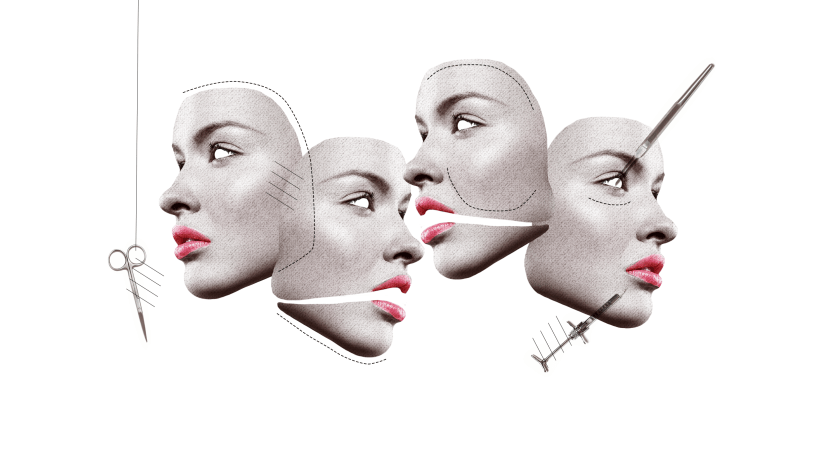
For many, the mention of ‘cosmetic surgery’ conjures images of vanity. The never-ending and inevitably fruitless attempt to stave off the years. Add some here and take it off over there. But what of the face left smashed and misshapen, burned or blown half off in service to country?
“Plastic” Surgery, the term comes to us from the Greek Plastikos and first used by the 18th century French surgeon Pierre Desault, has been with us longer than you might expect. Evidence exists of Hindu surgeons performing primitive ‘nose jobs’, as early as BC800-600. The Renaissance-era surgeon Gaspare Tagliacozzi (1545-1599) developed new methods of reconstruction, using the patient’s own arm skin to replace noses slashed off in swordplay.
Lt. William M. Spreckley of the Sherwood Foresters was Dr. Gillies’ 132nd patient, admitted to the hospital in January 1917 at the age of 33 with a ‘GSW, Nose”. He was discharged 3½ years later.
A hillside battle at a place called Hastings changed the world in 1066 yet, if you were on the next hillside, you may not have heard a thing. The industrialized warfare of the 19th and 20th century was vastly different, involving entire populations and inflicting unprecedented levels of destruction on the human form.
It is beyond horrifying what modern warfare can do to the human form
It’s been said of the American civil war and is no doubt true of any number of conflicts, that a generation of women had to accustom themselves to new ideas of male ‘beauty’. The ‘Great War’ of 1914 – ‘18 was particularly egregious when it came to injuries to the face, neck and arms, as millions of soldiers burrowed into 450-mile-long trench lines to escape what German Private Ernst Jünger described as the “Storm of Steel”.
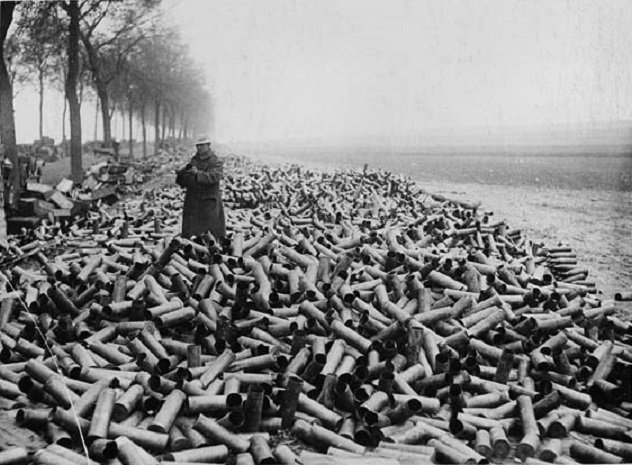
In the Battle of Verdun, German forces used 1,200 guns firing 2.5 million shells supplied by 1,300 ammunition trains to attack their Allied adversary on the First Day, alone.
For every soldier killed in the Great War, two returned home, maimed. Artillery was especially malevolent, with “drumfire” so rapid as to resemble the rat-a-tat-tat of drums, each blast sending thousands of jagged pieces of metal, shrieking through the air.
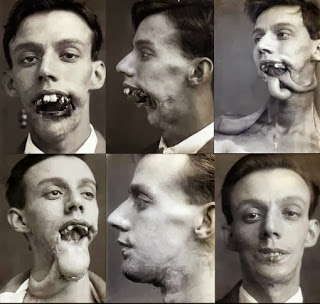
For many, severe facial disfigurement was a fate worse than amputation. Worse than death, even. To have been grievously wounded in service to country and return home to be treated not as a wounded warrior, but as something hideous.
The untold human misery of having been turned into a monster, misshapen and ugly. For these men, life often became one of ostracism and loneliness. The painful stares of friends and strangers alike, repelled by such disfiguration, offtimes lead to alcoholism, divorce and suicide.
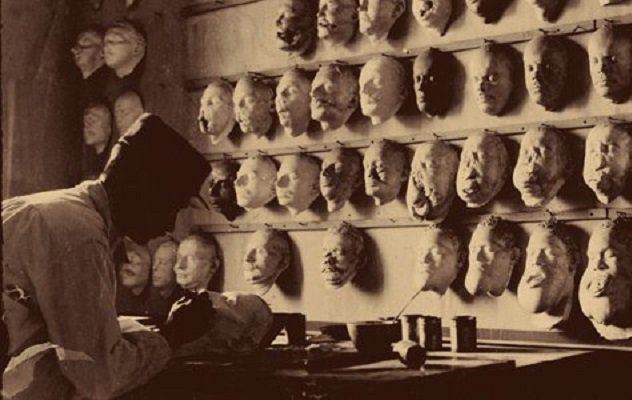
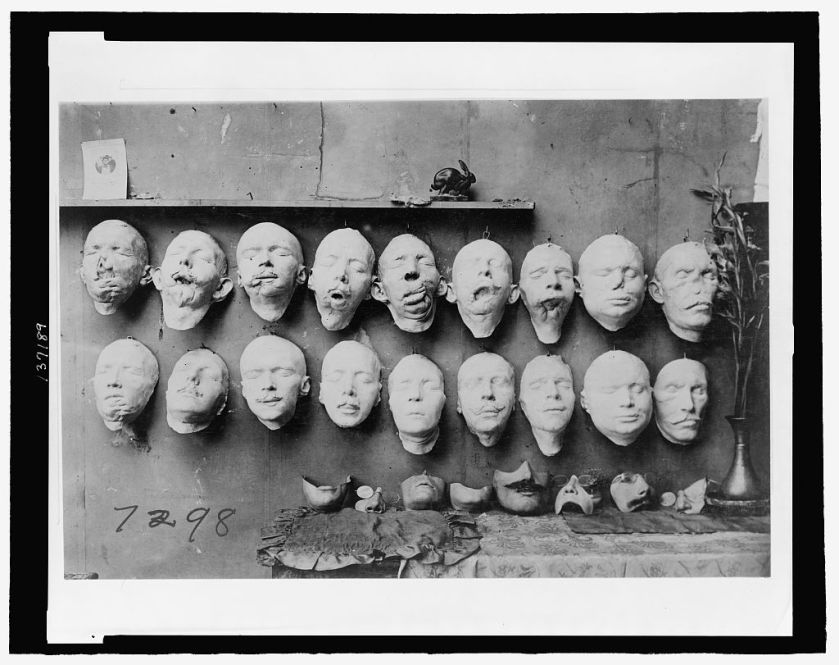
Manchester Massachusetts sculptor Anna Coleman Ladd moved to France in 1917. Inspired by the work of British artist Francis Derwent Wood and his “tin noses shop”, Ladd founded the “Studio for Portrait-Masks” of the Red Cross in Toul, to provide cosmetic prosthetics for men disfigured by the war.
Ladd’s prostheses were uncomfortable to wear, but her services earned her the Légion d’Honneur Croix de Chevalier and the Serbian Order of Saint Sava.
The New Zealand-born otolaryngologist Dr. Harold Gillies was shocked at the human destruction, while working with the French-American dental surgeon Sir August Charles Valadier on new techniques of jaw reconstruction and other maxillofacial procedures.
The interior of the Plastic Theatre at the Queen’s Hospital. Dr Gillie is seated, on the right
The sterile medical notation “GSW (gunshot wound) Face” does not begin to prepare the mind for a horror more closely resembling a highway roadkill, than the face of a living man. I left the worst of such images out of this essay. They’re easy enough to find on-line, if you’re interested in seeing them. The medical science is fascinating, but the images are hard to look at.
Dr. Gillies watched the renowned French surgeon Hippolyte Morestin, a man known as “The Father of the Mouths” after multiple breakthroughs in oral surgery, remove a tumor and use the patient’s own jaw-skin, to repair the damage.
Joseph Pickard, of the 5th Northumberland Fusiliers, before and after Dr. Gillies. H/T Daily Mail
Gillies understood the importance of the work, and spoke with British Chief Surgeon Sir William Arbuthnot Lane. The conversation lead to a 1,000-bed facial trauma ward at Queen Mary’s Hospital in Sidcup, Kent, opened in June, 1917.
The largest naval battle of the Great War, the Battle of Jutland, unfolded between May 31 and June 1, 1916, involving 250 ships and some 100,000 men.
The Queen Elizabeth-class battleship HMS Warspite took fifteen direct hits from German heavy shells, at one point having no rudder control and helplessly turning in circles.
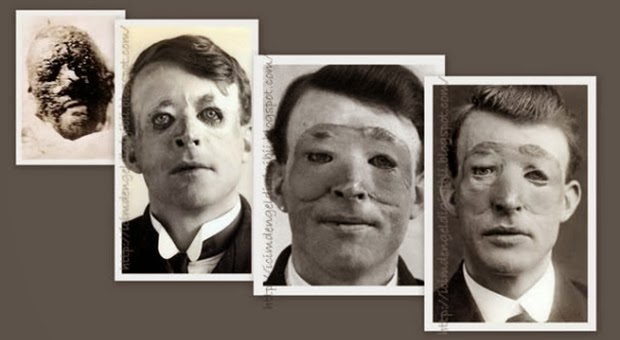
Petty Office Walter Yeo
Petty Officer Walter Yeo was manning the guns aboard Warspite and received terrible injuries to his face, including the loss of upper and lower eylids, and extensive blast and burn damage to his nose, cheeks and forehead.
When all else failed, there were the facial prosthetics. The masks.
Yeo was admitted to Queen Mary’s hospital the following August, where he was treated by Dr. Gillies and believed to be the first recipient of a full facial graft taken from another part of his own body.
Dr. Gillies & Co. developed surgical methods in which rib cartilage is first implanted in foreheads, and then swung down to form the foundational structure of a new nose.
At a time before antibiotics, tissue grafts could be as dangerous as the trenches themselves. “Tubed pedicles” were developed to get around the problem of infection, where living tissue and its blood supply was rolled into tubes and protected by the natural layer of skin. These tubes of living tissue weren’t pretty to look but were relatively safe from infection. When the patient was ready, new tissue could be “walked” into place, become whole new facial features.
Dr. Harold Gelf Gillies, the Father of modern plastic surgery, performed more than 11,000 such procedures with his colleagues, on over 5,000 individuals. Work continued well after the war and through the mid-twenties, developing new and important surgical techniques.
Dr. Gillies received a knighthood for his work in 1930 and, during the inter-war years, trained many other Commonwealth physicians on his surgical methods. Just in time to send the following generation, off to the next war.
If you enjoyed this “Today in History”, please feel free to re-blog, “like” & share on social media, so that others may find and enjoy it as well. Please click the “follow” button on the right, to receive email updates on new articles. Thank you for your interest, in the history we all share.
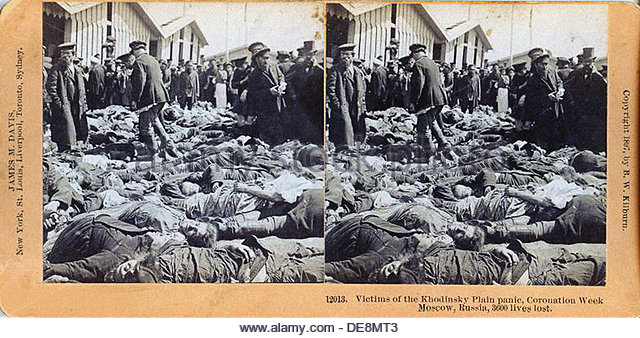
When it was over, 1,389 people had been trampled to death, and another 1,300 injured.
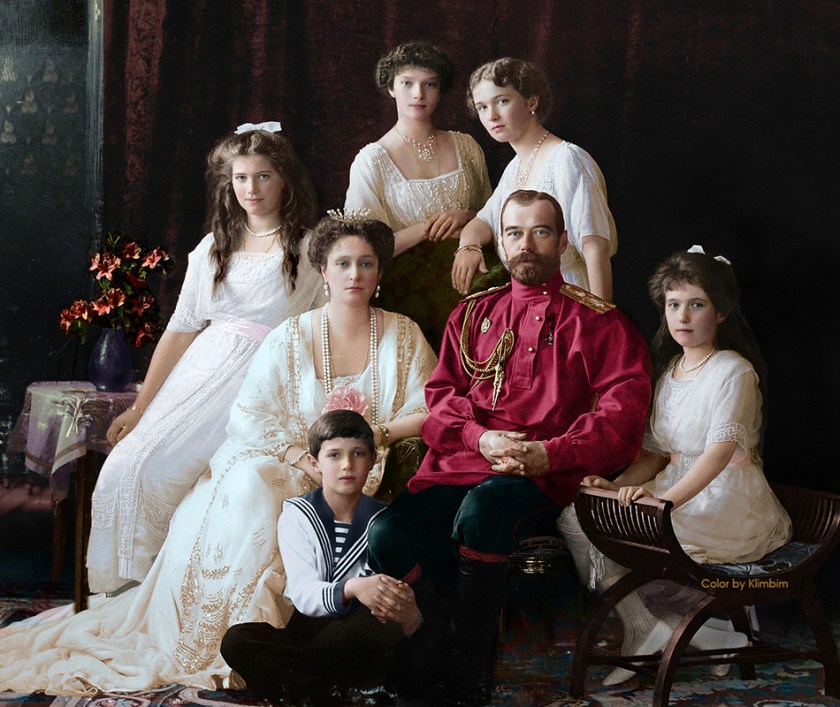
On May 26, 1896 according to the Gregorian calendar, Tsar Nicholas II, known as Saint Nicholas II to the Russian Orthodox Church, was crowned Tsar of Russia. The traditional celebration banquet was scheduled for May 30 at a large open space to the northwest of Moscow, called Khodynka Field.
It was customary that gifts be given to the guests of such a celebration. There were commemorative scarves and ornately decorated porcelain cups, bearing the ciphers of Nicholas and Alexandra opposite the double-headed symbol of the Imperial dynasty, the Romanov eagle.
There were food gifts as well, bread rolls and sausages, pretzels, gingerbread, and a cup of beer. 150 buffets and 20 pubs were constructed, to handle their distribution.
Revelers began to gather on the 29th. By 5:00am on the 30th, the crowd was a half-million strong, and growing.
Khodynka field was a poor venue for such an event, the crowd far larger than could be safely handled. A military training ground, the plain before the speaker’s podium was pocked and lined with trenches and pits.
Rumors began to spread among the crowd. There wasn’t enough beer to go around. Those enameled cups, already a great novelty for the time, each contained a gold coin.
The crowd became a mob and began to surge forward, as rumors grew and spread. An 1,800-man police force was inadequate to maintain order. The crush of the crowd grew into a panic, and then became a human stampede.
1,389 people were trampled to death in the rout, another 1,300, injured.
The new Czar and Czarina didn’t hear about the disaster at first but, when they did, the royal couple spent the rest of the day visiting their subjects in hospital.
Nicholas thought it best not to attend a ball put on that night by the French embassy, fearing that it would make him appear insensitive to the suffering of his people. The Tsar’s advisers persuaded him to go, however, and later events proved him correct.
There was great public indignation over the disaster at Khodynka field, despite generous subsidies paid to victims, by the Russian government. Despite his best efforts, Tsar Nicholas became ‘Bloody Nicholas”, to the Russian people. For the Tsarina, that enameled coronation cup more closely resembled a ‘Cup of Sorrows “.
Mystics prophesied that Nicholas’ refusal to decline the invitation would lead to his doom. J. Balmont wrote in 1905 that “Who started his reign with Khodynka, will finish it by mounting the scaffold”.
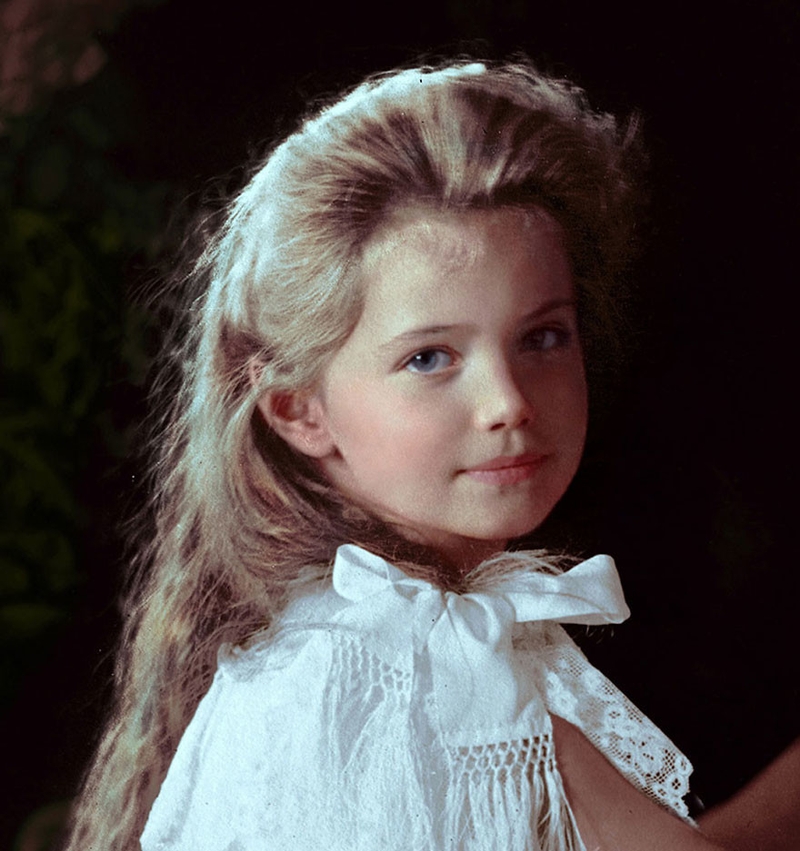
Hat tip to the Russian artist known as ‘Klimbims’, for her work in colorizing these vintage images
Tsar Nicholas was murdered by order of the Ural regional Soviet in Yekaterinburg on July 17, 1918. The Tsarina, the couple’s five children, servants, dogs and a number of individuals who had chosen to accompany the Imperial family into imprisonment, were shot, bayoneted and clubbed to death.
Great countess Maria Vladimirovna.
It was the end of the Romanov Dynasty, the end of Czarist Russia. The malignant ideology which arose to take its place, would murder more of its own civilians, than any system of government, in history.
If you enjoyed this “Today in History”, please feel free to re-blog, “like” & share on social media, so that others may find and enjoy it as well. Please click the “follow” button on the right, to receive email updates on new articles. Thank you for your interest, in the history we all share.
Then-Major Dwight D. Eisenhower was one of MacArthur’s aides at the time. Eisenhower believed that it was wrong for the Army’s highest ranking officer to lead an action against fellow war veterans. “I told that dumb son-of-a-bitch not to go down there”, he said.
In 1924, the United States Congress passed the “World War Adjusted Compensation Act”, promising cash bonuses to veterans of the “Great War” in which the nation had been involved between 1917 and ’18.
3,662,374 military service certificates were issued to qualifying veterans, bearing a face value equal to $1 per day of domestic service and $1.25 a day for overseas service, plus interest. Total face value of these certificates was $3.638 billion, equivalent to $43.7 billion in today’s dollars and coming to full maturity in 1945.
The Great Depression was two years old in 1932, and thousands of veterans had been out of work since the beginning. Certificate holders could borrow up to 50% of the face value of their service certificates, but direct funds remained unavailable for another 13 years.
On May 29, WWI veterans began to arrive in Washington to press their case for immediate cash redemption, setting up encampments between the Capitol and the Lincoln Memorial, and around Washington DC. Former Army sergeant Walter W. Waters led the group, which called itself the “Bonus Expeditionary Force” after the AEF of the late war. True to form, the Media insultingly dubbed them the “Bonus Army”.
This had happened before. Hundreds of Pennsylvania veterans of the Revolution had marched on Washington in 1783, after the Continental Army was disbanded without pay.
On that occasion the Congress fled to Princeton New Jersey, and the Army was called up to expel war veterans from the Capitol. Washington, DC was later excluded from the restrictions of the Posse Comitatus Act of 1878, making it the only part of the United States where the military may be used for domestic police activity.
17,000 veterans and their families, 43,000 all told, gathered in and around Washington. Men, women and children living in tents or in make-shift shelters built out of old lumber, packing boxes and scrap tin scavenged from nearby junkyards.
The House passed a bill to redress the situation, which went to the Senate for a vote on June 17, a day one newspaper described as “the tensest day in the capital since the war.” 10,000 marchers crowding the Capitol grounds responded with stunned silence when they got the news. The Senate had voted it down, 62 to 18. “Sing America and go back to your billets”, said Waters, and so they did. Marchers would hold a silent vigil in front of the Capitol until July 17, the day that Congress adjourned.
Marchers and their families were in their camps on July 28 when Attorney General William Mitchell ordered them evicted. Two policemen became trapped on the second floor of a building when they drew their revolvers and shot two veterans, William Hushka and Eric Carlson, both of whom died of their injuries.
President Herbert Hoover ordered the Army under General Douglas MacArthur to evict the Bonus Army from Washington. 500 Cavalry formed up on Pennsylvania Avenue at 4:45pm, supported by 500 Infantry, 800 police and six battle tanks under the command of then-Major George S. Patton. Civil Service employees came out to watch as bonus marchers cheered, thinking that the Army had gathered in their support.
And then the Cavalry was ordered to charge. The infantry followed with tear gas and fixed bayonets, entering the camps and evicting men, women and children alike.
Bonus marchers fled to their largest encampment across the Anacostia River, when President Hoover ordered the assault stopped. Feeling that the Bonus March was an attempt to overthrow the government, General MacArthur ignored the President and ordered a new attack, the army routing 10,000 and leaving their camps in flames. 1,017 were injured and 135 arrested.
The wife of one veteran miscarried. 12-week old Bernard Myers died after being caught in the gas attack. A government investigation later claimed he died of inflammation of the small intestine, but a hospital employee said the tear gas “didn’t do it any good.”
Then-Major Dwight D. Eisenhower was one of MacArthur’s aides at the time. Eisenhower believed that it was wrong for the Army’s highest ranking officer to lead an action against fellow war veterans. “I told that dumb son-of-a-bitch not to go down there”, he said.
The bonus march debacle doomed any chance that Hoover had of being re-elected. Franklin D. Roosevelt opposed the veterans’ bonus demands during the election, but was able to negotiate a solution when veterans organized a second demonstration in 1933. Roosevelt’s wife Eleanor was instrumental in these negotiations, leading one veteran to quip: “Hoover sent the army. Roosevelt sent his wife”.
If you enjoyed this “Today in History”, please feel free to re-blog, “like” & share on social media, so that others may find and enjoy it as well. Please click the “follow” button on the right, to receive email updates on new articles. Thank you for your interest, in the history we all share.
So it is that the name of the elite warrior who had served under three flags, a man who once wore the uniform of the Nazi SS, is engraved on that stone in Arlington, along with those of the South Vietnamese warriors with whom he once served.
There is a surprise or two, hidden among the 400,000+ grave sites, at Arlington National Cemetery. Did you know, for instance, that 4,000 former slaves went to their final rest there? Arlington is the only cemetery in the world, to hold American servicemen from every war in US history. Three graves contain the remains of enemy combatants, from WW2. Among them all there may no greater curiosity, than the grave of a Green Beret, interred with the remains of three South Vietnamese soldiers. Unless it’s to learn that that same guy, once wore the uniform of the Nazi SS.
In May 1941, the geopolitical map of the Eurasian continent could be drawn in two colors, the spheres of influence of governments headed by two of the great monsters of the 20th century: Josef Stalin’s Soviet Union, and the Nazi Germany of Adolf Hitler.
The Republic of Finland, the 8th largest nation on the European landmass with a population equal to that of Minnesota, suffered military defeat during the “Winter War” of a year earlier, a 105-days long David vs. Goliath contest fought against the Soviet Union.
The two dictators were allies at this time according to the terms of the Molotov-Ribbentrop pact, signed two years earlier. That state of affairs ceased the following month, with ‘Operation Barbarossa’, Hitler’s surprise attack on his erstwhile ally.
Finland never signed the Tripartite Pact with Nazi Germany and stated that it would fight the Soviets only insofar as to redress territorial losses suffered during the Winter War. Adolf Hitler saw the distinction as irrelevant and regarded the Nordic republic as an ally. To Hitler, Finland would become just another part of the war on the Eastern Front. To Finnish patriots, the uneasy alliance with Nazi Germany and the continued struggle with the Soviet Union, would be known as the “Continuation War’.
Lauri Törni (center) stands among other soldiers near Lake Tolvajärvi in Russia, date unknown
Lauri Alan Törni was such a patriot, born this day in 1919 in Finland’s Viipuri Province. Törni fought the Soviet Union during the Winter War and the Continuation War, rising to the rank of Captain and earning the Mannerheim Cross, Finland’s equivalent to the British Victoria Cross, or the American Medal of Honor. An elite and highly effective guerrilla fighter, Törni trained with the Nazi SS in Austria. Such a menace was this man to Stalin’s war effort, that the Soviets placed a bounty on his head of three million Finnish marks, equivalent to $650,000. There is no record of such a bounty on any other Finnish soldier.
Törni in Waffen-SS uniform, 1941
The Continuation War came to an end in September 1944, but Törni still had scores to settle with the Communists. He joined forces with a German unit fighting Soviet troops near Schwerin, Germany, and surrendered to British and American forces in the last stages of WW2.
Törni escaped the British POW camp and returned to Finland, only to be arrested on charges of treason for having joined the German army. There would be a six-year prison sentence and one more escape, before the Presidential pardon in 1948.
Traveling under alias as a Swedish seaman, Törni jumped overboard in the Gulf of Mexico, swimming ashore near Mobile, Alabama and claiming political asylum. He was granted citizenship in 1953 by special act of congress, and adopted the more “Americanized” name of Larry Thorne, joining the United States Army the following year.
Thorne was soon headed to Special Forces, the elite warrior becoming an instructor of skiing, mountaineering, survival and guerrilla tactics.
Thorne attended airborne school and earned the silver wings of a Green Beret. He went through Officer Candidate School and received his commission as a 1st Lieutenant, rising to the rank of Captain in just three years.
Larry Thorne had a reputation for physical toughness, even amidst such an elite organization as the Green Berets. Now in his mid-forties, he could physically out-perform many men half his age.
As part of the 10th Special Forces Group, Thorne served in a search-and-rescue capacity in West Germany, earning a reputation for courage in operations to recover bodies and classified documents, following a plane in the Zagros Mountains of Iran.
Captain Thorne was sent to Vietnam in 1963, assigned to operate Civilian Irregular Defense Group (CIDG) camps at Châu Lăng and later Tịnh Biên. Thorne earned two Purple Hearts and a Bronze Star for valor during one particularly ferocious attack on Tịnh Biên, an episode author Robin Moore wrote about in his best-selling paperback, The Green Berets.
On October 18, 1965, Larry Thorne was leading a covert mission against a Viet Cong stronghold in Laos when his helicopter crashed, killing all on board. He was 46. Captain Thorne was posthumously promoted to the rank of major and awarded the Legion of Merit and Distinguished Flying Cross. Let the citation tell his story:
“If the patrol were immediately confronted by a superior force, Major Thorne would land and extricate the patrol under fire. This was done with total disregard for the inherent dangers and with selfless concern for the ground forces. In so doing, he exposed himself to extreme personal danger which ultimately led to his disappearance and the loss of his aircraft. He had, however, guaranteed the safe introduction of the patrol into the area, the successful accomplishment of this mission and had positioned himself to react to any immediate calls for assistance from the patrol“.
The crash site of the Republic of Vietnam Air Force CH-34 helicopter was discovered in 1999. Thorne’s remains were found, intermingled with those of Lieutenant Bao Tung Nguyen, First Lieutenant The Long Phan, and Sergeant Vam Lanh Bui. Major Thorne was identified by dental records.
Thorne’s family in Finland said let him be buried in America, because that was the choice that he made. The four were buried with full military honors in Arlington National Cemetery, the way they had died. Together.
So it is that the name of the elite warrior who had served under three flags, a man who once wore the uniform of the Nazi SS, is engraved on that stone in Arlington, along with those of the South Vietnamese warriors with whom he once served.
If you enjoyed this “Today in History”, please feel free to re-blog, “like” & share on social media, so that others may find and enjoy it as well. Please click the “follow” button on the right, to receive email updates on new articles. Thank you for your interest, in the history we all share.
By day 9 of the evacuation, 338,226 soldiers had been rescued from the beach. For those, the “Miracle of Dunkirk” ended on June 4. For approximately 40,000 British and another 40,000 French soldiers left behind in the confusion, a special kind of hell had just begun.
The Nazi conquest of Europe began with the Sudetenland in 1938, the border districts of Bohemia, Moravia, and German speaking parts of Czechoslovakia. Within two years, every major power on the European mainland was either neutral, or under Nazi occupation.
The island nation of Great Britain alone escaped occupation, but British armed forces were shattered and defenseless in the face of the German war machine.
In May 1940, the British Expeditionary Force (BEF) and what remained of French forces occupied a sliver of land along the English Channel. Field Marshall Gerd von Rundstedt called a halt of the German armored advance on May 24. Reichsmarschall Hermann Göring urged Hitler to stop the ground assault, and let the Luftwaffe finish the destruction of the adversary. On the other side of the channel, Admiralty officials combed every boatyard for miles, for boats to ferry its people off of the beach.
Hitler ordered his Panzer groups to resume the advance on May 26, while a National Day of Prayer was declared at Westminster Abbey. That night Winston Churchill ordered “Operation Dynamo”. One of the most miraculous evacuations in military history had begun from the beaches of Dunkirk.
The battered remnants of the French 1st Army fought a desperate delaying action against the advancing Germans. They were 40,000 men against seven full divisions, 3 of them armored. They held out until May 31 when, having run out of food and ammunition, the last 35,000 finally surrendered. Meanwhile, a hastily assembled fleet of 933 vessels large and small began to withdraw the broken army from the beaches.
Larger ships were boarded from piers, while thousands waded into the surf and waited in shoulder deep water for smaller vessels. They came from everywhere: merchant marine boats, fishing boats, pleasure craft, lifeboats and tugs. The smallest among them was the 14’7″ fishing boat “Tamzine”, now in the Imperial War Museum.
A thousand copies of navigational charts helped organize shipping in and out of Dunkirk, as buoys were laid around Goodwin Sands to prevent strandings. Abandoned vehicles were driven into the water at low tide, weighted down with sand bags and connected by wooden planks, forming makeshift jetties.
7,669 were evacuated on the first full day of the evacuation, May 27, and none too soon. The following day, members of the SS Totenkopf Division marched 100 captured members of the 2nd Battalion of the Royal Norfolk Regiment off to a pit, and machine gunned the lot of them. A group of the 2nd Battalion of the Royal Warwickshire Regiment were captured that same day, herded into a barn and murdered with grenades.
Troops wait in the rubble of Dunkirk, for rescue
By day 9 of the evacuation, 338,226 soldiers had been rescued from the beach. For those, the “Miracle of Dunkirk” ended on June 4. For approximately 40,000 British and another 40,000 French soldiers left behind in the confusion, a special kind of hell had just begun.
Most light equipment and virtually all heavy equipment had to be left behind, just to get what remained of the allied armies out alive. But now, with the United States still the better part of a year away from entering the war, the allies had a military fighting force that would live to fight on.
Winston Churchill delivered a speech that night to the House of Commons, calling the events in France “a colossal military disaster”. “[T]he whole root and core and brain of the British Army”, he said, had been stranded at Dunkirk and seemed about to perish or be captured. In his “We shall fight on the beaches” speech of June 4, Churchill hailed the rescue as a “miracle of deliverance”.
On the home front, thousands of volunteers signed up for the “stay behind” mission, expected to follow. With German invasion all but imminent, their mission was to go underground and disrupt and destabilize the invaders, in any way they could. These were to be the British Resistance, a guerrilla force reportedly vetted by a senior Police Chief so secret that, the man was to be garroted in case of invasion, to prevent membership in the units from being revealed. Many were issued suicide pills in case of capture yet, thanks to these men and women, Great Britain was the only nation of the WW2 era to have a fully operational resistance, BEFORE occupation.
Participants in these auxiliaries were not allowed to tell their families what they were doing, or where they were. They generally passed themselves off as Home Guard, a home defense organisation operated by the British Army. Bob Millard, who passed away in 2014 at the age of 91, said they were given 3 weeks’ rations. Even Josephine, Millard’s wife of 67 years, didn’t know a thing about the auxiliaries until their reunion, in 1994. “You just didn’t talk about it, really”, he said. “As far as my family were aware I was still in the Home Guard. It was all very hush hush. After the war, it was water under the bridge”.
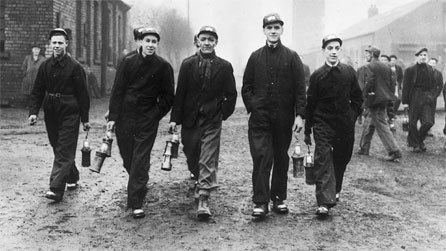
Another under-recognized group from the period are the young men conscripted to serve in the coal mines of the United Kingdom. One in ten conscripts of the time received not a uniform, but the hard hat and steel-toed boot of the coal miner. Often maligned as “Conchies” (conscientious objectors) or worse, these were held in service for as long as two years after the war, condemned to live the life of the Troglodyte with no expectation of peacetime jobs being held for them, as for those who served in uniform.
“Bevin Boys” of WW2
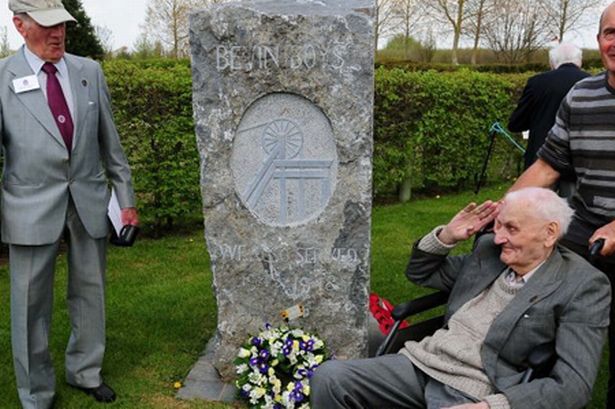
These “Bevin Boys”, so-called after Minister of Labor Ernest Bevin, would wait decades for recognition of their contribution to the war effort, full acceptance coming only as the result of a speech given by Queen Elizabeth II, fifty years after VE Day.
The word “Cenotaph” literally translates as “Empty Tomb”, in Greek. Every year since 1919 and always taking place on the Sunday closest to the 11th day of the 11th month, the Cenotaph at Whitehall is the site of a remembrance service, commemorating British and Commonwealth servicemen and women who died in the conflicts of the 20th century. Since WWII, the march on the Cenotaph includes an ever-decreasing number of Home Guard and the Bevin Boys, without whom the war effort would have ground to a halt.
In 2013, five short years ago, the last surviving auxiliers joined their colleagues, proudly marching past the Cenotaph for the very first time. Historians from the Coleshill Auxiliary Research Team (CART) had been trying to do this for years.
CART founder Tom Sykes said: “After over 70 years of silence, the veterans of the Auxiliary Units and Special Duties Section, now more than ever, deserve to get the official recognition that has for so long been lacking. ‘They were, in this country’s hour of need, willing to give up everything, families, friends and ultimately their lives in order to give us a fighting chance of surviving“.
Memorial to wartime ‘Bevin Boys’ unveiled in Staffordshire
They are so young and so few, who pick up the tab on behalf of the rest of us.
If you’ve raised a child, you are well acquainted with the triumphs and the terrors of giving those little tykes the sword with which they will conquer their world.
We all have those special dates we mark on the calendar. The birthdays. The anniversaries. For some among us, there are other dates. Moments in time, which very few of us are required to remember. Dates which not one of us wants to recall.
Most of us go about our business, knowing but at the same time forgetting, that we are a nation at war. There are families among us, who must mark such a date every year. The date when that child was taken from us.
On June 21, 2006, Sergeant Jared Monti’s 16-man patrol was ambushed by a 50-member force of insurgents, on a high mountain ridge in Afghanistan. Pfc. Brian Bradbury, 22, was mortally wounded early in the fight, and lay on open ground close to the enemy position.
Never a man to leave a fallen comrade behind, twice Sergeant Monti exposed himself to overwhelming fire from three sides, in the attempt to rescue Private Bradbury. A rocket-propelled grenade ended the third such attempt. Jared Monti was 30.
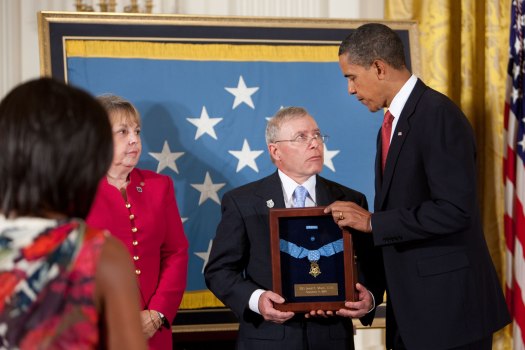
In 2011, Army Sergeant First Class Jared Christopher Monti was awarded the Medal of Honor for the action which took his life. The first Massachusetts soldier so honored, since the war in Vietnam.
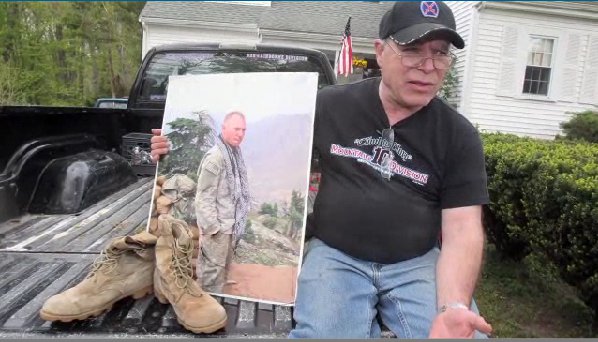
The following year, singer songwriter Lee Brice released “I drive your truck”, a song that went to country music song of the year in 2014. The “I” in the title, though he didn’t know it at the time, is Paul Monti, Jared’s father and a retired science teacher at Stoughton High School, in Massachusetts.
It’s Jared’s truck.
Several years ago, Paul was denied permission to place a flag on his son’s grave, at the National Cemetery in Bourne, here on Cape Cod. The authorities don’t like to be left cleaning things up.
Paul took it up the chain of command until he received permission. He could put the flag in, as long as he agreed to take it out a week later.
And that’s what he did. On every grave in the Bourne National Cemetery.
Today, ‘Operation Flags for Vets‘ is a semi-annual event, recurring on Memorial Day and again on Veteran’s day weekends. Later this morning, upwards of two thousand volunteers can be expected to join with the Monti family to place flags on every one of over 70,000 graves in the Massachusetts National Cemetery. A week later, they’ll be removed.
There is something that restores and recharges my soul, to be in the company of so many Patriots.
.
Medal of Honor citation
“For conspicuous gallantry and intrepidity at the risk of his life above and beyond the call of duty:
Jared Monti’s Medal of Honor presented to members of his family by the President of the United States, 2011
“Staff Sergeant Jared C. Monti distinguished himself by acts of gallantry and intrepidity above and beyond the call of duty while serving as a team leader with Headquarters and Headquarters troop, 3rd Squadron, 71st Cavalry Regiment, 3rd Brigade Combat Team, 10th Mountain Division, in connection with combat operations against an enemy in Nuristan Province, Afghanistan, on June 21st, 2006. While Staff Sergeant Monti was leading a mission aimed at gathering intelligence and directing fire against the enemy, his 16-man patrol was attacked by as many as 50 enemy fighters. On the verge of being overrun, Staff Sergeant Monti quickly directed his men to set up a defensive position behind a rock formation. He then called for indirect fire support, accurately targeting the rounds upon the enemy who had closed to within 50 meters of his position. While still directing fire, Staff Sergeant Monti personally engaged the enemy with his rifle and a grenade, successfully disrupting an attempt to flank his patrol. Staff Sergeant Monti then realized that one of his soldiers was lying wounding on the open ground between the advancing enemy and the patrol’s position. With complete disregard for his own safety, Staff Sergeant Monti twice attempted to move from behind the cover of the rocks into the face of relentless enemy fire to rescue his fallen comrade. Determined not to leave his soldier, Staff Sergeant Monti made a third attempt to cross open terrain through intense enemy fire. On this final attempt, he was mortally wounded, sacrificing his own life in an effort to save his fellow soldier. Staff Sergeant Monti’s selfless acts of heroism inspired his patrol to fight off the larger enemy force. Staff Sergeant Monti’s immeasurable courage and uncommon valor are in keeping with the highest traditions of military service and reflect great credit upon himself, Headquarters and Headquarters Troop, 3rd Squadron, 71st Calvary Regiment, 3rd Brigade Combat Team, 10th Mountain Division, and the United States Army”.
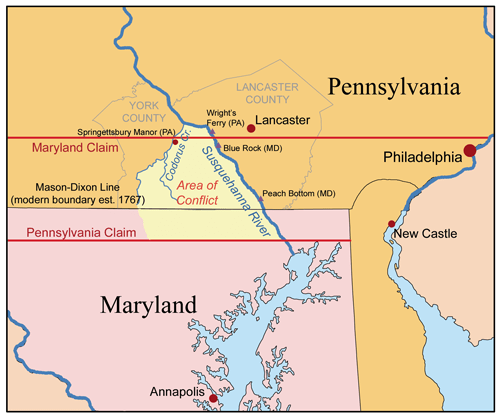
The problem comes about when you realize that 40° north latitude is north of Philadelphia, well into territory controlled by the Maryland colony.
The Pennsylvania Charter of 1681 specifies the southern boundary of the colony to be “A circle drawne at twelve miles distance from New Castle Northward and Westward unto the beginning of the fortieth degree of Northern Latitude, and then by a streight Line Westward“.
The problem comes about when you realize that 40° north latitude is north of Philadelphia, well into territory controlled by the Maryland colony.
Maryland insisted on the boundary as drawn by the Charter, while Pennsylvania proposed a boundary near 39°36′, creating a disputed zone of some 28 miles.
In 1726, Quaker minister John Wright began a “ferry” service across the Susquehanna River. Starting as a pair of dugout canoes, “Pennsylvania Dutch” farmers were soon settling the Conejohela Valley on the eastern border between Maryland and Pennsylvania.
Business was good. By 1730, Wright had applied for a ferry license. With Lord Baltimore fearing a loss of control in the area (read – taxes), Maryland resident Thomas Cresap established a second ferry service up the river. Maryland granted Cresap some 500 acres along the west bank, serenely unconcerned that much of the area was already inhabited by Pennsylvania farmers.
Cresap went to these farmers and began collecting “quit-rents”, (an early form of property tax) for the government in Maryland. Pennsylvania authorities responded by issuing “tickets” to settlers which, while not granting immediate title, amounted to an “IOU” of title under Pennsylvania jurisdiction.
When Cresap and his ferry worker were thrown overboard by two Pennsylvanian farmers, probably over a debt, Cresap took the matter to Pennsylvania authorities for justice. After the magistrate said that he couldn’t expect justice in his court because he was a “liver in Maryland”, Cresap filed charges with Maryland authorities, claiming that, as a Maryland resident, he was no longer bound by Pennsylvania law.
Cresap and his gang members began confiscating York and Lancaster county properties as early as 1734, handing them over to supporters. Maryland militia crossed colonial borders twice in 1736, and Pennsylvania militia were quick to respond.
Thomas Cresap
When the Lancaster county Sheriff arrived with a posse to arrest Cresap at his home, Cresap fired through the door, striking and mortally wounding deputy Knowles Daunt. When Daunt died of his wounds, Pennsylvania Governor Patrick Gordon demanded that Maryland arrest Cresap for murder.
Samuel Ogle, Governor of Maryland, responded by naming Cresap a captain of the Maryland militia.
Cresap resumed and expanded his raids, destroying barns and shooting livestock. Sheriff Samuel Smith raised a posse to arrest him in November. When the Pennsylvanians set his cabin on fire, Cresap ran for the river. Grabbing him before he could launch a boat, Cresap shoved one of them overboard, shouting, “Cresap’s getting away!”, whereupon the other deputies proceeded to pound their colleague with oars until one of them discovered the ruse.
Cresap was taken to Lancaster, where he decked the blacksmith who had come to put him in shackles. He was finally subdued and hauled off to Philadelphia in chains, but even then the man was anything but broken. “Damn it”, he said, looking around, “this is one of the prettiest towns in Maryland!”
Maryland authorities petitioned George II, King of Great Britain and Ireland, imploring the King to restore order among his subjects. King George’s proclamation of August 18, 1737 instructed the governments of both colonies to cease hostilities. When that failed to stop the fighting, the Crown organized direct negotiations between the two. Peace was signed in London on May 25, 1738, the agreement providing for an exchange of prisoners and a provisional boundary to be drawn fifteen miles south of the southernmost home in Philadelphia, and mandating that neither Maryland nor Pennsylvania “permit or suffer any Tumults Riots or other Outragious Disorders to be committed on the Borders of their respective Provinces.”
So ended the “Conojocular War”, the bloody eight-year conflict between Philadelphia and surrounding area and sometimes referred to as “Cresap’s War”. The matter was settled once and for all, when Penns and Calverts, each descendants of their colonial founders, hired surveyors Charles Mason and Jeremiah Dixon to establish the modern boundary in 1767. Today, the area in conflict is part of York County, Pennsylvania.
And now you know where that line comes from.
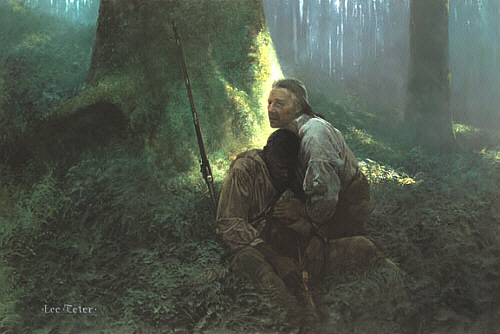
Afterward: During the French & Indian Wars of the 1750s Thomas Cresap and a party of 100 pursued an Indian war band over the present-day Savage Mountain and onto the next. Along with the party marched a free black man, a frontiersman known only as “Nemesis”. A fierce fight ensued on May 28, 1756. Nemesis, described only as “large and powerfully built”, fought bravely, but lost his life. He was buried on the site, where Cresap named the mountain in his honor. “Negro Mountain”, the long ridge of the Allegheny Mountains stretching from Deep Creek Lake in Maryland, north to the Casselman River in Pennsylvania, stands to this day as his monument. Feature image, top of page, the painting “Shades of Death” by artist Lee Teter, depicts Colonel Thomas Cresap comforting the mortally wounded, heroic frontiersman.


 Lay became a lumberjack, a jewelry salesman, and a peanut salesman, before going to work for the Atlanta based Barrett Potato Chip Company. He traveled the Southeast during the Great Depression in his Model A Ford, selling chips to grocery stores, gas stations and soda shops. When the company’s owner died, Lay raised $60,000 and bought the company’s plants in Atlanta and Memphis.
 Lay began buying up small regional competitors at the same time that another company specializing in corn chips, was doing the same. “Frito”, the Spanish word for “fried”, merged with Lay in 1961 to become – you got it – Frito-Lay. By 1965, Lay’s was the #1 potato chip brand sold in every state.
 The biggest threat that Frito-Lay would ever experience came from the Beer giant Anheuser-Busch, when the company introduced their “Eagle” line of salty snacks in the 1970s. It made perfect sense at the time, a marketing and distribution giant expanding into such a complementary product category, what could go wrong? Frito-Lay profits dropped by 16% by 1991 and PepsiCo laid off 1,800 employees, but Eagle Snacks never turned a profit in 16 years. Anheuser-Busch put the company up for sale in 1995.
 Tom Peters wrote about Frito-Lay in his 1982 book “In Search of Excellence”. The company will spend $150 to make a $30 delivery if that’s what they need to do. Their customer is counting on them. While a transaction like that doesn’t make economic sense, the company prides itself on a 99½% on-time delivery record. Frito-Lay has the highest profit margins in the industry and a 60% market share in an “undifferentiated commodity”, in which their closest competitor has 7%.


 Indigenous nations of the time divided more along ethnic and linguistic rather than political lines, so there was no monolithic policy among the tribes. At least one British fort was taken with profuse apologies by the Indians, who explained that it was the other nations making them do it.


 Some sixty to eighty Ohio valley Indians died of the disease following the Fort Pitt episode, but the outbreak appears isolated. Meanwhile, Indian warriors had looted clothing from some 2,000 outlying settlers they had killed or abducted.

 The British Royal Proclamation of October 7, 1763, drew a line between the British colonies and Indian lands, creating a vast Indian Reserve stretching from the Appalachians to the Mississippi River and from Florida to Newfoundland. For the Indian Nations, this was the first time that a multi-tribal effort had been launched against British expansion, the first time such an effort had not ended in defeat.

 It may be hard to imagine but, Canis lupus, the wolf, is the ancestor of the modern dog, Canis familiaris. Every one of them, from Newfoundlands to Chihuahuas.
 Sus scrofa (the pig) was domesticated around 6000 BC throughout the Middle East and China. Pigs were originally used as draft animals. There are stone engravings depicting teams of hogs hauling war chariots. I wonder what that sounded like.
 Early camelids spread across the Bering land bridge, moving the opposite direction from the Asian immigration to America, surviving in the Old World and eventually becoming domesticated and spreading globally by humans. The first “camelids” became domesticated about 4,500 years ago in Peru: The “New World Camels” the Llama and the Alpaca, and the “South American Camels”, the Guanaco and the Vicuña.


 “Plastic” Surgery, the term comes to us from the Greek Plastikos and first used by the 18th century French surgeon Pierre Desault, has been with us longer than you might expect. Evidence exists of Hindu surgeons performing primitive ‘nose jobs’, as early as BC800-600. The Renaissance-era surgeon Gaspare Tagliacozzi (1545-1599) developed new methods of reconstruction, using the patient’s own arm skin to replace noses slashed off in swordplay.
 Ladd’s prostheses were uncomfortable to wear, but her services earned her the Légion d’Honneur Croix de Chevalier and the Serbian Order of Saint Sava.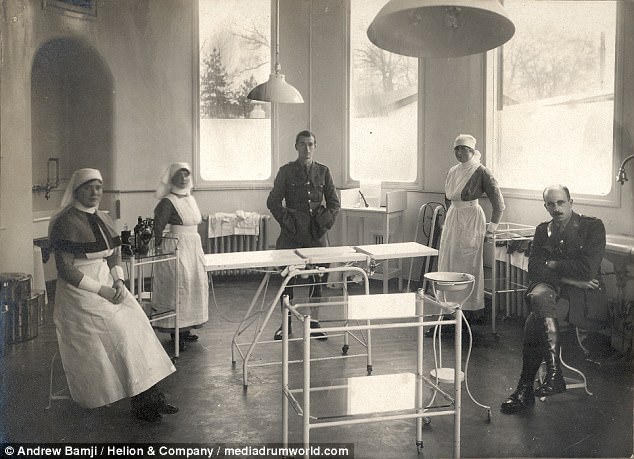


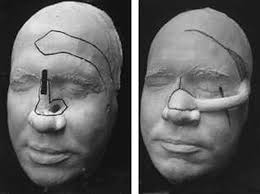 Dr. Gillies & Co. developed surgical methods in which rib cartilage is first implanted in foreheads, and then swung down to form the foundational structure of a new nose.


 It was customary that gifts be given to the guests of such a celebration. There were commemorative scarves and ornately decorated porcelain cups, bearing the ciphers of Nicholas and Alexandra opposite the double-headed symbol of the Imperial dynasty, the Romanov eagle.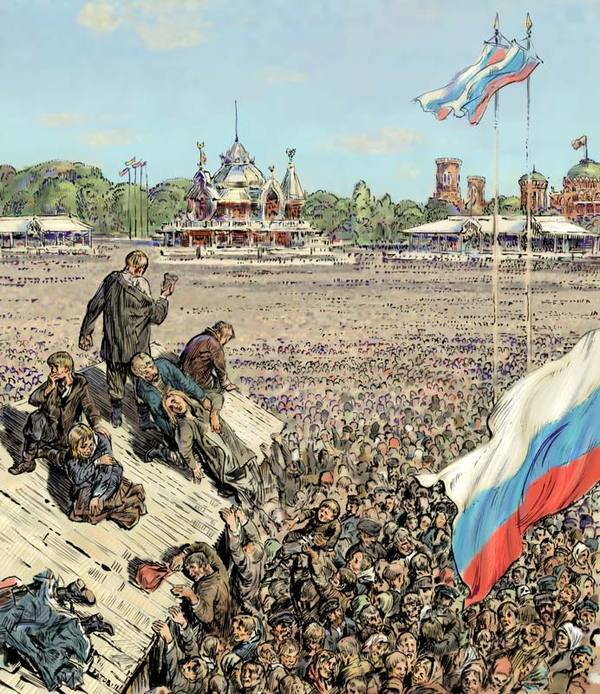
 podium was pocked and lined with trenches and pits.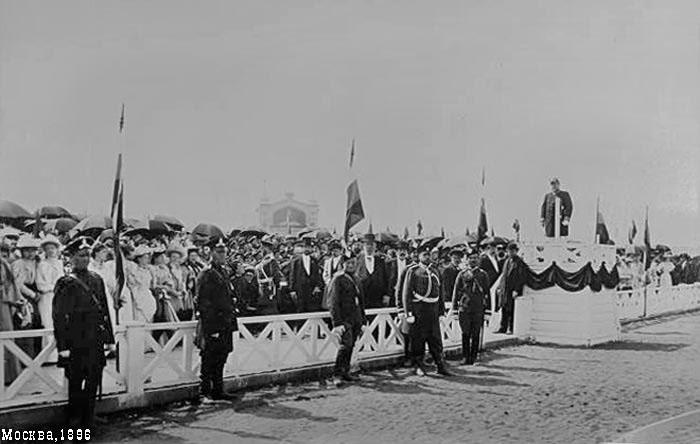


 3,662,374 military service certificates were issued to qualifying veterans, bearing a face value equal to $1 per day of domestic service and $1.25 a day for overseas service, plus interest. Total face value of these certificates was $3.638 billion, equivalent to $43.7 billion in today’s dollars and coming to full maturity in 1945.
 The Great Depression was two years old in 1932, and thousands of veterans had been out of work since the beginning. Certificate holders could borrow up to 50% of the face value of their service certificates, but direct funds remained unavailable for another 13 years.
 This had happened before. Hundreds of Pennsylvania veterans of the Revolution had marched on Washington in 1783, after the Continental Army was disbanded without pay.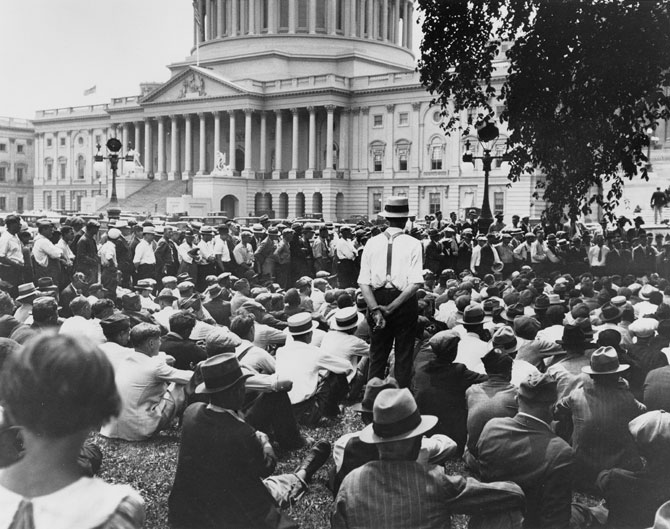
 Marchers and their families were in their camps on July 28 when Attorney General William Mitchell ordered them evicted. Two policemen became trapped on the second floor of a building when they drew their revolvers and shot two veterans, William Hushka and Eric Carlson, both of whom died of their injuries.
 President Herbert Hoover ordered the Army under General Douglas MacArthur to evict the Bonus Army from Washington. 500 Cavalry formed up on Pennsylvania Avenue at 4:45pm, supported by 500 Infantry, 800 police and six battle tanks under the command of then-Major George S. Patton. Civil Service employees came out to watch as bonus marchers cheered, thinking that the Army had gathered in their support.
 Bonus marchers fled to their largest encampment across the Anacostia River, when President Hoover ordered the assault stopped. Feeling that the Bonus March was an attempt to overthrow the government, General MacArthur ignored the President and ordered a new attack, the army routing 10,000 and leaving their camps in flames. 1,017 were injured and 135 arrested.
 Then-Major Dwight D. Eisenhower was one of MacArthur’s aides at the time. Eisenhower believed that it was wrong for the Army’s highest ranking officer to lead an action against fellow war veterans. “I told that dumb son-of-a-bitch not to go down there”, he said.
 The bonus march debacle doomed any chance that Hoover had of being re-elected. Franklin D. Roosevelt opposed the veterans’ bonus demands during the election, but was able to negotiate a solution when veterans organized a second demonstration in 1933. Roosevelt’s wife Eleanor was instrumental in these negotiations, leading one veteran to quip: “Hoover sent the army. Roosevelt sent his wife”.



 Thorne was soon headed to Special Forces, the elite warrior becoming an instructor of skiing, mountaineering, survival and guerrilla tactics.
 As part of the 10th Special Forces Group, Thorne served in a search-and-rescue capacity in West Germany, earning a reputation for courage in operations to recover bodies and classified documents, following a plane in the Zagros Mountains of Iran.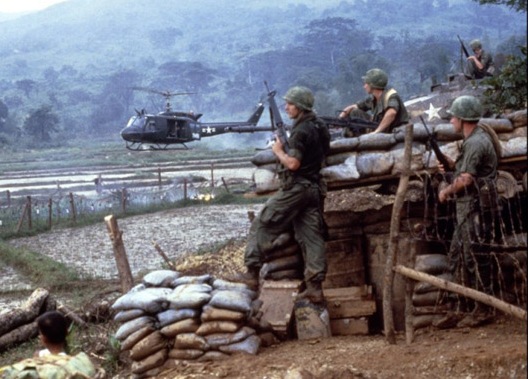


 The island nation of Great Britain alone escaped occupation, but British armed forces were shattered and defenseless in the face of the German war machine.
 Hitler ordered his Panzer groups to resume the advance on May 26, while a National Day of Prayer was declared at Westminster Abbey. That night Winston Churchill ordered “Operation Dynamo”. One of the most miraculous evacuations in military history had begun from the beaches of Dunkirk.
 Larger ships were boarded from piers, while thousands waded into the surf and waited in shoulder deep water for smaller vessels. They came from everywhere: merchant marine boats, fishing boats, pleasure craft, lifeboats and tugs. The smallest among them was the 14’7″ fishing boat “Tamzine”, now in the Imperial War Museum.
 A thousand copies of navigational charts helped organize shipping in and out of Dunkirk, as buoys were laid around Goodwin Sands to prevent strandings. Abandoned vehicles were driven into the water at low tide, weighted down with sand bags and connected by wooden planks, forming makeshift jetties.
 7,669 were evacuated on the first full day of the evacuation, May 27, and none too soon. The following day, members of the SS Totenkopf Division marched 100 captured members of the 2nd Battalion of the Royal Norfolk Regiment off to a pit, and machine gunned the lot of them. A group of the 2nd Battalion of the Royal Warwickshire Regiment were captured that same day, herded into a barn and murdered with grenades.
 Most light equipment and virtually all heavy equipment had to be left behind, just to get what remained of the allied armies out alive. But now, with the United States still the better part of a year away from entering the war, the allies had a military fighting force that would live to fight on.


 If you’ve raised a child, you are well acquainted with the triumphs and the terrors of giving those little tykes the sword with which they will conquer their world.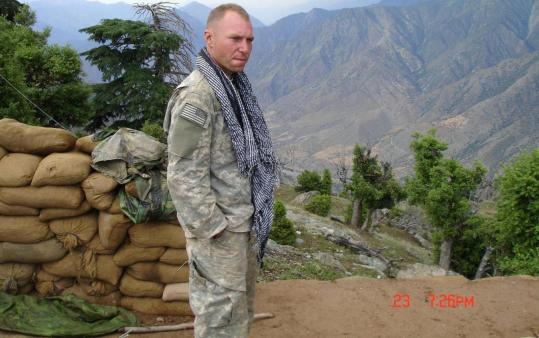



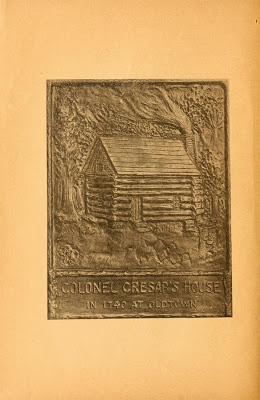 Business was good. By 1730, Wright had applied for a ferry license. With Lord Baltimore fearing a loss of control in the area (read – taxes), Maryland resident Thomas Cresap established a second ferry service up the river. Maryland granted Cresap some 500 acres along the west bank, serenely unconcerned that much of the area was already inhabited by Pennsylvania farmers.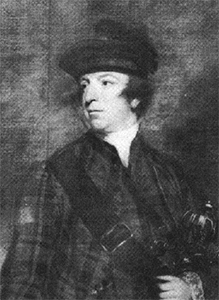
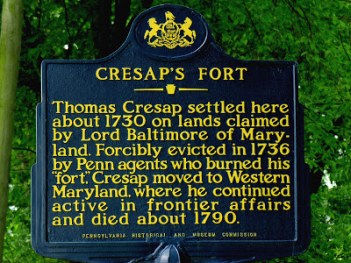 Maryland authorities petitioned George II, King of Great Britain and Ireland, imploring the King to restore order among his subjects. King George’s proclamation of August 18, 1737 instructed the governments of both colonies to cease hostilities. When that failed to stop the fighting, the Crown organized direct negotiations between the two. Peace was signed in London on May 25, 1738, the agreement providing for an exchange of prisoners and a provisional boundary to be drawn fifteen miles south of the southernmost home in Philadelphia, and mandating that neither Maryland nor Pennsylvania “permit or suffer any Tumults Riots or other Outragious Disorders to be committed on the Borders of their respective Provinces.”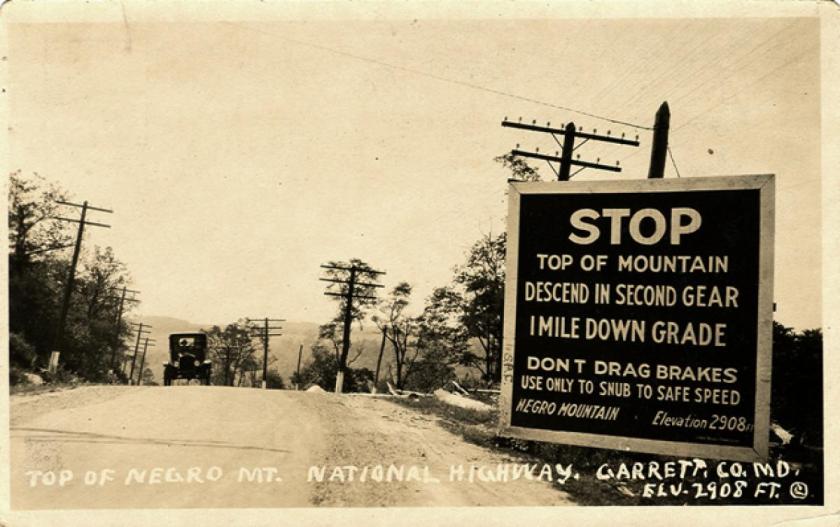


You must be logged in to post a comment.