Winston Churchill once quipped “A lie gets halfway around the world before the truth has a chance to get its pants on”. Guess he got that right.
Sometime around Easter Sunday, 1900, Captain Dimitrios Kondos set sail from the island of Symi. Kondos and a team of Greek sponge divers worked their way through the Peloponnese, across the Aegean en route to the rich fishing grounds off the coast of North Africa. The team was stopped and waiting for favorable winds off the Greek Island of Antikythera, when some of the divers thought they’d have a look around.
Elias Stadiatis descended some 150-feet, and quickly signaled that he wanted to come back up. Stadiatis told a wild tale about a rocky bottom, strewn with the rotting corpses and men and horses. Dozens of them.
Greek sponge divers
The effects of nitrogen narcosis were well understood by this time, that lethally narcotic-like state of drunkenness where deep divers have been known to hand regulators, to fish. Captain Kondos was convinced that Stadiatis was drunk on nitrogen. He donned the canvas suit and brass helmet, and went down to look for himself.
The divers had discovered a 1st-century (BC) shipwreck, a treasure trove of statuary: four marble horses, and thirty-six stone statues including Hercules, Ulysses, Diomedes, Hermes and Apollo.
The most astonishing find from the wreck was a complex clock-like mechanism, believed to be built around 100-200BC and vastly more sophisticated than anything known to have come from antiquity. In more recent years, computer x-ray tomography and high resolution surface scanning have revealed the enormous sophistication of the “Antikythera mechanism“, an analog computer comprising some 37 exquisitely precise gear wheels, enabling the device to follow the moon and sun through the full cycle of the zodiac.
The thing can even recreate the variable velocity of the moon, as the body speeds up through its perigee, and slows through the apogee.
Antikythera mechanism, recreation
What those Greek sponge divers had discovered was an Out-of-Place Artifact, (OOPArt), an object which called into question, our understanding of what has come before. OOPArts are artifacts of historical, archaeological, or paleontological interest, evincing a more advanced technology than known to have existed at the time, or even a human (or at least intelligent) hand at a time and place, where none are known to exist.
OOPArts run the gamut from the genuinely surprising to risible hoaxes to the favorites of cryptozoologists, UFOologists, paranormal enthusiasts and proponents of ancient astronaut theories. Some turn out to be objects of mistaken interpretation, based on little more than wishful thinking.
The Iron Pillar outside the Quwwat-ul-Islam Mosque in Delhi is believed to date from the fifth century Gupta monarchs of India. Standing 23-feet, 8-inches and weighing in at 13,000-pounds, the thing is almost entirely free of rust, demonstrating a level of metallurgical proficiency, surprising for the time.
The “London Hammer” was found in June 1934 near London Texas. It’s a common enough object, except is seems to be embedded, in 400 million year-old rock. Geologist J.R. Cole explains the conundrum:
London Hammer
“The stone is real, and it looks impressive to someone unfamiliar with geological processes. How could a modern artifact be stuck in Ordovician rock? The answer is that the concretion itself is not Ordovician. Minerals in solution can harden around an intrusive object dropped in a crack or simply left on the ground if the source rock (in this case, reportedly Ordovician) is chemically soluble”.
“Young Earth Creationist” Carl Baugh has other ideas, claiming the object to be a “monumental pre-flood discovery”. You can see the London Hammer and decide for yourself, at the Creation Evidence Museum, in Glen Rose Texas.
USNS Eltanin photo, 1964
The “Eltanin Antennae” was photographed by the cargo-carrying icebreaker and oceanographic research vessel USNS Eltanin in 1964. Located on the sea floor off the Antarctic coast, the object lies under 12,808 feet of water.
To many, the object is clearly the result of intelligent life, even extra-terrestrials. Author Brad Steiger has called it“an astonishing piece of machinery… very much like the cross between a TV antenna and a telemetry antenna“.
Other authorities have identified the object as Chondrocladia concrescens, an unusual carnivorous sponge.
Artist Karl Weingärtner created a mobile phone-style clay tablet for a museum display in 2012, complete with cuneiform script, keypad. Weingärtner posted a photo to his Facebook account, to help sell his art. Some wag dubbed the thing “BabyloNokia”, and it was off to the races. The “Conspiracy Club” website ran the image with the caption: “800-Year-Old Mobile Phone Found In Austria? Check This Out.”
For the editors at UFO Sighting Daily, the BabyloNokia was proof positive that ancient astronauts had been here. Not to be outdone, the British tabloid Daily Express ran with Weingärtner’s image, claiming the object dated to the 13th century, BC.
Winston Churchill once quipped “A lie gets halfway around the world before the truth has a chance to get its pants on“. Guess he got that right.
A large geode, lined with Amethyst crystals
Wallace Lane, Virginia Maxey and Mike Mikesell liked to prospect for geodes, near the California town of Olancha.
A geode is a hollow stone formation, containing a secondary lining of crystals or mineral matter. Geodes form slowly, over geologic time. There’s no way of knowing what’s inside, until it’s broken or cut, apart.
On this day in 1961, the trio discovered the “Coso Artifact”, a geode containing an unusual object. A Champion spark plug.
A reader wrote to Desert Magazine, claiming a trained geologist had dated the thing, at 500,000 years old. The identity of the “trained geologist”, went unsaid.
A number of Pseudoscientific theories arose, to explain the object:
• The spark plug was evidence of an ancient, advanced civilization, possibly proof of the long lost city of Atlantis, itself.
• Prehistoric extraterrestrial visitors came to Earth. How such creatures came to possess a “Champion” spark plug, went unanswered.
• Human time-travelers from the future had left or lost the spark plug, thus proving their visit to the past.
The answer it seems, was more prosaic. Researchers determined with help from the Spark Plug Collectors of America (who knew?), that this was a 1920s-era Champion spark plug, widely used in the engines of Model T and Model A Fords. The “geode” wasn’t that at all, but the accretion of iron and other minerals, produced as the object rusted in the ground.
Geologists from the University of Washington Earth and Space Science department were invited to inspect the thing again, just last year. Scientists confirmed the opinion that this was a 1920s-vintage plug but, I don’t know.
Sounds to me like someone’s still betting on the 500,000-year version of the story.
If you enjoyed this “Today in History”, please feel free to re-blog, “like” & share on social media, so that others may find and enjoy it as well. Please click the “follow” button on the right, to receive email updates on new articles. Thank you for your interest, in the history we all share.
2,000 men flooded in from the countryside, howling as they advanced “Slea, Slea…. Havock, Havock…. Smyte fast, give gode knocks.”
If you’re ever in Oxford, England, stop and see the four-way road junction called “Carfax”. The name derives from the Latin “quadrifurcus” via the French “carrefour”, meaning, “crossroads”. Here at the center of the oldest college town in the English-speaking world, you’ll find a branch of the Santander Bank. It’s not the sort of place you’d expect a bar fight, leading to a riot.
Except, yeah. It is. Or at least it was.
Oxford Carfax, NW
In the year 1355, the future bank branch was home to the Swindlestock Tavern, built in 1250. Tuesday, February 10 was a day of celebration, a remembrance of Saint Scholastica, the Roman Catholic Saint and twin sister to Saint Benedict, leader of monks.
A group of priests and students were drinking that night, when someone complained about the wine. Two students, Walter Spryngeheuse and Roger de Chesterfield had words with the tavern keeper, John Croidon. John responded to their complaints with “stubborn and saucy language” (I love that), whereupon someone hurled a quart pot of the stuff, at his head. Spryngeheuse and Chesterfield then proceeded to beat up the bartender.
To talk to the locals in any modern college town, is to hear the story of a mixed blessing. Sure there are jobs, and the business is good, just as sure as there is traffic, congestion and the annual invasion, of the Other. The once quiet town becomes the over-crowded scene of rowdy weekends, beer cans and thumping bass. Plato probably experienced the same adversarial relationship or something like it (presumably minus the bass) in 387BC, with the first Academy outside the walls of Athens.
Seems like some things don’t change, all that much.
Back to the Swindlestock Tavern. The riot about to happen, was far from the first. The thirteenth century had seen a number contretemps between “Towns and Gowns”, in which ninety people were killed.
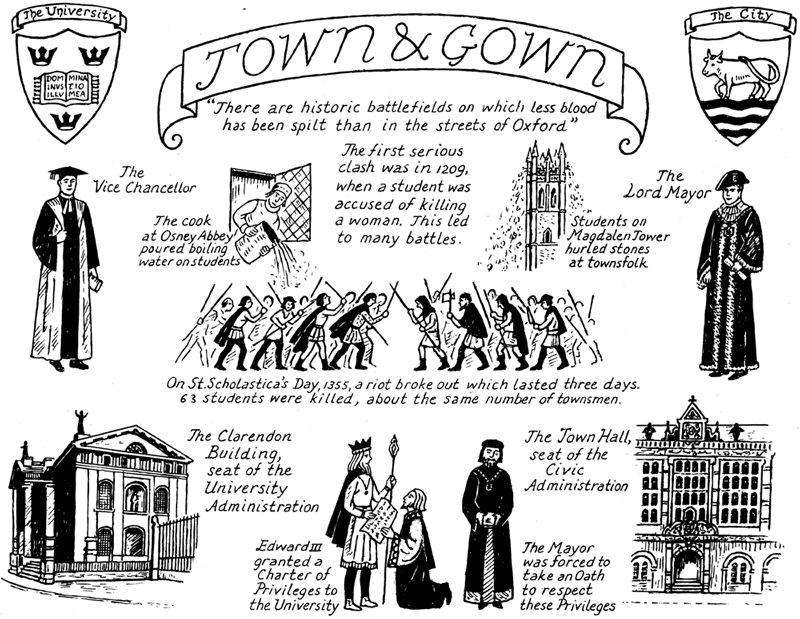
The landlord at the Swindlestock was John de Bereford, who just happened to be the Mayor of Oxford. On the following day, Mayor de Bereford asked University Chancellor Humphrey de Cherlton, to arrest the two students. Some two hundred undergraduates rushed to Spryngeheuse and Chesterfield’s defense, allegedly assaulting the Mayor, and several others.
The Church bells rang out at St Martin’s, calling the townspeople to arms. The University Church bells at rang in response at St. Mary’s, summoning hordes of students. What started out with a bar fight the night before, was about to become an all-out riot.
2,000 men flooded in from the countryside, howling as they advanced “Slea, Slea…. Havock, Havock…. Smyte fast, give gode knocks.”
The Mayor rode to Woodstock to enlist the help of the King. Back in Oxford, the violence went on for two days, coming to an end on Thursday, February 12.
Townspeople broke into academic halls, beating students and faculty, alike. By the time it was over, Sixty-three academics and thirty locals, were dead.
The dispute leading to the St. Scholasta’s day riot of 1355 was eventually settled in favor of the University. The Mayor and the Bailiffs of Oxford were ordered to do penance along with a number of townsfolk, one for each of the slain. The procession would march bare-headed through the streets of Oxford before attending Mass in memory of the slain. Then on to the University Church of Saint Mary the Virgin, where the Vice-Chancellor awaited with the Vicar, University Proctors, and the Registrar. The University delegation was then paid a fine of 5 shillings, three-pence, usually in small coin. A penny for every scholar killed.
This act of contrition continued every February 10 for 470 years until 1825, when the mayor refused to participate.
Carfax, as seen from St. Martin’s tower
The proverbial hatchet was finally buried on February 10, 1955. A ceremony was held in which the Mayor received an honorary degree, in exchange for which the Vice-Chancellor was made an Honorary Freeman.
It was six-hundred years, to the day. Talk about remembering your history.
If you enjoyed this “Today in History”, please feel free to re-blog, “like” & share on social media, so that others may find and enjoy it as well. Please click the “follow” button on the right, to receive email updates on new articles. Thank you for your interest, in the history we all share.
When a group of visiting Ottoman envoys declined to remove their turbans in Vlad’s court, the Prince ordered the turbans nailed to their heads.
Count Dracula, favorite of Halloween costume shoppers from time out of mind, has been around since the 1897 publication of Bram Stoker’s novel, of the same name. Stoker’s working titles for the manuscript included “The Un-dead”, and “Count Wampyr”. He nearly kept one of them too, until stumbling into the real-life story of Vlad Țepeș (TSE·pesh), a Wallachian Prince and front-line warrior, against the Jihad of his day.
In modern Romanian, “Dracul” means “The Devil”. In the old language, it meant “the Dragon”, the word “Dracula” (Drăculea) translating as “Son of the Dragon”.
Stoker wrote in his notes, “in Wallachian language means DEVIL“. In a time and place remembered for brutality, Vlad “the Impaler” Țepeș stands out for extraordinary cruelty. There are tales that Țepeș disemboweled his own mistress. That he collected the noses of vanquished adversaries. Some 24,000 of them. That he dined among forests of victims, spitted on poles. That he even impaled the donkeys they rode in on.
In 1436, Vlad II Dracul became Voivode (prince) of Wallachia, a region in modern-day Romania situated between the Lower Danube river and the Carpathian Mountains. The sobriquet “Dracul” came from membership in the “Order of the Dragon” (literally “Society of the Dragonists“), a monarchical chivalric order founded by Holy Roman Emperor Sigismund in 1408, dedicated to stopping the Ottomanadvance into Europe.
A crossroads between East and West, the region was scene to frequent bloodshed, as Ottoman forces pushed westward into Europe and Christian forces pushed back..
A weakened political position left Vlad II no choice but to pay homage to Ottoman Sultan Murad II, in the form of an annual Jizya (tax on non-Muslims) and a contribution of 500 Wallachian boys to serve as Janissaries, the elite slave army at the center of Ottoman power.
Vlad was taken hostage by the Sultan in 1442 along with his two younger sons, Vlad III and Radu. The terms of the boys’ captivity were relatively mild by the standards of the time and the boys became skilled horsemen and warriors. While Radu went over to the Turkish side, Vlad hated captivity and developed an incandescent hate for his captors. It would last him all of his days.
Following the fall of Constantinople in 1453, Sultan Mehmed II set his sights on the invasion of all Europe.
Vlad III gained the Wallachian throne three years later and immediately stopped all tribute to Sultan Mehmed II, by now risen to 10,000 ducats a year and 1,000 boys. When a group of visiting Ottoman envoys declined to remove their turbans in Vlad’s court, the Prince ordered the turbans nailed to their heads.
Vlad now consolidated power as his reputation for savagery, grew. According to stories circulated after his death, hundreds of disloyal Boyars (nobles) and their allies met their end, impaled on spikes.
The conqueror of Constantinople now amassed power of his own, setting his sights on campaigns against Anatolia, the Greek Empire of Trebizond and the White Sheep Turkomans of Uzun Hasan. Throughout this period, Romanian control of the Danube remained a thorn in his side.
Pope Pius II declared a new Crusade against the Ottoman in 1460, but Vlad Țepeș was the only European leader to show any enthusiasm. The Hungarian General and Ţepeş’ only ally Mihály Szilágyi was captured by the Turks, his men were tortured to death and Szilágyi himself sawed in half.
Țepeș invaded the Ottoman Empire the following year. In a letter to Hungarian king Matthias Corvinus dated February 11, 1462, Țepeș wrote: “I have killed peasants men and women, old and young, who lived at Oblucitza and Novoselo, where the Danube flows into the sea, up to Rahova, which is located near Chilia, from the lower Danube up to such places as Samovit and Ghighen. We killed 23,884 Turks without counting those whom we burned in homes or the Turks whose heads were cut by our soldiers…Thus, your highness, you must know that I have broken the peace with him (Sultan Mehmet II)”.
The Sultan invaded Wallachia at the head of a massive army, only to find a “forest of the impaled”. The Byzantine Greek historian Laonikos Chalkokondyles writes: “The sultan’s army entered into the area of the impalements, which was seventeen long and seven stades wide“.
To give a sense of scale to such a horror, a “stade” derives from the Greek “stadeon” – the dimensions of an ancient sports arena.
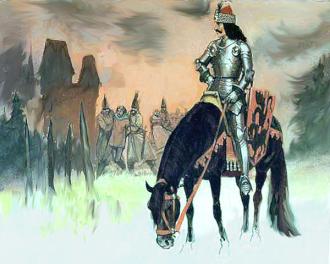
Outnumbered five-to-one, Ţepeş carried out a scorched earth policy, poisoning the waters, diverting small rivers to create marshes and digging traps covered with timber and leaves. He would send sick people among the Turks, suffering lethal diseases such as leprosy, tuberculosis and bubonic plague.
From his years in captivity, Ţepeş understood Ottoman language and customs as well as the Turks themselves. Absolutely fearless, he would disguise himself as a Turk and freely walk about their encampments.
On June 17, 1462, the Son of the Dragon launched a night attack on the Ottoman camp near the capital city of Târgoviște, in an effort to assassinate Mehmed himself. Knowing that the Sultan forbade his men from leaving their tents at night, a force of some 7,000 to 10,000 horsemen fell on Mehmed’s camp three hours after sunset. The skirmish lasted all night until 4 the next morning, killing untold numbers of Turks, their horses and camels. Ţepeş himself aimed for the Sultan’s tent, but mistook it for that of two grand viziers, Ishak Pasha and Mahmud Pasha.
The Battle With Torches by Romanian painter Theodor Aman, depicting the The Night Attack of Târgovişte,
Mehmed II “The Conqueror” survived the Night Attack at Târgovişte. In the end, the Romanian principalities had little with which to oppose the overwhelming force of the Ottoman Empire. Vlad III Țepeș would twice be deposed only to regain the throne but never able to defeat his vastly more powerful adversary.
In the end, the Romanian principalities had little with which to oppose the overwhelming force of the Ottoman Empire. Vlad III Țepeș would be twice deposed only to regain power. Unable to defeat his more powerful adversary, Vlad was exiled for several years in Hungary, spending much of that time in prison.
Heaven help the unsuspecting rodent who fell into his hands, in that wretched cell.
If you enjoyed this “Today in History”, please feel free to re-blog, “like” & share on social media, so that others may find and enjoy it as well. Please click the “follow” button on the right, to receive email updates on new articles. Thank you for your interest, in the history we all share.
“Part of every pitcher’s job was to dirty up a new ball the moment it was thrown onto the field… They smeared it with dirt, licorice, and tobacco juice; it was deliberately scuffed, sandpapered, scarred… and as it came over the plate, [the ball] was very hard to see.” – Ken Burns, Baseball
Pitcher Max Surkont once said “Baseball was never meant to be taken seriously — if it were, we would play it with a javelin instead of a ball”. I’m not sure about javelins, but this much I know. It’s a lot of fun to watch a home run, hit out of the park.
The New York Yankees hit 267 home runs last year, breaking the single-season record held for twenty-one years, by the Seattle Mariners. But that’s not always how the game was played. The “Hitless Wonders” of the 1906 Chicago White Sox won the World Series with a .230 club batting average. Manager Fielder Jones said “This should prove that leather is mightier than wood”. Fielder Allison Jones. That’s the man’s real name. If that’s not the greatest baseball name ever, it’s gotta be one of the top ten.
This was the “dead-ball” era of the Major Leagues, an “inside baseball” style relying on stolen bases, hit-and-run plays and, more than anything, speed.
That’s not to say there were no power hitters. In some ways, a triple may be more difficult than a home run, requiring a runner to cover three bases in the face of a defense, still in possession of the ball. Pittsburgh Pirates outfielder Owen “Chief” Wilson set a record 36 triples in 1912. “Wahoo” Sam Crawford hit a career record 309 triples in 18 years in Major League Baseball, playing for the Cincinnati Reds and Detroit tigers from 1899 to 1917. 100 years later, it’s unlikely that either record will ever be broken.
In his 1994 television miniseries “Baseball”, Ken Burns explained that “Part of every pitcher’s job was to dirty up a new ball the moment it was thrown onto the field… They smeared it with dirt, licorice, and tobacco juice; it was deliberately scuffed, sandpapered, scarred… and as it came over the plate, [the ball] was very hard to see.”
Spitballs lessened the natural friction with a pitcher’s fingers, reducing backspin and causing the ball to drop. Sandpapered, cut or scarred balls tended to “break” to the side of the scuff mark. Balls were rarely replaced in those days. By the end of a game, the ball was scarred, misshapen and entirely unpredictable. Major League Baseball outlawed “doctored” pitches on February 10, 1920, though it remained customary to play an entire game with the same ball.
The first ever game to be played “under the lights” was forty years in the past in 1920, but the practice would not be widespread, for another fifteen years.
Late afternoon on August 16, the Cleveland Indians were playing the New York Yankees at the Polo Grounds. Cleveland shortstop Ray Chapman took the plate in the top of the 5th, facing “submarine” pitcher Carl Mays.
A submarine pitch is not to be confused with the windmill underhand pitch we see in softball. Submarine pitchers throw side-arm to under-handed, with upper bodies so low that some scuff their hands on the ground, the ball rising as it approaches the strike zone.
Submarine pitch
It seems Chapman didn’t see it coming. He never moved. The crack of the ball hitting Ray Chapman’s head was so loud that Mays thought he had hit the end of the bat, fielding the ball and throwing to first for the out. Wally Pipp, the first baseman best known for losing his starting position to Lou Gehrig because of a headache, knew something was wrong. The batter made no effort to run but simply collapsed, slowly dropping to the ground with blood streaming out of his left ear.
Ray Chapman
29-year-old Ray Chapman had said this was his last year playing ball. He wanted to spend more time in the family business he had just married into. The man was right. Raymond Johnson Chapman died 12 hours later, the only player in the history of Major League Baseball, to die from injuries sustained during a game.
The age of one-ball-per-game died with Ray Chapman, and with it the era of the dead ball. The lively ball era, had begun. Batters loved it, but pitchers struggled to come to grips, with all those shiny new balls.
MLB rule #3.01(c) states that “Before the game begins the umpire shall…Receive from the home club a supply of regulation baseballs, the number and make to be certified to the home club by the league president. The umpire shall inspect the baseballs and ensure they are regulation baseballs and that they are properly rubbed so that the gloss is removed. The umpire shall be the sole judge of the fitness of the balls to be used in the game”.
Umpires would “prep” the ball using a mixture of water and dirt from the field, but this resulted in too-soft covers, vulnerable to tampering. Something had to take the shine off the ball without softening the cover.
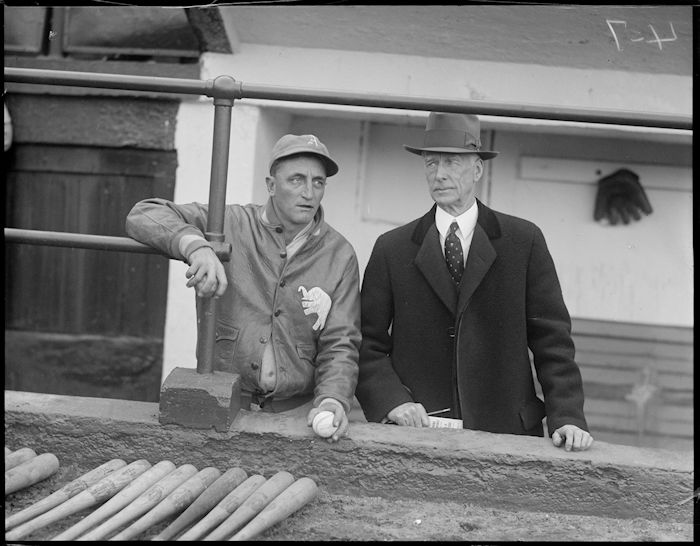
Philadelphia Athletics third base coach Lena Blackburne took up the challenge in 1938, scouring the riverbanks of New Jersey for just the right mud. Blackburne found his mud hole, describing the stuff as “resembling a cross between chocolate pudding and whipped cold cream”. By his death in the late fifties, Blackburne was selling his “Baseball Rubbing Mud” to every major league ball club in the country, and most minor league teams.
Philadelphia Athletics coach Lena Blackburne with team owner Cornelius McGillicuddy, better known as “Connie Mack”, Fenway Park
In a world where classified information is kept on personal email servers, there are still some secrets so pinky-swear-double-probation-secret that the truth may Never be known. Among them Facebook “Community Standards” algorithms, the formula for Coca Cola, and the Secret Swamp™, home of Lena Blackburne’s Baseball Rubbing Mud.
There’s an old joke here on Sunny Cape Cod™, that we have four seasons: Almost Winter, Winter, Still Winter and Bridge Construction. As we gaze out on the frozen tundra longing for that first crocus of Spring, one thing is sure. The first pitchers will show up to the first spring training camp, a few short days from now. Every baseball thrown from pre-season to the 2019 World Series, will first be de-glossed with Lena Blackburne’s famous, Baseball Rubbing Mud.
Play Ball!
Go Sox.
If you enjoyed this “Today in History”, please feel free to re-blog, “like” & share on social media, so that others may find and enjoy it as well. Please click the “follow” button on the right, to receive email updates on new articles. Thank you for your interest, in the history we all share.
It didn’t last forever but, for one golden moment in history, the goons and the government were playing for the same side.
As the Great War gave way to the Roaring Twenties, operators of the great ocean-going liners began to look at a new class of vessels.
The White Star Lines’ Britannic, Olympic and the doomed Titanic. Cunard’s Carpathia, Mauretania and the ill-fated Lusitania. The Red Star Line’s Finland, Kroonland, and Lapland. These were the veterans of the trans-Atlantic trade, built around enormous numbers of immigrants and the one-way steerage class voyage from Europe, to the United States.
Normandie poster
As the US all but shut down immigration in the early 1920s, the shipping industry looked to a new class of super liner to serve an upper-crust tourist trade, particularly Americans traveling to Europe, to escape Prohibition.
The German-built Norddeutscher Lloyd company was first off the line with the SS Bremen and Europa. The British-made RMS Queen Mary was not far behind, but the Queen of this new class of super-liner, was the French-built Normandie.
SS Normandie was one-of-a-kind. The first vessel laid in compliance with the 1929 SOLAS Convention (Safety of Life at Sea), she was enormous. 1,029-feet long and 119-feet wide and displacing 85,000 tons, she was the largest liner in the world. 1,975 berths offering seven classes of service, served by a crew of 1,300.
Despite worldwide depression, Normandie was launched in 1932, making her first Atlantic crossing, in 1935.
Normandie under construction
War broke out in Europe in 1939. When France surrendered to Nazi Germany in June 1940, Normandie was tied to a dock, in New York. Under no circumstance would such a vessel be allowed to fall into Nazi hands. SS Normandie was immediately placed under “protective custody” by the US Navy.
There was speculation in the press, that the liner would be converted to an aircraft carrier in the event of American entry into the war. The Navy seized the liner in the wake of Pearl Harbor, but not for a carrier. The most luxurious liner in the world would be converted, to a troop ship.
Work began within weeks on the renamed USS Lafayette.
The afternoon of February 9, 1942 was cold and clear, over the West 49th Street pier. Welder Clement Derrick was removing the last of four stanchions in the Grand Salon when sparks ignited bales of burlap, covering highly flammable life vests.
Within a half-hour, much of the great liner was engulfed in flames. Black, oily smoke filled the City skyline as spectators crowded Pier 88.
Squadrons of fire boats poured a deluge of water, more than the great liner could bear. Mayor Fiorello LaGuardia and Rear Admiral Adolphus Andrews attempted to board when she suddenly lurched several feet, to port. USS Lafayette was drowning in the water, meant to save her life.
The scene was a carnival, with food vendors and hawkers. Skycraper windows were opened, to watch the grim spectacle.
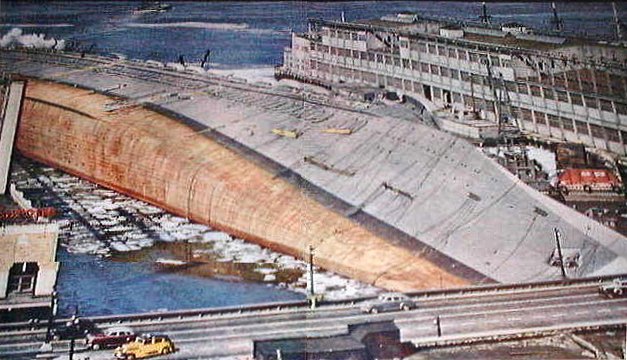
USS Lafayette continued her slow roll as, unseen within her holds, shifting water picked up speed. In twelve hours, it was over. At 2:35am on February 10, she rolled over and died.
Miki Rosen was five at the time, coming by in the family car, to gawk at the scene: “My father wanted us to see it because it was an historical event. I was terribly frightened by this enormous thing that I knew was supposed to be upright and bobbing up and down. It didn’t even look like a ship. It was a mass of iron floating in the water.”
USS Lafeyette, 1942
It wasn’t long before speculation turned to certainty. Sabotage. German spies were all over the waterfront, taking jobs as bartenders, stevedores and factory workers. Only a month earlier, 33 German agents were sentenced in a Brooklyn courtroom, to 300 years. German U-Boats sank 20 allied vessels in January alone, a mere sixty miles off the New Jersey and Long Island shore.
BBC broadcaster Alistaire Cooke, “the Twentieth Century’s de Tocqueville”, spoke of American seamen, torpedoed and picked up by a German submarine. The U-Boat commander came in and asked, in a perfect Brooklyn accent, if any were from the borough. “Maybe I worked with some o’ youse guys. I was twelve years in the Brooklyn Navy Yard.”
The FBI recreated Clement Derrick’s accident with the same dreadful result but, no matter. By then, speculation had turned to “fact”.
Naval intelligence distrusted the official FBI version. Hordes of uniformed personnel descended on the waterfront from Connecticut to New Jersey, to be met with a glowering brick wall of silence. This was a rough and unaccustomed place, an underworld of sailors and gangsters, fishermen and longshoremen. A world of street toughs who’d long since lost any trust in uniforms, from meter maids to police officers. Ivy-league Naval intelligence types got no information whatsoever. Many were lucky, to escape without a beating.
The only authority in this world, was the Mob.
Naval Intelligence Director Rear Admiral Carl Espe remembered: “The outcome of the war appeared extremely grave. In addition, there was the most serious concern over possible sabotage in the ports. It was necessary to use every possible means to prevent and forestall sabotage….” Someone on the docks was feeding the Nazis information, and only the mob had the power to hunt down the guilty party. Policy makers fretted about doing business with the Mafia, while the Kriegsmarine U-Boats enjoyed the “Happy Time”.
Could the Mafia even be trusted? Vito Genovese fled New York to Italy back in 1937 to avoid a murder prosecution, where he became close friends with Fascist dictator, Benito Mussolini. So tight were the pair that the cagey gangster dispatched hit men to New York to murder newspaperman Carlo Tresca, a vocal critic of the fascist regime.
Joseph “Socks” Lanza
Closer examination told a different story. Genovese was an opportunist, a double-crosser with no loyalty. Most Sicilian gangsters were different, most of them refugees from savage Italian purges where Mafiosi were machine gunned, bombed and arrested, in droves. Thugs and gangsters yes, but almost to a man they hated the fascists with the white heat, of a thousand suns.
So it was, the United States Navy entered into one of the strangest relationships of WW2, an operation which would remain secret, until 1977. “Operation Underworld“.
The first mob boss to come on board was Joseph “Socks” Lanza, a hulking bulldozer of a man and undisputed lord of the Fulton fish market. Socks got his name because he’d “sock” anyone in the jaw, who disagreed with his pronouncements. A man with a criminal history going back to 1917, Joe Socks could order the fishing fleet from Maine to Florida to dump an entire catch to inflate prices, with a nod of his head. Fishermen failing to bribe the racketeer found their fish left rotting, on the docks. Continued disobedience resulted in arson, beatings, and death.
If anyone could ferret out a Judas passing information to German intelligence it was Joe Socks, but how to contact a gangster, sworn to the code of Omerta?
Head of the New York Rackets Bureau, Murray Gurfein and Office of Naval Intelligence (ONI) Commander Charles Radcliffe Haffenden met with Lanza in the office of the gangster’s attorney. Gurfein explained “It’s a matter of great urgency. Many of our ships are being sunk along the Atlantic coast. We suspect German U-boats are being refueled and getting fresh supplies off our coast …You can find out how and where the submarines are being refueled.” Surprisingly, the Gangster jumped at the opportunity.
Socks provided union cards held for no-show jobs. Soon, naval intelligence agents were sailing aboard mackerel fleets from Newfoundland to Florida, ship-to-ship and ship-to-shore communications forming a valuable first-line of defense, against the Nazi submarine menace.
Important as it was, Lanza’s fishing fleet wasn’t enough, and Socks himself was disliked by the other four New York crime families.
Charles “Lucky” Luciano
The never-ending scrum of troop ships and merchant vessels crowding the New York waterfront was of life-and-death importance to the allied war effort. The only man who controlled it all, was in prison. Lucky Luciano. The only man Luciano trusted, was the Jewish gangster, Meyer Lansky.
Unlike the Italians, no one questioned Lansky’s patriotism. He and his Jewish mob had attacked Nazi meetings all over the city, throwing some of them out of the windows.
The meeting was arranged and, on May 12, 1942, Luciano was quietly transferred from Dannemora prison to a country club by comparison, and promised parole at the war’s end. This in exchange for the mobster’s cooperation in defeating Nazi Germany.
Cooperate, he did. The word went out from Luciano’s prison cell, from the docks to the heart of the city. Soon, every hat check girl and bartender, every longshoreman and numbers runner and the guys who serviced the vending machines, became the eyes and ears of the United States Navy. From bathroom attendants to elevator operators, the American Nazi organization known as German American Bund couldn’t so much as think out loud, without someone listening in.
It didn’t last forever but, for one golden moment in history, the goons and the government were playing for the same side.
In the end, USS Lafayette would never sail under a US Flag. She was a total loss, sold for scrap in 1946. The government was as good as its word. On January 3, 1946, Governor Thomas E. Dewey commuted Luciano’s sentence, on condition that he did not resist deportation. The most powerful mob boss in New York, Charles “Lucky” Luciano, was deported to Naples. Four years to the day from the death of the USS Lafayette.
If you enjoyed this “Today in History”, please feel free to re-blog, “like” & share on social media, so that others may find and enjoy it as well. Please click the “follow” button on the right, to receive email updates on new articles. Thank you for your interest, in the history we all share.
The Swedish-American poet Carl Sandburg once wrote “Valor is a gift. Those having it never know for sure whether they have it until the test comes.”
For six hundred years, the Balkan states of Southeastern and Central Europe were conquered and unwilling subjects of foreign powers. First the Ottoman, and then the Austro-Hungarian Empires.
By the dawn of the 20th century, the dream of a single state for ethnic Serbs, Croats and Slovenes had been around for some two hundred years.
The sparkthat started WW1 and literally changed the world was struck by the “Black Hand”, a secret society dedicated to Serbian liberation, no matter what.
The dream of sovereignty took form and shape in the wake of WW1, the six constituent republics of the Socialist Republic (SR) of Bosnia and Herzegovina, SR Croatia, SR Macedonia, SR Montenegro, SR Serbia, and SR Slovenia merging to form the “Kingdom of Serbs, Croats and Slovenes”. A creation of the treaty ending the Great War, the place was referred to as the “Versailles State“, for the first ten years. The name was officially changed to Yugoslavia in 1929, literally translating as the “Land of all South Slavic peoples“.
Lepa Svetozara Radić was born into this world on December 19, 1925.
From her earliest student days, Lepa Radić was known for dedication and hard work, a smart and serious girl, dedicated and reading well above grade level.
Radić developed strong left-of-center political views, taking influence from uncle Vladeta Radić, a strong proponent of the labor movement.
By that age when young teenage girls are thinking of other things, Radić had joined the League of Communist Youth of Yugoslavia (SKOJ). By the time she turned fifteen in 1941, she was a member of the Yugoslavian Communist Party.
As World War 2 enveloped the continent, a group of disaffected Yugoslav Army Air Force officers plotted to overthrow the government in Belgrade. The Cvetković government signed the Vienna protocol on March 25, 1941, signalling its intention to join the Tri-Partite pact of Nazi Germany, Fascist Italy and Imperial Japan. The bloodless coup d’état of two days later overthrew the Prince Regency of Paul Karađorđević, installing the pro-western, seventeen-year-old King Peter II, with encouragement and support from the British Special Operations Executive (SOE).
Adolf Hitler was apoplectic, taking personal offense at the coup d’état. Der Fuhrer had no interest in waiting to see if the new government would declare loyalty. Hitler summoned his military advisers the same day, determined “to destroy Yugoslavia militarily and as a state” and to do so “with pitiless harshness.”
The Nazi invasion of Yugoslavia was overwhelming, simultaneously launched from bases in Germany, Hungary, Romania and Bulgaria. The Yugoslav state never had a chance. It was all over, in eleven days.
The invasion was over in April, but not the Resistance.
With the German stranglehold in tight control of the towns and roadways, a Serbian resistance was quick to form in the wild mountains of the war torn nation. Two of them really: the Chetniks, dedicated to support of the Royal government in exile and the ferociously pro-Communist Partisans, under the leadership of Josip Broz “Tito.”
For the Radić family, there was no question of loyalty. Lepa’s father Svetor and uncles Voja and Vladeta joined the Partisans in July, leading to the arrest of the entire family by the Ustashe, the fascist Nazi-puppet government of Yugoslavia.
Resistance fighters freed the Radić family in weeks. That December, Lepa and her sister Dara officially joined the Partisans.
Though only fifteen, Lepa Radić was as fierce in her opposition to the Nazis, as any Partisan. She volunteered for the front lines, joining the 7th Partisan company of the 2nd Krajiski Detachment, transporting wounded and defenseless from the battlefield. Did I mention, she was fifteen years old.
Lepa was found out in February 1943, coordinating the rescue of 150 women and children attempting to flee the Nazis. She fired everything she had at attacking SS forces, but never had a chance. Lepa Radić was captured and sentenced to death by hanging, tortured for three days to extract information on Yugoslavian Resistance.
She gave up the cube root of zero.
She was brought to a hastily constructed gallows on February 8, 1943, and hanged in full view of the public.
Moments before her execution with the rope around her neck, Radić was offered a pardon. All she had to do, was give up the names of her Partisan comrades.
“I am not a traitor of my people”, she said. “Those whom you are asking about will reveal themselves when they have succeeded in wiping out all you evildoers, to the last man.”
Those were her last words.
The Swedish-American poet Carl Sandburg once wrote “Valor is a gift. Those having it never know for sure whether they have it until the test comes.”
Were I ever to be half so egregiously tested, I hope I would prove myself half the man, as that seventeen-year-old girl.
If you enjoyed this “Today in History”, please feel free to re-blog, “like” & share on social media, so that others may find and enjoy it as well. Please click the “follow” button on the right, to receive email updates on new articles. Thank you for your interest, in the history we all share.
Crashes were frequent and spectacular, often killing or maiming driver and horse, alike. Such wrecks were called naufragia, a Latin word translating as”shipwreck”. As many as forty chariots crashed in one catastrophic wreck, near Delphi.
For we who are New England sports fans, the Smug™ yet lies heavy on the air, following back to back World Championships for the Boston Red Sox, and New England Patriots. Having worked for the latter organization forty years ago when the team couldn’t get a game on TV, I have to tell you. This is a lot more fun.
Most will find this graphic braggadocious, if not obnoxious. A Chicago Cubs fan, will understand.
The winners of Superbowl LII received $112,000 each for winning the Big Game. Losing players were paid $56,000, apiece. Not bad for a single day’s work, but it raises an interesting question. Who is the highest paid athlete, of all time?
On December 13, 2017 Forbes Magazine answers as follows:
“The Highest-Paid Athletes of All-Time”
1. Michael Jordan Career earnings: $1.85 billion (2017 dollars)
2. Tiger Woods: $1.7 billion
3. Arnold Palmer: $1.4 billion
4. Jack Nicklaus Career earnings: $1.2 billion
5. Michael Schumacher: $1 billion
6. Phil Mickelson: $815 million
7. (tie) Kobe Bryant: $800 million
7. (tie) David Beckham: $800 million
9. Floyd Mayweather: $785 million
10. Shaquille O’Neal: $735 million
Seems Forbes missed one guy who earned nearly half-again, as the top ten. Combined.
The earliest chariots came around some 4,000 years ago, with the invention of the spoke-wheel. As a weapon of war, the use of these open, two-wheeled carriages came to a peak in 1300BC, around the Battle of Kadesh. Chariots lost their military importance as horses were bred to become bigger and stronger, able to carry a rider in the control position. The vehicle was gone as a weapon of war by the 1st century AD, but chariot races remained popular in Byzantine times, until the 6th century.
Chariots go back to the earliest days of the Roman Republic, coming down from the ancient Greeks, by way of the Etruscan empire. The mythical abduction of the Sabine women was carried out, while the Sabine men watched a chariot race. While Romans never used them as weapons of war, chariots were used in triumphal processions, pulled by teams of horses, dogs, tigers and even ostriches.
It was the racetrack, the circus, where the sport of chariot racing put the Fanatic in fans. None greater, than the Circus Maximus.
What the Greeks saw as an opportunity for talented amateurs to rise within their chosen sport, the Romans regarded as entertainment. A class of professional drivers, rose to meet the demand. There were four teams or “factions” (factiones), distinguished by the color of their outfit: Red, Blue, Green and White.
Modern sport has seen its share of fan passion rising to violence, but the worst “soccer hooligan” fades to docility, compared with the crowd come to watch the chariot races. In the year 69, Emperor Vitellius had commoners put to death for talking trash about the Blue faction. Ten years later, a fan threw himself on the funeral pyre, of his favorite driver. The week-long outbreak of violence known as the Nika Riots of 532 cost the lives of some 30,000 spectators. It all started, over a chariot race.
Mercedes Benz Stadium in Atlanta, home of Super Bowl LIII, has a rated capacity of 71,000 spectators, expandable to 75,000. The Circus Maximus measured 2,037-feet long by 387-feet wide and seated as many as a quarter-million. Come race day, the city was all but deserted.
Twelve chariots would enter each race, three from each faction. Golden-tipped dolphins were tipped over, to count the laps. Each race ran seven.
A raised median called a spina ran down the center, adorned with stone statuary and obelisks. Ganging up to drive opposing handlers into the stone median or the stands, whipping opponents and even hauling them out of their chariots was not only permitted, it was encouraged.
Tales of poisoned horses and drivers were not unheard of. Lead tablets and amulets were inscribed with curses, spiked through with nails and thrown from the stands. One such curse reads:
I call upon you, oh demon, whoever you are, to ask that from this hour, from this day, from this moment, you torture and kill the horses of the green and white factions and that you kill and crush completely the drivers Calrice, Felix, Primulus, and Romanus, and that you leave not a breath in their bodies.
Racing chariots were as light as possible and extremely flimsy, to increase speed. With no suspension, even a bump could throw a driver into the path of oncoming teams. Clogs were built into lattice floors, to hold the driver’s feet. Teams of two (biga), three (triga) and four (quadriga) horses were common, but teams as large as six were not unheard of. Though it was rare, ten-horse teams were known to take the field.
While Greek drivers held the reins in their hands, Roman charioteers wrapped them around the waist. Unsurprisingly, any driver thrown out would be dragged to death or trampled, unless able to cut himself free.
Crashes were frequent and spectacular, often killing or maiming driver and horse, alike. Such wrecks were called naufragia, a Latin word translating as”shipwreck”. As many as forty chariots crashed in one catastrophic wreck, near Delphi.
It is often said to “Beware the old man in a land where men die young“. The Roman countryside was dotted with the graves of twenty-year old chariot drivers. Yet, on this day in 138, the Spanish driver Gaius Appuleius Diocles was only midway through a 24-year career, spanning 4,257 races. He won 1,462 of them and placed in another 1,438.
Diocles wasn’t the “winningest” driver in Rome, though he did own an extremely rare ducenarius, a horse which had won at least 200 races. Flavius Scorpus scored 2,048 victories before being killed in a wreck at the age of twenty-seven. Pompeius Muscosus won 3,559. Diocles was the master of the “come from behind” victory. Crowds loved it. In his 24 years, Diocles went from White to Green to Red factions amassing an impressive 35,863,120 sesterces, over the course of a long career.
It was enough to keep the entire city of Rome in grain for a year, equivalent to $15 Billion, today. Not bad for a guy whose name indicates he probably started out a slave, freed by a guy named Gaius Appuleius.
If you enjoyed this “Today in History”, please feel free to re-blog, “like” & share on social media, so that others may find and enjoy it as well. Please click the “follow” button on the right, to receive email updates on new articles. Thank you for your interest, in the history we all share.
Neither knowing nor caring why they were there, the animals of the Great War suffered at prodigious rates.
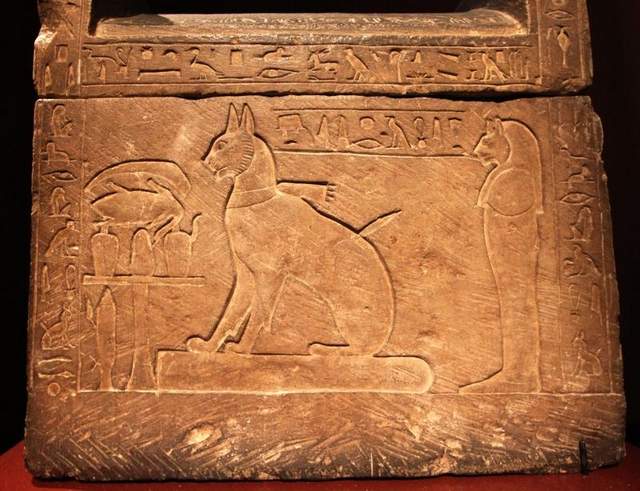
Mitochondrial DNA analysis of Felis silvestris catus suggests two great waves of expansion, first with the dawn of agriculture, when grain stores attracted vermin. Genetic analysis of the common house cat suggests they all descend from one of five feline ancestors: the Sardinian, European, Central Asian, Subsaharan African or the Chinese desert cat.
The second “cat-spansion” occurred later, as man took to water. From trade routes to diplomatic missions and military raids, men on ships needed food, and that meant rodents. The “ship’s cat” was a feature of life at sea from that day to this, first helping to control damage to food stores, ropes and woodwork and, in modern times, electrical wiring.
Fun fact: Who knew the Vikings had cats!
One Viking site in North Germany from ca 700-1000AD, contains one cat with Egyptian mitochondrial DNA. Once driven nearly to extinction, the Norwegian Forest cat (Norwegian: Norsk skogkatt) descends from Viking-era ship’s cats, brought to Norway from Great Britain sometime around 1000AD.
Not without reason, were cats seen as good luck. The power of cats to land upright is due to extraordinarily sensitive inner ears, capable of detecting even minor changes in barometric pressure. Sailors paid careful attention to the ship’s cat, often the harbinger of foul weather ahead.
Ship’s cat, HMS Queen Elizabeth, Gallipoli Peninsula, 1915
Togo, ships cat aboard the HMS Dreadnought
Ship’s cats “inspect” the breech of a 4-inch gun aboard an unidentified US ship
Left to right: 1. Ship’s cat, HMS Queen Elizabeth, Gallipoli Peninsula, 1915. 2. Togo, ships cat aboard the HMS Dreadnought, 3. Ship’s cats “inspect” the breech of a 4-inch gun aboard an unidentified US ship.
When the “Great War” arrived in 1914, animals of all kinds were dragged along. Cats performed the same functions in vermin infested trenches, as those at sea.
Gunner with the regimental cat in a trench in Cambrin, France, February 6th, 1918.
Officers of the U.S. 2nd Army Corps with a cat they discovered in the ruins of Le Cateau-Cambrésis
Trench cat, Gallipoli Peninsula, 1915
1. Gunner with the regimental cat in a trench in Cambrin, France, February 6th, 1918. 2. Officers of the U.S. 2nd Army Corps with a cat discovered in the ruins of Le Cateau-Cambrésis 3. Trench cat, Gallipoli Peninsula, 1915
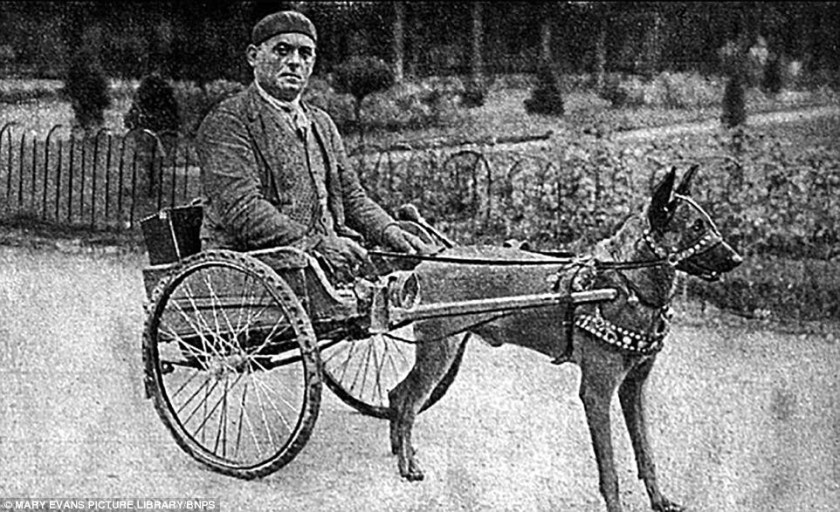
Tens of thousands of dogs performed a variety of roles, from ratters to sentries, scouts and runners. “Mercy” dogs were trained to seek out wounded on the battlefield, carrying medical supplies with which the stricken could treat themselves.
“A dog pulling the wheelchair of a wounded French soldier in the remarkable series of images featured in new book Images of War, Animals in the Great War” H/T Daily Mail
The French trained specialized “chiens sanitaire” to seek out the dead and wounded, and bring back bits of uniform. Often, dogs provided the comfort of another living soul, so the gravely wounded should not die alone.
“Messenger dogs pictured running the gauntlet of rifle fire during their training during the First World War” H/T Daily Mail
With the hell of no mans land all but impassable for human runners, dogs stepped up, as messengers. “First Division Rags” ran through a cataract of falling bombs and chemical weapons. Gassed and partially blinded with shrapnel injuries to a paw, eye and ear, Rags still got his message where it needed to be.
“First Division Rags”
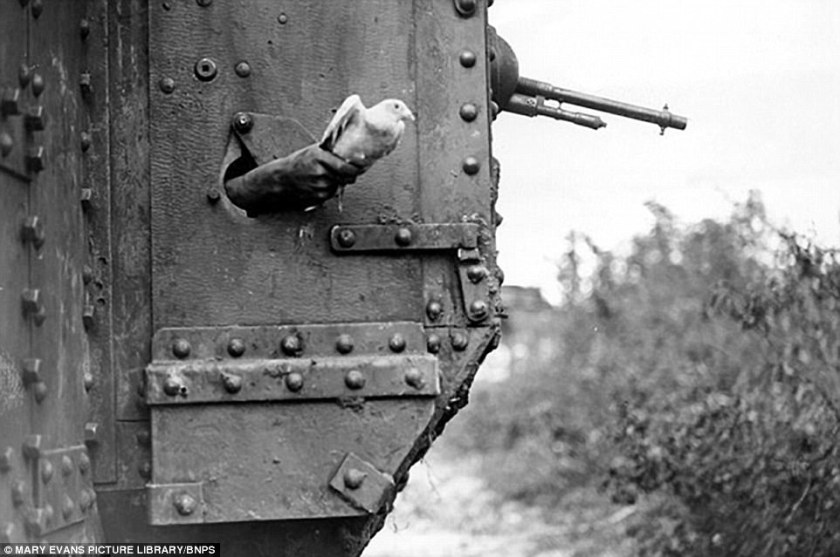
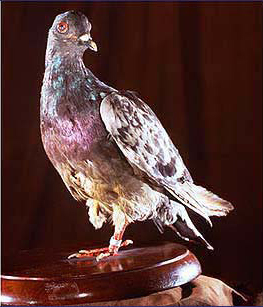
Other times, birds were the most effective means of communication. Carrier pigeons by the tens of thousands flew messages of life and death importance, for Allied and Central Powers, alike.
“A carrier pigeon held tight before release from the belly of a tank in 1918. Birds were often used to pass messages between troops” H/T Daily MailCher Ami
During the Meuse-Argonne offensive of 1918, Cher Amisaved 200 men of the “Lost Battalion”, arriving in her coop with a bullet through the breast, one eye shot out and a leg all but torn off, hanging by a single tendon.
Even the lowly garden slug pitched in. Extraordinarily sensitive to mustard gas, “slug brigades” provided the first gas warnings, allowing precious moments in which to “suit up”.
The keen senses of animals were often the only warning of impending attack.
Private Albert Marr’s Chacma baboon Jackiewould give early warning of enemy movement or impending attack with a series of sharp barks, or by pulling on Marr’s tunic.
One of many wrenching images of the Great war took place in April, 1918. The South African Brigade withdrew under heavy shelling through the West Flanders region of Belgium. Jackie was frantically building a stone wall around himself, when jagged splinters wounded his arm and all but tore off the animal’s leg. Jackie refused to be carried off by stretcher-bearers, hobbling about on his shattered limb, trying to finish his wall
Constituted on June 13 1917, British Aero Squadron #32 kept a red fox, as unit mascot.
H/T Daily Mail
The famous Lafayette Escadrillekept a pair of lion cubs, called Whiskey and Soda.
German soldiers in Hamburg, enlisted the labor of circus elephants in 1915.
H/T Daily Mail
The light cruiser Dresden was scuttled and sinking fast in 1914, leaving the only creature on board to swim for it. An hour later an Ensign aboard HMS Glasgow spotted a head, struggling in the waves. Two sailors dove in and saved him. They named him “Tirpitz”, after the German Admiral. Tirpitz the pig served out the rest of the war not in a frying pan, but as ship’s mascot aboard the HMS Glasgow.
“Tirpitz” the pig
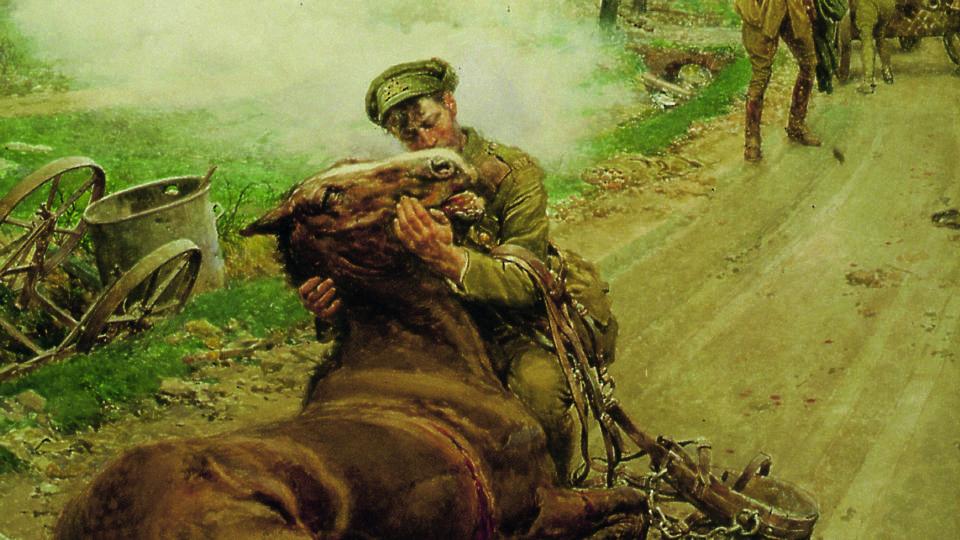
No beast who served in the Great war was as plentiful nor as ill used as the beast of burden, none so much as the horse. Horses were called up by the millions, along with 80,000 donkeys and mules, 50,000 camels and 11,000 oxen. The United States alone shipped a thousand horses between 1914 and 1917, every day.
Horsepower was indispensable throughout the war from cavalry and mounted infantry to reconnaissance and messenger service, as well as pulling artillery, ambulances, and supply wagons. With the value of horses to the war effort and difficulty in their replacement, the loss of a horse was a greater tactical problem in some areas, than the loss of a man.
Few ever returned. An estimated three quarters died of wretched working conditions. Exhaustion. The frozen, sucking mud of the western front. The mud-borne and respiratory diseases. The gas, artillery and small arms fire. An estimated eight million horses were killed on all sides, enough to line up in Boston and make it all the way to London four times, if such a thing were possible.
The United Kingdom entered the war with only eighty motorized vehicles, conscripting a million horses and mules, over the course of the war. Only one in sixteen, lived to come home.
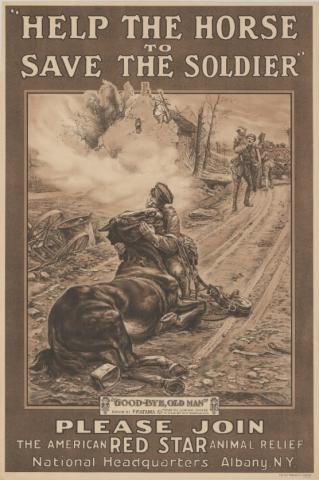
Neither knowing nor caring why they were there, the animals of the Great War suffered at prodigious rates. Humane organizations stepped up, the British Royal Society for the Prevention of Cruelty to Animals (RSPCA) processing some 2.5 million animals through veterinary hospitals. 1,850,000 were horses and mules. 85% were treated and returned to the front.
The American Red Star Animal Relief Program sent medical supplies, bandages, and ambulances to the front lines in 1916, to care for horses injured at a rate of 68,000 per month.
The century before the Great War was a Golden age, mushrooming populations enjoying the greatest rise in living standards, in human history. The economy at home would be dashed to rags and atoms by the Great War. Trade and capital as a proportion of the global economy would not recover to 1913 levels, until 1993.
Unseen amidst the economic devastation of the home front, was the desperate plight of animals. Turn-of-the-century social reformer Maria Elizabeth “Mia” Dickin founded the People’s Dispensary for Sick Animals in 1917, working to lighten the dreadful state of animal health in Whitechapel, London. To this day, the PDSA is one of the largest veterinary charities in the United Kingdom, carrying out over a million free veterinary consultations, every year.
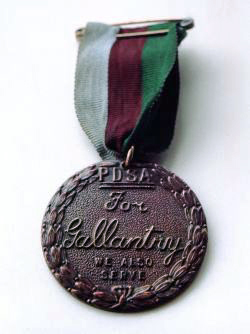
Dickin Medal
The “Dickin Medal” was instituted on December 2, 1943, honoring the work performed by animals, in WW2. The “animal’s Victoria Cross”, the highest British military honor equivalent to the American Medal of honor, is awarded in recognition of “conspicuous gallantry or devotion to duty while serving or associated with any branch of the Armed Forces or Civil Defence Units.”
The Dickin Medal has been awarded 71 times, recipients including 34 dogs, 32 pigeons, 4 horses and a cat. An honorary Dickin was awarded in 2014, in honor of all animals serving in the Great War.
Two Dickins were awarded on this day in 2007. the first to Royal Army Veterinary Corps explosives detection dog “Sadie”, a Labrador Retriever whose bomb detection skills saved the lives of untold soldiers and civilians in Kabul, in 2005. The second went to “Lucky”, a German Shepherd and RAF anti-terrorist tracker serving during the Malaya Emergency of 1949 – ’52. Part of a four-dog team including “Bobbie”, “Jasper” and “Lassie”, Lucky alone would survive the “unrelenting heat [of] an almost impregnable jungle“.
Handler Beval Austin Stapleton was on-hand to receive Lucky’s award. “Every minute of every day in the jungle” he said, “we trusted our lives to those four dogs, and they never let us down. Lucky was the only one of the team to survive our time in the Malayan jungle and I’m so proud of the old dog today. I owe my life to him.”
Ship’s cat, Her Majesty’s Australian Ship (HMAS) Encounter, World War I
“There is no possible excuse for such a delay”, Lippmann wrote. “The women are dying. If ever a case called for prompt adjudication, it is the case of five crippled women who are fighting for a few miserable dollars to ease their last days on earth. This is a heartless proceeding. It is unmanly, unjust and cruel. This is a case which calls not for fine-spun litigation but for simple, quick, direct justice.” Walter Lippmann, New York World
In 1922, a bank teller named Grace Fryer began to feel soreness in her jaw. She was 23 at the time and too young to have her teeth falling out, yet that’s what was happening. Her doctor was able to identify the problem, but couldn’t explain it. Grace Fryer’s jawbones were so honeycombed with holes, they looked like moth eaten fabric.
On December 21, 1898, Marie and Pierre Curie discovered the 88th element of the Periodic Table. This new and radioactive element was Radium, one of the ‘alkaline earth metals’.
Curie’s work would make her the first female recipient of a Nobel Prize in 1906, and the only person of either sex to ever win two Nobels, in 1911.
We’ve seen some strange pop culture fads over the years, from goldfish swallowing to pole sitting, but none stranger than the radium craze of 1904. The stuff was an industrial wonder, a medical cure-all. Newspapers waxed rhapsodic about cities of the future, streets aglow in the light of radium lamps as smiling restaurant patrons sipped “liquid sunshine”. Radium plays and dances featured performers, dressed in glow-in-the-dark costumes. The smiling farmer of the future, tilled glowing fields. Bartender, I’ll have a Radium Highball.
Serious physicians had early success killing cancer cells, driving a quack medicine craze where charlatans sold radium creams, salts and suppositories claiming to to cure everything from impotence to acne to insanity, rickets, tooth decay, and warts.
Unseen at the time, one benefit of the craze was that demand for radium vastly outstripped actual production. Prices skyrocketed to $84,500 per gram by 1915, equivalent to $1.9 million today. Authorities warned consumers to be on the lookout for fake radium, while the business in bogus radium products, soared.
WWI broke out in 1914. It didn’t take long to recognize the advantages of glow in the dark instruments. Any number of companies stepped up to fill the need, but none larger than US Radium and its glow-in-the-dark paint, “Undark”.
Hundreds of women worked in US Radium’s Orange New Jersey factory, hand painting the stuff on watches, gun sights and other instruments. Radioactivity levels were so small as to be harmless to users of these objects, but not so to the people who made them.
The harmful effects of radiation were relatively well understood by 1917, though the information was withheld from factory workers. Camel hair brushes tended to splay out with use. Supervisors encouraged the women to sharpen brushes using lips and tongues for a nice, sharp point. The stuff was odorless and tasteless, and some couldn’t resist the fun of painting nails and even teeth with the luminous paint. The only side effects of all that radium, they were told, would be rosy cheeks.
They were paid eight cents a dial.
The active ingredient in Undark was a million times more active than Uranium, and company owners and scientists knew it. Company labs were equipped with lead screens, masks and tongs, while literally everything on the factory floor, glowed.
Frances Splettscher died in 1925 at age 21, suffering severe anemia and unbearable toothaches. At one point a dentist pulled a tooth. Part of her jaw, came with it.
Doctors began to suspect that Grace Fryer’s condition may be related to her previous employment in US Radium. By that time she was seriously ill, yet Columbia University “Specialist” Frederick Flinn and a “Colleague” pronounced her to be in “fine health”.
Only later were the two revealed to be company executives.
Grace Fryer
These US Radium guys must have been genuine, mustache twirling, villains. In the early 1920s, company officials hired physiologist and Harvard Professor Cecil Drinker to report on working conditions. Drinker’s report detailed catastrophically dangerous working conditions, with virtually every factory employee suffering serious blood or bone conditions.
The report filed with the New Jersey Department of Labor omitted all of it, describing conditions in glowing terms (pun not intended), claiming that “every girl is in perfect condition”.
Reports of illness among other women came flooding in. US Radium took to assassinating the character of these women, claiming that their symptoms resulted from syphilis.
Attorney Raymond Berry filed suit on Fryer’s behalf in 1927, the lawsuit joined by four other dial painters seeking $250,000 apiece, in damages.
The newspapers dubbed them “radium girls”. The health of all five plaintiffs was deteriorating rapidly, while one stratagem after another was used to delay proceedings. By the first courtroom appearance in January 1928, none could so much as raise her arm, to take the oath. Grace Fryer was altogether toothless by this time, unable to walk and requiring a back brace even to sit up.
One dial painter, Amelia “Mollie” Maggia, died on September 12, 1922. She was twenty-six. Mollie’s lower jaw was removed in the last months of her life, the cause of death ruled as syphilis. Mollie’s dentist wasn’t buying it. Dr. Joseph Knef placed her jawbone on a piece of dental film. The resulting image showed “absurd” levels of radiation.
Mollie Maggia was exhumed on October 15, 1927 in the presence of six-man teams of doctors and lawyers from both sides, two brothers-in-law and her father, Valerio. Her bones spoke from beyond the grave, words she herself could no longer say. To hell with the character assassins, doctors found zero evidence of syphilis. “Each and every portion of tissue and bone tested”, they said. “gave evidence of radioactivity.”
The radium girls were far too sick to attend the next hearing in April, when the judge ordered a continuation to September, an accommodation to several company witnesses “summering” in Europe.
Walter Lippmann of the New York World called the proceedings a “Damnable travesty of justice”. “There is no possible excuse for such a delay”, Lippmann wrote. “The women are dying. If ever a case called for prompt adjudication, it is the case of five crippled women who are fighting for a few miserable dollars to ease their last days on earth. This is a heartless proceeding. It is unmanly, unjust and cruel. This is a case which calls not for fine-spun litigation but for simple, quick, direct justice.”
Delay was a deliberate and sleazy tactic, and it worked. Plaintiffs accepted a settlement of $10,000 apiece plus legal fees, and a $600 annual annuity. The deal was mediated by Judge William Clarke, himself a US Radium stockholder. None of the plaintiffs lived long enough to cash more than one or two annuity checks.
Dr. Sabin Arnold von Sochocky, the paint’s inventor, died of aplastic anemia in 1928, a victim of his own creation. Marie Curie herself was dead by 1934, poisoned by radiation. With a half-life of 1,600 years, her lab notebooks remain too hot to handle, to this day.
Radium was synthesized for the first time two years later, on February 4, 1936. One would hope that factory workers using the stuff, were no longer encouraged to sharpen their brushes, with their tongues.
If you enjoyed this “Today in History”, please feel free to re-blog, “like” & share on social media, so that others may find and enjoy it as well. Please click the “follow” button on the right, to receive email updates on new articles. Thank you for your interest, in the history we all share.
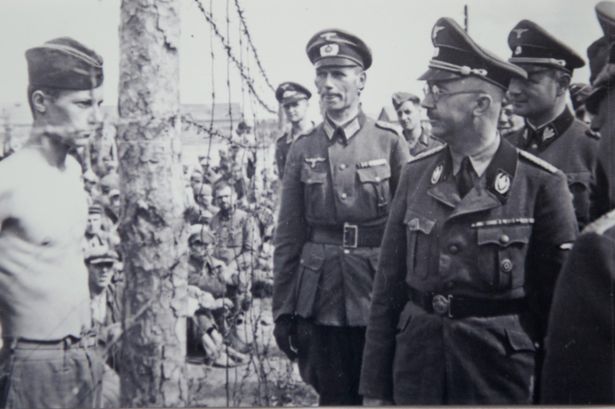
The POW is faced off through barbed wire, with one of the most powerful men of the Third Reich. As if to demand of this former chicken farmer turned wannabe Ubermensch, “Who are YOU, you Son-of-a-Bitch”.
World War II was a short affair for Joseph Horace “Jim” Greasely. Conscripted on the first draft, the Ibstock, Leicestershire native trained for seven weeks with the 2nd Regiment, 5th Battalion Leicestershire, landing in France at the end of that eight-month mobilization period known as the “Sitzkrieg”. The “Phoney War”.
Over 80,000 British, French and allied troops were taken into captivity during those calamitous days in June 1940, leading up to the final evacuation from Dunkirk. On May 25, 1940, Horace Greasely became one of them.
He would spend the next 5 years as a German POW.
Abandoned war materiel in the wake of the Dunkirk evacuation. H/T DailyMail
When he was eighty-nine, Greasely wrote the story of those five years with the help of “ghostwriter” Ken Scott. The book is called “Do The Birds Still Sing In Hell?” It tells the story of a 10-week death march across France and Belgium and into Holland, followed by a three-day train trek into captivity in Polish Silesia, then annexed to Germany.
Stalag VIIIB 344, Greasely’s second PoW camp, was a marble quarry/labor camp near Lamsdorf, where PoWs worked marble to form German headstones. There he met Rosa Rauchbach, the 17-year old daughter of the quarry’s owner. Rosa was a German girl working as camp interpreter, successfully hiding her Jewish roots in the Belly of the Beast. Greasely was 20 and single, at the time. The pair was soon romancing under the nose of prison guards, snatching time for trysts in camp workshops and anywhere else they could find.
French and British captives, force marched to the Belgian border, 1940. H/T DailyMail
Later on, Greasley was transferred to an annex of Auschwitz called Freiwaldau, 40 miles away. The only way to carry on the romance was to break out of camp, so that’s what he did. He met Rosa no fewer than two hundred times in the nearby woods, creeping back to camp under cover of darkness, every time.
Rosa Rauchbach, H/T AllthatInteresting.com
There is some dispute about whether Greasely “escaped”, or not. This particular camp was so remote that security was lax, the guards believing escape to be suicidal.
Furthermore, while Nazi captivity was notoriously savage toward eleven million victims of the holocaust and Russian POWs, German attitudes seemed relatively benign toward fellow signatories to the Geneva Conventions of 1929, particularly their fellow “Anglo-Saxon”.
British historian Guy Walters has called the escape story “fantasy”, citing ‘old men with failing memories teaming up with sharp-elbowed ghost-writers to ‘recall’ increasingly fantastical stories of ‘derring-do during the war’.
Walters goes on to explain that “Working camps for NCOs such as Greasley were not the tightly-guarded places conjured up by our collective imagination, which is weaned on images from Colditz and The Great Escape. In fact, bunking out of one’s camp to fraternise with local girls was hardly unusual, and certainly not ‘escaping’ in the sense most of us understand it.”
Lamsdorf POW Camp, date uncertain
The camp to which Greasely was assigned was liberated on May 24, 1945. He later heard that Rosa had died in childbirth, along with the baby. He would never learn, if the baby was his.
There is a striking image of a prisoner of the era. Skinny and bare chested, a lone captive glares in defiance through barbed wire into the eyes of Heinrich Himmler.
On seeing the 1941 photograph, Greasley asked: “Who is that with me?” There is some question as to whether the image is Greasely’s, the cap is Russian, but Ken Scott insists it is he. Greasely’s widow Brenda agrees, explaining that POWs wore whatever they could get. Besides, she says, “Although he was very thin then, I definitely recognize Horace without his shirt on!”
Brenda Greasely, H/T BirminghamLive
The identity of the man in the image may never be known, for certain. Horace Greasely passed away on February 3, 2010. In a greater sense, it may not matter.
The image may be captioned “The Last Great Act of Defiance”. Whoever it is has summoned the totality of all contempt and engraved it across his face. The man is symbolic, the POW faced off through barbed wire, with one of the most powerful men of the Third Reich. As if to demand of this former chicken farmer turned wannabe Ubermensch, “Who are YOU, you Son-of-a-Bitch”.
The Telegraph newspaper, would seem to agree. The Himmler image was published with the former POW’s obituary, along with the caption: “Greasley confronting Heinrich Himmler (wearing the spectacles) in the PoW camp”. Once one of the most feared visages of the thousand-year Reich, the Nothing had returned, to Zero.
Afterward
American film producer/director Stratton Leopold, executive producer of Mission Impossible III and The Sum of All Fears is working on a film with Silverline Productions, depicting the Jim Greasely story. Ghostwriter Ken Scott tells the UK Mirror: ‘I can say it will be a mix of German and British actors and they are A-listers’. I’ll keep an eye out. That’ll be fun to watch.
If you enjoyed this “Today in History”, please feel free to re-blog, “like” & share on social media, so that others may find and enjoy it as well. Please click the “follow” button on the right, to receive email updates on new articles. Thank you for your interest, in the history we all share.


 The Mayor rode to Woodstock to enlist the help of the King. Back in Oxford, the violence went on for two days, coming to an end on Thursday, February 12.


 In modern Romanian, “Dracul” means “The Devil”. In the old language, it meant “the Dragon”, the word “Dracula” (Drăculea) translating as “Son of the Dragon”.
 A crossroads between East and West, the region was scene to frequent bloodshed, as Ottoman forces pushed westward into Europe and Christian forces pushed back..
 Vlad now consolidated power as his reputation for savagery, grew. According to stories circulated after his death, hundreds of disloyal Boyars (nobles) and their allies met their end, impaled on spikes.
 Țepeș invaded the Ottoman Empire the following year. In a letter to Hungarian king Matthias Corvinus dated February 11, 1462, Țepeș wrote: “I have killed peasants men and women, old and young, who lived at Oblucitza and Novoselo, where the Danube flows into the sea, up to Rahova, which is located near Chilia, from the lower Danube up to such places as Samovit and Ghighen. We killed 23,884 Turks without counting those whom we burned in homes or the Turks whose heads were cut by our soldiers…Thus, your highness, you must know that I have broken the peace with him (Sultan Mehmet II)”.
 Outnumbered five-to-one, Ţepeş carried out a scorched earth policy, poisoning the waters, diverting small rivers to create marshes and digging traps covered with timber and leaves. He would send sick people among the Turks, suffering lethal diseases such as leprosy, tuberculosis and bubonic plague.


 This was the “dead-ball” era of the Major Leagues, an “inside baseball” style relying on stolen bases, hit-and-run plays and, more than anything, speed.
 Spitballs lessened the natural friction with a pitcher’s fingers, reducing backspin and causing the ball to drop. Sandpapered, cut or scarred balls tended to “break” to the side of the scuff mark. Balls were rarely replaced in those days. By the end of a game, the ball was scarred, misshapen and entirely unpredictable. Major League Baseball outlawed “doctored” pitches on February 10, 1920, though it remained customary to play an entire game with the same ball.
 A submarine pitch is not to be confused with the windmill underhand pitch we see in softball. Submarine pitchers throw side-arm to under-handed, with upper bodies so low that some scuff their hands on the ground, the ball rising as it approaches the strike zone.




 The afternoon of February 9, 1942 was cold and clear, over the West 49th Street pier. Welder Clement Derrick was removing the last of four stanchions in the Grand Salon when sparks ignited bales of burlap, covering highly flammable life vests.
 BBC broadcaster Alistaire Cooke, “the Twentieth Century’s de Tocqueville”, spoke of American seamen, torpedoed and picked up by a German submarine. The U-Boat commander came in and asked, in a perfect Brooklyn accent, if any were from the borough. “Maybe I worked with some o’ youse guys. I was twelve years in the Brooklyn Navy Yard.”


 For six hundred years, the Balkan states of Southeastern and Central Europe were conquered and unwilling subjects of foreign powers. First the Ottoman, and then the Austro-Hungarian Empires.
 Lepa Svetozara Radić was born into this world on December 19, 1925.
 Resistance fighters freed the Radić family in weeks. That December, Lepa and her sister Dara officially joined the Partisans.
 Lepa was found out in February 1943, coordinating the rescue of 150 women and children attempting to flee the Nazis. She fired everything she had at attacking SS forces, but never had a chance. Lepa Radić was captured and sentenced to death by hanging, tortured for three days to extract information on Yugoslavian Resistance.
 Moments before her execution with the rope around her neck, Radić was offered a pardon. All she had to do, was give up the names of her Partisan comrades.


 Chariots go back to the earliest days of the Roman Republic, coming down from the ancient Greeks, by way of the Etruscan empire. The mythical abduction of the Sabine women was carried out, while the Sabine men watched a chariot race. While Romans never used them as weapons of war, chariots were used in triumphal processions, pulled by teams of horses, dogs, tigers and even ostriches.
 Modern sport has seen its share of fan passion rising to violence, but the worst “soccer hooligan” fades to docility, compared with the crowd come to watch the chariot races. In the year 69, Emperor Vitellius had commoners put to death for talking trash about the Blue faction. Ten years later, a fan threw himself on the funeral pyre, of his favorite driver. The week-long outbreak of violence known as the Nika Riots of 532 cost the lives of some 30,000 spectators. It all started, over a chariot race.






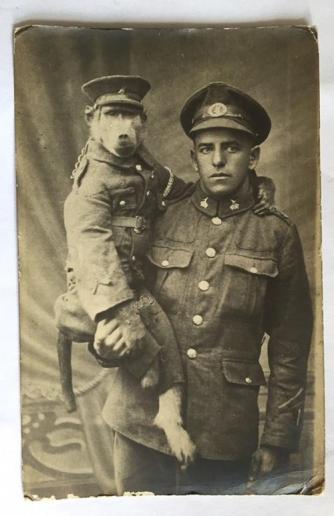 Private Albert Marr’s Chacma baboon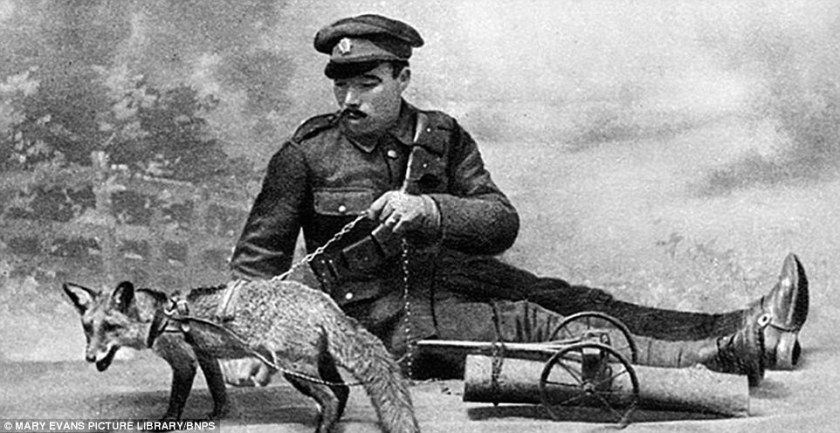


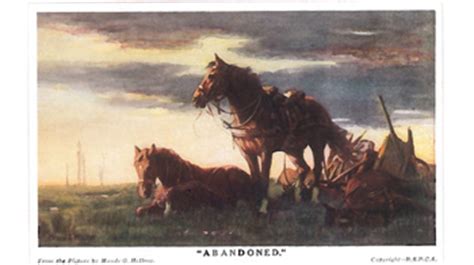 Horsepower was indispensable throughout the war from cavalry and mounted infantry to reconnaissance and messenger service, as well as pulling artillery, ambulances, and supply wagons. With the value of horses to the war effort and difficulty in their replacement, the loss of a horse was a greater tactical problem in some areas, than the loss of a man.
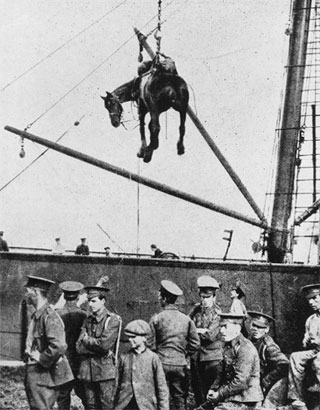 Few ever returned. An estimated three quarters died of wretched working conditions. Exhaustion. The frozen, sucking mud of the western front. The mud-borne and respiratory diseases. The gas, artillery and small arms fire. An estimated eight million horses were killed on all sides, enough to line up in Boston and make it all the way to London four times, if such a thing were possible.


 On December 21, 1898, Marie and Pierre Curie discovered the 88th element of the Periodic Table. This new and radioactive element was Radium, one of the ‘alkaline earth metals’.
 Serious physicians had early success killing cancer cells, driving a quack medicine craze where charlatans sold radium creams, salts and suppositories claiming to to cure everything from impotence to acne to insanity, rickets, tooth decay, and warts.


 Reports of illness among other women came flooding in. US Radium took to assassinating the character of these women, claiming that their symptoms resulted from syphilis.




 Historical Easter Eggs - Today in History
You must be logged in to post a comment.