The word “Pulchritude” has fallen out of everyday usage. Possibly, the term comes down to us from an individual, who may have been the greatest maniac if not the dumbest man, in Roman antiquity. Either that, or a man so bull-headedly determined to get what he wanted, as to be remembered as one of the great Meatheads, in all of history.
The etymology website etymonline.com defines “pulchritude” as (n.) – “beauty,” c. 1400, from Latin pulchritudo for “beauty, excellence, attractiveness”.
The word has fallen out of everyday usage. The website indicates, origin unknown. Possibly, the term comes down to us from an individual, who may have been the greatest maniac if not the dumbest man, in Roman antiquity. Either that, or a man so bull-headedly determined to get what he wanted, as to be remembered as one of the great Meatheads, in all of history.
In ancient Rome, women partook of a festival, strictly forbidden to Roman men. So stringent was this line of demarcation that only women were permitted even to know the name of the deity, to whom the festival was dedicated. For everyone else she was simply the “Good Goddess”. The Bona Dea.
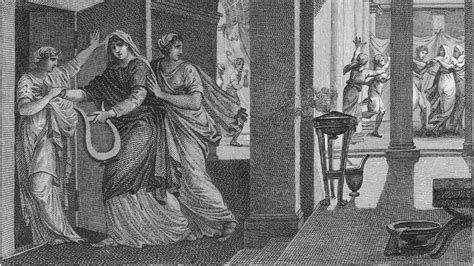
The first of two annual festivals of the Bona Dea was held during the winter, at the Aventine Temple. The second rite took place every May, hosted by the wife of the current Pontifex Maximus and attended by an elite group of Roman matrons, female attendants and vestal virgins.
Lo scandalo della bona dea, H/T studiarapido.it
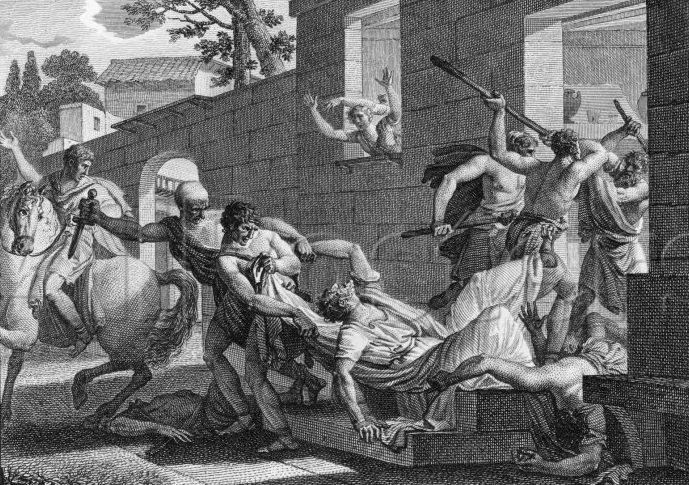
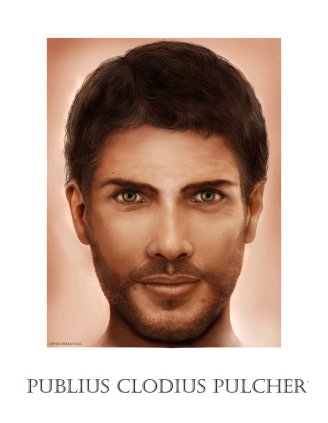
Eighteen years before the end of the Republic, the Pontifex Maximus was Julius Caesar. Scandal broke out on this day in 62BC, when the aforementioned meathead, the politician Publius Clodius Pulcher, dressed as a woman and sneaked into the Bona Dea festival bent on seducing Pompeia, the wife of Caesar himself.
I’m not even sure how that was supposed to work but, of all the women in Rome, this guy set his sights on the wife of Julius Caesar.
Apparently, ol’ Pulcher was insufficiently pulchritudinous. He was found out and thrown out and, thus vitiated, the rites of the Bona Dea were rendered null and void, necessitating repetition by the Vestal Virgins. Meanwhile, to have desecrated the sanctity of such rites as the Bona Dea was to have offended the city and the Gods, under pain of death. A trial ensued and the legal wrangling went on, for two years.
In the end, Clodius was acquitted, a fact Cicero put down to fixed juries and back-room deals. The Greek biographer and essayist Lucius Mestrius Plutarchus better known as Plutarch, writes that jurors handed in deliberately illegible verdicts, “in order that they might neither risk their lives with the populace by condemning him, nor get a bad name among the nobility by acquitting him“. Talk about Profiles in Courage.
Hat tip crayonmaniac.deviantart.com, for this image
Pulcher’s populist brand of politics would transform the politician into “One of the most innovative urban politicians in Western history” and, one day, get him killed at the hands of a political opponent. The man’s transvestite dalliance with the Bona Dea provided arch-rival Marcus Tullius Cicero with verbal ammunition, for years to come.
Interestingly, Cicero’s problem with Pulcher may have been more than just, political. Clodius Pulcher had once prosecuted one Fabia, a Vestal Virgin, on charges of incest. Fabia’s half-sister Terentia was mightily offended at the proceedings, and her husband just happened to be Cicero himself. I wonder how it sounded to come home to That, every night.
The verdict of the ages was quite unfair to Pompeia. Nothing more substantial than gossip and rumor ever implicated her in the Bona Dea scandal yet her husband divorced her, immediately.
Plutarch writes, in The Life of Caesar:
“Caesar divorced Pompeia at once, but when he was summoned to testify at the trial, he said he knew nothing about the matters with which Clodius was charged. His statement appeared strange, and the prosecutor therefore asked, “Why, then, didst thou divorce thy wife?” “Because,” said Caesar, “I thought my wife ought not even to be under suspicion.””
A Trivial Matter
To search on “average age in ancient Rome” is to be rewarded with the number, 35. While mathematically correct (maybe), the fact is misleading. Fully half of Roman children died before age ten. Roman men joined the military at age 17 and a distressingly high number of Roman women, died in childbirth. Karen Cokayne writes in Experiencing Old Age in Ancient Rome, that “From around the first century B.C. onwards, the age of 60 or 65 was commonly mentioned as the threshold of old age.” Should a person make sixty, (s)he had at least an average chance of living to seventy, and beyond. H/T revealedrome.com
Casey Jones had a knack for these complex and powerful machines. He was good at what he did and an aggressive risk taker. Ambitious for advancement, Jones was issued nine citations for rules infractions over the course of his career, resulting in 145 days’ suspension. He was well liked by fellow railroaders but widely regarded, as just this side of reckless.
Acts of heroism have a way of popping up, in the most unexpected places. Ordinary people rising to the occasion, in anything but ordinary circumstances.
Just recently, two teenage boys chased down a kidnapper on their bicycles, freeing a little girl from captivity. The Poway, California Rabbi grabs hold of a gun in the hands of a demented killer, losing a finger and saving untold numbers of congregants, in the process. An eight-month’s pregnant mother-to-be dives into the Australian surf, to save two drowning boys.
This is one of those stories.
Jonathon Luther Jones lived near Cayce Kentucky as a boy, and the nickname stuck. For reasons which remain unclear, he preferred to spell it, “Casey”.
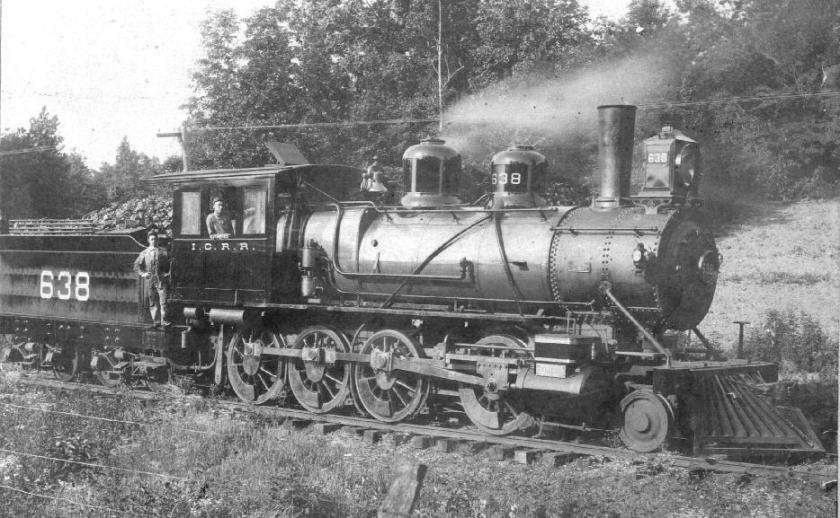
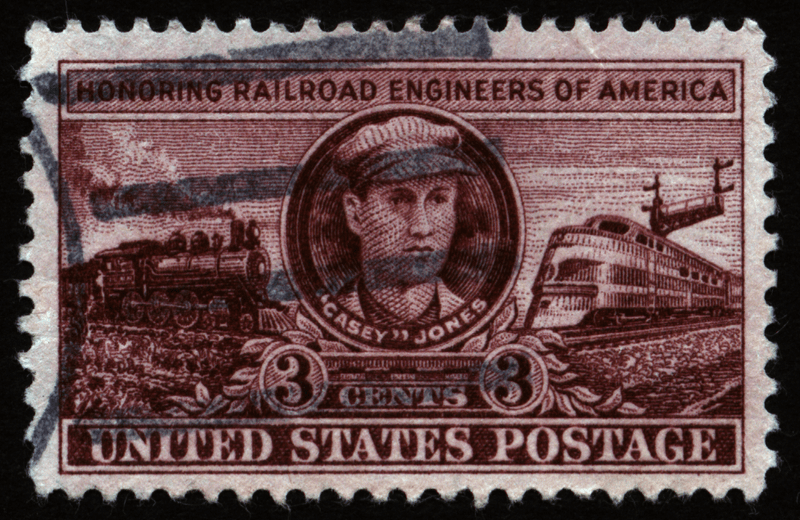
Casey Jones was a train man, working on the I.C.R.R., the Illinois Central Railroad.
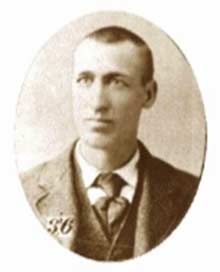
Jonathon Luther “Casey” Jones
One example of the man’s character comes to us from 1895, when Jones was thirty two. Outside Michigan City Mississippi, a group of children darted across the tracks, fewer than sixty yards from the speeding train. Most made it across except one little girl, who froze in terror before the oncoming locomotive.
With fellow engineer Bob Stevenson hauling back on the emergency brakes and buying precious extra moments, Jones ran across the running boards and inched his way down the pilot, better known as the “cow catcher”.
This is no trick rider. No circus acrobat. Casey Jones worked on the railroad. Bracing himself with his legs, Jones reached out and scooped up the little girl, at the last possible moment.
On this occasion, the man had every hope and expectation of remaining alive, and that he did. Five years later, he’d perform his last act of heroism in the face of certain and violent, death.
Casey Jones went to work for the Mobile & Ohio Railroad where he performed well, receiving first a promotion to brakeman, and then to fireman. He met Mary Joanna (“Janie”) Brady around this time, whose father owned the boarding house, where Jones lived. The pair fell in love and married on November 11, 1886, buying a house in Jackson Alabama where the couple raised their three children. By all accounts the man was sober and devoted to his work, a dedicated family man.
Several crews from the Illinois Central Railroad (IC) were down with yellow fever in the summer of 1887. Fireman Jones went to work for the IC the following year, firing a freight run between Jackson, Tennessee, and Water Valley, Mississippi.
Casey Jones had a knack for these complex and powerful machines. He was good at what he did and an aggressive risk taker. Ambitious for advancement, Jones was issued nine citations for rules infractions over the course of his career, resulting in 145 days’ suspension. He was well liked by fellow railroaders but widely regarded, as just this side of reckless.
Jones achieved his lifelong goal of becoming an engineer in 1891. He was well known, for being on time. Jones insisted he never “fall down” and get behind schedule. People learned to set their watches by his train whistle, knowing he would always “get her there on the advertised” (time).
Jones moved his family to Memphis in 1900, transferring to the “cannonball run” between Chicago and New Orleans. The run was a four train passenger relay, advertising the fastest travel times in the history of the American railroad. Experienced engineers were worried about the ambitious schedule and some even quit, but Jones saw the new itinerary as an opportunity for advancement.
How a steam locomotive, works
On this day in 1900, Engine #382 departed Memphis at 12:05am, ninety-five minutes behind schedule due to the late arrival of the first leg, of the relay.
The Memphis to Canton, Mississippi run was 190 miles long and normally took 4 hours, 50 minutes at an average speed of 39 MPH. 95 minutes was a lot of time to make up but #382 was a fast engine and traveling “light” that night, with only six cars.
Fireman Simeon “Sim” T. Webb
Fireman Simeon Taylor “Sim” Webb was one of the best. He would have to be. This would be a record breaking run.
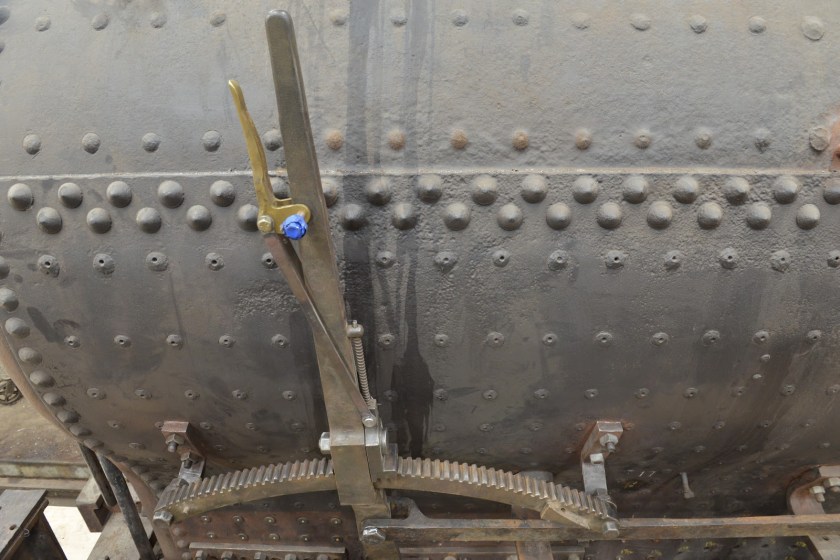
Jones hit the Johnson bar, throttling #382 up to 80 MPH despite sharp turns and visibility reduced by fog. There were two stops for water and a brief halt on a side track, to let another engine through. Despite all that, #382 made up most of that time by the 155-mile mark. On leaving the side track in Goodman, Mississippi, Jones was only five minutes behind the advertised arrival time of 4:05am.
Jones was well acquainted with those last 25 miles into Vaughn Mississippi. There were few turns and the engineer throttled his engine up to breakneck speed. He was thrilled with his time, saying “Sim, the old girl’s got her dancing slippers on tonight!”
Unknown to Casey, there was a problem ahead. Three trains were in the station at Vaughn, with a combined length ten cars longer, than the main siding. Rail yard workers performed a “saw by” maneuver, backing #83 onto the main line and switching overlapping cars onto the “house track”. Then there was that problem with an air hose. Four cars were stranded on the main line.
#382 sped through the final curve at 75MPH, only two minutes behind schedule. Clinging to the side board, Sim Webb was the first to see the red lights, of the caboose. “Oh my Lord”, he yelled, “there’s something on the main line!”
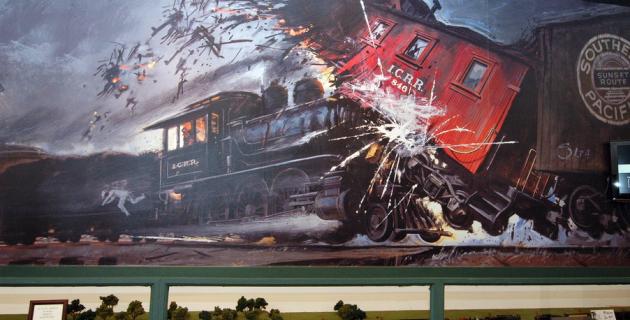
Jones didn’t have a prayer of stopping in time. He was moving too fast. He reversed throttle and slammed the air brakes into emergency stop, screaming “Jump Sim, jump!” Sim Webb jumped clear with only 300 feet to go as the piercing scream of the train’s whistle, rent the air.
Jones could have jumped himself. His ordering Webb to do so, demonstrates he understood the situation. Casey Jones stayed on the train as “Ole 382” plowed through the red wooden caboose and three freight cars, before leaving the track. By the time of impact, Jones frantic efforts had slowed the engine to 35 miles per hour, saving his passengers from serious injury or death. Jones himself was the only fatality, his watch stopped at 3:52am. He was only two minutes behind schedule.
Passenger Adam Hauser of the New Orleans Times-Democrat was in a sleeper car, at the time of the wreck: “The passengers did not suffer” he said, “and there was no panic. I was jarred a little in my bunk, but when fairly awake the train was stopped and everything was still. Engineer Jones did a wonderful as well as a heroic piece of work, at the cost of his life”.
Legend has it that, when Jones’ body was removed, his dead hands still clutched the whistle cord, and the brake.
Casey Jones has achieved mythological status since that day, alongside the likes of Pecos Bill and Paul Bunyan. “The Ballad of Casey Jones” was recorded by Mississippi John Hurt, Johnny Cash and the Grateful Dead, among others.
Jones’ son Charles was 12 at the time of his death at age 37, his daughter Helen, 10. The youngest, John Lloyd (“Casey Junior”) was 4. Janie received two life insurance payments totaling $3,000 as Casey was “Double Heading” at that time, as a member of two unions. she received no other compensation. The Railroad Retirement Fund didn’t come about, until 1937.
Janie never had any thought of remarrying and lived the rest of her years, dressed in black. She died on November 21, 1958 in Jackson Alabama, at the age of 92
A Trivial Matter
In 1907, brakeman Jesus Garcia drove his flaming train away from the small mining town of Nacozari, in the Mexican state of Sonora. The train was carrying dynamite, and blew up, Killing Garcia. His quick actions had saved the town, where Jesus Garcia remains a hero, to this day.
Of all the General officers who fought for American Independence, there is but one true Cincinnatus. A man who risked his life in the cause of Liberty, and truly retired from public life.
The Roman Republic of antiquity operated on the basis of separation of powers with checks and balances, and a strong aversion to the concentration of authority. Except in times of national emergency, no single individual was allowed to wield absolute power over his fellow citizens.
The retired patrician and military leader Lucius Quinctius Cincinnatus was called from his farm in 458BC to assume the mantle of Dictator and, despite his old age, again, twenty years later. With the crisis averted, Cincinnatus relinquished all power and the perks which came with it, and returned to his plow.
The man’s name remains symbolic, from that day to this. A synonym for outstanding leadership, selfless service and civic virtue.
Of all the General officers who fought for American Independence, there is but one true Cincinnatus. A man who risked his life in the cause of Liberty, and truly retired from public life.
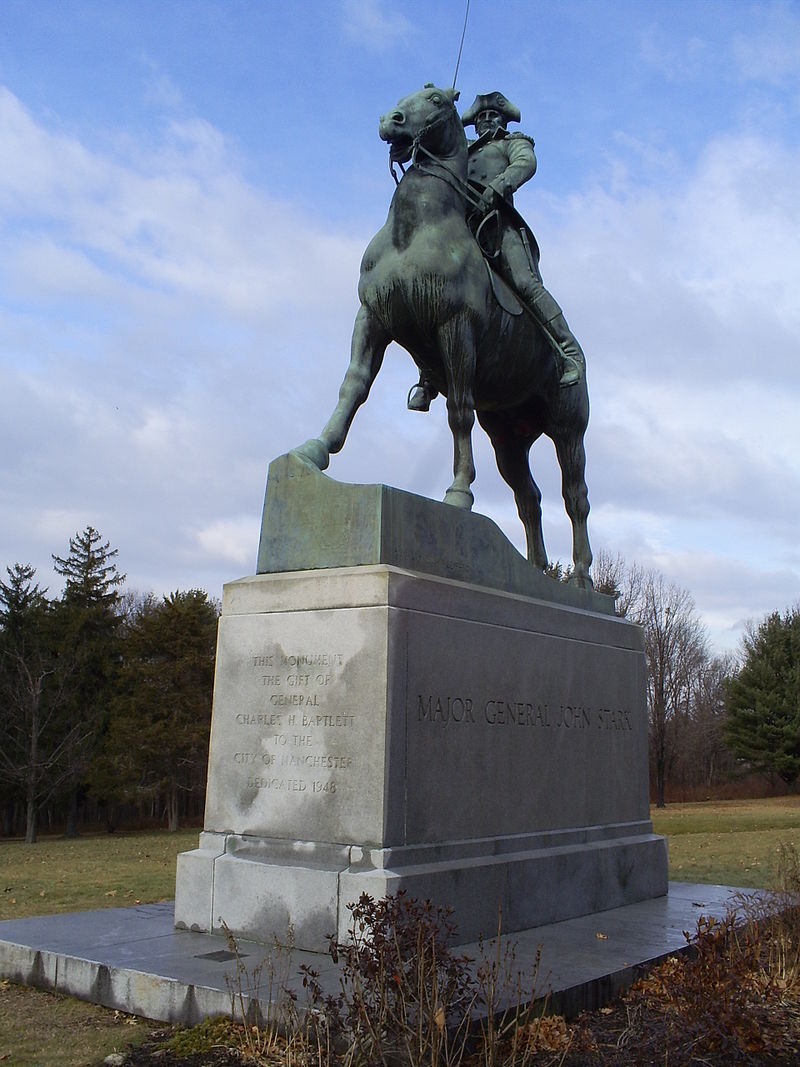
Outside of his native New Hampshire, few remember the name of John Stark. Born August 28, 1728 in Londonderry (modern day Derry), the family moved up the road when the boy was eight, to Derryfield. Today we know it as Manchester.
On April 28, 1752, 23-year-old John Stark was out trapping and fishing with his brother William, and a couple of buddies. The small group was set upon by a much larger party of Abenaki warriors. David Stinson was killed in the struggle, as John was able to warn his brother away. William escaped, in a canoe.
John was captured along with Amos Eastman. 267 years ago today, the hostages were heading north, all the way to Quebec, where the pair were subjected to a ritual torture known as “running the gauntlet”.
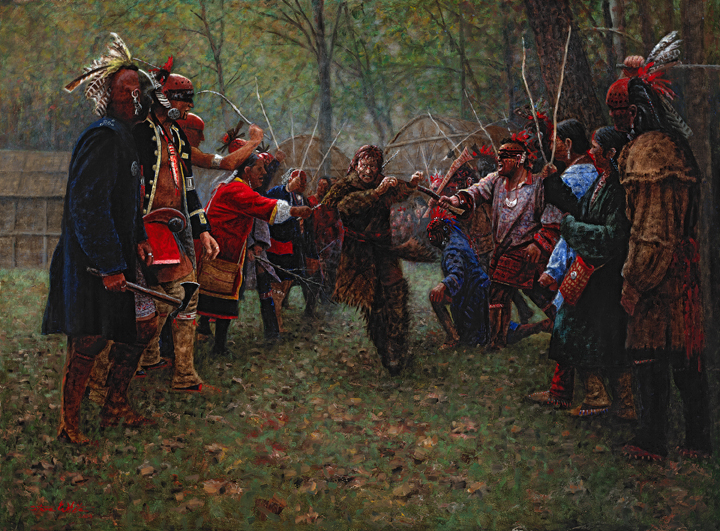
Frontiersman Simon Kenton, running the gauntlet
In the eastern woodlands of the United States and southern Quebec and Ontario, captives in the colonial and pre-European era often faced death by ritual torture at the hands of indigenous peoples, a process which could last, for days. In running the gauntlet, the condemned is forced between two opposing rows, where warriors strike out with clubs, whips and bladed weapons.
Eastman barely got out alive, but Stark wasn’t playing by the same rules. He hit the first man at a dead run, wrenching the man’s club from his grasp and striking out, at both lines. The scene was pandemonium, as the tormented captive gave as good as he got. To the chief of the Abenaki, it may have been the funniest thing, ever. He was so amused, he adopted the pair into the tribe. Eastman and Stark lived as tribal members for the rest of that year and into the following Spring, when a Massachusetts Bay agent bought their freedom. Sixty Spanish dollars for Amos and $103, for John Stark.
Seven years later during the French & Indian War, Rogers’ Rangers were ordered to attack the Abenaki village with John Stark, second in command. Stark refused to accompany the attacking force out of respect for his Indian foster family, returning instead to Derryfield and his wife Molly, whom he had married the year before.
John Stark returned to military service in 1775 following the Battles of Lexington and Concord, accepting a Colonelcy with the 1st Regiment of the New Hampshire militia.
During the early phase of the Battle of Bunker Hill, American Colonel William Prescott knew he was outgunned and outnumbered, and sent out a desperate call for reinforcements. The British warship HMS Lively was raining accurate fire down on Charlestown Neck, the narrow causeway linking the city with the rebel positions. Several companies were milling about just out of range, when Stark ordered them to step aside. Colonel Stark and his New Hampshire men then calmly marched to Prescott’s position on Breed’s Hill, without a single casualty.
Stark and his men formed the left flank of the rebel position, leading down to the beach at Mystic River. The Battle of Bunker Hill was a British victory, in that they held the ground, when it was over. It was a costly win which could scarcely be repeated. At the place in the line held by John Stark’s New Hampshire men, British dead were piled up like cord wood.
John Stark’s service record reads like a timeline of the American Revolution. The doomed invasion of Canada in the Spring of 1776. The famous crossing of the Delaware and the victorious battles at Trenton, and Princeton New Jersey. Lieutenant Colonel Friedrich Baum and his Brunswick mercenaries ran into a buzz saw in Bennington Vermont, in the form of Seth Warner’s Green Mountain Boys and John Stark, rallying his New Hampshire militia with the cry, “There are your enemies, the Red Coats and the Tories. They are ours, or this night Molly Stark sleeps a widow!” When it was over, Stark reported 14 dead and 42 wounded. Of Lt. Col. Baum’s 374 professional soldiers, only nine walked away.
Battle of Bennington
The loss of his German ally led in no small part to “Gentleman Johnny” Burgoyne’s defeat, at Saratoga. Stark served with distinction for the remainder of the war and, like Cincinnatus before him, returned home to his farm.
In 1809, a group of Bennington veterans gathered for a reunion. Stark was 81 at this time and not well enough to travel. Instead, he wrote his comrades a letter, closing with these words:
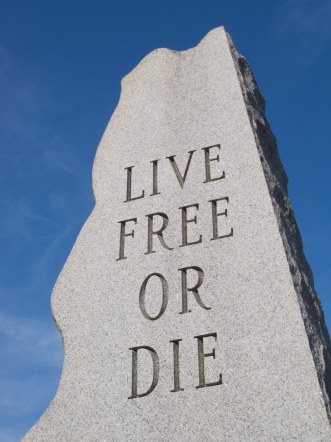
“Live free or die: Death is not the worst of evils.”
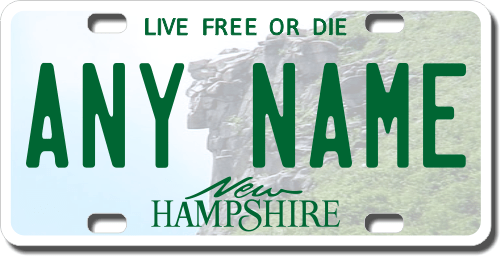
The name of the American Cincinnatus is all but forgotten today but his words live on, imprinted on every license plate, in New Hampshire. “Live Free or Die”.
A Trivial Matter
Neither George Washington nor Samuel Adams liked political parties, believing that such “factions” would splinter the Congress and divide the nation.
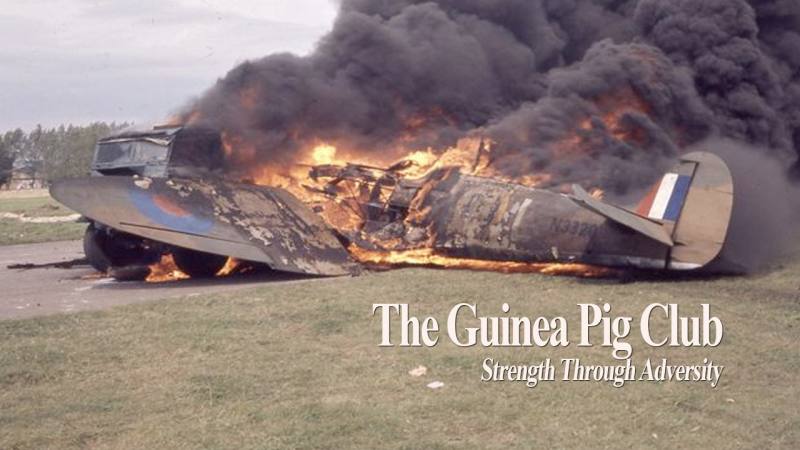
The mind recoils in horror at the human body enveloped in flame, but that’s just the beginning. Both Hurricane and Spitfire fighters place fuel tanks, directly in front of the pilot. The wind speed of an F5 tornado is 201MPH+. The nozzle speed from a common pressure washer, 243. The maximum speed of these two fighter aircraft are 340 and 363 respectively, the explosive force of escaping gasses, geometric multiples of those numbers. The burns resulting from exploding aviation fuel were called “Hurricane Burns”. The wreckage wrought on the human form, beggars the imagination.
The attraction of taking flight in time of war is unmistakable. For a lad of nineteen, twenty, twenty one, he is a latter-day knight at the prime of his life, mounting his steed of steel to do battle with evil. Life seems indestructible and without end at that age, except, reality is shockingly different. Of a group of 100 RAF airmen in the early phase of World War Two, a mere twenty escaped being killed, captured or incinerated alive.
Flying Officer Desmond “Des” O’Connell was just nineteen when he joined the British Royal Air Force, in 1938.
O’Connell was assigned to RAF Limavady in the north of Ireland in the early months of World War Two, around the time the Capital Battleship Bismarck cleared the Kiel Canal and emerged into the Baltic Sea. On this day in 1941, Desmond O’Connell and six other flyers were assigned to find and take out the German warship.
The twin engine Whitworth Mark V ‘Whitley’ medium bomber never had a chance, overloaded as it was with extra crew, tanks full of fuel and bombs. The aircraft struggled to gain altitude and clipped the mountains outside of Limavady before striking the ground, and breaking apart.
Desmond O’Connell miraculously survived as did the rest of the crew, but his ordeal had just begun. Soaked with fuel and suffering a skull fracture, he was crawling on his hands and knees when the fire caught up. He remembers peering through the flames at his hands, as pieces came off of his gloves. But those weren’t gloves. The flesh was burning from his hands.
Archibald Hector McIndoe took to medicine at an early age, earning the first New Zealand fellowship to the prestigious Mayo Clinic in Rochester Minnesota, at only 24. Dr. McIndoe moved to London in 1930 and, unable to find work, joined in private practice with his great uncle, fellow Kiwi Sir Harold Gillies. Gillies was a pioneer in the field of plastic surgery by this time, made famous through his work in the Great War as “The Man who Fixed Faces“.
Dr. McIndoe was a talented surgeon: confident, precise, and quick on his feet. Under Harold Gillies’ direction, Archibald McIndoe became a leading figure in the field of plastic surgery.
With the outbreak of WW2, Dr. McIndoe took a position at Queen Victoria Hospital in East Grinstead, Sussex, where he headed up a center for plastic and maxillofacial surgery. A trickle of patients from the “Phoney War” period soon turned to a flood, during the Battle of Britain.
The mind recoils in horror at the human body enveloped in flame, but that’s just the beginning. Both Hurricane and Spitfire fighters place fuel tanks, directly in front of the pilot. The wind speed of an F5 tornado is 201MPH+. The nozzle speed from a common pressure washer, 243. The maximum speed of these two fighter aircraft are 340 and 363 respectively, the explosive force of escaping gasses, geometric multiples of those numbers. The burns resulting from exploding aviation fuel were called “Hurricane Burns”. The wreckage wrought on the human form, beggars the imagination.
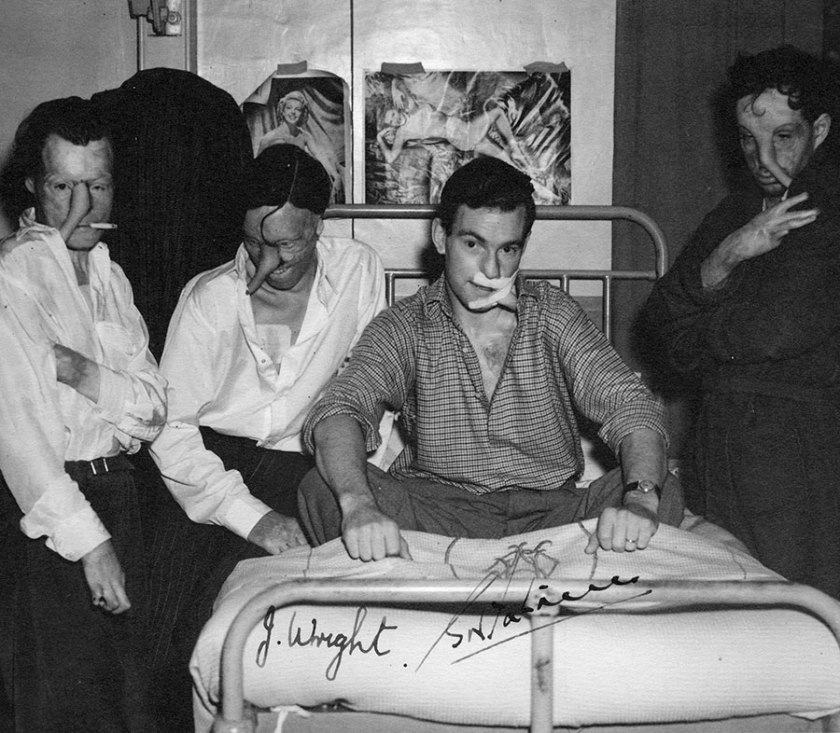
Dr. McIndoe treated no fewer than 649 of these men, not only Brits but Canadians, Australians and New Zealanders. There were Americans and French, Czechs and Poles. Each man required dozens and sometimes hundreds of surgeries over agonizing years. Sausage-like constructions of living flesh called “tubed pedicles” were “waltzed” up from remote donor sites on patient’s own bodies, to replace body parts consumed by the war.
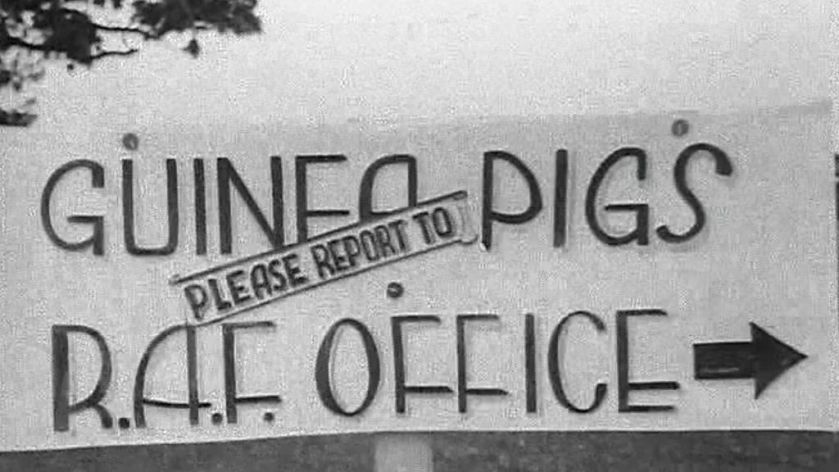
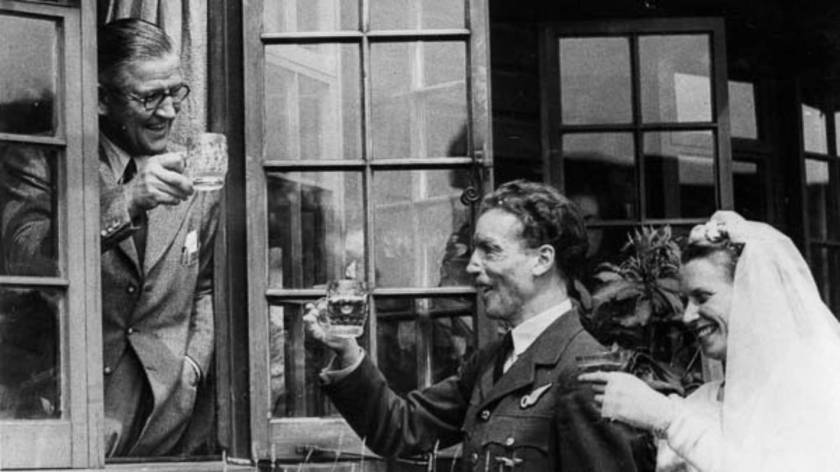
To be rendered hideous and unsightly in service to one’s nation, a subject of horrified stares, is more than most can bear. McIndoe understood as much and his treatment methods threw convention, out the window. Inmates were treated not as patients or objects of pity, but as men. They wore not the ‘jammies or those degrading hospital johnnys with their asses hanging out but their own clothing, and even uniforms. They had parties and socialized. Those who were able went “out on the town”. They were the “Guinea Pig Club”, they socialized, threw parties. More than a few relationships were formed with nurses, many ended in marriage.
“Others met women from East Grinstead, a place the ‘guinea pigs’ referred to as ‘the town that never stared’”. H/T nzhistory.govt.nz
Dr. McIndoe was knighted in 1947 and passed away at only fifty nine, but his work lives on in the African Medical and Research Foundation (AMREF), and the British Association of Plastic Surgeons (BAPS) for which he once served, as president. The Blond McIndoe Research Foundation opened at the Queen Victoria Hospital in 1961, and continues to conduct research into new methods of wound management, to this day.
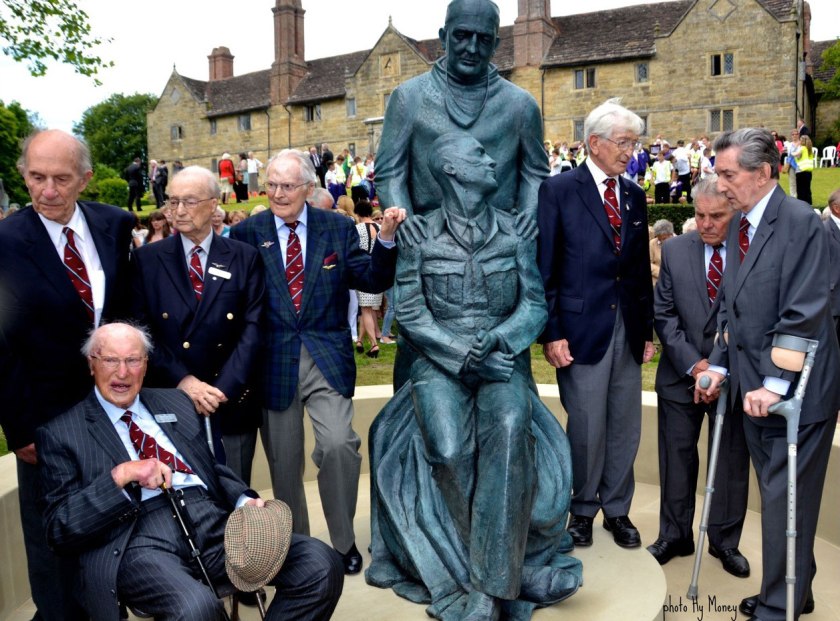
The Guinea Pig Club turned seventy-five years old in 2016. Most of those early RAF members are gone now, but the organization lives on. Today, new members come from places like the Falkland islands. And Iraq. And Afghanistan.
Feature image, top of page: A scene from the 2012 play “The Guinea Pig Club”, depicts the agonies of WW2-era RAF airmen, treated for severe burns
A Trivial Matter
“Until the spring of 1944, the priority for manpower in the UK was not the navy, RAF, army, or even the merchant navy, but the Ministry of Aircraft Production. In the war, Britain alone built 132,500 aircraft, a staggering achievement – especially when considering that Fighter Command in the battle of Britain never had more than 750 fighters”. H/T HistoryExtra.com
The time and place is unknown to history but the question must have come up, in some lost and forgotten conference. What would it take, to bomb a city. To Hell. On that day, people of the former Basque capital of Guernica became guinea pigs. Unsuspecting victims of a cold blooded and beastly experiment, mere data points in a future World War.
The Spanish Civil War of 1936-’39 pitted a left leaning alliance of Anarchists, Marxists and the Republican government of President Manuel Azaña against a Rightist coalition of Nationalists, Monarchists and Catholics originally under the leadership of José Sanjurjo and later led by General Francisco Franco.
Among nations, only Mexico and the Soviet Union openly supported the Republicans while Nationalists received aid and support from Nazi Germany, Fascist Italy, the Estado Novo regime of Portuguese Prime Minister António de Oliveira Salazar and volunteers of the Romanian Iron Guard.
Posters of the Spanish Civil War
Many among the International Left saw this as the authentic front line against International fascism. As many as 40,000 poured into the conflict claiming to represent 53 nations such as the American Abraham Lincoln Brigade, the Canadian Mackenzie–Papineau Battalion and even groups of Germans and Italians of the Garibaldi Battalion.
For Nazi Germany, this was a dress rehearsal. An opportunity to try out new weapons and tactics for the larger war, to come. Adolf Hitler sent the multi-tasking Condor Legion, combining units of the Luftwaffe and the Heer, the Army component of the German Wehrmacht.
The time and place is unknown to history but the question must have come up, in some lost and forgotten conference. What would it take, to bomb a city. To Hell. On that day, people of the Spanish town of Guernica became guinea pigs. Unsuspecting victims of a cold blooded and beastly experiment, mere data points in a future World War.
Many years later, German air chief Hermann Goering testified at his trial for war crimes:
“The Spanish Civil War gave me an opportunity to put my young air force to the test, and a means for my men to gain experience.” – Hermann Goering
Guernica was a market town in the northern “Basque” region of Spain, a place where local farmers and village people come in from the countryside, to conduct business. Monday, April 26 was Market day, with an estimated 10,000 in the former Basque capital.
Noel Monks was an Australian reporter, covering the war for the London Daily Express. The German bombers first appeared on this day in 1936, some eighteen miles outside Guernica.
Monks and a driver named Anton were on a dusty road that afternoon when six Heinkel 52 fighters came in fast and low, directly at them. The pair leapt out of the car and into the mud of a bomb hole, as machine gun bullets tore into the road. “When the Heinkels departed”, Monks wrote, “out of ammunition I presumed, Anton and I ran back to our car. Nearby a military car was burning fiercely. All we could do was drag two riddled bodies to the side of the road. I was trembling all over now, in the grip of the first real fear I’d ever experienced.”
Let Monks pick up the story. He was the first correspondent into the burning city:
“We were still a good ten miles away when I saw the reflection of Guernica’s flames in the sky. As we drew nearer, on both sides of the road, men, women and children were sitting, dazed. I saw a priest in one group. I stopped the car and went up to him. ‘What I happened, Father?’ I asked. His face was blackened, his clothes in tatters. He couldn’t talk. He just pointed to the flames, still about four miles away, then whispered: ‘Aviones. . . bombas’. . . mucho, mucho.’
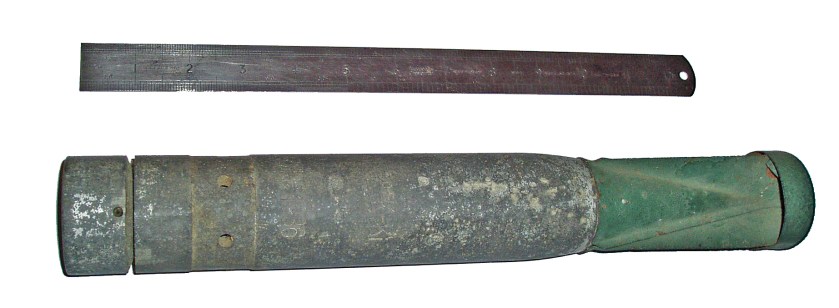
Luftwaffe Incendiary Bomb, circa 1937
I was the first correspondent to reach Guernica, and was immediately pressed into service by some Basque soldiers collecting charred bodies that the flames had passed over. Some of the soldiers were sobbing like children. There were flames and-smoke and grit, and the smell of burning human flesh was nauseating. Houses were collapsing into the inferno.
In the Plaza, surrounded almost by a wall of fire, were about a hundred refugees. They were wailing and weeping and rocking to and fro. One middle-aged man spoke English. He told me: ‘At four, before the-market closed, many aeroplanes came. They dropped bombs. Some came low and shot bullets into the streets. Father Aroriategui was wonderful. He prayed with the people in the Plaza while the bombs fell.’..
Five separate raids struck Guernica that day, each in their turn.
…The only things left standing were a church, a sacred Tree, symbol of the Basque people, and, just outside the town, a small munitions factory. There hadn’t been a single anti-aircraft gun in the town. It had been mainly a fire raid.
Estimates of that time count the number of dead as high as 1,700. Monks wrote of “…A sight that haunted me for weeks was the charred bodies of several women and children huddled together in what had been the cellar of a house. It had been a refugio.”
Later estimates put the number between 170 and 300, not counting the 592 dead registered in the hospital, in Bilbao.
First came the propagandists. A fog of lies, blanketing the ground. Monks received this cable, from his office in London: “Berlin denies Guernica bombing. Franco says he had no planes up yesterday owing fog. (Nationalist General) Queipo de Llano says Reds dynamited Guernica during retreat.”
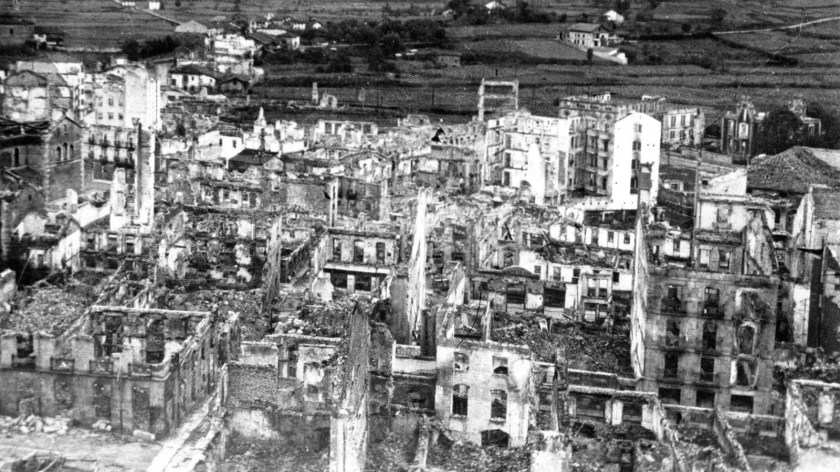
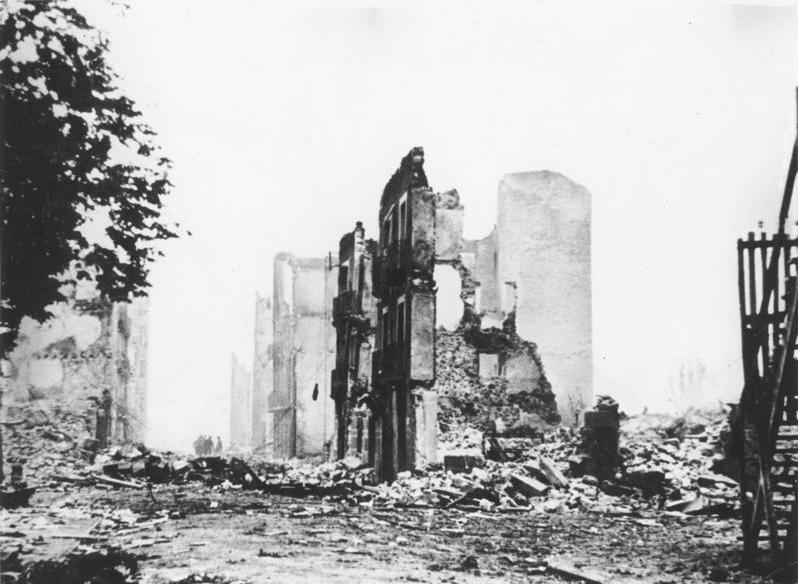
As much as 74% of Guernica was destroyed in the raids. There were the cold calculations. The ratios. How many buildings destroyed per ton of bombs. How many lives.
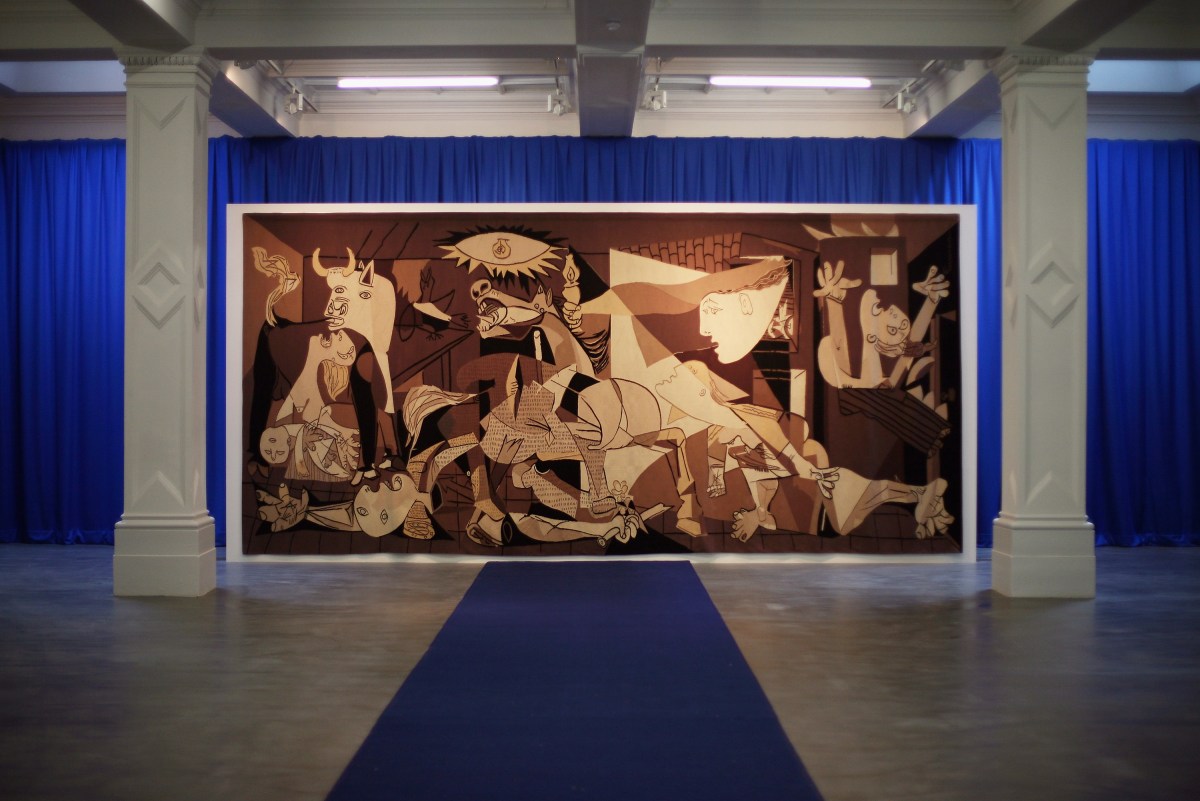
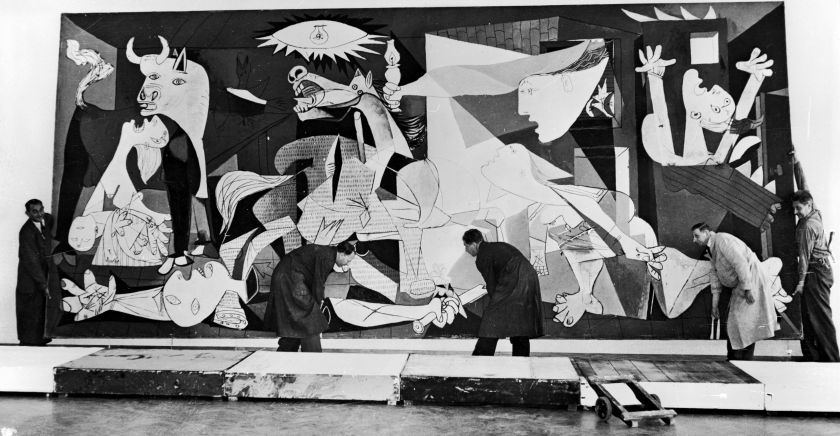
Spanish artist Pablo Picasso completed his famous work in June of that year, the oil painting in Gray, Black and White depicting what it is like to be under attack from the air, perhaps the most powerful piece of anti-war art, in history.
For those left on the ground of Guernica, there was little doubt. The bombing raids of the age were more than capable of wiping entire cities, off of the map.
Guernica by Pablo Picasso in Amsterdam being hung in the Municipal Museum 12th July 1956. H/TKeystone Hulton Archive Getty Images
A Trivial Matter
There were few “good guys” in the Spanish Civil War and those there were, must have been quickly disillusioned. Nationalists murdered an estimated 150,000 prisoners of war and civilians over the course of the three year conflict, plus another 20,000 following their victory, in 1939. An estimated 49,000 were murdered at the hands of the Republicans. Hat tip, History.com
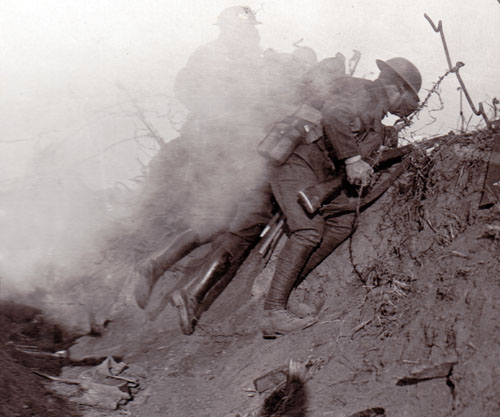
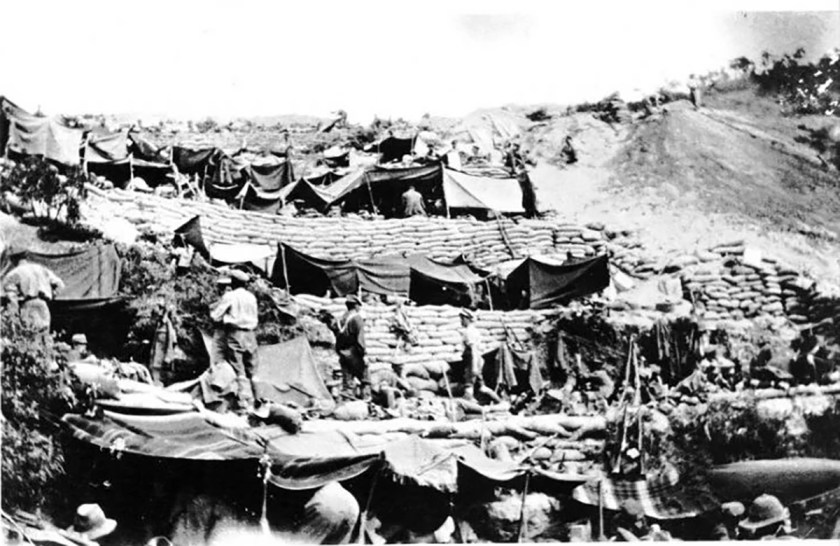
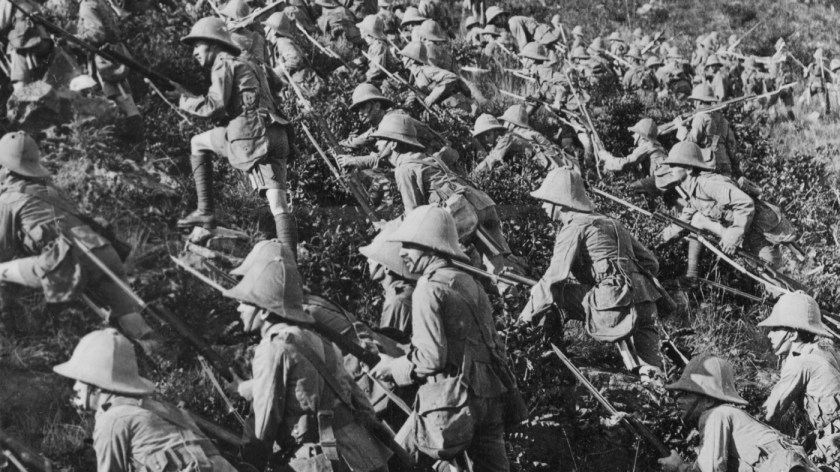
Following four months training in Egypt, the fledgling ANZAC forces came ashore on this day in 1915, under heavy Turkish fire.
Europe was unprepared for what was to come in September 1939. Wags called the eight months ending in May 1940 the ‘Phoney War”. The “Sitzkreig”. The outbreak of the “Great War” was different in August 1914, as war exploded across the European landmass. France alone suffered 140,000 casualties over the four-day “Battle of the Frontiers”, where the River Sambre met the Meuse. 27,000 Frenchmen died in a single day, August 22, in the forests of the Ardennes and Charleroi.
The British Expeditionary Force escaped annihilation on August 22-23 only by the intervention of mythic angels, at a place called Mons. In the East, a Russian army under General Alexander Samsonov was encircled and so thoroughly shattered at Tannenberg, that German machine gunners were driven to insanity over the damage inflicted by their own guns, on the milling and helpless masses of Russian soldiers. Only 10,000 of the original 150,000 escaped death, destruction or capture. Samsonov himself walked into the woods, and shot himself.
The “Race to the Sea” of mid-September to late October was more a series of leapfrog movements and running combat, in which the adversaries tried to outflank one another. It would be some of the last major movement of the Great War.
A million men were transported by all sides to the ancient textile town of Ypres, “Leper” to the Dutch and “Wipers” to the Tommies, for the purpose of killing each other.
75,000 men from all sides lost their lives in the month-long apocalypse at Ypres while, all along a 450-mile front, millions of soldiers dug into the ground to shelter from what Private Ernst Jünger later called the “Storm of Steel”.
With stalemate on the western front in early 1915, Allied powers considered opening an offensive in another theater. The Ottoman Empire had entered the war on the side of the Central powers by this time, against whom Russia’s Grand Duke Nicholas was asking for help in the Caucasus. A Naval expedition was decided upon to seize the Dardanelles, the narrow strait connecting the Aegean with the Sea of Marmara and taking Turkey out of the war.
Despite misgivings, naval bombardment opened on the Dardanelles on February 19, 1915. A month of French and British shelling failed to force the straits and Allied planners fell back on amphibious invasion. The table was set for the eight month disaster known as the battle of Gallipoli.
489,000 French and Commonwealth troops were fed into the abyss, including some sixty five thousand Australians and New Zealand forces collectively known as the Australian and New Zealand Army Corps. or ANZACs.
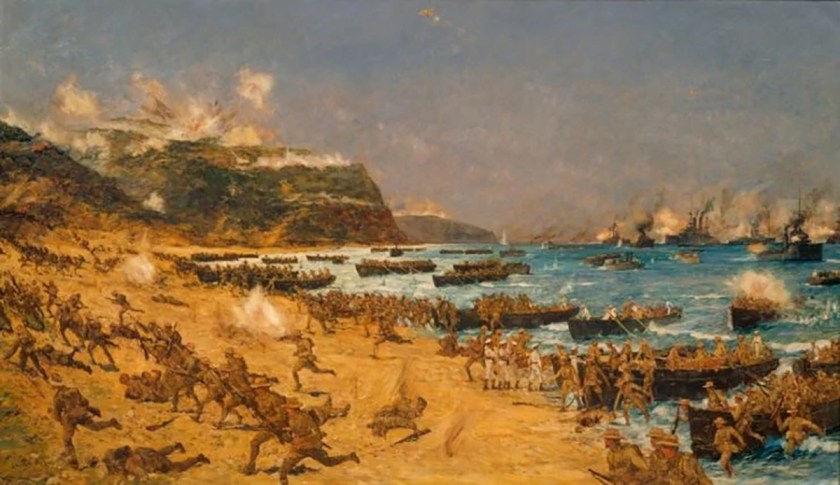
Following four months training in Egypt, the fledgling ANZAC forces came ashore on this day in 1915, under heavy Turkish fire. Commonwealth forces fought heroically, thousands of individual stories including the famous “Six Before Breakfast”, pre-dawn actions leading to as many Victoria Crosses. Despite all of it, the landing was a fiasco, stranding thousands of men, vehicles and vast quantities of stores on the beach.
The traffic jam, was horrendous. With the water behind them red with blood, ANZAC forces attempted to force the high ground despite determined fire from Turkish forces under Mustafa (Atatürk) Kemal.
A bold strike designed to knock the Ottomans out of the war became a stalemate, the blood soaked campaign dragging on for eight months.
By the end of 1915, Commonwealth forces suffered some 302,000 casualties. While the Gallipoli campaign made little difference in the course of the war, the actions of the ANZACs left a powerful legacy. In time, this date became that rarest of days, a solemn day of remembrance shared by two sovereign nations, a part of the national identity of both countries.
With the beginning of WWII, ANZAC Day became a day to commemorate the lives of Australians and New Zealanders lost in all wars, the meaning of the date broadened to include those killed in all military operations in which the two nations have been involved.
Gallipoli Landing, April 1915
ANZAC Day was first commemorated at the Australian War Memorial in 1942 but, due to government orders preventing large public gatherings in case of Japanese air attack, this was a small affair with neither march nor memorial service.
For the wounded, the dead and the maimed of that day one hundred four years ago today, ANZAC Day remains an occasion for solemn remembrance, from that day to this.
In the early days of the Great War, the Endurance expedition of Sir Ernest Shackleton disappeared into the ice pack, within sight of the Antarctic continent. Theirs was a 497-day struggle for survival, re-emerging twenty months later to learn, the war wasn’t over. Millions were dead. Europe had gone mad. The world had gone mad.
In an alternate history, the June 1914 assassination of the heir-apparent to the Habsburg Empire may have led to nothing more than a regional squabble. A policing action in the Balkans. As it was, mutual distrust and entangling alliances drew the Great Powers of Europe into the vortex. On August 3, the “War to End Wars” exploded across the European continent.
The period has been called the “Heroic Age of Antarctic Exploration”. As the diplomatic wrangling, mobilizations and counter-mobilizations of the “period preparatory to war” unfolded across the continent, Sir Ernest Shackleton made final arrangements for his third expedition into the Antarctic. Despite the outbreak of war, first Lord of the Admiralty Sir Winston Churchill ordered Shackleton to Proceed. The “Endurance” expedition departed British waters on August 8.
The German invasion of France ground to a halt that September. The first entrenchments were being dug as Shackleton himself remained in England, departing on September 27 to meet up with the Endurance expedition in Buenos Aires.
H/T GreatWarPhotos.com
With the unofficial “Christmas Truce” of 1914 short weeks away from the trenches of Flanders, Shackleton’s expedition left Grytviken whaling station on South Georgia Island. It was December 5.
The Endurance expedition intended to be the first to cross the Antarctic continent. The way things turned out, the crew wouldn’t touch land, for 497 days.
The disaster of the Great War became “Total War” with the zeppelin raids of January, as Endurance met with disaster of its own. The ship was frozen fast, within sight of the Antarctic continent. There was no hope of escape.
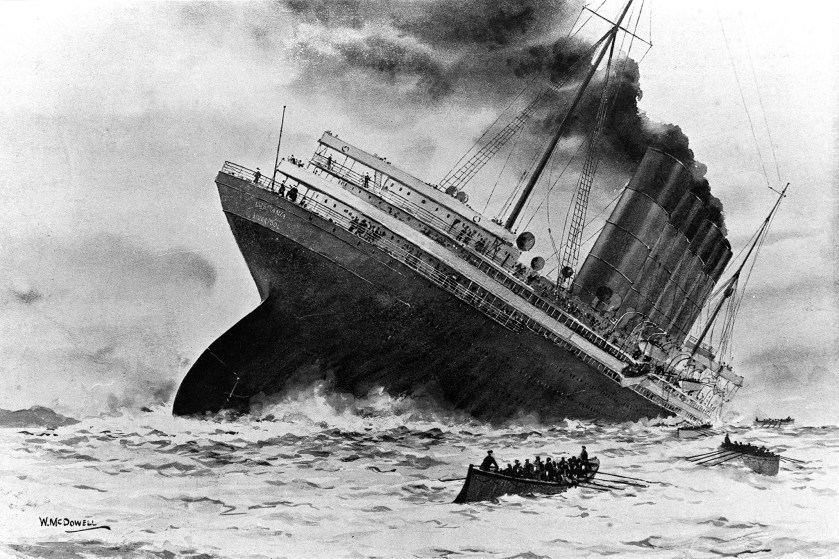
HMS Lusitania departed New York City on May 1, 1915, with no way to know she had only six days to live. The sun that vanished that night over the Shackleton expedition, would not reappear for another four months.
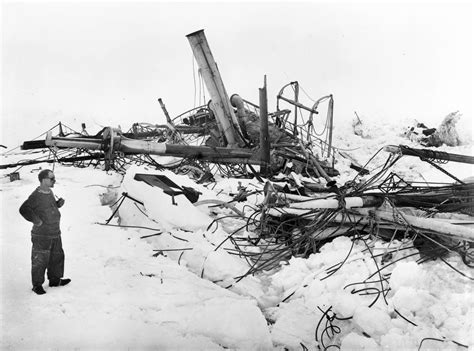
As the nine-month battle unfolded across the Gallipoli Peninsula, Shackleton’s men abandoned ship’s routine and converted to winter station. On September 1, the massive pressure of the pack ice caused Endurance to “literally [jump] into the air and [settle] on its beam,” as losses to the Czar’s army in Galicia and Poland lead to a mass exodus of Russian troops and civilians from Poland. The “Great Retreat” gave way to the sort of discontent which would end the Czarist regime, as Shackleton gave the order to abandon ship. On November 21, the wreck of the Endurance slipped below the surface.
That December, Allies began preparations for a summer offensive along the upper reaches of the River Somme. The Shackleton party camped on pack ice, adrift in open ocean as Erich von Falkenhayn began the Verdun offensive with which he would “bleed France white”. The ice broke up that April, forcing Shackleton and his party into three small lifeboats. Seven brutal days would come and go in those open boats, before the party reached land at the desolate shores of Elephant Island.
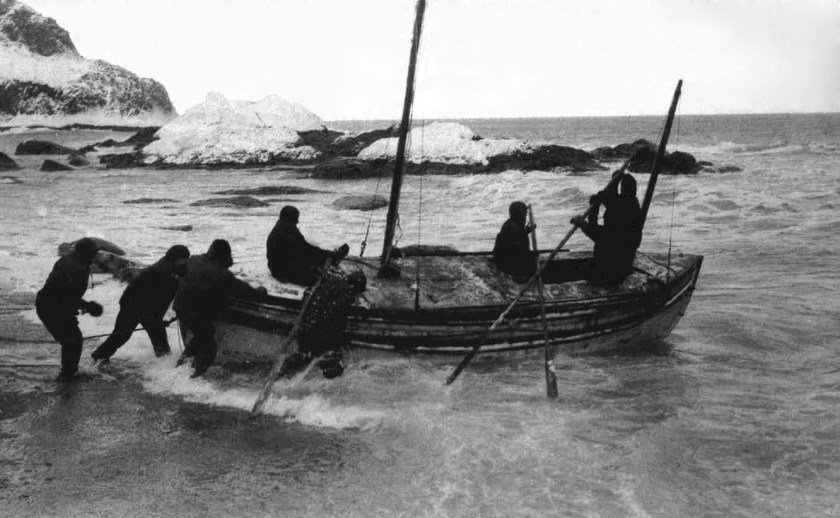
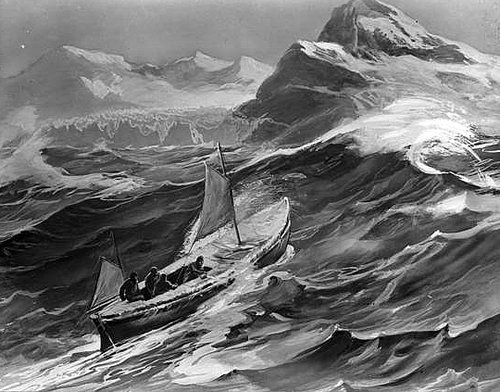
The whaling stations at South Georgia Island, some 800 miles distant, were the only hope for survival. Shackleton and a party of five set out on April 24 aboard the 22½’ lifeboat James Caird, as the five-month siege at Kut-al-Amara in Mesopotamia ended with the surrender of 13,000 British and Indian soldiers, to the Turks.
The party arrived on the west coast of South Georgia Island in near-hurricane force winds, the cliffs of South Georgia Island coming into view on May 10. As Captain Frank Worsely, Second officer Tom Crean and expedition leader Ernest Shackleton picked their way across glacier-clad mountain peaks thousands of feet high, Austrian troops attacked Italian mountain positions in the Trentino.
The trio arrived at the Stromness whaling station on May 20, ten days after the temporary German suspension of unrestricted submarine warfare . They must have been a sight, with thick ice encrusting long, filthy beards, and saltwater-soaked clothing rotting from their bodies. The first people they came across were children, who ran in fright at the sight of them.
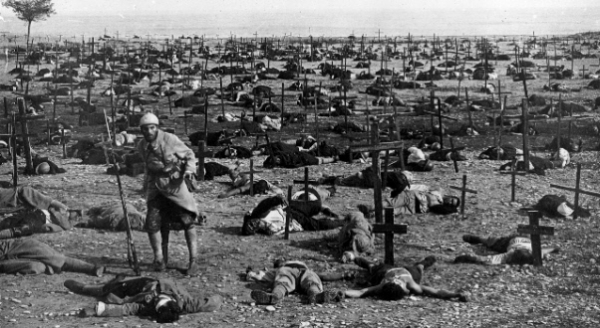
The last of the Shackleton expedition would be rescued on August 22, ending the 20-months long ordeal. Six days later, Italy turned on her future ally and declared war on Germany. At South Georgia Island, Ernest Shackleton asked how the war had ended. The response hit him like a hammer. “The war isn’t over. Millions are dead. Europe is mad. The world is mad“.
A Trivial Matter
“The coldest temperature ever recorded on Earth was minus 128.56 degrees Fahrenheit (minus 89.2 degrees Celsius), registered on July 21, 1983, at Antarctica’s Vostok station”. – H/T LiveScience.com
From “Robert” the evil doll of Fort East Martello to the wild chickens who roam the streets, where conch fritters are considered a food group and history is literally built on salvaging shipwrecks, we’re talking about Key West Florida, where the “Weird go Pro”.
On December 5, 1937, bar owner Joe Russell faced an increase in rent. From three dollars a week to a whopping four bucks. Lucky for Joe, the former Victoria Restaurant owned by one Juan Farto (I didn’t make that up), was available. That night, everyone in the place picked up his drink, and his chair, and “moved the bar” across the street.
None other than Ernest Hemingway pitched in, (yeah, That Ernest Hemingway), helping himself to the urinal. “I’ve pissed enough of my money into this thing to pay for it‘ he said, bringing the thing home to his wife Pauline, who converted it to a fountain. The peacocks who once roamed “Papa” Hemingway’s yard are gone now but the fountain’s still there, not far from “Sloppy Joe’s Bar” on the corner of Greene and Duval Street.
Papa Hemingway’s fountain
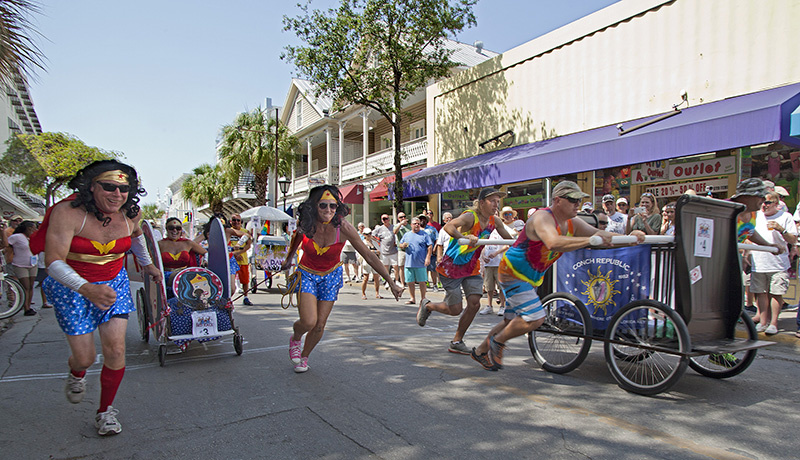
Where else but Duval Street could you watch a “bed race”, pulled by men and women in Wonder Woman outfits, or men in grass skirts. Where Times Square drops a ball to ring in the New year and Miami drops an orange, while Sloppy Joe’s drops a six-foot conch.
Duval Street Bed Races, July 2015. H/t CBS, Miami
Even the above-ground cemetery is “off the beaten path”. Inscriptions on headstones include “I told you I was sick“. One long-suffering wife got to write this one, for a philandering husband: “At least I know where he’s sleeping tonight“.
From “Robert” the evil doll of Fort East Martello to the wild chickens who roam the streets, where conch fritters are considered a food group and history is literally built on salvaging shipwrecks, we’re talking about Key West Florida, where the “Weird go Pro”.
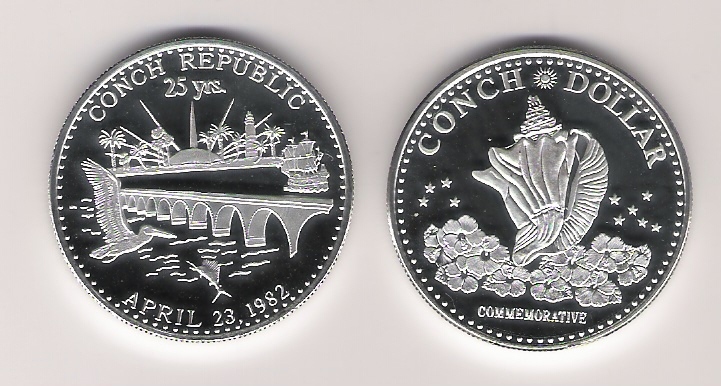
Oh. Did I tell you the place seceded? Really. It’s the “Conch Republic”, now.
Except for the Naval Air Station at Boca Chica and Coast Guard installations in Key West, Marathon and Islamorada, most of the economic activity in the Florida Keys, comes from tourism. It’s no wonder that, when the federal government shuts down the only road into the Keys, the locals are going to get cranky.
In April 1982, the Mariel boat lift was a mere two years in the past, and very much in the public memory.
The United States had a border in those days, which the Federal government attempted to enforce.
On April 18, Border Patrol set up a roadblock in front of Skeeter’s Last Chance Saloon in Florida City, shutting down US Route 1, the only road in and out of the Florida Keys. Originally intended to intercept illegals entering the country, the roadblock soon morphed into a hunt for illegal drugs, as well.
Cars waited for hours, in lines stretching 19 miles. Predictably, the attitude of Federal officials was one of towering indifference. Not so local business owners. Robert Kerstein wrote in his Key West on the Edge — Inventing the Conch Republic, “No one in Key West doubted that drugs were trafficked widely in the Keys by road and by boat. But tourism’s boosters had little tolerance for interruptions to their business.”
Dennis Wardlow, then-Mayor of Key West, contacted the chief of police, the Monroe County sheriff, his State Representative and then-Governor Bob Graham, demanding the roadblock’s removal. With none of the above having any knowledge of the barrier and lacking the authority to pull it down, Wardlow contacted INS directly. When the Border Patrol told him it was “none of his business,” the Mayor’s response could best be summed up in the words of Bugs Bunny: “Of course you know, this means war!”
Suffering a blizzard of hotel cancellations, this “attack on Key West’s sovereignty” could not stand. On April 22, Mayor Wardlow, local attorney & pilot David Horan and Old Town Trolley Tours operator Ed Swift flew to Miami seeking legal remedy. When District Court Judge C. Clyde Atkins failed to issue an injunction, the Key West delegation took to the courthouse steps.
“What are you going to do, Mr. Mayor”, asked the assembled media. Swift leaned over and whispered into the Mayor’s ear, “Tell them we are going to go home and secede!” “We are going to go home and secede!”, said Wardlow, and that’s what they did.
Over the next 24 hours, secessionist co-conspirators worked feverishly to form a new government, filling cabinet positions such as “Secretary of Underwater Affairs” and “Minister of Nutrition”.
On April 23, with federal agents on scene to monitor the proceedings, a crowd gathered before the old customs building. Mayor Wardlow and a gaggle of allies mounted the back of a flatbed truck, to read the proclamation of secession. “We serve notice on the government in Washington”, Wardlow began, “to remove the roadblock or get ready to put up a permanent border to a new foreign land. We as a people, may have suffered in the past, but we have no intention of suffering in the future at the hands of fools and bureaucrats“.
With that, Mayor Wardlow declared “war” on the United States. The “Great Battle of the Conch Republic” broke out in the harbor, when the Schooner Western Union commanded by Captain John Kraus, attacked the Coast Guard Cutter Diligence with water balloons, Conch fritters and toilet paper. Diligence fought back with water hoses, as the new “Prime Minister” broke a stale loaf of Cuban bread over the head of a man dressed in a Navy uniform.
Naval History was forever changed on this day, as the “Great Battle of the Conch Republic” raged across the waters of Key WestPandemonium broke out as onlookers launched stale bread and conch fritters at federal agents, Navy sailors and Coast Guard personnel. One minute after declaring his “verbal shot” at the Federal government, Mayor Wardlow surrendered to a nearby Naval officer, demanding a billion dollars in “foreign aid” in compensation for “the long federal siege.”
Apparently, that’s what it takes to get the attention of a Federal government bureaucrat. The roadblock lifted. The restaurants, stores and hotels of the Keys soon filled with tourists and, once again, happiness smiled upon the land. Key West never got its “foreign aid”, but secessionist leaders never received so much as a letter, saying they couldn’t leave the Union, either.
So it is that the micro-nation of Key West celebrates its independence, every April 23. The “Conch Republic’ issues its own passports, selling T-shirts and bumper stickers with the slogan “We seceded where others failed”.
And if the Federal government ever comes back to mess with the sovereign nation of Key West, it had best be prepared to deal with the Conch Republic’s very own “Special Forces”, the motto for which is “Sanctus Merda”. “Holy Shit”.
Mine eyes have seen the glory of the sunshine and the sea Right here upon our islands, where we love to live so free But in April 1982, the peace was not to be And we went rolling on
CHORUS Glory glory Conch Republic Glory glory Conch Republic Glory glory Conch Republic From Key to shining Key
They were setting up a check point, tween the mainland and the Keys They had put a US Border, where it shouldn’t ‘oughta’ be So that’s when we seceded, and declared our sovereignty And the fun had just begun
(CHORUS)
We went forth into the harbor and a cutter we did spy And we sailed up along side her and we took her by surprise We hoisted up our battle flag, so proudly and so high And we went sailing on
(CHORUS)
The water and Conch fritters and the Cuban bread did fly Our bombers, they were raining toilet paper from the sky Our cannons they did thunder to proclaim our victory And we fought bravely on
(CHORUS)
We have faced the silly forces of misguided zealotry We have stood up to their foolishness for all the world to see And we’ve showed the other nations what America can be From Key to shining Key
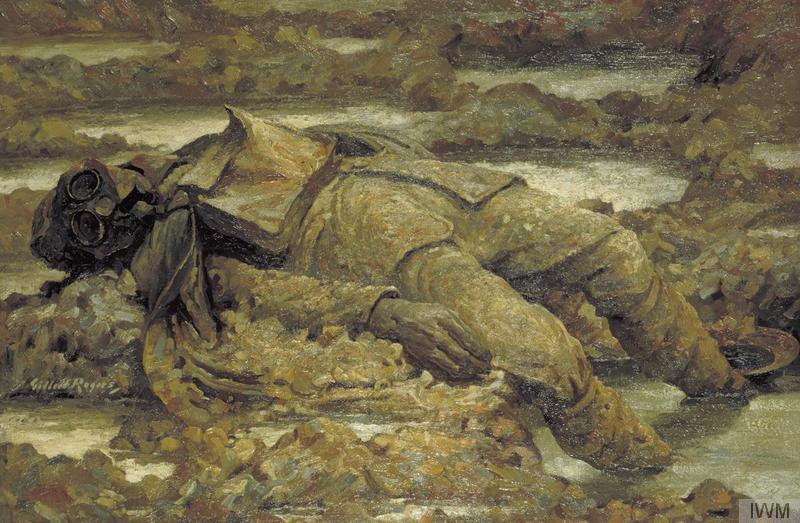
Mustard gas is a cytotoxic agent, capable of entering the system via skin, eyes and respiratory tract and attacking every cell type with which it comes into contact. First comes the garlic smell, as the yellow-brown, heavier-than-air cloud creeps along the ground.
According to Greek mythology, the malevolent centaur Nessus attempted to force himself upon Deianeira, wife of Hercules (Herakles). Seeing this from across a river, Hercules shot Nessus with an arrow, poisoned by the venom of the Hydra. In a final act of malice, the dying centaur convinced Deianeira his blood would make her husband, faithful for life. Deianeira foolishly believed him, coming to realize her error only as her husband lay dying by the tainted blood of his victim.
Both sides in the battle for Troy used poisoned arrows, according to the Iliad and the Odyssey of Homer. Alexander the great encountered poison arrows and fire weapons in the Indus valley of India, in the fourth century, BC. Chinese chronicles describe an arsenic laden “soul-hunting fog”, used to disperse a peasant revolt, in AD178.
The French were first to use poison weapons in the modern era, firing tear gas grenades containing xylil bromide against German forces in the first month of the Great War: August, 1914.
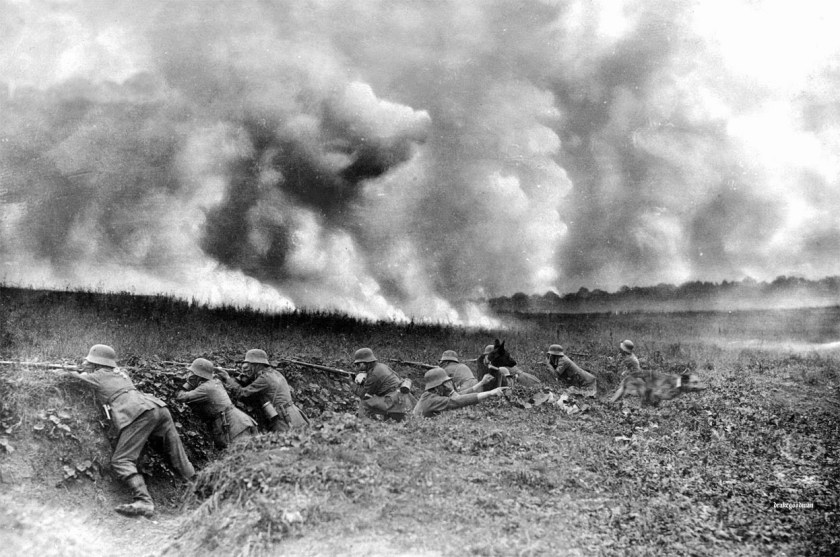
Imperial Germany was first to give serious study to chemical weapons of war, early experiments with irritants taking place at the battle of Neuve-Chapelle in October 1914, and with tear gas at Bolimów on January 31, 1915 and again at Nieuport, that March.
The first widespread use of poison gas, in this case chlorine, came on April 22, 1915 at the second battle of Ypres.
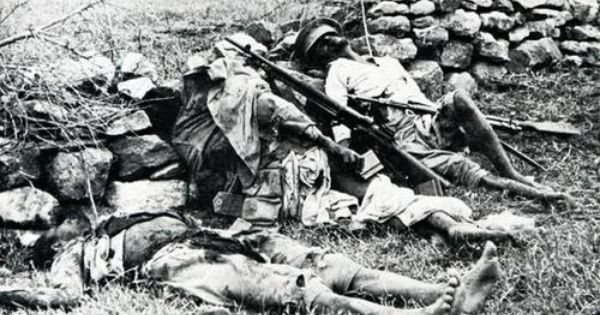
The story of gas warfare is inextricably linked with that of WW1. 124,000 tons of the stuff was produced by all sides by the end of the war, accounting for 1,240,853 casualties, including the agonizing death of 91,198.
Had the war continued into 1919, technological advances promised a new and fresh hell, unimaginable to contemporary and modern reader, alike.
Today we think of chemical agents in WW2 as being limited to the death camps of the Nazis, but such weapons were far more widespread. The Imperial Japanese military frequently used vesicant (blister) agents such as Lewisite and mustard gas against Chinese military and civilians, and in the hideous “medical experiments” conducted on live prisoners at Unit 731and Unit 516. Emperor Hirohito personally authorized the use of toxic gas during the 1938 Battle of Wuhan, on no fewer than 375 occasions.
The Italian military destroyed every living creature in its path during the 1936 Colonial war with Ethiopia, in what Emperor Haile Selassie called “a fine, death-dealing rain”.
Nazi Germany possessed some 45,000 tons of blister and nerve agents, though such weapons were rarely used against western adversaries. The “Ostfront” – the apocalyptic race war pitting the Teuton against the Slavic states of the Soviet Union – was a different story. Russian resistance fighters and Red Army soldiers were attacked, most notably during the assault on the catacombs of Odessa in 1941, the 1942 siege of Sebastopol, and the nearby caves and tunnels of the Adzhimuskai quarry, where “poison gas was released into the tunnels, killing all but a few score of the (3,000+) Soviet defenders”.
The official American policy toward chemical weapons was enunciated by President Franklin Roosevelt, in 1937.
“ I do not want the Government of the United States to do anything to aggrandize or make permanent any special bureau of the Army or the Navy engaged in these studies. I hope the time will come when the Chemical Warfare Service can be entirely abolished”. – Franklin D Roosevelt, in a letter to the United States Senate
None of the western allies resorted to chemical warfare in WW2, despite having accumulated over twice the chemical stockpile as Nazi Germany. The policy seems to have been one of “mutually assured destruction”, where no one wanted to be first to go there, but all sides reserved the option.
Great Britain possessed massive quantities of mustard, chlorine, Lewisite, Phosgene and Paris Green, awaiting retaliation should Nazi Germany resort to such weapons on the beaches of Normandy. General Alan Brooke, Commander-in-Chief of the Home Forces, “[H]ad every intention of using sprayed mustard gas on the beaches” in the event of a German landing on the British home islands.
The Geneva Protocols on 1925 banned the use of chemical weapons, but not their manufacture, or transport. By 1942, the U.S. Chemical Corps employed some 60,000 soldiers and civilians and controlled a $1 Billion budget.
In August 1943, Roosevelt authorized the delivery of chemical munitions containing mustard gas, to the Mediterranean theater. Italy surrendered in early September, changing sides with the signing of the armistice of Cassibile.
The liberty ship SS John Harvey arrived at the southern Italian port of Bari in November, carrying 2000 M47A1 mustard gas bombs, each containing 60 to 70-pounds of sulfur mustard.
Bari was packed at the time, with ships waiting to be unloaded. It would be days before stevedores could get to her. Captain John Knowles wanted to inform port authorities of his deadly cargo and request that it be unloaded immediately, but secrecy prevented him from doing so. As it was, John Harvey was still waiting to be unloaded, on December 2.
For Luftwaffe Generalfeldmarschall Albert Kesselring, the traffic jam at Bari was an opportunity to slow the advance of the British 8th army on the Italian peninsula.
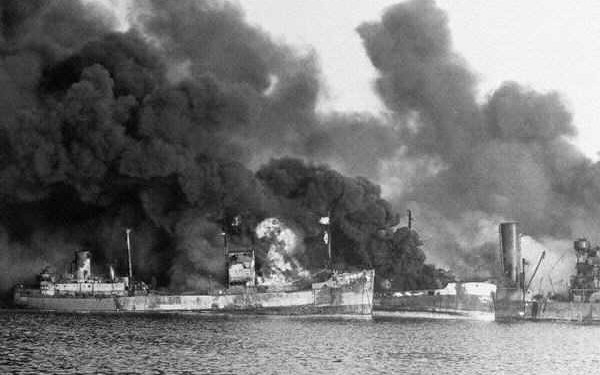
The “Little Pearl Harbor” began at 7:25PM, when 105 Junkers JU-88 bombers came out of the East. The tactical surprise was complete, and German pilots were able to bomb the harbor with great accuracy. Two ammunition ships were first to explode, shattering windows 7 miles away. A bulk gasoline pipeline was severed, as a sheet of burning fuel spread across the harbor, igniting those ships left undamaged.
43 ships were sunk, damaged or destroyed including John Harvey, which erupted in a massive explosion. Liquid sulfur mustard spilled into the water, as a cloud of toxic vapor blew across the port and into the city.
Mustard gas is a cytotoxic agent, capable of entering the system via skin, eyes and respiratory tract and attacking every cell type with which it comes into contact. First comes the garlic smell, as the yellow-brown, heavier-than-air cloud creeps along the ground. Contact first results in redness and itching, resulting 12-24 hours later in excruciating, untreatable blisters on exposed areas of the skin. Sufferers are literally burned inside and out, as mucous membranes are stripped away from the eyes, nose and respiratory tract.
Death comes in days or weeks. Survivors are likely to suffer chronic respiratory disease and infections. DNA is altered, often resulting in certain cancers and birth defects. To this day there is no antidote.
A thousand or more died outright in the bombing. 643 military service personnel were hospitalized for gas symptoms. 83 of those were dead, by the end of the month. The number of civilian casualties is unknown. The whole episode remained shrouded in secrecy.
At the time, the chemical disaster at Bari was all but unknown. Everyone with any knowledge of John Harvey’s secret cargo was killed in the explosion. Lieutenant-Colonel Stewart Francis Alexander, an American physician from New Jersey, was sent by the Deputy Surgeon General of the US Army to find out what happened.
Dr. Alexander identified mustard as the responsible agent. In the process of testing, Dr. Alexander noticed the unknown agent first went after rapidly dividing cells, such as white blood cells. Alexander wondered if it might be useful in going after other rapidly dividing cells. Like cancer.
Based on Dr. Alexander’s field work, Yale pharmacologists Louis Goodman and Alfred Gilman developed the first anti-cancer chemotherapy drug, in the treatment of lymphoma.
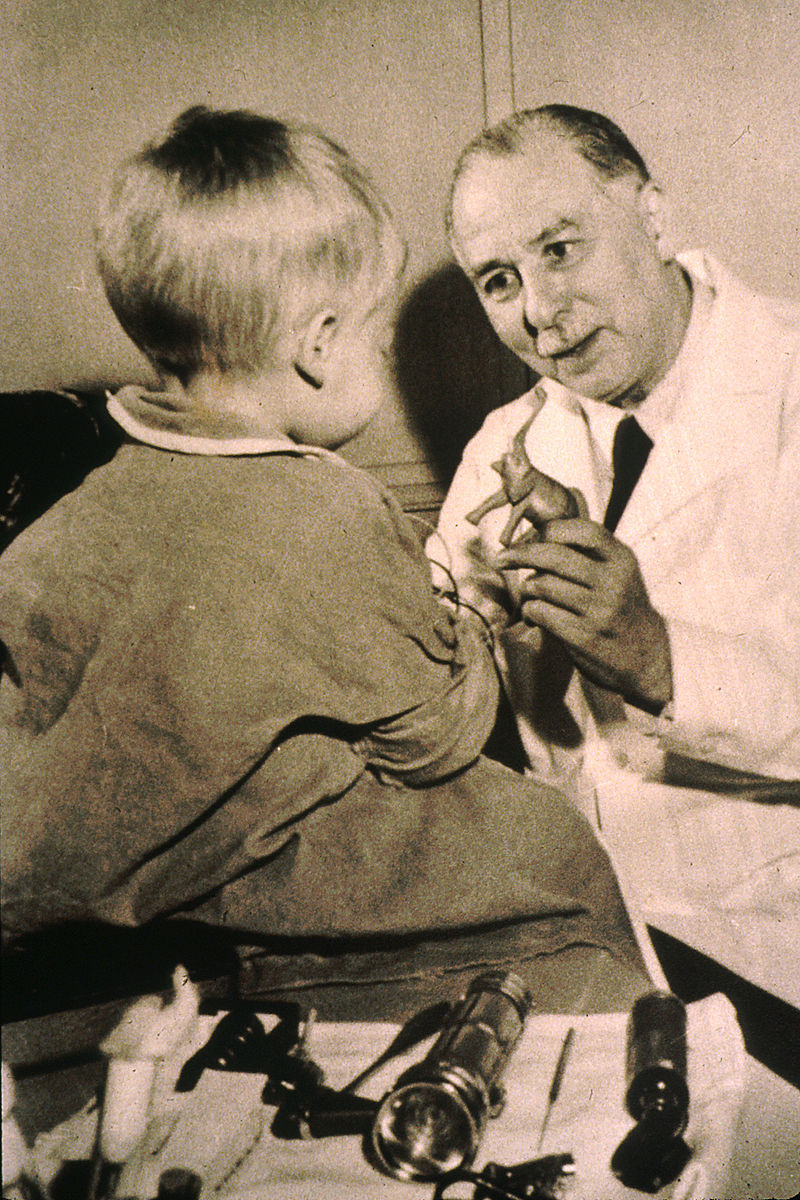
Dr. Sidney Farber of Boston built on this work, producing remission in children with acute Leukemia using Aminopterin, an early precursor to Methotrexate, a chemotherapy drug still in use, today.
Dr. Sidney Farber, regarded by many as the “Father of Modern Chemotherapy”
Writers have labeled SS John Harvey a Savior of Millions, due to the vessel’s role in the pioneering era of modern chemotherapy drugs.
The claim may be a bit of an exaggeration, but not entirely so. The American Cancer Society estimates that there were 7,377,100 male cancer survivors in the United States as of January 1, 2016 and another 8,156,120, females.
A Trivial Matter
German chemist Albert Niemann discovered cocaine in 1859, and went on to document the poison effects of sulphur mustard around the time of the American Civil War. In 1913, British and German civilian researchers were accidentally exposed to mustard and had to be hospitalized. The German military obtained notes about the incident and promptly went about weaponizing the stuff.
Many of the secular symbols associated with Easter trace back to the pagan goddess of spring and the dawn, Ēostre or Ostara, from the Old English Ēastre. History fades into mythology in the pre-Christian usage and accounts differ, but this Teutonic deity was frequently depicted with eggs symbolizing the rebirth of Spring. And rabbits.
In Christian tradition, Jesus of Nazareth was crucified on Good Friday, arising from the dead two days later to reveal himself to his disciples, before finally ascending to heaven.
So where did the Easter Bunny come from?
“Titian’s painting The Madonna of the Rabbit depicts this relationship. Mary holds the rabbit in the foreground, signifying both her virginity and fertility. The rabbit is white to convey her purity and innocence.” H/T Ancient-Origins.net
Many of the secular symbols associated with Easter trace back to the pagan goddess of spring and the dawn, Ēostre or Ostara, from the Old English Ēastre. History fades into mythology in the pre-Christian usage and accounts differ, but this Teutonic deity was frequently depicted with eggs symbolizing the rebirth of Spring. And rabbits.
Hat tip Ancient-Origins.net for this image
It’s small wonder that the latter symbolized fertility. A female Hare, called a “Jill” has a 42-day gestation period, and is capable of conceiving while still pregnant. Kriss Kringle and an egg laying Easter Hare called “Osterhase” or “Oschter Haws” came to America in the 1700s, with German immigrants who settled in Pennsylvania. Children would make nests of clothing and blankets, in which the creature could lay its colored eggs. This is the origin of the Easter basket.
Hares and rabbits are different species of the same family, like sheep and goats. Until the 18th century, rabbits were called Coneys, after the Latin “cuniculus”. The word has all but disappeared from American English vernacular, its only use today relates to Coney Island, in New York. It was around that time that the diminutive, fuzzier “bunny” came to replace the Easter Hare.
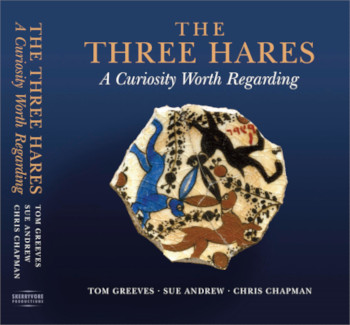
The Three Hares – A Curiosity Worth Regarding by Tom Greeves, Sue Andrew and Chris Chapman
More recently, the discovery of a Medieval “Three Hares” motif in a minor cathedral in Devon England led archaeologist and historian Tom Greeves, art history researcher Sue Andrew and documentary photographer Chris Chapman on a trans-continental odyssey, from Great Britain across the Eurasian landmass, to discover the origins of the enigmatic symbol.
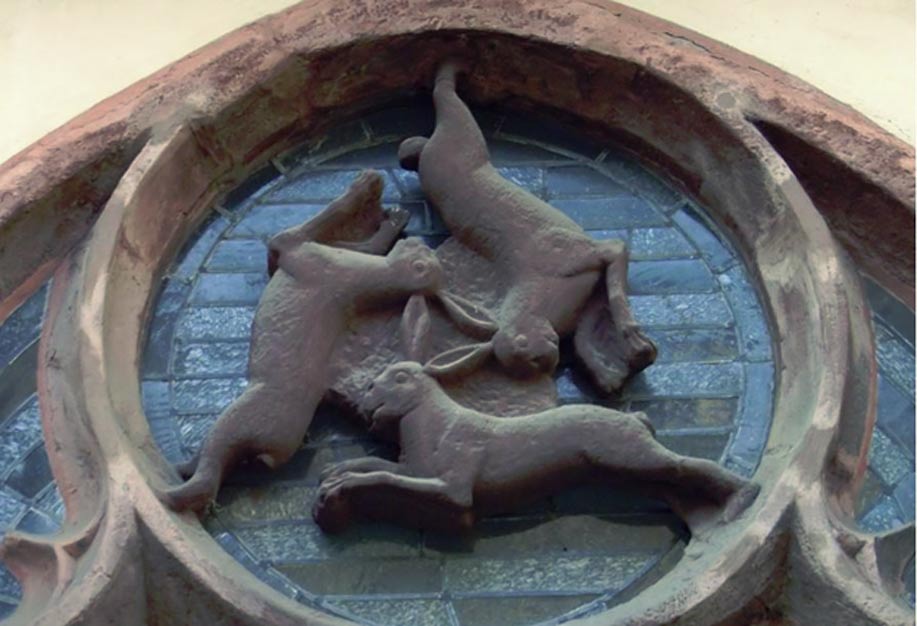
The design depicts three hares in a triangle, each possessed of one ear and making in all, six. The image appears in tapestry, architecture and/or precious objects emanating from at least four of the world’s great faith traditions including Christianity, Judaism, Buddhism and Islam, cropping up from English cathedrals to Italian monasteries, German synagogues, Iranian metalwork and Russian reliquary caskets to Buddhist cave temples in North West China.
The three hares image may have spread across the 4,000-mile “Spice Road” during the “Pax Mongolica” period of the 13th and 14th centuries, in which it was said “A maiden bearing a nugget of gold on her head could wander safely throughout the realm.”
For Greeves, Andrew and Chapman, three decades of work has culminated in The Three Hares, a Curiosity Worth Regarding, a volume I have personally added to my must read list.
Medieval roof bosses, St Mary the Virgin, Throwleigh, Devon. Hat Tip, chrischapmanphotography.co.uk
History gives us one tale concerning rabbits having nothing whatever to do with Easter, but it’s too good not to tell here.
The story involves no less a figure than Napoleon Bonaparte. In July 1807, Napoleon had just signed the Treaty of Tilsit, ending the war between the French Empire and Imperial Russia. As a means of celebration, Napoleon suggested a rabbit hunt, and ordered Chief of Staff Alexandre Berthier, to make it happen.
Berthier put together an outdoor luncheon, inviting the highest brass from the French military. Meanwhile, Napoleon’s men ranged far and wide, collecting rabbits for the hunt. As many as 3,000 of them.
Napoleon arrived at one side of a grassy field with his beaters and gun bearers, with all those caged rabbits lined up on the other side. Rabbits and Hares are predictably shy and retiring creatures, but Berthier’s soldiers had found it easier to pilfer domesticated rabbits instead of flushing out the wild variety, and these things were hungry.
The hunt was supposed to begin when all those cages opened but, instead of scattering, a swarm of rabbits thought it was dinner time and pelted straight across the field.
H/T wearethemighty.com
The most powerful man in the world thought it was funny at first, until all those rabbits started coming up his legs. Coachmen cracked bullwhips and men grabbed sticks. There was shooting and shouting and pandemonium, everywhere. Still, the bunny horde came on.
French General and diarist Baron Paul Thiébault was there, let him tell the story:
“The intrepid rabbits turned to the Emperor’s flank, attacked him frantically in the rear, refused to quit their hold, piled themselves up between his legs till they made him stagger, and forced the conqueror of conquerors, fairly exhausted, to retreat and leave them in possession of the field”.
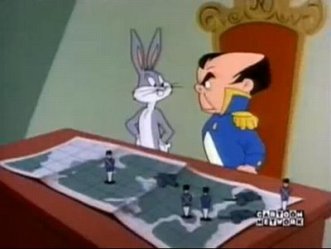
H/T Warner Bros., Napoleon Bunny-Part
Napoleon retreated to his carriage, but the onslaught, continued. Historian David Chandler picks up the story:
“With a finer understanding of Napoleonic strategy than most of his generals, the rabbit horde divided into two wings and poured around the flanks of the party and headed for the imperial coach.”
The tide of bunnies continued the advance, some even got into the carriage. The bunny blitz finally ebbed away, only as the Royal Conveyance drove out of sight.
So it is that Emperor Napoleon Bonaparte, a General who fought and won more battles than Hannibal Barca, Alexander the Great, Julius Caesar and Frederick the Great, combined, was defeated and driven out of town…
By bunnies.
Featured image, top of page: The Dreihasenfenster (Window of Three Hares), Paderborn Cathedral, Germany. Photo source: Public Domain. H/T ancient-origins.net
A Trivial Matter
According to WomansDay.com, Americans are expected to spend over $2 Billion on Cadbury eggs, jelly beans and other Easter candies, this year. Peeps, the number one seller (sorry Cadbury), came out in 1953 when each one was extruded, from a pastry tube. In those days, Peeps took twenty-seven hours to set. These days’ they’re ready to eat in about six minutes.







 Seven years later during the French & Indian War, Rogers’ Rangers were ordered to attack the Abenaki village with John Stark, second in command. Stark refused to accompany the attacking force out of respect for his Indian foster family, returning instead to Derryfield and his wife Molly, whom he had married the year before.










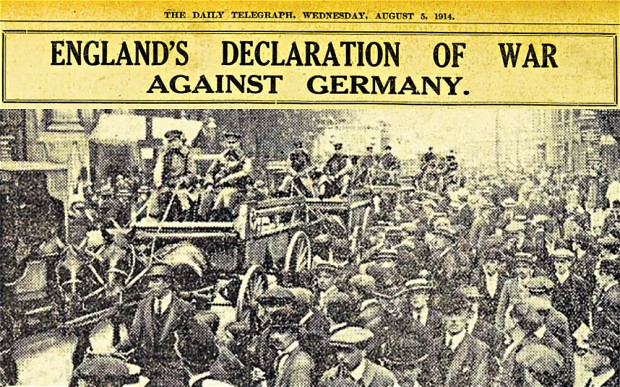
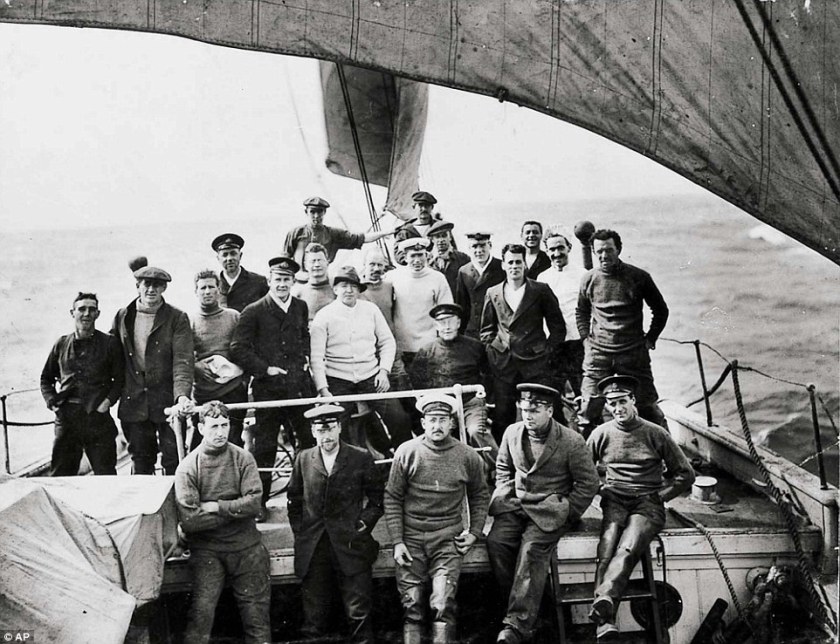
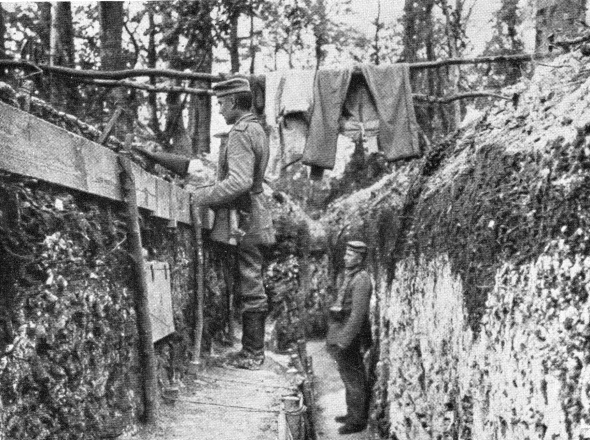
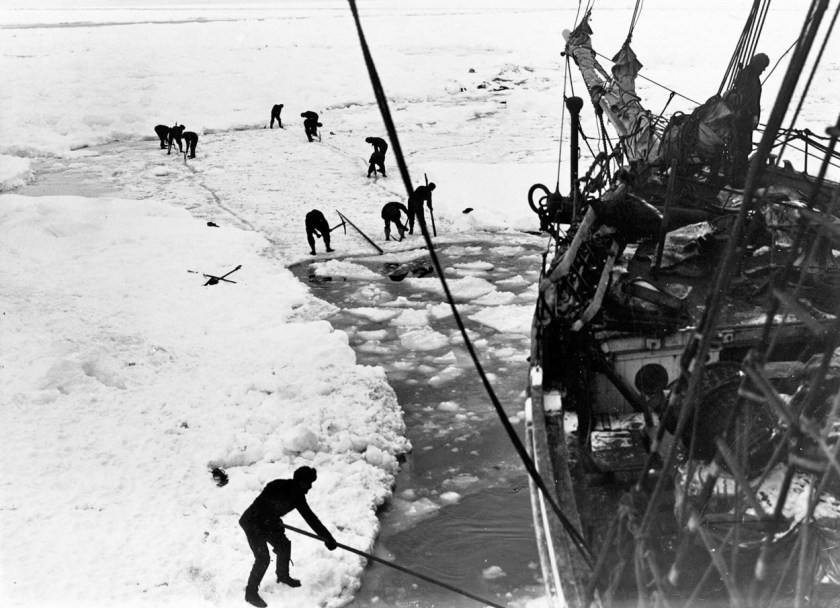
 The disaster of the Great War became “Total War” with the zeppelin raids of January, as Endurance met with disaster of its own. The ship was frozen fast, within sight of the Antarctic continent. There was no hope of escape.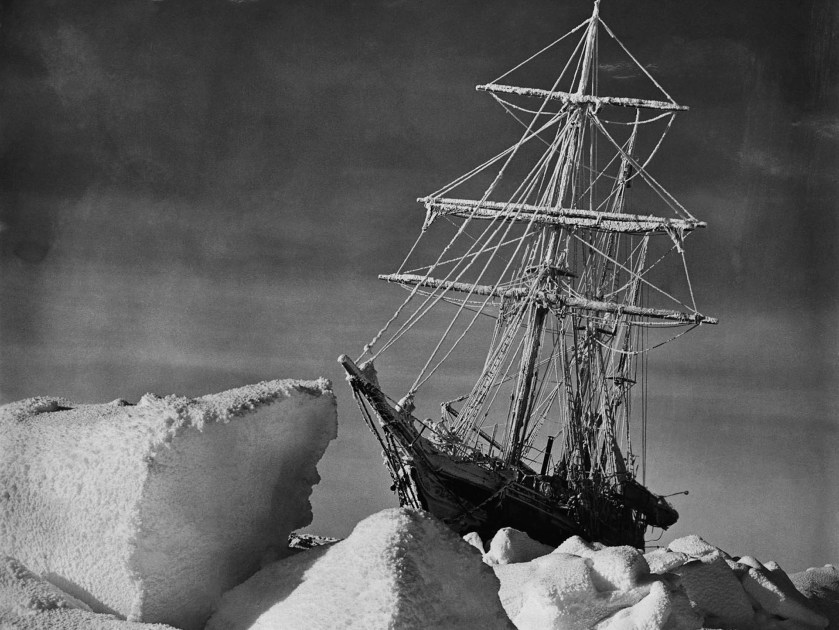




 The United States had a border in those days, which the Federal government attempted to enforce.
 Dennis Wardlow, then-Mayor of Key West, contacted the chief of police, the Monroe County sheriff, his State Representative and then-Governor Bob Graham, demanding the roadblock’s removal. With none of the above having any knowledge of the barrier and lacking the authority to pull it down, Wardlow contacted INS directly. When the Border Patrol told him it was “none of his business,” the Mayor’s response could best be summed up in the words of Bugs Bunny: “Of course you know, this means war!”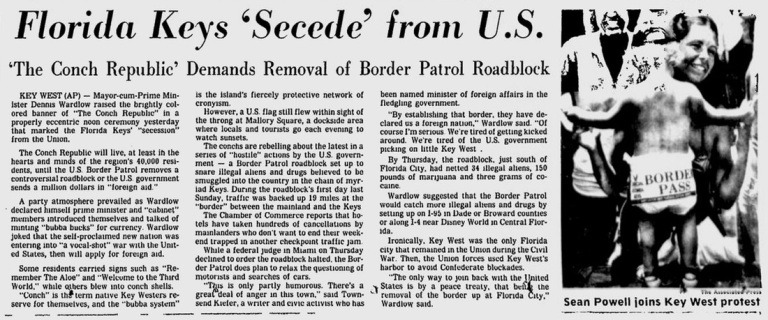
 On April 23, with federal agents on scene to monitor the proceedings, a crowd gathered before the old customs building. Mayor Wardlow and a gaggle of allies mounted the back of a flatbed truck, to read the proclamation of secession. “We serve notice on the government in Washington”, Wardlow began, “to remove the roadblock or get ready to put up a permanent border to a new foreign land. We as a people, may have suffered in the past, but we have no intention of suffering in the future at the hands of fools and bureaucrats“.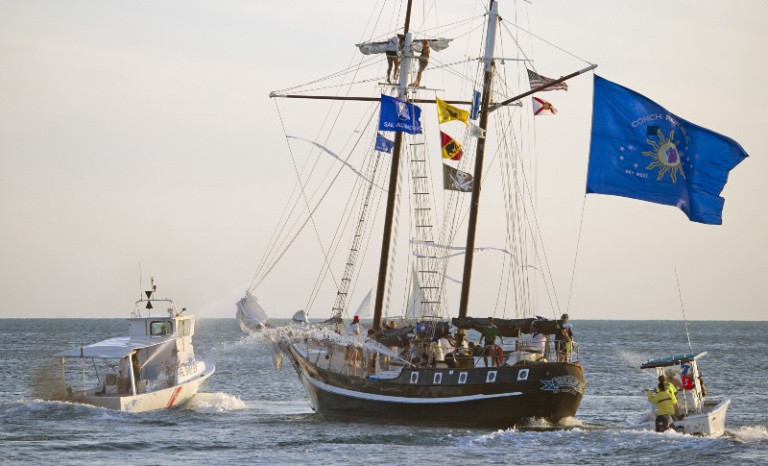
 Apparently, that’s what it takes to get the attention of a Federal government bureaucrat. The roadblock lifted. The restaurants, stores and hotels of the Keys soon filled with tourists and, once again, happiness smiled upon the land. Key West never got its “foreign aid”, but secessionist leaders never received so much as a letter, saying they couldn’t leave the Union, either.
 So it is that the micro-nation of Key West celebrates its independence, every April 23. The “Conch Republic’ issues its own passports, selling T-shirts and bumper stickers with the slogan “We seceded where others failed”.

 Both sides in the battle for Troy used poisoned arrows, according to the Iliad and the Odyssey of Homer. Alexander the great encountered poison arrows and fire weapons in the Indus valley of India, in the fourth century, BC. Chinese chronicles describe an arsenic laden “soul-hunting fog”, used to disperse a peasant revolt, in AD178.
 Imperial Germany was first to give serious study to chemical weapons of war, early experiments with irritants taking place at the battle of Neuve-Chapelle in October 1914, and with tear gas at Bolimów on January 31, 1915 and again at Nieuport, that March.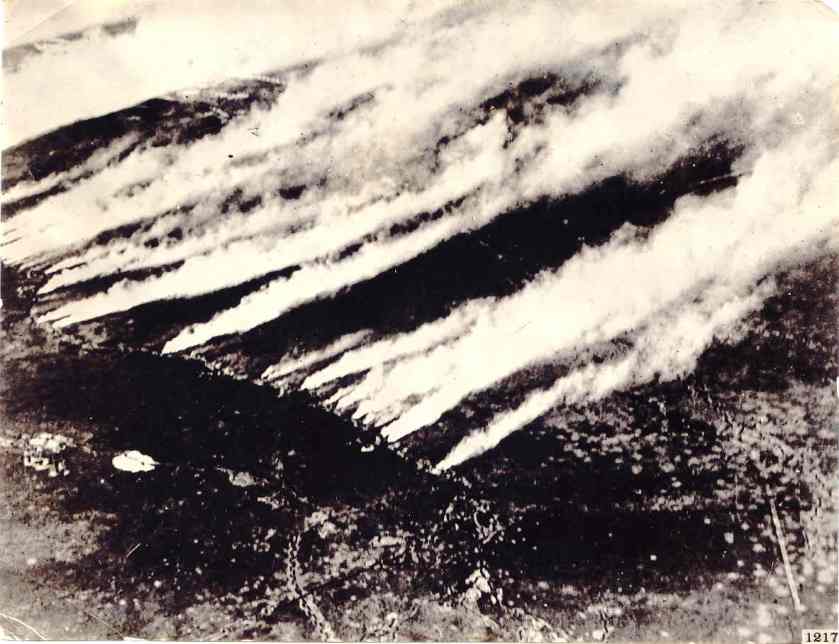
 Great Britain possessed massive quantities of mustard, chlorine, Lewisite, Phosgene and Paris Green, awaiting retaliation should Nazi Germany resort to such weapons on the beaches of Normandy. General Alan Brooke, Commander-in-Chief of the Home Forces, “[H]ad every intention of using sprayed mustard gas on the beaches” in the event of a German landing on the British home islands.
 The Geneva Protocols on 1925 banned the use of chemical weapons, but not their manufacture, or transport. By 1942, the U.S. Chemical Corps employed some 60,000 soldiers and civilians and controlled a $1 Billion budget.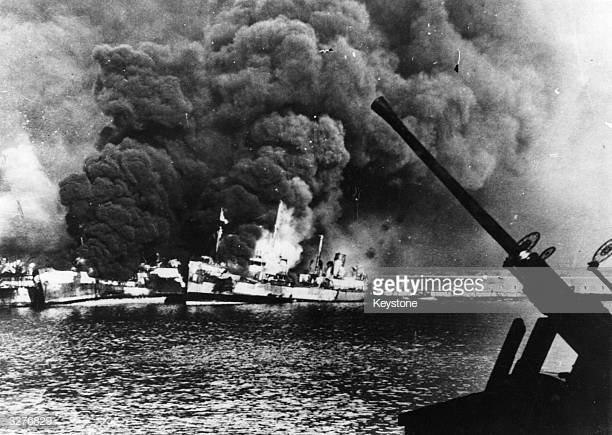
 Death comes in days or weeks. Survivors are likely to suffer chronic respiratory disease and infections. DNA is altered, often resulting in certain cancers and birth defects. To this day there is no antidote.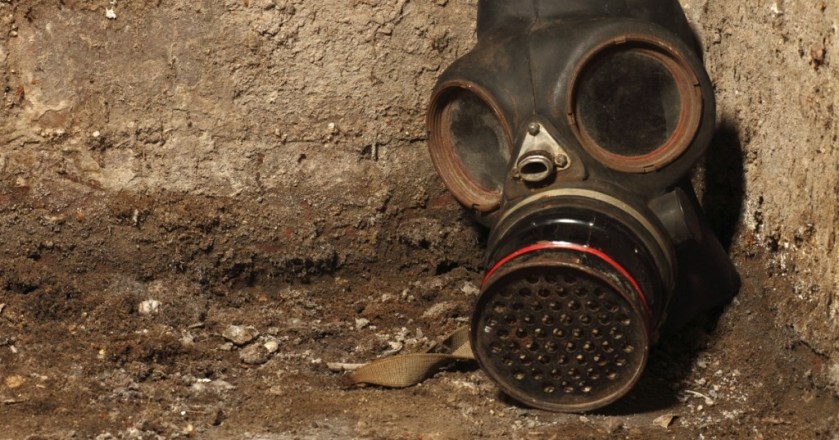





 The story involves no less a figure than Napoleon Bonaparte. In July 1807, Napoleon had just signed the Treaty of Tilsit, ending the war between the French Empire and Imperial Russia. As a means of celebration, Napoleon suggested a rabbit hunt, and ordered Chief of Staff Alexandre Berthier, to make it happen.


You must be logged in to post a comment.