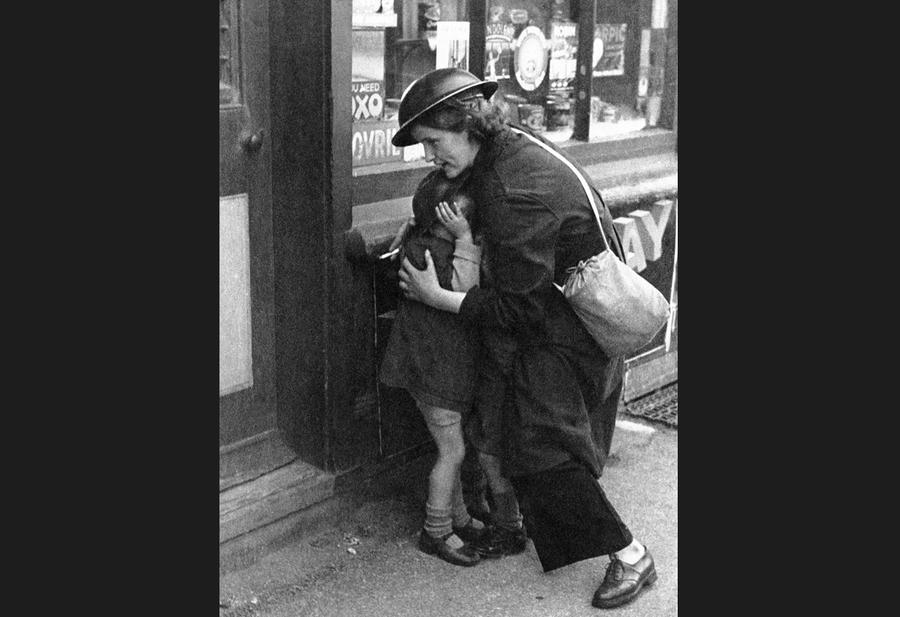
September 17, 1940 Battle of Britain

Prime Minister Winston Churchill captured the spirit of the period, as only he could. “Never in the field of human conflict was so much owed by so many to so few”. – Winston Churchill

When the allies invaded Europe in 1944, they had to land on the beach in order to get a foothold. At that point, they controlled none of the European continent. The Nazi war machine had been so successful, that a map of Europe at that time could have been drawn in only two colors. One for the occasional neutral nation, the other for Nazi controlled or occupied territory.

dunkirk2
Allied evacuation of Dunkirk, May 1940

Your eyes would have to cross the English Channel on that map to find a third color, that of Great Britain, which in June of 1940 stood defiant and alone in the face of the Nazi war machine.

Rooftop Observer

In his “Finest Hour” speech of June 18, Prime Minister Winston Churchill said “What General Weygand has called the Battle of France is over. I expect that the Battle of Britain is about to begin“.

In Germany, street decorations were being prepared for the victory parades which were sure to come, as Hitler considered plans for his surprise attack on his ally to the East, the Soviet Union. After Great Britain and her allies had been hurled from the beaches of Dunkirk, Hitler seemed to feel he had little to do but “mop up”.

Battle of britain, children evacuatedGermany needed air supremacy before “Operation Sea Lion”, the amphibious invasion of England, could begin. Luftwaffe commander Hermann Göring said he would have it in four days.

Military planners of the 1930s believed that “The Bomber will always get through”, and Luftwaffe strategy was based on that assumption. Air Chief Marshal Sir H.C.T. “Stuffy” Dowding, leader of RAF Fighter Command, had other ideas. Dangerously low on aircraft and the pilots to fly them, the “Dowding System” employed a complex network of detection, command, and control to run the battle. The RAF hadn’t the faintest prayer of defending their entire coast, but Dowding’s system allowed them to dispatch individual squadrons to intercept each German air raid.

Battle of Britain, cleaning up
THE BATTLE OF BRITAIN 1940 (HU 104718) Workmen carry part of the bullet-riddled fuselage of a Dornier Do 17, alongside the wreckage of other crashed German aircraft at a scrapyard in Britain, August 1940. Copyright: © IWM. Original Source: http://www.iwm.org.uk/collections/item/object/205227877

The “Channel battles” beginning on July 10 were followed by a month of Luftwaffe attacks on English air fields. Losses were catastrophic for the RAF, but worse for the Luftwaffe. On only one day during this period, September 1, did the Germans succeed in destroying more aircraft than they lost.

German tactics changed on September 7. For almost two months, Luftwaffe attacks concentrated on cities and towns.

battleofbritain2

The Imperial War Museum online library (http://www.iwm.org.uk/collections/search?query=battle+of+britain&items_per_page=10) overflows with images of every day English life, set against a backdrop of catastrophic destruction. Children climbing over piles of rubble on their way to school. A milk man on his rounds, picking his way through shattered streets.  Adults browsing through stacks of library books, the ceilings open to the sky, great beams and rubble littering the aisles between the stacks.

23,002 English civilians died in the raids.  Another 32,138 were injured.

Battle of Britain, score
BATTLE OF BRITAIN (HU 810) A newspaper seller in the street watching a dog-fight during the Battle of Britain. Copyright: © IWM. Original Source: http://www.iwm.org.uk/collections/item/object/205226579

Interestingly, the most successful RAF squadrons to fight in the Battle of Britain weren’t British at all, but Polish.

battle of britain, kidsCzechoslovakia fell to the Nazis on the Ides of March, 1939, Czech armed forces having been ordered to offer no resistance. Some 4,000 Czech soldiers and airmen managed to get out, most escaping to neighboring Poland.

Tales of Polish courage in the face of the Nazi invasion of September 1 are magnificent bordering on reckless, replete with images of Polish horse cavalry riding out to meet German tanks. Little Poland never had a chance, particularly when the Soviet Union piled on two weeks later. Poland capitulated in a month, but the German victory was more costly than expected. Much more.  It’s estimated that the Wehrmacht expended twice as much ammunition defeating Poland as they did France the following Spring.  A country with a third larger population.

Battle of Britain, where from

The combined fighting forces of the two nations wound up in France in accordance with the Franco-Polish Military Alliance of 1921, thence to Great Britain following the French capitulation of June, 1940.

Battle of Britain, MilkmanBritish military authorities were slow to recognize the flying skills of the Polskie Siły Powietrzne (Polish Air Forces), the first fighter squadrons only seeing action in the third phase of the Battle of Britain. Despite the late start, Polish flying skills proved superior to those of less-experienced Commonwealth pilots. The 303rd Polish fighter squadron became the most successful RAF fighter unit of the period, its most prolific flying ace being Czech Sergeant Josef František.  He was killed in action in the last phase of the Battle of Britain, the day after his 26th birthday.

145 Polish aircrew served with the RAF during this period, making up the largest non-British contribution to the Battle of Britain.  The smallest is a two-way tie at one each, between Barbados and Jamaica.

Polish_airforce_memorial,_St_Clements
Polish Air Force memorial, St Clement Danes, London

In the end, Great Britain could not be defeated. German resources greatly outnumbered those of the English, but the ratio was reversed when it came to losses. The two nations were at a stalemate and none but a Pyrrhic victory was possible for either. Hitler indefinitely postponed Operation Sea Lion on September 17. By the end of October, the air raids had come to an end.

In the end, the Battle of Britain remains a story we remain free to tell, in English.  Prime Minister Winston Churchill captured the spirit of the period, as only he could.

“Never in the field of human conflict was so much owed by so many to so few”.


September 16, 1906 Mad Jack

Of all the hundreds of amphibious landings carried out in WW2, no other soldier ever stepped off a landing craft with bow and arrow and Scottish broadsword. Usually, while playing bagpipes.

A child was born on this day in 1906.  He was John Malcolm Thorpe Fleming Churchill, the first son and grandson of British civil servants in the Ceylon Civil Service.  The family lived in Hong Kong at the time, returning to England in 1917.  “Jack” graduated from the Royal Military College at Sandhurst, serving in Burma with the Manchester Regiment, before leaving the military, ten years later.

Churchill worked as a newspaper editor for a time in Nairobi Kenya, along with an occasional career as male model, and a couple appearances in motion pictures.  From there he might have faded into obscurity, unlike his fellow Englishman of no relation, with the same last name.  Then came World War II, where John Churchill would earn the name, “Mad Jack”.

It was around this time that Churchill learned to play bagpipes, a bit of an eccentricity for an Englishman of his era.  Mad Jack was nothing if not eccentric.  He also taught himself to shoot a bow and arrow, becoming quite good at it.  Good enough to represent his country in the world archery championship in Oslo, in 1939.

Jack-Churchill

Churchill resumed his military commission and rejoined the Manchester Regiment later that year, when Germany invaded Poland.  Part of the British Expeditionary force to France in 1940, Churchill signaled an ambush on a German unit, by taking its Feldwebel (staff sergeant) out with a broadhead arrow.  No one could have been more surprised than that German NCO, whose dying thought must have been “How did I get an arrow in my chest?”

The unfortunate German is, to my knowledge, the only combatant in all of WWII, to be felled by an English longbow.

Not long after, allied military forces were hurled from the beaches of Europe.  The only way back in, was via those same beaches.  We’ve all seen the D-Day style waterborne assault:  invading forces pouring out of Higgins Boats and charging up the beaches.  Amphibious landings were carried out from the earliest days of WWII, from Norway to North Africa, from the Indian Ocean to Italy.  In all those landings, there’s likely no other soldier who stepped off a Higgins Boat, with a bow and arrows.

On December 27, 1941, #3 Commando raided the German garrison at Vågsøy, Norway. As the ramp dropped on the first landing craft, out jumped Mad Jack Churchill playing “March of the Cameron Men” on the bagpipes, before throwing a grenade and charging into battle.  Mad Jack made several such landings, usually while playing his bagpipes, a Scottish broadsword at his belt.

Jack-Churchill-Speaks-During-a-Landing-Exercise
“Mad Jack” Churchill, speaking at a landing exercise

Churchill was attached to that sword, a basket hilted “Claybeg”, a slightly smaller version of the Scottish Claymore.  He said “Any officer who goes into action without his sword is improperly dressed.” Mad Jack could be seen at the Catania (Sicily) and Salerno landings of 1943, trademark broadsword at his belt, bagpipes under an arm and an English longbow and arrows, around his neck.

Churchill lost the sword in confused, hand to hand fighting around the town of Piegoletti, for which he received the Distinguished Service Order.  Almost single-handed but for a corporal named Ruffell, Churchill captured 42 Germans including a mortar squad.   “I always bring my prisoners back with their weapons”, he explained.  “It weighs them down. I just took their rifle bolts out and put them in a sack, which one of the prisoners carried. [They] also carried the mortar and all the bombs they could carry and also pulled a farm cart with five wounded in it….I maintain that, as long as you tell a German loudly and clearly what to do, if you are senior to him he will cry ‘Jawohl’ and get on with it enthusiastically and efficiently whatever the … situation. That’s why they make such marvelous soldiers…”  It looked, he said, like “an image from the Napoleonic Wars.

Churchill later trudged back to town, to collect his sword.  He encountered an American squad along the way, who seemed to have lost themselves and were headed toward German lines.  When the NCO refused to turn around, Churchill informed him that he was going to be on his way, and he “wouldn’t come back for a bloody third time”.

07_Hugh-4-bows-1
Archery historian Hugh Soar, pictured with four of “Mad Jack’s” English longbows

Mad Jack’s luck ran out in 1944 on the German-held, Yugoslavian island of Brac.  He was leading a Commando raid at the time, in coordination with Josip Broz Tito’s Partisans.  Only Churchill and six others managed to reach the top of hill 622, when a mortar shell killed or wounded everyone but Churchill himself.  He was knocked unconscious by a grenade and captured.

He’d been playing “Will Ye No Come Back Again?” on his pipes.

Hitler’s infamous ‘Commando Order” had long since taken effect, and Churchill and his surviving men escaped immediate execution at the hands of the Gestapo, thanks to the decency of one Wehrmacht Captain Thuener. “You are a soldier“, he said, “as I am. I refuse to allow these civilian butchers to deal with you. I shall say nothing of having received this order.” Churchill was able to pay Thuener back for his kindness after the war, keeping him out of the merciless hands of the Red Army.

Churchill was flown to Berlin and interrogated on suspicion that he might be related to the more famous Churchill, before being sent off to Sachsenhausen concentration camp in Oranienburg, Germany.  There, Mad Jack and Royal Air Force officer Bertram James escaped that September, slipping under the wire and crawling through an abandoned drain, walking all the way to the Baltic coast. They almost made it, too, but the pair was captured near the coastal city of Rostock, just a few miles from the coast.

churchill2Mad Jack was sent off to Burma, following the defeat of Nazi Germany.  He was disappointed by the swift end to the war brought about by the American bombings at Hiroshima and Nagasaki, saying “If it wasn’t for those damn Yanks, we could have kept the war going another 10 years!”

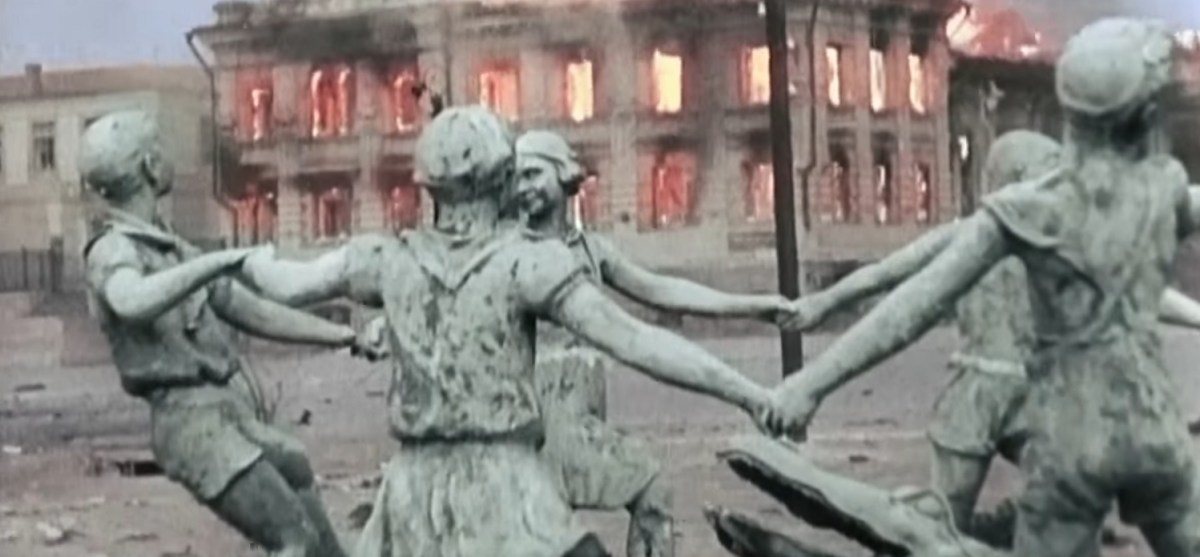
As a Seaforth Highlander, Mad Jack was posted to the British Mandate in Palestine, in 1948. He was one of the first to the scene of the ambush and massacre of the Haddassah medical convoy that April, banging on a bus and offering evacuation in an armored personnel carrier. His offer was refused in the mistaken belief that Hadassah was mounting an organized rescue.

No such rescue ever arrived. Churchill and a team of 12 British Light Infantry were left to shoot it out with some 250 Arab insurgents, armed with everything from blunderbusses and old flintlocks, to Sten and Bren guns. Seventy-eight Jewish doctors, nurses, students, patients, faculty members and Haganah fighters were killed along with one British soldier. Dozens were burned beyond recognition and buried in mass graves. Churchill later coordinated the evacuation of some 700 Jewish patients and medical personnel from the Hadassah hospital at Hebrew University, in Jerusalem.

Churchill served as an instructor at the land-air warfare school in Australia, where he became passionately devoted to surfing.  Returning to England upon his retirement, he became the first to surf the 5′ tidal surge up the River Severn, on a board of his own design.

Tidal Bore
Surfing the Tidal Bore, up the Severn River

Mad Jack Churchill remained an eccentric, even in his later years.   He loved sailing radio-controlled model warships on the Thames, and little seemed to bring him more joy than to horrify fellow train passengers, opening the window and hurling his briefcase into the darkness.

No one ever suspected that he threw it into the garden of his own back yard.  It saved him the trouble of carrying it home from the station.

He scribbled a couplet once on a postcard, and mailed it to a friend.  The face of the card bore the regimental colors.

On the back, Mad Jack Churchill had written these words.

“No Prince or Lord has tomb so proud / As he whose flag becomes his shroud.”

He may have been talking about himself.


August 23, 1942 War of the Rats

A German infantryman wrote to his family, “Animals flee this burning hell of a city. The hardest stones do not last for long. Only men endure”.

WWII could have ended differently, had two of the most homicidal dictators in history become allies. It actually started out that way, when the Soviet Union and Nazi Germany signed the Molotov-Ribbentrop non-aggression pact, in August, 1939. That would end two years later with “Operation Barbarossa”, the German surprise invasion of the Soviet Union, beginning on June 22, 1941.

We’re accustomed to thinking of World War II in terms of the European and the Pacific “Theaters”, but the most horrific casualties of the most destructive war in history, took place on the “Ostfront”, (Eastern Front).  95% of all German Army casualties between 1941 and 1944, and 65% of all Allied military casualties from the entire war, took place on the Eastern Front. The bloodiest battle of the Eastern Front, probably the bloodiest battle in all of history, began this day in 1942, in the city of Stalingrad.

stalingrad. Red Army
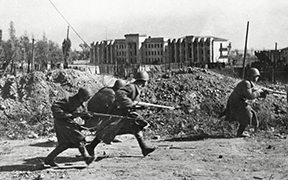
Photo by Nara Archives / Rex Features (2093505a) October 1942, Stalingrad – Soviet Guardsmen Fighting In The Streets Of The Stalingrad Outskirts

Soviet propagandists called it a “harvest victory”, when most of the cattle, grain and rail cars were shipped out of the city in advance of the German assault.

Most of Stalingrad’s civilian residents remained however, leaving the city short of food, even before the commencement of German attacks. Making things worse, the Luftwaffe bombed Volga River shipping, sinking 32 ships and crippling another 9 in the narrow waterway, cutting off this vital link in the city’s supply chain.

Wilfred von Richtofen, cousin of the famous “Red Baron” of WWI, opened up with his heavy bombers on August 23rd, dropping over 1,000 tons of high explosive on Stalingrad.

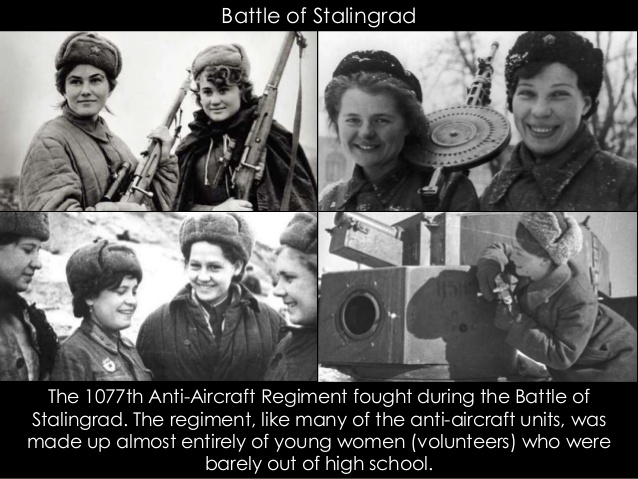
The Soviets suffered from extreme manpower shortages in the beginning.  The burden of the early defense of the city fell to the 1077th Anti-Aircraft Regiment, a primarily female unit of young volunteers who had no training and the wrong weapons to engage ground targets. These women were all alone at this point with no support from other units, but they traded shot for shot with the German 16th Panzer Division until all 37 AA guns had been wiped out or overrun. When it was over, 16th Panzer soldiers were shocked to learn they’d been fighting women.

1077th

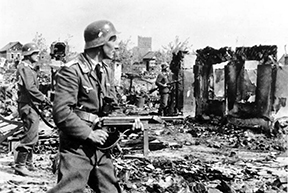
Stalingrad was quickly reduced to rubble, with the German 6th Army controlling 90% of the city.  Still, Lt. Gen. Vasily Ivanovich Chuikov’s army held on.  With backs to the Volga, they fought for the very sewers of the city, men and women alike reduced to a primitive level of existence. The Germans called it “Rattenkrieg”. “War of the Rats”. A German infantryman wrote to his family, “Animals flee this burning hell of a city. The hardest stones do not last for long. Only men endure”.

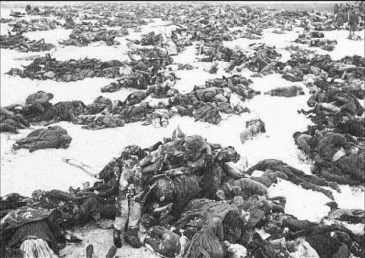
As many as 80,000 Red Army soldiers lay dead by the middle of October, 1942. Counting German losses and civilian deaths, the battle cost a quarter of a million lives up to this point, and the fighting still had months to go.Stalingrad

Ice floes in the Volga river further cut off the defender’s supplies, reducing them to cannibalism as a massive Soviet counter-attack was building on the German’s exposed left flank.

By November, General Georgy Zhukov had assembled over a million fresh troops, 1,500 tanks, 2,500 heavy guns, and three Air Armies for the assault on Stalingrad. The rumble of artillery, the “Great Soviet God of War” could be heard across the steppe as the Soviet counter-attack commenced in a blinding snowstorm on November 19th, 1942. It was now the Germans who were trapped.

German General Friedrich von Paulus asked Hitler’s permission to withdraw before they became surrounded.  The response was that he should fight “to the last soldier and the last bullet.”stalingrad1

German forward movement on the Eastern Front came to an end in February, 1943, when 91,000 freezing, wounded, sick and starving Germans were surrendered to the Red Army.

Even then, as many as 11,000 Germans refused to lay down their arms and continued to fight from the cellars and the sewers of Stalingrad, holding on until early March.

Disease, death marches, cold, overwork, mistreatment, and malnutrition would all take their toll on the prisoners.  Of the nearly 110,000 who went into captivity after the Battle of Stalingrad, fewer than 6,000 lived to return to Germany, after the war.

  August 16, 1945  The Last Emperor

Mao’s “Cultural Revolution” of the late 1960s is estimated to have killed 40 to 70 million Chinese.  You’re really playing in the Big Leagues, when they can’t estimate your death toll to anything closer than the nearest 30 million.

At the age of 2 years and 10 months, Puyi was taken from his parents and installed on the Qing Dynasty throne, in the Chinese Imperial Palace in Beijing.  The year was 1908.

It must have been bewildering for this toddler who was terrified by the sound of the ceremonial drums. Grown men would kowtow and avert their eyes in his presence.  His wet nurse, Wen-Chao Wang, was the only familiar face in the Royal Court.  She was the only one who could console him.  She alone was allowed to accompany him to the Forbidden City.

Puyi’s abdication of the throne four years later marked the end of 1,000 years of dynastic rule in China, earning him the sobriquet “The Last Emperor” of China.

mukden
Japanese experts gathered to inspect the scene of the ‘railway sabotage’ on the railway line.

Today, the Tsingtao beer available in Chinese restaurants the world over, is one of the last cultural vestiges of European colonization of China. In the latter half of the 19th century, China became increasingly subjugated through colonization by British, French and German powers.

American President Millard Filmore dispatched Commodore Matthew Perry to Japan in 1852, forcing an opening of that nation’s economy to trade with the West, and commencing a half-century’s period of rapid industrialization in resource-poor Japan. The smaller nation grew in both economic and military power, while China suffered the humiliations of the first and second opium wars, and forced colonization by European interests.

Japan piled on in the First Sino-Japanese War of 1894-95, culminating in the massacre of much of Lüshun City (formerly “Port Arthur”), cession of Chinese territories, and the recognition of an independent Korea.

China declared war on Imperial Germany in August 1917, intending to send combat units to the western front, but never getting around to doing so. The move entitled them to a seat at the Paris Peace Conference, but all that got them was a secret list of 21 demands issued by the Japanese Empire.  Japan emerged from this period with greater influence over the Chinese economy, and increased Japanese control over the resource-rich regions of Northern China and Manchuria.

On September 18, 1931, a small quantity of dynamite was detonated by Japanese Lt. Kawamoto Suemori, near a railroad owned by Japan’s South Manchuria Railway near Mukden, in modern Shenyang.  It was a ruse, a bald pretext for the Japanese invasion of Manchuria in Northern China, and everyone knew it.Mukden_1931_japan_shenyang

The explosion was so weak that it failed to destroy the line and a train passed minutes later, but the script was already written.  The Imperial Japanese Army accused Chinese dissidents of the “Mukden Incident”, launching a full scale invasion.

Japan installed Puyi as Emporer Kangde of the puppet state of “Manchukuo”, all the while suppressing the native Han Chinese in one of the most brutal and genocidal occupations of the 20th century.

Puyi was kept on a short leash by his Japanese handlers, his life mainly consisting of signing laws prepared by Japan, reciting prayers, consulting oracles, and making formal visits throughout his state.

The Second world war was drawing to a close when the Soviet Union declared war on Japan, beginning its invasion of occupied China two days after the atomic bomb was dropped on Hiroshima, the day before Nagasaki.  Puyi was captured at an airfield on this day in 1945, and held in a Soviet gulag in Siberia until Mao Tse-Tung’s Communist party came to power in 1949.

JapaneseBeijing
Japanese occupation of Beijing, 1937 – 1945

Puyi spent ten years in the Fushun War Criminals Management Centre in Liaoning province until he was declared “reformed”, moving to Peking in 1959 and taking up residence as an ordinary citizen.Puyi-Manchukuo

Mao’s “Cultural Revolution” of the late 1960s is estimated to have killed 40 to 70 million Chinese.  You’re really playing in the Big Leagues, when they can’t estimate your death toll any closer than the nearest 30 million.

The Last Emperor was an easy target of the “Red Guards”.  He probably wouldn’t have survived the tender ministrations of the communist government, but he died quietly due to complications of Kidney Cancer on October 17, 1967.

The ashes of the last Emperor, a man who had  found himself at the head of over a half-billion people at a time when the world population was only 2 billion, were placed at the Babaoshan Cemetery, the former burial ground of imperial concubines and court eunuchs.

August 14, 1945 A Kiss in Times Square

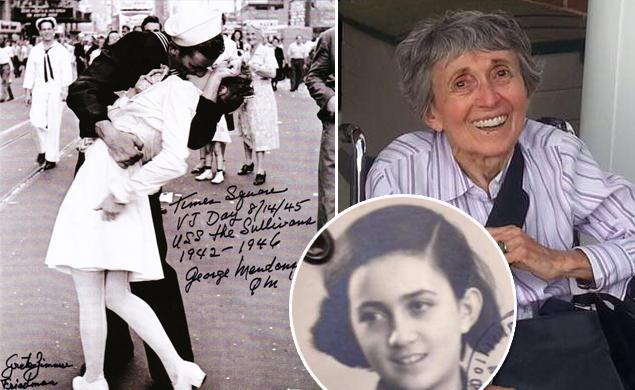
The lit message running around the Times Building read, “VJ, VJ, VJ, VJ” as George Mendonsa grabbed a stranger and kissed her. Two seconds later the moment was gone, but Alfred Eisenstaedt and his camera had been in the right place at the right time.

The most destructive war in history ended this day in 1945, with the unconditional surrender of the Empire of Japan.

It was morning on the East Coast.  President Harry Truman had not yet received the formal surrender. The White House official announcement was still hours away, but rumors had been flying since the early morning hours.

Born and raised in Austria, Greta Zimmer was 16 in 1939. Seeing the war bearing down on them, Greta’s parents sent her and her two sisters to America, not knowing if they would ever see them again. Six years later she was a dental assistant, working at the Manhattan office of Dr. J. L. Berke.

Greta’s lunch break came just after 1:00 that day.  Patients had been coming into the office all morning with rumors that the war was over. She set out for Times Square, knowing that the lit and moving type on the Times news zipper would give her the latest news.

Mendonsa, Zimmer
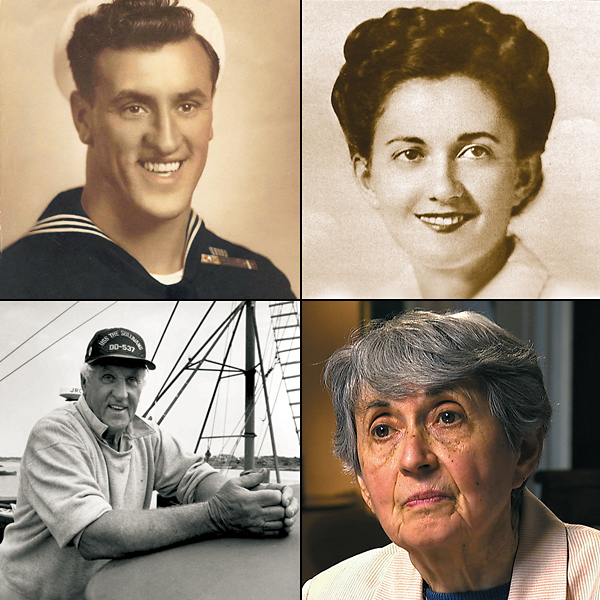
George Mendonsa, Greta Zimmer-Friedman

Petty Officer 1st Class George Mendonsa was on his last day of shore leave, spending the day with his new girlfriend, Rita Petry. They had heard the rumors too, but right now they were enjoying their last day together. The war could wait until tomorrow.

The couple went to a movie at Radio City Music Hall, but the film was interrupted by a theater employee who turned on the lights, announcing that the war was over. Leaving the theater, the couple joined the tide of humanity moving toward Times Square. The pair stopped at the Childs Restaurant on 7th Ave & 49th, where bartenders were pouring anything they could get hands on into waiting glasses.  Revelers were scooping them up as fast as the glasses were filled.

Mendonsa’s alcohol-powered walk/run from the restaurant left Rita trailing behind, but neither one seemed to mind. Times Square was going wild.

The sailor from the USS Sullivans had seen bloodshed. He’d been there on May 11, as kamikaze planes smashed into the USS Bunker Hill.  Explosions and fires killed 346 sailors that day.  43 of their bodies would never be found. Mendonsa had helped to pull the survivors, some of them hideously burned, out of the water. He had watched while Navy nurses tended to the injured and the dying.

When the sailor spotted Greta Zimmer, the dental assistant was dressed the same way.  To him, she must have seemed like one of those white-clad angels of mercy from those earlier months.

kiss-in-times-square-leica-2Reporters from the AP, NY Times, NY Daily News and others descended on Times Square to record the spontaneous celebration.
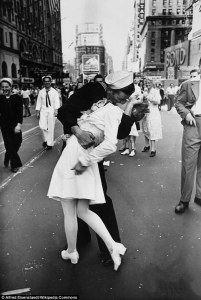
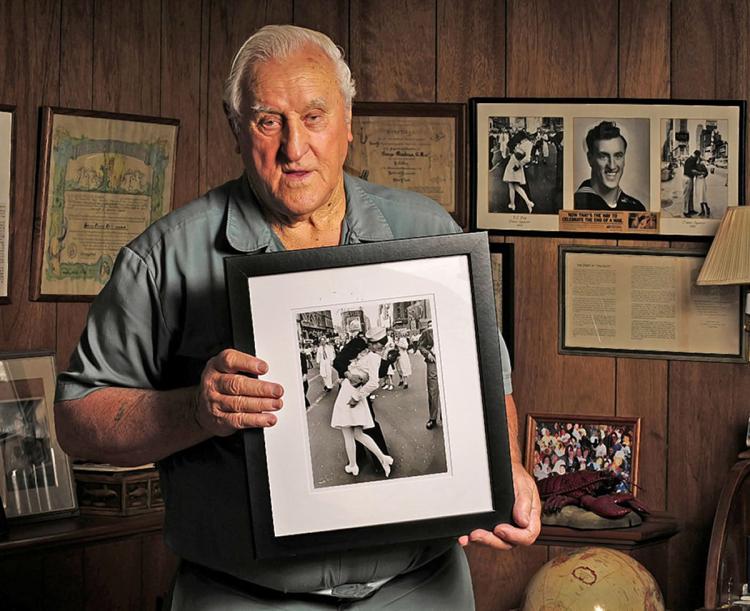
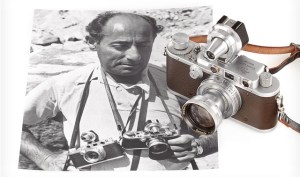
As a German Jew in the 1930s, Alfred Eisenstaedt had photographed the coming storm. He had photographed Benito Mussolini’s first meeting with Adolf Hitler in Venice in 1934. Now he and his Leica Illa rangefinder camera worked for Life Magazine, heading to Times Square in search of “The Picture”.

The lit message running around the Times Building read, “VJ, VJ, VJ, VJ” as George Mendonsa grabbed a stranger and kissed her. Two seconds later the moment was gone, but Eisenstaedt and his camera had been in the right place at the right time.Times Square Kiss

The image of the sailor kissing the nurse would become as famous as Joe Rosenthal’s photo of the flag raising at Iwo Jima, but not until years later.

The German made camera which took the iconic image recently went to auction at the Westlicht auction house in Vienna, where it was expected to sell for $30,000. The winning bid was almost $150,000.

After the war, Greta Zimmer learned that both of her parents had died in the camps. She later married and made her home in Frederick, Maryland.  Greta Zimmer Friedman never returned to Austria, and passed away last September, at the age of 92.

George Mendonsa and Rita Petry later married. George never saw the famous photograph until 1980.  At first he wasn’t sure he recognized himself.  Today, framed copies of it hang on the wall of their Rhode Island home.

MendonsaThis year, the couple celebrates their 68th wedding anniversary.  Rita says she wasn’t angry that her husband kissed another woman on their first date.  She points out that she can been seen grinning in the background of the famous picture.  She will admit, however, ‘In all these years, George has never kissed me like that.’

August 12, 1944 Operation Aphrodite

Kennedy and Willy remained aboard as BQ-8 completed its first remote controlled turn at 2,000′, near the North Sea coast. They removed the safety pin arming the explosive, Kennedy sending the code “Spade Flush”, to signal the task was complete. They were his last words.

The Normandy landings were two months in the past in August 1944, with yet another 9 months of hard fighting to go before the defeat of Nazi Germany.

Allied strategic bombing was having little effect on German submarine pens and rocket launch sites. Operations “Aphrodite” and “Anvil” were supposed to help. The idea was to load old Boeing B-17 Flying Fortresses and B-24 Liberator bombers with tons of explosives, fly it via radio control, and crash it directly onto a target.

The drone was to fly at 2,000′ with the controlling aircraft directing the flying bomb onto its target from 20,000′. The converted bombers required a minimum of two crew to take off and operate.  The plan was to have them bail out over the English Channel, a waiting boat picking up the two pilots while control of the drone passed to the operating aircraft.Kennedy, Aphrodite

On August 12, 1944, Lt. Joseph Patrick “Joe” Kennedy, Jr. and Lieutenant Wilford John Willy stepped into a converted B-24 Liberator, designated BQ-8. It was the seventh Aphrodite mission, and Willy had “pulled rank” on Kennedy’s usual co-pilot, Ensign James Simpson, in order to be on the mission.

Two Lockheed Ventura mother planes with radio control sets took off from RAF Fersfield at 6:00pm, followed by the BQ-8 aircraft, loaded with 21,170 lbs of Torpex, a British high explosive 50% more powerful than TNT.  Two P-38 Lightning fighters followed, as mission escort. A sixth aircraft followed the formation, a de Havilland Mosquito, come to film the operation. In an unlikely historical coincidence, the Mosquito was piloted by Colonel Elliott Roosevelt, USAAF, son of President Franklin Delano Roosevelt.

The target was the Fortress of Mimoyecques and its V-3 cannons, in the north of France.

Operation-Aphrodite-Drones-versus-V2-Rockets-4Kennedy and Willy remained aboard as BQ-8 completed its first remote controlled turn at 2,000′, near the North Sea coast. They removed the safety pin arming the explosive, Kennedy sending the code “Spade Flush”, to signal the task was complete. They were his last words. The aircraft exploded two minutes later, a shower of wreckage coming to earth near the village of Blythburgh in Suffolk, England.  A series of small fires were started and 59 buildings were damaged, but there were no casualties on the ground. The bodies of Kennedy and Willy were never recovered.

There would be fourteen such missions in total.  Only one caused damage to the intended target, and that may have been accidental. In the end, the program killed more American airmen than it did Nazis.  More damage was done to the British countryside, than to German interests.

Operation-Aphrodite-Drones-versus-V2-Rockets-5When Joseph Kennedy Jr. was born, his grandfather John F. Fitzgerald, then Mayor of Boston, said, “This child is the future President of the nation”.  He had been a delegate to the Democrat’s National Convention in 1940, and planned to run for Massachusetts’ 11th congressional district in 1946.

Kennedy could have gone home, he had already completed the 25-mission requirement, to do so.  Clearly, Joseph Kennedy Jr. had the resume, and he had the pedigree.  He showed every indication of following the path which would later lead his brother to the Presidency.  Joe Senior had already begun to lay the campaign groundwork when his son was killed.

‘What if’ histories are always tricky, but in this particular alternate universe, it seems safe to say.  A future President of the United States was killed over the Blyth Estuary.  73 years ago, today.

August 9, 1945 Nagasaki

The 10,000lb, 10’8″ weapon was released at 28,900′. Seconds later, a perfect circle of 64 detonators exploded inside the heart of the bomb, compacting the plutonium core into a supercritical mass and  exploding with the force of 20,000 tons of high explosive.

Now I am become death, the destroyer of worlds“.

Trinity_Test_Fireball_16ms
Trinity Test Fireball

The line comes from the Bhagavad Gita, the Hindu epic which Mohandas Gandhi described as his “spiritual dictionary”. On July 16, 1945, these words were spoken by J. Robert Oppenheimer, director of the Manhattan Project, as he witnessed “Trinity”, the world’s first nuclear detonation.

The project had begun with a letter from prominent physicists Leo Szilard and Albert Einstein to President Franklin Roosevelt, warning that Nazi Germany may have been working to develop a secret “Super Weapon”.  The project ended with the explosion of the “Gadget” in the Jornada del Muerto desert, equaling the explosive force of 20 kilotons of TNT.Trinity_site_plaque

The Manhattan Project, the program to develop the Atomic Bomb, was so secret that even Vice President Harry Truman was unaware of its existence.

President Roosevelt passed away on April 14, and Harry Truman was immediately sworn in as President. He was fully briefed on the Manhattan project 10 days later, writing in his diary that night that the US was perfecting an explosive “great enough to destroy the whole world”.

Nazi Germany surrendered on May 7, but the war in the Pacific theater, ground on. By August, Truman faced the most difficult decision ever faced by an American President. Whether to drop an atomic bomb on Imperial Japan.

The morality of President Truman’s decision has been argued ever since. In the end, it was decided that to drop the bomb would end the war faster, with less loss of life on both sides, compared with the invasion of the Japanese home islands.

So it was that the second nuclear detonation in history took place on August 6 over the city of Hiroshima, Japan. “Little Boy”, as the bomb was called, was delivered by the B29 Superfortress “Enola Gay”, named after the mother of United States Army Air Forces pilot Lieutenant Colonel Paul Tibbets. 70,000 Japanese citizens were vaporized in an instant.  Another 100,000 later died from injuries and the delayed effects of radiation.

FatMan
Fat Man

Even then the Japanese Government refused to surrender. ‘Fat Man’, a plutonium bomb carried by the B29 “Bockscar”, was dropped on Nagasaki, on August 9.

The three cities originally considered for this second strike included Kokura, Kyoto and Niigata. Kyoto was withdrawn from consideration due to its religious significance. Niigata was taken out of consideration due to the distance involved.

Kokura was the primary target on this day, but local weather reduced visibility.  Bockscar criss-crossed the city for the next 50 minutes, but the bombardier was unable to see well enough to make the drop.  Japanese anti-aircraft fire became more intense with every run, and Second Lieutenant Jacob Beser reported activity on the Japanese fighter direction radio bands.

In the end, 393rd Bombardment Squadron Commander Major Charles Sweeney bypassed the city and chose the secondary target, the major shipbuilding center and military port city of Nagasaki.

The 10,000lb, 10’8″ weapon was released at 28,900′.  43 seconds later at an altitude of 1,650′, a perfect circle of 64 detonators exploded inside the heart of the bomb, compacting the plutonium core into a supercritical mass which exploded with the force of 20,000 tons of high explosive.

In the early 1960s, the Nagasaki Prefectural Office put the death count resulting from this day, at 87,000.  70% of the city’s industrial zone was destroyed.

Japan surrendered unconditionally on the 14th of August, ending the most destructive war in history.

Nazi Germany was, in fact, working on a nuclear weapon, and had begun before the allies. They chose to pursue nuclear fusion, colliding atomic particles together to form a new type of nuclear material, instead of fission, the splitting of the atom which resulted in the atomic bomb.

That one critical decision, probably taken in some laboratory or conference room, put Nazi Germany behind in the nuclear arms race. How different would the world be today, had Little Boy and Fat Man had swastikas painted on their sides.

July 30 1945 USS Indianapolis

“This is Captain McVay’s dog tag from when he was a cadet at the Naval Academy. As you can see, it has his thumbprint on the back. I carry this as a reminder of my mission in the memory of a man who ended his own life in 1968. I carry this dog tag to remind me that only in the United States can one person make a difference no matter what the age. I carry this dog tag to remind me of the privilege and responsibility that I have to carry forward the torch of honor passed to me by the men of the USS Indianapolis”.

The heavy cruiser USS Indianapolis set out on its secret mission on July 16, 1945, under the command of Captain Charles Butler McVay, III.  She was delivering “Little Boy” to the Pacific island of Tinian, the atomic bomb which would later be dropped on Hiroshima.

USS_Indianapolis_at_Mare_IslandIndianapolis made her delivery on July 26, arriving at Guam two days later and then heading for Leyte to take part in the planned invasion of Japan. She was expected to arrive on the 31st.
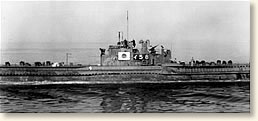
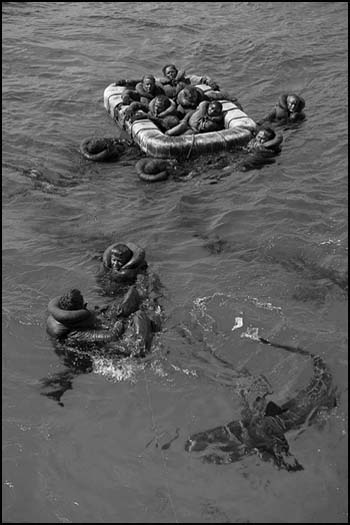
Japanese submarine I-58, Captain Mochitsura Hashimoto commanding, fired a spread of six torpedoes at the cruiser, two striking Indianapolis’ starboard bow at fourteen minutes past midnight on Monday, July 30. The damage was massive. Within 12 minutes she had rolled over, gone straight up by the stern, and sunk beneath the waves.

About 300 of Indianapolis’ 1,196-member crew were killed outright, leaving almost 900 treading water. Many had no life jackets and there were few life boats.  There had been too little time.Indianapolis Sub

For four days they treaded water, alone in open ocean, hoping for the rescue that did not come.   Shark attacks began on the first day, and didn’t let up for the entire time they were in the water. Kapok life vests became waterlogged and sank after 48 hours, becoming worse than useless.

Exhaustion, hypothermia, and severe sunburn took their toll as the days went by. Some went insane and began to attack shipmates.  Others found the thirst so unbearable that they drank seawater, setting off a biological chain reaction which killed them in a matter of hours.

Some simply swam away, following some hallucination that only they could see. Through it all, random individuals would suddenly rise up screaming from the ocean, and then disappear from sight, as the sharks claimed another victim.

indianapolis_2
Caribbean Reef sharks circling the sailors in reenactment scene after USS Indianapolis had been sunk by Japanese submarine. As seen on OCEAN OF FEAR: WORST SHARK ATTACK EVER.

At Naval Command, there was confusion about where Indianapolis was to report when it arrived.  When the cruiser failed to arrive on the 31st, there was no report of the non-arrival.  Perhaps worst, a message which could have clarified Indianapolis’ expected arrival on Monday came through garbled, and there was no request to repeat it.

As it was, only the barest of chances led to Indianapolis’ survivors being located at all.   Lieutenant Wilbur Gwinn, pilot of a Ventura scout-bomber, had lost the weight from a navigational antenna wire.  Belly-crawling through the fuselage to fix the thrashing antenna, Gwinn noticed an oil slick.  Back in the cockpit, he dropped down to have a better look.  Only then did he spot men floating in open ocean.

Lieutenant R. Adrian Marks and his PBY Catalina amphibious patrol aircraft were the first on the scene.  Horrified to see sharks actually attacking the men below, Marks landed his flying boat at sea.   The last Indianapolis survivor was plucked from the ocean Friday afternoon, half dead after almost five days in the water.  Of the 900 or so who survived the sinking, only 317 remained alive at the end of the ordeal.

The Navy had committed multiple errors, from denying McVay’s requested escort to informing him that his route was safe, even when the surface operations officer knew at least two Japanese submarines operated within the area.  No Matter.  A capital ship had been lost and someone was going to pay.  A hastily convened court of inquiry was held in Guam on August 13, leading to Captain McVay’s court-martial.

No less a figure than Fleet Admiral Chester Nimitz (CINCPAC) and Admiral Raymond Spruance, for whom the Indianapolis had served as 5th Fleet flagship, opposed the court-martial, believing McVay to be guilty of an error in judgement at worst, not gross negligence. Naval authorities in Washington saw things differently, particularly Navy Secretary James Forrestal and Chief of Naval Operations Admiral Ernest King.

Captain McVay’s orders were to “zigzag” at discretion, a naval maneuver most effective at avoiding torpedoes already in the water.   No Navy directives in effect at that time or since have so much as recommended, let alone ordered, zigzagging at night or in poor visibility.

Prosecutors flew I-58 commander Hashimoto in to testify at the court-martial, but he swore that zigzagging would have made no difference.  The Japanese Commander even became part of a later effort to exonerate McVay, but to no avail. Charles Butler McVay III was convicted of “hazarding his ship by failing to zigzag”, his career ruined.

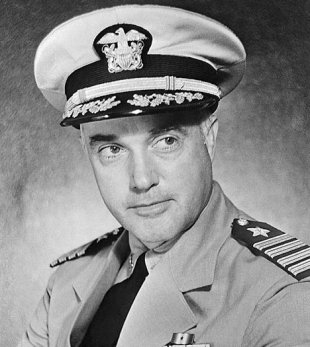
Captain Charles Butler McVay, III

McVay had wide support among Indianapolis’ survivors, but opinion was by no means unanimous. Many family members held him personally responsible for the death of loved ones.  Birthdays, anniversaries and holidays would come and go.  There was almost always hate mail from some family member. One Christmas missive read “Merry Christmas! Our family’s holiday would be a lot merrier if you hadn’t killed my son”.

As the years went by, McVay began to question himself.  In time, he came to feel the weight of the Indianapolis’ dead, a soul crushing burden from which there was no escape.  On November 6, 1968, Charles McVay took a seat on his front porch in Litchfield Connecticut, took out his Navy revolver, and killed himself.  He was cremated, his ashes scattered at sea.

The ULTRA code-breaking system which revealed I-58’s presence on Indianapolis’ course, would not be declassified until the early 90s.

Afterward:

Hunter Alan Scott was 11 and living in Pensacola when he saw the movie “Jaws”, in 1996. He was fascinated by the movie’s brief mention of Indianapolis’ shark attacks.  The next year, he created his 8th grade “National History Day” project on USS Indianapolis’ sinking.

The boy interviewed nearly 150 survivors and reviewed 800 documents.  The more he read, the more he became convinced that Captain McVay was innocent of the charges for which he’d been convicted.

Scott’s National History Day project went up to the state finals, only to be rejected because he used the wrong type of notebook to organize the material.

He couldn’t let it end there. Scott began to attend Indianapolis survivors’ reunions, at their invitation, and helped to gain a commitment in 1997 from then-Representative Joe Scarborough that he would introduce a bill in Congress to exonerate McVay the following year.

Senator Bob Smith of New Hampshire joined Scarborough in a joint resolution of Congress.  Hunter Scott and several Indianapolis survivors were invited to testify before Senator John Warner and the Senate Armed Services committee on September 14, 1999.

Holding a dog tag in his hand, Scott testified “This is Captain McVay’s dog tag from when he was a cadet at the Naval Academy. As you can see, it has his thumbprint on the back. I carry this as a reminder of my mission in the memory of a man who ended his own life in 1968. I carry this dog tag to remind me that only in the United States can one person make a difference no matter what the age. I carry this dog tag to remind me of the privilege and responsibility that I have to carry forward the torch of honor passed to me by the men of the USS Indianapolis”.

The United States Congress passed a resolution in 2000, signed into law by President Bill Clinton on October 30, exonerating Charles Butler McVay, III of the charges which had led to his court martial, humiliation and suicide.

The record cannot not be expunged – Congress has rules against even considering bills which alter military records.  Yet Captain McVay had been exonerated, something that the Indianapolis survivors had tried for years to accomplish, without success.  Until the intervention of a 12-year-old boy.

The last word on the whole episode belongs to Captain Hashimoto, who wrote the Senate Armed Services Committee in 1999 on behalf of Captain McVay.  “Our peoples have forgiven each other for that terrible war and its consequences“, wrote the former submarine commander, now a Shinto Priest.  “Perhaps it is time your peoples forgave Captain McVay for the humiliation of his unjust conviction“.

July 25, 1944 V2

When Wernher von Braun showed Adolf Hitler the launch of the V2 on color film, Hitler jumped from his seat and shook Braun’s hand with excitement. “This is the decisive weapon of the war. Humanity will never be able to endure it,” Hitler exclaimed. “If I had this weapon in 1939 we would not be at war now.”

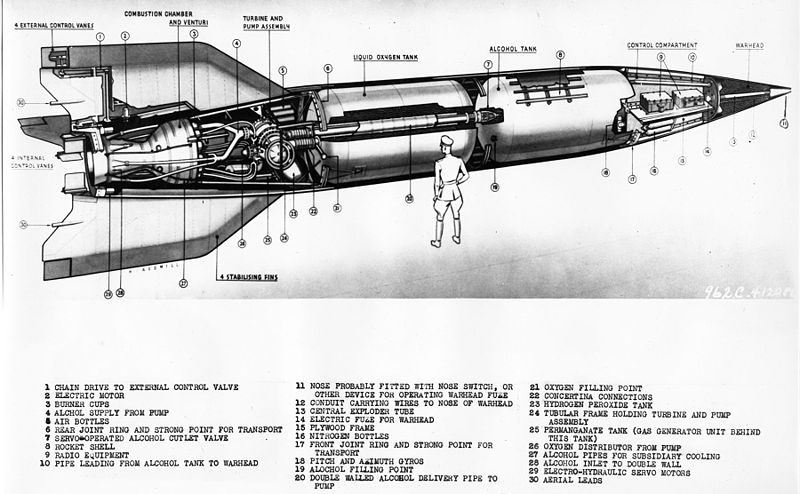
V-1_cutaway
V! “Doodlebug”

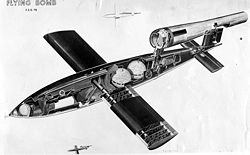
In the early years of WWII, Nazi Germany fired 10,000 V1″Doodlebug” rockets at England, killing over 6,000 Londoners by 1943. The subsonic V1 was an effective terror weapon, but the “low and slow” trajectory and short range of the weapon lacked the strategic power to end the war in the Nazi’s favor.

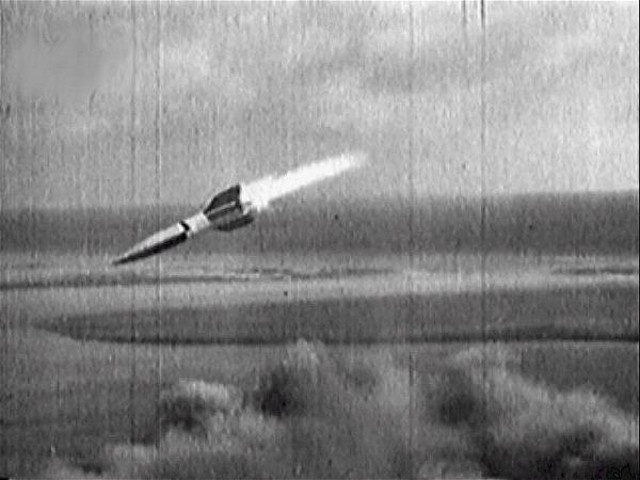
The V2 was different.  It was the dawn of the ballistic missile era, and Nazi Germany was first off the starting line.

The Peenemünde Aggregat A4 V2 was an early predecessor of the Cruise Missile, delivering a 2,148-pound payload over a 236 mile range at 5 times the speed of sound. You could hear the V1 “Buzz Bomb” coming and seek shelter.  Not so the V2.  Victims of the V2 didn’t know they were under attack until the weapon had exploded.

When Wernher von Braun showed Adolf Hitler color film of the launch of a V2, Hitler jumped from his seat and shook Braun’s hand with excitement. “This is the decisive weapon of the war. Humanity will never be able to endure it,” Der Fuhrer exclaimed. “If I had this weapon in 1939 we would not be at war now!”

V2 diagram
V2 Diagram

About that, Hitler may have been right.  The Allies were anxious to get their hands on one.  In early 1944, they had their chance. A V2 crashed onto a muddy bank of the River Bug, in Nazi occupied Poland. The Polish underground had been waiting for such a situation, and quickly descended on the rocket, covering it with brush. Desperate to retrieve the missile, the Germans conducted a week-long aerial and ground search, but failed find the weapon under its camouflage.

After the search came to an end, partisans returned to the site. This time they brought four Polish scientists who carefully disassembled the weapon, packing the pieces in barrels. The parts were then shipped to a barn in Holowczyce, just a few miles away.

The allied effort to retrieve the stolen missile, code named “Most III”, got underway on this day in 1944, when Royal New Zealand Air Force 1st Lieutenant Stanley George Culliford landed his Dakota C47 in the early morning darkness, at a secret air strip near Tarnow.

They loaded the rocket chassis and several technical experts on board, but it was too much weight.  The overloaded C47 couldn’t move on the wet, muddy field.  The port-side wheel was stuck fast in the mud.  Everything had to be offloaded, Polish partisans working desperately to free the aircraft as dawn approached. They stuffed the wheel track with straw, and then laid boards in the trench.  Nothing worked.V2 in flight

Co-pilot Kazimierz “Paddy” Szrajer thought the parking brake must be stuck, so they cut the hydraulic lines supplying the brake. That didn’t work, either. In the end, partisans were frantically digging trenches under the aircraft’s main wheel. There were two failed attempts to take off.  Culliford was considering blowing up the plane and burning all the evidence, but agreed to one last attempt. The aircraft lumbered off the ground on the third try. The headlights of Nazi vehicles could be seen in the darkness as the last of the Polish partisans scattered into the night.

There would be 5 hours of unarmed, unescorted flight over Nazi territory, and an emergency landing with no brakes, before the V2 rocket components finally made it to England.

Today, few remember their names.  We are left only to imagine a world in which Nazi Germany remained in sole possession, of the game changing weapons of World War Two.

July 13, 1943 Kursk

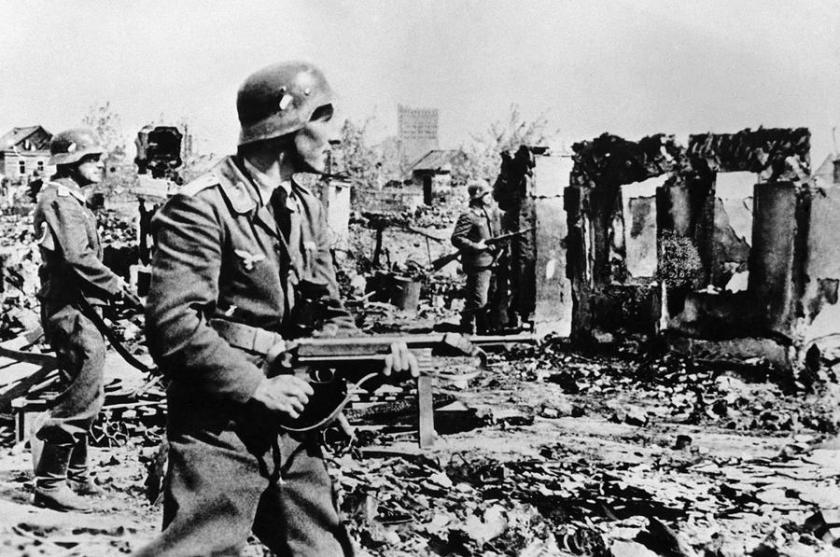
Fighting between Nazi Germany and the Soviet Union had long since taken on shades of a race war, Slav against Teuton, in a paroxysm of mutual extermination that is horrifying, even by the hellish standards of WWII.

WWII has been rightly described as the deadliest conflict in human history. Yet to the extent that WWII history is taught at all, it is largely based on the Western and Pacific theaters of the war. The “Ostfront” is less well understood, at least in the West:  the war as it was fought between the Soviet Union and Germany, on the Eastern theater of the war.

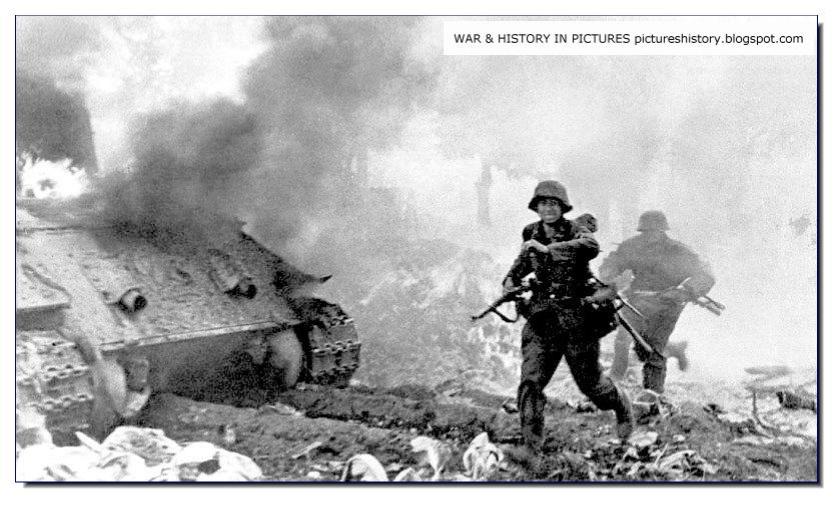
It may have been governments who started the war.  It was the every-day “Fritz” and the “Ivan” down the street, who did the fighting and the dying.totenkopf-SS-division-nazi-germany-elite-classic-fiercest-warriors-006

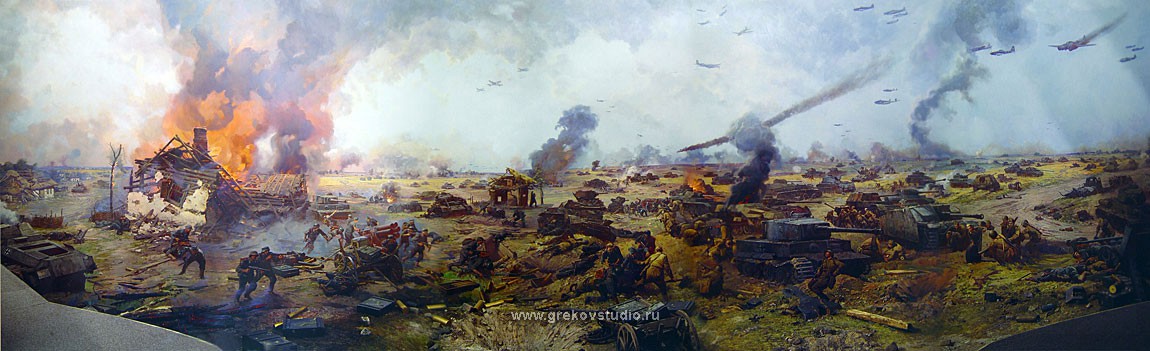
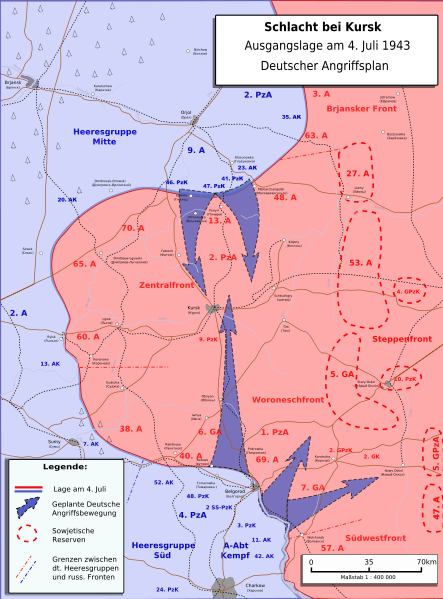
The greatest tank battle in history started this day on the Eastern Front. It began as a “Battle of a Bulge”, six months before the last German offensive began in the snow-covered forests of the Ardennes. The five-months long Battle for Stalingrad had ended with a decisive Soviet victory in February of that year, resulting in a “Bulge”, or salient in the Soviet lines, near the city of Kursk.

The Germans planned to shorten their battle lines by eliminating the Kursk salient, and commenced a series of strategic attacks in March, retaking Kharkov and Belgorod. Offensive operations ceased by the end of March due to the onset of the spring “rasputitsa” (mud season) and the exhaustion of both the Wehrmacht and the Red Army.

Field Marshal Erich von Manstein sent to Germany for massive reinforcements of Panther medium and Tiger heavy tanks, while Soviet forces prepared the “Defense in Depth” strategy which would prove decisive in July.

Kursk-1943-Plan-GE.svgThe Kursk salient was of little or no strategic value to the German war effort.  Both Manstein and General Walter Model argued for a tactical defense. Even Heinz Guderian, arguably the father of modern armored tactics, argued against the offensive, but Hitler would not hear of it. Der Fuhrer was going to have his offensive.
“Operation Citadel” started with a series of two offensives beginning on July 5. The Soviet’s defensive preparations began to take their toll almost immediately.

Minefields, fortifications, pre-sighted artillery fire zones and anti-tank strong points extended over 190 miles into the Soviet perimeter. By July 13, the Red Army had regained the offensive. Accounts of the battle vary wildly, with most estimates around 6,000 tanks, 2,000,000 troops, and 4,000 aircraft being involved in the fight.

Estimated losses are difficult to learn, due to the obsessive secrecy of both Nazis and Communists. Sources indicate over a quarter of a million German casualties and four times that number on the Soviet side.  1,083 tanks & assault guns were lost to the German side, over 8 times that number for the Russians.

The battle is considered to be a decisive victory for the Soviet union, representing the final German initiative of the Eastern Front. Though Soviet losses were far higher than those of Germany, the vast resources of the Soviet Union were far better positioned to replace those losses than that of the 3rd Reich.

main_900

Fighting between Nazi Germany and the Soviet Union had long since taken on shades of a race war.  Slav against Teuton, in a paroxysm of mutual extermination that is horrifying, even by the hellish standards of WWII.  The war on the Ostfront, was yet to grind out another year.