The battered aircraft was completely alone and struggling to maintain altitude, the American pilot well inside German air space when he looked to his left and saw his worst nightmare. Three feet from his wing tip was the sleek gray shape of a German fighter, the pilot so close that the two men were looking into one another’s eyes.
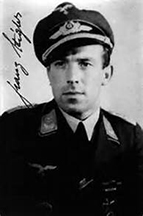
Franz Stigler
At the age of 26, Franz Stigler was an Ace. The Luftwaffe pilot of a Messerschmitt Bf-109 fighter, some of his kills had been revenge, payback for the death of his brother August, earlier in the war. This man was no Nazi. He was a German Patriot with 22 confirmed kills. On December 20, 1943, he needed one more for a Knight’s Cross. He tossed his cigarette aside and climbed into his fighter as the crippled American B17 bomber lumbered overhead. This was going to be an easy kill.
Charles Brown
21-year-old Charles Brown was at the throttle of that B17, a plane named “Ye Olde Pub”. The earlier attack on the munitions factory in Bremen had been a success, but the pilot and crew had paid a heavy price.
The aircraft had been savaged by no fewer than 15 German fighters. Great parts of the air frame were torn away, one wing severely damaged and part of the tail torn off. The aircraft’s Plexiglas nose was shattered and the #2 engine seized. Six of the ten-man crew were wounded and the tail gunner dead, his blood frozen in icicles over silent machine guns. Brown himself had been knocked out at one point, coming around just in time to avert a fatal dive.
The battered aircraft was completely alone and struggling to maintain altitude, the American pilot well inside German air space, when he looked to his left and saw his worst nightmare. Three feet from his wing tip was the sleek gray shape of a German fighter, the pilot so close that the two men were looking into one another’s eyes.
Brown’s co-pilot, Spencer “Pinky” Luke said “My God, this is a nightmare.” “He’s going to destroy us,” was Brown’s reply. This had been his first mission. He was sure it was about to be his last.
Before his first mission, Stigler’s commanding officer, Lt. Gustav Roedel, had said “Honor is everything here. If I ever see or hear of you shooting at a man in a parachute, I will shoot you down myself”.
The German ace must have remembered those words as he watched the wounded, terrified US airmen inside the B17, some still helping one another with their injuries. “You follow the rules of war for you – not for your enemy, Roedel had said. “You fight by rules to keep your humanity”.
The German had to do something. The Nazis would surely shoot him for treason if he was seen this close without completing the kill. One of the American crew was making his way to a gun turret as the German made his decision. Stigler saluted his adversary, motioned with his hand for the stricken B17 to continue, and then peeled away. Ye Olde Pub made it, crossing 250 miles of the frozen North Sea before finally landing in Norfolk.
More than 40 years later, the German pilot was living in Vancouver, Canada, when Brown took out an ad in a fighter pilots’ newsletter. It said that he was searching for the man ‘who saved my life on December 20, 1943.’ Stigler saw the ad, and the two met for the first time in 1987. “It was like meeting a family member”, Brown said of that first meeting. “Like a brother you haven’t seen for 40 years”.
The two became close friends and occasional fishing buddies until their passing in 2008, six months apart. Franz Stigler was 92, Charles Brown 87. A book called “A Higher Call”, tells their story in far greater detail, if you want to know more about it.
In their obituaries, both men were mentioned as the other’s “Special Brother”.
If you enjoyed this “Today in History”, please feel free to re-blog, “like” & share on social media, so that others may find and enjoy the same. Please click the “follow” button on the right, to receive email updates on new articles. Thank you for your interest, in the history we all share.
Hulls would creak and groan with the pounding and rivets popped. Captains in wheelhouses would order course headings, but helmsmen could do no better than 50° to either side of the intended course. Some ships rolled more than 70°. The 888-ft carrier USS Hancock, scooped tons of water onto its flight decks, 57′ up.
In September 1935, the Imperial Japanese Navy was conducting wargame maneuvers, when the fourth fleet was caught in extremely foul weather. By the 26th, the storm had reached Typhoon status, The damage to the Japanese fleet was near catastrophic. Two large destroyers had their bows torn away by heavy seas. Several heavy cruisers suffered major structural damage. Submarine tenders and light aircraft carriers developed serious cracks in their hulls. One minelayer required near total rebuild, and virtually all fleet destroyers suffered damage to their superstructures. 54 crewmen were lost.
Nine years later, it would be the turn of the American fleet.
The war in the Pacific was in its third year in December 1944. A comprehensive defeat only weeks earlier had dealt the Imperial Japanese war effort a mortal blow at Leyte Gulf, yet the war would go on for the better part of another year.
Carrier Task Force 38 was a massive assembly of warships, a major element of the 3rd Fleet under the Command of Admiral William “Bull” Halsey. In formation, TF-38 moved in three eight-mile diameter circles, each with an outer ring of destroyers, an inner ring of battleships and cruisers, and a mixed core of 35,000-ton Essex class and smaller escort carriers. TF-38 was a massive force, fielding eighty-six warships, altogether.
By mid-December 1944, Task Force 38 had been underway for three weeks, having just completed three days of heavy raids against Japanese airfields in the Philippines, suppressing enemy aircraft in support of American amphibious operations against Mindoro. Ships were badly in need of re-supply. A replenishment fleet, 35 ships in all, was sent to the nearest spot near Luzon, yet still outside of Japanese fighter range. Replenishment operations began the morning of the 17th.
Rapid movement into previously enemy-held territory made it impossible to establish advance weather reporting. By the time that Task Force aerological (meteorological) service reports made it to ships in the operating area, weather reports were at least twelve hours old.
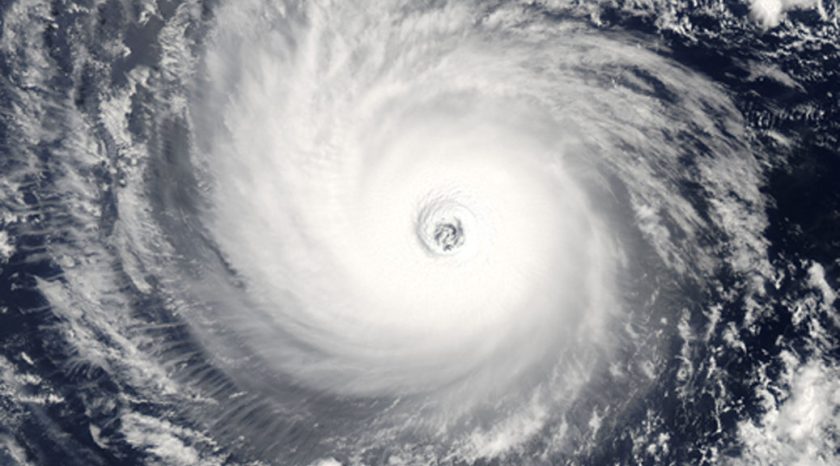
Three days earlier, a barometric low pressure system had begun to form off Luzon, fed by the warm waters of the Philippine sea. High tropospheric humidity fed and strengthened the disturbance, as counter-clockwise winds began to develop around the low pressure center. By the 18th, this small “tropical disturbance” had developed into a compact but powerful cyclone.
Replenishment operations began the morning of the 17th, as increasing winds and building seas made refueling increasingly difficult. Refueling hoses were parted on several occasions and thick hawsers had to be cut to avoid collision, as sustained winds built to 40 knots. Believing the storm center to be 450 miles to his southeast, Admiral Halsey didn’t want to return to base. That would take too long, and combat operations were scheduled to resume, two days later. Halsey needed the carrier group refueled and on station, and so it was decided. Task Force 38 and the replenishment fleet, would proceed to a second replenishment point, hoping to resume refueling operations on the morning of the 18th.
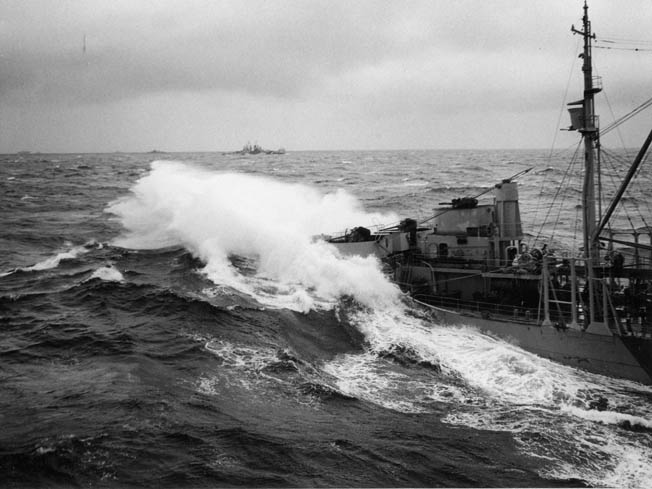
Four times over the night of December 17-18, course was corrected in the search for calmer water. Four times, the ships of Task Force 38 and it’s attendant resupply ships, turned closer to the eye of the storm. 2,200-ton destroyers pitched and rolled like corks, towering over the crest of 70-waves, only to crash into the trough of the next, shuddering like cold dogs as decks struggled to shed thousands of tons of water.
Hulls would creak and groan with the pounding and rivets popped. Captains in wheelhouses would order course headings, but helmsmen could do no better than 50° to either side of the intended course. Some ships rolled more than 70°. The 888-ft carrier USS Hancock, scooped tons of water onto its flight decks, 57′ up.
Typhoon Cobra reached peak ferocity between 1100 and 1400, with sustained winds of 100mph and gusts of up to 140.
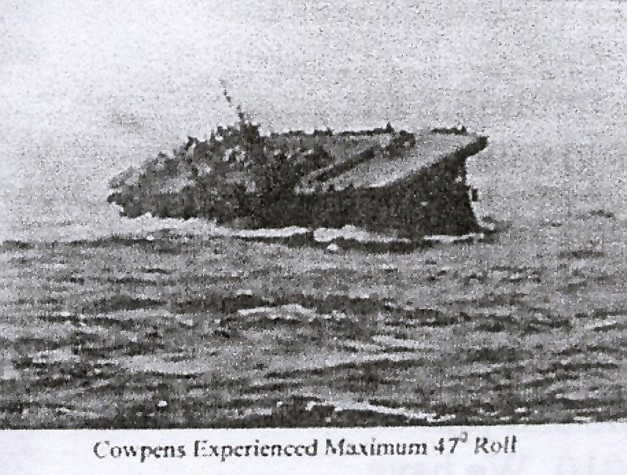
The lighter destroyers got the worst of it, finding themselves “in irons” – broad side to the wind and rolling as much as 75°, with no way to regain steering control. Some managed to pump seawater into fuel tanks to increase stability, while others rolled and couldn’t recover, as water cascaded down smokestacks and disabled engines.
146 aircraft were either wrecked or blown overboard. The carrier USS Monterrey nearly went down in flames, as loose airplanes crashed about on hanger decks and burst into flames. One of those fighting fires aboard Monterrey was then-Lieutenant Gerald Ford, the former Michigan Wolverine center and future President of the United States.
Many of the ships of TF-38 sustained damage to above-decks superstructure, knocking out radar equipment and crippling communications.
790 Americans lost their lives in Typhoon Cobra, killed outright or washed overboard and drowned.
It could have been worse. The destroyer escort USS Tabberer defied orders to return to port, Lieutenant Commander Henry Lee Plage conducting a 51-hour boxed search for survivors, despite the egregious pounding being taken by his own ship. USS Tabberer plucked 55 swimmers from the water, survivors of the capsized destroyers Hull and Spence.
Typhoon Cobra moved on that night, December 19 dawning clear with brisk winds. Admiral Halsey ordered “All ships of the Task Force line up side-by-side at about ½ mile spacing and comb the 2800-square mile area” in which they’d been operating. Carl M. Berntsen, SoM1/C aboard the destroyer USS DeHaven, recalled that “I saw the line of ships disappear over the horizon to starboard and to port”. The Destroyer USS Brown rescued six survivors from the Monaghan, and another 13 from USS Hull. 18 more would be plucked from the water, 93 in all, by ships spread across 50-60 miles of open ocean.
When it was over, Admiral Chester Nimitz said typhoon Cobra “represented a more crippling blow to the Third Fleet than it might be expected to suffer in anything less than a major action.”
Afterward
Carl Martin Berntsen passed away on October 13th, 2014 in Kitty Hawk, North Carolina. He would have been 94, the following month. I am indebted to him and his excellent essay for this story. Virtually all ships of Task Force 38 were damaged to some degree. I tip my hat to Wikipedia, for the following summary of the more serious instances.
USS Hull – with 70% fuel aboard, capsized and sunk with 202 men drowned (62 survivors)
USS Monaghan – capsized and sunk with 256 men drowned (six survivors)
USS Spence – rudder jammed hard to starboard, capsized and sunk with 317 men drowned (23 survivors) after hoses parted attempting to refuel from New Jersey because they had also disobeyed orders to ballast down directly from Admiral Halsey
USS Cowpens – hangar door torn open and RADAR, 20mm gun sponson, whaleboat, jeeps, tractors, kerry crane, and 8 aircraft lost overboard. One sailor lost.
USS Monterey – hangar deck fire killed three men and caused evacuation of boiler rooms requiring repairs at Bremerton Navy yard
USS Langley – damaged
USS Cabot – damaged
USS San Jacinto – hangar deck planes broke loose and destroyed air intakes, vent ducts and sprinkling system causing widespread flooding. Damage repaired by USS Hector
USS Altamaha – hangar deck crane and aircraft broke loose and broke fire mains
USS Anzio – required major repair
USS Nehenta – damaged
USS Cape Esperance – flight deck fire required major repair
USS Kwajalein – lost steering control
USS Iowa – propeller shaft bent and lost a seaplane
USS Baltimore – required major repair
USS Miami – required major repair
USS Dewey – lost steering control, RADAR, the forward stack, and all power when salt water shorted main electrical switchboard
Untold numbers of lives that could have been lost. But for the actions, of a sixteen-year-old ship’s cook.
Similar to the Base Exchange system serving American military personnel, the British Navy, Army and Air Force Institutes (NAAFI) is the UK-government organization operating clubs, bars, shops and supermarkets in service to British armed forces, as well as naval canteen services (NCS) on board Royal Navy ships.
NAAFI personnel serving on ships are assigned to duty stations and wear uniforms, while technically remaining civilians.
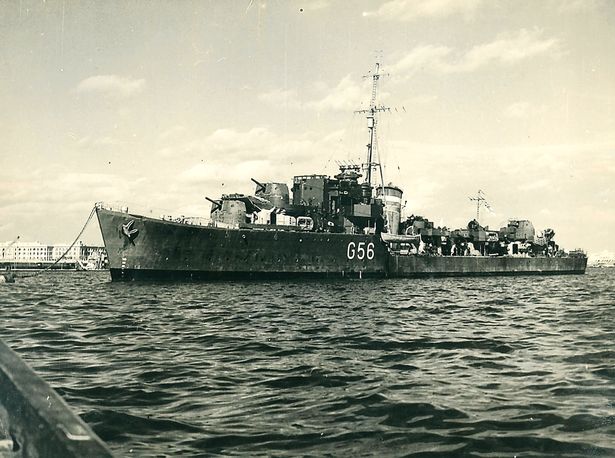
Tommy Brown was fifteen when he lied about his age, enlisting in the NAAFI and assigned as canteen assistant to the “P-class” destroyer, HMS Petard.
HMS Petard
On October 30, 1942, Petard joined three other destroyers and a squadron of Vickers Wellesley light bombers off the coast of Port Said Egypt, in a 16-hour hunt for the German “Unterseeboot”, U–559.
Hours of depth charge attacks were rewarded when the crippled U-559 came to the surface, the 4-inch guns of HMS Petard, permanently ending the career of the German sub.
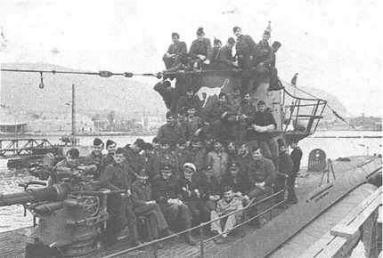
U-559
The crew abandoned ship, but not before opening the boat’s seacocks. Water was pouring into the submarine as Lieutenant Francis Anthony Blair Fasson and Able Seaman Colin Grazier dived into the water and swam to the submarine, with junior canteen assistant Tommy Brown close behind.
With U-559 sinking fast, Fasson and Grazier made their way into the captain’s cabin. Finding a set of keys, Fasson opened a drawer, to discover a number of documents, including two sets of code books.
With one hand on the conning ladder and the other clutching those documents, Brown made three trips up and down through the hatch, to Petard’s whaler.
U-185 sinking, after American depth charging
In the final moments, the ship’s cook called for his shipmates to get out of the boat. Brown himself was dragged under, but managed to kick free and come to the surface. Colin Grazier and Francis Fasson, went down with the German sub.
The episode brought Brown to the attention of the authorities, ending his posting aboard Petard when his true age became known. He was not discharged from the NAAFI, and later returned to sea on board the light cruiser, HMS Belfast.
In 1945, now-Leading Seaman Tommy Brown was home on shore leave, when fire broke out at the family home in South Shields. He died while trying to rescue his 4-year-old sister Maureen, and was buried with full military honors in Tynemouth cemetery.
Fasson and Grazier were awarded the George Cross, the second-highest award in the United Kingdom system of honors. Since he was a civilian due to his NAAFI employment, Brown was awarded the George Medal.
For German U-boat commanders, the period between the fall of France and the American entry into WW2 was known as “Die Glückliche Zeit” – “The Happy Time” – in the North Sea and North Atlantic. From July through October 1940 alone, 282 Allied ships were sunk on the approaches to Ireland, for a combined loss of 1.5 million tons of merchant shipping.
Tommy Brown’s Mediterranean episode took place in 1942, in the midst of the “Second Happy Time”, a period known among German submarine commanders as the “American shooting season”. U-boats inflicted massive damage during this period, sinking 609 ships totaling 3.1 million tons with the loss of thousands of lives, against a cost of only 22 U-boats.
USMM.org reports that the United States Merchant Marine service suffered a higher percentage of fatalities at 3.9%, than any American service branch in WW2.
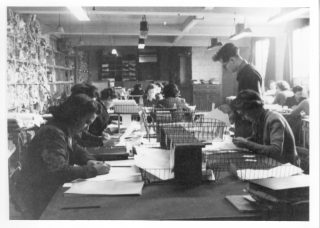
Early versions of the German “Enigma” code were broken as early as 1932, thanks to cryptanalysts of the Polish Cipher Bureau, and French spy Hans Thilo Schmidt. French and British military intelligence were read into Polish decryption techniques in 1939, these methods later improved upon by the British code breakers of Bletchley Park.
Vast numbers of messages were intercepted and decoded from Wehrmacht and Luftwaffe sources through the Allied intelligence project “Ultra”, shortening the war by at least a year, and possibly two.
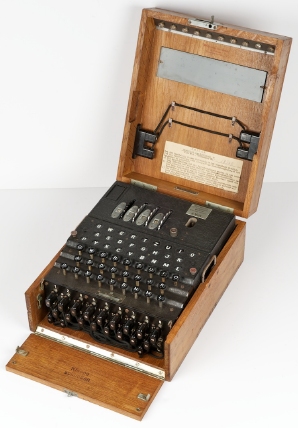
The Kriegsmarine was a different story. Maniacally concerned with security, Admiral Karl Dönitz introduced a third-generation enigma machine (M4) into the submarine service around May 1941, a system so secret that neither Wehrmacht nor Luftwaffe, were aware of its existence.
The system requires identical cipher machines at both ends of the transmission and took a while to put into place, with German subs being spread around the world.
All M4 machines were distributed by early 1942. On February 2, German submarine communications went dark. For code breakers at Bletchley Park, the blackout was sudden and complete. For a period of nine months, Allies had not the slightest idea of what the German submarine service was up to. The result was catastrophic.
U-559 documents were rushed back to England, arriving at Bletchley Park on November 24, allowing cryptanalysts to attack the “Triton” key used within the U-boat service. It would not be long, before the U-boats themselves were under attack.
The M4 code was broken by December 13, when the first of a steady stream of intercepts arrived at the Admiralty Operational Intelligence Office, giving the positions of 12 U-boats.
The UK Guardian newspaper wrote: “The naval historian Ralph Erskine thinks that, without the (M4) breakthrough, the Normandy invasion would have been delayed by at least a year, and that between 500,000 and 750,000 tons of allied shipping were saved in December 1942 and January 1943 alone”.
Tommy Brown never knew what was in those documents. The entire enterprise would remain Top Secret, until decades after he died.
Winston Churchill later wrote, that the actions of the crew of HMS Petard were “crucial to the outcome of the war”.
Untold numbers of lives that could have been lost. But for the actions, of a sixteen-year-old ship’s cook.
If you enjoyed this “Today in History”, please feel free to re-blog, “like” & share on social media, so that others may find and enjoy the same. Please click the “follow” button on the right, to receive email updates on new articles. Thank you for your interest, in the history we all share.
Interestingly, though the Japanese government held considerable animosity for that of the United States, the people of Japan seemed a different story. Ambassador Grew was flooded with expressions of sympathy from Japanese citizens, who apologized for their government and expressed affection for the United States.
USS Panay was a flat bottomed river craft, built in Shanghai as part of the Asiatic fleet and charged with protecting American lives and property on the Yangtze River, near Nanking.
Japanese forces invaded China in the summer of 1937, advancing on Nanking as American citizens evacuated the city. The last of them boarded Panay on December 11: five officers, 54 enlisted men, four US embassy staff, and 10 civilians.
Japanese air forces received word the morning of December 12, 1937, that Chinese forces were being evacuated on several large steamers and a number of junks, about 12 miles north of the city.
Anchored a short way upstream along with several Chinese oil tankers, Panay came under bombing and strafing attack that morning, sinking mid-river with three men killed. 43 sailors and five civilians were wounded. Two newsreel cameramen were on board at the time, and captured part of the attack.
The American ambassador to Japan at the time was Joseph C. Grew, a man who was more than old enough to remember how the sinking of the Maine in Havana Harbor brought the US into war with Spain, in 1898. Grew hoped to avoid a similar outcome following the Panay sinking, though Japanese authorities were less than helpful.
US cryptographers uncovered information shortly after the attack, indicating that aircraft were operating under orders. The Japanese government continued to insist that the attack had been accidental.
The matter was officially settled four months later, with an official apology and an indemnity of $2,214,007.36 paid to the US government.
The “accidental attack” narrative appears to be a safe story which both sides pretended to accept, but it seems a little hard to believe. HMS Ladybird had been fired on that same morning by Japanese shore batteries, and the attack was followed a month later by the “Allison incident”, in which the American consul in Nanking, John M. Allison, was struck in the face by a Japanese soldier.
Added to the fact that American property was being looted by Japanese forces, it seems clear that relations between the two governments at that time, were toxic.
Interestingly, though the Japanese government held considerable animosity for that of the United States, the people of Japan seemed a different story. Ambassador Grew was flooded with expressions of sympathy from Japanese citizens, who apologized for their government and expressed affection for the United States.
Letters came from citizens of all ages and walks of life, from doctors and professors to school children. The wives of high ranking Japanese officials apologized to Grew’s wife without the knowledge of their husbands, while ten Japanese men describing themselves as retired US Navy sailors living in Yokohama, sent a check for $87.19.
A typical letter read: “Dear Friend! This is a short letter, but we want to tell you how sorry we are for the mistake our airplane made. We want you to forgive us I am little and do not understand very well, but I know they did not mean it. I feel so sorry for those who were hurt and killed. I am studying here at St. Margarets school which was built by many American friends. I am studying English. But I am only thirteen and cannot write very well. All my school-mates are sorry like myself and wish you to forgive our country. To-morrow is X-Mas, May it be merry, I hope the time will come when everybody can be friends. I wish you a Happy New Year. Good-bye.”
The two governments never did patch things up. What’s been called the “Rape of Nanking”, began the day after the Panay incident. On December 13, Japanese forces smashed into the city of 600,000, murdering fully half of the inhabitants. Newsreel footage may be found of live prisoners being used for bayonet practice, being mowed down by machine guns, or doused with accelerant and burnt alive.
The US placed an embargo on September 1940, prohibiting exports of steel, scrap iron, and aviation fuel, in retaliation for the Japanese occupation of northern French Indochina: modern day Laos, Cambodia and Vietnam.
Japan occupied southern Indochina by the summer of 1941, as the US, Great Britain, and the Netherlands retaliated by freezing Japanese assets.
Throughout that summer and fall, Japan tried to negotiate a settlement to lift the embargo on terms which allowed them to keep newly captured territory, while at the same time preparing for war.
General Hideki Tojo, future Prime Minister, secretly set November 29 as the last day on which Japan would accept settlement without war.
Air and naval forces of the Imperial Japanese government attacked the US naval anchorage at Pearl Harbor, about a week later.
Roosevelt probably learned that he was riding in Al Capone’s limo after he got in, on the way to Capitol Hill. He didn’t seem to be bothered, the President’s only comment was “I hope Mr. Capone won’t mind.”
On Sunday morning, December 7th, 1941, the armed forces of Imperial Japan attacked the US Navy’s Pacific anchorage at Pearl Harbor.
The President of the United States, Franklin Delano Roosevelt, was notified almost immediately. It had been an act of war, a deliberate attack on one sovereign nation by another. Roosevelt intended to ask Congress for a declaration of war.
Presidential Limo “Sunshine Special”, used in both the FDR and Truman administrations
Work began almost immediately on what we now know as Roosevelt’s “Day of Infamy” speech, to be delivered to a joint session of Congress the following day.
There was no knowing if the attack on Pearl Harbor had been an isolated event, or whether there would be a continuation of such attacks, sabotage on facilities, or even assassination attempts.
The Willamette University football team, in Honolulu at this time to play the “Shrine Bowl”, took up a defensive cordon around the Punahou school.
Roosevelt’s speech was scheduled for noon on the 8th, and the Secret Service knew they had a problem. Roosevelt was fond of his 1939 Lincoln V12 Convertible. Roosevelt called it the “Sunshine Special,” but the car was anything but secure. Armored Presidential cars would not come into regular use for another 20 years, after the assassination of President Kennedy.
Federal regulations of the time restricted the purchase of any vehicle costing $750 or higher, $10,455 in today’s dollars, and that wasn’t going to get them an armored limo. They probably couldn’t have gotten one that quickly anyway, even if there had been no restriction on spending.
In 1928, Al Capone purchased a Cadillac 341A Town Sedan with 3,000 pounds of armor and inch-thick bulletproof windows. It was green and black, matching the Chicago police cars of the era, and equipped with a siren and flashing lights hidden behind the grill.
Advanced syphilis had reduced Al Capone to a neurological wreck by this time. By the time of FDR’s speech, Capone had been released from Alcatraz, and resided in Palm Island, Florida. His limo had been sitting in a Treasury Department parking lot, ever since being seized in his IRS tax evasion suit from years earlier.
Mechanics cleaned and checked Capone’s Caddy well into the night of December 7th, making sure that it would safely get the Commander in Chief the few short blocks to Capitol Hill. It apparently did, because Roosevelt continued to use it until his old car could be fitted with the same features. To this day, Presidential limousines have flashing police lights hidden behind their grilles.
Roosevelt probably learned that he was riding in Al Capone’s limo after he got in, on the way to Capitol Hill. He didn’t seem to be bothered, the President’s only comment was “I hope Mr. Capone won’t mind.”
Afterward
The internet can be a wonderful thing, if you don’t mind taking your water from a fire hose. The reader of history quickly finds that some tales are true as written, some are not, and some stories are so good you want them to be true.
Napoleon once asked, ‘What is history, but a fable agreed upon?” Winston Churchill said “History will be kind to me, for I intend to write it”.
You can find on-line sources if you like, to tell you this story is a myth. Others will tell you it’s perfectly true. CBS News reports: “After the attack on Pearl Harbor, President Roosevelt made use of a heavily armored Cadillac that was originally owned by gangster Al Capone until the Sunshine Special could be modified with armor plating, bulletproof glass, and sub-machine gun storage“.
As a piece of history, you may take this one as you like. I confess, I am one who wants it to be true.
If you enjoyed this “Today in History”, please feel free to re-blog, “like” & share on social media, so that others may find and enjoy the same. Please click the “follow” button on the right, to receive email updates on new articles. Thank you for your interest, in the history we all share.
Commander Joe Taylor found a typewriter and wrote the plan of the day, to which he added this headline, “Big Ben Bombed, Battered, Bruised and Bent But Not Broken”. No ship in history had taken such a beating, and survived.
On December 7, 1941, Imperial Japanese air forces attacked the US Pacific Naval anchorage at Pearl Harbor. The attack killed 2,335 and wounded another 1,178. Four battleships and two other vessels were sunk to the bottom. Thirteen other ships were damaged or destroyed. 188 aircraft were destroyed and another 159 damaged, most while still on the ground. All eight battleships then in harbor were damaged.
USS Oklahoma
Four torpedoes slammed into USS Oklahoma, capsizing the Nevada-class battleship and trapping hundreds within the overturned hull. Frantic around-the-clock rescue efforts delivered 32. Bulkhead markings later revealed that at least some of the sailors aboard the doomed battleship lived another seventeen days. Seventeen days alone in that black, upside down hell, they died waiting for the rescue that came too late. The last mark was drawn by the last survivor on Christmas Eve, 1941.
Harvard-educated Japanese Admiral Isoroku Yamamoto was the unwilling architect of the attack on Pearl Harbor, writing home to a correspondent “I wonder if our politicians [who speak so lightly of a Japanese-American war] have confidence as to the final outcome and are prepared to make the necessary sacrifices”. Yamamoto well understood the consequences of the actions taken by his government, confiding to his diary. “I fear we have awakened a sleeping giant and filled him with a terrible resolve.”
For Imperial Japan, Yamamoto’s worst nightmare would prove correct. In terms of GDP, the Tokyo government had attacked an adversary, nearly six times its own size. The Japanese economy reached its high point in 1942 and declined steadily throughout the war years, while that of the United States exploded at a rate unseen in human history.
1942 started out grimly in the Pacific, with Americans and their Filipino allies besieged in Bataan and Corregidor, and Commonwealth forces hurled from the Malayan peninsula. The Kriegsmarine celebrated the “Second Happy Time”, as German submarine commanders called it the “American shooting season”. Yet, at the home front, 1942 saw massive industrial mobilization.
The backbone of American naval power during this period was the Essex-class aircraft carrier, remaining so until the supercarriers of the 60s and 70s. Twenty-four Essex class carriers were completed during WW2, including USS Franklin, her hull laid down seventy-five years ago, today, one year after the attack on Pearl Harbor. December 7, 1942.
Essex-class carrier, USS Franklin
“Big Ben” was launched ten months later at Newport News Shipbuilding Company in Virginia, and commissioned on January 31, 1944.
For the remainder of 1944, Franklin’s engagements read like a timeline of the war, South of the Japanese home islands. The Bonin archipelago. Mariana Islands. Iwo Jima, Chichi Jima, Haha Jima, Leyte, Guam and the Palau Islands.
By late 1944, a series of defeats had left the Japanese critically short of military aviators, and the experienced aircraft mechanics and groundcrew necessary to keep them aloft.
On October 14, USS Reno was hit by the deliberate crash of a Japanese airplane. The following day, Rear Admiral Masafumi Arima personally lead an attack by 100 Yokosuka D4Y “Judy” dive bombers, against a carrier task force including USS Franklin. Arima was killed and part of a plane hit Franklin.
It’s not clear that this was a suicide attack, but Japanese propagandists were quick to seize on Arima’s example. Official Japanese accounts bear little resemblance to the actual event, but Arima was officially given credit for the first kamikaze attack, of World War II.
By war’s end, this “divine wind” tactic would end the lives of 3,862 kamikaze pilots, and over 7,000 naval personnel.
On October 30, Franklin was attacked by a three-plane squadron of enemy bombers, bent on a suicide mission. One plummeted off her starboard side while a second hit the flight deck, crashing through to the gallery deck, killing 56 and wounding 60. The third discharged it’s bombs nearly missing Franklin, before diving into the flight deck of the nearby Belleau Wood. It was a harbinger of things to come.
Both carriers withdrew to Ulithi Atoll for temporary repairs of battle damage, and Franklin proceeded to the Puget Sound Navy Yard, for more permanent repairs.
Early in the following spring, Franklin rendezvoused with Task Force 58, joining in strikes against the Japanese home islands.
On the morning of March 19, 1945, Franklin turned into the early dawn wind preparing to launch aircraft, while up on the bridge, Commander Stephen Jurika was writing in his log. On the hangar deck, chow lines snaked their way between 12″ wide “Tiny Tim” rockets on ordnance carts, while Messmen plopped the morning’s breakfast onto steel trays.
At 7:05, Commander Jurika heard a message from the carrier Hancock. “Enemy plane closing on you…one coming toward you!” Franklin’s Combat Information Center (CIC) picked up the enemy bomber at a range of twelve miles, but lost it in the clutter of Task Force 58’s morning launch.
At 7:07, Commander Jurika saw the Japanese dive bomber sweep over his head, dropping two 500-pound bombs on Franklin. The first ripped through 3-inch armor to the hangar deck, as the second exploded two decks below. Great sheets of flame enveloped the flight deck, as the 32-ton forward elevator literally rose into the air. 5 bombers, 14 torpedo bombers and 12 fighters were engulfed in the inferno, between them carrying 36,000 gallons of aviation fuel and 30 tons of bombs and rockets.
From the other ships of TF 58, Franklin appeared to be engulfed in flames. With firefighters working fore and aft and Franklin making 24 knots, an aft gas line ruptured, igniting bombs, rockets, and a 40mm ready-service magazine. This second explosion literally lifted Franklin and spun her to starboard, as a 400′ sheet of flame towered over the carrier. Franklin was listing at 13°, with radar and CIC, gone. The flight deck was ruptured in a dozen places. In ready room #51, eleven of twelve aviators of the famed “Black Sheep Squadron”, were dead.
12′ Tiny Tim rockets flew screaming across the decks in every direction, as entire aircraft engines, propellers attached, flew through the air. Each time firefighters dropped to the deck, and then went back at it.
Commander Jurika felt as if the carrier was a rat, being shaken by an angry cat.
The destroyers Miller and Hickox moved within several hundred feet, aiming their hoses at the damaged ship. A Mitsubishi Zero fighter was reported diving on the carrier at 7:41, but determined flak batteries, brought it down.
Six minutes later, the light cruiser Santa Fe moved up, hurling life jackets and floater nets into the water to help swimmers. Task Group 58.2 commander Rear Admiral Ralph Davison departed Franklin for the destroyer Miller, telling Captain Leslie Gehres, “Captain, I think there’s no hope. I think you should consider abandoning ship — those fires seem to be out of control”.
Ensign William Hayler later said “I was not sure whether I was entering Dante’s Inferno or crossing the River Styx”
A mile-high column of thick, greasy smoke rose from the carrier, as signalmen blinkered a message to Santa Fe: “We have lost steering control. Can you send fire hoses? Can you send for sea tugs?” Santa Fe blinkered back, asking if Franklin’s magazines were flooded. “We believe the magazines are flooded, Big Ben replied. “Am not sure”. No one knew at the time, that the water valves were on, but the pipes had split. Hundreds of tons of explosives stored in the aft magazines, were dry.
Lieutenant Commander Joseph O’Callahan, a Jesuit priest from Boston and former Holy Cross track star was a Chaplain aboard the Franklin. O’Callahan was everywhere, hurling bombs overboard and administering last rites, shouting encouragement and fighting fires. Father O’Callahan would be the only Chaplain of WW2, to be awarded the Medal of Honor.
At 10am, Santa Fe signaled the carrier Bunker Hill: “Franklin now dead in water. Fires causing explosions. Have got a few men off. Fires still blazing badly…whether Franklin can be saved or not is still doubtful”. Boards and ladders stretched between the cruiser and the carrier, evacuating the wounded. Gehres ordered 800 off Franklin onto Santa Fe, as thirty sailors hacked at the starboard anchor with files, steel cutters and acetylene torches, dumping the anchor and using the 540′ chain as a towline, to the Baltimore-class heavy cruiser, USS Pittsburgh. Others passed hot shells hand to hand, and dumping them overboard.
Chaplain O’Callahan administers last rites
Another dive bomber attacked at 12:40, dropping its 500-pounder close enough to shake the carrier, while a motley crew of laundrymen and ship’s buglers manning the last operational 40mm AA guns, dropped the “Judy” into the water.
By 15:45, Franklin was under tow at 7 knots. That night she was able to make way under her own power. No lights shone that night, but for the faint red glow of still burning fires. The few Franklin crew remaining would continue to fight off additional dive bombers and put out fires, through the 31st.
832 were dead and another 300 wounded, one-third of the crew. Commander Joe Taylor found a typewriter and wrote the plan of the day, to which he added this headline, “Big Ben Bombed, Battered, Bruised and Bent But Not Broken”. No ship in history had taken such a beating, and survived.
If you enjoyed this “Today in History”, please feel free to re-blog, “like” & share on social media, so that others may find and enjoy the same. Please click the “follow” button on the right, to receive email updates on new articles. Thank you for your interest, in the history we all share.
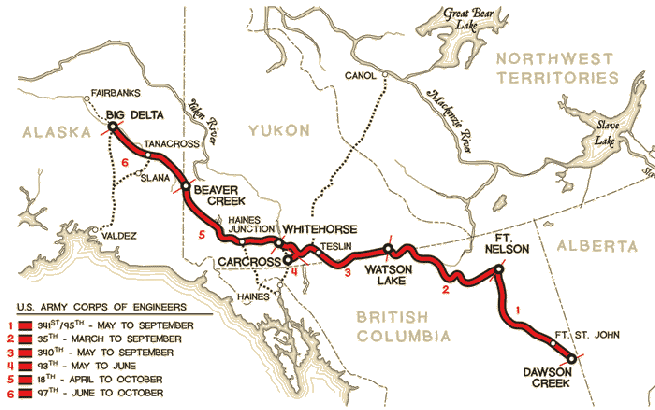
Construction began in March as trains moved hundreds of pieces of construction equipment to Dawson Creek, the last stop on the Northern Alberta Railway. At the other end, 10,670 American troops arrived in Alaska that spring, to begin what their officers called “the biggest and hardest job since the Panama Canal.”
In-between lay over 1,500 miles of unmapped, inhospitable wilderness.
Discussions of a road to Alaska began as early as 1865, when Western Union contemplated plans to install a telegraph wire from the United States to Siberia. The idea picked up steam with the proliferation of automobiles in the 1920s, but it was a hard sell for Canadian authorities. Such a road would necessarily pass through their territory, but the Canadian government felt the project would have little impact, benefiting no more than a few thousand people in the Yukon.
In the days following the attack on Pearl Harbor, Guam and Wake Island fell to Imperial Japanese forces , making it clear that parts of the Pacific coast were vulnerable.
Priorities were changing for both the United States and Canada.
The Alaska Territory was particularly exposed. Situated only 750 miles from the nearest Japanese base, the Aleutian Island chain had only 12 medium bombers, 20 pursuit planes, and fewer than 22,000 troops in the entire territory, an area four times the size of Texas. Colonel Simon Bolivar Buckner Jr., the officer in charge of the Alaska Defense Command, made the point succinctly. “If the Japanese come here, I can’t defend Alaska. I don’t have the resources.”
The US Army approved construction of the Alaska Highway in February, the project receiving the blessing of Congress and President Roosevelt within the week. Canada agreed to allow the project, provided that the US pay the full cost, and the roadway and other facilities be turned over to Canadian authorities at the end of the war.
Construction began in March as trains moved hundreds of pieces of construction equipment to Dawson Creek, the last stop on the Northern Alberta Railway. At the other end, 10,670 American troops arrived in Alaska that spring, to begin what their officers called “the biggest and hardest job since the Panama Canal.”
In-between lay over 1,500 miles of unmapped, inhospitable wilderness.
The project had a new sense of urgency in June, when Japanese forces landed on Kiska and Attu Islands, in the Aleutian chain. Adding to that urgency was that there is no more than an eight month construction window, before the return of the deadly Alaskan winter.
Construction began at both ends and the middle at once, with nothing but the most rudimentary engineering sketches. A route through the Rockies had not even been identified yet.
Radios didn’t work across the Rockies and there was only erratic mail and passenger service on the Yukon Southern airline, a run that locals called the “Yukon Seldom”. It was faster for construction battalions at Dawson Creek, Delta Junction and Whitehorse to talk to each other through military officials in Washington, DC.
Moving men to their assigned locations was one thing, moving 11,000 pieces of construction equipment, to say nothing of the supplies needed by man and machine, was another.
Tent pegs were useless in the permafrost, while the body heat of sleeping soldiers meant they woke up in mud. Partially thawed lakes meant that supply planes could use neither pontoon nor ski, as Black flies swarmed the troops by day, and bears raided camps at night, looking for food.
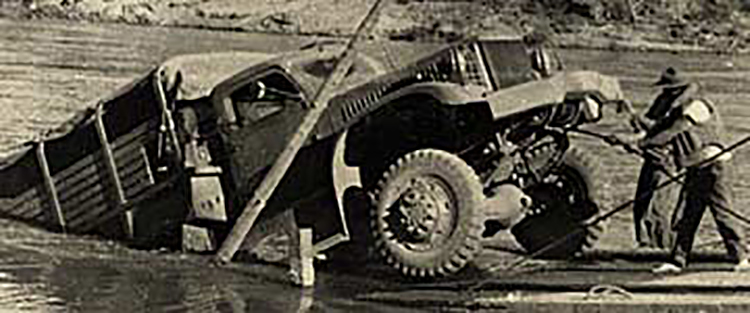
Engines had to run around the clock, as it was impossible to restart them in the cold. Engineers waded up to their chests building pontoons across freezing lakes, battling mosquitoes in the mud and the moss laden arctic bog. Ground that had been frozen for thousands of years was scraped bare and exposed to sunlight, creating a deadly layer of muddy quicksand in which bulldozers sank in what seemed like stable roadbed.
On October 25, Refines Sims Jr. of Philadelphia, with the all-black 97th Engineers was driving a bulldozer 20 miles east of the Alaska-Yukon line, when the trees in front of him toppled to the ground. He slammed his machine into reverse as a second bulldozer came into view, driven by Kennedy, Texas Private Alfred Jalufka. North had met south, and the two men jumped off their machines, grinning. Their triumphant handshake was photographed by a fellow soldier and published in newspapers across the country, becoming an unintended first step toward desegregating the US military.
They celebrated the route’s completion at Soldier’s Summit on November 21, 1942, though the “highway” remained unusable by most vehicles, until 1943.
NPR ran an interview about this story back in the eighties, in which an Inupiaq elder was recounting his memories. He had grown up in a world as it existed for hundreds of years, without so much as an idea of internal combustion. He spoke of the day that he first heard the sound of an engine, and went out to see a giant bulldozer making its way over the permafrost. The bulldozer was being driven by a black operator, probably one of the 97th Engineers Battalion soldiers. I thought the old man’s comment was a classic. “It turned out”, he said, “that the first white person I ever saw, was a black man”.
We rarely hear about the work of the spy or the saboteur in times of war. They are the Heroes who work behind enemy lines, with little to protect them but their own guts and cleverness.
We rarely hear about the work of the spy or the saboteur in times of war. They are the Heroes who work behind enemy lines, with little to protect them but their own guts and cleverness. Their work is performed out of sight, yet there have been times when the lives of millions hung in the balance, and they never even knew it.
One such was Iacob Somme, a Norwegian who was caught, tortured and executed by the Gestapo, for his role in sabotaging the Nazi heavy water plant in Telemark, in 1943. We can only imagine a world in which Nazi Germany was the first to build a nuclear bomb. We might thank this man that that world remains entirely imaginary.
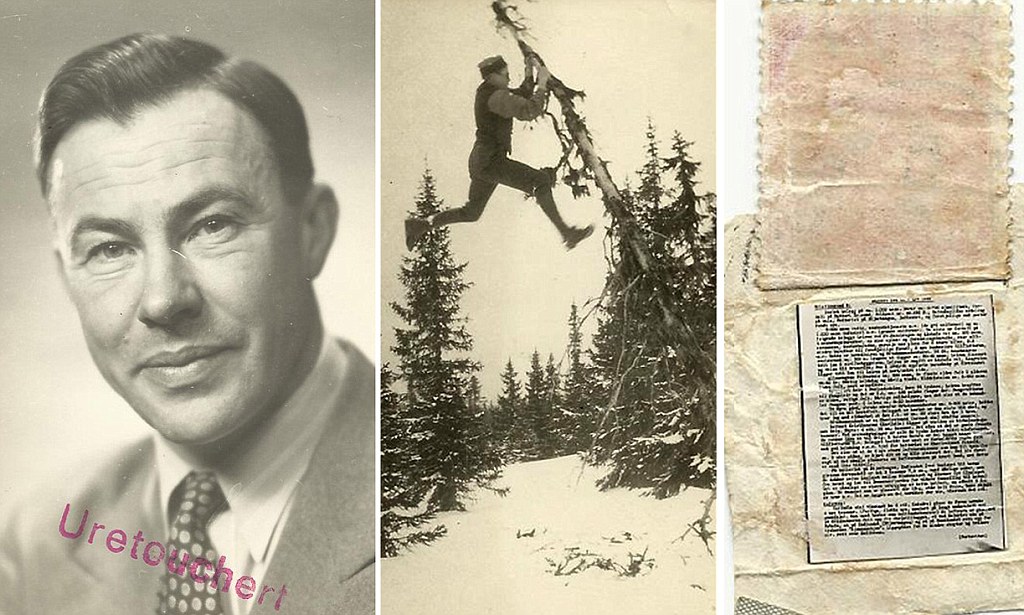
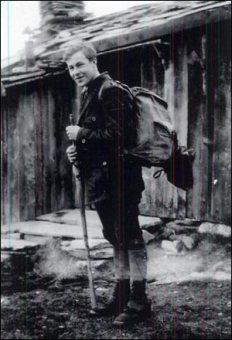
Another such man was his brother Sven, born this day, November 19, 1904.
Like his brother Iacob, Sven Somme joined the Norwegian Resistance to fight the Nazis who had occupied his country since 1940. He photographed strategic German military bases using a covert camera, sending tiny maps, photographs and intelligence reports to the Allies hidden under the stamps on letters.
In 1944, Somme was caught taking pictures of a German U-boat base on the island of Otteroy. Guards saw the sun glint off the camera’s lens, and they came running. Sven tried hiding the tiny camera under a rock, but the Germans quickly found it and he was put in cuffs.
That night, Somme managed to slip his handcuffs and creep past his sleeping guard. What followed was a two months-long race between life and death.
The Norwegian had barely an hour’s head start, and the Nazis couldn’t let this guy get away. He knew too much. Somme was pursued through streams and ravines as he worked his way into the mountains.
He wore a pair of beat up dress shoes and certainly would have succumbed to frostbite in the mountains, had he not been taken in for a time by a friendly family. He couldn’t stay for long, but this family’s 19-year-old son Andre gave him the pair of mountain boots that saved his life.
Somme would wade through icy streams to avoid leaving tracks in the snow, or leap from one tree to another, a technique he had learned as a kid. He trekked 200 miles through the mountains in this manner, dodging bears and wolves, all the while being pursued by 900 German soldiers and a pack of bloodhounds.
Somme finally made it to neutral Sweden, where he was taken to England. There he met the exiled King of Norway, and the woman who would one day become his wife and mother of his three daughters, an English woman named Primrose.
Sven Somme passed away in 1961 after a fight with cancer. Primrose died not long after. It was only in going through her things after she passed, that the three girls discovered their father’s history. The photographs, the letters, even an arrest warrant written out in German and Norwegian.
Somme had written a memoir about his escape, calling it “Another Man’s Shoes”. In 2004, his daughters used the book to retrace their father’s epic flight across the mountains. They even met the family who had sheltered him and, to their amazement, they still had his old shoes. The book is still in print as far as I know. It has a forward by his daughter Ellie, describing their emotional meeting with the family who had sheltered her father.
On April 18, 2015, Richard Cole and David Thatcher fulfilled their original bargain, as the last two surviving members of the Doolittle raid. Staff Sergeant Thatcher passed in June of last year, at the age of 94. As I write this, Lieutenant Colonel Richard Cole age 102, Jimmy Doolittle’s co-pilot, is the only man in the world who has earned the right to open that bottle.
On November 9, 2013, there occurred a gathering of four, a tribute to fallen heroes. These four are themselves heroes, and worthy of tribute. It was to be their last such gathering.
This story begins on April 18, 1942, when a flight of 16 Mitchell B25 medium bombers took off from the deck of the carrier USS Hornet. It was a retaliatory raid on Japan, planned and led by Lieutenant Colonel James “Jimmy” Doolittle of the U.S. Army Air Forces. It was payback for the sneak attack on Pearl Harbor, seven months earlier. A demonstration that the Japanese home islands were not immune from attack.
Launching such large aircraft from the decks of a carrier had never been attempted, and there were no means of bringing them back. This was to be a one-way mission, into enemy occupied territory.
Fearing a breach in operational security, the mission was forced to launch 200 miles before the intended departure spot. The range now made fighter escort impossible, and left the bombers themselves with the slimmest margin of error.
Japanese Premier Hideki Tojo was inspecting military bases at the time of the raid. One B-25 came so close that he could see the pilot, though the American bomber never fired a shot.
After dropping their bombs, all but one aircraft was able to continue west into Japanese occupied China. That one landed in Vladivostok, where the pilot and crew were interned for a year by our Soviet “allies”.
A quarter of a million Chinese were murdered by Japanese soldiers, as they hunted for Doolittle’s raiders. Eight of them were captured, three were executed and one died in captivity, but most of the 80 who began the mission survived the war.
There was little serious damage done to the Japanese home islands, but the raid had a decisive effect. Japan withdrew its powerful aircraft carrier force to protect the home islands. Admiral Isoroku Yamamoto attacked Midway, thinking it to have been the jump-off point for the raid. Described by military historian John Keegan as “the most stunning and decisive blow in the history of naval warfare”, the battle of Midway would be a major strategic defeat for Imperial Japan.
The Doolittle raiders have held a reunion every year, from the late 40’s, until 2013. In 1959, the city of Tucson presented them with 80 silver goblets, each engraved with the name of one of their number. They are on display at the National Museum of the Air Force, in Dayton Ohio.
With those goblets is a fine bottle of vintage Cognac, 1896, the year Jimmy Doolittle was born. There’s been a bargain among the Doolittle raid survivors that, one day, the last two of their number would open that bottle, and toast their comrades.
In 2013 they changed their bargain, just a bit. Jimmy Doolittle himself passed away in 1993. Twenty years later, 76 goblets had been turned over, each signifying a man who had passed on. The last four were Lieutenant Colonel Richard E. Cole, co-pilot of crew No. 1; Lieutenant Colonel Robert L. Hite, co-pilot of crew No. 16; Lieutenant Colonel Edward J. Saylor, engineer-gunner of crew No. 15; and Staff Sergeant David J. Thatcher, engineer-gunner of crew No. 7. These four agreed that they would gather one last time. It would be they who would finally open that bottle.
Robert Hite, 93, was too frail to travel, so his son stood in for him. So it was that a 117 year-old bottle of cognac was cracked open on this date in 2013, and enjoyed in the company of heroes. If there is a more magnificent act of tribute, I cannot at this moment think of what it might be.
On April 18, 2015, Richard Cole and David Thatcher fulfilled their original bargain, as the last two surviving members of the Doolittle raid. Staff Sergeant Thatcher passed in June of last year, at the age of 94. As I write this, Lieutenant Colonel Richard Cole age 102, Jimmy Doolittle’s co-pilot, is the only man in the world who has earned the right to open that bottle.
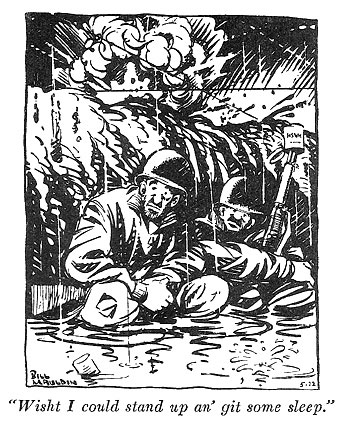
A talented artist, Bill Mauldin’s medium was the cartoon. Through them, he told the story of the common soldier, usually at a rate of six per week.
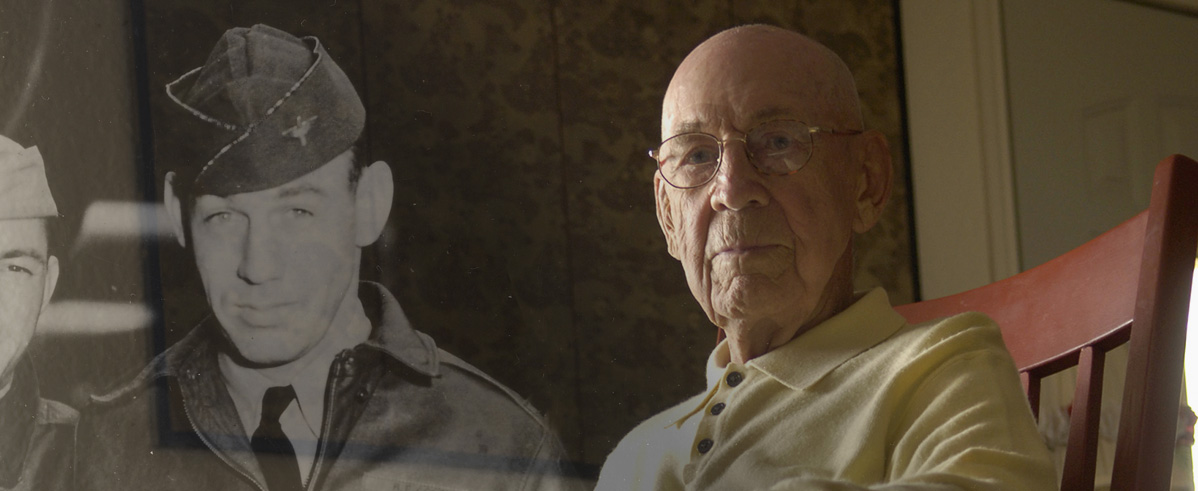
Born on October 29, 1921 in New Mexico and brought up in Arizona, William Henry “Bill” Mauldin was part of what Tom Brokaw called, the “Greatest Generation”.
Mauldin enlisted in the 45th Infantry Division when the United States entered WWII. He was a talented artist, trained at the Chicago Academy of Fine Arts, and volunteered to work for the unit’s newspaper, as a cartoonist.
As a sergeant of the 45th Division’s press corps and later for Stars & Stripes, Mauldin was part of the invasion of Sicily and the later Italian campaign. He was given his own jeep and allowed to go wherever he pleased, which was usually out in front. His medium was the cartoon. He told the story of the common soldier, usually at the rate of six per week.
Mauldin developed two cartoon infantrymen, calling them “Willie and Joe”. He told the story of the war through their eyes. He became extremely popular within the enlisted ranks, while his humor tended to poke fun at the “spit & polish” of the officer corps. He even lampooned General George Patton one time, for insisting that his men to be clean shaven all the time. Even in combat.
Patton summoned the cartoonist to his office, threatening to “throw his ass in jail” for “spreading dissent”, until Dwight Eisenhower told Patton to leave him alone. According to the Supreme Allied Commander, Mauldin’s cartoons gave the soldiers an outlet for their frustrations.
Mauldin later told an interviewer, “I always admired Patton. Oh, sure, the stupid bastard was crazy. He was insane. He thought he was living in the Dark Ages. Soldiers were peasants to him. I didn’t like that attitude, but I certainly respected his theories and the techniques he used to get his men out of their foxholes”.
His was no rear echelon assignment. Mauldin’s fellow soldier-cartoonist, Gregor Duncan, was killed in Anzio in May 1944. Mauldin himself was wounded in a German mortar attack near Monte Cassino. By the end of the war, he had received the Army’s Legion of Merit for his drawings.
Mauldin tried to revive Willy & Joe after the war, but found they didn’t assimilate well into civilian life.
“Peanuts” cartoonist Charles M. Schulz was himself a veteran of World War II. Schulz paid tribute to Rosie the Riveter and Ernie Pyle in his strip, but more than any other, he paid tribute to Willy & Joe. Snoopy visited with Willie & Joe no fewer than 17 times over the years. Always on Veterans Day.
Bill Mauldin passed away on January 22, 2003, from a bathtub scalding exacerbated by complications of Alzheimer’s disease.
Bill Mauldin drew Willie & Joe for last time in 1998, for inclusion in Schulz’ Veteran’s Day Peanuts strip. Schulz had long described Mauldin as his hero. He signed that final strip Schulz, as always, and added “and my Hero“. Bill Mauldin’s signature, appears underneath.



 The battered aircraft was completely alone and struggling to maintain altitude, the American pilot well inside German air space, when he looked to his left and saw his worst nightmare. Three feet from his wing tip was the sleek gray shape of a German fighter, the pilot so close that the two men were looking into one another’s eyes.





 For German U-boat commanders, the period between the fall of France and the American entry into WW2 was known as “Die Glückliche Zeit” – “The Happy Time” – in the North Sea and North Atlantic. From July through October 1940 alone, 282 Allied ships were sunk on the approaches to Ireland, for a combined loss of 1.5 million tons of merchant shipping.
 Early versions of the German “Enigma” code were broken as early as 1932, thanks to cryptanalysts of the Polish Cipher Bureau, and French spy Hans Thilo Schmidt. French and British military intelligence were read into Polish decryption techniques in 1939, these methods later improved upon by the British code breakers of Bletchley Park.
 All M4 machines were distributed by early 1942. On February 2, German submarine communications went dark. For code breakers at Bletchley Park, the blackout was sudden and complete. For a period of nine months, Allies had not the slightest idea of what the German submarine service was up to. The result was catastrophic.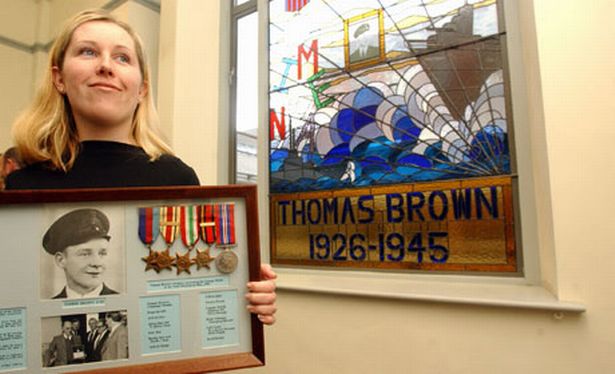


 Japanese forces invaded China in the summer of 1937, advancing on Nanking as American citizens evacuated the city. The last of them boarded Panay on December 11: five officers, 54 enlisted men, four US embassy staff, and 10 civilians.
 The matter was officially settled four months later, with an official apology and an indemnity of $2,214,007.36 paid to the US government.


 In 1928, Al Capone purchased a Cadillac 341A Town Sedan with 3,000 pounds of armor and inch-thick bulletproof windows. It was green and black, matching the Chicago police cars of the era, and equipped with a siren and flashing lights hidden behind the grill.
 The internet can be a wonderful thing, if you don’t mind taking your water from a fire hose. The reader of history quickly finds that some tales are true as written, some are not, and some stories are so good you want them to be true.


 For Imperial Japan, Yamamoto’s worst nightmare would prove correct. In terms of GDP, the Tokyo government had attacked an adversary, nearly six times its own size. The Japanese economy reached its high point in 1942 and declined steadily throughout the war years, while that of the United States exploded at a rate unseen in human history.


 Lieutenant Commander Joseph O’Callahan, a Jesuit priest from Boston and former Holy Cross track star was a Chaplain aboard the Franklin. O’Callahan was everywhere, hurling bombs overboard and administering last rites, shouting encouragement and fighting fires. Father O’Callahan would be the only Chaplain of WW2, to be awarded the Medal of Honor.


 Construction began in March as trains moved hundreds of pieces of construction equipment to Dawson Creek, the last stop on the Northern Alberta Railway. At the other end, 10,670 American troops arrived in Alaska that spring, to begin what their officers called “the biggest and hardest job since the Panama Canal.”
 The project had a new sense of urgency in June, when Japanese forces landed on Kiska and Attu Islands, in the Aleutian chain. Adding to that urgency was that there is no more than an eight month construction window, before the return of the deadly Alaskan winter.
 Engines had to run around the clock, as it was impossible to restart them in the cold. Engineers waded up to their chests building pontoons across freezing lakes, battling mosquitoes in the mud and the moss laden arctic bog. Ground that had been frozen for thousands of years was scraped bare and exposed to sunlight, creating a deadly layer of muddy quicksand in which bulldozers sank in what seemed like stable roadbed.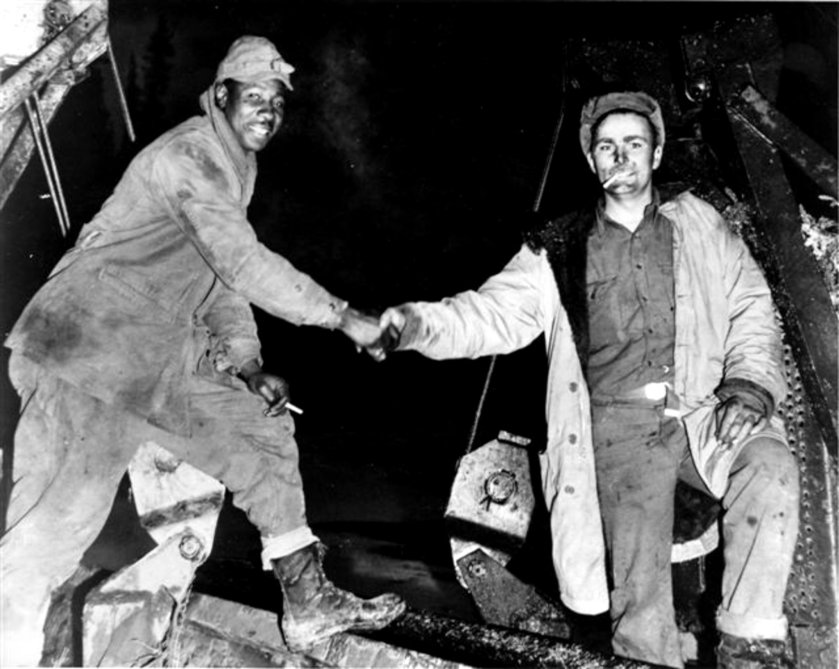

 Another such man was his brother Sven, born this day, November 19, 1904.
 The Norwegian had barely an hour’s head start, and the Nazis couldn’t let this guy get away. He knew too much. Somme was pursued through streams and ravines as he worked his way into the mountains.
 Somme finally made it to neutral Sweden, where he was taken to England. There he met the exiled King of Norway, and the woman who would one day become his wife and mother of his three daughters, an English woman named Primrose.


 Born on October 29, 1921 in New Mexico and brought up in Arizona, William Henry “Bill” Mauldin was part of what Tom Brokaw called, the “Greatest Generation”.
 Mauldin developed two cartoon infantrymen, calling them “Willie and Joe”. He told the story of the war through their eyes. He became extremely popular within the enlisted ranks, while his humor tended to poke fun at the “spit & polish” of the officer corps. He even lampooned General George Patton one time, for insisting that his men to be clean shaven all the time. Even in combat.
 Mauldin later told an interviewer, “I always admired Patton. Oh, sure, the stupid bastard was crazy. He was insane. He thought he was living in the Dark Ages. Soldiers were peasants to him. I didn’t like that attitude, but I certainly respected his theories and the techniques he used to get his men out of their foxholes”.
 Bill Mauldin drew Willie & Joe for last time in 1998, for inclusion in Schulz’ Veteran’s Day Peanuts strip. Schulz had long described Mauldin as his hero. He signed that final strip Schulz, as always, and added “and my Hero“. Bill Mauldin’s signature, appears underneath.


You must be logged in to post a comment.