May 27, 1940 The Miracle of Dunkirk

By day 9 of the evacuation, 338,226 soldiers had been rescued from the beach.  For those, the “Miracle of Dunkirk” ended on June 4.  For approximately 40,000 British and another 40,000 French soldiers left behind in the confusion, a special kind of hell had just begun. 

The Nazi conquest of Europe began with the Sudetenland in 1938, the border districts of Bohemia, Moravia, and German speaking parts of Czechoslovakia. Within two years, every major power on the European mainland was either neutral, or under Nazi occupation.

319154The island nation of Great Britain alone escaped occupation, but British armed forces were shattered and defenseless in the face of the German war machine.

In May 1940, the British Expeditionary Force (BEF) and what remained of French forces occupied a sliver of land along the English Channel. Field Marshall Gerd von Rundstedt called a halt of the German armored advance on May 24.  Reichsmarschall Hermann Göring urged Hitler to stop the ground assault, and let the Luftwaffe finish the destruction of the adversary. On the other side of the channel, Admiralty officials combed every boatyard for miles, for boats to ferry its people off of the beach.

dunkirk1Hitler ordered his Panzer groups to resume the advance on May 26, while a National Day of Prayer was declared at Westminster Abbey. That night Winston Churchill ordered “Operation Dynamo”. One of the most miraculous evacuations in military history had begun from the beaches of Dunkirk.

The battered remnants of the French 1st Army fought a desperate delaying action against the advancing Germans. They were 40,000 men against seven full divisions, 3 of them armored. They held out until May 31 when, having run out of food and ammunition, the last 35,000 finally surrendered. Meanwhile, a hastily assembled fleet of 933 vessels large and small began to withdraw the broken army from the beaches.

The Evacuation of DunkirkLarger ships were boarded from piers, while thousands waded into the surf and waited in shoulder deep water for smaller vessels. They came from everywhere: merchant marine boats, fishing boats, pleasure craft, lifeboats and tugs. The smallest among them was the 14’7″ fishing boat “Tamzine”, now in the Imperial War Museum.

dunkirk2A thousand copies of navigational charts helped organize shipping in and out of Dunkirk, as buoys were laid around Goodwin Sands to prevent strandings. Abandoned vehicles were driven into the water at low tide, weighted down with sand bags and connected by wooden planks, forming makeshift jetties.

dunkirkevacuation7,669 were evacuated on the first full day of the evacuation, May 27, and none too soon.  The following day, members of the SS Totenkopf Division marched 100 captured members of the 2nd Battalion of the Royal Norfolk Regiment off to a pit, and machine gunned the lot of them.  A group of the 2nd Battalion of the Royal Warwickshire Regiment were captured that same day, herded into a barn and murdered with grenades.

428B34BA00000578-0-image-a-52_1500631364614
Troops wait in the rubble of Dunkirk, for rescue

By day 9 of the evacuation, 338,226 soldiers had been rescued from the beach.  For those, the “Miracle of Dunkirk” ended on June 4.  For approximately 40,000 British and another 40,000 French soldiers left behind in the confusion, a special kind of hell had just begun.

dunkirk troops, 1940Most light equipment and virtually all heavy equipment had to be left behind, just to get what remained of the allied armies out alive. But now, with the United States still the better part of a year away from entering the war, the allies had a military fighting force that would live to fight on.

Winston Churchill delivered a speech that night to the House of Commons, calling the events in France “a colossal military disaster”. “[T]he whole root and core and brain of the British Army”, he said, had been stranded at Dunkirk and seemed about to perish or be captured. In his “We shall fight on the beaches” speech of June 4, Churchill hailed the rescue as a “miracle of deliverance”.

On the home front, thousands of volunteers signed up for the “stay behind” mission, expected to follow. With German invasion all but imminent, their mission was to go underground and disrupt and destabilize the invaders, in any way they could. These were to be the British Resistance, a guerrilla force reportedly vetted by a senior Police Chief so secret that, the man was to be garroted in case of invasion, to prevent membership in the units from being revealed.  Many were issued suicide pills in case of capture yet, thanks to these men and women, Great Britain was the only nation of the WW2 era to have a fully operational resistance, BEFORE occupation.

WW2-Aux_Units-1112x634

Participants in these auxiliaries were not allowed to tell their families what they were doing, or where they were.  They generally passed themselves off as Home Guard, a home defense organisation operated by the British Army.  Bob Millard, who passed away in 2014 at the age of 91, said they were given 3 weeks’ rations.  Even Josephine, Millard’s wife of 67 years, didn’t know a thing about the auxiliaries until their reunion, in 1994. “You just didn’t talk about it, really”, he said. “As far as my family were aware I was still in the Home Guard. It was all very hush hush. After the war, it was water under the bridge”.

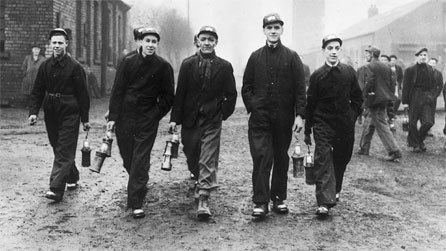
Another under-recognized group from the period are the young men conscripted to serve in the coal mines of the United Kingdom.  One in ten conscripts of the time received not a uniform, but the hard hat and steel-toed boot of the coal miner.  Often maligned as “Conchies” (conscientious objectors) or worse, these were held in service for as long as two years after the war, condemned to live the life of the Troglodyte with no expectation of peacetime jobs being held for them, as for those who served in uniform.
bevin_boys
“Bevin Boys” of WW2

These “Bevin Boys”, so-called after Minister of Labor Ernest Bevin, would wait decades for recognition of their contribution to the war effort, full acceptance coming only as the result of a speech given by Queen Elizabeth II, fifty years after VE Day.

The word “Cenotaph” literally translates as “Empty Tomb”, in Greek. Every year since 1919 and always taking place on the Sunday closest to the 11th day of the 11th month, the Cenotaph at Whitehall is the site of a remembrance service, commemorating British and Commonwealth servicemen and women who died in the conflicts of the 20th century. Since WWII, the march on the Cenotaph includes an ever-decreasing number of Home Guard and the Bevin Boys, without whom the war effort would have ground to a halt.

In 2013, five short years ago, the last surviving auxiliers joined their colleagues, proudly marching past the Cenotaph for the very first time.  Historians from the Coleshill Auxiliary Research Team (CART) had been trying to do this for years.

CART founder Tom Sykes said: “After over 70 years of silence, the veterans of the Auxiliary Units and Special Duties Section, now more than ever, deserve to get the official recognition that has for so long been lacking. ‘They were, in this country’s hour of need, willing to give up everything, families, friends and ultimately their lives in order to give us a fighting chance of surviving“.
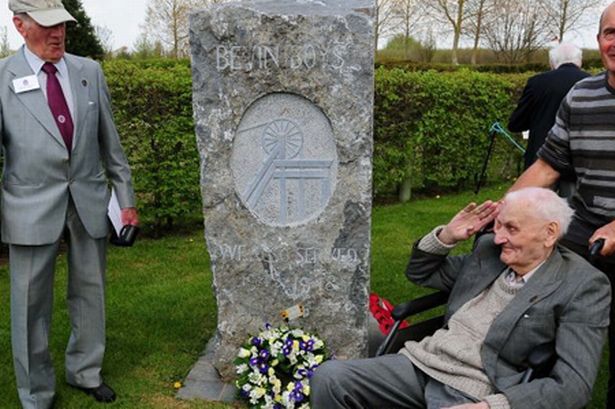
visitors-pay-tribute-at-the-bevin-boys-memorial-in-alrewas-745730884
Memorial to wartime ‘Bevin Boys’ unveiled in Staffordshire

May 21, 1944 That Other Disaster, at Pearl Harbor

Details of the West Loch disaster would remain classified until 1960, explaining why the incident is so little known, today.

Between June and November 1944, forces of the United States Marine Corps and Army conducted Operation Forager with support from the United States Navy, an offensive intended to dislodge Imperial Japanese forces from the Mariana Islands and the island nation of Palau.

Part of the island-hopping strategy employed during the last two years of WW2, Operation Forager followed the Gilbert and Marshall Islands campaign and had as its objective the neutralization of Japanese bases in the central Pacific, support for the Allied drive to retake the Philippines, and to provide bases for strategic bombing raids against the Japanese home islands.

pearlharbor_sm-640x533
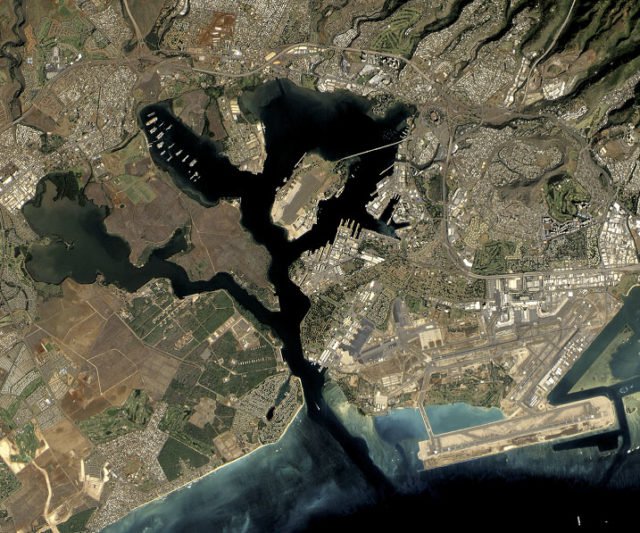
A NASA image of Pearl Harbor. The disaster occurred in West Loch which is to the left side of the photo, where the water is lighter in color.

In May 1944, the Pacific naval anchorage at Pearl Harbor was a rush of activity, building up for the planned invasion.  Seventy-four years ago today, twenty-nine Landing Ships, Tank (LSTs) were tied beam-to-beam on six piers, loading munitions, high octane gasoline and other equipment.

LST_Sicily
LST in Sicily

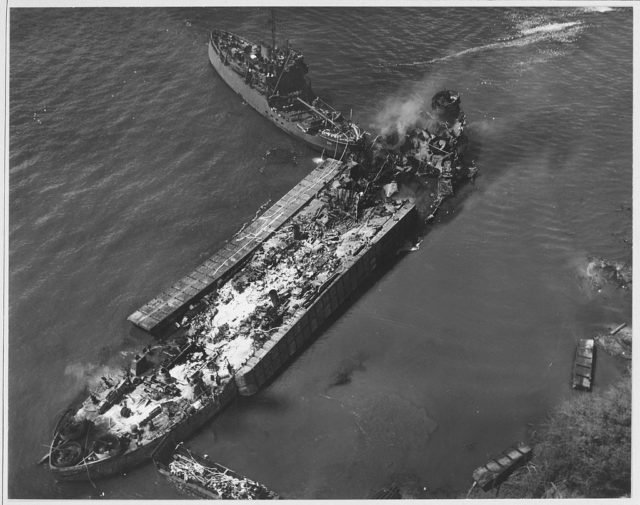
LST-353 exploded shortly after three in the afternoon, causing an incendiary chain reaction down the line of LSTs. 200 men were blown into the water in the first few minutes, in explosions powerful enough to knock vehicles on their sides. Eleven buildings on the shore were destroyed altogether and another nine, damaged.

Firefighting efforts were slow to get underway, due to the heat and the inexperience of many of the crew. Some LSTs began to move away under their own power or with the assistance of tugs, others were abandoned and left adrift and burning, before sinking in the channel.

Burning gasoline spread across the water and ignited other ships, left unharmed by the initial explosions. Fires continued to burn for the next twenty-four hours.

Casualty figures are surprisingly inexact. Most sources report 163 personnel killed in the incident and another 396, wounded. Some sources put the number of dead as high as 392.  Eleven tugboats were damaged while engaged in fire control efforts.  Six LSTs were sunk, two already carrying smaller, fully loaded Landing Craft Tanks (LCT) lashed to their decks.  Several others were heavily damaged and/or run aground.

A press blackout was ordered immediately after the incident, and military personnel were ordered not to talk. A Naval Board of Inquiry was opened the following day. The disaster at West Loch was initially believed to be caused by Japanese submarines, but the idea was dismissed due to the shallow depth of the harbor, and the presence of anti-submarine nets.

lst-480_following_west_loch_disaster-640x505
The wreckage of the LST 480 following the West Loch Disaster.

The precise cause of the accident remained elusive, as everyone near the initial explosion was killed. Army stevedores were unloading mortar ammunition at the time, using an elevator just fifteen feet from 80 drums of fuel. Some believe that a mortar round was accidentally dropped and exploded, others that fuel vapors were ignited by a cigarette or welder’s torch.

Subsequent salvage and removal efforts on the West Loch brought up the remains of a Japanese midget submarine, now believed to be the fifth such sub used in the attack of two years earlier.

Details of the West Loch disaster would remain classified until 1960, explaining why the incident is so little known, today.

1000w_q95

The last fatality from the disaster at West Loch occurred nine months later, during salvage operations for a sunken LST.

330px-Owen_F_P_Hammerberg

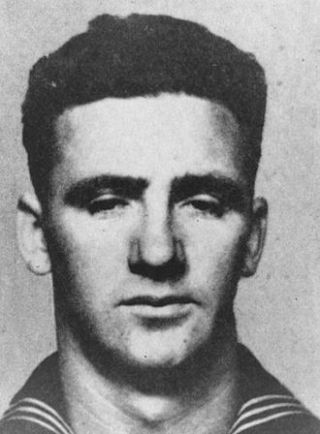
Boatswain’s Mate 2nd Class Owen Francis Patrick Hammerberg

On February 17, 1945, two divers were using jet nozzles to tunnel under a sunken LST, when the steel wreckage above them caved in. Buried alive with lifelines and air hoses hopelessly tangled with jagged pieces of steel, the pair was trapped under 40′ of water and another 20′ of mud.  There seemed no chance of survival, when fellow Navy diver Owen Francis Patrick Hammerberg went into the water.

Working in the swirling mud and pitch blackness beneath the bottom of Pearl Harbor, the diver worked desperately to wash another tunnel under the sunken LST.  Hammerberg reached the first man after hours of exhausting labor, freeing his lines and enabling the man to reach the surface.

Let Owen Hammerberg’s Medal of Honor citation, the one he would not live to read, tell what happened next.

Cmoh_army“…Venturing still farther under the buried hulk, he held tenaciously to his purpose, reaching a place immediately above the other man just as another cave-in occurred and a heavy piece of steel pinned him crosswise over his shipmate in a position which protected the man beneath from further injury while placing the full brunt of terrific pressure on himself. Although he succumbed in agony 18 hours after he had gone to the aid of his fellow divers, Hammerberg, by his cool judgment, unfaltering professional skill and consistent disregard of all personal danger in the face of tremendous odds, had contributed effectively to the saving of his 2 comrades…”.

Navy diver and Boatswain’s Mate 2nd Class Owen Francis Patrick Hammerberg was the only service member in WW2 and the last person ever, to receive the Medal of Honor as the result of heroism performed outside of combat.

If you enjoyed this “Today in History”, please feel free to re-blog, “like” & share on social media, so that others may find and enjoy it as well. Please click the “follow” button on the right, to receive email updates on new articles.  Thank you for your interest, in the history we all share.

May 19, 1944 The Seven Dwarves of Auschwitz

Not even concentration camp guards could resist the irony of seven dwarves. They immediately awakened Dr. Josef Mengele, the “Angel of Death”.

Shimson Eizik Ovitz was a Romanian rabbi, a WWI-era entertainer, and a man afflicted with pseudoachondroplasia. He was a dwarf. Ovitz fathered 10 children by two normal sized wives:  Brana Fruchter and Batia Bertha Husz. Three of those grew to normal height, the other seven were dwarves.

Batia gave the kids a piece of advice that stuck with them, all their lives: “through thick and thin” she said, “never separate. Stick together, guard each other, and live for one another”.

war2_1687882a

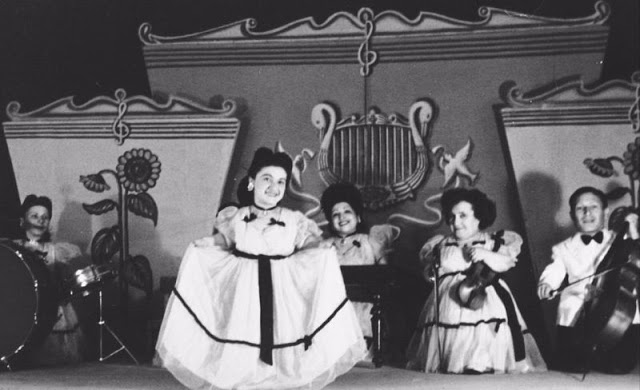
The dwarves were talented musicians, performing a variety show throughout the ’30s and early ’40s as the “Lilliput Troupe”. They toured Romania, Hungary and Czechoslovakia with their normal height siblings serving as road crew, until being swept up by the Nazis and deported to Auschwitz.

The train arrived around midnight on May 19th, 1944 and, accustomed to celebrity, one began to give out autographed cards. The family would soon be disabused of any notions of celebrity.

Not even concentration camp guards could resist the irony of seven dwarves. Dr. Josef Mengele was immediately awakened, knowing of his perverse fascination with the malformed, and what he called “blood” (family) experiments. The “Angel of Death”was delighted, “I now have work for 20 years”.

the-dwarves-of-auschwitz-4

The ten siblings were spared from the gas chamber that night, along with two more family members, a 15-month old boy and a 58-year old woman. Families of their handyman and a neighbor were also spared, insisting that they were close relatives. A total of 22 people.

The family was housed in horrific conditions, yet seven dwarves didn’t come along every day.  They were kept alive for further use and, as bad as it was, the food and clothing was better than that received by most camp inmates. Mengele even allowed them to keep their hair, and arranged special living quarters for them.

The bizarre and hideous “experiments” Mengele performed in the name of “science” were little more than torture rituals.  The three skeletons displayed of their dwarf predecessors, an ever-present reminder of what could be.  Boiling water was poured into their ears followed by freezing.  Eyelashes and teeth were pulled without anesthesia.  Blood was drawn until they would throw up and pass out, only to be revived to have more blood drawn.

the-ovitzs-leaving-the-ca-008

On one occasion, the Angel of Death told the family they were “going to a beautiful place”. Terrified, the siblings were given makeup, and told to dress themselves. Brought to a nearby theater and placed onstage, the family must have thought they’d be asked to perform. Instead, Mengele ordered them to undress, leaving all seven naked before a room full of SS men.  Mengele gave a speech, and then the audience was invited onstage to poke and prod the humiliated family.

One day of fresh horrors ended to reveal the next, and still they lived.  It was unusual for even two or three siblings to survive the Auschwitz death camp.  I don’t believe there was another instance where a family of twelve lived to tell the tale.

Auschwitz was liberated by the Soviet Red Army on January 27, 1945.

Traveling by foot to their Transylvanian home village of Rozavlea, the family found it ruined, though they did find a stash of gold coins where they had left it, buried for safekeeping before the war.

ba132f2b89040eef0fb0b59e29512bafThere was no future for them in this place.  Only 50 of the 650 Jewish inhabitants of the village ever returned. The family emigrated to Israel in May 1949, resuming their musical tour and performing until the group retired in 1955.

Josef Mengele never faced justice. He fled to South America after the war, and suffered a stroke while swimming in 1979.  The cause of death for one of the great monsters of history, was accidental drowning.

The youngest and last of the Ovitz dwarves, Piroska, “Perla” to her friends, passed away two days before the terrorist attack on the World Trade Towers. She spoke for the whole family, I think, when she said “I was saved by the grace of the devil”.

If you enjoyed this “Today in History”, please feel free to re-blog, “like” & share on social media, so that others may find and enjoy it as well. Please click the “follow” button on the right, to receive email updates on new articles.  Thank you for your interest, in the history we all share.

May 10, 1940 Children of the Situation

It is often said that, when governments make war, it’s the everyday John and the Nigel, the Fritz and the Pierre down the street, who must do the fighting, the bleeding and the dying.  It might well be added, that it is left to the mice, to pick up the pieces.

Little is written in times of war, about the Innocents. The proverbial mice trying to go about their business, amidst the combat of elephants. What then is to be made of the innocent who exists, only as the result of that war?

Throughout history and across cultures, having a child by a member of a hostile force is looked upon as a grave betrayal of social values.  Often, such parents (usually women) are shunned by neighbors and even family.  “War children” are ostracized and bullied, or worse.

0816794dc6f218e5e56c1b3a489b439f--rare-photos-old-photosFollowing liberation, French women were beaten and humiliated in the streets, their heads shaved, for being “collaborators” with their German occupiers.

On the Eastern Front of WW2, combat between Nazi Germany and the Soviet Union had long taken on shades of a race war, Slav against Teuton, in a paroxysm of mutual extermination that is horrifying, even by the hellish standards of that war.  Soviet soldiers committed prodigious numbers of rapes on German and Austrian women, and even Soviet women released from work camps.  Historian Geoffrey Roberts writes that 70,000–100,000 such rapes took place in Vienna, alone.

800px-US_Army_Germany_occupation_zones_1945
Post-WW2 Occupation Zones

Propaganda banners and posters appeared all over the Soviet-occupation zone and later East Germany, proclaiming the heroism of those who had smashed the Nazi war machine and paved the way to Soviet-German friendship.  The plight of tens of thousands of the mostly fatherless “Russian children”,  was taboo.

s-l640Sixty-five years later, Jan Gregor of the East German state of Brandenburg, can still remember the day his mother told him that she’d been “made pregnant by force”.  He was five, at the time.
An estimated 100,000 “Amerasian” children were born to Asian mothers and US servicemen during WWII, the Korean War, and war in Vietnam.

37,000 or more children were fathered by American soldiers and German & Austrian women in the 10 years following the German surrender.  Food and sex became principle units of  currency in a growing black market.  Cigarettes were widely referred to as “frau bait.”

Locals disapproved of such relations, not only because Americans had recently been their enemies, but also because such children often became “wards of the state” in local economies severely impoverished by war.

The situation for children fathered by black GIs called Negermischlinge (“Negro half-breeds”) was particularly difficult, in what was then a nearly-racially homogeneous society.  Even in cases where the father wanted to marry the mother of his child, Army policy prohibited interracial marriages, until 1948.  Some were eventually adopted by African-American couples and families in the United States.  The plight of black German-speaking children trying to get by in post-war America, is a tale that is yet to be told.

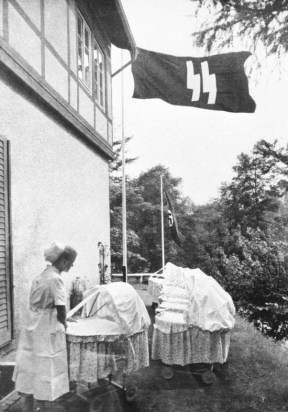
Bundesarchiv_Bild_146-1973-010-11,_Schwester_in_einem_Lebensbornheim
Lebensborn Birth House

Military forces of Nazi Germany invaded the Scandinavian Kingdoms of Denmark and Norway on April 9, 1940.  Denmark fell in a day and Norwegian armed resistance ceased within two months, when civil rule passed to the Reichskommissariat Norwegen (Reich Commissariat of Norway).

The neutral Scandinavian countries remained under Wehrmacht occupation, for the following five years.

Sometimes, relationships formed between German occupying forces and native women.  The racially obsessed Nazi regime was happy to encourage such relations, particularly in Norway, where local women were considered to be of pure, “Aryan” stock.

“Lebensborn”, the SS-initiated, state-supported association whose goal it was to raise the birth rate of the “Master Race” began on December 12, 1935.  The first such Birth House outside of German soil opened in Norway, within a year of the invasion.

Some such relationships were consensual.  Many were anything but.  Some 10,000 to 12,000 children were born of Norwegian women and German fathers, the most famous being Anni-Frid Synni Lyngstad of ABBA, who was forced to flee Norway after the war for fear of reprisals.

For nearly a thousand years, the administration of Iceland was all but indistinguishable from that of Denmark and Norway.  An Act of Union established Iceland as a fully sovereign state in 1918, an independent country in a Personal Union through a common monarch, with the Kingdom of Denmark.

iceland-location-map

Alarmed at the possibility of a German military presence in Iceland, British authorities invited the neutral nation to join the war as “as a belligerent and an ally,” following the collapse of Denmark. The invitation was rejected, and the UK invaded Iceland on May 10, an initial force of 746 British Royal Marines disembarking at the Icelandic capital of Reykjavík.

The British invasion of Iceland never resembled the “shooting war” in Europe.  The government complained that its neutrality had been “flagrantly violated” and demanded compensation, but principle opposition took the form of hordes of civilians, crowding in to see what was going on.  Many locals learned they had been invaded, only on seeing a single British aircraft – at that time the only airplane in Iceland.

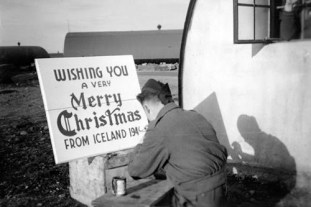
Wife's grandfatherIcelandic public opinion was sharply divided at the invasion and subsequent occupation.  Some described this as the “blessað stríðið”, the “Lovely War”, and celebrated the building of roads, hospitals, harbors, airfields and bridges as a boon to the local economy.  Many resented the occupation, which in some years equaled 50% of the native male population.

Sexual relationships between foreign troops and local women were severely frowned upon, such women often subjected to what might indelicately be described as “slut-shaming”.  In 1941, the Icelandic Minister of the Judiciary investigated “The Situation”.  Upset that foreign troops were “taking away” women from friends and family. Police investigated over 500 women for sexual relations with soldiers.  Most were determined to be consensual.  Two facilities opened to house such women in 1942, but closed within a year.

Two-hundred fifty-five ástandsbörn (“Children of the Situation”) were born of such relationships.  332 Icelandic women married foreign soldiers.

52818947753c5a2c9430272.00130840
WWII landing craft – Mjóifjorður, Iceland

It is often said that, when governments make war, it’s the everyday John and the Nigel, the Fritz and the Pierre down the street, who must do the fighting, the bleeding and the dying.  It might well be added, that it is left to the mice, to pick up the pieces.

If you enjoyed this “Today in History”, please feel free to re-blog, “like” & share on social media, so that others may find and enjoy it as well. Please click the “follow” button on the right, to receive email updates on new articles.  Thank you for your interest, in the history we all share.

May 5, 1945 Church Picnic

284 Japanese balloon bombs are known to have completed the Pacific crossing to the United States, Mexico and Canada. Experts estimate as many as 1,000 may have made it.

Following the eruption of the Krakatoa volcano in 1883, weather watchers described an eastbound, upper atmospheric air current described as the “equatorial smoke stream”.

In the 1920s, Japanese meteorologist Wasaburo Oishi tracked these upper level winds from a site near Mount Fuji, using pilot balloons. Oishi doomed his work to international obscurity when he published his findings in Esperanto. Inside Japan, there were those who took note, filing away this new-found knowledge of what we now call the “Jet Stream”.

In the latter half of WWII, Imperial Japanese military planners conceived the fūsen bakudan or “fire balloon”, a hydrogen filled balloon device designed to ride the jet stream, using sand ballast and a valve system to navigate the weapon system onto the North American continent.

BalloonBomb-1bWith sandbags, explosives, and the device which made the thing work, the total payload was about a thousand pounds on liftoff. The first such device was released on November 3, 1944, beginning the crossing to the west coast of North America. 9,300 such balloons were released with military payloads, between late 1944 and April, 1945.

Such a long-range attack would not be duplicated until the 1982 Falklands War, and was near unimaginable at the time.

JB41In 1945, intercontinental weapons were more in the realm of science fiction. As these devices began to appear, American authorities theorized that they originated with submarine-based beach assaults, German POW camps, and even the internment camps into which the Roosevelt administration herded Japanese Americans.

These “washi” paper balloons flew at high altitude and surprisingly quickly, completing the Pacific crossing in three days. Balloons landed from Alaska to Northern Mexico, and as far east as Detroit. Fighter aircraft shot down fewer than 20.

image011-r

A P-38 Lightning fighter shot one down near Santa Rosa, California, while Yerington, Nevada cowboys cut one up to make hay tarps. Pieces of balloon were found in the streets of Los Angeles. A prospector near Elko Nevada delivered one to local authorities, on the back of a donkey.

Among US units assigned to fight fire balloons was the 555th Parachute Infantry Battalion, which suffered one fatality and 22 injuries fighting fires.

One of the last balloons came down on March 10 near Hanford Washington, shorting out power lines supplying electricity for Manhattan Project nuclear reactor cooling pumps. The war in the Pacific could have ended very differently, had not backup safety devices restored power, almost immediately.

Colonel Sigmund Poole, head of the U.S. Geological Survey military geology unit, asked, “Where’d the damned sand come from?” Microscopic analysis of sand ballast identified diatoms and other microscopic sea life. This and the mineral content of the sand itself proved to be definitive. This stuff could only have come from the home islands of Japan, more specifically, one or two beaches on the island of Honshu.

world-war-ii-balloonAmerican authorities were alarmed. Anti-personnel and incendiary bombs were relatively low grade threats. Not so the biological weapons Japanese military authorities were known to be developing at the infamous Unit 731, in northern China.

284 of these weapons are known to have completed the Pacific crossing to the United States, Mexico and Canada. Experts estimate as many as 1,000 may have made it.

Balloon Bomb Route

Sightings were reported in seventeen US states. Pilots were ordered to shoot them down on sight, but many devices escaped detection, altogether.

In an effort to deny valuable intelligence to their Japanese adversary, US military and government authorities did everything they could to keep these “Fire Bombs” out of the media. Even though such secrecy put Americans at risk.

Japanese Authorities reported that the bombs were hitting key targets, thousands were dead or injured, and American morale was low.

Terrorballoons3
Archie & Elsie mitchell

On the morning of May 5, 1945, Pastor Archie Mitchell and his wife Elsie took their Sunday school class of five on a picnic to a forest area near Bly, Oregon. Elsie and the kids came upon a large balloon with a strange looking device attached to it, as Pastor Mitchell parked the car. There was no way they could have known, what they had found was a Japanese weapon of war. The device exploded, killing all six, instantly.

Several such devices exploded, igniting wildfires in the forests of California, Oregon and Washington, but the site near Bly is the only one known to have resulted in American casualties.

6149872687_10db3f9597_b
Shrapnel Tree – Mitchell Monument, Bly, Oregon

Today there is a small picnic area located in the Fremont-Winema National Forest, in Lake County, Oregon. It’s maintained by the US Forest Service, memorialized as the Mitchell Recreation Area and listed on the National Register of Historic Places. A small stone marker points the way to a shrapnel scarred tree.

Mitchell_Monument;_August_12,_2013

A second memorial bears these words, cast in bronze: The “only place on the American continent where death resulted from enemy action during World War II”. There are six names above those words, those of five children and their teacher, who was pregnant at the time. Elsie Mitchell, age 26. Edward Engen, age 13. Jay Gifford, age 13. Joan Patzke, age 13. Dick Patzke, age 14. Sherman Shoemaker, age 11.


If you enjoyed this “Today in History”, please feel free to re-blog, “like” & share on social media, so that others may find and enjoy it as well. Please click the “follow” button on the right, to receive email updates on new articles.  Thank you for your interest, in the history we all share.

April 30, 1943 Operation Mincemeat

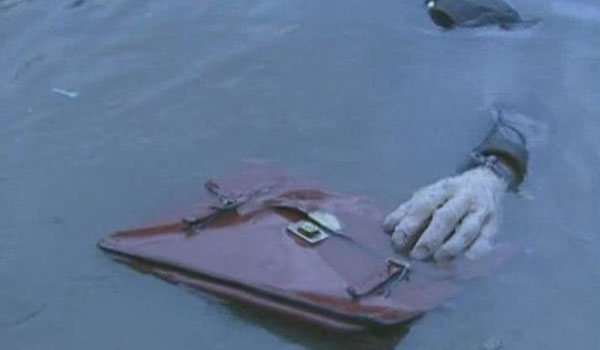
On April 30, 1943, Lieutenant Norman Jewell, commanding the submarine HMS Seraph (P219), read the 39th Psalm over the man who never was.  With briefcase containing “secret” documents padlocked to his wrist, the homeless man who in death would help defeat Nazi Germany, was gently pushed into the Atlantic, off the Spanish coast.

The idea was a head fake.  Disinformation intended to make the Nazi government believe that their adversaries intended to invade Sardinia and Greece in 1943, rather than the real targets of North Africa and Sicily.  British Military Intelligence called it “Operation Mincemeat”.

The London coroner obtained the body of 34-year-old Glyndwr Michael, on condition that his real identity never be revealed. The Welshman had died of rat poison, though it’s uncertain whether the death was accidental or suicide. This particular poison came in paste form, and was spread on bread crusts to attract rats.  The homeless man may have died, merely because he was hungry.

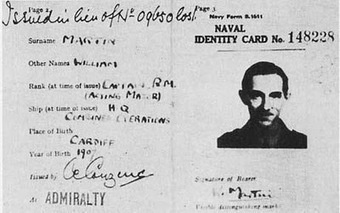
Naval identity cardBe that as it may, this cause of death is difficult to detect,  The condition of the corpse was close to that of someone who had died at sea, of hypothermia and drowning. The dead man’s parents were both deceased, there were no known relatives and the man died friendless. So it was that Glyndwr Michael became the “Man who Never Was”.
The next step was to create a “past” for the dead man. Michael became “(Acting) Major William “Bill” Martin, Royal Marines”, born 1907, in Cardiff, Wales, assigned to Headquarters, Combined Operations. As a Royal Marine, “Martin” could wear battle dress rather than a naval uniform. This was important, because Naval uniforms at the time were tailor-made by Gieves & Hawkes of Saville Row. Authorities could hardly ask Gieves’ tailors to measure a corpse, without raising eyebrows.

The rank of acting major made the fictional William Martin senior enough to be entrusted with sensitive documents, but not so prominent that anyone would expect to know him. The name “Martin” was chosen because there were several Martins of about that rank, already serving in the Royal Marines.

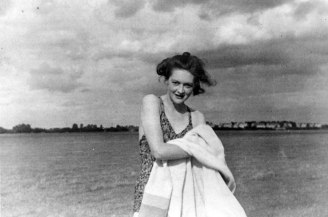
PamA “fiancée” was furnished for Major Martin, in the form of  MI5 clerk “Pam”. “Major Martin” carried her snapshot, along with two love letters, and a jeweler’s bill for a diamond engagement ring.
In keeping with his rank, Martin was given some good quality underwear, to increase his authenticity. Extremely difficult to obtain due to rationing, the underwear was purloined from the Master of the New College Oxford, who’d been run over and killed by a truck.

Made to look like the victim of a plane crash, the plan was to drop the body at sea, at a place where the tide would bring it ashore and into German Hands.

On April 30, 1943, Lieutenant Norman Jewell, commanding the submarine HMS Seraph (P219), read the 39th Psalm over the man who never was.  With briefcase containing “secret” documents padlocked to his wrist, the homeless man who in death would help defeat Nazi Germany, was gently pushed into the Atlantic, off the Spanish coast.

HMS Seraph

The hoax worked out, nicely. A Spanish fisherman recovered the body and a Nazi agent intercepted the papers, as intended. Mussolini insisted correctly that the allied attack would come through Sicily, but Hitler wasn’t buying it. He had swallowed the Mincemeat scam whole, insisting that the Sicilian attack was nothing but a diversion from the real objective.

Manwhoneverwas

When the Allies invaded Sicily on the 9th of July, the Germans were so convinced it was a feint that forces were kept out of action for a full two full weeks. After that, it was far too late to effect the outcome.

The non-existent Major William Martin was buried with full military honors in the Huelva cemetery of Nuestra Señora. The headstone reads:
“William Martin, born 29 March 1907, died 24 April 1943, beloved son of John Glyndwyr Martin and the late Antonia Martin of Cardiff, Wales, Dulce et Decorum est pro Patria Mori, R.I.P.”  “It is sweet and fitting to die for one’s country.”

In 1998, the British Government revealed Martin’s true identity, and “Glyndwr Michael; Served as Major William Martin, RM”, was added to the gravestone.

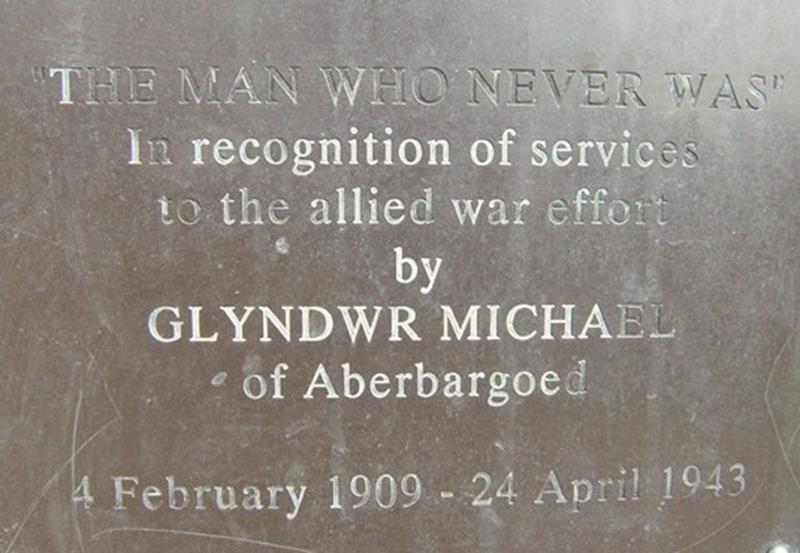
There is a war memorial in the small South Wales town of Aberbargoed, in memory of Glyndwr Michael. A plaque is inscribed with the Welsh phrase “Y Dyn Na Fu Erioed”. It means “The Man Who Never Was”.

Man who Never Was

April 9, 1940 “Evacuation Day”

Norway was out of the war, but not necessarily out of the fight.   A Nazi officer passed an old woman on the street, who complained at his rudeness and knocked his hat off, with her cane. The officer apologized and scurried off.  The gray-haired old matron snickered, to herself:  “Well, we’ll each have to fight this war as best we can.  That’s the fourth hat I’ve knocked into the mud this morning.”

The Encyclopedia Britannica describes Croton oil as a “poisonous viscous liquid obtained from the seeds of a small Asiatic tree…”  Highly toxic and a violent irritant, the substance was once used as a drastic purgative and counter-irritant in human and veterinary medicine, but is now considered too dangerous for medicinal use. Applied externally, Croton oil is capable of peeling your skin off.  Taken internally, the stuff may be regarded as the atomic bomb, of laxatives.

The Nazi conquest of Europe began with the annexation of the Sudetenland in 1938, the border districts of Bohemia, Moravia, and German speaking parts of Czechoslovakia. Within two years, every major power on the European mainland was either neutral, or subject to Nazi occupation.  France fell to the Nazi war machine in six weeks, in 1940.  The armed forces of the island nation of Great Britain were left shattered and defenseless, stranded on the beaches of Dunkirk.

On the Scandinavian Peninsula, longstanding policies of disarmament in the wake of WW1, left the Nordic states of Denmark and Norway severely under-strength, able to offer little resistance to the Nazi invaders.

On this day in 1940, German warships entered Norwegian harbors from Narvik to Oslo, as German troops occupied Copenhagen and other Danish cities.  King Christian X of Denmark surrendered almost immediately.  To the northwest, Norwegian commanders loyal to former foreign minister Vidkun Quisling ordered coastal defenders to stand down, permitting the German landing to take place, unopposed.  Norwegian forces refused surrender demands from the German Minister in Oslo, but the outcome was never in doubt.

Nazi Germany responded with an airborne invasion by parachute.  Within weeks, Adolf Hitler could add a second and third scalp to his belt, following the invasion of Poland, six months earlier.  The Kingdoms of Denmark and Norway, were out of the war.

Norway was out of the war, but not necessarily out of the fight.   A Nazi officer passed an old woman on the street, who complained at his rudeness and knocked his hat off, with her cane. The officer apologized and scurried off.  The gray-haired old matron snickered, to herself:  “Well, we’ll each have to fight this war as best we can.  That’s the fourth hat I’ve knocked into the mud this morning.

A Norwegian Resistance was quick to form, as patriotic locals united against the Nazi occupier and the collaborationist policies of the Quisling government.

The Norwegian secret army, known as Milorg and led by General Otto Ruge, was at first loath to engage in outright sabotage, for fear of German reprisals against innocent civilians.  Later in the war, Milorg commandos attacked the heavy water factory at Rjukan and sank a ferry carrying 1,300 lbs of heavy water, inflicting severe damage to the Nazi nuclear research program.

Sven Somme, tree
Norwegian Resistance member Sven Somme demonstrates one of the techniques by which he evaded capture in the mountains.

In the beginning, Resistance activities centered more around covert sabotage and the gathering of intelligence.  One of the great but still-unknown dramas of WW2 unfolded across the snow covered mountains of the Scandinavian peninsula, as the civilian-turned-spy Sven Somme fled 200 miles on foot to neutral Sweden, pursued by 900 Wehrmacht soldiers and a pack of bloodhounds.

Operations of all kinds were undertaken, to stymie the Nazi war effort. Some actions seem like frat-boy pranks, such as coating condoms destined for German units, with itching powder.  Hundreds of Wehrmacht soldiers (and presumably Norwegian women) showed up at Trondheim hospitals, believing they had contracted God-knows-what kind of plague.

Other operations demonstrate a kind of evil genius.  This is where Croton oil comes in.

download (61)
“Croton oil (Crotonis oleum) is an oil prepared from the seeds of Croton tiglium, a tree belonging to the order Euphorbiales and family Euphorbiaceae, and native or cultivated in India and the Malay Archipelago. Small doses taken internally cause diarrhea. Externally, the oil can cause irritation and swelling. Croton oil is used in some chemical peels, due to its caustic exfoliating effects it has on the skin”. H/T, Wikipedia

Norwegian resistance fighters, as dedicated as they were, still had to feed themselves and their families.  Many of these guys were subsistence fishermen, and that meant sardines.  For centuries, the small fish had been a staple food item across the Norwegian countryside.  It was a near-catastrophic blow to civilian and Resistance fighters alike, when the Quisling government requisitioned the entire sardine crop.

The Battle of the Atlantic was in full-swing by this time, as wolf packs of German submarines roamed the north Atlantic, preying on Allied shipping.  Thousands of tons of sardines would be sent to the French port of Saint-Nazaire, to feed U-Boat crews on their long voyages at sea.

U-864
German Type X Submarine, U-864

Norwegian vengeance began with a request to the Special Operations Executive (SOE) in Great Britain, for the largest shipment of Croton oil, possible.  The “atomic laxative” was smuggled into canneries across Norway, and used to replace vegetable oil in sardine tins.  The plan worked nicely and no one suspected a thing, the pungent taste of the fish covering the strange flavor of Croton oil.

From midget submarines such as the Biber, Hai, Molch, and Seehund models to the behemoth 1,800-ton “Type X“, the Kriegsmarine employed no fewer than fifteen distinct submarine types in WW2, including the workhorse “Type VII”, of which some 700 saw service in the German war effort.  In the North Atlantic, the battle raged on with torpedo and depth charge.  Under the surface, there unfolded a different story.

Except for the participants in this tale, no one knows what it looks like, when ten thousand submariners simultaneously lose control of their bowels. It could not have been a pretty sight.

Feature image, top of page:  “Anti-Nazi graffiti on the streets of Oslo, reading “Live” above the monogram for the Norwegian king, who had fled when the Germans invaded in 1940”. (Photo: Bettmann/Getty Images)


If you enjoyed this “Today in History”, please feel free to re-blog, “like” & share on social media, so that others may find and enjoy it as well. Please click the “follow” button on the right, to receive email updates on new articles.  Thank you for your interest, in the history we all share.

April 3, 1946 Death March

Mario “Motts” Tonelli hoped to fulfill his one years’ commitment and return to the Cardinals for the ’42 season, but it wasn’t meant to be. The radio crackled to life at 2:30am local time on December 7. “Air raid on Pearl Harbor. This is no drill!”

The game was November 27, 1937.  Late in the 4th quarter, Notre Dame was tied 6-6 with Southern California. The “Fighting Irish” needed a miracle. Notre Dame fullback #58 Mario Tonelli took the hand-off deep in Notre Dame territory and ran the ball 70 yards back before being tackled. Seconds later, the 5’11”, 195lb Tonelli, scored the game winning touchdown.

In some ways, Mario Tonelli himself was the miracle. At the age of 6, “Motts” Tonelli had been burned over 80% of his body, when a trash compactor toppled over on him. Mario’s immigrant father Celi, a laborer from a northern Italian marble quarry, refused to believe the doctor who said his son would never walk again. Fixing four wheels to a door, the elder Tonelli taught his first American-born son to move about with his arms. By 1935, Mario Tonelli was a football, basketball and track star at Chicago’s DePaul Academy.

TonelliAfter a year coaching at Providence College in 1939 and a year playing professional football for the Chicago Cardinals in 1940, Tonelli joined the Army in early 1941, assigned to the 200th Coast Artillery Regiment in Manila.

Tonelli hoped to fulfill his one years’ commitment and return to the Cardinals for the ’42 season, but it wasn’t meant to be. The radio crackled to life at 2:30am local time on December 7. “Air raid on Pearl Harbor. This is no drill!”

Bataan1Military forces of Imperial Japan appeared unstoppable in the early months of WWII, attacking first Thailand, then the British possessions of Malaya, Singapore, and Hong Kong, as well as US military bases in Hawaii, Wake Island, Guam and the Philippines.

The United States was grotesquely unprepared to fight a World War in 1942, and dedicated itself to beating Adolf Hitler first. General Douglas MacArthur abandoned the “Alamo of the Pacific” on March 11 saying “I shall return”, leaving 90,000 American and Filipino troops without food, supplies or support with which to fight off the Japanese offensive.

bataanOn April 9, 75,000 surrendered the Bataan peninsula, beginning a 65 mile, five-day slog into captivity through the heat of the Philippine jungle. Japanese guards were sadistic. They would beat the marchers and bayonet those too weak to walk. Japanese tanks  swerved out of their way to run over anyone who had fallen and was too slow in getting up. Some were burned alive. Already crippled from tropical disease and starving from the long siege of Luzon, thousands perished in what came to be known as the Bataan Death March.

Exhausted, sunburned and aching with thirst, Tonelli still refused when a Japanese soldier demanded his Notre Dame class ring. As the guard reached for his sword, a nearby prisoner shouted “Give it to him. It’s not worth dying for”.

Mario Tonelli RingMinutes later, a Japanese officer appeared, speaking perfect English. “Did one of my men take something from you?” “Yes”, Tonelli replied. “My school ring”. “Here,” said the officer, pressing the ring into his hand. “Hide it somewhere. You may not get it back next time”. Tonelli was speechless. “I was educated in America”, the officer said. “At the University of Southern California. I know a little about the famous Notre Dame football team. In fact, I watched you beat USC in 1937. I know how much this ring means to you, so I wanted to get it back to you”.

Nearly 700 Americans and over 10,000 Filipinos died on the Bataan death march. For the survivors, the ordeal was only the beginning. For 2½ years, Tonelli suffered starvation, disease and endless beatings in the squalid prison camps known as O’Donnell, Cabanatuan, and Davao. Tonelli kept his ring throughout, buried in a soap dish. He’d take it out from time to time to remind himself:  life used to be better than this. It gave him something to hope for.

tonelli2The hellish 60-day journey aboard the filthy, cramped merchant vessel began in late 1944, destined for slave labor camps in mainland Japan. Tonelli was barely 100 pounds on arrival, his body ravaged by malaria and intestinal parasites. He was barely half the man who once played fullback at Notre Dame Stadium, Soldier Field and Comiskey Park.

Arriving at Nagoya #7 prison camp, Tonelli was handed a piece of paper. Scribbled on it was a 58. He was prisoner number 58, the same number he once wore on his football Jersey. “From that point on,” he said, “I knew I was going to make it”.

An American military tribunal conducted after the war held Lieutenant General Homma Masaharu, commander of the Japanese invasion forces in the Philippines, guilty of war crimes. He was executed by firing squad on April 3, 1946.

Mario Tonelli always hoped to meet the officer who’d returned his ring, but it wasn’t meant to be. He probably didn’t survive the war. Tonelli still had that ring when he passed away, in 2003.

Last year, nearly 10,000 gathered in New Mexico, to commemorate the 75th anniversary of the Bataan death march. 7,200 retired and active duty military personnel and civilians gathered to run the 26.2 “Death March” through the hilly desert terrain of the White Sands Missile Range, a race described by DoD.mil as “one of the toughest marathon-length events in the U.S.”

handshakes-467x350
Bataan Death March survivor retired U.S. Air Force Chief Master Sgt. Harold Bergbower, 97, shakes hands with 2018 Bataan Memorial Death March participants at the race’s finish line. DoD photo by Army Staff Sgt. Bruce Petitt

Ed Broadnax of El Paso, Texas, ran the course in full uniform, boots and 45-pound backpack. “As a veteran who served 26 years in the US Army and deployed three times to combat and experienced the horrors of war, I feel pain for the men and women who suffered intensely under the deadly Japanese Imperial Forces, as they were marched through the Philippine jungle. This is what drives me to run in their honor.”

Hundreds of others walked a 14.2 mile course, including Bataan Death March survivor Ben Skardon, who turned 100 last July.  Mr. Skardon walked 8½.  “The word hero doesn’t apply to me, at all”, Skardon said.  “As I said in my talk, ‘no greater love hath any man, than to lay down his life for his friends’.  That’s in the bible”.

Seven survivors of the Death March of 1942, turned out for the March 31, 2017 event.   The 2018 edition held on March 25, had one fewer.

If you enjoyed this “Today in History”, please feel free to re-blog, “like” & share on social media, so that others may find and enjoy it as well. Please click the “follow” button on the right, to receive email updates on new articles.  Thank you for your interest, in the history we all share.

March 31, 2016 A Talent for Music

The 1104th worked to find and defuse explosives, though on several occasions, the unit had to drop its tools and fight as Infantry.

James and Kate Kaminski’s little bundle of joy came into the world on June 26th 1926, in Brooklyn.

The Kaminskis named this, their fourth son, Melvin James. The elder James died of tuberculosis at 34, when the boy was only two. A small Jewish kid growing up in a tough Brooklyn neighborhood, Kaminsky learned the value of being able to crack a joke. “Growing up in Williamsburg”, he said, “I learned to clothe it in comedy to spare myself problems—like a punch in the face”.

download (41)The boy had a talent for music. He was taught by another kid from Williamsburg, named Buddy Rich.  By 14 he was good enough to be playing drums for money.

Melvin attended a year at Brooklyn College before being drafted into the Army, in WWII. After attending Army Specialized Training at VMI, Corporal Kaminsky joined the 1104th Combat Engineers Battalion of the 78th Infantry Division, in the European theater.  There, he served through the end of the war.

He and his unit worked to find and defuse explosives, though on several occasions, the 1104th had to drop its tools and fight as Infantry.

download (40)At one point, Kaminsky’s unit gathered along a River. The Americans were so close they could hear German soldiers singing a beer hall song, from the other side. Kaminsky grabbed a bullhorn and serenaded the Germans back, crooning out an old tune that Al Jolson used to perform, in black face:  “Toot Toot Tootsie, Goodbye”.  After he was done, polite applause could be heard, drifting across the river.  I can’t imagine many Allied soldiers ever tried singing to their Nazi adversaries, during World War II.  The ones who actually pulled it off, must number precisely, one.

Kaminski went into show business after the war, playing drums and piano in the Borscht Belt resorts and nightclubs of the Catskills. It was around this time that he took his professional name, adopting his mother’s maiden name of Brookman and calling himself “Mel Brooks”.

images (45)Brooks started doing stand-up, when the regular comedian at one of the clubs was too sick to perform. By ’49 he was “Tummler”, the master entertainer at Grossinger’s, one of the most famous resorts in the Borscht Belt.

Soon he was making $50 a week writing for his buddy Sid Caesar and his NBC program “The Admiral Broadway Review”.

In 1968, Mel Brooks wrote and produced the satirical comedy film “The Producers”, about a theatrical producer and an accountant who set out to fleece their investors. The scheme was to create a play so awful that it was sure to flop on Broadway, then to abscond to Brazil with investors’ money.  The problems started, when the show turned out to be a hit. The fictional play is a musical, called “Springtime for Hitler”.  Even before the time when taking offense became an industry, I don’t know many guys beside Mel Brooks who could have gotten away with that one.

There isn’t one of us who doesn’t know his work. Three of his movies made the American Film Institute’s top 100 list of comedy films.  From the 2,000 year old man with “over forty-two thousand children, and not one comes to visit me” to Blazing Saddles’ “Candygram for Mongo” (“Mongo likes candy”).

download (46)

“As long as the world is turning and spinning”, Brooks says, “we’re gonna be dizzy and we’re gonna make mistakes”.

images (42)

Brooks has risen to the top of his chosen profession, winning the coveted “EGOT”, an acronym for the entertainment industry’s four major awards, the Emmy, Grammy, Oscar and Tony. Only eleven others have ever risen to this level: Richard Rodgers, Helen Hayes, Rita Moreno, John Gielgud, Audrey Hepburn, Marvin Hamlisch, Jonathan Tunick, Mike Nichols, Whoopi Goldberg, Scott Rudin, and Robert Lopez.  As of this date, Brooks only needs another Oscar to be the first “Double EGOT”, in history.

Two years ago, March 31, 2016, the Averhill Park K-12 School District in upstate New York kicked off a three-day production of “Young Frankenstein”.  Let me know if you can think of another 90-year-old guy, who remains that current.  I can’t think of one.

“Well, just being stupid and politically incorrect doesn’t work. You can be politically incorrect if you’re smart”.

melbrooks1-2x

If you enjoyed this “Today in History”, please feel free to re-blog, “like” & share on social media, so that others may find and enjoy it as well. Please click the “follow” button on the right, to receive email updates on new articles.  Thank you for your interest, in the history we all share.

March 4, 1942 Pearl Harbor, Version 2.0

If successful, this would be an endurance mission, one of the longest bombing raids ever attempted, and carried out entirely without fighter escort.  The mission was designated “Operation K”, and scheduled for March 4, 1942.

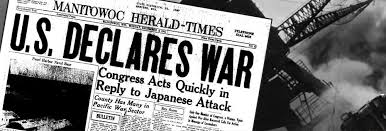
On December 7, 1941, forces of the Imperial Japanese Navy attacked the United States’ Pacific naval Anchorage, at Pearl Harbor. President Franklin Delano Roosevelt addressed a joint session of Congress the following day, requesting a declaration that, since the attack, a state of war had existied between the United States, and Japan. Three days later, Nazi Germany declared war on the United States, reciprocated by an American declaration against Nazi Germany, and their Italian allies. A two-years long conflict in Europe, had become a World War.

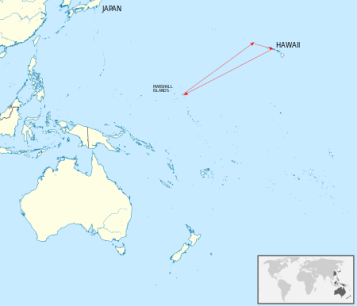
450px-Operation_K.svgIn the months that followed, the United States ramped up its war capacity, significantly.  Realizing this but having little information, the Imperial Japanese Navy (IJN) determined to visit Pearl Harbor once again, to have a look around.

For the IJN, this was an opportunity to test the new Kawanishi H8K1 “Emily” flying boat, an amphibious bomber designed to carry out long distance bombing raids. So it was that a second, albeit smaller attack was launched against Pearl Harbor.

The IJN plan was complex.  This, the first Kawanishi H8K1 operation in Japanese military service, involved a small formation of flying boats to be sent to Wotje Atoll in the Marshall Islands, from there to stage the long-range attack.  The five flying boats would be loaded with four 550lb bombs apiece and flown to French Frigate Shoals northwest of Oahu, there to rendezvous with three Japanese submarines, waiting to refuel them.  Ten miles south of Oahu, the 356’ diesel-powered submarine I-23 was to hold watch over the operation, reporting weather and acting as “lifeguard” in case any aircraft had to ditch in the ocean.

HighFlight-OperationK2-300x181
“A Kawanishi H8K1 of the 802nd Kokutai is lifted out of the water onto the decks of the HIJMS Akitsushima, 1942, off Shortland Island”. H/T fly.historicwings.com, for this image

After refueling, the bomber – reconnaissance mission would approach Pearl Harbor and attack the “10-10 dock”, so-called because it was 1,010 feet long and a key naval asset for the US Pacific Fleet.

If successful, this would be an endurance mission, one of the longest bombing raids ever attempted, and carried out entirely without fighter escort.  The mission was designated “Operation K”, and scheduled for March 4, 1942.

As it turned out, the raid was a “comedy of errors”, on both sides.

Things began to go wrong, almost from the beginning.  I-23 vanished.  To this day nobody knows where the submarine went. American forces reported several engagements with possible subs during this time frame.  Maybe one of those depth charges did its job.  It is equally possible that, unknown to the Imperial Japanese Navy, I-23 was involved in an accident, lost at sea with all hands.

cb33f4104e2bbd353f6d2db6accd356c

As it was, only two of the new flying boats were ready for the operation, the lead plane (Y-71) flown by Lieutenant Hisao Hashizume, and his “wingman” Ensign Shosuke Sasao flying the second aircraft, Y-72.

The staging and refueling parts of the operation were carried out but, absent weather intelligence from the missing I-23, the two-aircraft bombing formation was ignorant of weather conditions over the target.  As it was, a thick cloud cover woud leave the Japanese pilots all but blind.

HighFlight-OperationK3-285x300
Captain Joseph J. Rochefort, USN

On the American side, Captain Joseph J. Rochefort, USN, worked in the Combat Intelligence Unit, tasked with intercepting enemy communications and breaking Japanese codes.  US code breakers had intercepted and decoded Japanese radio communications prior to the attack of four months earlier, but urgent warnings were ignored by naval authorities at Pearl Harbor.

Once again, Rochefort’s team did its job and urgent warnings were sent to Commander in Chief Pacific (CINCPAC) and to Com-14.  Incredibly, these warnings too, fell on deaf ears.  Rochefort was incredulous.  Years later, he would describe his reaction, at the time “I just threw up my hands and said it might be a good idea to remind everybody concerned that this nation was at war.”

American radar stations on Kauai picked up and tracked the incoming aircraft, but that same cloud cover prevented defenders from spotting them.  Curtiss P-40 Warhawk fighters were scrambled to search for the attackers, while Consolidated PBY Catalina flying boats were sent to look for non-existent Japanese aircraft carriers, assumed to have launched the two bombers.

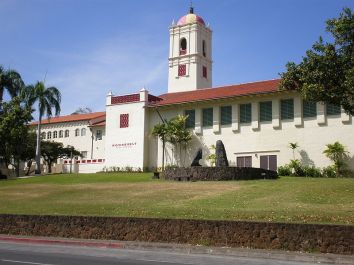
Meanwhile, the two Japanese pilots became confused, and separated.  Hashizume dropped his bombs on the side of Mt. Tantalus, about 1,000 ft. from nearby Roosevelt High School.  Hashizume’s bombs left craters 6-10 ft deep and 20-30 ft across on the side of the extinct volcano.  Sasao is presumed to have dropped his bombs, over the ocean.

800px-President-Theodore-Roosevelt-High-School
President Theodore Roosevelt High School, Honolulu

A Los Angeles radio station reported “considerable damage to Pearl Harbor”, with 30 dead sailors and civilians, and 70 wounded.  Japanese military authorities took the broadcast to heart, and considered the operation to have been a great success.  Talk about ‘fake news’.  As it was, the damage was limited to those craters on Mt. Tantalus, and shattered windows at Roosevelt High.

The United States Army and the US Navy blamed each other for the explosions, each accusing the other of jettisoning munitions over the volcano.

The IJN planned another such armed reconnaissance mission for the 6th or 7th of March, but rescheduled for the 10th because of damage to Hashizume’s aircraft, and the exhaustion of air crew.  The second raid was carried out on March 10, but Hashizume was shot down and killed near Midway atoll, by Brewster F2A “Buffalo” fighters.

HighFlight-OperationK7
The results of the second Japanese raid on Pearl Harbor, carried out on March 4, 1942, were limited to four craters on the side of an extinct volcano.

A follow-up to Operation K was scheduled for May 30, but by that time, US military intelligence had gotten wise to the IJN meet-up point.  Japanese submarines arriving at French Frigate Shoals found the place mined, and swarming with American warships.

In the end, the Imperial Japanese Navy was unable to observe US Navy activity, or to keep track of American aircraft carriers.  Days later, this blindness would have a catastrophic effect on the Japanese war effort, at a place called Midway.

DiscoverHawaiiTours_PearlHarbor_USSMissouri_2

If you enjoyed this “Today in History”, please feel free to re-blog, “like” & share on social media, so that others may find and enjoy it as well. Please click the “follow” button on the right, to receive email updates on new articles.  Thank you for your interest, in the history we all share.