The 1104th worked to find and defuse explosives, though on several occasions, the unit had to drop its tools and fight as Infantry.
James and Kate Kaminski’s little bundle of joy came into the world on June 26th 1926, in Brooklyn.
The Kaminskis named this, their fourth son, Melvin James. The elder James died of tuberculosis at 34, when the boy was only two. A small Jewish kid growing up in a tough Brooklyn neighborhood, Kaminsky learned the value of being able to crack a joke. “Growing up in Williamsburg”, he said, “I learned to clothe it in comedy to spare myself problems—like a punch in the face”.
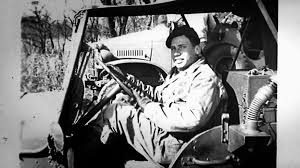
The boy had a talent for music. He was taught by another kid from Williamsburg, named Buddy Rich. By 14 he was good enough to be playing drums for money.
Melvin attended a year at Brooklyn College before being drafted into the Army, in WWII. After attending Army Specialized Training at VMI, Corporal Kaminsky joined the 1104th Combat Engineers Battalion of the 78th Infantry Division, in the European theater. There, he served through the end of the war.
He and his unit worked to find and defuse explosives, though on several occasions, the 1104th had to drop its tools and fight as Infantry.
At one point, Kaminsky’s unit gathered along a River. The Americans were so close they could hear German soldiers singing a beer hall song, from the other side. Kaminsky grabbed a bullhorn and serenaded the Germans back, crooning out an old tune that Al Jolson used to perform, in black face: “Toot Toot Tootsie, Goodbye”. After he was done, polite applause could be heard, drifting across the river. I can’t imagine many Allied soldiers ever tried singing to their Nazi adversaries, during World War II. The ones who actually pulled it off, must number precisely, one.
Kaminski went into show business after the war, playing drums and piano in the Borscht Belt resorts and nightclubs of the Catskills. It was around this time that he took his professional name, adopting his mother’s maiden name of Brookman and calling himself “Mel Brooks”.
Brooks started doing stand-up, when the regular comedian at one of the clubs was too sick to perform. By ’49 he was “Tummler”, the master entertainer at Grossinger’s, one of the most famous resorts in the Borscht Belt.
Soon he was making $50 a week writing for his buddy Sid Caesar and his NBC program “The Admiral Broadway Review”.
In 1968, Mel Brooks wrote and produced the satirical comedy film “The Producers”, about a theatrical producer and an accountant who set out to fleece their investors. The scheme was to create a play so awful that it was sure to flop on Broadway, then to abscond to Brazil with investors’ money. The problems started, when the show turned out to be a hit. The fictional play is a musical, called “Springtime for Hitler”. Even before the time when taking offense became an industry, I don’t know many guys beside Mel Brooks who could have gotten away with that one.
There isn’t one of us who doesn’t know his work. Three of his movies made the American Film Institute’s top 100 list of comedy films. From the 2,000 year old man with “over forty-two thousand children, and not one comes to visit me” to Blazing Saddles’ “Candygram for Mongo” (“Mongo likes candy”).
“As long as the world is turning and spinning”, Brooks says, “we’re gonna be dizzy and we’re gonna make mistakes”.
Brooks has risen to the top of his chosen profession, winning the coveted “EGOT”, an acronym for the entertainment industry’s four major awards, the Emmy, Grammy, Oscar and Tony. Only eleven others have ever risen to this level: Richard Rodgers, Helen Hayes, Rita Moreno, John Gielgud, Audrey Hepburn, Marvin Hamlisch, Jonathan Tunick, Mike Nichols, Whoopi Goldberg, Scott Rudin, and Robert Lopez. As of this date, Brooks only needs another Oscar to be the first “Double EGOT”, in history.
Two years ago, March 31, 2016, the Averhill Park K-12 School District in upstate New York kicked off a three-day production of “Young Frankenstein”. Let me know if you can think of another 90-year-old guy, who remains that current. I can’t think of one.
“Well, just being stupid and politically incorrect doesn’t work. You can be politically incorrect if you’re smart”.
If you enjoyed this “Today in History”, please feel free to re-blog, “like” & share on social media, so that others may find and enjoy it as well. Please click the “follow” button on the right, to receive email updates on new articles. Thank you for your interest, in the history we all share.
If successful, this would be an endurance mission, one of the longest bombing raids ever attempted, and carried out entirely without fighter escort. The mission was designated “Operation K”, and scheduled for March 4, 1942.
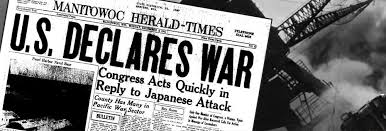
On December 7, 1941, forces of the Imperial Japanese Navy attacked the United States’ Pacific naval Anchorage, at Pearl Harbor. President Franklin Delano Roosevelt addressed a joint session of Congress the following day, requesting a declaration that, since the attack, a state of war had existied between the United States, and Japan. Three days later, Nazi Germany declared war on the United States, reciprocated by an American declaration against Nazi Germany, and their Italian allies. A two-years long conflict in Europe, had become a World War.
In the months that followed, the United States ramped up its war capacity, significantly. Realizing this but having little information, the Imperial Japanese Navy (IJN) determined to visit Pearl Harbor once again, to have a look around.
For the IJN, this was an opportunity to test the new Kawanishi H8K1 “Emily” flying boat, an amphibious bomber designed to carry out long distance bombing raids. So it was that a second, albeit smaller attack was launched against Pearl Harbor.
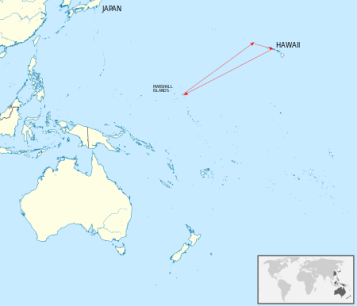
The IJN plan was complex. This, the first Kawanishi H8K1 operation in Japanese military service, involved a small formation of flying boats to be sent to Wotje Atoll in the Marshall Islands, from there to stage the long-range attack. The five flying boats would be loaded with four 550lb bombs apiece and flown to French Frigate Shoals northwest of Oahu, there to rendezvous with three Japanese submarines, waiting to refuel them. Ten miles south of Oahu, the 356’ diesel-powered submarine I-23 was to hold watch over the operation, reporting weather and acting as “lifeguard” in case any aircraft had to ditch in the ocean.
“A Kawanishi H8K1 of the 802nd Kokutai is lifted out of the water onto the decks of the HIJMS Akitsushima, 1942, off Shortland Island”. H/T fly.historicwings.com, for this image
After refueling, the bomber – reconnaissance mission would approach Pearl Harbor and attack the “10-10 dock”, so-called because it was 1,010 feet long and a key naval asset for the US Pacific Fleet.
If successful, this would be an endurance mission, one of the longest bombing raids ever attempted, and carried out entirely without fighter escort. The mission was designated “Operation K”, and scheduled for March 4, 1942.
As it turned out, the raid was a “comedy of errors”, on both sides.
Things began to go wrong, almost from the beginning. I-23 vanished. To this day nobody knows where the submarine went. American forces reported several engagements with possible subs during this time frame. Maybe one of those depth charges did its job. It is equally possible that, unknown to the Imperial Japanese Navy, I-23 was involved in an accident, lost at sea with all hands.
As it was, only two of the new flying boats were ready for the operation, the lead plane (Y-71) flown by Lieutenant Hisao Hashizume, and his “wingman” Ensign Shosuke Sasao flying the second aircraft, Y-72.
The staging and refueling parts of the operation were carried out but, absent weather intelligence from the missing I-23, the two-aircraft bombing formation was ignorant of weather conditions over the target. As it was, a thick cloud cover woud leave the Japanese pilots all but blind.
Captain Joseph J. Rochefort, USN
On the American side, Captain Joseph J. Rochefort, USN, worked in the Combat Intelligence Unit, tasked with intercepting enemy communications and breaking Japanese codes. US code breakers had intercepted and decoded Japanese radio communications prior to the attack of four months earlier, but urgent warnings were ignored by naval authorities at Pearl Harbor.
Once again, Rochefort’s team did its job and urgent warnings were sent to Commander in Chief Pacific (CINCPAC) and to Com-14. Incredibly, these warnings too, fell on deaf ears. Rochefort was incredulous. Years later, he would describe his reaction, at the time “I just threw up my hands and said it might be a good idea to remind everybody concerned that this nation was at war.”
American radar stations on Kauai picked up and tracked the incoming aircraft, but that same cloud cover prevented defenders from spotting them. Curtiss P-40 Warhawk fighters were scrambled to search for the attackers, while Consolidated PBY Catalina flying boats were sent to look for non-existent Japanese aircraft carriers, assumed to have launched the two bombers.
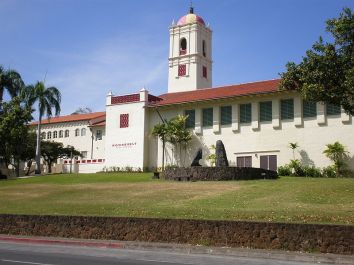
Meanwhile, the two Japanese pilots became confused, and separated. Hashizume dropped his bombs on the side of Mt. Tantalus, about 1,000 ft. from nearby Roosevelt High School. Hashizume’s bombs left craters 6-10 ft deep and 20-30 ft across on the side of the extinct volcano. Sasao is presumed to have dropped his bombs, over the ocean.
President Theodore Roosevelt High School, Honolulu
A Los Angeles radio station reported “considerable damage to Pearl Harbor”, with 30 dead sailors and civilians, and 70 wounded. Japanese military authorities took the broadcast to heart, and considered the operation to have been a great success. Talk about ‘fake news’. As it was, the damage was limited to those craters on Mt. Tantalus, and shattered windows at Roosevelt High.
The United States Army and the US Navy blamed each other for the explosions, each accusing the other of jettisoning munitions over the volcano.
The IJN planned another such armed reconnaissance mission for the 6th or 7th of March, but rescheduled for the 10th because of damage to Hashizume’s aircraft, and the exhaustion of air crew. The second raid was carried out on March 10, but Hashizume was shot down and killed near Midway atoll, by Brewster F2A “Buffalo” fighters.
The results of the second Japanese raid on Pearl Harbor, carried out on March 4, 1942, were limited to four craters on the side of an extinct volcano.
A follow-up to Operation K was scheduled for May 30, but by that time, US military intelligence had gotten wise to the IJN meet-up point. Japanese submarines arriving at French Frigate Shoals found the place mined, and swarming with American warships.
In the end, the Imperial Japanese Navy was unable to observe US Navy activity, or to keep track of American aircraft carriers. Days later, this blindness would have a catastrophic effect on the Japanese war effort, at a place called Midway.
If you enjoyed this “Today in History”, please feel free to re-blog, “like” & share on social media, so that others may find and enjoy it as well. Please click the “follow” button on the right, to receive email updates on new articles. Thank you for your interest, in the history we all share.
In her 1951 memoir “Fliegen – mein leben”, (Flying is my life), Hannah Reitsch offers no moral judgement one way or the other, on Hitler or the Third Reich.
Hannah Reitsch wanted to fly. Born March 29, 1912 into an upper-middle-class family in Hirschberg, Silesia, it’s all she ever thought about. At the age of four, she tried to jump off the family balcony, to experience flight. In her 1955 autobiography The Sky my Kingdom, Reitsch wrote: ‘The longing grew in me, grew with every bird I saw go flying across the azure summer sky, with every cloud that sailed past me on the wind, till it turned to a deep, insistent homesickness, a yearning that went with me everywhere and could never be stilled.’
Reitsch began flying gliders in 1932, as the treaty of Versailles prohibited anyone flying “war planes” in Germany. In 1934, she broke the world’s altitude record for women (9,184 feet). In 1936, Reitsch was working on developing dive brakes for gliders, when she was awarded the honorary rank of Flugkapitän, the first woman ever so honored. In 1937 she became a Luftwaffe civilian test pilot. She would hold the position until the end of WW2.
A German Nationalist who believed she owed her allegiance to the Fatherland more than to any party, Reitsch was patriotic and loyal, and more than a little politically naive. Her work brought her into contact with the highest levels of Nazi party officialdom. Like the victims of Soviet purges who went to their death believing that it would all stop “if only Stalin knew”, Reitsch refused to believe that Hitler had anything to do with events such as the Kristallnacht pogrom. She dismissed any talk of concentration camps, as “mere propaganda”.
In February 1938, Hannah Reitsch became the first person of either sex to fly a helicopter, the Focke-Achgelis Fa-61, inside a building, Berlin’s Deutschlandhalle. (ullstein bild via Getty Images)
As a test pilot, Reitsch won an Iron Cross, Second Class, for risking her life in an attempt to cut British barrage-balloon cables. On one test flight of the rocket powered Messerschmitt 163 Komet in 1942, she flew the thing at speeds of 500 mph, a speed nearly unheard of at the time. She spun out of control and crash-landed on her 5th flight, leaving her with severe injuries. Her nose was all but torn off, her skull fractured in four places. Two facial bones were broken, and her upper and lower jaws out of alignment. Even then, she managed to write down what had happened, before she collapsed.
Doctors did not expect her to live, let alone fly again. She spent five months in hospital, and suffered from debilitating dizzy spells. She put herself on a program of climbing trees and rooftops, to regain her sense of balance. Soon, she was test flying again.
On this day in 1944, Reichsmarshall Hermann Göring awarded her a special diamond-encrusted version of the Gold Medal for Military Flying. Adolf Hitler personally awarded her an Iron Cross, First Class, the first and only woman in German history, so honored.
It was while receiving this second Iron Cross in Berchtesgaden, that Reitsch suggested the creation of a Luftwaffe suicide squad, “Operation Self Sacrifice”.
Hitler was initially put off by the idea, though she finally persuaded him to look into modifying a Messerschmitt Me-328B fighter for the purpose. Reitsch put together a suicide group, becoming the first to take the pledge, though the idea would never take shape. The pledge read, in part: “I hereby voluntarily apply to be enrolled in the suicide group as a pilot of a human glider-bomb. I fully understand that employment in this capacity will entail my own death.”
The plan came to an abrupt halt when an Allied bombing raid wiped out the factory in which the prototype Me-328s were being built.
In the last days of the war, Hitler dismissed his designated successor Hermann Göring, over a telegram in which the Luftwaffe head requested permission to take control of the crumbling third Reich. Hitler appointed Generaloberst Robert Ritter von Greim, ordering Hannah to take him out of Berlin and giving each a vial of cyanide, to be used in the event of capture. The Arado Ar 96 left the improvised airstrip on the evening of April 28, under small arms fire from Soviet troops. It was the last plane to leave Berlin. Two days later, Adolf Hitler was dead.
Taken into American custody on May 9, Reitsch and von Greim repeated the same statement to American interrogators: “It was the blackest day when we could not die at our Führer’s side.” She spent 15 months in prison, giving detailed testimony as to the “complete disintegration’ of Hitler’s personality, during the last months of his life. She was found not guilty of war crimes, and released in 1946. Von Greim committed suicide, in prison.
In her 1951 memoir “Fliegen – mein leben”, (Flying is my life), Reitsch offers no moral judgement one way or the other, on Hitler or the Third Reich.
She resumed flying competitions in 1954, opening a gliding school in Ghana in 1962. She later traveled to the United States, where she met Igor Sikorsky and Neil Armstrong, and even John F. Kennedy.
Hannah Reitsch remained a controversial figure, due to her ties with the Third Reich. Shortly before her death in 1979, she responded to a description someone had written of her, as `Hitler’s girlfriend’. “I had been picked for this mission” she wrote, “because I was a pilot…I can only assume that the inventor of these accounts did not realize what the consequences would be for my life. Ever since then I have been accused of many things in connection with the Third Reich”.
Toward the end of her life, she was interviewed by the Jewish-American photo-journalist, Ron Laytner. Even then she was defiant: “And what have we now in Germany? A land of bankers and car-makers. Even our great army has gone soft. Soldiers wear beards and question orders. I am not ashamed to say I believed in National Socialism. I still wear the Iron Cross with diamonds Hitler gave me. But today in all Germany you can’t find a single person who voted Adolf Hitler into power … Many Germans feel guilty about the war. But they don’t explain the real guilt we share – that we lost“.
Hannah Reitsch died in Frankfurt on August 24, 1979, of an apparent heart attack. Former British test pilot and Royal Navy officer Eric Brown received a letter from her earlier that month, in which she wrote, “It began in the bunker, there it shall end.” There was no autopsy, or at least there’s no report of one. Brown, for one, believes that after all those years, she may have finally taken that cyanide capsule.
While unsuccessful, the incident killed some of Japan’s most moderate internationalist politicians, putting an end to effective civilian control over the army while increasing the military’s influence over civilian government.
As Japan emerged from the medieval period into the early modern age, the future Nippon Empire transformed from a period characterized by warring states, to the relative stability of the Tokugawa Shōgunate. Here, a feudal military government ruled from the Edo castle in the Chiyoda district of modern-day Tokyo, over some 250 provincial domains called han.
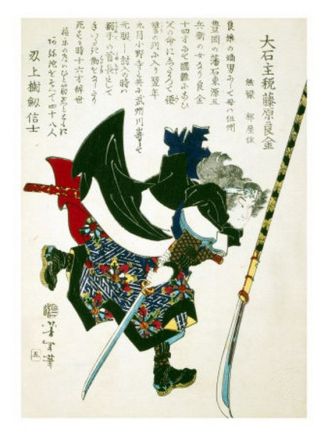
The military and governing structure of the time was based on a rigid and inflexible class system, placing the feudal lords or daimyō at the top, followed by a warrior-caste of samurai, and a lower caste of merchants and artisans. At the bottom of it all stood some 80% of the population, the peasant farmer forbidden to engage in non-agricultural work, and expected to provide the income to make the whole system work.
Concerned about 17th century Spanish and Portuguese colonial expansion into Asia made possible by Catholic missionaries, the Tokugawa Shōgunate issued three edicts of expulsion beginning in the early 1630s, effecting a complete ban on Christianity in the Japanese home islands. The policy ushered in a period of national seclusion, where Japanese subjects were forbidden to travel abroad, and foreign contact limited to a small number of Dutch and Chinese merchants, trading through the port of Nagasaki.
Economically, the production of fine silk and cotton fabrics, the manufacture of paper and porcelain and sake brewing operations thrived in the larger urban centers, bringing considerable wealth to the merchant class. Meanwhile, the daimyō and samurai classes remained dependent on a fixed stipend tied to agricultural production, particularly in the smaller han.
The system led to a series of peasant uprisings in the 18th and 19th centuries, and extreme dislocation within the warrior caste.
Into this world stepped the “gunboat diplomats” of President Millard Filmore in the person of Commodore Matthew Calbraith Perry, determined to open the ports of Japan to trade with the west. By force, if necessary.
In time, these internal Japanese issues and the growing pressure of western encroachment led to the end of the Tokugawa period and the restoration of the Meiji Emperor, in 1868. The divisions would last, well into the 20th century.
By the 1920s, two factions had evolved within the Japanese Imperial Army. The Kōdō-ha or “Imperial Way” members were the radical nationalists, resentful of civilian control over the military. This group sought a “Shōwa Restoration”, purging Japan of western ideas and returning the Emperor to what they believed to be his rightful place. By force, if necessary. Incensed by the rural poverty they blamed on the privileged classes, the group was vehemently anti-capitalist, seeking to eliminate corrupt party politics and establish a totalitarian state-socialist government, run by the military.
Opposed to this group was the much larger Tōsei-ha or “Control faction” within the army, who stressed the need for technological development within the military, while taking a more conciliatory tone with the government when it came to military spending.
Rebel occupation of the Sannō Hotel
In the Fall of 1930, a group of young officers of the Kōdō-ha attempted the assassinations of Prime Minister Osachi Hamaguchi, Prince Saionji Kinmochi. and Lord Privy Seal Makino Nobuaki. The group attempted a coup the following March, and the installation of soldier-stateman Ugaki Kazushige, as Premier. Ugaki himself was of the more moderate faction and took no role in the attempted coup, though he assumed responsibility and resigned his post.
That September, the ultra-nationalists launched an invasion of Manchuria, without authorization from the Imperial Japanese Army General Staff Office, and over objections from the civilian government. A month later the group launched another coup attempt. This too was unsuccessful but, as with the “March Incident” of six months earlier, the government’s response was excessively mild. Ringleaders were sentenced to 10 or 20 days’ house arrest, and other participants were merely transferred. For the radicals, such lenience became a virtual hall pass, ensuring that there would be future such efforts.
This “Righteous Army” faction remained influential throughout the period known as “government by assassination“, due largely to the threat that it posed. Sympathizers among the general staff and imperial family included Prince Chichibu, the Emperor’s own brother. Years later, Winston Churchill would describe Hitler’s appeasers as “one who feeds a crocodile, hoping it will eat him last”. Despite being fiercely anti-capitalist, this particular crocodile received sustenance from zaibatsu – the industrial and financial business leaders who hoped that their support would shield themselves.
The February 26 incident killed some of Japan’s most moderate, internationalist leaders, including Finance minister Takahashi Korekiyo (left) and Lord Keeper of the Privy Seal, Saitō Makoto.
General Tetsuzan Nagata was murdered in 1935, following the discovery of yet another coup plot and the Army’s arrest and subsequent expulsion of its leaders.
In 1931, Japan abandoned the gold standard in an effort to defeat deflationary forces exerted by worldwide depression. The “John Maynard Keynes of Japan”, the moderate politician and Finance Minister Takahashi Korekiyo, argued for government deficit spending to stimulate demand. The country emerged from the worst parts of the depression two years later, but Takahashi’s efforts to reign in military spending created a conspiracy mindset among more radical army officers.
On February 26, 1936, 1,438 soldiers divided into six groups attacked Prime Minister Admiral Keisuke Okada, former Prime Minister and now-Finance Minister Takahashi Korekiyo, Grand Chamberlain Admiral Suzuki Kantarō, Lord Keeper of the Privy Seal and former Prime Minister Saitō Makoto, the Ministry of War, the offices of the Asahi Shimbun newspaper, Tokyo police headquarters and attempted to seize the Imperial palace of the Emperor himself.
While unsuccessful, the incident killed some of Japan’s most moderate internationalist politicians, putting an end to effective civilian control over the army while increasing the military’s influence over civilian government. Admiral Isoroku Yamamoto, the unwilling architect of the attack on Pearl Harbor, was reassigned to sea to prevent his assassination by army hard-liners. Another step had been taken, on the road to war.
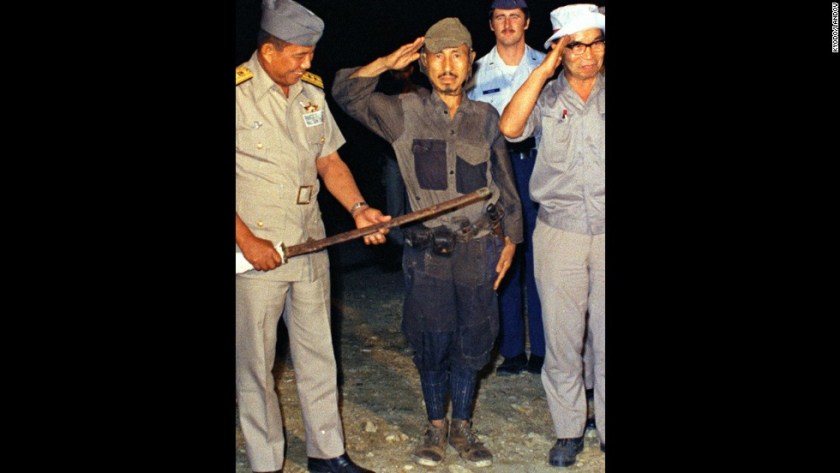
Thus properly relieved of duty, Onada surrendered, turning over his sword, his rifle, 500 rounds of ammunition and a number of hand grenades, along with the dagger his mother had given him, to kill himself if he were ever captured. It was March 9, 1974.
On December 7, 1941, Imperial Japanese air forces attacked the US Pacific Naval anchorage at Pearl Harbor.
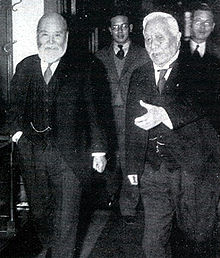
President Franklin Delano Roosevelt appeared before a joint session of Congress the following day, asking for a declaration of war. Little did they know, the war with Imperial Japan would rage for another 33 years.
Alright, not really. Representatives of the Empire of Japan signed the instruments of surrender aboard the USS Missouri on September 2, 1945, formally ending the war in the Pacific. Except, there were those who didn’t get the message.
Following the Battle of Saipan, June 15 – July 9, 1944, Captain Sakae Ōba and a company of 46 men took to carrying out guerrilla actions against American troops. The company surrendered on December 1, 1945, three months after the end of the war.
Navy Lieutenant Hideo Horiuchi was arrested on August 13, 1946, while recovering from wounds received in a battle with Dutch troops.
Lieutenant Ei Yamaguchi led 33 soldiers in an attack on an American Marine Corps detachment on Peleliu in March, 1947. Reinforcements were sent in, including a Japanese admiral who finally convinced these guys that the war was over. The group surrendered in April.
Two machine gunners from the Imperial Japanese Navy surrendered on Iwo Jima, on January 6, 1949.
Several went on to fight for the Viet Minh against French troops in Indochina.
Seaman Noburo Kinoshita hanged himself in the Luzon jungle, in 1955. Kinoshita had vowed never to “return to Japan in defeat”. I guess he meant it.
Private Bunzō Minagawa held out until May 1960, on the American territory of Guam. Minagawa’s immediate superior, Sergeant Masashi Itō, surrendered a few days later. Corporal Shoichi Yokoi, who also served under Itō, was captured twelve years later.
After the war, 2nd Lieutenant Hirō Onoda took to the mountains of Lubang Island in the Philippines, along with Private Yūichi Akatsu, Corporal Shōichi Shimada and Private First Class Kinshichi Kozuka, carrying out guerilla actions and engaging in shootouts with local police. Akatsu left the other three in 1949, and surrendered six months later. Shimada was killed by a search party in 1954. Kozuka was shot and killed by local police in 1972, while burning rice collected by farmers.
Suzuki returned to Japan with this photograph in February 1974, as proof of his encounter with Onada.
Two years later, the Japanese explorer and adventurer Norio Suzuki set out, looking for “Lieutenant Onoda, a wild panda, and the Abominable Snowman, in that order”. The pair met on February 20, 1974 when Suzuki nearly got shot for his troubles, but he was quick. “Onoda-san, the emperor and the people of Japan are worried about you.”
“I am a soldier” he said, “and remain true to my duties.” Onada would surrender when ordered to do so, by a superior officer. Suzuki returned to Japan and located Onoda’s commanding officer, Major Yoshimi Taniguchi, who was working in a book store. The pair flew to Lubang, where Taniguchi issued the following orders:
In accordance with the Imperial command, the Fourteenth Area Army has ceased all combat activity.
In accordance with military Headquarters Command No. A-2003, the Special Squadron of Staff’s Headquarters is relieved of all military duties.
Units and individuals under the command of Special Squadron are to cease military activities and operations immediately and place themselves under the command of the nearest superior officer. When no officer can be found, they are to communicate with the American or Philippine forces and follow their directives.
Thus properly relieved of duty, Onada surrendered, turning over his sword, his rifle, 500 rounds of ammunition and a number of hand grenades, along with his kaiken, the dagger his mother had given him, to kill himself if he were ever captured. It was March 9, 1974.
Private Teruo Nakamura, born Attun Palalin to the aboriginal Amis people of Taiwan, was the last confirmed holdout of WW2. Nakamura, who spoke neither Japanese nor Chinese, was discovered by the Indonesian Air Force on Morotai, surrendering to a search patrol on December 18, 1974. The war was over. 29 years, 3 months, and 16 days after the Japanese Instrument of Surrender.
Years later, Hirō Onada described that first encounter: “This hippie boy Suzuki came to the island to listen to the feelings of a Japanese soldier. Suzuki asked me why I would not come out…” Norio Suzuki had found his Onada, and the wild panda was soon to follow. The explorer died in a Himalayan avalanche at age 37, still searching for the Abominable Snowman.
If you enjoyed this “Today in History”, please feel free to re-blog, “like” & share on social media, so that others may find and enjoy it as well. Please click the “follow” button on the right, to receive email updates on new articles. Thank you for your interest, in the history we all share.
To the human participants in this story, this is a tale of four weeks’ combat for a tropical island. For the apex predator of the mangrove swamp, it was little more than a dinner bell.
500 ft. off the coast of Myanmar (formerly Burma), and across the Bay of Bengal from the Indian sub-continent, there lies the island of Ramree, about a third the size of New York’s Long Island.
In 1942, the Imperial Japanese Army aided by Thai forces and Burmese insurgents drove the British Empire and Chinese forces out of Burma, occupying much of the Burmese peninsula and with it, Ramree island. In January 1945, the allies came to take it back.
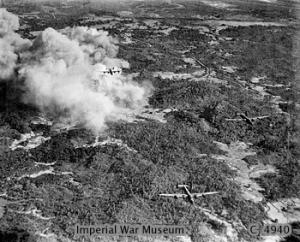
RAF 356 Squadron after bombing Japanese positions on Ramree Island
The battle started out with Operation Matador on January 14, an amphibious assault designed to capture the strategic port of Kyaupyu, and it’s nearby airfield.
By early February, a mixed force of British Royal Marines and their Indian allies dislodged a force of some 980 Japanese defenders, who abandoned their base and marched inland to join a larger regiment of Japanese soldiers across the island.
The route took the retreating Japanese across 10 miles of marsh and mangrove swamp. Bogged down and trapped in the mire, the soldiers soon found themselves cut off and surrounded, alone with the snakes, the mosquitoes and the scorpions, of Ramree island.
On February 7, the 71st Infantry and supporting tanks reached Ramree town where they found determined Japanese resistance, the town falling two days later. Naval forces blockaded small tributaries called “chaungs”, which the retreating Japanese used in their flight to the mainland. A Japanese air raid damaged an allied destroyer on the 11th as a flotilla of small craft crossed the strait, to rescue survivors of the garrison. By February 17, Japanese resistance had come to an end.
Throughout the four-week battle for Ramree Island, the allied blockade inflicted heavy casualties on Japanese forces. The thousand men cut off in the swamp, had more immediate concerns.
:Lured by a tour guide dangling kangaroo meat from a pole, the 18ft, two-ton monster was, er, snapped by photographer Katrina Bridgeford, who was on the Adelaide River cruise with her family”. Tip of the Hat for this image, to the UK Daily Mail Note the missing right arm on this monster – probably eaten by one of his own kind.
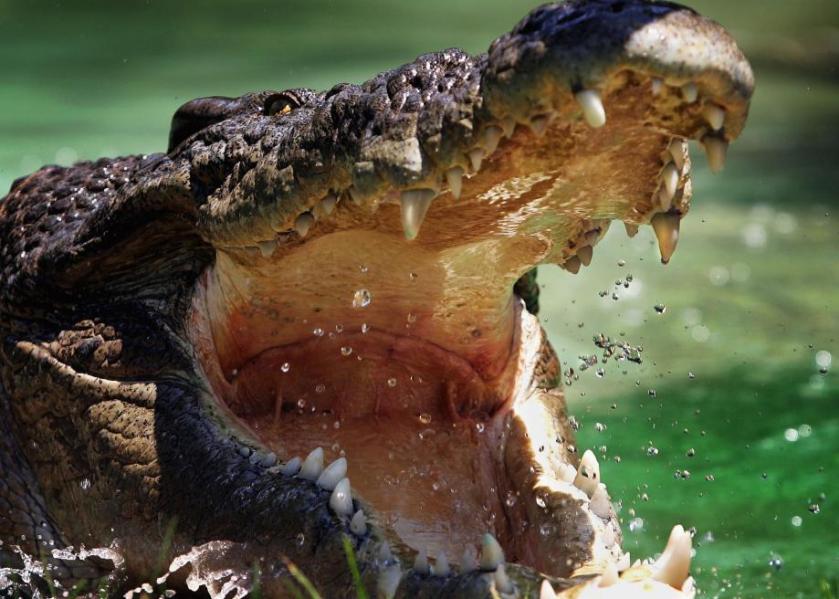
NationalGeographic.com describes the Japanese’ problem, the nightmare predator, Crocodylus porosus: “Earth’s largest living crocodilian—and, some say, the animal most likely to eat a human—is the saltwater or estuarine crocodile. Average-size males reach 17 feet and 1,000 pounds, but specimens 23 feet long and weighing 2,200 pounds are not uncommon.
Classic opportunistic predators, they lurk patiently beneath the surface near the water’s edge, waiting for potential prey to stop for a sip of water. They’ll feed on anything they can get their jaws on, including water buffalo, monkeys, wild boar, and even sharks. Without warning, they explode from the water with a thrash of their powerful tails, grasp their victim, and drag it back in, holding it under until the animal drowns.
British naturalist Bruce Stanley Wright participated in the battle for Ramree, and gave the following account in his book, Wildlife Sketches Near and Far, published in 1962:
“That night [February 19, 1945] was the most horrible that any member of the M.L. [marine launch] crews ever experienced. The crocodiles, alerted by the din of warfare and the smell of blood, gathered among the mangroves, lying with their eyes above water, watchfully alert for their next meal. With the ebb of the tide, the crocodiles moved in on the dead, wounded, and uninjured men who had become mired in the mud.
The scattered rifle shots in the pitch black swamp punctured by the screams of wounded men crushed in the jaws of huge reptiles, and the blurred worrying sound of spinning crocodiles made a cacophony of hell that has rarely been duplicated on earth. At dawn the vultures arrived to clean up what the crocodiles had left…Of about 1,000 Japanese soldiers that entered the swamps of Ramree, only about 20 were found alive.
The crocodile attacks of Ramree are well documented, but there are those who question the numbers. Some accounts indicate as many as 400 escaping the swamp, while the Guinness Book of World Records credits the incident with the “Most Number of Fatalities in a Crocodile Attack.” Could there be so many of these creatures, as to wipe out nearly a thousand men? What was there to eat, to support such a large population?
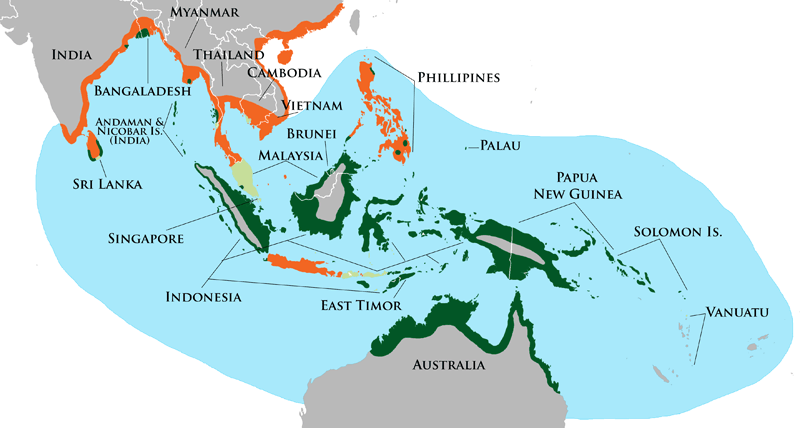
Current Distribution – Saltwater or Estuarine Crocodile (Crocodylus porosus)
The actual numbers can never be known, but consider this: Saltwater crocodiles are excellent swimmers, and are regularly spotted miles out to sea. Individuals have even been discovered in the relatively frigid Sea of Japan – thousands of miles from their native habitat. In 2016, Australian Rangers counted 120 “salties” in a 6-kilometer (3.7 mile) stretch of the East Alligator River, in the Northern Territory.
To the human participants in this story, this is a tale of four weeks’ combat for a tropical island. For the apex predator of the mangrove swamp, it was little more than a dinner bell.
If you enjoyed this “Today in History”, please feel free to re-blog, “like” & share on social media, so that others may find and enjoy it as well. Please click the “follow” button on the right, to receive email updates on new articles. Thank you for your interest, in the history we all share.
The most unusual confrontation of WW2 occurred on this day in 1945, in the form of a combat action between two submerged submarines.
In 1939, the impending Nazi invasion of Poland was an open secret. That August, representatives of Nazi Germany and the Soviet Union signed the Nazi-Soviet Pact, pledging mutual non-aggression for a period of two years.
Two days later, representatives of the United Kingdom signed the Agreement of Mutual Assistance with Poland, aligning Great Britain with the Franco-Polish Military Alliance. Should Poland be invaded by a foreign power, England and France were now committed to intervene.
The first fourteen “Unterseeboots” (U-boats) left their bases, fanning out across the North Atlantic. Hitler’s invasion of Poland, began, three weeks later. Even then, Hitler believed that war with England and France could still be avoided. The “Kriegsmarine” was under strict orders to follow the “Prize Regulations” of 1936.
England and France declared war on Nazi Germany on Septemebr 3. Hours later, U-30 Oberleutnant Fritz Julius Lemp fired a torpedo into the British liner SS Athenia. Lemp had mistakenly believed it to be an armed merchant vessel and fair game under Prize Regulations, but the damage was done. The longest and most complex naval battle in history, had begun.
As in WWI, both England and Germany were quick to implement blockades on one another. For good reason. By the time that WWII was in full swing, England alone would require over a million tons a week of imported goods, in order to continue the fight.
The “Battle of the Atlantic” lasted 5 years, 8 months and 5 days, ranging from the Irish Sea to the Gulf of Mexico, from the Caribbean to the Arctic Ocean. Winston Churchill would describe this as “the dominating factor all through the war. Never for a moment could we forget that everything happening elsewhere, on land, at sea or in the air depended ultimately on its outcome”.
Thousands of ships were involved in more than a hundred convoy battles, with over 1,000 single ship encounters unfolding across a theater thousands of miles wide. According to http://www.usmm.org, the United States Merchant Marine suffered the highest percentage of fatalities of any service branch, at 1 in 26 compared to one in 38, 44, 114 and 421 respectively, for the Marine Corps, Army, Navy and Coast Guard.
New weapons and tactics would shift the balance first in favor of one side, and then to the other. In the end over 3,500 merchant ships and 175 warships would be sunk to the bottom of the ocean, compared with the loss of 783 U-boats.
The most unusual confrontation of the war occurred on this day in 1945, in the form of a combat action between two submerged submarines. Submarines operate in 3-dimensional space, but their most effective weapon does not. The torpedo is a surface weapon, operating in two-dimensional space: left, right and forward. Firing at a submerged target requires that the torpedo be converted to neutral buoyancy, introducing near-insurmountable complexity into firing calculations.
U-864
The war was going badly for the Axis Powers in 1945, the allies enjoying near-uncontested supremacy over the world’s shipping lanes. At this time, any surface delivery between Nazi Germany and Imperial Japan was likely to be detected and stopped. The maiden voyage of the 287’, 1,799 ton German submarine U-864 departed on “Operation Caesar” on December 5, delivering Messerschmitt jet engine parts, V-2 missile guidance systems, and 65 tons of mercury to the Imperial Japanese war production industry.
WW2 U-boat pens, Bergen, Norway
The mission was a failure, U-864 having to retreat to the submarine pens in Bergen, Norway, for repairs after running aground in the Kiel Canal. The sub was able to clear the island of Fedje off the Norway coast undetected on February 6. By this time British MI6 had broken the German Enigma code. They were well aware of Operation Caesar.
The British submarine Venturer, commanded by 25-year-old Lieutenant Jimmy Launders, was dispatched from the Shetland Islands, to intercept and destroy U-864.
A four dimensional firing solution accounting for time, distance, bearing and target depth was theoretically possible, but had rarely been attempted under combat conditions.
ASDIC, an early name for sonar, would have been far more helpful in locating U-864, but at a price. That familiar “ping” would have been heard by both sides, alerting the German commander that he was being hunted. Launders opted for hydrophones, a passive listening device which could alert him to external noises. Calculating his adversary’s direction, depth and speed was vastly more complicated without ASDIC, but the need for stealth won out.
Developing an engine noise which he feared might give him away, U-864’s commander, Ralf-Reimar Wolfram decided to return to Bergen for repairs. German submarines of the age were equipped with “snorkels”, heavy tubes which broke the surface, enabling diesel engines and crews to breathe while running submerged. Venturer was on batteries when the first sounds were detected, giving the British sub the stealth advantage but sharply limiting the time frame in which it could act.
A four dimensional firing solution accounting for time, distance, bearing and target depth was theoretically possible, but had rarely been attempted under combat conditions. Plus, there were unknown factors which could only be approximated.
A fast attack sub, Venturer only carried four torpedo tubes, far fewer than her much larger adversary. Launders calculated his firing solution, ordering all four tubes firing with a 17½ second delay between each pair.
With four incoming at as many depths, the German sub didn’t have time to react. Wolfram was only just retrieving his snorkel and converting to electric, when the #4 torpedo struck. U-864 imploded and sank, instantly killing all 73 aboard.
Surface actions were common enough between all manner of vessels, but a fully submerged submarine to submarine kill occurred only once in WWI, on October 18, 1914, when the German U-27 torpedoed and sank the British sub HMS E3 with the loss of all 28 aboard. To my knowledge, such an action occurred only this one time, in all of WWII.
If you enjoyed this “Today in History”, please feel free to re-blog, “like” & share on social media, so that others may find and enjoy it too. Please click the “follow” button on the right, to receive email updates on new articles. Thank you for your interest, in the history we all share.
As the ship upended and went down by the bow, survivors floating nearby could see the four chaplains. With arms linked and leaning against the slanting deck, their voices offered prayers and sang hymns for the dead and for those about to die.
The Troop Transport USAT Dorchester sailed out of New York Harbor on January 23, 1943, carrying 904 service members, merchant seamen and civilian workers. They were headed for the the Army Command Base at Narsarsuaq in southern Greenland, part of a six-ship convoy designated SG-19, together with two merchant ships and escorted by the Coast Guard Cutters Comanche, Escanaba and Tampa.
Built as a coastal liner in 1926, Dorchester was anything but graceful, bouncing and shuddering her way through the rough seas of the North Atlantic.
German U-Boats had already sunk several ships in these waters. One of the Cutters detected a submarine late on February 2, flashing the light signal “we’re being followed”. Dorchester Captain Hans Danielson ordered his ship on high alert that night. Men were ordered to sleep in their clothes with their life jackets on, but many disregarded the order. It was too hot down there in the holds, and those life jackets were anything but comfortable.
Some of those off-duty tried to sleep that night, while others played cards or threw dice, well into the night. Nerves were understandably on edge, especially among new recruits, as four Army chaplains passed among them with words of encouragement.
They were the Jewish rabbi Alexander David Goode, the Catholic priest John Patrick Washington, the Reformed Church in America (RCA) minister Clark Vandersail Poling, and the Methodist minister George Lansing Fox.
At 12:55am on February 3rd, the German submarine U-223 fired a spread of three torpedoes. One struck Dorchester amidships, deep below the water line. A hundred or more were killed in the blast, or in the clouds of steam and ammonia vapor billowing from ruptured boilers. Suddenly pitched into darkness, untold numbers were trapped below decks. With boiler power lost, there was no longer enough steam to blow the full 6 whistle signal to abandon ship, while loss of power prevented a radio distress signal. For reasons not entirely clear, there never were any signal flares.
Those who could escape scrambled onto the deck, injured, disoriented, many still in their underwear as they emerged into the cold and darkness.
The four chaplains must have been a welcome sight, guiding the disoriented and the wounded, offering prayers and words of courage. They opened a storage locker and handed out life preservers, until there were no more. “Padre,” said one young soldier, “I’ve lost my life jacket and I can’t swim!” Witnesses differ as to which of the four it was who gave this man his life jacket, but they all followed suit. One survivor, John Ladd, said “It was the finest thing I have seen or hope to see this side of heaven.” Rabbi Goode gave his gloves to Petty Officer John Mahoney, saying “Never mind. I have two pairs”. It was only later that Mahoney realized, Rabbi Goode intended to stay with the ship.
Dorchester was listing hard to starboard and taking on water fast, with only 20 minutes to live. Port side lifeboats were inoperable due to the ship’s angle. Men jumped across the void into those on the starboard side, overcrowding them to the point of capsize. Only two of fourteen lifeboats launched successfully.
Private William Bednar found himself floating in 34° water, surrounded by dead bodies and debris. “I could hear men crying, pleading, praying,” he recalled. “I could also hear the chaplains preaching courage. Their voices were the only thing that kept me going.”
As the ship upended and went down by the bow, survivors floating nearby could see the four chaplains. With arms linked and leaning against the slanting deck, their voices offered prayers and sang hymns for the dead and for those about to die.
Rushing back to the scene, coast guard cutters found themselves in a sea of bobbing red lights, the water-activated emergency strobe lights of individual life jackets. Most marked the location of corpses. Of the 904 on board, the Coast Guard plucked 230 from the water, alive.
The United States Congress attempted to confer the Medal of Honor on the four chaplains for their selfless act of courage, but strict requirements for “heroism under fire” prevented it from doing so. Congress authorized a one time, posthumous “Chaplain’s Medal for Heroism”, awarded to the next of kin by Secretary of the Army Wilber M. Brucker at Fort Myer, Virginia on January 18, 1961.
John 15:13 says “Greater love hath no man than this, that a man lay down his life for his friends”. Rabbi Goode did not call out for a Jew when he gave away his only hope for survival, Father Washington did not ask for a Catholic. Neither minister Fox nor Poling asked for a Protestant. Each gave his life jacket to the nearest man.
Carl Sandburg once said that “Valor is a gift. Those having it never know for sure whether they have it until the test comes.” If I were ever so tested, I hope that I would prove myself half the man, as any of those four chaplains.
“They’re not shooting me for deserting the United States Army”, he said, “thousands of guys have done that. They just need to make an example out of somebody and I’m it because I’m an ex-con”.
When Eddie Slovik was little, his neighbors must have considered him a bad kid. His first arrest came at the age of 12, when he and some friends were caught stealing brass from a foundry. There were other episodes between 1932 and ’37: petty theft, breaking & entering, and disturbing the peace. In 1939 he was sent to prison, for stealing a car.
Edward Donald “Eddie” Slovik was paroled in 1942, his criminal record making him 4F. “Registrant not acceptable for military service”. He took a job at the Montella Plumbing and Heating company in Dearborn, Michigan, where he met bookkeeper Antoinette Wisniewski, the woman who would later become his wife.
There they might have ridden out WWII, but the war was consuming manpower at a rate unprecedented in history. Shortly after the couple’s first anniversary, Slovik was re-classified 1A, fit for service, and drafted into the Army. Arriving in France on August 20, 1944, he was part of a 12-man replacement detachment, assigned to Company G of the 109th Infantry Regiment, US 28th Infantry Division.
Slovik and a buddy from basic training, Private John Tankey, became separated from their detachment during an artillery attack, and spent the next six weeks with Canadian MPs. It was around this time that Private Slovik decided he “wasn’t cut out for combat”.
The rapid movement of the army during this period caused difficulty for many replacements, in finding their units. Edward Slovik and John Tankey finally caught up with the 109th on October 7. The following day, Slovik asked his company commander Captain Ralph Grotte for reassignment to a rear unit, saying he was “too scared” to be part of a rifle company. Grotte refused, confirming that, were he to run away, such an act would constitute desertion.
That, he did. Eddie Slovik deserted his unit on October 9, despite Private Tankey’s protestations that he should stay. “My mind is made up”, he said. Slovik walked several miles until he found an enlisted cook, to whom he presented the following note.
“I, Pvt. Eddie D. Slovik, 36896415, confess to the desertion of the United States Army. At the time of my desertion we were in Albuff [Elbeuf] in France. I came to Albuff as a replacement. They were shelling the town and we were told to dig in for the night. The following morning they were shelling us again. I was so scared, nerves and trembling, that at the time the other replacements moved out, I couldn’t move. I stayed there in my fox hole till it was quiet and I was able to move. I then walked into town. Not seeing any of our troops, so I stayed over night at a French hospital. The next morning I turned myself over to the Canadian Provost Corp. After being with them six weeks I was turned over to American M.P. They turned me loose. I told my commanding officer my story. I said that if I had to go out there again I’d run away. He said there was nothing he could do for me so I ran away again AND I’LL RUN AWAY AGAIN IF I HAVE TO GO OUT THERE. — Signed Pvt. Eddie D. Slovik A.S.N. 36896415”.
Slovik was repeatedly ordered to tear up the note and rejoin his unit, and there would be no consequences. Each time, he refused. The stockade didn’t scare him. He’d been in prison before, and it was better than the front lines. Beside that, he was already an ex-con. A dishonorable discharge was hardly going to change anything, in a life he expected to be filled with manual labor. “I’ve made up my mind”, he said. “I’ll take my court martial”.
Finally, instructed to write a second note on the back of the first acknowledging the legal consequences of his actions, Eddie Slovik was taken into custody.
1.7 million courts-martial were held during WWII, 1/3rd of all the criminal cases tried in the United States during the same period. The death penalty was rarely imposed. When it was, it was almost always in cases of rape or murder.
2,864 US Army personnel were tried for desertion between January 1942 and June 1948. Courts-martial handed down death sentences to 49 of them, including Eddie Slovik. Division commander Major General Norman Cota approved the sentence. “Given the situation as I knew it in November, 1944,” Cota said, “I thought it was my duty to this country to approve that sentence. If I hadn’t approved it–if I had let Slovik accomplish his purpose–I don’t know how I could have gone up to the line and looked a good soldier in the face.”
On December 9, Slovik wrote to Supreme Allied Commander Dwight D. Eisenhower, pleading for clemency. Desertion was a systemic problem at this time. Particularly after the surprise German offensive coming out of the frozen Ardennes Forest on December 16, an action that went into history as the Battle of the Bulge. Eisenhower approved the execution order on December 23, believing it to be the only way to discourage further desertions.
Movie poster – “The Execution of Private Slovik”
His uniform stripped of all insignia with an army blanket draped over his shoulders, Slovik was brought to the place of execution near the Vosges Mountains of eastern France. “They’re not shooting me for deserting the United States Army”, he said, “thousands of guys have done that. They just need to make an example out of somebody and I’m it because I’m an ex-con. I used to steal things when I was a kid, and that’s what they are shooting me for. They’re shooting me for the bread and chewing gum I stole when I was 12 years old.”
Army Chaplain Father Carl Patrick Cummings said, “Eddie, when you get up there, say a little prayer for me.” Slovik said, “Okay, Father. I’ll pray that you don’t follow me too soon”. Those were his last words. A soldier placed the black hood over his head. The execution was carried out by firing squad. It was 10:04am local time, January 31, 1945.
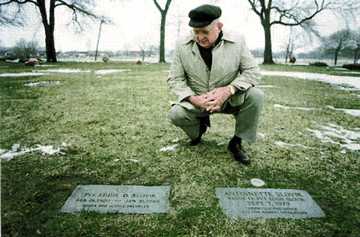
Edward Donald Slovik was buried in Plot E of the Oise-Aisne American Cemetery, his marker bearing a number instead of his name. Antoinette Slovik received a telegram informing her that her husband had died in the European Theater of war, and a letter instructing her to return a $55 allotment check. She would not learn about the execution for nine years.
“Bernard Calka, a former Macomb County commissioner, fought to have Pvt. Eddie Slovik’s remains brought back from France to be reburied next to his wife” Detroit News Blog
In 1987, President Ronald Reagan ordered the repatriation of Slovik’s remains. He was re-interred at Detroit’s Woodmere Cemetery next to Antoinette, who had gone to her final rest eight years earlier.
In all theaters of WWII, the United States military executed 102 of its own, almost always for the unprovoked rape and/or murder of civilians. From the Civil War to this day, Eddie Slovik’s death sentence remains the only one ever carried out for the crime of desertion. At least one member of the tribunal which condemned him to death, would come to see it as a miscarriage of justice.
Nick Gozik of Pittsburg passed away in 2015, at the age of 95. He was there in 1945, a fellow soldier called to witness the execution. “Justice or legal murder”, he said, “I don’t know, but I want you to know I think he was the bravest man in that courtyard that day…All I could see was a young soldier, blond-haired, walking as straight as a soldier ever walked. I thought he was the bravest soldier I ever saw.”
In the summer of 1938, the horrors of the Great War were a mere twenty years in the past. Hitler had swallowed up Austria, only six months earlier. Authorities divided the British Isles into “risk zones”, identified as “evacuation,” “neutral,” and “reception.” In some of the most gut wrenching decisions of the age, these people were planning “Operation Pied Piper”, the evacuation of millions of their own children, in the event of war.
For the people of the modern Czech Republic, the Munich agreement of 1938 was a betrayal. “O nás bez nás!” “About us, without us!”
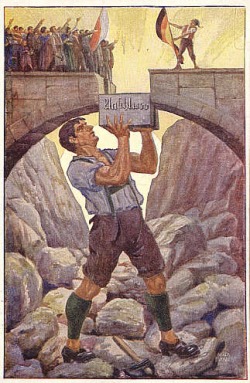
Nazi propaganda depicting German Anschluss with Austria
Intent on avoiding war with Nazi Germany, Italy, France and Great Britain had convened in Munich that September, to resolve German claims on western Czechoslovakia. The “Sudetenland”. Representatives of the Czech and Slovak peoples, were not invited.
On September 30, British Prime Minister Neville Chamberlain returned to London, declaring “Peace in Our Time”. The piece of paper Chamberlain held in his hand bore the signatures of Adolf Hitler, Benito Mussolini and Édouard Daladier as well as his own, annexing the Sudetenland, to Nazi Germany.
To Winston Churchill, it was an act of appeasement. Feeding the crocodile (Hitler), in hopes that he will eat you last. For much of Great Britain, the sense of relief was palpable.
In the summer of 1938, the horrors of the Great War were a mere twenty years in the past. Hitler had swallowed up Austria, only six months earlier. British authorities divided the home islands into “risk zones”, identified as “Evacuation,” “Neutral,” and “Reception.” In some of the most gut wrenching decisions of the age, these people were planning “Operation Pied Piper”, the evacuation of millions of their own children, in the event of war.
When Nazi Germany invaded Poland the following September, London mayor Herbert Morrison was at 10 Downing Street, meeting with Chamberlain’s aide, Sir Horace Wilson. Morrison believed that the time had come for Operation Pied Piper. A year to the day from the Prime Minister’s “Peace in our Time” declaration, Wilson protested. “But we’re not at war yet, and we wouldn’t want to do anything to upset delicate negotiations, would we?”
Morrison was done with the Prime Minister’s dilatory response to Hitler’s aggression, practically snarling in his thick, East London accent “Look, ’Orace, go in there and tell Neville this from me: If I don’t get the order to evacuate the children from London this morning, I’m going to give it myself – and tell the papers why I’m doing it. ’Ow will ’is nibs like that?”
Thirty minutes later, Morrison had the document. The evacuation, had begun.
Next weekend, Superbowl 52 will be played at U.S. Bank Stadium, in front of a crowd of 66,655. In 1938, forty-five times that number were mobilized in the first four days of the evacuation, primarily children, relocated from cities and towns across Great Britain to the relative safety of the countryside. What must that have sounded like?
BBC History reported that, “within a week, a quarter of the population of Britain would have a new address”.
Zeppelin raids had killed 1,500 civilians in London alone, during the ‘Great War’. Since then, governments had gotten so much better at killing each other’s citizens. As early as 1922, Prime Minister Lord Arthur Balfour had spoken of ‘unremitting bombardment of a kind that no other city has ever had to endure.’ As many as 4,000,000 civilian casualties were predicted, in London alone.
BBC History describes the man in charge of the evacuation, Sir John Anderson, as a “cold, inhuman character with little understanding of the emotional upheaval that might be created by evacuation”.
Children were labeled ‘like luggage’, and sent off with gas masks, toothbrushes and fresh socks & underwear. None of them knew to where, or for how long.
The evacuation of all that humanity ran relatively smoothly, considering. James Roffey, founder of the Evacuees Reunion Association, recalls ‘We marched to Waterloo Station behind our head teacher carrying a banner with our school’s name on it. We all thought it was a holiday, but the only thing we couldn’t work out was why the women and girls were crying.’
Arrivals at the billeting areas, were another matter. Many kids were shipped off to the wrong places, and rations were insufficient. Geoffrey Barfoot, billeting officer in the seaside town of Weston-super-Mare, said ‘The trains were coming in thick and fast. It was soon obvious that we just didn’t have the bed space.’
Kids were lined up against walls and on stages, and potential hosts were invited to “take their pick”.
For many, the terrors and confusion of those first few days grew into love and friendships, that lasted a lifetime. Others entered a hell of physical or sexual abuse, or worse.
For the first time, “city kids” and country folks were finding out how the “other half” lived, with sometimes amusing results. One boy wrinkled his nose on seeing carrots pulled out of muddy fields, saying “Ours come in tins”. Richard Singleton recalled the first time he asked his Welsh ‘foster mother’ for directions to the toilet. “She took me into a shed and pointed to the ground. Surprised, I asked her for some paper to wipe our bums. She walked away and came back with a bunch of leaves.”
John Abbot, evacuated from Bristol, had his rations stolen by his host family. He was horsewhipped for speaking out while they enjoyed his food, and he was given nothing more than mashed potatoes. Terri McNeil was locked in a birdcage and left with a piece of bread and a bowl of water.
In the 2003 BBC Radio documentary “Evacuation: The True Story,” clinical psychologist Steve Davis described the worst cases, as “little more than a pedophile’s charter.”
Eighty years later, the words “I’ll take that one”, are seared into the memories of more than a few.
Hundreds of evacuees were killed because of relocation, while en route or during their stays at “safe havens”. Two boys were killed on a Cornish beach, mined to defend against German amphibious assault. Apparently, no one had thought to put up a sign.
Irene Wells, age 8, was standing in a church doorway, when she was crushed by an army truck. One MP from the house of Commons said “There have been cases of evacuees dying in the evacuation areas. Fancy that type of news coming to the father of children who have been evacuated”.
When German air raids failed to materialize, many parents decided to bring the kids back home. By January 1940, almost half of evacuees had returned.
Authorities produced posters urging parents to leave the kids where they were, and a good thing, too. The Blitz against London itself began on September 7. The city experienced the most devastating attack to-date on December 29, in a blanket fire-bombing that killed almost 3,600 civilians.
Sometimes, refugees from relatively safe locations were shipped into high-risk target areas. Hundreds of refugees from Gibraltar were sent into London, in the early days of the Blitz. None of them could have been happy to leave London Station, to see hundreds of locals pushing past them, hurrying to get out.
This story doesn’t only involve the British home islands, either. American Companies like Hoover and Eastman Kodak took thousands of children in, from employees of British subsidiaries. Thousands of English women and children were evacuated to Australia, following the Japanese attack on Singapore.
By October 1940, the “Battle of Britain” had devolved into a mutually devastating battle of attrition, in which neither side was capable of striking the death blow. Hitler cast his gaze eastward the following June, with a surprise attack on his “ally”, Josef Stalin.
“Operation Steinbock”, the Luftwaffe’s last large-scale strategic bombing campaign of the war against southern England, was carried out three years later. 285 German bombers attacked London on this day in 1944, in what the Brits called the “Baby Blitz”. You’ve got to be some tough cookie, to call 245 bombers a Baby Blitz.
Late in the war, the subsonic “Doodle Bug” or V1 “flying bomb” was replaced by the terrifying supersonic V2. 1,000 or more of these, the world’s first rocket, were unleashed against southern England, primarily London, killing or wounding 115,000. With a terminal velocity of 2,386mph, you never saw or heard this thing coming, until the weapon had done its work.
In the end, many family ‘reunions’ were as emotionally bruising as the original breakup. Years had come and gone and new relationships had formed. The war had turned biological family members, into all but strangers.
Richard Singleton remembers the day his mother came, to take him home to Liverpool. “I had been happily living with ‘Aunty Liz and Uncle Moses’ for four years,” he recalled. “I told Mam that I didn’t want to go home. I was so upset because I was leaving and might never again see aunty and uncle and everything that I loved on the farm.”
Douglas Wood tells a similar story. “During my evacuation I had only seen my mother twice and my father once,” he recalls. “On the day that they visited me together, they had walked past me in the street as they did not recognise me. I no longer had a Birmingham accent and this was the subject of much ridicule. I had lost all affinity with my family so there was no love or affection.”
The Austrian-British psychoanalyst Anna Freud, daughter of Sigmund Freud, commissioned an examination of the psychological effects of the separation. After a 12-month study, she concluded that “separation from their parents is a worse shock for children than a bombing.”

 The boy had a talent for music. He was taught by another kid from Williamsburg, named Buddy Rich. By 14 he was good enough to be playing drums for money.
 At one point, Kaminsky’s unit gathered along a River. The Americans were so close they could hear German soldiers singing a beer hall song, from the other side. Kaminsky grabbed a bullhorn and serenaded the Germans back, crooning out an old tune that Al Jolson used to perform, in black face: “Toot Toot Tootsie, Goodbye”. After he was done, polite applause could be heard, drifting across the river. I can’t imagine many Allied soldiers ever tried singing to their Nazi adversaries, during World War II. The ones who actually pulled it off, must number precisely, one.
 Brooks started doing stand-up, when the regular comedian at one of the clubs was too sick to perform. By ’49 he was “Tummler”, the master entertainer at Grossinger’s, one of the most famous resorts in the Borscht Belt.


 In the months that followed, the United States ramped up its war capacity, significantly. Realizing this but having little information, the Imperial Japanese Navy (IJN) determined to visit Pearl Harbor once again, to have a look around.




 Reitsch began flying gliders in 1932, as the treaty of Versailles prohibited anyone flying “war planes” in Germany. In 1934, she broke the world’s altitude record for women (9,184 feet). In 1936, Reitsch was working on developing dive brakes for gliders, when she was awarded the honorary rank of Flugkapitän, the first woman ever so honored. In 1937 she became a Luftwaffe civilian test pilot. She would hold the position until the end of WW2.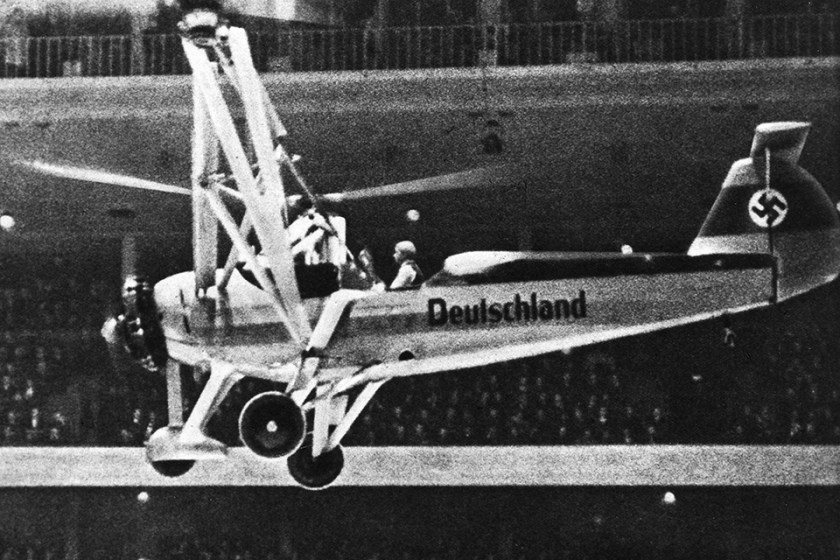
 Doctors did not expect her to live, let alone fly again. She spent five months in hospital, and suffered from debilitating dizzy spells. She put herself on a program of climbing trees and rooftops, to regain her sense of balance. Soon, she was test flying again.
 Hitler was initially put off by the idea, though she finally persuaded him to look into modifying a Messerschmitt Me-328B fighter for the purpose. Reitsch put together a suicide group, becoming the first to take the pledge, though the idea would never take shape. The pledge read, in part: “I hereby voluntarily apply to be enrolled in the suicide group as a pilot of a human glider-bomb. I fully understand that employment in this capacity will entail my own death.”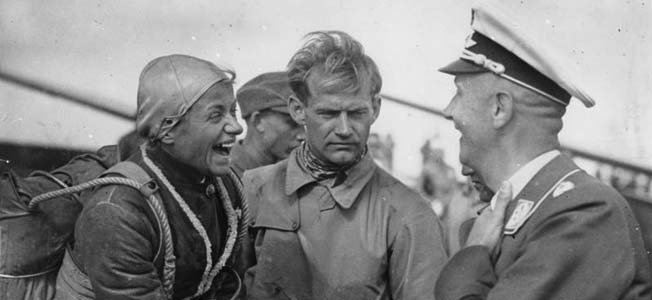
 Toward the end of her life, she was interviewed by the Jewish-American photo-journalist, Ron Laytner. Even then she was defiant: “And what have we now in Germany? A land of bankers and car-makers. Even our great army has gone soft. Soldiers wear beards and question orders. I am not ashamed to say I believed in National Socialism. I still wear the Iron Cross with diamonds Hitler gave me. But today in all Germany you can’t find a single person who voted Adolf Hitler into power … Many Germans feel guilty about the war. But they don’t explain the real guilt we share – that we lost“.

 The military and governing structure of the time was based on a rigid and inflexible class system, placing the feudal lords or daimyō at the top, followed by a warrior-caste of samurai, and a lower caste of merchants and artisans. At the bottom of it all stood some 80% of the population, the peasant farmer forbidden to engage in non-agricultural work, and expected to provide the income to make the whole system work.
 In time, these internal Japanese issues and the growing pressure of western encroachment led to the end of the Tokugawa period and the restoration of the Meiji Emperor, in 1868. The divisions would last, well into the 20th century.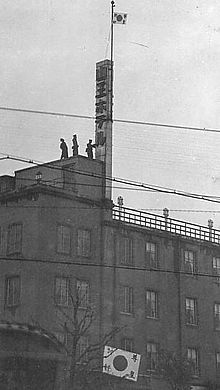


 Imperial Japan would rage for another 33 years.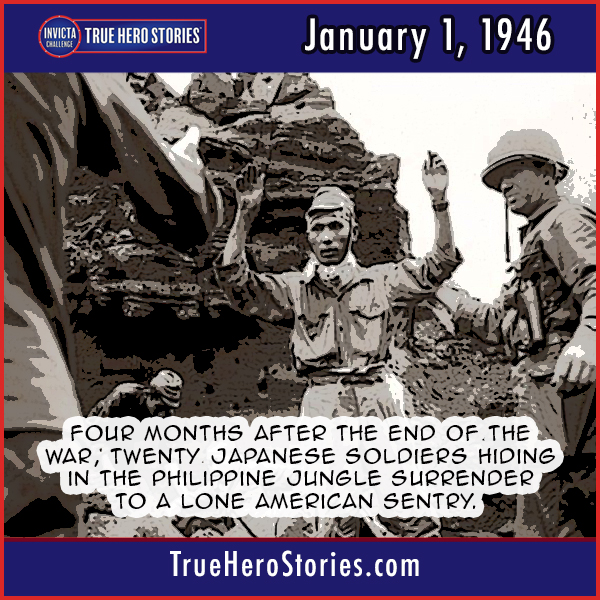
 Several went on to fight for the Viet Minh against French troops in Indochina.


 On February 7, the 71st Infantry and supporting tanks reached Ramree town where they found determined Japanese resistance, the town falling two days later. Naval forces blockaded small tributaries called “chaungs”, which the retreating Japanese used in their flight to the mainland. A Japanese air raid damaged an allied destroyer on the 11th as a flotilla of small craft crossed the strait, to rescue survivors of the garrison. By February 17, Japanese resistance had come to an end.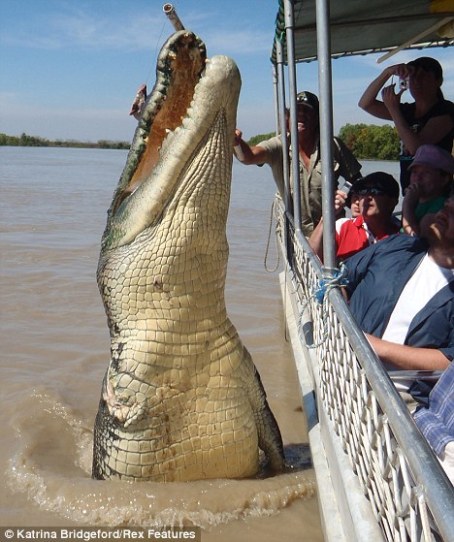



 The “Battle of the Atlantic” lasted 5 years, 8 months and 5 days, ranging from the Irish Sea to the Gulf of Mexico, from the Caribbean to the Arctic Ocean. Winston Churchill would describe this as “the dominating factor all through the war. Never for a moment could we forget that everything happening elsewhere, on land, at sea or in the air depended ultimately on its outcome”.
 New weapons and tactics would shift the balance first in favor of one side, and then to the other. In the end over 3,500 merchant ships and 175 warships would be sunk to the bottom of the ocean, compared with the loss of 783 U-boats.


 and crews to breathe while running submerged. Venturer was on batteries when the first sounds were detected, giving the British sub the stealth advantage but sharply limiting the time frame in which it could act.
 With four incoming at as many depths, the German sub didn’t have time to react. Wolfram was only just retrieving his snorkel and converting to electric, when the #4 torpedo struck. U-864 imploded and sank, instantly killing all 73 aboard.


 Those who could escape scrambled onto the deck, injured, disoriented, many still in their underwear as they emerged into the cold and darkness.
 Dorchester was listing hard to starboard and taking on water fast, with only 20 minutes to live. Port side lifeboats were inoperable due to the ship’s angle. Men jumped across the void into those on the starboard side, overcrowding them to the point of capsize. Only two of fourteen lifeboats launched successfully.
 Rushing back to the scene, coast guard cutters found themselves in a sea of bobbing red lights, the water-activated emergency strobe lights of individual life jackets. Most marked the location of corpses. Of the 904 on board, the Coast Guard plucked 230 from the water, alive.
 John 15:13 says “Greater love hath no man than this, that a man lay down his life for his friends”. Rabbi Goode did not call out for a Jew when he gave away his only hope for survival, Father Washington did not ask for a Catholic. Neither minister Fox nor Poling asked for a Protestant. Each gave his life jacket to the nearest man.


 Edward Donald “Eddie” Slovik was paroled in 1942, his criminal record making him 4F. “Registrant not acceptable for military service”. He took a job at the Montella Plumbing and Heating company in Dearborn, Michigan, where he met bookkeeper Antoinette Wisniewski, the woman who would later become his wife.
 The rapid movement of the army during this period caused difficulty for many replacements, in finding their units. Edward Slovik and John Tankey finally caught up with the 109th on October 7. The following day, Slovik asked his company commander Captain Ralph Grotte for reassignment to a rear unit, saying he was “too scared” to be part of a rifle company. Grotte refused, confirming that, were he to run away, such an act would constitute desertion.
 “I, Pvt. Eddie D. Slovik, 36896415, confess to the desertion of the United States Army. At the time of my desertion we were in Albuff [Elbeuf] in France. I came to Albuff as a replacement. They were shelling the town and we were told to dig in for the night. The following morning they were shelling us again. I was so scared, nerves and trembling, that at the time the other replacements moved out, I couldn’t move. I stayed there in my fox hole till it was quiet and I was able to move. I then walked into town. Not seeing any of our troops, so I stayed over night at a French hospital. The next morning I turned myself over to the Canadian Provost Corp. After being with them six weeks I was turned over to American M.P. They turned me loose. I told my commanding officer my story. I said that if I had to go out there again I’d run away. He said there was nothing he could do for me so I ran away again AND I’LL RUN AWAY AGAIN IF I HAVE TO GO OUT THERE. — Signed Pvt. Eddie D. Slovik A.S.N. 36896415”.
 1.7 million courts-martial were held during WWII, 1/3rd of all the criminal cases tried in the United States during the same period. The death penalty was rarely imposed. When it was, it was almost always in cases of rape or murder.


 When Nazi Germany invaded Poland the following September, London mayor Herbert Morrison was at 10 Downing Street, meeting with Chamberlain’s aide, Sir Horace Wilson. Morrison believed that the time had come for Operation Pied Piper. A year to the day from the Prime Minister’s “Peace in our Time” declaration, Wilson protested. “But we’re not at war yet, and we wouldn’t want to do anything to upset delicate negotiations, would we?”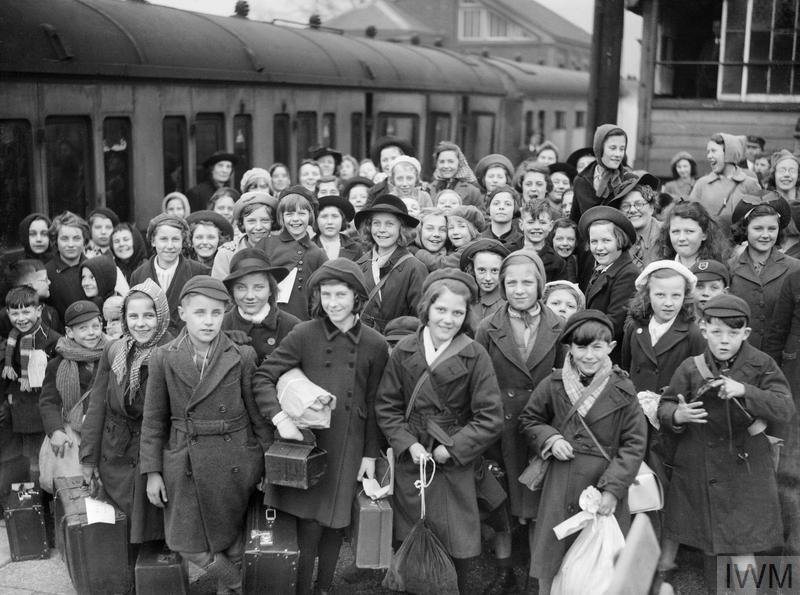
 BBC History reported that, “within a week, a quarter of the population of Britain would have a new address”.
 The evacuation of all that humanity ran relatively smoothly, considering. James Roffey, founder of the Evacuees Reunion Association, recalls ‘We marched to Waterloo Station behind our head teacher carrying a banner with our school’s name on it. We all thought it was a holiday, but the only thing we couldn’t work out was why the women and girls were crying.’
 In the 2003 BBC Radio documentary “Evacuation: The True Story,” clinical psychologist Steve Davis described the worst cases, as “little more than a pedophile’s charter.”
 Authorities produced posters urging parents to leave the kids where they were, and a good thing, too. The Blitz against London itself began on September 7. The city experienced the most devastating attack to-date on December 29, in a blanket fire-bombing that killed almost 3,600 civilians.
 By October 1940, the “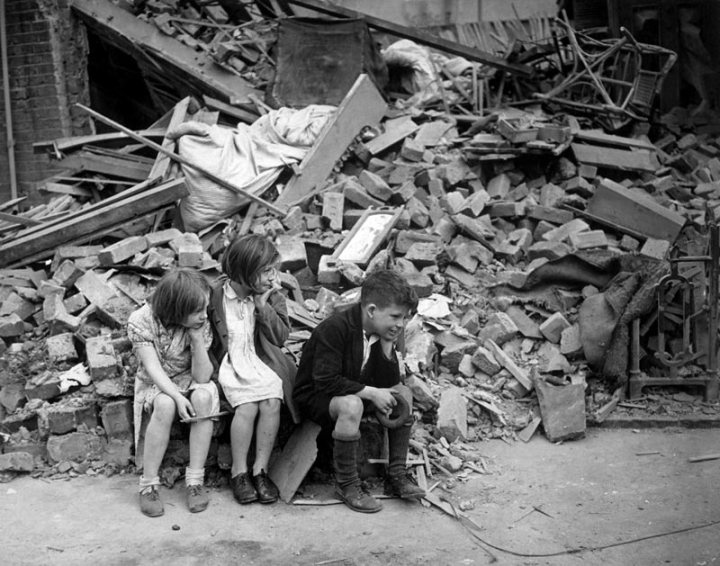
 In the end, many family ‘reunions’ were as emotionally bruising as the original breakup. Years had come and gone and new relationships had formed. The war had turned biological family members, into all but strangers.


You must be logged in to post a comment.