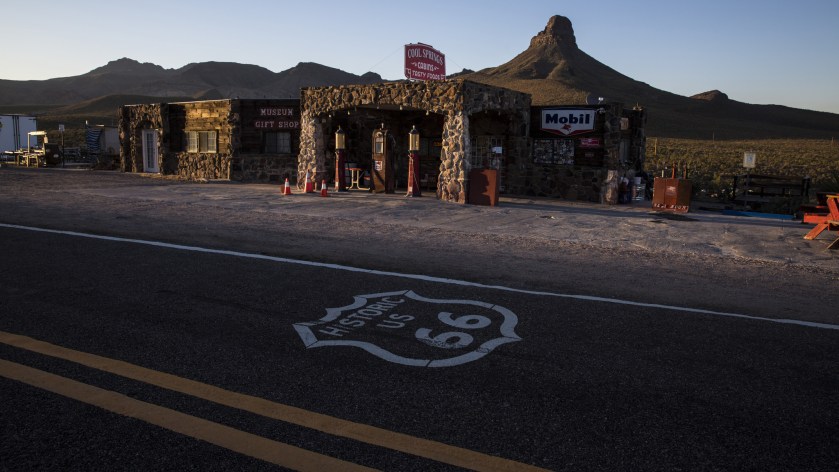
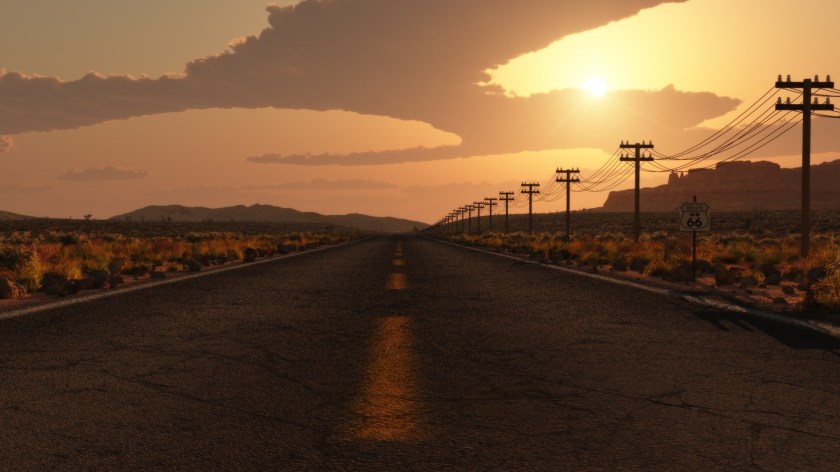
The golden age of the automobile, had arrived. All manner of roadside attractions popped up to serve the burgeoning tourist business. There were teepee-shaped motels and frozen custard stands. Indian curio shops and reptile farms.
In 1857, President James Buchanan appointed Lieutenant Edward Beale to survey and build a 1,000-mile wagon road from Fort Defiance, New Mexico to the Arizona/California border. The survey continued an experiment first suggested by Secretary of War and future President of the Confederate States of America Jefferson Davis, in the use of camels as draft animals.
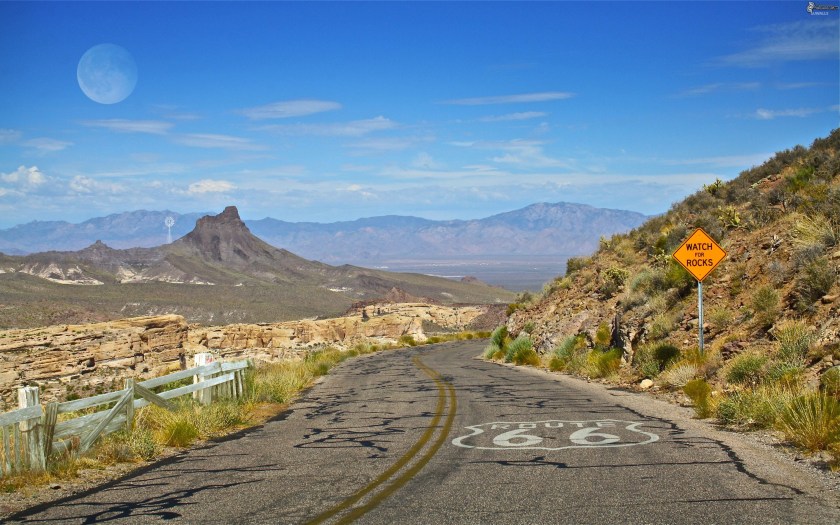
The camel part turned out to be a flop, but the road building was not. Beale’s wagon trail went on to become the western end of “America’s Main Street”. Route 66.
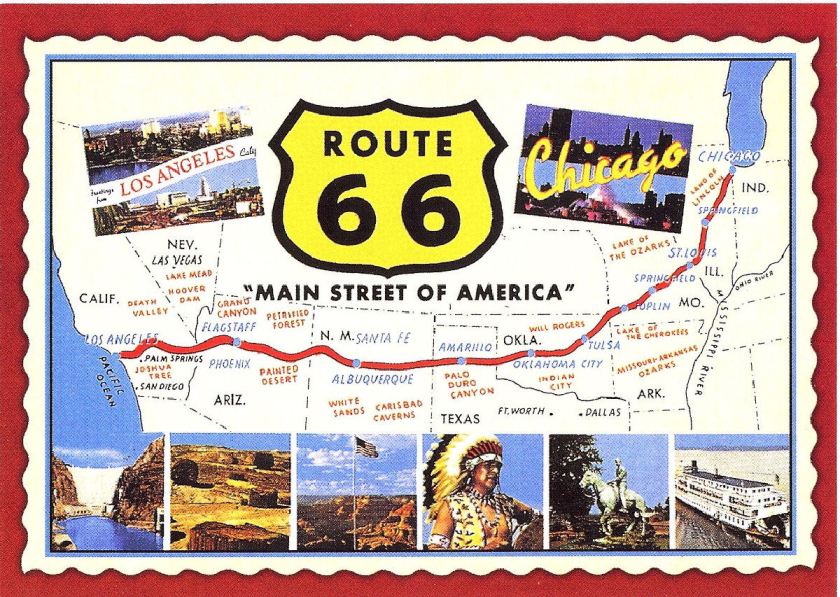
The “Mother Road” became an official part of the national highway system in 1927. It was yet to be paved, when the US Highway 66 Association held a “Bunion Derby” in 1928. It was a footrace from Los Angeles to Madison Square Garden, a distance of 3,423½ miles. Naturally, the LA to Chicago leg ran along Route 66.
Andy Hartley Payne, an Oklahoma Cherokee runner won the race in 573 hours, 4 minutes and 34 seconds. 11th place finisher Harry Abrams ran the race in the opposite direction the following year, becoming the only person to twice run across the continental United States.
In 1914, a Model T sold for $490. As the 20s drew to a close, the number of registered drivers had tripled to 23 million.
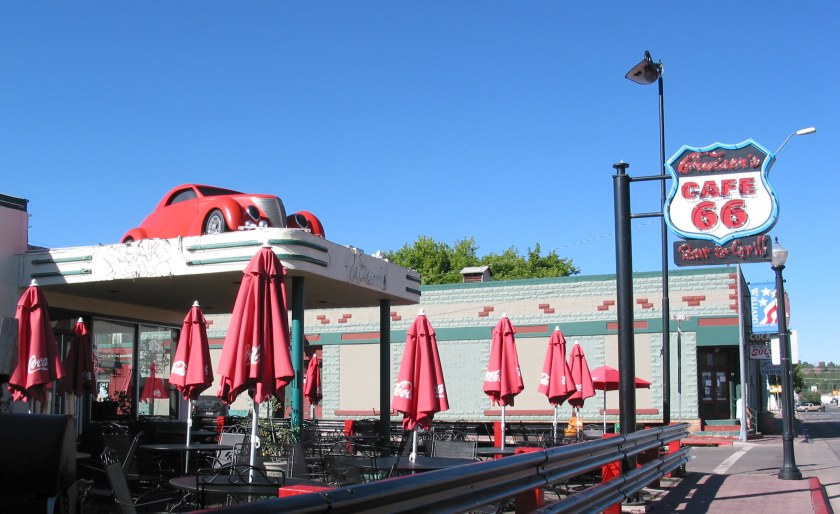
The 1932 Summer Olympics in Los Angeles and the westward migration of the “Dust Bowl” era increased the number of “Mom & Pop” service stations, restaurants, and motor courts, springing up to serve the needs of passing motorists.
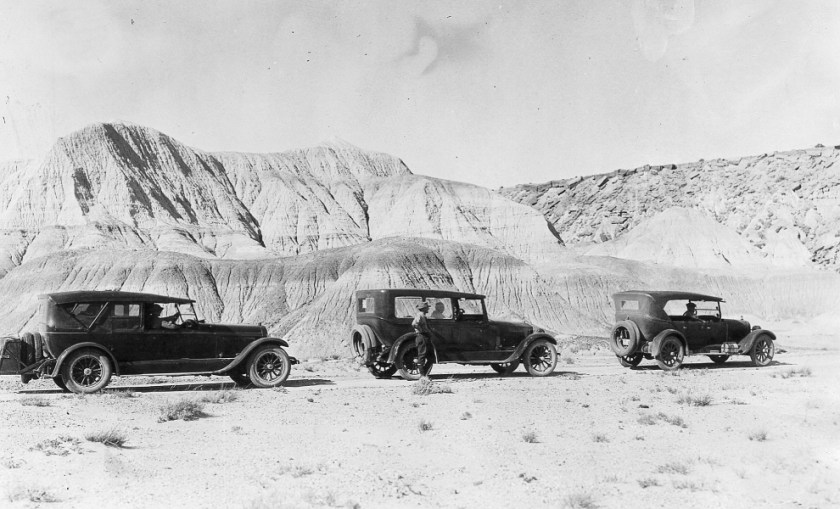
The road was fully paved by 1938, passing through the Painted Desert on the way by the Grand Canyon and Meteor Crater in Arizona.
The golden age of the automobile, had arrived. All manner of roadside attractions popped up to serve the burgeoning tourist business. There were teepee-shaped motels and frozen custard stands. Indian curio shops and reptile farms.
Meramec Caverns outside of St. Louis painted billboards on barns, calling themselves “Jesse James hideout”. The Big Texan sold a 72-ounce steak dinner, making it free to anyone who could eat the whole thing in an hour.
The fast-food industry was born on Route 66, when Sheldon “Red” Chaney built Red’s Giant Hamburg in Springfield, Missouri. Believed to be the first drive-through restaurant in the country, the name was supposed to be “Red’s Giant Hamburger“. Chaney had to cut the two bottom letters off his sign, when the city refused to raise the telephone wires.
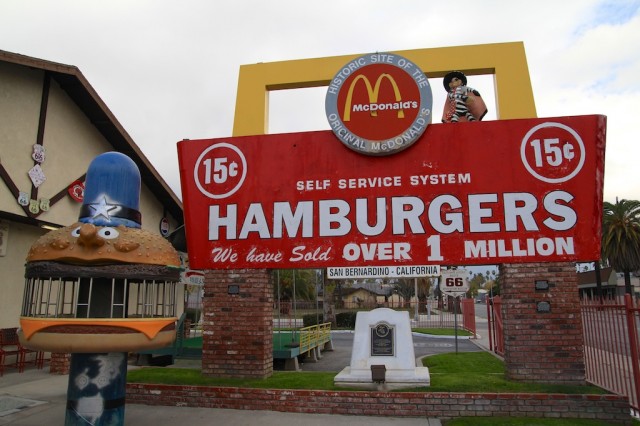
Patrick McDonald opened “The Airdrome” restaurant on Route 66 in 1937, years before the world knew anything about Ray Kroc. Hot dogs were some of the first items he ever sold. Ten cent hamburgers were added later, along with all-you-can-drink orange juice for five cents. Three years later, McDonald’s two sons Maurice and Richard (“Mac” and “Dick”) moved the entire building 40 miles east, to San Bernardino, calling the place “McDonald’s Bar-B-Que”.
General Eisenhower came out of WWII with an appreciation for the German highway system, the Autobahn, and signed the Interstate Highway Act as President in 1956. It was the beginning of the end for Route 66. New highway construction began to bypass town centers, and once-thriving Mom & Pops began to die off.
By the mid-’50s, Missouri upgraded its sections of US 66 to four lanes, by-passing town centers and the businesses that went with them.
Illinois widened US 66 from Chicago to the Mississippi River. By 1957, virtually the entire Missouri-Kansas-Oklahoma stretch was replaced by 4 lane toll roads. You could see the old 66 as you drove parallel to it, but travelers rarely stopped.
The last parts of Route 66 were decertified by state highway and transportation officials on this day in 1985. In some cities, the old road is now the “Business Loop”.
The Mother Road has been carefully preserved in some areas, abandoned in others.
Today, most of the old attractions are gone. You couldn’t drive the old Route 66 from Chicago to LA if you wanted to. But you could get close. If you plan ahead.
If you enjoyed this “Today in History”, please feel free to re-blog, “like” & share on social media, so that others may find and enjoy it as well. Please click the “follow” button on the right, to receive email updates on new articles. Thank you for your interest, in the history we all share.
At the height of the operation, an aircraft landed every thirty seconds in West Berlin. The USAF delivered 1,783,573 tons altogether and the RAF 541,937, on a total of 278,228 flights. The Royal Australian Air Force delivered 7,968 tons of freight in over 2,000 sorties. Added together, the Berlin Airlift covered nearly the distance from the Earth, to the Sun.
Following the end of World War II in Europe, the three major allied powers (United States, United Kingdom and the Soviet Union) met at Potsdam, capital of the German federal state of Brandenburg. The series of agreements signed at Cecilienhof Castle and known as the Potsdam agreement built on earlier accords reached at conferences at Tehran, Casablanca and Yalta, addressing issues of German demilitarization, reparations, de-nazification and the prosecution of war criminals.
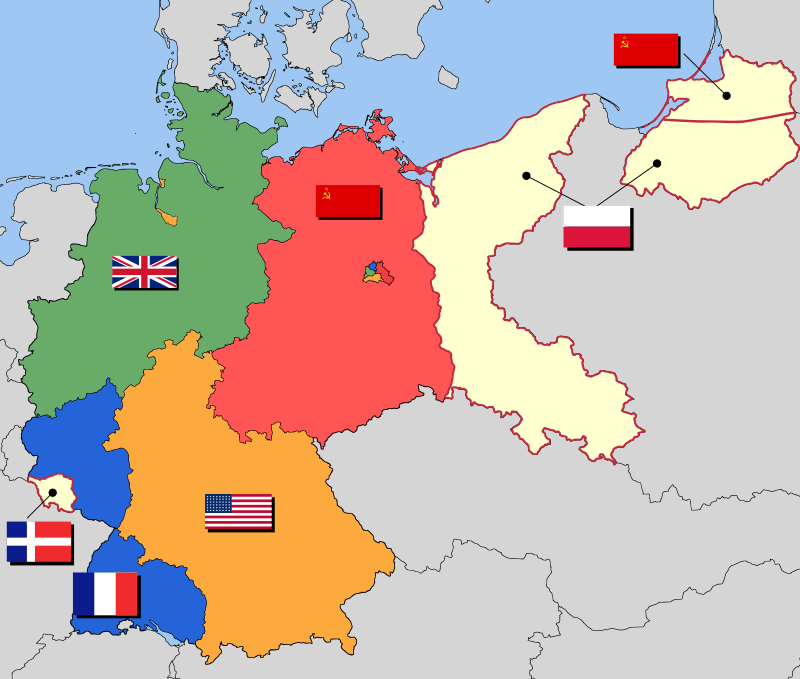
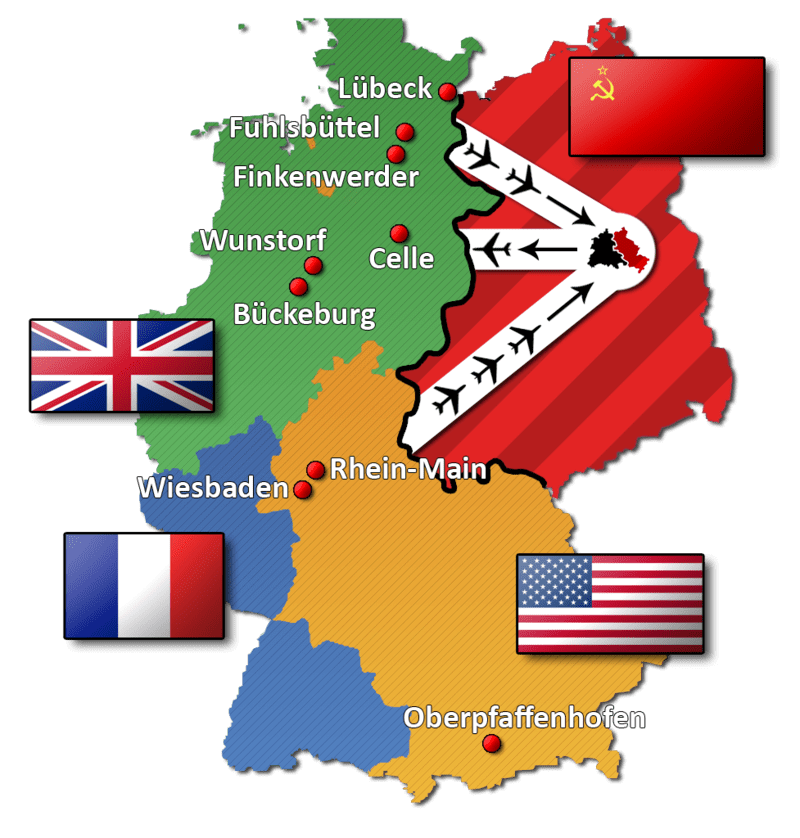
Among the provisions of the Potsdam agreement was the division of defeated Germany into four zones of occupation, rougly coinciding with the then-current locations of allied armies. The former capital city of Berlin was itself partitioned into four zones of occupation. A virtual island located 100 miles inside Soviet-controlled eastern Germany.
“The red area of Germany (above) is Soviet controlled East Germany. German territory east of the Oder-Neisse line (light beige) was ceded to Poland, while a portion of the easternmost section of Germany East Prussia, Königsberg, was annexed by the USSR, as the Kaliningrad Oblast”. H/T Wikipedia
During the war, ideological fault lines were suppressed in the mutual desire to destroy the Nazi war machine. These were quick to reassert themselves, in the wake of German defeat. In Soviet-occupied east Germany, factories and equipment were disassembled and transported to the Soviet union, along with technicians, managers and skilled personnel.
Soviet leader Josef Stalin informed German communist leaders in June 1945, of his belief that the United States would withdraw within a year or two. He had his reasons. At that time, the Truman Administration had yet to decide whether American forces would remain in West Berlin past 1949, when an independent West German government was expected to be established.
Stalin would do everything he could to undermine the British position within its zone of occupation, and appears unconcerned about that of the French. He and other Soviet leaders assured visiting Bulgarian and Yugoslavian delegations. In time, all of Germany would be Soviet, and Communist.
The former German capital became the focus of diametrically opposing governing philosophies, and leaders on both sides believed all Europe to be at stake. Soviet Foreign Minister Vyacheslav Molotov put it succinctly, “What happens to Berlin, happens to Germany; what happens to Germany, happens to Europe.”
There never was any formal agreement, concerning road and rail access to Berlin through the 100-mile Soviet zone. Western leaders were forced to rely on the “good will” of a regime which had deliberately starved millions of its own citizens to death, in consolidating power.
With 2.8 million Berliners to feed, clothe and shelter from the elements, Soviet leaders permitted cargo access on only ten trains per day over a single rail line.
Western allies believed the restriction to be only be temporary, but this belief would prove to be sadly mistaken.
Only three corridors were permitted through Soviet-controlled air space. With millions to feed, the Soviets stopped delivering agricultural products from their zone in eastern Germany, in 1946. The American commander, General Lucius Clay, retaliated by stopping shipments of dismantled industries from western Germany into the Soviet Union. The Soviets responded with obstructionist policies, doing everything it could to throw sand in the gears of all four occupied zones.
US and UK zones of occupation combined into a single “bizone” in January 1947, joining with that of France and becoming the “trizone” on June 1, 1948. Representatives of these governments and that of the Benelux nations of Belgium, the Netherlands and Luxembourg met twice in London to discuss the future of Germany, while Soviet leaders threatened to ignore any decisions coming out of such conferences.
The four-power solution was unworkable throughout the postwar period. For the city of Berlin, 1948 would reach the point of crisis.
That March, Soviet authorities slowed cargo to a crawl, individually searching every truck and train. General Clay ordered a halt to train traffic on April 2, ordering that supplies to the military garrison in Berlin be transported by air. Soviets eased their restrictions a week later, but still interrupted road and rail traffic. Meanwhile, Soviet military aircraft began to harass and “buzz” allied flights in and out of West Berlin. On April 5, a Soviet Air Force Yakovlev Yak-3 fighter collided with a British European Airways Vickers Viking 1B airliner near RAF Gatow airfield. Everyone onboard both aircraft, were killed.
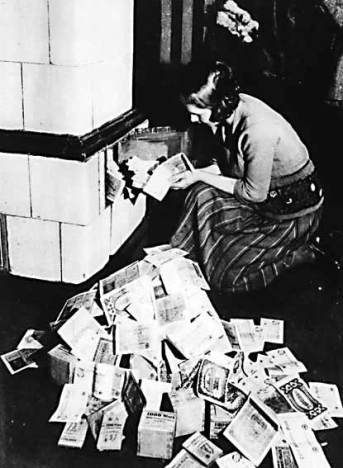
The final straw came with the currency crisis of early 1948, when the Deutsche Mark was introduced. The former Reichsmark was severely devalued by this time, with calamitous economic repercussions. The new currency went into use in all four sectors of occupied Berlin, against the wishes of the Soviets. This new currency combined with the Marshall Pan had the potential to revitalize the German economy, and that wouldn’t do. Not for Soviet policy makers, for whom a prostrate German economy remained the objective.
Soviet guards halted all traffic on the autobahn to Berlin on June 19, the day after the new currency was introduced.
German woman burning cash, for heat
At the time, West Berlin had 36 days’ food supplies, and 45 days’ supply of coal. The western nations had scaled military operations down in the wake of the war, to the point where the western sectors of the city had only 8,973 Americans, 7,606 British and 6,100 French. Soviet military forces numbered some 1.5 million. Believing that Allied powers had no choice but to cave to their demands, Soviet authorities cut off the electricity.
While ground routes were never negotiated in and out of occupied Berlin, the same was not true of the air. Three air routes had been agreed upon back in 1945. These went into use on this day in 1948, beginning the largest humanitarian airlift, in history.
Of all the malignant governing ideologies of history, Josef Stalin’s Soviet Union has to be counted among the worst. These people had no qualms about using genocide by starvation as a political tool. They had proven as much during the Holodomorof 1932 – ’33, during which this evil empire had murdered millions of its own citizens, by deliberate starvation. Two million German civilians would be nothing more than a means to an end.
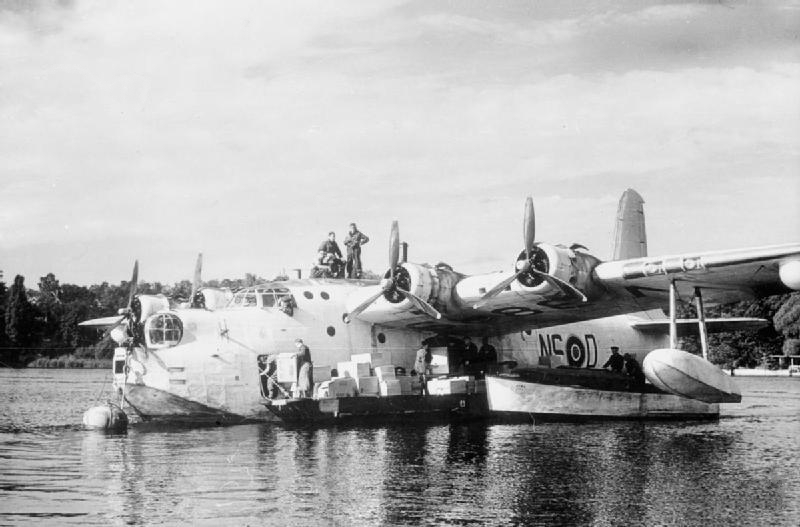
RAF Sunderland flying Boat moored on the Havel near Berlin unloading salt
With that many lives at stake, allied authorities calculated that a daily ration of only 1,990 kilocalories would require 646 tons of flour and wheat, 125 tons of cereal, 64 tons of fat, 109 tons of meat and fish, 180 tons of dehydrated potatoes, 180 tons of sugar, 11 tons of coffee, 19 tons of powdered milk, 5 tons of whole milk for children, 3 tons of fresh yeast for baking, 144 tons of dehydrated vegetables, 38 tons of salt and 10 tons of cheese.
Every. Single. Day.
Heat and power for such a population would require 3,475 tons of coal, diesel and gasoline, every day.
United States Air force General Curtis LeMay was asked “Can you haul coal?” LeMay replied “We can haul anything.”
Loading milk, bound for Berlin
The obstacles were daunting. Postwar demobilization had diminished US cargo capabilities in Europe to a nominal 96 aircraft, theoretically capable of transporting 300 tons per day. Great Britain’s RAF was somewhat better with a capacity of 400 tons, according to General Sir Brian Robertson.
700 tons were nowhere near the 5,000 per day that was needed, but it was a start. With additional aircraft mobilizing all over the United States, the United Kingdom and France, the people of occupied Berlin had to buy into the program.
General Clay went to Ernst Reuter, Berlin’s mayor-elect. “Look, I am ready to try an airlift. I can’t guarantee it will work. I am sure that even at its best, people are going to be cold and people are going to be hungry. And if the people of Berlin won’t stand that, it will fail. And I don’t want to go into this unless I have your assurance that the people will be heavily in approval.”
Luckily, General Albert Wedemeyer was in Europe on an inspection tour, when the crisis broke out. Wedemeyer had been in charge of the previously-largest airlift in history, the China-Burma-India theater route over the Himalayas, known as “The Hump”. Reuter was skeptical but assured the authorities that the people of Berlin were behind the plan. Wedemeyer’s endorsement gave the plan a major boost. The Berlin Airlift began seventy years ago today, June 26, 1948.
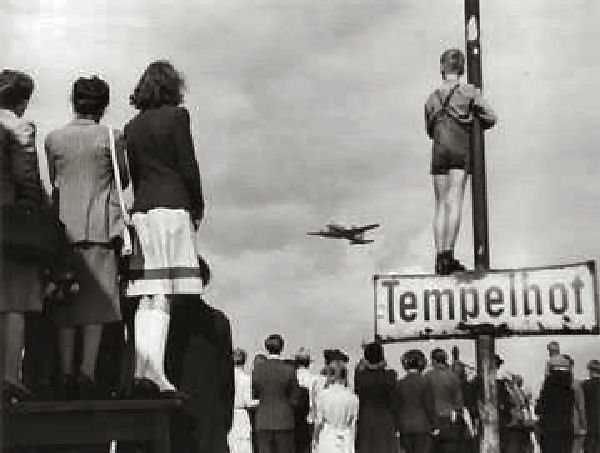
German civilians awaiting inbound aircraft, at Templehof
The Australian Air force joined in the largest humanitarian effort in history that September. The Canadians never did, believing the operation to be a provocation which would lead to war with the Soviet Union.
Through the Fall and Winter of 1948 – ’49 the airlift carried on. Soviet authorities maintained their stranglehold but, preoccupied with rebuilding their own war-ravaged economy and fearful of the United States’ nuclear capabilities, Stalin had little choice but to look on. On April 15, 1949, the Soviet news agency TASS announced that the Soviets were willing to lift the blockade.
C-54 drops candy over berlin, 1948 – ’49
Negotiations were begun almost at once but now, the Allies held the stronger hand. An agreement was announced on May 4 that the blockade would be ended, in eight days’ time. A British convoy drove through the gates at a minute after midnight on May 12, though the airlift would continue, to build up a comfortable surplus.
At the height of the operation, an aircraft landed every thirty seconds in West Berlin. The USAF delivered 1,783,573 tons altogether and the RAF 541,937, on a total of 278,228 flights. The Royal Australian Air Force delivered 7,968 tons of freight in over 2,000 sorties. Added together, the Berlin Airlift covered nearly the distance from the Earth, to the Sun.
39 British and 31 American airmen lost their lives during the operation.
In 1961, Communist leaders would erect a wall around their sector of the city. Not to keep foreigners out, but to keep their own unfortunate citizens, in. The Berlin Wall would not come down, for twenty-eight years.
If you enjoyed this “Today in History”, please feel free to re-blog, “like” & share on social media, so that others may find and enjoy it as well. Please click the “follow” button on the right, to receive email updates on new articles. Thank you for your interest, in the history we all share.
No whites were to be permitted onto these territories but for Federal Government officials, but the rich resources of the Black Hills, first in timber and then in gold, made the provision near-impossible to enforce.
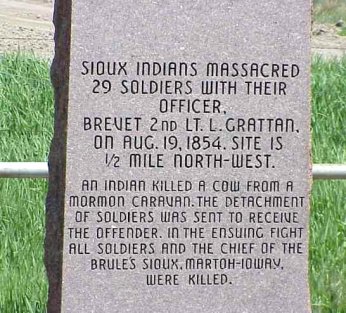
During the late summer of 1854, 4,000 natives of the Brulé and Oglala Sioux were camped in the future Wyoming territory, near the modern city of Torrington, WY. On August 17, visiting Miniconjou High Forehead killed a wandering cow, belonging to a Mormon traveling the nearby Oregon trail. The native camp accorded with the terms of the treaty of 1851 and the cow episode could have been amicably handled, but events quickly spun out of control.
Chief Conquering Bear attempted to negotiate recompense, offering a horse or cow from the tribe’s herd. The owner refused, demanding $25. That same treaty of 1851 specified that such matters would be handled by the local Indian agent, in this case John Whitfield, scheduled to arrive within days with tribal annuities more than sufficient to settle the matter to everyone’s satisfaction.
Ignorant of this provision or deliberately choosing to ignore it, senior officer Lieutenant Hugh Fleming from nearby Ft. Laramie requested that the Sioux Chief arrest High Forehead, and hand him over to the fort. Conquering Bear refused, not wanting to violate rules of hospitality. Besides, the Oglala Chief had no authority over a Miniconjou.
6th Infantry Regiment Second Lieutenant John Grattan arrived with a force of twenty-nine and a bad attitude, intent on arresting the cow’s killer. One Ft. Laramie commander later remarked, “There is no doubt that Lt. Grattan left this post with a desire to have a fight with the Indians, and that he had determined to take the man at all hazards.” French-Native interpreter Lucienne Auguste was contemptuous, taunting Sioux warriors as “women” and threatening that the soldiers had come not to talk, but to kill.
What followed was all but inevitable. Angry warriors took up flanking positions around the soldiers, one of whom panicked and fired, mortally wounding Conquering Bear. When it was over, all thirty soldiers were dead, their bodies ritually mutilated.
The Federal government was quick to respond to the “Gratton Massacre”, Secretary of War Jefferson Davis characterizing the incident as “the result of a deliberately formed plan.”
The first Sioux War of 1854 – ’56 became the first of seven major wars and countless skirmishes between the United States and various sub-groups of the Sioux people, culminating in the Ghost Dance War of 1890.
Diametrically opposite cultures steeped in mutual distrust engaged in savage cruelty each upon the other, often at the expense of innocents. There was even one major massacre of natives by other natives, when a war band of some 1,500 Oglala/Brulé Sioux attacked a much smaller group of Pawnee, during their summer buffalo hunt. Seventy-one Pawnee warriors were killed along with 102 of their women and children, their bodies horribly mutilated and scalped, some even set on fire.
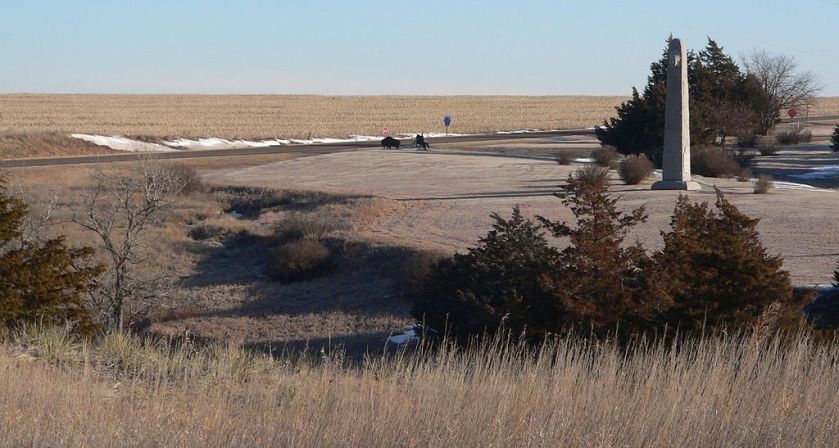
Today, a 35-foot obelisk stands in mute witness, to the horrors of “Massacre Canyon”.
Massacre Canyon Monument
In the early eighteenth century, peoples of the Suhtai and Tsitsista tribes migrated across the northern Mississippi River, pushing the Kiowa to the southern plains and in turn being pushed westward, by the more numerous Lakota, or “Teton” Sioux. These were the first to adopt the horse culture of the northern plains, the two tribes merging in the early 19th century to become the northern Cheyenne.
The ten bands comprising the northern Cheyenne spread from the black hills of South Dakota, to the Platte Rivers of Colorado, at times antagonistic to and at others allied with all or part of the seven nations of the Sioux.
In 1866, the Lakota people went to war behind Chief Red Cloud, over Army encroachment onto the Powder River basin area, in northeastern Wyoming. The war ended two years later with the Treaty of Fort Laramie, granting a Great Sioux Reservation to include the western half of South Dakota including the Black Hills, as well as large, “unceded territory” in Wyoming and Montana and the Powder River Country, as Cheyenne and Lakota hunting grounds.
No whites were to be permitted onto these territories but for Federal Government officials, but the rich resources of the Black Hills, first in timber and then in gold, made the provision near-impossible to enforce.
The Army attempted for a time to keep settlers out of Indian territories, while political pressure mounted on the Grant administration to take back the Black Hills from the Lakota. Delegations of Sioux Chieftains traveled to Washington, D.C. in an effort to persuade the President to honor existing treaties, and to stem the flow of miners into their territories. Congress offered $25,000 for the land, and for the tribes to relocate south to Indian Territory, in modern-day Oklahoma. Chief Spotted Tail spoke for the whole delegation: “You speak of another country, but it is not my country; it does not concern me, and I want nothing to do with it. I was not born there … If it is such a good country, you ought to send the white men now in our country there and let us alone.”
The government now determined to force the issue, and imposed a deadline of January 31. That many of the tribes even knew of such a time limit seems unlikely. The government’s response was unworthy of a Great Nation. On February 8, 1876, Major General Philip Sheridan ordered the commencement of military operations against those deemed “hostiles”.
The Great Sioux War of 1876-’77 began with a ham-fisted assault on the frigid morning of March 17, when Colonel Joseph Reynolds and six companies of cavalry attacked a village believed to that of the renegade Crazy Horse, but turned out to be a village of Northern Cheyenne.
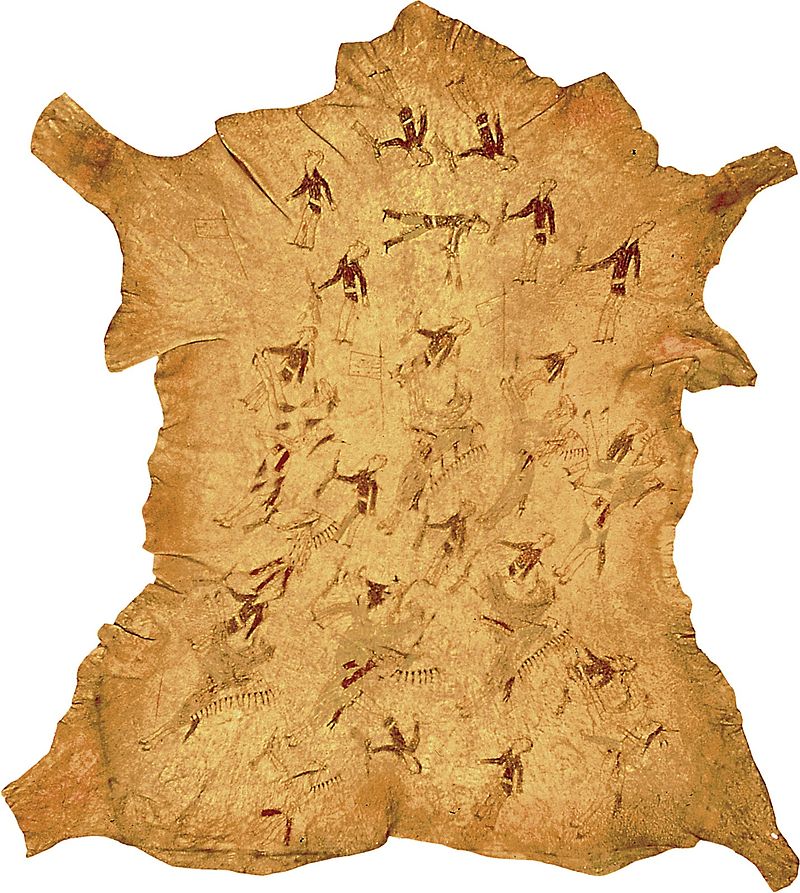
Cheyenne Artist’s Depiction of the Battle of Little bighorn
A second, far larger campaign was launched that Spring, when three columns were sent to converge on the Lakota hunting grounds. Brigadier General George Crook’s column was the first to make contact, resulting in the Battle of Rosebud Creek on June 17. While Crook claimed victory afterward, the native camp was vastly larger than expected, and Crook withdrew to camp and wait for reinforcements. He had just taken his force out of what was to come.
General Alfred Terry dispatched the 7th Cavalry, 31 officers and 566 enlisted men led by Lieutenant Colonel George Armstrong Custer, to begin a reconnaissance in force along the Rosebud. Custer was given the option of departing from his orders and going on the offence, should there be “sufficient reason”. For a man possessed of physical bravery bordering on recklessness – Custer had proven that thirteen years earlier at Gettysburg – there was bound to be sufficient reason.
Custer divided his force into three detachments, more concerned about preventing the escape of the “hostiles”, than with fighting them. It was a big mistake.
The tale of those other two columns is worth a “Today in History” essay of their own if not an entire book, but this is a story about Little Big Horn. Suffice it to say that Major Marcus Reno‘s experience of this day was as grizzly and as shocking, as that moment when the brains and face of his Arikara scout Bloody Knife spattered across his own. Reno’s detachment had entered a buzz saw and would have been annihilated altogether, had it not met up with that of captain Frederick Benteen.
To describe what followed as “Custer’s last stand“ is to conjure images of soldiers fighting back to back, or crouched behind dead and dying horses amidst a swirling tide of warriors. Later archaeological evidence reveals not piles of spent casings marking the site of each man’s last desperate stand, but rather a scattering of brass across the hillside. Like a handful of rice, tossed across a hardwood floor.
2,500 warriors swept down on 268. There were no survivors.
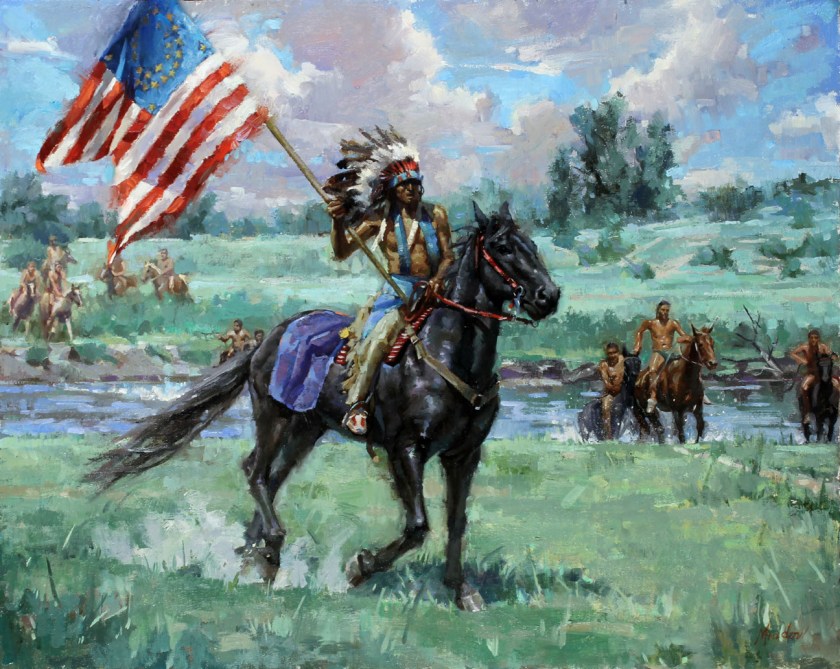
Capture The Flag, at Little Bighorn
The Battle of Little Big Horn, the Natives called it the “Battle of the Greasy Grass”, may be more properly regarded as the Indian’s last stand. Custer’s detachment was destroyed, to a man. Within hours, an enormous encampment of 10,000 natives or more were returning to their reservations, leaving no more than 600 in their place.
Crook and Terry awaited reinforcements for nearly two months after the battle. Neither cared to venture out again, until there were at least 2,000 men.
Most such outbreaks coincided with periods of extreme hardship such as crop failure, famine and floods, and involved between dozens and tens of thousands of individuals.
Amidst our people here is come The madness of the dance. In every town there now are some Who fall upon a trance. It drives them ever night and day, They scarcely stop for breath, Till some have dropped along the way And some are met by death. – Straussburgh Chronicle of Kleinkawel, 1625
A legend of the medieval Christian church had it that, if anyone were to provoke the wrath of St. Vitus, the Sicilian saint martyred in 303AD, he would send down plagues of compulsive dancing. One of the first outbreaks of St. Vitus’ Dance, occurred sometime in the 1020s in Bernburg, Germany. 18 peasants disturbed a Christmas Eve service, singing and dancing around the church.
In a story reminiscent of the Pied Piper of Hamelin, a large group of children jumped and danced all the way from Erfurt to Arnstadt in 1237, a distance of some sixteen miles. In 1238, 200 people jumped, twitched and convulsed on a bridge over the River Meuse, until the span collapsed.
A major outbreak St. Vitus’ Dance occurred on June 24, 1374. The population writhed and jerked through the streets of Aachen, screaming of visions and hallucinations until, one by one, each collapsed. There, victims continued to tremble and twitch on the ground, too exhausted to stand.
Most such outbreaks coincided with periods of extreme hardship such as crop failure, famine and floods, and involved between dozens and tens of thousands of individuals.
This “choreomania”, more commonly referred to as dancing mania, spread throughout Europe, fanning out to Cologne, Flanders, Franconia, Hainaut, Metz, Strasbourg, Tongeren and Utrecht. Further outbreaks were reported in England and the Netherlands.
One Frau Troffea began to dance in a street in Strasbourg in July 1518, going at it somewhere between four to six days. 34 joined in by the end of a week. Within the month there were 400 more. Many of this primarily female group actually danced themselves to death, succumbing to heart attack or stroke. Others collapsed in exhaustion, their bloody feet no longer able to hold them up.
According to one report, the dancing plague was killing fifteen people every day.
Reactions varied. Some thought those suffering from dance mania were possessed by the devil, others by ‘hot blood’. Doctors were called, who advised that the Dance be allowed to run its course. Bands were hired and one town even built a dance floor, to contain the phenomenon.
There were no fewer than seven distinct outbreaks of the dancing plague during the medieval period, and one in Madagascar as late as 1840.
Even today there is little consensus about what caused the phenomenon. Some have blamed “St Anthony’s Fire”, a toxic and psychoactive fungus of the Claviceps genus, also known as ergot. Often ingested with infected rye bread, symptoms of ergot poisoning are not unlike those of LSD, and include nervous spasms, psychotic delusions, spontaneous abortion, convulsions and gangrene resulting from severe vasoconstriction.
Many associate the Salem witchcraft hysteria of 1692 with ergot poisoning but, for others, such explanations are wanting. Both the dancing episodes of earlier centuries and the witchcraft chapter involved lucid and deliberate action, far more than the convulsions and involuntary spasms associated with ergotism.
Others describe the Dancing Plague phenomenon as some kind of mass psychosis, brought on by the Bubonic Plague. The Black Death, a pandemic which killed 75-100 million people around the earth, in a world with a population of 450 million. The explanation seems as plausible as any. The modern mind is incapable of understanding (at least mine is) what it is to live in a world where one in every four-to-five people on the planet is dead, killed by a horror not one of them understands.
Long before germ theory was commonly understood, disease was thought to be borne of odors. Medieval plague doctors donned head-to-toe waxed canvas gowns and leather hats, with the distinctive beak-like mask filled with aromatic herbs.
Today, a calamity of such magnitude would kill over 1.5 Billion souls.
If you enjoyed this “Today in History”, please feel free to re-blog, “like” & share on social media, so that others may find and enjoy it as well. Please click the “follow” button on the right, to receive email updates on new articles. Thank you for your interest, in the history we all share.
Strong men, bareback riders, trapeze performers and acrobats were killed instantly and others horribly maimed, as wooden circus cars telescoped into one another. Confused and bleeding survivors stumbled from the wreckage, as gas-fed lanterns began to set fire to all that wood.
There is an oft-repeated but mistaken notion that the circus goes back to Roman antiquity. The panem et circenses, (bread and circuses)” of Juvenal, ca AD100, refers more to the ancient precursor of the racetrack, than to anything resembling a modern circus. The only common denominator is the word itself, the Latin root ‘circus’, translating into English, as “circle”.
The father of the modern circus is the British Sergeant-Major turned showman, Philip Astley. A talented horseman, Astley opened a riding school near the River Thames in 1768, where he taught in the morning and performed ‘feats of horsemanship’ in the afternoon. Equestrian and trick riding shows were gaining popularity all over Europe at this time, performers riding in circles to maintain balance while standing on the backs of galloping horses. It didn’t hurt matters, that the “ring” made it easier for spectators to view the event.
These afternoon shows gained overwhelming popularity by 1770, and Astley hired acrobats, rope-dancers, and jugglers to fill the spaces between equestrian events. The modern circus, was born.
From that day to this, the “Fancy Pants” dresses in red tailcoat and top hat, evocative of British fox hunting garb. This “Announcer” is commonly (and mistakenly) called the “ringmaster”, while the true ring master is the “equestrian director”, standing in the center of the ring and pacing horses for the riding acts.
In 1825, Joshuah Purdy Brown of Somers New York replaced the wooden structure common to European circuses with a canvas tent, around the time when cattle dealer Hachaliah Bailey bought a young African elephant, and began to exhibit the animal all over the country.
The exotic animal angle was a great success. Other animals were added, and farmers were soon leaving their fields to get into the traveling menagerie business. The unique character of the American traveling circus emerged in 1835, when 135 such farmers and menagerie owners combined with three affiliated circuses to form the American Zoological Institute.
Phineas Taylor Barnum and William Cameron Coup launched P.T. Barnum’s Museum, Menagerie & Circus in 1871, where the “museum” part was a separate exhibition of human and animal oddities. It wouldn’t be long, before the ‘sideshow” became a regular feature of the American circus.
There have been no fewer than 81 major circuses in American history, and countless “Dog & Pony” shows, programs so small as to include only a few family members and an assistant or two, with a couple of trained animals. And all this time, I thought ‘Dog & Pony Show’ referred to the United States Congress.
The ‘Greatest Show on Earth’ closed for the last time on Sunday, May 21 2017, when ‘animal rights activists’ and changing tastes in entertainment finished the Ringling Brothers, Barnum & Bailey Circus, ending a 146-year run.
In the mid-19th century, German animal trainer Carl Hagenbeck toured Europe with “ethnographical” spectacles, combining animals with native peoples such as the Sámi of the Scandinavian peninsula, complete with reindeer and sleds. Hagenbeck was among the first to develop animal training methods based on trust and reward rather than pain and fear, his demonstrations emphasizing the animal’s intelligence and tractability over ferocity.
In 1906, Hagenbeck sold his traveling animal show to American circus operator Benjamin Wallace, before going on to develop open zoological gardens and native panoramas which would be familiar to today’s zoo enthusiast, rather than the barred cells of his day.
The American war machine was spinning up to peak operational capacity in 1918, as the industrial might of the nation pursued an end to the war ‘over there’.
Hagenbeck-Wallace was one of the premier circuses of the day, moving about the country on three trains and employing no fewer than 1,000 roustabouts and assorted performers.
In the small hours of June 22, an engineer with the Michigan Central Railroad was at the wheel of Train No. 41, an empty 21-car troop train. Automatic signals and flares and at least one frantic signalman should have warned the driver that a stalled train lay on the track ahead, but he missed them all. Alonzo Sargent was asleep at the wheel.
The following day, newspapers across the country told the story of what happened next.
On June 22, the circus was scheduled to appear at the Show Grounds at 150th and Calumet Avenue in Hammond, Indiana. In the early morning darkness, an overheated axle box required one train to make an unscheduled stop. It was 4am and most of the circus’ employees were asleep, when the Michigan Central locomotive smashed into the rear of the stalled train.
The Hammond circus train wreck was one of the worst such accidents, in history. Strong men, bareback riders, trapeze performers and acrobats were killed instantly and others horribly maimed, as wooden circus cars telescoped into one another. Confused and bleeding survivors stumbled from the wreckage, as gas-fed lanterns began to set fire to all that wood.
Hagenbeck-Wallace clown “Big Joe” Coyle
Those lucky enough to escape the horror were forced to watch in disbelief as friends, families and co-workers were incinerated alive.
Hours later a clown, “Big Joe” Coyle, could be seen weeping, beside the mangled bodies of his wife and two small boys.
127 were injured and an estimated 86 crushed or burned to death in the wreck. The rumor mill went berserk. Wild lions and tigers had escaped and were roaming the streets and back yards of Gary, Indiana. Elephants died in an heroic attempt to put out the flames, spraying water on the burning wreckage with their trunks.
None of the stories were true. The animals had passed through hours before on an earlier caravan, and now awaited a train which would never come.
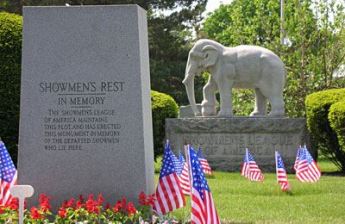
The Showmen’s League of America was formed in 1913, with Buffalo Bill Cody its first President. The group had recently purchased a 750-plot parcel at the Woodlawn Cemetery in Forest Park, Illinois and called it “Showmen’s Rest”, having no idea their investment would be used so soon.
A mass grave was dug for the unidentified and unidentifiable. Some of the dead were roustabouts or temporary workers, hired only hours or days earlier. Some performers were known only by stage names, their gravestones inscribed with names like “Four-Horse Driver”, “Baldy” and “Smiley”.
The Hagenbeck-Wallace circus was a big deal in those days. Famed lion tamer Clyde Beatty was a member, as was a young Red Skelton, tagging along with his father, who worked as a clown.
Only two shows had to be canceled, as erstwhile ‘competitors’ Barnum & Bailey and others lent workers, performers and equipment. The show would go on.
In the world of elephants, an upraised trunk carries connotations of joy, while a lowered trunk symbolizes mourning. At the Woodlawn cemetery of Chicago, five elephant statues circumscribe the mass grave of clowns, trapeze artists, strongmen and other circus performers. Each has a foot raised with a ball underneath. Every trunk, hangs low. The largest of the five bears the inscription, “Showmen’s League of America.” On the other four are inscribed the words “Showmen’s Rest”.
British envoys delivered proclamations reaffirming the practice of impressment, amounting to the kidnapping of sailors and forcing their labor aboard British ships. In total, the Royal Navy impressed over 9,000 sailors claiming to be American citizens, becoming the driving force behind the United States going to war with England, in 1812.
The Napoleonic Wars took place between 1799 and 1815, pitting a series of seven international coalitions against the forces of Napoleon Bonaparte and his Grande Armée. The former American colonies benefited from the European conflict, remaining on the sidelines and doing business with both sides. Within a ten-year period, the fledgling United States had become one of the world’s largest neutral shippers.
In 1807, two third-rate French warships were penned up in Maryland’s Chesapeake Bay, blockaded by a number of English warships outside of the harbor.
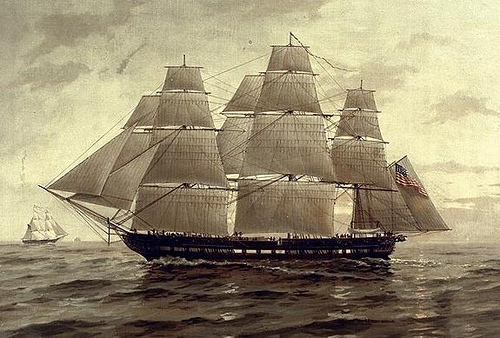
The American frigate, USS Chesapeake
London born Jenkin Ratford was an English sailor who deserted the British Navy and defected to the neutral United States. This story might have ended better for him had he not run his mouth, but that wasn’t this guy. Ratford couldn’t resist taunting British officers, boasting of his escape to the “land of liberty”
The USS Chesapeake was preparing for a Mediterranean cruise with Ratford aboard, when she emerged from Norfolk, Virginia. Her decks were laden with supplies and stores of every kind, and her guns unwisely stored. Chesapeake was nowhere near combat ready when she was approached by the HMS Leopard on June 22.
The Chesapeake’s commander, Commodore James Barron, was unconcerned when the Leopard, under the command of Captain Salusbury Pryce Humphreys, asked permission to board. Lieutenant John Meade of Her Majesty’s Navy presented Barron with a search warrant. Barron declined to submit, and the officer returned to the Leopard.
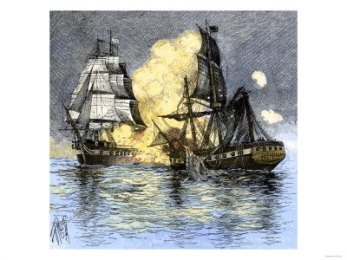
Humphreys then used a hailing trumpet and ordered the American ship to comply, to which Barron responded “I don’t hear what you say”. Humphreys fired two rounds across Chesapeake’s bow, followed immediately by four broadsides.
Chesapeake fired a single shot before striking colors and surrendering. Humphreys refused the surrender and boarded, taking Ratford and three American born sailors with them when they left.
There was little resistance, yet the “Chesapeake-Leopard Affair” had left three American crewmembers dead, and 18 wounded.
American public opinion was outraged over the humiliation, as the four men were transported to Halifax for trial. Federalists and Democratic-Republicans were united as never before. President Thomas Jefferson remarked “Never since the Battle of Lexington have I seen this country in such a state of exasperation as at present, and even that did not produce such unanimity.”
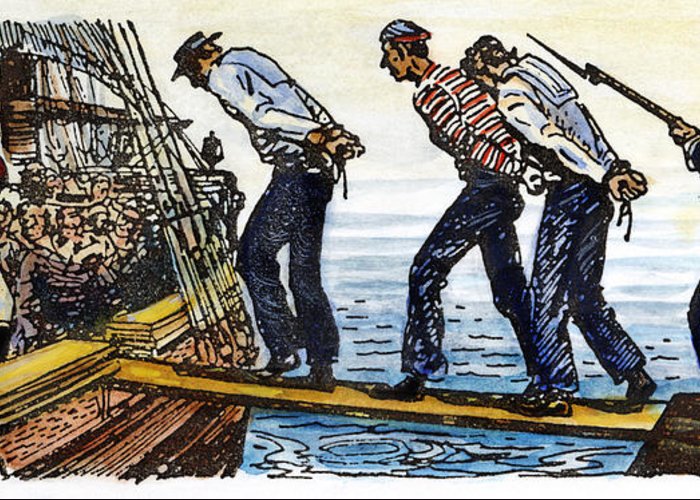
The English court found all four guilty of desertion and hanged Ratford by the fore yardarm of his former vessel, HMS Halifax. The three Americans, David Martin, John Strachan, and William Ware, were sentenced to 500 lashes.
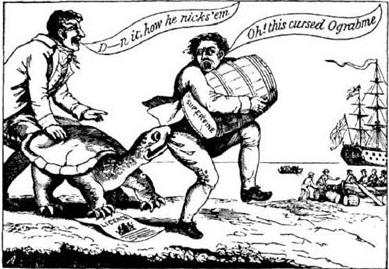
With the puny American navy deployed to the Mediterranean to check the Barbary pirates, President Jefferson’s options were limited to economic retaliation. The Embargo Act of 1807 intended to extract concessions from France and Great Britain, instead had the effect of imposing crippling setbacks on some industries, while others railed against government interference in the private economy. Many came to the conclusion that the only solution, lay in violence.
Political cartoon depicting merchants harassed cursing the “Ograbme”—“embargo” spelled backwards.
British envoys delivered proclamations reaffirming the practice of impressment, amounting to the kidnapping of sailors and forcing their labor aboard British ships. In total, the Royal Navy impressed over 9,000 sailors claiming to be American citizens, becoming the driving force behind the United States going to war with England, in 1812.
Despite being wounded, Barron was blamed for the “Chesapeake-Leopard Affair”. A court-martial suspended him from service for five years, without pay. Commodore Stephen Decatur was one of the presiding officers at the court-martial. In 1820, Barron challenged Decatur to a duel, killing his fellow Commodore over comments concerning the 1807 incident.
Undergoing a refit in Boston Harbor in 1813, USS Chesapeake was challenged to single combat by Captain Philip Broke, commanding the British frigate HMS Shannon.
United States Naval Captain James Lawrence was eager to comply, confident in the wake of a number of American victories in single-ship actions.
It was a Big mistake.
All of Boston turned out that June day, to watch the fight. Cheers went out across the docks and from scores of private vessels across Boston Harbor, as Chesapeake slipped her moorings and glided out of the harbor.
Boston authorities reserved dock space in expectation of a guest. The arrival of a captured British frigate, so it was thought, was a foregone conclusion. Rooftops, hills and trees from Lynn to Malden and Cohasset to Scituate were crowded with spectators, come to watch the show.
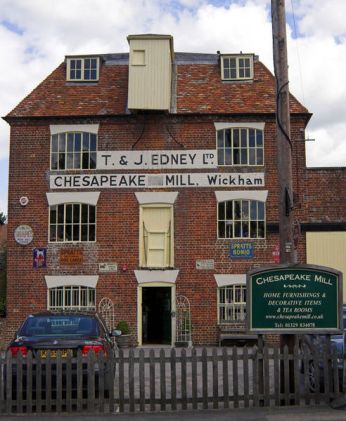
The tale of the Battle of Boston Harbor must be a story for another day. Suffice it to say that USS Chesapeake ended her career as the British frigate HMS Chesapeake, before being sold for scrap, in 1819. Two-hundred years later, the ship’s timbers live on. Part of the Chesapeake Mill in the historic village of Wickham, in Hampshire, England.
If you enjoyed this “Today in History”, please feel free to re-blog, “like” & share on social media, so that others may find and enjoy it as well. Please click the “follow” button on the right, to receive email updates on new articles. Thank you for your interest, in the history we all share.
There is a story about Galileo, which may or may not be true. After his conviction, the astronomer is said to have muttered “Eppur si muove” — “And yet it moves”.
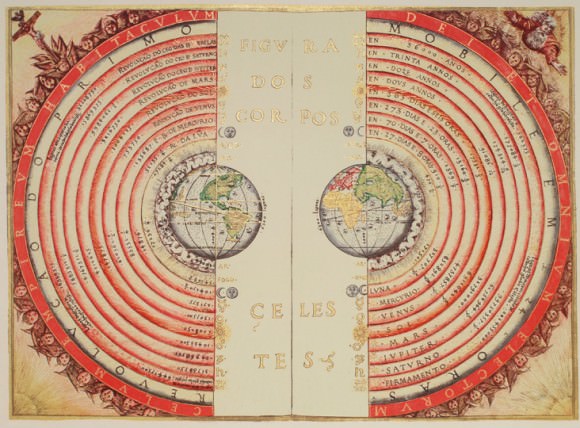
Planet Earth exists at the center of the solar system, the sun and other celestial bodies revolving around it. That was the “geocentric” model of the solar system, from the time of antiquity.
The perspective was by no means unanimous. The Greek astronomer and mathematician Aristarchus of Samos put the Sun in the center of the universe, in the third century BC. Later Greek astronomers Hipparchus and Ptolemy agreed, refining Aristarchus’ methods to arrive at a fairly accurate estimate for the distance to the moon, but theirs remained the minority view.
Earth is at the center of this model of the universe created by Bartolomeu Velho, a Portuguese cartographer, in 1568. H/T: NASA/Bibliothèque Nationale, Paris
In the 15th century, Polish mathematician and astronomer Nicolaus Copernicus parted ways with the orthodoxy of his time, describing a “heliocentric” model of the universe placing the sun at the center. The Earth and other bodies, according to this model, revolved around the sun.
Copernicus resisted publishing his ideas until the end of his life, fearing to offend the religious sensibilities of the time. Legend has it that he was presented with an advance copy of his “De revolutionibus orbium coelestium” (On the Revolutions of the Heavenly Spheres) as he awakened on his death bed from a stroke-induced coma. He took one look at his book, closed his eyes, and never opened them again.
Copernicus’ ‘heliocentric’ view of the universe.
The Italian physicist, mathematician, and astronomer Galileo Galilei came along, about a hundred years later. Galileo has been called the “Father of Modern Observational Astronomy”, his improvements to the telescope and resulting astronomical observations supporting the Copernican heliocentric view.
They also brought him to the attention of the Roman Inquisition.
Biblical references such as, “The Lord set the Earth on its Foundations; it can Never be Moved.” (Psalm 104:5) and “And the Sun Rises and Sets and Returns to its Place.” (Ecclesiastes 1:5) were taken at the time as literal and immutable fact, becoming the basis for religious objection to the heliocentric model.
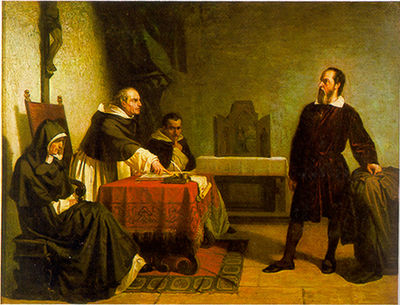
Galileo faces the Roman Inquisition
Galileo was brought before inquisitor Vincenzo Maculani for trial in 1633. The astronomer backpedaled before the Inquisition, but only to a point, testifying in his fourth deposition on this day in 1633, that “I do not hold this opinion of Copernicus, and I have not held it after being ordered by injunction to abandon it. For the rest, here I am in your hands; do as you please”.
There is a story about Galileo, which may or may not be true. After his conviction, the astronomer is said to have muttered “Eppur si muove” — “And yet it moves”.
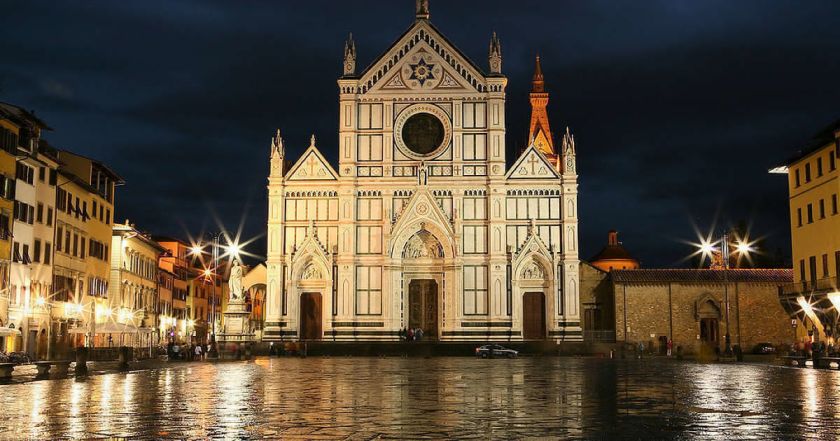
The Inquisition condemned the astronomer to “abjure, curse, & detest” his Copernican heliocentric views, returning him to house arrest at his villa in 1634, there to spend the rest of his life. Galileo Galilei, the Italian polymath who all but orchestrated the transition from late middle ages to scientific Renaissance, died on January 8, 1642, desiring to be buried in the main body of the Basilica of Santa Croce, next to the tombs of his father and ancestors. His final wishes were ignored at the time, though they would be honored some ninety-five years later, when Galileo was re-interred in the basilica, in 1737.
Basilica of Santa Croce, in Florence
Often, atmospheric conditions in these burial vaults lead to a natural mummification of the corpse. Sometimes, they look almost lifelike. When it came to the saints, believers took this to be proof of the incorruptibility of these individuals, and small body parts were taken as holy relics.
Such a custom seems ghoulish to us today, but the practice was was quite old by the 18th century. Galileo is not now and never was a Saint of the Catholic church, quite the opposite. The Inquisition had judged the man an enemy of the church, a heretic.
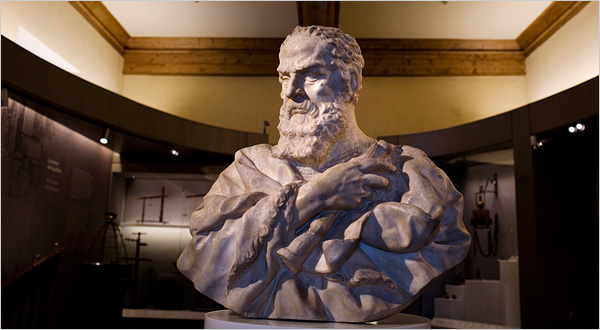
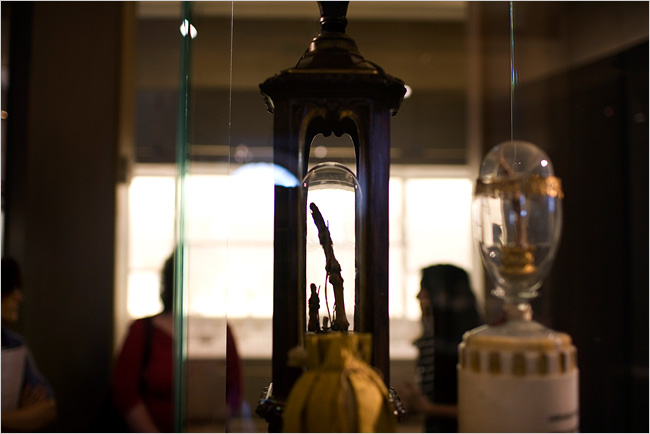
“A bust of Galileo at the Galileo Museum in Florence, Italy. The museum is displaying recovered parts of his body”. H/T New York Times
Possibly, the condition of Galileo’s body made him appear thus “incorruptible”. Be that as it may, Anton Francesco Gori removed the thumb, index and middle fingers on March 12, 1737, the digits with which Galileo wrote down his theories of the cosmos. The digits with which he adjusted his telescope.
The other two fingers and a tooth disappeared in 1905, leaving the middle finger from Galileo’s right hand on exhibit at the Museo Galileo in Florence, Italy. Locked in a glass case, the finger points upward, toward the sky.
Some 100 years later, two fingers and a tooth were purchased at auction, and have since rejoined their fellow digit at the Museo Galileo. To this day, these remain the only human body parts, in a museum otherwise devoted to scientific instrumentation.

Nearly four-hundred years after his death, Galileo’s extremity points upward, toward the glory of the cosmos. Either that, or the finger rises in eternal defiance, flipping the bird to the church which had condemned him.
If you enjoyed this “Today in History”, please feel free to re-blog, “like” & share on social media, so that others may find and enjoy it as well. Please click the “follow” button on the right, to receive email updates on new articles. Thank you for your interest, in the history we all share.
No less a figure than Wilt Chamberlain once said “Meadowlark was the most sensational, awesome, incredible basketball player I’ve ever seen. People would say it would be Dr. J or even Jordan. For me it would be Meadowlark Lemon”.
Twenty years before the integration of professional sports, 24-year-old Abraham Saperstein organized a basketball team. He called his club the “Savoy Big Five,” after the famous Savoy Ballroom of Chicago, home to such Jazz greats as Louis Armstrong, Count Basie, Dizzy Gillespie, Ella Fitzgerald and Woody Herman.
At least, that’s what the official team history says, except the Savoy didn’t open until 1927. We may have to just go with it.
Saperstein renamed his club the “Harlem Globetrotters” despite their being from Chicago, the team arriving in a model T Ford for their debut game on January 7, 1927.
The last two years had been nothing but exhibition games before dances. Now, the big game in Hinckley, Illinois would be played in front of 300 fans, with a total game payout of $75.
The squad toured Wisconsin, Minnesota, and Iowa, playing almost every night against any and all challengers. Despite a height of 5’3″, Saperstein himself sometimes suited up, to fill in for an injured player.
The Globetrotters played their 1000th game in Iron Mountain, Michigan, in 1934.
In 1941, Negro League 1st baseman Reece “Goose” Tatum caught Saperstein’s eye. A multi-sport athlete and teammate of Satchel Paige, Tatum would entertain crowds with comedic routines, whenever he put a runner out. 6’4″ with an 84″ wingspan and able to touch his knees without bending, Tatum is credited with inventing the hook shot, an early version of the “skyhook” that made Kareem Abdul-Jabbar famous, 30 years later
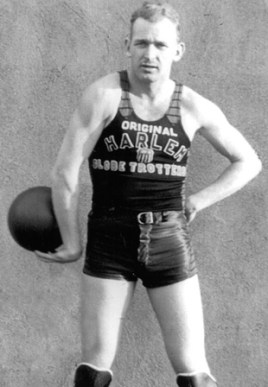
Tatum was the original “Clown Prince” of the Globetrotters, though the title is more often associated with Meadowlark Lemon and his confetti-in-the-water-bucket routine. Tatum combined natural athletic ability with a comedic timing that would change the whole direction of the club. When he passed away in 1967 at age 45, sports reporter Lawrence Casey of the Chicago Daily Defender remarked, “Like Joe Louis in boxing, Babe Ruth in baseball, Bobby Jones in golf, Goose Tatum was king of his chosen sport.”
When Goose was drafted into the Army Air Corps in 1942, the Globetrotters signed their third caucasian, the first-ever white player to be offered a contract. Bob Karstens, the newest showman on the team, created the signature pregame “Magic Circle,” the behind-the-back shot, the “yo-yo” basketball and the “goofball,” a basketball filled with weights to give it a crazy bounce.
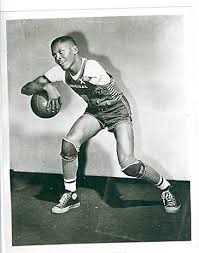
In the early 1940s, the Harlem Globetrotters were the most famous, and most profitable, professional basketball franchise in the world.
A near-fatal car accident cost Boid Buie his left arm when he was 13. Never a great athlete before the crash, Buie worked so hard on his goals that he became the “One Armed Firecracker”. He signed with the Globetrotters in 1946 and played 9 seasons as a starter, averaging 14 points per game. Ever since the 2011 Elite Showcase Basketball Classic, the MVP Award is presented in the name of Boid Buie.
The Globetrotters were a serious basketball team in the early years, winning the World Professional Basketball Tournament as late as 1940. The club worked more gag routines into their game throughout the late 40s and 50s, as the newly founded NBA gained popularity. Finally, the team became better known for entertainment, than for sport.
“Playing the bones” has a musical history going back to ancient China, Egypt, Greece and Rome, part of 19th century minstrel shows and traditional to musical genres ranging from Irish to Bluegrass to Zydeco. Freeman Davis’ “Brother Bones” recording of the 1925 jazz standard “Sweet Georgia Brown” became the Globetrotters’ theme song, in 1952.
Ba Da Da, Dunt Da Da Da, Dunt Da Da Da Da… Now try to keep that out of your head.
Former NBA Baltimore Bullets point guard Louis “Red” Klotz formed an exhibition team in 1952 to play against the Globetrotters. He called his team the Washington Generals, in a nod to future president Dwight Eisenhower.
The Generals played serious basketball while their opponents juggled balls, spun them on fingertips, and made trick shots. The two teams played 13,000 games between 1953 and 1995, of which the Generals actually won 6.
Those of us who came of age in the 70s remember Curley Neal and Meadowlark Lemon, who joined the club in 1954. Who remembers that Wilt “the Stilt” Chamberlain joined the team, four years later? Chamberlain would be the first Globetrotter to have his jersey retired.
Chamberlain and the Globetrotters did their part to warm the Cold War, with a nine game series in Moscow, in 1959. The Generals stayed home, for this series the opponent was the “Chinese Basketeers”. At first slow to catch on, the audience of 14,000 sat in stupefied silence, finally warming on the realization that this was more show than sport. The team was paid the equivalent of $4,000 per game which could only be spent in Moscow, prompting the American press to observe that the Soviets were finally becoming capitalists.
Abe Saperstein passed away in 1966, at the age of 63. The owner and founder of the Harlem Globetrotters, he was also founder and first Commissioner of the American Basketball League. Under Saperstein’s direction, the ABL was the first basketball league to institute the 3-point rule, in 1961. Saperstein was inducted into the Basketball of Fame in 1971, and the National Jewish Sports Hall of Fame, in 2005.

Here’s a great piece of sports trivia. At 5’3″, Abe Saperstein is the shortest male inductee in the Professional Basketball Hall of Fame, according to his Wikipedia page.
Abe Saperstein was gone but his creation went on, signing Olympic Gold Medalist Lynette Woodard the first-ever female player in 1985. Pope John Paul II became an honorary Globetrotter in 1986, in a ceremony in front of 50,000 in Saint Peter’s Square.
There are nine honorary Globetrotters, including Henry Kissinger, Bob Hope, Kareem Abdul-Jabbar, Whoopi Goldberg, Nelson Mandela, Jackie Joyner-Kersee, Pope Francis and Jesse Jackson. Jesse Owens, the track star who stuffed Adolf Hitler’s “master race” at the 1936 Berlin olympics, accompanied the Globetrotters to Berlin in 1951. Bill Cosby and Magic Johnson are both signed to $1 a year lifetime contracts, though Cosby’s contract was increased to $1.05 in 1986.
Ninety-one years after their founding, the Harlem Globetrotters show no signs of slowing down. In 2015, the team drafted 6’6″ 2015 college slam dunk champion LaQuavius Cotton from Mississippi’s Delta State University, and trick shot expert “Dude Perfect” of Mickinney, Texas.
How do you not root for a team with two guys named LaQuavius Cotton and Dude Perfect?
Prior to a 2011 visit to Dallas, the Globetrotters emailed local media, challenging Globetrotter nation to a H.O.R.S.E. competition. If you’re not familiar, a player takes a shot. Any shot. You can spin around and bounce the ball off of your head if you like. If you sink the basket, the next player has to sink the same shot. Otherwise, they get an ‘H’.
The last one to spell ‘HORSE’, wins.
71-year-old Kay Seamayer of the “Granny Globetrotters” entered a video, sinking an old Meadowlark three-pointer, blindfolded. Kay is a motivational speaker who wants to encourage everyone to “Get up, Get out, and Get Your Move on”. She was only voted #2 in the HORSE challenge, but the lady would have had my vote.
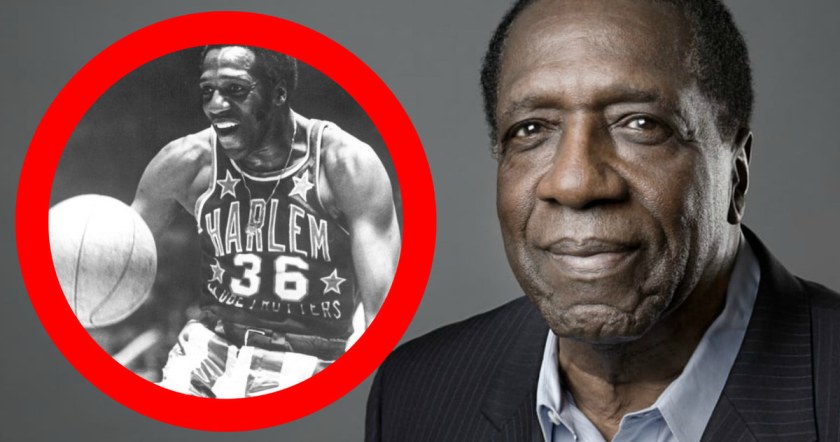
Shortly before his death in 1999, Wilt Chamberlain paid homage to his favorite basketball player: “Meadowlark was the most sensational, awesome, incredible basketball player I’ve ever seen. People would say it would be Dr. J or even Jordan. For me it would be Meadowlark Lemon.”
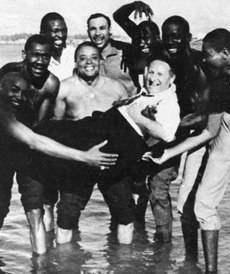
American basketball player, actor and ordained Christian minister Meadow Lemon III, professionally known as Meadowlark Lemon, played over 16,000 games with the Harlem Globetrotters, between 1954 and 1994. He passed away two years ago almost to the day, in Scottsdale, Arizona. He was 83. Rest in Peace, Mr. Lemon. You brought a lot of smiles to the little boy in me.
Most histories of the Roman Empire end with some event along a 476-586A.D. timeline, but the Roman Empire in the east lived for another thousand years.
A certain type of politician loves nothing more than to divide us against one another for their own advantage, but that’s nothing new. The tyrant Theagenes of the Dorian city state of Megara destroyed the livestock of the wealthy in the late 7th century BC, in an effort to increase his support among the poor. It may have been this tactic which drove Byzas, son of the Greek King Nisos, to set out in 657BC to found the new colony of Byzantion.
The Oracle at Delphi advised Byzas to build his city “opposite the city of the blind”. Arriving at the Bosphorus Strait (“boos poros“, or “cow-ford”), the narrow channel dividing Europe from Asia and the Mediterranean from the Black Sea, the party judged the inhabitants of the eastern bank city of Chalcedon to be blind if not stupid, not to have recognized the advantages of the European side. There they set down the roots of what is today one of the ten largest cities, in the world.
Byzantium city leaders made the mistake of siding with Pescennius Niger, a pretender to the Roman throne during the “Year of the Five Emperors”, 193-194AD. Laid siege and virtually destroyed in 196 by the victorious Septimius Severus, the city was rebuilt and quickly regained the wealth and status it had formerly enjoyed as a center of trade at the crossroads of east and west.
Constantine the Great, Roman Emperor from 306 to 337, established a second residence at Byzantium in 330, officially establishing the city as “Nove Roma”: New Rome. Later renamed in his honor, “Constantinople” became the capital of the Byzantine Empire and seat of the Roman Empire in the east.
Byzantine Empire and its vassal states, as it looked under Emperor Justinian the Great
The eastern and western Roman empires would separate and reunite in a succession of civil wars and usurpations throughout the 4th century, permanently dividing in two with the death of Emperor Theodosius I, in 395. The Western and Eastern Empires would co-exist for about 80 years. Increasing barbarian invasions and internal revolts finally brought the western empire to an end when Emperor Romulus Augustulus was deposed, in 476.
The Ostrogothic Kingdom which came to rule all of Italy was briefly deposed, when the Byzantine General Belisarius entered Rome on December 9, 536. The Ostrogothic garrison left the city peacefully, briefly returning the old capital to its Empire. Fifty years later, there would be little to defend against the invasion of the Lombards. By 586, the Western Roman Empire had permanently ceased to exist.
Most histories of the Roman Empire end with some event along this 476-586 timeline, but the Roman Empire in the east would live for another thousand years. With traditions, customs and language drawn more heavily from the Greek than those of the Latin, the Byzantine Empire would last beyond the birth of Columbus, one of the most powerful economic, cultural, and military forces on the Eurasian landmass.
Theodosian walls
In 413, construction began on a formidable system of defensive walls, protecting Constantinople against attack by land or sea. Called the “Theodosian Walls” after the child Emperor Theodosius II, these fortifications were built on the orders of the Praetorian Prefect Anthemius, as a defensive measure against the Huns. One of the most elaborate defensive fortifications ever built, the Theodosian Walls warded off sieges by Avars, Arabs, Rus’, Bulgars and others. This, the last great fortification of antiquity, would fall only twice. First amidst the chaos of the 4th Crusade in 1203, and finally to the age of gunpowder.
Between the mid-5th and early 13th centuries, Constantinople was the largest and wealthiest city in all Europe. Located along the 4,000-mile long “spice roads” at the confluence of east and west, the city was guardian to some of the holiest relics in all Christendom, including the Crown of Thorns and the True Cross. Constantinople was home to some of the architectural masterpieces of the age, including the Greek Orthodox cathedral of Hagia Sophia, the Hippodrome, and the Golden Gate of the Land Walls. The vast Imperial library of the University of Constantinople was home to no fewer than 100,000 volumes and ancient texts, including some of the last remnants of the ancient library of Alexandria.
Hagia Sophia, interior
The Byzantine empire entered a period of decline in the 13th century, following the devastation of the fourth crusade. Constantinople would experience a brief recovery following the restoration of Nikephoros Palaiologos as sole Emperor in 1261, as territories and population of the greater Byzantine Empire were swallowed up by the fledgling Ottoman Empire.
Ottoman Sultan Mehmed II, “The Conqueror”
By mid-15th century, the former seat of the Byzantine Empire was little more than an island.
Constantinople, one of the most heavily fortified cities on the planet, fell in the wake of a 50-day siege to an army of 150,000, and the siege cannon of 22-year old Sultan Mehmed II, ruler of the Ottoman Turks. It was May 29, 1453.
Constantinople, now Istanbul, became an Islamic stronghold. Istanbul would remain seat of the Ottoman Empire until joining the losing side in WW1. The Ottoman Empire was partitioned in the wake of the Great War, creating the modern contours of the Arab World and the Republic of Turkey, with its economic, cultural, and historic center of Istanbul.
Siege of Constantinople, 1453
If you enjoyed this “Today in History”, please feel free to re-blog, “like” & share on social media, so that others may find and enjoy the same. Please click the “follow” button on the right, to receive email updates on new articles. Thank you for your interest, in the history we all share.
On July 30, 1916, the Black Tom terminal had over two million pounds of ammunition in freight cars, and one hundred thousand pounds of TNT on a nearby Barge.
In the early months of World War I, Britain’s Royal Navy swept the seas of the Kaiser’s ships and blockaded ports in Germany. The United States was neutral at the time, and more than a hundred German ships sought refuge in US harbors.
The blockade made it impossible for the Central Powers of Germany and Austria-Hungary to import war materiel from overseas, while Great Britain, France, and Russia continued to buy products from US farms and factories. American businessmen were happy to sell to any foreign customer who had the cash, but for all intents and purposes, such trade was limited to the allies.
To the Central Powers, such trade had the sole purpose of killing their boys on the battlefields of Europe.
The first and most overt reaction from the Kaiser came in the form of unrestrained submarine warfare, when even vessels flying the flags of neutral countries were attacked. Less apparent at the time, was the covert campaign of sabotage carried out by German agents on US soil.
“Black Tom” was originally an island in New York Harbor, next to Liberty Island. So called after a former resident, by WWI, landfill had expanded the island to become part of Jersey City. The area contained a mile-long pier with warehouses and rail lines, and served as a major hub in the trade of war materiel to the allies.
On July 30, 1916, the Black Tom terminal had over two million pounds of ammunition in freight cars, and one hundred thousand pounds of TNT on a nearby Barge.
Guards discovered a series of small fires around 2:00am. Some of them tried to put them out while others fled, fearing an explosion. The first and loudest blast took place at 2:08am, a detonation massive enough to be estimated at 5.5 on the Richter scale. People from Maryland to Connecticut were awakened in what they thought was an earthquake. The walls of Jersey City’s City Hall were cracked as shrapnel flew through the air. Windows broke as far as 25 miles away, while fragments embedded themselves in the clock tower at the Jersey Journal building in Journal Square, over a mile away. The clock stopped at 2:12 am.
Stained Glass windows were shattered at St. Patrick’s Church, and Ellis Island was evacuated to Manhattan. Damage done to the Statue of Liberty alone was valued at over $2 million in today’s dollars. To this day, the ladder to the Statue of Liberty’s torch, remains off limits to visitors.
Known fatalities in the explosion included a Jersey City police officer, a Lehigh Valley Railroad Chief of Police, a ten week old infant, and the barge captain.
The explosion at Black Tom was the most spectacular, but by no means the only such attack. The archives at cia.gov reports that “[B]etween 1915 and spring 1917, 43 American factories suffered explosions or fires of mysterious origin, in addition to the bombs set on some four dozen ships carrying war supplies to the Allies”.
Among those responsible for the Black Tom explosion was Naval Lieutenant Lothar Witzke, arrested on February 1, 1918, in Nogales, AZ. Witzke was convicted by court martial and sentenced to death, though President Wilson would later commute the sentence to life.
By 1923, most countries were releasing POWs from the “Great War”, including spies. A prison report from Leavenworth shows Witzke heroically risking his life in prison, entering a boiler room after an explosion and probably averting disaster. It may be on that basis that he was finally released. Imperial German Navy Lieutenant Lothar Witzke was pardoned by President Calvin Coolidge on November 22, 1923, and deported to Berlin, where a grateful nation awarded him the Iron Cross, 1st and 2nd Class.
If you enjoyed this “Today in History” article, please “like” and share on Facebook, Linkedin or Twitter, so that others may find and enjoy the same. Please click the “follow” button on the right, to receive email updates on new articles. Thank you for your interest, in the history we all share.
You must be logged in to post a comment.