These guys were sending human beings 240,000 miles into space, to land on the moon and come back again, on computing “horsepower” equivalent to modern pocket calculators.
On May 25, 1961, President John F. Kennedy delivered a message before a joint session of Congress, articulating a goal of “landing a man on the moon and returning him safely to the earth” by the end of the decade.
Though he wouldn’t live to see it, Kennedy’s pledge would be realized forty-nine years ago on this day: July 20, 1969.
Today, the accomplishments of the Apollo series of spacecraft seem foreordained, the massive complexities of the undertaking, forgotten.
In the modern era, the most powerful supercomputers on earth put the Hubble Space Telescope into orbit, with “vision” literally requiring correction. With “glasses”.
These guys were sending human beings 240,000 miles into space, to land on the moon and come back again, on computing “horsepower” equivalent to modern pocket calculators.
Any one of countless calculations could have misfired, slinging three astronauts into the black void of space, there to spend eternity, in a flying tomb.
The 363′, 6,698,700-pound Saturn V launch vehicle lifted off from the John F. Kennedy Space Center on Merritt Island, Florida on July 16, carrying mission commander Neil Armstrong, Lunar module pilot Edwin “Buzz” Aldrin, and Command Module Michael Collins.
The Apollo spacecraft consisted of three components: a Command Module (CM) with a cabin for the three astronauts, a Service Module (SM) supporting the CM with propulsion, electrical power, oxygen, and water; and a Lunar Module (LM) for landing on the Moon. The vehicle was launched toward the moon by a Saturn V rocket, designed to break apart as each of a series of rocket stages were exhausted, and separated from the main craft.
The Command/Service Module passed behind the moon at 12:21 Eastern Standard Time on July 19, firing its service propulsion engine and inserting the craft into lunar orbit.
The moon as seen from the International Space Station on July 9, 2018 H/T Alexander Gerst, NASA
Aldrin and Armstrong next moved into the LM, the only component to actually land on the lunar surface, with Collins remaining to orbit the moon in the CM.
The pair landed on a flat plain called the “Sea of Tranquility” on this day in 1969 at 4:18pm EST. Half the world heard the words “Tranquility base, the eagle has landed”. Neil Armstrong stepped onto the lunar surface six hours later, with the words “That’s one small step for [a] man, one giant leap for mankind”.
These first two humans to set foot on the moon spent about 2½ hours on the surface. The pair collected nearly 50-lbs of material for transport back to earth, planting the American flag where it most likely remains, to this day.
Two days earlier, White House speechwriter William Safire had written an address, a speech to be delivered by President Richard Nixon, in case of failure. Twenty-five years earlier on the eve of the D-Day invasion, General Dwight D. Eisenhower penned a letter, taking personal responsibility for the mission’s failure. Like Eisenhower’s letter, President Nixon’s speech was never delivered. The speech was entitled, “IN EVENT OF MOON DISASTER”
“Fate has ordained that the men who went to the moon to explore in peace will stay on the moon to rest in peace. These brave men, Neil Armstrong and Edwin Aldrin, know that there is no hope for their recovery. But they also know that there is hope for mankind in their sacrifice. These two men are laying down their lives in mankind’s most noble goal: the search for truth and understanding”…
The course of events envisioned by Richard Nixon’s speech writer, never came to be. The upper part of the Lunar Module lifted off 21½ hours later, returning Armstrong and Aldrin to the Command Module. Armstrong, Aldrin and Collins returned to earth and splashed down in the Pacific Ocean on July 24. Three astronauts had made history. The United States had had the last word in the space race, with the Soviet Union.
The Apollo 17 Saturn V rocket was the last human flight to the moon
If you enjoyed this “Today in History”, please feel free to re-blog, “like” & share on social media, so that others may find and enjoy it as well. Please click the “follow” button on the right, to receive email updates on new articles. Thank you for your interest, in the history we all share.
“I could have had her out of that car twenty-five minutes after I got the call. But he [Ted Kennedy] didn’t call”.
The Saturn V rocket departed Florida’s Kennedy Space Center on July 16, 1969, carrying Apollo 11 mission members Neil Armstrong, Buzz Aldrin and Michael Collins. The Command/Service Module passed behind the moon at 12:21 Eastern Standard Time on July 19, firing its service propulsion engine and inserting the craft into lunar orbit. Armstrong became the first man to step foot on the moon on July 21, descending the last stair to the lunar surface at 11:56EST. “That’s one small step for [a] man, one giant leap for mankind.”
On the evening of July 18, most of the country was focused on the unfolding drama.
Edward M. “Ted” Kennedy, Senior Senator from Massachusetts, was focused on a former secretary and volunteer with his brother’s 1968 Presidential campaign, 28-year-old Mary Jo Kopechne.
The pair left a house party on Chappaquiddick island off Martha’s Vineyard, shortly after 11:00pm. The two claimed to be going back to the ferry then on to their hotel rooms in Edgartown, but it’s not clear how many believed the story.
Mary Jo left her purse and room keys, on the table.
Kennedy drove his Oldsmobile Delmont 88 in the opposite direction from the ferry, finally turning off the road and onto the unpaved Dike Road. He later claimed to have been disoriented in the dark, but both of them knew the road, and the secluded ocean beach to which it led.
It’s not there anymore, but there was an old wooden bridge at the time, over a tidal inlet called Poucha Pond. The Olds entered the bridge at an odd angle, veering off and plunging into the water, coming to rest upside down in the shallow, tide swept channel.
Kennedy managed to swim free but Mary Jo did not. In later testimony, he claimed to have swum down several times trying to free her from the car, before swimming to the shore and calling her name.
It’s impossible to know the man’s state of mind at this time, but one can hazard a guess. Ted Kennedy was a married man. He had driven off a bridge with a woman not his wife, in the middle of the night. Recently elected Senate Majority Whip, Kennedy was considered the odds-on favorite for nomination as the Democratic candidate, for the 1972 presidential election. The murder of his two brothers, one at the hands of a leftist and the other by a Muslim extremist, had barely faded from current events into memory. The sympathy factor alone would have made him difficult to beat.
Kennedy walked back to the house party, returning once more to the scene of the accident, before finally swimming back to Edgartown, and his hotel room.
Senator Kennedy emerged from his room on the morning of July 19, cleaned up, sobered up and lawyered up. It was ten full hours before he finally got around to reporting the accident.
The Oldsmobile had been discovered by this time. Captain of the Edgartown Fire Rescue unit John Farrar arrived with scuba gear at 8:45am, and recovered Mary Jo’s body within ten minutes. She was wedged and contorted into the back seat, in a manner indicating that she may have found an air bubble, and used it until the small space could no longer sustain life. Her body was buried the next day, without benefit of autopsy to determine exact cause of death.
Legally, Mary Jo Kopechne’s cause of death was recorded as drowning. Farrar swore at the inquest that she died of slow asphyxiation, a process which would have taken hours.
“It looked as if she were holding herself up to get a last breath of air. It was a consciously assumed position…. She didn’t drown. She died of suffocation in her own air void. It took her at least three or four hours to die. I could have had her out of that car twenty-five minutes after I got the call. But he [Senator Kennedy] didn’t call”. Rescue diver John Farrar
In his official report from the inquest, Judge James A. Boyle concluded that:
1. “The accident occurred “between 11:30 p.m. on July 18 and 1:00 a.m. on July 19.”
2. “Kopechne and Kennedy did not intend to drive to the ferry slip and his turn onto Dike Road had been intentional.”
3. “A speed of twenty miles per hour as Kennedy testified to operating the car as large as his Oldsmobile would be at least negligent and possibly reckless.”
4. “For some reason not apparent from [Kennedy’s] testimony, he failed to exercise due care as he approached the bridge.”
5. “There is probable cause to believe that Edward M. Kennedy operated his motor vehicle negligently… and that such operation appears to have contributed to the death of Mary Jo Kopechne.”
Boyle’s report was impounded, and never shown to the grand jury. Farrar told People Magazine in July 1989 “I was told outright by the D.A.’s office that I would not be allowed to testify on how long Kopechne was alive in the car. They were not interested in the least in anything that would hurt Ted Kennedy.”
Kennedy’s driver’s license was suspended for a time. There would be no further penalty. Joan Kennedy, who was pregnant at the time, attended Mary Jo Kopechne’s funeral, and stood by her husband’s side at the courthouse, three days later. She miscarried a short time later, a personal tragedy she always blamed on the events at Chappaquiddick.
The Commonwealth of Massachusetts would continue to elect and re-elect the “Liberal Lion of the Senate”, for the rest of his life. Edward Kennedy’s Senate career, begun in 1962, ended only with his death of brain cancer, in 2009.
“Progressive” blogger for the Huffington Post Melissa Lafske reflected in a now-deleted editorial, on what Mary Jo Kopechne might have felt had she lived long enough to witness the accomplishments of Senator Kennedy’s long career. “So it doesn’t automatically make someone (aka, me) a Limbaugh-loving, aerial-wolf-hunting NRA troll for asking what Mary Jo Kopechne would have had to say about Ted’s death, and what she’d have thought of the life and career that are being (rightfully) heralded”.
“Who knows — maybe she’d feel it was worth it”.
If you enjoyed this “Today in History”, please feel free to re-blog, “like” & share on social media, so that others may find and enjoy it as well. Please click the “follow” button on the right, to receive email updates on new articles. Thank you for your interest, in the history we all share.
The reputation of professional baseball had suffered a major blow. Franchise owners appointed a man with the best “baseball name” in history, to help straighten out the mess. He was Major League Baseball’s first Commissioner, federal judge Kenesaw Mountain Landis.
From the World Cup to the Superbowl, the world of professional sports has little to compare with the race for the Pinnacle Trophy. The contest for Championship, in which entire economies slow to a crawl and even casual sports fans are caught up in the spectacle.
For professional baseball, the “Fall Classic” began in 1903, a best-of-nine “World Series” played out between the Boston Braves and the Pittsburg Pirates. (Boston won, in eight).
Excepting the boycott year of 1904 when there was no series at all, most World Series have been ‘best-of-seven”. That changed in 1919, when league owners agreed to play a nine-game series, to generate more revenue and increase the popularity of the sport.
Today, top players are paid the GDP of developing nations, but that wasn’t always the case. One-hundred years ago, much of that revenue failed to find its way to the players. Even the best, held second jobs.
Around that time, Chicago White Sox owner Chuck Comiskey built the most powerful organizations in professional baseball, despite a stingy reputation.
The scandal of the 1919 “Black Sox” series began when Arnold “Chick” Gandil, the first baseman with ties to Chicago gangsters, convinced his buddy and professional gambler Joseph “Sport” Sullivan, that he could throw the World Series against the Cincinnati Reds. New York gangster Arnold Rothstein supplied the money through his right-hand man, former featherweight boxing champion Abe Attell.
Pitchers Eddie Cicotte and Claude “Lefty” Williams were principally involved with throwing the series, along with outfielder Oscar “Hap” Felsch and shortstop Charles “Swede” Risberg. Third baseman George “Buck” Weaver attended a meeting where the fix was discussed, but decided not to participate. Weaver handed in some of his best statistics of the year during the 1919 post-season.
Star outfielder “Shoeless” Joe Jackson may have been a participant, though his involvement has been disputed. It seems that other players may have used his name in order to give themselves credibility. Utility infielder Fred McMullin was not involved in the planning, but he threatened to report the others unless they cut him in on the payoff.
The more “straight arrow” players on the club knew nothing about the fix. Second baseman Eddie Collins, catcher Ray Schalk, and pitcher Red Faber had nothing to do with it, though the conspiracy received an unexpected boost, when Faber came down with the flu.
Official Program
Rumors were flying as the series started on October 2. So much money was bet on Cincinnati, that the odds were flat. Gamblers complained that nothing was left on the table. Cicotte, who had shrewdly collected his $10,000 the night before, struck leadoff hitter Morrie Rath with his second pitch, a prearranged signal that “the fix was in”.
The plot began to unravel, that first night. Attell withheld the next installment of $20,000, to bet on the following game.
Game 2 starting pitcher Lefty Williams was still willing to go through with the fix, even though he hadn’t been paid. He’d go on to lose his three games in the best-of nine series, but by game 8, he wanted out.
The wheels came off in game three. Former Tigers pitcher and Rothstein intermediary Bill “Sleepy” Burns bet everything he had on Cincinnati, knowing the outcome in advance. Except, Rookie pitcher Dickie Kerr wasn’t in on the fix. He pitched a masterful game in game three, shutting Cincinnati out 3-0, and leaving Burns flat broke.
Cicotte became angry in game 7, thinking that gamblers were trying to renege on their deal. The knuckle baller bore down to a White Sox win and the series stood, 4-3.
Williams was back on the mound in game 8. By this time he wanted out of the deal, but gangsters threatened to hurt him and his family if he didn’t lose the game. Williams threw nothing but mediocre fastballs, allowing four hits and three runs in the first. The White Sox went on to lose that Game 10-5, ending the series in a 3 – 5 Cincinnati win.
Rumors of the fix began immediately, and dogged the team throughout the 1920 season. Chicago Herald and Examiner baseball writer Hugh Fullerton, wrote that there should never be another World Series. A grand jury was convened that September. Two players, Eddie Cicotte and Shoeless Joe Jackson, testified on September 28, both confessing to participating in the scheme. Despite a virtual tie for first place at that time, Comiskey pulled the seven players then in the majors. Gandil was back in the minors, at the time.
“Shoeless” Joe Jackson
The reputation of professional baseball had suffered a major blow. Franchise owners appointed a man with the best “baseball name” in history, to help straighten out the mess. He was Major League Baseball’s first Commissioner, federal judge Kenesaw Mountain Landis.
The Black Sox trial began this day in 1921, in the Criminal Court in Cook County. Key evidence went missing before the trial, including both Cicotte’s and Jackson’s signed confessions. Both recanted and, in the end, all players were acquitted. The missing confessions reappeared several years later, in the possession of Comiskey’s lawyer. It’s funny how that works.
According to legend, a young boy approached Shoeless Joe Jackson one day as he came out of the courthouse. “Say it ain’t so, Joe”. There was no response.
The Commissioner was unforgiving, irrespective of the verdict. The day after the acquittal, Landis issued a statement: “Regardless of the verdict of juries, no player who throws a ball game, no player who undertakes or promises to throw a ball game, no player who sits in confidence with a bunch of crooked ballplayers and gamblers, where the ways and means of throwing a game are discussed and does not promptly tell his club about it, will ever play professional baseball”.
Jackson, Cicotte, Gandil, Felsch, Weaver, Williams, Risberg, and McMullin are long dead now, but every one remains Banned from Baseball.
Ironically, the 1919 scandal lead the way to the “Curse of the Black Sox”, a World Series championship drought lasting 88 years and ending only in 2005, with a White Sox sweep of the Houston Astros. Exactly one year after the Boston Red Sox ended their own 86-year drought, the “Curse of the Bambino”.
The Philadelphia Bulletin newspaper published a poem back on opening day for the 1919 series. They would probably have taken it back, if only they could.
“Still, it really doesn’t matter, After all, who wins the flag. Good clean sport is what we’re after, And we aim to make our brag. To each near or distant nation, Whereon shines the sporting sun. That of all our games gymnastic, Base ball is the cleanest one!”
If you enjoyed this “Today in History”, please feel free to re-blog, “like” & share on social media, so that others may find and enjoy it as well. Please click the “follow” button on the right, to receive email updates on new articles. Thank you for your interest, in the history we all share.
Aviation officials were apoplectic that a New York to California flight plan, would wind up in Ireland.
In the period between the two World Wars, the Wright brothers’ first flight at Kittyhawk was well within living memory. The flying Aces of the Great War seemed like some kind of modern-day knights, and many became pop-culture heroes. Wood-and-fabric biplanes gave way to sleek, metal monoplanes, while air races and daring, record-setting flights seemed a constant feature of the daily news.
Heavier-than-air flight, once considered an impossibility, was coming of age.
The first non-stop transatlantic flight in history began on June 14, 1919, when British aviators John Alcock and Arthur Whitten Brown departed St. John’s, Newfoundland in a modified bomber, arriving in Ireland the following day.
Charles Lindbergh’s better known (and longer) New York to Ireland flight began in the early morning hours of May 20, 1927, when the custom-built, linen-skinned Ryan Aeronautical Company monoplane Spirit of St. Louis departed Roosevelt Field on Long Island, New York.
33½ hours later, thousands of spectators’ cars were caught up in “the largest traffic jam in Paris history”, to be there for the landing at Le Bourget Aerodrome.
Five years later to the day, Amelia Earhartperformed the first nonstop transatlantic crossing by a female pilot, completing the 2,000 mile crossing from Newfoundland to Ireland, in fifteen hours.
Five years later, “Lady Lindy” disappeared over the South Pacific, along with copilot Frederick J. Noonan.
Few events so captured the world’s imagination, as the Earhart search of 1937, and the explosion aboard the Apollo spacecraft, in 1970. On both occasions, breathless headlines the world over followed the unfolding drama.
The Apollo 13 story had a happy ending, as astronauts James Lovell, John Swigert and Fred Haise returned safely, to earth. It was thirty-three years since the Earhart disappearance, a mystery which remains unsolved, to this day.
The 1920s – 30s have been described as the “Golden Age of Aviation”. This was the world of Douglas Corrigan.
Douglas Corrigan
At the age of eighteen, Corrigan forked over $2.50 for a ride on a Curtiss Jenny biplane. He was hooked. He began flying lessons a week later, making his first solo flight on March 25, 1926.
A man without the means or the fame of Charles Lindbergh, Douglas Corrigan brought himself up in the aviation world, with his hands. He was an aircraft mechanic, and a good one.
It was Corrigan who assembled the wing and installed the fuel tanks and instrument panel, for Lindberg’s Spirit of St. Louis. Corrigan and colleague Dan Burnett increased the lift of the aircraft, extending the wing an additional 10-ft. longer than any earlier Ryan-designed aircraft.
Following Lindbergh’s success, Corrigan set his sights on a transatlantic crossing of his own. Working as an aircraft mechanic with the Airtech Flight School in San Diego, Corrigan would work on his flight skills, during short lunch breaks. He would perform aerobatic stunts with company aircraft, much to the chagrin of his employer. He continued to perform stunts after the company prohibited the practice, simply a little south, where the boss couldn’t see him.
Corrigan worked several jobs as aircraft mechanic, always using his employer’s planes to hone his flying skills.
In 1933, Corrigan paid $310 for a used 1929 Curtiss Robin monoplane, and began to modify it for transatlantic flight. He scavenged the parts from two old Wright Whirlwind engines, increasing the aircraft’s horsepower from 90 to 165. He installed additional fuel tanks and applied to the Bureau of Air Commerce in 1935, for permission to make the flight. The application was rejected.
Corrigan made additional modifications and repeated applications over the next two years, all of which were rejected. By 1935, the once-freelance aviation industry faced increasing government regulation. Corrigan found his project losing ground. . In 1937, federal officials not only rebuffed his flight plan. Authorities deemed Corrigan’s aircraft Sunshine unstable for safe flight, and denied renewal of its license to fly.
That was it. If he couldn’t get the permit, he’d do it without.
Corrigan flew in from California, arriving in Brooklyn unannounced and nauseous from a fuel leak. All was confusion at the time, with Howard Hughes preparing to take off on a world tour. Corrigan filed his flight plan for a return trip to California and headed out at first dawn on July 17, 1938, headed east with two chocolate bars, a couple boxes of fig bars, and a quart of water.
This was not the well-backed, bountifully financed custom aircraft of the Lindbergh days. This was the soapbox derby of airplanes, literally held together with baling wire and a quiltwork of patches, welded to the hood. Let journalist H. R. Knickerbocker, pick up the story:
“You may say that Corrigan’s flight could not be compared to Lindbergh’s in its sensational appeal as the first solo flight across the ocean. Yes, but in another way the obscure little Irishman’s flight was the more audacious of the two. Lindbergh had a plane specially constructed, the finest money could buy. He had lavish financial backing, friends to help him at every turn. Corrigan had nothing but his own ambition, courage, and ability. His plane, a nine-year-old Curtiss Robin, was the most wretched-looking jalopy…The door behind which Corrigan crouched for twenty-eight hours was fastened together with a piece of baling wire. The reserve gasoline tanks put together by Corrigan, left him so little room that he had to sit hunched forward with his knees cramped, and not enough window space to see the ground when landing”.
Ten hours into the flight, Corrigan discovered his ‘cold feet’ were the result of gasoline, sloshing around the cockpit. He poked a hole with a screwdriver, and kept going. 26 hours in, he claimed to have discovered a “navigation error”. The Robin was still over water. 28 hours and 13 minutes after leaving Brooklyn, Corrigan touched down at Baldonnel Aerodrome, in Dublin.
Aviation officials were apoplectic that a New York to California flight plan, would wind up in Ireland. At a time when Western Union charged by the word, the pilot was excoriated with a 600-word diatribe, enumerating the pilot’s transgressions. Corrigan served a 14-day suspension of his flying license, ending the day he returned with his aircraft aboard the steamship Manhattan.
“Wrong Way” Corrigan returned to a ticker-tape parade, larger than the one given Lindbergh, himself.
The flight mechanic was a celebrity, writing an autobiography and endorsing a line of “Wrongway” products, including a watch that ran backward. He appeared on a 1957 episode of To Tell the Truth, and earned $75,000 portraying himself in the RKO film, The Flying Irishman. It would have taken thirty years to earn that much, at any of his airfield jobs.
To his great disappointment, Charles Lindbergh, Corrigan’s hero and the reason he had made the flight in the first place, never acknowledged his feat.
Wrong Way Corrigan flight tested bombers during WW2 and retired in 1950, and bought an orange grove in Santa Ana, California. He claimed he knew nothing about growing oranges, he just copied what his neighbors were doing.
The old Robin came out of its hangar one last time on the golden anniversary of the flight, reassembled and the engine restarted, successfully. Corrigan became so excited that event organizers placed guards at the aircraft’s wings – they even considered tying the tail to a police car – fearful that the old man would once again, take off in the thing.
At age 84, Douglas Corrigan was elected an Honorary Member of the ‘Liars Club of America’, an honor which he politely, but firmly, refused. To the end of his days, Wrong Way Corrigan insisted that his transatlantic flight was nothing more than a navigation error. He was as surprised to find himself in Ireland, as anyone else.
The autobiography is out of print but still available, if you’re interested. It’s about fifty bucks, in hard cover, the title is That’s my Story.
If you enjoyed this “Today in History”, please feel free to re-blog, “like” & share on social media, so that others may find and enjoy it as well. Please click the “follow” button on the right, to receive email updates on new articles. Thank you for your interest, in the history we all share.
“Now I am become death, the destroyer of worlds”. – Bhagavad Gita
“Now I am become death, the destroyer of worlds“.
The words come down to us from the Bhagavad Gita, the Hindu epic Mohandas Gandhi would describe as his “spiritual dictionary”. On this day in 1945, these were the words of “Manhattan Project” director J. Robert Oppenheimer as he witnessed “Trinity”, the world’s first nuclear detonation.
The project had begun with an August 2, 1939 letter, written by the prominent physicists Leo Szilárd and Albert Einstein to President Franklin Roosevelt, warning that Nazi Germany may be working to develop a secret “Super Weapon”. It ended with that single explosion in the Jornada del Muerto (loosely, “Journey of the Dead Man”) desert, equal to the explosive force of 15,000 – 20,000 tons of TNT.
Einstein–Szilárd letter
The Manhattan project, the program to develop the Atomic Bomb, was so secret that Vice President Harry Truman was unaware of its existence. President Roosevelt passed away on April 14, when Harry Truman was sworn in as President. He was fully briefed on the Manhattan project 10 days later, writing in his diary that night that the United States was perfecting an explosive great enough to destroy the whole world.
Nazi Germany surrendered on May 7, but the war with Japan ground on. By August, Truman faced the most difficult decision ever faced by an American President. Whether to drop an atomic bomb on a population of human beings.
The morality of the decision has been argued ever since, and will continue to be, I’m sure. In the end, it was decided that to drop the bomb would end the war faster with fewer lives lost (on both sides), compared with an invasion of the Japanese home islands.
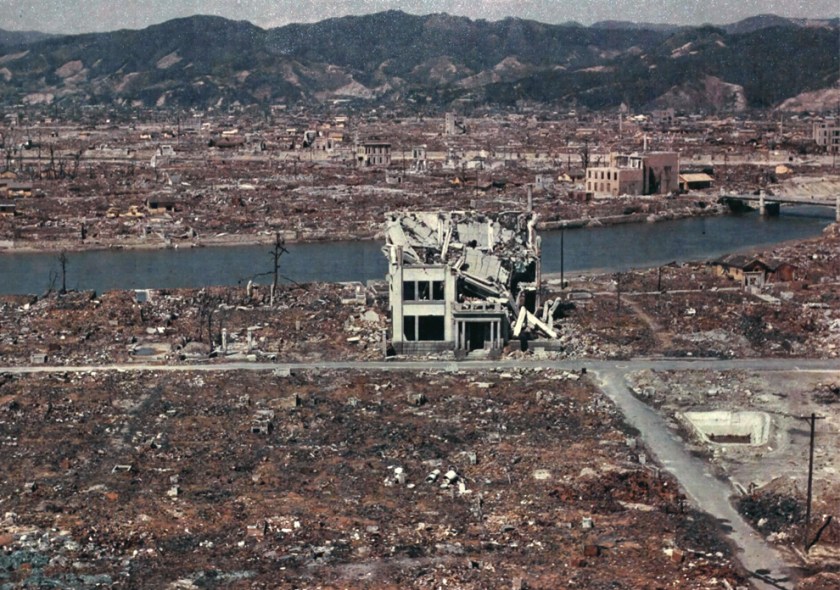
The second nuclear detonation in history took place on August 6 over Hiroshima, Japan. “Little Boy”, as the bomb was called, was delivered by the B29 Superfortress “Enola Gay”, named after the mother of United States Army Air Forces pilot Lieutenant Colonel Paul Tibbets. 66,000 Japanese citizens were vaporized in an instant, or died within the following days from the effects of the bomb. Another 100,000 later died from injuries and the delayed effects of radiation.
Even then, the Imperial Japanese Government refused to surrender. ‘Fat Man’, a plutonium bomb carried by the B29 “Bockscar”, was dropped on Nagasaki on August 9.
The intended target was Kokura, but local weather reduced visibility. 393d Bombardment Squadron Commander Major Charles Sweeney bypassed Kokura and chose the secondary target, Nagasaki. Half of Nagasaki was destroyed in the blast, and another 70,000 people killed.
Japan surrendered unconditionally on the 14th of August, ending the most destructive war in history.
During the 1920s, the University of Göttingen was one of the world’s leading centers for theoretical physics. American-born J. Robert Oppenheimer was himself educated there, along with the likes of Enrico Fermi, Edward Teller, and the English-born Paul Dirac, regarded as “one of the most significant physicists of the 20th century”.
The academic landscape of 1920s Germany was such that the Nazi regime may very well have been first to the nuclear finish line, but for the politicization of the universities themselves, brought on by National Socialist policy.
On April 7, just 67 days after Adolf Hitler’s appointment as Chancellor, the ‘Civil Service Law’ of 1933 established the framework for the removal of ‘undesirables’ in civil service, medicine, education and the legal profession. A series of increasingly draconian anti-Jewish laws left tens of thousands of Jews including that pillar of modern theoretical physics Albert Einstein himself, no choice but to flee.
More than 133,000 German Jewish émigrés moved to the United States between 1933 and 1944, many of them highly educated and some holding Nobel prizes. In a research paper for the University of Stanford, assistant Professor of Economics Petra Moser reported a 31% increase in the number of US patents in the physical sciences, after 1933.
The Nazi nuclear weapons project began on December 17, 1938 when German physicist Otto Hahn and assistant Fritz Strassmann discovered the atomic fission of heavy elements. The first real push to develop a nuclear weapon began the following April but fizzled months later, when a number of notable physicists were drafted into the Wehrmacht.
A second such effort began on September 1, 1939, the day that Hitler invaded Poland. While the Nazi nuclear program received funding throughout the war, it never received the concentrated effort of a Manhattan project. Instead, the program was carved into three separate pieces, and personnel were always subject to the recruiting needs of the military, irrespective of education, training or skills.
This series of decisions, no doubt taken in some conference room somewhere, put Nazi Germany behind in the nuclear arms race. How different the world would be, if Little Boy and Fat Man displayed swastikas, painted on their sides.
If you enjoyed this “Today in History”, please feel free to re-blog, “like” & share on social media, so that others may find and enjoy it as well. Please click the “follow” button on the right, to receive email updates on new articles. Thank you for your interest, in the history we all share.
Note the pointed tops of the Confederate grave markers, different from the arc-shapes at the top of Federal stones. Rumor has it that the point was there to “stick it” to any Yankee, dumb enough to sit on a Confederate gravestone. No Rebel would ever be so disrespectful.
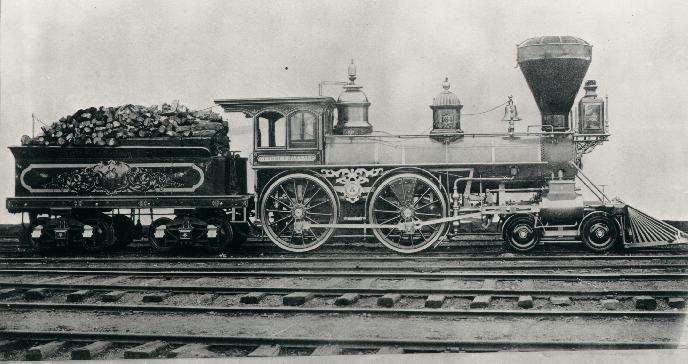
The wood burning steam locomotive #171 left Jersey City, New Jersey on July 15, 1864, pulling 17 passenger and freight cars. On board were 833 Confederate Prisoners of War and 128 Union guards, heading from Point Lookout, Maryland to the Federal prison camp in Elmira, New York.
Engine #171 was an “extra” that day, running behind a scheduled train numbered West #23. West #23 displayed warning flags, giving the second train right of way, but #171 was delayed while guards located missing prisoners. Then there was the wait for the drawbridge. By the time #171 reached Port Jervis, Pennsylvania, the train was four hours behind schedule.
Telegraph operator Douglas “Duff” Kent was on duty at the Lackawaxen Junction station, near Shohola Pennsylvania. Kent had seen West #23 pass through that morning with the “extra” flags. His job was to hold eastbound traffic at Lackawaxen until the second train passed.
He might have been drunk that day, but nobody’s sure. He disappeared the following day, never to be seen again.
Erie Engine #237 arrived at Lackawaxen at 2:30pm pulling 50 coal cars, loaded for Jersey City. Kent gave the All Clear at 2:45, the main switch was opened, and Erie #237 joined the single track heading east out of Shohola.
Only four miles of track now lay between the two speeding locomotives.
The two trains met head-on at “King and Fuller’s Cut”, a section of track following a blind curve with only 50’ of visibility.
King and Fullers Cut
Engineer Samuel Hoit at the throttle of the coal train had time to jump clear, and survived the wreck. Many of the others, never had a chance.
Historian Joseph C. Boyd described what followed on the 100th anniversary of the wreck:
“[T]he wooden coaches telescoped into one another, some splitting open and strewing their human contents onto the berm, where flying glass, splintered wood, and jagged metal killed or injured them as they rolled. Other occupants were hurled through windows or pitched to the track as the car floors buckled and opened. The two ruptured engine tenders towered over the wreckage, their massive floor timbers snapped like matchsticks. Driving rods were bent like wire. Wheels and axles lay broken.” The troop train’s forward boxcar had been compacted and within the remaining mass were the remains of 37 men”. [Witnesses] saw “headless trunks, mangled between the telescoped cars” and “bodies impaled on iron rods and splintered beams.”
Pinned against the split boiler plate and slowly scalded to death, engineer William Ingram lived long enough to speak with would-be rescuers. “With his last breath he warned away all who went near to try and aid him, declaring that there was danger of the boiler exploding and killing them.”
Frank Evans, a guard on the train, describes the scene: “The two locomotives were raised high in air, face to face against each other, like giants grappling. The tender of our locomotive stood erect on one end. The engineer and fireman, poor fellows, were buried beneath the wood it carried. Perched on the reared-up end of the tender, high above the wreck, was one of our guards, sitting with his gun clutched in his hands, dead!. The front car of our train was jammed into a space of less than six feet. The two cars behind it were almost as badly wrecked. Several cars in the rear of those were also heaped together.”
51 Confederate prisoners and 17 Union guards were killed on the spot, or died within a day of the wreck. Five prisoners escaped in the confusion.
Captured at Spotsylvania early in 1864, 52nd North Carolina Infantry soldier James Tyner was a POW at this time, languishing in “Hellmira” – the fetid POW camp at Elmira, New York. “The Andersonville of the Northern Union.”
Tyner’s brother William was one of the prisoners on board #171.
William was badly injured in the wreck, surviving only long enough to avoid a mass grave alongside a train track, in Shohola. William Tyner was transported to Elmira where he died three days later, never regaining consciousness.
I’ve always wondered if the brothers were able to find one another, that one last time. James Tyner was my own twice-great Grandfather, one of four brothers who went to war for North Carolina, in 1861.
We’ll never know. James Tyner died in captivity on March 13, 1865, 27 days before General Lee’s surrender, at Appomattox. Of the four Tyner brothers, Nicholas alone survived the war. He laid down his arms on the order of the man they called “Marse Robert”, and walked home to pick up the shattered bits of his life, in the Sand Hills of North Carolina.
Memorial for the brothers Tyner is located on the old family farm, in North Carolina. Note the pointed tops, which are different from the arc-shapes at the top of Federal grave markers. Rumor has it that the point was there to “stick it” to any Yankee, dumb enough to sit on a Confederate gravestone. No Rebel would ever be so disrespectful.
“About 56,000 soldiers died in prisons during the war, accounting for almost 10% of all Civil War fatalities. During a period of 14 months in Camp Sumter, located near Andersonville, Georgia, 13,000 (28%) of the 45,000 Union soldiers confined there died. At Camp Douglas in Chicago, Illinois, 10% of its Confederate prisoners died during one cold winter month; and Elmira Prison in New York state, with a death rate of 25%, very nearly equaled that of Andersonville”. H/T Wikipedia
Afterward
Burial details worked throughout the night of July 15 until dawn of the following day.
Two Confederate soldiers, the brothers John and Michael Johnson, died overnight and were buried in the congregational church yard across the Delaware river, in Barryville, New York.
Last resting place of the brothers John and Michael Johnson, killed in the Great Shohola Trainwreck
The remaining POW dead and those about to die were buried alongside the track in a 75′ trench, placed four at a time in crude boxes fashioned from the wreckage. Conventional caskets arrived overnight. Individual graves were dug for the 17 Federal dead, and they too were laid alongside the track.
As the years went by, memorial markers faded and then disappeared, altogether. Hundreds of trains carried thousands of passengers up and down the Erie railroad, ignorant of the burial ground through which they had passed.
The “pumpkin flood“ of 1903 scoured the rail line, uncovering many of the dead and carrying away their mortal remains. It must have been a sight – caskets moving with the flood, bobbing like so many fishing plugs, alongside countless numbers of that year’s pumpkin crop.
On June 11, 1911, the forgotten dead of Shohola were disinterred, and reburied in mass graves in the Woodlawn national cemetery in Elmira, New York. Two brass plaques bear the names of the dead, mounted to opposite sides of a common stone marker.
The names of the Union dead, face north. Those of the Confederate side, face south. To my knowledge, this is the only instance from the Civil War era, in which Union and Confederate share a common grave.
If you enjoyed this “Today in History”, please feel free to re-blog, “like” & share on social media, so that others may find and enjoy it as well. Please click the “follow” button on the right, to receive email updates on new articles. Thank you for your interest, in the history we all share.
Dueling was illegal in both New York and New Jersey by this time, though enforcement was far more aggressive in NY. The two rowed across the Hudson River from Manhattan to Weehawken, New Jersey in the early morning hours of July 11, 1804, dueling pistols tucked safely in a leather bag.
What would it be like to turn on CNN or Fox News, to learn that Former Secretary of the Treasury Jacob (‘Jack’) Lew was party to a duel and that he was near death, after being shot by the sitting Vice President of the United States, Mike Pence.
The year was 1804, and President Jefferson’s Vice President, Aaron Burr, had a long standing personal conflict with one of the Founding Fathers. Alexander Hamilton had been Secretary of the Treasury under George Washington; the first Secretary of the Treasury, and the only signer of the US Constitution from the state of New York.
The animosity between the two began in 1791, when Burr defeated Hamilton’s father-in-law Philip Schuyler in a US Senate election. Hostilities escalated when the Electoral College deadlocked in the 1800 Presidential election, moving the selection of President and Vice President to the House of Representatives. Hamilton exerted his influence on behalf of Jefferson, who was elected on the 36th ballot, making Burr his VP.
Burr knew that Jefferson wouldn’t keep him on as VP for the 1804 election, and so he ran for Governor of New York. He blamed Hamilton for his defeat, and challenged the man to a duel over comments made during the election.
Dueling was illegal in both New York and New Jersey by this time, though enforcement was far more aggressive in NY. The two rowed across the Hudson River from Manhattan to Weehawken, New Jersey in the early morning hours of July 11, 1804, dueling pistols tucked safely in a leather bag.
Both men’s “seconds” stood with their backs to the duelists, enabling both to later state under oath that they didn’t see either the weapons or the duel itself. “Plausible deniability” was preserved, but it’s hard to have a first-hand account when the only witnesses have turned their backs. Accounts vary, but it seems that Hamilton fired first, apparently “throwing away his shot” as he had once advised his son Philip to do when the younger man was in this position.
This account is supported by a letter that Hamilton wrote the night before the duel, stating that he was “strongly opposed to the practice of dueling” for both religious and practical reasons. The letter went on, “I have resolved, if our interview is conducted in the usual manner, and it pleases God to give me the opportunity, to reserve and throw away my first fire, and I have thoughts even of reserving my second fire”.
Aaron Burr had no such reservations. The Vice President fired with intent to kill, the shot hitting Hamilton in the lower abdomen. The wound was clearly fatal, even to Hamilton himself, who said “This is a mortal wound, doctor”.
The man whose likeness appears on the $10 bill died the next day. Among his last words were “Pendleton knows,” (Judge Nathaniel Pendleton, his second), “that I did not intend to fire at him”.
Weehawken, today
If you enjoyed this “Today in History”, please feel free to re-blog, “like” & share on social media, so that others may find and enjoy it as well. Please click the “follow” button on the right, to receive email updates on new articles. Thank you for your interest, in the history we all share.
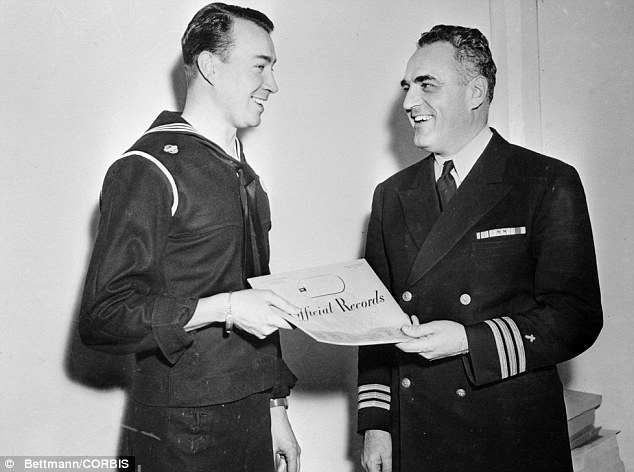
William Patrick Hitler petitioned President Roosevelt for permission to fight on the American side, receiving permission in 1944. Drafted into the Navy, the induction officer asked his name. The reply came, “Hitler”. “Glad to see you Hitler,” the officer replied, “My name’s Hess.”
Suppose for a moment, that Gallup or Ipsos were to conduct a survey, naming the top ten bad guys, in all history. One name I daresay would top every list, would be that of the National Socialist German Workers’ Party leader, Adolf Hitler.
Hitler himself wouldn’t have the term, “Nazi”. That was bitter insult, coined long before the rise of the Nazi party. In German, Hitler would have referred to the Nationalsozialistische Deutsche Arbeiterpartei, or NSDAP for short.
Alois Johann Schicklgruber was born on June 7, 1837, to the 42-year-old unmarried peasant Maria Schicklgruber. The boy’s father was known to her, the priest wrote “illegitimate” on the baptismal certificate. Johann Georg Hiedler married the peasant woman when the boy was five. By ten, Alois was sent to live with Heidler’s brother, Johann Nepomuk Hiedler. Three years later, Alois Schicklgruber moved to Vienna where he worked as a cobbler’s apprentice, finally becoming a low level civil servant in the Austrian Finance Ministry.
There are plenty of variations on the Hiedler family surname. ‘Hiedler’ apparently derives from an Austro-Bavarian dialect, meaning one who lives by a Hiedl, or underground spring. Other derivations come from the German Hutte (hut), as in “one who lives in a hut”. Be that as it may, the variations appear to have been interchangeable. Common variations included Hitler, Hiedler, Hüttler, Hytler, and Hittler.
There are plenty of tales regarding the man’s paternity, but none are any more than that. Alois Schicklgruber ‘legitimized’ himself in 1877, adopting a variant on the name of his stepfather and calling himself ‘Hitler”.
Historian Alan Bullock has described Alois Hitler as “hard, unsympathetic and short-tempered”. He seems to have had a problem with marital fidelity, as well. Alois was thirty-six when he married Anna Glasl-Hörer, the 50-year-old, invalid daughter of a customs official. By age 43, he was carrying on with the 19-year-old servant girl, Franziska “Fanni” Matzelsberger, with whom he had an illegitimate son, Alois Jr.
Alois Sr. was for all intents and purposes ‘married’ to the Matzelsberger girl for the next two years, while his lawful wife Anna, sickened and died. Hitler, 45, married Matzelsberger, age 21 in May, 1883. The couple’s second child Angela, was born two months later.
Sixteen-year-old Klara Pölzl moved in years earlier as household servant, and no woman was going to do to the new Mrs. Hitler, that which she had done to another woman. Frau Hitler demanded that the “servant girl” be sent away but Pölzl would return the following year, as Fanni herself sickened and died.
Pölzl was by this time pregnant with the first of the couple’s four children, but there was a problem. There are many candidates for Alois (Schicklgruber) Hitler’s biological father. If Hitler’s step-father was in fact his real sire as implied by the name change, that made Klara Pölzl his first cousin once removed, at least by law. The couple was too close to marry.
Alois petitioned the church for a humanitarian waiver. The waiver was granted and Klara Pölzl became the third Frau Hitler in January 1885. The first-born child was born five months later.
Adolf Hitler as an infant
The future leader of the National Socialist Party was born fours later, by that time the only child born to his mother Klara. Her first three children Gustav, Ida and Otto, all died in childhood.
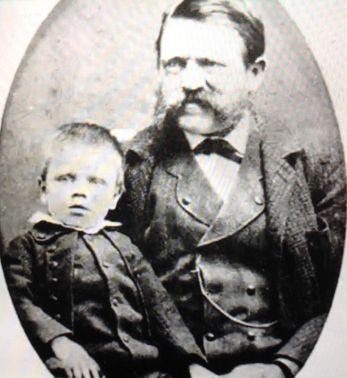
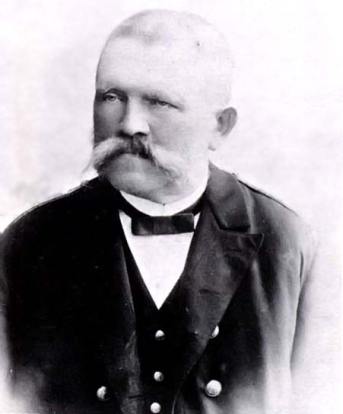
Alois Hitler, Sr. seems to have been a thoroughly unlikable man, lording it over neighbors and brutalizing his own family. Historian Robert Waite notes that, “Even one of his closest friends admitted that Alois was ‘awfully rough’ with his wife and ‘hardly ever spoke a word to her at home’.” The man would berate Klara and children alike, and apparently beat them on a regular basis. Alois Jr. left home never to return, following a violent argument with his father. The elder Alois swore that he would never give the boy a single mark of inheritance, over what the law required. The youngest, Adolf, grew up a frail and sickly child, doted on by his mother and often at the center of violent rages by his father.
Alois Hitler
Alois tried to browbeat his youngest into following him, into the civil service. The boy feared and detested his father, and wanted nothing to do with him. Adolf Hitler would follow the path which would bring him to that list of the great monsters of the 20th century, as his brother Alois Jr., made his own way in the world.
Some apples don’t fall far from the tree. Alois Hitler Jr. went to Ireland, where he met Bridget Dowling at the Dublin Horse Show. Nothing more than a poor kitchen porter at the Shelbourne Hotel, Hitler managed to convince her that he was, in fact, a wealthy hotelier, touring Europe. The couple eloped to London in June 1910. Bridget’s father William threatened to bring Hitler up on charges of kidnapping, and only relented when Bridget pleaded with him to stop.
It was a decision she would come to regret.
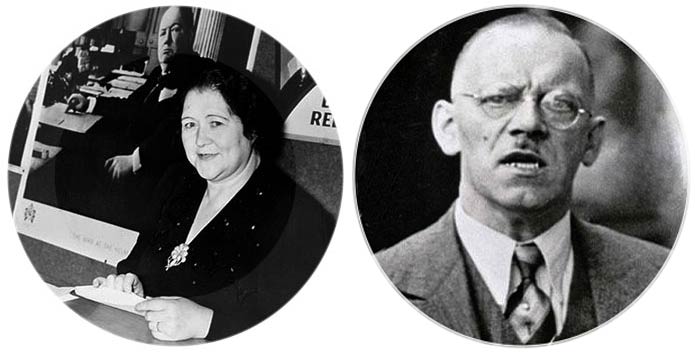
Dowling-Hitler
The couple had their only child in 1911, William Patrick Hitler. Alois left home in Liverpool in May 1914 to establish himself in the safety razor business. He had become violent by this time and begun to beat the boy. Bridget refused to go with William’s father and would end up, raising the boy alone.
War descended over Europe in 1914, when the elder Hitler met and (bigamously) married his second wife, Hedwig Heidemann.
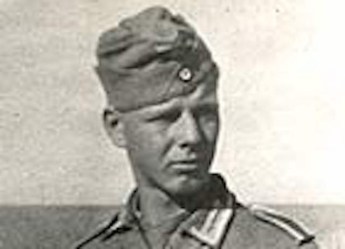
Heinz Hitler was captured by Soviet Forces in 1942, and tortured to death
Alois’ second marriage produced a son, Heinz, who went on to become a committed Nazi. In 1933, William moved to Germany, in an effort to take advantage of his uncle’s rise to power. He got a job at an Opel factory and later worked as a car salesman, but badgered his uncle for a better job. At last, he threatened to sell embarrassing family stories to the newspapers, if Uncle Adolf didn’t do something to improve his “personal circumstances”.
Ironically, Nazi party regulations precluded Adolf Hitler himself from proving his own “Aryan Purity”, based on his father’s unknown paternity. For years, Hitler had been dogged by hushed speculation about “Jewish blood”. Quiet rumor became front-page headline this day in 1933, when Austrian newspapers published reports that the German Chancellor, sworn enemy of all things Jewish, was himself, a Jew. That same day, all political parties but the Nazi party, were banned from Germany.
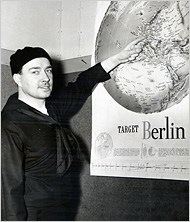
Pharmacists Mate William Patrick Hitler
Der Führer of the fledgling thousand-year Reich promised his nephew a “high ranking post” in 1938, in exchange for renunciation of his British citizenship. Suspecting a trap, the younger Hitler fled Germany, traveling to the United States in 1939. William Patrick Hitler petitioned President Roosevelt for permission to join the American side, receiving permission in 1944.
Drafted into the Navy, the induction officer asked his name. The reply came, “Hitler”. “Glad to see you Hitler,” the officer replied, “My name’s Hess.”
William Patrick Hitler served honorably for the duration of the war, holding the rank of Pharmacists Mate (a designation later changed to Hospital Corpsman) and earning a purple heart in the process. Hitler’s half-brother Heinz was captured by Soviet forces in 1942, and tortured to death. Their more famous uncle took his own life in 1945 and died, childless.
Ironically, Hitler’s childhood home in Liverpool was destroyed in the last air raid of the Liverpool Blitz, in 1942.
Alexander
Wishing to live a life of anonymity, “Willy” Hitler changed his name to William Patrick Stuart-Houston at the end of the war, and married fellow German emigre Phyllis Jean-Jacques in 1947. The couple made a home in Patchogue, New York and raised four sons: Alexander Adolf (b. 1949), Louis (b. 1951), Howard Ronald (1957–1989), and Brian William (b. 1965).
William Patrick Stuart-Houston, nephew to one of the worst dictators in history and a man who fought with honor on the side of his uncle’s mortal enemy, died this day in 1987, leaving no grandchildren.
Alexander Adolf Stuart-Houston,, an American social worker, dismissed speculation of a pact to end the Hitler line. There was no such agreement among the last four boys in the family. Things just turned out that way.
If you enjoyed this “Today in History”, please feel free to re-blog, “like” & share on social media, so that others may find and enjoy it as well. Please click the “follow” button on the right, to receive email updates on new articles. Thank you for your interest, in the history we all share.
The “Tunguska Event” was the largest such impact event in recorded history, but far from the first. Or the last.
The first atomic bomb in the history of human conflict exploded in the skies over Japan on August 6, 1945. The bomb, code named “Little Boy”, reached an altitude of 1,900-ft. over the city of Hiroshima at 8:15am, Japanese Standard Time.
A “gun-triggered” fission bomb, barometric-pressure sensors initiated the explosion of four cordite charges, propelling a small “bullet” of enriched uranium the length of a fixed barrel and into a sphere of the same material. Within picoseconds (1/.000000000001 of a second), the collision of the two bodies initiated a fission reaction, releasing an energy yield roughly equivalent to 15,000 tons of TNT.
66,000 were killed by the effects of the blast, the shock wave spreading outward at a velocity greater than the speed of sound and flattening virtually everything in its path, for a distance of a mile in all directions.
Thirty-seven years earlier, the boreal forests of Siberia lit up with an explosion 1,000 times greater than the atomic bomb dropped over Hiroshima. At the time, no one had the foggiest notion that it was coming.
The Taiga occupies the high latitudes of the world’s northern regions, a vast international belt line of coniferous forests consisting mostly of pines, spruces and larches between the high tundra, and the temperate forest. An enormous community of plants and animals, this trans-continental ecosystem comprises a vast biome, second only to the world’s oceans.
The Eastern Taiga is a region in the east of Siberia, an area 1.6 times the size of the continental United States. The Stony Tunguska River wends its way along an 1,160-mile length of the region, its entire course flowing under great pebble fields with no open water.
On the morning of June 30, 1908, the Tunguska River lit up with a bluish-white light. At 7:17a local time, a column of light far too bright to look at moved across the skies above the Tunguska. Minutes later, a vast explosion knocked people off their feet, flattening buildings, crops and as many as 80 million trees over an area of 830-square miles. A vast “thump” was heard, the shock wave equivalent to an earthquake measuring 5.0 on the Richter scale. Within minutes came a second and then a third shock wave and finally a fourth, more distant this time and described by eyewitnesses as the “sun going to sleep”.
On July 13, 1908, the Krasnoyaretz newspaper reported “At 7:43 the noise akin to a strong wind was heard. Immediately afterward a horrific thump sounded, followed by an earthquake that literally shook the buildings as if they were hit by a large log or a heavy rock”.
Fluctuations in atmospheric pressure were detectable as far away as Great Britain. Night skies were set aglow from Asia to Europe for days on end, theorized to have been caused by light, passing through high-altitude ice particles.
In the United States, lookout posts from the Smithsonian Astrophysical Observatory headquartered in Cambridge, Massachusetts, to the Mount Wilson Observatory in Los Angeles recorded a several months-long decrease in atmospheric transparency, attributed to an increase in dust, suspended in the atmosphere.
The “Tunguska Event” was the largest such impact event in recorded history, but far from the first, or the last. Mistastin Lake in northern Labrador was formed during the Eocene era of 36-million years ago, cubic Zirconium deposits suggesting an impact-zone temperature of some 4,300° Fahrenheit. Halfway to the temperature of the sun.
“A bolide – a very bright meteor of an apparent magnitude of &−14 or brighter” H/T Wikimedia
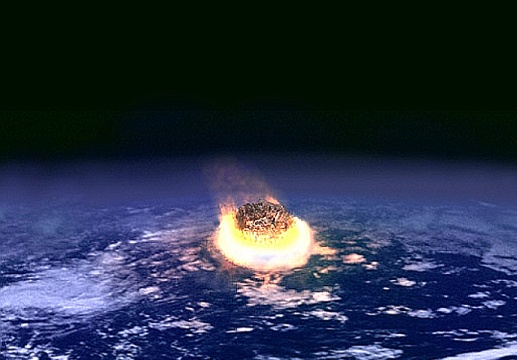
Some sixty-six million years ago, the “Chicxulub impactor” struck the Yucatan Peninsula of Mexico, unleashing a mega-tsunami of 330-ft in height from Texas to Florida. Superheated steam, ash and vapor towered over the impact zone, as colossal shock waves triggered global earthquakes and volcanic eruptions. Vast clouds of dust blotted out the sun for months on end, leading to mass extinction events the world over.
The official history of the Ming Dynasty records the Ch’ing-yang event of 1490, a meteor shower in China, in which “stones fell like rain”, killing some 10,000 people.
In 2013, a twenty-meter (66-ft) space rock estimated at 13,000-14,000 tons flashed across the skies of Chelyabinsk, Russia, breaking apart with a kinetic impact estimated at 26-times the nuclear blast over Hiroshima. The Superbolide (a bolide is “an extremely bright meteor, especially one that explodes in the atmosphere”) entered the earth’s atmosphere on February 15, burning exposed skin and damaging retinas for miles around. No fatalities were reported, though 1,500 were injured seriously enough to require medical attention.
The 450-ton Chicora Meteor collided with western Pennsylvania on June 24, 1938, in a cataclysm comparable to the Halifax Explosion of 1917. The good luck held, that time, the object making impact in a sparsely populated region. The only reported casualty, was a cow. Investigators F.W. Preston, E.P. Henderson and James R. Randolph remarked that “If it had landed on Pittsburgh there would have been few survivors”.
In 2018, the non-profit B612 Foundation dedicated to the study of near-Earth object impacts, reported that “It’s a 100 per cent certain we’ll be hit [by a devastating asteroid]”. Comfortingly, the organization’s statement concluded “we’re [just] not 100 per cent sure when.”
If you enjoyed this “Today in History”, please feel free to re-blog, “like” & share on social media, so that others may find and enjoy it as well. Please click the “follow” button on the right, to receive email updates on new articles. Thank you for your interest, in the history we all share.
As inflation approached escape velocity, the government responded by changing the name, and the color, of the currency. The Pengö was replaced by the Milpengö (1,000,000 Pengö), and then the Bilpengö (1,000,000,000,000) and, finally by the (supposedly) inflation-indexed Adopengö. This spiral resulted in the largest denominated note in history, the Milliard Bilpengö. A Billion Trillion Pengö. The thing was worth twelve cents.
You’ve worked all your life. You’ve supported your family, paid your taxes, and paid your bills. You’ve even managed to put a few bucks aside, in hopes of a long and happy retirement.
The subject of currency devaluation is normally left to eggheads and academics, the very term sufficient to make most of us tip over and hit our heads on the floor, from boredom. But, what happens to that “nest egg”, if the cost of the coffee in your hand doubles in the time it takes, to drink it?
History records 58 such instances of hyperinflation. Current events in Venezuela constitute #59 despite the largest proven oil reserves on the planet, while certain American politicians and celebrity types, are nowhere to be found.
In antiquity, Roman law required a high silver content in the coinage of the republic. Precious metal made the coins themselves objects of value, and the Roman economy remained relatively stable for 500 years. Republic morphed into Empire over the 1st century BC, leading to a conga line of Emperors minting mountains of coins in their own likenesses. Slaves worked to death in Spanish silver mines. Birds fell from the sky over vast smelting fires, yet there was never enough to go around. Silver content inexorably reduced, until the currency itself collapsed in the 3rd century reign of Diocletian. An Empire and its citizens were left to barter as best they could, in a world where currency had no value.
The assistance of French King Louis XIV was invaluable to Revolutionary era Americans, at a time when American inflation rates approached 50% per month. Yet, French state income was only about 357 million livres at that time, with expenses exceeding one-half Billion. France descended into its own Revolution, as the government printed “assignat”, notes purportedly backed by 4 billion livres in property expropriated form the church. 912 million livres were in circulation in 1791, rising to nearly 46 billion in 1796. One historian described the economic policy of the Jacobins, the leftist radicals behind the Reign of Terror: “The attitude of the Jacobins about finances can be quite simply stated as an utter exhaustion of the present at the expense of the future”.
Somehow, that sounds familiar.
Confederate Inflation
In the waning days of the Civil War, the Confederate dollar wasn’t worth the paper it was printed on. Paper money crashed in the post-Revolutionary Articles of Confederation period as well, when you could buy a live sheep for two silver dollars, or 150 paper “Continental” dollars. Roles reversed and creditors hid from debtors, not wanting to be repaid in worthless paper money. Generations after our founding, a thing could be described as worthless as “Not worth a Continental”.
Germany was a prosperous country in 1914, with a gold-backed currency and thriving industries in optics, chemicals and machinery. The German Mark had approximately equal value with the British shilling, the French Franc and the Italian Lira, with an exchange rate of four or five to the dollar.
That was then.
While the French third Republic levied an income tax to pay for the “Great War”, the Kaiser suspended the gold standard and fought the war on borrowed money, believing he could get it back from conquered territories.
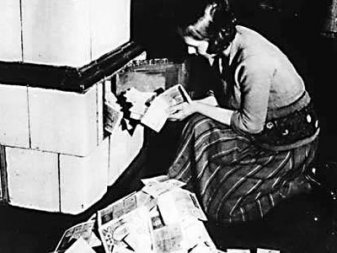
Except, Germany lost. The “Carthaginian peace” described by British economist John Maynard Keynes saddled an economy already massively burdened by war debt, with reparations. Children built ‘forts’ with bundles of hyperinflated, worthless marks. Women fed banknotes into wood stoves, while men papered walls. By November 1923, one US dollar bought 4,210,500,000,000 German marks.
The despair of the ‘Weimar Republic’ period resulted in massive political instability, providing rich soil for the growth of the National Socialist German Workers’ Party (‘Nationalsozialistische Deutsche Arbeiterpartei’) of Adolf Hitler.
Papering the walls with worthless currency in 1923 Weimar Germany
The Austro-Hungarian Empire was also on the losing side, and broken up after the war. Lacking the governmental structures of established states, a newly independent Hungary began to experience inflation. Before the war, one US Dollar bought you 5 Kronen. In 1924, it was 70,000. Hungary replaced the Kronen with the Pengö in 1926, pegged to a rate of 12,500/1.
Hungary became a battleground in the latter stages of WW2, between the military forces of Nazi Germany and the USSR. 90% of Hungarian industrial capacity was damaged, half destroyed altogether. Transportation became difficult with most of the nation’s rail capacity, damaged or destroyed. What remained was either carted off to Germany, or seized by the Russians as reparations.
The loss of all that productive capacity led to scarcity of goods, and prices began to rise. The government responded by printing money. Total currency in circulation in July 1945 stood at 25 Billion Pengö. Money supply rose to 1.65 Trillion by January, 65 Quadrillion and 47 Septillion July. That’s a Trillion Trillion. Twenty-four zeroes.
Banks received low rate loans, so that money could be loaned to companies to rebuild. The government hired workers directly, giving out loans to others and in many cases, outright grants. The country was flooded with money, the stuff virtually grew on trees, but there was nothing to back it up.
Inflation approached escape velocity. The item that cost you 379 Pengö in September 1945, cost 1,872,910 by March, 35,790,276 in April, and 862 Billion in June. Inflation neared 150,000% per day, making the currency all but worthless. Massive printing of money accomplished the cube root of zero. The worst hyperinflation in history peaked on this day in 1946, when the item that cost you 379 Pengö last September, now cost 1,000,000,000,000,000,000,000,000.
The government responded by changing the name, and the color, of the currency. The Pengö was replaced by the Milpengö (1,000,000 Pengö), which was replaced by the Bilpengö (1,000,000,000,000), and finally by the (supposedly) inflation-indexed Adopengö. This spiral resulted in the largest denominated note in history, the Milliard Bilpengö. A Billion Trillion Pengö. The thing was worth twelve cents.
One more currency replacement and all that Keynesian largesse would finally stabilize the currency, but at what price? Real wages were reduced by 80% and creditors wiped out. The fate of the nation was sealed when communists seized power in 1949. Hungarians could now share in that old Soviet joke. “They pretend to pay us, and we pretend to work”.
The ten worst hyperinflations in history occurred during the 20th century, including Zimbabwe in 2008, Yugoslavia 1994, Germany 1923, Greece 1944, Poland 1921, Mexico 1982, Brazil 1994, Argentina 1981, and Taiwan 1949. The common denominator in all ten were massive government debt and a currency with no inherent value, excepting what a willing buyer and a willing seller agreed it was worth.
In 2015, Boston University economist Laurence Kotlikoff testified before the Senate Budget Committee. “The first point I want to get across” he said, “is that our nation is broke. Our nation’s broke, and it’s not broke in 75 years or 50 years or 25 years or 10 years. It’s broke today”. Kotlikoff went on to describe the “fiscal gap”, the difference between US’ projected revenue, and the obligations our government has saddled us with. “We have a $210 trillion fiscal gap at this point”. Nearly twelve times GDP – the sum total of all goods and services produced in the United States.
This morning, Treasurydirect.govquotes US’ total outstanding public debt at $21,205,959,245,607.94, more than the combined GDP of the bottom 174 nations, on earth. All that, in a currency unmoored from anything objective value. What could go wrong?


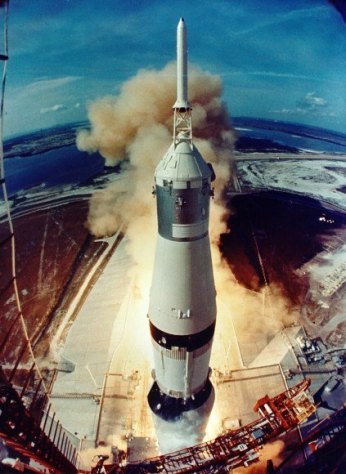 Today, the accomplishments of the Apollo series of spacecraft seem foreordained, the massive complexities of the undertaking, forgotten.
 The 363′, 6,698,700-pound Saturn V launch vehicle lifted off from the John F. Kennedy Space Center on Merritt Island, Florida on July 16, carrying mission commander Neil Armstrong, Lunar module pilot Edwin “Buzz” Aldrin, and Command Module Michael Collins.

 These first two humans to set foot on the moon spent about 2½ hours on the surface. The pair collected nearly 50-lbs of material for transport back to earth, planting the American flag where it most likely remains, to this day.


 Edward M. “Ted” Kennedy, Senior Senator from Massachusetts, was focused on a former secretary and volunteer with his brother’s 1968 Presidential campaign, 28-year-old Mary Jo Kopechne.

 Kennedy’s driver’s license was suspended for a time. There would be no further penalty. Joan Kennedy, who was pregnant at the time, attended Mary Jo Kopechne’s funeral, and stood by her husband’s side at the courthouse, three days later. She miscarried a short time later, a personal tragedy she always blamed on the events at Chappaquiddick.

 The scandal of the 1919 “Black Sox” series began when Arnold “Chick” Gandil, the first baseman with ties to Chicago gangsters, convinced his buddy and professional gambler Joseph “Sport” Sullivan, that he could throw the World Series against the Cincinnati Reds. New York gangster Arnold Rothstein supplied the money through his right-hand man, former featherweight boxing champion Abe Attell.

 in the possession of Comiskey’s lawyer. It’s funny how that works.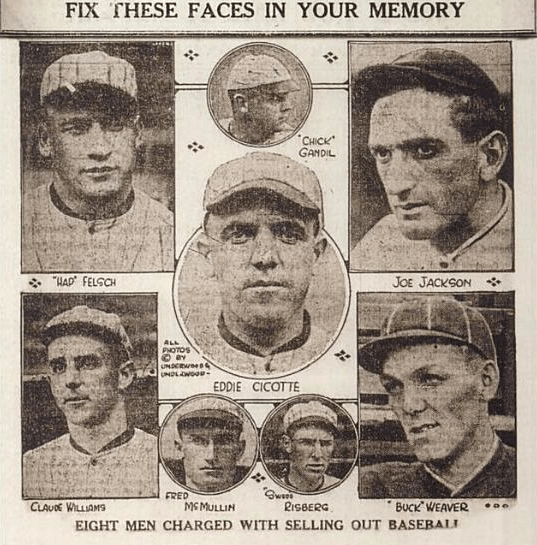


 The first non-stop transatlantic flight in history began on June 14, 1919, when British aviators John Alcock and Arthur Whitten Brown departed St. John’s, Newfoundland in a modified bomber, arriving in Ireland the following day.
 Five years later, “Lady Lindy” disappeared over the South Pacific, along with copilot Frederick J. Noonan.
 Corrigan made additional modifications and repeated applications over the next two years, all of which were rejected. By 1935, the once-freelance aviation industry faced increasing government regulation. Corrigan found his project losing ground. . In 1937, federal officials not only rebuffed his flight plan. Authorities deemed Corrigan’s aircraft Sunshine unstable for safe flight, and denied renewal of its license to fly.
 Aviation officials were apoplectic that a New York to California flight plan, would wind up in Ireland. At a time when Western Union charged by the word, the pilot was excoriated with a 600-word diatribe, enumerating the pilot’s transgressions. Corrigan served a 14-day suspension of his flying license, ending the day he returned with his aircraft aboard the steamship Manhattan.
 Wrong Way Corrigan flight tested bombers during WW2 and retired in 1950, and bought an orange grove in Santa Ana, California. He claimed he knew nothing about growing oranges, he just copied what his neighbors were doing.






 Captured at Spotsylvania early in 1864, 52nd North Carolina Infantry soldier James Tyner was a POW at this time, languishing in “Hellmira” – the fetid POW camp at Elmira, New York. “The Andersonville of the Northern Union.”

 The “pumpkin flood“ of 1903 scoured the rail line, uncovering many of the dead and carrying away their mortal remains. It must have been a sight – caskets moving with the flood, bobbing like so many fishing plugs, alongside countless numbers of that year’s pumpkin crop.


 What would it be like to turn on CNN or Fox News, to learn that Former Secretary of the Treasury Jacob (‘Jack’) Lew was party to a duel and that he was near death, after being shot by the sitting Vice President of the United States, Mike Pence.


 There are plenty of tales regarding the man’s paternity, but none are any more than that. Alois Schicklgruber ‘legitimized’ himself in 1877, adopting a variant on the name of his stepfather and calling himself ‘Hitler”.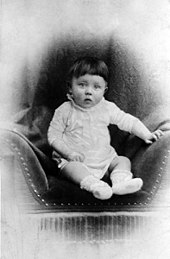


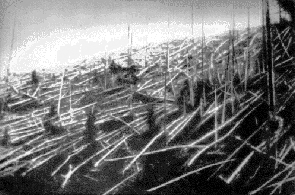 On the morning of June 30, 1908, the Tunguska River lit up with a bluish-white light. At 7:17a local time, a column of light far too bright to look at moved across the skies above the Tunguska. Minutes later, a vast explosion knocked people off their feet, flattening buildings, crops and as many as 80 million trees over an area of 830-square miles. A vast “thump” was heard, the shock wave equivalent to an earthquake measuring 5.0 on the Richter scale. Within minutes came a second and then a third shock wave and finally a fourth, more distant this time and described by eyewitnesses as the “sun going to sleep”.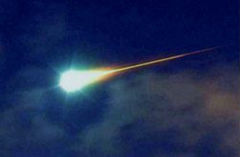


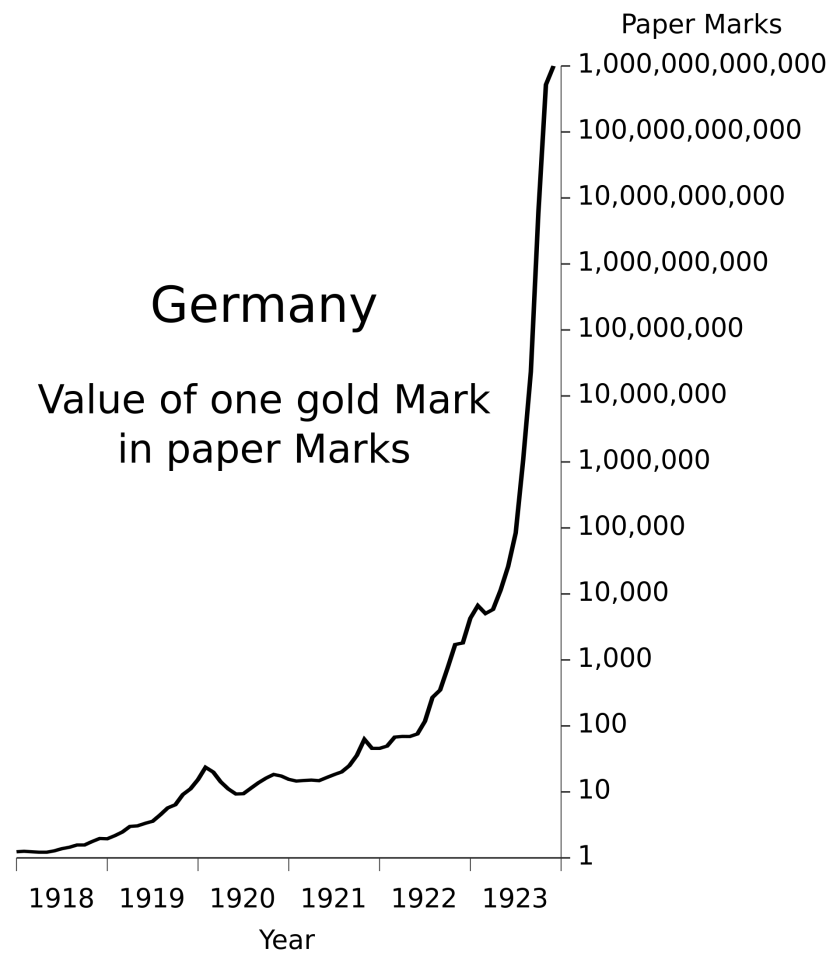 History records 58 such instances of hyperinflation. Current events in Venezuela constitute #59 despite the largest proven oil reserves on the planet, while certain American politicians and celebrity types, are nowhere to be found.


 The loss of all that productive capacity led to scarcity of goods, and prices began to rise. The government responded by printing money. Total currency in circulation in July 1945 stood at 25 Billion Pengö. Money supply rose to 1.65 Trillion by January, 65 Quadrillion and 47 Septillion July. That’s a Trillion Trillion. Twenty-four zeroes.
 The ten worst hyperinflations in history occurred during the 20th century, including Zimbabwe in 2008, Yugoslavia 1994, Germany 1923, Greece 1944, Poland 1921, Mexico 1982, Brazil 1994, Argentina 1981, and Taiwan 1949. The common denominator in all ten were massive government debt and a currency with no inherent value, excepting what a willing buyer and a willing seller agreed it was worth.
 Historical Easter Eggs - Today in History
You must be logged in to post a comment.