

With his father suffering tuberculosis and often hospitalized, Otis Ray Redding, Jr. quit school at the age of fifteen to help support the family. He worked at a gas station, but it was the occasional musical gig that got him noticed. From Macon (Georgia) talent contests to local bands, Redding later joined Little Richard’s band “The Upsetters” when the singer abandoned rock & roll music, for gospel.
Redding began his musical career at a time of racial segregation, touring the “chitlin circuit”: a string of venues hospitable to black musicians, comedians and entertainers throughout the American south, northeast and upper Midwest. Harlem’s Apollo Theater, the Regal Theater in Chicago, the Howard Theater in Washington, D.C, the Royal Peacock in Atlanta, and others.
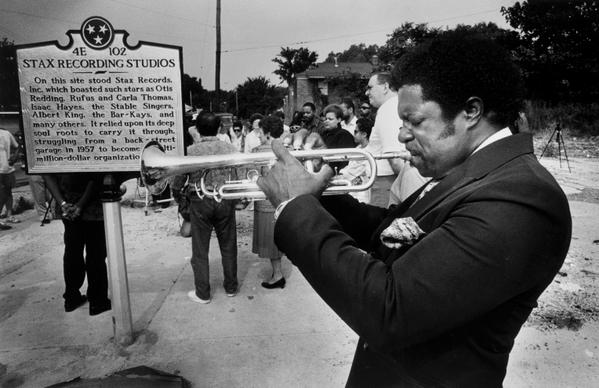
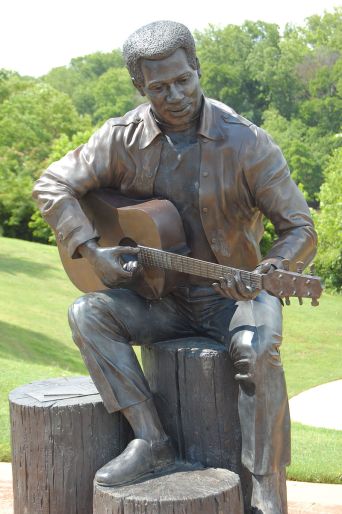 Redding joined STAX Records in 1962, a portmanteau of the founding partners and siblings Jim Stewart and his sister Estelle Axton (STewart/AXton = Stax).
The label’s use of a single studio and a small stable of musicians and songwriters produced a readily identifiable sound based on black gospel and rhythm & blues which came to be known as Southern soul, or Memphis soul.
Singer-songwriter-musician Otis Redding became Stax Records’ biggest star in the five years before the plane crash that took his life: the “Big O”, the “King of Soul”.
Musicians from Led Zeppelin to Lynyrd Skynyrd to Janis Joplin and virtually every soul and R&B musician of the era have taken musical influence from Otis Redding. It was he who wrote the ballad R-E-S-P-E-C-T made famous by the “Queen of Soul”, Aretha Franklin.
His initial recordings were mainly popular with black audiences, but Redding (and others) crossed the “color barrier”, performing at “white owned” venues like Whisky a Go Go in LA, the Monterey Pop Festival of 1967, and venues throughout Paris, London and other European cities.
Redding’s iconic song and #1 hit, “Sittin’ on the Dock of the bay“, became the first posthumous number-one record on both the Billboard Hot 100 and R&B charts. Dock of the Bay was the first posthumous album to reach number one on the UK Albums Chart.
The song wasn’t intended to turn out the way it did.
Redding had taken strong influence from the Beatles, particularly the layered sounds of Sgt. Pepper’s Lonely Hearts Club Band. He wanted to expand his musical footprint beyond the soul and R&B genre. If you listen to the song – the seagulls, the sound of lapping waves – that’s what he was going for. The “outro”, the twenty-five seconds’ whistling at the end, were nothing but a place holder, intended to be replaced by some yet-to-be-decided vocal effect in a second recording session, a few days later.
That second session was never meant to be.
The kid who once pumped gas to help support his family boarded his own Beechcraft H-18 aircraft on December 10, 1967, along with Bar-Kays guitarist Jimmy King, tenor saxophonist Phalon Jones, organist Ronnie Caldwell, trumpet player Ben Cauley, drummer Carl Cunningham, their valet Matthew Kelly and the pilot, Richard Fraser.
The band had played two nights in Cleveland. The next stop was Madison, Wisconsin. The plane took off despite warnings of foul weather. The show must go on. Ben Cauley remembers waking from a nap to see band-mate Phalon Jones look out a window and exclaim “Oh No!” He then found himself alone, clutching a seat cushion in the 34-degree waters of Lake Monona. He was the sole survivor.
A keyword search reveals seventy-two sole survivors, defined as the only survivor of a plane crash that killed ten or more passengers and crew.
Pilot error was ruled at fault for the wreck of Vietnam Airlines Flight 815 on September 3, 1997. The Tupolev Tu-134B-3 crashed at final approach at Phnom Penh Internatinal Airport in Cambodia, leaving Chanayuth Nim-anong the youngest on the list, at 14-months-old. The crash killed 66 passengers and crew including Taiwanese national Ho Suicheng, who was there to marry his fiancée, Cambodian Khuth Linda. It was she who identified his body. Khuth went through with the wedding, as planned. With his photograph.
Crew member Alexander Sizov is the oldest at 52, sole survivor of the charter plane crash of September 7, 2011 that wiped out forty-three members of the Lokomotiv Yaroslavl ice hockey team along with Canadian coach Brad McCrimmon. At the time, Lokomotiv Yaroslavl was a member of the Kontinental Hockey League (KHL), Russia’s top ice hockey league.

The old adage ‘only the good die young’ may be illustrated with Chinese national Huáng Yù, sole survivor of the hijacked Cathay Pacific aircraft Miss Macao in the 1948 crash that killed the other 27 people on board. Huáng was the lead hijacker. He not only escaped death, but prosecution, too. No one could decide what jurisdiction to try him under.
Though they would never meet, the Beatles form a common bond between the Redding crash and another sole survivor, half a world away.
Serbian flight attendant Vesna Vulović grew up in the age of Beatlemania, and wanted nothing more than to learn English, and move to London. That she did for a time before moving to Stockholm, but the girl’s parents would have nothing of the drugs and sex of the Swedish capital. On returning to Belgrade, Vulović saw a friend in a stewardess uniform. That was it, she remembered: “I thought, ‘Why shouldn’t I be an air hostess? I could go to London once a month’.” Vulović joined JAT, Yugoslavia’s national flag carrier and largest airline, in 1971.

JAT 367 flew from Stockholm to Belgrade with stopovers in Copenhagen and Zagreb, arrived in Denmark on January 25, 1972. Vulović wasn’t intended to be on the second leg scheduled for the following day, but JAT confused her for another flight attendant with the same name.
Croatian nationalists carried out 128 terrorist attacks against Yugoslav civilian and military targets between 1962 and 1982. JAT Flight 367 became one of them on this day in 1972, the briefcase bomb exploding at 33,330-feet and tearing the aircraft into three pieces.

Former WW2 medic Bruno Honke found Vulović screaming among the wreckage outside the Czechoslovak village of Srbská Kamenice, her turquoise uniform covered with blood, her 3-inch stiletto heels torn off by the force of the impact. Vulović herself has no recollection of the explosion, or the descent. She suffered a fractured skull with brain hemorrhage, two broken legs and three broken vertebrae. She would spend her next 27 days, in a coma. Two months later, she was offered a sedative for the flight back to Belgrade. She declined the injection, saying she had no memory of the crash. What was there to be afraid of?
Something of a Yugoslavian national hero, Vesna Vulović went back to work for JAT following sixteen months recuperation, albeit, with a limp. She wanted to go back to flying, but got a desk job, instead. The Guinness Book of world Records officially recognized Vulović’s 1971 fall. The title was officially awarded in 1985 in a special ceremony, personally bestowed by none other than Paul McCartney.
Feature image, top of page: Otis Reddings aircraft is fished out of the frigid waters of Lake Monona, near Madison Wisconsin. The band was four miles from their destination.



 Dr. Curtis Welch practiced medicine in Nome, Alaska, in 1925. Several children became ill with what he first diagnosed as tonsillitis. More came down with sore throats, early sufferers beginning to die as Welch observed the pseudomembrane of diphtheria. Dr. Welch had ordered fresh antitoxin the year before, but the shipment hadn’t arrived by the time the ports froze over. By January, all the serum in Nome was expired.


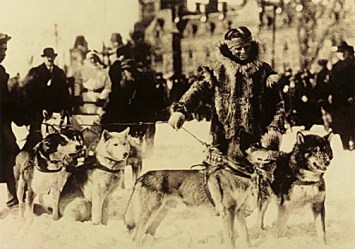 20 mushers and 150 dogs or more had covered 674 miles in 5 days, 7½ hours, a distance that normally took the mail relay 2-3 weeks. Not a single serum ampule was broken.


 “The once tight fabric covering the wings and fuselage was weak from all the rough landings as well as the wind and rain. Dirt and oil caked the engine and prop. Wires for the rudders and elevators hung from the sides of the fuselage.” Even in such disrepair, the pilots and mechanics thought one of the planes could be ready to go Nome in just three days, a flight they thought would take no more than 6-hours”.


 Local farmers were enlisted to help and by December 17, Knox was able to report to General Washington “I have had made forty two exceedingly strong sleds & have provided eighty yoke of oxen to drag them as far as Springfield where I shall get fresh cattle to carry them to camp. . . . I hope in 16 or 17 days to be able to present your Excellency a noble train of artillery.”


 In the middle ages, a French soldier once saw fit to mouth off to an
 In 585BC, the battle between the Medes and Lydians was stopped in its tracks, on account of a
  So, yes, there is irony when men make war, if not always humor. Yet, in all the annals of warfare, there may be no episode more amusing, than the time a naval force was defeated by men on horseback.





 The happy couple had yet to meet when the marriage was performed by proxy, the bride remaining in Vienna while the groom stayed in Paris. At 12 she was now the Dauphine, Marie Antoinette, wife of the 14-year-old Dauphin, future King of France.
 The stories you read about 18th century Court intrigue make you wonder how anyone lived like that. Antoinette was naive of the shark tank into which she’d been thrown. Relations were especially difficult with the King’s mistress, the Comtesse du Barry. Antoinette was somehow expected to work them out.
 France had serious debt problems in the 1770s, the result of endless foreign wars, but Antoinette received more than her share of the blame.

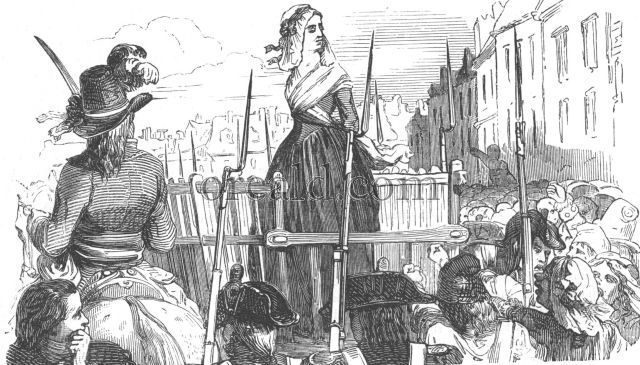
 Marie-Antoinette’s hair was cut off on October 16, 1793. She was driven through Paris in an ox cart, taken to the Place de la Révolution, and executed by decapitation. She accidentally stepped on the executioner’s foot on mounting the scaffold. Her last words were “Pardon me sir, I meant not to do it”.


 Over the years there have been many Rosie the Riveters, the last of whom was Elinor Otto, who built aircraft for fifty years before being laid off at age ninety-five. Naomi Parker-Fraley knew she was the “first”, but that battle was a long lost cause until Dr. Kimble showed up at her door, in 2015. All those years, she had known. Now the world knew.


 Former Olympian and coach of the German Olympic track & field team Josef Waitzer took an interest in the work, becoming a friend and consultant. Dassler brothers shoes were used in international competitions as early as the 1928 games in Amsterdam and the Los Angeles games, of 1932.




 Frank Bench, a personal friend of the inventor, was the first to install the machine. The first pre-sliced loaf was sold in July of the following year. Customers loved the convenience and Bench’s bread sales shot through the roof.
 Article 1, Section 8 of the Constitution includes the “Commerce Clause”, permitting the Congress “To regulate Commerce with foreign Nations, and among the several States, and with the Indian Tribes”. That’s it.
 The United States Supreme Court, apparently afraid of President Roosevelt and his aggressive and illegal “
 The stated reasons for the ban never did make sense. At various times, Wickard claimed that it was to conserve wax paper, wheat or steel, but one reason was goofier than the one before. According to the War Production Board, most bakeries had plenty of wax paper supplies on hand, even if they didn’t buy any. Furthermore, the federal government had a billion bushels of wheat stockpiled at the time, about two years’ supply, and the amount of steel saved by not making bread slicers has got to be marginal, at best.


 He appeared from 1973 – ’75 on The National Lampoon Radio Hour, along with future SNL regulars Gilda Radner, Chevy Chase and Bill Murray. A number of radio segments went on to become SNL sketches in the show’s first couple of seasons.
 Animal House, the film that launched Belushi’s career on the big screen, almost didn’t happen.
 John Belushi was found dead the following morning. The cause of death was originally thought to be an accidental overdose. Cathy Smith was extradited from Canada and tried on first degree murder charges following a National Enquirer interview in which she admitted giving Belushi eleven speedballs. A plea bargain reduced the charge to involuntary manslaughter. She served fifteen months in prison.


You must be logged in to post a comment.