March 7, 1912 The Heroic Age of Polar Exploration

The final camp became their tomb, a high cairn of snow erected over it. Ship’s carpenters built a wooden cross, inscribed with a line from Alfred Lord Tennyson’s poem Ulysses: “To strive, to seek, to find, and not to yield”.

The fourth son of a family of Norwegian shipowners and captains, Roald Amundsen always wanted to go to sea. His mother wanted no such thing and made him promise he’d go to school to become a doctor. Amundsen was 21 when his mother died. He kept his promise until that day.  There would be no more school after that.

Roald Amundsen
Roald Amundsen

Amundsen wanted to become an explorer, taking inspiration from the doomed Franklin Arctic Expedition of 1848, and Fridtjof Nansen’s crossing of Greenland in 1888.

It’s been called the “Heroic Age” of polar exploration.

Amundsen was drawn to it as much as he helped create it. He was part of the Antarctic expedition of 1897-99 aboard the RV Belgica, the first to winter in Antarctica. He led the first expedition to successfully navigate Canada’s Northwest Passage between the Atlantic and Pacific Oceans, in 1903–06.

Amundsen’s attempt to reach the South Pole set out on September 8, 1911. Using skis and dog sleds, Amundsen and his men created supply depots at 80°, 81° and 82° south, along a direct line to the Pole. The effort proved to be premature and had to be abandoned due to extreme cold.

A second attempt departed on October 19 with four sledges and 52 dogs, along the previously unknown Axel Heiberg Glacier.  The team of five men and 16 dogs arrived at 90° 0′ S on December 14, 1911,  the first team in history to reach the South Pole.

Aan_de_Zuidpool
Amundsen expedition plants the Norwegian flag on the South Pole, December 14, 1911.

Amundsen expedition plants the Norwegian flag on the South Pole, December 14, 1911.

English explorer Robert Falcon Scott had attempted the South Pole in 1901–04, and was doing so once again in 1911. Though he’d had to turn back, the earlier expedition had established the southernmost record for that time, at 88° 23′ S. 97 miles short of the pole.

Unlike Amundsen who adopted the lighter fur-skins of the Inuit, the Scott expedition wore heavy wool clothing, depending on motorized and horse-drawn transport, and man-hauling sledges for the final drive across the polar plateau. Dog teams were expected to meet them only on the way out, on March 1.

Scott's_party_at_the_South_Pole
The doomed Scott party used a string to take this “selfie”, the day after becoming 2nd to reach the South Pole

Weak, poorly acclimated ponies slowed the depot-laying part of the Scott expedition, four horses dying of cold or having to be shot because they slowed the team. When Scott decided to locate “One-Ton Depot” 35 miles short of its planned location at 80°, expedition member Lawrence Oates warned “Sir, I’m afraid you’ll come to regret not taking my advice.”

Routes taken by Scott (green) and Amundsen (red) expeditions to the South Pole.
Unlike the previous attempt, Scott made it this time, only to find that Amundsen’s Norwegian expedition had beat him by five weeks. The anguish in Scott’s diary entry for January 17, 1912, is clear: “The worst has happened.  All the day dreams must go.  Great God! This is an awful place”.

Roald Amundsen returned safely and publicly announced his attainment of the South Pole on March 7, 1912.

Amundsen_-_Scott_Antarctic_expedition_map.svg

Routes taken by Scott (green) and Amundsen (red) expeditions to the South Pole.

Defeated, the five-man Scott party began the 800-mile, frozen slog back from the Pole on January 19. Team member Edgar Evans’ condition was visibly deteriorating as early as the 23rd. A bad fall on Beardmore Glacier on February 4 left him “dull and incapable”. Another fall on the 17th left him dead at the foot of the glacier.

Dog teams failed to materialize at the appointed time.  By March 16, Lawrence Oates was severely frostbitten. He left his tent for the last time in a valiant act of suicide, in the forlorn hopes that his comrades, might live.  Oates stepped into the maelstrom, saying “I am just going outside and may be some time”.  He never returned.

Belgica_schiff
RV Belgica frozen in the ice, 1898

The last three made their final camp on March 19, with 400 miles to go.   A howling blizzard descended on camp the following day and lasted for days, as Scott and his companions wrote good-bye letters to mothers, wives, and others. The last words in his diary, were: “Last entry.  For God’s sake look after our people”.

The frozen corpses of Scott and his comrades were found 8 months later, the last diary entry dated March 29, 1912.  A high cairn of snow was erected over it all, that final camp becoming their tomb. Ship’s carpenters built a wooden cross, inscribing on it the names of those lost: Scott, Edward Wilson, Henry Bowers, Lawrence Oates and Edgar Evans. A line from Alfred Lord Tennyson’s poem, Ulysses, appears on the cross:

“To strive, to seek, to find, and not to yield”.

The team was eleven miles from the next supply depot.

Grave_of_the_Southern_PartySatellites measured the coldest temperature in recorded history on August 10, 2010 at −93.2 °C (−135.8 °F), in East Antarctica.   The Amundsen-Scott weather station at the South Pole reports the average daily temperature for March, at -50.3°C (-58.54°F).

A century of ice and snow have covered bodies, camp and the cross alike. Now encased 75′ down in the Ross Ice Shelf and inching their way outward, the bodies are expected to reach the Ross Sea sometime around 2276, perhaps to float away in an iceberg.

In 1926, Amundsen and a team of 15 reached the North Pole in the airship Norge. Three previous claims to have attained the North Pole: Frederick Cook (1908), Robert Peary (1909), and Richard E. Byrd (1926), have all been disputed as being of dubious accuracy or downright frauds, leaving Amundsen the undisputed first to have reached both poles.

cross_on_observation_hill_mcmurdo_station
The Observation Hill cross memorial to the Scott expedition, erected 1913.

Roald Amundsen and a crew of five disappeared into the Arctic on June 18, 1928, lost in the search for survivors following the crash of the Airship Italia.

Despite efforts to find them as late as August 2009, neither aircraft nor bodies were ever found.On hearing the details of Scott’s end, Roald Engelbregt Gravning Amundsen is quoted as saying “I would gladly forgo any honour or money if thereby I could have saved Scott his terrible death”.

Peter Markham Scott, the only child produced by the marriage of Robert Falcon and Kathleen Bruce Scott, went on to found the World Wide Fund for Nature, which operates to this day as the World Wildlife Fund (WWF).

Shackleton advert

If you enjoyed this “Today in History”, please feel free to re-blog, “like” & share on social media, so that others may find and enjoy it as well. Please click the “follow” button on the right, to receive email updates on new articles.  Thank you for your interest, in the history we all share.

March 6, 1836  Remember the Alamo

The final assault began at 5:00am, on Sunday, March 6, 1836. 1,800 troops attacked from all sides.  Santa Anna’s troops were shattered by concentrated artillery fire, but the numbers were overwhelming.

In 1831, Mexican authorities gave the settlers of Gonzales, Texas a small cannon, a defense against Comanche raids.  The political situation deteriorated in the following years.  By 1835, several Mexican states were in open revolt.  That September, commander of “Centralist” (Mexican) troops in Texas Colonel Domingo de Ugartechea, came to take it back.

Dissatisfied with the increasingly dictatorial policies of President and General Antonio Lopez de Santa Anna, the colonists had no intention of handing over that cannon.  One excuse was given after another to keep the Mexican dragoons out of Gonzalez, while pleas fr assistance secretly went out to surrounding communities.  Within two days, 140 “Texians” had gathered in Gonzalez, determined not to give up that gun.

bbda0f5f692de2515979555a76d55e74

Militarily, the skirmish of October 2 had little significance, much the same as the early battles in the Massachusetts colony, some sixty years earlier.  Politically, the “Lexington of Texas” marked a break between Texian settlers, and the Mexican government.

Settlers continued to gather, electing the well-respected local and former legislator of the Missouri Stephen F. Austin, as their leader.  Santa Anna sent his brother-in-law, General Martin Perfecto de Cos to reinforce the settlement of San Antonio de Béxar, near the modern city of San Antonio.  On the 13th, Austin led his Federalist army of Texians and their Tejano allies to Béxar, to confront the garrison.  Austin’s forces captured the town that December, following a prolonged siege. It was only a matter of time before Santa Anna himself came to take it back.

OLYMPUS DIGITAL CAMERA
Gonzalez Flag

Two forts – more like lonely outposts – blocked the only approaches from the Mexican interior into Texas: Presidio La Bahía (Nuestra Señora de Loreto Presidio) at Goliad and the Alamo at San Antonio de Béxar.  That December, a group of volunteers led by George Collinsworth and Benjamin Milam overwhelmed the Mexican garrison at the Alamo, and captured the fort  The Mexican President arrived on February 23 at the head of an army of 3,000, demanding its surrender.  Lieutenant Colonel William Barret “Buck” Travis, responded with a cannon ball.

Knowing that his small force couldn’t hold for long against such an army, Travis sent out a series of pleas for help and reinforcement, writing “If my countrymen do not rally to my relief, I am determined to perish in the defense of this place, and my bones shall reproach my country for her neglect.” 32 troops attached to Lt. George Kimbell’s Gonzales ranging company made their way through the enemy cordon and into the Alamo on March 1. There would be no more.

Estimates of the Alamo garrison have ranged between 189 and 257 at this stage, but current sources indicate that defenders never numbered more than 200.

Alamo-Weight-Loss-Motivation-2

The final assault began at 5:00am, on Sunday, March 6, 1836. 1,800 troops attacked from all sides.  Santa Anna’s troops were shattered by concentrated artillery fire, but the numbers were overwhelming. The walls were breached and to hand fighting moved to the barracks, ending in the chapel. As many as seven defenders remained alive when it was over.  Many believe former Congressman Davy Crockett was among them.

Santa Anna ordered them all, executed.

defendingthealamo

By 8:00am there were no survivors, saving a handful of noncombatant women, children, and slaves, slowly emerging from the smoking ruins. These were provided with blankets and two dollars apiece, and given safe passage through Mexican lines with the warning:  a similar fate awaited any Texan who continued in their revolt.

On April 21, a force of 800 Texans shouting “Remember the Alamo!” and led by Sam Houston defeated Santa Anna’s force of some 1,500 at San Jacinto, near modern day Houston. The victory secured Texan independence.  Mexican troops occupying San Antonio were ordered to withdraw by May. Texas became the 28th state of the United States on December 29, 1845.

167770-004-CD749F3B

Santa Anna went on to lose a leg to a cannon ball two years later, fighting the French at the Battle of Veracruz. following amputation, the leg spent four years buried at Santa Anna’s hacienda, Manga de Clavo, in Veracruz. When Santa Anna resumed the presidency in late 1841, he had the leg dug up and placed in a crystal vase, brought amidst a full military dress parade to Mexico City and escorted by the Presidential bodyguard, the army, and cadets from the military academy. This guy was nothing if not a self-promoter.

The leg was reburied in an elaborate ceremony in 1842, including cannon salvos, speeches, and poetry read in the General’s honor. The state funeral for Santa Anna’s leg was attended by his entire cabinet, the diplomatic corps, and the Congress.

456195157-leg.png

Antonio Lopez de Santa Anna served 11 non-consecutive terms as Mexican President, spending most of his later years in exile in Jamaica, Cuba, the United States, Colombia, and St. Thomas. In 1869, the 74-year-old former President was living in Staten Island, trying to raise an army to return and take over Mexico City.  In a bid to raise the money, Santa Anna brought the first shipments of chicle to the United States, a gum-like substance made from the tree species, Manilkara chicle.  This, he proposed to use as rubber on carriage tires.

Thomas Adams, the American assigned to aid Santa Anna’s stay in the US, also experimented with chicle as a substitute for rubber. He bought a ton of the stuff from the General, but those experiments would likewise prove, unsuccessful. Instead, Adams helped to found an American chewing gum industry with a product he called “Chiclets”.

If you enjoyed this “Today in History”, please feel free to re-blog, “like” & share on social media, so that others may find and enjoy it as well. Please click the “follow” button on the right, to receive email updates on new articles.  Thank you for your interest, in the history we all share.

March 5, 1776 Head Fake

It’s doubtful whether Washington possessed either powder or shot for a sustained campaign, but British forces occupying Boston didn’t know that.

Over the night and the following day of April 18-19, 1775, individual British soldiers marched 36 miles or more, on the round-trip expedition from Boston.  Following the early morning battles at Lexington and Concord, armed colonial militia from as far away as Worcester swarmed over the column, forcing the regulars into a fighting retreat.

In those days, Boston was a virtual island, connected to the mainland by a narrow “neck” of land.  More than 20,000 armed men converged from all over New England in the weeks that followed, gathering in buildings and encampments from Cambridge to Roxbury.

siege-of-boston-1775-1776-grangerA man who should have gone into history among the top tier of American Founding Fathers, the future turncoat Benedict Arnold, arrived with Connecticut militia to support the siege.  Arnold informed the Massachusetts Committee of Safety that Fort Ticonderoga, located along the southern end of Lake Champlain in northern New York, was bristling with cannon and other military stores.  Furthermore, the place was lightly defended.

The committee commissioned Arnold a colonel on May 3, authorizing him to raise troops and lead a mission to capture the fort.  Seven days later, Colonel Arnold and militia forces from Connecticut and western Massachusetts in conjunction with Ethan Allen and his “Green Mountain Boys” captured the fort, and all its armaments.

The Continental Congress created the Army that June, appointing General George Washington to lead it.  When General Washington took command of that army in July, it was a force with an average of nine rounds-worth of shot and powder, per man.  British forces occupying Boston, were effectively penned up by forces too weak to do anything about it.

The stalemate dragged on for months, when a 25-year-old bookseller came to General Washington with a plan. His name was Henry Knox. His plan was a 300-mile, round trip slog into a New England winter, to retrieve the guns of Ticonderoga:  brass and iron cannon, howitzers, and mortars.  59 pieces in all.  Washington’s advisors derided the idea as hopeless, but the General approved.

Henry-Knox-moving-canning-from-Fort-Ticonderoga

Knox set out with a column of men in late November, 1775.  For nearly two months, he and his team wrestled 60 tons of cannons and other armaments by boat, animal & man-hauled sledges along roads little better than foot trails.  Across two barely frozen rivers, and through the forests and swamps of the Berkshires to Cambridge, historian Victor Brooks called it “one of the most stupendous feats of logistics” of the Revolution.  It must have been a sight on January 24, 1776, when Knox returned at the head of that “Noble Train of Artillery”.

For British military leadership in Boston, headed by General William Howe, the only option for resupply was by water, via Boston Harbor.  Both sides of the siege understood the strategic importance of the twin prominences overlooking the harbor, the hills of Charlestown to the north, and Dorchester heights to the south.  It’s why British forces had nearly spent themselves on Farmer Breed’s hillside that June, an engagement that went into history as the Battle of Bunker Hill.

e716f0fbb9

With Howe’s forces in possession of the Charlestown peninsula, Washington had long considered occupying Dorchester Heights, but considered his forces too weak.  That changed with the guns of Ticonderoga.

In the first days of March, Washington placed several heavy cannon at Lechmere’s Point and Cobble Hill in Cambridge, and on Lamb’s Dam in Roxbury.  The batteries opened fire on the night of March 2, and again on the following night and the night after that.  With British attention thus diverted, American General John Thomas and a force of some 2,000 made plans to take the heights.

As the ground was frozen and digging impossible, fortifications and cannon placements were fashioned from heavy 10′ timbers.  With the path to the top lined with hay bales to muffle their sounds, these fortifications were manhandled to the top of Dorchester heights over the night of March 4-5, along with the bulk of Knox’ cannons.

General Howe was stunned on awakening, on the morning of March 5.  The British garrison in Boston and the fleet in harbor, were now under the muzzles of Patriot guns.  “The rebels have done more in one night”, he said, “than my whole army would have done in a month.”

Plans were laid for an immediate British assault on the hill, as reinforcements poured into the position.  By day’s end, Howe faced the prospect of another bunker Hill, this time against a force of 6,000 in possession of heavy artillery.

A heavy snowstorm descended late in the day, interrupting Howe’s plan for the assault.  A few days later, he had thought better of it.  A tacit cease-fire settled in over the next two weeks, with Washington’s side declining to open fire, and Howe’s side refraining from destroying the town, in the course of withdrawing from Boston.

British forces departed Boston by sea on March 17 with about 1,000 civilian loyalists, resulting in a peculiar Massachusetts institution which exists to this day. “Evacuation Day”:

evacuation-day
British evacuation of Boston. March 17, 1776

It’s doubtful whether Washington possessed either powder or shot for a sustained campaign, but British forces occupying Boston didn’t know that. The mere presence of those guns moved General Howe to weigh anchor and sail for Nova Scotia. The episode may be the greatest head fake, in military history.

If you enjoyed this “Today in History”, please feel free to re-blog, “like” & share on social media, so that others may find and enjoy it as well. Please click the “follow” button on the right, to receive email updates on new articles.  Thank you for your interest, in the history we all share.

March 4, 1789  A Self Governing Republic

Even at the convention, many of the framers were concerned about the larger, more populous states governing at the expense of the smaller states. The proverbial five wolves and a lamb, voting on what’s for lunch. 

Early discussions concerning the American experiment in self-government began nearly twenty years before the Revolution, with the Albany Congress of 1754 and Benjamin Franklin’s proposed Albany Plan of Union. The 2nd Continental Congress appointed a drafting committee to write our first constitution in 1776, the work beginning on July 12. The finished document was sent to the states for ratification on November 15, the following year.

ArticlesOfConfederation (1)Twelve of the thirteen original states ratified these “Articles of Confederation” by February, 1779. Maryland would hold out for another two years, over land claims west of the Ohio River. In 1781, seven months before Cornwallis’ surrender at Yorktown, the 2nd Continental Congress formally ratified the Articles of Confederation. The young nation’s first governing document.

The Articles of Confederation provided for a loose alliance of sovereign states. At the center stood a congress, a unicameral legislature, and that’s about it. There was no Executive, there was no Judiciary.

In theory, Congress had the authority to govern foreign affairs, conduct war, and regulate currency. In practice, these powers were limited because Congress had no authority to enforce requests made on the states, either for money or for troops.

The Union would probably have broken up if the Articles of Confederation were not amended or replaced. Twelve delegates from five states met at Mann’s Tavern in Annapolis Maryland in September 1786, to discuss the issue. The decision of the Annapolis Convention was unanimous. Representatives from all the states were invited to send delegates to a new constitutional convention in Philadelphia, the following May.

635800718776443557-signing-of-the-constitution

The United States had won its independence from England four years earlier, when 55 state delegates convened in Philadelphia to compose a new constitution.

Delegates from 12 of the 13 colonies met on May 25, 1787 at Philadelphia’s Pennsylvania State House, the birthplace of the Declaration of Independence and the Articles of Confederation.  Only Rhode Island abstained.  The building is now known as Independence Hall.

The assembly immediately discarded the idea of amending the Articles, instead crafting a brilliant Federal system of checks and balances over three months of debate. The Federal Republic crafted by the framers delegates specific, limited powers to the Federal Government, with authority outside those specified powers devolving to the states.

bigstock-Declaration-of-Independence-20186213-1140x592

Even at the convention, many of the framers were concerned about the larger, more populous states governing at the expense of the smaller states. The proverbial five wolves and a lamb, voting on what’s for lunch.  The “Connecticut Compromise” solved that problem, creating a bicameral legislature with proportional representation in the lower house (House of Representatives) and equal representation of the states in the upper house (Senate).

The Constitution was signed by 38 of the 41 delegates on September 17, 1787. As dictated by Article VII, the document would not become binding until ratified by nine of the 13 states.

Five states: Delaware, Pennsylvania, New Jersey, Georgia, and Connecticut ratified the document in quick succession. Some states objected to the new constitution, particularly Massachusetts, which wanted more protection for basic political rights such as freedom of speech, religion, and of the press. They wanted it specified that powers undelegated to the Federal government, were reserved to the states. A compromise was reached in February, 1788 whereby Massachusetts and other states would ratify the document, with the assurance that such amendments would be immediately proposed.

The Constitution was ratified in Massachusetts by a two vote margin, followed by Maryland and South Carolina. New Hampshire became the ninth state to ratify on June 21. The new Constitutional Government would take effect on March 4, 1789.

On September 25, the first Congress adopted 12 amendments, sending them to the states for ratification. The states got rid of the first two, and so the Congress’ original 3rd amendment became 1st, of what we now call the “Bill of Rights”. Today, the United States Constitution is the oldest written national constitution in operation in the world.

united-states-founding-documents-vintage-american-flag-declaration-independence-constitution-america-58534238It’s interesting to note the priorities of that first Congress, as expressed in their original 1st and 2nd amendments. The ones that were thrown out. The first had to do with proportional representation, and would have led us to a 6,000-member House of Representatives, instead of the 435 we currently have. The second most important thing in the world, judging by the priorities of that first Congress, was that any future Congress could not change their own salaries. Any such change could affect only future Congresses.

That original 2nd amendment, reading that “No law, varying the compensation for the services of the Senators and Representatives, shall take effect, until an election of Representatives shall have intervened”, took effect in 1992 as the 27th amendment, following a ratification period stretching out to 202 years, 7 months, and 12 days. We must not be too hasty about these things.

If you enjoyed this “Today in History”, please feel free to re-blog, “like” & share on social media, so that others may find and enjoy it as well. Please click the “follow” button on the right, to receive email updates on new articles.  Thank you for your interest, in the history we all share.

March 3, 1634 Ye Olde Watering Hole

The connection between sanitation and the boiling to make beer was poorly understood at the time, but everyone knew. Those who drank beer and ale didn’t get sick.  The brewhouse was an indispensable priority in every new settlement.

Despite seemingly inexhaustible supplies of pristine drinking water, colonists to the New World were first and foremost Englishmen, every one of whom understood that drinking water could make you deathly ill. The connection between sanitation and the boiling to make beer was poorly understood at the time, but everyone knew. Those who drank beer and ale didn’t get sick.  The brewhouse was an indispensable priority in every new settlement.

The earliest settlers to Jamestown, Virginia neglected the brewer’s art. Their first pleas for relief from England, included advertisements seeking “two brewers’ to join them.

ccnews116_01_big

When Pilgrims fetched up on the shores of Cape Cod and the later Plimoth colony in 1620, it was not in search of a beach vacation, but because of dwindling beer supplies.

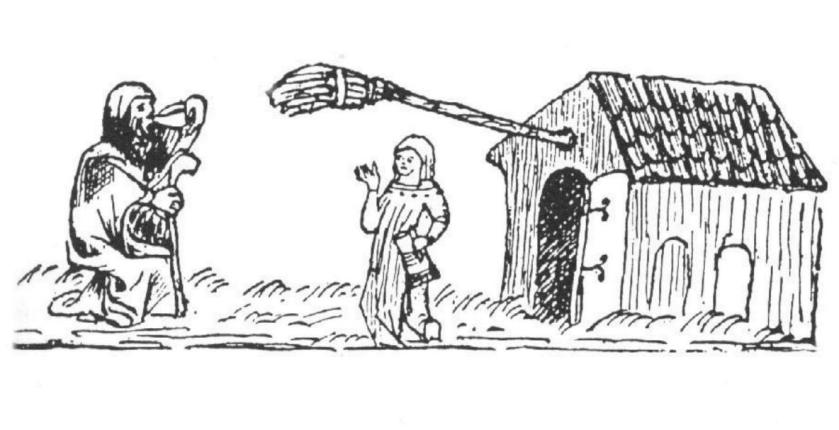
In the early colonial period, tavern keepers would put out an “Ale Stick” or “Ale Stake”, a wooden pole with a bush of barley tied to the top, informing thirsty travelers that sustenance was available, inside.  Sometimes a hoop of woven barley hanging outside, would signal, you’d arrived.

Samuel Cole was an early Puritan settler in the Massachusetts Bay colony, arriving with the Winthrop fleet in 1630 and putting down roots on the Shawmut peninsula.  Four years later, Cole opened the first house of entertainment in the Massachusetts Bay Colony, calling the place “Cole’s Inn”, established March 3, 1634.

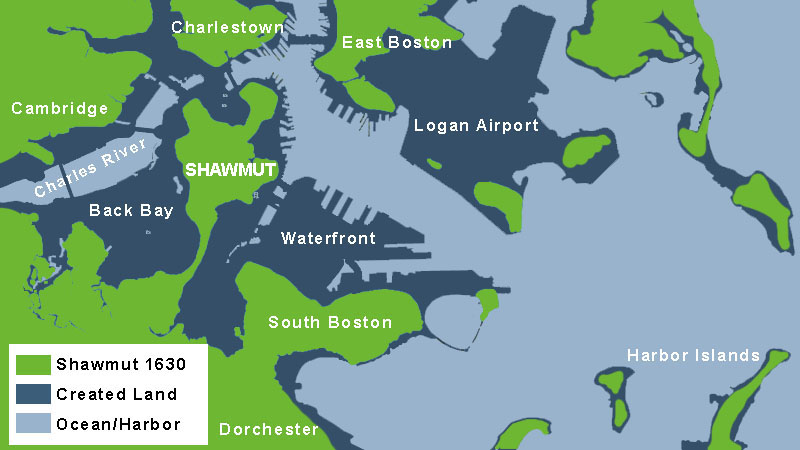
shawmut
Today, the former mud flats and marshlands of Boston Harbor and Charles River have been filled in and developed, transforming the Boston shoreline. This is the Shawmut Peninsula, as it looked in 1630.

Taverns were common in England from as early as the 1200s, where women called “Ale Wives” would fetch beer, wine, mead and ale for the guests. Though lodgings were a common feature of the ale houses of the time, it would not be until the early 1700s that Colonial taverns commonly offered such amenities.

14th+century+alehouse

14th century ale house

James Franklin set up a printing business in Boston and produced one the area’s earliest newspapers, the new England Courant.   Little brother Benjamin Franklin describes his earliest experience working in his brother’s print shop, with frequent reference to fetching ale for the journeyman printers.

Beer and ale were dietary staples in the era, a source of nourishment as well as refreshment. Infants drank beer and it was especially recommended for nursing mothers. Many households added a small brewing room to the outside of the building, so the heat and risk of fire associated with brewing and cooking could be kept outside of living quarters. To this day, the lower roof lines of these “brew rooms” can be found, jutting out from the sides of the oldest American homes.

George Washington, home brew
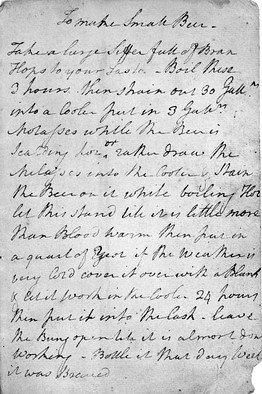
George Washington’s “small beer” recipe, written in his own hand

George Washington’s home brew recipe, “To make Small Beer”, instructed the enthusiast to:  Take a large Sifter full of Bran Hops to your Taste. — Boil these 3 hours. Then strain out 30 Gallons into a Cooler, put in 3 Gallons Molasses while the Beer is scalding hot or rather drain the molasses into the Cooler & strain the Beer on it while boiling Hot. Let this stand till it is little more than Blood warm. Then put in a quart of Yeast if the weather is very cold, cover it over with a Blanket & let it work in the Cooler 24 hours. Then put it into the Cask — leave the Bung[hole] open till it is almost done working — Bottle it that day Week it was Brewed.”

Later taverns posted elaborate signs, carved from wood, stone, or even terra cotta, and hanged from wooden posts mounted to the building or to a nearby tree. Barley, the universal symbol for beer, remained a common feature of such signs, and continues in use on the labels of many brands sold to this day.

The colonial-era brew house was the crucible of the American Revolution. The United States Marine Corps was born in Philadelphia’s Tun Tavern.  In the hours preceding the “shot heard round the world, the “Minutemen” of Lexington awaited General Thomas Gage’s advancing column of “Regulars”, at Buckman Tavern.

warren-tavern
Warren Tavern, Charleston

Charlestown was left a smoldering ruin in the wake of the 1775 Battle of Bunker Hill.  One of the first buildings to rise from the ashes was the Warren Tavern, opened in 1780.  Today, the Warren Tavern website describes itself as “the oldest tavern in Massachusetts…visited by many famous individuals including George Washington and Paul Revere”.

The signs of the time frequently included horses, indicating that lodgings and stables were available. Many such establishments came to be called after such signs, and names such as “Chestnut Mare” and “White Stallion” were common.

Today, a keyword search of the term “Black Horse Tavern” yields some 28,800,000 hits.  Cheers.

il_340x270.1070223624_arf1“Filled with mingled cream and amber
I will drain that glass again.
Such hilarious visions clamber
Through the chambers of my brain –
Quaintest thoughts — queerest fancies
Come to life and fade away;
Who cares how time advances?
I am drinking ale today.” – Edgar Allen Poe

If you enjoyed this “Today in History”, please feel free to re-blog, “like” & share on social media, so that others may find and enjoy it as well. Please click the “follow” button on the right, to receive email updates on new articles.  Thank you for your interest, in the history we all share.

March 2, 1864 A POW story

Four men, each of whom played a part in the most destructive war, in American history.  Without any of these four, I wouldn’t be here to tell their story.

In the early days of the Civil War, the government in Washington refused to recognize the Confederate states’ government, believing any such recognition would amount to legitimizing an illegal entity.  The Union refused formal agreement regarding the exchange of prisoners. Following the capture of over a thousand federal troops at the first battle of Bull Run (Manassas), a joint resolution in Congress called for President Lincoln to establish a prisoner exchange agreement.

In July 1862, Union Major General John A. Dix and Confederate Major General D. H. Hill met under flag of truce to draw up an exchange formula, regarding the return of prisoners. The “Dix-Hill Cartel” determined that Confederate and Union Army soldiers were exchanged at a prescribed rate:  captives of equivalent ranks were exchanged as equals.  Corporals and Sergeants were worth two privates.  Lieutenants were four and Colonels fifteen, all the way up to Commanding General, equivalent to sixty private soldiers.  Similar exchange rates were established for Naval personnel.

My twice-great grandfather, Corporal Jacob Deppen of the 128th Pennsylvania Infantry,  was paroled in such an exchange.

President Lincoln’s emancipation proclamation of September 1862 not only freed those enslaved in Confederate territories, but also provided for the enlistment of black soldiers.  The government in Richmond responded that such would be regarded as runaway slaves and not soldiers.  Their white officers would be treated as criminals, for inciting servile insurrection.

The policy was made clear in July 1863, following the Union defeat at Fort Wagner, an action depicted in the 1989 film, Glory.  The Dix-Hill protocol was formally abandoned on July 30.  Neither side was ready for the tide of humanity, about to come.

The US Army began construction the following month on the Rock Island Prison, built on an Island between Davenport Iowa and Rock Island, Illinois. In time, Rock Island would become one of the most infamous POW camps of the north, housing some 12,000 Confederate prisoners, seventeen per cent of whom, died in captivity.

illinois--1864--rock-island--bird-s-eye-view-114349732-5b6e3d7b4cedfd0025fd2c3d

On this day in 1864, the first prisoners had barely moved into the most notorious POW camp of the Civil War, the first Federal soldiers arriving on February 28.

The pictures at the top of this page were taken at Camp Sumter, better known as Andersonville.  Conditions in this place defy description. Sergeant Major Robert H. Kellogg of the 16th Regiment Connecticut Volunteers, entered this hell hole on May 2:

“As we entered the place, a spectacle met our eyes that almost froze our blood with horror, and made our hearts fail within us. Before us were forms that had once been active and erect;—stalwart men, now nothing but mere walking skeletons, covered with filth and vermin. Many of our men, in the heat and intensity of their feeling, exclaimed with earnestness. “Can this be hell?” “God protect us!” and all thought that he alone could bring them out alive from so terrible a place. In the center of the whole was a swamp, occupying about three or four acres of the narrowed limits, and a part of this marshy place had been used by the prisoners as a sink, and excrement covered the ground, the scent arising from which was suffocating. The ground allotted to our ninety was near the edge of this plague-spot, and how we were to live through the warm summer weather in the midst of such fearful surroundings, was more than we cared to think of just then”.

Over 45,000 Union troops would pass through the verminous open sewer known as Andersonville. Nearly 13,000 died there.

Andersonville1
Andersonville

Now all but forgotten, the ‘Eighty acres of Hell’ located in the Bronzeville neighborhood of Chicago was home to some forty thousand Confederate POWs between 1862 and 1865, seventeen per cent of whom, never left.  No southern soldier was equipped for the winters at Camp Douglas, nor the filth, or the disease. Nearby Oak Woods Cemetery is home to the largest mass grave, in the western hemisphere.

Union and Confederate governments established 150 such camps between 1861 and 1865, makeshift installations of rickety wooden buildings and primitive sewage systems, often little more than tent cities.   Some 347,000 human beings languished in these places, victims of catastrophically poor hygiene, harsh summary justice, starvation, disease and swarming vermin.

The training depot designated camp Rathbun near Elmira New York became the most notorious camp in the north, in 1864.  12,213 Confederate prisoners were held there, often three men to a tent.  Nearly 25% of them died there, only slightly less, than Andersonville.   The death rate in “Hellmira” was double that of any other camp in the north.

Prisons8
“Hellmira”

Historians debate the degree to which such brutality resulted from deliberate mistreatment, or economic necessity.

The Union had more experience being a “country” at this time, with well established banking systems and means of commerce and transportation.  For the south, the war was an economic catastrophe.  The Union blockade starved southern ports of even the basic necessities from the beginning, while farmers abandoned fields to take up arms. Most of the fighting of the Civil War took place on southern soil, destroying incalculable acres of rich farm lands.

The capital at Richmond saw bread riots as early as 1862.  Southern Armies subsisted on corn meal and peanuts.  The Confederate government responded by printing currency, about a billion dollars worth.  By 1864, a Confederate dollar was worth 5¢ in gold.  Southern inflation exceeded 9000%, by 1865.

Captain Henry Wirz, commandant of the stockade at Camp Sumter, was tried and executed after the war, only one of two men to be hanged for war crimes.  Captain Wirz appeared at trial reclined on a couch, advanced gangrene preventing him from sitting up.  To some, the man was a scapegoat. A victim of circumstances beyond his control. To others he is a demon, personally responsible for the hell of Andersonville prison.  I make no pretense of answering such a question.  The subject is capable of inciting white-hot passion, from that day to this.

Family Plot
Family cemetery, Scotland County, North Carolina.  Note the peaked tops of Confederate stones.  It’s said they were shaped that way, so no Yankee could sit on them.

On a personal note:

There are many good reasons to study history, among which is an understanding of where we come from.  How do we know where we’re going, if we don’t understand where we’ve been.

Should our ancestors be towering historical figures or merely those who played a part, the principle applies on the micro, as well as a larger scale.

Among those farmers who laid down their tools were the four Tyner brothers of North Carolina:  James, William, Nicholas and Benjamin.  My twice-great Grandfather, Private James Tyner, 52nd North Carolina Infantry, was captured at Spotsylvania Courthouse and imprisoned at “Hellmira”.  He died in captivity on March 13, 1865, less than a month before General Lee surrendered at Appomattox.  Nicholas alone survived the war, to return to the Sand Hills of North Carolina.

Corporal Jacob Deppen of the 128th PA Infantry re-enlisted with the Army of the James, after his parole.  He and Nicholas Tyner would lay down their weapons at Appomattox, former enemies turned countrymen, if they could only figure out how to do it.

William Christian Long was Blacksmith to the 17th Pennsylvania Cavalry, and survived the war.  His name may be found on the Pennsylvania monument, at Gettysburg.

Archibald Blue of Drowning Creek North Carolina wanted no part of what he saw as a “rich man’s war” and ordered his five sons away.  He was murdered for his politics in 1865.  The killer was never found.

Four men, each of whom played a part in the most destructive war, in American history.  Without any of these four, I wouldn’t be here to tell their story.

Rick Long

March 1, 1692 The Conduct of Public Affairs for Private Advantage

“Politics: A strife of interests masquerading as a contest of principles. The conduct of public affairs for private advantage”. – Ambrose Bierce

On this day in 1692, three residents of Salem Village in the Massachusetts Bay Colony were charged with the illegal practice of witchcraft.  Twelve-year-old Abigail Williams and ten-year-old Elizabeth Parris were ill with some unknown sickness, and accused the trio of biting and pinching the girls, and poking them with knitting needles.

Massachusetts Governor William Phips established “Courts of Oyer and Terminer” (to hear and determine) to hear the charges.  Sarah Goode, Sarah Osborne, and an Indian slave from Barbados named Tituba, being the first so accused.  Five men and fourteen women were hanged as witches over the following seven months.  As many as 17 more died in the tiny, freezing stone compartments which then passed for jail cells.

crucibleaccused
H/T The Crucible. Accused

According to the law of the time, the accused were required to enter a plea.  Guilty or not guilty.  Without such a plea, there could be no trial.  On March 19, 72-year-old Martha Corey was arrested for witchcraft.  Martha’s husband, 81-year-old Giles Cory, was so caught up in the hysteria as to join in the accusations against his wife.  Until he himself was accused.

Martha Corey: “I, sir, am innocent to a witch. I know not what a witch is”.
Judge Hathorne: “If you know not what a witch is, how do you know you are not one?” ~ The Crucible

Corey refused to plead, so he was subjected to the “peine forte et dure”  (French:  “hard and forceful punishment”).  Stripped naked and placed under a board, Corey was tied spread-eagle on is back, his arms and legs secured, by cords.  Stones of increasing size were heaped on top, to extract his plea.  This torture went on for two days, the man given nothing but the “worst bread” on day one, and “standing” water, the following day.

Knowing his possessions would be forfeit to his tormentor in the event of conviction, Corey’s only response was “more weight”.

gilescoreytrial

Giles Corey’s persecutor was Essex County High Sheriff George Corwin, he who signed warrants for the arrest and execution of those condemned of witchcraft.  It was he who (conveniently) received the belongings, of those so condemned.  In the end, Corwin himself was standing atop the pile of stones, shoving Corey’s tongue back into his mouth, with a cane.

The end came on Monday September 19, around noon.  One witness remembered the old farmer’s last words:  “Damn you. I curse you and Salem!”  Martha Corey was hanged, three days later.

Politics: A strife of interests masquerading as a contest of principles. The conduct of public affairs for private advantage”. – Ambrose Bierce

Even then, George Corwin came after Corey’s adult children, to extort money from the Corey farm.  What a guy.  In 1710, Corey’s daughter Elizabeth and her husband John Moulton filed a lawsuit, seeking damages.  Elizabeth’s statement to the court said, “After our father’s death the sheriff threatened to seize our father’s estate and for fear we complied with him and paid him eleven pound six shillings in money.”

210d7ba514235b4587ef16cac39a0f1e

The hideous nature of Giles Corey’s death did much to cool the ardor, for the persecution of witches.  Governor Phips dissolved the Courts of Oyer and Terminer a month later, around the time his own wife was accused of witchcraft.

Afterward

This George Corwin character must have been some 14-carat SOB but, he would get what he had coming, in the end.  Four years after the witchcraft hysteria of 1692, the High Sheriff died of an apparent heart attack, at the age of 30.  Salem resident Phillip English was accused in the earlier madness, when Corwin seized his property.  English put a lien on the corpse and delayed its burial, until he could be reimbursed.   The lien was eventually satisfied, and the debt paid back.  How long George Corwin was left to rot, is unknown to this writer.

Sometime in the 1830s, the writer Nathaniel Hawthorne added the “W” to his name, distancing himself from his twice-great grandfather and Salem witch trial judge, John Hathorne.  It didn’t do a lick of good for the poor collection of oddballs and outcasts who would not survive the witchcraft hysteria of 1692.

Page break

For three hundred years, nineteen innocents were believed to have been hanged on Gallows Hill.  You can visit Gallows Hill Park if you like, in modern-day Salem.  Today it’s more of a skate park, than historic site.  In 2016, the Gallows Hill Project of Salem State University determined the place to have been Proctor’s Ledge, not Gallows Hill.  It’s an interesting story in itself, for those inclined to read more.  Salem State’s story, is linked above.

If you enjoyed this “Today in History”, please feel free to re-blog, “like” & share on social media, so that others may find and enjoy it as well. Please click the “follow” button on the right, to receive email updates on new articles.  Thank you for your interest, in the history we all share.

February 27, 2014 To Err is Human

On this day in 2014, the Stockholm offices of the Swedish Public Employment Service erupted in chaos, as 61,000 people showed up for a job interview. The email was supposed to go out to a thousand select individuals. Instead, tens of thousands went out to registered job seekers, demonstrating the truth of the old adage:  To err is human. To Really screw up, requires a Government.

In 1999, the NASA space probe Mars Climate Orbiter burned up in the Martian atmosphere and with it, three hundred million taxpayer dollars. Post-mortem examination revealed that NASA calculations used metric newton-seconds as a unit of measure, while prime contractor Lockheed Martin used pound-seconds.  Oops.

That’s up there with the multi-billion dollar Hubble Space Telescope, needing “glasses”.

ff85a527-c954-444a-e86e-34042da4b025
Images taken before and after “corrective lenses” were installed on the multi-billion dollar Hubble Space Telescope

Of all the powers citizens delegate to Government, few can be as fearsome as the power of arrest, the power to take our freedom, the power to take our lives.  Such awesome power must be wielded by the wisest of heads and subjected to the strictest of checks and balances, but such is not always the case.

According to the government’s own website, vault.fbi.gov:

The FBI began COINTELPRO—short for Counterintelligence Program—in 1956 to disrupt the activities of the Communist Party of the United States. In the 1960s, it was expanded to include a number of other domestic groups, such as the Ku Klux Klan, the Socialist Workers Party, and the Black Panther Party. All COINTELPRO operations were ended in 1971. Although limited in scope (about two-tenths of one percent of the FBI’s workload over a 15-year period), COINTELPRO was later rightfully criticized by Congress and the American people for abridging first amendment rights and for other reasons”.

5bb8b3022200004301dd71d0
FBI Director J. Edgar Hoover

“Rightfully criticized”?  I should say so.  COINTELPRO tactics included smearing individuals and groups using forged documents and false reports, planted in the media.  There were instances of harassment, wrongful imprisonment and illegal violence, up to and including assassination. Director J. Edgar Hoover’s FBI harassed witnesses, withheld evidence, and publicly humiliated or falsely charged targets, with crimes.  Washington Light_bulb_votePost journalist Carl Rowan insists the FBI sent at least one anonymous letter to Reverend Martin Luther King, Jr., urging the man to commit suicide.

The program was exposed when an activist group burgled an FBI field office in Media, Pennsylvania, stealing reams of information which were then exposed to news outlets. It was March 1971, the “fight of the century” between Joe Frazier and Muhammad Ali providing cover for the burglary. The irony is rich.  Ali himself was a COINTELPRO target, based on associations with the Nation of Islam, and the anti-Vietnam war movement.

It was the perfect crime.  No one was ever caught.

FBI

Decades later, long after the statute of limitations had run its course, Keith Forsyth identified himself as one of eight burglars.  Knowing the office to be locked at night, one of the crooks wrote a polite note asking the door be left unlocked, and pinned it to the door.

It pays be nice I guess.  The last to leave the office, courteously obliged.  One burglar was so delighted, he proposed that a polite thank you note, be left on the door.  Lucky for him, cooler heads prevailed.

Speaking of savvy Government personnel.  On this day in 2014, the Stockholm offices of the Swedish Public Employment Service erupted in chaos, as 61,000 people showed up for a job interview. The email was supposed to go out to a thousand select individuals. Instead, tens of thousands went out to registered job seekers, demonstrating the truth of the old adage:  To err is human. To Really screw up, requires a Government.

If you enjoyed this “Today in History”, please feel free to re-blog, “like” & share on social media, so that others may find and enjoy it as well. Please click the “follow” button on the right, to receive email updates on new articles.  Thank you for your interest, in the history we all share.

February 26, 1959 Don’t Go There

Explanations have been offered from the mundane to the supernatural, but none was ever proven.

In the sport of mountaineering, climbers assign a grade to a boulder or climbing route, describing the degree of difficulty and danger, in the ascent. The group that assembled in January 1959 were experienced Grade II hikers, off on a winter trek which would earn them a Grade III certification, upon their return. They were ten in number, colleagues from the Ural Polytechnic Institute in Sverdlovsk (now Yekaterinburg) Russia, bent on conquering Mount Otorten, in the northern Ural Mountains.

The Northern Ural is a remote and frozen place, the Ural Mountains forming the barrier between the European and Asian continents, ending in an island chain, in the Arctic Ocean. Very few live there, mostly a small ethnic minority called the Mansi people. In the Mansi tongue, Otorten translates as “Don’t Go There”.  No matter. This was going to be a grand adventure.

800px-Ural_mountains_3_448122223_93fa978a6d_b
Northern Ural Mountains

Eight men and two women made it by truck as far as the tiny village of Vizhai, on the edge of the wilderness.  There the group learned the ancient and not a little frightening tale of a group of Mansi hunters, mysteriously murdered on what came to be called “Dead Mountain”.  Nothing like a good, scary mystery when you’re heading into the woods, right?

On January 28, Yuri Yefimovich Yudin became ill, and had to back out of the trek.  The other nine agreed to carry on.  None of them knew at the time.  Yudin was to become the sole survivor of his own terrifying mystery.

The leader of the expedition, Igor Alekseyevich Dyatlov, left word that he expected to return, on February 12.  The day came and went with no sign of the group but, no big deal.  It was common enough to come back a few days late, from the frozen wilds of the Ural Mountains.

Dyatlov_Pass_incident_00.jpg

Friends and relatives of the nine became concerned by February 20.  Something was wrong.  Rescue expeditions were assembled, first from students and faculty of the Ural Polytechnic Institute, later by military and local police.

There were airplanes and helicopters, and skiers on the ground.  On February 26, searchers found an abandoned tent on the flanks of Kholat Syakhl.  Dead Mountain.

Mikhail Sharavin, the student who found the tent, described the scene: “the tent was half torn down and covered with snow. It was empty, and all the group’s belongings and shoes had been left behind.”  The tent was cut up the back from the inside, eight or nine sets of footprints in the snow, leading away some 1,600 feet until disappearing, under a fresh fall of snow.

Dyatlov_Pass_incident_02
“A view of the tent as the rescuers found it on 26 February 1959: the tent had been cut open from inside, and most of the skiers had fled in socks or barefoot”. H/T Wikipedia

Despite winter temperatures of -13° to -30° Fahrenheit, most of these prints showed feet clad only in socks.  Some were barefoot.  One had a single shoe.  Two bodies were found clad only in underwear, those of Yuri (Georgiy) Alexeyevich Krivonischenko and Yuri Nikolayevich Doroshenko, near the remains of a small fire.  They were under a large Siberian Pine, broken branches up to thirty feet high suggesting that someone had climbed the thing, to look around.  Or to get away?

Three more bodies were found leading back to the tent, frozen in postures suggesting they were trying to get back.  Medical investigators examined the bodies. One, that of Rustem Vladimirovich Slobodin showed a small skull fracture, probably not enough to threaten his life.  Cause of death was ruled, hypothermia.

dyatlov-pass-incident-body

It took two more months to find the last four bodies, buried under twelve feet of snow some 75-feet away.  These were better dressed than the other five, indicating they were probably outside.  There were unexplained traces of radiation on their clothes.

The condition of these last four, would change this whole story.  Nikolai Vladimirovich Thibeaux-Brignolles suffered massive skull fractures, with no external injury.  Lyudmila Alexandrovna Dubinina and Semyon (Alexander) Alekseevich Zolotaryov showed massive chest fractures, such as to be caused by a force, similar to a car crash.  Again, with no external injury.  Both were missing their eyes.  Dubinina was missing her tongue, and part of her face.

With volumes of unanswered questions, the inquiry was closed in May 1959.  Cause of death was ruled “A spontaneous force which the hikers were unable to overcome“.  Dead Mountain was ruled off limits, the files marked confidential.  Case closed.

The-Dyatlov-Pass-Incident-The-Greatest-Unsolved-Mystery-Of-The-Modern-Age-4

Explanations have been offered from the mundane to the supernatural, but none was ever proven.  Mansi hunters had killed them for encroaching on their territory.  Except there were no other footprints.  This was the work of a Menk, a mythical Siberian Yeti, or an avalanche, or a super-secret parachute mine exercise, carried out by the Soviet military.  Some believe it was aliens.  There were reports of orange glowing orbs, in the sky.

How nine experienced mountaineers got caught out and frozen to death remains a profound mystery, to say nothing of the massive internal injuries, suffered by three.  The incident at what has come to be called Dyatlov Pass remains an enigma, to this day.

085-640x480
A tomb marks their final resting place, in Yekaterinburg. H/T thevintagenews.com
If you enjoyed this “Today in History”, please feel free to re-blog, “like” & share on social media, so that others may find and enjoy it as well. Please click the “follow” button on the right, to receive email updates on new articles.  Thank you for your interest, in the history we all share.


February 25, 1944 Soldier Bear

If you’re ever in Edinburgh, stop and see his monument.  Erected in honor of the “Soldier Bear” and his keeper.  The orphaned brown bear who helped to win a World War.

The most destructive war in history began on September 1, 1939, with the Nazi invasion of Poland. German forces invaded from the north, south and west, following an SS-concocted false flag operation known as the Gleiwitz incident. The Soviet Union, then allied with Nazi Germany, invaded from the east on September 17, according to a secret provision of the Molotov–Ribbentrop Pact. Polish forces fought back with stunning bravery, horse cavalry riding to meet German tanks, but little Poland never had a chance. German and Soviet forces were in full control of Polish territory by October 6.

17881034_303

France and Great Britain declared war in support of their Polish ally on September 3, but effective relief came too little, too late. In the end, some 65,000 Polish troops were killed in the fighting, compared with 16,000 Germans. 420,000 became prisoners of the Reich and a quarter-million more, of the USSR. In April 1942, some 22,000 Polish officers were murdered in the forests of Katyń, an atrocity carried out by Soviet troops but blamed at the time, on German soldiers.

eastern-european-01
Scene from the 2007 Polish film, “Katyń”

Some 120,000 Polish troops escaped via neutral Romania, another 20,000 to Latvia and Lithuania. The second Polish Republic was dead, but Polish soldiers made some of the most heroic contributions to the allied war effort. Polish units fought from North Africa to Italy, to the north of Europe. Polish pilots and air crews made some of the largest contributions of any non-British nationality, to the Battle of Britain.  As the first light of dawn broke over the age of the inter-continental ballistic missile, Polish partisans captured the first V2 rocket, that supersonic and potentially game-changing super weapon of the Third Reich.

V2The doors to the Soviet Gulags opened after June 22, 1941, following Hitler’s surprise invasion of his Soviet “Ally”. While tens of thousands of free Poles worked their way to the assistance of France and Great Britain, these former POWs became the core of the Polish II Corps, numbering some 100,000 soldiers by 1945.

Around the time of the Katyń massacre, Polish troops of the newly formed “Anders Army” were passing through Hamedān Iran, in the company of thousands of civilians fleeing Soviet territory. A Kurdish boy was keeping a bear cub at that time, a Syrian brown bear whose mother had been shot, by hunters. Eighteen-year-old Irena Bokiewicz was smitten with the animal, prompting Lieutenant Anatol Tarnowiecki to buy him. The young bear spent three months in a Polish refugee camp before being handed over to the 2nd Transport Company, which later became the 22nd Artillery Supply Company. The soldiers called him Wojtek (“VOY-tek”), the diminutive form of “Wojciech”, meaning “Happy Warrior”.

wojtek5Wojtek was small in the beginning, yet to be weaned from his mother’s milk and having trouble swallowing.  Soldiers fed him condensed milk from an old vodka bottle, leading to honey or syrup and marmalade and whole fruit.

From Iraq through Syria and on to Palestine and Egypt, Wojtek moved with the 22nd Company. He loved to wrestle and learned by imitating, marching alongside on his hind legs, and learning to smoke. As he grew larger, soldiers rewarded Wojtek with a beer, which soon became his favorite libation.

With the Italian armistice of September 3, 1943, Allied planners hoped to occupy the Italian peninsula with minimal bloodshed.  It wasn’t meant to be.  The Italian campaign was embarked on its eighth month on this day in 1944, with another three months yet to go.  No campaign in all the West of Europe, cost the lives of more infantry, on both sides.

I personally have an uncle among them, killed in the fighting around Anzio.

20151905192725
The shattered ruins of Monte Cassino cost the Allied side 55,000 casualties, to 20,000 Germans. H/T Life Magazine

The 22nd Artillery Supply Company joined a British transport out of Egypt, bound for the Italian peninsula.  Regulations prohibited mascot animals from troop ships.  So it was that Wojtek was officially enlisted as a soldier with his own serial number and paybook, and given the rank of Private.

Twenty divisions of Allied troops were engaged against the fortified strong points at Monte Cassino and the Gustav line, in terrain that would have challenged the talents of a mountain goat. On May 18, the Polish flag was raised over the shattered ruins, followed by the Union Jack. The former abbey had cost the Allies 55,000 casualties.

Monte_Cassino_transport
“Polish soldiers carry ammunition to the front lines just before the capture of the abbey”. H/T Wikipedia

The 22nd Artillery Supply Company helped provide ammunition during the battle for Monte Cassino, the men carrying 100-pound crates of shells and stacking them on trucks.  Wojtek was quick to imitate and, though a mere stripling of a bear at 200-pounds, could carry a crate by himself, which would’ve taken four men.  He never dropped a single one.800px-Wojtek_soldier_bear.svg

Wojtek’s actions earned him a promotion to the rank of Corporal, his image becoming the official emblem of the 22nd Company.

Wojtek was transported to Berwickshire, Scotland after the war, along with the 22nd Company. There he became a local celebrity, and honorary member of the Polish-Scottish association.

Following full demobilization in 1947, Wojtek was given over to the Edinburgh Zoo, where he spent the rest of his life. Journalists and former Polish soldiers would visit from time to time.  Some would toss him a cigarette which he would eat, not having anyone to light it for him. At the time of his death in 1963, the former soldier bear weighed in at 490-lbs.

If you’re ever in Edinburgh, stop and see his monument.  Erected in honor of the “Soldier Bear” and his keeper.  The orphaned brown bear who helped to win a World War.

Wojtek-the-Bear-Princes-Street-Gardens-21st-November-2015
Monument to Wojtek in West Princes Street Gardens, Edinburgh
If you enjoyed this “Today in History”, please feel free to re-blog, “like” & share on social media, so that others may find and enjoy it as well. Please click the “follow” button on the right, to receive email updates on new articles.  Thank you for your interest, in the history we all share.