56 men would sign the Declaration of Independence in the days and weeks that followed, giving birth to a nation unique in all history. A nation founded on an idea.
The first Virginia Convention organized in 1774, when Royal Governor Lord Dunmore dissolved the colony’s House of Burgesses. The colonial governing body had called for a day of prayer, a show of solidarity with her sister colony in Boston, after the British government closed the harbor in retaliation for the “Boston Tea Party“.
Three additional such meetings would take place in the following year-and-one-half, to discuss increasingly fractious relations with the British Empire. No expression emerged from these conventions, in favor of independence.
That would change on May 15, 1776, when the fifth Virginia Convention declared that the colonial government as “formerly exercised” by King George III in Parliament, was “totally dissolved”. Three resolutions emerged from this body: one calling for a declaration of rights in Virginia, another calling for the establishment of a republican constitution, and a third instructing its delegates to the Continental Congress in Philadelphia, to declare independence from Great Britain.
Richard Henry Lee’s resolution was taken almost verbatim from instructions from the Virginia Convention. As presented to the second Continental Congress on June 7, 1776, Lee’s resolution read:
“Resolved, that these United Colonies are, and of right ought to be, free and independent States, that they are absolved from all allegiance to the British Crown, and that all political connection between them and the State of Great Britain is, and ought to be, totally dissolved. That it is expedient forthwith to take the most effectual measures for forming foreign Alliances. That a plan of confederation be prepared and transmitted to the respective Colonies for their consideration and approbation”.
At the time, several colonies were not yet ready to declare independence.
Representatives agreed to delay the vote until July 1, appointing a “Committee of Five” to draft a declaration of independence from Great Britain. Members of the committee included John Adams of Massachusetts, Benjamin Franklin of Pennsylvania, Roger Sherman of Connecticut, Robert Livingston of New York and Thomas Jefferson of Virginia. The committee selected Jefferson to write the document, the draft presented to the Congress for review on June 28.
Debate resumed on July 1, 1776, with most of the delegates expressing favor for Lee’s resolution.
The final vote was taken on July 2, when delegates from 12 of the 13 colonies voted in favor. Delegates from New York abstained, having as yet received no clear instructions from their constituents.
The Pennsylvania Evening Post reported on July 2nd that “This day the Continental Congress declared the United Colonies Free and Independent States”.
The Pennsylvania Gazette followed suit on the third with “Yesterday, the CONTINENTAL CONGRESS declared the UNITED COLONIES FREE and INDEPENDENT STATES”.
John Adams believed that July 2 would go down as Independence Day, for the young nation.
56 men would sign the Declaration of Independence in the days and weeks that followed, giving birth to a nation unique in all history. A nation founded on an idea.
That line was drawn in the sand, two hundred and forty two years ago, today. As Caesar had ‘crossed the Rubicon’ nearly two thousand years earlier, a decision had been taken from which there would be no turning back. Fifty-six men affixed their signatures to that document, affirming that to this “… we mutually pledge to each other our lives, our fortunes and our sacred honor.”
These were no empty words. One of those signers, Benjamin Franklin, stated in all candor, that now “We must all hang together or, assuredly we shall all hang separately.”
On this day in 1984, exactly 208 years after a young nation declared its independence, a memorial was dedicated in the Constitution Gardens, on the National Mall in Washington, DC. The monument consists of fifty-six stone blocks, each bearing the inscribed likeness of the actual signature, of every man who so pledged his life, his fortune and his sacred honor.
Today, this day is mostly forgotten in favor of July 4, when the final edits of Jefferson’s Declaration were adopted, the final document engrossed (handwritten onto parchment), and sent off to the printer.
Happy Independence Day.
If you enjoyed this “Today in History”, please feel free to re-blog, “like” & share on social media, so that others may find and enjoy it as well. Please click the “follow” button on the right, to receive email updates on new articles. Thank you for your interest, in the history we all share.
At the height of the operation, an aircraft landed every thirty seconds in West Berlin. The USAF delivered 1,783,573 tons altogether and the RAF 541,937, on a total of 278,228 flights. The Royal Australian Air Force delivered 7,968 tons of freight in over 2,000 sorties. Added together, the Berlin Airlift covered nearly the distance from the Earth, to the Sun.
Following the end of World War II in Europe, the three major allied powers (United States, United Kingdom and the Soviet Union) met at Potsdam, capital of the German federal state of Brandenburg. The series of agreements signed at Cecilienhof Castle and known as the Potsdam agreement built on earlier accords reached at conferences at Tehran, Casablanca and Yalta, addressing issues of German demilitarization, reparations, de-nazification and the prosecution of war criminals.
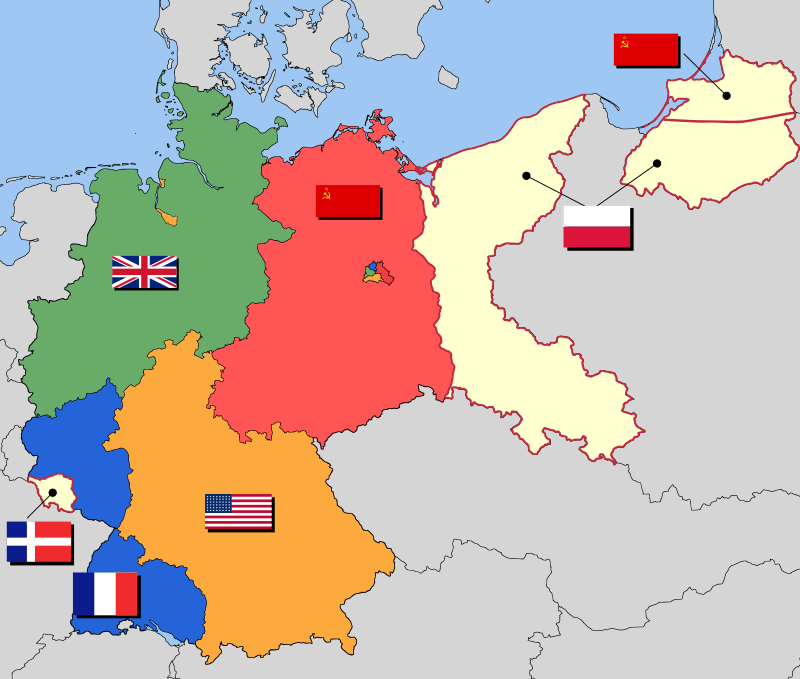
Among the provisions of the Potsdam agreement was the division of defeated Germany into four zones of occupation, rougly coinciding with the then-current locations of allied armies. The former capital city of Berlin was itself partitioned into four zones of occupation. A virtual island located 100 miles inside Soviet-controlled eastern Germany.
“The red area of Germany (above) is Soviet controlled East Germany. German territory east of the Oder-Neisse line (light beige) was ceded to Poland, while a portion of the easternmost section of Germany East Prussia, Königsberg, was annexed by the USSR, as the Kaliningrad Oblast”. H/T Wikipedia
During the war, ideological fault lines were suppressed in the mutual desire to destroy the Nazi war machine. These were quick to reassert themselves, in the wake of German defeat. In Soviet-occupied east Germany, factories and equipment were disassembled and transported to the Soviet union, along with technicians, managers and skilled personnel.
Soviet leader Josef Stalin informed German communist leaders in June 1945, of his belief that the United States would withdraw within a year or two. He had his reasons. At that time, the Truman Administration had yet to decide whether American forces would remain in West Berlin past 1949, when an independent West German government was expected to be established.
Stalin would do everything he could to undermine the British position within its zone of occupation, and appears unconcerned about that of the French. He and other Soviet leaders assured visiting Bulgarian and Yugoslavian delegations. In time, all of Germany would be Soviet, and Communist.
The former German capital became the focus of diametrically opposing governing philosophies, and leaders on both sides believed all Europe to be at stake. Soviet Foreign Minister Vyacheslav Molotov put it succinctly, “What happens to Berlin, happens to Germany; what happens to Germany, happens to Europe.”
There never was any formal agreement, concerning road and rail access to Berlin through the 100-mile Soviet zone. Western leaders were forced to rely on the “good will” of a regime which had deliberately starved millions of its own citizens to death, in consolidating power.
With 2.8 million Berliners to feed, clothe and shelter from the elements, Soviet leaders permitted cargo access on only ten trains per day over a single rail line.
Western allies believed the restriction to be only be temporary, but this belief would prove to be sadly mistaken.
Only three corridors were permitted through Soviet-controlled air space. With millions to feed, the Soviets stopped delivering agricultural products from their zone in eastern Germany, in 1946. The American commander, General Lucius Clay, retaliated by stopping shipments of dismantled industries from western Germany into the Soviet Union. The Soviets responded with obstructionist policies, doing everything it could to throw sand in the gears of all four occupied zones.
US and UK zones of occupation combined into a single “bizone” in January 1947, joining with that of France and becoming the “trizone” on June 1, 1948. Representatives of these governments and that of the Benelux nations of Belgium, the Netherlands and Luxembourg met twice in London to discuss the future of Germany, while Soviet leaders threatened to ignore any decisions coming out of such conferences.
The four-power solution was unworkable throughout the postwar period. For the city of Berlin, 1948 would reach the point of crisis.
That March, Soviet authorities slowed cargo to a crawl, individually searching every truck and train. General Clay ordered a halt to train traffic on April 2, ordering that supplies to the military garrison in Berlin be transported by air. Soviets eased their restrictions a week later, but still interrupted road and rail traffic. Meanwhile, Soviet military aircraft began to harass and “buzz” allied flights in and out of West Berlin. On April 5, a Soviet Air Force Yakovlev Yak-3 fighter collided with a British European Airways Vickers Viking 1B airliner near RAF Gatow airfield. Everyone onboard both aircraft, were killed.
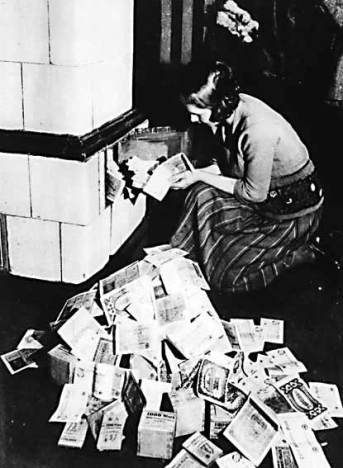
The final straw came with the currency crisis of early 1948, when the Deutsche Mark was introduced. The former Reichsmark was severely devalued by this time, with calamitous economic repercussions. The new currency went into use in all four sectors of occupied Berlin, against the wishes of the Soviets. This new currency combined with the Marshall Pan had the potential to revitalize the German economy, and that wouldn’t do. Not for Soviet policy makers, for whom a prostrate German economy remained the objective.
Soviet guards halted all traffic on the autobahn to Berlin on June 19, the day after the new currency was introduced.
German woman burning cash, for heat
At the time, West Berlin had 36 days’ food supplies, and 45 days’ supply of coal. The western nations had scaled military operations down in the wake of the war, to the point where the western sectors of the city had only 8,973 Americans, 7,606 British and 6,100 French. Soviet military forces numbered some 1.5 million. Believing that Allied powers had no choice but to cave to their demands, Soviet authorities cut off the electricity.
While ground routes were never negotiated in and out of occupied Berlin, the same was not true of the air. Three air routes had been agreed upon back in 1945. These went into use on this day in 1948, beginning the largest humanitarian airlift, in history.
Of all the malignant governing ideologies of history, Josef Stalin’s Soviet Union has to be counted among the worst. These people had no qualms about using genocide by starvation as a political tool. They had proven as much during the Holodomorof 1932 – ’33, during which this evil empire had murdered millions of its own citizens, by deliberate starvation. Two million German civilians would be nothing more than a means to an end.
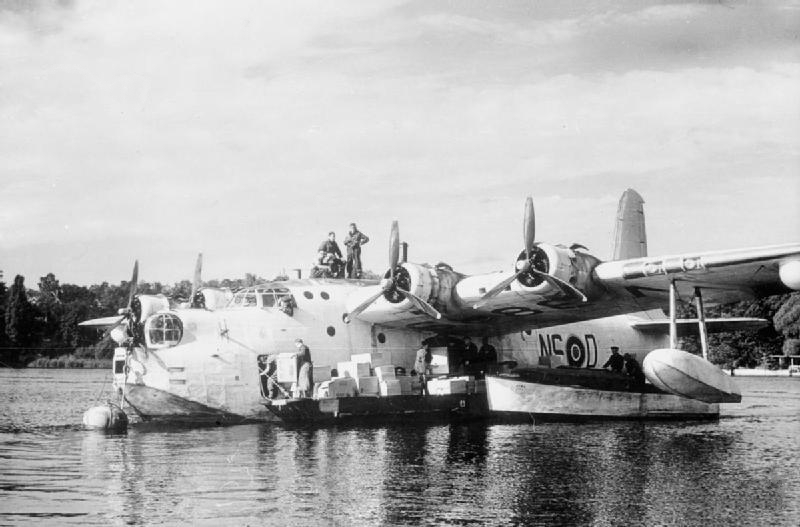
RAF Sunderland flying Boat moored on the Havel near Berlin unloading salt
With that many lives at stake, allied authorities calculated that a daily ration of only 1,990 kilocalories would require 646 tons of flour and wheat, 125 tons of cereal, 64 tons of fat, 109 tons of meat and fish, 180 tons of dehydrated potatoes, 180 tons of sugar, 11 tons of coffee, 19 tons of powdered milk, 5 tons of whole milk for children, 3 tons of fresh yeast for baking, 144 tons of dehydrated vegetables, 38 tons of salt and 10 tons of cheese.
Every. Single. Day.
Heat and power for such a population would require 3,475 tons of coal, diesel and gasoline, every day.
United States Air force General Curtis LeMay was asked “Can you haul coal?” LeMay replied “We can haul anything.”
Loading milk, bound for Berlin
The obstacles were daunting. Postwar demobilization had diminished US cargo capabilities in Europe to a nominal 96 aircraft, theoretically capable of transporting 300 tons per day. Great Britain’s RAF was somewhat better with a capacity of 400 tons, according to General Sir Brian Robertson.
700 tons were nowhere near the 5,000 per day that was needed, but it was a start. With additional aircraft mobilizing all over the United States, the United Kingdom and France, the people of occupied Berlin had to buy into the program.
General Clay went to Ernst Reuter, Berlin’s mayor-elect. “Look, I am ready to try an airlift. I can’t guarantee it will work. I am sure that even at its best, people are going to be cold and people are going to be hungry. And if the people of Berlin won’t stand that, it will fail. And I don’t want to go into this unless I have your assurance that the people will be heavily in approval.”
Luckily, General Albert Wedemeyer was in Europe on an inspection tour, when the crisis broke out. Wedemeyer had been in charge of the previously-largest airlift in history, the China-Burma-India theater route over the Himalayas, known as “The Hump”. Reuter was skeptical but assured the authorities that the people of Berlin were behind the plan. Wedemeyer’s endorsement gave the plan a major boost. The Berlin Airlift began seventy years ago today, June 26, 1948.
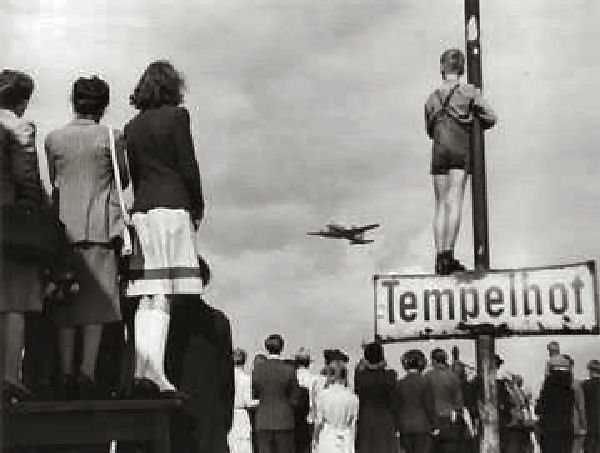
German civilians awaiting inbound aircraft, at Templehof
The Australian Air force joined in the largest humanitarian effort in history that September. The Canadians never did, believing the operation to be a provocation which would lead to war with the Soviet Union.
Through the Fall and Winter of 1948 – ’49 the airlift carried on. Soviet authorities maintained their stranglehold but, preoccupied with rebuilding their own war-ravaged economy and fearful of the United States’ nuclear capabilities, Stalin had little choice but to look on. On April 15, 1949, the Soviet news agency TASS announced that the Soviets were willing to lift the blockade.
C-54 drops candy over berlin, 1948 – ’49
Negotiations were begun almost at once but now, the Allies held the stronger hand. An agreement was announced on May 4 that the blockade would be ended, in eight days’ time. A British convoy drove through the gates at a minute after midnight on May 12, though the airlift would continue, to build up a comfortable surplus.
At the height of the operation, an aircraft landed every thirty seconds in West Berlin. The USAF delivered 1,783,573 tons altogether and the RAF 541,937, on a total of 278,228 flights. The Royal Australian Air Force delivered 7,968 tons of freight in over 2,000 sorties. Added together, the Berlin Airlift covered nearly the distance from the Earth, to the Sun.
39 British and 31 American airmen lost their lives during the operation.
In 1961, Communist leaders would erect a wall around their sector of the city. Not to keep foreigners out, but to keep their own unfortunate citizens, in. The Berlin Wall would not come down, for twenty-eight years.
If you enjoyed this “Today in History”, please feel free to re-blog, “like” & share on social media, so that others may find and enjoy it as well. Please click the “follow” button on the right, to receive email updates on new articles. Thank you for your interest, in the history we all share.
Then-Major Dwight D. Eisenhower was one of MacArthur’s aides at the time. Eisenhower believed that it was wrong for the Army’s highest ranking officer to lead an action against fellow war veterans. “I told that dumb son-of-a-bitch not to go down there”, he said.
In 1924, the United States Congress passed the “World War Adjusted Compensation Act”, promising cash bonuses to veterans of the “Great War” in which the nation had been involved between 1917 and ’18.
3,662,374 military service certificates were issued to qualifying veterans, bearing a face value equal to $1 per day of domestic service and $1.25 a day for overseas service, plus interest. Total face value of these certificates was $3.638 billion, equivalent to $43.7 billion in today’s dollars and coming to full maturity in 1945.
The Great Depression was two years old in 1932, and thousands of veterans had been out of work since the beginning. Certificate holders could borrow up to 50% of the face value of their service certificates, but direct funds remained unavailable for another 13 years.
On May 29, WWI veterans began to arrive in Washington to press their case for immediate cash redemption, setting up encampments between the Capitol and the Lincoln Memorial, and around Washington DC. Former Army sergeant Walter W. Waters led the group, which called itself the “Bonus Expeditionary Force” after the AEF of the late war. True to form, the Media insultingly dubbed them the “Bonus Army”.
This had happened before. Hundreds of Pennsylvania veterans of the Revolution had marched on Washington in 1783, after the Continental Army was disbanded without pay.
On that occasion the Congress fled to Princeton New Jersey, and the Army was called up to expel war veterans from the Capitol. Washington, DC was later excluded from the restrictions of the Posse Comitatus Act of 1878, making it the only part of the United States where the military may be used for domestic police activity.
17,000 veterans and their families, 43,000 all told, gathered in and around Washington. Men, women and children living in tents or in make-shift shelters built out of old lumber, packing boxes and scrap tin scavenged from nearby junkyards.
The House passed a bill to redress the situation, which went to the Senate for a vote on June 17, a day one newspaper described as “the tensest day in the capital since the war.” 10,000 marchers crowding the Capitol grounds responded with stunned silence when they got the news. The Senate had voted it down, 62 to 18. “Sing America and go back to your billets”, said Waters, and so they did. Marchers would hold a silent vigil in front of the Capitol until July 17, the day that Congress adjourned.
Marchers and their families were in their camps on July 28 when Attorney General William Mitchell ordered them evicted. Two policemen became trapped on the second floor of a building when they drew their revolvers and shot two veterans, William Hushka and Eric Carlson, both of whom died of their injuries.
President Herbert Hoover ordered the Army under General Douglas MacArthur to evict the Bonus Army from Washington. 500 Cavalry formed up on Pennsylvania Avenue at 4:45pm, supported by 500 Infantry, 800 police and six battle tanks under the command of then-Major George S. Patton. Civil Service employees came out to watch as bonus marchers cheered, thinking that the Army had gathered in their support.
And then the Cavalry was ordered to charge. The infantry followed with tear gas and fixed bayonets, entering the camps and evicting men, women and children alike.
Bonus marchers fled to their largest encampment across the Anacostia River, when President Hoover ordered the assault stopped. Feeling that the Bonus March was an attempt to overthrow the government, General MacArthur ignored the President and ordered a new attack, the army routing 10,000 and leaving their camps in flames. 1,017 were injured and 135 arrested.
The wife of one veteran miscarried. 12-week old Bernard Myers died after being caught in the gas attack. A government investigation later claimed he died of inflammation of the small intestine, but a hospital employee said the tear gas “didn’t do it any good.”
Then-Major Dwight D. Eisenhower was one of MacArthur’s aides at the time. Eisenhower believed that it was wrong for the Army’s highest ranking officer to lead an action against fellow war veterans. “I told that dumb son-of-a-bitch not to go down there”, he said.
The bonus march debacle doomed any chance that Hoover had of being re-elected. Franklin D. Roosevelt opposed the veterans’ bonus demands during the election, but was able to negotiate a solution when veterans organized a second demonstration in 1933. Roosevelt’s wife Eleanor was instrumental in these negotiations, leading one veteran to quip: “Hoover sent the army. Roosevelt sent his wife”.
If you enjoyed this “Today in History”, please feel free to re-blog, “like” & share on social media, so that others may find and enjoy it as well. Please click the “follow” button on the right, to receive email updates on new articles. Thank you for your interest, in the history we all share.
The issue of slavery had joined and become so intertwined with ideas of self-determination, as to be indistinguishable.
Since the earliest days of the Republic, those supporting strong federal government found themselves opposed by those favoring greater self-determination by the states. In the southern regions, climate conditions led to dependence on agriculture, the rural economies of the south producing cotton, rice, sugar, indigo and tobacco. Colder states to the north tended to develop manufacturing economies, urban centers growing up in service to hubs of transportation and the production of manufactured goods.
In the first half of the 19th century, 90% of federal government revenue came from tariffs on foreign manufactured goods. A lion’s share of this revenue was collected in the south, with the region’s greater dependence on imported goods. Much of this federal largesse was spent in the north, with the construction of railroads, canals and other infrastructure.
The debate over economic issues and rights of self-determination, so-called ‘state’s rights’, grew and sharpened with the “nullification crisis” of 1832-33, when South Carolina declared such tariffs to be unconstitutional and therefore null and void within the state. A cartoon from the time depicted “Northern domestic manufacturers getting fat at the expense of impoverishing the South under protective tariffs.”
Chattel slavery pre-existed the earliest days of the colonial era, from Canada to Brazil and around the world. Moral objections to what was really a repugnant institution could be found throughout, but economic forces had as much to do with ending the practice, as any other. The “peculiar institution” died out first in the colder regions of the US and may have done so in warmer climes as well, but for Eli Whitney’s invention of a cotton engine (‘gin’) in 1794.
It takes ten man-hours to remove the seeds to produce a single pound of cotton. By comparison, a cotton gin can process about a thousand pounds a day, at comparatively little expense.
The year of Whitney’s invention, the South exported 138,000 pounds a year to Europe and the northern states. Sixty years later, Great Britain alone was importing 600 million pounds a year from the southern states. Cotton was King, and with good reason. The stuff is easily grown, highly transportable, and can be stored indefinitely, compared with food crops. The southern economy turned overwhelmingly to the one crop, and its need for plentiful, cheap labor.
The issue of slavery had joined and become so intertwined with ideas of self-determination, as to be indistinguishable.
The first half of the 19th century was one of westward expansion, generating frequent and sharp conflicts between pro and anti-slavery factions. The Missouri compromise of 1820 attempted to reconcile the sides, defining which territories would legalize slavery, and which would be “free”.
The short-lived “Wilmot Proviso” of 1846 sought to ban slavery in new territories, after which the Compromise of 1850 attempted to strike a balance. The Kansas Nebraska Act of 1854 created two new territories, essentially repealing the Missouri Compromise and allowing settlers to determine their own direction.
This attempt to democratize the issue had the effect of drawing up battle lines. Pro-slavery forces established a territorial capital in Lecompton, while “antis” set up an alternative government in Topeka.
In Washington, Republicans backed the anti-slavery side, while most Democrats supported their opponents. On May 20, 1856, Massachusetts Senator Charles Sumner took to the floor of the Senate and denounced the Kansas-Nebraska Act. Never known for verbal restraint, Sumner attacked the measure’s sponsors Stephen A. Douglas of Illinois (he of the later Lincoln-Douglas debates), and Andrew Butler of South Carolina by name, accusing the pair of “consorting with the harlot, slavery”. Douglas was in the audience at the time and quipped “this damn fool Sumner is going to get himself shot by some other damn fool”.
In the territories, the standoff had long since escalated to violence. Upwards of a hundred or more were killed between 1854 – 1861, in a period known as “Bleeding Kansas”.
The town of Lawrence was established by anti-slavery settlers in 1854, and soon became the focal point of pro-slavery violence. Emotions were at a boiling point when Douglas County Sheriff Samuel Jones was shot trying to arrest free-state settlers on April 23, 1856. Jones was driven out of town but he would return.
Sack of Lawrence, Kansas
The day after Sumner’s speech, a posse of 800 pro-slavery forces converged on Lawrence Kansas, led by Sheriff Jones. The town was surrounded to prevent escape and much of it burned to the ground. This time there was only one fatality; a slavery proponent who was killed by falling masonry. Seven years later, Confederate guerrilla Robert Clarke Quantrill carried out the second sack of Lawrence. This time, most of the men and boys of the town were murdered where they stood, with little chance to defend themselves.
Meanwhile, Preston Brooks, Senator Butler’s nephew and a Member of Congress from South Carolina, had read over Sumner’s speech of the day before. Brooks was an inflexible proponent of slavery and took mortal insult from Sumner’s words.
Preston Brooks (left), Charles Sumner, (right)
Brooks was furious and wanted to challenge the Senator to a duel. He discussed it with fellow South Carolina Representative Laurence Keitt, who explained that dueling was for gentlemen of equal social standing. Sumner was no gentleman, he said. No better than a drunkard.
Brooks had been shot in a duel years before, and walked with a heavy cane. Resolved to publicly thrash the Senator from Massachusetts, the Congressman entered the Senate building on May 22, in the company of Congressman Keitt and Virginia Representative Henry A. Edmundson.
The trio approached Sumner, who was sitting at his desk writing letters. “Mr. Sumner”, Brooks said, “I have read your speech twice over carefully. It is a libel on South Carolina, and Mr. Butler, who is a relative of mine.”
Sumner’s desk was bolted to the floor. He never had a chance. The Senator began to rise when Brooks brought the cane down on his head. Over and over the cane crashed down, while Keitt brandished a pistol, warning onlookers to “let them be”. Blinded by his own blood, Sumner tore the desk from the floor in his struggle to escape, losing consciousness as he tried to crawl away. Brooks rained down blows the entire time, even after the body lay motionless, until finally, the cane broke apart.
In the next two days, a group of unarmed men will be hacked to pieces by anti-slavery radicals, on the banks of Pottawatomie Creek.
The 80-year-old nation forged inexorably onward, to a Civil War which would kill more Americans than every war from the American Revolution to the War on Terror, combined.
If you enjoyed this “Today in History”, please feel free to re-blog, “like” & share on social media, so that others may find and enjoy it as well. Please click the “follow” button on the right, to receive email updates on new articles. Thank you for your interest, in the history we all share.
For traditionally-oriented Americans, such language was alarming, to say the least.
The Cold War was at its peak in 1950, the war in Korea, just begun. US policy makers were convinced that the conflict represented a Kremlin-backed expansion of international communism. The US began sending military advisers into French Indochina that year, in support of a colonial war which had been off and on since before the American Civil War.
France would leave the country following defeat by Viet Minh forces at Dien Bien Phu (May, 1954), while US involvement continued and escalated through the early ’60s.
US Troop levels tripled and then tripled again. Combat units were deployed, beginning in 1965.
The American war in Vietnambegan to lose public support by the late ’60s, ultimately driving an American President out of office. In a March 31, 1968 address carried on live television, President Lyndon Johnson stated “I shall not seek, and I will not accept, the nomination of my party for another term as your president.”
North Vietnam invaded the South that year on the Lunar New Year “Tet” holiday. The “Tet Offensive” was a crushing military defeat for communist forces, but a public relations setback for the American side. TV news and AP crews brought the events into living rooms, across America.
No TV news crews were on-hand in the ancient city of Huế, to record the communist murder of thousands of prisoners and civilians, including women, men, children, and infants.
Richard M. Nixon won overwhelming victory in the Presidential election of 1968, running on a platform including a “secret plan” to end the war in Vietnam.
US combat fatalities exceeded 3,600 in the first two months of the new administration, as Nixon secretly expanded the war effort, bombing neighboring Cambodia and sending US Marines into Laos.
US public opinion went ballistic in May 1969, as the New York Times revealed expanded military operations on the Indochinese peninsula. The President was furious, and ordered government officials and journalists to be wiretapped, to track down the leak.
Opposition increased later that year, in response to the massacre of civilians at the village of My Lai, and the re-institution of involuntary military conscription by US Selective Service, later that year. The First Draft Lottery was held on December 1, 1969.
Draft-age Americans didn’t want to be conscripted into a war they strongly opposed, and demonstrations erupted across the American countryside. In Ohio, full-scale riots broke out at Kent State University, part of what Time Magazine called “a nation-wide student strike”.
Kent State University, a large, multi-campus public research university located in Northeastern Ohio, (the Kent Campus had 28,972 students in 2017), had long been a focal point for antiwar protests. In the 1966 homecoming parade, protesters marched in military uniforms, wearing gas masks.
Students for a Democratic Society (SDS) and other “New Left” organizations staged sit-ins in the fall of 1968. Demonstrations became violent six months later, resulting in 58 arrests. Four SDS leaders spent six months in prison.
In April 1970, “Youth International” (“Yippie”) Party leader Jerry Rubin spoke on campus, stating that “The first part of the Yippie program is to kill your parents. They are the first oppressors.” Two weeks later, SDS member Bill Anthrell distributed flyers to a campus event, in which the former student announced his intention to “napalm a dog”.
For traditionally-oriented Americans, such language was alarming, to say the least.
“Yippie” leader, Jerry Rubin
Cambodia’s political neutrality and military weakness had long turned the eastern border regions of that country into “safe zones” for Vietnamese communist forces.
President Nixon announced a US incursion into Cambodia in late April 1970, at a time when the war seemed to be winding down.
Kent State University students held rallies on the following day, at which about 500 burned draft cards. Some burned a copy of the United States Constitution. Another rally was planned for the fourth, but violence broke out that night. A toxic mix of approximately 120 students, bikers, and out-of-town troublemakers set fires, threw bottles at police, shouted obscenities and smashed Kent store fronts. Mayor LeRoy Satrom declared a state of emergency and closed the bars, adding to the crowds in the streets.
Mayor Satrom requested that Governor Jim Rhodes call out the National Guard. Satrom’s request was granted, as a large demonstration formed on the Kent State campus. The campus ROTC building was set on fire late on May 2, as over a thousand demonstrators surrounded the building and cheered as it burned.
Radical revolutionaries, agitators and other non-students had by this time infiltrated the crowd, though their numbers are uncertain. Several Kent firemen and police officers were hit by rocks and other projectiles while attempting to put out the fire. Several fire engine companies were called in while protesters slashed hoses and hurled projectiles at fire fighters, police officers, National Guard soldiers, and Highway Patrol troopers. The ROTC building burned to the ground.
An emotional Governor Rhodes pounded the table during a press conference, the following day. “They’re worse than the brown shirts and the communist element and also the night riders and the vigilantes. They’re the worst type of people that we harbor in America. Now I want to say this. They are not going to take over [the] campus. I think that we’re up against the strongest, well-trained, militant, revolutionary group that has ever assembled in America. This is when we’re going to use every part of the law enforcement agency of Ohio to drive them out of Kent. We are going to eradicate the problem. We’re not going to treat the symptoms“.
University authorities attempted without success to stop the May 4 demonstration, planned three days earlier. Shortly before noon, campus patrolman Harold Rice approached demonstrators in a National Guard Jeep, and read the order to disperse. Over 2,000 protesters responded by hurling rocks, injuring one campus police officer and forcing the Jeep into retreat.
Tear gas failed to break up the crowd and several canisters were thrown back, with near-constant volleys of rocks, bottles and other projectiles. 77 National Guardsmen advanced in line-abreast, as screaming protesters closed behind them. Guardsmen briefly assumed firing positions when cornered near a chain link fence, though no one fired.
At 12:24, the Guardsmen once again assumed firing position. Witnesses later testified that a sniper opened first, but the story was never proven nor debunked. 67 rounds were fired. 13 seconds later it was over, with four dead and nine wounded. Two of the dead, Allison Krause and Jeffrey Miller, had participated in the protest. The other two, Sandra Scheuer and William Schroeder, were walking to class at the time they died. Schroeder was a member of the Kent State ROTC battalion.
One National Guardsman was wounded severely enough to require medical treatment.
Christine Ellen “Chrissie” Hynde, future lead singer of The Pretenders, was a KSU student at that time. She was there. Let the words she wrote in her 2015 autobiography, finish this story: “Then I heard the tatatatatatatatatat sound. I thought it was fireworks. An eerie sound fell over the common. The quiet felt like gravity pulling us to the ground. Then a young man’s voice: “They fucking killed somebody!” Everything slowed down and the silence got heavier… The guardsmen themselves looked stunned. We looked at them and they looked at us. They were just kids, 19 years old, like us. But in uniform. Like our boys in Vietnam”.
The arsonist(s) were never found.
If you enjoyed this “Today in History”, please feel free to re-blog, “like” & share on social media, so that others may find and enjoy it as well. Please click the “follow” button on the right, to receive email updates on new articles. Thank you for your interest, in the history we all share.
So important was the Cod to the regional economy, that a carved likeness of the fish hung in the Massachusetts State House, fifty years or more before the Revolution.
The American Revolution was barely 15 years in the rear-view mirror, when the new State House opened in the Beacon Hill neighborhood of Boston. The building has expanded a couple of times since then, and remains the home of Massachusetts’ state government, to this day.
On January 11, 1798, a procession of legislators and other dignitaries worked its way from the old statehouse at the intersection of Washington and State Streets to the new one on Beacon Hill, a symbolic transfer of the seat of government. The procession carried with it, a bundle. Measuring 4’11” and wrapped in an American flag, it was a life-size wooden carving. Of a fish.
For the former Massachusetts colony, the Codfish had once been a key to survival. Now, this “Sacred Cod” was destined for a new home in the legislative chamber of the House of Representatives.
Mark Kurlansky, author of “Cod: A Biography of the Fish That Changed the World”, laments the 1990s collapse of the Cod fishery, saying the species finds itself “at the wrong end of a 1,000-year fishing spree.”
Records exist from as early as AD985, of Eirik the Red, Leif Eirikson’s father, preserving Codfish by hanging them in the cold winter air. Medieval Spaniards of the Basque region improved on the process, by the use of salt. By A.D. 1,000, Basque traders were supplying a vast international market, in Codfish.
By 1550, Cod accounted for half the fish consumed in all Europe. When the Puritans set sail for the new world it was to Cape Cod, to pursue the wealth of the New England fishery.
Without Codfish, Plymouth Rock would likely have remained just another boulder. William Bradford, first signer of the Mayflower Compact in 1620 and 5-term governor of the Plymouth Colony (he called it “Plimoth”), reported that, but for the Cod fishery, there was talk of going to Manhattan or even Guiana: “[T]he major part inclined to go to Plymouth, chiefly for the hope of present profit to be made by the fish that was found in that country“.
There are tales of sailors scooping Codfish out of the water, in baskets. So important was the Cod to the regional economy, that a carved likeness of the creature hung in the old State House, fifty years or more before the Revolution.
Massachusetts’ old Statehouse
The old State House burned in 1747, leaving nothing but the brick exterior you see today, not far from Faneuil Hall. It took a year to rebuild the place, including a brand new wooden Codfish. This one lasted until the British occupation of Boston, disappearing sometime between April 1775 and March 1776.
The fish which accompanied that procession in 1798 was the third, and so far the last such carving to hang in the Massachusetts State House, where it’s remains to this day. Sort of.
With the country plunged into the Great Depression, someone looked up in Massachusetts’ legislative chamber, and spied – to his dismay – nothing but bare wires. The Commonwealth had suffered “The Great Cod-napping”, of 1933.
Newspapers went wild with speculation about what happened to The Sacred Cod.
Suspects were questioned and police chased down one lead after another, but they all turned out to be red herring (sorry, I couldn’t help myself). State police dredged the Charles River, (Love that dirty water). Lawmakers refused D’Bait (pardon), preferring instead to discuss what they would do with the Cod-napper(s), if and when the evildoers were apprehended.
Soon, an anonymous tip revealed the culprits to be college pranksters, three editors of the Harvard Lampoon newspaper pretending to be tourists. It was a two-part plan, the trio entering the building with wire cutters and a flower box, as other Lampoon members created a diversion by kidnapping an editor from the arch-rival newspaper, the Harvard Crimson. The caper worked, flawlessly. Everyone was busy looking for the missing victim, as two snips from a wire cutter brought down the Sacred Cod.
Two days later, it was April 28. A tip led University Police to a car with no license plate, cruising up the West Roxbury Parkway. After a 20-minute low speed chase, (I wonder if it was a white Bronco), the sedan pulled over. Two men Carp’d the Diem (or something like that), and handed over the Sacred Cod, before driving away.
The Sacred Cod resumed its rightful place, and once again, there was happiness upon the Land. The Cod was stolen one more time in 1968, this time by UMASS students protesting some thing or other, but the fish never made it out of the State House.
The “Holy Mackerel” of the Massachusetts State Senate
Years later, future Speaker of the House Tip O’Neill faced the Cod in the direction of the majority party. It will come as no surprise to anyone familiar with Bay State politics, that the thing has faced Left, from that day to this. For Massachusetts’ minuscule Republican delegation, hope springs eternal that the Sacred Cod will one day, face Right.
Not to be outdone, the State Senate has its own fish, hanging in the legislative chambers. There in the chandelier, above the round table where sits the Massachusetts upper house, is the copper likeness of the “Holy Mackerel”. No kidding. I wouldn’t fool around about a thing like that.
Legend has it that, when you see those highway signs saying X miles to Boston, they’re really giving you the distance to the Holy Mackerel.
A tip of my hat to my friend and Representative to the Great & General Court David T. Vieira, without whom I’d have remained entirely ignorant of this fishy tale.
Beacon Hill, seat of Massachusetts state government, where the author addresses an empty chamber. Maybe The Sacred Cod™ was listening.
If you enjoyed this “Today in History”, please feel free to re-blog, “like” & share on social media, so that others may find and enjoy it as well. Please click the “follow” button on the right, to receive email updates on new articles. Thank you for your interest, in the history we all share.
The Dutchess County Militia had to be called up. The Colonel himself had only a single night to prepare for battle, and this rider was exhausted. The job would have to go to Colonel Ludington’s first-born. His daughter, Sybil.
Listen my children and you shall hear, Of the midnight ride of…Sybil Ludington.
Paul Revere’s famous “midnight ride” began on the night of April 18, 1775. Revere was one of two riders, soon joined by a third, fanning out from Boston to warn of an oncoming column of “regulars”, come to destroy the stockpile of gunpowder, ammunition, and cannon in Concord.
Revere himself covered barely 12 miles before being captured, his horse confiscated to replace the tired mount of a British sergeant. Revere would finish his “ride” on foot, arriving at sunrise on the 19th to witness the last moments of the battle on Lexington Green.
Two years later, Patriot forces maintained a similar supply depot, in the southwest Connecticut town of Danbury.
William Tryon was the Royal Governor of New York, a long-standing advocate for attacks on civilian targets. In 1777, Tryon was also a Major-General of the provincial army. On April 25th, Tryon set sail for the Connecticut coast of Long Island Sound with a force of 1,800, intending to destroy Danbury.
Patriot Colonel Joseph Cooke’s small Danbury garrison was caught and quickly overpowered on the 26th, trying to remove food supplies, uniforms, and equipment. Facing little if any opposition, Tryon’s forces went on a bender, burning homes, farms and storehouses. Thousands of barrels of pork, beef and flour were destroyed, along with 5,000 pairs of shoes, 2,000 bushels of grain, and 1,600 tents.
Colonel Henry Ludington was a farmer and father of 12, with a long military career. A long-standing and loyal subject of the British crown, Ludington switched sides in 1773, joining the rebel cause and rising to command the 7th Regiment of the Dutchess County Militia, in New York’s Hudson Valley.
In April 1777, Ludington’s militia was disbanded for planting season, returned to homes across the countryside. Soaked to the skin and exhausted, a rider arrived at the Ludington farm on the night of the 26th, on an equally soaked and exhausted horse. With a driving rain cascading in sheets off an empty saddle, the rider explained the purpose of his visit. 15 miles away, British regulars and a loyalist force were burning Danbury to the ground.
The Dutchess County Militia had to be called up. The Colonel himself had only a single night to prepare for battle, and this rider was done for. The job would have to go to the Colonel’s first-born. That meant Ludington’s daughter Sybil, and she was barely sixteen.
From Poughkeepsie to what is now Putnam County and back, the “Female Paul Revere” rode across the lower Hudson River Valley, covering 40 miles in the pitch darkness of night, alerting her father’s militia to the danger and urging them to come out and fight. She’d use a stick to knock on doors, even using it once to beat back a highway bandit.
By the time that Sybil returned the next morning, cold, rain-soaked, and exhausted, most of 400 militia members were prepared to march.
35 miles east of Danbury, General Benedict Arnold was gathering a force of 500 regular and irregular Connecticut militia, along with Generals David Wooster and Gold Selleck Silliman.
Arnold’s forces arrived too late to save Danbury, but inflicted a nasty surprise on the British rearguard as the column approached nearby Ridgefield. Never outnumbered by less than three-to-one, Connecticut militia was able to slow the British advance until Ludington’s New York Militia arrived on the following day. The last phase of the action saw the same type of swarming harassment, as seen on the British retreat from Concordto Boston, earlier in the war.
Though the British operation was a tactical success, the mauling suffered at the hands of colonials ensured that this was the last hostile British landing on the Connecticut coast.
The British raid on Danbury destroyed at least 19 houses and 22 stores and barns. Town officials submitted £16,000 in claims to Congress, for which town selectmen received £500 reimbursement. Further claims were made to the General Assembly of Connecticut in 1787, for which Danbury was awarded land. In Ohio.
The old Keeler Tavern in Ridgefield is now a museum. The British cannonball fired into the side of the building, remains there to this day.
At the time, Benedict Arnold planned to travel to Philadelphia, to protest the promotion of officers junior to himself, to Major General. Arnold, who’d had two horses shot out from under him at Ridgefield, was promoted to Major General in recognition of his role in the battle. Along with that promotion came a horse, “properly caparisoned as a token of … approbation of his gallant conduct … in the late enterprize to Danbury.”
The pride which would one day be Arnold’s undoing, was assuaged. For a time.
Henry Ludington became Aide-de-Camp to General George Washington, and grandfather to Harrison Ludington, future mayor of Milwaukee and the 12th Governor of Wisconsin.
Gold Silliman was kidnapped with his son by a first marriage by Tory neighbors, and held for nearly seven months at a New York farmhouse. Having no hostage of equal rank with whom to exchange for the General, Patriot forces went out and kidnapped one of their own, in the person of Chief Justice Judge Thomas Jones, of Long Island.
Mary Silliman was left to run the farm, and negotiate for the release of her husband. The 1993 made-for-TV movie “Mary Silliman’s War” tells a story of non-combatants, pregnant mothers and farm wives, during the Revolution.
General David Wooster was mortally wounded at the Battle of Ridgefield, moments after shouting “Come on my boys! Never mind such random shots!” Today, an archway marks the entrance to Wooster Square, in the East Rock Neighborhood of New Haven.
Sybil Ludington received the thanks of family and friends, even George Washington himself, and then stepped off the pages of history.
Paul Revere’s famous ride would likewise have faded into obscurity, but for the poetry of Henry Wadsworth Longfellow. 86 years later.
If you enjoyed this “Today in History”, please feel free to re-blog, “like” & share on social media, so that others may find and enjoy it as well. Please click the “follow” button on the right, to receive email updates on new articles. Thank you for your interest, in the history we all share.
The United States still had a border in those days, which the Federal government attempted to enforce.
Except for the Naval Air Station at Boca Chica and Coast Guard installations in Key West, Marathon and Islamorada, most of the economic activity in the Florida Keys, comes from tourism. It’s no wonder that, when the federal government shuts down the only road into the Keys, the locals are going to get cranky.
In April 1982, the Mariel boatlift was a mere two years in the past, and very much in the public memory.
The United States still had a border in those days, which the Federal government attempted to enforce.
On April 18, Border Patrol set up a roadblock in front of Skeeter’s Last Chance Saloon in Florida City, shutting down US Route 1, the only road in and out of the Florida Keys. Originally intended to intercept illegals entering the country, the roadblock soon morphed into a hunt for illegal drugs, as well.
Cars waited for hours, in lines stretching 19 miles. Predictably, the attitude of Federal officials was one of towering indifference. Not so local business owners. Robert Kerstein wrote in his Key West on the Edge — Inventing the Conch Republic, “No one in Key West doubted that drugs were trafficked widely in the Keys by road and by boat. But tourism’s boosters had little tolerance for interruptions to their business.”
Dennis Wardlow, then-Mayor of Key West, contacted the chief of police, the Monroe County sheriff, his State Representative and then-Governor Bob Graham, demanding the roadblock’s removal. With none of the above having any knowledge of the barrier and lacking the authority to pull it down, Wardlow contacted INS directly. When the Border Patrol told him it was “none of his business,” the Mayor’s response could best be summed up in the words of Bugs Bunny: “Of course you know, this means war!”
Suffering a blizzard of hotel cancellations, this “attack on Key West’s sovereignty” could not stand. On April 22, Mayor Wardlow, local attorney & pilot David Horan and Old Town Trolley Tours operator Ed Swift flew to Miami seeking legal remedy. When District Court Judge C. Clyde Atkins failed to issue an injunction, the Key West delegation took to the courthouse steps.
“What are you going to do, Mr. Mayor”, asked the assembled media. Swift leaned over and whispered into the Mayor’s ear, “Tell them we are going to go home and secede!” “We are going to go home and secede!”, said Wardlow, and that’s what they did.
Over the next 24 hours, secessionist co-conspirators worked feverishly to form a new government, filling cabinet positions such as “Secretary of Underwater Affairs” and “Minister of Nutrition”.
On April 23, with federal agents on scene to monitor the proceedings, a crowd gathered before the old customs building. Mayor Wardlow and a gaggle of allies mounted the back of a flatbed truck, to read the proclamation of secession. “We serve notice on the government in Washington”, he started, “to remove the roadblock or get ready to put up a permanent border to a new foreign land. We as a people, may have suffered in the past, but we have no intention of suffering in the future at the hands of fools and bureaucrats“.
With that, Mayor Wardlow declared “war” on the United States. The “Great Battle of the Conch Republic” broke out in the harbor, when the Schooner Western Union commanded by Captain John Kraus, attacked the Coast Guard Cutter Diligence with water balloons, Conch fritters and toilet paper. Diligence fought back with water hoses, as the new “Prime Minister” broke a stale loaf of Cuban bread over the head of a man dressed in a Navy uniform.
Naval History was forever changed on this day, as the “Great Battle of the Conch Republic” raged across the waters of Key West
Pandemonium broke out as others launched stale bread and conch fritters at federal agents, Navy sailors and Coast Guard personnel. One minute after declaring his “verbal shot” at the Federal government, Mayor Wardlow surrendered to a nearby Naval officer, demanding a billion dollars in “foreign aid” in compensation for “the long federal siege.”
Apparently, that’s what it takes to get the attention of a Federal government bureaucrat. The roadblock lifted. The restaurants, stores and hotels of the Keys soon filled with tourists and, once again, there was happiness upon the land. Key West never got its “foreign aid”, but “secesh” leaders never received so much as a letter, saying they couldn’t leave the Union, either.
So it is that the micro-nation of Key West celebrates its independence, every April 23. The “Conch Republic’ issues its own passports, selling T-shirts and bumper stickers with the slogan “We seceded where others failed”.
And if the Federal government ever comes back to mess with the sovereign nation of Key West, it had better be prepared to deal with the Conch Republic’s very own “Special Forces”, the motto for which is “Sanctus Merda”. “Holy Shit”.
Tip of the hat to
“Conch Republic Military Forces, The Official Site of the Conch Republic Military”
Mine eyes have seen the glory of the sunshine and the sea Right here upon our islands, where we love to live so free But in April 1982, the peace was not to be And we went rolling on
CHORUS Glory glory Conch Republic Glory glory Conch Republic Glory glory Conch Republic From Key to shining Key
They were setting up a check point, tween the mainland and the Keys They had put a US Border, where it shouldn’t ‘oughta’ be So that’s when we seceded, and declared our sovereignty And the fun had just begun
(CHORUS)
We went forth into the harbor and a cutter we did spy And we sailed up along side her and we took her by surprise We hoisted up our battle flag, so proudly and so high And we went sailing on
(CHORUS)
The water and Conch fritters and the Cuban bread did fly Our bombers, they were raining toilet paper from the sky Our cannons they did thunder to proclaim our victory And we fought bravely on
(CHORUS)
We have faced the silly forces of misguided zealotry We have stood up to their foolishness for all the world to see And we’ve showed the other nations what America can be From Key to shining Key
(CHORUS)
If you enjoyed this “Today in History”, please feel free to re-blog, “like” & share on social media, so that others may find and enjoy it as well. Please click the “follow” button on the right, to receive email updates on new articles. Thank you for your interest, in the history we all share.
Not far from food riots of his own and loathe to unleash such a bacterium against his own homeland, a “Sealed Train” carrying Vladimir Ilyich Lenin and 31 dissidents departed from exile in Switzerland on April 9, complements of the Kaiser.
The “War to End all Wars” entered its third year in 1917, seeming as though it would go on forever. Neither side seemed able to gain strategic advantage on the front. The great battles of 1916 seemed only yesterday, in which any single day’s fighting produced more casualties than every European war of the preceding 100 years, combined. At home, the social fabric of the combatant nations was unraveling.
Vladimir Ilyich Ulyanov
By 1916 it was generally understood in Germany, that the war effort was “shackled to a corpse”, referring to Germany’s Austro-Hungarian ally. Italy, the third member of the “Triple Alliance”, was little better. On the Triple Entente side, the French countryside was literally torn to pieces, the English economy close to collapse. The Russian Empire, the largest nation on the planet, was on the edge of the precipice.
With the American declaration of war in April 1917, both sides understood that the balance was about to shift. For Kaiser Wilhelm’s Germany, it was time to throw a knockout punch, before the US arrived in force.
Imperial Russia had seen the first of what would be two revolutions back in February, when food riots led to the overthrow and exile of the Imperial family. Full scale civil war broke out in 1918, resulting in the Bolshevik murder of the Czar and Czarina, together with their children, servants and dogs.
Lenin makes his way to the sealed train which would take him out of exile. April 13, 1917.
In the midst of this chaos, the Kaiser calculated that all he had to do was “kick the door in”, the Russian Republic would collapse, and they would be out of the war. He was right.
Following the overthrow of the Romanov dynasty, the more moderate Menshevik “Whites” vowed to continue the war effort. The split which had begun with the failed revolution of 1905 was more pronounced by this time with the more radical Bolsheviks (“Reds”) taking the more extreme road. While Reds and Whites both wanted to bring socialism to the Russian people, the Mensheviks argued for predominantly legal methods and trade union activism, while Bolsheviks favored armed violence.
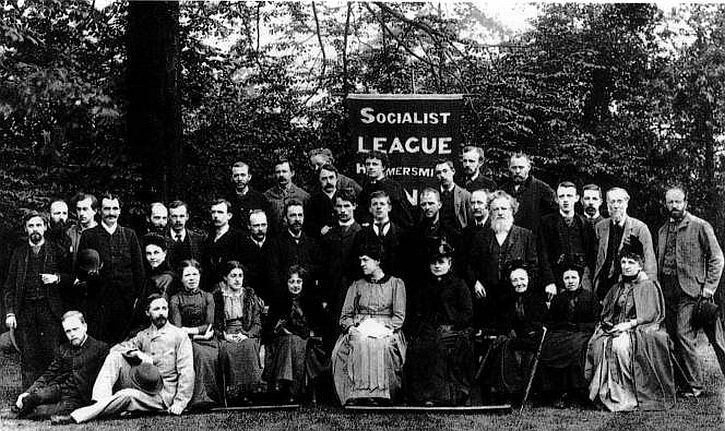
In a small town in the northeast of Sweden, there is a train station. A bronze plaque on a blue tile wall, proclaims: “Here Lenin passed through Haparanda on April 15, 1917, on his way from exile in Switzerland to Petrograd in Russia”.
Lenin was in exile at this time, and Imperial Germany was at war with Russia. British historian Edward Crankshaw writes, the German government saw “in this obscure fanatic one more bacillus to let loose in tottering and exhausted Russia to spread infection”.
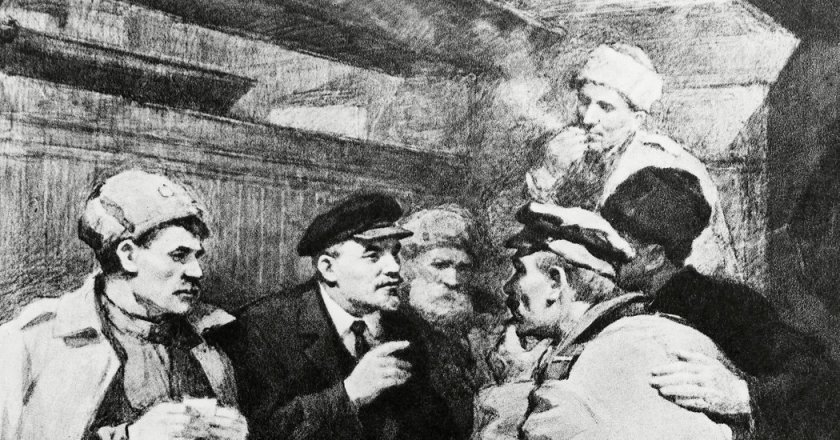
Not far from food riots of his own and loathe to unleash such a bacterium against his own homeland, a “Sealed Train” carrying Vladimir Ilyich Lenin and 31 dissidents departed from exile in Switzerland on April 9, complements of the Kaiser. Leaving Zurich Station amid the jeers and the insults of 100 or so assembled Russians shouting “Spies!” “Traitors!” “Pigs!” “Provocateurs!” Lenin turned to a friend. “Either we’ll be swinging from the gallows in three months, or we shall be in power.”
North through Germany and across the Baltic Sea, the group traveled the length of Sweden, crossing at the border village of Haparanda into Russian-Occupied Finland. The group arrived at Finlandsky Vokzal (Finland Station) in Petrograd on the evening of April 16, 1917. Like the handful of termites that brought down the mighty oak, that small faction inserted into the picture that April, would help to radicalize the population, and consolidate power on the Bolshevik’s side.
By October, Russia would experience its second revolution in a year. The Kaiser’s Germany could breathe easier. The “Russian Steamroller”, was out of the war. Chief of the General Staff Paul von Hindenburg and his deputy Erich Ludendorff could move their divisions westward, in time to face the arrival of the AEF.
Since the end of the Soviet era, Russian historians have come to believe that Vladimir Ilyich (Ulyanov) Lenin personally ordered the murder of the czar and his family, and that the Lenin era was every bit as bloody, as that of his successor Josef Stalin.
Lenin called for “Mass Terror” during the civil war of 1918, resulting in executions in the tens of thousands. Historian Alexander Margolis had the last word on the subject, if not the understatement of the century: “If they had arrested Lenin at the Finland Station, it would have saved everyone a lot of trouble”.
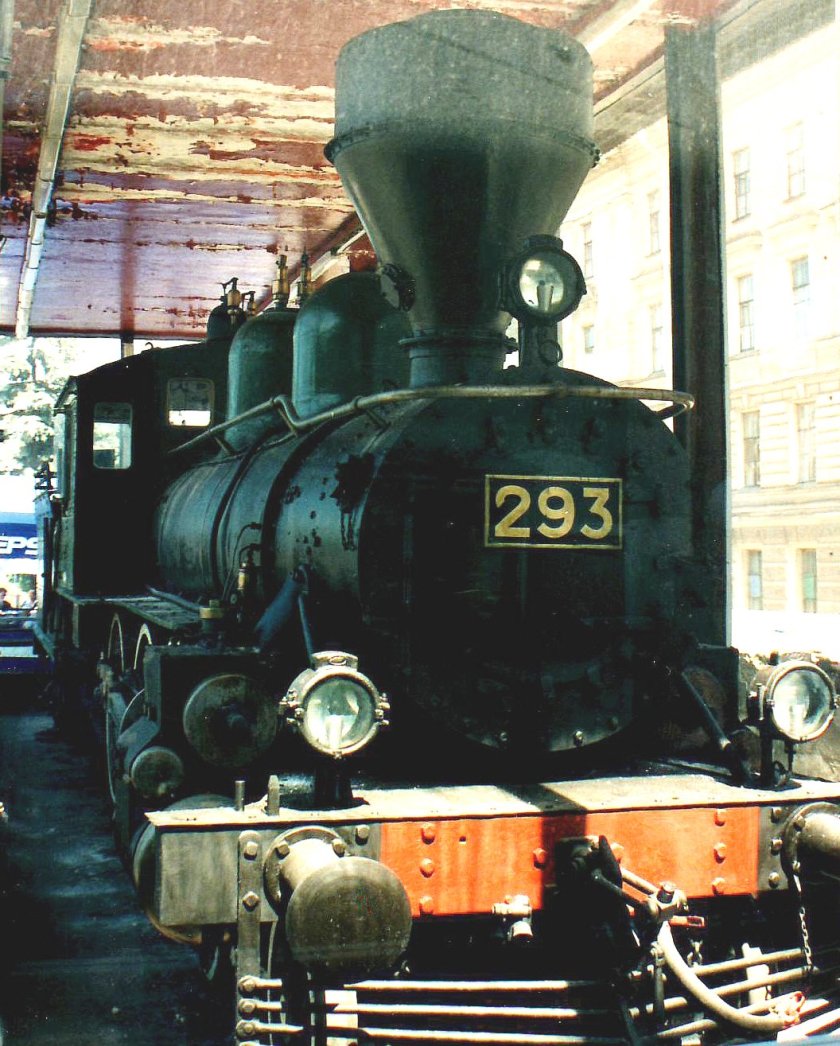
The locomotive which carried the ideological infection of Communism. from exile in Switzerland, to the Imperial Russian heartland
If you enjoyed this “Today in History”, please feel free to re-blog, “like” & share on social media, so that others may find and enjoy it as well. Please click the “follow” button on the right, to receive email updates on new articles. Thank you for your interest, in the history we all share.
In the end, US public opinion would not sustain what too many saw as an endless war.
Since the late 19th century, the area now known as Laos, Cambodia and Vietnam was governed as a French Colonial territory. “French Indo-China” came to be occupied by the Imperial Japanese after the fall of France, at the onset of WWII. There arose a nationalist-communist army during this period, dedicated to throwing out the Japanese occupier. It called itself the “League for the Independence of Vietnam”, or “Viet Minh”.
France re-occupied the region following the Japanese defeat ending WWII, but soon faced the same opposition from the army of Ho Chi Minh and Vo Nguyen Giap. What began as a low level rural insurgency, later became a full-scale modern war when Communist China entered the fray in 1949.
The disastrous defeat of French forces at Dien Bien Phu in 1953 led to French withdrawal from Vietnam, the Geneva Convention partitioning the country into the communist “Democratic Republic of Vietnam” in the north, and the State of Vietnam in the south, led by Emperor Bao Dai and Prime Minister Ngo Dinh Diem.
Communist forces of the north continued to terrorize Vietnamese patriots in north and south alike, with aid and support from communist China and the Soviet Union.
The student of history understands that nothing happens in a vacuum. US foreign policy is no exception. International Communism had attempted to assert itself since the Paris Commune rebellion of 1871, and found its first major success with the collapse of czarist Russia in 1917.
US policy makers feared a “domino” effect, and with good cause. The 15 core nations of the Soviet bloc were soon followed by Eastern Europe, as Poland, Bulgaria, Romania, Hungary and Czechoslovakia fell into the Soviet sphere of influence. Germany was partitioned into Communist and free-enterprise spheres after WWII, followed by China, North Korea and on across Southeast Asia.
This is no benign ideology. Current estimates of citizens murdered by Communist ideology in the Soviet Union alone, range from 8 to 61 million during the Stalinist period.
Agree or disagree with policy makers of the time, that’s your business, but they followed a logical thought process. US aid and support for South Vietnam increased as a way to “stem the tide” of international communism, at the same time that French support was pulling back. By the late 50s, the US was sending technical and financial aid in expectation of social and land reform. By 1960, the “National Front for the Liberation of South Vietnam” (“NLF”, or “Viet Cong”) had taken to murdering Diem supported village leaders. JFK responded by sending 1,364 American advisers into South Vietnam, in 1961.
The war in Vietnam pitted as many as 1.8 million allied forces from South Vietnam, the United States, Thailand, Australia, the Philippines, Spain, South Korea and New Zealand, against about a half million from North Vietnam, China, the Soviet Union and North Korea. Begun on November 1, 1955, the conflict lasted 19 years, 5 months and a day. On March 29, 1973, two months after signing the Paris Peace accords, the last US combat troops left South Vietnam as Hanoi freed the remaining POWs held in North Vietnam.
Even then it wasn’t over. Communist forces violated cease-fire agreements before they were signed. Some 7,000 US civilian Department of Defense employees stayed behind to aid South Vietnam in conducting an ongoing and ultimately futile war against communist North Vietnam.
The last, humiliating scenes of the war played themselves out on the roof of the US Embassy in Saigon on April 29 – 30, 1975, as those who could boarded helicopters, while communist forces closed around the South Vietnamese capital.
The “Killing Fields” of Cambodia followed between 1975 – ‘79, when the “Khmer Rouge”, self-described as “The one authentic people capable of building true communism”, murdered or caused the deaths of an estimated 1.4 to 2.2 million of their own people, out of a population of 7 million. All to build the perfect, agrarian, “Worker’s Paradise”.
Imagine feeling so desperate, so fearful of this alien ideology invading your country, that you convert all your worldly possessions and those of your family to a single diamond, bite down on that stone so hard it embedded in your shattered teeth, and fled with your family to open ocean in a small boat. All in the faint and desperate hope, of getting out of that place. That is but one story among more than three million “boat people”. Three million from a combined population of 56 million, fleeing the Communist onslaught in hopes of temporary asylum in other countries in Southeast Asia or China.
They were the Sino-Vietnamese Hoa, and Cambodians fleeing the Khmer Rouge. Ethnic Laotians, Iu Mien, Hmong and other highland peoples of Laos. The 30 or so Degar (Montagnard) tribes in the Central Highlands, so many of whom had been our steadfast allies in the late war. Over 2.5 million of them were resettled, more than half to the United States. The other half went mostly to Canada, Europe and South Pacific nations. A half-million were repatriated, voluntarily or involuntarily. Hundreds of thousands vanished in their attempt to flee.
The humanitarian disaster that was the Indochina refugee crisis was particularly acute between 1979 – ’80, but reverberations continued into the 21st century.
Today, we remember John Ogonowski as Senior Captain on American Airlines flight 11, one of thousands killed by Islamist terrorists, on September 11, 2001. When he wasn’t flying jumbo jets, John Ogonowski was a farmer. For years, John mentored Cambodian farmers on his Dracut, Massachusetts “White Gate Farm“, helping them grow familiar crops, in an unfamiliar climate. Just as those old Yankee farmers had mentored his Polish immigrant ancestors, years before.
There were 57,939 names inscribed on the Vietnam Memorial Wall, the day it opened in 1982. Over the years, the names of military personnel who succumbed to wounds sustained in the war, were added to the wall. As of Memorial Day 2015, there are 58,307.
In the end, US public opinion would not sustain what too many saw as an endless war. We continue to feel the political repercussions, to this day. I was ten at the time of the Tet Offensive in 1968. I remember the way some of my fellow Americans conducted themselves, and came to feel as I do to this day, that anyone who has a problem with our country’s war policy, needs to take it up with a politician. Not with a member of the Armed Services.
In 2017, Senator Pat Toomey (R-PA) and Joe Donnelly (D-IN) co-sponsored a measure to declare March 29 Vietnam Veterans Day, to honor US service members who served in the war in southeast Asia. The measure passed the House of Representatives on March 21 and the Senate on February 3. President Donald Trump signed the measure into law on March 28, designating the following day, March 29, Vietnam Veteran’s Day.


 There never was any formal agreement, concerning road and rail access to Berlin through the 100-mile Soviet zone. Western leaders were forced to rely on the “good will” of a regime which had deliberately starved millions of its own citizens to death, in consolidating power.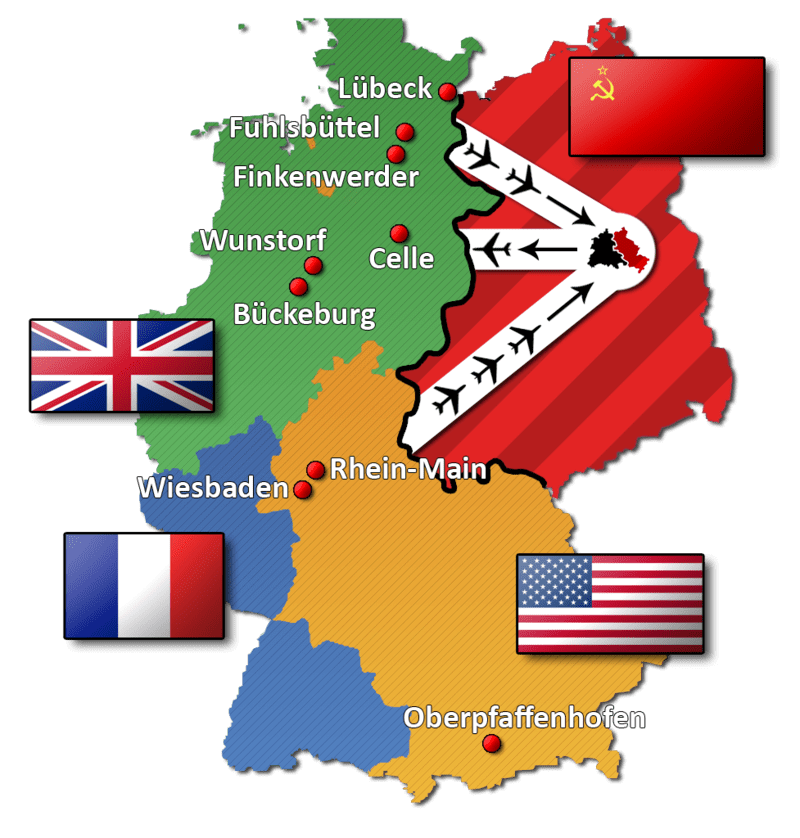



 3,662,374 military service certificates were issued to qualifying veterans, bearing a face value equal to $1 per day of domestic service and $1.25 a day for overseas service, plus interest. Total face value of these certificates was $3.638 billion, equivalent to $43.7 billion in today’s dollars and coming to full maturity in 1945.
 The Great Depression was two years old in 1932, and thousands of veterans had been out of work since the beginning. Certificate holders could borrow up to 50% of the face value of their service certificates, but direct funds remained unavailable for another 13 years.
 This had happened before. Hundreds of Pennsylvania veterans of the Revolution had marched on Washington in 1783, after the Continental Army was disbanded without pay.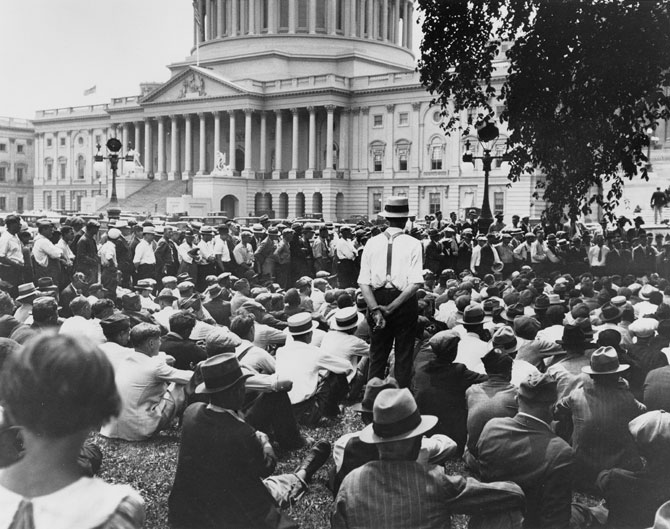
 Marchers and their families were in their camps on July 28 when Attorney General William Mitchell ordered them evicted. Two policemen became trapped on the second floor of a building when they drew their revolvers and shot two veterans, William Hushka and Eric Carlson, both of whom died of their injuries.
 President Herbert Hoover ordered the Army under General Douglas MacArthur to evict the Bonus Army from Washington. 500 Cavalry formed up on Pennsylvania Avenue at 4:45pm, supported by 500 Infantry, 800 police and six battle tanks under the command of then-Major George S. Patton. Civil Service employees came out to watch as bonus marchers cheered, thinking that the Army had gathered in their support.
 Bonus marchers fled to their largest encampment across the Anacostia River, when President Hoover ordered the assault stopped. Feeling that the Bonus March was an attempt to overthrow the government, General MacArthur ignored the President and ordered a new attack, the army routing 10,000 and leaving their camps in flames. 1,017 were injured and 135 arrested.
 Then-Major Dwight D. Eisenhower was one of MacArthur’s aides at the time. Eisenhower believed that it was wrong for the Army’s highest ranking officer to lead an action against fellow war veterans. “I told that dumb son-of-a-bitch not to go down there”, he said.
 The bonus march debacle doomed any chance that Hoover had of being re-elected. Franklin D. Roosevelt opposed the veterans’ bonus demands during the election, but was able to negotiate a solution when veterans organized a second demonstration in 1933. Roosevelt’s wife Eleanor was instrumental in these negotiations, leading one veteran to quip: “Hoover sent the army. Roosevelt sent his wife”.

 In the first half of the 19th century, 90% of federal government revenue came from tariffs on foreign manufactured goods. A lion’s share of this revenue was collected in the south, with the region’s greater dependence on imported goods. Much of this federal largesse was spent in the north, with the construction of railroads, canals and other infrastructure.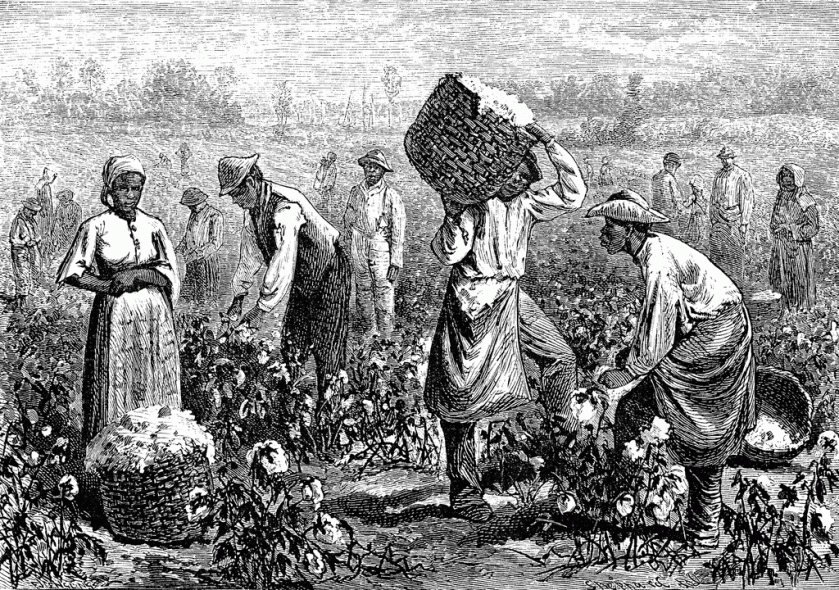
 The issue of slavery had joined and become so intertwined with ideas of self-determination, as to be indistinguishable.
 In Washington, Republicans backed the anti-slavery side, while most Democrats supported their opponents. On May 20, 1856, Massachusetts Senator Charles Sumner took to the floor of the Senate and denounced the Kansas-Nebraska Act. Never known for verbal restraint, Sumner attacked the measure’s sponsors Stephen A. Douglas of Illinois (he of the later Lincoln-Douglas debates), and Andrew Butler of South Carolina by name, accusing the pair of “consorting with the harlot, slavery”. Douglas was in the audience at the time and quipped “this damn fool Sumner is going to get himself shot by some other damn fool”.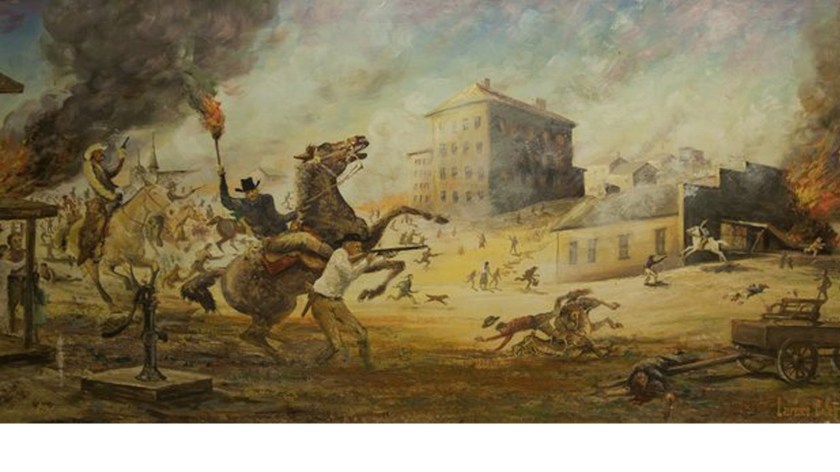


 The trio approached Sumner, who was sitting at his desk writing letters. “Mr. Sumner”, Brooks said, “I have read your speech twice over carefully. It is a libel on South Carolina, and Mr. Butler, who is a relative of mine.”
 In the next two days, a group of unarmed men will be hacked to pieces by anti-slavery radicals, on the banks of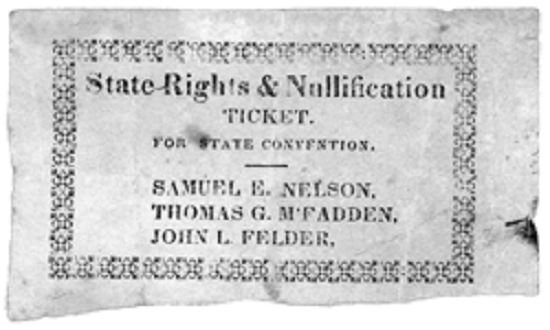


 France would leave the country following defeat by Viet Minh forces at
  Richard M. Nixon won overwhelming victory in the Presidential election of 1968, running on a platform including a “secret plan” to end the war in Vietnam.
 Students for a Democratic Society (SDS) and other “New Left” organizations staged sit-ins in the fall of 1968. Demonstrations became violent six months later, resulting in 58 arrests. Four SDS leaders spent six months in prison.
 Tear gas failed to break up the crowd and several canisters were thrown back, with near-constant volleys of rocks, bottles and other projectiles. 77 National Guardsmen advanced in line-abreast, as screaming protesters closed behind them. Guardsmen briefly assumed firing positions when cornered near a chain link fence, though no one fired.


 Mark Kurlansky, author of “Cod: A Biography of the Fish That Changed the World”, laments the 1990s collapse of the Cod fishery, saying the species finds itself “at the wrong end of a 1,000-year fishing spree.”


 Two years later, Patriot forces maintained a similar supply depot, in the southwest Connecticut town of Danbury.


 Mary Silliman was left to run the farm, and negotiate for the release of her husband. The 1993 made-for-TV movie “Mary Silliman’s War” tells a story of non-combatants, pregnant mothers and farm wives, during the Revolution.


 The United States still had a border in those days, which the Federal government attempted to enforce.
 Suffering a blizzard of hotel cancellations, this “attack on Key West’s sovereignty” could not stand. On April 22, Mayor Wardlow, local attorney & pilot David Horan and Old Town Trolley Tours operator Ed Swift flew to Miami seeking legal remedy. When District Court Judge C. Clyde Atkins failed to issue an injunction, the Key West delegation took to the courthouse steps.
 On April 23, with federal agents on scene to monitor the proceedings, a crowd gathered before the old customs building. Mayor Wardlow and a gaggle of allies mounted the back of a flatbed truck, to read the proclamation of secession. “We serve notice on the government in Washington”, he started, “to remove the roadblock or get ready to put up a permanent border to a new foreign land. We as a people, may have suffered in the past, but we have no intention of suffering in the future at the hands of fools and bureaucrats“.
 So it is that the micro-nation of Key West celebrates its independence, every April 23. The “Conch Republic’ issues its own passports, selling T-shirts and bumper stickers with the slogan “We seceded where others failed”.






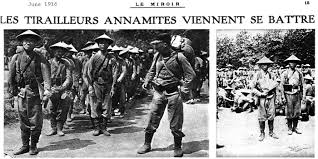 France re-occupied the region following the Japanese defeat ending WWII, but soon faced the same opposition from the army of Ho Chi Minh and Vo Nguyen Giap. What began as a low level rural insurgency, later became a full-scale modern war when Communist China entered the fray in 1949.
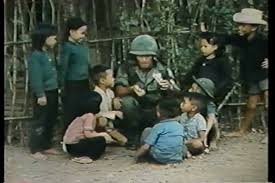 US policy makers feared a “domino” effect, and with good cause. The 15 core nations of the Soviet bloc were soon followed by Eastern Europe, as Poland, Bulgaria, Romania, Hungary and Czechoslovakia fell into the Soviet sphere of influence. Germany was partitioned into Communist and free-enterprise spheres after WWII, followed by China, North Korea and on across Southeast Asia.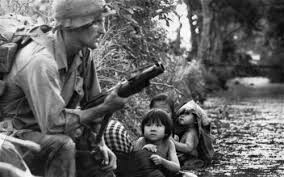
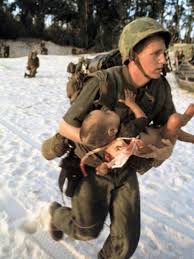 Even then it wasn’t over. Communist forces violated cease-fire agreements before they were signed. Some 7,000 US civilian Department of Defense employees stayed behind to aid South Vietnam in conducting an ongoing and ultimately futile war against communist North Vietnam.
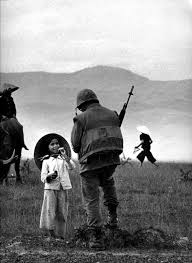 Imagine feeling so desperate, so fearful of this alien ideology invading your country, that you convert all your worldly possessions and those of your family to a single diamond, bite down on that stone so hard it embedded in your shattered teeth, and fled with your family to open ocean in a small boat. All in the faint and desperate hope, of getting out of that place. That is but one story among more than three million “boat people”. Three million from a combined population of 56 million, fleeing the Communist onslaught in hopes of temporary asylum in other countries in Southeast Asia or China.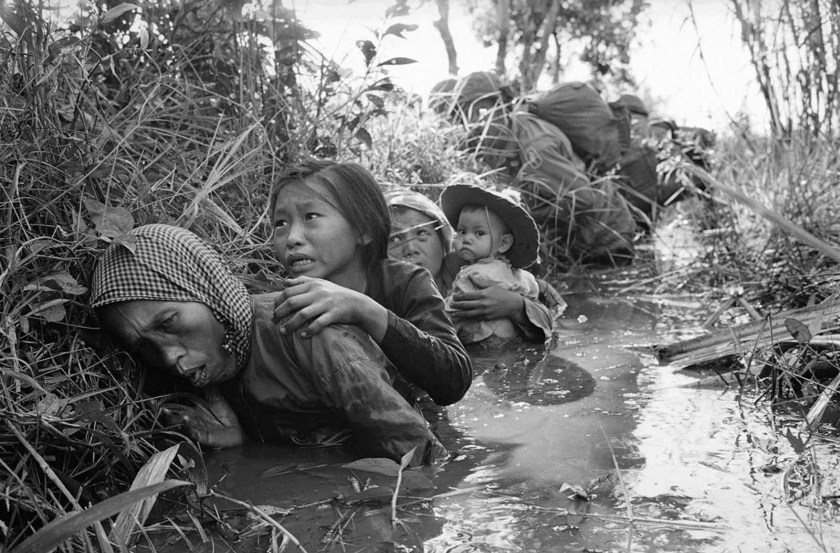


 themselves, and came to feel as I do to this day, that anyone who has a problem with our country’s war policy, needs to take it up with a politician. Not with a member of the Armed Services.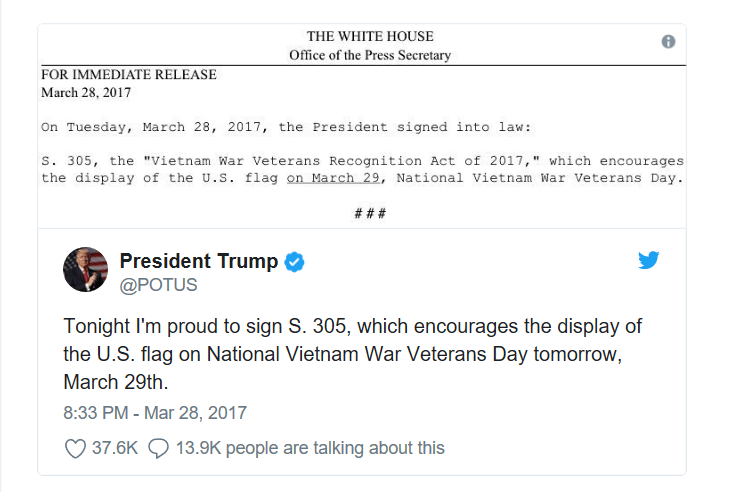

 Historical Easter Eggs - Today in History
You must be logged in to post a comment.