Long before the famous “underground railroad”, the first such track pointed not north, but south, to St. Augustine.
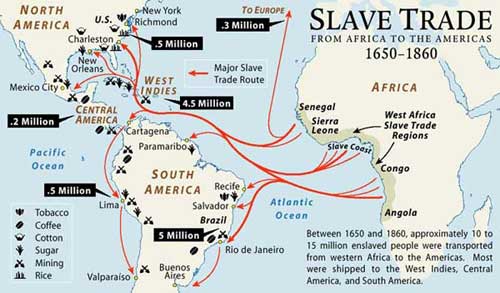
From the earliest years of the “new world” period, every economy from Canada to Argentina was, to varying degrees, involved with slavery. Spanish and Portuguese settlers brought the first African slaves to the Americas in 1501, establishing the new world’s first international slave port in Santo Domingo, modern capital city of the Dominican Republic.
Hundreds of thousands of Africans entered the Americas through the sister ports of Veracruz, Mexico, and Portobelo, Panama, “products” of the “Asiento” system wherein the contractor (asientista) was awarded a monopoly in the slave trade to Spanish colonies in exchange for royalties, paid to the crown.
The first such contractor was a Genoese company which agreed to supply 1,000 slaves over an 8-year period, beginning in 1517. A German company entered into such a contract eight years later with a pledge of 4,000.
By 1590, as many as 1.1 million Africans had come through the port of Cartagena, Colombia, sorted and surnamed under the “casta de nación” classification system.
In the American colonies, 17th century attitudes toward race appear to have been more fluid than they would later become. The first black Africans, 19 of them, came to the Virginia Colony in 1619 not as slaves, but as indentured servants. Their passage, involuntary as it was, was paid for by a term of indenture, a sort of ‘temporary slavery’, usually lasting seven years.
John Punch ran away from his term of indenture along with two Europeans, in 1640. The trio was captured in Maryland and sentenced to extended terms of indenture. Alone among the three, Punch was punished with indenture for life, effectively making him the first African ‘slave’ in the American colonies.
Meanwhile, black Africans both enslaved and free had arrived in the north American colonies, for nearly a hundred years.
Juan Garrido moved from the west coast of Africa to Lisbon, Portugal, possibly as a slave, or perhaps the son of an African King, sent for a Christian education. Be that as it may, Garrido came to the new world a free man in 1513, with Juan Ponce de León. A black Conquistador who spent thirty years with the conquest, “pacifying” indigenous peoples and searching for gold, and the mythical fountain of youth.
He was not alone. Other black Africans entered Spanish society as free men, and joining the conquest as soldiers. Some did so in exchange for freedom, some for land, official jobs, or public pensions. Ponce was fatally injured by a native arrow in 1521. Garrido went on to marry and settle in Mexico city, where he is credited with the first commercial cultivation of wheat, in the new world.
Twenty years before the “Lost” English colonists first landed at Roanoke, Pedro Menendez de Aviles founded St. Augustine, in the Spanish colony of Florida. Aviles’ colonial expedition included many black Africans, both free men and slaves, who remained a part of St. Augustine society, from that time forward. The first recorded birth in the New World of an American child of African descent took place in 1606 according to St. Augustine Catholic parish records, a year before the English settlement, at Jamestown.
The Spanish government in Florida began to offer asylum to slaves from British colonies as early as 1687, when eight men, two women and a three year old nursing child arrived there, seeking refuge. It probably wasn’t as altruistic as it sounds, given the history. The primary interest seems to have been disrupting the English agricultural economy, to the north.
The Florida governor required only that such runaways convert to Catholicism, and then he put the men to work for wages.
In 1693, King Charles of Spain officially proclaimed that runaways would find freedom in Florida, provided they would convert to Catholicism and perform four years of service to the Crown. Spain had effectively created a maroon colony (from the Spanish word cimarrón, meaning “fugitive, runaway”, literally “living on mountaintops”), forming a front-line defense against English attack, from the north.
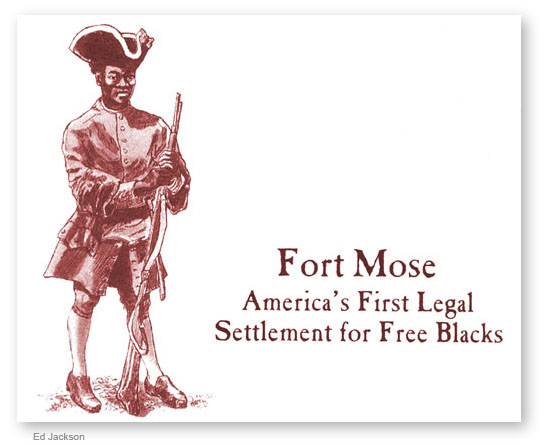
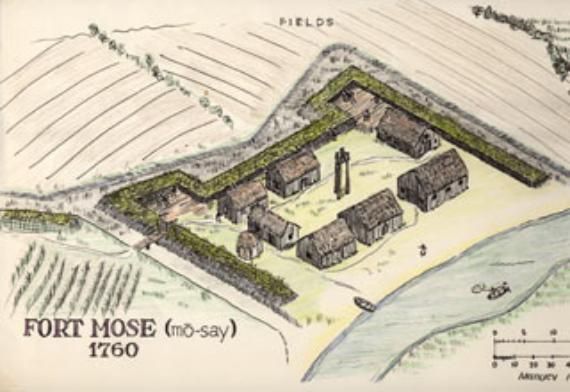
Gracia Real de Santa Teresa de Mosé (pronounced “Moh-say”), was a military fortification two miles north of St. Augustine, established by Colonial Governor Manuel de Montiano, in 1738. Spanish militia would place incoming freedom seekers into military service at the fort, under the leadership of an African Creole man known as Francisco Menendez.
Fort Mosé was the first legally sanctioned free black settlement, in what would become the United States.
Long before the famous “underground railroad”, the first such track pointed not north, but south, to St. Augustine. Word of the settlement reached into Georgia and South Carolina to the north, attracting escaping slaves. It was probably the “final straw” that set off the unsuccessful 1739 slave insurrection known as the Stono Rebellion, in which several dozen runaway slaves attempted to reach Spanish Florida.
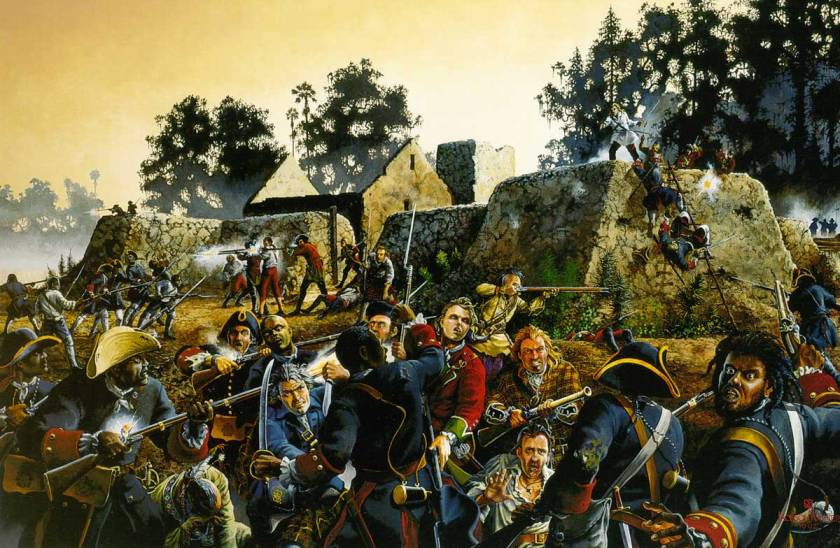
In the early phase of the War of Jenkins Ear, Fort Mosé was abandoned and occupied by General James Oglethorpe, colonial governor of Georgia, along with a force of British colonial rangers, Scottish Highlanders, enslaved black auxiliaries and native Creek and Uchise allies.
The British garrison was caught by surprise in the pre-dawn hours of June 16, 1740 and all but annihilated, by a force of Spanish soldiers, free black militia and native Yamasee allies. The coquina fortification was destroyed in the process, and would not be rebuilt until 1752.
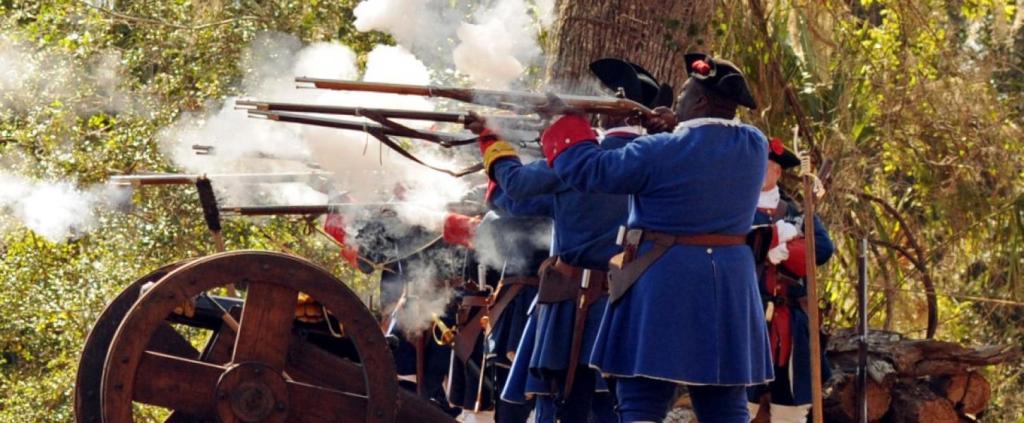
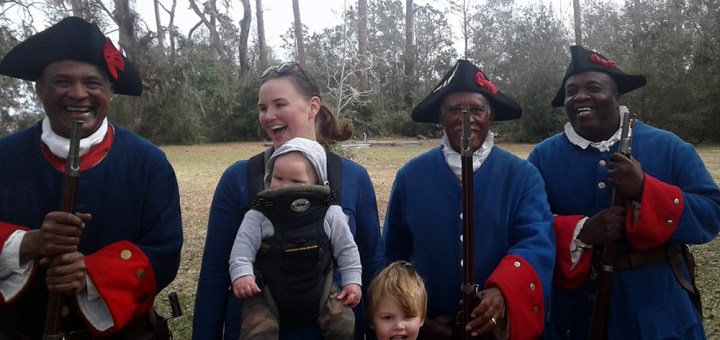
In June of this year, Florida Living History, Inc. and the Fort Mosé Historical Society presented the latest in a series of re-enactments, celebrating the 277th anniversary of the “Bloody Battle of Fort Mosé “. The site has seen several archaeological excavations in recent years, and is considered the “premier site on the Florida Black Heritage Trail.” Fort Mosé was officially designated an Historic State Park on October 12, 1994.
“1st Saturday militia”, H/T Fort Mosé Historical Society
Five states ratified the new constitution in quick succession. Others wanted the document to specify those powers left un-delegated to the Federal government, be reserved to the states.
The Founding Fathers ratified the United States Constitution on June 21, 1788. In so doing, our forebears bestowed on generations yet unborn, a governing system unique in all history. A system of diffuse authority, checks and balances and authority delegated but Never relinquished, by a sovereign electorate.
The American system is often described as “democracy”, but such a description is in error. Four wolves and a lamb voting on what to eat for dinner, is democracy. The genius of the founders is demonstrated in a system which protects the rights of All citizens, including that one. The proverbial lamb. The specifics are enumerated in our bill of rights, twelve amendments adopted by the first Congress on this day in 1789, and sent to the states for ratification.
Even at the Constitutional Convention, delegates expressed concerns about the larger, more populous states holding sway, at the expense of the smaller states. The “Connecticut Compromise” solved the problem, creating a bicameral legislature with proportional representation in the lower house (House of Representatives) and equal representation of the states themselves in the upper house (Senate).
The 62nd Congress proposed a Constitutional amendment in 1912, negating the intent of the founders and proposing that Senators be chosen by popular election. The measure was adopted the following year, the seventeenth amendment having been ratified by ¾ of the states. Since that time, it’s difficult to understand what the United States Senate even is, an institution neither democratic nor republican, but I digress.
Five states: Delaware, Pennsylvania, New Jersey, Georgia, and Connecticut, ratified the document in quick succession. Some states objected to the new Constitution, especially Massachusetts, which wanted more protection for basic political rights such as freedom of speech, religion, and of the press. These wanted the document to specify, that those powers left un-delegated to the Federal government, were reserved to the states.
A compromise was reached in February, 1788 whereby Massachusetts and other states would ratify the document, with the assurance that such amendments would immediately be put up for consideration.
With these assurances, Massachusetts ratified the Constitution by a two-vote margin, followed by Maryland and South Carolina. New Hampshire became the ninth state on June 21. The new Constitutional Government would take effect on March 4 of the following year.
Amendments 2-12 were adopted on December 15, 1791, becoming the “Bill of Rights”.
It’s interesting to note the priorities of that first Congress, as expressed in their original 1st and 2nd amendments. As proposed to the 1st Congress, the original 1st amendment dictated apportionment of representation. It was ratified by only 11 states, and technically remained pending. Had the states ratified that original first amendment, we would now have a Congress of at least 6,345 members, instead of the 535 we currently have.
The original 2nd amendment was an article related to Congressional compensation, that no future Congress could change their own salaries. The measure would in fact, pass, becoming the 27th amendment in 1992. Following a ratification period of 202 years, 7 months, and 10 days.
From “separate but equal” to the rights of terrorists SCOTUS rulings are final, inviolate and sometimes imbecilic.
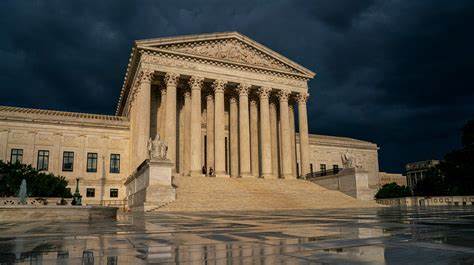
Article III of the United States Constitution establishes the Supreme Court of the United States (SCOTUS), and “such inferior Courts as the Congress may from time to time ordain and establish”.
There is no mention of the number of justices. The first Congress passed the Federal Judiciary Act on September 24, 1789, specifying a six-justice Supreme Court.
Twelve years later, the presidency of John Adams was coming to an end. As a Federalist, Adams wanted nothing more than to stymie the incoming administration of Democratic-Republican Thomas Jefferson. Toward that end, Adams appointed the infamous “midnight judges” in the last hours of his administration: 16 Federalist Circuit Court judges and 42 Federalist Justices of the Peace.
The incoming Jefferson administration sought to block the appointments. Jefferson ordered then-Secretary of State James Madison to hold those commissions as yet undelivered, thus invalidating the appointments. One of the appointees, William Marbury, took the matter to Court.
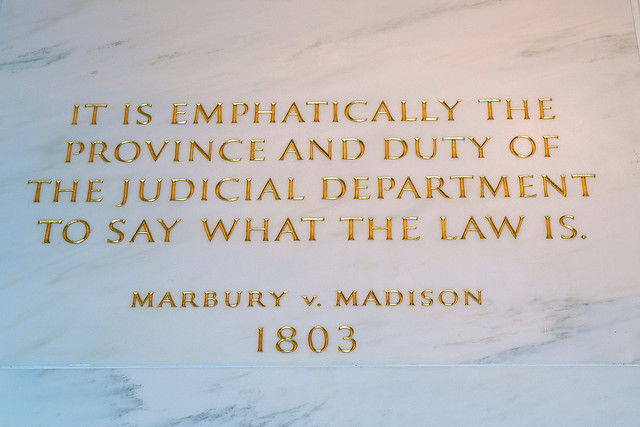
The case advanced all the way to the Supreme Court, which ruled in Marbury v. Madison that the provision of the Judiciary Act enabling Marbury to bring his claim, was unconstitutional. Marbury lost his case, but the principle of judicial review, the idea that the court could preside Godlike, over laws passed by their co-equal branch of government, has been the law of the land, ever since.
In the early days of the Great Depression, Federal agricultural officials conceived the hare brained idea that artificially introducing scarcity would increase prices, and therefore wages, in the agricultural sector. Six million hogs were destroyed in 1933. Not harvested, just destroyed and thrown away. 470,000 cattle were shot in Nebraska alone. Vast quantities of milk were poured down sewers, all at a time of national depression, when malnutrition was widespread.
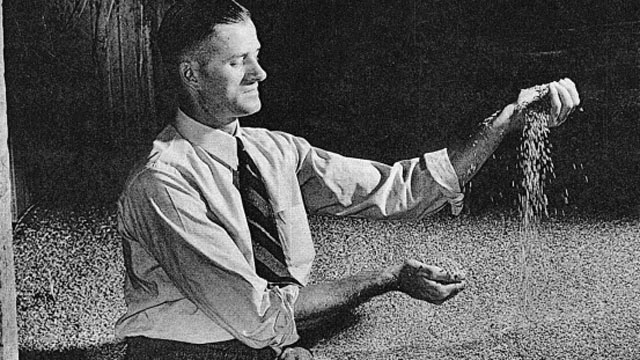
With the Agricultural Adjustment Act of 1938, Washington began to impose production quotas on the nation’s farmers. Ohio farmer Roscoe Filburne was ordered to grow 223 bushels of wheat in the 1941 season. Filburne grew 462.
Article 1, Section 8 of the Constitution permits Congress “To regulate Commerce with foreign Nations, and among the several States, and with the Indian Tribes”. That is all but, on this flimsy basis, the Federal Government took Roscoe Filburne to court.
The farmer argued that the “surplus” stayed on his farm, feeding his family and his chickens. Lower Courts sided with Filburne. The government appealed all the way to the Supreme Court, arguing that, by withholding his surplus, Filburne was effecting interstate market conditions, thereby putting him under federal government jurisdiction.
Intimidated by the Roosevelt administration’s aggressive and illegal “court packing scheme“, SCOTUS decided the Wickard v. Filburnecase, against the farmer. Ever since, what you don’t do can be held against you in a court of law. Get it? Neither do I.
Over time, SCOTUS has proven itself to be as imperfect as any other institution. There have only been 17 Chief Justices and 101 Associate Justices in the entire history of the court. Five Chiefs having previously sat as Associate Justices, there are only 113 in all. Should Brett Kavanaugh be confirmed, he would be #114.
Some among those 113 have been magnificent human beings, and some of them cranks. There have been instances of diminished capacity ranging from confusion to outright insanity. One justice spent part of his term in a debtor’s prison. Another killed a man. There have been open racists and anti-Semites.
There is no official portrait of the 1924 court because Justice James C. McReynolds wouldn’t stand next to Louis Brandeis, the court’s first Jewish Justice. One Justice was known to chase flight attendants around his quarters, while another spent his time in chambers, watching soap operas.
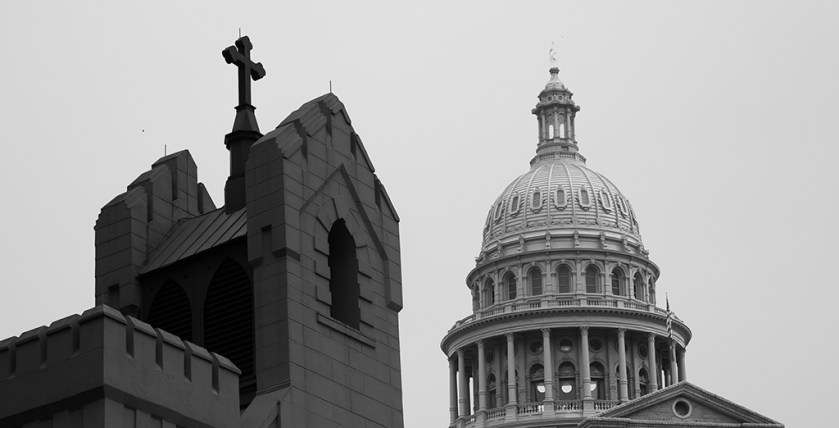
There’s the former Klan lawyer turned Justice who took a single phrase, “separation of church and state”, from a private letter of Thomas Jefferson, and turned the constitutional freedom OF religion into an entirely made up freedom FROM religion.
The Supreme Court reinforced chattel slavery with the Dred Scott decision. The Korematsu ruling gave us the forced incarceration of Americans of Japanese descent. Buck v. Bell gave Americans the “gift” of forced sterilization, and Stenberg v. Carhartt enshrined the constitutional “right” to the hideous and detestable “procedure” known as partial birth abortion. From “Separate but Equal” to the “rights” of terrorists, SCOTUS’ rulings are final, inviolate, and sometimes imbecilic.
Chief Justice John Roberts, who once said “remember that it’s my job to call balls and strikes, and not to pitch or bat,” invented a whole new definition of taxation, enshrining the “Affordable Care Act” as the law of the land.
The framers gave us a Constitutional Republic with co-equal branches of government, with power diffused and limited by a comprehensive set of checks and balances.
They gave us two distinct means to amend that Constitution, should circumstances require it.
Traditionally, Congress proposes amendments, submitting them to the states for ratification. The problem is that many believe Congress itself to be part of the problem, and a broken institution is unlikely to fix itself.
Article V gives us a way to amend the constitution, if we would take it. Instead of Congress proposing amendments, an Article V convention of state legislatures would propose amendments, to take effect only if ratified by a super majority of states. We could start with an amendment permitting 2/3rds of the People’s representatives in Congress, to overturn a SCOTUS decision. Then we could term limit these people.
Unless, that is, you believe it’s fine for the Federal Government to prohibit a farmer from growing wheat for his own use, that one man in a black robe can force you to buy a product you don’t want and call it a “tax”, or you believe that “established by the state” means by the state or federal government, at the sole discretion of the man who says, “I’m from the Government. I’m here to help”.
If the findings of a 2004 Pew survey are any indication, older and younger audiences alike turn to late night comedians as a source of political news. Whether anyone leaves such programs better informed may be a matter for conjecture, but one thing is certain. The use of satire in political commentary is anything but new.
If the findings of a 2004 Pew survey are any indication, older and younger audiences alike turn to late night comedians as a source of political news.
Whether anyone leaves such programs better informed may be a matter for conjecture, but one thing is certain. The use of satire in political commentary is anything but new.
Anything but new but highly, effective. In the 4th century BC the Greek comedic playwright Aristophanes lampooned the Athenian general Cleon as an unprincipled and warmongering demagogue. The playwright’s work was in no small measure a reason for the sentence of death, against the Great Socrates.
Seventeen centuries later the Divine Comedy of Dante Alighieri had the soothsayers and fortune tellers of his time walking through the inferno of purgatory with their heads screwed on backwards, rendering them no longer able to see what lay ahead.
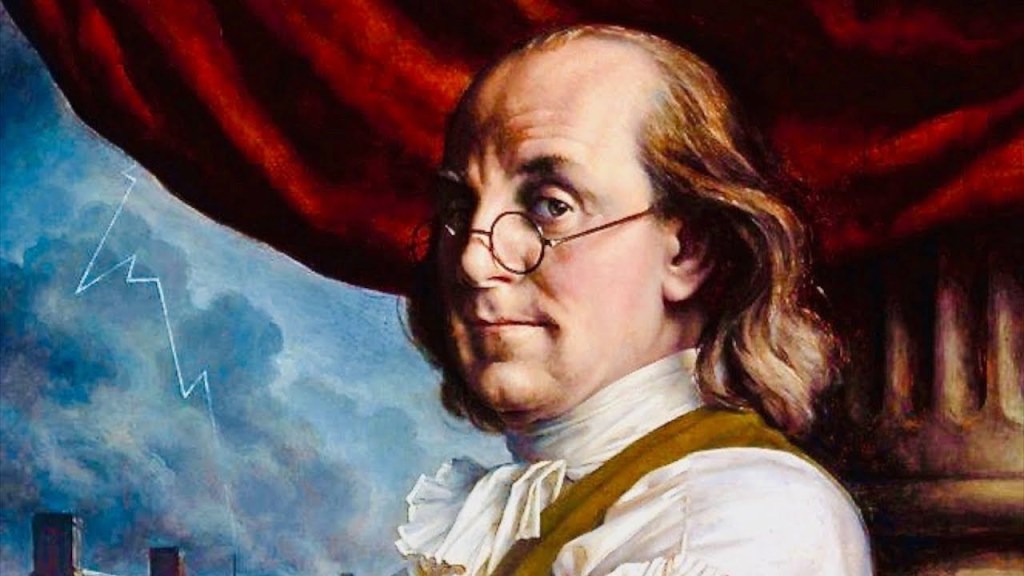
On this day in 1773 the poison pen of one Benjamin Franklin skewered Great Britain’s King George III…writing as the King of Prussia, no less.
At the height of the revolution, public opinion remained essentially split in thirds with one part for independence, one for remaining and a third that didn’t care that much, either way.
The seven years war of 1754 was a world war for global supremacy between Britain and France with major ramifications, for the Spanish Empire. Britain’s North American colonies experienced the conflict as the fourth French and Indian war, pitting France and a coalition of first nations against Britain and her own following of native American allies.
“When you’re born, you get a ticket to the freak show. When you’re born in America, you get a front row seat.”
George Carlin
For British policymakers it all seemed quite reasonable to impose the costs of this “protection”, on King George III’s North American subjects. The Stamp Act of 1765, the Townshend Acts of 1767 and the Tea Act of 1773 were all measures enacted to extract ever greater taxes, from the American colonists.
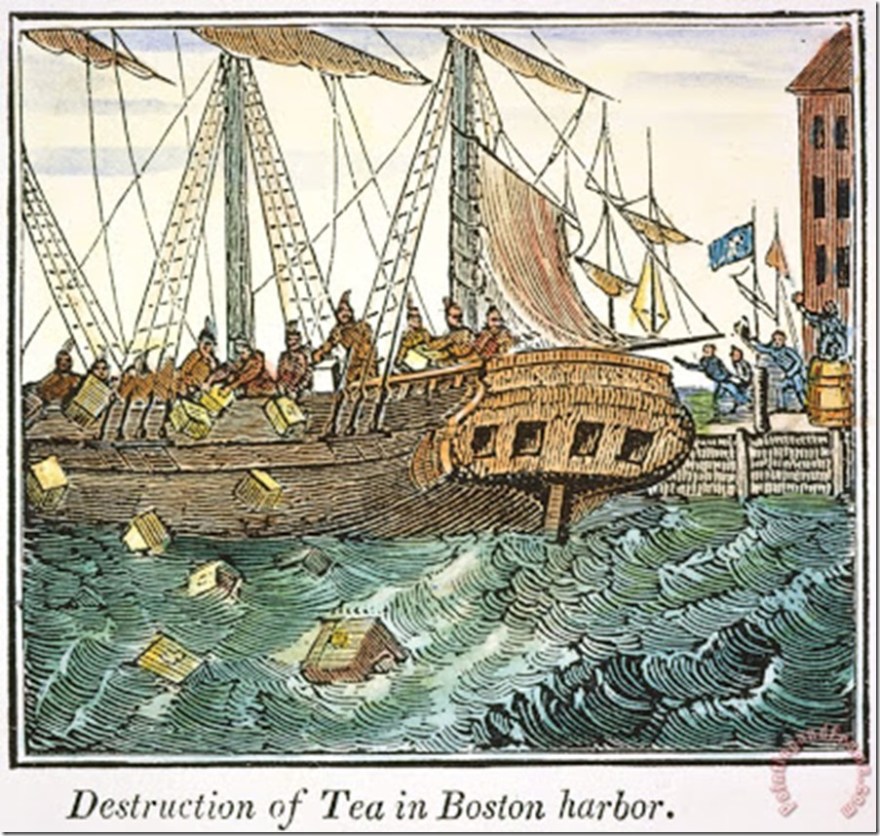
The colonists themselves took a dim view of all of it and threw the tea off the boat, that December. Literally.
Political satire was nothing new to Benjamin Franklin. The teenage Franklin’s anonymously written Silence Dogood letters skewered the brahmins of Boston and generated proposals of marriage to a widow, who did not exist. The young Franklin’s ‘outing’ as the author earned him a beating from his older brother the publisher and a one-way trip out of Boston to Philadelphia, where an older Franklin was destined to enter the pages of history.
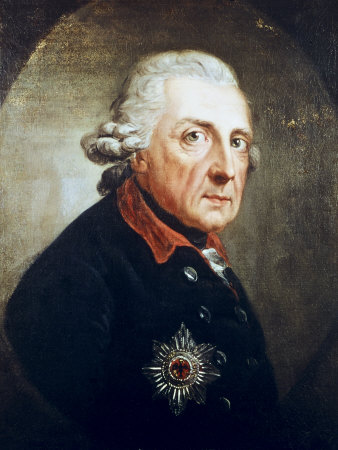
Benjamin Franklin was a man of words whose contributions to the coming revolution were the equal to that man of action, George Washington. In 1773 Franklin sat down to lampoon 100 years of American grievance against Great Britain writing as Frederick II, King of Prussia.
The choice was inspired. A growing power on the continent, Frederick “The Great” had recently seized large chunks of Poland and Silesia, claiming both to be rightfully his going back to the time, of the Teutonic knights. The treaty of Paris ending the seven years war settled territorial issues from Canada to the French sugar plantations of the Caribbean but left Britain’s ‘ally’ Prussia, out of the bargain. Suffering losses of some 260,000 men Frederick II was left to negotiate peace terms, on his own.
For these reasons Franklin’s hoax carried with it, a ring of authenticity. Published this day in 1773, An Edict from the King of Prussia made claims on Britain herself, in the name of the Prussian King:
“We have long wondered here at the Supineness of the English Nation, under the Prussian Impositions upon its Trade entering our Port…”
The edict went back to the 5th century Germanic brothers Hengist and Horsa who led the Angles, Saxons and Jutes in the 5th century invasions of the British Isles and the 6th century Cerdicus, first of the Kings of Saxon Wessex who reigned from 519 to 534 AD:
“Whereas it is well known to all the World, that the first German Settlements made in the Island of Britain, were by Colonies of People, Subjects to our renowned Ducal Ancestors, and drawn from their Dominions, under the Conduct of Hengist, Horsa, Hella, Uffa, Cerdicus, Ida, and others…”
Fictitious “edict” from the King of Prussia
Frederick II “The Great, King of Prussia was the longest reigning monarch of the House of Hohenzollern reigning from 1740 until his death in 1786.
In 1,546 words the King’s edict went on to enunciate in “claims both antient (ancient) and modern”, Prussian rights to the lands, peoples, commerce and above all taxes of Great Britain, in the name of the Prussian state.
Back in England many swallowed the ruse whole as a bald pretext for war, with her former ally. The more perspicacious among them may have noticed a remarkable similarity between the Prussian King’s grievances, and those of the American colonies.
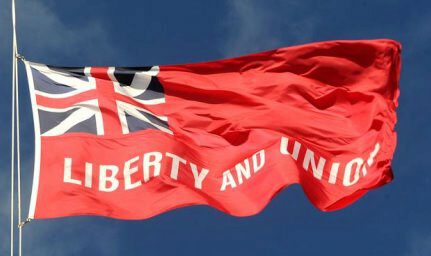
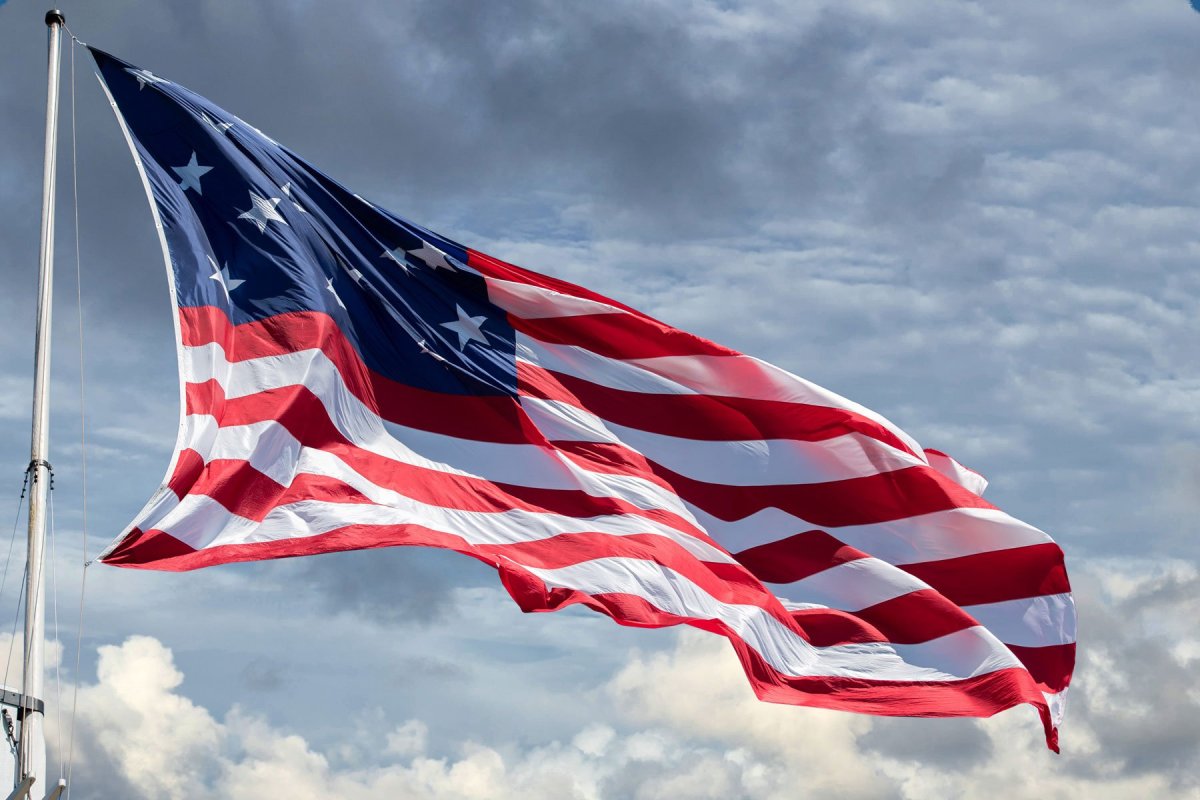
No matter. Insensate obstinacy doth dwell where humor and reason, fear to tread. Or something like that. The following year the “Liberty and Union” banner unfurled above the town green in Taunton Massachusetts, that first distinctly American flag as yet symbolizing a desire for greater autonomy and continued union, as loyal British subjects.
The “Intolerable Acts” also happened in 1774, that series of punitive measures passed by the parliament to punish the American colonies, in the wake of the Boston Tea Party.
There would as yet be olive branches and frantic supplications on both sides of the Atlantic, but to no avail. The “Shot heard ’round the World” lay such a short time in the future to make it known to all that the path, was now set.
An ardent patriot in the cause of American independence, the young school teacher turned spy placed his trust, where it did not belong.
From the earliest days of the American Revolution, the nine Hale brothers of Coventry Connecticut fought on the Patriot side. Five of them were there to help out at the battles at Lexington and Concord. The youngest and most famous brother was still at home in New London at the time, finishing the term of a teaching contract.
Nathan Hale’s unit participated in the siege of Boston. Hale himself joined General George Washington’s army in the spring of 1776, as the army moved to Long Island to block the British move on the strategically important port city of New York.
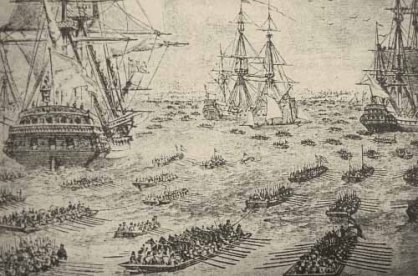
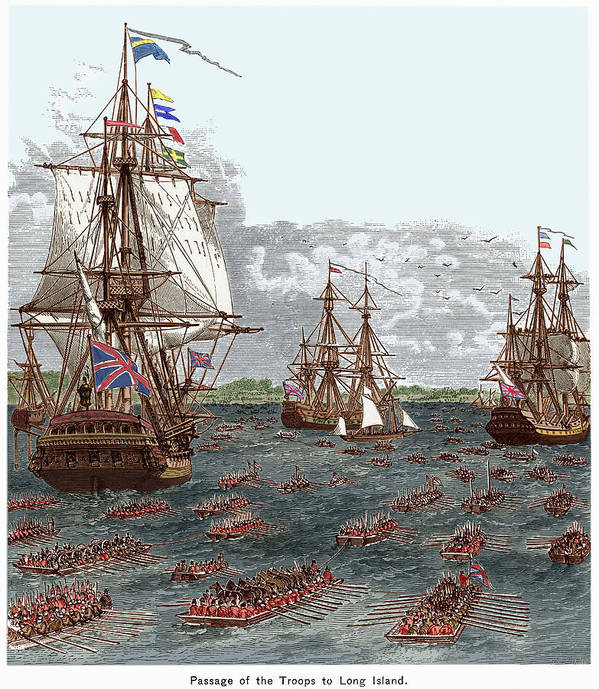
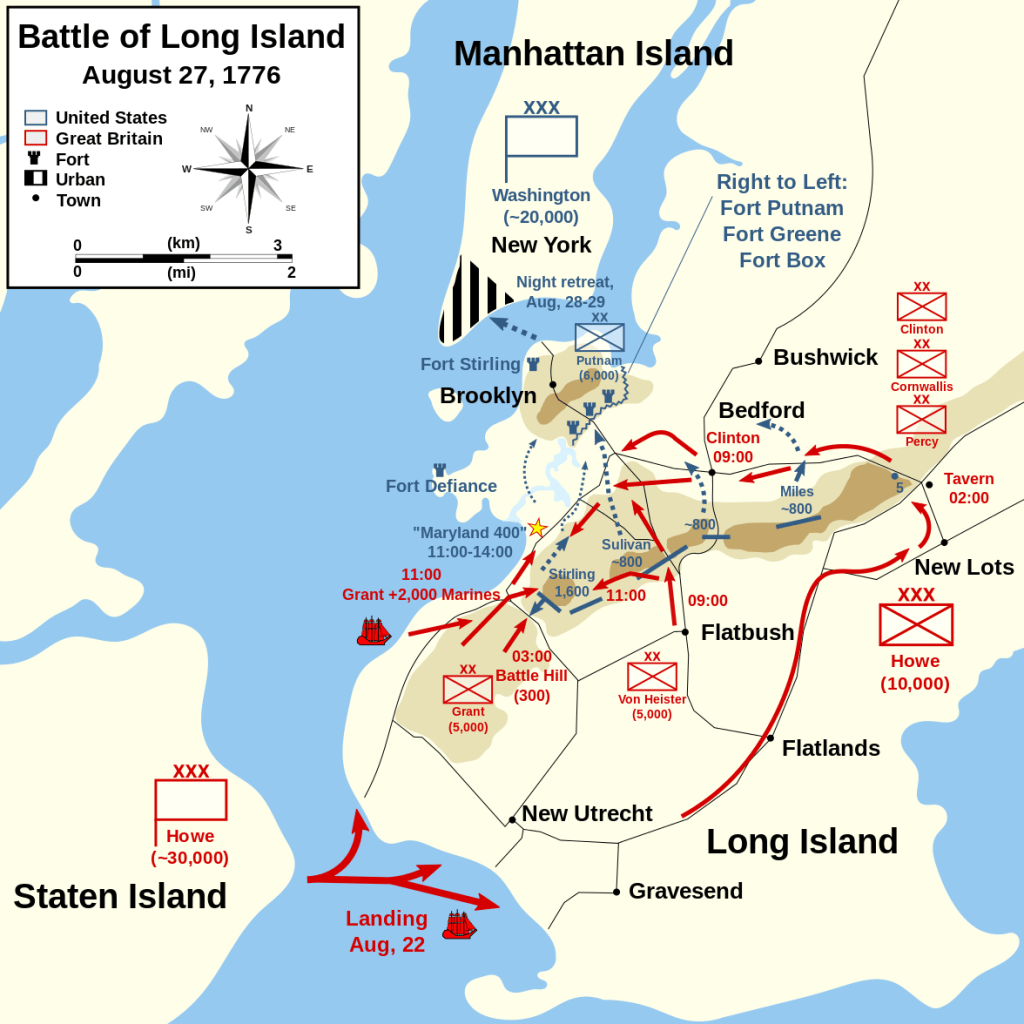
On June 29, General Howe appeared at Staten Island with a fleet of 45 ships. By the end of the week, he’d assembled an overwhelming fleet of 130.
There was an attempt at peaceful negotiation on July 13, when General Howe sent a letter to General Washington under flag of truce. The letter was addressed “George Washington, Esq.”, intentionally omitting Washington’s rank. Washington declined to receive the letter, saying there was no one present by that address. Howe tried the letter again on the 16th, this time addressing “George Washington, Esq., etc., etc.”. Again, Howe’s letter was refused.
British Landing on Long island
The next day, General Howe sent Captain Nisbet Balfour in person, to ask if Washington would meet with Howe’s adjutant, Colonel James Patterson. A meeting was scheduled for the 20th.
Patterson told Washington that General Howe had come with powers to grant pardons. Washington refused, saying “Those who have committed no fault want no pardon”.
Patriot forces were comprehensively defeated at the Battle of Brooklyn, fought on August 27, 1776. With the Royal Navy in command on the water, Howe’s army dug in for a siege, confident that the adversary was trapped and waiting to be destroyed at their convenience.
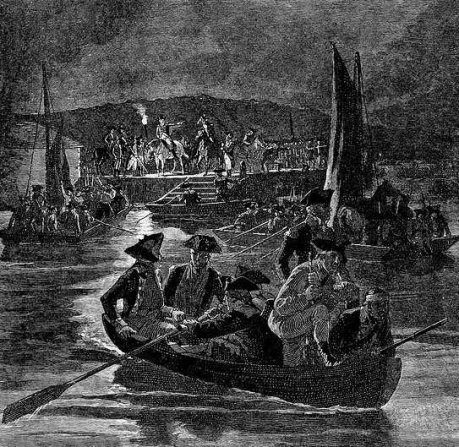
British retreat from Long Island
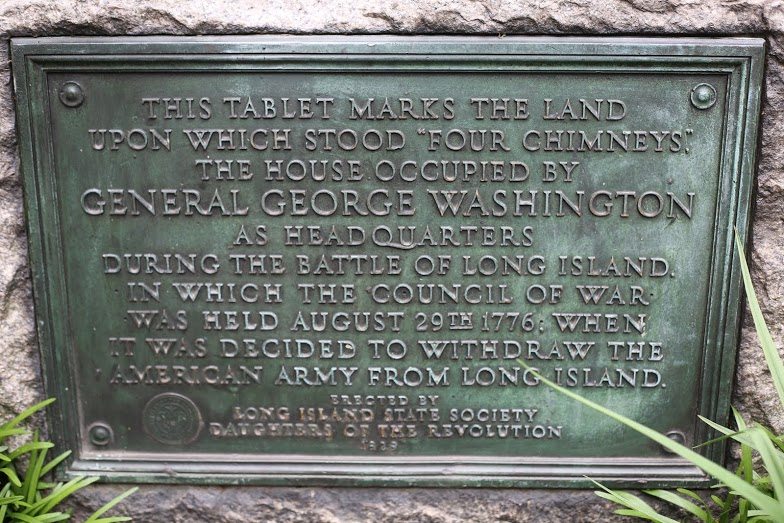
On the night of August 29-30, Washington withdrew his army to the ferry landing and across the East River, to Manhattan.
With horse’s hooves and wagon wheels muffled, oarlocks stuffed with rags, the Patriot army withdrew, as a rearguard tended fires, convincing the redcoats in their trenches that the Americans were still there.
The surprise was complete for the British side, on waking for the morning of the 30th. The Patriot army had vanished.
The Battle of Long Island would almost certainly have ended in disaster for the Patriot cause, but for that silent evacuation over the night of August 29-30.
Following evacuation, the Patriot army found itself isolated on Manhattan island, virtually surrounded. Only the thoroughly disagreeable current conditions of the Throg’s Neck-Hell’s Gate segment of the East River, prevented Admiral Sir Richard Howe (William’s brother), from enveloping Washington’s position, altogether.
Expecting a British assault in September, General Washington became increasingly desperate for information on British movements.
Washington asked for volunteers for a dangerous mission, to go behind enemy lines, as a spy. Up stepped a volunteer. His name was Nathan Hale.
Hale set out on his mission on September 10, disguised as a Dutch schoolmaster. He was successful for about a week but appears to have been something less than “street smart”. The young and untrained Patriot-turned spy, placed his trust where it did not belong.
Major Robert Rogers was an old British hand, a leader of Rangers during the earlier French and Indian War. Rogers must have suspected that this Connecticut schoolteacher was more than he pretended to be, and intimated that he, himself, was a spy in the Patriot cause.
Hale took Rogers into his confidence, believing the two to be playing for the same side. Barkhamsted Connecticut shopkeeper Consider Tiffany, a British loyalist and himself a sergeant of the French and Indian War, recorded what happened next, in his journal: “The time being come, Captain Hale repaired to the place agreed on, where he met his pretended friend” (Rogers), “with three or four men of the same stamp, and after being refreshed, began [a]…conversation. But in the height of their conversation, a company of soldiers surrounded the house, and by orders from the commander, seized Captain Hale in an instant. But denying his name, and the business he came upon, he was ordered to New York. But before he was carried far, several persons knew him and called him by name; upon this he was hanged as a spy, some say, without being brought before a court martial.”
The “stay behind” spy Hercules Mulligan would have far greater success reporting on British goings-on, from the 1776 capture of New York to the ultimate withdrawal seven years later. But that is a story for another day.
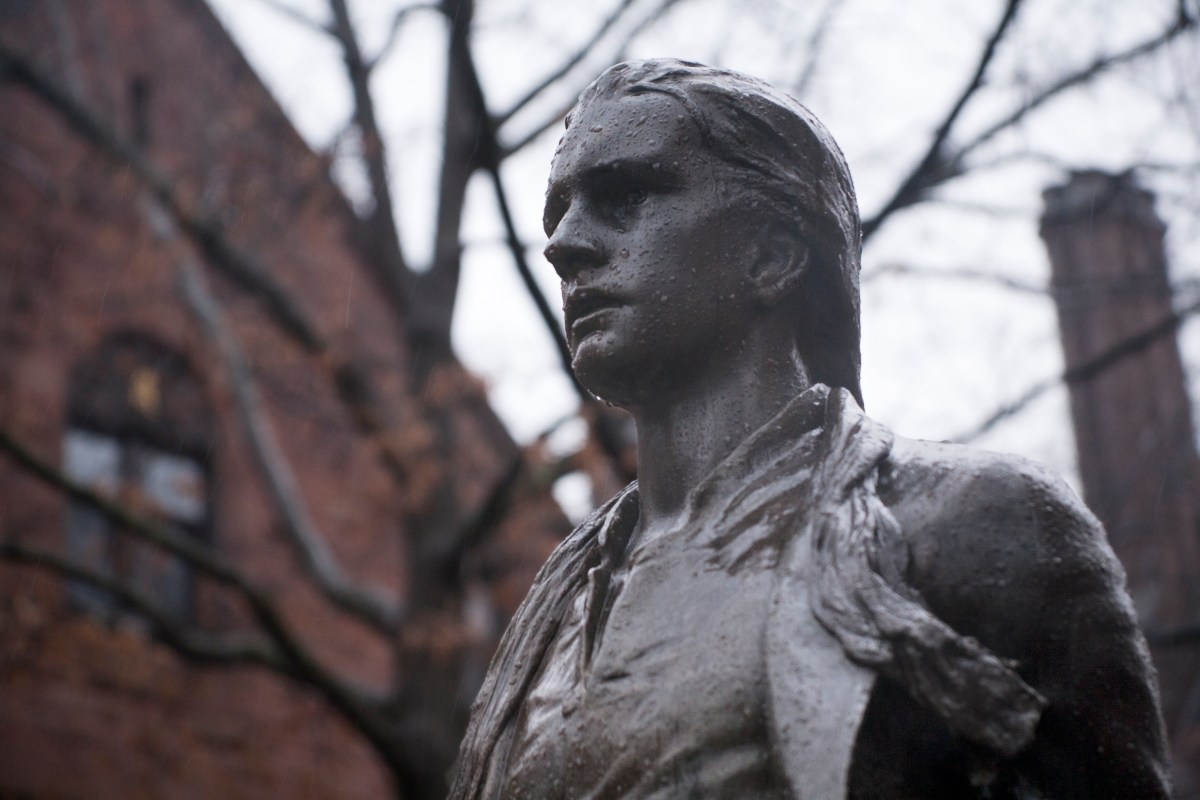
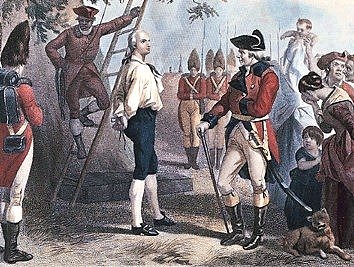
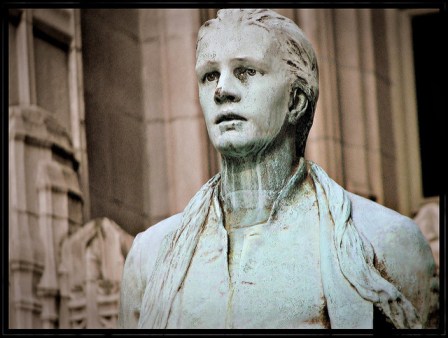
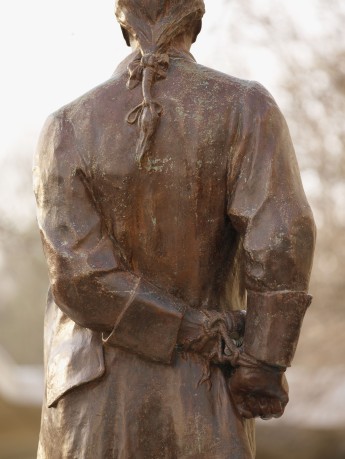
Nathan Hale was arrested on September 21, 1776, and hanged as a spy. He was 21. CIA.gov describes Hale as “The first American executed for spying for his country”.
There is no official account of Nathan Hale’s final words, but we have an eyewitness statement from British Captain John Montresor, who was present at the hanging.
Montresor spoke with American Captain William Hull the following day under flag of truce. He gave Hull the following account: “‘On the morning of his execution,’ said Montresor, ‘my station was near the fatal spot, and I requested the Provost Marshal to permit the prisoner to sit in my marquee, while he was making the necessary preparations. Captain Hale entered: he was calm, and bore himself with gentle dignity, in the consciousness of rectitude and high intentions. He asked for writing materials, which I furnished him: he wrote two letters, one to his mother and one to a brother officer.’ He was shortly after summoned to the gallows. But a few persons were around him, yet his characteristic dying words were remembered. He said, ‘I only regret, that I have but one life to lose for my country‘.
The naval bombardment taking place that night, is scarcely to be imagined. At first exchanging shot for shot with the garrison the warships soon pulled back, out of range of the fort’s guns. For 27 hours in a driving rain, nineteen warships pounded shot, shell and rocket by the thousands onto the 1,000-man garrison.
3,000 years ago, the Greek poet Anacreon composed lyric verse intended to be recited or sung to musical accompaniment, usually that of the lyre.
Anacreon. Marble. Roman copy of the 2nd century A.D. after a Greek original of the 5th century B.C. Inv. No. 491. Copenhagen, New Carlsberg Glyptotek.
Today, Anacreon himself is all but unknown, save for the efforts of the Anacreontic Society of 18th century, Great Britain.
The English composer and church organist John Stafford Smith founded the Anacreontic Society somewhere around 1766, the group meeting in various taverns before settling on the old coffee house on Ludgate Hill, in London. A gentlemen’s club of amateur musicians and professionals meeting monthly and dedicating themselves to “wit, harmony and the god of wine”, the society presented regular concerts, the high point of which came in January 1791 with the attendance the Austrian composer, Joseph Haydn.
The low point came somewhere in 1792 when the Duchess of Devonshire attended a meeting and found the entertainments, displeasing to the fairer sex. That October it was reported, “The Anacreontick Society meets no more; it has long been struggling with symptoms of internal decay“.
Success has many fathers but failure, is an orphan. Today the Anacreontic Society itself is all but forgotten but for the theme song written by society member and lyricist Ralph Tomlinson and put to music by John Smith, remembered by the first four words: “To Anacreon in Heaven“.
From the first signs of discontent in the American colonies to the dissolution of the Articles of Confederation and adoption of our own modern constitution, the life of the Anacreontic Society tracks with the British colonies in North America’s struggle for independence.
Within a decade of that constitution the rise of a certain Corsican corporal embroiled Great Britain in a series of international coalitions against the forces of Napoleon Bonaparte and his Grande Armée. The former American colonies benefited from the European conflict, remaining on the sidelines and doing business with (while earning the animosity of) both sides.
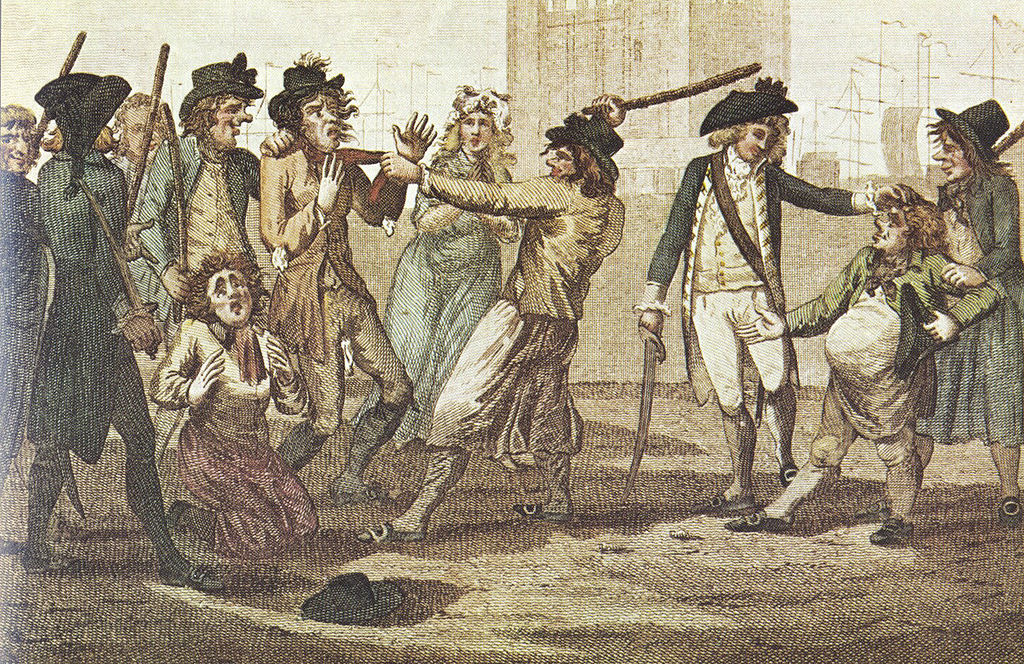
Anachronistic to that collection of agreements both written and unwritten which together comprise the Constitution of the United Kingdom, the practice of Impressment traces back to the time of Edward Longshanks the Hammer of the Scots, King of England between 1272 to 1307. Naval service imposed massive manpower requirements in the age of sail. Several European navies employed the use of “press gangs” to forcibly “impress” (read, kidnap) the unsuspecting into terms of service at sea though the dominance of the British navy largely associates the practice, with that of the United Kingdom.
1780 caricature of the Press Gang
Widely detested on both sides of the Atlantic, the practice nevertheless survived a number of court challenges. Impressment of American sailors appears in the Declaration of Independence, along with 26 other grievances against King George III. While not entirely the cause of the War of 1812, impressment remained one among a number, of casus belli.
Neither side was ready for it when war broke out between the United States and the United Kingdom in June, 1812. Most of the British war machine was busy with that “Little Corporal”, whose “Waterloo” remained, two years in the future. America had disbanded the National Bank by that time and had no means of paying for war, while private northeastern bankers were reluctant to provide financing.
Support for the War of 1812 was bitterly divided, between the Democratic-Republicans of President James Madison, and the Federalist strongholds of Connecticut, Massachusetts and Rhode Island. Of the six New England states, New Hampshire alone complied with President Madison’s requests for state militia.
New England may have actually seceded following the Hartford Convention of 1814 if not for future President Andrew Jackson’s overwhelming victory at the Battle of New Orleans. A battle I might add took place after the treaty of Ghent formally ending the war, but now I’m getting ahead of the story.
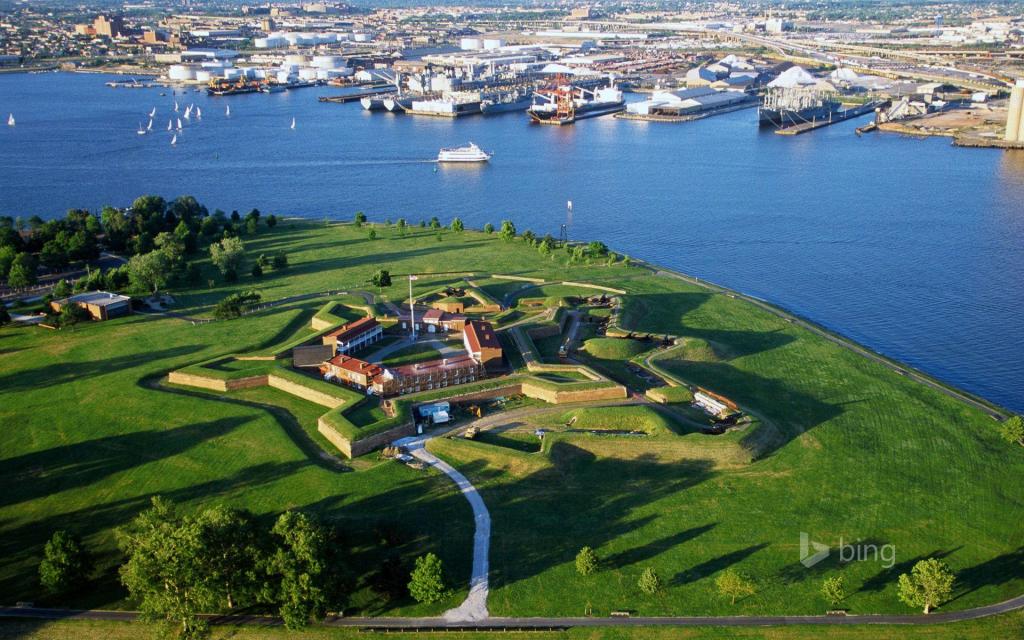
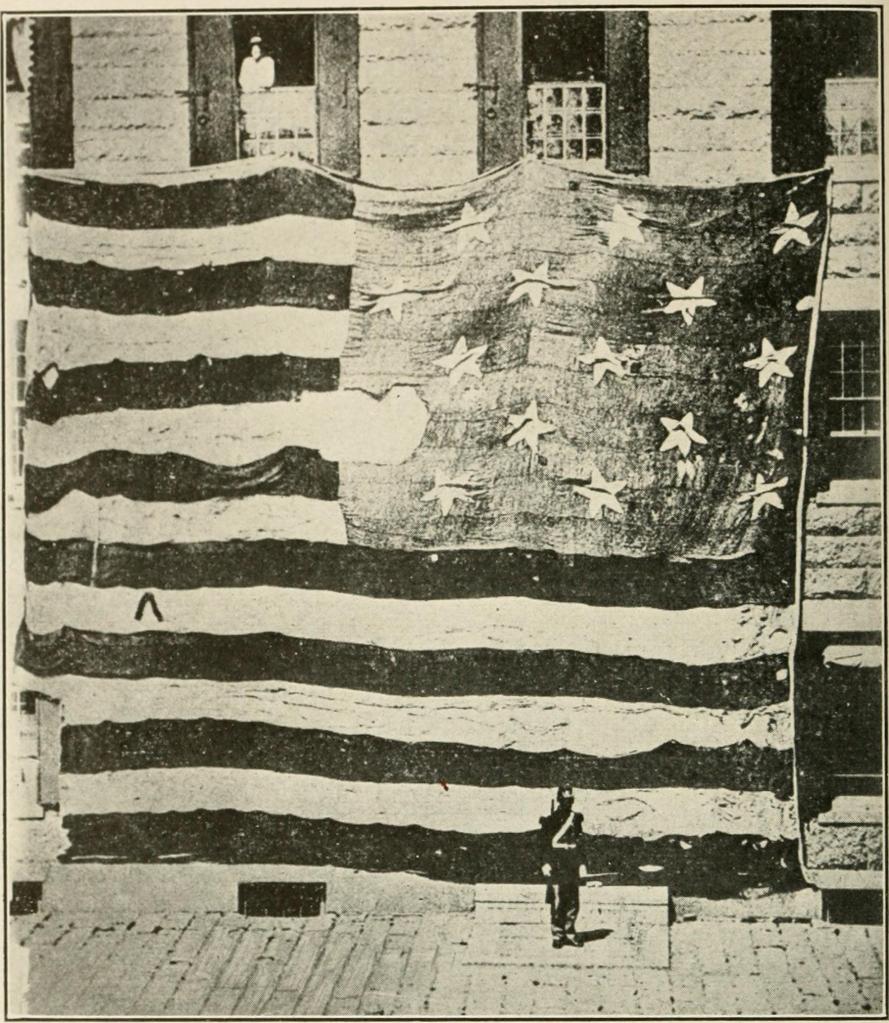
Like nearly everyone else in Baltimore, Fort McHenry commander Major George Armistead expected an attack, on the port city. Never one to run away from a fight Armistead wanted “a flag so large that the British will have no difficulty in seeing it from a distance.”
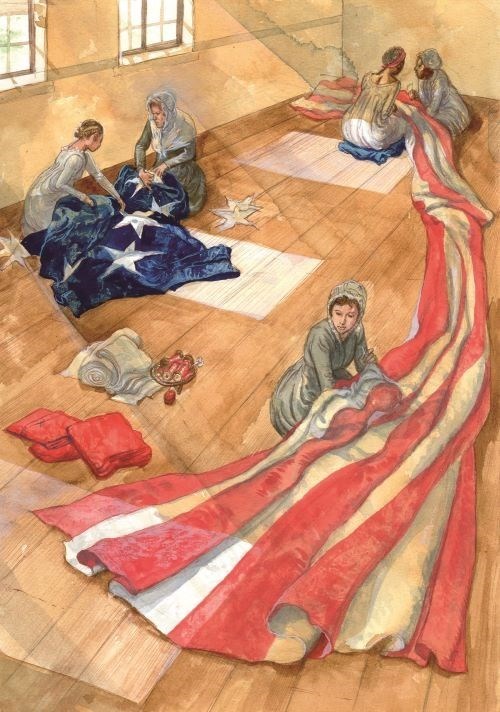
In July of 1813, Armistead ordered an enormous garrison flag measuring 30 x 42-feet and a smaller storm flag of 17 x 25 feet. The job went to a 37-year-old widow and seamstress named Mary Pickersgill.
Today the flag contains 50 stars, one for each state in the union and 13 stripes representing each of the original colonies. It was the practice in 1813 to add a star and a stripe for every state. In Mary’s time, there were 15 of each.
Using over 400 yards of hand-dyed fabric she fashioned white stars two feet across on a blue canton with stripes measuring two feet tall and assembled it all on the main floor, of a nearby brewery.
Such a project is beyond the abilities of a single seamstress. Mary enlisted the aid of her 13-year-old daughter Caroline, two nieces, 13-year-old Eliza Young and 15-year-old Margaret Young and a 13-year-old African-American girl named Grace Wisher indentured to her by her mother Jenny for a period of six years. Some sources report that Jenny Wisher, a free black woman, helped out.
Mary received $405.90 for the larger flag and $168.54 for the smaller. She was given 6 to 8 weeks in which to finish the commission, the largest one of her career. She completed the job in seven, delivering the two flags on August 19, 1813. Thirteen months later Mary Pickersgill, her flags and the team of women who helped her, took their place in American history.
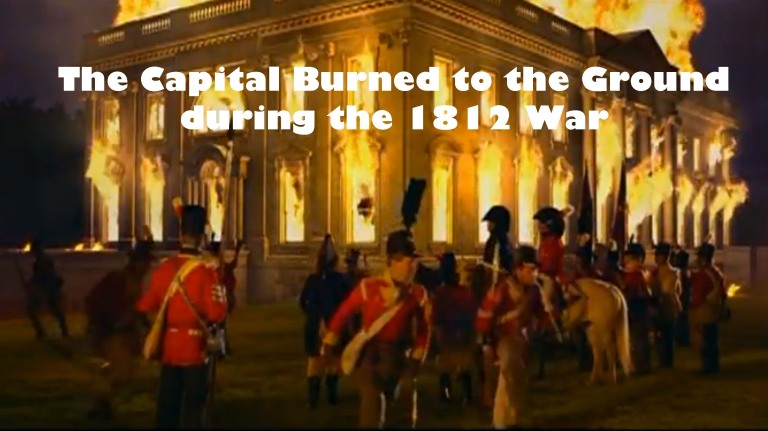
This most unpopular of wars became even more so, following the sack of Washington and burning of the United States Capitol and the White House, in August, 1814. Major General Robert Ross’ men were met on this occasion by an inexperienced and poorly equipped militia of some 6,000 American forces at Bladensburg, Maryland, whose comprehensive defeat and humiliating rout went into the history books as the “Bladensburg Races”.
A month later the force facing General Ross’ 4,700 troops landing at North Point were not that hastily assembled collection of Maryland and DC militia routed at Bladensburg, but a thoroughly prepared force led by Brigadier General John Stricker, dug in across a narrows bristling with small arms and a battery of six 4-pounder field guns and flanked by tidal creeks, all but nullifying the invaders’ numerical advantage.
General Ross himself was shot in the engagement and mortally wounded, leaving British forces in confusion as the Americans affected a strategic retreat. While a tactical victory for the British side, the delay bought the Americans precious time in which to strengthen the defense.
The following day British troops encountered a massive force of some 10,000 men and 100 cannon astride the Philadelphia Road blocking the advance, on Baltimore. Invading forces were at a two-to-one, disadvantage and in need of naval support to dislodge American ground forces. There would be no advance on Baltimore harbor while Fort McHenry, remained in American hands. Fort McHenry had to be taken.
A lawyer and amateur poet called Francis Scott Key was on-hand at the time, a prisoner exchange negotiator along with Colonel John Stuart Skinner, dining as guests aboard the HMS Tonnant. The two had an inside view of British naval capabilities in the harbor and were held, pending the outcome of the battle.
So it is this Baltimore lawyer had a front row seat, as that battered storm flag disappeared in the twilight’s last gleaming.
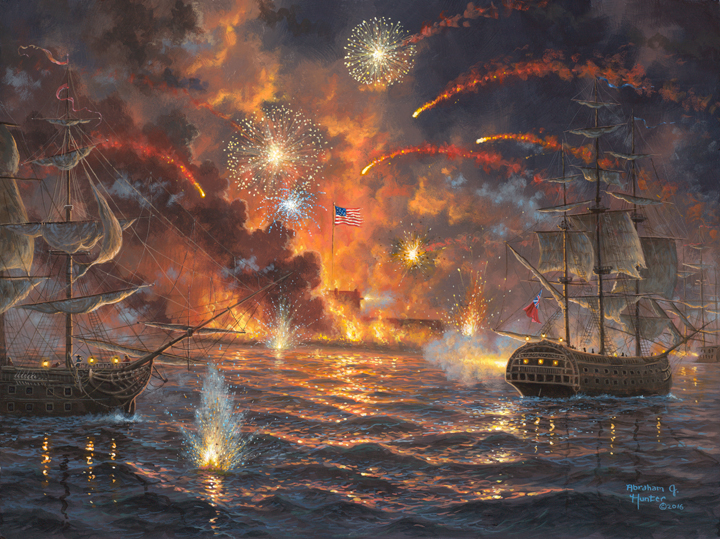
The naval bombardment taking place that night, is scarcely to be imagined. At first exchanging shot for shot with the garrison the warships soon pulled back, out of range of the fort’s guns. For 27 hours in a driving rain, nineteen warships pounded shot, shell and rocket by the thousands onto the 1,000-man garrison.
Sometime during the night that battered storm banner was taken down and replaced by the garrison flag. By the dawn’s early light of September 14 This was the banner, which now came into view. Nineteen warships had taken their best shot and yet, the garrison held. Key was so moved by the sight he dashed out a few lines on the back of an envelope. He called his poem, Defence of Fort M’Henry.
Without Fort McHenry in British hands there would be no occupation of Baltimore harbor, no assault upon the city. Colonel Arthur Brooke’s forces were withdrawn, by September 15. Vice Admiral Sir Alexander Cochrane sailed for New Orleans to regroup for the next, and last, battle of the War of 1812.
Over the years some 200 yards were removed in souvenir chunks from the “Great Garrison Flag reducing the banner from 30 x 42 to 30 x 34.
It was Key’s brother-in law Joseph H. Nicholson who first noticed the words fit nicely, with the popular melody of “The Anacreontic Song”. The Baltimore Patriot and The American printed the song on September 20 with the note “Tune: Anacreon in Heaven”. A short time later Thomas Carr of the Carr Music Store in Baltimore published words and music together under the title “The Star Spangled Banner”.
The song grew in popularity throughout the 19th century to be played at 4th of July celebrations, military ceremonies and other patriotic occasions. By World War 1 many of the more stridently anti-British verses had been removed from sheet music to avoid giving offense, to our British allies.
The anthem was played during the 7th inning stretch of game one of the 1918 World Series, believed to be the first time the song appeared, at a baseball game. Six legislative attempts came and went during the 1920s, to make Star Spangled Banner the national anthem of the United States. In the end a petition from the Veterans of Foreign Wars did the job. President Herbert Hoover signed the bill into law on March 4, 1931.
While all four verses are included according to United States code, the last three are all but unknown today and rarely sung, if at all.
Long may it wave.
O! say can you see, by the dawn’s early light, What so proudly we hail’d at the twilight’s last gleaming, Whose broad stripes and bright stars through the perilous fight, O’er the ramparts we watch’d, were so gallantly streaming? And the rockets’ red glare, the bombs bursting in air, Gave proof through the night that our flag was still there — O! say, does that star-spangled banner yet wave O’er the land of the free, and the home of the brave?
On the shore, dimly seen through the mists of the deep, Where the foe’s haughty host in dread silence reposes, What is that which the breeze o’er the towering steep, As it fitfully blows, half conceals, half discloses? Now it catches the gleam of the morning’s first beam, In full glory reflected now shines on the stream — ‘Tis the star-spangled banner, O! long may it wave O’er the land of the free, and the home of the brave.
And where is that band who so vauntingly swore That the havock of war and the battle’s confusion A home and a country should leave us no more? Their blood has wash’d out their foul foot-steps’ pollution, No refuge could save the hireling and slave, From the terror of flight or the gloom of the grave; And the star-spangled banner in triumph doth wave O’er the land of the free, and the home of the brave.
O! thus be it ever when freemen shall stand Between their lov’d home, and the war’s desolation, Blest with vict’ry and peace, may the heav’n-rescued land Praise the power that hath made and preserv’d us a nation! Then conquer we must, when our cause it is just, And this be our motto — “In God is our trust!” And the star-spangled banner in triumph shall wave O’er the land of the free, and the home of the brave.
It’s a new perspective on a now-familiar story, to think of the shock and the grief of those refugees from the killing fields of Pol Pot, on hearing the news that their friend and benefactor had been hijacked and murdered, his aircraft flown into a New York skyscraper.
At the turn of the 20th century, a great wave of immigrants came to the United States, 20 million Europeans and more making the long journey to become Americans.
Among those multitudes came the Ogonowski family, emigrating from Poland and making a new home in the Merrimack Valley of Massachusetts, along the New Hampshire line.
Those early members of the Ogonowski family received invaluable assistance from Yankee farmers, well accustomed to growing conditions in the harsh New England climate. Generations later, the family still tilled the soil of the 150-acre “White Gate Farm” in Dracut, Massachusetts.
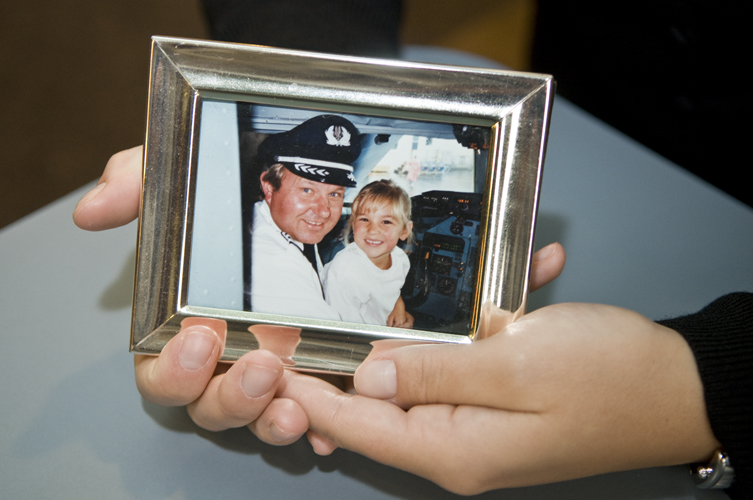
Graduating from UMass Lowell in 1972 with a degree in nuclear engineering, John Alexander Ogonowski joined the United States Air Force. During the war in Vietnam, this farmer-turned military pilot would ferry equipment from Charleston, South Carolina to Southeast Asia, often returning with the bodies of the fallen aboard that giant, C-141 transport aircraft.
Ogonowski left the Air Force with the rank of Captain, becoming a commercial pilot and joining American Airlines in 1978. There he met Margaret, a flight attendant, “Peggy” to friends and family. The two would later marry and raise a family of three daughters, Laura, Caroline, and Mary Catherine.
Twelve days a month, Ogonowski would leave the farm in his Captain’s uniform, flying jumbo jets out of Logan Airport. When he was finished , he would always return to the land he loved.
Family farming is not what it used to be, as suburban development and subdivisions creep into formerly open spaces. “When you plant a building on a field”, John would say, “it’s the last crop that will ever grow there”.
John Ogonowski helped to create the Dracut Land Trust in 1998, working to conserve the growing town’s agricultural heritage. He worked to bring more people into farming, as well. The bumper sticker on his truck read “There is no farming without farmers”.
That was the year the farm Service Agency in Westford came looking for open agricultural land, for Cambodian immigrants from Lowell.
“This is what he was all about. He flew airplanes, he loved flying, and that provided all the money, but this is what he lived for. He was a very lucky man, he had both a vocation and an avocation and he loved them both”. – Margaret “Peggy” Ogonowski
It was a natural fit. Ogonowski felt a connection with these people, based on his time in Southeast Asia. He would help them, here putting up a shed, there getting a greenhouse in order or putting up irrigation. He would help these immigrants, just as those Yankee farmers of long ago, had helped his ancestors.
Cambodian farmers learned to grow their native vegetables in an unfamiliar climate. They would lease small plots growing water spinach, lemon grass, pigweed, Asian basil, and Asian squash. They raised taro and Laotian mint, coconut amaranth, pickling spices, pea tendrils and more. It was the food they grew up with, the food they knew. They would sell their produce into nearby immigrant communities, and to the high-end restaurants of Boston.
The program was a great success. Ogonowski told The Boston Globe in 1999, “These guys are putting more care and attention into their one acre than most Yankee farmers put into their entire 100 acres.”
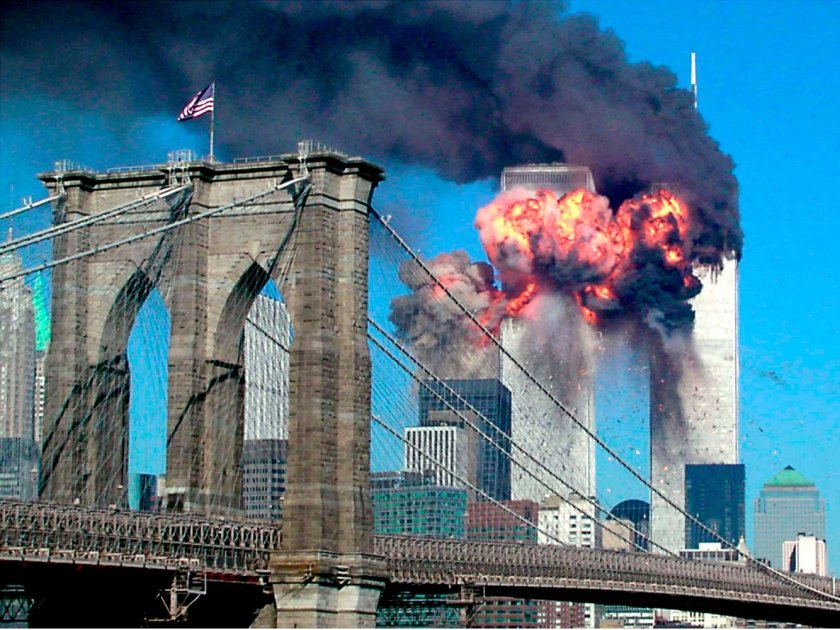
So it was that, with the fall harvest of 2001, Cambodian immigrants found themselves among the pumpkins and the hay of a New England farm, putting on a special lunch spread for visiting agricultural officials from Washington, DC. It was September 11.
By now you know that John Ogonowski was flying that day, Senior Captain on American Airlines flight 11. He may have been the first to die, attacked from behind and murdered in his cockpit by terrorist savages.
It’s a new perspective on a now-familiar story, to think of the shock and the grief of those refugees from the killing fields of Pol Pot, on hearing the news that their friend and benefactor had been hijacked and murdered, his aircraft flown into a New York skyscraper.
The White Gate Farm was closed for a week, but the Ogonowski family was determined. John’s dream would not die. Peg said it best: “This is what he was all about. He flew airplanes, he loved flying, and that provided all the money, but this is what he lived for. He was a very lucky man, he had both a vocation and an avocation and he loved them both.”
John Ogonowski was working with the Land Trust at the time of his death, in an effort to raise $760,000 to purchase a 34-acre farm in Dracut, slated for development. Federal funds were raised with help from two members of Congress. The “Captain John Ogonowski Memorial Preservation Farmland” project was dedicated in 2003. A living memorial to one day that changed the world. And to John Alexander Ogonowski. Pilot. Farmer. Fallen angel.
Loyalty
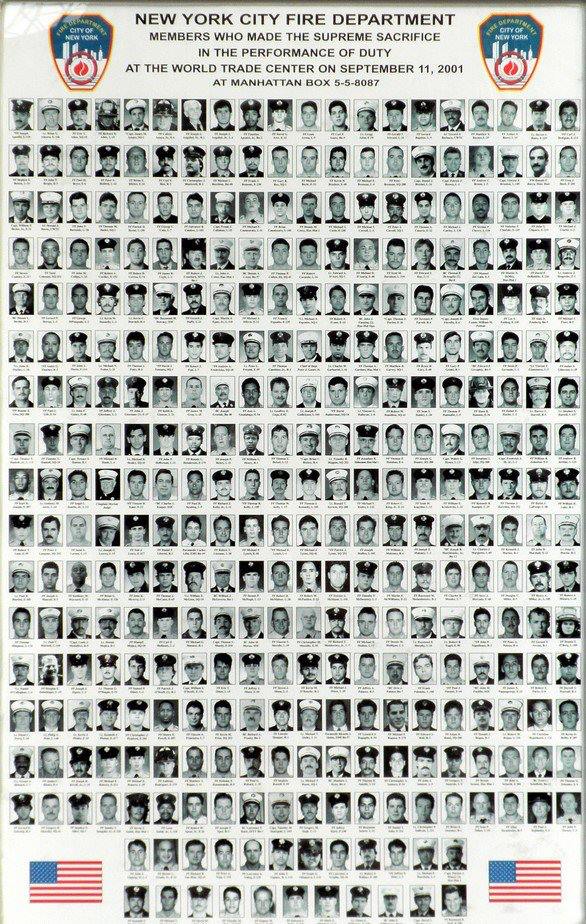
Another tale to emerge from that awful day concerns one of the many first responders who rushed to the inferno, and never returned. This was one of the lucky ones, in a way. This firefighters family had a body to mourn over.
The night before the funeral, the firefighters wife and his buddies “stole“ the body, casket and all, with the connivance of the folks at the funeral home. They brought him to the beach where they spent that last night with a case of beer, laughing together, crying and sharing stories. The next morning, they brought him back to the funeral home as promised, and their loved one was buried with honors.
I don’t know the name of this man or that if his wife, but that part matters more to those precious few. For the rest of us, this is a story of a short life well lived, a story of love and friendship and loyalty. May we all be so fortunate, as to be blessed with friends such as these.
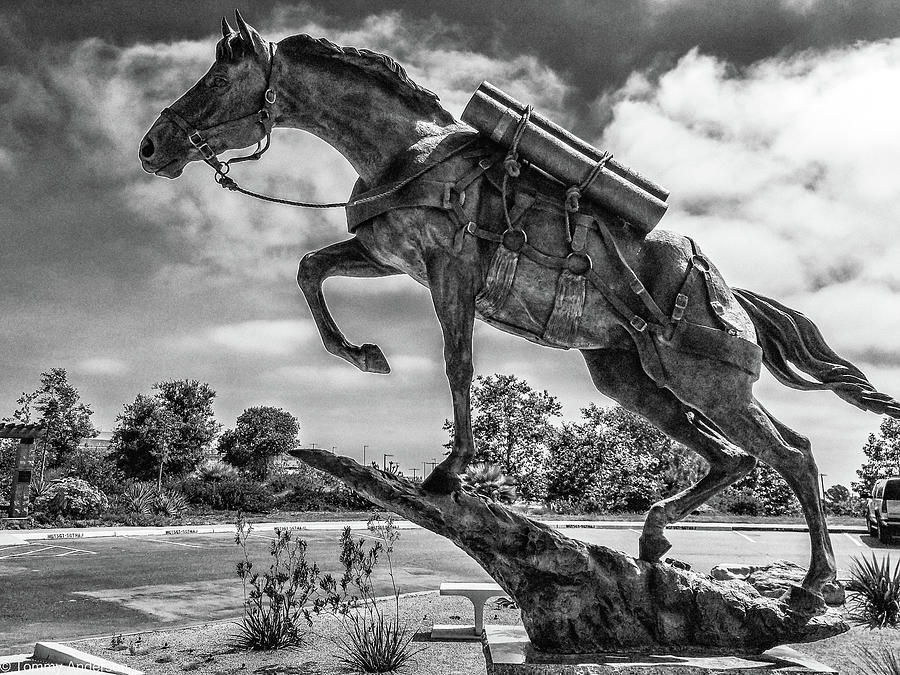
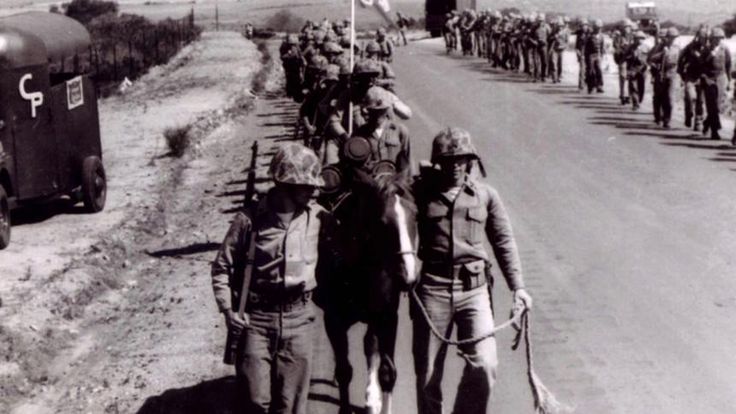
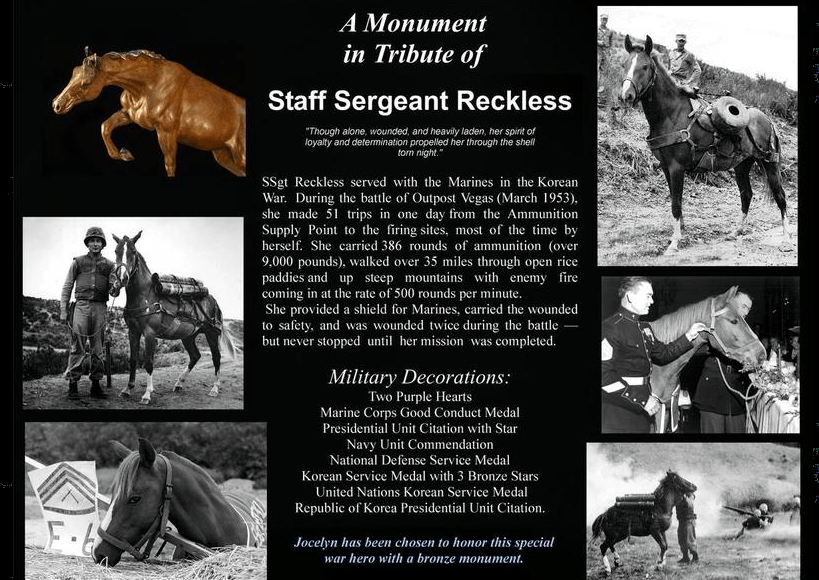
Reckless was the first horse in Marine Corps history to participate in an amphibious landing. She was wounded twice, and later awarded two Purple Hearts and a Marine Corps Good Conduct Medal. Her name appears on Presidential Unit citations both from the United States and the Republic of Korea.
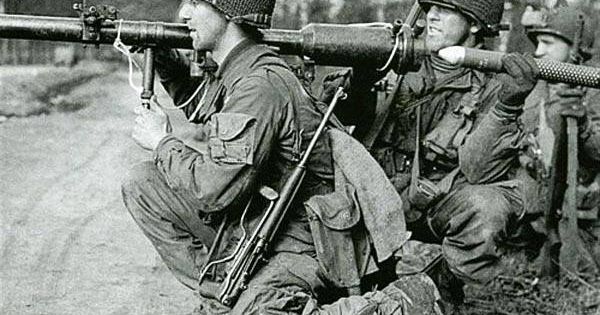
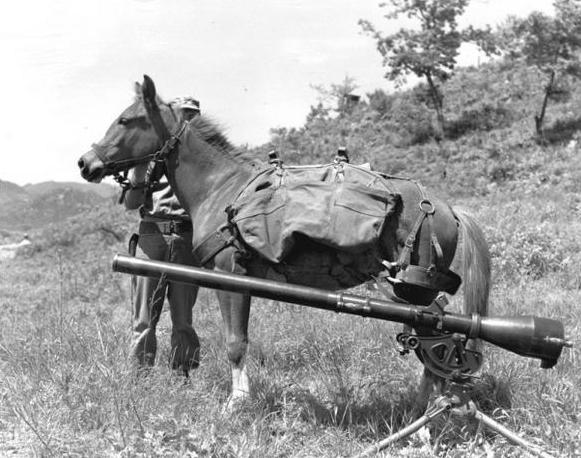
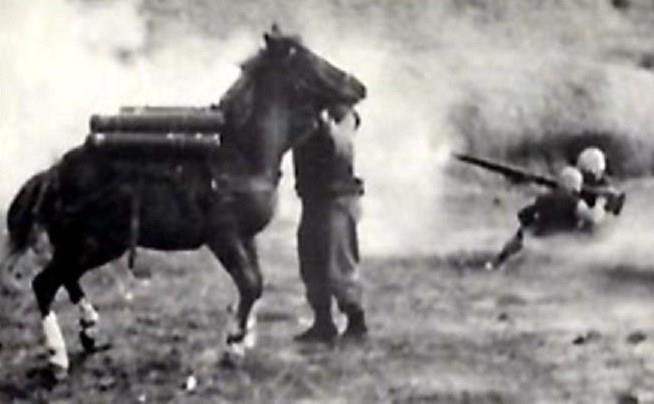
A Recoilless Rifle is a type of lightweight tube artillery. Think of a portable cannon. Kind of a bazooka, really, only the Recoilless fires modified shells rather than rockets. The back blast of the shell compensates for the mule’s kick which would otherwise be expected from such a weapon, making the rifle “recoilless”.
While it reduces projectile range, reduced gas pressures permit a thinner-walled barrel, resulting in a weapon light enough to be served by a 2 to 3-man crew and shoulder fired by a single infantryman.
The “RCLR” weapon system has provided the punch of artillery to mobile troop formations since the early days of WWII including Airborne, Special Forces and Mountain units.
The problem arises when combat operations consume ammunition faster than the supply chain can replace it. Mountainous terrain makes the situation worse. Over the last 20 years in the more mountainous regions of Afghanistan, there were times when the best solution for the problem, is horsepower.
Ah Chim-hai was a chestnut mare of mixed Mongolian and Thoroughbred lineage, a race horse at the track in Seoul, South Korea. Her name translated as “Flame of the Morning”.
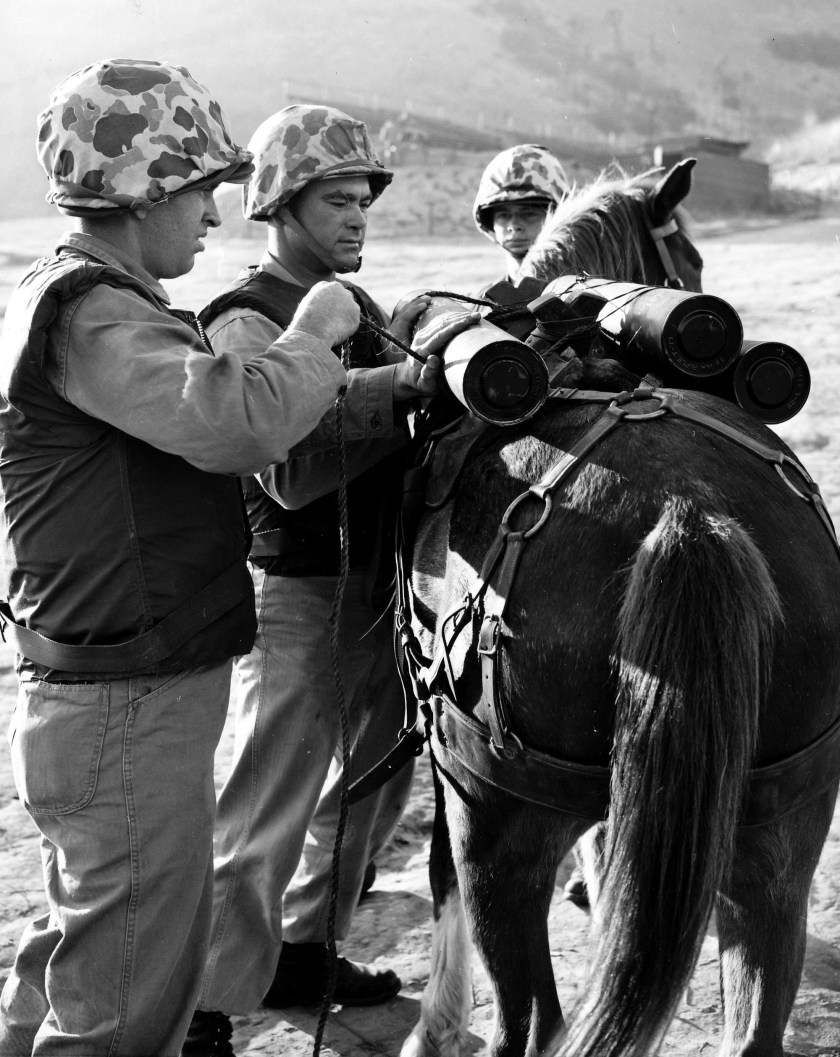
Lieutenant Eric Pedersen of the recoilless rifle platoon, anti-tank company of the 5th Marine Regiment, needed a pack animal to carry the weapon’s 24-pound shells up Korean mountain passes. In October 1952, Pederson received permission from regimental commander Colonel Eustace P. Smoak, to buy a horse for his platoon.
Lt. Pederson and stable boy Kim Huk-moon agreed on a price of $250, and Pederson paid with his own money. Kim cried on watching his “Flame” leave the stable, but the sale had a higher purpose. The boy’s sister had stepped on a land mine, and badly needed a prosthetic leg.
The Marines called the new recruit “Reckless” – a nod to the weapon system she was meant to serve, and to the fighting spirit of the 5th Marines.
Pederson wrote to his wife in California to send a pack saddle, while Gunnery Sergeant Joseph Latham and Private First Class Monroe Coleman provided for her care and training.
Navy Hospitalman First Class George “Doc” Mitchell provided most of Reckless’ medical care, Latham taught her battlefield skills: how to step over communication wires, when to lie down under fire, how to avoid becoming entangled in barbed wire. She learned to run for cover at the cry “Incoming!”
The platoon built her a bunker and fenced off a pasture, but soon Reckless was allowed to roam freely throughout the camp. She’d enter tents at will, sometimes spending the night if it was cold.
She’d eat anything: bacon, mashed potatoes, shredded wheat. She loved scrambled eggs and just about anything else a Marine wasn’t watching closely enough. Reckless even ate her own horse blanket once, and she loved a to have a beer. Mitchell had to warn his fellow Marines against giving her more than two Cokes a day, which she’d drink out of a helmet. One time, Reckless ate $30 worth of winning poker chips.
General Randolph McCall Pate, a veteran of Guadalcanal, Iwo Jima and Korea, served as the 21st Commandant of the Marine Corps from 1956 – ’59. Pate wrote: “I was surprised at her beauty and intelligence, and believe it or not, her esprit de corps. Like any other Marine, she was enjoying a bottle of beer with her comrades. She was constantly the center of attraction and was fully aware of her importance. If she failed to receive the attention she felt her due, she would deliberately walk into a group of Marines and, in effect, enter the conversation. It was obvious the Marines loved her.” Reckless was a Marine.
Reckless “went straight up” the first time she heard an RCLR go off, despite being loaded down with six shells. All four feet left the ground and she came down trembling with fear, but Coleman was able to soothe her. The second time she snorted. By the fourth she didn’t do much as bother to look up, happily munching on a discarded helmet liner.
Recoilless rifle tactics call for fire teams to expend four or five rounds, and then relocate before the enemy can shoot back. Reckless usually learned the route after one or two trips, often traveling alone to deliver supplies on the way up, and evacuate wounded on the way down.
In February 1953, Captain Dick Kurth and his Fox Company were fighting for a hill called “Detroit”. Reckless made 24 trips by herself, carrying a total 3,500-pounds of ammunition over 20 miles. She made 51 solo trips that March, during the battle for Outpost Vegas. Reckless carried 9,000lbs of ammunition in a single day, over 35 miles of open rice paddies and steep hills. At times, artillery exploded around her at the rate of 500 rounds per minute. That night, she was too exhausted to do anything but hang her head while they rubbed her down.
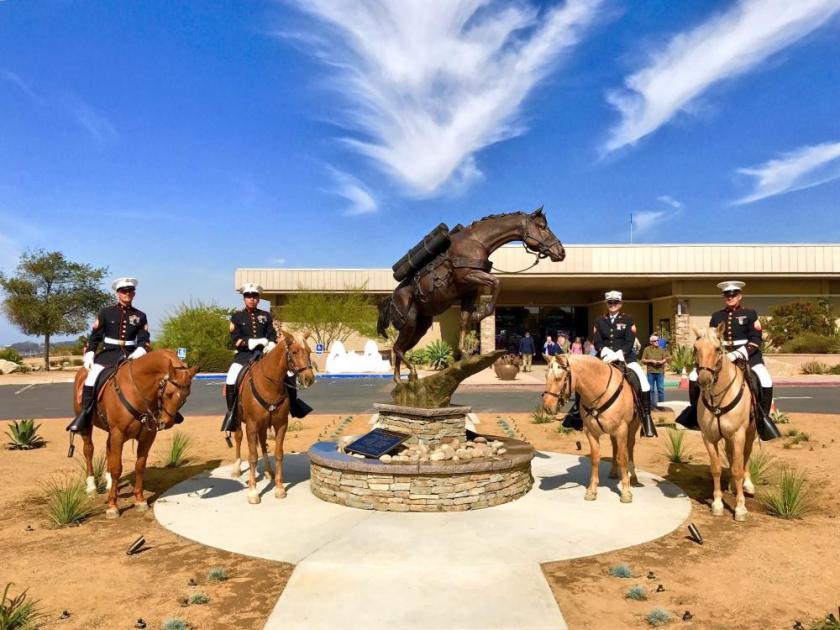
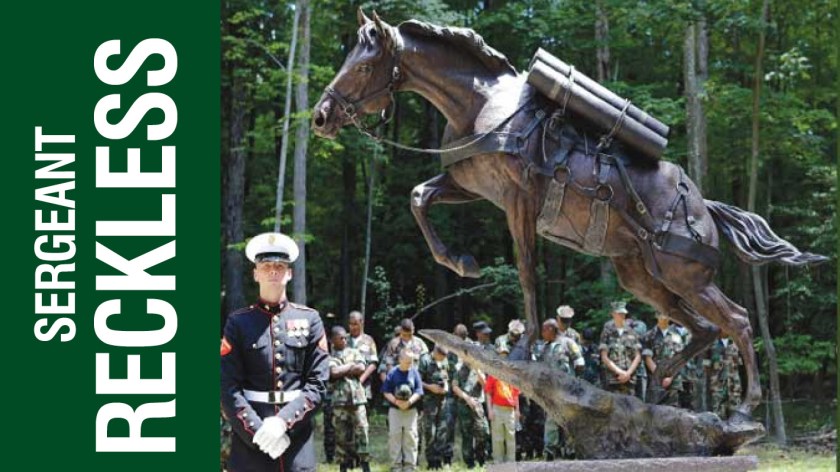
Reckless was the first horse in Marine Corps history to participate in an amphibious landing. She was wounded twice, and later awarded two Purple Hearts and a Marine Corps Good Conduct Medal. Her name appears on Presidential Unit citations both from the United States and the Republic of Korea.
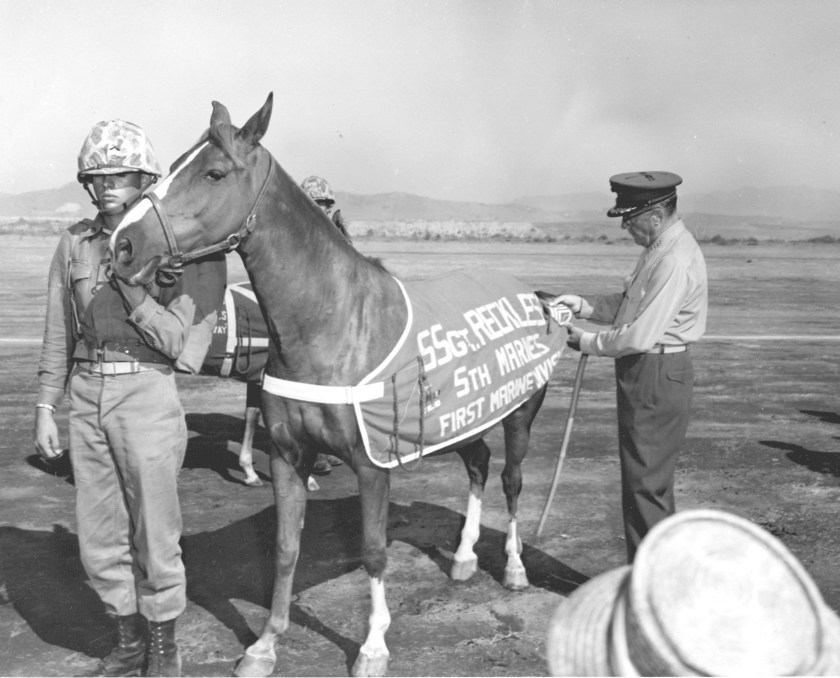
On August 31, 1959, Reckless was promoted to Staff Sergeant in a ceremony at Camp Pendleton. 1,900 of her 5th Marine comrades attended, as did two of her sons, “Fearless” and “Dauntless”. A third, “Chesty”, was unavailable to attend.
General Pate wrote: “In my career I have seen many animals that have been adopted by Marines, but never in all my experience have I seen one which won the hearts of so many as did. . .Reckless.”
Life Magazine published a collector’s edition in 1997, listing 100 heroes from American history. Alongside the names of George Washington and Thomas Jefferson, Sally Ride and Abraham Lincoln, was that of a small Mongolian horse. Sergeant Reckless.
The astonishing part of this story is it all took place in the midst of a plague vastly more deadly than the COVID-19 pandemic, of our own age.
When George Washington raised his swordunder the branches of that ancient elm on Cambridge commons, by that act did the General take command of an “army” equipped with an average of nine rounds, per man.
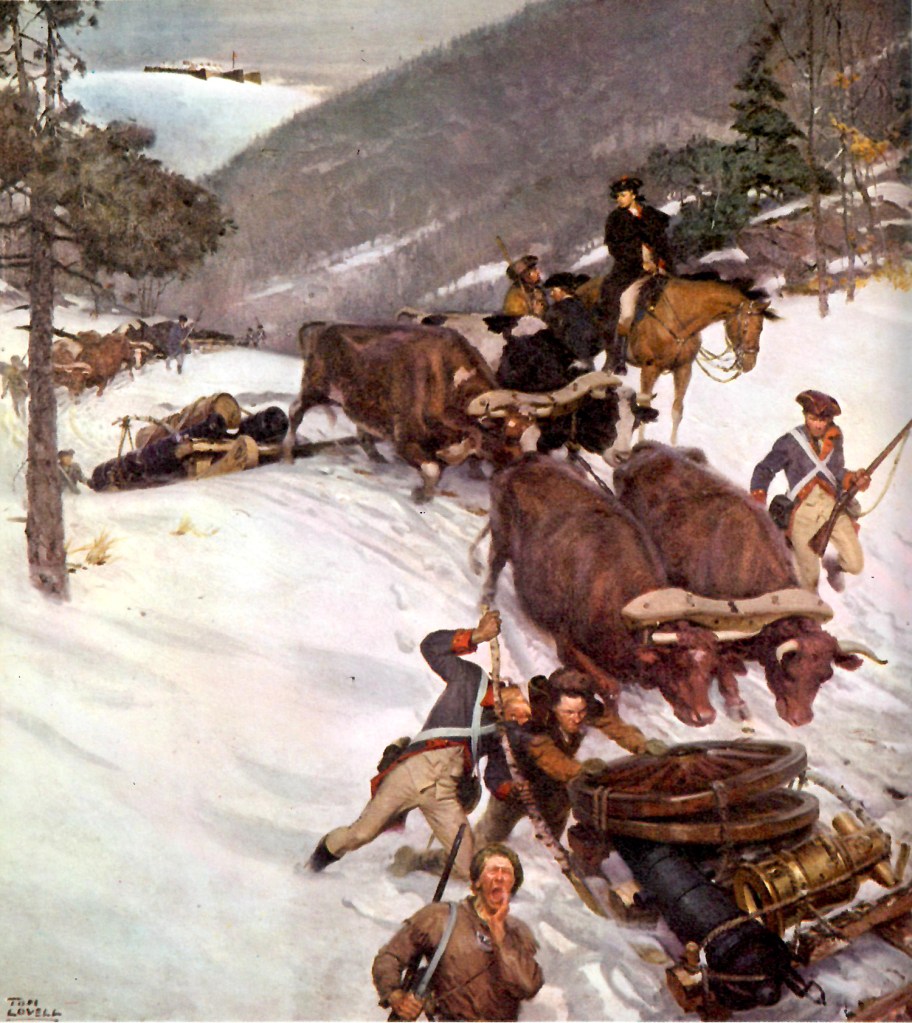
1776 started out well for the cause of American independence, when the twenty-six-year-old bookseller Henry Knox emerged from a six week slog through a New England winter, at the head of a “Noble train of artillery’. Manhandled all the way from the wilds of upstate New York, the guns of Fort Ticonderoga were wrestled to the top of Dorchester Heights, overlooking the British fleet anchored in Boston Harbor. General sir William Howe now faced the prospect of another Bunker Hill, a British victory which had come at a cost he could ill afford, to pay again.
The eleven-month siege of Boston came to an end on March 17 when Howe’s fleet evacuatedBoston Harbor and removed, to Nova Scotia. Three months later, a force of some 400 South Carolina patriots fought a day-long battle with the nine warships of Admiral Sir Peter Parker, before the heavily damaged fleet was forced to withdraw. The British eventually captured Fort Moultrie and Charleston Harbor with it but, for now, 1776 was shaping up to be a very good year.
Tory and Patriot alike understood the strategic importance of New York, as the center of communication between the upper and lower colonies. Beginning that April, Washington moved his forces from Boston to New York placing his troops along the west end of Long Island, in anticipation of the British return.
The fleet was not long in coming, the first arrivals dropping anchor by the end of June. Within the week, 130 ships were anchored off Staten Island under the command of Admiral sir Richard Howe, the General’s brother.
The Howe brothers attempted to negotiate on July 14 with a letter to General Washington, addressed: “Georg Washington, Esq.” The letter was returned unopened by Washington’s aide Joseph Reed who explained there’s nobody over here, by that address. Again the letter came back addressed to “George Washington, Esq., etc.,” the etc. meaning… “and any other relevant titles.” That letter too came back unopened but this time, with a message. The general would meet with one of Howe’s subordinates. The meeting took place on July 20 when Howe’s representative offered pardon, for the American side. General Washington responded as they had done nothing wrong his side had no need, of any pardons. But thanks anyway.
By August 12 the British force numbered some 400 vessels with 73 warships and a force of 32,000 camped on Staten island.
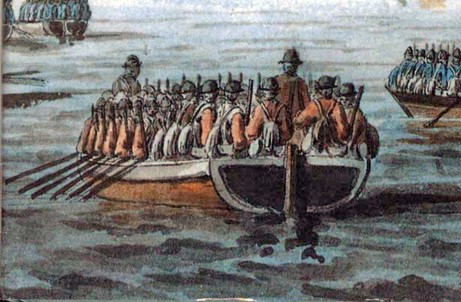
“British troops in the type of flat-bottomed boat used for the invasion of Long Island. Hessians in their blue uniforms are in the two boats that are only partly visible”. H/T Wikipedia
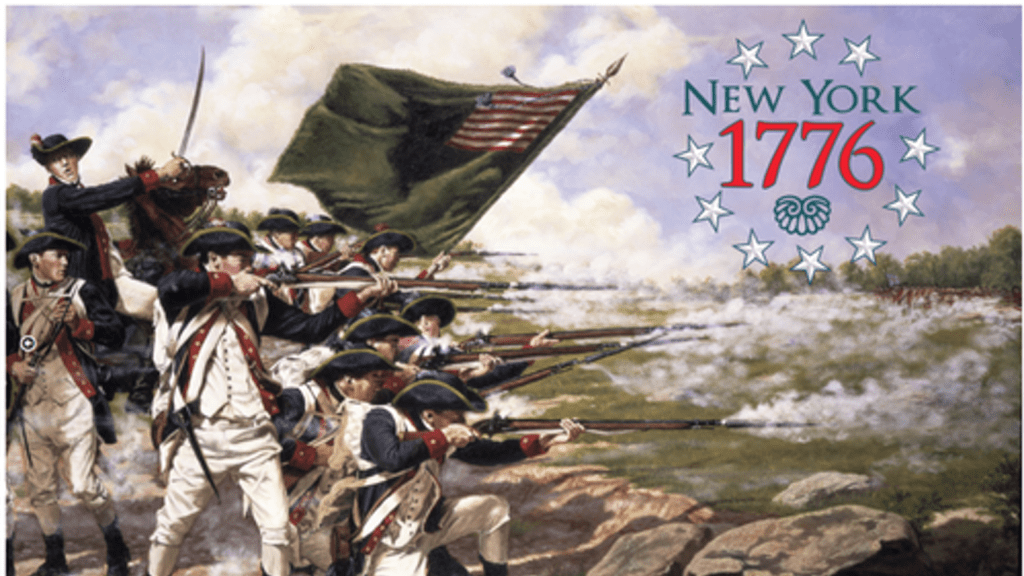
Patriot forces were badly defeated at the Battle of Brooklyn, fought on August 27, 1776. In terms of number of troops deployed and actual combat it was the largest battle, of the Revolution. The British dug in for a siege, confident their adversary was cornered and waiting only to be destroyed at their convenience while the main Patriot army retreated to Brooklyn Heights.
Cornered on land with the British-controlled East River to their backs, it may have been all over for the Patriot cause, but for one of the great tactical feats of all military history. The surprise was complete for the British side, on waking for the morning of August 30 to discover the 9,000-strong Patriot army, had vanished. The silent evacuation over the night of August 29-30 had averted disaster, a feat made possible only through the nautical skills of the merchants and rum traders, the sailors and the fishermen of Colonel John Glover’s Marblehead Massachusetts militia, the “Amphibious Regiment”.
Following evacuation, the Patriot army found itself isolated on Manhattan island, virtually surrounded. Only the thoroughly disagreeable current conditions of the Throg’s Neck-Hell’s Gate segment of the East River, prevented Admiral Sir Richard Howe from enveloping Washington’s position, altogether.
Desperate for information about the attack he was sure would come Washington dispatched a 22-year old Connecticut schoolteacher named Nathan Hale on September 10, to keep an eye on British movements. Disguised as a Dutch schoolteacher, Hale naïvely placed his trust, where it didn’t belong. He was betrayed in just over a week.
As expected, Howe landed a force at Kip’s Bay on September 15 and the Redcoats quickly occupied the city. Patriots delivered an unexpected check the following day at Harlem Heights against an overconfident force of British light troops. It was to be the only such bright spot for the Americans who were now driven out of New York and into New Jersey and finally, to Pennsylvania.
A great fire broke out on the 21st that destroyed as much as a quarter of all the buildings on Manhattan Island. Both sides pointed the finger of blame at the other but the cause, was never determined. Nathan Hale was hanged for a spy the following day with the words, ‘I only regret, that I have but one life to lose for my country‘.
That October, the defeat of General Benedict Arnold’s home-grown “Navy” on the waters near Valcour Island in Vermont, cost the British fleet dearly enough that it had to turn back, buying another year for the Patriot cause.
Reduced to a mere 4,707 fit for duty, Washington faced the decimation of his army by the New Year, with the end of enlistment for fully two-thirds of an already puny force. With nowhere to go but the offense, Washington crossed the Delaware river in the teeth of a straight-up gale over the night of December 25 and defeated a Hessian garrison at Trentonin a surprise attack on the morning of December 26.
While minor skirmishes by British standards, the January 2-3 American victories at Assunpink Creek and Princeton demonstrated an American willingness, to stand up to the most powerful military of the age. Cornwallis suffered three defeats in a ten day period and withdrew his forces from the south of New Jersey. American morale soared as enlistments, came flooding in.
The American war for independence had years to go. Before it was over, more Americans would die in the fetid holds of British prison ships than in every battle of the Revolution, combined. Yet, that first year had come and gone and the former colonies, were still in the fight.
The astonishing part of this story is it all took place in the midst of a plague vastly more deadly than the COVID-19 pandemic, of our own age. Of 2,780,369 counted by the 1770 census* in this country no fewer than 130,000 died in the smallpox pandemic of 1775-1782. That works out to 4,815 per 100,000. Contrast that with a Coronavirus death rate of 194.14 per 100,000 according to Johns Hopkins University a death rate, of less than .2% *This figure does not include Native Americans who were not counted in the US census, until 1860.
A generation later and an ocean away, Lord Arthur Wellesley described the final defeat of a certain Corsican corporal at a place called Waterloo. Wellesley might have been talking about the whole year of 1776 in describing that day in 1815, when he said “It was a damn close run thing”.
Feature image, top of page: Battle of Long Island, by Alonzo Chappel.
Once hopelessly caught in arctic ice the British vessel HMS Resolute was returned to her majesty Queen Victoria’s government and now serves as a desk for virtually every US President from Rutherford B. Hayes, to Joseph R. Biden.
Since the time of Columbus, European explorers have searched for a navigable shortcut by open water, from Europe to Asia. The “Corps of Discovery“ better known as the Lewis and Clark expedition, departed the Indiana Territory in 1804 with, among other purposes, the intention of finding a water route to the Pacific.
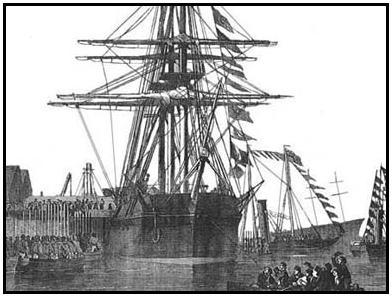
Forty years later, Captain sir John Franklin departed England aboard two ships, HMS Erebus and HMS Terror, to discover the mythical Northwest Passage.
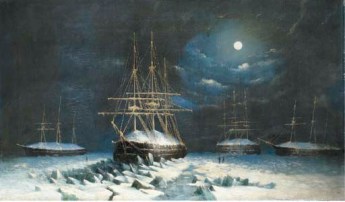
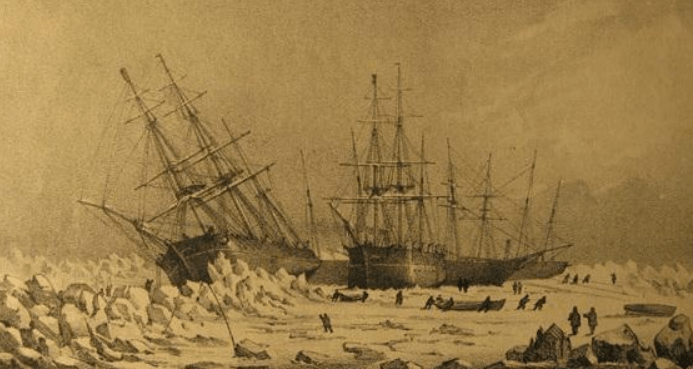
The two vessels became icebound in Victoria Strait near King William Island, in the Canadian Arctic.
Prodded by Lady Jane Franklin, the hunt for her husband’s expedition would continue for years, at one time involving as any as eleven British and two American ships. Clues were found including notes and isolated graves, telling the story of a long and fruitless effort to stay alive in a hostile climate. The wreck of HMS Erebus would not be discovered until 2014, her sister ship, two years later.
In 1848, the British Admiralty possessed few hulls suitable for arctic service. Two civilian steamships were purchased and converted to exploration vessels: HMS Pioneer and HMS Intrepid, along with four seagoing sailing vessels, Resolute, Assistance, Enterprise and Investigator.
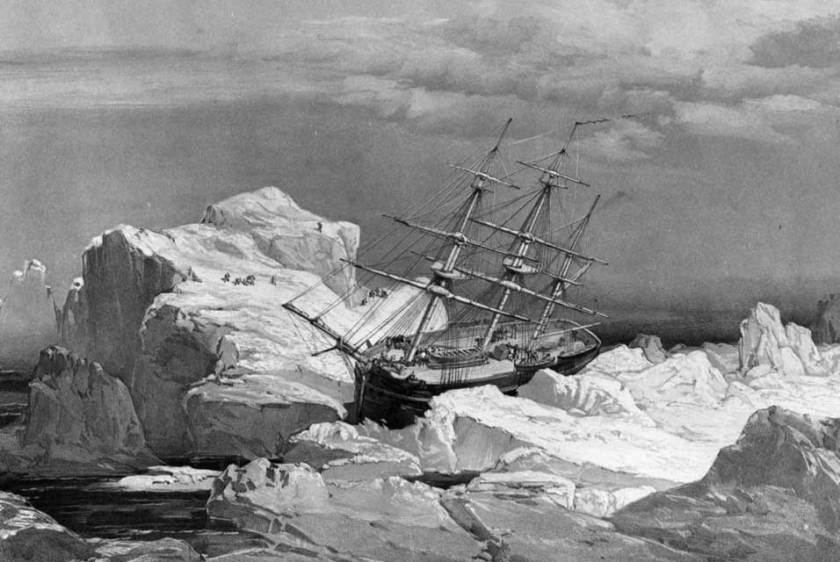
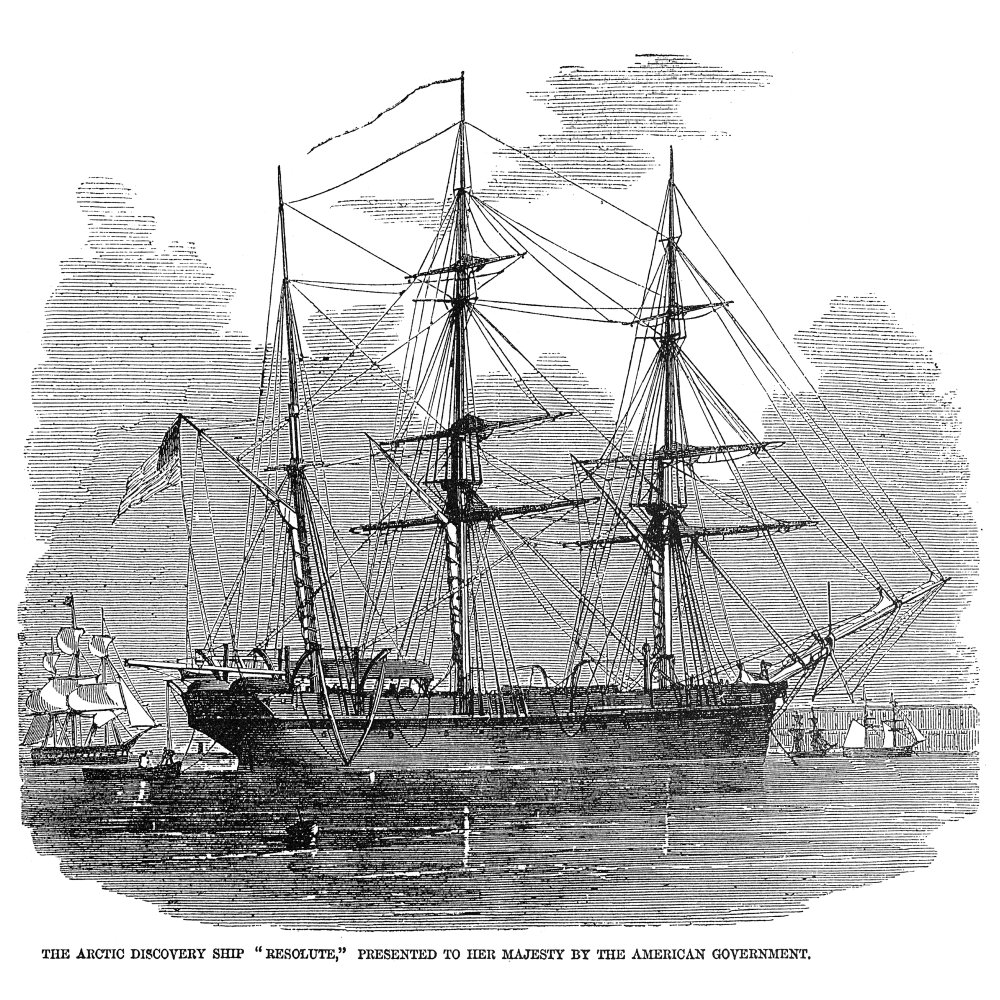
HMS Resolute was a Barque rigged merchant ship, purchased in 1850 as the Ptarmigan and refitted for Arctic exploration. Renamed Resolute, the vessel became part of a five ship squadron leaving England in April 1852, sailing into the Canadian arctic in search of the doomed Franklin expedition.
Neither Franklin nor any of his 128 officers and men would ever return alive. What HMS Resolute Did find was the long suffering crew of the HMS Investigator, hopelessly encased in ice where, three years earlier, she too had been searching for the lost expedition.
Three of the Resolute expedition’s ships themselves became trapped in floe ice in August 1853 including Resolute, herself. There was no choice but to abandon ship, striking out across the ice pack in search of their supply ships. Most of them made it despite egregious hardship, straggling into Beechey Island in the Canadian Arctic Archipelago, between May and August, of the following year.
The expedition’s survivors left Beechey Island on August 29, 1854, never to return. Meanwhile Resolute, alone and abandoned among the ice floes, continued to drift eastward at a rate of 1½ nautical miles per day.
The American whale ship George Henry discovered the drifting Resolute on September 10, 1855, 1,200 miles from her last known position. Captain James Buddington split his crew, half of them now manning the abandoned ship. Fourteen of them sailed Resolute back to their base in Groton CT, arriving on Christmas eve.
The so-called ‘Pig and Potato War” of 1859 was resolved between the British and American governments with the loss of no more than a single hog, yet a number of border disputes made the late 1850s a difficult time, for American-British relations. Senator James Mason of Virginia presented a bill in Congress to fix up the Resolute and give her back to her Majesty Queen Victoria’s government, as a token of friendship between the two nations.
$40,000 were spent on the refit. Resolute sailed for England later that year. Commander Henry J. Hartstene presented the vessel to Queen Victoria on December 13. HMS Resolute served in the British navy until being retired and broken up in 1879. The British government ordered two desks to be fashioned from the English oak of the ship’s timbers, the work being done by the skilled cabinet makers of the Chatham dockyards.
In 1880, the British government presented President Rutherford B. Hayes the gift, of a large partner’s desk. A token of gratitude for the return of the HMS Resolute, 24 years earlier.
The desk, known as the Resolute Desk, has been used by nearly every American President from that day, to this. Every president from Hayes through Hoover used the desk either in the White House Green Room, the president’s study or working office. FDR moved the desk into the oval office where he had a panel installed in the opening, as he was self conscious about his leg braces.
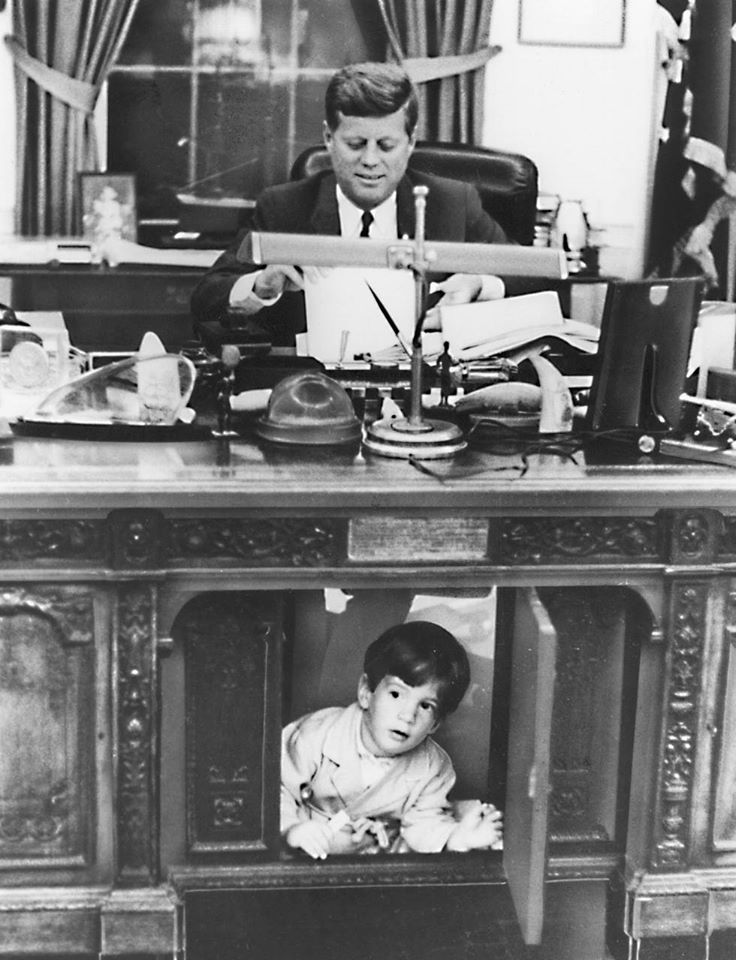
There was a brief period of climate controlled storage during the Truman era as the White House went through major renovation. It was Jackie Kennedy who brought the desk back, into the Oval Office. There are pictures of JFK working at the desk while a young JFK, Jr., played underneath.
Stanley Tretick’s October 2, 1963 photo of John F. Kennedy Jr. playing in the kneehole of the Resolute desk
Presidents Johnson, Nixon and Ford were the only ones not to use the Resolute desk, as LBJ allowed it to leave the White House following the Kennedy assassination.
The Resolute Desk spent several years in the Kennedy Library and later the Smithsonian Institute, the only other time the desk has been out of the White House.
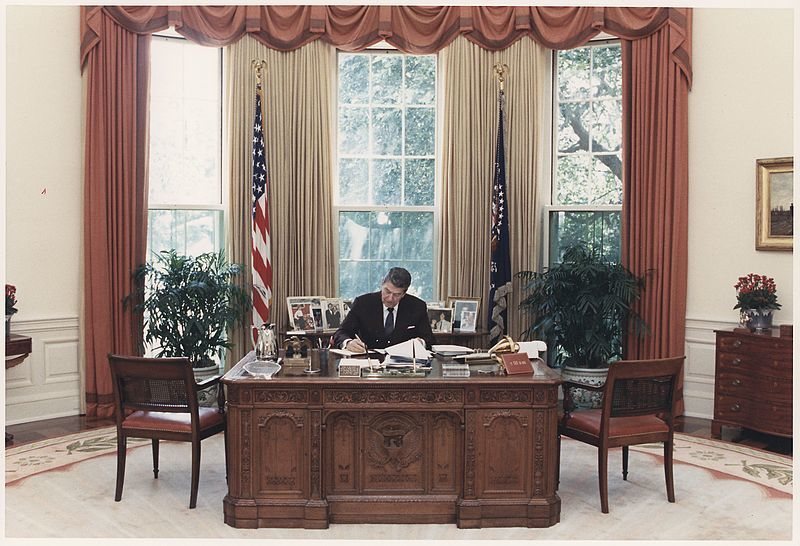
Jimmy Carter returned the desk to the Oval Office where it has remained through the Presidencies of Ronald Reagan, George H.W. Bush, Bill Clinton, George W. Bush, Barack Obama, Donald J. Trump and, as of this article, Joe Biden.




 Even at the Constitutional Convention, delegates expressed concerns about the larger, more populous states holding sway, at the expense of the smaller states. The “Connecticut Compromise” solved the problem, creating a bicameral legislature with proportional representation in the lower house (House of Representatives) and equal representation of the states themselves in the upper house (Senate).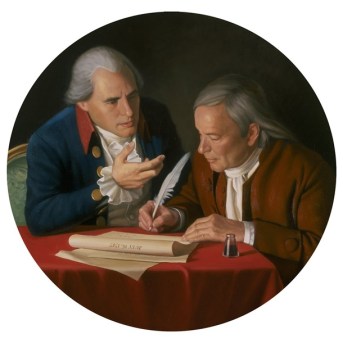

















 Historical Easter Eggs - Today in History
You must be logged in to post a comment.