November 12, 1912 An Awful Place

You can almost feel his frozen, dying fingers in the words on that final page, written back on March 29.

“Last entry. For God’s sake look after our people”.

Roald Amundsen

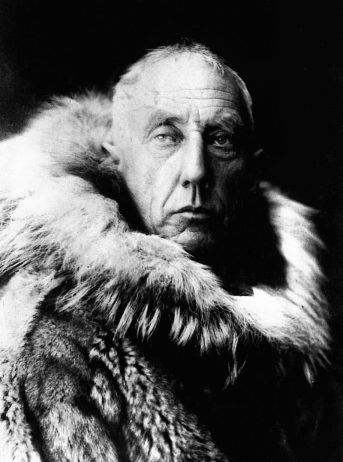
As long as he could remember, Roald Amundsen wanted to be an explorer.  As a boy in Norway, he would read about the doomed Franklin Expedition to the Arctic, in 1848.  As a sixteen-year-old, Amundsen was captivated by Fridtjof Nansen’s epic crossing of Greenland, in 1888.

The period would come to be known as the “Heroic Age” of polar exploration.  Roald Amundsen was born to take part.

Not so, Robert Falcon Scott.   A career officer with the British Royal Navy, Scott would take a different path to this story.

Clements Markham, President of the British Royal Geographical Society (RGS), was known to “collect” promising young naval officers with an eye toward future polar exploration.  The two first met on March 1, 1887, when the eighteen-year old midshipman’s cutter won a sailing race, across St. Kitt’s Bay.

In 1894, Scott’s father John made a disastrous mistake, selling the family brewery and investing the proceeds, badly.  The elder Scott’s death of heart disease three years later brought on fresh family crisis, leaving John’s widow Hannah and her two unmarried daughters, dependent on Robert and his younger brother, Archie.

Now more than ever, Scott was eager to distinguish himself with an eye toward promotion, and the increase in income to be expected, with it.
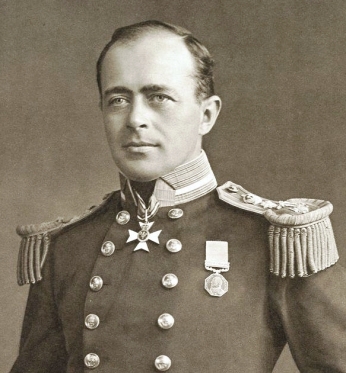
RobertFalconScott.jpg

In the Royal Navy, limited opportunities for career advancement were aggressively sought after, by any number of ambitious officers.  Home on leave in 1899, Scott chanced once again to meet the now-knighted “Sir” Clements Markham, and learned of an impending RGS expedition to the Antarctic, aboard the barque-rigged auxiliary steamship, RRS Discovery

What passed between the two went unrecorded but, a few days later, Scott showed up at the Markham residence and volunteered to lead the expedition.

The Discovery expedition of 1901-’04 was one of science as well as exploration.  Despite a combined polar experience of near-zero, the fifty officers and men under Robert Falcon Scott made a number of important biological, zoological and geological findings, proving the world’s southernmost continent was at one time, forested.  Though later criticized as clumsy and amateurish, a journey south in the direction of the pole discovered the polar plateau, establishing the southernmost record for this time at 82° 17′ S. Only 530 miles short of the pole.

Discovery returned in September 1904, the expedition hailed by one writer as “one of the great polar journeys”, of its time.  Once an obscure naval officer, Scott now entered Edwardian society, moving among the higher social and economic circles, of the day.

A brief but stormy relationship ensued with Kathleen Bruce, a sculptress who studied under Auguste Rodin and counted among her personal friends, the likes of Pablo Picasso, Aleister Crowley and Isadora Duncan.  The couple was married on September 2, 1908 and the marriage produced one child. Peter Markham Scott would grow up to found the World Wide Fund for Nature (WWF).

a0a85691e405edb91673335150d4f571--robert-falcon-scott-robert-scott
Kathleen Bruce Scott

The elder Scott would never live to see it.

The “Great Southern Journey” of Scott’s Discovery officer Ernest Shackleton, arrived 112 miles short of the pole on January 9, 1909, providing Scott with the impetus for a second attempt, the following year.  Scott was still fundraising for the expedition when the old converted whaler Terra Nova departed Cardiff, in South Wales.  Scott joined the ship in South Africa and arrived in Melbourne Australia in October, 1910.

Meanwhile, and unbeknownst to Scott, Roald Amundsen was preparing for his own drive on the south pole, aboard the sailing vessel, “Fram” (Forward).

Scott was in Melbourne when he received the telegram: “Beg leave to inform you Fram proceeding Antarctic Amundsen“.  Robert Falcon Scott now faced a race to the pole.
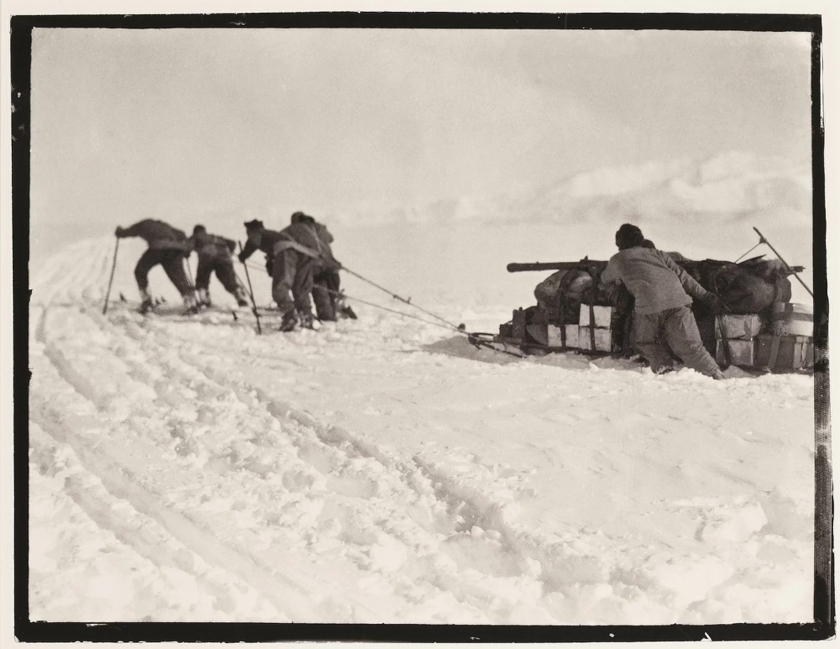
Man-hauled sledges

Unlike Amundsen who adopted the lighter fur-skins of the Inuit, the Scott expedition wore heavy wool clothing, depending on motorized and horse-drawn transport and man-hauling sledges for the final drive across the polar plateau. Dog teams were expected to meet them only on the way out, on March 1.
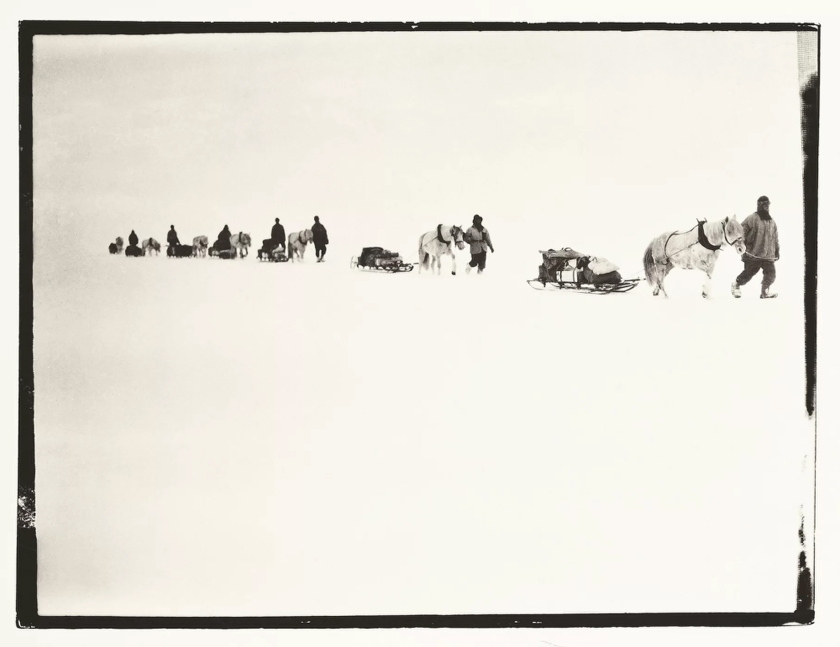
Scott Expedition

Ponies, poorly acclimatized and weakened by the wretched conditions of Antarctica, slowed the depot-laying part of the Scott expedition.  Four horses died of cold or had to be shot, because they slowed the team.

Expedition member Lawrence “Titus” Oates warned Scott against the decision to locate “One-Ton Depot” at 80°, 35-miles short of the planned location.  “Sir, I’m afraid you’ll come to regret not taking my advice.”  Titus’ words would prove prophetic.
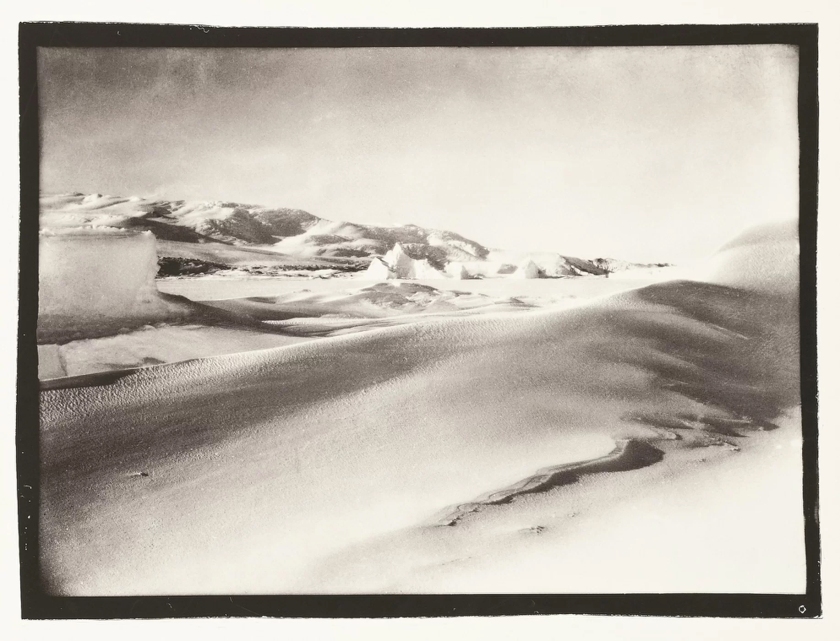
Mount Erebus
Mount Erebus, the southernmost active volcano, in the world. Robert Falcon Scott took this photograph in 1911

Unlike the earlier attempt, Robert Falcon Scott made it to the pole this time. Amundsen’s Norwegian team had beat him. By a mere five weeks. A century later you can still feel the man’s anguish, by the words in his diary: “The worst has happened…All the day dreams must go…Great God! This is an awful place”.
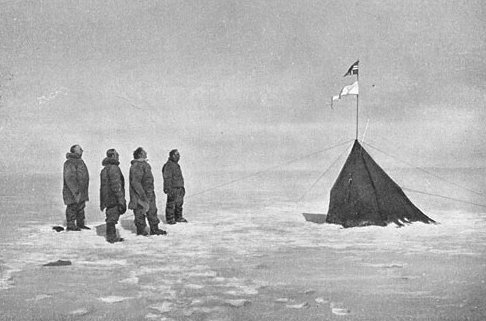
Norwegian flag at the South Pole

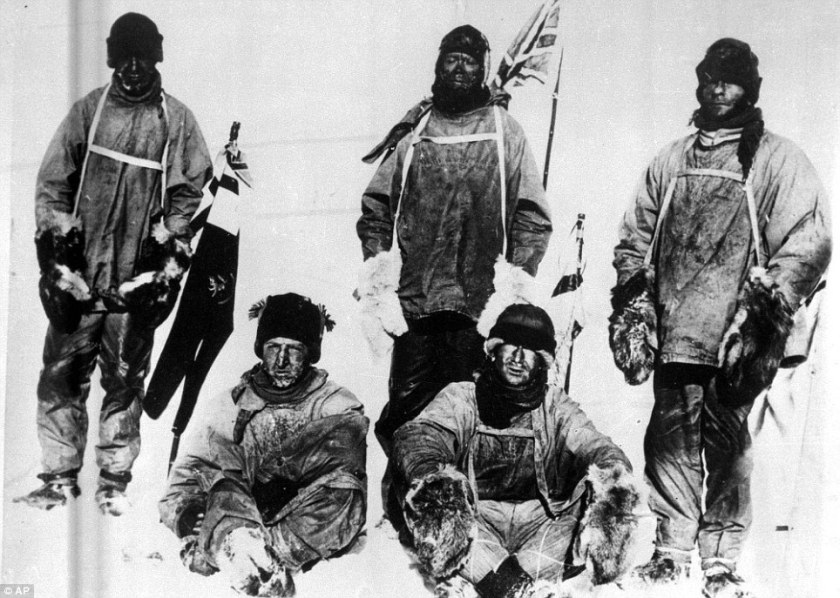
Utterly Defeated, the five-man Scott party turned to begin the 800-mile, frozen slog back from the Pole on January 19, 1912.  By the 23rd, the condition of Petty Officer Edgar “Taff” Evans, began to deteriorate . On February 4, a bad fall on Beardmore Glacier left the man concussed, “dull and incapable”.  A second fall two weeks later left the man dead at the foot of the glacier.
article-2087811-001f786700000258-615_964x687 (1)
Defeated by only weeks, the Scott party spends a moment at the south pole, before turning for the frozen, 800-mile slog, back.

The appointed time came and went in early March and the dog teams, failed to materialize.  Severely frostbitten, Lawrence Oates struggled on. Soldier, explorer, he was “No Surrender Oates”, a moniker earned years before when he refused to surrender before a superior force in the Boer Wars. In the end, it was impossible to go on.
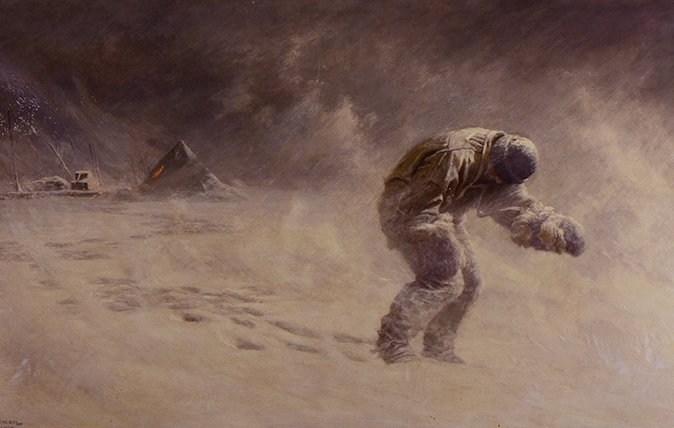
A Very Gallant Gentleman, 1913, by John Charles Dollman (1851–1934), 70in by 40in, The Cavalry and Guards Club, London

Lawrence Oates knew he was holding up the team. There was but one option and leaving that tent, was a deliberate act. Final. Suicidal.

Scott’s diary tells us the story:

March 16, 1912He was a brave soul. This was the end. He slept through the night before last, hoping not to wake; but he woke in the morning – yesterday. It was blowing a blizzard. He said, ‘I am just going outside and may be some time.’ He went out into the blizzard and we have not seen him since.”

His body was never found.

The last three made final camp on March 19, with 11 miles to go before the next food and supply cache.   A howling blizzard descended on the tents and lasted for days as Scott, Henry “Birdie” Bowers and Dr. Edward Wilson wrote good-bye letters to mothers, wives, and others.

March 22, 1912 “Blizzard bad as ever. Wilson and Bowers unable to start. Tomorrow last chance. No fuel and only one or two of food left — must be near the end. Have decided it shall be natural. We shall march for the depot with or without our effects and die in our tracks.”

Starving, frostbitten, Robert Falcon Scott wrote to his diary during the final hours of his life.

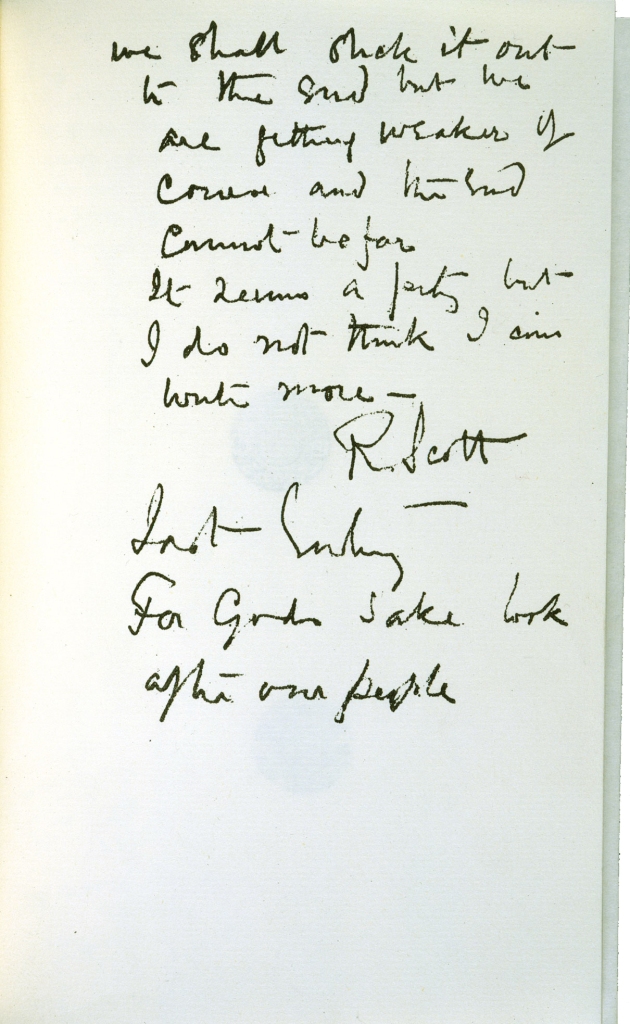
March 29, 1912 “We had fuel to make two cups of tea apiece and bare food for two days on the 20th. Every day we have been ready to start for our depot 11 miles away, but outside the door of the tent it remains a scene of whirling drift. I do not think we can hope for any better things now. We shall stick it out to the end, but we are getting weaker, of course, and the end cannot be far.

It seems a pity, but I do not think I can write more.

R. SCOTT.

The frozen corpses of Robert Falcon Scott and his comrades were found on November 12, 1912. You can almost feel his frozen, dying fingers in the words on that final page, written back on March 29:

Last entry.  For God’s sake look after our people”.
The lowest ground level temperature ever recorded was −128.6° Fahrenheit at the Soviet Vostok Antarctic Station, in 1983.  Meteorological conditions for those last days in the Scott camp went unrecorded, and must only be imagined.

There are places in this world so inhospitable, the visitor is fortunate to get out alive. Where returning with the body of one not so lucky, is impossible. The frozen side of Everest is such a place where no fewer than 300 climbers have perished, in the last six decades. A third of them, will never come down.

The final camp, is such a place. A high cairn of snow was erected over it all, that final camp becoming the three men’s tomb. Ship’s carpenters built a wooden cross, inscribing on it the names of those lost: Scott, Edward Wilson, Henry Bowers, Lawrence Oates and Edgar Evans. A line from Alfred Lord Tennyson’s poem, Ulysses, was carved into the cross:

To strive, to seek, to find, and not to yield”.
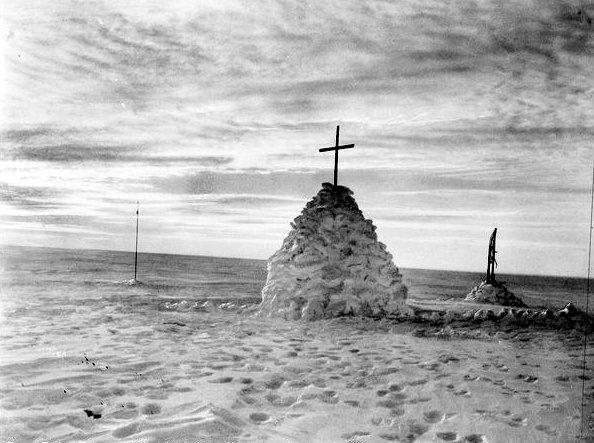
The grave of the southern party

If only they’d been able to make it, that next eleven miles.

On hearing the fate of his rival, Amundsen said “I would gladly forgo any honor or money if thereby I could have saved Scott his terrible death”.

More than a century later, ice and snow have covered the last camp of the southern party.  Pressed ever downward by the weight of snow and ice, their corpses are encased seventy-five-feet down now in the Ross Ice Shelf, inching their way outward and expected to reach the Ross Sea sometime around 2276. 

One day in a distant future none alive today will ever see, they will break off and float away, at the heart of some nameless iceberg.
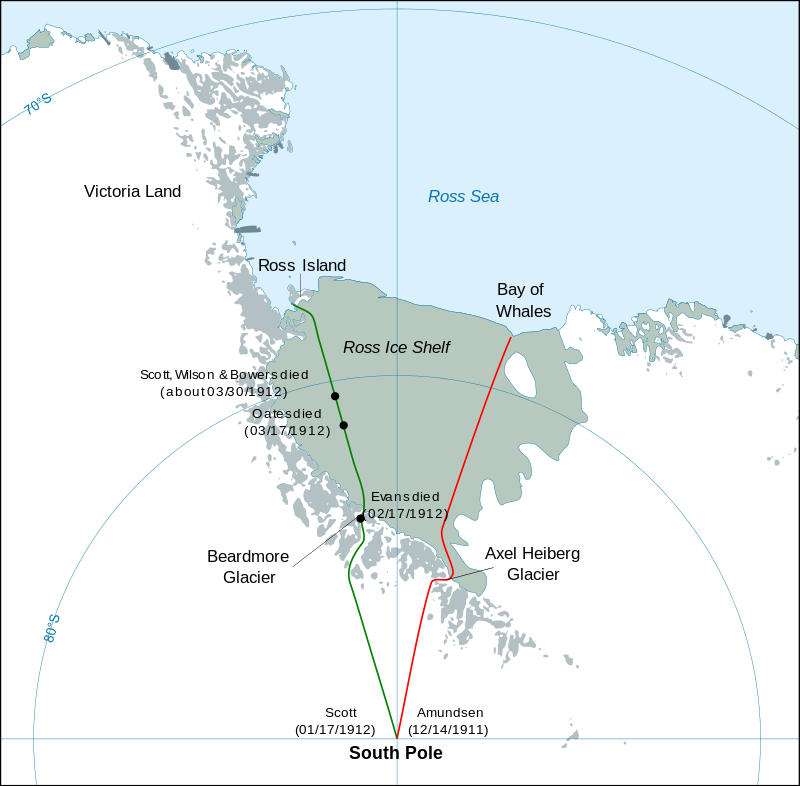
Amundsen_-_Scott_Antarctic_expedition_map.svg

November 11, 1918 Sacred Soil

Over the summer of 2013, more than 1,000 British and Belgian schoolchildren visited 70 battlefields of the Great War. Ypres. Passchendaele. Verdun. The Somme. It was a singular event. Never before had the Commonwealth War Graves Commission permitted excavation on Any of these battlefields.

November 11. Veteran’s Day.  A federal holiday in the United States, set aside to honor those who have served in the US Armed Forces. The Commonwealth nations call it Remembrance Day and sometimes Poppy Day, harking back to the tradition of the Remembrance Poppy. Once, it was simply “Armistice Day”. The end of the “Great War”.  Before they had numbers.

Passchendaele (1)
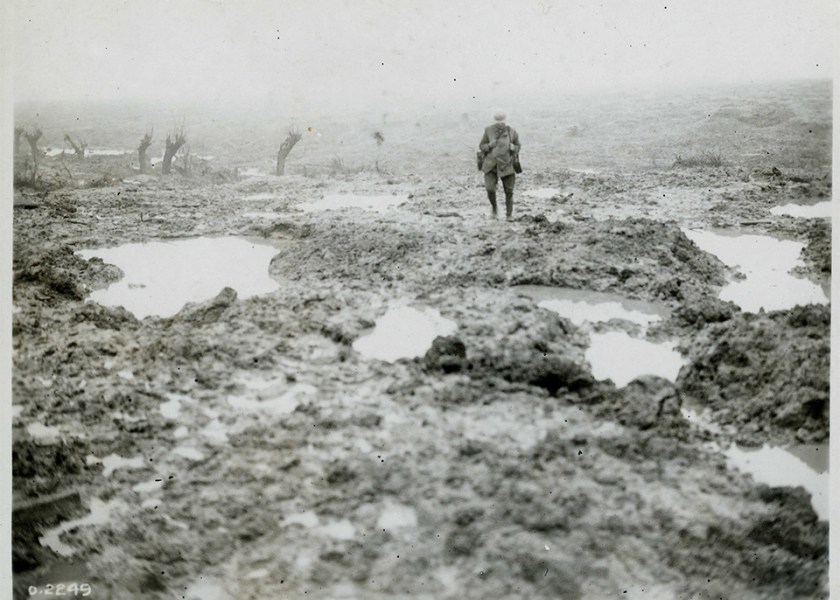
Passchendaele

There is barely a piece of 20th century history that can’t be traced back to World War One, the “War to end all Wars”.

International Communism was borne of the Great War, without which there would have been no cold war, no Korean War, no war in Vietnam. The killing fields of Cambodia would have remained, mere rice fields.  The spiritual descendants of Chiang Kai-shek’s brand of capitalism would be running all of China, instead of only Taiwan.

The current proportions of the Middle East arose from the Great War. While tribal alliances and religious strife are nothing new in that region, those conditions would have taken a different form, had it not been for those boundaries.

Ypres. The aftermath. Stop for a moment if you will, and imagine. What this felt like. What this smelled like. What this looked like. In color.

There were five such battles for the Ypres salient, of WW1

World War II, an apocalypse which left more dead, wounded or missing than any conflict in world history, was little more than the Great War, part II. A Marshall of France, on reading the Versailles Treaty formally ending WWI, said “This isn’t peace. This is a cease-fire that will last for 20 years”.  He was off, by about 36 days.

_78081389_resized_3279921_10

It’s hard to understand how a participating citizen of a self-governing Republic, can function without some understanding of our own history. We can’t know where we want our nation to go, if we don’t understand where it’s been.  It’s one of the principle reasons for examining history.  It’s why I think something wonderful happened just a few years ago, and I don’t think many of us heard about it.

Over the summer of 2013, more than 1,000 British and Belgian schoolchildren visited 70 battlefields of the Great War.  Ypres.  Passchendaele.  Verdun.  The Somme. It was a singular event.  Never before had the Commonwealth War Graves Commission permitted excavation on Any of these battlefields.

All over Northern France and Belgium, the region known as “Flanders”.  There these children collected samples of the sacred soil of those fields of conflict.

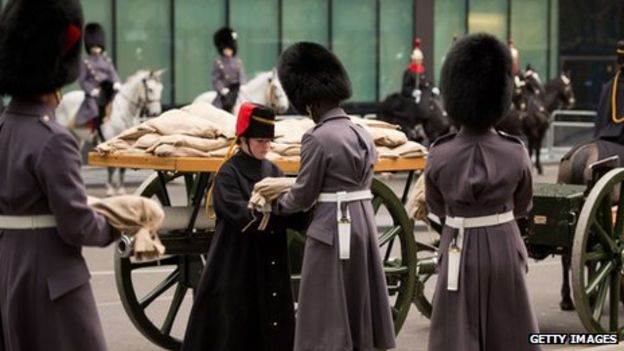
No ordinary dirt, the soil of Flanders Fields is literally infused with the essence of those who fought and died there. The soil from those seventy battlefields was placed in as many WWI-style burlap sandbags, each stenciled with a red poppy, where it came from, and the dates. 

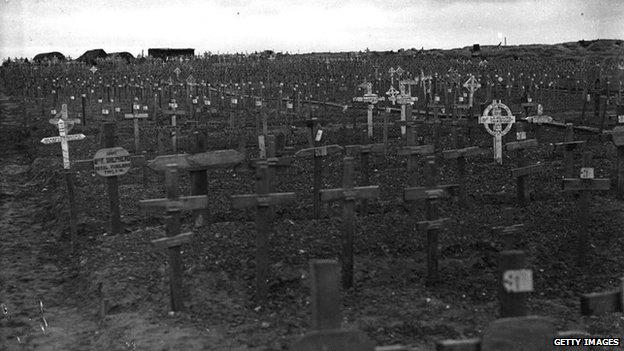
A hundred-odd years ago, countless British and Commonwealth soldiers passed through the Menenpoort, the Menin Gate in the Belgian city of Ypres. Some 300,000 gave their lives in defense of the “Ypres Salient” of WW1. Some 90,000 of those, have no known graves.

With a solemn Armistice Day ceremony at the Menin Gate, those 70 sandbags began their journey.

The sacred soil of Flanders Fields was transported to London aboard the Belgian Navy frigate Louisa Marie and installed with great care at Wellington Barracks, the central London home of the Grenadier Guards, Coldstream Guards and Scots Guards.

There the soil of the Great War would nourish and support a simple garden.  It was all in preparation for the following year, 2014 and the solemn remembrance of the centenary, of the War to end all Wars.

_71447576_soil4_getty

I cannot think of anything more fitting than that it was children, our future and posterity, who retrieved the sacred soil of Flanders and installed it in that garden. A grassy mound, surrounded by the native trees of Flanders and inscribed with a poem by Dr. John McCrea, the 41-year-old Canadian physician who could have joined the medical corps based on his age and training. He volunteered instead to join a fighting unit, as gunner and medical officer.
His poem is called, “In Flanders Fields”.

In Flanders Fields, by Dr. John McCrae

In Flanders fields the poppies blow
Between the crosses, row on row,
    That mark our place; and in the sky
    The larks, still bravely singing, fly
Scarce heard amid the guns below.

We are the Dead. Short days ago
We lived, felt dawn, saw sunset glow,
    Loved and were loved, and now we lie,
        In Flanders fields.

Take up our quarrel with the foe:
To you from failing hands we throw
    The torch; be yours to hold it high.
    If ye break faith with us who die
We shall not sleep, though poppies grow
        In Flanders fields.

It is now for that posterity to keep our history alive, never to let it fade into some sepia-toned and forgotten past.

49a1160c9141869ce025a820a599ef56--flanders-field-lest-we-forget

Afterward

Moina Belle Michael was a professor at the University of Georgia. She took a leave of absence when the US entered the war in 1917 and accepted a job at the YMCA Overseas War Secretaries headquarters, in New York.  Browsing through the Ladies Home Journal, she came across Dr. McCrae’s poem. It was Saturday morning, November 9, 1918.  The war would be over in two days.

Dr. McCrae had succumbed to pneumonia by this time, while serving the No. 3 Canadian General Hospital (McGill), at Boulogne.  He was buried with full military honors at the Wimereux cemetery where his gravestone lies flat, due to the sandy, unstable soil.

Professor Michael had seen McCrae’s poem before but it got to her this time, especially that last part:

“If ye break faith with us who die
We shall not sleep, though poppies grow
 In Flanders fields”

Moina was so moved she made a personal pledge to “keep the faith”, vowing always to wear a red poppy, in remembrance of the dead. She scribbled down a response, a poem, on the back of a used envelope.  She called it, “We Shall Keep the Faith”.

We Shall Keep the Faith

Moina Michael

Oh! you who sleep in Flanders Fields,
Sleep sweet – to rise anew!
We caught the torch you threw
And holding high, we keep the Faith
With All who died.

We cherish, too, the poppy red
That grows on fields where valor led;
It seems to signal to the skies
That blood of heroes never dies,
But lends a luster to the red
Of the flower that blooms above the dead
In Flanders Fields

poppy. red poppy isolated on white background.red poppy.

November 10, 1918 11th Hour

The German King abdicated on November 10, as riots broke out in the streets. The final surrender was signed at 5:10am on November 11, and back-timed to 5:00am Paris time, scheduled to go into effect later that morning. The 11th hour, of the 11th day, of the 11th month.


In an alternate history, the June 1914 assassination of the heir-apparent to the Habsburg Empire may have led to nothing more than a regional squabble.  A policing action, in the Balkans.

As it was, mutual distrust and entangling alliances combined with slavish obedience to mobilization timetables, to draw the Great Powers of Europe, into the vortex.  On August 3, the “War to End All Wars” exploded across the continent.

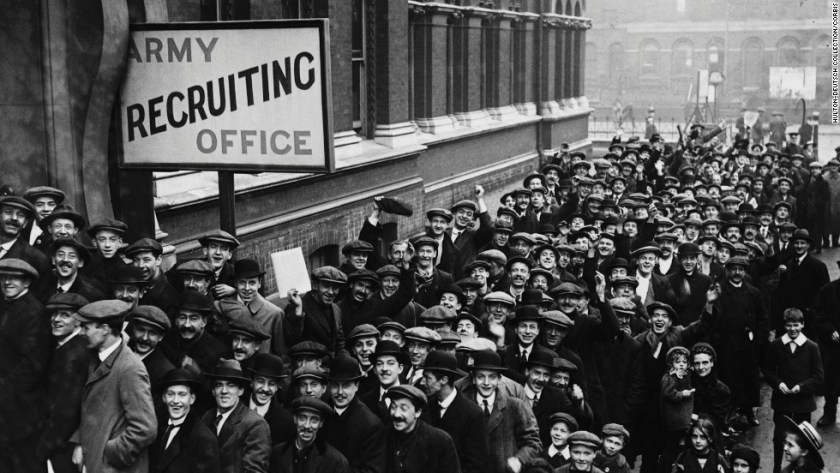
Many of the soldiers who went off to war in those days, viewed the conflict as some kind of grand adventure. Many of them singing patriotic songs, the men and boys of Russia, Germany, Austria, England and France stealing last kisses from wives and sweethearts, and boarding their ships and trains.

Believing overwhelming manpower to be the key to victory, British Secretary of State for War Lord Horatio Kitchener recruited friends and neighbors by the tens of thousands into “Pal’s Battalions”, to fight for King and country.

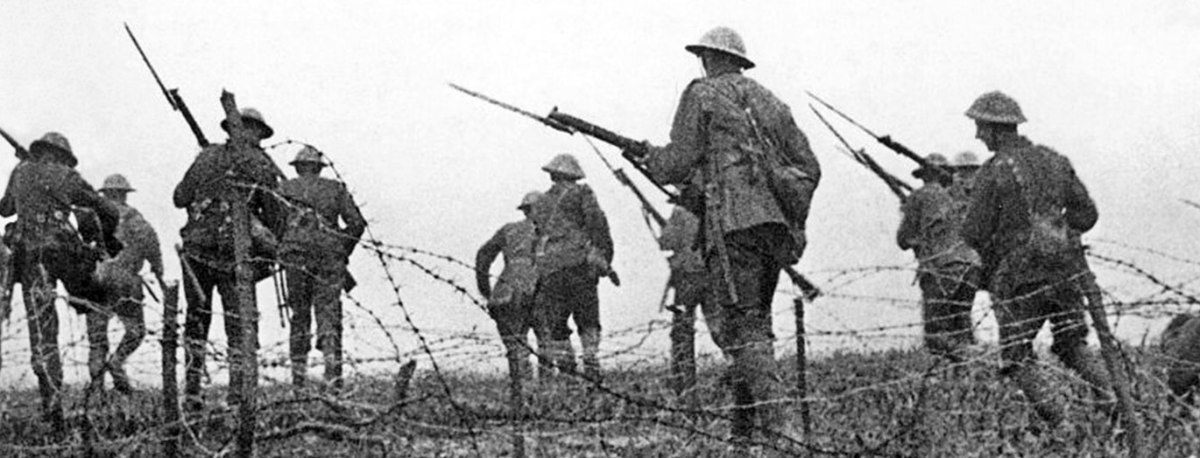
Four years later, a generation had been chewed up and spit out, as if in pieces.

140604153439-19-wwi-main-timeline-0604-restricted-horizontal-large-gallery
The signs could have been written in any number of languages, in the early phase of the war

Any single day’s fighting during the great battles of 1916 produced more casualties than every European war of the last 100 years, civilian and military, combined.

As a point of reference, 6,503 Americans lost their lives during the savage, month-long battle for Iwo Jima, in 1945. The first day’s fighting during the 1916 Battle of the Somme, killed three times that number on the British and Commonwealth side, alone.

Over 16 million were killed and another 20 million wounded, while vast stretches of the European countryside were literally, torn to pieces. Tens of thousands of sons, brothers and fathers remain missing, to this day.

battle_of_the_somme_in_pictures_1
Over 1.5 million shells were fired in the days leading to the battle of the Somme

Had you found yourself stuck in the mud and the blood, the rats and the lice of the muddy trenches of New Year 1917-’18, you could have heard a plaintive refrain drifting across the barbed wire and frozen wastes of no man’s land, sung to the tune of ‘Auld Lang Syne”.

We’re here, because we’re here,
because we’re here, because we’re here,
We’re here, because we’re here,
because we’re here, because we’re here.

cher-ami
Cher Ami

Many of those who fought the “Great War”, weren’t even human.  The carrier pigeon Cher Ami escaped a hail of bullets and returned twenty-five miles to her coop despite a sucking chest wound, the loss of an eye and a leg that hung on, by a single tendon.  The message she’d been given to carry, saved the lives of 190 men.

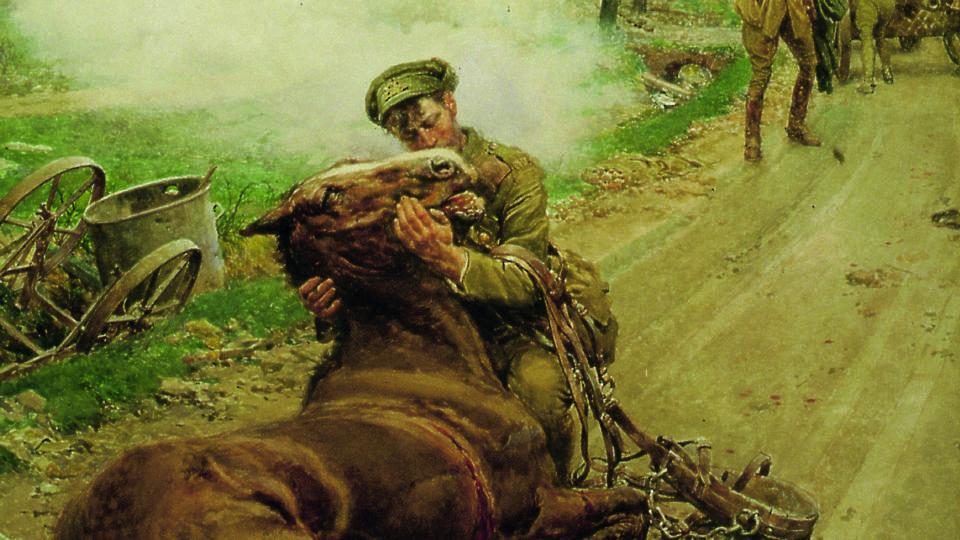
“Warrior” was the thoroughbred mount to General “Galloper” Jack Seely, arriving in August 1914 and serving four years “over there”. “The horse the Germans can’t kill” survived snipers, poison gas and shellfire, twice buried alive in great explosions, only to return home to the Isle of Wight, to live to the ripe old age of 33.

18-03-23-thumb
First division Rags

First Division Rags” ran through a torrent of shells, gassed and blinded in one eye, a shell fragment damaging his front paw and even then, he got his message through.

Jackie the baboon lost a leg during a heavy bombardment from German guns, frantically building a protective rock wall around himself, and his comrades.

Tirpitz the German pig jumped clear of the sinking light cruiser SMS Dresden, only to be rescued in open ocean to become mascot to the HMS Glasgow.

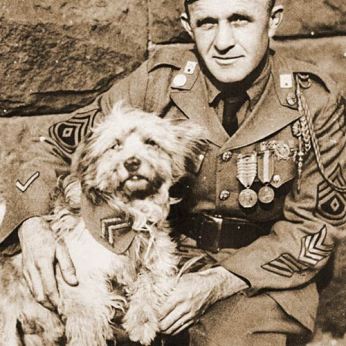
Sixteen million animals served on all sides and in all theaters of WW1:  from cats to canaries to pigeons and mules, camels, donkeys and dogs.  As “dumb animals”, these were never given the choice to “volunteer”.  And yet they served, some nine million making the supreme sacrifice.

In the end, starvation and malnutrition stalked the land at home as well as the front. Riots were rife at home as well as in the trenches. The Russian Empire of the Czars was collapsed into a Bolshevik hellhole, never to return.  The domestic economies of nearly every combatant nation was disintegrating, or teetering on the brink.

A strange bugle call came out of the night of November 7, 1918. French soldiers of the 171st Régiment d’Infanterie, stationed near Haudroy, advanced into the the darkness, expecting to be attacked. Instead, the apparitions of three sedans appeared out of the fog, their sides displaying the German Imperial Eagle.

Imperial Germany, its army disintegrating in the field and threatened with revolution at home had sent a peace delegation, headed by 43-year-old politician Matthias Erzberger.

The delegation was escorted to the Compiegne Forest near Paris, to a conference room fashioned from a railroad dining car. There they were met by a delegation headed by Ferdinand Foch, Marshall of France.

original-french-postcard-showing-the-wagon-in-which-the-ww1-armistice-M1B0DJ

The German delegation was stunned at what Foch had to say. ‘Ask these gentlemen what they want,’ he said to his interpreter. Dismayed, Erzberger responded. The German believed they were there to discuss terms of an armistice. Foch dropped the hammer: “Tell these gentlemen that I have no proposals to make”.

Ferdinand Foch had seen his nation destroyed by war, and had vowed “to pursue the Feldgrauen (Field Grays) with a sword at their backs”. He had no intention of letting up.

Marshall Foch now produced a list of 34 demands, each a sledgehammer blow on the German delegation. Germany was to divest herself of all means of self-defense, from her high seas fleet to the last machine gun. She was to withdraw from all lands occupied since 1870. With her population starving at home – the German Board of Public Health claimed a month later, that 763,000 civilians were dead of starvation – the allies were to confiscate 5,000 locomotives, 150,000 rail cars and 5,000 trucks.

Adolf Hitler would gleefully accept French surrender in that same rail car, some twenty-two years later.

1200px-Waffenstillstand_gr

By this time, 2,250 combatants were dying every day on the Western Front.  Foch informed Ertzberger he had 72 hours in which to respond. “For God’s sake, Monsieur le Marechal”, responded the German, “do not wait for those 72 hours. Stop the hostilities this very day”.  The plea fell on deaf ears. Fighting would continue until the last minute, of the last day.

The German King abdicated on November 10, as riots broke out in the streets. The final surrender was signed at 5:10am on November 11, and back-timed to 5:00am Paris time, scheduled to go into effect later that morning. The 11th hour, of the 11th day, of the 11th month.

The order went out. The war would be over in hours, but specific instructions, were few.

Some field commanders ordered their men to stand down. Why fight and die over ground they could walk over, in just a few hours?

the-last-soldier-killed-in-wwi-died-one-minute-before-the-war-ended
The last six hours

Others continued the attack, believing that Germany had to be well and truly beaten. Others saw a last chance at glory, or promotion. One artillery captain named Harry S Truman, kept his battery firing until minutes before 11:00.

English teacher turned Major General Charles Summerall had a fondness for the turn of phrase. Ordering his subordinates across the Meuse River in those final hours, Summerall said “We are swinging the door by its hinges. It has got to move…Get into action and get across. I don’t expect to see any of you again…

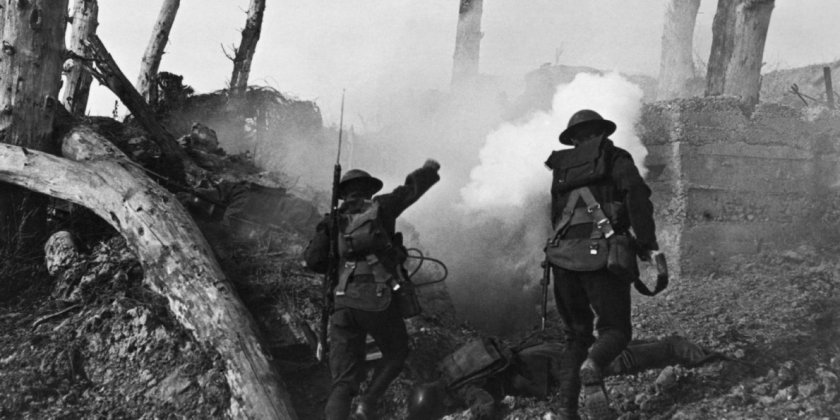
No fewer than 320 Americans were killed in those final six hours, another 3,240 seriously wounded.

7fe16b6c9f770b107480c9ca6c28e87c

Still smarting from the disaster at Mons back in 1914, British High Command was determined to take the place back, on that final day. The British Empire lost more than 2,400 in those last 6 hours.

The French 80th Régiment d’Infanterie received two orders that morning – to launch an attack at 9:00, and cease-fire at 11:00. French losses for the final day amounted to 1,170. The already retreating Germans suffered 4,120.

All sides suffered over 11,000 dead, wounded or missing in those last six hours. Some have estimated that more men died per hour after the armistice was signed, than during the D-Day invasion, some 26 years later.

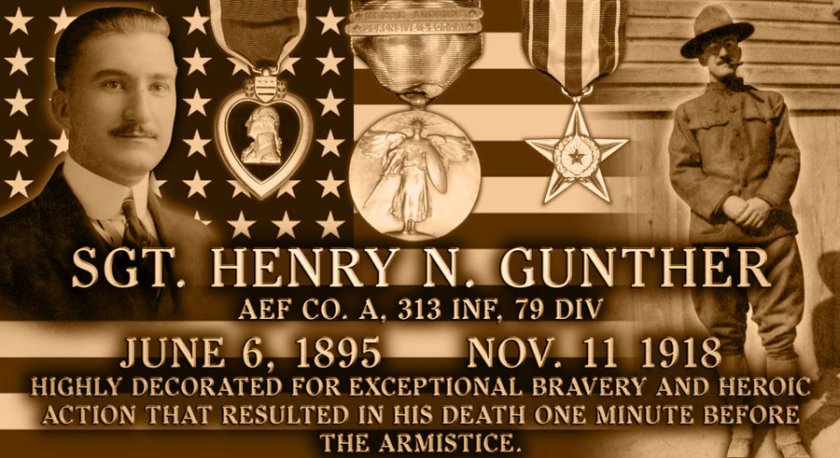
Over in the Meuse-Argonne sector, Henry Gunther was “visibly angry”.   Perhaps this American grandson of German immigrants felt he had something to prove.  Anti-German bias had not reached levels of the next war, when President Roosevelt interned Americans of Japanese descent, but even so. Such animosity was very real.  Gunther’s fiancé had broken the engagement. He’d been busted in rank after that letter home, complaining about conditions.

Bayonet fixed, Gunther charged the German machine gun position, as enemy soldiers frantically waved and yelled for him, to get back. He got off a “shot or two”, before the five round burst tore into his head. Henry Nicholas John Gunther of Baltimore Maryland was the last man to die in combat, in the Great War.  It was 10:59am.  The war would be over, in sixty seconds.

Sargeant-Henry-Gunther

After eight months on the front lines of France, Corporal Joe Rodier of Worcester Massachusetts, was jubilant.   “Another day of days“.   Rodier wrote in his diary.  “Armistice signed with Germany to take effect at 11 a.m. this date. Great manifestations. Town lighted up at night. Everybody drunk, even to the dog. Moonlight, cool night & not a shot heard“.

Matthias Erzberger was assassinated in 1921, for his role in the surrender. The “Stab in the Back” mythology destined to become Nazi propaganda, had already begun.

AEF Commander General John “Black Jack” Pershing believed the armistice to be a grave error. He believed that Germany had been defeated but not beaten, and that failure to smash the German homeland meant the war would have to be fought, all over again. Ferdinand Foch agreed. On reading the Versailles treaty in 1919, he said “This isn’t peace! This is a truce for 20 years”.

The man got it wrong, by 36 days.

Norman Francis Long
On a personal note:

At sixty-two I still enjoy the memories of a five-year-old, fishing with his grandfather.

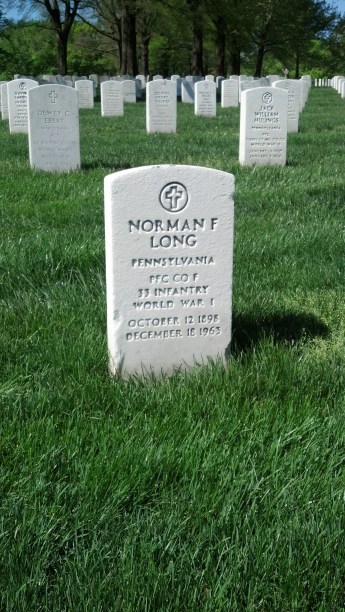
PFC Norman Franklin Long was wounded during the Great War, before they had numbers, a member of the United States Army, 33rd Pennsylvania Infantry.  He left us on December 18, 1963. A few short hours before his namesake, my brother Norm, was born.

A 1977 fire in the national archives, left us without the means to learn the details of his service.

My father’s father went to his final rest on Christmas eve 1963, in Arlington National Cemetery.  Section 41, grave marker 2161.

Rest in peace, Grampa.  You left us, too soon.

November 7, 1805 Corps of Discovery

Over the course of the expedition, the tiny group was hunted by no fewer than four Spanish expeditions with as many as 600 soldiers, mercenaries and Comanche guides, each intending to make the Corps of Discovery vanish without a trace.

As early as the 1780s, minister to France and future President Thomas Jefferson began to express interest in an expedition to the Pacific Northwest.

As President, Jefferson asked Congress to fund an expedition to the Pacific, two years into his first term. He understood that the fledgling United States would have a better claim to the Pacific Northwest if the team gathered data on plants and animals, but Jefferson’s primary interest in the mission, was trade.

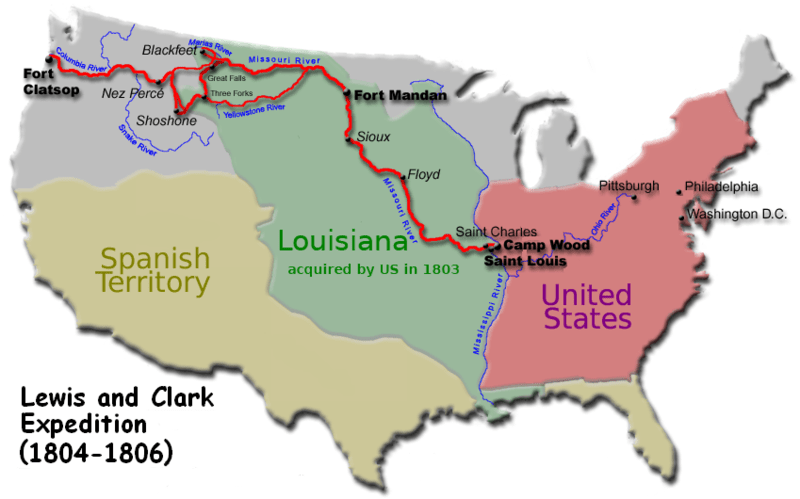
Carte_Lewis-Clark_Expedition-en

Today we take coast-to-coast travel for granted. It seems odd to think how strange and unknown at one time, were the more remote parts of our own nation.   Though extraordinarily well read and one of the brightest men of his generation, (Jefferson once cut out 901 bible verses from which he assembled his own “Jefferson Bible”, translating the volume into Greek, Latin, French and back to English “just for fun”), President Jefferson legitimately believed that herds of Wooly Mammoth may well yet roam the western reaches of the nation. 

Jefferson wanted to find an all-water route to the Pacific, for the conduct of business. The President commissioned the Corps of Discovery expedition in 1803, naming Army Captain Meriwether Lewis expedition leader.

The two men had known one another since Lewis was a boy, having long since developed a relationship of mentor and protégé.  At this time Lewis was working as personal secretary to the President.  Physically tough, intellectually gifted and resourceful, Lewis received a crash course in the natural sciences from the President himself, before being sent off to Philadelphia to brush up on medicine, botany and celestial navigation.

Lewis selected William Clark as his second in command, due to the man’s exceptional skills as a frontiersman. He would prove to be an excellent choice.

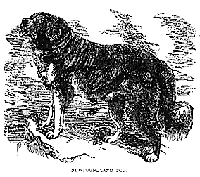
Lewis_and_clark, Seaman

Most of 1803 was spent in planning and preparation, Lewis and Clark joining forces near Louisville that October. After wintering in the Indiana territory base camp in modern Illinois, the 33-man expedition departed on May 14, 1804 accompanied by “Seaman”, a “Dogg of the Newfoundland breed”.

Lewis and Clark set out to explore the Louisiana Territory, even as it became an official part of the United States. Borders were still hazy at the time, and Spanish authorities suspected that the expedition would encroach on their territory in the southwest. They had good reason to think so, Thomas Jefferson believed the same.

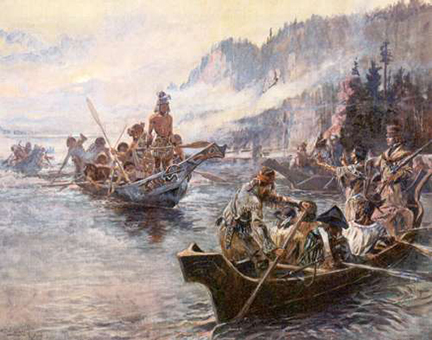
Lewis_and_clark-expedition

Corps of Discovery members couldn’t know that General James Wilkinson, one of the most duplicitous, avaricious, and corrupt individuals of the age, was reporting their every move to his paymaster, the Spanish King Charles IV.

Over the course of the expedition, the tiny group was hunted by no fewer than four Spanish expeditions with as many as 600 soldiers, mercenaries and Comanche guides, each intending to make the Corps of Discovery vanish without a trace.

Discovery established friendly relations with at least 24 indigenous tribes, without whose help they may have become lost or starved in the wilderness.  

Most were highly impressed with Lewis’ state-of-the-art pneumatic rifle, which was always demonstrated with great fanfare not to mention great care, not to reveal that the expedition possessed, but one. Four-score years before Christopher Spencer’s repeating rifle, the single air powered repeater possessed by Lewis and Clark may have had more to do with their safe return, than any single factor. Designed by Italian inventor Bartolomeo Girardoni sometime around 1779, the Girardoni air rifle required some 1,500 strokes of a hand pump before discharging up to 30 .46 round balls, each with a combat lethality of nearly 150 yards.

The Girardoni air rifle was feared not only for its prodigious rate of fire but also for the near silence and absence of smoke, which made the weapon near impossible to detect.

Not all Indian tribes were friendly. There were several run-ins with a group called “Teton-wan Sioux”. These people were no joke. On one occasion, a group of four who had separated from the main expedition fled 100 miles in a single day to get away from them, before they felt it was safe to stop.

Lewis and Clark’s memoirs describe similar encounters with a large and especially ferocious species of bear, the Grizzly, an animal which more than once had expedition members climbing trees with a notable sense of urgency.

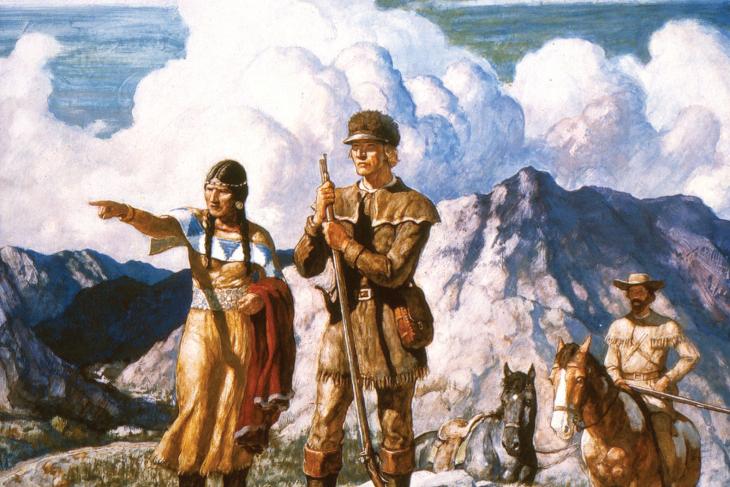
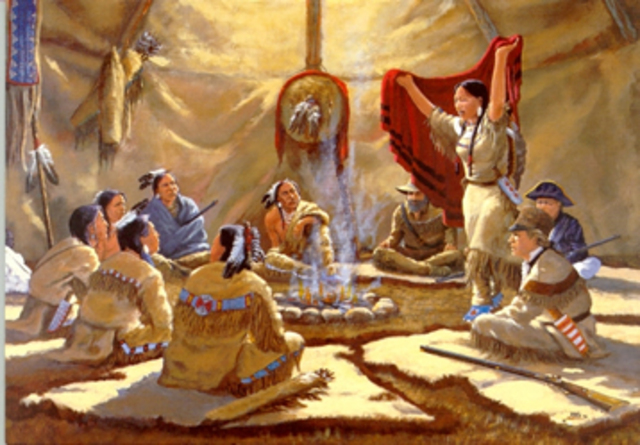
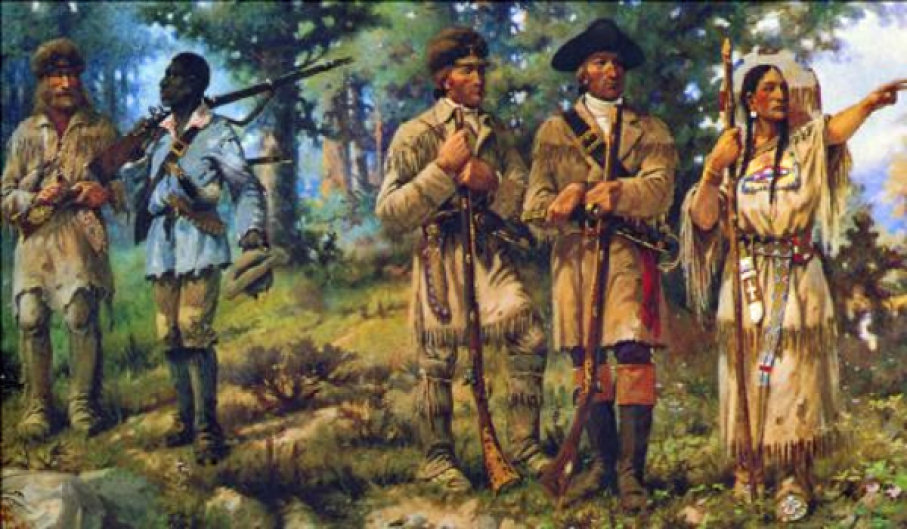
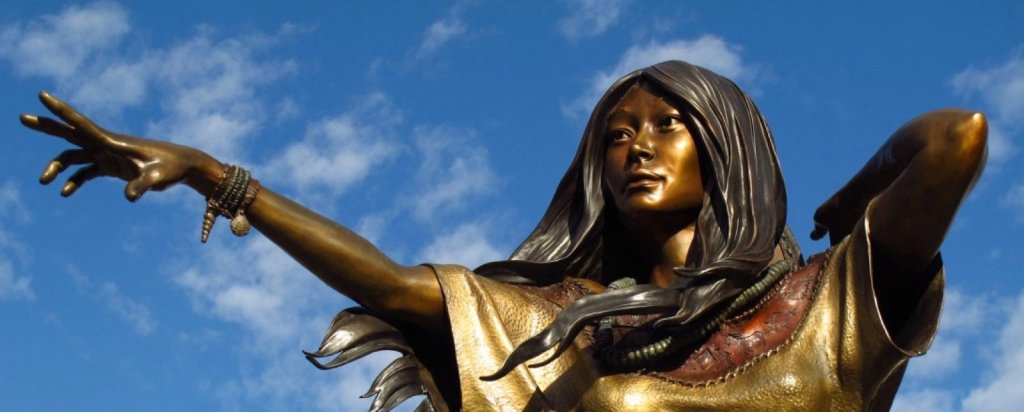
It was at the winter camp of 1804-5 that they met a French fur trapper Toussaint Charbonneau and his young wife (or slave – she might have been a bit of both), Sacagawea. Lewis and Clark seemed to have thought Charbonneau a shady character but they liked the young Indian girl, and her linguistic skills would prove useful. Sacagawea spoke Shoshone and Hidatsa while Charbonneau spoke Hidatsa and French. More than once Lewis and Clark found themselves negotiating for their lives with hostile tribes, as Discovery Corps member Francois Labiche translated English to French, Charbonneau French to Hidatsa, and Sacagawea speaking to the other side in Shoshone.

It was at this camp that Sacagawea gave birth to a son, whom she and Charbonneau named Jean Baptiste. The family stayed with the expedition, proving to be incredibly valuable to the group. They met many Indian bands along the way, whom Sacagawea’s presence quickly put at ease. War bands never traveled with women, especially not with one carrying an infant. One such band was a group of Shoshone led by Chief Cameahwait, who turned out to be none other than Sacagawea’s own brother. It must have been quite the reunion. The pair hadn’t seen one another since her kidnap by the Hidatsa, back in 1800.

Lewis_and_clark, first glimpse

On this day in 1805, the Corps of Discovery first sighted the Pacific Ocean, and set out their second winter camp in modern day Oregon.

They returned through a cut in the Rocky Mountains which Sacagawea remembered from her childhood, the present day Bozeman Pass, arriving at the Hidatsa-Mandan villages on August 14, 1806.   For Sacagawea, Charbonneau and Jean Baptiste, the trip had come to an end.

Lewis and Clark arrived in St. Louis on September 23, 1806, the Corps of Discovery having met their objectives. They had reached the western coast and returned, though they never did find a continuous water route to the Pacific. The expedition created maps along the way establishing legal claim to the land, while describing 178 previously unknown plants and 122 unknown animals, and establishing diplomatic and trade relations with at least two dozen indigenous nations.

Despite being heavily armed, most members were required to defend themselves only once, that in a running gun battle with a band of Blackfoot, on the way home.

The expedition suffered only one fatality when Sergeant Charles Floyd succumbed to what appears to have been appendicitis.  Though not seriously wounded, a humiliated Lewis had to spend several weeks face-down in a canoe, when one of the enlisted guys mistook his rump for that of an elk, and shot it.

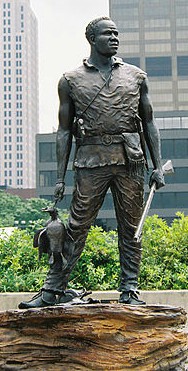
York_Statue
York

Among the two-dozen plus officers and enlisted men on Discovery was William Clark’s African slave “York”, who accompanied the expedition from beginning to end.  Though not an official member of the Corps of Discovery, York’s hunting skills made him a valuable member of the expedition.  Indigenous tribes were fascinated by the first black man any of them had ever seen.  The Arikara people of North Dakota believed him to hold spiritual powers, calling the tall man “Big Medicine”.

Though a slave, York seems to have earned a degree of respect from expedition members.  At least two geographic features were named after the man.   Both York and Sacagawea had a vote on the placement of the 1805-’06 winter camp, prompting historian Stephen E. Ambrose to speculate that this may be the first time in American history, that a black man and a woman exercised the power of the vote.

Accounts differ as to what became of him.  Some say Clark freed the man, others say that York was unwilling to return to a life of slavery, following 2½ years of liberty.  A black man who claimed to have been he was discovered ten or twelve years later, now a tribal elder living with four wives among the Crow, in north-central Wyoming.

Thomas Berger, author of the fictional Dances with Wolves, writes about a particularly dark skinned strain among the Indians, which many believe to have descended from York.

Sacagawea gave birth to a daughter named Lizette on December 22, 1812, and died a few months later at the age of 25. Eight months later, William Clark legally adopted her two children. Clark is recorded as having brought the boy up and educating him in St. Louis, before sending him to Europe with a German prince at the age of 18. I was unable to determine with any certainty, whether Lizette survived infancy.

Meriwether Lewis died from gunshot wounds to the chest and head on October 11, 1809.  Historians differ as to whether it was murder or suicide, though most believe it to have been the latter.  It would not have been his first such attempt.

What became of Seaman the dog is unknown. Having accompanied the Lewis & Clark expedition from the very beginning, the last journal reference to him was written in July, two months before the journey’s end.

November 6, 1944 Burial at Sea

Two Avengers flew overhead in salute as the torpedo bomber-turned sarcophagus, bobbed in the waves. And then the Avenger went down by the nose, and disappeared out of sight.

When Depression struck the nation in the 1930s, few states were hit harder than Oklahoma. This was the dust bowl, a time of ruinous levels of unemployment when farm income alone dropped 64 percent. Great, all-consuming dust storms seemed to swallow the horizon as whole populations, were driven from the land. Fifteen percent of all Oklahoma packed up and moved west, in hopes of a better life.

This was the world of Loyce Edward Deen’s childhood, the seventh of eight children born to Grace and Allen Deen in the tiny south-central Oklahoma town of Sulphur.

The family moved west in pursuit of work, to Altus Oklahoma, nearly 200 miles by car. There, Allen took work as a schoolteacher.  Loyce would care for his younger brother Lewis, a child afflicted with Down’s syndrome.  The boys were extremely close. It must have broken Loyce’s heart when his little brother fell and ill and died, while he was still in Junior High.

While a Junior in High School, Loyce’s mother Grace fell victim to a debilitating stroke. For nearly two months in 1938, he and his brother Lance cared for their mother. She died on November 30.

Altus was the kind of town, where the newspaper printed the bio of every graduating High school senior. The Times-Democrat wrote: “Loyce Deen is a young man with high ambitions. He plans to enter the US Navy aeronautical mechanics division after graduation and finds subjects such as problems of American democracy, the most interesting. He has also been active in dramatics work at school.

He worked for a time with the Civilian Conservation Corps (CCC), later joining the Douglas Aircraft Company in Wichita where he helped to build wing sets for the A-26 Invader attack bomber.

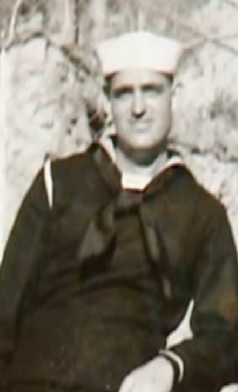
Loyce_pic_

Long before the Japanese sneak attack on Pearl Harbor, Loyce wanted to join the Navy. In October 1942, he did just that. First came basic training in San Diego and then gunner’s school, where he learned about the weapons systems aboard the Grumman TBF Avenger torpedo bomber.

Then it was on to Naval Air School in Fort Lauderdale, before joining the “Fabled 15th” Air Group forming out of Westerly, Rhode Island.

In April 1944, the Air Group reported for duty aboard the “Fightingest Ship in the Navy” at Pearl Harbor.  The aircraft carrier, USS Essex.

WW2-era Air Groups consisted of eighty or so aircraft, of three distinct types. First came the fighters, in this case the fast, single seat Grumman Hellcats. Next were the two-seat dive bombers, the Curtiss Helldivers, the pilot joined by a rear-seat gunner whose job it was to lay the one-ton bomb on the target, while handling the machine gun. Third came the torpedo bomber, the Grumman Avenger, with two enlisted crewmen in addition to the pilot. The Avenger carries a ton of bombs, depth charges or aerial torpedoes and, like the Helldiver, is designed for low-level attack.

Loyce was the turret gunner on an Avenger, assigned to protect the aircraft from above, with fellow crewmen Pilot Lt. Robert Cosgrove of New Orleans, Louisiana and Radioman Donald “Digby” Legoia Denzek from Grand Rapids, Michigan.

Left to right: Cosgrove, Denzek, and Deen

Cosgrove was a superb pilot, returning many times with an aircraft so shot up as to be all but unflyable. Digby had several jobs including arming weapons systems and operating the radio. When the team was under fire, he would crawl down to a ball turret on the belly of the aircraft where his machine gun would defend the aircraft an crew, from below.

The 15th Air group saw some of the most intense fighting it had ever encountered during the battle of Leyte Gulf of October 24-25, 1944. Captain David McCampbell, the 3rd-highest scoring Naval ace of WW2 and the highest to survive the war shot down 9 enemy aircraft on the 24th alone. Assisted by but a single aircraft, McCampbell waded into a land-based formation of 60 incoming aircraft and attacked with such aggression, as to force the Japanese formation to abandon the attack.

Grumman TBF Avenger

Loyce Deen received a shrapnel would to the foot in that same battle. He wrapped up the foot so he could stay on to fight, the following day. Deen would receive a Purple heart for that wound and McCampbell, the Medal of Honor.

Deen’s award was destined to be, posthumous.

Following rest and replenishment at Ulithi Atoll in the Caroline Islands, USS Essex was on station for the November 5 Battle of Manila.  Deen could have stayed back on the hospital ship until that foot healed, but chose to ignore the injury. He rejoined his unit.

VT-15 torpedo group (no pilots)

Bertha Deen was not surprised. On being informed of his injury, she said “I’m not surprised he stayed with his unit. Loyce would not have it any other way – he would always remain at his post to make sure his brothers came home safely with him.

Loyce Deen climbed into his gun turret for the last time on November 5. It was a two hour flight to the target zone in Manila Bay, with Japanese aircraft on the radar for most of that time and the carriers USS Lexington and Ticonderoga, under kamikaze attack.

Lieutenant Cosgrove’s Avenger came under savage anti-aircraft fire, from a Japanese cruiser. Aviation Machinist’s Mate Second Class Loyce Edward Deen was killed instantly, taking multiple direct hits from 40mm anti-aircraft shells. The Avenger aircraft, tail #93, was so smashed up as to be virtually unflyable.  It took all of Cosgrove’s considerable strength and skill as a pilot, to fly the thing back through two thunderstorm and hours of open ocean, to land at last on the decks of the carrier.

e281f946d5375133dd2c1afe6213dacd
Grumman Avenger top turret

What remained of Loyce Edward Deen was so utterly destroyed, the decision was made. The man would be buried at sea. Inside of the aircraft. This particular Avenger wouldn’t even be scavenged, for parts.

Shipmates took his fingerprints and carefully removed the dog tags.    With a ship’s complement assembled to pay last respects and a chaplain to read last rites, the shattered aircraft was tipped over the rear of the flight deck, and into the water.  Two Avengers flew overhead in salute as the torpedo bomber-turned sarcophagus, bobbed in the waves. And then the Avenger went down by the nose, and disappeared out of sight.

A hero, was going home. For the first and last time in US Naval history, a man was buried with the aircraft in which he had served.

A normal person could not be blamed, for believing that’s the end of the story. Essex went to General Quarters.  There were kamikazes to deal with. Air Group 15, ordinary men from Massachusetts to Oklahoma, climbed back into their aircraft on November 6 and again on the 12th, 13th and 14th, to attack those same Japanese cruisers outside Manila Bay.

For the Deen family, the dread knock on the door came sometime around Thanksgiving.

November 5, 2004 I did not die

The elegy has been set to music and featured in television series and movies the world over and even appears in the multi-player on-line game, World of Warcraft. Even so, the name and even nationality of the author, remained unknown.

For many among us, 2020 has been a time of grievous loss. My family is no exception.

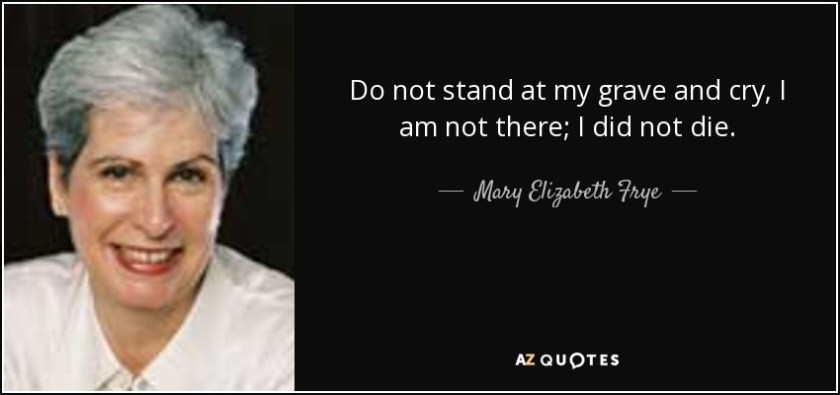
During the 1930s, Mary Elizabeth Frye was a Baltimore housewife and amateur florist, the wife of clothing merchant, Claud Frye.

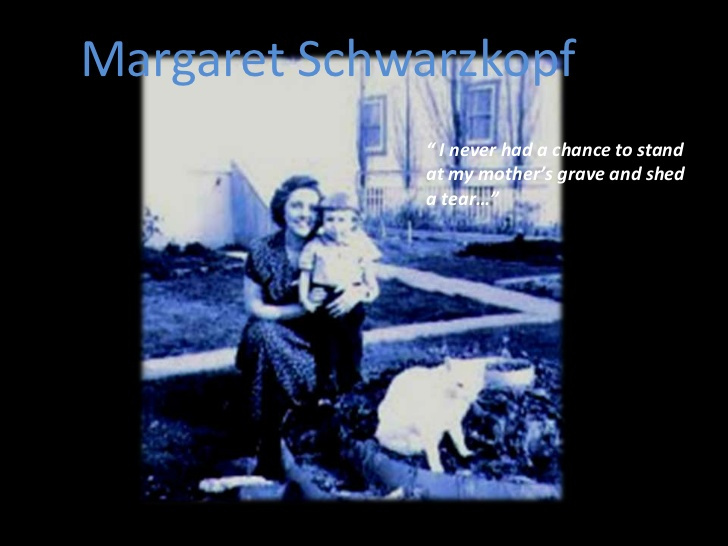
A young Jewish woman was living with the couple at this time, unable to visit her sick mother in Germany, due to anti-Semitic violence of the pre-war period.  Her name was Margaret Schwarzkopf.

Margaret was bereft when her mother died, heartbroken that she could never “stand by my mother’s grave and shed a tear.” Mrs. Frye took up a brown paper shopping bag, and wrote out twelve lines. Eighty-seven words arranged in iambic tetrameter, save for two lines.

She didn’t title the poem, nor did she ever publish, or copyright the work.  People heard about it and liked it. Frye would make copies and send them to those who asked, but that’s about it.

Do not stand at my grave and weep…

The short verse came to be read at funerals and similar occasions, the world over. The first four lines appear on the Chukpi Lhara, that cold and silent memorial to climbers who never returned, from the slopes of Everest. “Desperate Housewives” character Karen McClusky recited the verse as she spread the ashes of her best friend on a baseball field and yet, for three-score years and more, few knew from whence the elegy had come.

Chukpi Lhara

There were many claims to authorship, including attributions to traditional and Native American origins.

I am not there. I do not sleep...

The unknown poem has been translated into Danish, Dutch, French, German, Hebrew, Ilocano, Japanese, Korean, Russian, Spanish, Tagalog and other languages, appearing on countless bereavement cards and read over untold services.

In the United Kingdom, many heard it for the first time in 1995, when a grieving father read it over BBC radio in honor of his son, a soldier slain by a bomb in Northern Ireland. The son had left the poem with a few personal effects and marked the envelope ‘To all my loved ones’.

I am a thousand winds that blow…

For that year’s National Poetry Day, the British television program The Bookworm conducted a poll to learn the nation’s favorite poems. The top picks were published in book form, the preface describing the untitled work as “the unexpected poetry success of the year…despite it being outside the competition.”

The elegy has been set to music and featured in television series and movies and even appears in the multi-player on-line game, World of Warcraft.

Even so, the name, even nationality of the author, remained unknown.

I am the diamond glints on snow…

Abigail Van Buren, better known as “Dear Abby”, researched the history of the poem in 1998 and determined that Mrs. Frye was, after all, the author.

Mary Elizabeth Frye passed away in Baltimore Maryland on September 4, 2004. She was ninety-eight.

The Times of Great Britain published the work on November 5, as part of Frye’s obituary. ‘The verse demonstrated a remarkable power to soothe loss”, wrote the Times. “It became popular, crossing national boundaries for use on bereavement cards and at funerals regardless of race, religion or social status”.

November 4, 1918 Dulce et decorum est

And finally it came, the eleventh hour of the eleventh day of the eleventh month. The church bells rang out in celebration that day in 1918, even as his mother and father, opened the dread telegram. “Deeply regret to inform you, that…”

The words come down to us some 2,000 years from the Roman poet, Horace. Dulcē et decōrum est prō patriā mōrī. It is sweet and proper to die for one’s country.

When the “Great War” broke out in 1914, Wilfred Owen was working as a private English tutor, in Bordeaux. At first in no hurry to sign up, Owen considered joining the French Army before returning home, to England.

In October 1915, he enlisted in the Artists Rifles Training Corps. Originally formed in 1859, the Artists Rifles was a British special forces regiment, raised in London and comprised of painters, musicians, actors and architects, symbolized by the heads of the Roman gods Mars and Minerva.

It must have felt natural.  Wilfred Owen was a poet, a talent first discovered about ten years earlier, at the age of ten or eleven.

Owen was commissioned Second Lieutenant after six-months training, and posted with the Manchester Regiment of line infantry.  An application to the Royal Flying Corps was rejected in 1916 and he was shipped to France, joining the 2nd Manchester regiment near Beaumont Hamel, on the river Somme.

He was contemptuous of his men at first, considering them all to be louts and barbarians.  He wrote home to his mother Susan in 1917, describing his company as “expressionless lumps”.  The war was soon to beat that out of him.

Owen was close with his mother, his letters home telling a tale of mud and frostbite, of endless hours under heavy bombardment, sheltered only by a muddy, flooded dugout, of the fall through shell-shattered earth into the cellar below, that earned him a trip to the hospital.  It would not be his last.

He was caught in an explosion during the bitter battle of St. Quentin, blown off his feet and into a hole, there to spend days fading in and out of consciousness amidst the mangled remains of a fellow officer.

Following this experience, soldiers reported Owen behaving strangely. He was diagnosed as suffering from neurasthenia or shell shock, what we now understand to be Post-Traumatic Stress Disorder, and sent to Craiglockhart War Hospital in Edinburgh, for treatment.

There, Dr. Arthur Brock encouraged Owen to work on his poetry, to overcome shell shock.  There he met another patient, the war poet Siegfried Sassoon. The chance meeting would elevate Wilfred Owen to one of the great war poets, of his generation.

Owen’s work was different before this time, vaguely self important but never self pitying. Never the pacifist – he held those people in contempt – Owen’s nightmares now brought forth a savage honesty and bottomless compassion for the burdens of the ordinary soldier.  Tales of trench life:  of gas, of lice, of mud and death, of hell and returning to earth, steeped in contempt for the patriotic sentimentality of non-combatants and the slurs of cowardice, so lightly dispensed by the women of the “White Feather” movement.

Anthem for Doomed Youth gives a sense of this period:

What passing-bells for these who die as cattle?
— Only the monstrous anger of the guns.
Only the stuttering rifles’ rapid rattle
Can patter out their hasty orisons.

Owen continued to write through his convalescence, his fame as author and poet growing with the late months of 1917 and into March of the following year. Supporters requested non-combat postings on his behalf, but such requests were turned down. It’s unlikely he would have accepted them, anyway. His letters reveal a deep sense of obligation, an intention to return to the front to be part of that life and to tell the story of the common man, thrust by his government into uncommon conditions.

Wilfred Owen well understood his special talent.  He wanted to return to front line combat, made all the more urgent when Sassoon was once again wounded, and removed from the front.

Back in France, Owen captured a German machine gun position on September 29, for which he was awarded the Military Cross.  Posthumously.

He wrote home to his mother on October 31, from the shelter of a cellar in a small wood called Bois l’Évêque, near the Sambre–Oise Canal.  It was the last such note she would ever receive.  “Of this I am certain” he wrote, ” you could not be surrounded by a band of friends half so fine as surround me here.

Sambre-Oise Canal, now

The 44-mile Sambre-Oise Canal flows through the Meuse river basin, a network of 38 locks directing the water’s flow and connecting the Netherlands and Belgium with the central waterways of France. Forces of the 2nd Battalion Royal Sussex forced the canal on November 4 in coordination with elements of the 2nd Manchester Regiment and the Lancashire Fusiliers. British forces were to cross surrounding fields lined with high hedges, then to traverse the canal by portable foot bridges or climbing across lock gates.

The battle of the Sambre–Oise Canal was one of the last Allied victories of the Great War, but not without cost. Lock houses on the opposite side formed strong points for German defensive fire, from small arms and machine guns.

Wilfred Owen was leading a raiding party when the German machine gun barked and chattered to life, the bullets tearing into his body. The armistice ending the ‘War to End All Wars” was to come a week later, nearly to the hour.

Sambre-Oise Canal, then

The eleventh hour of the eleventh day of the eleventh month. The church bells of Shrewsbury rang out in celebration that day in 1918, even as Tom and Susan Owen, the 25-year-old’s mother and father, opened the dread telegram.

“Deeply regret to inform you, that…”

Wilfred March 18, 1893 – November 4, 1918

“Dulce et Decorum Est”

Bent double, like old beggars under sacks,
Knock-kneed, coughing like hags, we cursed through sludge,
Till on the haunting flares we turned our backs,
And towards our distant rest began to trudge.
Men marched asleep. Many had lost their boots,
But limped on, blood-shod. All went lame; all blind;
Drunk with fatigue; deaf even to the hoots
Of gas-shells dropping softly behind.

Gas! GAS! Quick, boys!—An ecstasy of fumbling
Fitting the clumsy helmets just in time,
But someone still was yelling out and stumbling
And flound’ring like a man in fire or lime.—
Dim through the misty panes and thick green light,
As under a green sea, I saw him drowning.

In all my dreams before my helpless sight,
He plunges at me, guttering, choking, drowning.

If in some smothering dreams, you too could pace
Behind the wagon that we flung him in,
And watch the white eyes writhing in his face,
His hanging face, like a devil’s sick of sin;
If you could hear, at every jolt, the blood
Come gargling from the froth-corrupted lungs,
Obscene as cancer, bitter as the cud
Of vile, incurable sores on innocent tongues,—
My friend, you would not tell with such high zest
To children ardent for some desperate glory,
The old Lie: Dulce et decorum est
Pro patria mori.

Wilfred Owen, 1917

November 3, 1954 King of Monsters

The atomic explosions at Hiroshima and Nagasaki were a short nine years in the past in 1954 when a ferocious, anti-nuclear sentiment began to build in Japan. In this context there arose a metaphor for the titanic destruction wrought by the atomic bombs. A Great Beast, literally rising from the sea, the product of the Japanese entertainment industry.


It was 6:45am local time on March 1, 1954, when a flash lit up the sky over the Pacific, like the sun itself.   Then came the sound. An explosion outside the experience of all but the tiniest fraction among us, followed by the mushroom cloud, towering into the atmosphere.  It was a test, the detonation of a TX-21 thermonuclear weapon with a predicted yield of 6 megatons with the unlikely codename, of “Shrimp”.

The 23 men of the fishing boat Daigo Fukuryū Maru (“Lucky Dragon No.5”) were working the grounds near the Marshall Islands that day, in the equatorial Pacific. For a full eight minutes, these twenty-three men watched the characteristic mushroom cloud rise above them.  An hour and a half later came the fallout, the fine white dust, calcinated coral of the Bikini atoll, falling from the sky, like snow.

None among the twenty-three recognized the material as hazardous, and made no effort to avoid exposure.  Some men even tasted the stuff.

Operation_Crossroads_Test_Baker_In_Colour

Over the next three days, several fishermen developed acute radiation sickness.   By the time they returned to Yaizu two weeks later, all 23 were suffering from nausea, headaches, bleeding from the gums and other symptoms.  One was destined to die six months later from a liver disorder, brought on by radiation sickness.  They had entered the ranks of that most exclusive of clubs that no one, Ever, wanted to join. They were “hibakusha”.  The “explosion-affected people”.

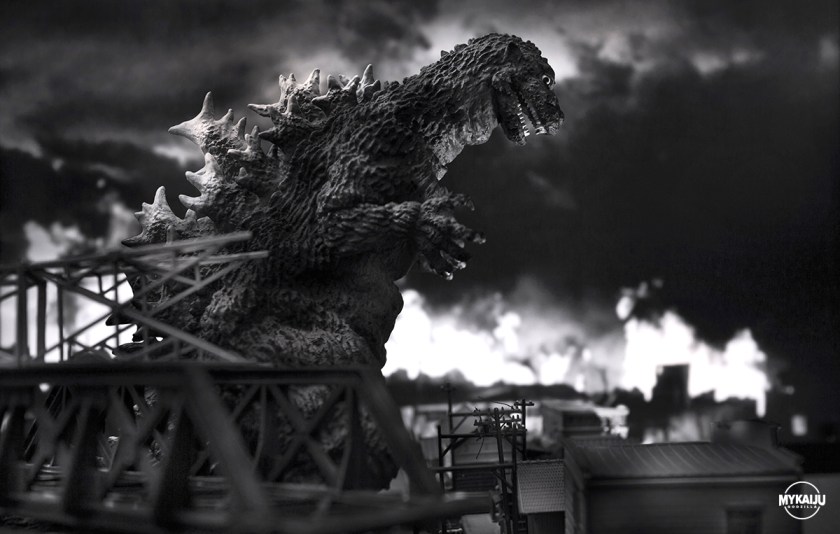
The atomic explosions at Hiroshima and Nagasaki were a short nine years in the past in 1954 when a ferocious, anti-nuclear sentiment began to build in Japan. In this context there arose a metaphor for the titanic destruction wrought by the atomic bombs. A Great Beast, literally rising from the sea, the product of the Japanese entertainment industry. A monster, “Godzilla”, Ishirō Honda’s first film released by Toho Studios on this day, in 1954.

The name is a portmanteau, two words combined to form a third, of the Japanese word “gorira”, (gorilla), and “kujira”, meaning whale.  Godzilla was the Gorilla Whale with the head of a Tyrannosaur, Stegasaur-like plates on his back and skin modeled after the hideous keloid scarring, of the hibakusha.

The original Godzilla (“ɡodʑiɽa”) was awakened by atomic testing and impervious to any but a nuclear weapon. Emerging from the depths with his atomic breath, havoc and destruction was always accompanied by the distinctive roar, a sound effect made by rubbing a resin glove down the strings of a bass violin and then changing the speed, at playback.

1-g54-bridge-1

The actor who played Godzilla in the original films, Haruo Nakajima, was a black belt in Judo. His expertise was used to choreograph the monster’s movements, defining the standard for most of the Godzilla films, to follow.

Originally an “it”, Godzilla was usually depicted as a “he”, although that became a little complicated with the 1998 American remake when “Zilla” started laying eggs.

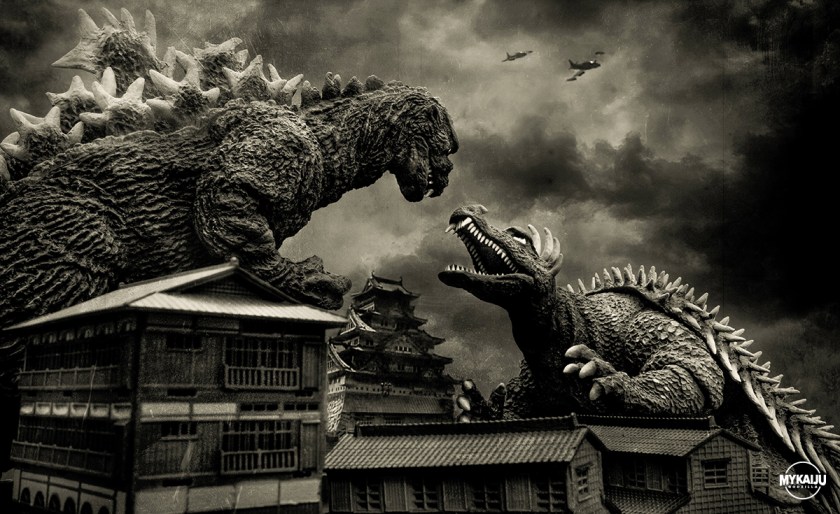
He was a Kaiju, a Japanese word meaning “strange creature”, more specifically a “daikaiju”, meaning a really, really big one. Godzilla is the best known but certainly not the only such creature of the Japanese entertainment industry. You may remember other kaiju including Gamera, Mothra, King Ghidorah, Mechagodzilla and Rodan.

2-g55-angirus-1

Godzilla has appeared in 28 original films, with more in the works. Over the course of his existence he has been a hero, a villain, and a destructive but values-neutral force of nature.

Godzilla got his own star on the Hollywood “Walk of Fame” in 2004, timed to coincide with the release of the 29th film of the genre, “Godzilla: Final Wars.” Instead of nuclear weapons testing, this version was spawned by “environmental pollution”. It takes the superheroes of the “Earth Defense Organization” (but, of course) to freeze him back into the ice of the South Pole.

The film was a flop, grossing less than $12 million after a production budget over half again, as large.

The franchise came roaring back ten years later, when Godzilla was released in 2014, grossing $200 million domestically with $529.1 million in worldwide sales.

To this day, the man who played those original 12 films is considered the best “suit actor”, in franchise history. In 2018, asteroid 110408 Nakajima was named in his memory.

34622

A film franchise 66 years in the making is still going strong and will continue to do so, for the foreseeable future. Godzilla: King of the Monsters released in 2019 with a Box Office of $386.6 million and a production budget, of less than $200 million. Godzilla vs. Kong, originally scheduled for release this year, went the way of so many things in 2020 and fell victim, to the Chinese Coronavirus. The 36th film in the series is complete and currently scheduled for release in May, 2021.

Tip of the hat to http://www.mykaiju.com, for most of the images used in this story.

November 2, 1985 The Curse of Colonel Sanders

Much has been written of 1930’s Japan and the military officers, who brought the nation to war. How different the 20th century could have been, had those guys picked up baseball, instead.

Baseball as we know it was introduced to the country in 1872. To this day, the game remains the most popular sport in the nation for participants and spectators, alike. In 1907, Tsuneo Matsudaira commented: “the game spread, like a fire in a dry field, in summer, all over the country, and some months afterwards, even in children in primary schools in the country far away from Tōkyō were to be seen playing with bats and balls“.

Oh. Did I neglect to mention? The nation we’re talking about, is Japan.

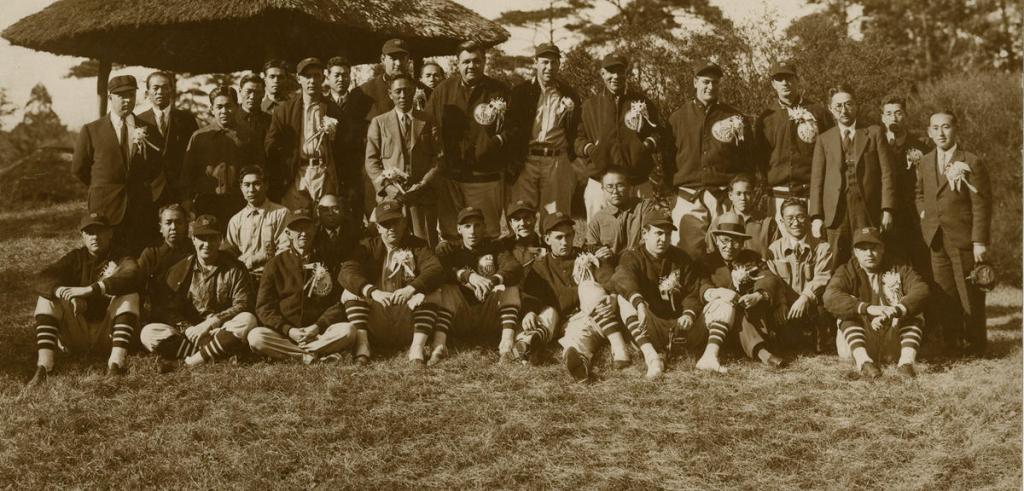
Professional baseball got off to a rocky start in 1920s Japan and continued to flounder, until 1934. That’s when media bigwig Matsutarō Shōriki pulled off a “goodwill tour” with an all-star American team including Babe Ruth, Jimmie Foxx, Lou Gehrig, Connie Mack and Charlie Gehringer. Even Moe Berg was part of that 1934 entourage, the Jewish catcher known as “the brainiest guy in baseball,” who went behind enemy lines during World War 2, to spy on Nazi Germany.

“The [1934] party included future Hall of Famers Earl Averill, Lou Gehrig, Charlie Gehringer, Lefty Gomez, Connie Mack, Foxx and Ruth, along with several other American Leaguers (asked to accompany the tour when the National League forbade its stars from coming along). Even Moe Berg, the big league catcher who would eventually work as a United States government spy, was a member of the ball playing entourage”. H/T baseballhall.org

Much has been written of 1930’s Japan and the military officers, who brought the nation to war. How different the 20th century could have been, had those guys picked up baseball, instead.

The first Japanese professional league was formed in 1936, becoming large enough to split into two leagues in 1950, the Central and Pacific.

Today, the Kansai region of Honshu is the 2nd largest metropolis, in all Japan. That’s where you’ll find the Hanshin Tigers, those perennial underdogs of Nippon Professional Baseball and arch-rival to the Yomiuri Giants of Tokyo, widely regarded as the kings of Japanese baseball.

As a life-long Red Sox fan, this story is beginning to sound familiar.

35 years ago today was a time of unbridled joy for delirious Tigers fans, following Hanshin’s 6-2 drubbing of the Seibu Lions to win the ultimate prize, the Japan series pennant of 1985.

Now you may not know this, but Japan is one of the largest markets in the world for Kentucky Fried Chicken, #3 behind the United States and China. Not bad for a fast food outfit that opened its first Japanese franchise, only fifteen years earlier.

The Boston baseball fan is well acquainted with the “Curse of the Bambino”, the 86-year World Series championship drought, second only to the “Curse of the Billy Goat” that denied victory to long-suffering Chicago fans, for 106 years.

Since 1985, Japanese mothers have scared wayward children into acting right, with the curse of Colonel Sanders.

The Hanshin club emerged victorious in 1985, due in large part to the efforts of American slugger, Randy Bass. Delirious after unexpected victory in game one and superstitious as baseball fans the world over, Hanshin supporters gathered at the Ebisu Bridge over the Dōtonbori river in Osaka, to partake in one of the most bizarre spectacles, in modern sports.

Fans would shout out the names of Tigers players and someone who resembled that player, even vaguely, would jump into the river. There being no Caucasians in attendance to represent Mr. Bass, the crowd took hold of a storefront statue of Harlan Sanders, and threw it into the River.

What the hell. They both had beards.

Thus began the curse of Colonel Sanders, a losing streak brought on by the ghost of a man who didn’t appreciate being thrown into a river. Brief rallies in 1992 and again in ’99 brought hope once again to the Hanshin faithful, (gosh, this story sounds Really familiar now), only to have cruel fate, block the way. Repeated efforts were made to retrieve the Colonel from the river, only to be met with failure. The curse, dragged on.

The joy of victory smiled upon the land of Hanshin once again in 2003, when Yomiuri Giants MVP Hideki Matsui was traded to the New York Yankees, clearing the way to a Central League pennant for Hanshin. Even so, final victory remained elusive. The Japan series went to the Fukuoka Daiei Hawks that year, in 7 games.

Celebration turned to tragedy that year, when thousands of Tigers fans jumped into the river. 24-year-old Masaya Shitababa, drowned. The Osaka city council ordered construction of a new bridge over the Dōtonbori beginning in 2004, making further such jumps, next to impossible.

Divers discovered the upper part of Harlan Sanders’ statue on March 10, 2009 and the lower piece, the following day. And yet the Colonel’s other hand and eyeglasses, were nowhere to be found.

Colonel Sanders’ left hand and spectacles remain missing to this day and the KFC where it all started, is closed and gone forever. So it is for long suffering fans of the Hanshin Tigers, the curse of Colonel Sanders, lives on.

“Dangerous! Do not dive into this river. Osaka Regional Development Bureau and Osaka-Minami Police station” sign at the new Ebisubashi bridge H/T Wikipedia

November 1, 1959 Game Face

For NHL hockey, the face mask became standard equipment on this day, in 1959. I’m not sure if goalies are any prettier these days, but they have a lot more teeth.

Stanley Cup

In the Netherlands, modern ice hockey began sometime in the 16th century.  North Americans have played the sport since 1855.   For all that time, flying hockey pucks have collided with the faces of goaltenders.  The results have not have been pretty.

The name of Montreal Canadien goal tender Jacques Plante is engraved five times on Lord Stanley’s cup, once for each of five consecutive championships between 1956, and ‘60.  

For a lifelong Bruins fan, that isn’t easy to say.

Jacques Plante Putting on Mask
Original caption: 11/1/1959-New York, NY- His face and shirt bloodied, Montreal Canadiens goalie Jacques Plante puts on a special plastic mask after being treated for a facial cut received in the opening period of the Rangers-Canadiens hockey game. Plante suffered a severe gash on the left side of his face when he was struck by a shot off the stick of Andy Bathgate of the New York Rangers. After donning the mask, which he had designed himself, Plante returned to the game. November 1, 1959 New York, New York, USA

Plante literally wrote the book on NHL goal tending. He was the first to take the position outside of the crease, making himself the third defenseman. He was the first to take the puck behind the net and the first to bring anything even vaguely resembling stick handling, to the position. Before Plante, a Goalie’s job was pretty much to deflect the puck and let the defenders take it from there.

On this day in 1959, Jacques Plante decided he’d had enough. It was three minutes into a game with the New York Rangers when he took a puck to the nose on a shot fired by Andy Bathgate. The puck broke his nose, opening a wound requiring seven stitches to close.  When Plante returned to the ice, he was wearing a fiberglass mask.

Coach Toe Blake was furious. He had allowed the mask during practice, but this was regulation.  Nobody wore a mask.  Coaches believed they cut the goaltender’s field of vision, and, besides.  These were supposed to be the “fearless” guys, who jumped in front of the puck.

Easy for him to say.  It wasn’t his face.  Plante was adamant, and Blake wasn’t about to bench the best goalie in the NHL. There would be one more game when Plante played without the mask, the only game the Canadiens lost in that series, and that was the end of it.  

For Jacques Plante, the mask had now become standard equipment.

In 1966, Life Magazine published an image of Toronto Maple Leafs goalie Terry Sawchuk, “a face only a hockey puck could love“. “Re-created here, by a professional make-up artist and a doctor” read the accompanying article, “are some of the more than 400 stitches he had earned during 16 years in the National Hockey League. Terry Sawchuk’s face was bashed over and over, but not all at one time. His wounds healed. The scars weren’t easily seen – except for a few of them. The re-creation of his injuries was done to help show the extent of his injuries over a span of years”.

During a 1968-’69 season playoff game against the Boston Bruins, a puck fired by Phil Esposito hit Plante in the forehead, knocking him out, cold.  He later said that the mask had saved his life.  He’s probably right.

Gerry Cheevers, who played for the 1970-’72 Bruins, famously had his mask marked up with stitches. That started when a puck hit him in the face during practice. When Bruins coach Harry Sinden followed Cheevers to the dressing room, he found the goalie enjoying a beer and smoking a cigarette. Sinden sent Cheevers back out on the ice and John Forestall, the team trainer, painted stitches on his mask. Every time Cheevers was hit after that, he would have new stitches painted on. The mask became one of the most recognizable symbols of the era, and now hangs on the wall of his grandson’s bedroom.

Gerry Cheevers
Gerry Cheevers

Jacques Plante wasn’t the first NHL goaltender to wear a face mask.  Montreal Maroons’ Clint Benedict wore a crude leather mask in 1929, to protect a broken nose.

clint-benedict
Montreal Maroon’s goaltender Clint Benedict, 1930

It was Plante who introduced the face mask as everyday equipment, now a mandatory fixture for all goaltenders.

I’m not sure if NHL goalies are any prettier these days, but I bet they have a lot more teeth.