Captain Phillips was too much of an imp, to miss out on the navigational freak of a lifetime. Course was adjusted and speed fine-tuned, bringing the Warrimoo to just the right place and time.
“Warrimoo.” The word seems to come from the Aboriginal Ladjiladji people along the border land of New South Wales and Victoria in South Australia, and translating as ‘Eagle’, or ‘Place of Eagles’.
The SS Warrimoo was a passenger steamer, launched in 1892 to serve the Trans-Tasman route between Australia and New Zealand. Later assigned to a Canada-to-Australia passenger route, she would be taken into service as a troop ship with the advent of the Great War, in 1914.
The first Maori detachment destined for the disastrous Gallipoli campaign of 1915 departed Wellington aboard the SS Warrimoo that February, its motto ‘Te Hokowhitu a Tū’ (the seventy twice-told warriors of the war god).
A list of WW1 troop ship departures from New Zealand shows 113 such passages, on which the Warrimoo appears, three times.
The troop ship met its end on May 17, 1918 on a convoy from Tunisia to Marseille. Warrimoo collided with the escorting French warship Catapulte, dislodging the destroyer’s depth charges and blowing out the bottom plates of both vessels. SS Warrimoo and Catapulte went down together with loss of life, yet this is not why the troop ship is remembered.
Nineteen years earlier, the “War to End all Wars” was part of some unknown and unknowable future. A century begun with the Napoleonic Wars and President Thomas Jefferson’s Corps of Discovery, (better known as the Lewis and Clark Expedition), was drawing to a close on the tranquil, moonlit waters of the world’s largest and deepest Ocean.
A simplified illustration of the relation between date line, date and time of day. Each color represents a different date. H/T, Wikipedia
On this day in 1899, SS Warrimoo plied the waters of the central Pacific, in transit from Vancouver to Brisbane.
It was warm and clear with the approach of midnight, the Warrimoo’s position LAT 00 31′ N and LON 179 30′ W. Captain John Phillips quietly puffed on a cigar as 1st Mate Payton, broke into his reverie. “Know what this means? We’re only a few miles from the intersection of the Equator and the International Date Line“.
Captain Phillips called his navigators to check the position, and then check it again. It was true.
Captain Phillips was too much of an imp, to miss out on the navigational freak of a lifetime. Course was adjusted and speed fine-tuned, bringing the Warrimoo to just the right place and time.
At precisely midnight on December 31, 1899, the steamer passed through that imaginary point where the international dateline, meets the equator.
The bow of the ship was in the Southern Hemisphere, where it was the middle of summer. The stern was still in the Northern Hemisphere, where it was the middle of winter. The date on the starboard side of the ship was January 1, 1900. On the port side, it was still December 31, 1899.
For that one moment in time, the SS Warrimoo was in two different days, two different months, two different years, two different seasons, and two different centuries. All at the same time.
All the best from the Long family to yours, for a healthy and prosperous New Year. May this be the first of many more.
If you enjoyed this “Today in History”, please feel free to re-blog, “like” & share on social media, so that others may find and enjoy it as well. Please click the “follow” button on the right, to receive email updates on new articles. Thank you for your interest, in the history we all share.
For the Americans and their allies, the frontal assault of October 9 was one of the bloodiest engagements, of the Revolution. It could have been worse. As battered American and French soldiers fell back, 500 free men of color known as the Chasseurs Volontaires de Saint-Domingue stepped up, to cover their retreat.
Many of these Haitian soldiers went on to win their own war of independence, and credited their military experience, to Savannah.
As 1778 drew to a close, British military planners could look back on five years of trying to suppress rebellion in the American colonies, with little to show for it. In March of that year, the British defeat at Saratoga had brought France into the war, on the side of the Rebels.
Two years of open warfare had centered mostly on the north. Now, a “southern strategy” was devised to conquer rebellious colonies in the south, while isolating those to the north. Key to the Southern Strategy was Georgia and the colonial capital at Savannah, the southernmost commercial port of the thirteen Colonies.
General sir Henry Clinton dispatched a force of some 3,100 from New York under Lieutenant Colonel Archibald Campbell, along with an unknown quantity of artillery. Campbell arrived outside Tybee Island on December 23.
Georgia was defended by two separate forces at this time, units of the Continental Army under the command of General Robert Howe, and state militia under the command of Governor John Houstoun. The two men had a history of squabbling for control and most of their troops, had yet to be tried.
Lieutenant Colonel Archibald Campbell, British commander at the capture of Savannah in December 1778
The 850 under General Howe never really had a chance, against the battle hardened Regulars, Hessian auxiliaries and Loyalist militia, coming ashore on December 29. Defeat turned to rout when Howe’s forces threw down their weapons and ran. Campbell reported that “It was scarcely possible to come up with them, their retreat was rapid beyond conception.
Patriot forces suffered 83 killed, 11 wounded and 453 captured. Campbell suffered 7 killed and 17 wounded.
Howe was court-marshaled for the disaster, while Campbell bragged about being “the first British officer to [rend] a star and stripe from the flag of Congress“
Brigadier General Augustine Prevost arrived from St. Augustine Florida two weeks later, with a mixed force of Regulars and Creek and Cherokee allies. Campbell and a force of 1,000 would take the provisional capital at Augusta that February but soon retreated to Savannah, citing insufficient support among Loyalist and Native American populations.
American hopes soon fell back on their new-found alliance with France. During the following summer, French Admiral Count Charles-Hector Theodat d’Estaing captured St. Vincent and Grenada in the British West Indies, clearing the way to the Georgia coast. The powerful 47-ship French fleet arrived with 4,000 troops on September 1, surprising and capturing several British ships outside the mouth of the Savannah River.
D’Estaing sent an ultimatum to British Commander Augustine Prevost on September 16, 1779. He was to surrender the city “To the arms of his Majesty the King of France”, or he would be personally answerable for what was about to happen. It could not have pleased General Benjamin Lincoln or his Patriot allies when d’Estaing added “I have not been able to refuse the army of the United States uniting itself with that of the King. The junction will probably be effected this day. If I have not an answer therefore immediately, you must confer with General Lincoln and me”.
“Bullet Head Prevost”, so called because of a circular scar on his temple, stalled for 24 hours, using the time in furiously building up his defenses and calling up 800 reinforcements from South Carolina.
Lincoln joined d’Estaing on September 23 with an army of 3,000 militia and Continental soldiers, laying siege to Savannah and the 2,500 British and Loyalist troops in occupation.
On October 1, a British relief column under one Captain French was coming to the city’s aid, camped on the banks of the Ogeechee River. Georgia Continental Colonel John White had two officers, a sergeant and three privates with him, when he tricked French into surrendering. These guys ran through the woods lighting so many fires that the British thought the entire continental Army was bivouacked around them. Captain French was unavailable for comment but, it must be a special feeling, knowing that you just surrendered 111 guys to six, without firing a shot.
View of the siege works against the town at the Siege of Savannah September and October 1779 in the American Revolutionary War: contemporary picture by a French officer
Lack of horses and artillery carriages delayed the allies’ moving their cannon ashore, so French warships bombarded the city from the sea. At one point shortly after Midnight on October 3, with rum rations flowing far too freely, fire from French gunners became more dangerous to themselves than to the city itself.
For the Americans and their allies, the frontal assault of October 9 was one of the bloodiest engagements, of the Revolution. It could have been worse. As battered American and French soldiers fell back, 500 free men of color known as the Chasseurs Volontaires de Saint-Domingue stepped up, to cover their retreat.
Many of these Haitian soldiers went on to win their own war of independence, and credited their military experience, to Savannah.
Franklin Square Monument remembers the contributions of the Haitian militia, in the Siege of Savannah
The siege of Savannah inflicted untold misery among the population, but Patriot forces and their French allies, never did break the city’s defenses. The siege broke a short time later, amidst recriminations on both sides. D’Estaing returned to France, where he lost his head to the guillotine in 1794.
Savannah would remain in British hands until the end of the war, finally evacuated on July 11, 1782. A coquina marker in a small Savannah park; that soft, seashell limestone common throughout the Caribbean basin to Florida and beyond, bears a small brass plaque, darkened with the patina of age.
COMMEMORATIVE OF THE BRITISH EVACUATION OF SAVANNAH 1782
PRESENTED TO THE CITY OF SAVANNAH
BY THE
LACHLAN McINTOSH CHAPTER
DAUGHTERS OF THE AMERICAN REVOLUTION
1904
Attack of 2nd South Carolina Continentals on the Spring Hill Redoubt at the Siege of Savannah on 9th October 1779 in the American Revolutionary War: picture by A.I. Keller
In Spanish speaking countries, newspapers and television stations do gag stories on December 28. A few years ago, headlines read that Kate Middleton was leaving Prince William for Mexican soccer star Chicharito.
In 1983, Boston University history professor Joseph Boskin explained the custom of ‘April Fools Day’ goes back to the Roman Emperor Constantine. A group of jesters and fools informed the Emperor, that they could do his job, better. Amused, Constantine appointed a jester named Kugel, ‘King for a Day’.
Professor Boskin went on to explain. “In a way,” he said, “it was a very serious day. In those times fools were really wise men. It was the role of jesters to put things in perspective with humor.” The Associated Press picked up the story, and newspapers ran it, across the country.
It took AP a couple weeks to realize, the professor had made the whole thing up. April fools.
In one translation of Chaucer’s Canterbury Tales, “March 32” in the year 1392 is the day the vain cock Chauntecleer was tricked by a fox. The fox appealed to the rooster’s vanity by insisting he would love to hear Chauntecleer crow, just as his amazing father did. Standing on tiptoe with neck outstretched and eyes closed. The rooster obliged, with unfortunate, if not unpredictable results.
In most of the west, March 32 is that minor holiday on which we love to play pranks. In Scotland, April Fools’ Day is called Hunt-the-Gowk Day. Although the term has fallen into disuse, a “gowk” is a cuckoo or a foolish person. The prank consists of asking someone to deliver a sealed message requesting some sort of help. The message reads “Dinna laugh, dinna smile. Hunt the gowk another mile”. On reading the message, the recipient will explain that to help, he’ll first need to contact another person, sending the victim to another person with the same message.
On April 1, 1698, citizens were invited to the Tower of London to witness the “Washing of the Lions” in the tower moat. Quite a few were sucked in. The April 2 edition of Dawks’ News-Letter reported that “Yesterday being the first of April, several persons were sent to the Tower Ditch to see the Lions washed.” The “annual ceremony of washing the lions,” lasted throughout the 18th & 19th centuries, always held on April 1st.
There is no “White Gate”, at the tower of London
In 1957, (you can guess the date), the BBC reported the delightful news that mild winter weather had virtually eradicated the dread spaghetti weevil of Switzerland, and that Swiss farmers were now happily anticipating a bumper crop of spaghetti. Footage showed smiling Swiss peasants, pulling strands of spaghetti down from trees. Apparently, an embarrassingly large number of viewers were fooled. Many called BBC offices, asking how to grow their own spaghetti tree. “Place a piece of spaghetti in a tin of tomato sauce”, callers were told, “and hope for the best.”
In Mexico as well as Spain and most Latin countries, pranksters practice their craft not on April 1 but on December 28. The custom goes back to the biblical story of King Herod, who is said to have killed all the baby boys in Bethlehem, to rid himself of the future ‘King of the Jews. The “Massacre of the Innocents” is a sad story but the ‘joke’ was on Herod. Mary and Joseph had taken the baby Jesus away, to Egypt.
So it is that el Día de los Santos Inocentes (Day of the Holy Innocents) is observed in Spanish speaking countries, on December 28. In a sort of gallows humor, the butt of the joke is the “¡Inocente!” or “Innocent one”.
Newspapers and television stations run gag stories on December 28. A few years ago, headlines read that Kate Middleton was leaving Prince William for Mexican soccer star Chicharito.
For two-hundred years now, the citizens of Ibi, Alicante on the Spanish Mediterranean coast have celebrated December 28, with a giant food fight. The practice was suspended for a time following the Spanish Civil War but revived, in 1981. Now, it’s a big tourist attraction, and the event makes a ton of money, for charity.
Who needs to run with bulls when you have la fiesta de Los Enharinados. “The Fiesta of the Flour-Covered Ones.”
Participants are covered with flour at the fiesta of Los Enharinados in Ibi, Spain. Fotógrafo Ibi/Creative Commons ASA 4.0 International.
Feature image, top of page: Food fight participants are at the fiesta of Los Enharinados in Ibi, Spain.
If you enjoyed this “Today in History”, please feel free to re-blog, “like” & share on social media, so that others may find and enjoy it as well. Please click the “follow” button on the right, to receive email updates on new articles. Thank you for your interest, in the history we all share.
Nearly 100,000 Allied and German troops were involved in the unofficial ceasefire of Christmas 1914, lasting in some sectors until New Year’s Day.
“Sitzkrieg”. “Phony War”. Those were the terms used to describe the September ‘39 to May 1940 period, when neither side of what was to become the second world war, was yet prepared to launch a major ground war against the other.
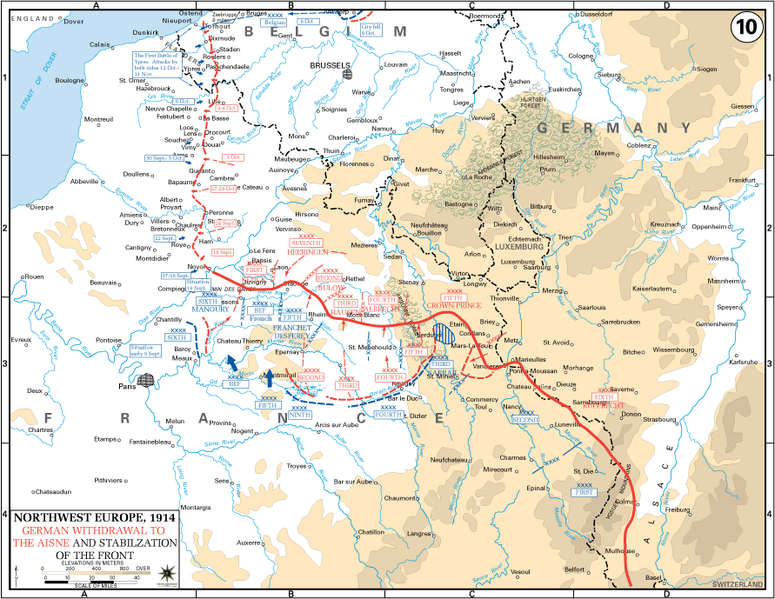
The start of the “Great War” twenty-five years earlier, was different. Had you been alive in August 1914, you would have witnessed what might be described as the simultaneous detonation of a continent. France alone suffered 140,000 casualties over the four day “Battle of the Frontiers”, where the River Sambre met the Meuse. 27,000 Frenchmen died in a single day, August 22, in the forests of the Ardennes and Charleroi. The British Expeditionary Force escaped annihilation on August 22-23, only by the intervention of mythic angels, at a place called Mons.
First Battle of the Marne, September 1914 H/T Britannica
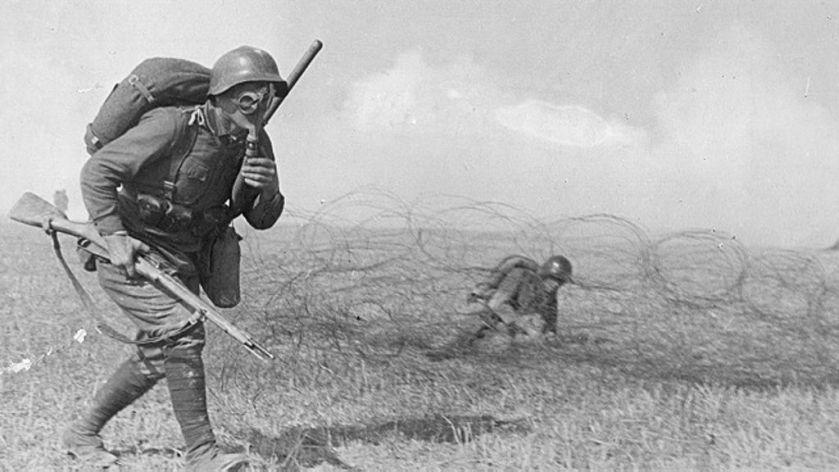
In the East, a Russian army under General Alexander Samsonov was encircled and so thoroughly shattered at Tannenberg, that German machine gunners were driven to insanity at the damage inflicted by their own guns, on the milling and helpless masses of Russian soldiers. Only 10,000 of the original 150,000 escaped death, destruction or capture. Samsonov himself walked into the woods, and shot himself.
Russian soldiers, WW1, H/T BBC
The “Race to the Sea” of mid-September to late October was more a series of leapfrog movements and running combat, in which the adversaries tried to outflank one another. It would be some of the last major movement of the Great War, ending in the apocalypse of Ypres, in which 75,000 from all sides lost their lives. All along a 450-mile front, millions of soldiers dug into the ground to shelter themselves from what Private Ernst Jünger later called a “Storm of Steel”.
On the Western Front, it rained for much of November and December that first year. The no man’s land between British and German trenches was a wasteland of mud and barbed wire. Christmas Eve, 1914 dawned cold and clear. The frozen ground allowed men to move about for the first time in weeks. That evening, English soldiers heard singing. The low sound of a Christmas carol, drifting across no man’s land…Stille Nacht, heilige Nacht…Silent Night.
The Tommies saw lanterns and small fir trees. Messages were shouted along the trenches. In some places, British soldiers and even a few French joined in the Germans’ songs. Alles schläft; einsam wacht, Nur das traute hochheilige Paar. Holder Knabe im lockigen Haar…
Christmas day truce of 1914 published 1915 London illustrated news
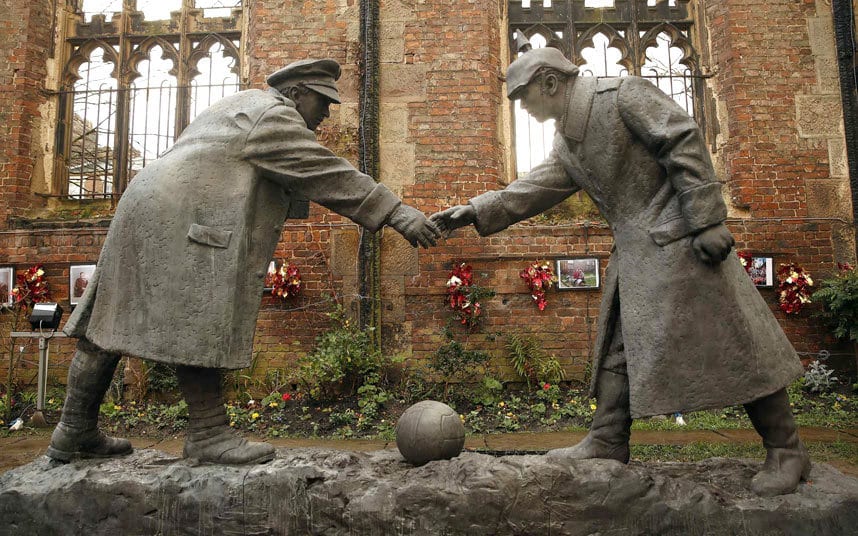
The following day was Christmas, 1914. A few German soldiers emerged from their trenches at the first light of dawn, approaching the Allies across no man’s land and calling out “Merry Christmas” in the native tongue of their adversaries. Allied soldiers first thought it was a trick, but these Germans were unarmed, standing out in the open where they could be shot on a whim. Tommies soon climbed out of their own trenches, shaking hands with the Germans and exchanging gifts of cigarettes, food and souvenirs. In at least one sector, enemy soldiers played a friendly game of soccer.
Captain Bruce Bairnsfather later wrote: “I wouldn’t have missed that unique and weird Christmas Day for anything. … I spotted a German officer, some sort of lieutenant I should think, and being a bit of a collector, I intimated to him that I had taken a fancy to some of his buttons. … I brought out my wire clippers and, with a few deft snips, removed a couple of his buttons and put them in my pocket. I then gave him two of mine in exchange. … The last I saw was one of my machine gunners, who was a bit of an amateur hairdresser in civil life, cutting the unnaturally long hair of a docile Boche, who was patiently kneeling on the ground whilst the automatic clippers crept up the back of his neck.”
Captain Sir Edward Hulse Bart reported a sing-song which “ended up with ‘Auld lang syne’ which we all, English, Scots, Irish, Prussians, Wurttenbergers, etc, joined in. It was absolutely astounding, and if I had seen it on a cinematograph film I should have sworn that it was faked!”
Nearly 100,000 Allied and German troops were involved in the unofficial ceasefire of Christmas 1914, lasting in some sectors until New Year’s Day.
A few tried to replicate the event the following year, but there were explicit orders preventing it. Captain Llewelyn Wyn Griffith recorded that after a night of exchanging carols, dawn on Christmas Day 1915 saw a “rush of men from both sides … [and] a feverish exchange of souvenirs” before the men were quickly called back by their officers.
One German unit tried to leave their trenches under a flag of truce on Easter Sunday 1915, but were warned off by the British opposite them.
German soldier Richard Schirrmann wrote in December 1915, “When the Christmas bells sounded in the villages of the Vosges behind the lines …. something fantastically unmilitary occurred. German and French troops spontaneously made peace and ceased hostilities; they visited each other through disused trench tunnels, and exchanged wine, cognac and cigarettes for Westphalian black bread, biscuits and ham. This suited them so well that they remained good friends even after Christmas was over”.
Some will tell you, the bitterness engendered by continuous fighting made such fraternization all but impossible. Yet, there are those who believe that soldiers never stopped fraternizing with their opponents, at least during the Christmas season. Heavy artillery, machine gun, and sniper fire were all intensified in anticipation of Christmas truces, minimizing such events in a way that kept them out of the history books.
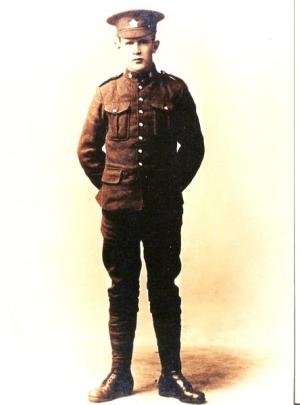
Pvt. Ronald MacKinnon, H/T National Post
Even so, evidence exists of a small Christmas truce in 1916, though little is known of it. 23-year-old Private Ronald MacKinnon of Princess Patricia’s Canadian Light Infantry, wrote home about German and Canadian soldiers reaching across battle lines near Arras, sharing Christmas greetings and trading gifts. “I had quite a good Christmas considering I was in the front line”, he wrote. “Christmas Eve was pretty stiff, sentry-go up to the hips in mud of course. … We had a truce on Christmas Day and our German friends were quite friendly. They came over to see us and we traded bully beef for cigars”. The letter ends with Private MacKinnon noting that “Christmas was ‘tray bon’, which means very good.”
Private Ronald MacKinnon of Toronto Ontario, Regimental number 157629, was killed barely three months later on April 9, 1917, during the Battle of Vimy Ridge.
The Man He Killed
by Thomas Hardy
Had he and I but met By some old ancient inn, We should have set us down to wet Right many a nipperkin!
But ranged as infantry, And staring face to face, I shot at him as he at me, And killed him in his place.
I shot him dead because– Because he was my foe, Just so: my foe of course he was; That’s clear enough; although
He thought he’d ‘list, perhaps, Off-hand like–just as I– Was out of work–had sold his traps– No other reason why.
Yes; quaint and curious war is! You shoot a fellow down You’d treat, if met where any bar is, Or help to half a crown.
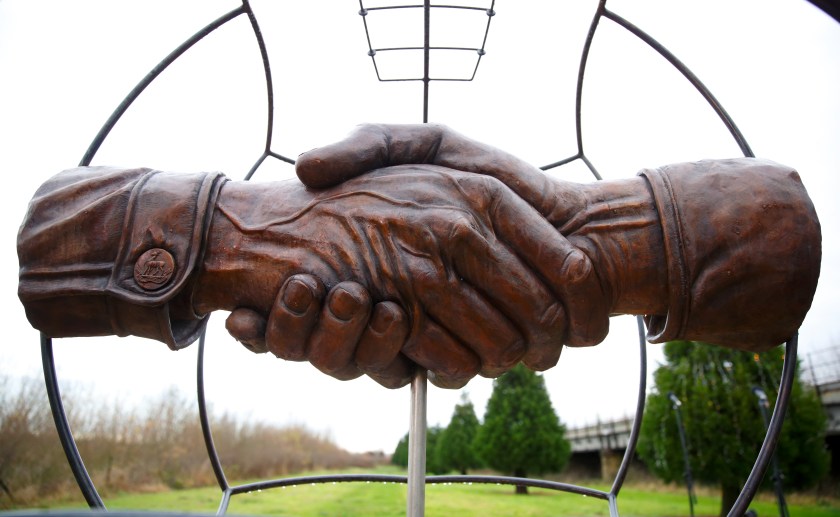
Christmas truce memorial, National Arboretum, Staffordshire, England
If you enjoyed this “Today in History”, please feel free to re-blog, “like” & share on social media, so that others may find and enjoy it as well. Please click the “follow” button on the right, to receive email updates on new articles. Thank you for your interest, in the history we all share.
Santa Claus may be the most powerful cultural idea, ever conceived. This year, Christmas sales are expected to exceed one Trillion dollars. Not bad for a 2,000-year old saint, best remembered for gift giving with no expectation of anything in return.
The historical life of St. Nicholas is shrouded in legend. Born in modern-day Turkey on March 15, AD270, Nicholas was the only child of rich parents who died in a plague, leaving the boy a wealthy orphan.
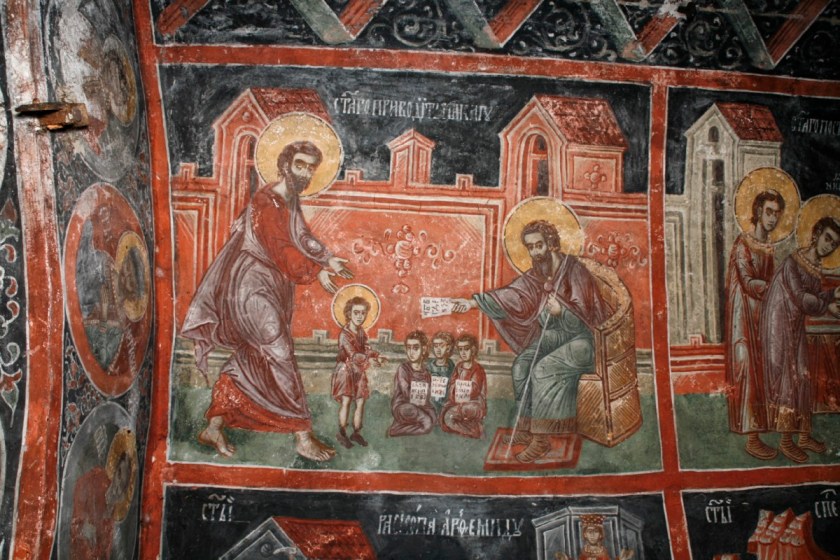
1689 fresco depicts St. Nicholas, giving to a school
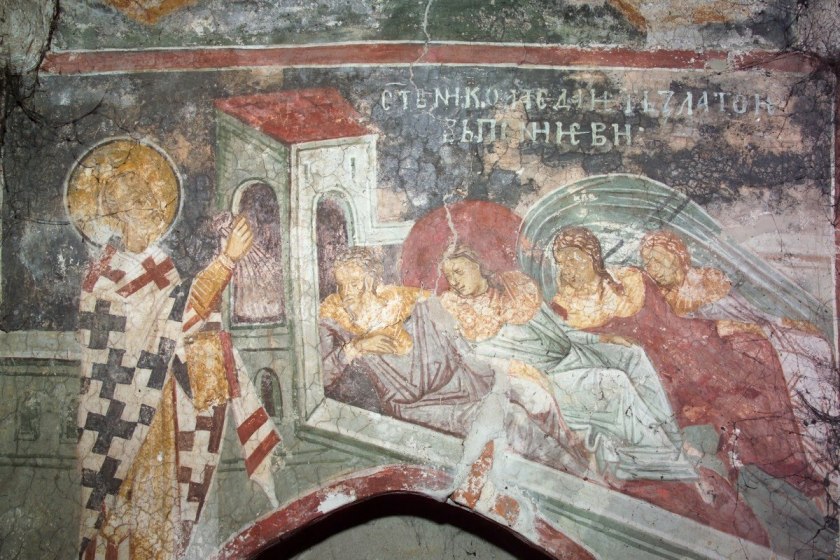
Nicholas was raised in the Christian faith and became an early bishop in the Greek church. One of many stories concerning the bishop’s generosity involves a destitute father, unable to raise a dowry sufficient to marry off his three daughters. On two consecutive nights, Nicholas crept up to the man’s window, and dropped a small sack of gold coins. On the third night, the man stayed up to learn the identity of his secret benefactor, only to be asked to keep the name, secret.
St. Nicholas saving the Three Maidens, Decani monastery, Kosovo
Saint Nicholas passed on December 6 in the year 343. He’s entombed in a marble cathedral dedicated to his name, in Myra.
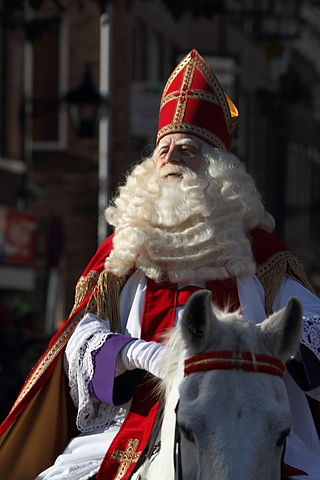
The “Sinterklass” of the Netherlands, rides a white horse
Nicholas is remembered as the patron saint of whole nations and cities such as Amsterdam and Moscow, revered among the early Christian saints and remembered for a legendary habit of secret gift-giving.
Some ideas take hold in the popular imagination, while others fade into obscurity. The “Three Daughters” episode made it into nearly every artistic medium available at that time, from frescoes to carvings and windows, even theatrical performances.
The Patron Saint not only of sailors, but of ships and their cargoes, the seas were the internet of the day, and the story of St. Nick spread from the Balkans to Holland, from England to Crete.
The Feast of St. Nicholas took hold around the 6th of December. Children and other marginal groups such as old women and slaves could receive gifts, but only by demanding them. The secret giving of gifts appeared sometime around the year 1200.
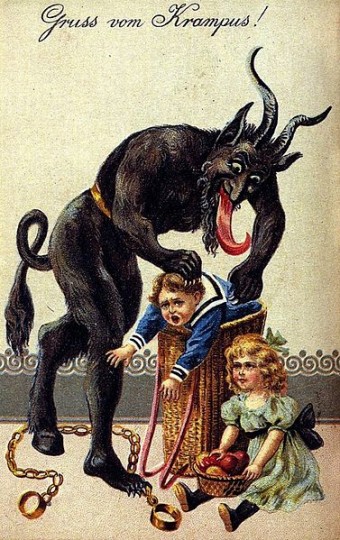
On the continent, legends of St. Nicholas combined with Pagan traditions and developed in quirky directions, including an evil doppelgänger who accompanies St. Nick on his rounds. As early as the 11th century, the Krampus may be expected to snatch bad little tykes away from parts of Germany, Austria and the Alpine villages of northern Italy, never to be seen again.
In eastern Europe, the witch Frau Perchta “The Disemboweller” was said to place pieces of silver in the shoes of children and servants who’d been good over the year, and replace the organs of the bad ones, with garbage. Yikes.
In French-speaking regions, Père Fouettard (Father Whipper) accompanies Père Noël on gift-giving rounds, dispensing beatings and/or lumps of coal to naughty boys & girls. In some German speaking regions, the malevolent Schmutzli accompanies Samichlaus, with a twig broom to spank wicked children.
Never mind Santa Claus. The Schmutzli is watching.
Samichlaus and the Schmutzli
The “Little Ice Age” of the 13th century, led to a proliferation of chimneys. Windows and doors were the things of thieves and vagabonds, while the chimney led directly to the warm heart of the home. St. Nick made his first gift-giving appearance via the chimney in a three daughters fresco, painted sometime in 1392, in Serbia.
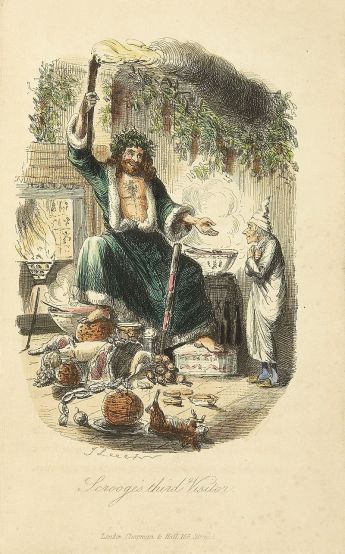
The Ghost of Christmas present as illustrated by John Leech, in Charles Dickens’ classic, a Christmas Carol
St. Nicholas was beginning to be seen as part of the family outside of the Church, which is probably why he survived what came next. Saints reigned in the Christian world until the 16th century, when the Protestant reformation rejected such “idolatry” as a corruption of Christianity.
Whatever you called him: Sinterklaos, Saint-Nikloi or Zinniklos, St. Nick went away entirely in England and Scotland during the time of Henry VIII, giving way to the spirit of Christmas cheer in the person of one Father Christmas. England would no longer keep the feast of the Saint on December 6. The celebration moved to December 25, to coincide with Christmas.
Protestants adopted as gift bringer the Baby Jesus or Christkindl, later morphing into Kris Kringle.
Puritan arrivals to New England rejected Christmas and everything with it, as “un-Christian”. In 1644, Massachusetts levied a fine of five shillings, on anyone observing the holiday.
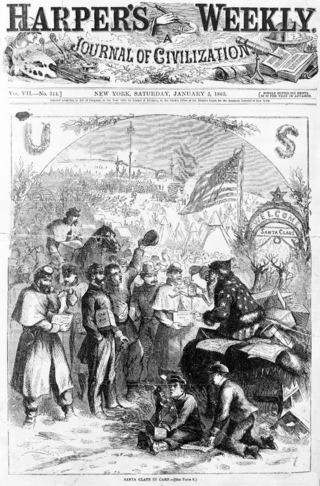
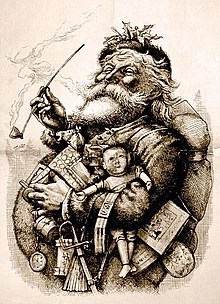
Santa Claus 1863, by Thomas Nast
Sinterklaas survived the iconoclasm of the Reformation in places like Holland, transferring to the 17th century settlement of New Amsterdam: what we now know as the new world port city of New York.
Sinterklass blended with Father Christmas, to create a distinctly American Santeclaus, which began to take hold in the 19th century.
The Christmas “celebrations” of the period, looked more like Mardi Gras than what we know today. Drunk and rowdy gangs wandered the streets of New York, Philadelphia and the cities of the northeast, something between a noisy mob and a marching band. Men fired guns into the air and banged or blew on anything that would make noise. Mobs would beat up the unfortunate, and break into the homes of the “upper classes”, demanding food and liquor.
New York philanthropist John Pintard, the man responsible for the holidays celebrating the fourth of July and George Washington’s birthday, popularized an image first set forth by Washington Irving, in his satirical story A History of New York from the Beginning of the World to the End of the Dutch Dynasty, by Diedrich Knickerbocker, depicting St. Nicholas bringing gifts to good little boys and girls, and switches with which to tan the hides of bad kids.
The unknown genius who published and illustrated A Children’s Friend in 1821, first depicted “Santa Claus” not as a Catholic bishop, but as a non-sectarian adult in a fur lined robe, complete with a sleigh inexplicably powered by a single reindeer, coming in through the chimney not on December 6, but on Christmas eve.
An anonymous poem believed to have been written on December 24, 1822 and later attributed to Clement Clarke Moore, began with the words: “T’was the night before Christmas, and all through the house“…
“A Visit From St. Nicholas“, better known by its first line, gave us the first description of the modern Santa Claus and a tool for domesticating the occasion, agreeable to law enforcement for calming the rowdy streets, to manufacturers and retailers for selling goods, to the church to make way for a family friendly day of worship and to parents, to control unruly children.
Goody Santa Claus 1889
The “Right Jolly old Elf” took his modern form thanks to the pen of illustrator and editorial cartoonist Thomas Nast, creator of the Democratic donkey and the Republican elephant and scourge of the Tammany Hall political machine which had swindled New York city, out of millions.
The idea of a Mrs. Claus seems to come from a poem by Katharine Lee Bates of the Cape Cod Curmudgeon’s own town of Falmouth, Massachusetts.
Today, the author is best known for her 1895 poem “Pikes Peak”, later set to music and widely known as “America the Beautiful”.
Tonight, NASA may be expected to track Santa and his sleigh drawn by eight reindeer, though none are any longer, all that tiny. Santa Claus will appear around the planet. Regional variations include Santa’s arriving on a surfboard in Hawaii. In Australia, he’s pulled by six white kangaroos. In Cajun country, Papa Noël arrives in a pirogue, drawn by eight alligators.
Santa Claus may be the most powerful cultural idea, ever conceived. This year, Christmas sales are expected to exceed one Trillion dollars. Not bad for a 2,000-year old saint, best remembered for gift giving with no expectation of anything in return.
Fun fact: Today, the port city of Barion the Adriatic coast of Italy is remembered for the WW2-era mustard gas accident, which spawned the discovery of modern chemotherapy drugs. A thousand years earlier, city fathers feared growing Muslim influence over the tomb of Saint Nicholas, and went to retrieve his remains. Find him, they did. Saint Nicholas’ large bones were removed and brought back as holy relics to Bari, where they remain, to this day. Smaller fragments were removed during the 1st Crusade and brought back to Venice, or enshrined in basilica from Moscow to Normandy. According to one local antiquarian, the “Tomb of Saint Nicholas” in Ireland, is probably that of a local priest.
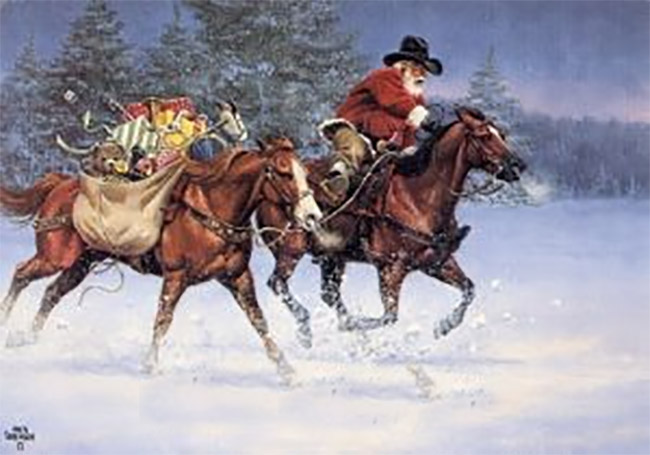
Feature image, top of page: Hat tip GP Cox. I don’t know where you got it, but I Love this image. Merry Christmas and all the best for a healthy and prosperous New Year to you and yours, from Mr. & Mrs. Cape Cod Curmudgeon.
If you enjoyed this “Today in History”, please feel free to re-blog, “like” & share on social media, so that others may find and enjoy it as well. Please click the “follow” button on the right, to receive email updates on new articles. Thank you for your interest, in the history we all share.
The meadows and the bayous of our southern lands shall swarm with herds of hippopotami
Only hours from now, families will gather from across the nation, for the Christmas table. There will be moist and savory stuffing, and green bean casserole. Creamy mashed potatoes and orange cranberry sauce. And there, the centerpiece of the feast. Slow-roasted and steaming in its tray, golden brown and delicious, the roast hippopotamus.
Wait…What?
Water Hyacinth
On this day in 1884, the World Cotton Centennial and World’s Fair was beginning its second week, in New Orleans. Among the many wonders on display was the never-before seen, Eichornia crassipes, a gift of the Japanese delegation. The Water Hyacinth.
Visitors marveled at this beautiful aquatic herb, its yellow spots accentuating the petals of beautiful delicate purple and blue flowers, floating across tranquil ponds on thick, dark green leaves.
The seeds of Eichornia crassipes are spread by wind, flood, birds and humans, and remain viable for 30 years. Beautiful as it is to look at, the Water Hyacinth is an “alpha plant”, an aquatic equivalent to the Japanese invasive perennial Kudzu, the “vine that ate the south”. Impenetrable floating mats choke out native habitats and species, while thick roots impede the passage of vessels, large and small. The stuff is toxic if ingested by humans and most animals, and costs a fortune to remove.
This plant native from the Amazon basin quickly broke the bounds of the 1884 World’s Fair, spreading across the bayous and waterways of Louisiana, and beyond.
During the first decade of the 20th century, an exploding American population could barely keep up with its own need for food, especially, meat. The problem reached crisis proportions in 1910, with over grazing and a severe cattle shortage. Americans were seriously discussing the idea, of eating dogs.
Enter Louisiana member of the House of Representatives, New Iberia’s own Robert Foligny Broussard, with a solution to both problems. “Lake Bacon”.
The attorney from Louisiana’s 3rd Congressional district proposed the “American Hippo” bill, H.R. 23621, in 1910, with enthusiastic support from Theodore Roosevelt and the New York Times. One Agricultural official estimated that such a free-range hippo herd would produce up to a million tons of meat, per year.
Lippincott’s monthly magazine, waxed rhapsodic: “This animal, homely as a steamroller, is the embodiment of salvation. Peace, plenty and contentment lie before us, and a new life with new experiences, new opportunities, new vigour, new romance, folded in that golden future, when the meadows and the bayous of our southern lands shall swarm with herds of hippopotami”.
With a name deriving from the Greek term “River Horse”, the common hippopotamus is the third largest land animal living today. Despite a physical resemblance to hogs and other even-toed ungulates, Hippopotamidae’s closest living relatives are cetaceans such as whales, dolphins and porpoises.
All well and good. The problem is, these things are dangerous.
The adult bull hippopotamus is extremely aggressive, unpredictable and highly territorial. And heaven help anyone caught between a cow, and her young. Hippos can gallop at short sprints of 19 mph, only a little slower than Jamaican Sprinter Usain Bolt, “the fastest man who ever lived”.
To search the “10 most dangerous animals in Africa” is to learn that hippos are #1, responsible for more human fatalities than any other large animal, in Africa.
Be that at it as it may, the animal is a voracious herbivore, spending daylight hours at the bottom of rivers & lakes, happily munching on vegetation.
What could be better than taking care of two problems at once. Otherwise unproductive swamps and bayous from Florida to Louisiana would become home to great hordes of free-range hippos. The meat crisis would be solved. America would become a nation of hippo ranchers.
As Broussard’s bill wended its way through Congress, the measure picked up steam with the enthusiastic support of two men, mortal enemies who’d spent ten years in the African bush, trying to kill each other. No, really.
Frederick Russell Burnham had argued for the introduction of African wildlife into the American food stream, some four years earlier. A freelance scout and American adventurer, Burnham was known for his service to the British South Africa company, and to the British army in colonial Africa. The “King of Scouts’, commanding officers described Burnham as “half jackrabbit and half wolf”. A “man totally without fear.” One writer described Burnham’s life as “an endless chain of impossible achievements”, another “a man whose senses and abilities approached that of a wild predator”. He was the inspiration for the Indiana Jones character and for the Boy Scouts. Frederick Burnham was the “most complete human being who ever lived “.
Frederick Russell Burnham (left), Fritz Joubert Duquesne (right)
Frederick “Fritz” Joubert Duquesne was a Boer of French Huguenot ancestry, descended from Dutch settlers to South Africa. A smooth talking guerrilla fighter, the self-styled “Black Panther” once described himself as every bit the wild African animal, as any creature of the veld. An incandescent tower of hate for all things British, Duquesne was a liar, a chameleon, a man of 1,000 aliases who once spent seven months feigning paralysis, so he could fool his jailers long enough to cut through his prison bars.
Duquesne was destined to be a German spy and saboteur, through two world wars. Frederick Burnham described his mortal adversary, thus: “He was one of the craftiest men I ever met. He had something of a genius of the Apache for avoiding a combat except in his own terms; yet he would be the last man I should choose to meet in a dark room for a finish fight armed only with knives“.
During the 2nd Boer war, the pair had sworn to kill each other. In 1910, these two men became partners in a mission to bring hippos, to America’s dinner table.
Biologically, there is little reason to believe that Hippo ranching couldn’t have worked along the Gulf coast. Colombian officials estimate that, within a few years, the hippo descendants of drug kingpin Pablo Escobar’s exotic animal menagerie will number 100 or more individuals.
Broussard’s measure went down to defeat by a single vote, but never entirely went away. Always the political calculator, Representative and later-Senator Broussard died with the bill on his legislative agenda, waiting for the right moment to reintroduce the thing.
Over time, the solution to the meat question became a matter of doubling down on what we’re already doing, as factory farms and confinement operations took the place of free ranges, and massive use of antibiotics replaced the idea of balanced biological systems.
We may or may not have “traded up”. Today, we contend with ever more antibiotic-resistant strains of “Superbug”. Louisiana spends $2 million per year on herbicidal control of the water hyacinth. The effluent of factory farms from Montana to Pennsylvania works its way into the nation’s rivers and streams, washing out to the Mississippi Delta to a biological dead zone, the size of New Jersey.
Gulf of Mexico dead zone, image credit NOAA
That golden future of Lippincott’s hippo herds roam only in the meadows and bayous of the imagination. Who knows, it may be for the best. I don’t know if any of us could’ve seen each other across the table, anyway. Not when the roast hippopotamus, got there.
If you enjoyed this “Today in History”, please feel free to re-blog, “like” & share on social media, so that others may find and enjoy it as well. Please click the “follow” button on the right, to receive email updates on new articles. Thank you for your interest, in the history we all share.
The forgotten angel of Bastogne was eighty-six when the knock came on the door of that Belgian nursing home. It took months for the Scottish historian to coax the story out of her.
The Battle of the Bulge is a familiar tale: The massive German offensive bursting out of the frozen Ardennes forest on December 16, 1944. The desperate drive to capture the Belgian port of Antwerp, vital to German re-supply efforts.
The terrain was considered unsuitable for such an attack. The tactical surprise was complete, British and American forces separated and driven back, their positions forming an inward “bulge” on wartime battle maps.
The story of the “Battered Bastards” is likewise, well known. 22,800 Americans, outnumbered five to one in some places and surrounded, in the do-or-die fight to hold the indispensable crossroads, of Bastogne. The German demand to surrender, of December 22. The response from American General Anthony McAuliffe, the one word response, “Nuts”, the American slang, confusing to the German delegation.
The siege of Bastogne would last another four days, the German encirclement at last broken by elements of George S. Patton’s 3rd Army. By the end of January, the last great effort of German arms was spent and driven back behind original lines.
Historian Stephen Ambrose wrote “Band of Brothers” nearly fifty years later, a non-fiction account later broadcast as an HBO mini-series, of the same name. The story refers to a black nurse named Anna. There is a brief appearance and then she is gone. No one knew who Anna was, or even if she was real.
Sixty-one years after Bastogne, military historian Martin King was conducting research for a book, Voices of the Bulge. The knock on the door came in October 2007, in a geriatric home outside of Brussels.
In the months following the Great War, Henri Chiwy (pronounced “SHE-wee”) was a veterinarian, working in the Belgian colony of the Congo Free State. The name of the Congolese woman who bore his child is unrecorded, the name of their baby girl, Augusta Marie.
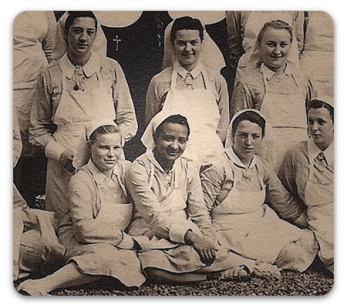
Augusta Chiwy came back to Belgium when she was nine, one of the luckier of thousands born to European fathers, and African mothers. Back to the doctor’s home in Bastogne, a small town of 9,000 where Augusta was loved and cared for by her father and his sister, whom the girl knew as “aunt Caroline”.
Augusta was educated and raised a Catholic. She always wanted to teach but, due to the rancid racial attitudes of that time and place, it would not do to have a black woman teaching white children. She became a nurse instead, on the advice of her father and his brother, a well-known Bastogne physician.
Nursing school was about 100 miles north. Augusta became a qualified nurse in 1943 and returned home the following year for Christmas. She arrived on December 16, the day Adolf Hitler launched his surprise offensive.
Bastogne was soon surrounded, part of one of the fiercest and bloodiest battles, of WW2. Poorly equipped American GIs were outnumbered five to one. These guys didn’t even have winter uniforms.
US Army Doctor Jack Prior was desperate, the abandoned building serving as military aid station, home to some 100 wounded GIs. Thirty of those were seriously wounded. With virtually no medical equipment or medicine and the only other medical officer an Ohio dentist, Dr. Prior badly needed nursing help.
Augusta Chiwy did not hesitate to volunteer, knowing full well that she would be executed, if caught.
Scene from the HBO mini series, “A Band of Brothers”
Working conditions were grisly in the weeks that followed. With no surgical instruments and no anesthesia, amputations and other procedures were performed with an army knife, with cognac to dull the patient’s pain. On Christmas eve, a direct hit from a 500-pound bomb hit one hospital building, instantly killing dozens of wounded GIs and the only other nurse, Renée Lemaire. She would be remembered as “The Angel of Bastogne.”
Augusta Chiwy was in a neighboring building at the time. The explosion blew the petite nurse through a wall but, unhurt, she picked herself up and went back to work. There were grisly injuries and many died due to inadequate medical facilities, but many lived, their families reunited thanks to the tireless work of Dr. Jack Prior, and nurse Augusta Chiwy.
Given the month of hell the pair had been through, Augusta was heartbroken when Dr. Prior had to move out, in January. The pair exchanged addresses and stayed in touch, writing letters and exchanging small gifts, of candy. They last saw each other in 2004, when Dr. Prior returned from his home state of Vermont, for the 50th anniversary of the Battle of the Bulge.
Augusta Chiwy suffered symptoms of post-traumatic stress disorder, a condition poorly understood at that time. She would go long periods without speaking, becoming quiet and withdrawn even years later. She married a Belgian soldier in 1959 and the couple had two children. It would be twenty years, before she resumed her nursing career. She almost never spoke of her experience in Bastogne.
The forgotten angel of Bastogne was eighty-six when the knock came on the door of that Belgian nursing home. It took months for the Scottish historian to coax the story out of her.
Thanks to King’s efforts, Augusta Chiwy would finally receive the recognition she had earned.
“On June 24, 2011, she was made a Knight in the Order of the Crown by King Albert II of Belgium. Six months later she received the U.S. Army’s Civilian Award for Humanitarian Service. And on March 21, 2014, Augusta was recognized by her hometown as a Bastogne Citizen of Honor”. http://www.augustachiwy.org
When asked about her heroism, she’d always say the same thing: “I only did what I had to do.”
Augusta Marie Chiwy died peacefully in her sleep at the age of 94, on August 23, 2015. How many lives would have been cut short, will never be known. But for the selfless and untiring efforts, of the Forgotten Angel of Bastogne.
If you enjoyed this “Today in History”, please feel free to re-blog, “like” & share on social media, so that others may find and enjoy it as well. Please click the “follow” button on the right, to receive email updates on new articles. Thank you for your interest, in the history we all share.
There have been no fewer than 207 End-of-the-World predictions over the last 2,000 years.
During the recent past, one of the sillier bits of pop culture nonsense served up to us, may be that time the world came to an end on December 21, 2012.
It was the Mayan Apocalypse. A day of giant solar flares, when the planets aligned to cause massive tidal catastrophe, and the Earth collided with the imaginary planet Nibiru. Over in China, Lu Zhenghai even built himself an Ark. Sort of.
If I’d only been smart enough back then, to sell survival kits.
Lu Zhenghai’s ark, 2012. H/T Huffpo
End-of-the-world scenarios are nothing new. In 1806, the “Prophet Hen of Leeds” was laying eggs, inscribed with the message “Christ is coming”. It was the end of times. The Judgement Day cometh.
The story, as told in the book “Extraordinary Popular Delusions and the Madness of Crowds,” written by Scottish author Charles Mackay in 1841, tells the story of a “panic[ked] terror”, when a “great number of visitors” traveled from far and near, to peer at the chicken Nostradamus.
Turns out that Mary Bateman, the bird’s owner and a serial fraudster, was writing these messages with some kind of “corrosive ink”, maybe an acid, and reinserting them into the poor chicken. The “Yorkshire Witch” met her end on a gibbet, hanged for the poisoned pudding she gave that couple to relieve their chest pain. But I digress.
If you were around in 1986, you may remember the great excitement, concerning the return of Halley’s Comet. The celestial body only comes around once every 76 years and, the time before that, it was the end of the world. In 1910, the New York Times reported the discovery of the deadly poison cyanogen, in the comet’s tail. French astronomer Camille Flammarion predicted the gas would “would impregnate the atmosphere and possibly snuff out all life on the planet.”
French postcard, 1910
Hucksters sold comet pills. Doomsayers claimed that massive tides would cause the Pacific to empty, into the Atlantic. Finally, the end of days arrived. May 20, 1910. And then it went. There was no end of the world though, tragically, 16-year-old Amy Hopkins fell to her death from a rooftop, while awaiting the comet.
There have been no fewer than 207 End-of-the-World predictions over the last 2,000 years, if Wikipedia is any source. Polls conducted in 2012 across twenty countries revealed percentages from 6% in France to 22% in the United States and Turkey, believing the world would come to an end, in their lifetimes.
5,000 years ago, the Mayan civilization of modern-day Mexico and Central America developed a sophisticated calendar, working with a base numerical system of 20.
It was three calendars, really. The “Long Count” was mainly used for historical purposes, able to specify any date within a 2,880,000 day cycle. The Haab was a civil calendar, consisting of 18 months of 20 days, and an “Uayeb” of five days. The Tzolkin was the “divine” calendar, used mainly for ceremonial and religious purposes. Consisting of 20 periods of 13 days, the Tzolkin goes through a complete cycle every 260 days. The significance of this cycle is unknown, though it may be connected with the 263-day orbit of Venus. There is no year in the Haab or Tzolkin calendars, though the two can be combined to specify a particular day within a 52-year cycle.
Get it? Neither do I. Suffice it to say that the world of the Mayan Gods lasted 5,125 years and 133 days, a period of time known as 13 b’ak’tun.
The last Long Count began in August 3114 BC. Counting forward, scholars decided on December 21, 2012, as the end of the cycle.
An estimated 2% of the American public believed this betokened the end of the world. Online searches went up for one-way flights to Turkey and the South of France, both of which were rumored to be safe havens from the apocalypse.
They should have asked a Mayan, who may have been amused by all those crazy Gringos. The world wasn’t coming to an end. The calendar just rolls over and begins again at “Zero”, like the old odometers that only went up to 100,000 miles. What a party that could have been, though. The “New Year” to end all New Years. Only comes around once every 5,125 years, plus 133 days. Happy Long Count.
If you enjoyed this “Today in History”, please feel free to re-blog, “like” & share on social media, so that others may find and enjoy it as well. Please click the “follow” button on the right, to receive email updates on new articles. Thank you for your interest, in the history we all share.
This quintessentially English tale is said to have drawn much from the work of Shakespeare, and others. Perhaps the Old World drew inspiration from the New, as well.
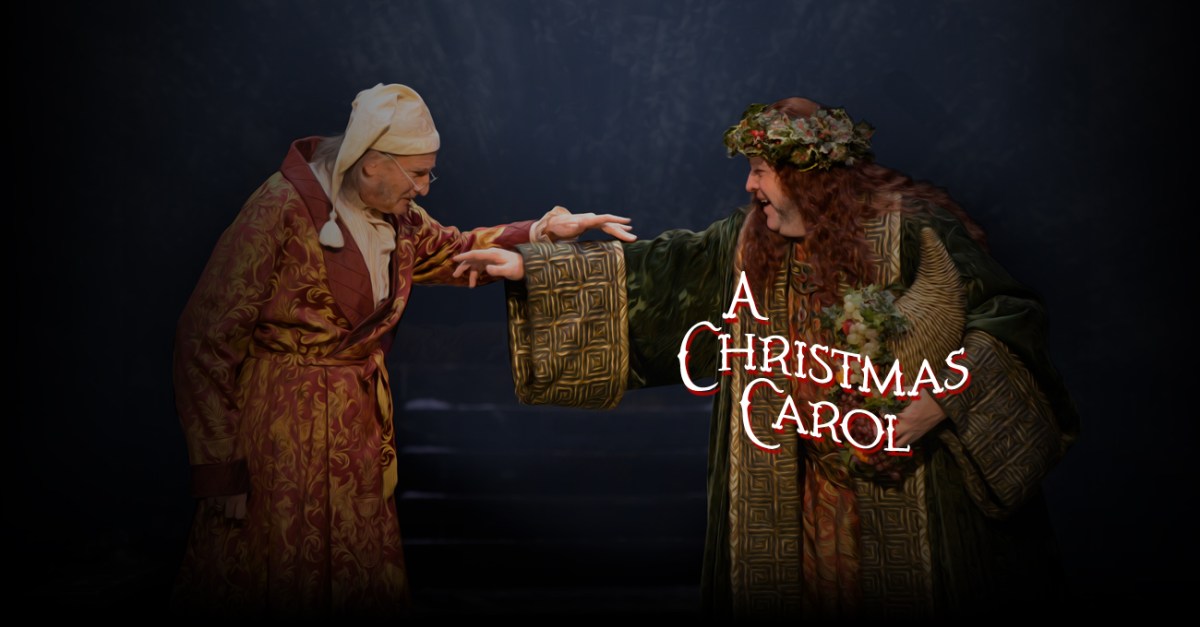
It’s hard not to love the traditions of the Christmas season. Getting together with loved ones, good food, the exchange of gifts, and our favorite Christmas specials on TV. I always liked a Charlie Brown’s Christmas, and of course there’s the Charles Dickens classic, “A Christmas Carol”, set against the vast brick factory buildings of Lowell, Massachusetts, along the Merrimack River.
Wait … What?
The 29-year-old Charles Dickens was already a well-known and popular author when he stepped onto the shores of Boston Harbor on January 22, 1842. New Yorkers had literally lined the docks the year before, greeting ships bearing copies of the author’s latest, The Old Curiosity Shop.
“The Pickwick Papers,” “Oliver Twist,” “Nicholas Nickleby”; all were behind the young writer when he came to America, perhaps to write a travelogue, or maybe looking for material for a new novel.
The “Mill Girls”, of Lowell
Dickens traveled to Watertown, to the Perkins School for the Blind, where Helen Keller and her teacher Anne Sullivan underwent their mutual education, a half-century later. He visited a school for neglected boys, in Boylston.
Dickins must have thought the charitable institutions in his native England suffered by comparison, for he later wrote “I sincerely believe that the public institutions and charities of this capital of Massachusetts are as nearly perfect as the most considerate wisdom, benevolence, and humanity, can make them.”
In February, Dickens took a train north to the factory town of Lowell, visiting the textile mills and speaking with the “mill girls”, the women who worked there. Once again, he seemed to believe that his native England came up short, in the comparison. Dickens spoke of the new buildings and the well dressed, healthy young women who worked in them, perhaps comparing them with his own traumatic childhood experience of working in the mills back home, with his father confined in debtor’s prison.
The celebrity novelist enjoyed the finest sights of Boston and New York, and took in a steamship ride, down the Mississippi. He visited one of the great wonders of the natural world, the spectacular Niagara Falls.
And yet, the author described that visit to the industrial city of Lowell as “the happiest day” of his American vacation.
Dickens left the mill girls with a copy of “The Lowell Offering”, a literary magazine written by those same women, which he later described as “four hundred good solid pages, which I have read from beginning to end.”
More than a century and a half later, Natalie McKnight, professor of English and Dean at Boston University, noticed similarities between the two while preparing a talk for the Lowell Historical Society.
She read the same 400 pages as Dickens, and couldn’t help noticing parallels between the work of the mill girls, and “A Christmas Carol,” published about a year and a half after the author’s visit. Chelsea Bray was a senior English major at the time. Professor McKnight asked her to read those same pages.
Marley’s Ghost, by John Leech, 1843
One story, “A Visit from Hope,” begins, “‘Past twelve!’ said a sweet, musical voice, as I was seated by the expiring embers of a wood fire. I turned hastily to see who had thus intruded on my presence, when, lo! I beheld an old man. His thin white locks were parted on his forehead, his form was bent, and as he extended his thin, bony hand toward me, it shook like an aspen leaf.”’
Makes it hard not to think of the ghost of Jacob Marley, Ebenezar Scrooge’s “dead as a doornail”, former partner.
“Christmas,” another Lowell essay, describes Christmas as “the best day in the whole year” for what it brings out in people. The theme pops up again with Scrooge’s nephew, as in: “[T]he only time I know of, in the long calendar of the year, when men and women seem by one consent to open their shut-up hearts freely, and to think of people below them as if they really were fellow-passengers to the grave, and not another race of creatures bound on other journeys.”
Another piece, “The Blessings of Memory,” speaks of joyful recollections, too soon overridden by “unreal phantoms.” Scrooge’s redemption is all about Memory: Bray writes, “Scrooge’s conversion begins when the Ghost of Christmas Past makes him relive his memories and reconnect to past sorrows and joys.”
The research performed by the two was published in the form of a thesis, and later fleshed out to a full-length book:
“Dickens and Massachusetts The Lasting Legacy of the Commonwealth Visits
(University of Massachusetts Press, 2015)
The book describes a number of similarities between the two works, making the argument that Dickens’ familiar story draws much from his experience in Lowell. The authors specifically reject any accusation of plagiarism. The Lowell essays possess neither the character development nor the linguistic richness of Dickens’ masterwork.
This quintessentially English tale is said to have drawn much from the work of Shakespeare, and others. Perhaps the Old World drew inspiration from the New, as well. Charles Dickens’ masterpiece, A Christmas Carol, was published for the first time 175 years ago today, December 19, 1843.
If you enjoyed this “Today in History”, please feel free to re-blog, “like” & share on social media, so that others may find and enjoy it as well. Please click the “follow” button on the right, to receive email updates on new articles. Thank you for your interest, in the history we all share.
What if thousands of these creatures were equipped with tiny little fire bombs, and dropped on Japanese cities. All that bamboo & paper construction, the place oughtta go up like a match head.
In a letter dated January 7, 1941, Marshall Admiral Isoroku Yamamoto directed Rear Admiral Onishi Takijiro under conditions of utmost secrecy, to study the feasibility of an attack on the American Naval anchorage at Pearl Harbor. Half a world away in Irwin Pennsylvania, American dentist Dr. Lytle S. Adams was planning a driving vacation to the Carlsbad Caverns, in New Mexico.
Dr. Adams was gripped with amazement that day in December, on witnessing millions of bats, exiting the cave. It was December 7 and word came over the radio, of a sneak attack in Hawaii. Millions of Americans must have been thinking about payback that day, Dr. Adams among them. His thoughts returned to those bats. What if thousands of these creatures were equipped with tiny little fire bombs, and dropped on Japanese cities. All that bamboo & paper construction, the place oughtta go up like a match head.
Lytle Adams was a personal friend of First Lady Eleanor Roosevelt and submitted the idea, the following month. Zoology professor Donald Griffin was conducting studies at this time of echolocation among animals, and recommended the White House approve the idea. The Presidential memorandum read: “This man is not a nut. It sounds like a perfectly wild idea but is worth looking into.” The mammalian super weapon that never was, was born.
Four biological factors lent promise to the plan. First, they’re the most plentiful mammal in North America. A single cave can hold several million individuals. Second, load-carrying tests conducted in the dirigible hangar at Moffett Field in Sunnyvale, California, demonstrated that bats can carry more than their own weight. Third, they hibernate, making them easy to handle and, last, bats like secluded places such as buildings to hide during daylight.
Professor Louis Fieser, the inventor of military napalm, devised a tiny little canister to be carried by the bats. A suitable species was selected by March 1943, the Mexican Free-tailed Bat (Tadarida brasiliensis mexicanus). “Bat bombs” were devised including 26 stacked trays, each containing compartments for 40 bats. Carriers would be dropped from 5,000-feet with parachutes deployed at 1,000-feet, allowing hibernating bats sufficient time to “snap out” of it.
Carlsbad AAF Fire, following Bat Bomb Accident
Early tests were promising. Too promising. On May 15, armed bats were accidentally released at the Carlsbad Army Airfield Auxiliary Air Base near Carlsbad, New Mexico, and incinerated the place when some of them came to roost under a fuel tank.
Despite the setback or possibly because of it, the program was handed off to the Navy that August, and code named Project X-Ray. The project was handed off once again that year, placed under control of the Marine Corps Air Station at El Centro, California, by December 18.
A “Japanese Village” was mocked up by the Chemical Warfare Service at the Dugway Proving Ground in Utah. National Defense Research Committee (NDRC) observers were positive, one stating: “It was concluded that X-Ray is an effective weapon.” The Chief Chemist’s report was more enthusiastic: “Expressed in another way, the regular bombs would give probably 167 to 400 fires per bomb load where X-Ray would give 3,625 to 4,748 fires.”
Project X-Ray was scheduled for further tests in mid-1944 and not expected for combat readiness for another year, when the program was cancelled by Fleet Admiral Ernest J. King. The project had already cost $2 million, equal to over $29 million today. It was too much, for too little.
Die Fledermaus (“The Bat”) was a German operetta by composer Johann Strauss II, featuring a prolonged and drunken soliloquy by one Frosch, (the jailer), in act 2. Stanley Lovell was director of research and development for the OSS at the time (Office of Strategic Services), precursor to the CIA. Ordered to evaluate the bat bomb by OSS Director “Wild Bill” Donovan, Lovell may have had the last word. “Die Fledermaus Farce” he called it, noting that the things were dropping to the ground, like stones.
Fun Fact:
During WW2, the British Special Operations Executive (SOE) devised a “Rat Bomb”, for use against German targets. 100 rat carcasses were sewn up with plastic explosives, to be distributed near German boiler rooms and locomotives. The idea was that the carcass would be disposed of by burning, resulting in a boiler explosion. The explosive rats were never put to use as the Germans intercepted the first and only shipment. The project was deemed a success anyway, due to the enormous time and manpower resources expended by the Germans, looking for booby trapped rats.
If you enjoyed this “Today in History”, please feel free to re-blog, “like” & share on social media, so that others may find and enjoy it as well. Please click the “follow” button on the right, to receive email updates on new articles. Thank you for your interest, in the history we all share.


 D’Estaing sent an ultimatum to British Commander Augustine Prevost on September 16, 1779. He was to surrender the city “To the arms of his Majesty the King of France”, or he would be personally answerable for what was about to happen. It could not have pleased General Benjamin Lincoln or his Patriot allies when d’Estaing added “I have not been able to refuse the army of the United States uniting itself with that of the King. The junction will probably be effected this day. If I have not an answer therefore immediately, you must confer with General Lincoln and me”.


 In Mexico as well as Spain and most Latin countries, pranksters practice their craft not on April 1 but on December 28. The custom goes back to the biblical story of King Herod, who is said to have killed all the baby boys in Bethlehem, to rid himself of the future ‘King of the Jews. The “Massacre of the Innocents” is a sad story but the ‘joke’ was on Herod. Mary and Joseph had taken the baby Jesus away, to Egypt.
 For two-hundred years now, the citizens of Ibi, Alicante on the Spanish Mediterranean coast have celebrated December 28, with a giant food fight. The practice was suspended for a time following the Spanish Civil War but revived, in 1981. Now, it’s a big tourist attraction, and the event makes a ton of money, for charity.


 On the Western Front, it rained for much of November and December that first year. The no man’s land between British and German trenches was a wasteland of mud and barbed wire. Christmas Eve, 1914 dawned cold and clear. The frozen ground allowed men to move about for the first time in weeks. That evening, English soldiers heard singing. The low sound of a Christmas carol, drifting across no man’s land…Stille Nacht, heilige Nacht…Silent Night.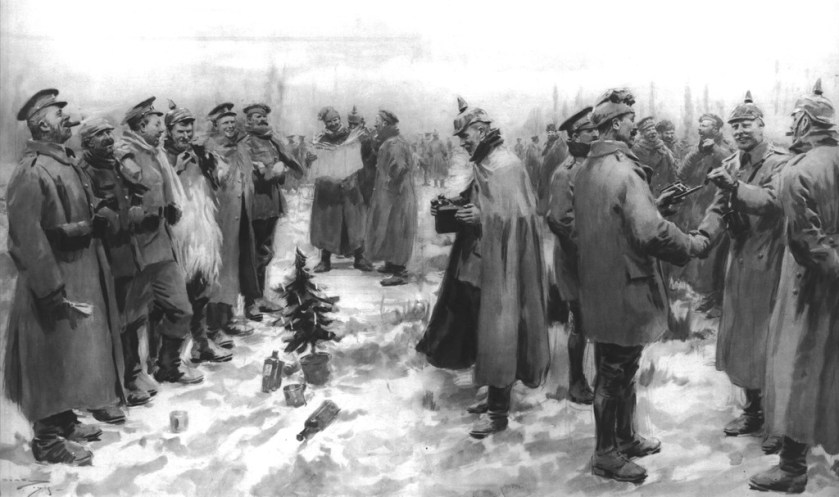
 Captain Sir Edward Hulse Bart reported a sing-song which “ended up with ‘Auld lang syne’ which we all, English, Scots, Irish, Prussians, Wurttenbergers, etc, joined in. It was absolutely astounding, and if I had seen it on a cinematograph film I should have sworn that it was faked!”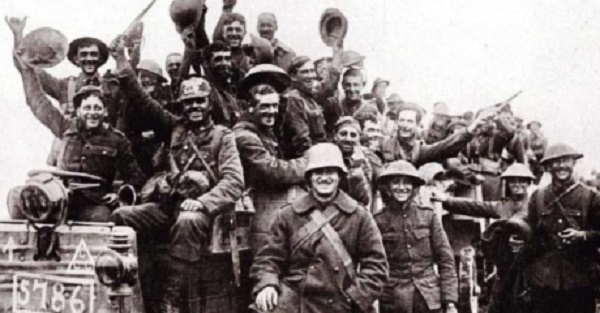


 The Feast of St. Nicholas took hold around the 6th of December. Children and other marginal groups such as old women and slaves could receive gifts, but only by demanding them. The secret giving of gifts appeared sometime around the year 1200.
 The unknown genius who published and illustrated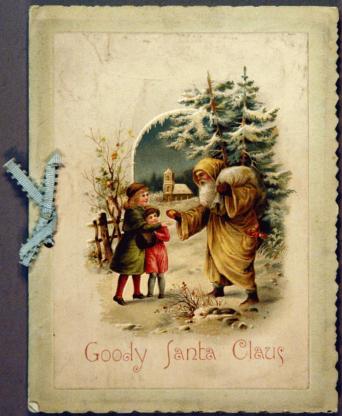
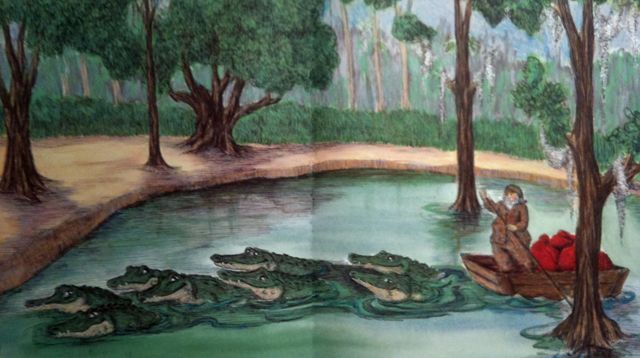

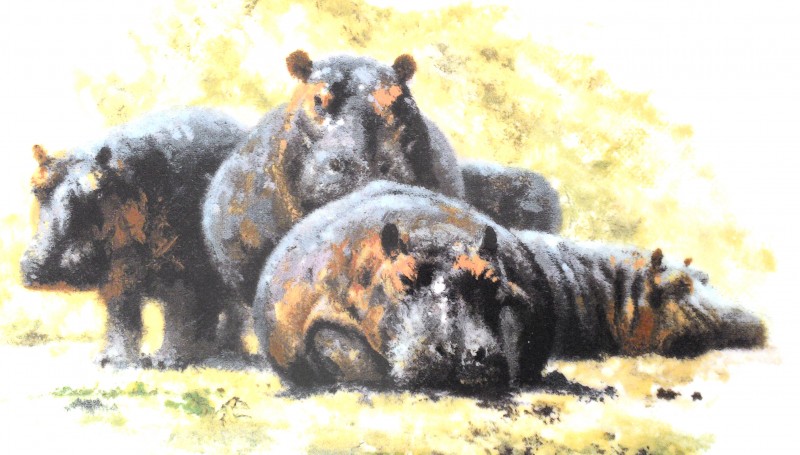


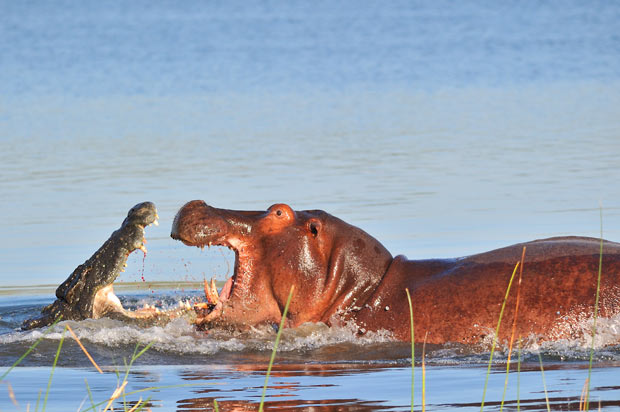
 Be that at it as it may, the animal is a voracious herbivore, spending daylight hours at the bottom of rivers & lakes, happily munching on vegetation.

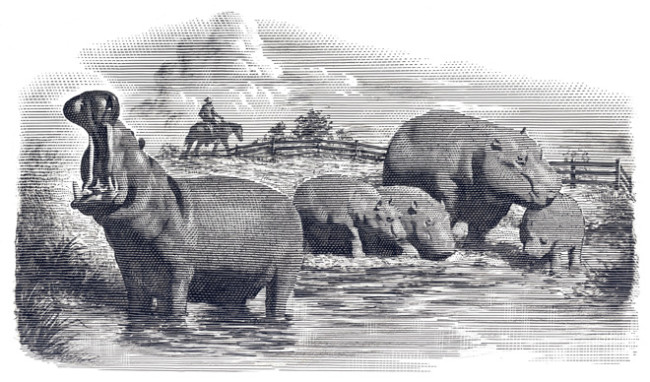 During the 2nd Boer war, the pair had sworn to kill each other. In 1910, these two men became partners in a mission to bring hippos, to America’s dinner table.



 The terrain was considered unsuitable for such an attack. The tactical surprise was complete, British and American forces separated and driven back, their positions forming an inward “bulge” on wartime battle maps.
 Historian Stephen Ambrose wrote “Band of Brothers” nearly fifty years later, a non-fiction account later broadcast as an HBO mini-series, of the same name. The story refers to a black nurse named Anna. There is a brief appearance and then she is gone. No one knew who Anna was, or even if she was real.
 Augusta Chiwy came back to Belgium when she was nine, one of the luckier of thousands born to European fathers, and African mothers. Back to the doctor’s home in Bastogne, a small town of 9,000 where Augusta was loved and cared for by her father and his sister, whom the girl knew as “aunt Caroline”.

 Augusta Chiwy was in a neighboring building at the time. The explosion blew the petite nurse through a wall but, unhurt, she picked herself up and went back to work. There were grisly injuries and many died due to inadequate medical facilities, but many lived, their families reunited thanks to the tireless work of Dr. Jack Prior, and nurse Augusta Chiwy.
 Augusta Chiwy suffered symptoms of post-traumatic stress disorder, a condition poorly understood at that time. She would go long periods without speaking, becoming quiet and withdrawn even years later. She married a Belgian soldier in 1959 and the couple had two children. It would be twenty years, before she resumed her nursing career. She almost never spoke of her experience in Bastogne.
 Albert II of Belgium. Six months later she received the U.S. Army’s Civilian Award for Humanitarian Service. And on March 21, 2014, Augusta was recognized by her hometown as a Bastogne Citizen of Honor”.


 Turns out that Mary Bateman, the bird’s owner and a serial fraudster, was writing these messages with some kind of “corrosive ink”, maybe an acid, and reinserting them into the poor chicken. The “Yorkshire Witch” met her end on a gibbet, hanged for the poisoned pudding she gave that couple to relieve their chest pain. But I digress.
 5,000 years ago, the Mayan civilization of modern-day Mexico and Central America developed a sophisticated calendar, working with a base numerical system of 20.


 The celebrity novelist enjoyed the finest sights of Boston and New York, and took in a steamship ride, down the Mississippi. He visited one of the great wonders of the natural world, the spectacular Niagara Falls.





 Historical Easter Eggs - Today in History
You must be logged in to post a comment.