November 9, 2013 A Rare and Vintage Cognac

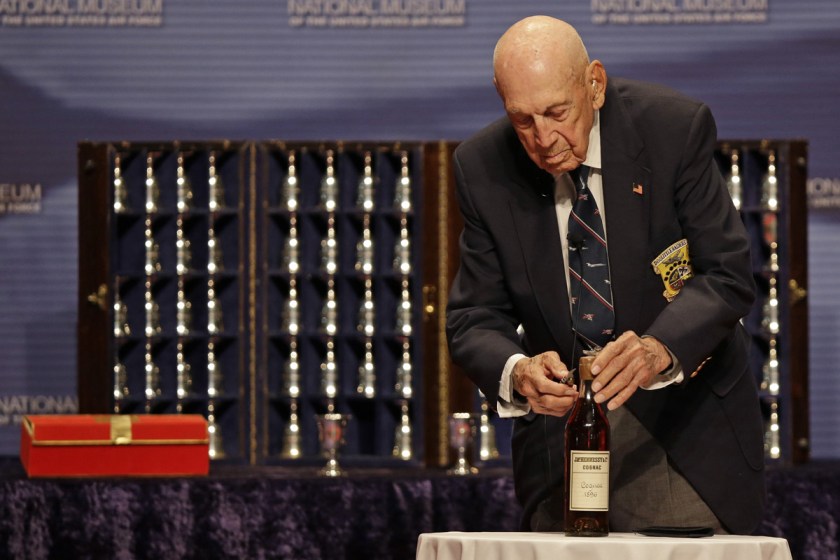
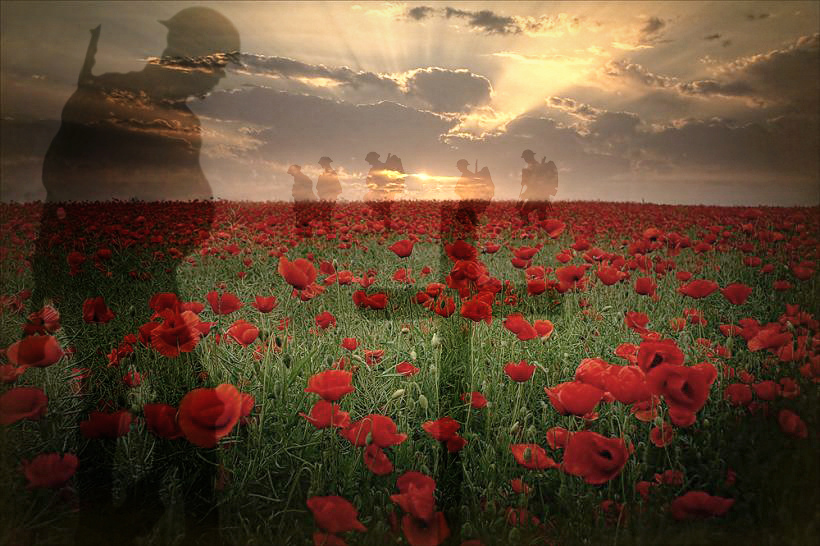
On November 9, 2013, a 117 year-old bottle of rare, vintage cognac was cracked open, and enjoyed among a company of heroes.  If there is a more magnificent act of tribute, I cannot at this moment think of what it might be.

On November 9, 2013, there occurred a gathering of four.  A tribute to fallen heroes. These four were themselves heroes, and worthy of tribute.  This was to be their last such gathering.

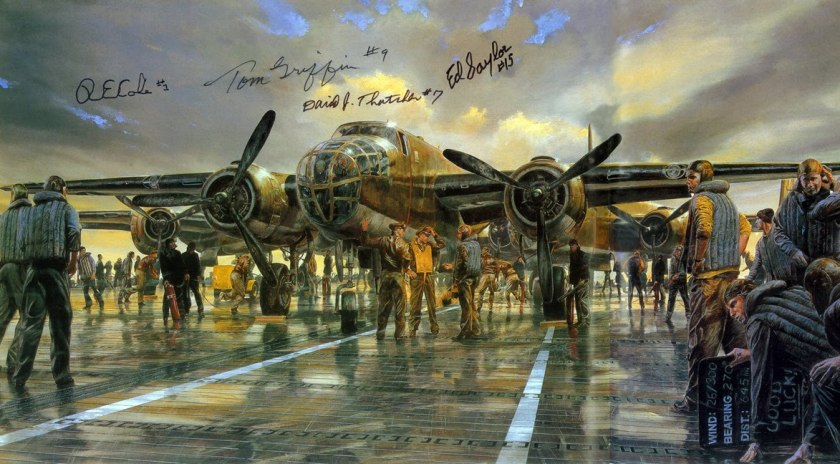
This story begins on April 18, 1942, when a flight of sixteen Mitchell B25 medium bombers took off from the deck of the carrier, USS Hornet.   It was a retaliatory raid on Imperial Japan, planned and led by Lieutenant Colonel James “Jimmy” Doolittle of the United States Army Air Forces.  It was payback for the sneak attack on Pearl Harbor, seven months earlier.  A demonstration that the Japanese home islands, were not immune from destruction.

Launching such massive aircraft from the decks of a carrier had never been attempted, and there were no means of bringing them back.  With extra gas tanks installed and machine guns removed to save the weight, this was to be a one-way mission, into territory occupied by a savage adversary.

Doolittle Signatures

Fearing that mission security had been breached, the bomb run was forced to launch 200 miles before the intended departure spot.  The range made fighter escort impossible, and left the bombers themselves with only the slimmest margin of error.

Japanese Premier Hideki Tojo was inspecting military bases, at the time of the raid. One B-25 came so close he could see the pilot, though the American bomber never fired a shot.

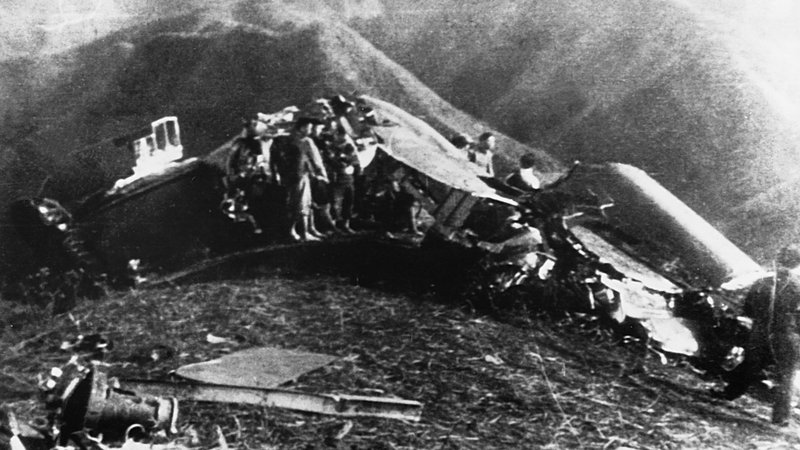
After dropping their bombs, fifteen continued west, toward Japanese occupied China.  Unbeknownst at the time, carburetors bench-marked and calibrated for low level flight had been replaced in flight #8, which now had no chance of making it to the mainland.  Twelve crash landed in the coastal provinces.  Three more, ditched at sea.  Pilot Captain Edward York pointed flight 8 toward Vladivostok, where he hoped to refuel.  The pilot and crew were instead taken into captivity, and held for thirteen months.

aftermath.jpg__800x450_q85_crop_upscale

Crew 3 Engineer-Gunner Corporal Leland Dale Faktor died in the fall after bailing out and Staff Sergeant Bombardier William Dieter and Sergeant Engineer-Gunner Donald Fitzmaurice bailed out of aircraft # 6 off the China coast, and drowned.

The heroism of the indigenous people at this point, is a little-known part of this story.  The massive sweep across the eastern coastal provinces, the Zhejiang-Jiangxi campaign, cost the lives of 250,000 Chinese.  A quarter-million murdered by Japanese soldiers, in the hunt for Doolittle’s raiders.  How many could have betrayed the Americans and refused, will never be known.

Amazingly, only eight were captured, among the seventy-seven survivors.

First Lieutenant Pilot “Bill” Farrow and Sergeant Engineer-Gunner Harold Spatz, both of Crew 16, and First Lieutenant Pilot Dean Edward Hallmark of Crew 6 were caught by the Japanese and executed by firing squad on October 15, 1942.  Crew 6 Co-Pilot First Lieutenant Robert John Meder died in a Japanese prison camp, on December 11, 1943.  Most of the 80 who began the mission, survived the war.

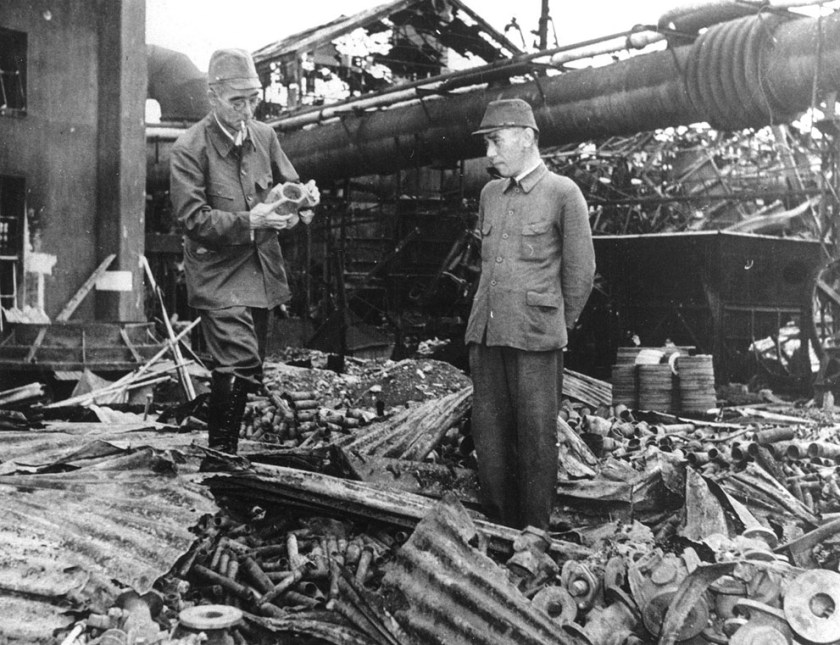
Thirteen targets were attacked, including an oil tank farm, a steel mill, and an aircraft carrier then under construction.. Fifty were killed and another 400 injured, but the mission had a decisive psychological effect.  Japan withdrew its powerful aircraft carrier force to protect the home islands. Admiral Isoroku Yamamoto attacked Midway, thinking it to have been the jump-off point for the raid. Described by military historian John Keegan as “the most stunning and decisive blow in the history of naval warfare”, the battle of Midway would be a major strategic defeat for Imperial Japan.

s_w07_20418042
Ryozo Asano, left, spokesman for a group of diversified Japanese family enterprises called the Zaibatsu, inspects the wreckage of his Tokyo steel plant

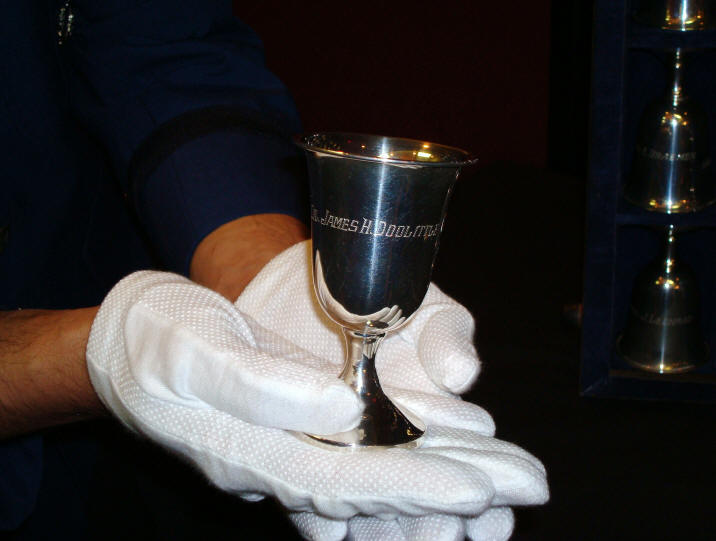
Every year since the late 1940s, the surviving Doolittle raiders have held a reunion.  In 1959, the city of Tucson presented them with 80 silver goblets, each engraved with a name. They are on display at the National Museum of the Air Force, in Dayton Ohio.

With those goblets is a fine bottle of vintage Cognac.  1896, the year Jimmy Doolittle was born. There’s been a bargain among the survivors that, one day, the last two would open that bottle, and toast their comrades.

DSC00017

In 2013 they changed their bargain.  Just a little. Jimmy Doolittle himself passed away in 1993. Twenty years later, 76 goblets had been turned over, each signifying a man who had passed on.  Now, there were only four.

  1. Lieutenant Colonel Richard E. Cole* of Dayton Ohio was co-pilot of crew No. 1.  Remained in China after the Tokyo Raid until June 1943, and served in the China-Burma-India Theater from October, 1943 until June, 1944. Relieved from active duty in January, 1947 but returned to active duty in August 1947.
  2. Lieutenant Colonel Robert L. Hite* of Odell Texas was co-pilot of crew No. 16. Captured by the Japanese and held prisoner for forty months, he watched his weight drop to eighty pounds.
  3. Lieutenant Colonel Edward J. Saylor* of Brusett Montana was engineer-gunner of crew No. 15.   Served throughout the duration of WW2 until March 1945, both Stateside, and overseas.  Accepted a commission in October 1947 and served as Aircraft Maintenance Officer at bases in Iowa, Washington, Labrador and England.
  4. Staff Sergeant David J. Thatcher* of Bridger Montana was engineer-gunner of crew No. 7.  Served in England and Africa after the Tokyo raid until June 1944, and discharged in July 1945.
*H/T, http://www.doolittleraider.com

These four agreed that they would gather one last time.  It would be these four men who would finally open that bottle.

doolittle2

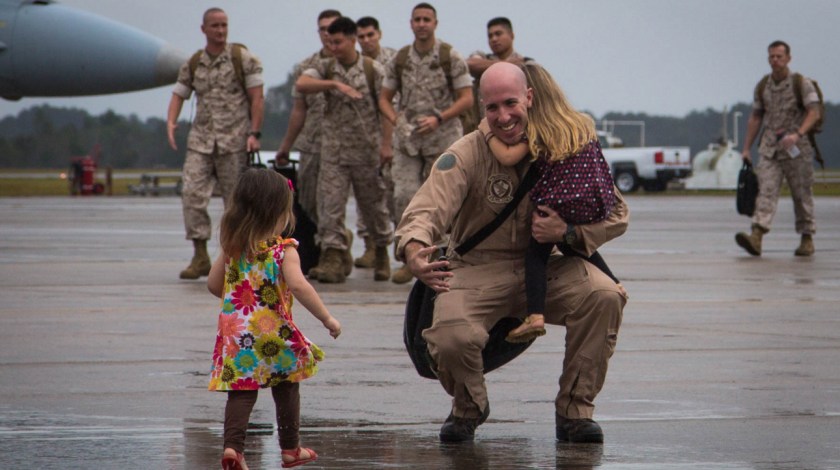
Robert Hite, 93, was too frail to travel in 2013.  Wally Hite, stood in for his father.

On November 9, 2013, a 117 year-old bottle of rare, vintage cognac was cracked open, and enjoyed among a company of heroes.  If there is a more magnificent act of tribute, I cannot at this moment think of what it might be.

On April 18, 2015, Richard Cole and David Thatcher fulfilled their original bargain, as the last surviving members of the Doolittle raid.  Staff Sergeant Thatcher passed away on June 23, 2016, at the age of 94.  As I write this, only one of those eighty goblets remains upright.  Lieutenant Colonel Richard Cole, co-pilot to mission leader Jimmy Doolittle himself, is 103.  He is the only living man on the planet, who has earned the right to open that rare and vintage cognac.

If you enjoyed this “Today in History”, please feel free to re-blog, “like” & share on social media, so that others may find and enjoy it as well. Please click the “follow” button on the right, to receive email updates on new articles.  Thank you for your interest, in the history we all share.

November 8, 1965 The Eighth of November

“On the 8th of November, the angels were cryin’
As they carried his brothers away
With the fire rainin’ down and the hell all around
There were few men left standin’ that day”

Fifty-three years ago today, the 173rd Airborne Brigade was halfway through its year of service in Vietnam.  “Operation Hump”, so named in recognition of that mid-point, was a search and destroy mission inserted by helicopter on November 5.

Vietcong fighters had taken up positions on several key hills near Bien Hoa, with the objective of driving them out.

hqdefault (9)There had been little contact through the evening of the 7th, when B and C Companies of the 1/503rd took up a night defensive position in the triple canopied jungle near Hill 65.
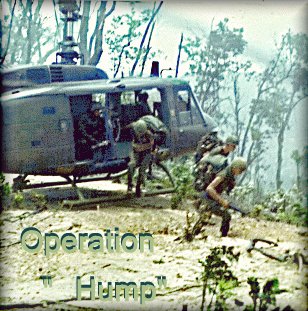
On the morning of the 8th, the Brigade found itself locked in combat with an entire main line Vietcong Regiment, pouring out of their trenches and onto the Americans’ position.

The VC were well aware of the Americans’ superior artillery and air cover capabilities.  Their strategy was to get in so close that it nullified the advantage.  “Grab Their Belts to Fight Them”, they would say.

Operation hump, 2Outnumbered in some places six to one, it was a desperate fight for survival as parts of B and C companies were isolated in shoulder to shoulder, hand to hand fighting.

Shot through the right thigh and calf with medical supplies depleted, Army Medic Lawrence Joel hobbled about the battlefield on a makeshift crutch, tending to the wounded.  Though wounded himself, Specialist 4 Randy Eickhoff ran ahead, providing covering fire. Eickhoff was later awarded the Silver Star and Purple Heart for his actions.

Specialist 5 Joel received the Medal of Honor.  Let his citation, tell the story:

Cmoh_armyFor conspicuous gallantry and intrepidity at the risk of life above and beyond the call of duty. Specialist 5 Joel demonstrated indomitable courage, determination, and professional skill when a numerically superior and well-concealed Viet Cong element launched a vicious attack which wounded or killed nearly every man in the lead squad of the company. After treating the men wounded by the initial burst of gunfire, he bravely moved forward to assist others who were wounded while proceeding to their objective. While moving from man to man, he was struck in the right leg by machine gun fire. Although painfully wounded his desire to aid his fellow soldiers transcended all personal feeling. He bandaged his own wound and self-administered morphine to deaden the pain enabling him to continue his dangerous undertaking. Through this period of time, he constantly shouted words of encouragement to all around him. Then, completely ignoring the warnings of others, and his pain, he continued his search for wounded, exposing himself to hostile fire; and, as bullets dug up the dirt around him, he held plasma bottles high while kneeling completely engrossed in his life saving mission. Then, after being struck a second time and with a bullet lodged in his thigh, he dragged himself over the battlefield and succeeded in treating 13 more men before his medical supplies ran out. Displaying resourcefulness, he saved the life of one man by placing a plastic bag over a severe chest wound to congeal the blood. As 1 of the platoons pursued the Viet Cong, an insurgent force in concealed positions opened fire on the platoon and wounded many more soldiers. With a new stock of medical supplies, Specialist 5 Joel again shouted words of encouragement as he crawled through an intense hail of gunfire to the wounded men. After the 24 hour battle subsided and the Viet Cong dead numbered 410, snipers continued to harass the company. Throughout the long battle, Specialist 5 Joel never lost sight of his mission as a medical aid man and continued to comfort and treat the wounded until his own evacuation was ordered. His meticulous attention to duty saved a large number of lawrence-joellives and his unselfish, daring example under most adverse conditions was an inspiration to all. Specialist 5. Joel’s profound concern for his fellow soldiers, at the risk of his life above and beyond the call of duty are in the highest traditions of the U.S. Army and reflect great credit upon himself and the Armed Forces of his country“.
48 Americans lost their lives in the battle, with many more wounded.  Two Australian paratroopers were recorded as MIA.  Their remains were discovered years later, and repatriated in 2007.

In May of 2006, the country music duo Big and Rich released a song in tribute to that day.  It’s called the 8th of November.

November 7, 1957 Nuke the Moon

The second Vanguard launch was nearly as bad as the first, exploding in flames only seconds after launch.  Soviet leaders were beside themselves with joy, and stamped the twin disasters “Kaputnik”.  “Flopnik”.

As World War II drew to a close in 1945, there arose a different sort of conflict, a contest of wills, between the two remaining Great Powers of the world. The “Cold War” pitted the free market economy and constitutional republicanism of the United States against the top-down, authoritarian governing and economic models of the Soviet Union. The stakes could not have been higher, as each side sought to demonstrate the superiority of its own technology, military might and, by implication, the dominance of its political and economic system.

American nuclear preeminence lasted but four short years, coming to an end with the first successful Soviet atomic weapon test code named “First Lightning”, carried out on August 29, 1949. Mutual fear and distrust fueled the Soviet-American “arms race”, a buildup of nuclear stockpiles beyond any rational purpose. An entire generation grew up under the shadow of nuclear annihilation.  A single mistake, misunderstanding or one fool in the wrong place at the wrong time, initiating a sequence and bringing about the extinction of life on this planet.

nuclear

The arms race acquired the dimensions of a Space Race on July 29, 1956, when the United States announced its intention to launch an artificial satellite, into earth orbit. Two days later, the Soviet Union announced its intention to do the same.

The early phase of the Space Race was a time of serial humiliation for the American side, the Soviet Union launching the first Inter-Continental Ballistic Missile (ICBM) on August 21, 1957, and the first artificial satellite “Sputnik 1” on October 4.

Laika and capsuleThe first living creature to enter space was the dog Laika“, launched aboard the spacecraft Sputnik 2 on November 3 and labeled by the more smartass specimens among the American commentariat, as “Muttnik”. Soviet propaganda proclaimed “the first traveler in the cosmos”, with heroic images printed on posters, stamps and matchbook covers. The American news media could do little but focus on the politics of the launch, as animal lovers the world over questioned the ethics of sending a dog to certain death, in space.

On the American side, the giant Vanguard series rocket was scheduled to launch the grapefruit-sized test satellite into earth orbit in September, but the program was plagued by one delay after another.  The December 6 launch was a comprehensive disaster, the rocket lifting all of four feet off the pad before crashing to the ground in a sheet of flame, the satellite rolling free where it continued to beep, only feet from the burning wreck.

The second Vanguard launch was nearly as bad, exploding in flames only seconds after launch.  Soviet leaders were beside themselves with joy, and stamped the twin disasters “Kaputnik”.  “Flopnik”.

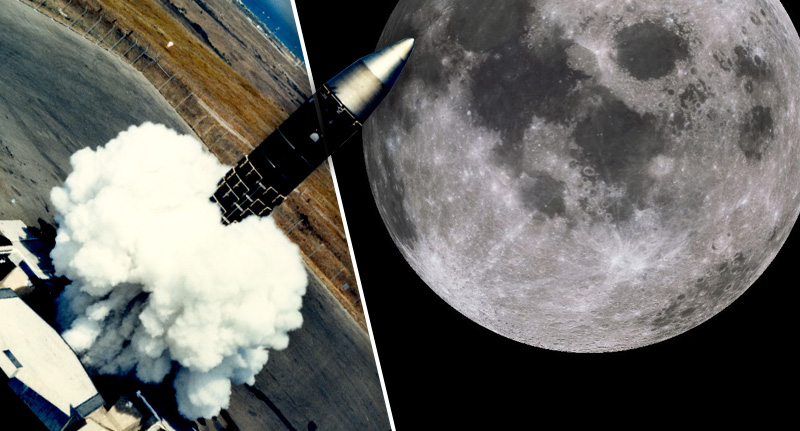
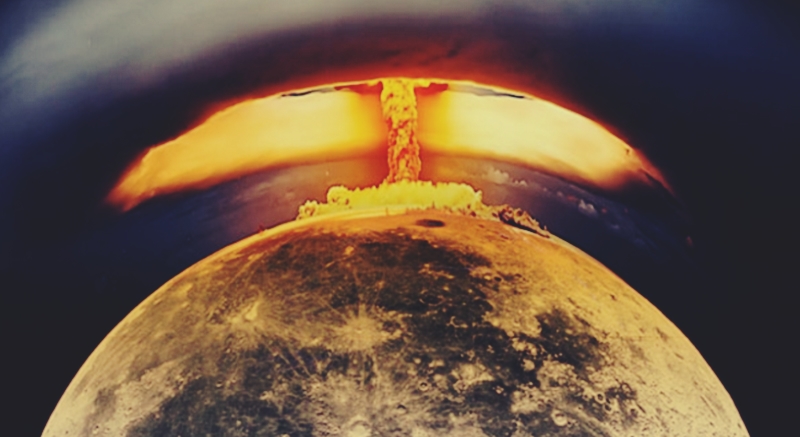
Out of this mess emerged an idea destined to go down in the Hare-Brain Hall of fame, if there ever is such a place. A show of force sufficient to boost domestic morale, while showing the Soviets, we mean business. It was the top-secret “Project A119”, also known as A Study of Lunar Research Flights. We would detonate a nuclear weapon, on the moon.

In 1957, newspapers reported a rumor that the Soviet Union planned a nuclear test explosion on the moon, timed to coincide with the lunar eclipse of November 7, and celebrating the anniversary of the Glorious October Revolution. Edward Teller himself, the ‘Father of the H-Bomb” is said to have proposed such an idea as early as February, to test the effects of the explosion in a vacuum, and conditions of zero gravity.

644962_v1

Today, we take for granted the massively complex mathematics, involved in hitting an object like the moon. In 1957 there was a very real possibility of missing the thing, and the bomb returning to earth.

Though the information is still classified, the project was revealed in 2000 by former NASA executive Leonard Reiffel, who said he was asked to “fast track” the program in 1958, by senior Air Force officials. A young Carl Sagan was all for the idea, believing at the time that living microbes may inhabit the moon, and a nuclear explosion may help in detecting such organisms.

In an interview with the Guardian newspaper, Reiffel said “It was clear the main aim of the proposed detonation was a PR exercise and a show of one-upmanship. The Air Force wanted a mushroom cloud so large it would be visible on earth. The US was lagging behind in the space race.” The now-retired NASA executive went on to explain that “The explosion would obviously be best on the dark side of the moon and the theory was that if the bomb exploded on the edge of the moon, the mushroom cloud would be illuminated by the sun.”

The Air Force canceled the A119 program in 1959, apparently out of concern that a ‘militarization of space’ would create public backlash, and that nuclear fallout may hamper future research and even colonization efforts, on the moon.

moon-nuke_wikimedia-commons_fb

Previously secret reports revealed in 2010 that Soviet leaders had indeed contemplated such a project, part of a multi-part program code named “E”.  Project E-1 involved reaching the moon, while E-2 and E-3 focused on sending a probe around the far side of the celestial body. The final stage, project E-4, involved a nuclear strike on the moon as a “display of force”.

Construction plans for the aforementioned Hare-Brain Hall of Fame have yet to be announced but, it appears the place may need another wing.

If you enjoyed this “Today in History”, please feel free to re-blog, “like” & share on social media, so that others may find and enjoy it as well. Please click the “follow” button on the right, to receive email updates on new articles.  Thank you for your interest, in the history we all share.

November 6, 1944 Going Home

For the first and last time in history, a man was deliberately buried at sea, inside of the aircraft he had served.

When the Great Depression fell over the nation in the 1930s, few states had a harder time of it, than Oklahoma.  Loyce Edward Deen grew up in this world, the seventh of eight children born to Grace and Allen Deen in the small town of Sulphur.

The family moved to Altus, Oklahoma where Allen worked as a schoolteacher.  Loyce would care for his younger brother Lewis, born with Down’s syndrome.  The pair became close. It must have broken Loyce’s heart when Lewis became and ill and died, while Loyce was still in Jr. High.

Loyce and his older brother Lance were busy during the High school years, caring for Grace following a debilitating stroke.

Loyce’s niece Bertha Deen Sullivan was little at the time, and still remembers.  “Loyce was a tall dark handsome young man with deep blue eyes”. He would pick her up and ask “Who loves ya?”, and then he would kiss her on the forehead.

Altus was the kind of small town, where the newspaper printed the bio of every graduating High school senior. The Times-Democrat wrote that “Loyce Deen is a young man with high ambitions. He plans to enter the US Navy aeronautical mechanics division after graduation and finds subjects such as problems of American democracy, the most interesting. He has also been active in dramatics work at school.

Loyce worked for a time with the government’s Civilian Conservation Corps (CCC), and later joined the Douglas Aircraft Company in Wichita, building wing sets for the A-26 Invader attack bomber.

Loyce_pic_Even before the Japanese attack on Pearl Harbor, Loyce had wanted to join the Navy. In October 1942, he did just that. First there was basic training in San Diego, and then gunner’s school, learning all about the weapons systems aboard a Grumman TBF Avenger torpedo bomber. Then on to Naval Air School Fort Lauderdale, before joining the new 15th Air Group, forming out of Westerly, Rhode Island.
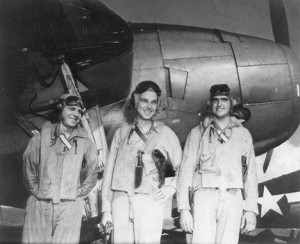
On April 29, 1944, the Air Group reported for duty aboard the “Fightingest Ship in the Navy” at Pearl Harbor.  The aircraft carrier, USS Essex.

An Air Group consists of eighty or so aircraft, of three distinct types. First are the fighters, the fast, single seat Grumman Hellcats. Next are the two-seat dive bombers, the Curtiss Helldivers, the pilot joined by a rear-seat gunner whose job it is to lay the one-ton bomb on the target, while handling a machine gun at the same time. Third is the torpedo bomber, the Grumman Avenger, with two enlisted crewmen in addition to the pilot. The Avenger carries a ton of bombs, depth charges or aerial torpedoes and, like the Helldiver, is designed for low-level attack.

cache_3727742604Loyce was the turret gunner on one of these Avengers, assigned to protect the aircraft from above and teamed up with Pilot Lt. Robert Cosgrove from New Orleans, Louisiana and Radioman Digby Denzek, from Grand Rapids, Michigan.
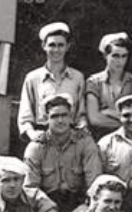
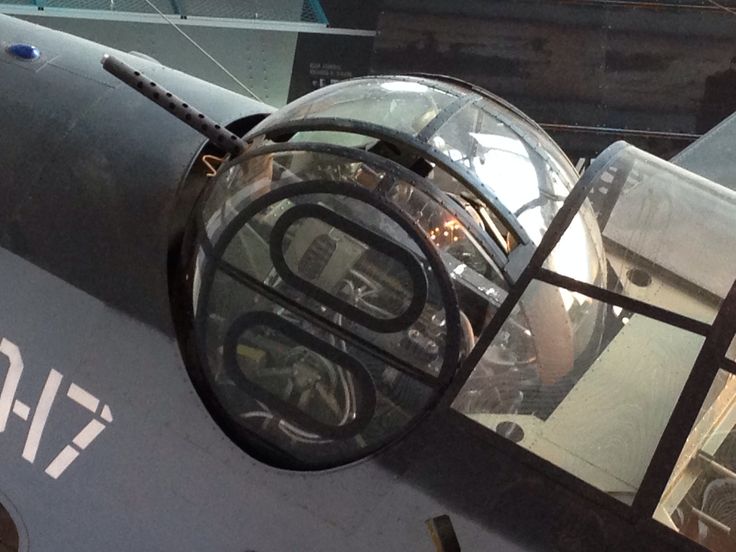
Cosgrove was a superb pilot, often returning aircraft to the carrier, so shot up as to seem unflyable. Digby had several jobs, including arming the weapons systems, and operating the radio. When the team was under fire, Digby would crawl down into a ball turret on the belly of the aircraft, his machine gun defending, from below.

The 15th Air group saw some of the most intense fighting it had ever encountered during the battle of Leyte Gulf of October 24-25, 1944. Commander Lambert, who oversaw the Avenger squadron, described “Coming in through the most intense and accurate AA yet experienced, the squadron made three hits on one battleship, two hits on another battleship, and two hits each on two different heavy cruisers“.

Dennis_Blalock
Dennis Blalock of Calhoun GA, his hands on the shoulders of shipmate, Loyce Deen. Both would be dead within ten days, of this photograph

Deen received a shrapnel wound to his foot sometime during the fighting of the 24th. He wrapped the thing up and stayed on to fight, the following day. He would receive a Purple heart medal for the wound. Posthumously.

Following rest and replenishment at Ulithi Atoll in the Caroline Islands, USS Essex was on station for the November 5 Battle of Manila Bay.  Loyce could have stayed back on a hospital ship until that foot healed, but chose to ignore the injury and rejoin his unit.

Loyce’s niece Bertha, was not surprised. On being informed of his injury, she said “I’m not surprised he stayed with his unit. Loyce would not have it any other way – he would always remain at his post to make sure his brothers came home safely with him.

Loyce Deen climbed into his gun turret for the last time on November 5. It was a two hour ride to the target zone in Manila Bay, with Japanese aircraft on the radar for most of that time, and the carriers USS Lexington and Ticonderoga, under kamikaze attack.

Lieutenant Cosgrove’s Avenger came under savage anti-aircraft fire, from a Japanese cruiser.  Loyce Deen took two direct hits and was killed, instantly.  The Avenger aircraft, tail number 93, was so smashed up as to be all but unflyable.  It took all of the pilot’s strength and skill to fly the thing back through two thunderstorms, and land on the Essex.

e281f946d5375133dd2c1afe6213dacd

What remained of Loyce Edward Deen was so badly mangled, it was all but impossible to remove him from his smashed turret.  For the first and last time in history, a man was deliberately buried at sea, inside of the aircraft he had served.

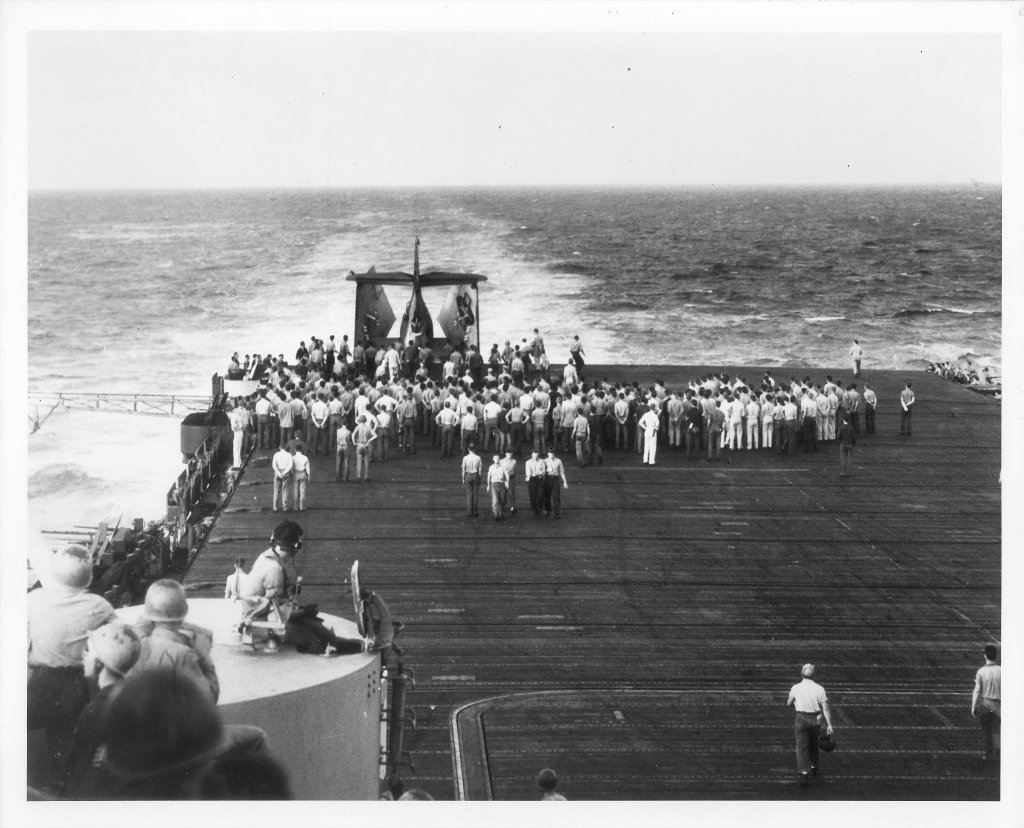
Fingerprints were taken and dog tags removed.  This Avenger was not even scavenged, for parts.  With the crew of the USS Essex assembled on deck, the shattered aircraft was pushed over the side.  Two other Avengers flew overhead in salute, as the tail dipped beneath the waves.

Loyce Edward Deen, was going home.

Not long after the ceremony, the Essex went to General Quarters.  There were kamikazes to deal with.

Lt. Cosgrove and the rest of Air Group 15 got back into their aircraft the following day and again on the 12th, 13th and 14th, and attacked those same cruisers in Manila Bay.

The Deen family would not receive the knock on the door, until Thanksgiving week.

If you enjoyed this “Today in History”, please feel free to re-blog, “like” & share on social media, so that others may find and enjoy it as well. Please click the “follow” button on the right, to receive email updates on new articles.  Thank you for your interest, in the history we all share.

November 5, 2004 I Did not Die

For nigh on seventy years, few knew from where this little known bit of verse, had come.

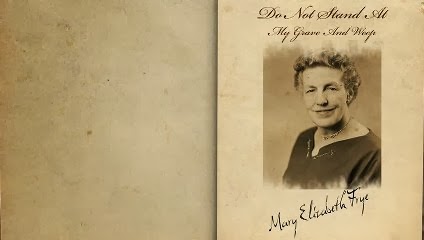
In the early 1930s, Mary Elizabeth Frye was a Baltimore housewife and amateur florist, the wife of clothing merchant, Claud Frye.

A young Jewish girl was living with the couple at this time, unable to visit her sick mother in Germany, due to the growing anti-Semitic violence of the period.  Her name was Margaret Schwarzkopf.

Margaret was bereft when her mother died, heartbroken that she could never “stand by my mother’s grave and shed a tear.” Mrs Frye took up a brown paper shopping bag, and wrote out this twelve line verse.

She didn’t title the poem, nor did she ever publish it, nor copyright the work.  People heard about it and liked it so Frye would make copies, but that’s about it.

mary-elizabeth-frye-4-728

For nigh on seventy years, few knew from where this little known bit of verse, had come.

Over the years, there have been many claims to authorship, including attributions to traditional and Native American origins.

The unknown poem has been translated into Danish, Dutch, French, German, Hebrew, Ilocano, Japanese, Korean, Russian, Spanish, Tagalog and other languages, appearing on countless bereavement cards and read over untold funeral services.

The English translation of one Swedish version reads: “Do not weep at my grave – I am not there / I am in the sun’s reflection in the sea / I am in the wind’s play above the grain fields / I am in the autumn’s gentle rain / I am in the Milky Way’s string of stars / And when on an early morning you are awaked by bird’s song / It is my voice that you are hearing / So do not weep at my grave – we shall meet again.

Many in the United Kingdom heard the poem for the first time in 1995, when a grieving father read it over BBC radio in honor of his son, a soldier slain by a bomb in Northern Ireland. The son had left the poem with a few personal effects, and marked the envelope ‘To all my loved ones’.

For National Poetry Day that year, the British television program The Bookworm conducted a poll to learn the nation’s favorite poems, subsequently publishing the winners, in book form. The book’s preface describes “Do Not Stand at My Grave and Weep” as “the unexpected poetry success of the year from Bookworm’s point of view… the requests started coming in almost immediately and over the following weeks the demand rose to a total of some thirty thousand. In some respects it became the nation’s favourite poem by proxy… despite it being outside the competition.”

All this at a time when the name and even the nationality of the author, was unknown.

47261870-jpeg_preview_large

Abigail Van Buren, better known as “Dear Abby”, researched the history of the poem in 1998, and determined that Mrs. Frye was, after all, the author.

Mary Elizabeth Frye passed away in Baltimore Maryland on September 4, 2004. She was ninety-eight.

The Times of Great Britain published her untitled work on November 5, as part of her obituary. ‘The verse demonstrated a remarkable power to soothe loss”, wrote the Times. “It became popular, crossing national boundaries for use on bereavement cards and at funerals regardless of race, religion or social status”.

I Did Not Die”
by Mary Elizabeth Frye

Do not stand at my grave and weep,
I am not there; I do not sleep.
I am a thousand winds that blow,
I am the diamond glints on snow,
I am the sun on ripened grain,
I am the gentle autumn rain.
When you awaken in the morning’s hush
I am the swift uplifting rush
Of quiet birds in circling flight.
I am the soft star-shine at night.
Do not stand at my grave and cry,
I am not there; I did not die.

If you enjoyed this “Today in History”, please feel free to re-blog, “like” & share on social media, so that others may find and enjoy it as well. Please click the “follow” button on the right, to receive email updates on new articles.  Thank you for your interest, in the history we all share.

November 4, 1918 Soldier Poet

My friend, you would not tell with such high zest
To children ardent for some desperate glory,
The old Lie: Dulce et decorum est
Pro patria mori.

Wilfred Edward Salter Owen was working as a private English tutor in Bordeaux, when the “Great War” broke out in 1914.

800px-Memorial_to_the_Artists_Rifles,_Royal_Academy,_LondonAt first in no hurry to sign up, he even considered joining the French Army before returning home to England, to enlist in the Artists Rifles Training Corps, in October 1915.
Originally formed in 1859, the Artists Rifles was a British special forces regiment, raised in London and comprised of painters, musicians, actors and architects, and symbolized by the heads of the Roman gods Mars and Minerva.

It must have felt a natural place.  Wilfred Owen was a poet, a talent first discovered about ten years earlier, at age ten or eleven.

Owen was commissioned Second Lieutenant after six-months training, and posted with the Manchester Regiment of line infantry.  An application to the Royal Flying Corps was rejected in 1916 and he was shipped to France, joining the 2nd Manchester regiment near Beaumont Hamel, on the river Somme.

He was contemptuous of his men at first, considering them to be louts and barbarians.  He wrote home to his mother Susan in 1917, describing his company as “expressionless lumps”.  The war would soon beat that out of him.

Owen was close with his mother, his letters home telling a tale of mud and frostbite, of fifty hours spent under heavy bombardment, sheltered only by a muddy, flooded out dugout, of falling through shell-shattered earth into a cellar below, earning him a trip to the hospital.  It would not be his last.

Owen was caught in an explosion during the bitter battle of St. Quentin, blown off of his feet and into a hole, there to spend days fading in and out of consciousness amidst the shattered remains of a fellow officer.

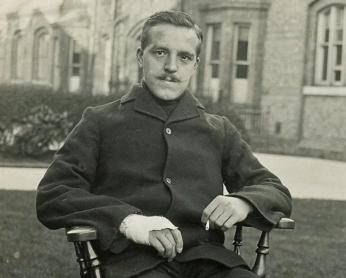
d6d65d6After this experience, soldiers reported him behaving strangely. Owen was diagnosed as suffering from neurasthenia or shell shock, what we now understand to be Post-Traumatic Stress Disorder, and sent to Craiglockhart War Hospital in Edinburgh, for treatment.

There, Dr. Arthur Brock encouraged Owen to work hard on his poetry, to overcome his shell shock.  There he met another patient, the soldier and poet, Siegfried Sassoon. The chance meeting would elevate Wilfred Owen to one of the great war poets, of his generation.

Owen’s work was qualitatively different before this time, vaguely self important but never self pitying. Never a pacifist – he held those people to ridicule – Owen’s nightmares now brought forth a brutal honesty and a deep compassion for the burdens of the ordinary soldier.  Tales of trench life:  of gas, lice, mud and death, of Hell and returning to earth, steeped in contempt for the patriotic sentimentality of non-combatants and the slurs of cowardice, so lightly dispensed by the women of the “White Feather” movement.

Anthem for Doomed Youth, is a classic of the period:

What passing-bells for these who die as cattle?
— Only the monstrous anger of the guns.
Only the stuttering rifles’ rapid rattle
Can patter out their hasty orisons.
No mockeries now for them; no prayers nor bells;
Nor any voice of mourning save the choirs,—
The shrill, demented choirs of wailing shells;
And bugles calling for them from sad shires.

What candles may be held to speed them all?
Not in the hands of boys, but in their eyes
Shall shine the holy glimmers of goodbyes.
The pallor of girls’ brows shall be their pall;
Their flowers the tenderness of patient minds,
And each slow dusk a drawing-down of blinds.

wilfred-owenOwen continued to write through his period of convalescence, his fame as author and poet growing through the late months of 1917 and into March of the following year. Supporters requested non-combat postings on his behalf, but such requests were turned down. It’s unlikely he would have accepted them, anyway. His letters reveal a deep sense of obligation, an intention to return to the front to be part of and to tell the story of the common man, thrust by his government into uncommon conditions.

Wilfred Owen well understood his special talent.  He wanted a return to front line combat, made all the more urgent when Sassoon was once again wounded, and removed from the front.

He was back in France by September 1918, capturing a German machine gun position on the 29th, for which he would be awarded the Military Cross.  Posthumously.

On October 31, Owen wrote home to his mother, from the cellar of the Forrester’s house, at Ors.  It was to be the last such note she would ever receive,  “Of this I am certain: you could not be surrounded by a band of friends half so fine as surround me here.

The forty-four mile Sambre-Oise Canal flows through the Meuse river basin, a network of 38 locks directing the water’s flow and connecting the Netherlands and Belgium with the central waterways of France. Forces of the 2nd Battalion Royal Sussex forced the canal on November 4, in coordination with elements of the 2nd Manchester Regiment and the Lancashire Fusiliers. British forces were to cross surrounding fields lined with high hedges, then to cross the canal by portable foot bridges, or climbing across the lock gates, themselves.

landrecies1918

The battle of the Sambre–Oise Canal was one of the last Allied victories of the Great War, and not without cost. Lock houses on the opposite side formed strong points for German defensive fire, from small arms and machine guns.

Wilfred Owen was at the head such a raiding party, when the bullets from the German machine gun tore into his body. He died a week nearly to the hour, from the armistice which would end the war.  He was twenty-five.

The church bells of Shrewsbury rang out in celebration that day in 1918, as Owen’s parents Tom and Susan, received the telegram.  The eleventh hour of the eleventh day of the eleventh month.

“Deeply regret to inform you, that…”

“Dulce et Decorum Est”

Bent double, like old beggars under sacks,
Knock-kneed, coughing like hags, we cursed through sludge,
Till on the haunting flares we turned our backs,
And towards our distant rest began to trudge.
Men marched asleep. Many had lost their boots,
But limped on, blood-shod. All went lame; all blind;
Drunk with fatigue; deaf even to the hoots
Of gas-shells dropping softly behind.

Gas! GAS! Quick, boys!—An ecstasy of fumbling
Fitting the clumsy helmets just in time,
But someone still was yelling out and stumbling
And flound’ring like a man in fire or lime.—
Dim through the misty panes and thick green light,
As under a green sea, I saw him drowning.

In all my dreams before my helpless sight,
He plunges at me, guttering, choking, drowning.

If in some smothering dreams, you too could pace
Behind the wagon that we flung him in,
And watch the white eyes writhing in his face,
His hanging face, like a devil’s sick of sin;
If you could hear, at every jolt, the blood
Come gargling from the froth-corrupted lungs,
Obscene as cancer, bitter as the cud
Of vile, incurable sores on innocent tongues,—
My friend, you would not tell with such high zest
To children ardent for some desperate glory,
The old Lie: Dulce et decorum est
Pro patria mori.

Wilfred Owen, 1917

November 3, 1954 Godzilla

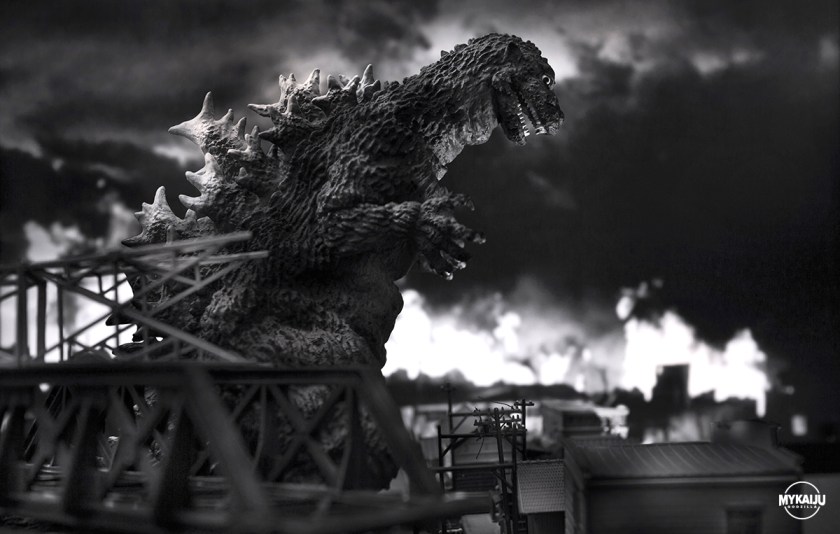
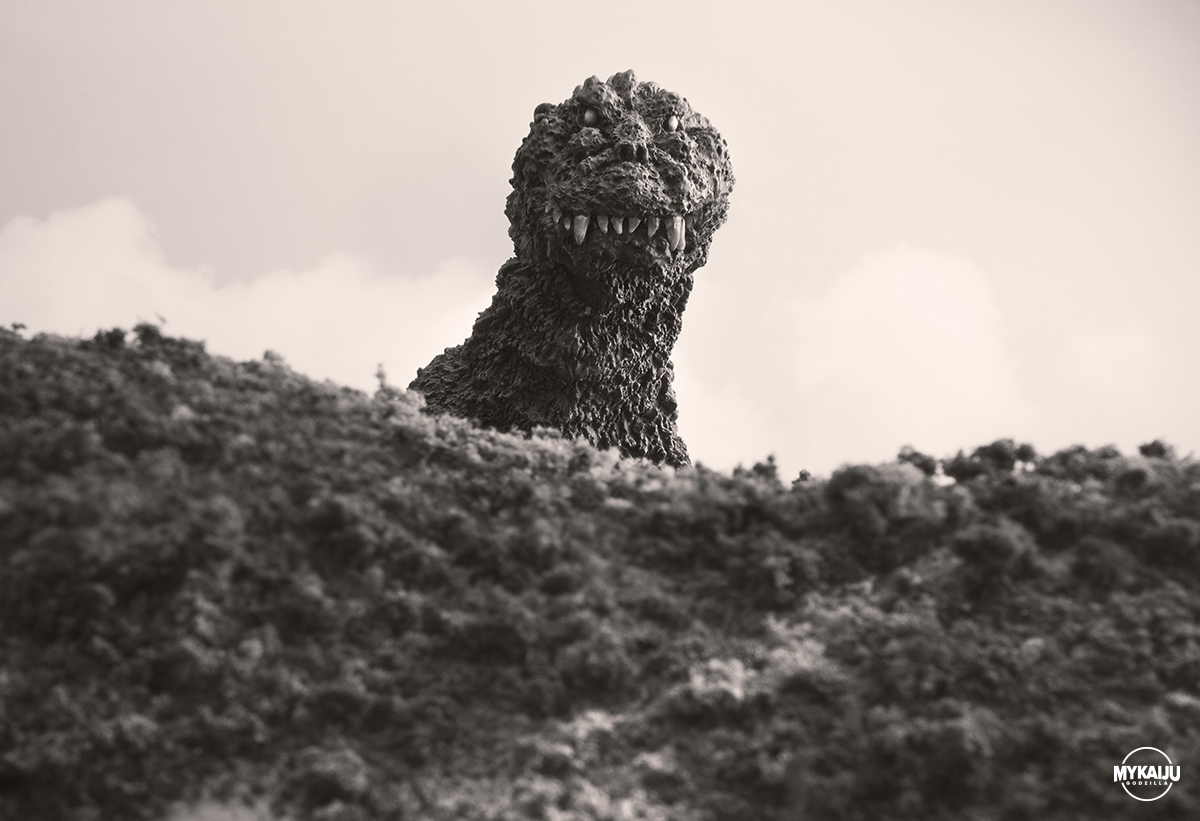
He was a Kaiju, a Japanese word meaning “strange creature”, more specifically a “daikaiju”, meaning a really, really big one.

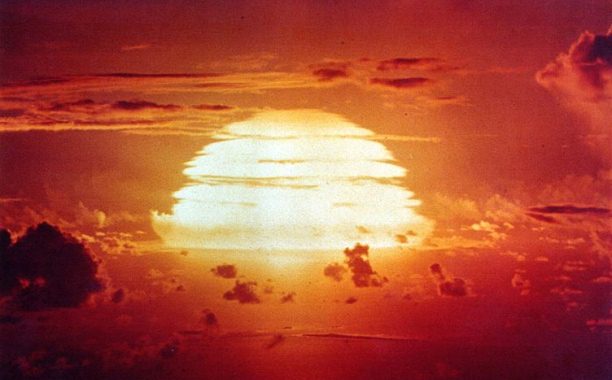
In 1954, the fishing boat Daigo Fukuryū Maru (“Lucky Dragon No.5”) was working the grounds near the Marshall Islands, in the equatorial Pacific. At 6:45am local time, March 1, 23 fishermen were witness to “Castle Bravo”,  a thermonuclear test explosion that lit up the western sky “like a sunrise”.  Then came the sound the explosion.  The TX-21 device with a predicted yield of 6 megatons, and code named “Shrimp”.

For eight minutes, these twenty-three men watched the mushroom cloud rise into the sky.  An hour and one-half later came the fallout, the fine white dust, calcinated coral of the Bikini atoll, falling like snow from the sky.

None of the twenty-three crew members of the Lucky Dragon recognized the material as hazardous, and made no effort to avoid exposure.  Some even tasted the stuff.

Operation_Crossroads_Test_Baker_In_Colour

A few fishermen developed acute radiation sickness, over the next three days.   By the time of their return to Yaizu on the 14th, all 23 were suffering from nausea, headaches, bleeding from the gums, and other symptoms.  One was destined to die of a liver disorder on September 23,  a complication of radiation sickness.  They had entered the ranks of the “hibakusha”.  The “explosion-effected people”.

The atomic explosions at Hiroshima and Nagasaki were only nine years in the past at this time, and a fierce anti-nuclear sentiment was building in Japan. In this context, there arose a metaphor for all that destruction. Literally rising from the sea, this product of the Japanese entertainment industry took the form of a monster. “Godzilla”, Ishirō Honda’s first film released by Toho Studios, this day in 1954.

The name is a portmanteau, two words combined to form a third, of the Japanese word “gorira”, (gorilla), and “kujira”, meaning whale.  Godzilla was the Gorilla Whale, with the head of a Tyrannosaur, Stegasaur-like plates on his back and skin modeled after the keloid scarring of the hibakusha.

The original Godzilla (“ɡodʑiɽa”) was awakened by atomic testing and impervious to any but a nuclear weapon. Emerging from the depths with his atomic breath, havoc and destruction was always accompanied by the distinctive roar, a sound effect made by rubbing a resin glove down the strings of a bass violin, then changing the speed at playback.

1-g54-bridge-1

The actor who played Godzilla in the original films, Haruo Nakajima, was a black belt in Judo. His expertise was used to choreograph the monster’s movements, defining the standard for most of the Godzilla films, to follow.

Originally an “it”, Godzilla was usually depicted as a “he”, although that became a little complicated with the 1998 American remake “Zilla”, when he started laying eggs.

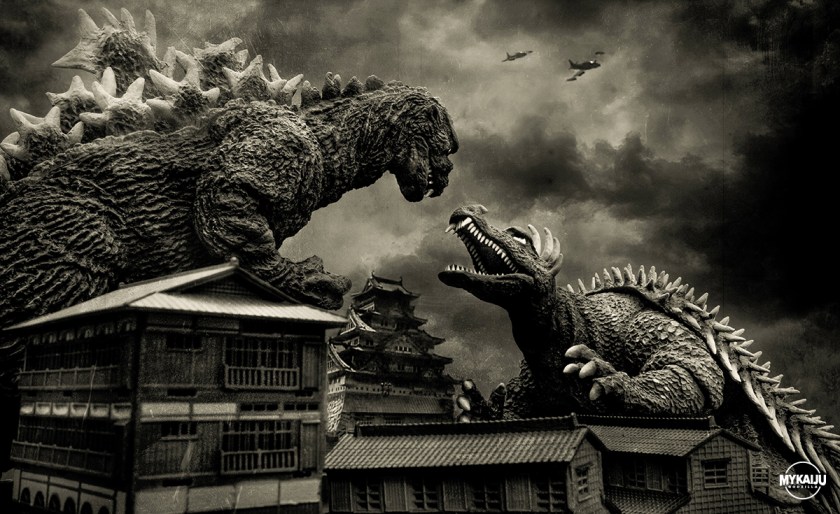
He was a Kaiju, a Japanese word meaning “strange creature”, more specifically a “daikaiju”, meaning a really, really big one. Godzilla is the best known, but certainly not the only such creature. You may remember other kaiju, including Gamera, Mothra, King Ghidorah, Mechagodzilla and Rodan.

2-g55-angirus-1

Godzilla has appeared in 28 original films, with more in the works. Over the course of his existence he has been a hero, a villain, and a destructive but values-neutral force of nature.

Godzilla got his own star on the Hollywood “Walk of Fame” in 2004, timed to coincide with the release of the 29th movie, “Godzilla: Final Wars.” Instead of nuclear weapons testing, this version was spawned by “environmental pollution”. It takes the superheroes of the “Earth Defense Organization” (but, of course) to freeze him back into the ice of the South Pole. The film was a flop, grossing less than $12 million after a production budget of $19 million.

34622

The franchise came roaring back ten years later, when Godzilla was released in 2014, grossing $200 million domestically and $529.1 million on worldwide sales.

A film franchise 64 years in the making is still going strong, and will continue to do so, for the foreseeable future. Godzilla: King of the Monsters is set to be released in 2019 and Godzilla vs. Kong, in 2020.

Tip of the hat to http://www.mykaiju.com, for most of the images used in this story.

If you enjoyed this “Today in History”, please feel free to re-blog, “like” & share on social media, so that others may find and enjoy it as well. Please click the “follow” button on the right, to receive email updates on new articles.  Thank you for your interest, in the history we all share.

November 2, 1950  The Shepherd wore Combat Boots

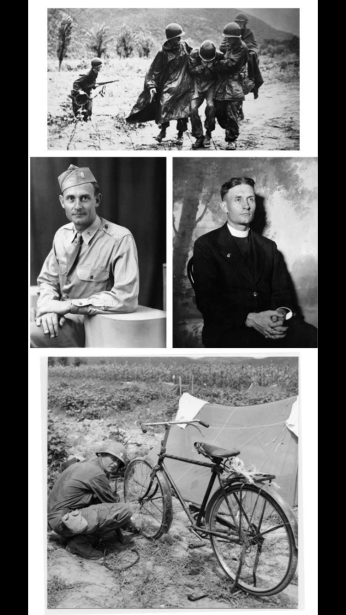
Chaplain Kapaun once lost his Mass kit to enemy fire. He earned a Bronze Star in September of 1950, when he ran through intense enemy fire to rescue a wounded soldier. His was no rear-echelon ministry.

Kapaun5Emil Joseph Kapaun was the son of Czech immigrants, a farm kid who grew up in 1920s Kansas. Graduating from Pilsen High, class of 1930, he spent much of the 30s in theological seminary, becoming an ordained priest of the Roman Catholic faith on June 9, 1940.
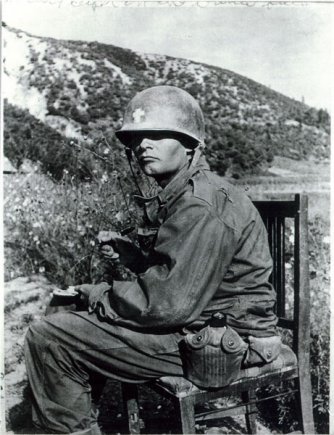
Kapaun served as military chaplain toward the end of WWII, before leaving the army in 1946, and rejoining in 1948.

Father Kapaun was ordered to Korea a month after the North invaded the South, joining the 8th Cavalry Regiment of the 1st Cavalry Division, out of Fort Bliss.

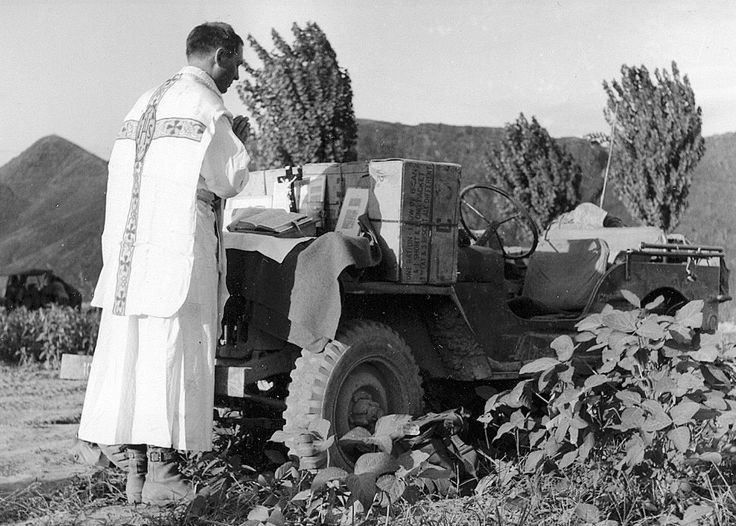
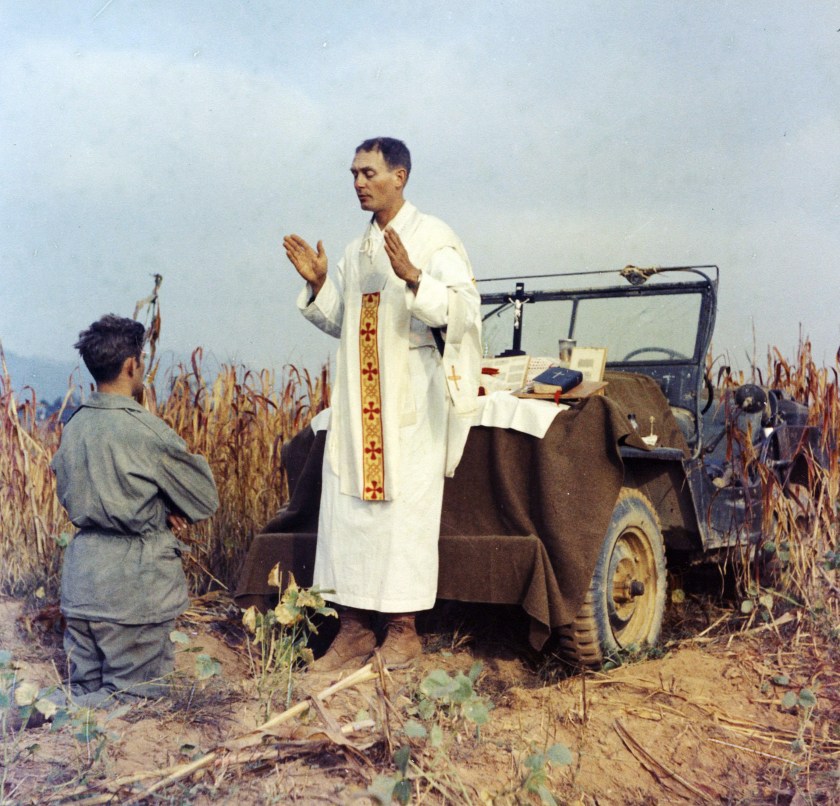
His unit entered combat at the Pusan perimeter, moving steadily northward through the summer and fall of 1950. Kapaun would minister to the dead and dying, performing baptisms, hearing first confessions, offering Holy Communion and celebrating Mass from an improvised altar set up on the hood of a jeep.

He once lost his Mass kit to enemy fire. He earned a Bronze Star in September that year, when he ran through intense enemy fire to rescue a wounded soldier. His was no rear-echelon ministry.

Kapaun2A single regiment was attacked by the 39th Chinese Corps on November 1, and completely overrun the following day. For the 8th Cav., the battle of Unsan was one of the most devastating defeats of the Korean War. Father Kapaun was ordered to evade, an order he defied. He was performing last rites for a dying soldier, when he was seized by Chinese communist forces.
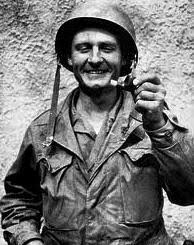
Prisoners were force marched 87 miles to a Communist POW camp near Pyoktong, in North Korea. Conditions in the camp were gruesome. 1st Lt. Michael Dowe was among the prisoners, it’s through him that we know much of what happened there. Dowe later described Father Kapaun trading his watch for a blanket, only to cut it up to fashion socks for the feet of prisoners.

Father Kapaun would risk his life, sneaking into the fields around the prison compound to look for something to eat. He would always bring it back to the communal pot.

Kapaun4Chinese Communist guards would taunt him during daily indoctrination sessions, “Where is your god now?” Before and after these sessions, he would move through the camp, ministering to Catholic and non-Catholic alike. Kapaun would slip in behind every work detail, cleaning latrines while other prisoners argued over who’d get the job. He’d wash the filthy laundry of those made weak and incontinent with dysentery.
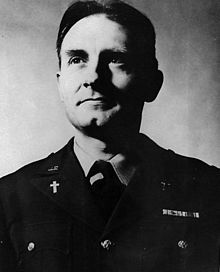
Starving, suffering from a blood clot in his leg and a severe eye infection, Father Kapaun defied his communist captors to lead Easter services in April, 1951. He was incapacitated a short time later. Chinese guards carried him off to a “hospital” – a fetid, stinking part of the camp known to prisoners as the “Death House”, from which few ever returned. “If I don’t come back”, he said, “tell my Bishop that I died a happy death.”

Kapaun1In the end, he was too weak to lift the plate that held the meager meal the guards left for him. US Army records report that he died of pneumonia on May 6, 1951, but his fellow prisoners will tell you that he died on May 23, of malnutrition and starvation. He was 35.
Scores of men credit their own survival in that place, to Chaplain Kapaun.

In 2013, President Barack Obama presented Kapaun’s family with the Medal of Honor, posthumous, for his heroism at Unsan. The New York Times reported that April: “The chaplain “calmly walked through withering enemy fire” and hand-to-hand combat to provide medical aid, comforting words or the last rites of the Roman Catholic Church to the wounded, the citation said. When he saw a Chinese soldier about to execute a wounded comrade, Sgt. First Class Herbert A. Miller, he rushed to push the gun away. Mr. Miller, now 88, was at the White House for the ceremony with other veterans, former prisoners of war and members of the Kapaun family”.

Pope John Paul II named Father Kapaun a “Servant of God” in 1993, the first step toward Roman Catholic Sainthood. On November 9, 2015, the Catholic Diocese of Wichita submitted a 1,066 page report on the life of Chaplain Kapaun, to the Roman Curia at the Vatican. A team of six historians reviewed the case for beatification. On June 21, 2016, the committee unanimously approved the petition.

The Medal at Last
In this photo provided by Col. Raymond A. Skeehan, Father Emil Kapaun celebrates Mass using the hood of his jeep as an altar, as his assistant, Patrick J. Schuler, kneels in prayer in Korea on Oct. 7, 1950, less than a month before Kapaun was taken prisoner. Kapaun died in a prisoner of war camp on May 23, 1951, his body wracked by pneumonia and dysentery. (AP Photo/Col. Raymond A. Skeehan via The Wichita Eagle)

The Congregation for the Causes of Saints, the committee of cardinals which makes recommendations concerning sainthood to the Pope, have taken the position that Kapaun would not be declared a martyr, a step which would have greatly accelerated the Pilsen, Kansas native toward sainthood.  Fellow prisoners and Korean War veterans have argued passionately, (I personally know one of them) that Kapaun was killed by Chinese Army prison guards, for standing up for his faith.  Vatican officials counter that no one actually saw Kapaun die.  Witnesses only saw the Father being carried away and, ever watchful over the credibility of its own sainthood investigations, the matter continues under Church review.

Wichita Bishop Carl Kemme believes that full canonization will not take place until 2020, at the earliest.

KapaunBanner

November 1, 1945 Downfall: A History that Never Was

The battle for the Japanese home islands was expected to be a fight like no other. 

If you’re ever in southeastern Massachusetts, be sure visit Battleship Cove in Fall River, the largest collection of WW2 naval craft, in the world. The Battleship Cove museum sports some sixty exhibits, preserving the naval heritage of these iconic vessels, and the veterans who served them. To walk aboard the battleship USS Massachusetts, the attack submarine USS Lionfish, is to experience a side of WW2, fast receding from living memory.

ParkCoveBattleship

Walk among the wooden-hulled PT boats of the Pacific war, and there you will find a strange little craft.  Closed at the top and semi-submersible, a Japanese kamikaze boat, perhaps, designed for suicide missions against allied warships. Museum management thought it was just that when they acquired the thing, back in the 1970s.  CIA files declassified in 2011 revealed a very different story.  The tale of a history, that never was.

24892346711_af70d25932_b

On August 2, 1939, Hungarian physicist Leó Szilárd delivered a letter which would change history, to President Franklin Delano Roosevelt. Written in consultation with fellow Hungarian physicists Edward Teller and Eugene Wigner and signed by Albert Einstein, the letter warned that Nazi Germany was working to develop atomic weapons, and urged the American government to develop a nuclear program of its own.  Immediately, if not sooner.

The Einstein–Szilárd letter spawned the super-secret Manhattan project, culminating in the atomic bombs “Little Boy” and “Fat Man”, and ending the war in the Pacific in August, 1945.

At the time, precious few were aware of even the possibility of such a weapon.  Fewer still, the existence of a program dedicated to building one.  Vice President Harry Truman, second only to the Commander in Chief himself, was entirely ignorant of the Manhattan project, and only read in following the death of the President in April, 1945.

300px-Kokumin_Giyutai
Female students with the Kokumin Giyū Sentōtai, the Volunteer Fighting Corps, prepare for the Allied projected invasion

The battle for the Japanese home islands was expected to be a fight like no other.  Casualties of a million or more, were expected.  And for good reason.  Japanese soldiers fought with such fanaticism, that hundreds continued to resist, years after the war was ended.  The last holdout wouldn’t lay down his arms until 1974.  29 years, 3 months, and 16 days after the war had ended.

Such frenzied resistance would not be isolated to Japanese military forces, either.  Japanese government propaganda warned of “American devils raping and devouring Japanese women and children.” American GIs looked on in horror in 1944, as hundreds if not thousands of Japanese soldiers and civilians hurled themselves to their death, at Laderan Banadero and “Banzai Cliff” on the northern Mariana island of Saipan.  One correspondent wrote with admiration of such mass suicides, praising them as “the finest act of the Shōwa period”… “the pride of Japanese women.”

This is what their government, taught them to believe.

Plans for the final defeat of the Imperial Japanese Empire all but wrote themselves, phase one launched from the south against the main island of Kyūshū, and using the recently captured island of Okinawa, as staging area.  Phase two was the planned invasion of the Kantō Plain toward Tokyo, on the island of Honshu.

Adobe ImageReady

The story of the D-Day invasion begins with deception, a massive head fake intended to draw German defenders away from intended landing zones.  “Operation Downfall” offered no such options, for deceit.  Geography dictated the method of attack, and everybody knew it.  Virtually everything left of Japanese military might would be assembled for the all-out defense of Kyūshū, against what would be the largest amphibious invasion, in history.

American military planners ordered half a million Purple Hearts, in preparation for the final invasion of the Japanese home islands. To this day, military forces have yet to use them all up. As of 2003, 120,000 Purple Heart medals still remained, in inventory.

The whole thing would begin on “X-Day”.  November 1, 1945.

gimik-underwayWhich brings us back to that funny-looking boat. The Office of Strategic Services (OSS), predecessor to the modern Central Intelligence Agency (CIA), built two of these semi-submersibles, code named “Gimik”, part of a top-secret operation code named “NAPKO”.

55 Korean-Americans and Korean prisoners freed from Japanese prison labor camps were trained to infiltrate Japanese occupied Korea and possibly Japan itself, to collect intelligence and carry out sabotage against military targets in advance of Operation Downfall.

The Gimik craft, each operated by a single OSS officer with two Korean operatives secured inside, would be the means of insertion.

The mission was extremely dangerous for obvious reasons.  Training was carried out during the summer of 1945 on Catalina Island, off the California coast.  The two boats, nicknamed “Gizmos”, were tested at night against the US Naval base in Los Angeles. Even this part was dangerous, since no one was told about the trials. Should such a vessel be detected entering the American installation, it would be treated as an enemy vessel, and destroyed.

In the end, the Gizmo teams never left American waters.  Several such tests were carried out without detection, leading to a scheduled departure date of August 26, 1945.  It was never meant to be.

A parallel and equally secret plan to end the war literally burst on the scene on August 6, 1945.  The war was over, nine days later.

If you enjoyed this “Today in History”, please feel free to re-blog, “like” & share on social media, so that others may find and enjoy it as well. Please click the “follow” button on the right, to receive email updates on new articles.  Thank you for your interest, in the history we all share.


October 31, 1883 The Dress in the Closet

Major Rathbone would heal, in time, but he never came to terms with his failure to protect the President.  He was tormented, distraught with guilt, unable to understand what he could have done differently.  Surely there must have been…Something.

An historical ghost story, for your Halloween enjoyment.   But there are no such things as ghosts…Right?

Albany, New York businessman Jared Rathbone passed away in 1845, leaving a considerable fortune to his widow Pauline, and their four children.

New York Supreme Court Justice Ira Harris, himself a widower, joined his household with hers when the couple married, in 1848.  There were now eight kids.  A regular 19th-century “Brady Bunch.”

Pauline’s son Henry and Ira’s daughter Clara became close friends and later, more.  Much more.  They were step-siblings, yes, but there was no “blood” between them.  Such a relationship seems not to have been so ‘odd’ then, as it may seem, today.

With the incoming Lincoln administration, Ira Harris was elected to the United States Senate, replacing Senator William H. Seward who’d been picked to serve in the new administration.

By the time of the War between the States, Clara Harris and Henry Rathbone were engaged to be married.

udvwxyoa

Rathbone served the Union army for the duration of the war, becoming Captain in the 12th Infantry Regiment and participating in the battles at Antietam and Fredericksburg.  By the end of the war, Rathbone had attained the rank of Major.

Meanwhile, Senator Harris’ daughter Clara had conceived a friendship with the First Lady of the United States, Mary Todd Lincoln.

If a picture is worth a thousand words, before and after photographs tell of the burdens, born by the chief executive of a nation at war with itself.  Making matters worse, the Lincolns had lost two of their four boys in childhood, by war’s end.  In April 1865, a night out must have seemed like a welcome break.  An evening at the theater.  The play, a three-act farce by English playwright Tom Taylor.  “Our American Cousin”.197030-Abraham-Lincoln-Before-And-After-Civil-War

The Lincoln’s companions for the evening were to be General Grant and his wife, Julia, but the General had other plans.  It was probably convenient, because the ladies didn’t get along.  Mary suggested her neighbor Clara Harris, of whom she was quite fond.  And besides, didn’t her fiancée cut a dashing figure, in his blue uniform.

The story of that night is familiar, the assassin creeping up from behind.  The mark of the coward.

John Wilkes Booth was himself one of the great actors of his day, and chose his moment, carefully.  Raucous laughter and applause could be expected to follow the line “Don’t know the manners of good society, eh? Well, I guess I know enough to turn you inside out, old gal — you sockdolagizing old man-trap!

John_Wilkes_Booth_dagger
John Wilkes Booth dagger, used to attack Rathbone

The bullet was fired at point-blank range, entering the President’s skull behind the left ear and coming to rest, behind the right eye.  Rathbone sprang to the attack but the assassin was ready, the dagger slashing the major nearly bone-deep, from shoulder to elbow.  Rathbone made one last lunge, knocking Booth off balance as he leapt to the stage, below.  Witnesses remembered that he cried out “Sic Semper Tyrannis”.  Thus always, to tyrants.  And then, he was gone.

In the President’s box, all was chaos.  The first lady was inconsolable, sobbing and shrieking, like a wildcat.  Rathbone was losing blood at a prodigious rate, a major artery slashed in the scuffle.

Clara’s new dress was soaked with the blood of her fiancee, her face splashed and clothing drenched through the layers of petticoats to the skin, beneath.  The small group was taken across the street to the Peterson house, the President laid out on a bed.  Henry Rathbone faded in and out of consciousness due to blood loss, raving in his delirium how he should have caught the assassin, his head on Clara’s lap, her handkerchief stuffed into the void where the bicep used to be.

There wasn’t even time to clean off her face.  Mary Lincoln would just begin to calm down when she’d see Clara and fall apart, wailing “My husband’s blood!”.  It wasn’t, but, no matter.  Perception is reality.  The death vigil lasted this way, for nine hours.  The 16th President of the United States passed away at 7:22 the following morning, April 15, 1865.

Lincolns-Death

Major Rathbone would heal, in time, but he never came to terms with his failure to protect the President.  He was tormented, distraught with guilt, unable to understand what he could have done differently, but, What!? Surely there must have been…Something.

Clara Harris couldn’t bring herself to wash that dress, nor to burn it.  She hung it in a guest room closet, blood and all, in the family’s vacation home in New York.

What demons afflicted the mind of Henry Rathbone can only be guessed at, as a mental illness which had no name, crept into his soul.  He was possessed with that night.  Was I not quick enough?  Or brave enough?  Or Strong enough?  It was MY fault.  A Better Man would have taken that bullet.  Or Stopped that man.  No he wouldn’t…yes he would…but…I…what, the, hell, is WRONG WITH YOU???!!!

clara-harris
The dress

Washington DC was saturated with All Things Lincoln in April 1866, and Clara fled to the family home in Albany, to get away.  There in that closet hung the bloody dress.  On the anniversary of the assassination, she heard laughter, she knew she did, coming down the hall.  Lincoln’s laughter.

Others reported the same thing in the following years.  The sound of laughter.  A single gun shot.  But there are no such things as ghosts…Right?

Major Rathbone and Clara Harris were married in July 1867 and the couple had three children, Henry rising to the rank of brevet Colonel, in 1870.  That was the year he resigned from the army, but work was hard to come by, due to increasing mental instability.

Rathbone convinced himself that Clara was unfaithful, and that she planned to take the kids away.   He would fly into rages and she considered divorce, but couldn’t bear the thought, nor the stigma.

Clara went so far as to have the closet bricked up with that dress inside, like Montresor bricked up Fortunato.  It changed, nothing.  The family traveled to Europe and back in search of a cure, but Rathbone’s condition only worsened.

Vault_ag1982_0119x_085_1_opt
US Capitol as it looked, in 1872

Despite all this or possibly because of it, President Chester A. Arthur appointed Rathbone US Consul to the Province of Hannover in Germany, in 1882.

“Trick or Treating” had yet to take hold by this time, back in the United States.  For most, October 31, 1883 passed pleasantly enough:  Fall festivals, children bobbing for apples, young women consulting mirrors or tossing nuts into fires, to see whom they would marry.  Not so, Henry Rathbone.  He had Monsters in his head.

Two months later, December 23, Henry Rathbone shot his wife, and stabbed himself, in the chest.  Six times.  He lived.  She died.

He claimed he was defending her, against an attacker.

The three children, Henry Riggs, Gerald Lawrence and Clara Pauline, went to live with relatives. Henry Reed Rathbone was convicted of their mother’s murder and committed to an asylum for the criminally insane in Hildesheim, Germany, there to spend the next twenty-eight years.

Henry Reed Rathbone died on August 14, 1911 and was buried, next to his wife.

In 1922, Henry Riggs Rathbone would be elected to the United States House of Representatives.  Twelve years earlier he unbricked that closet and burned the hated dress, the dress which had stolen his childhood, and murdered his mother, and cursed his father.  But there are no such things as ghosts…Right?

loudoncottagetoday
“The modern day home where Union Army Officer Henry Rathbone and Clara Harris resided”. Hat tip, HISTORIAN’S OFFICE, TOWN OF COLONIE.

Afterward

Burial customs are different in Germany, than in the United States.  Grave plots are generally leased for a period of 20 – 30 years, with an option to renew.  In 1952, officials with the city cemetery at Hanover/Engesohde looked over visitation records, and determined that there was no further interest, in Clara Harris or Henry Rathbone.  The couple was exhumed and their remains burned, and disposed of.  Like they were never even there.

But there are no such things as ghosts.

Right?

If you enjoyed this “Today in History”, please feel free to re-blog, “like” & share on social media, so that others may find and enjoy it as well. Please click the “follow” button on the right, to receive email updates on new articles.  Thank you for your interest, in the history we all share.