
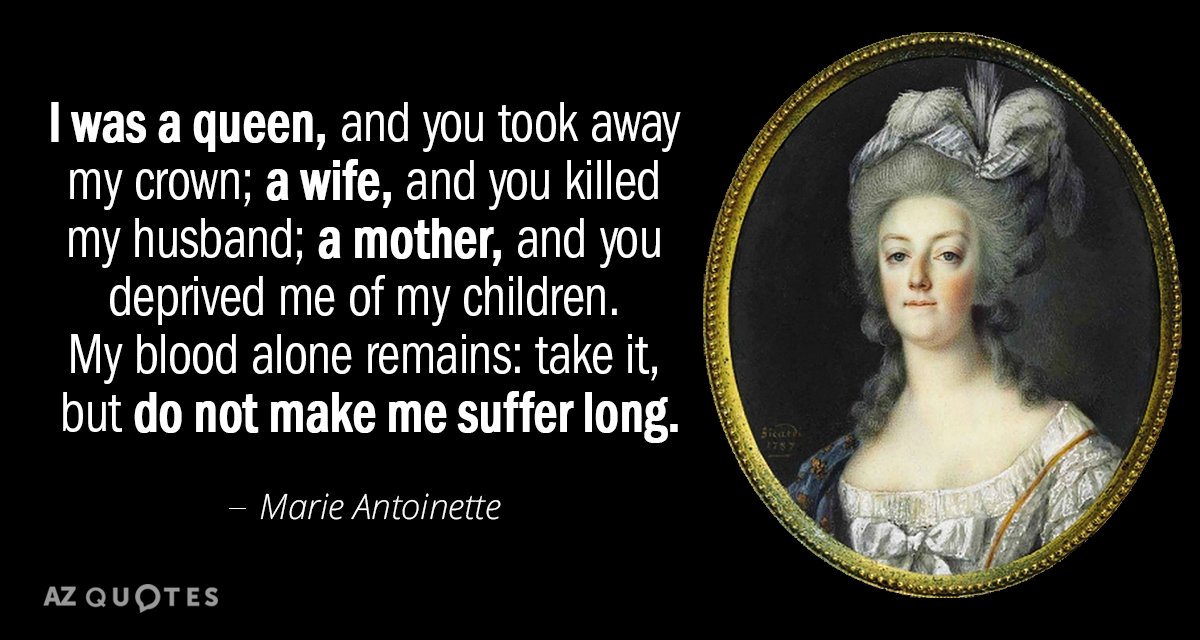
Political alliances came and went throughout 18th century Europe, with treaties often sealed by arranged marriages. One such alliance took place in 1770. Francis I, Holy Roman Emperor and Queen Maria Theresa, the formidable Sovereign of Hungary and Bohemia, married their little girl to Louis-Auguste, the son of Louis XV, King of France. Her name was Maria Antonia. She was twelve years old.
The happy couple had yet to meet when the marriage was carried out by proxy, the bride remaining in Vienna with the groom near-800 miles away, in Paris. She was now the Dauphine, Marie Antoinette, pre-teen wife of the 14-year-old Dauphin, future King of France.
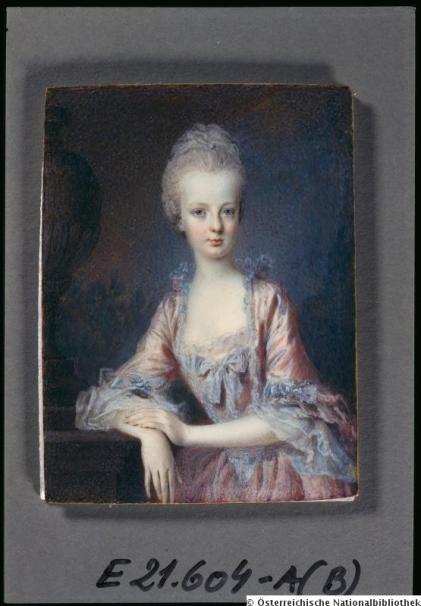
There was a second, ceremonial wedding held in May, after which came the ritual bedding. This wasn’t the couple quietly retiring to their own private space. Ohhhhh, no. This was the bizarre spectacle of courtiers crowding into the bedchambers, peering down at the frightened couple to be sure the marriage was consummated.
Unsurprisingly, it was not. In time, that failure would do damage to both their reputations.
At first the people liked their new Dauphine, but the Royal Court was another story. A shark tank of grasping ambition, this crowd had promoted several Saxon Princesses for the match and called the French Queen-to-be “The Austrian Woman”. She would come to be called far worse.
The stories you read about 18th century Court intrigue make you wonder how anyone lived like that. Antoinette was naïve of the vicious circles into which she was cast. Relations were especially difficult with the King’s mistress, the Comtesse du Barry, and Antoinette was somehow expected to work them out. The King’s daughters on the other hand, didn’t care for du Barry or their unsavory relations, with their father. She literally couldn’t win. The sisters bellyached about feeling “betrayed” one time, when Antoinette commented to the King’s mistress: “There are a lot of people at Versailles today”.
Court intrigues were accompanied by reports to Antoinette’s mother in Vienna, the Empress responding with her own stream of criticism. The Dauphin was more interested in lock making and hunting she wrote, because Antoinette had failed to “inspire passion” in her husband. The Empress even went so far as to tell her daughter she was no longer pretty. She had lost her grace. Antoinette came to fear her own mother more than she loved her.

Louis-Auguste was crowned Louis XVI, King of France, on June 11, 1775. Antoinette remained by his side though she was never crowned Queen, instead remaining Louis’ “Queen Consort”.
With her marriage as yet unconsummated, Antoinette’s position became precarious when her sister in law gave birth to a son and possible heir to the throne. Antoinette spent her time gambling and shopping, while wild rumors and printed pamphlets described supposedly bizarre sexual romps.
The French government was staggered by debt at this time, the result of endless foreign wars, but Antoinette received more than her share of the blame. As first lady to the French court, Antoinette was expected to be a fashion trendsetter. Her shopping was in keeping with the role but rumors wildly inflated her spending habits. Her lady-in-waiting protested that her habits were modest, visiting village workshops in a simple dress and straw hat. Nevertheless, the Queen Consort was rumored to have plastered the walls of Versailles with gold and diamonds.
The difficult winter of 1788-89 produced bread shortages and rising prices as the King withdrew from public life. The marriage had produced children by this time, but the legend of the licentious spendthrift and empty headed foreign queen had taken root as government debt overwhelmed the economy.
French politics boiled over in June 1789, leading to the storming of the Bastille on July 14. Much of the French nobility fled as the newly formed National Constituent Assembly conscripted men to serve in the Garde Nationale, while the French Constitution of 1791 weakened the King’s authority.

Food shortages magnified the unrest. That October, the King and Queen were placed under house arrest in the Tuileries Palace. They attempted to flee the escalating violence the following June, but were caught and returned within days. Radical Jacobins exploited the escape attempt as a betrayal, and pushed to have the monarchy abolished altogether.
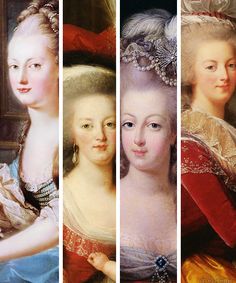
Unrest turned to barbarity as Antoinette’s friend and supporter, the Princesse de Lamballe, was taken by the Paris Commune for interrogation. She was murdered at La Force prison, her head fixed on a pike and marched through the city.
Louis XVI was charged with undermining the First Republic in December 1792, found guilty and executed by guillotine on January 21, 1793. He was 38 years old.
Marie-Antoinette was now prisoner #280, her health deteriorating in the following months. She suffered from tuberculosis by this time and suffered frequent bleeding, possibly as the result of uterine cancer.
Antoinette was taken from her cell on October 14 and subjected to a sham trial whose outcome was never in doubt. She was accused of molesting her own son, a charge so outrageous that even the market women who had stormed the palace demanding her entrails in 1789, spoke out in her support. “If I have not replied”, she said, “it is because nature itself refuses to respond to such a charge laid against a mother.”

On October 16, 1793, Marie-Antoinette’s hair was cut off. She was paraded through Paris in an ox cart, taken to the Place de la Révolution, and decapitated. On mounting the scaffold, she accidentally stepped on the executioner’s foot. The last words of the most hated woman in Paris, were “Pardon me sir, I meant not to do it”.
“Let them eat cake” is often attributed to Marie Antoinette, but there’s no evidence that she ever said it. The phrase appears in “Les Confessions”, the autobiography of Jean-Jacques Rousseau, attributed to a “Grande Princesse” whom the book declines to name. Considering the lifetime of cheap and mean-spirited gossip to which the woman was subjected, it’s easy to believe this was just more of the same.



















 These older bombs were way past their “sell-by” date, having spent the better part of the last ten years in the heat and humidity of Subic Bay depots. Ordnance officers wanted nothing to do with the Fat Boys, with their rusting shells leaking paraffin, and rotted packaging. Some had production date stamps as early as 1953.
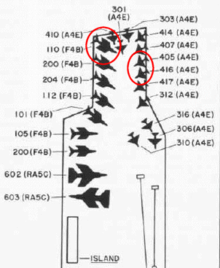 In addition to the bombs, ground attack aircraft were armed with 5″ “Zuni” unguided rockets, carried four at a time in under-wing rocket packs. Known for electrical malfunctions and accidental firing, standard Naval procedure required electrical pigtails to be connected, at the catapult.


 Gary Childs of Paxton Massachusetts, my uncle, was among the hundreds of sailors and marines who fought to bring the fire under control. Gary was below decks when the fire broke out, leaving moments before his quarters were engulfed in flames. Only by that slimmest of margins did any number of sailors aboard the USS Forrestal, escape being #135.


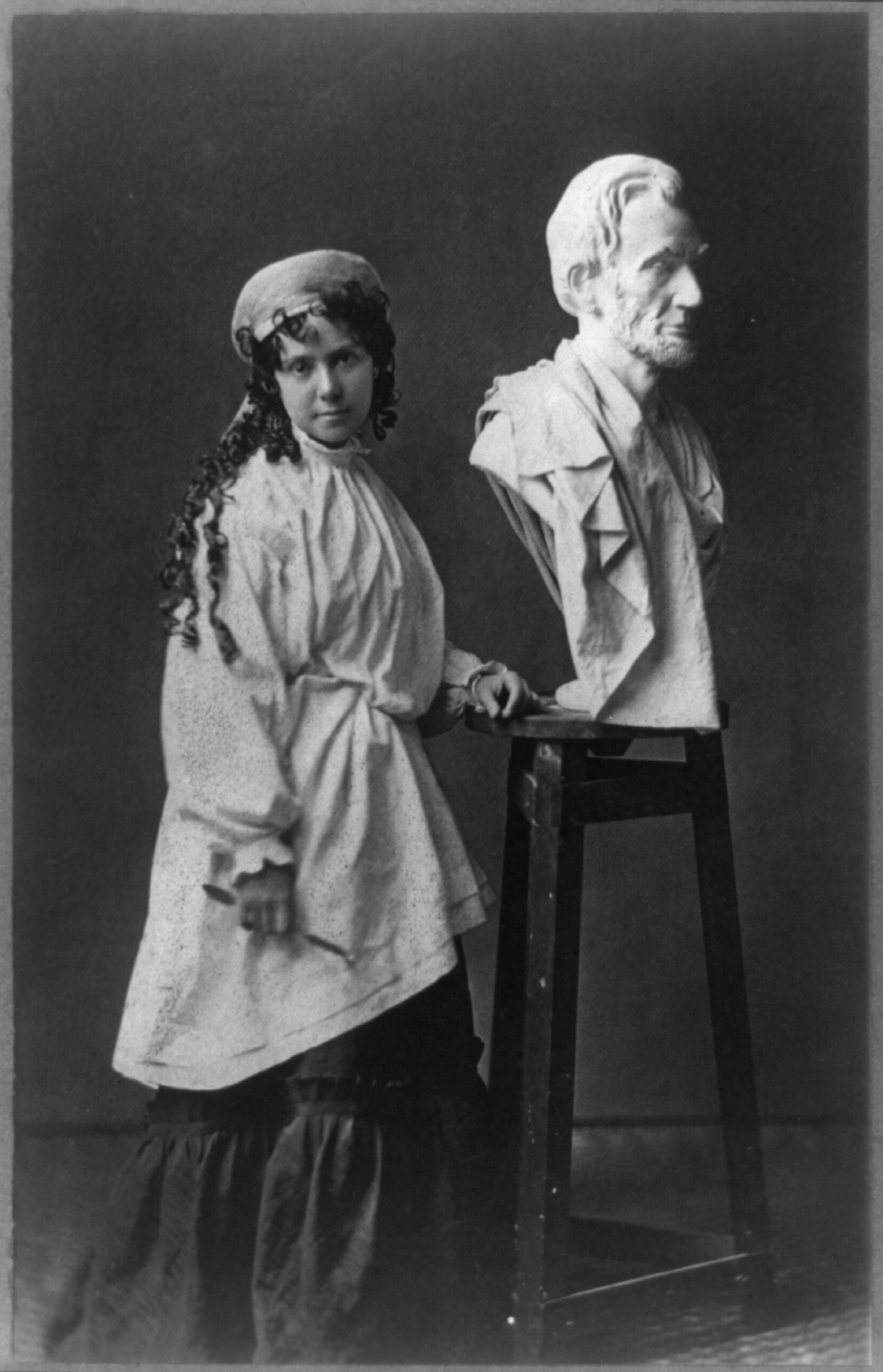
 Then as now, Washington was a “Swamp” and a cesspit for the venal and self-interested. Now grown to an attractive young woman, Vinnie Ream was not without critics. Kansas Senator Edmund Gibson Ross boarded with the Ream family during Johnson’s impeachment trial and cast the one vote absolving the President of “High Crimes and Misdemeanors”.
 One editor had the last word, however, printing Swisshelm’s column under the headline “A Homely Woman’s Opinion of a Pretty One.”





 Boston was a two-team town in 1914, when the American League Red Sox hired 6’2″, 200-pound left handed rookie George Herman “Babe” Ruth from the Baltimore Orioles.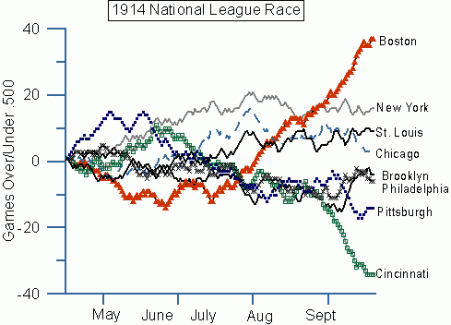
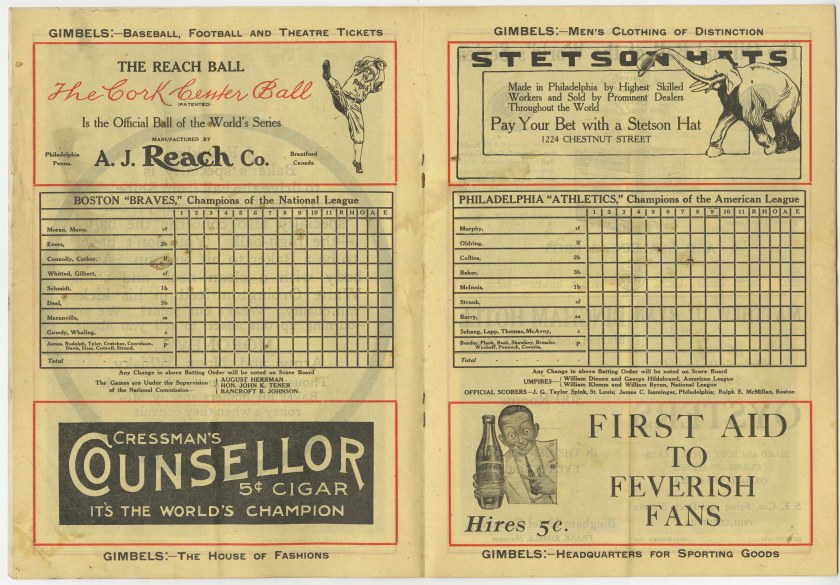
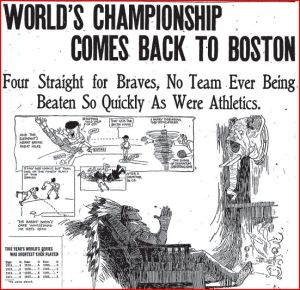
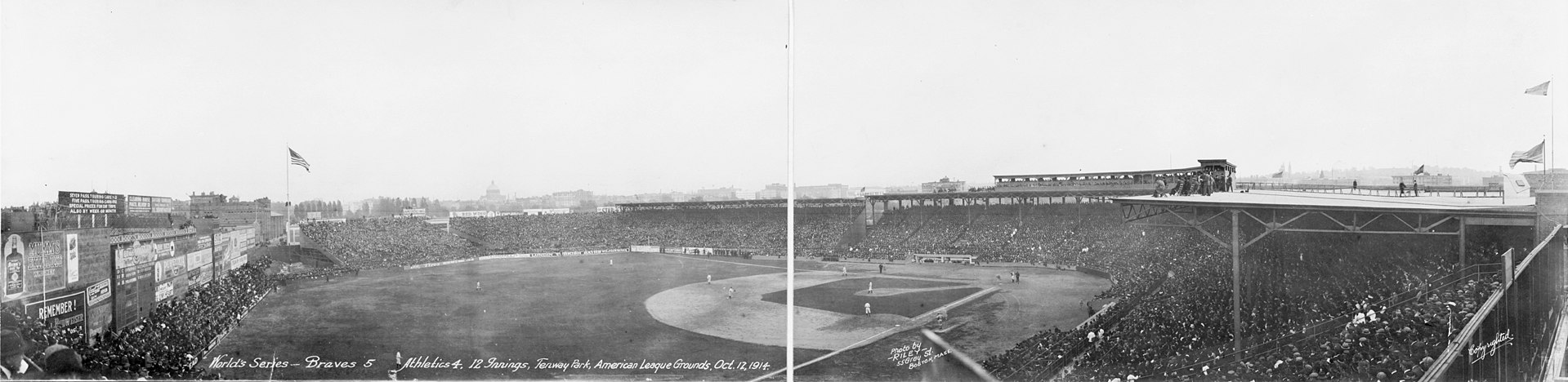
 Today we take team-issued Championship rings for granted, but the practice isn’t believed to have begun until years later. Prior to that and dating well back in the previous century, World Series winners were rewarded with team-issued pins.


You must be logged in to post a comment.