January 2, 1935 Nazis of the Amazon

In 1935, the third Reich reached out to the Amazon basin, in search of ‘lebensraum’.  Living space.  3 SS officers bankrolled by the Nazi government, came with dozens of helpers to explore the region bordering French Guyana, with an eye toward colonizing the area for the ‘thousand-year’ Reich.

In 1978, the British-American science fiction thriller “The Boys from Brazil”  told the story of a bizarre plot to clone Adolf  Hitler, hatched by the “Angel of Death” Josef Mengele in his Brazilian jungle hideout.

In the film, Mengele met his fate at the jaws of a pack of vengeful Dobermans, under orders from one of his 94 ‘baby dictators’.

A story as squirrelly is this one could only come from the minds of Hollywood, but parts of it were closer to reality, than anyone knew at the time.

In the years following WW2, thousands of Nazi officers, senior party members and Nazi collaborators escaped across the Atlantic to find refuge in South America, especially Argentina, Chile and Brazil.

Though widely believed to be dead, Mengele himself was very much alive at the time of the film, living under an assumed identity in Bertioga, São Paulo.  The Angel of Death would escape the noose he so richly deserved, succumbing to a stroke while swimming in 1979, and drowning.

Long before there were Nazis, before there was even a Germany, ethnically German people have been emigrating in search of a better life.  In the United States, some 57 million people identify as being of full or part German ancestry, forming the largest single ethnic group, in the country.  I am one of them.

Outside of Germany itself,  The second largest German population in the world, resides in Brazil.

Mention Oktoberfest, and you’re speaking of an annual celebration of Germanic traditions, in Munich.  The second-largest Oktoberfest is a two-way tie, between the one held in Waterloo, Canada, and the city of Blumenau, in Santa Catarina, Brazil.

Oktoberfest Blumenau
Outside of Munich, Oktoberfest Blumenau in Brazil is one of the two largest celebrations of the original festival, in the world.

Outside of Europe, descendants of German immigrant ancestors have largely assimilated into their host societies, adopting local languages and adapting Germanic-sounding surnames to spellings and sounds more familiar to their adopted cultures.

Brazilians of German ancestry are in every sense Brazilian, except to the racially obsessed mind, of a Nazi.

In 1935, the third Reich reached out to the Amazon basin, in search of ‘lebensraum’.  Living space.  3 SS officers bankrolled by the Nazi government, came with dozens of helpers to explore the region bordering French Guyana, with an eye toward colonizing the area for the ‘thousand-year’ Reich.

Talk about squirrelly ideas.  The hardships of life in the Amazon jungle made this a strange choice of destination, but the idea made sense to these people.  With over 1 million ethnic Germans already living in the country, the pieces were already in place.  Or so they believed.

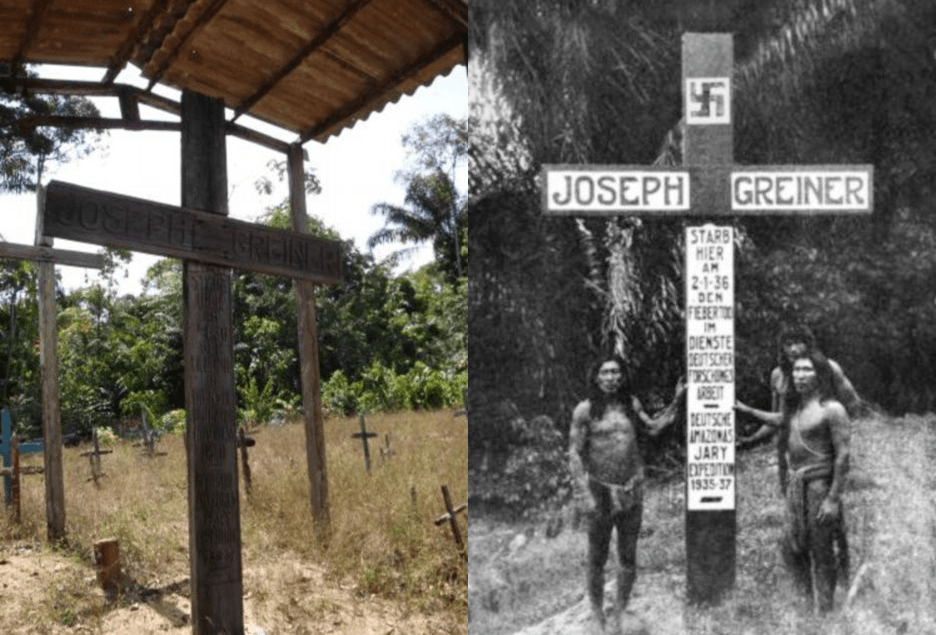
SS officer Joseph Greiner died of a ‘fever’ while on the expedition, most likely yellow fever or malaria. Expedition leader Schulz Kampfhenkel returned to the Fatherland with glowing reports of “The Guyana Projekt”.  “The two largest scantly populated, but rich in resources, areas on earth” Kampfhenkel wrote to his boss, the failed chicken farmer turned Reichsführer-SS Heinrich Himmler, “are in Siberia and South America”.

article-1080071-0238C02C000005DC-732_468x623As befitting a man who completely buys into Nazi ideas of racial superiority, the SS officer wrote “For the more advanced white race it offers outstanding possibilities for exploitation”, adding that the people who lived there “cannot be measured in civilised terms as we know them in Germany”.

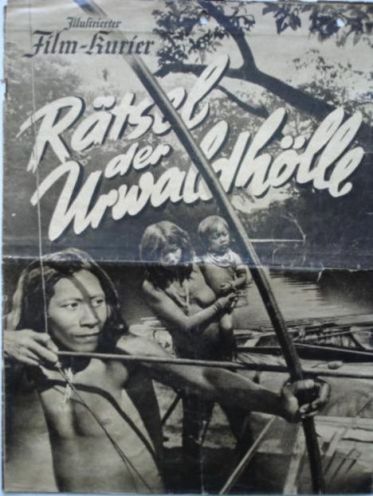
A propaganda film was made of Greiner’s work in the jungle, but Himmler showed ‘scant interest’ in such grandiose plans.  “Given time”, the bloodless bureaucrat wrote to his jungle emissary, “the plan may be submitted again”.

So it is, that there is a Nazi graveyard by a tributary of the River Jary,  in the Amazon jungle. There you will find a 9-ft. cross, bearing this inscription: “Joseph Greiner died here on 2.1.1936“.

January 1, 1995 Rogue Wave

“None of the state-of-the-art weather forecasts and wave models—the information upon which all ships, oil rigs, fisheries, and passenger boats rely—had predicted these behemoths. According to all of the theoretical models at the time under this particular set of weather conditions, waves of this size should not have existed”.

From the time of Aristotle, mankind has looked to the field of scientific inquiry to explain the world around us.

From Copernicus to Charles Darwin to Stephen J. Hawking, the greatest of scientific minds have struggled to explain not only “that” the universe works, but also the “how” and the “why”.

We live in a near-miraculous age, when science has conquered complexities from space travel to molecular biology, to medicine, climate and astral physics.

Except sometimes, science has not the foggiest notion of why things happen.

Rogue Wave

In 1826, French scientist and naval officer captain Jules Dumont d’Urville described waves as high as 108.3 feet tall, in the Indian Ocean.  Despite having three colleagues as witnesses, d’Urville was publicly ridiculed by fellow scientists. “Everybody knew” at that time, that no wave could exceed 30 feet.   Walls of water the size of 10 story buildings, simply didn’t exist.

Either that, or very few who’d ever seen such a thing, lived to tell about it.

For nearly 100 years, oceanographers, meteorologists, engineers and ship designers have used a standard linear model to predict wave height.  This model suggests that there will hardly ever be a wave higher than 50 feet. One of 100 feet or larger is possible but unlikely, occurring maybe once in 10,000 years.

Serious study of the subject is younger than you might think.  The first scientific article on “freak waves” was written in 1964, by professor Lawrence Draper.   Far from ridiculing old sailors’ stories about monster waves, professor Draper posited not only that wave heights “can exceed by an appreciable amount the maximum values which have been accepted in responsible circles“, but also a terrifying phenomenon he called ‘freak wave holes’, the exact opposite of a rogue wave.  God help anyone caught at the bottom of one of those things.

rogue wave_destructionOnce considered mythical but for the old sailor’s stories and the damage inflicted on ships themselves, the first scientific measurement of a rogue wave occurred in the North sea in 1984, when a 36′ wave was measured off the Gorm oil platform, in a relatively placid sea.

What really caught the attention of the science community was the “New Year’s wave” measured from the Draupner oil platform off the coast of Norway, on January 1, 1995.  Laser instruments measured this thing at 84-ft.  Oil platform damage above the water line, confirmed the measurement.

Not to be confused with a tidal wave which is caused by underwater earthquake or volcanic eruption, a rogue wave is a different kind of animal. Oceanographers define rogue waves as being two or more times the height of the mean top-third of waves, in any given sea state.

rogue wave (3)

These literal freaks of nature are rare, unpredictable, appear and disappear without warning or trace, and are capable of sudden and catastrophic damage.  Modern ships are designed to withstand a “breaking pressure” of 6 metric tons per square meter or 21psi. A 39-ft wave in the usual linear model produces just over a third of that. A rogue wave can generate breaking pressures of 140psi and more.

In 2000, the British oceanographic research vessel RRS Discovery measured individual waves up to 95.5-ft. Analysis of the data took years, noting that “none of the state-of-the-art weather forecasts and wave models—the information upon which all ships, oil rigs, fisheries, and passenger boats rely—had predicted these behemoths. According to all of the theoretical models at the time under this particular set of weather conditions, waves of this size should not have existed”.

rogue wave (2)

In December 1900, Thomas Marshall, James Ducat, and Donald McArthur vanished from the Flannan Island lighthouse, in the Hebrides Islands of Scotland.  No serious storm had been reported between the 12th and the 17th, and there was speculation about supernatural causes.  Subsequent inspection revealed wave-damage, 200ft. above sea level.

flannan-isles-lighthouseIn 1909, the 500-ft. cargo liner SS Waratah disappeared off Durban South Africa, with 211 passengers and crew.

The liner RMS Queen Mary was broadsided by a 92-ft. monster in 1942, nearly pushing the 1,019-ft vessel over on her side. The 81,961-ton liner listed all the way over to 52°, before slowly righting herself.

In 1966, heavy glass was smashed 80-ft. above the waterline of the Italian liner SS Michelangelo, killing three and tearing a hole in her superstructure.

In 1995, the 963-ft. RMS Queen Elizabeth 2 was forced to “surf” a 95-ft. behemoth to avoid being sunk. The ship’s master said this thing “came out of the darkness” and “looked like the White Cliffs of Dover.”

The 1975 sinking of the Edmund Fitzgerald is widely blamed on the 1-2-3 punch of a freak wave phenomenon peculiar to Lake Superior, known as the “three sisters”.

rogue-wave

In 2007, NOAA compiled a catalog of over 50 historical incidents, most likely associated with rogue waves.

Serious scientific study of non-linear fluid dynamics began only 20-30 years ago. Researchers now believe that ‘super rogue waves’ of up to eight times the surrounding sea state, are possible.

rogue wave
“The Perfect Storm” movie based on the Sebastian Junger book of the same title depicts the last moments of the Gloucester fisherman Andrea Gail in September, 1991

European Space Agency satellite radar studies have proven that waves cresting at 65 to 98-ft. occur far more regularly than previously believed. Rogue waves occur several times a day, in all of the world’s oceans. One three-week period in 2004 identified over ten individual giants measuring 82-ft. and above, in the South Atlantic, alone.

MIT researchers Themis Sapsis and Will Cousins working with the Office of Naval Research, the Army Research Office and the American Bureau of Shipping have combined high resolution scanning technology with advanced algorithms, to digitize and map the sea state in real time, to predict the possible formation of rogue waves. The method only gives 2-3 minutes warning, but that is enough. Research is ongoing. Lighthouse keepers, mariners and oil platform operators the world over, anxiously await the results.

December 31, 1903 Happy New Year

In 1907, Times owner Adolph Ochs wanted a bigger spectacle to draw attention to the newly renamed Times Square. He asked the newspaper’s chief electrician, Walter F. Painer for an idea. Painer suggested a time ball.

From the 7th century BC, the Roman calendar attempted to follow the cycles of the moon. The method frequently fell out of phase with the change of seasons, requiring the random addition of days. The Pontifices, the Roman body charged with overseeing the calendar, made matters worse. They were known to add days to extend political terms, and to interfere with elections. Military campaigns were won or lost due to confusion over dates. By the time of Julius Caesar, things needed to change.

julius-caesar-11-638

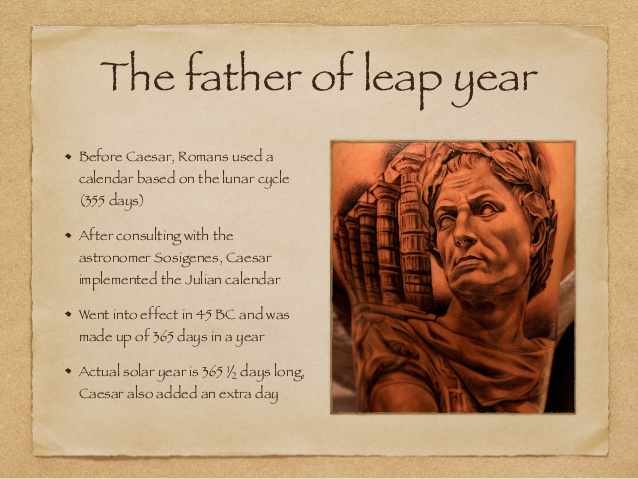
Caesar hired the Alexandrian astronomer Sosigenes to help straighten things out. The astronomer calculated that a proper year was 365¼ days, which more accurately tracked the solar, and not the lunar year. “Do like the Egyptians”, he might have said, the new “Julian” calendar went into effect in 46BC. Caesar decreed that 67 days be added that year, moving the New Year’s start from March to January 1. The first new year of the new calendar was January 1, 45BC.

Caesar synchronized his calendar with the sun by adding a day to every February, and changed the name of the seventh month from Quintilis to Julius, to honor himself. Rank hath its privileges.

Not to be outdone, Caesar’s successor changed the 8th month from Sextilis to Augustus. 2,062 years later, we still have July and August.

Julian_to_Gregorian_Date_ChangeSosigenes was close with his 365¼ day long year, but not quite there. The correct value of a solar year is 365.242199 days.  By the year 1000, that 11-minute error had added seven days. To fix the problem, Pope Gregory XIII commissioned Jesuit astronomer Christopher Clavius to come up with yet another calendar. The Gregorian calendar was implemented in 1582, omitting ten days and adding a day on every fourth February.
Most of the non-Catholic world took 170 years to adopt the Gregorian calendar. Britain and its American colonies “lost” 11 days synchronizing with it in 1752.  The last holdout, Greece, would formally adopt the Gregorian calendar in 1923. Since then, we’ve all gathered to celebrate New Year’s Day on the 1st of January.

For years, New Years’ eve celebrations were held at Trinity Church, where revelers would gather to “ring in the new”. The New York Times newspaper moved into “Longacre Square” just after the turn of the 20th century.   Times owner Adolph Ochs held his first fireworks celebration on December 31, 1903, with almost 200,000 people attending the event.  Four years later, Ochs wanted a bigger spectacle to draw attention to the newly renamed Times Square. He asked the newspaper’s chief electrician, Walter Painer, for an idea. Painer suggested a time ball.

Time Ball
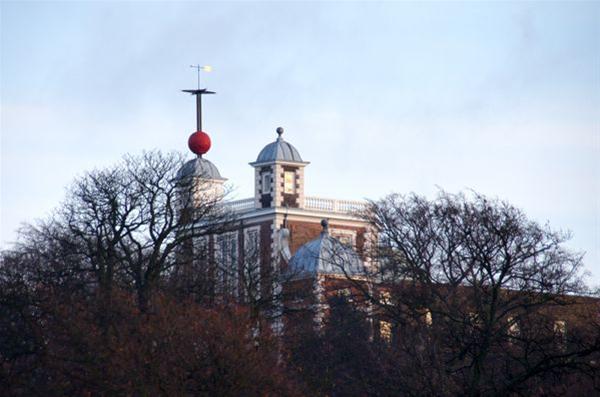
Flamsteed house royal observatory time ball, Greenwich, England

A time ball is a marine time signaling device, a large painted ball which is dropped at a predetermined rate, enabling mariners to synchronize shipboard marine chronometers for purposes of navigation. The first one was built in 1829 in Portsmouth, England, by Robert Wauchope, a Captain in the Royal Navy.

Time balls were obsolete technology by the 20th century, but it fit the Times’ purposes, nicely.  A young immigrant metalworker named Jacob Starr designed a 5′ wide, 700-lb iron and wooden ball, decorated with 100 25-watt incandescent bulbs.  For most of the twentieth century the company he founded, sign maker Artkraft Strauss, was responsible for lowering the ball.

download (1)That first ball was hoist up a flagpole by five men on December 31, 1907. Once it hit the roof of the building, the ball completed an electric circuit, lighting up a sign and touching off a fireworks display.

The newspaper no longer occupies the building at 1 Times Square, but the tradition continues.  One of seven versions of the Times Square ball has marked the coming of the new year ever since, with the exceptions of 1942 and ’43, due to the wartime need to dim out the lights.

The version used the last few years is 12′ wide, weighing in at 11,875lbs; a great sphere of 2,688 Waterford Crystal triangles, illuminated by 32,256 Philips LED bulbs and producing more than 16 million colors.  It used to be that the ball only came out for New Year.  The last few years, you can see the thing, any time you like.

only-sailors-truly-understand-the-strange-tradition-of-the-new-years-eve-ball-drop

In most English-speaking countries, the singing of “Auld Lang Syne”, is the traditional end to the New Year’s celebration.  Written by the Scottish poet Robert Burns in 1788, the tune comes from an old pentatonic Scots folk melody. The original verse, phonetically spelled as a Scots-speaker would pronounce it, sounds like this:

“Shid ald akwentans bee firgot, an nivir brocht ti mynd?

Shid ald akwentans bee firgot, an ald lang syn?”

CHORUS

“Fir ald lang syn, ma jo, fir ald lang syn,

wil tak a cup o kyndnes yet, fir ald lang syn.

An sheerly yil bee yur pynt-staup! an sheerly al bee myn!

An will tak a cup o kyndnes yet, fir ald lang syn”.

CHORUS

“We twa hay rin aboot the braes, an pood the gowans fyn;

Bit weev wandert monae a weery fet, sin ald lang syn”.

CHORUS

“We twa hay pedilt in the burn, fray mornin sun til dyn;

But seas between us bred hay roard sin ald lang syn”.

CHORUS

“An thers a han, my trustee feer! an gees a han o thyn!

And we’ll tak a richt gude-willie-waucht, fir ald lang syn”.

December 30, 1863 The Confederate States of…Bermuda

“The opportunities for Bermudians to profit from blockade running were boundless… The Civil War proved to be the road to riches.”

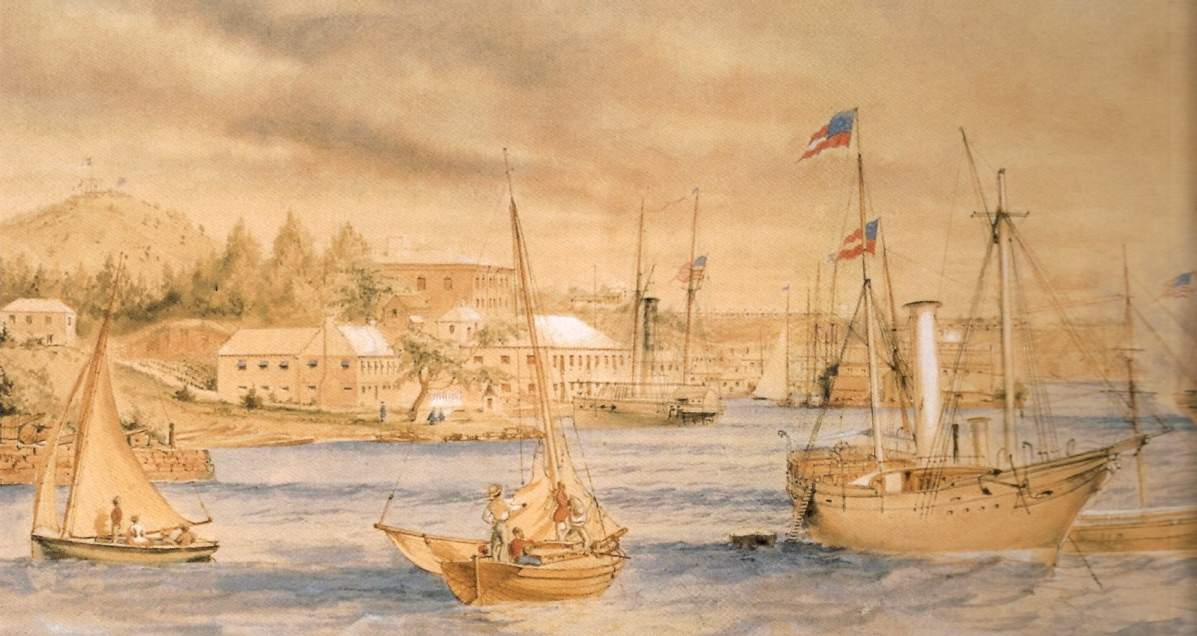
When South Carolina seceded from the Union in December 1860, it was the first of 11 states to do so. War broke out in April, and the Confederacy desperately needed ships for its fledgling Navy. It needed manufactured goods as well, goods which were no longer available from the industrialized North. The answer, in both cases, was Great Britain. While remaining officially neutral, England soon became primary ship builders and trade partners for the Confederacy.

For the British military, Bermuda had already demonstrated its value. Bermuda based privateers captured 298 American ships during the war of 1812. The place served as a base for amphibious operations as well, such as the 1815 sack of Washington, DC. British Commander Sir Alexander Milne said “If Bermuda were in the hands of any other nation, the base of our operations would be removed to the two extremes, Halifax and Jamaica, and the loss of this island as a Naval Establishment would be a National misfortune”.

slide_18President Abraham Lincoln issued a proclamation soon after taking office, threatening to blockade southern coastlines. It wasn’t long before the “Anaconda Plan” went into effect, a naval blockade extending 3,500 miles along the Atlantic coastline and Gulf of Mexico, up into the lower Mississippi River.

Running the blockade was no small or occasional enterprise. The number of attempts to run the Federal stranglehold have been estimated at 2,500 to 2,800, of which about 2/3rds succeeded. Over the course of the war, the Union Navy captured over 1,100 blockade runners. Another 355 vessels were destroyed or run aground.

runnerbritanniawilmCotton would ship out of Mobile, Charleston, Wilmington and other ports, while weapons and other manufactured goods would come back in. Sometimes, these goods would make the whole trans-Atlantic voyage.  Often, they would stop at neutral ports in Cuba or the Bahamas.
North Carolina and Virginia had long-established trade relations with Bermuda, 600 nautical miles to the east.

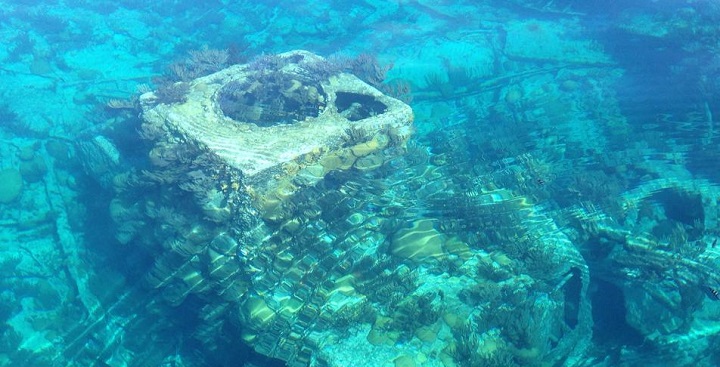
The most successful blockade runners were the fast, paddle wheeled steamers, though surprisingly little is known of the ships themselves. They were usually built in secrecy, and operated at night. One notable exception is the “Nola”, a 236-foot paddle steamer which ran aground on December 30, 1863, en route from London to North Carolina. Nola ran aground, attempting to escape threatening weather. She was wrecked near Western Blue Cut on Bermuda’s reefs, and remains a popular dive destination to this day.

shipwreck-in-bermuda
The blockade runner “Nola” was known at various times as Montana, Gloria, and Paramount.

President Lincoln appointed Massachusetts native Charles Maxwell Allen Consul to Bermuda in 1861, where he remained until his death in 1888. There were times when it was a great job, I’m sure, but not in the early days. “There are a great many Southern people here”, Allen wrote in 1862, “14 came in the steamer ‘Bermuda’. They & their friends are down on me & have threatened to whip me”. People were getting rich running the blockade.  Allen estimated that one blockade runner alone, which sank after three voyages, generated a profit of more than £173,000.

Bermuda-National-Trust-Museum
Bermuda National Trust Museum

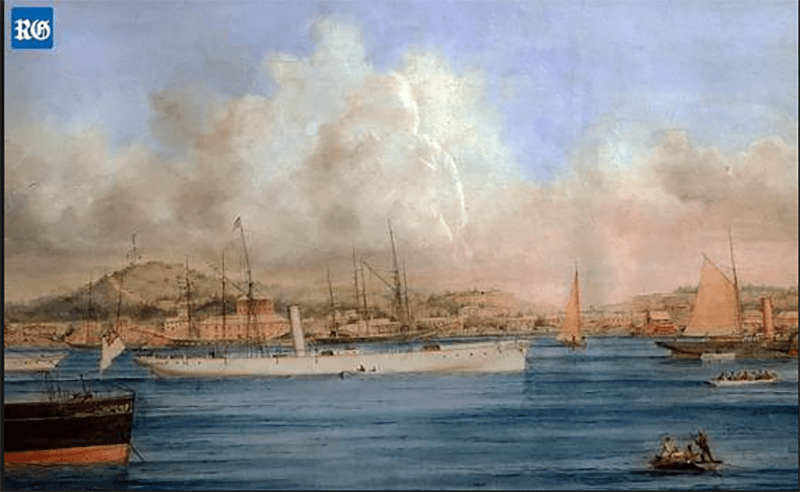
Today, the capital of Bermuda is Hamilton, moved across the island in 1815 from the old port of St. George, leaving the former capital in a kind of time warp, where you can walk down streets that look like they did 150 years ago. Portraits of Robert E. Lee and Confederate battle flags can still be found on the walls of the old port, beside paintings showing the harbor filled with blockade runners, lying quietly at anchor.

Once the office of Confederate Commercial Agent John Tory Bourne and Confederate Shipping Agent Major Norman Walker, today the Bermuda National Trust Museum tells the story of the island’s history, including Bermuda’s role in the American Civil War. The museum’s guide book explains: “The opportunities for Bermudians to profit from blockade running were boundless. Ships needed coal and provisions. Crews required lodging, food and entertainment between runs. Cargoes had to be unloaded, stored and reloaded, while crews and cargoes had to be ferried to ships lying at anchor. Bermudian pilots guided the ships through the reefs; those with skills as mates, carpenters, firemen and ordinary seamen signed on as crew. The Civil War proved to be the road to riches.

Sheryl and I traveled to Bermuda a while back, and visited the old port at St. George. At some point we learned about the maritime history of the island, as well. Making a living at sea in the 19th century was a dangerous business, so much so that one in ten of the married women living in Bermuda at that time, were widows.

It occurred to me that all those Confederate officers and enlisted men were spending a lot of time in Bermuda.  The possibility that followed soon morphed into a probability and then a certainty. At this point I can only wonder how many English citizens there are, residents of Bermuda and loyal subjects of the Queen, who can trace their paternity back to the Confederate States of America.

Bonnie Blue
‘The ‘Bonnie Blue’ flies over bonnie St George’s’ H/T Royal Gazette


December 29, 1895 If

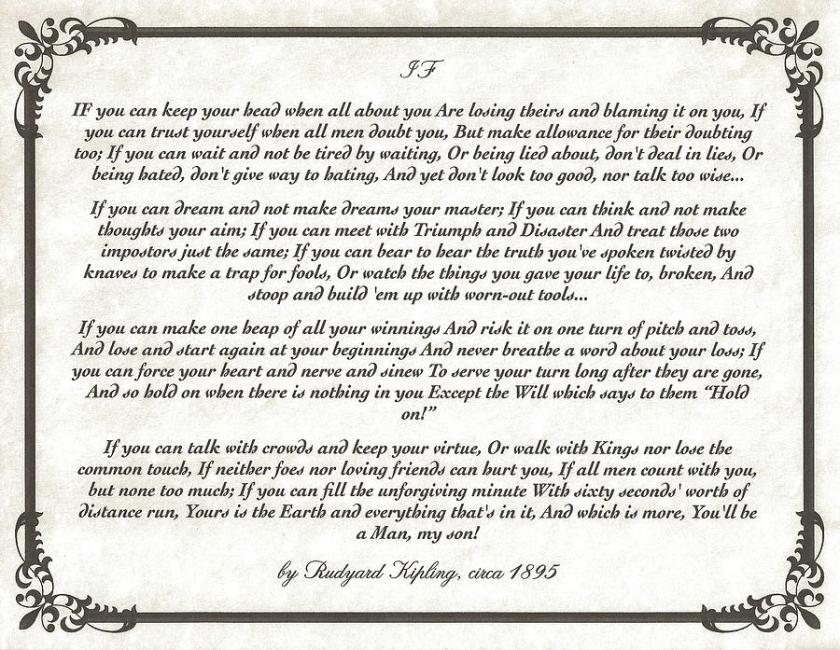
The younger Kipling would not survive his father. He entered the First World War, and disappeared in the Battle of Loos, in 1915. His body was never found. The elder Kipling’s gift would live on, the words of fatherly advice to an only son, in a poem he called “If”.

It was the 9th of February, 1853, in Edinburgh, Scotland. Robert William Jameson went for a walk, while his wife and mother of his 11 children, a woman with the unlikely name of Christian Pringle, labored to deliver their 12th child. Jameson slipped on a grassy embankment and into a frigid canal, where he would have drowned if not for the kindly stranger who fished him out. The man said he was an American, named Leander Starr.  Before the day was over, Starr was godfather to a newborn Scottish baby boy.  Leander Starr Jameson.

ec213-afrForty years later and half a world away, what would one day become South Africa was divided into four entities: the two British possessions of Cape Colony and Natal, and the two Boer (Dutch) Republics of the Orange Free State and the South African Republic, better known as Transvaal. Of the four states, Natal and the two Boer Republics were mainly agricultural, populated by subsistence farmers. The Cape Colony was by far the largest, dominating the other three economically, culturally, and socially.
There was considerable friction between Dutch and English settlers, stemming largely from differing attitudes toward slavery. British authorities passed legislation back in 1828, promising equal treatment for all under the law, regardless of race. Boer farmers argued that they needed forced labor to make their farms work, and that slaveholders were too little compensated upon emancipation.

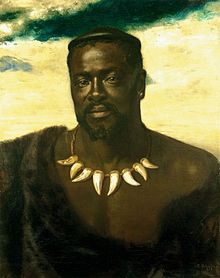
Cetshwayo,_King_of_the_Zulus_(d._1884),_Carl_Rudolph_Sohn,_1882
Cetshwayo, King of the Zulus (d.1884), by Carl Rudolph Sohn

The situation was exacerbated in 1867, with the discovery of vast diamond deposits near modern day Kimberly, in Orange Free State territory. The Cape soon annexed the territory as its own, which I think is a fancy term for “stole”.  The Boers found themselves between the proverbial rock and a hard place, pressed by the British from the south and west, and by the Zulu “Impi” (army) of King Cetshwayo kaMpande to the north. War broke out between the two sides in 1880-81, called the “First Anglo-Boer War” by one side; the “First Freedom War” by the other.

Gold was discovered near Johannesburg in 1886, massive amounts of it, drawing tens of thousands of “Uitlanders”:  English, American and Australian foreigners, in search of employment and fortune.

Governor of the Cape Colony Cecil Rhodes wanted to incorporate the Transvaal and the Orange Free State into a single federation under British control, while the Transvaal government of Paul Kruger feared just that. Soon outnumbered by Uitlanders two to one, Transvaal limited the right to vote to those having many years’ residency, and imposing heavy taxes on gold mining profits.

By mid-1895, Rhodes had concocted a plan. In a scheme which could only be described as hare-brained, he would send an armed raid into Johannesburg, inciting an uprising of Uitlanders, with the aim of stepping in to take control. Back in London, the father of future Prime Minister Neville Chamberlain, British Colonial Secretary Joseph Chamberlain, thought that was a swell idea, and did everything he could to encourage it.

On December 29, 1895, 400 Matabeleland Mounted Police and 200 assorted volunteers crossed from Rhodesia into Transvaal, with Leander Starr Jameson at their head.

Leander_Starr_Jameson

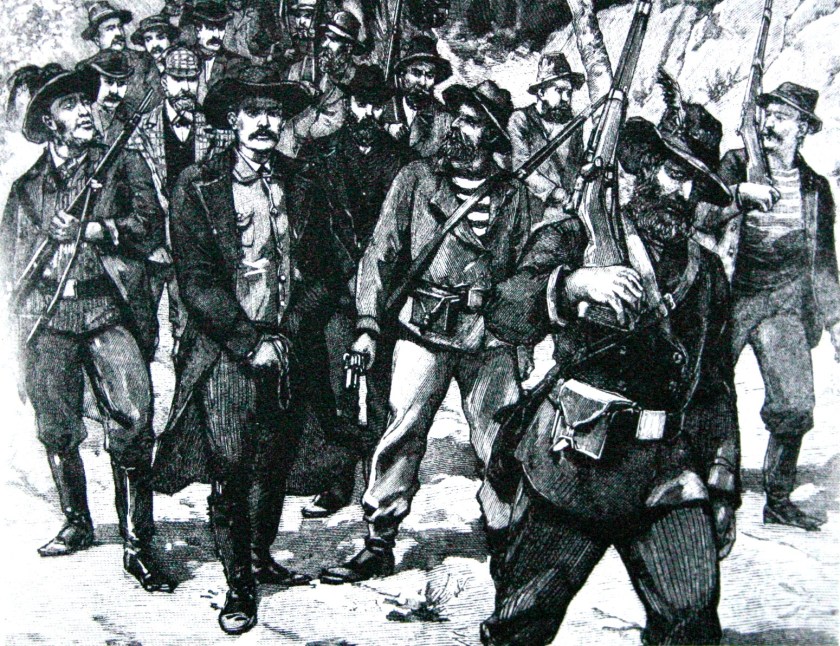
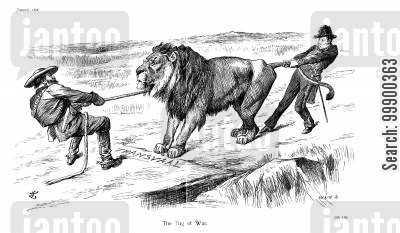
The raid was a humiliating failure.  They cut a wire fence, thinking it was a telegraph wire.  Transvaal authorities were tracking them from the moment they crossed the border. Meanwhile, Chamberlain got cold feet, saying that “if this succeeds it will ruin me. I’m going up to London to crush it”. Chamberlain ordered Sir Hercules Robinson, Governor-General of the Cape Colony, to repudiate the raid, threatening Rhodes and calling on British settlers in the Transvaal not to lend any aid to the raiders.

After several sharp encounters with dug in and well-prepared defenders, what remained of the raiders entered Pretoria on January 2, in chains. The Transvaal government received almost £1 million compensation from the British South Africa Company, turning their prisoners over to be tried by the British government. Jameson was convicted of leading the raid and sentenced to 15 months in prison.

During the whole ordeal, he never revealed the degree to which British politicians supported the raid, or the way they had betrayed him in the end.

Chamberlain Tries to Avert the Jameson Raid
Boer cartoon: Chamberlain Tries to Avert the Jameson Raid

So impressed was the poet, Rudyard Kipling, with Jameson’s display of stoicism under adversity, that he wrote a poem about it in 1895, later giving it to his son, Lieutenant John Kipling.

The younger Kipling would not survive his father. He entered the First World War, and disappeared in the Battle of Loos, in 1915. His body was never found.

The elder Kipling’s gift would live on, the words of fatherly advice to an only son, in a poem he called “If”.

if-poem-by-rudyard-kipling-claudette-armstrong

December 28, 1955 Juche

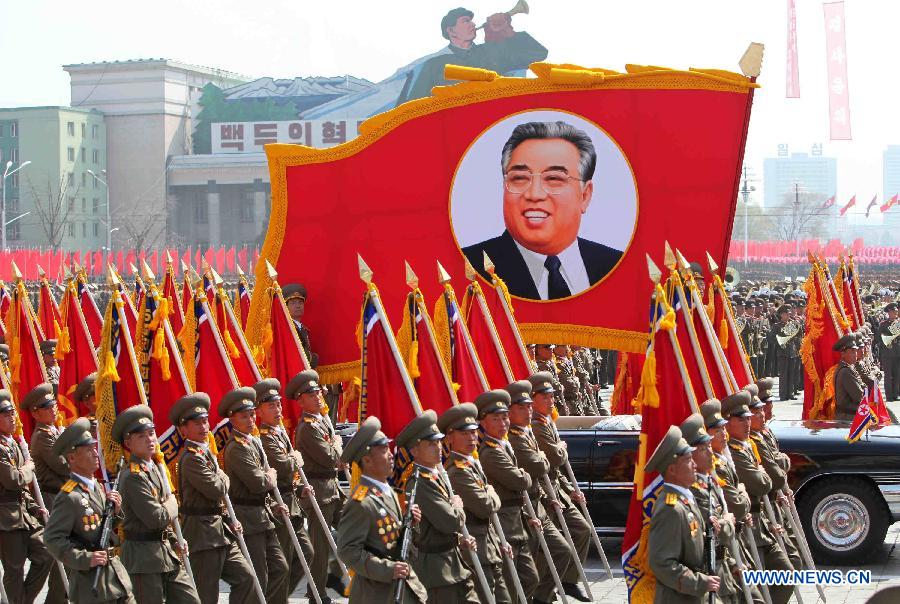
In the “Democratic People’s Republic of Korea” (DPRK), Kim Il-sung built a cult of personality, a communist totalitarian dictatorship established under an ideology known as “Juche”, (JOO-chay)

We tend to look at WW2 in a kind of historical box, with a beginning and an end.  In reality, we feel the effects of WWII to this day.  Just as the modern boundaries (and many of the problems) of the Middle East were shaped by WWI, the division of the Korean Peninsula was borne of WWII.

Korea’s brief period of modern sovereignty ended in 1910, when the country was annexed by Imperial Japan. After the Japanese surrender in 1945, Korea was divided into two occupied zones; the north held by the Soviet Union and the south by the United States.

The Cairo Declaration of 1943 called for a unified Korea, but cold war tensions hardened the separation. By 1948, the two Koreas had separate governments, each with its own diametrically opposite governing philosophy.

Kim Il-sung came to power in North Korea in 1946, nationalizing key industries and collectivizing land and other means of production. South Korea declared statehood in May 1948, under the vehemently anti-communist military strongman, Syngman Rhee.

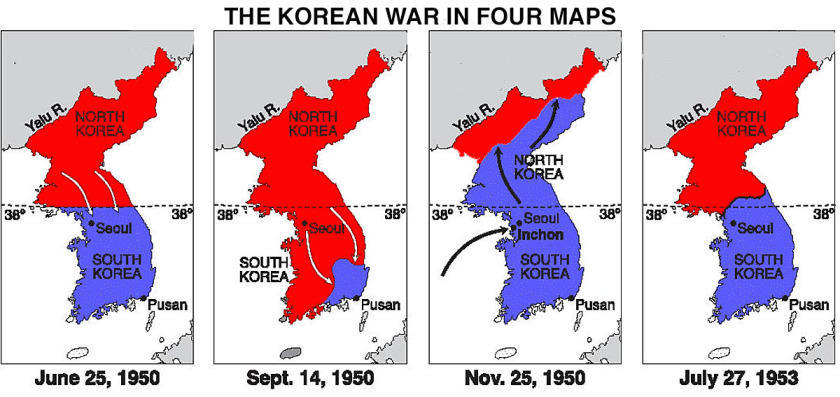
Both governments sought control of the Korean peninsula, but the 1948-49 withdrawal of Soviet and most American forces left the south holding the weaker hand. Escalating border conflicts along the 38th parallel led to war when the North, with assurances of support from the Soviet Union and Communist China, invaded South Korea in June 1950.

koreanwar-fourmaps1200Sixteen countries sent troops to South Korea’s aid, about 90% of whom were Americans.  The Soviets sent material aid to the North, while Communist China sent troops. The Korean War lasted three years, causing the death or disappearance of over 2,000,000 on all sides, combining military and civilian.

The Korean War ended in July 1953.  The two sides technically remain at war to this day, staring each other down over millions of land mines in a fortified demilitarized zone spanning the width of the country.

Korea at Night, NASAThe night-time satellite image of the two Koreas, tells the story of what happened next.  In the south, the Republic of Korea (ROK) developed into a successful constitutional Republic, a G-20 nation with an economy ranking 11th in the world in nominal GDP, and 13th in terms of purchasing power parity.


In the “Democratic People’s Republic of Korea” (DPRK), Kim Il-sung built a cult of personality, a communist totalitarian dictatorship established under an ideology known as “Juche”, (JOO-chay).

The term translates as “independent stand” or “spirit of self-reliance”, its first known reference in a speech given by Kim Il-sung on December 28, 1955.  Theoretically based on independent thought, economic self-sufficiency and self-reliance in defense, “independence” applies to the collective, not to the individual, from whom absolute loyalty to the revolutionary party leader is required.

In practice, this principle puts one man at the center and above it all.  According to recent amendments to the DPRK constitution, that man will always be a well-fed member of the Kim family.

PulgasariSon of the founder of the Juche Ideal, Kim Jung Il, was an enthusiastic film buff. In a move that would make Caligula blush, Kim had South Korean film maker Shin Sang Ok kidnapped along with his actress ex-wife, Choi Eun Hee. After four years spent starving in a North Korean gulag, the couple accepted Kim’s “suggestion” to re-marry and go to work for him, producing the less-than-box-office-smash “Pulgasari”, a kind of North Korean Godzilla film.
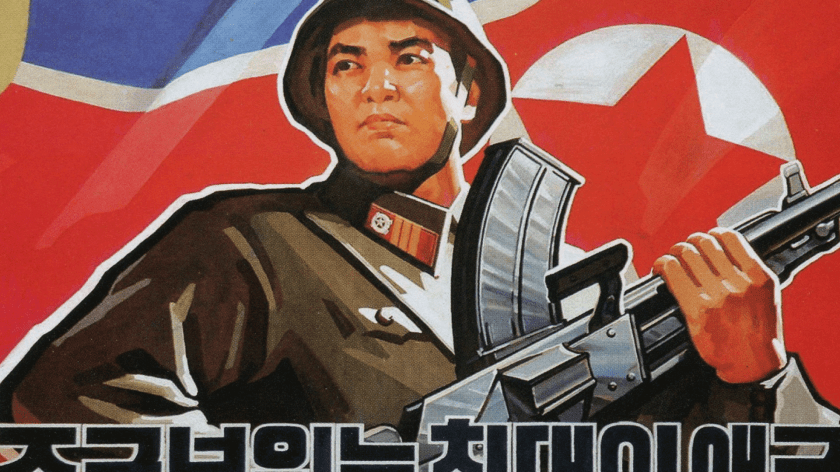
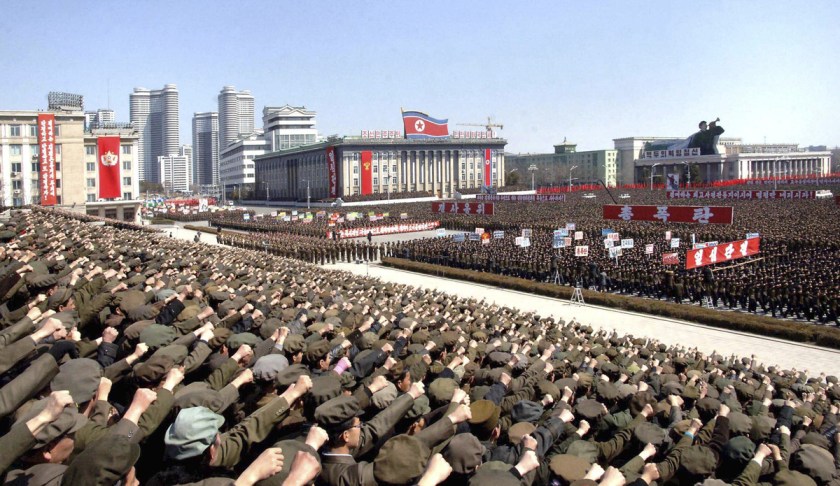
The couple escaped, unlike untold numbers of unfortunates “recruited” with the help of chloroform soaked rags.

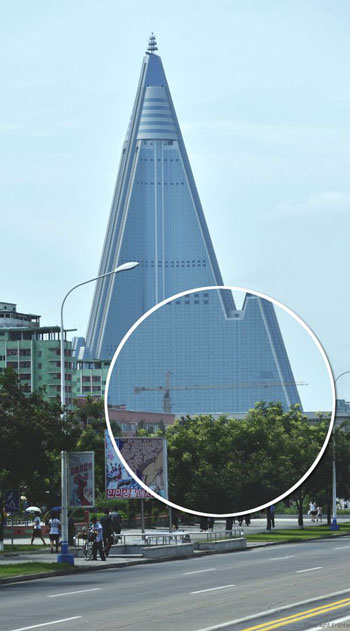
North Korea broke ground on the Ryugyong hotel in 1987, just in time for the Seoul Olympics the following year. 105 stories tall with eight revolving floors, the Ryugyong would be the tallest hotel in the world, if it ever opens.

Ryugyong hotel, 2017

Begun thirty years ago by the grandfather of the current “Dear Leader”, the “Hotel of Doom” is still under construction.  The project appears to hold particular significance for Kim Jung Un, who probably needs to show that he can get things done.  Perhaps 2018 will be the year.  For now, Travelocity notes under all its Pyongyang attractions: “Our online travel partners don’t provide prices for this accommodation, but we can search other options in Pyongyang”.

As the tallest unoccupied building in the world rose above the streets of Pyongyang, anywhere from 1 to 3 million North Koreans starved to death during the 1990s.

Authorities warned the nation of yet another famine impending in March 2016, the state-run newspaper Rodong Sinmun editorializing that “We may have to go on an arduous march, during which we will have to chew the roots of plants once again.”

The DPRK government enforces its will with a murderous system of gulags, torture chambers and concentration camps, complete with crematoria.  A 2014 UN report estimated that “hundreds of thousands of political prisoners” have died in North Korean gulags over the past 50 years amid “unspeakable atrocities.”

migrate-83NmE2bzoPKQnQvCr8OS-9_foetX2DAG

As of 2010, the DPRK Military had 7,679,000 active, reserve, and paramilitary personnel, in a nation of 25,000,000. Over 30% of the nation’s population, absorbing nearly 21% of GDP. Today, that military is under the personal control of a 33-year old who had his half-brother assassinated in Kuala Lumpur, using VX nerve gas.

The Islamic Republic of Iran (IRI) and the “Hermit Kingdom” in North Korea have had more or less “normal” relations, since the 1979 Iranian Revolution.  The relationship isn’t all moonbeams and lollipops, but a cordial hatred for the United States have bound the two together, the last remaining members of President George W. Bush’ “Axis of Evil”.

heres-the-kind-of-damage-north-korea-could-do-if-it-went-to-war

Recently, the Obama administration concluded a nuclear “deal” with Iran, replete with secret “side deals” and sealed with pallets of taxpayer cash.  CIA Director John Brennan conceded last September that his agency is “monitoring” whether North Korea is providing Iran with clandestine nuclear assistance.  It doesn’t seem a stretch.  There have been arms sales and “peaceful nuclear cooperation” between the two, since the 1980s.

The relationship between the two is now guided by the steady hands of the “Death to America” mullahs, and a man who banished Christmas and ordered North Koreans to worship his grandmother, as a god.   Two among five nations on earth, designated by the US State Department, as “State Sponsors of Terrorism.”  I can’t imagine what could go wrong.

December 27, 1865 Confederados

The numbers are hazy, but port records indicate that somewhere between ten and twenty thousand former Confederates moved to Brazil in the twenty years following the Civil War. A great uncle of former First Lady Rosalynn Carter, was one.

Most of us grew up learning that 600,000+ Americans were killed in the Civil War.  618,222 to be precise, more than the combined totals of every conflict in which the United States has been involved, from the Revolution to the War on Terror.  Recently, sophisticated data analysis techniques have been applied to newly digitized 19th century census figures, indicating that even that figure may be understated.

The actual number may lie somewhere between 650,000 and 850,000.

VIR_362561_27117_cuanto_sabes_sobre_los_estados_confederados_de_america

The cataclysm of the Civil War would leave in its wake animosities which would take generations to heal.  “Reconstruction” would be 12 years in the making, but some never did reconcile themselves to the war’s outcome. Vicksburg, Mississippi, which fell after a long siege on July 4, 1863, would not celebrate another Independence Day for 70 years.

In 1865, Emperor Dom Pedro II of Brazil wanted to encourage domestic cultivation of cotton.  Men like Jefferson Davis and Robert E. Lee advised southerners against emigration, but the Brazilian Emperor offered transportation subsidies, cheap land and tax breaks to those who would move.

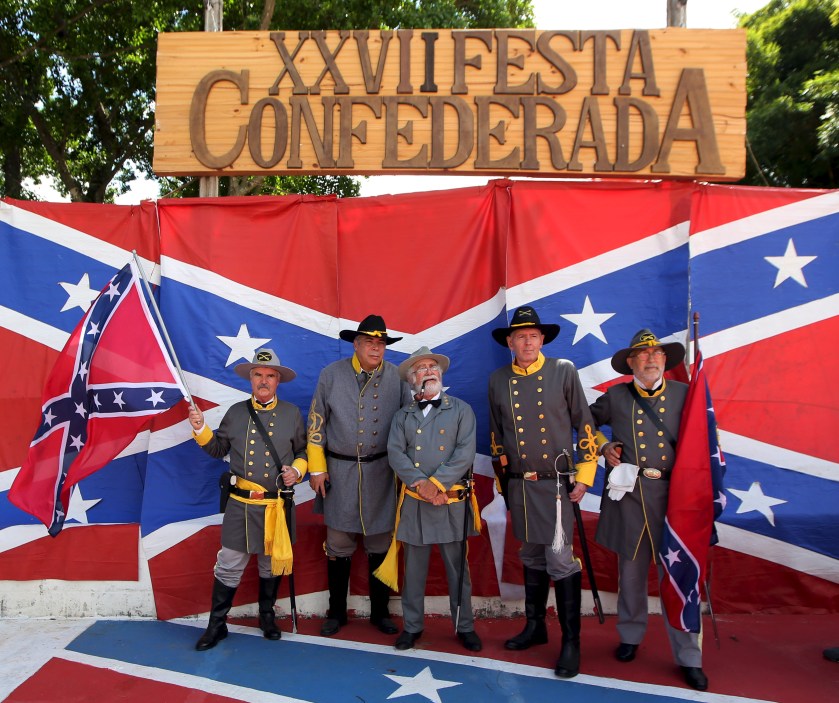
Descendants of American Southerners wearing Confederate-era uniforms pose for a photograph during a party to celebrate the 150th anniversary of the end of the American Civil War in Santa Barbara D'Oeste, Brazil
Descendants of American Southerners wearing Confederate-era uniforms pose for a photograph during a party to celebrate the 150th anniversary of the end of the American Civil War in Santa Barbara D’Oeste, Brazil,

Colonel William Hutchinson Norris, veteran of the Mexican American War and former member of the Alabama House of Representatives and later State Senator, was the first to make the move.  Together with his son Robert and 30 families of the former Confederacy, Norris arrived in Rio de Janeiro on December 27, 1865, aboard the ship “South America”.

The numbers are hazy, but port records indicate that somewhere between ten and twenty thousand former Confederates moved to Brazil in the twenty years following the Civil War.  A great uncle of former First Lady Rosalynn Carter, was one.

Confederate flag rally at Stone Mountain Park

Some of these “Confederados” settled in the urban areas of São Paulo, most made their homes in the northern Amazon region around present-day Santa Bárbara d’Oeste and a place the locals called “Vila dos Americanos”, and the inhabitants called “Americana”.  Some would return to the newly re-united states.  Most would never return, and their ancestors, Portuguese speaking Brazilians all, remain there to this day.

Confederados earned a reputation for honesty and hard work, and Dom Pedro’s program was judged a success by immigrant and government alike.  The settlers brought modern cultivation techniques and new food crops, all of which were quickly adopted by native Brazilian farmers.

Small wonder.  Mark Twain once wrote “The true Southern watermelon is a boon apart, and not to be mentioned with common things. It is chief of this world’s luxuries, king by the grace of God over all the fruits of the earth. When one has tasted it, he knows what the angels eat. It was not a Southern watermelon that Eve took; we know it because she repented”.

That first generation kept to itself for the most part, building themselves Baptist churches and town squares, while traditional southern dishes like barbecue, buttermilk biscuits, vinegar pie and southern fried chicken did their own sort of culinary diplomacy with native populations.

Slavery remained legal in Brazil until 1888, but this nation of 51% African or mixed-race ancestry (according to the 2010 census), seems more interested in understanding and celebrating their past, than tearing their culture apart over it.

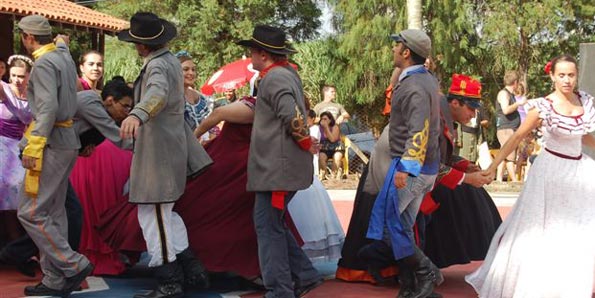
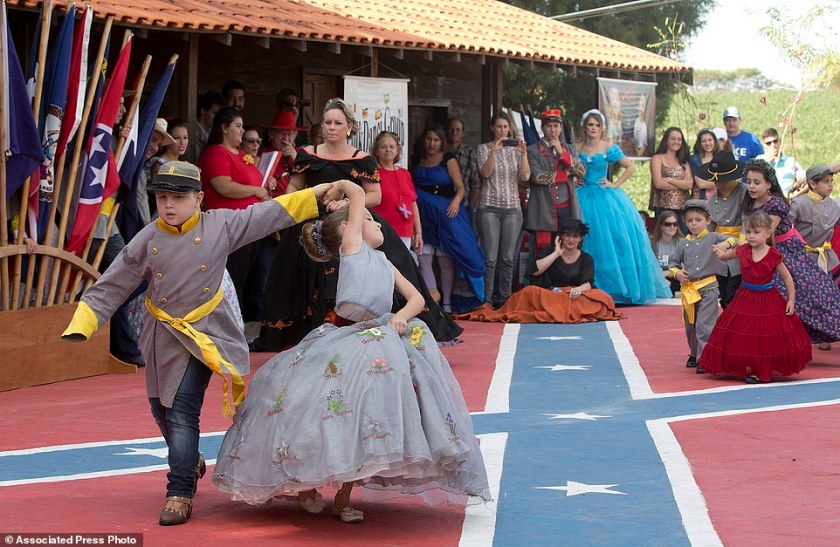
Today, descendants of those original Confederados preserve their cultural heritage through the Associação Descendência Americana (American Descendants Association), with an annual festival called the Festa Confederada.  There you’ll find hoop skirts and uniforms in gray and butternut, along with the food, the music and the dances of the antebellum South.

There you will find the Confederate battle flag, as well.  It seems that Brazilians have thus far resisted that peculiar urge which afflicts Isis and the American Left, to destroy the symbols of their own history.

descendentes-confederados-guerra-civil-eua

In 2016, the New York Times reported on the May celebration of the Festa Confederada, of Santa Bárbara d’Oeste:

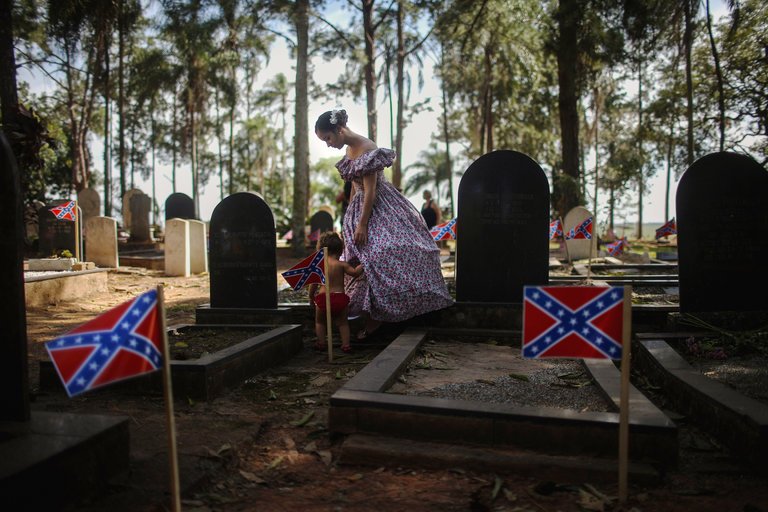
‘“This is a joyful event,” said Carlos Copriva, 52, a security guard who described his ancestry as a mix of Hungarian and Italian. He was wearing a Confederate kepi cap that he had bought online as he and his wife, Raquel Copriva, who is Afro-Brazilian, strolled through the bougainvillea-shaded cemetery.  Smiling at her husband, Ms. Copriva, 43, who works as a maid, gazed at the graves around them. “We know there was slavery in both the United States and Brazil, but look at us now, white and black, together in this place,” she said while pointing to the tombstones. “Maybe we’re the future and they’re the past.”’

Brazil Confederates

09BRAZIL-master768-v3 (1)
“A woman in a traditional hoop skirt walked past graves adorned with Confederate battle flags in Santa Bárbara d’Oeste, Brazil. An annual celebration of the area’s many Confederate settlers was held in the cemetery last month”. Hat tip to Mario Tama/Getty Images, New York times, for this image

December 26, 1776 Trenton

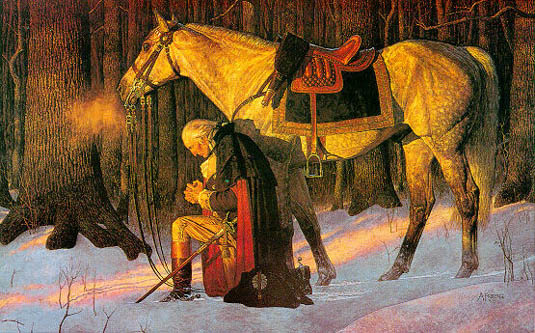
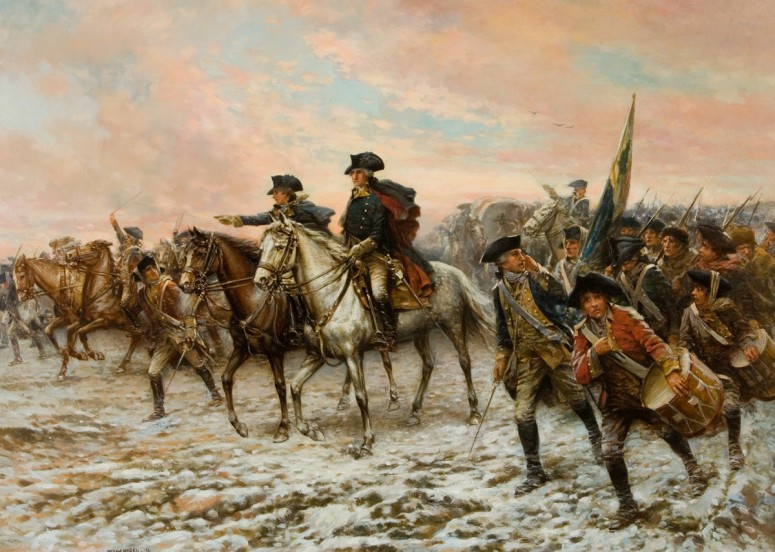
Most of his troops were about to end their enlistments, effective at the end of the year. A mere five days away.  Washington himself, who had become Commander-in-Chief of an Army with an average of nine rounds’ powder per man, thought they may have reached the end, writing to his cousin in Virginia “I think the game is pretty near up”.

1776 started out well for the Patriot cause, with the British evacuating Boston in March, the June victory at Fort Moultrie South Carolina, and the Continental Congress adopting the Declaration of Independence on July 4.

Valcour 1
Battle of Valcour Island

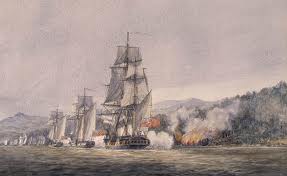
Things took a turn for the worse in August, with General George Washington’s defeat at the Battle of Long Island, and the loss of the strategically important port of New York that September. It wasn’t all bad, Benedict Arnold’s October defeat at Valcour Island in Vermont, cost the fleet of General Sir Guy Carleton dearly enough that it had to turn back, buying another year of life for the Patriot cause.

By the end of November, General Howe pushed the last American troops out of New York, chasing Washington’s shrinking army through New Jersey and across the Delaware River into Pennsylvania.

Washington’s men gathered up or destroyed every boat they could find for miles, while across the Delaware, British General Lord Cornwallis established outposts from New Brunswick to Burlington, including one at Trenton, New Jersey.

Camping on the western banks of the Delaware, Washington was in desperate straits. Most of the Patriots’ military supplies and artillery had been lost in the defense of New York.  Food, ammunition and equipment were in short supply, men were deserting as the string of defeats brought morale to a new low.

washington-praying

Most of his troops were about to end their enlistments, effective at the end of the year. A mere five days away.  Washington himself, who had become Commander-in-Chief of an Army with an average of nine rounds’ powder per man, thought they may have reached the end, writing to his cousin in Virginia “I think the game is pretty near up”.

The Americans needed a decisive victory, and quickly, if their cause was to survive. Washington planned a three-pronged attack on the Hessian garrison at Trenton, himself at the head of a 2,400 man army, flanked by a 1,900 man diversionary force under Colonel John Cadwalader and a blocking move by 700 men under General James Ewing.

As the army began the famous crossing of the Delaware that Christmas night, the password was “Victory”. There was only one recognized response:  “Or Death”.

durham-boats-by-luke-jones-flickr-cc-cropped
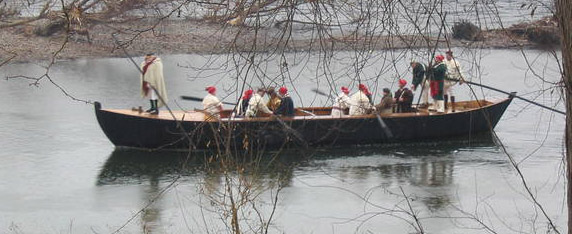
Washington’s men made the crossing in 40-60′ “Durham Boats”, with flat-bottom barges transporting horses and artillery

Washington’s three crossings soon dissolved into one, as Cadwalader and Ewing both turned back. The weather that night was dreadful.  A howling ‘nor-easter’ came up at 11:00, hampering the crossing as freezing rain changed to sleet and sleet to snow. Horses balked at being led onto flat-bottom barges.  Cannon weighing as much as 1,720 lbs had to be tied down to prevent capsize. With visibility near zero, several men fell overboard during the crossing.  One soldier said it “blew a perfect hurricane”.

Washington’s crossing may have itself been forced to turn back from the difficult crossing, but for the indispensable nautical skills of Colonel John Glover’s Marblehead Militia, the “amphibious regiment”.

Two froze to death on the overnight march to Trenton. Men were so poorly equipped that many of them lacked boots, the soaked and freezing rags wrapped around their feet not enough to keep them from leaving bloody footprints in the snow.

large_di-0707-2_m-4535_march-to-trenton-web

Loyalists had warned the Hessian commander, Colonel Johann Rall, that American forces were planning an action. As late as December 22, a spy had warned British General James Grant that Washington was holding a war council.  His warning to the Hessian commander was “Be on your guard”.

Approaching Trenton along parallel roads, General John Sullivan sent word to Washington that the weather was wetting his men’s gunpowder. Washington responded, “Tell General Sullivan to use the bayonet. I am resolved to take Trenton.”

The Patriot force arrived at Trenton at 8am December 26, completely surprising the Hessian garrison. There is a story about the Hessians being drunk or hungover after Christmas celebrations, but the story is almost certainly untrue.

1200px-Battle_of_Trenton_by_Charles_McBarron

Unaware of Washington’s march on Trenton, 50 colonists had attacked a Hessian outpost earlier that morning. While Washington worried that his surprise was blown, Colonel Rall apparently believed that this was the attack he’d been warned about. He expected no further action that day.

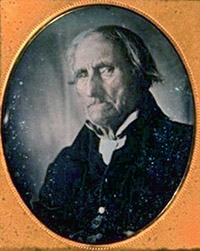
conrad_heyer-200px
Conrad Heyer crossed the Delaware with General Washington, and lived long enough to see the dawn of the age of photography

The tactical surprise was complete for the American side. Hessian soldiers spilled out of their quarters and tried to form up, but most were shot down or dispersed. A few American civilians, residents of Trenton, even joined in the fight. All told, Hessian losses were 22 killed, 92 wounded, 918 captured and 400 escaped. Four Hessian colonels were killed, including Rall himself. The Americans suffered the two who had frozen to death, and five wounded. They had won the first major victory of the Revolution.

On December 30, the Americans once again crossed the Delaware, eluding a main force under Generals Cornwallis and Grant, proving on January 3rd at a place called Princeton, that they could defeat a regular British army in the field.

Encouraged by these victories, many of Washington’s men extended their terms of enlistment, and new enlistments flooded in. The American Revolution would slog on for almost six more years.  For today, the Patriot cause had lived to fight another day

December 25, 1914 Christmas Truce

Allied soldiers first thought it was a trick, but these Germans were unarmed, standing out in the open where they could be shot on a whim.

“Sitzkrieg”. “Phony War”. Those were the terms used to describe the September ‘39 to May 1940 period, when neither side of what was to become the second world war, was yet prepared to launch a major ground war against the other.

5739-75-dpi-1914-11-10
“The Blow on the Yser”, depicting the ‘Race to the Sea’. 6th in a series of postcards on the German invasion of France.

25 years earlier things had been different, at the outbreak of “The Great War”.  Had you been alive in August of 1914, you’d have witnessed what might be described as the simultaneous detonation of a continent.

When governments make war on one another, it’s the Harry and the Fritz down the street, the every day Pierre and the Ivan, who must do the fighting.  And the bleeding.  And the dying.

France alone suffered 140,000 casualties over the four day “Battle of the Frontiers”, where the River Sambre meets the Meuse.  27,000 Frenchmen died in a single day, August 22, in the forests of the Ardennes and Charleroi.

The British Expeditionary Force escaped annihilation on August 22-23, only by the intervention of mythic angels, at a place called Mons.

In the East, a Russian army under General Alexander Samsonov was encircled and so thoroughly shattered at Tannenberg, that German machine gunners were driven to insanity at the damage inflicted by their own guns, on the milling and helpless masses of Russian soldiers.  Only 10,000 of the original 150,000 escaped death, destruction or capture.  Samsonov himself walked into the woods, and shot himself.

hqdefault
Angels of Mons

The “Race to the Sea” of mid-September to late October was more a series of leapfrog movements and running combat, in which the adversaries tried to outflank one another.  It would be some of the last major movement of the Great War, ending in the apocalypse of Ypres, in which 75,000 from all sides lost their lives.  All along a 450-mile front, millions of soldiers dug into the ground to shelter themselves from what Private Ernst Jünger later called the “Storm of Steel”.

On the Western Front, it rained for much of November and December that first year.  The no man’s land between British and German trenches was a wasteland of mud and barbed wire. Christmas Eve, 1914 dawned cold and clear.  The frozen ground allowed men to move about for the first time in weeks.

That evening, English soldiers heard Germans singing a Christmas carol.  “Silent night.  The Tommies were the first to respond, singing ‘The First Noel”.  Then both sides joined together, in a rendition of ‘O Come, all ye Faithful’.

images

The following day was Christmas, 1914. A few German soldiers emerged from their trenches at the first light of dawn, approaching the Allies across no man’s land, calling out “Merry Christmas” in the native tongue of their adversaries.

Allied soldiers first thought it was a trick, but these Germans were unarmed, standing out in the open where they could be shot on a whim. Tommies soon climbed out of their own trenches, shaking hands with the Germans and exchanging gifts of cigarettes, food and souvenirs. In at least one sector, enemy soldiers played a friendly game of soccer.

world-war-1-truce

Captain Bruce Bairnsfather later wrote: “I wouldn’t have missed that unique and weird Christmas Day for anything. … I spotted a German officer, some sort of lieutenant I should think, and being a bit of a collector, I intimated to him that I had taken a fancy to some of his buttons. … I brought out my wire clippers and, with a few deft snips, removed a couple of his buttons and put them in my pocket. I then gave him two of mine in exchange. … The last I saw was one of my machine gunners, who was a bit of an amateur hairdresser in civil life, cutting the unnaturally long hair of a docile Boche, who was patiently kneeling on the ground whilst the automatic clippers crept up the back of his neck.”

Captain Sir Edward Hulse Bart reported a sing-song which “ended up with ‘Auld lang syne’ which we all, English, Scots, Irish, Prussians, Wurttenbergers, etc, joined in. It was absolutely astounding, and if I had seen it on a cinematograph film I should have sworn that it was faked!”

Nearly 100,000 Allied and German troops were involved in the unofficial ceasefire of December 24-25, 1914, which lasted in some sectors until New Year’s Day.

christmas-truce-1914-400x186A few tried to replicate the event the following year, but there were explicit orders preventing it. Captain Llewelyn Wyn Griffith recorded that after a night of exchanging carols, dawn on Christmas Day 1915 saw a “rush of men from both sides … [and] a feverish exchange of souvenirs” before the men were quickly called back by their officers.

One German unit tried to leave their trenches under a flag of truce on Easter Sunday 1915.  They were warned off by the British opposite them.

christmas-military1-e1482512805772German soldier Richard Schirrmann wrote in December 1915, “When the Christmas bells sounded in the villages of the Vosges behind the lines …. something fantastically unmilitary occurred. German and French troops spontaneously made peace and ceased hostilities; they visited each other through disused trench tunnels, and exchanged wine, cognac and cigarettes for Westphalian black bread, biscuits and ham. This suited them so well that they remained good friends even after Christmas was over”.

Some will tell you, that the bitterness engendered by continuous fighting made such fraternization all but impossible.  Yet there are those who believe that soldiers never stopped fraternizing with their opponents, at least during the Christmas season.  Heavy artillery, machine gun, and sniper fire were all intensified in anticipation of Christmas truces, minimizing such events in a way that kept them out of the history books.

1914-christmas-eve-truceEven so, there is evidence of a small Christmas truce occurring in 1916, previously unknown to historians. 23-year-old Private Ronald MacKinnon of Princess Patricia’s Canadian Light Infantry, wrote home about German and Canadian soldiers reaching across battle lines near Arras, sharing Christmas greetings and trading gifts. “I had quite a good Christmas considering I was in the front line”, he wrote. “Christmas Eve was pretty stiff, sentry-go up to the hips in mud of course. … We had a truce on Christmas Day and our German friends were quite friendly. They came over to see us and we traded bully beef for cigars”. The letter ends with Private MacKinnon noting that “Christmas was ‘tray bon’, which means very good.”

Private Ronald MacKinnon of Toronto Ontario, Regimental number 157629, was killed barely three months later on April 9, 1917, during the Battle of Vimy Ridge.

The Man He Killed
BY THOMAS HARDY

“Had he and I but met
By some old ancient inn,
We should have sat us down to wet
Right many a nipperkin!

“But ranged as infantry,
And staring face to face,
I shot at him as he at me,
And killed him in his place.

“I shot him dead because —
Because he was my foe,
Just so: my foe of course he was;
That’s clear enough; although

“He thought he’d ‘list, perhaps,
Off-hand like — just as I —
Was out of work — had sold his traps —
No other reason why.

“Yes; quaint and curious war is!
You shoot a fellow down
You’d treat if met where any bar is,
Or help to half-a-crown.”

December 24, 1814 Shanghai’d

In the 1860s and 70s, one “ferocious old harridan” called “Miss Piggott” operated a saloon and boarding house, in San Francisco. She’d maneuver unsuspecting guests over a trap door before serving them her “Miss Piggott Special” a potion consisting of equal parts brandy, whiskey and gin laced with laudanum or opium. One knock on the head with her “bung starter”, a wooden mallet used to open whiskey kegs, and she’d pull the lever and down they would fall, to the mattress waiting below.

In modern times, governments have employed various strategies to meet the personnel needs of national armed services. Recruiting methods range from voluntary to compulsory service, and even a lottery or other form of draft, in times of national emergency.

During the age of sail, vast numbers of skilled and unskilled seamen alike, were required to meet the needs of naval vessels at sea. Governments resorted to more straightforward methods of meeting manpower requirements, namely, kidnapping.

Such involuntary service or “impressment”, was first made legal during Elizabethan times, but the practice dates back to the 13th century.

impressment-of-american-sailors-granger

“Press gangs” would patrol waterfronts looking for vagrants, raiding taverns and even pouncing on unsuspecting victims in their beds. Prints from the time show armed gangs barging into weddings and hauling the groom away, much to the dismay of the bride.
Such “pressing” more often took place at sea, where armed gangs would board merchant ships and take what they needed, sometimes leaving victims without sufficient hands to take them safely back to port.

Such methods were essential to the strength of the British Navy, particularly during the Napoleonic wars. American merchant vessels were often targets. The British Navy impressed over 15,000 American sailors alone, between 1793 and 1812.

impressThe American public was outraged and there were calls for war in 1807, when HMS Leopard overtook the USS Chesapeake, kidnapping three American-born sailors and one British deserter, leaving another three dead and 18 wounded.

This time, American retaliation took the form of an embargo. Five years later, continued impressment of American seamen would be a major cause of the war of 1812, the conflict formally ending this day in 1814.

Crimping 1Outside of the British Royal Navy, the practice of kidnapping people to serve as shipboard labor was known as “crimping”. Low wages combined with the gold rushes of the 19th century left the waterfront painfully short of manpower, skilled and unskilled, alike. “Boarding Masters” had the job of putting together ship’s crews, and were paid for each recruit. There was strong incentive to produce as many able bodies, as possible. Unwilling men were “shanghaied” by means of trickery, intimidation or violence, most often rendered unconscious and delivered to waiting ships, for a fee.

Crimps made $9,500 or more per year in the 1890s, equivalent to over a quarter-million, today. The practice flourished in British port cities like London and Liverpool, and in the west coast cities of San Francisco, Portland, Astoria and Seattle. You certainly didn’t want to be caught out alone and drunk, in east coast port cities like New York, Boston, Philadelphia, or Baltimore.

James Kelly kept several bars and a boarding house, in San Francisco. Better-known as “Shanghai” Kelly, the man provided a steady stream of the unwilling to labor aboard the undermanned ships of the San Francisco waterfront.

He once shanghai’d 100 guys, in a single evening.

In the early 1870s, Kelly rented the paddleboat Goliath, and widely publicized a free booze cruise to celebrate his birthday. Bartenders drugged unwitting revelers with opium-laced whiskey, and then offloaded them to waiting ships. Shanghai Kelly’s biggest concern was returning after such a public event, with an empty boat. His luck held, when another paddle wheel steamer, the Yankee Blade, struck a rock and began to sink. Goliath rescued everyone on board, and continued the party. Nobody back at the waterfront, noticed a thing.

Crimping 3, Bunko Kelley
James “Bunko” Kelley

Joseph “Bunko” Kelley was another infamous crimp, also working out of the San Francisco waterfront. The “King of Crimps”, Kelley once set a record, rounding up 50 guys in three hours. The Bunko name stuck, when Kelley delivered one crewman for $50, who turned out to be a cigar store Indian. In 1893, Kelley delivered 22 guys who’d mistakenly consumed embalming fluid, from a local mortuary. He sold all of them for $52 apiece though most of them were dead, a fact to which the ship’s captain only became wise, after returning to sea.

The “Shanghai tunnels” of Portland run through the Old Town/Chinatown section to the main business district, connecting the basements of hotels and taverns to the waterfront at the Willamette River. The tunnels themselves are real enough, though their history is shrouded in mystery. Originally constructed to move goods from the Willamette waterfront to basement storage areas, the number of unconscious bodies hustled down the dark chambers of the Portland Underground”, remains unknown. There are those who will tell you, the practice continued into the WW2 period.

State and federal legislatures passed measures to curb the practice after the Civil War, but crimping didn’t go away, easily. In their heyday, the owners of sailor’s boarding houses had endless supplies of manpower, fanning out across polling places to “vote early and often”.

crimping 2San Francisco political bosses William T. Higgins, (R) and Chris “Blind Boss” Buckley (D) were both notable crimps, and well positioned to look after their political interests. Notorious crimps such as Joseph “Frenchy” Franklin and George Lewis were elected to the California state legislature. There was no better spot, from which to ensure that no legislation would interfere with such a lucrative trade.

A brief list of infamous crimps includes Andy “Shanghai Canuck” Maloney of Vancouver, Anna Gomes of San Francisco, and New Bedford’s own “Shanghai Joe” and Tom Codd the “Shanghai Prince”. William “Billy” Gohl, the “Ghoul of Grays Harbor” of Aberdeen Washington, was also a serial killer.

In the 1860s and 70s, one “ferocious old harridan” called “Miss Piggott” operated a saloon and boarding house, in San Francisco. She’d maneuver unsuspecting guests over a trap door before serving them her “Miss Piggott Special” a potion consisting of equal parts brandy, whiskey and gin laced with laudanum or opium. One knock on the head with her “bung starter”, a wooden mallet used to open whiskey kegs, and she’d pull the lever and down they would fall, to the mattress waiting below.

Crimping 5Imagine the hangover the next morning, to wake up and find you’re now at sea, bound for somewhere in the far east. Regulars knew about the trap door and avoided it at all costs, knowing that anyone going over there, was “fair game”.

Widespread adoption of steam power in the late 19th and early 20th centuries did as much to curb shanghaiing as did any legislative effort. Without acres of canvas to furl and unfurl, the need for unskilled labor was greatly diminished. The “Seaman’s Act of 1915”, sometimes called the “magna carta of sailor’s rights,” ended the practice for good.

You might want to do yourself a favor, though, and look out for that trap door.