January 12, 1967 Frozen

“I should prefer to an ordinary death, being immersed with a few friends in a cask of Madeira, until that time, then to be recalled to life by the solar warmth of my dear country”. – Benjamin Franklin

The human brain is an awesome thing. Weighing in at about 3lbs, the organ is comprised of something like 86 billion neurons, each made up of a stoma or cell body, an axon to take information away from the cell, and anywhere between a handful and a hundred thousand dendrites bringing information in. Chemical signals transmit information over minute gaps between neurons called synapses, about 1/25,000th to 1/50,000th of the thickness of a sheet of paper.

Signal+Transmission+Dendrites+Cell+body+Nucleus+SynapseThere are roughly a quadrillion such synapses, meaning that any given thought could wend its way through more pathways than there are molecules in the known universe. This is roughly the case, whether you are Stephen J. Hawking, or Forrest Gump.

For all of this, the brain cannot store either oxygen or glucose (blood sugar), meaning that there’s about 6 minutes after the heart stops, before the brain itself begins to die.

Legally, brain death occurs at “that time when a physician(s) has determined that the brain and the brain stem have irreversibly lost all neurological function”. Brain death defines the legal end of life in every state except New York and New Jersey, where the law requires that a person’s lungs and heart must also have stopped, before that person is declared legally dead.

Clearly there is a gap, a small span of time, between the moment of legal death and a person’s permanent and irreversible passing. So, what if it were possible to get down to the molecular level and repair damaged brain tissue.  For that matter, when exactly does such damage become “irreversible”?

“Information-theoretic death” is defined as death which is final and irreversible by any technology, apart from what is currently possible given contemporary medical methodologies.  For some, the gap between current legal and clinical definitions of death and the truly irretrievable, is a source of hope for some future cure.

cryonicsThe Alcor Life Extension Foundation, the self-described “world leader in cryonics, cryonics research, and cryonics technology” explains “Cryonics is an effort to save lives by using temperatures so cold that a person beyond help by today’s medicine can be preserved for decades or centuries until a future medical technology can restore that person to full health”.

The practice is highly controversial, and not to be confused with Cryogenics, the study of extremely low temperatures, approaching the still-theoretical cessation of all molecular activity.  Absolute zero.

The Cryogenic Society of America, Inc. includes this statement on its home page: “We wish to clarify that cryogenics, which deals with extremely low temperatures, has no connection with cryonics, the belief that a person’s body or body parts can be frozen at death, stored in a cryogenic vessel, and later brought back to life. We do NOT endorse this belief, and indeed find it untenable”.

The modern era of cryonics began in 1962, when Michigan College physics professor Robert Ettinger proposed that freezing people may be a way to reach out to some future medical technology.

The Life Extension Society, founded by Evan Cooper in 1964 to promote cryonic suspension, offered to preserve one person free of charge in 1965. Dr. James Hiram Bedford was suffering from untreatable kidney cancer at that time, which had metastasized to his lungs.

James Bedford
Dr. James Hiram Bedford

Bedford became the first person to be cryonically preserved on January 12, 1967, frozen at the boiling point of liquid nitrogen, −321° Fahrenheit, and sealed up in a double-walled, vacuum cylinder called a “dewar”, named after Sir James Dewar, the 19th century Scottish chemist and physicist best known for inventing the vacuum flask, and for  research into the liquefaction of gases.

Fifty-one years later, cryonics societies around the world celebrate January 12 as “Bedford Day”.  Dr. Bedford has since received two new “suits”, and remains in cryonic suspension, to this day.

Advocates experienced a major breakthrough in the 1980s, when MIT engineer Eric Drexler began to publish on the subject of nanotechnology. Drexler’s work offered the hope that, theoretically, one day injured tissue may be repaired at the molecular level.

Cryonics1-640x353In 1988, television writer Dick Clair, best known for television sitcoms “It’s a Living”, “The Facts of Life”, and “Mama’s Family”, was dying of AIDS related complications. In his successful suit against the state of California, “Roe v. Mitchell” (Dick Clair was John Roe), Judge Aurelio Munoz “upheld the constitutional right to be cryonically suspended”, winning the “right” for everyone in California.

The decision failed to make clear who was going to pay for it.

As to cost, the Cryonics Institute (CI) website explains, “A person who wishes to become a Lifetime CI Member can make a single membership payment of $1,250 with no further payment required. If a new member would rather pay a smaller amount up front, in exchange for funding a slightly higher cryopreservation fee later on ($35,000), he or she can join with a $75 initiation fee, and pay annual dues of only $120, which are also payable in quarterly installments of $35”.

Ted Williams went into cryonic preservation in 2002, despite the bitter controversy that split the Williams first-born daughter Bobby-Jo Williams Ferrell, from her two half-siblings John-Henry and Claudia. The pair were adamant that the greatest hitter in baseball history wanted to be preserved to be brought back in the future, while Ferrell pointed out the will, which specified that Williams be cremated, his ashes scattered off the Florida coast.

teds_new_will_072502The court battle produced a “family pact” written on a cocktail napkin, which was ruled authentic and allowed into evidence. So it is that Ted Williams’ head went into cryonic preservation in one container, his body in another.

The younger Williams died of Leukemia two years later, despite a bone marrow donation from his sister. John-Henry joined his father, in 2004.

Walt Disney has long been rumored to be in frozen suspension, but the story isn’t true. After his death in 1966, Walt Disney was interred at Forest Lawn Memorial Park in Glendale, California.

FranklinIn April 1773, Benjamin Franklin wrote a letter to Jacques Dubourg. “I wish it were possible”, Franklin wrote, “to invent a method of embalming drowned persons, in such a manner that they might be recalled to life at any period, however distant; for having a very ardent desire to see and observe the state of America a hundred years hence, I should prefer to an ordinary death, being immersed with a few friends in a cask of Madeira, until that time, then to be recalled to life by the solar warmth of my dear country! But…in all probability, we live in a century too little advanced, and too near the infancy of science, to see such an art brought in our time to its perfection”.

Maybe so but, for the several hundred individuals who have plunked down $25,000 to upwards of $200,000 to follow Dr. Bedford into cryonic suspension, hope springs eternal.

January 11, 1935 Earhart

A specially trained team of four border collies was brought to the atoll to search for bones in June 2017, but the answers remain elusive.

Amelia Earhart was born July 24, 1897 in Atchison, Kansas, the first surviving child of Samuel “Edwin” and Amelia “Amy” Otis Earhart. Amy didn’t believe in raising “nice little girls”, she allowed “Meeley” and her younger sister “Pidge” to live an outdoor, rough and tumble “tomboy” kind of childhood.

AmeliachildEdwin seems to have had life-long problems with alcohol, often resulting in an inability to provide for his family. Amelia must have been a disciplined student despite it all, as she graduated with her high school class, on time, notwithstanding having attended six different schools.

Earhart was certainly independent, saying later in life that “The woman who can create her own job is the woman who will win fame and fortune”.

Amelia and her sister saw their first airplane in 1908, at the Iowa State Fair in Des Moines. It was a rickety old biplane in which Edwin was trying to interest them in a ride.   Earhart later described the biplane as “a thing of rusty wire and wood and not at all interesting.”  At the time, the girls preferred the merry-go-round.

Meeley and Pidge worked as nurse’s aids in Toronto in 1919.  There she met several wounded aviators, developing a strong admiration for these people and spending much of her free time watching the Royal Flying Corps practice at a nearby airfield.

Around that time, Earhart and a friend were visiting an air show in Toronto, when one of the pilots thought it would be funny to dive at the two women. “I am sure he said to himself, ‘Watch me make them scamper,'” she said, but Earhart held her ground.  “I did not understand it at the time, but I believe that little red airplane said something to me as it swished by.”

A ten-minute ride at a Long Beach California air show in 1920 changed her life.  From that time on, Amelia Earhart knew she wanted to fly.

Earhart worked at a variety of jobs from photographer to truck driver, earning money to take flying lessons from pioneer female aviator Anita “Neta” Snook.

She bought a second-hand Kinner Airster in 1921, a bright yellow biplane she called “The Canary”, flying it to 14,000’ the following year, a world altitude record for female pilots.

Neta_amelia_kinner_airster_s
Neta Snook, Amelia Earhart, 1921

Short funds grounded her for a time, by 1927 she was flying out of the Dennison Airport in Quincy, Massachusetts.  Earhart invested in the airport and worked as a salesman for Kinner airplanes in the Boston area while writing about flying in the local newspaper.

Charles Lindbergh’s New York to Paris Flight on May 20-21 of that year was the first solo, non-stop transatlantic crossing by airplane. Aviatrix Amy Phipps Guest wanted to be the first woman to make the flight, but later decided it was too dangerous. Instead she would sponsor the trip, provided that “another girl with the right image” was found.

“Lady Lindy”, Earhart became that first woman on May 21, 1932, five years to the day after Lindbergh.

Amelia_Earhart_standing_under_nose_of_her_Lockheed_Model_10-E_Electra,_small

On this day in 1935, Amelia Earhart became the first person of either sex to fly solo from Hawaii to California.

Two years later, Earhart and copilot/navigator Frederick J. Noonan attempted to fly around the world. The US Coast Guard cutter Itasca picked up radio messages that the aircraft was lost and low on fuel on July 2, 1937, and then it vanished.

The $4 million search and rescue effort covered 150,000 square miles and lasted for sixteen days, but to no avail.

amelialostphotosFollowing the end of the official search, Earhart’s husband and promoter George Palmer Putnam financed private searches of the Phoenix Islands, Christmas (Kiritimati) Island, Fanning (Tabuaeran) Island, the Gilbert and the Marshall Islands, but no trace of the aircraft or its occupants was ever found.

Earhart was declared dead in absentia on January 5, 1939 at the age of 41, Noonan on June 20, 1938.  He was 44.

For years, the prevailing theory was that Earhart’s Lockheed Model 10 Electra ran out of gas and plunged into the ocean.

Earhart-electra_10
“Amelia Earhart’s Lockheed Electra 10E. During its modification, the aircraft had most of the cabin windows blanked out and had specially fitted fuselage fuel tanks. The round RDF loop antenna can be seen above the cockpit. This image was taken at Luke Field on March 20, 1937; the plane would crash later that morning”.

The International Group for Historic Aircraft Recovery (TIGHAR) has been exploring a 1½ mile long, uninhabited tropical atoll once called Gardner Island, now Nikumaroro, in the southwestern Pacific Republic of Kiribati. After eleven visits to the atoll, TIGHAR sonar images revealed a straight, unbroken anomaly under the sand, remarkably consistent with the fuselage of a Lockheed Electra.

The traces of a long-dead campfire were discovered in 1940, along with animal bones, a box from a sextant, and thirteen human bones.  A doctor judged them to have belonged to a male and American authorities were never notified.

Those bones were subsequently lost, but computerized re-evaluation of their measurements suggest that the skeleton was probably that of a white female of European ethnicity, standing roughly the same 5’8″ as Amelia Earhart.

A specially trained team of four border collies was brought to Nikumaroro to search for bones in June 2017.  Thus far, the answer to one of the great mysteries of the 20th century, remains elusive.

Nikumaroro is no tropical island paradise.  There is no fresh water and daytime temperatures exceed 100°F in July. The island’s only inhabitants are Birgus latro, commonly known as the coconut crab, The largest land-dwelling arthropod in the world, specimens weigh up to 9lbs and measure over 3′ from leg tip to leg tip.

Coconut crab

Gifted with a keen sense of smell, the adult coconut crab feeds on fruits, nuts, seeds, and the pith of fallen trees, but will eat carrion or just about anything else if given the chance.  Virtually any food source left unattended will be investigated and carried away, giving rise to the alternative name “Robber crab.”

It’s anyone’s guess how the two aviators spent the last hours of their lives, or who it was who lit that fire or left those bones. Looking at the size of the island’s only inhabitants, it’s not difficult to imagine why there were only 13.


If you enjoyed this “Today in History”, please feel free to re-blog, “like” & share on social media, so that others may find and enjoy it too. Please click the “follow” button on the right, to receive email updates on new articles.  Thank you for your interest, in the history we all share.

January 10, 1869 The Mad Monk of Tobolsk

What the Tsar and Tsarina saw as a pious and holy man, the Russian nobility saw as a foul smelling, sex-crazed peasant with far too much influence on decisions of State. Alexandra believed Rasputin had the power to make her boy better. Many around her openly spoke of the man ruining the Royal Family, and the nation.

Traditionally, the line of succession to the Imperial Russian throne descended through the male line. By 1903 the Tsarina Alexandra had delivered four healthy babies, each of them girls.  Olga, Tatiana, Maria and Anastasia. In 1904, the Tsarina labored to deliver her fifth.

That August, the country waited and hoped for an heir to the throne. All of Russia prayed for a boy.

The prayers of the nation were answered on August 12 (July 30 Old Style calendar), with the birth of a son. The Tsarevich Alexei Nikolayevich. The happy news was announced with a 301-gun salute from the cannons of the Peter and Paul fortress, and all of Russia rejoiced.

Those hopes would be dashed in less than a month, when the infant’s navel began to bleed. It continued to bleed for two days, and required all the doctors at the Tsar’s disposal, to stop it.

Alexei_Nikolaevich,_1904
Alexei Nikolaevich, 1904

The child suffered from hemophilia, an hereditary condition passed down from his Grandmother British Queen Victoria.  She’d already lost a son and a grandson to the disease, both at the age of three.

The early years of any small boy are punctuated by dents and dings and the Tsarevich was no exception. Bleeding episodes were often severe, despite the never-ending efforts of his parents, to protect him. Doctors’ remedies were frequently in vain, and Alexandra turned to a succession of quacks, mystics and “wise men”, for a cure.

Born on this day in 1869, Grigori Efimovich Rasputin was a strange man, a Siberian peasant wanderer and self-proclaimed “holy man”, a seer of the future claiming the power to heal.  Rasputin would leave his home village of Pokrovskoye for months or even years at a time, wandering the countryside and visiting holy sites.  It’s rumored that he once went as far Athos in Greece, at that time a center of monastic life in the Orthodox church.

RasputinThe precise circumstances are unknown, but the monk came into the royal orbit, sometime in 1905.  “We had the good fortune”, Tsar Nicholas wrote to his diary , “to meet the man of God Grigori from the province of Tobolsk”.

Alexei suffered an internal hemorrhage in the spring of 1907, and Grigori was summoned to pray.  The Tsarevich recovered the next morning.   The royal family came to rely on the faith-healing powers of Rasputin.  It seemed that he alone was able to stop the boy’s bleeding episodes.

The Tsarevich developed a serious hematoma in his groin and thigh in 1912, following a particularly jolting carriage ride. Severely in pain and suffering with high fever, the boy appeared to be close to death. Desperate, the Tsarina sent a telegram, asking the monk to pray for her son.  Rasputin wrote back from Siberia, “God has seen your tears and heard your prayers. Do not grieve. The Little One will not die. Do not allow the doctors to bother him too much.” The bleeding stopped, within the next two days.

The British historian Harold Shukman wrote that Rasputin was “an indispensable member of the royal entourage”.

Romanov
Romanov family, colorized by the Russian artist Olga Shirnina, also known as ‘klimbim’

As the royal family became more attached to the monk Rasputin, scandals followed the peasant holy man like the chains of Jacob Marley.  Rumors abounded of sexual peccadillos, involving society ladies and prostitutes alike.  Gossip describing trysts between the “Mad Monk” and the Tsarina herself were almost certainly unfounded, but so widespread that pornographic postcards were openly circulated, depicting these liaisons.

What the Tsar and Tsarina saw as a pious and holy man, the Russian nobility saw as a foul smelling, sex-crazed peasant with far too much influence on decisions of State. Alexandra believed the man had the power to make her boy better. Those around her openly spoke of Rasputin ruining the Royal Family, and the Russian nation.

Rasputin, 1

Influential people approached Nicholas and Alexandra with dire warnings, leaving dismayed by their refusal to listen.  Rasputin was indispensable according to the Royal Couple.  He was the only man who could save the Tsarevich.

Rasputin_listovkaBy 1916 it was clear to many in the Nobility. The only course was to kill Rasputin, before he destroyed the monarchy.


A group of five Nobles led by Prince Felix Yusupov lured Rasputin to the Moika Palace on December 16, 1916, using the possibility of a sexual encounter with Yusopov’s beautiful wife Irina, as bait. Pretending that she was upstairs with unexpected guests, the five “entertained” Rasputin in a basement dining room, feeding him arsenic laced pastries and washing them down with poisoned wine. None of it seemed to have any effect.

Panicked, Yusupov pulled a revolver and shot the monk.  Rasputin went down, but soon got up and attacked his tormentors. He tried to run away, only to be shot twice more and have his head beaten bloody with a dumbbell. At last, with hands and feet bound, Grigory Efimovich Rasputin was thrown from a bridge into the icy Malaya Nevka River.

Police found the body two days later, with water in the lungs and hands outstretched. Poisoned, shot in the chest, back and head, with his head stove in, Rasputin was still alive when he hit the water.

1109B616-D96A-4E0C-827F-158613B58F04_w650_r0_s
Poisoned, shot in the chest, back and head, with his head stove in, Rasputin was still alive when he hit the water.

In the end, the succession question turned out to be moot. A letter attributed to Rasputin, which he may or may not have written, contained a prophecy. “If I am killed by common assassins and especially by my brothers the Russian peasants, you, Tsar of Russia, have nothing to fear for your children, they will reign for hundreds of years in Russia…[I]f it was your relations who have wrought my death…none of your children or relations will remain alive for two years. They will be killed by the Russian people…”

The stresses and economic dislocations of the Great War proved too much to handle.  The Imperial Russian state collapsed in 1917.  Tsar Nicholas II abdicated the throne within three months of the death of Rasputin.   Members of the Ural regional Soviet shot, bludgeoned and bayoneted the Russian Imperial family to death:  Tsar Nicholas, his wife Tsarina Alexandra, all five children, the Grand Duchess Olga, the Romanov family physician, their footman, maid, and their dogs.

A coded telegram was sent to Lenin’s secretary, Nikolai Gorbunov.  “Inform Sverdlov”, (Communist party administrator Yakov Sverdlov ) “The whole family have shared the same fate as the head. Officially the family will die at the evacuation”.

January 9, 1493 Mermaid

Columbus seems not to have been impressed, describing these mermaids as “not half as beautiful as they are painted.”

“Pax Romana”, or “Roman Peace”, refers to a period between the 1st and 2nd century AD, when the force of Roman arms subdued most everyone standing against them.  The conquered peoples described the period differently.  Sometime in 83 or 84AD, Calgacus of the Caledonian Confederacy in Northern Scotland, said “They make a desert and call it peace”.

catalan-atlas-depicting-marco-polo-traveling-to-the-east-during-the-pax-mongolica (1)

The conquests of Genghis Khan and his successors accomplished much the same during the 13th and 14th century.  The “Pax Mongolica” effectively connected Europe with Asia, making it safe to travel the “Silk Road” from Britain in the west to China in the east.  Great caravans carrying Chinese silks and spices came to the west via transcontinental trade routes.  It was said of the era that “a maiden bearing a nugget of gold on her head could wander safely throughout the realm.”

Never mind the pyramids of skulls, over there.

The “Black Death” and the political fragmentation of the Mongol Empire brought that period to an end.  Muslim domination of Middle Eastern trade routes made overland travel to China and India increasingly difficult in the 15th century.  After Constantinople fell to the Ottoman Turks in 1453, such travel became next to impossible.   Europe began to look for a water route to the East.

flat-earth

It’s popular to believe that 15th century Europeans thought the world was flat, but that’s a myth.  Otherwise, the cats would have pushed everything over the edge, by now.

The fact that the world is round had been understood for over a thousand years, though 15th century mapmakers often got places and distances wrong.  In 1474, Paolo dal Pozzo Toscanelli detailed a scheme for sailing westward to China, India and the Spice Islands.  He believed that Japan, which he called “Cipangu”, was larger than it is, and farther to the east of “Cathay” (China).  Toscanelli vastly overestimated the size of the Eurasian landmass, and the Americas were left out altogether.

This is the map that Christopher Columbus took with him in 1492.

mermaidColumbus had taken his idea of a westward trade route to the Portuguese King, to Genoa and to Venice, before he came to Ferdinand and Isabella in 1486.  At that time the Spanish monarchs had a Reconquista to tend to, but they were ready in 1492.  The Nina, Pinta and the Santa Maria sailed that August.

By January 9, 1493, the expedition had been at sea for six months.  Sailing off the coast of Hispaniola, what we now call the Dominican Republic, Columbus spotted three “mermaids”.

They were Manatee, part of the order “Sirenia”.  “Sirens” are the beautiful sisters, half birdlike creatures who live by the sea, according to ancient Greek mythology.  These girls, according to myth, sang a song so beautiful that sailors were hypnotized, crashing their ships into rocks in their efforts to reach them.

ManateeColumbus seems not to have been impressed, describing these mermaids as “not half as beautiful as they are painted.”

Small wonder.  These marine herbivores measure 10’ to 13′ from nose to tail, and weigh in at 800-1,200 lbs.

Not everyone was quite so dismissive.  A hundred years later, the English explorer John Smith reported seeing a mermaid, almost certainly a Manatee. It was “by no means unattractive”, he said, but I’m not so sure.  I think it’s possible that Mr. Smith needed to get out a little more.


If you enjoyed this “Today in History”, please feel free to re-blog, “like” & share on social media, so that others may find and enjoy it too. Please click the “follow” button on the right, to receive email updates on new articles.  Thank you for your interest, in the history we all share.

January 8, 1945 The Sub that Bagged a Train

So ended the only ground combat operation of WW2, on the soil of the Japanese homeland. And so it is, that an American submarine came to count a Medal of Honor and a Japanese locomotive, among its battle honors.

In the early phase of WW2, the traditional role of the American submarine service was to search, identify and report enemy activity to surface ships. Customary tactics emphasized stealth over offense, preferring to submerge and lie in wait over the surface attack.

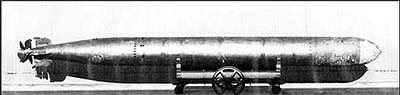
Small wonder. The Mark XIV torpedo, the primary anti-ship submarine-launched torpedo of WW2, was literally a scandal. Not only was torpedo production woefully inadequate to the needs of the war in the Pacific, but stingy pre-war budgets had precluded live-fire testing of the thing.

mk14torpedoAmong the Mark-XIV’s more pronounced deficiencies was a tendency to run about 10-ft. too deep, causing it to miss with depressing regularity. The magnetic exploder often caused premature firing of the warhead, and the contact exploder frequently failed altogether. There must be no worse sound to a submariner, than the metallic ‘clink’ of a dud torpedo bouncing off an enemy hull.
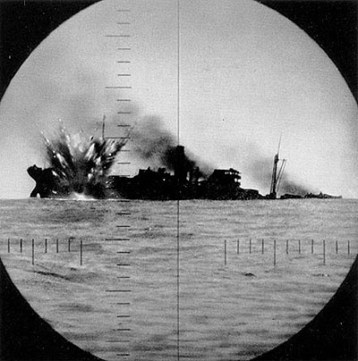
Worse still, these things tended to ‘run circular’, meaning that they’d return to strike the firing vessel.

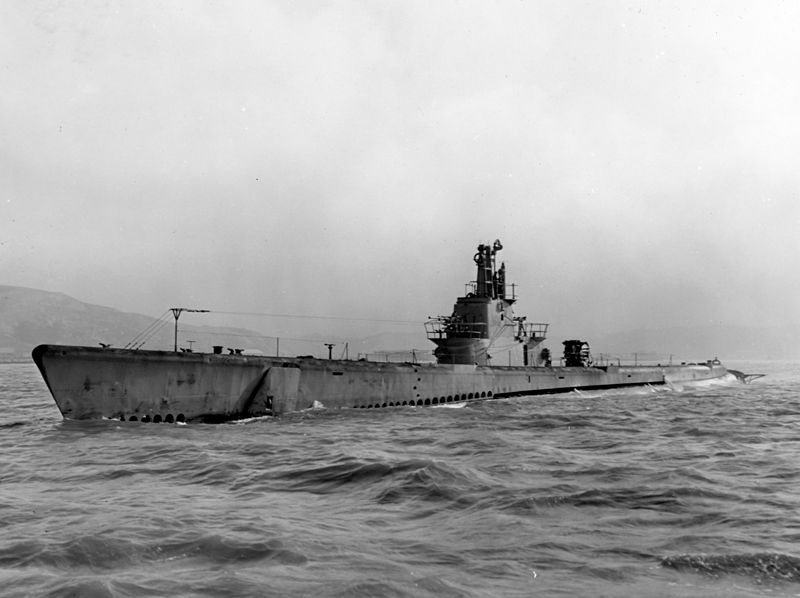
USS_Barb_(SS-220)_underway_in_May_1945
USS Barb (SS-220) underway in May, 1945

On July 24, 1943, Lawrence “Dan” Daspit commanding USS Tinosa (SS-283) attacked the 19,000-ton whale factory ship Tonan Maru III. Tinosa fired fifteen torpedoes with two stopping dead in the water and the other thirteen striking their target. Not one of them exploded. Thinking that he had a bad production run, Daspit kept his last torpedo for later inspection. Nothing out of the ordinary, was found.

Commander Eugene “Lucky” Fluckey didn’t subscribe to the conventional wisdom. WW2 vintage submarines were designed for speed on the surface, and USS Barb (SS-220) was capable of 21 knots.  Equivalent to 24mph on land. Under Commander Fluckey, Barb was for all intents and purposes, a fast-attack surface craft.

BarbperiscopeSam Moses, writing for historynet’s “Hell and High Water,” writes, “In five war patrols between May 1944 and August 1945, the 1,500-ton Barb sank twenty-nine ships and destroyed numerous factories using shore bombardment and rockets launched from the foredeck”.

In January 1945, the Barb, USS Picuda (SS-382), and the USS Queenfish (SS-393) were ordered to the China Sea, blocking the Formosa Strait to Japanese shipping.

On the 8th, the small “wolf pack” encountered eight large Japanese merchant ships, escorted by four patrol boats. In a two-hour running night battle, Barb sank merchant cargo ships Anyo Maru and Tatsuyo Maru in explosions so violent that Barb was forced to go deep, even then suffering light damage to her decks. She also sank merchant tanker Sanyo Maru and damaged the army cargo ship Meiho Maru.

The merchant tanker Hiroshima Maru ran aground in the confusion.  SS-220 returned the following day, to finish the job.

barbfastexitpaintingTwo weeks later, USS Barb spotted a 30-ship convoy, anchored in three parallel lines in Namkwan Harbor, on the China coast. Slipping past the Japanese escort guarding the harbor entrance under cover of darkness, the American submarine crept to within 3,000 yards.
Fluckey gave the order and Barb fired her six bow torpedoes at the tightly packed convoy. Swinging around, she fired her four stern torpedoes, just as the first salvo slammed home. Four ships were mortally wounded and another three heavily damaged, as a Japanese frigate opened fire.

It took a full hour to extract herself from the uncharted, heavily mined and rock-obstructed shallows of Namkwan Harbor. Torpedoes meant for the American sub struck Chinese junks instead. A Japanese aircraft appeared overhead, just as Barb slipped out into deeper water. No wonder they called him “Lucky Fluckey”.

The episode earned Commander Fluckey the Medal of Honor in March, 1945.

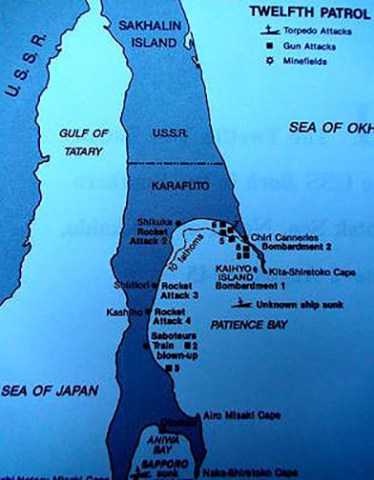
BarbOkhoskOn completion of her 11th patrol, USS Barb underwent overhaul and alterations, including the installation of 5″ rocket launchers, setting out on her 12th and final patrol in early June.

For the first time in the history of submarine warfare, rocket attacks were successfully employed against shore targets, including facilities in Shari, Hokkaido; Shikuka, Kashiho; and Shiritoru. Barb also attacked Kaihyo To with her regular armaments, destroying 60% of the town.

By mid July 1945, USS Barb had racked up one of the most successful records in the submarine service, sinking the third-highest gross tonnage of enemy shipping of the entire war, and the highest in Japanese shipping, according to the Japanese’ own records..

In poring over a coastal map of Karafuto, the Japanese end of Sakhalin island, the answer as to what to do next, soon came clear. The American sub was going to take out the supply line to enemy merchant shipping, and use a Japanese train, to do it.

Steel plates were bent and welded into crude tools, and a team of eight volunteers was selected. There was so much excitement among the crew over the idea, that even the Japanese POW on board wanted to go ashore, promising he wouldn’t try to escape.

On the night of July 22-23, Fluckey maneuvered the sub into shallow water within 950 feet of land, and put two rubber rafts ashore.

main-qimg-7d0915017cc1ad3409a1a960f4379e17Working so close to a Japanese guard tower that they could almost hear the snoring of the sentry, the eight-man team dug into the space between two ties and buried the 55-pound scuttling charge. They then dug into the space between the next two ties, and placed the battery.


At one point the team had to dive for the bushes, as a night train came through.

At last the work was done and, for the first time that night, the group disobeyed a direct order.  The other seven had been ordered to back off as Electricians Mate 3rd Class Billy Hatfield wired the switch and activated the bomb. That way only one man would die if things went wrong, but these guys weren’t going anywhere. Seven men looked on as Hatfield made the final connections, each wanting to see that this last step was done right.

Barb had worked her way to within 600′ of shore and the shore party was barely halfway back, when the second train came through. A thunderous explosion tore through the stillness, as night turned to day.  Pieces of the locomotive were thrown 200 feet in the air as twelve freight cars, two passenger cars, and a mail car derailed and piled together.

There was no further need for stealth.  With barely 6′ of water under her keel, Fluckey took up a megaphone, bellowing “Paddle like the devil!”  Five minutes later the shore party was on board.  As “The Galloping Ghost of the China Coast” slipped away, every crew member not absolutely necessary to the operation of the boat was on-deck, to witness the spectacle they had wrought.

So closes a little-known chapter of the war in the Pacific.  The only ground combat of WW2, carried out on the Japanese home islands. So it is, that an American submarine came to count a Medal of Honor and a Japanese locomotive, among its battle honors.

USS_Barb_crew_1945_i03570
Members of the USS Barb demolition squad pose with her battle flag at the conclusion of her 12th war patrol, Pearl Harbor, August 1945. Chief Gunners Mate Paul G. Saunders, USN, Electricians Mate 3rd Class Billy R. Hatfield, USNR, Signalman 2nd Class Francis N. Sevei, USNR, Ships Cook 1st Class Lawrence W. Newland, USN, Torpedomans Mate 3rd Class Edward W. Klingesmith, USNR, Motor Machinists Mate 2nd Class James E. Richard, USN, Motor Machinists Mate 1st Class John Markuson, USN; and Lieutenant William M. Walker, USNR.

In addition to Commander Fluckey’s Medal of Honor, the crew of USS Barb earned a Presidential Unit Citation, a Navy Unit Commendation, the Asiatic-Pacific Campaign Medal with eight battle stars, the World War II Victory Medal, and the National Defense Service Medal.  Of all those awards, the one of which later-Rear Admiral Fluckey was most proud, was the one he didn’t get.  In five successful combat patrols under Commander Eugene Fluckey, not one crew member of the USS Barb ever received so much as a purple heart.


If you enjoyed this “Today in History”, please feel free to re-blog, “like” & share on social media, so that others may find and enjoy it too. Please click the “follow” button on the right, to receive email updates on new articles.  Thank you for your interest, in the history we all share.

January 7, 1927 Harlem Globetrotters

No less a figure than Wilt Chamberlain once said “Meadowlark was the most sensational, awesome, incredible basketball player I’ve ever seen. People would say it would be Dr. J or even Jordan. For me it would be Meadowlark Lemon”.

Twenty years before the integration of professional sports, 24-year-old Abraham Saperstein organized a basketball team.  He called his club the “Savoy Big Five,” after the famous Savoy Ballroom of Chicago, home to such Jazz greats as Louis Armstrong, Count Basie, Dizzy Gillespie, Ella Fitzgerald and Woody Herman.

Abe SapersteinAt least, that’s what the official team history says, except the Savoy didn’t open until 1927.  We may have to just go with it.

Saperstein renamed his club the “Harlem Globetrotters” despite their being from Chicago, the team arriving in a model T Ford for their debut game on January 7, 1927.

The last two years had been nothing but exhibition games before dances. Now, the big game in Hinckley, Illinois would be played in front of 300 fans, with a total game payout of $75.

The squad toured Wisconsin, Minnesota, and Iowa, playing almost every night against any and all challengers.  Despite a height of 5’3″, Saperstein himself sometimes suited up, to fill in for an injured player.

The Globetrotters played their 1000th game in Iron Mountain, Michigan, in 1934.

Goose TatumIn 1941, Negro League 1st baseman Reece “Goose” Tatum caught Saperstein’s eye. A multi-sport athlete and teammate of Satchel Paige, Tatum would entertain crowds with comedic routines, whenever he put a runner out.  6’4″ with an 84″ wingspan and able to touch his knees without bending, Tatum is credited with inventing the hook shot, an early version of the “skyhook” that made Kareem Abdul-Jabbar famous, 30 years later
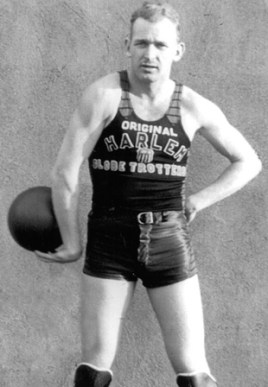
Tatum was the original “Clown Prince” of the Globetrotters, though the title is more often associated with Meadowlark Lemon and his confetti-in-the-water-bucket routine. Tatum combined natural athletic ability with a comedic timing that would change the whole direction of the club. When he passed away in 1967 at age 45, sports reporter Lawrence Casey of the Chicago Daily Defender remarked, “Like Joe Louis in boxing, Babe Ruth in baseball, Bobby Jones in golf, Goose Tatum was king of his chosen sport.”

Bob-KarstensWhen Goose was drafted into the Army Air Corps in 1942, the Globetrotters signed their third caucasian, the first-ever white player to be offered a contract.  Bob Karstens, the newest showman on the team, created the signature pregame “Magic Circle,” the behind-the-back shot, the “yo-yo” basketball and the “goofball,” a basketball filled with weights to give it a crazy bounce.
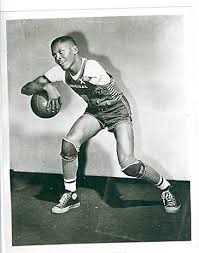
In the early 1940s, the Harlem Globetrotters were the most famous, and most profitable, professional basketball franchise in the world.

A near-fatal car accident cost Boid Buie his left arm when he was 13. Never a great athlete before the crash, Buie worked so hard on his goals that he became the “One Armed Firecracker”. He signed with the Globetrotters in 1946 and played 9 seasons as a starter, averaging 14 points per game. Ever since the 2011 Elite Showcase Basketball Classic, the MVP Award is presented in the name of Boid Buie.

download (2)The Globetrotters were a serious basketball team in the early years, winning the World Professional Basketball Tournament as late as 1940. The club worked more gag routines into their game throughout the late 40s and 50s, as the newly founded NBA gained popularity.  Finally, the team became better known for entertainment, than for sport.

“Playing the bones” has a musical history going back to ancient China, Egypt, Greece and Rome, part of 19th century minstrel shows and traditional to musical genres ranging from Irish to Bluegrass to Zydeco. Freeman Davis’ “Brother Bones” recording of the 1925 jazz standard “Sweet Georgia Brown” became the Globetrotters’ theme song, in 1952.

Ba Da Da, Dunt Da Da Da, Dunt Da Da Da Da… Now try to keep that out of your head.

Former NBA Baltimore Bullets point guard Louis “Red” Klotz formed an exhibition team in 1952 to play against the Globetrotters. He called his team the Washington Generals, in a nod to future president Dwight Eisenhower.

The Generals played serious basketball while their opponents juggled balls, spun them on fingertips, and made trick shots. The two teams played 13,000 games between 1953 and 1995, of which the Generals actually won 6.

54d5c4085d956.image

Those of us who came of age in the 70s remember Curley Neal and Meadowlark Lemon, who joined the club in 1954. Who remembers that Wilt “the Stilt” Chamberlain joined the team, four years later? Chamberlain would be the first Globetrotter to have his jersey retired.

Chamberlain and the Globetrotters did their part to warm the Cold War, with a nine game series in Moscow, in 1959. The Generals stayed home, for this series the opponent was the “Chinese Basketeers”.  At first slow to catch on, the audience of 14,000 sat in stupefied silence, finally warming on the realization that this was more show than sport.  The team was paid the equivalent of $4,000 per game which could only be spent in Moscow, prompting the American press to observe that the Soviets were finally becoming capitalists.

fd890540b6931e8f9c42a98cefb76083Abe Saperstein passed away in 1966, at the age of 63. The owner and founder of the Harlem Globetrotters, he was also founder and first Commissioner of the American Basketball League.  Under Saperstein’s direction, the ABL was the first basketball league to institute the 3-point rule, in 1961.  Saperstein was inducted into the Basketball of Fame in 1971, and the National Jewish Sports Hall of Fame, in 2005.

Here’s a great piece of sports trivia. At 5’3″, Abe Saperstein is the shortest male inductee in the Professional Basketball Hall of Fame, according to his Wikipedia page.

Abe Saperstein was gone but his creation went on, signing Olympic Gold Medalist Lynette Woodard the first-ever female player in 1985. Pope John Paul II became an honorary Globetrotter in 1986, in a ceremony in front of 50,000 in Saint Peter’s Square.

hgi_popefrancis_1

There are nine honorary Globetrotters, including Henry Kissinger, Bob Hope, Kareem Abdul-Jabbar, Whoopi Goldberg, Nelson Mandela, Jackie Joyner-Kersee, Pope Francis and Jesse Jackson. Jesse Owens, the track star who stuffed Adolf Hitler’s “master race” at the 1936 Berlin olympics, accompanied the Globetrotters to Berlin in 1951. Bill Cosby and Magic Johnson are both signed to $1 a year lifetime contracts, though Cosby’s contract was increased to $1.05 in 1986.

Ninety-one years after their founding, the Harlem Globetrotters show no signs of slowing down. In 2015, the team drafted 6’6″ 2015 college slam dunk champion LaQuavius Cotton from Mississippi’s Delta State University, and trick shot expert “Dude Perfect” of Mickinney, Texas.

How do you not root for a team with two guys named LaQuavius Cotton and Dude Perfect?

img-20111116-00164Prior to a 2011 visit to Dallas, the Globetrotters emailed local media, challenging Globetrotter nation to a H.O.R.S.E. competition.   If you’re not familiar, a player takes a shot. Any shot.  You can spin around and bounce the ball off of your head if you like.  If you sink the basket, the next player has to sink the same shot.  Otherwise, they get an ‘H’.

The last one to spell ‘HORSE’, wins.

71-year-old Kay Seamayer of the “Granny Globetrotters” entered a video, sinking an old Meadowlark three-pointer, blindfolded. Kay is a motivational speaker who wants to encourage everyone to “Get up, Get out, and Get Your Move on”. She was only voted #2 in the HORSE challenge, but the lady would have had my vote.

Shortly before his death in 1999, Wilt Chamberlain paid homage to his favorite basketball player: “Meadowlark was the most sensational, awesome, incredible basketball player I’ve ever seen. People would say it would be Dr. J or even Jordan. For me it would be Meadowlark Lemon.”

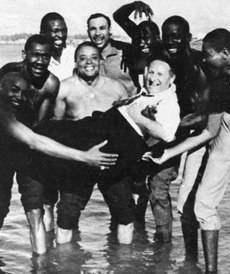
American basketball player, actor and ordained Christian minister Meadow Lemon III, professionally known as Meadowlark Lemon, played over 16,000 games with the Harlem Globetrotters, between 1954 and 1994. He passed away two years ago almost to the day, in Scottsdale, Arizona.  He was 83.  Rest in Peace, Mr. Lemon.  You brought a lot of smiles to the little boy in me.

e26e10a737f869bc93480daece918b87

January 6, 1929 Saint from the Gutter

Mother Teresa was once asked about the overwhelming nature of her work. ‘Never worry about numbers, she said. “Help one person at a time and always start with the person nearest you”.

In Albanian, “Gonxhe” means “Rosebud”.   Anjezë Gonxhe Bojaxhiu was born August 26, 1910, in what is now Uskup, the capital of Macedonia, then Skopje, part of the Ottoman Empire. Her mother raised the girl in the Roman Catholic faith after her father died in 1919.  By age 12, she was committed to a religious life.  “Agnes” had always been fascinated with the lives of missionaries, joining the Sisters of Loreto at the age of 18 to become one.  Though she would live to 87, Agnes would never again see her mother, or her sister.

The Sisters taught English to school children in India, a language she learned in the Loreto Abbey in Rathfarnham, Ireland.

maxresdefault (1)

She arrived in India on January 6, 1929, beginning her novitiate in Darjeeling, near the Himalayas. There she learned to speak Bengali, teaching at St. Teresa’s School, near her convent. Agnes took her first religious vows as a nun in 1931, choosing the name Thérèse de Lisieux, after the patron saint of missionaries. Another nun in the convent had already chosen the name, so Agnes adopted the Spanish spelling, becoming Sister Teresa on May 24.

Teresa would take her solemn vows six years later, while teaching at the Loreto School in Entally, eastern Calcutta, a position she would hold until 1944.

Today, about 10% of the world’s Muslims live in India, making up close to 15% of the population. The number was much higher in 1944, as much as 2/3rds in some regions. The idea of the Muslim population breaking off India and forming an independent Pakistan had come up as early as 1930, and become a major force with the breakup of British rule over the Indian subcontinent, the “British Raj”, at the end of WW2.

Tensions spilled over in the province of Bengal in August 1946, as violence between Muslim, Hindu and Sikh mobs left thousands dead. Violence was particularly bad in Calcutta, where the massive riots of August 16-19 left over 4,000 dead and more than 100,000 homeless.

India would be partitioned the following year, and Pakistan declared an independent nation in August. For now, the violence of 1946, following on the heels of the Bengal famine of 1943, left Calcutta in a state of despair.

MOTHER TERESASister Teresa was looking out from the train carrying her from Darjeeling to Calcutta on September 10, when she heard the call. “I was to leave the convent and help the poor while living among them. It was an order. To fail would have been to break the faith.”

No one knew it at the time, but “Sister Teresa” had become “Mother Teresa”.

Mother Teresa spent a few months at Holy Family Hospital receiving medical training, venturing into the slums of Calcutta to begin her missionary work in 1948. A small group of women joined in her ministry to the “poorest among the poor”, as she wrote in her diary of begging for food and supplies. The hardships were severe, as was the near-constant temptation to return to the ease and comfort of the convent.

Teresa received permission from the Vatican on October 7, 1950, to start the diocesan congregation which would become the Missionaries of Charity.  With only 13 members in Calcutta, their mission was caring for “the hungry, the naked, the homeless, the crippled, the blind, the lepers, all those people who feel unwanted, unloved, uncared for throughout society, people that have become a burden to the society and are shunned by everyone.”

Awarded the Nobel Peace Prize in 1979, Mother Teresa refused the traditional honor banquet, requesting instead that the $192K cost be given to help the poor of India.

With the help of Indian officials, Teresa opened the Kalighat Home for the Dying in an abandoned temple, where dying Muslims were read from the Quran, Hindus received water from the Ganges, and Catholics were read the Last Rites. “A beautiful death,” she said, “is for people who lived like animals to die like angels—loved and wanted”.

b5ea6763663d56414a5527b7f30ed9672cccee71-tc-img-preview

Mother Teresa was once asked about the overwhelming nature of her work. ‘Never worry about numbers, she said. “Help one person at a time and always start with the person nearest you”.

By the time of her death on September 5, 1997, Mother Teresa’s Missionaries of Charity had over 4,000 sisters, and an associated brotherhood of 300 members. They operated 610 missions in 123 countries, including hospices and homes for victims of HIV/AIDS, leprosy and tuberculosis. There were soup kitchens, children’s and family counseling programs, personal helpers, orphanages, and schools.

t162-011

Mother Teresa was canonized on September 4, 2016 in Vatican City, becoming Saint Teresa of Calcutta.  The ceremony at St. Peter’s Square was attended by over 1,500 homeless.

Even saints have critics, in her case usually the warm and well-fed likes of Christopher Hitchens, the “New Left Review” and the German magazine Stern.  Anjezë Gonxhe Bojaxhiu once said “Spread love everywhere you go.  Let no one ever come to you without leaving happier”.  Let that be the woman’s answer to the critics.

January 5, 1709 Frost Fair

The science is politicized. Vast sums of public largesse and political capital are lavished on the climate.  We are told to expect global warming, and warned of a coming ice age. The skeptical taxpayer who has to pay for it all is forced to wade through competing narratives, in an exercise not unlike taking a sip from a fire hose. 

Over the past two weeks, temperatures have dipped near 0° Fahrenheit, as far south as Alabama.  The capital of Florida awoke only yesterday to snow in the palm trees, as frozen iguanas fell to the ground.    Ice hangs from the Spanish mosses of Savannah, as something called a “bomb cyclone” worked its way toward the New England coast.

Yikes.

In July 1983, temperatures of -129° were recorded at the Soviet Vostok Station in Antarctica, the coldest temperature ever measured by ground instruments. NASA satellite data recorded a low temperature of -135.8°F in August, 2010.

Four years later, a Russian research ship full of environmental, scientific and activist types, the Akademik Shokalskiy, got stuck in Antarctic ice, as did the Chinese icebreaker Xue Long, which had come to their rescue.

Very few media outlets got around to reporting that they were there to study “global warming”.

The environmental activist types would object to my use of the term, preferring what they feel to be the more descriptive “climate change”.  They’re right to prefer the term. We can all agree that climate is changing, five ice ages demonstrate that much, but it does beg the question.  How, exactly, will we know we’ve reached climate optimum?

In England, accounts of the River Thames freezing over date back as early as 250AD. The river was open to wheeled traffic for 13 weeks in 923 and again in 1410.  That time, the freeze lasted for 14 weeks. By the early 17th century, the Thames became a place of “Frost Fairs”.

_72554538_abrahamhondius

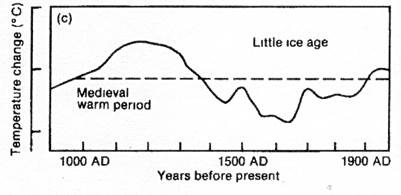
The “Medieval Warm Period” lasting from 950 to 1250 was followed by the “Little Ice Age”, a 300-year period beginning in the 16th century.  King Henry VIII rode a sleigh down the Thames from London to Greenwich in 1536.  Elizabeth I was out on the ice shooting at archery targets, in 1564.

English writer John Evelyn describes the famous “Frost Fair” of the winter of 1683-’84:  “Coaches plied from Westminster to the Temple, and from several other stairs too and fro, as in the streets; sleds, sliding with skeetes, a bull-baiting, horse and coach races, puppet plays and interludes, cooks, tipling and other lewd places, so that it seemed to be a bacchanalian triumph, or carnival on the water”.

The Great Frost of the winter of 1708-09 was held in the coldest winter Europe had seen in 500 years.  William Derham, an English clergyman and natural philosopher best known for calculating a reasonably accurate estimate of the speed of sound, recorded a low of −12°C (10 °F) on the night of January 5, 1709.  It was the lowest he’d measured since beginning readings in 1697, prompting the comment that “I believe the Frost was greater than any other within the Memory of Man”.

24,000 Parisians died of cold in the next two weeks.  Animals froze in their stalls and crops planted the prior year, failed.  The resulting famine killed an estimated 600,000 in France alone while, in Italy, the lagoons and canals of Venice, froze solid.

clip_image0026Breaks in cold weather inevitably marked the end of the frost fairs, sometimes all of a sudden.  In January 1789, melting ice dragged a ship with it, while tied to a riverside tavern, in Rotherhite.  Five people were killed when the building was pulled down on their heads.

The last Thames River frost fair took place in 1814, the year someone led an elephant across the ice, below Blackfriar’s Bridge.  Structural changes in river embankments and the demolition of the medieval London Bridge have increased water flow in the Thames, making it possible that the river will never freeze again.

Today, many blame weather extremes on “anthropogenic” (human) causes, associating what used to be called global warming”, with CO2. Others contend the reverse: that historic increases in carbon do not precede but rather result from, climate extremes. A third group associates the sun with climate change (imagine that), linking an extended period of low solar activity called the “Maunder Minimum”, with the brutal cold of 1645-1715.

The science is politicized. Vast sums of public largesse and political capital are lavished on the climate.  We are told to expect global warming, and warned of a coming ice age. The skeptical taxpayer who has to pay for it all is forced to wade through competing narratives, in an exercise not unlike taking a sip from a fire hose.

Meanwhile, the sun is going to do what the sun is going to do, which at the moment appears to be another quiet period in solar activity.  Very quiet. Before it’s over, we may find ourselves wishing for a little Global Warming.

Feature image, top:  The Battery, Charleston SC, January 2, 2018

January 4, 1642  The Three Kingdoms

In the American colonies, the Petition of Right would pop up 129 years later, reflected in the 3rd, 5th, 6th and 7th amendments of the United States’ Constitution.  Four parts in ten, of what we now know as the Bill of Rights.

Agree or disagree with US government policy, what we do in this country we do as a nation.  It would seem absurd to us to see the President and Congress raise separate armies to go to war with one another, yet that’s just what happened in 17th century England.

Queen Elizabeth I passed away without issue in 1603, succeeded by her first cousin twice removed, King James VI of Scotland.  For the first time, the Kingdoms of England and Scotland were united under single rule.

Edgehill-attack-on-the-train-web
Royalist attack on the Parliamentary train at the Battle of Edgehill, October 23, 1642

The English Parliament of the age didn’t have a permanent role in government, instead being a temporary advisory body, summoned and dismissed at the will of the King.  Practically speaking, the King had no means to enforce his will on matters of taxation, without the consent of the “gentry”, the untitled land-owning classes who were the primary means of national tax collection.  This gave rise to an elected “House of Commons”, joining the House of Lords to form a Parliament.

James thought of Kings as “little Gods on Earth”, and had long gotten whatever he wanted from a supine Scottish Parliament.  The English Parliament was another matter.  James’ entire reign and that of his son Charles I, was one long contest of wills with the English governing body.

Charles’ 1625 marriage to a Roman Catholic, the French princess Henrietta Maria, did little to win him support in Protestant England.  His interventionist policies in the 30 years’ war made things worse, ending with Parliament bringing impeachment proceedings against his minister, the Duke of Buckingham.

Marston-Moor-2-web
Battle of Marston Moor, July 2, 1644

Parliament drew up the “Petition of Right”, invoking the Magna Carta and severely limiting the King’s right of non-Parliamentary taxation, along with other restrictions on the Royal Prerogative.  Charles looked to the House of Lords to check the power of the Commons, but both houses ratified the measure by the end of May.

The King dissolved this first Parliament in 1629, putting nine of its leaders in prison and unwittingly making them martyrs for their cause.  The following 11 years are sometimes called “the personal rule” or the “eleven years’ tyranny”.  By 1640 Charles had severe money problems, forcing him to call another Parliament.

The King wanted a more docile body this time, so he appointed many of his adversaries as Sheriffs, knowing that this would require them to stay within their counties, making them ineligible for election.  On others he bestowed aristocratic titles, making them ineligible for the House of Commons.  Of course, that only moved them to the House of Lords.

Measures the King saw as reasonable, the legislative body saw as opportunity to negotiate, and this “Short Parliament” was dissolved within a month.  That was May 1640, and Charles once again called a Parliament that November.  This “Long Parliament”, proved as uncooperative as any before it.

Cavalry-battle-time-of-Civil-War-web-1
A significant Parliamentary victory was won at the Battle of Cheriton, fought on March 29, 1644

In January, Charles directed the legislature to surrender five members of the Commons and one Peer on grounds of high treason.  On the following day, January 4, 1642, the King himself entered the House of Commons with an armed guard of 400, demanding that the offenders be handed over.  The Speaker, William Lenthall, replied, “May it please your Majesty, I have neither eyes to see nor tongue to speak in this place but as the House is pleased to direct me, whose servant I am here.”

Lenthall might as well have told the King “I work for these people.  I don’t work for you”.

It was a grave breach of protocol.  No King had ever entered the House of Commons.  Making things worse, the botched arrest had cut the feet out from under Charles’ supporters.  The two sides began to arm themselves that summer.  Full-scale civil war broke out that October.

Civil war ensued between Royalist and Parliamentary forces, as Ireland and Scotland broke with England’s primacy among the Three Kingdoms.

The period 1639-’51 saw a series of intertwined conflicts within and between the three kingdoms, including the Bishops’ Wars of 1639 and ’40, the Scottish Civil War of 1644–’45; the Irish Rebellion of 1641, Confederate Ireland, 1642–’49 and the Cromwellian conquest of Ireland in 1649, collectively known as the Eleven Years War or Irish Confederate Wars and finally, the first, second and third English Civil Wars of 1642–’46, 1648–’49 and 1650–’51.

A “Rump” House of Commons indicted the King on treason charges, in a trial which was never recognized by the upper house.  Charles maintained that he was above the law, while the court argued that “the King of England was not a person, but an office whose every occupant was entrusted with a limited power to govern by and according to the laws of the land and not otherwise”.

800px-Sir_Anthony_Van_Dyck_-_Charles_I_(1600-49)_-_Google_Art_Project
Charles I in Three Positions by van Dyck, 1635–36

Charles I was found guilty of treason and sentenced to die by decapitation.   Clothed in two shirts by his own request lest any shiver of cold be misinterpreted as a sign of fear, he put his head on the block on January 30, 1649.  “A subject and a sovereign are clean different things,” he said. “I shall go from a corruptible to an incorruptible Crown, where no disturbance can be”.  With that, the King of England extended his hands to signal that he was ready, and his head was parted with a stroke.

Some 300,000 citizens of what is now known as the ‘United Kingdom’ lost their lives in the series of conflicts.  Roughly 6% of the population, almost twice that lost in the American Civil War.  Nationally, the burial rate increased by 29%, between 1643-’64.

The Protestant Reformation begun some 100 years earlier was itself ‘reformed during this period, as Charles’ stranglehold on church-state policy was replaced by more individualized religious experience.  Ritual was set aside in favor of The Sermon, as individual congregations coalesced around charismatic speakers.  Gone were the days of strong opposition and religious persecution, as previously ‘lunatic fringe’ sects from Muggletonians to Puritans and Quakers expanded across the British Isles and on to Great Britain’s overseas dominions.

The Rump House of Commons disbanded the House of Lords and England briefly became a Commonwealth.  The Scottish Parliament proclaimed Charles eldest son King Charles II of Scotland a week after the execution of his father, but Royalist hopes were dashed two years later when Charles was deposed and exiled to France.

cromwell-battle-of-dunbar
Oliver Cromwell at the Battle of Dunbar, painted by Andrew Carrick Gow, 1886

“1st Lord Protector of the Commonwealth of England, Scotland, and Ireland” Oliver Cromwell became virtual dictator for much of the 1650s. Succeeded by his son Richard upon his death on 1658, the son was not the equal to his father. When the Royalists returned to power, they had Cromwell’s corpse dug up, hung in chains, and beheaded.  Parliament was reinstated, and the monarchy of the Three Kingdoms restored to Charles II, in 1660.

After that, all legal documents were dated as if Charles had succeeded his father, back in 1649.

In the American colonies, the Petition of Right would pop up 129 years later, reflected in the 3rd, 5th, 6th and 7th amendments of the United States’ Constitution.  Four parts in ten, of what we now know as the Bill of Rights.

January 3, 1870 Mr. Roebling’s Bridge

To aid in the work, Emily Roebling took a crash course in bridge engineering. For 11 years she studied higher mathematics, catenary curves, materials strength, and the intricacies of cable construction, all while acting as the pivot point on the largest bridge construction project in the world, and nursemaid to a desperately sick husband.

At the time it was built, the span across the East river linking Brooklyn with Manhattan was the longest suspension bridge in the world.

In 1869, civil engineer John Roebling had already invested two years in site work.   With the ferry coming in, he should have paid more attention to his surroundings.  Focused on what he was doing on the pier, the engineer’s toes were crushed as the boat docked, so badly that several had to be amputated.

brooklyn-bridge-caisson-granger“Lockjaw” is such a sterile term, it doesn’t begin to describe the condition known as Tetanus. In the early stages, the anaerobic bacterium Clostridium Tetani produces tetanospasmin, a neurotoxin producing mild spasms in the jaw muscles. As the disease progresses, sudden and involuntary contractions effect most skeletal muscle groups, becoming so powerful that bones are fractured and the muscles tear themselves apart. These were the last days of John Roebling, the bridge engineer who would not live to see his most famous work.

Roebling was the first casualty of the project.  He would not be the last.

Brooklyn Bridge Caisson ConstructionRoebling’s 32-year-old son Washington took over the project, beginning construction on January 3, 1870.

Enormous yellow pine boxes called “caissons” were built on the Brooklyn and New York sides of the river, descending at the rate of 6-in. per week in search of bedrock. Like giant diving bells, the New York side ended up at 78′ below mean high tide, the Brooklyn side 44′. Pressurized air was pumped into these boxes, keeping water and mud at bay, as workers excavated the bottom. In 1872, these “sandhogs” began to experience a strange illness that came to be called “caisson disease”.

Civil War era submarine designer Julius Hermann Kroehl may have recognized what was happening, but Kroehl was five years in his grave by this time, victim of the same “fever”. Today we call it “the bends”. Pop the top off a soda bottle and you’ll see the principle at work. Without sufficient decompression time, dissolved gasses come out of solution and the blood turns to foam. Bubbles form in or migrate to any part of the body, resulting in symptoms ranging from joint pain and skin rashes, to paralysis and death.  The younger Roebling was badly injured as a result of the bends in 1872, leaving him partially paralyzed and bedridden, incapable of supervising construction on-site.

brooklyn-anchorageRoebling conducted the entire project looking out his apartment window, designing and redesigning details while his wife, Emily Warren Roebling, became the critical connection between her husband and the job site.

To aid in the work, Emily Roebling took a crash course in bridge engineering. For 11 years she studied higher mathematics, catenary curves, materials strength, and the intricacies of cable construction, all while acting as the pivot point on the largest bridge construction project in the world, and nursemaid to a desperately sick husband.

Emily-Warren-Roebling-e1389630968571
Emily Warren Roebling, the “first woman field engineer”.

Historian David McCullough wrote in his book, The Great Bridge: The Epic Story of the Building of the Brooklyn Bridge: “By and by it was common gossip that hers was the great mind behind the great work and that this, the most monumental engineering triumph of the age, was actually the doing of a woman, which as a general proposition was taken in some quarters to be both preposterous and calamitous. In truth, she had by then a thorough grasp of the engineering involved”.

Unlikely as it sounds, fires broke out at the bottom of the river on several occasions, started by workmen’s candles, fed by the oakum used for caulking, and turbocharged by all that pressurized air. On at least one occasion, the caisson had to be filled with millions of gallons of water, before the fire went out for good.

Brooklyn bridge builders

A footbridge connected the two sides in 1877, and soon the wires began to be strung. Wooden “buggies” carried men back and forth along wires suspended hundreds of feet above the water, as individual wires were woven into the four great cables that support the bridge. The work was exacting, with each wire bound together to precise specifications. Rumors about corruption and sleaze surrounded the project when J. Lloyd Haigh, the wire contractor, was discovered to be supplying inferior material. It was way too late to do anything about it, and 150 extra wires were bundled into each cable to compensate. The tactic worked.  Haigh’s shoddy wire remains there, to this day.

Construction was completed in 1883, the bridge opening for use on May 24. The first person to cross was Emily Roebling. Six days later, a rumor started that the bridge was about to collapse.  At least 12 people were killed in the resulting stampede. A year later, a publicity stunt by P. T. Barnum helped to put people’s minds at ease when Jumbo, the circus’ prize elephant, led a parade of 20 other elephants across the bridge.

Brooklyn Bridge

For a long time the span was called the “New York and Brooklyn Bridge” or the “East River Bridge”, officially becoming the “Brooklyn Bridge” only in 1915. At least 27 were killed in its construction; 3 from the bends, several from cable stringing accidents and others crushed under granite blocks or killed in high falls.

Even today, popular culture abounds with stories of suckers “buying” the Brooklyn Bridge. It was the longest bridge in the world for its time, and would remain so until 1903. Roebling had designed his project to be six times the strength required for the job. Even with the defective cables installed, the bridge is four times as strong as it needs to be. Many of the Brooklyn Bridge’s contemporary structures have long since gone.  Johann Augustus Röbling’s bridge carries 145,000 cars, every day.