February 13, 1542 Six Wives of Henry VIII

The science to prove or disprove the theory didn’t exist in the Tudor era, but it may not matter. Anyone attempting to bring that particularly bit of news to Henry VIII, very likely would have paid for it, with his head.

Catherine of Aragon, the youngest daughter of Ferdinand and Isabella, came to England to marry Arthur, the eldest son and heir to the throne of Henry VII, in 1501. Arthur died the following year and his younger brother took the throne, asking Catherine to marry him in 1509.

The Spanish princess-turned Queen Consort of England was by all accounts a devoted wife, but the marriage bore no sons. Henry came to believe, or said he believed, that it was punishment from God for marrying his brother’s wife. By this time the King had fallen hard for the daughter of Thomas Boleyn, 1st Earl of Wiltshire, Anne. Henry was in a pickle. His wife wouldn’t agree to a divorce, and Anne Boleyn was not about to give it up as a mere mistress. She was going to be the King’s wife, or nothing.

HenryVIII_wivesThe problem was, the Pope refused to grant the divorce. Henry launched the Reformation so that he could divorce his wife and marry this young girl from Kent, getting his divorce the following year and going on to become Supreme Head of the Church of England.

Catherine of Aragon died alone in a convent some three years later, the only Class Act in this whole, sorry story.

Catherine had been popular with the people, but this second wife was not. To many, she was ”the King’s whore”. Many believed Boleyn to be a witch who had cast a spell on the King. The marriage produced a daughter, Elizabeth, but again no sons.

On the day that Catherine of Aragon was buried at Peterborough Abbey, Anne miscarried a male child. The Savoyard ambassador Eustace Chapuys commented “She has miscarried of her saviour”.  There would be no divorce this time.  The King of England concocted a plot based on a rumor, and Anne was convicted of incest, adultery and treason. Anne Boleyn was executed by decapitation in 1536. She would not be the last.

Henry married Jane Seymour, 11 days later. Though she bore him a son, she died two weeks after the birth. Years later, Henry would request on his deathbed that he be buried next to her.

Henry+VIIIAnne of Cleaves would be wife #4, an arranged marriage with a German Princess intended to secure an alliance with the other major Protestant power on the continent, especially after England’s break with Rome over that first divorce. Henry was put off by her appearance however, apparently believing himself to be quite the prize. The marriage went unconsummated. They were amicably divorced after 6 months.

Catherine Howard was 19 and Henry 49 when she became wife #5. He was hugely fat by this time, with festering ulcers on his leg that never healed. Henry’s suits of armor reveal a waistline grown from 32″ to 54″. The man weighed 400lbs on his passing, five years later. Catherine was young and flirtatious, preferring the company of young courtiers to that of the fat old guy she was married to. She would be tried and convicted of adultery two years later. As with her predecessor, execution was by the headsman’s axe. Catherine Howard lost her head on, February 13, 1542.

Katherine Parr was the 6th and last wife of Henry VIII. Henry died in January 1547, Parr going on to marry Thomas Seymour, 1st Baron of Sudeley, six months later. Katherine died in September 1548, as the result of complications of childbirth.

Ironically, Henry himself may have been the problem, when it came to the inability to produce a male heir. Researchers revealed in 2011 that Henry’s blood group may have been “Kell positive”, a rare condition which would have initiated an auto-immune response in the mother’s body, targeting the body of the baby inside of her. It’s unlikely that first pregnancies would have been effected, but the mother’s antibodies would have attacked second and subsequent Kell-positive babies as foreign objects.

The science to prove or disprove the theory didn’t exist in the Tudor era, but it may not matter. Anyone attempting to bring that particularly bit of news to Henry VIII, very likely would have paid for it, with his head.

February 12, 1733 The Last Colony

Tomochichi presented a symbol of power to the King of England, a bald eagle feather, the first time this symbol of our nation was connected to the American colonies.

In 1727 England, the anonymously published book “The Sailor’s Advocate”, argued for improvements in the terrible working conditions, that sailors of the day were forced to endure.

The pamphlet’s “unknown” author was James Oglethorpe, a crusader, an idealist, and member of the British Parliament.  Oglethorpe saw urbanization as the great evil of his day, the stripping of the productively employed from the countryside, while depositing them in cities with no opportunity for meaningful work.

Oglethorpe chaired a committee on prison reform the following year, calling attention to the horrendous conditions in English debtors’ prisons, and the hopeless plight of those released with no means of support.

To deal with the problem, Oglethorpe and others petitioned in 1730 to form a committee of trustees, to form the 13th Colony in America. They would call this new colony “Georgia”, a new start for the worthy poor, and a military buffer against Spanish Florida to the south, and French Louisiana to the west.  The charter was signed by King George II on April 21, 1732.slide_11

Thousands applied to go, trustees narrowing the number down to an initial 114 colonists. Those who couldn’t pay their own way would be subject to a period of indenture, typically 5-7 years.

It was November of that year, when the first group of colonists left aboard the “Anne”, bound for the new world.  James Oglethorpe and his 114 pilgrims scrambled up the 40′ banks of the Savannah River on February 12, 1733, there to establish the Province of Georgia and its Colonial Capital of Savannah.

tumblr_oeuwsvcOCx1s9fj4po1_500
Artist’s depiction of Johnson Square, the earliest public square in Savannah

A personal friendship developed between Oglethorpe and native Chieftan Tomochichi, Mico (Leader) of the Yamacraw, a formal treaty of friendship signed in May of that year.

The Trustees obtained £10,000 for the Georgia colony that first year, the subsidy becoming smaller in the following years. Georgia was the only American colony thus dependent on a Parliamentary allowance.

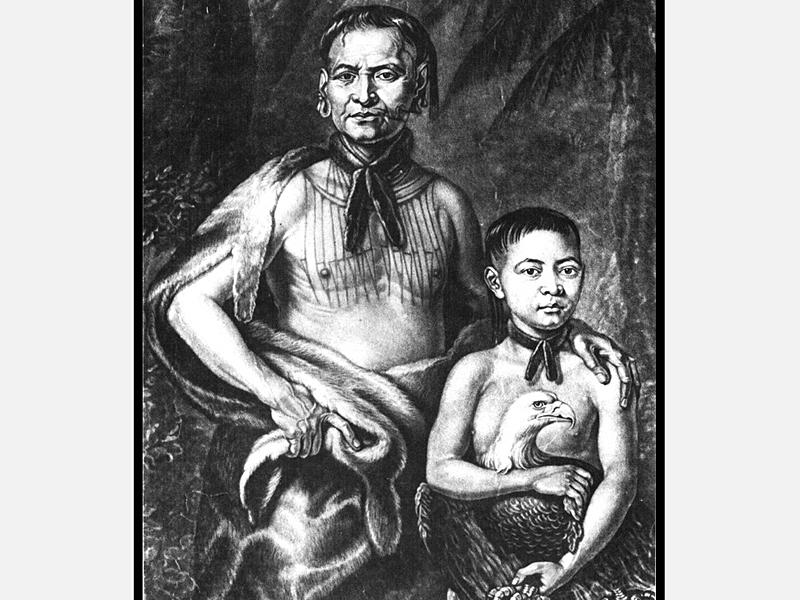
Oglethorpe returned to England two years later along with several “goodwill ambassadors”, among them Chief Tomochichi himself, his wife Senauki, their nephew Toonahowi, and six other members of the Lower Creek tribes. Members of the Indian delegation were treated as celebrities, entertained by Trustees and personal guests of the King and Queen, after which the group became tourists, visiting the Tower of London, St. Paul’s Cathedral and enjoying a number of plays, from Shakespearean dramas to comic farces.

Tomochichi presented a symbol of power to the King of England, a bald eagle feather, the first time this symbol of our nation was connected to the American colonies.

m-1123
“As the principal mediator between the native population and the new English settlers during the first years of Georgia’s settlement, Tomochichi (left) contributed much to the establishment of peaceful relations between the two groups and to the ultimate success of Georgia. His nephew, Toonahowi, is seated on the right in this engraving, circa 1734-35, by John Faber Jr.” – Hat tip for this image, to the Hargrett Rare Book and Manuscript Library, University of Georgia Libraries

The home town to Oglethorpe’s Utopian experiment, Savannah, was founded around four wards, each containing eight blocks situated around its own central square. Established to help the poor and to produce materials like silk and olives for England, Georgia issued each colonist 50 acres of land – perfect for the yeoman farmer, but too small for major landholders.  Its motto was “Non Sibi Sed Allis”. “Not for Themselves But for Others”.  Oglethorpe outlined four by-laws for the Georgia province, four prohibitions forming the legal framework of his Utopian experiment.

1. No rum, Brandy or spirits were allowed in Georgia, though beer, wine and ale, were OK.
2. No African slaves were permitted, though they were occasionally “borrowed” for construction projects.
3. Oglethorpe believed that every man ought to be able to speak for himself. Hence, no lawyers were allowed.
4. No Catholics were allowed either, as it was feared that they’d be too sympathetic with co-religionist Spain, then in control of the Florida territory.

“If we allow slaves,” Oglethorpe had said, “we act against the very Principles by which we associated together, which was to relieve the distressed.”

Returning to England, Oglethorpe continued to serve on the Board of Trustees, though he often found himself outvoted.  Despite his opposition, the Board of Trustees gradually relaxed their restrictions on land ownership, on hard liquor, and on slavery. By 1750, Georgia’s founding father was no longer involved with the board which had given it life. Oglethorpe’s grand experiment was over in 1754, when Trustees voted to dissolve their governing charter, making Georgia the 13th of Great Britain’s American colonies.

Tomochichis-Grave-in-Wright-Square
Mico Tomochichi’s monument, Wright Square, Savannah, Georgia

Chief Tomochichi died in 1739 at age 97, requesting that he be buried among his English friends. The Mico of the Yamacraw was interred in Wright Square, and saluted with cannon and musket fire. James Oglethorpe himself was one of the pall bearers. If you ever visit the city of my childhood, there you will find Wright Square and Tomochichi’s monument, dedicated on April 21, 1899. A bronze tablet is engraved with Cherokee roses and arrowheads, and inscribed with these words. “In memory of Tomochichi – the Mico of the Yamacraws – the companion of Oglethorpe – and the friend and ally of the Colony of Georgia”.

Featured image, top:  LaFayette Square, Savannah, named for the Frenchman and Aide-de-Camp to General George Washington, Marie-Joseph Paul Yves Roch Gilbert du Motier, Marquis de Lafayette.

February 11, 1812 Gerry-mander

In 1842, Federal law required that voting districts be compact, and contiguous. That worked out for about a hot minute.

The dictionary defines “Gerrymander” as a verb: “To divide (a geographic area) into voting districts in a way that gives one party an unfair advantage in elections”. In the Old Country the practice goes way back, the earliest instance in the American colonies dates back to early 1700s, Pennsylvania.

In 1788, Virginia voted to ratify the Constitution and join the Union. Former Governor Patrick Henry persuaded the state legislature to reconfigure the 5th Congressional District, thereby forcing his political adversary James Madison to run against a powerful opponent named James Monroe. Henry’s redistricting tactic failed and Madison won, anyway. One day he would become the nation’s fourth president. All was not over for the loser, though. James Monroe would become #5.

73703-004-17E3CF79Elbridge Gerry was born in 1744, in the north shore Massachusetts town of Marblehead. Gerry spent most of his adult life in public office, excepting a ten-year period in the family codfish packing business. First elected to the state legislature in 1772, Gerry died in office in 1814, while serving as Vice President under President James Madison.

Politics are as ugly these days as any time in living memory, but that’s nothing new. Back in 1812, parties were split between Federalists supporting strong central government and favoring business & industry, pitted against Jeffersonian Democratic-Republicans, suspicious of centralized power and favoring small landowning family farmers to secure the well-being of the nation. Both parties believed the other would destroy the young nation, and campaigns were as nasty as they get.

GerrymanderContext

Elbridge Gerry was elected Massachusetts Governor in 1810. Soon, his Democratic-Republican supporters were doing everything they could to get the man re-elected. The redistricting plan that emerged on February 11, 1812 confined Federalist precincts to a handful of congressional districts, while Democratic-Republican precincts were spread across many. In the end, 50,164 Democratic-Republican votes resulted in 29 seats in the state legislature and only 11 Federalist Party seats, despite a favorable vote tally of 51,766.

gerrymanderBenjamin Russell was a newspaper editor, and ardent Federalist. The painter Gilbert Stuart commented on the new district map hanging over Russell’s desk, saying “That will do for a salamander.” “Better say a Gerry-mander!” was Russell’s reply. A cartoonist added head, wings, and claws. The cartoon map and the name appeared in the Boston Gazette within the month.

Ever since, “gerrymandering” has been a bi-partisan favorite for keeping “public servants” firmly ensconced at the public trough.

In 1842, Federal law required that voting districts be compact, and contiguous. That worked out for about a hot minute. In the 1870s, Mississippi gerrymandered a “shoestring” district some 300 miles long and only 32 miles wide. Other states have “packed” voters into districts shaped like frying pans, dumbbells, and turkey feet.

slide_3In the 1960s, gerrymandering was used to “crack” the voting strength of black and urban voters. A 1962 Supreme Court decision ruled that electoral districts must reflect the principle of “one man, one vote”. A 1985 decision ruled it unconstitutional to alter election districts to favor of any political party.

These days, voting districts are intentionally drawn up to favor or disfavor parties, racial, and other “interest” groups, ensuring that we look on one another as “us and them”, rather than just, plain, fellow Americans. Talk about “the conduct of public affairs for private advantage”. (Hat tip to my favorite curmudgeon, Ambrose Bierce, for that one).

Massachusetts's_4th_congressional_districtHere in the home of the Gerrymander, Barney Frank’s old 4th congressional district resembles nothing so much as a grasping hand. I’m not sure if the new congressional map is much of an improvement, but hey. It seems to work for the ruling class.

In 2000, California’s two major parties worked together to redraw state and Federal legislative districts, in such a way as to preserve the status quo, in perpetuity. It worked. 53 congressional, 20 state senate, and 80 state assembly seats were at risk in the 2004 election. Not one of them changed parties. 28th state senate district Senator Jenny Oropeza (D) won re-election in 2010.  About a month, after she died.

How_to_Steal_an_Election_-_Gerrymandering.svg

If you enjoyed this “Today in History”, please feel free to re-blog, “like” & share on social media, so that others may find and enjoy it as well. Please click the “follow” button on the right, to receive email updates on new articles.  Thank you for your interest, in the history we all share.

February 10, 1920  Lena Blackburne’s Famous Baseball Rubbing Mud

The age of one-ball-per-game died with Ray Chapman, the only player in the history of Major League Baseball, to die from injuries sustained during a game.. The lively ball era had begun. Batters loved it, but pitchers complained about having to handle all those shiny new balls.

Max_Surkont_1953
Max Surkont, 1953

The former Boston Braves pitcher Max Surkont, once said “Baseball was never meant to be taken seriously — if it were, we would play it with a javelin instead of a ball”.

I’m not sure about javelins, but this I know.  There’s nothing more fun at a baseball game, than watching a home run head for the bleachers.

Yet, as much as we all like to see a home run, that’s not always how the game was played. The “Hitless Wonders” of the Chicago White Sox won the 1906 World Series with a .230 club batting average. Manager Fielder Jones said “This should prove that leather is mightier than wood”.  Fielder Allison Jones, that’s the man’s real name.  If that’s not the greatest baseball name ever, it’s got to be one of the top five.

This was the “dead-ball” era, when an “inside baseball” style of play relied on stolen bases, hit-and-run plays and, more than anything else, speed.  Cumulative Major League batting averages stayed between .239 and .279 in the National League.  American League averages remained between .239 and .283.  In 1908, every team in Major League Baseball combined for an average of only 3.4 runs per game.

That’s not to say there were no power hitters. In some ways, a triple may be more difficult than a home run, requiring a runner to cover three bases in the face of a defense still in possession of the ball. Pittsburgh Pirates outfielder Owen “Chief” Wilson set a record of 36 triples in 1912. “Wahoo” Sam Crawford hit a career record 309 triples in his 18 years in Major League Baseball, playing for the Cincinnati Reds and Detroit tigers between 1899 and 1917. 100 years later, it’s unlikely that either record will ever be broken.

In a time when Barry Bonds holds the single season home record at 73, it’s hard to get your head around what a spectacular feat it was, when Babe Ruth hit 29 in 1919.

ty-cobb_shoeless-joe-jackson_only-400-hitters-in-1902-1919-dead-ball-era_b

In his 1994 television miniseries “Baseball”, Ken Burns explains “The moment a new ball was thrown onto the field, part of every pitchers job was to dirty it up. By turns they smeared it with mud, licorice, tobacco juice, it was deliberately scuffed, sandpapered, cut, even spiked. The result was a misshapen earth-colored ball that traveled through the air erratically, tended to soften in the later innings. And as it came over the plate, was very hard to see.”

8195979Spitballs lessened the natural friction with a pitcher’s fingers, reducing backspin and causing the ball to drop. Sandpapered, cut or scarred balls tended to “break” to the side of the scuff mark.

Balls were rarely replaced in those days.  By the end of a game, the ball was scarred, misshapen and entirely unpredictable.  Major League Baseball outlawed “doctored” pitches on February 10, 1920, though entire games continued to be played with the same ball.

The first-ever game to be played “under the lights” was forty years in the past in 1920, but it would be another 15 before the practice became widespread.

On the late afternoon of August 16, the Cleveland Indians were playing the New York Yankees at the Polo Grounds. Cleveland shortstop Ray Chapman took the plate in the top of the 5th, facing “submarine” pitcher Carl Mays.

15pitchers.spanSubmarine pitches are not to be confused with the windmill underhand pitches we see in softball.  Submarine pitchers throw side-arm to under-handed, their upper bodies so low that some of them scuff their knuckles on the ground, the ball rising as it approaches the strike zone.

Chapman may not have seen the pitch coming, because he never moved.  The crack of the ball as it hit his head was so loud that Mays thought he had hit the end of the bat, fielding the ball and throwing to first for the out. Wally Pipp, the first baseman best known for getting a headache and losing his starting position to Lou Gehrig, immediately knew something was wrong. The batter made no effort to run, collapsing slowly to the ground with blood streaming out of his ear.

YNBiMiB29-year-old Ray Chapman had said this was his last year playing ball.  He wanted to spend more time in the family business he had just married into. The man was right.  Raymond Johnson Chapman died 12 hours later, the only player in the history of Major League Baseball, to die from injuries sustained during a game.

The age of one-ball-per-game died with Ray Chapman, and with it the era of the dead ball. The lively ball era, had begun. Batters loved it, but pitchers complained about having to handle all those shiny new balls.

MLB rule #3.01(c) states that “Before the game begins the umpire shall…Receive from the home club a supply of regulation baseballs, the number and make to be certified to the home club by the league president. The umpire shall inspect the baseballs and ensure they are regulation baseballs and that they are properly rubbed so that the gloss is removed. The umpire shall be the sole judge of the fitness of the balls to be used in the game”.

Umpires would “prep” the ball using a mixture of water and dirt from the field, but this resulted in too-soft covers, vulnerable to tampering. Something had to take the shine off the ball without softening the cover.

Rubbing Mud

Philadelphia Athletics third base coach Russell Aubrey “Lena” Blackburne took up the challenge in 1938, scouring the riverbanks of New Jersey for just the right mud. Blackburne found his mud hole on the banks of the Delaware River, describing the stuff as “resembling a cross between chocolate pudding and whipped cold cream”. By the time of his death in the late 1950s, Blackburne was selling his “Baseball Rubbing Mud” to every major league ball club in the country, and most minor league teams.

Rubbing Mud 2In a world where classified government information is kept on personal email servers, there are still some secrets so pinky-swear-double-probation-secret that the truth may Never be known. Among them Facebook “Community Standards” algorithms, the formula for Coca Cola, and the secret fishing hole where Lena Blackburne’s Baseball Rubbing Mud comes from.

Nobody knows, but one thing is certain. The first pitchers will show up to the first spring training camp, a few short days from now. Every baseball thrown from pre-season to the last pitch of the 2018 World Series, will first have been de-glossed with Lena Blackburne’s famous, Baseball Rubbing Mud.

Go Sox.


If you enjoyed this “Today in History”, please feel free to re-blog, “like” & share on social media, so that others may find and enjoy it as well. Please click the “follow” button on the right, to receive email updates on new articles.  Thank you for your interest, in the history we all share.

February 9, 1945 Operation Caesar

The most unusual confrontation of WW2 occurred on this day in 1945, in the form of a combat action between two submerged submarines.

In 1939, the impending Nazi invasion of Poland was an open secret.  That August, representatives of Nazi Germany and the Soviet Union signed the Nazi-Soviet Pact, pledging mutual non-aggression for a period of two years.

Two days later, representatives of the United Kingdom signed the Agreement of Mutual Assistance with Poland, aligning Great Britain with the Franco-Polish Military Alliance.  Should Poland be invaded by a foreign power, England and France were now committed to intervene.

The first fourteen “Unterseeboots” (U-boats) left their bases, fanning out across the North Atlantic.  Hitler’s invasion of Poland, began, three weeks later. Even then, Hitler believed that war with England and France could still be avoided.  The “Kriegsmarine” was under strict orders to follow the “Prize Regulations” of 1936.

how-hitler-tried-to-terrorize-the-seas-with-u-boats-during-world-war-ii

England and France declared war on Nazi Germany on Septemebr 3. Hours later, U-30 Oberleutnant Fritz Julius Lemp fired a torpedo into the British liner SS Athenia. Lemp had mistakenly believed it to be an armed merchant vessel and fair game under Prize Regulations, but the damage was done. The longest and most complex naval battle in history, had begun.

As in WWI, both England and Germany were quick to implement blockades on one another. For good reason. By the time that WWII was in full swing, England alone would require over a million tons a week of imported goods, in order to continue the fight.

convoy_thumbThe “Battle of the Atlantic” lasted 5 years, 8 months and 5 days, ranging from the Irish Sea to the Gulf of Mexico, from the Caribbean to the Arctic Ocean. Winston Churchill would describe this as “the dominating factor all through the war.  Never for a moment could we forget that everything happening elsewhere, on land, at sea or in the air depended ultimately on its outcome”.

Thousands of ships were involved in more than a hundred convoy battles, with over 1,000 single ship encounters unfolding across a theater thousands of miles wide. According to http://www.usmm.org, the United States Merchant Marine suffered the highest percentage of fatalities of any service branch, at 1 in 26 compared to one in 38, 44, 114 and 421 respectively, for the Marine Corps, Army, Navy and Coast Guard.

800px-Atlantic_Merchant_CasualtyNew weapons and tactics would shift the balance first in favor of one side, and then to the other. In the end over 3,500 merchant ships and 175 warships would be sunk to the bottom of the ocean, compared with the loss of 783 U-boats.

The most unusual confrontation of the war occurred on this day in 1945, in the form of a combat action between two submerged submarines. Submarines operate in 3-dimensional space, but their most effective weapon does not. The torpedo is a surface weapon, operating in two-dimensional space: left, right and forward. Firing at a submerged target requires that the torpedo be converted to neutral buoyancy, introducing near-insurmountable complexity into firing calculations.

U-864
U-864

The war was going badly for the Axis Powers in 1945, the allies enjoying near-uncontested supremacy over the world’s shipping lanes. At this time, any surface delivery between Nazi Germany and Imperial Japan was likely to be detected and stopped. The maiden voyage of the 287’, 1,799 ton German submarine U-864 departed on “Operation Caesar” on December 5, delivering Messerschmitt jet engine parts, V-2 missile guidance systems, and 65 tons of mercury to the Imperial Japanese war production industry.

2655041787_639d9fb20a_b
WW2 U-boat pens, Bergen, Norway

The mission was a failure, U-864 having to retreat to the submarine pens in Bergen, Norway, for repairs after running aground in the Kiel Canal. The sub was able to clear the island of Fedje off the Norway coast undetected on February 6. By this time British MI6 had broken the German Enigma code. They were well aware of Operation Caesar.

The British submarine Venturer, commanded by 25-year-old Lieutenant Jimmy Launders, was dispatched from the Shetland Islands, to intercept and destroy U-864.

6868162_f496
A four dimensional firing solution accounting for time, distance, bearing and target depth was theoretically possible, but had rarely been attempted under combat conditions.

ASDIC, an early name for sonar, would have been far more helpful in locating U-864, but at a price. That familiar “ping” would have been heard by both sides, alerting the German commander that he was being hunted. Launders opted for hydrophones, a passive listening device which could alert him to external noises. Calculating his adversary’s direction, depth and speed was vastly more complicated without ASDIC, but the need for stealth won out.

Developing an engine noise which he feared might give him away, U-864’s commander, Ralf-Reimar Wolfram decided to return to Bergen for repairs. German submarines of the age were equipped with “snorkels”, heavy tubes which broke the surface, enabling diesel engines U-864 locationand crews to breathe while running submerged. Venturer was on batteries when the first sounds were detected, giving the British sub the stealth advantage but sharply limiting the time frame in which it could act.

A four dimensional firing solution accounting for time, distance, bearing and target depth was theoretically possible, but had rarely been attempted under combat conditions. Plus, there were unknown factors which could only be approximated.

A fast attack sub, Venturer only carried four torpedo tubes, far fewer than her much larger adversary. Launders calculated his firing solution, ordering all four tubes firing with a 17½ second delay between each pair.

U-864 WreckWith four incoming at as many depths, the German sub didn’t have time to react. Wolfram was only just retrieving his snorkel and converting to electric, when the #4 torpedo struck. U-864 imploded and sank, instantly killing all 73 aboard.

Surface actions were common enough between all manner of vessels, but a fully submerged submarine to submarine kill occurred only once in WWI, on October 18, 1914, when the German U-27 torpedoed and sank the British sub HMS E3 with the loss of all 28 aboard. To my knowledge, such an action occurred only this one time, in all of WWII.


If you enjoyed this “Today in History”, please feel free to re-blog, “like” & share on social media, so that others may find and enjoy it too. Please click the “follow” button on the right, to receive email updates on new articles.  Thank you for your interest, in the history we all share.

February 8, 1960 Of Dogs and Dolls

If you’ve ever loved a dog, I need not explain the final stanza.

At 256 tons with a barrel of 111′ 7″, the German super gun hurled 38″ shells into the city of Paris, from a range of 75 miles. If you were there in 1918, you may never have heard of the “Paris gun”. You’d have been well aware of the damage it caused.  You never knew you were under attack from this thing, until the explosion. The lucky ones were those who lived to see the 4’ deep, 10’-12’ wide crater.

Paris Gun
“Paris Gun”, 1918

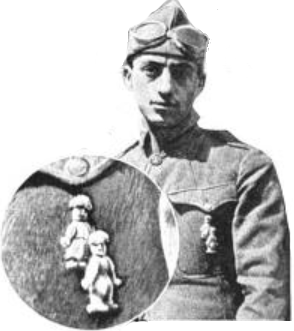
image1361Parisian children made little good luck charms, as “protection” from the Paris gun. They were tiny pairs of handmade dolls, joined together by scraps of yarn.  Their names were Nénette and Rintintin

The dolls were said to provide protection for their owners, but only under certain circumstances. You couldn’t make your own and you couldn’t buy them, they had to be given to you, as a gift. They also had to remain attached, or else the little dolls would lose their protective powers.

That July, one observer noted: “It is taking a long chance in these wild days of war . . . to go about unprotected by a Nénette and Rintintin. Curious little mascot dolls they are, that have taken Paris by storm. . . . But their charm is not to be purchased. Until you have been presented with a Nénette and Rintintin, you have not their sweet protection; and if you have the one without the other, the charm is broken.”

42ffc2cfe8f593f96a1bd77e07dcfc8cUS Army Air Service Corporal Lee Duncan was in Paris at this time, with the 135th Aero Squadron. Duncan was aware of the custom, he may even have been given such a talisman himself.

In the wake of the Battle of Saint-Mihiel, Corporal Duncan was sent forward to the small village of Flirey, to check out the area’s suitability for an airfield. The village was heavily damaged by shellfire, and Duncan came upon the shattered remains of a dog pound. Once, this kennel had provided Alsatians (German Shepherd Dogs) to the Imperial German Army. Now, the only dogs left alive were a starving mother and five nursing puppies, so young that their eyes were still closed.

Corporal Duncan cared for them, selling several once the puppies were weaned. He sold the mother to an officer and three puppies to fellow airmen, keeping two for himself. Like those little yarn dolls, Duncan felt those two puppies were his good luck charms. He called them Nanette and Rin Tin Tin.

Returning home after the war, Duncan placed the dogs with a police dog breeder and trainer in Long Island. Nanette contracted pneumonia and died, the breeder giving Duncan a female puppy, “Nanette II”, to replace her.

6388077243_307a5d1bbc_b

Etzel von Oeringen was born on October 1, 1917 in Quedlinburg Germany, trained as a police dog and serving in the German Red Cross, during WW1.  Left impoverished after the war and unable to support even a dog, his owner declined larger offers in preference to the most humane option, selling him to a friend in White Plains, New York.

Rin Tin Tin signed photoBetter known as “Strongheart”, Etzel appeared in silent films throughout the ’20s, becoming the first major canine film star and credited with enormously increasing the popularity of the breed.
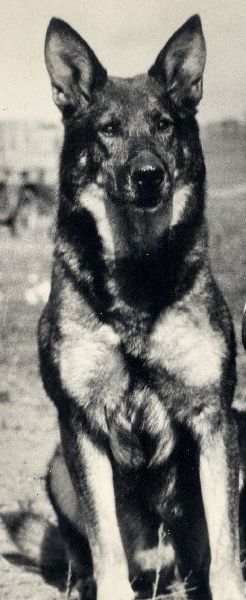
A friend of silent film actor Eugene Pallete, Duncan became convinced that Rin Tin Tin could become the next canine movie star.  “I was so excited over the motion-picture idea”, Duncan wrote, “that I found myself thinking of it night and day.”

Walking his dog on “Poverty Row”, 1920s slang for B movie studios, did the trick. Rin Tin Tin got his first film break in 1922, replacing a camera shy wolf in “The Man from Hell’s River”. His first starring role in the 1923 “Where the North Begins”, is credited with saving Warner Brothers Studios from bankruptcy.

Rin Tin Tin
Rin Tin Tin

Between-the-scenes silent film “intertitles” were easily changed from one language to another, and Rin Tin Tin films enjoyed international distribution. In 1927, Rin Tin Tin was voted Most Popular Actor by Berlin audiences.

There’s a Hollywood legend that may or may not be true, that Rin Tin Tin received the most votes for Best Actor at the 1st Academy Awards, in 1929.  Inclined to take themselves oh-so seriously and wanting a human actor, the Academy threw out the ballots. German actor Emil Jannings got Best Actor on the 2nd ballot.

Rin Tin Tin appeared in 27 feature length silent films, 4 “talkies”, and countless commercials and short films. Regular programming was interrupted to announce his passing on August 10, 1932, at the age of 13.

An hour-long program about his life was broadcast the following day.

Suffering from the Great Depression like so many others, Duncan couldn’t afford a fancy funeral. By this time, he couldn’t even afford the house he lived in.

Duncan sold the house and returned the body of his beloved German Shepherd to the country of his birth, where Rin Tin Tin was buried in the Cimetière des Chiens et Autres Animaux Domestiques, in the Parisian suburb of Asnières-sur-Seine.

K9_unit
WW2 K-9 Recruiting poster, featuring Rin Tin Tin III

Duncan continued breeding the line, careful to preserve the physical qualities and intelligence of the original, while avoiding the less desirable traits that crept into other GSD bloodlines.

Duncan may have been obsessive about it, at least according to Mrs. Duncan. When she filed for divorce, she named Rin Tin Tin as co-respondent.

Rin Tin Tin and Nanette II produced at least 48 puppies.

Unique among the belligerents of WW1, the United States was the only country with no service dogs among its military forces.  The next war, was a different story.  The United States Armed Forces had an extensive K-9 program in WW2, when private citizens were asked to donate their dogs to the war effort.

One such dog was “Chips”, the most decorated K-9 of the war.  Rin Tin Tin III, reputed to be grandson to the original but likely a more distant relation, helped to promote the program.

Rin Tin Tin was awarded his own star on the Hollywood Walk of Fame on February 8, 1960. Lee Duncan passed away later that same year.

At some point, Duncan had written a poem, one man’s tribute to a beloved companion animal, who was no more.

ap580923087_custom-5ca70bd1b125030809eeff742ae70fabb486c74a-s400-c85
“Lee Duncan, 67, holds a pair of Rin Tin Tin’s descendants, Rin Tin Tin 5 and 6, in 1958”. H/T NPR.org, for this image

If you’ve ever loved a dog, I need not explain his final stanza.

“…A real unselfish love like yours, old pal,
Is something I shall never know again;
And I must always be a better man,
Because you loved me greatly, Rin Tin Tin”.


If you enjoyed this “Today in History”, please feel free to re-blog, “like” & share on social media, so that others may find and enjoy it too. Please click the “follow” button on the right, to receive email updates on new articles.  Thank you for your interest, in the history we all share.

poem-rin-tin-tin-by-lee-duncan-master-and-friend-001_custom-dfe6a0281b0372578daa7875c277af29fef78397-s800-c85

February 7, 1775  Bringing A Knife to a Gunfight

It is often said that you should never bring a knife to a gunfight.  You probably don’t want to draw a rhetorical popgun, either.  Not if the other guy is carrying a cannon.

In early 1775, Benjamin Franklin was on an extended diplomatic mission to England.  The balance had not yet tipped toward Revolution, though things were headed in that direction.

113An unnamed British military officer felt the need to run his mouth before the Parliament, at the expense of his fellow British subjects in the American colonies.  “Americans are unequal to the People of this Country”, he said, “in Devotion to Women, and in Courage, and worse than all, they are religious”.

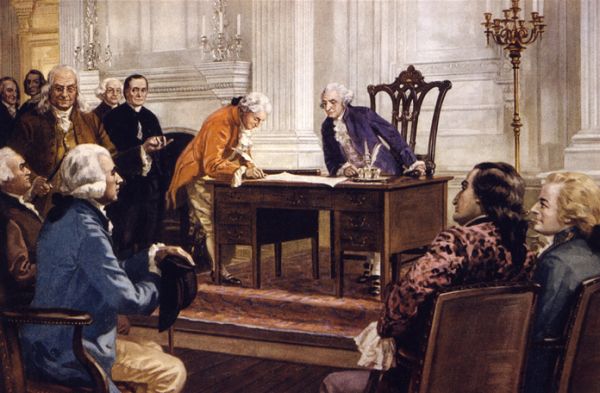
On this day in London, February 7, 1775, the man who would be called “The First American” for his early and tireless campaign for colonial unity, published his response.

Franklin himself was not the most religious man, but he reminded his readers that it was the zealous Puritans who rid Great Britain of the hated King Charles I.

Franklin went on to relate a history of the Seven Years’ War, in which the colonial militia were forever saving inept and blundering British regulars from themselves.

“Indiscriminate Accusations against the Absent are cowardly Calumnies”, he wrote, but old Ben saved his best for the crack about American men not liking women.  Franklin noted that the British population was declining at the time, while in the American colonies, numbers were increasing.  American men, he concluded, are clearly more “effectually devoted to the Fair Sex”, than their counterparts across the pond.

franklin (1)

It is often said that you should never bring a knife to a gunfight.  You probably don’t want to draw a rhetorical popgun, either.  Not if the other guy is carrying a cannon.


If you enjoyed this “Today in History”, please feel free to re-blog, “like” & share on social media, so that others may find and enjoy it too. Please click the “follow” button on the right, to receive email updates on new articles.  Thank you for your interest, in the history we all share.

February 6, 1788 Founding Documents

That original 2nd amendment, which read “No law, varying the compensation for the services of the Senators and Representatives, shall take effect, until an election of Representatives shall have intervened”, took effect in 1992 as the 27th amendment, following a ratification period stretching out 202 years, 7 months, and 12 days.

Early discussions of the American experiment in self-government began almost 20 years before the Revolution, with the Albany Congress of 1754, and Benjamin Franklin’s proposed Albany Plan of Union. The 2nd Continental Congress appointed a drafting committee to write our first constitution in 1776, the work beginning on July 12. The finished document was sent to the states for ratification on November 15 of the following year.

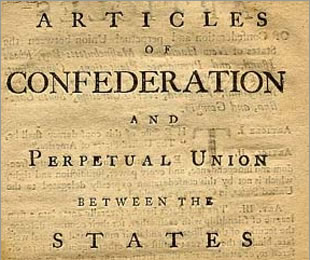
ArticlesOfConfederationTwelve of the original thirteen states ratified these “Articles of Confederation” by February, 1779. Maryland held out for another two years, over land claims west of the Ohio River. In 1781, seven months before Cornwallis’ surrender at Yorktown, the 2nd Continental Congress formally ratified the Articles of Confederation. The young nation’s first governing document.
The document provided for a loose confederation of sovereign states. At the center stood a congress, a unicameral legislature, and that’s about it. There was no Executive, there was no Judiciary.

In theory, Congress had the authority to govern foreign affairs, conduct war, and to regulate currency. In practice, these powers were limited since Congress had no authority to enforce requests made on the states, for either money or manpower.

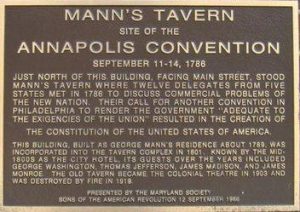
Manns-Tavern-300x212The Union would probably have broken up, had not the Articles of Confederation been amended or replaced. Twelve delegates from five states met at Mann’s Tavern in Annapolis Maryland in September 1786, to discuss the issue. The decision of the Annapolis Convention was unanimous. Representatives from all the states were invited to send delegates to a constitutional convention in Philadelphia, the following May.
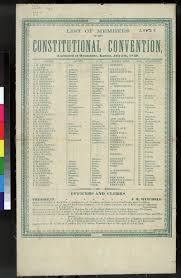
The United States won its independence from England four years earlier, when 55 state delegates convened in Philadelphia to compose a new Constitution.

Delegates from 12 of the 13 original colonies, only Rhode Island abstaining, met at Philadelphia’s Pennsylvania State House on May images (19)25, 1787. The building is now known as Independence Hall, the same place where the Declaration of Independence and the Articles of Confederation were drafted.
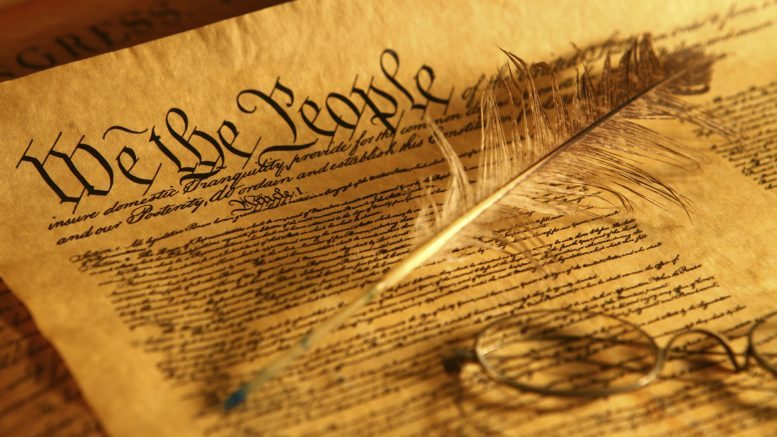
The assembly immediately discarded amending the Articles, crafting in their stead a brilliant Federal system of checks and balances over three months of debate. The Federal Republic envisioned by the framers delegates specific, limited powers to the Federal Government, with authority outside those specific powers devolving to the states.

Even at the convention, there was concern about the larger, more populous states governing at the expense of the smaller ones. The “Connecticut Compromise” solved the problem, creating a bicameral legislature with proportional representation in the lower house (House of Representatives) and equal representation of the states themselves in the upper house (Senate).

The Constitution was signed by 38 of 41 delegates on September 17, 1787. As dictated by Article VII, the document would become binding following ratifiication by nine of the 13 states.

US-Constitution-777x437

Five states: Delaware, Pennsylvania, New Jersey, Georgia, and Connecticut, ratified the document in quick succession. Some states objected to the new Constitution, especially Massachusetts, which wanted more protection for basic political rights such as freedom of speech, religion, and of the press. These wanted the document to specify, that those powers left undelegated to the Federal government, were reserved to the states.

A compromise was reached in February, 1788 whereby Massachusetts and other states would ratify the document, with the assurance that such amendments would be immediately proposed.

With these assurances, Massachusetts ratified the Constitution by a two-vote margin on this day in 1788, followed by Maryland and South Carolina. New Hampshire became the ninth state on June 21. The new Constitutional Government would take effect on March 4 of the following year.

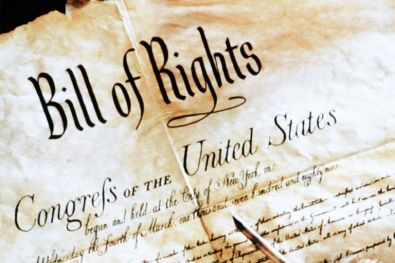
82638952-56a9aadd5f9b58b7d0fdcec6On September 25, the first Congress adopted 12 amendments, sending them to the states for ratification.

The states got rid of the first two, so it is that the Congress’ original 3rd amendment became 1st, of what we now call the “Bill of Rights”. Today, the United States Constitution is the oldest written national constitution in operation, in the world.

It’s interesting to note the priorities of that first Congress, as expressed in their original 1st and 2nd amendments. The ones that were thrown out. The first had to do with proportional representation, and would have led us to a 6,000 member House of Representatives, instead of the 435 we currently have. The second most important thing in the world, judging by the priorities of that first Congress, was that any future Congress could not change their own salaries. Any such change could effect only future Congresses.

That original 2nd amendment, stating that “No law, varying the compensation for the services of the Senators and Representatives, shall take effect, until an election of Representatives shall have intervened”, took effect in 1992 as the 27th amendment, following a ratification period stretching out 202 years, 7 months, and 12 days. One must not not be too hasty about these things.

February 4, 2012 Have a Nice Day

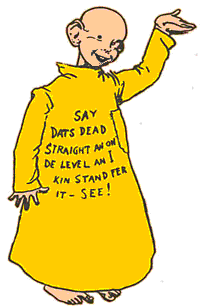
From Betty Boop to the hula hoop, popular culture is always primed and ready to dive into the latest fad.

medals_silver_star_100x200If you were to keyword search “United States Army”, “Silver Star” and “World War II”, you’ll find among a long list of recipients the name of “Ball, Harvey A. HQ, 45th Infantry Division, G.O. No. 281”.

Harvey Ball earned the silver star medal “for Conspicuous Gallantry in Action” in 1945, during the battle for Okinawa. He went on to serve most of his life in the United States Army Reserve, retiring with the rank of Colonel, in 1979.

Twenty years later, Colonel Ball was awarded the “Veteran of the Year” award from the Veterans Council of his home town of Worcester, Massachusetts. Yet, if we think of Harvey Ball, it is probably not for his military service.

Harvey Ross Ball worked for a sign painter while attending Worcester South High School, and went on to study fine arts at the Worcester Art Museum School.

After the war, Ball came home to Worcester and worked for a local advertising firm, later opening his own ad agency, Harvey Ball Advertising, in 1959.

In 1963, Worcester’s State Mutual Life Assurance Company (now Hanover Insurance) bought out the Guarantee Mutual Company of Ohio.  Employee morale had plummeted at the new acquisition, and Director of Promotions Joy Young was tasked with solving the problem.  She hired Harvey Ball as a freelance artist to create a visual icon. A pin to be worn as part of the company’s ‘friendship campaign’.

Harvey_Ball
Harvey Ball, surrounded by his own creation

First came that silly grin. The pair quickly realized that the button could be inverted, and we can’t have “frowny” faces walking about, can we. Ball added eyes, the left drawn slightly smaller than the right, to “humanize” the design.

The work took about ten minutes and the artist was paid $45, equivalent to $330 today.  Neither Ball nor State Mutual Felt it necessary to copyright the graphic.

From Betty Boop to the hula hoop, popular culture is always primed and ready to dive into the latest fad. State Mutual ordered 100 buttons.  Before  Long, manufacturers were taking orders for thousands at a time.

Philadelphia brothers Bernard and Murray Spain seized on the image seven years later, producing millions of coffee mugs, t-shirts, watches and bumper stickers, emblazoned with the happy face and the slogan “Have a happy day”, later revised to the ever present, “Have a nice day”.

The image was everywhere, second only to the ubiquitous “Peace Sign”.

Frenchman Franklin Loufrani copyrighted the image in France in 1972, using it to highlight the “good news” section of the newspaper France Soir.

WMCA_good_guys_sweatshirt_1962
WMCA “good guys” sweatshirt, 1962

Loufrani’s son Nicolas took over the family business, launching The Smiley Company in 1996.  The younger Loufrani is skeptical of Harvey Ball’s claim to have created such a simple design, pointing to cave paintings found in France dated to 2500BC, and a similar graphic used in radio ad campaigns, of the early ’60s.

Of course, that didn’t prevent the company from seeking US trademark rights to the image, kicking off a years-long legal battle with retail giant Wal-Mart, which had been using the happy face in its “Rolling Back Prices” campaign.

The Smiley Company is one of the 100 largest licensing corporations in the world with revenues of $167 million in 2012, the year that BBC Radio produced the documentary “Smiley’s People”, broadcast on February 4.

GalleMartianCrater
Martian Crater

The artist didn’t seem to mind, that he never copyrighted his Smiley Face. Harvey Ball is gone now, but his son Charles says his father never was a money driven kind of guy. “Hey”, he would say, “I can only eat one steak at a time. drive one car at a time”.

In the 2009 film “Watchmen” characters fly to Mars, landing in a crater that looks like a Smiley Face. The red planet really does have such a place. It’s called the Galle crater.

In June of 2010, Wal-Mart and the Smiley Company settled their 10-year-old legal dispute in Chicago federal court. The terms of the settlement are confidential, and the judges words as he lowered the gavel, are unknown to this writer.  I so want to believe he told all those lawyers, to “have a nice day”.

If you enjoyed this “Today in History”, please feel free to re-blog, “like” & share on social media, so that others may find and enjoy it too. Please click the “follow” button on the right, to receive email updates on new articles.  Thank you for your interest, in the history we all share.

February 3, 1943  Greater Love Hath No Man Than This

As the ship upended and went down by the bow, survivors floating nearby could see the four chaplains.  With arms linked and leaning against the slanting deck, their voices offered prayers and sang hymns for the dead and for those about to die.

The Troop Transport USAT Dorchester sailed out of New York Harbor on January 23, 1943, carrying 904 service members, merchant seamen and civilian workers.  They were headed for the  the Army Command Base at Narsarsuaq in southern Greenland, part of a six-ship convoy designated SG-19, together with two merchant ships and escorted by the Coast Guard Cutters Comanche, Escanaba and Tampa.

Built as a coastal liner in 1926, Dorchester was anything but graceful, bouncing and shuddering her way through the rough seas of the North Atlantic.

German U-Boats had already sunk several ships in these waters.  One of the Cutters detected a submarine late on February 2, flashing the light signal “we’re being followed”.  Dorchester Captain Hans Danielson ordered his ship on high alert that night.  Men were ordered to sleep in their clothes with their life jackets on, but many disregarded the order.  It was too hot down there in the holds, and those life jackets were anything but comfortable.

Dorchester-facta-nautica-1000

Some of those off-duty tried to sleep that night, while others played cards or threw dice, well into the night.  Nerves were understandably on edge, especially among new recruits, as four Army chaplains passed among them with words of encouragement.

They were the Jewish rabbi Alexander David Goode, the Catholic priest John Patrick Washington, the Reformed Church in America (RCA) minister Clark Vandersail Poling, and the Methodist minister George Lansing Fox.

At 12:55am on February 3rd, the German submarine U-223 fired a spread of three torpedoes.  One struck Dorchester amidships, deep below the water line.  A hundred or more were killed in the blast, or in the clouds of steam and ammonia vapor billowing from ruptured boilers.  Suddenly pitched into darkness, untold numbers were trapped below decks.  With boiler power lost, there was no longer enough steam to blow the full 6 whistle signal to abandon ship, while loss of power prevented a radio distress signal.  For reasons not entirely clear, there never were any signal flares.

druidartThose who could escape scrambled onto the deck, injured, disoriented, many still in their underwear as they emerged into the cold and darkness.

The four chaplains must have been a welcome sight, guiding the disoriented and the wounded, offering prayers and words of courage.  They opened a storage locker and handed out life preservers, until there were no more.  “Padre,” said one young soldier, “I’ve lost my life jacket and I can’t swim!”  Witnesses differ as to which of the four it was who gave this man his life jacket, but they all followed suit.  One survivor, John Ladd, said “It was the finest thing I have seen or hope to see this side of heaven.” Rabbi Goode gave his gloves to Petty Officer John Mahoney, saying “Never mind.  I have two pairs”.  It was only later that Mahoney realized, Rabbi Goode intended to stay with the ship.

size0Dorchester was listing hard to starboard and taking on water fast, with only 20 minutes to live.  Port side lifeboats were inoperable due to the ship’s angle.  Men jumped across the void into those on the starboard side, overcrowding them to the point of capsize.  Only two of fourteen lifeboats launched successfully.

Private William Bednar found himself floating in 34° water, surrounded by dead bodies and debris. “I could hear men crying, pleading, praying,” he recalled. “I could also hear the chaplains preaching courage. Their voices were the only thing that kept me going.”

As the ship upended and went down by the bow, survivors floating nearby could see the four chaplains.  With arms linked and leaning against the slanting deck, their voices offered prayers and sang hymns for the dead and for those about to die.

images (17)Rushing back to the scene, coast guard cutters found themselves in a sea of bobbing red lights, the water-activated emergency strobe lights of individual life jackets.  Most marked the location of corpses.  Of the 904 on board, the Coast Guard plucked 230 from the water, alive.

The United States Congress attempted to confer the Medal of Honor on the four chaplains for their selfless act of courage, but strict requirements for “heroism under fire” prevented it from doing so.  Congress authorized a one time, posthumous “Chaplain’s Medal for Heroism”, awarded to the next of kin by Secretary of the Army Wilber M. Brucker at Fort Myer, Virginia on January 18, 1961.

chaplains_medalJohn 15:13 says “Greater love hath no man than this, that a man lay down his life for his friends”.  Rabbi Goode did not call out for a Jew when he gave away his only hope for survival, Father Washington did not ask for a Catholic. Neither minister Fox nor Poling asked for a Protestant.  Each gave his life jacket to the nearest man.

Carl Sandburg once said that “Valor is a gift.  Those having it never know for sure whether they have it until the test comes.”  If I were ever so tested, I hope that I would prove myself half the man, as any of those four chaplains.

four-chaplainsUSSDorchester