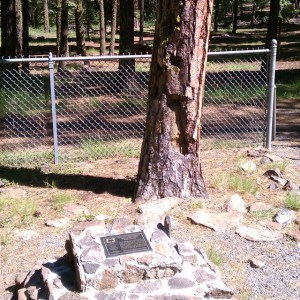
June 12, 1942 Operation Pastorius

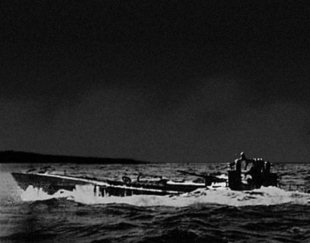
The German submarine U-202 came to the surface in the small hours of June 12 at Amagansett, NY, near Montauk Point. The inflatable that came out of its hatch was rowed to shore at what is today Atlantic Avenue beach, Long Island.

Much has been written about the eight central characters in this story. These individuals have been described in contemporary and subsequent sources alike, as Saboteurs, Nazis and Spies. Certainly to call them such, fed into the political expectations of the day.  Yet their country had chosen them for this mission based on unique qualifications, separate and apart from whatever devotion they felt for the fatherland, or to the Nazi party.  It may be that these guys deserve every evil name that’s been heaped upon them. Or maybe they were just eight guys who got caught up between two nations at war.  It’s an interesting story.  You decide.

The German submarine U-202 came to the surface in the small hours of June 12 at Amagansett, New York, near Montauk Point. The inflatable that came out of its hatch was rowed to shore at what is today Atlantic Avenue beach, Long Island. Four figures stepped onto the beach wearing German military uniforms.  If they’d been captured at that point, they wanted to be treated as enemy combatants, rather than spies.

Their mission was to sabotage American economic targets and damage defense production. Their targets included hydroelectric plants, train bridges, and factories. They had almost $175,000 in cash, some good liquor, and enough explosives to last them through a two year campaign.Pastorius
German plans began to unravel as they buried their uniforms and explosives in the sand.  21-year old Coast Guardsman John Cullen was a “sand pounder”.  Armed only with a flashlight and a flare gun, Cullen had the unglamorous duty of patrolling the beaches, looking for suspicious activity.

It was “so foggy that I couldn’t see my shoes”, Cullen said, when a solitary figure came out of the dunes.  He was George John Davis, he said, a fisherman run ashore.  Something seemed wrong and Cullen’s suspicions were heightened, when another figure came out of the darkness.  He was shouting something in German, when “Davis” spun around, yelling, “You damn fool!  Go back to the others!”

With standing orders to kill anyone who confronted them during the landing, Davis hissed, “Do you have a mother? A father?  Well, I wouldn’t want to have to kill you.”

It was Cullen’s lucky day.  “Davis'” real name was George John Dasch.  He was no Nazi. He’d been a waiter and dishwasher before the war, who’d come to the attention of the German High Command because he’d lived for a time in America.   “Forget about this, take this money, and go have a good time” he said, handing over a wad of bills.   $260 richer, Cullen sprinted two miles to the Coast guard station.
Cullen
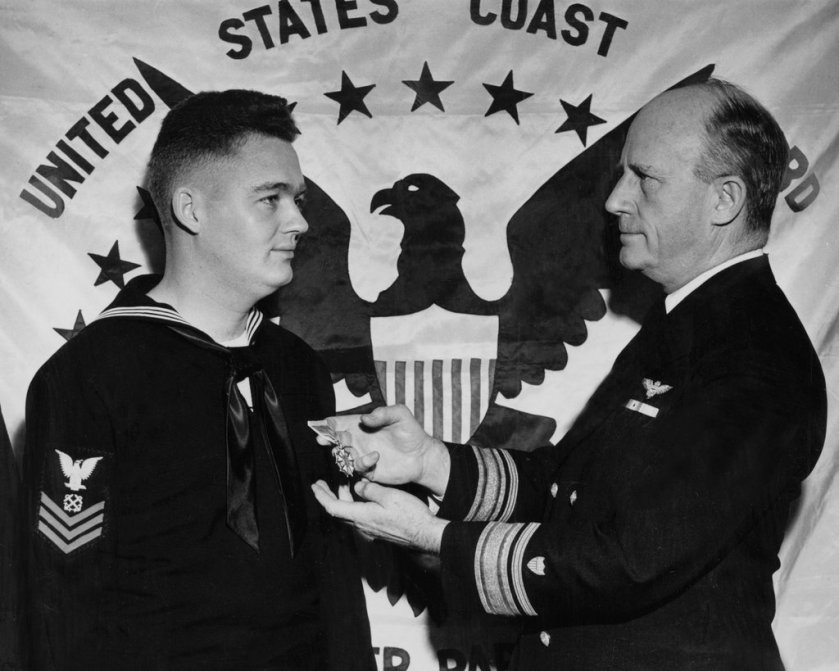
Seaman John Cullen, left, received the Legion of Merit from Rear Adm. Stanley V. Parker for his service in WW2

Four days later, U-584 deposited a second team of four at Ponte Vedra Beach, Florida, south of Jacksonville. As with the first, this second group had lived and worked in the United States, and were fluent in English.  Two of the eight were US citizens.

George Dasch had a secret.  He had no intention of carrying out his mission.  He summoned Ernst Peter Burger to an upper-level hotel room.  Gesturing toward an open window, Dasch said  “You and I are going to have a talk, and if we disagree, only one of us will walk out that door—the other will fly out this window.”

Burger turned out to be a naturalized citizen, who’d spent 17 months in a concentration camp.  He hated the Nazis as much as Dasch, and the pair decided to defect.Pastorius-Plaque
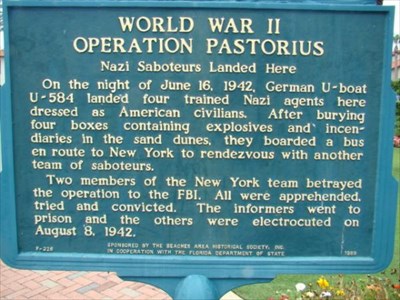
Dasch tested the waters. Convinced the FBI was infiltrated with Nazi agents, he telephoned the New York field office.  Put on hold with the call transferred several times, Dasch was horrified to have the agent who finally listened to him, quietly hang up the phone.  Had he reached a German mole?  Had the call been traced?

Dasch could not have known, he’d been transferred to the ‘nut desk’.  The FBI thought he was a clown.

Finally, Dasch went to the FBI office in Washington DC, where he was treated like a nut job.  Until he dumped $84,000 on Assistant Director D.M. Ladd’s desk, equivalent to about a million, today.  Dasch was interrogated for hours, and happily gave up everything he knew.  Targets, German war production, he spilled it all, even a handkerchief with the names of local contacts, written in invisible ink.  He couldn’t have been a very good spy, though.  He forgot how to reveal the names.

All eight were in custody within two weeks.

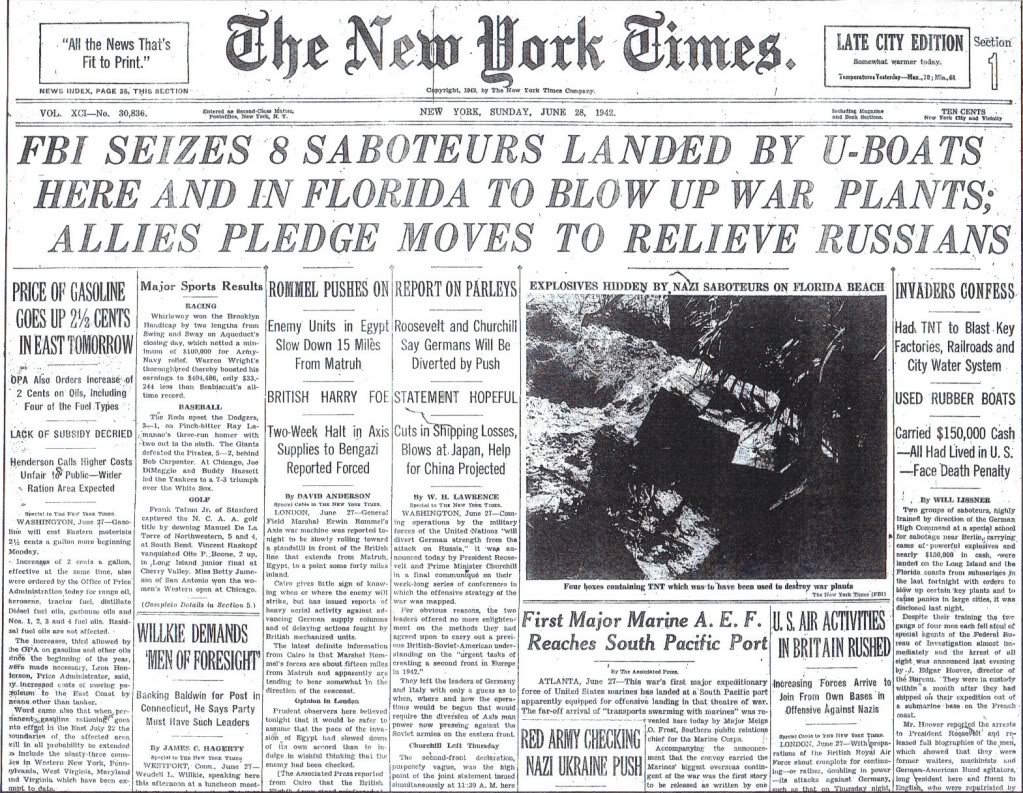
J. Edgar Hoover announced the German plot on June 27, but his version had little resemblance to that of Dasch and Burger.  As with the brief he had given President Roosevelt, Hoover praised the magnificent work of FBI detectives, and the Sherlock Holmes-like powers of deduction which led Assistant Director Ladd to the $84,000.  Dasch and Burger’s role in the investigation was conveniently left out, as was the fact that the money had basically bounced Ladd off the head.Pastorius-8

Neither Dasch nor Burger expected to be thrown in a cell, but agents assured them it was a formality.  Meanwhile, a credulous and adoring media speculated on how Hoover’s FBI had done it all.  Did America have spies inside the Gestapo?  German High Command?  Were they seriously that good?

Attorneys for the defense wanted a civilian trial, but President Roosevelt wrote to Attorney General Francis Biddle: “Surely they are as guilty as it is possible to be and it seems to me that the death penalty is almost obligatory”. The case went all the way to the Supreme Court, where the decision “Ex parte Quirin” became precedent for the way unlawful combatants are tried, to this day.  All eight would appear before a military tribunal.

It’s unclear whether any of the eight were the menace they were made out to be.  German High Command had selected all eight based on a past connection with the United States, ordering them to attack what they may have regarded as their adopted country.  Several were arrested in gambling establishments or houses of prostitution.  One had resumed a relationship with an old girlfriend, and the pair was planning to marry.  Not exactly the behavior patterns of “Nazi saboteurs”.

The trial was held before a closed-door military tribunal in the Department of Justice building in Washington, the first such trial since the Civil War. All eight defendants were found guilty and sentenced to death.  It was only on reading trial transcripts, that Roosevelt learned the rest of the story.  The President commuted Burger’s sentence to life and Dasch’s to 30 years, based on their cooperation with the prosecution. The other six were executed by electric chair on August 8, in alphabetical order.
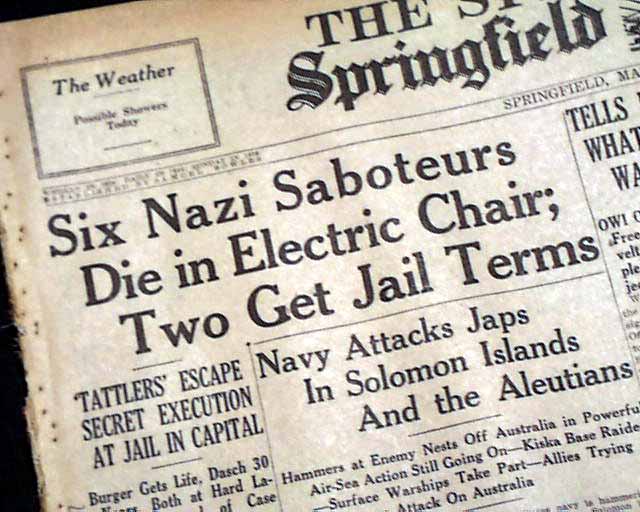
Pastorius-Sentinel

After the war, Burger and Dasch’s trial transcripts were released to the public, over the strenuous objections of J. Edgar Hoover.  In 1948, President Harry S. Truman bowed to political pressure, granting them executive clemency and deporting both to the American zone of occupied Germany.  The pair found themselves men without a country, hated as spies in America, and traitors in Germany.

The reader may decide, whether Hoover and Roosevelt operated from base and venal political motives, or whether the pair was playing 4-D chess.  Be that as it may, Hitler rebuked Admiral Canaris, and seems to have bought into Hoover’s version of FBI invincibility.  There would be no further missions of this type, save for one in November 1944, when two spies were landed on the coast of Maine to gather information on the Manhattan project.

George Dasch campaigned for the rest of his life, to be allowed to return to what he described as his adopted country.  Ernst Burger died in Germany in 1975, Dasch in 1992.  The pardon Hoover promised both men a half-century earlier, never materialized

June 10, 1944 Oradour-sur-Glane

The women and children were locked in a village church while the German soldiers looted the town. The men were taken to a nearby barn, where the machine guns had already been set up.

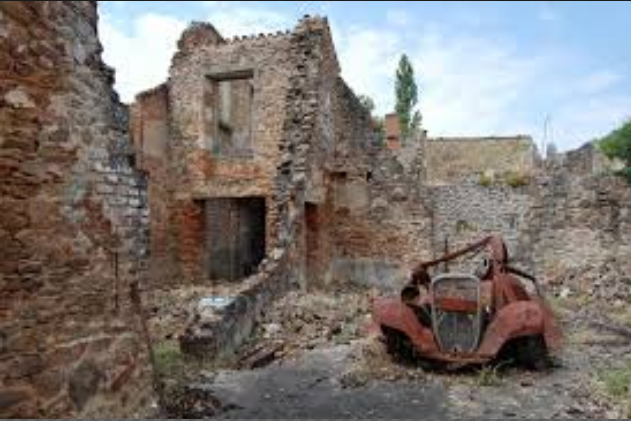
Oradour-sur-Glane-StreetsIt was D+4 in the invasion of Normandy, and the 2nd SS Panzer Division (“Das Reich”) had been ordered to stop the Allied advance. They were passing through the Limousin region in west central France, when SS-Sturmbannführer Adolf Diekmann received word that Waffen-SS officer Helmut Kämpfe was being held by French Resistance forces in the village of Oradour-sur-Vayres.

Diekmann’s battalion sealed off the nearby village of Oradour-sur-Glane, unaware that they had confused it with the other village. Everyone in the town was ordered to assemble in the village square to have their identity papers examined. The entire population of the village was there, plus another 6 unfortunates who were riding their bicycles in the wrong place, at the wrong time.

Oradour-sur-Glane.jpg 1

The women and children were locked in a village church while German soldiers looted the town. The men were taken to a nearby barn, where machine guns had already been set up.

The Germans aimed for the legs when they opened fire, intending to inflict as much pain as possible. Five escaped in the confusion before the SS lit the barn on fire. 190 men were burned alive.

Nazi soldiers then lit an incendiary device in the church, and gunned down 247 women and 205 children as they tried to get out.

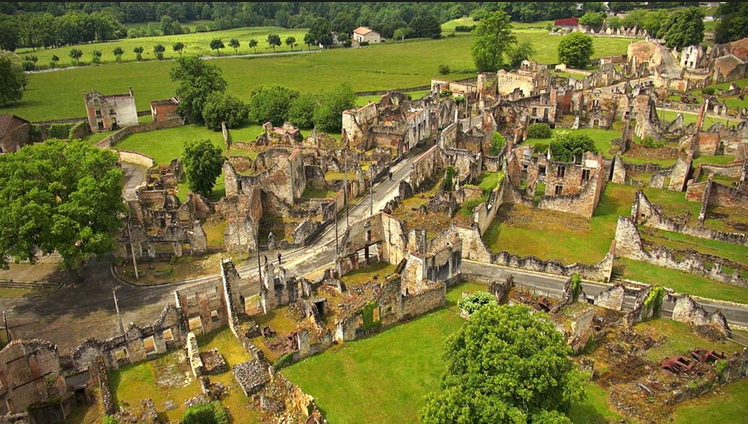
642 inhabitants of Oradour-sur-Glane, age one week to 90 years, were murdered in a few hours, the village razed to the ground. After the war, French President Charles de Gaulle ordered that the village remain as is; a memorial to the cruelty of collective punishment, and the savagery committed by the Waffen-SS in countless places: the French towns of Tulle, Ascq, Maillé, Robert-Espagne, and Clermont-en-Argonne; the Polish villages Michniów, Wanaty and Krasowo-Częstki, Warsaw; the Soviet village of Kortelisy; the Lithuanian village of Pirčiupiai; the Czechoslovakian villages of Ležáky and Lidice; the Greek towns of Kalavryta and Distomo; the Dutch town of Putten; the Yugoslavian towns of Kragujevac and Kraljevo, and the village of Dražgoše, in what is now Slovenia; the Norwegian village of Telavåg; the Italian villages of Sant’Anna di Stazzema and Marzabotto. And on, and on, and on.

French President Jacques Chirac dedicated a memorial museum in 1999, the “Centre de la mémoire d’Oradour”. The village stands today as the Nazis left it, 73 years ago today. It may be the most forlorn place on earth.

The story was featured in the 1974 British television series “The World at War”, narrated by Sir Laurence Olivier. The first and final episodes of the program began with these words: “Down this road, on a summer day in 1944. . . The soldiers came. Nobody lives here now. They stayed only a few hours. When they had gone, the community which had lived for a thousand years. . . was dead. This is Oradour-sur-Glane, in France. The day the soldiers came, the people were gathered together. The men were taken to garages and barns, the women and children were led down this road . . . and they were driven. . . into this church. Here, they heard the firing as their men were shot. Then. . . they were killed too. A few weeks later, many of those who had done the killing were themselves dead, in battle. They never rebuilt Oradour. Its ruins are a memorial. Its martyrdom stands for thousands upon thousands of other martyrdoms in Poland, in Russia, in Burma, in China, in a World at War”.

Oradour-sur-Glane

June 6, 1944 A Great Crusade

The amphibious invasion which began this day on the beaches of Normandy, was the culmination of the largest single endeavor in human history.

The amphibious invasion which began this day on the beaches of Normandy, was the culmination of the largest single endeavor in human history.

D-Day landing

3,200 reconnaissance missions were launched leading up to the invasion, to photograph vital locations. Other landing sites were considered, in fact Adolf Hitler expected the invasion to take place at Calais. Normandy was chosen because defenses were lighter, and because advancing troops would have fewer rivers and canals to cross.

“Exercise Tiger”, an earlier practice landing on the beaches of Slaptonkilled more Americans than many full-scale battles.

Five landing zones were selected along a 50-mile stretch of beach. Americans would attack at two points code named Utah and Omaha, British troops at Gold and Sword, and Canadian troops at Juno.

D-Day_map_2

On the eve of the invasion Eisenhower told his troops: “You are about to embark upon a great crusade, toward which we have striven these many months. The eyes of the world are upon you.” Conscious of his own role in the disastrous landings at Gallipoli of the earlier war, a nervous Winston Churchill said to his wife, Clementine, “Do you realize that by the time you wake up in the morning 20,000 men may have been killed?”

The invasion began in the early morning hours with 1,200 planes delivering gliders and parachute troops of the 82nd and 101st Airborne Infantry. Eight different navies made up the invasion fleet, the sun rising that morning on 6,939 vessels along the coast of France.

160,000 US, UK, Canadian and Free French troops landed on the first day. Later invasion phases included forces from Australia, Greece, New Zealand, Netherlands and Norway, combined with the free forces of Nazi occupied Poland, Belgium and Czechoslovakia.

Normandy Landing

There were the “Mulberries”, the great steel structures built to form temporary harbors for landing vehicles and equipment, and floated across the 25 miles of the English Channel. By July 4, over a million men, 148,000 vehicles, and 570,000 tons of supplies had passed over them to the beaches.

Operation Fortitude DecoyIt was impossible to assemble the pieces of such a massive undertaking in secret, so an elaborate ruse called “Operation Fortitude” was launched to divert attention from the real objective. Fake field armies were assembled in Edinburgh, Scotland and the south coast of England, threatening attack on the coasts of Norway and the Pas de Calais. The real General George S. Patton was put in charge of the fake First US Army Group (FUSAG). The allied “Twenty Committee”, represented by its roman numerals “XX”, controlled a network of double agents, making the deception so complete that Hitler personally withheld critical reinforcements until long after they would have made a difference. It’s where we get the term “Double Cross”.

What had seemed like an inexorable Nazi tide had begun to slow with the reversal of the German armies in Soviet Russia and North Africa. The allies had gained their first European toehold with a successful landing in Italy nine months earlier. It had been 5 years since the beginning of World War II, 4 years almost to the day, since the National Socialist regime of Adolf Hitler had hurled the English and French armies from the beaches of Dunkirk. The Soviet Union had joined the side of the Allies 3 years earlier, and the United States 2½. The entire European subcontinent was either neutral or under Nazi domination.  The Allies needed to break down the door to get back in.Normandy, Battlefield Cross

Supreme Headquarters Allied Expeditionary Force (SHAEF) commander Dwight D Eisenhower had planned to launch the invasion on the 5th, but the weather was working against it. The invasion couldn’t be held for long, it had to be launched or turned back.

Allied troop convoys were at sea on the 4th, and the full moon which would bring high tides would soon be over. There was finally a break in the forecast, and the invasion began shortly after midnight.

Eisenhower had written two letters.  Only one would be delivered to his superior in Washington, DC, Army Chief of Staff, General George C. Marshall. The first announced the success of the invasion, the second taking personal responsibility for its failure. “Our landings in the Cherbourg-Havre area have failed to gain a satisfactory foothold and I have withdrawn the troops. My decision to attack at this time and place was based upon the best information available. The troops, the air and the Navy did all that bravery and devotion to duty could do. If any blame or fault attaches to the attempt it is mine alone.” Eisenhower dated the letter July 5 instead of June 5, a small indication of the enormous pressure the man was under.

eisenhower-in-case-of-failure-letter
Eisenhower labeled this backup letter “In case the Nazis won.”

Over 9,000 Allied soldiers were killed or wounded on that first day.  Almost a year of hard fighting remained before VE Day:  Victory in Europe.  On this day, General Eisenhower would be able to keep that second message, in his pocket.

American Cemetery, Normandy
9,387 Americans are buried at the American cemetery at Omaha Beach 3 Medal of Honor recipients, Brig. Gen. Theodore Roosevelt, Jr., his brother Quentin who was killed in WWI, Army Air Corps crews shot down over France as early as 1942 and two of the Niland brothers, on whom the film Saving Private Ryan is based.


June 4, 1939 Vacation Cruise to Freedom

So it was that a vacation cruise to freedom became the “voyage of the damned”. MS St. Louis returned to Europe

In 1933, the year that Adolf Hitler and his National Socialist party came to power, some 522,000 Jews lived in Germany. Fearing for their safety, some 304,000 of them emigrated in the first six years of the regime, including the physicist Albert Einstein. Jews were banned from holding professional jobs in 1936, effectively blocking them from German politics, education and industry, and relegating them to 2nd class citizenship. The SS-ordered “Kristallnacht” (Night of the Broken Glass), was carried out over the night of November 9-10, 1938. Jewish owned stores and offices were smashed and vandalized, and synagogues burned.

Many of Germany’s Jews had lived there since the time of Charlemagne. By the eve of WWII, only 214,000 remained.

msstlouispostcard
Postcard depicting MS St Louis

Part of this exodus, the Hamburg-America line cruise ship MS St. Louis departed Hamburg on May 13, 1939, headed for Cuba. On board were 937 refugees, seeking asylum from Nazi persecution.

St. Louis’ Atlantic crossing was described as a “joyous affair”.  A non-Jewish German and adamant anti-Nazi, Captain Gustav Schröder made sure that it was so.

A full-time nursemaid looked after small children while their parents sat to eat, uniformed stewards serving dishes which were rationed by this time in Germany. Swimming lessons were held for children on deck. They were even permitted to throw a tablecloth over the Adolf Hitler statue in the dining room. Lothar Molton, a boy traveling with his parents, described the experience as “a vacation cruise to freedom”.

The joyous affair came to an end on May 27, when St. Louis dropped anchor in Havana Harbor. Passengers had all purchased legal visas, but most had been retroactively canceled on May 5, due to a change in Cuban immigration policy. For six days they waited amidst bureaucratic wrangling. In the end, only 29 were permitted to get off in Cuba. Four were Spanish citizens and two Cuban nationals. Another 22 were Jews with valid US visas. One attempted suicide, and was brought to a Havana hospital.

stlouisinhavanaharbor
Small boats surrounded the MS St Louis in Havana Harbor to prevent refugee passengers from committing suicide when denied landing in Cuba.

St. Louis then crossed the Florida strait, arriving off the coast on June 4 and hoping for better results in the United States. It wasn’t meant to be. “Sailing so close to Florida that they could see the lights of Miami”, passengers sent President Franklin Roosevelt an urgent telegram, pleading to be admitted into the country. Secretary of State Cordell Hull, who later won the Nobel Peace Prize for his work in creating the United Nations, urged Roosevelt to reject the refugees, sending Coast Guard cutters to be sure that nobody jumped overboard and swam ashore. stlouistelegram

Roosevelt had his own politics to deal with. The Great Depression had left millions unemployed at the time and Americans were fearful of additional competition for scarce jobs. In Congress, the Wagner-Rogers bill, which would have admitted an additional 20,000 German-Jewish refugees over existing quotas, was being allowed to die in committee. Roosevelt was preparing to run for an unprecedented third term, and calculations of self-interest won out. He ignored the plight of the St. Louis.

Finally, a group of Canadian clergy and academics attempted to persuade Prime Minister William Lyon Mackenzie King, to provide sanctuary in Canada. The ship was, after all, only two days from Halifax. Director of Canada’s immigration branch Frederick Blair opposed the move. Blair must have been some piece of work. He had written a year earlier, that “Pressure by Jewish people to get into Canada has never been greater than it is now, and I am glad to be able to add that, after 35 years of experience here, that it has never been so carefully controlled”. Blair urged King against the decision. On June 9, the Prime Minister officially declined to admit St. Louis’ refugees.

Jedes Bild ist mir begegnet © Herbert Dombrowski / Galerie Hilaneh von KoriesSo it was that a vacation cruise to freedom became the “Voyage of the Damned”. MS St. Louis returned to Europe. Captain Schröder negotiated and schemed to find safe haven for his 907 passengers.  Anything but return them to Nazi Germany.  At one point, Schröder contemplated intentionally running aground off the coast of England. In the end, they all found refuge in Europe. 288 passengers were admitted by Great Britain, and 224 by France. 214 were accepted into Belgium and another 181 by the Netherlands.
Many of the St. Louis refugees were later swept up in the Nazi invasion of Europe. Scott Miller and Sarah Ogilvie of the Holocaust Memorial Museum have exhaustively researched the fate of these individuals, finding that “Of the 620 St. Louis passengers who returned to continental Europe, we determined that eighty-seven were able to emigrate before Germany invaded western Europe on May 10, 1940. 254 passengers in Belgium, France, and the Netherlands after that date, died during the Holocaust. Most of these people were murdered in the killing centers of Auschwitz and Sobibór; the rest died in internment camps, in hiding or attempting to evade the Nazis. 365 of the 620 passengers who returned to continental Europe survived the war.”

May 26, 1940 Dunkirk

The Nazi conquest of Europe began with the Sudetenland in 1938. Within two years, every major power on the European mainland was either neutral, or under Nazi occupation. The island nation of Great Britain alone escaped occupation, but its armed forces were shattered and defenseless in the face of the German war machine.

The Nazi conquest of Europe began with the Sudetenland in 1938, the border districts of Bohemia, Moravia, and German speaking parts of Czechoslovakia. Within two years, every major power on the European mainland was either neutral, or under Nazi occupation.

The island nation of Great Britain alone escaped occupation, but its armed forces were shattered and defenseless in the face of the German war machine.

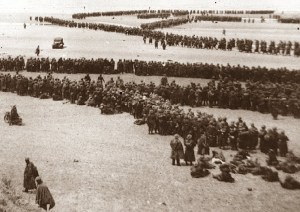
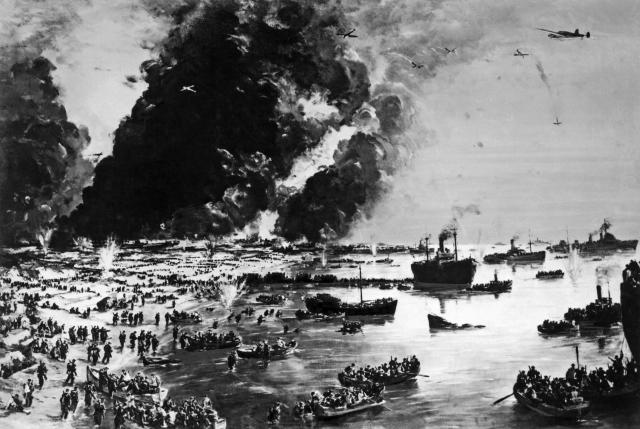
Dunkirk4In May of 1940 the British Expeditionary Force and what remained of French forces occupied a sliver of land along the English Channel. Field Marshall Gerd von Rundstedt called a halt of the German armored advance on May 24, while Hermann Göring urged Hitler to stop the ground assault, let the Luftwaffe finish the destruction of Allied forces. On the other side of the channel, Admiralty officials combed every boatyard they could find for boats to ferry their people off of the beach.
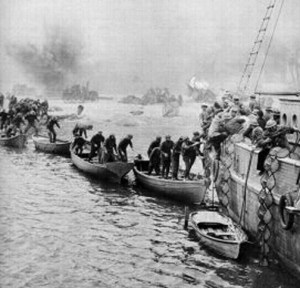
Hitler ordered his Panzer groups to resume their advance on May 26, while a National Day of Prayer was declared at Westminster Abbey. That night Winston Churchill ordered “Operation Dynamo”. One of the most miraculous evacuations in military history had begun from the beaches of Dunkirk.

The battered remnants of the French 1st Army fought a desperate delaying action against the advancing Germans. They were 40,000 men against seven full divisions, 3 of them armored. They held out until May 31 when, having run out of food and ammunition, the last 35,000 finally surrendered. Meanwhile, a hastily assembled fleet of 933 vessels large and small began to withdraw the broken army from the beaches.Dunkirk6

Larger ships were boarded from piers, while thousands waded into the surf and waited in shoulder deep water for smaller vessels. They came from everywhere: merchant marine boats, fishing boats, pleasure craft, lifeboats and tugs. The smallest among them was the 14’7″ fishing boat “Tamzine”, now in the Imperial War Museum.

A thousand copies of navigational charts helped organize shipping in and out of Dunkirk, as buoys were laid around Goodwin Sands to prevent strandings. Abandoned vehicles were driven into the water at low tide, weighted down with sand bags and connected by wooden planks, forming makeshift jetties.

7,669 were evacuated on May 27, the first full day of the evacuation. By day 9 a total of 338,226 soldiers had been rescued from the beach.  The “Miracle of Dunkirk” would remain the largest such waterborne evacuation in history, until September 11, 2001.

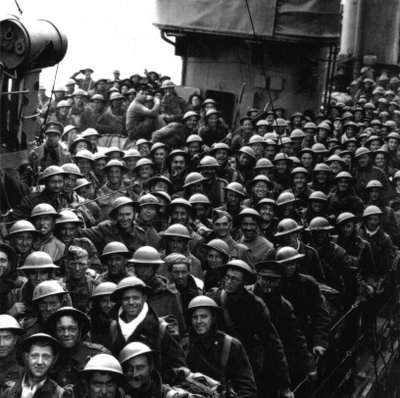
It all came to an end on June 4. Most of the light equipment and virtually all the heavy stuff had to be left behind, just to get what remained of the allied armies out alive. But now, with the United States still the better part of a year away from entering the war, the allies had a fighting force that would live to fight on. Winston Churchill delivered a speech that night to the House of Commons, calling the events in France “a colossal military disaster”. “[T]he whole root and core and brain of the British Army”, he said, had been stranded at Dunkirk and seemed about to perish or be captured. In his “We shall fight on the beaches” speech of June 4, Churchill hailed the rescue as a “miracle of deliverance”.dunkirk2

On the home front, thousands of volunteers signed up for a “stay behind” mission in the weeks that followed. With German invasion all but imminent, their mission was to go underground and to disrupt and destabilize the invaders in any way they could. They were to be the British Resistance, a guerrilla force reportedly vetted by a senior Police Chief so secret, that he was to be assassinated in case of invasion to prevent membership in the units from being revealed.

Participants of these auxiliaries were not allowed to tell their families, what they were doing or where they were. Bob Millard, who passed in 2014 at the age of 91, said that they were given 3 weeks’ rations, and that many were issued suicide pills in case of capture. Even Josephine, his wife of 67 years, didn’t know a thing about it until the auxiliaries’ reunion in 1994. “You just didn’t talk about it, really”, he said. “As far as my family were aware I was still in the Home Guard. It was all very hush hush. After the war, it was water under the bridge”.dunkirk troops, 1940

The word “Cenotaph” literally translates as “Empty Tomb”, in Greek. Every year since 1919 and always taking place on the Sunday closest to the 11th day of the 11th month, the Cenotaph at Whitehall is the site of a remembrance service, commemorating British and Commonwealth servicemen and women who died in 20th century conflicts. Since WWII, the march on the Cenotaph includes members of the Home Guard and the “Bevin Boys”, the 18-25 year old males conscripted to serve in England’s coal mines. In 2013, the last surviving auxiliers joined their colleagues, proudly marching past the Cenotaph for the very first time.

Historians from the Coleshill Auxiliary Research Team (CART) had been trying to do this for years.

CART founder Tom Sykes said: “After over 70 years of silence, the veterans of the Auxiliary Units and Special Duties Section, now more than ever, deserve to get the official recognition that has for so long been lacking. ‘They were, in this country’s hour of need, willing to give up everything, families, friends and ultimately their lives in order to give us a fighting chance of surviving”.

May 19, 1944 The Seven Dwarves of Auschwitz

The youngest sister “Perla” spoke for the whole family, when she said: “I was saved by the grace of the devil”.

Shimson Eizik Ovitz was a Romanian rabbi, a WWI era entertainer, and someone afflicted with pseudoachondroplasia. He was a dwarf. Ovitz fathered 10 children by two normal sized wives, Brana Fruchter and Batia Bertha Husz. Three of them grew to normal height, the other seven were dwarves.

Batia gave the kids a piece of advice that stayed with them all their lives: “through thick and thin” she said, “never separate. Stick together, guard each other, and live for one another”.Liliput Troupe

The seven dwarves were talented musicians, performing throughout the 30s and early 40s as the “Lilliput Troupe”. They toured Romania, Hungary and Czechoslovakia with their normal height siblings serving as road crew, until being swept up by the Nazis and deported to Auschwitz.

The train arrived at around midnight on May 19th, 1944. Not even concentration camp guards could resist the irony of seven dwarves. They immediately woke Dr. Josef Mengele, the “Angel of Death”, knowing of his perverse fascination with what he called “blood” (family) experiments. Mengele was delighted, “I now have work for 20 years”.Auschwitz

The ten siblings were spared from the gas chamber that night, along with two more family members, a 15 month old boy and a 58 year old woman. Families of their handyman and a neighbor insisted that they were also close relatives, and were also spared. A total of 22 people. Though they were subjected to bizarre and freakish “experiments” and housed in horrific conditions, these were kept healthy for further use, and received better food and clothing than most camp inmates. Mengele even arranged to have special living quarters built for them.

The Ovitzs leaving the camp in May 1944The bizarre and hideous acts of cruelty that Mengele performed in the name of “science” are beyond the scope of this essay, but seven dwarves didn’t come along every day.  The Angel of Death treated the Ovitz siblings differently than other camp inmates.

It was unusual for even two or three siblings to survive the Auschwitz death camp. The Ovitz family endured eight months at Auschwitz.  This was the only instance in which an entire family survived the death camp, intact.

Auschwitz was liberated by the Soviet Red Army on January 27, 1945.

Perla Ovitz
Perla Ovitz

The Ovitz family was transported from the camp by cart, a year later arriving at their Transylvanian home village of Rozavlea.  The family found the place ruined, though they did find a stash of gold where they had left it, buried for safekeeping before the war.

There was no future for them in this place.  Only 50 of the 650 Jewish inhabitants of the village ever returned. The family emigrated to Israel in May 1949, resuming their musical tour and performing until the group retired in 1955.Seven Dwarves, Smithsonian Channel

Josef Mengele never faced justice. He fled to South America, where he accidentally drowned in 1979.

The youngest and last of the Ovitz dwarves, Piroska, “Perla” to her friends, passed away two days before the terrorist attack on the World Trade Towers. She spoke for the whole family, when she said:  “I was saved by the grace of the devil”.

The Smithsonian Channel produced a ¾-hour documentary on the Ovitz siblings.  They call it “The Seven Dwarves of Auschwitz”.

May 17, 1947  Final Voyage of the USS Oklahoma

Frantic around the clock rescue efforts began almost immediately, to get at 461 sailors and Marines trapped within the hull of the Oklahoma.

Pearl Harbor attact mapIt was literally “out of the blue”, when the first wave of enemy aircraft arrived at 7:48 local time, December 7, 1941.  353 Imperial Japanese warplanes approached in two waves out of the southeast, fighters, bombers, and torpedo planes, across Hickam Field and over the waters of Pearl Harbor.  Tied in place and immobile, the eight vessels moored at “Battleship Row” were easy targets.

In the center of the Japanese flight path, sailors and Marines aboard the USS Oklahoma fought back furiously.  She didn’t have a chance.  Holes as wide as 40′ were torn into the hull in the first ten minutes of the fight.  Eight torpedoes smashed into her port side, each striking higher on the hull as the Battleship began to roll.

HT John F DeVirgilio for this graphic

Bilge inspection plates had been removed for a scheduled inspection the following day, making counter-flooding to prevent capsize, impossible.   Oklahoma rolled over and died as the ninth torpedo slammed home.  Hundreds scrambled out across the rolling hull, jumped overboard into the oil covered, flaming waters of the harbor, or crawled out over mooring lines in the attempt to reach USS Maryland in the next berth.

The damage was catastrophic.  Once the pride of the Pacific fleet, all eight battleships were damaged, four of them sunk.  Nine cruisers, destroyers and other ships were damaged, and another two sunk. 347 aircraft were damaged, most caught while still on the ground.  159 of those, were destroyed altogether.  2,403 were dead or destined to die from the attack, another 1,178 wounded.

Japanese torpedo strikes hull of the Oklahoma
Nine Japanese torpedoes struck Oklahoma’s port side, in the first ten minutes.

Frantic around the clock rescue efforts began almost immediately, to get at 461 sailors and Marines trapped within the hull of the Oklahoma.  Tapping could be heard as holes were drilled to get to those trapped inside.  32 of them were delivered from certain death. 14 Marines and 415 sailors aboard Oklahoma lost their lives immediately, or in the days and weeks to come.  Bulkhead markings would later reveal that, at least some of the doomed would live for another seventeen days in the black, upside-down hulk of that ship.  The last such mark was drawn by the last survivor on Christmas Eve.Righting A Frames

Of the sixteen ships lost or damaged, thirteen would be repaired and returned to service.  USS Arizona remains on the bottom, a monument to the event and to the 1,102-honored dead who remain entombed within her hull.  The USS Utah defied salvage efforts. She too is a War Grave, 64 honored dead remaining within her hull, lying at the bottom not far from the Arizona.  Repairs were prioritized and USS Oklahoma was beyond repair.  She, and her dead, would have to wait.

The extraordinarily difficult salvage would not begin until March, 1943.  21 giant A-frames were fixed to the hull, 3″ cables connecting compound pulleys to 21 electric motors, each capable of pulling 429 tons.  Two pull configurations were used over 74 days, first the configuration shown (above right), then direct connections once the hull had achieved 70°.  In May the decks once again saw the light of day.Winch design

Fully righted, the ship was 10′ below water.  Massive temporary wood and concrete structures called “cofferdams” closed the gaping wounds left by torpedoes, so the hull could be pumped out and re-floated.  A problem even larger than those torpedo holes were the gaps between hull plates, caused by the initial capsize and righting operations.  Divers stuffed kapok in the gaps as water was pumped out.

Individual divers spent 2-3 years on the Oklahoma salvage job.  Underwater arc welding and hydraulic jet techniques were developed during this period, which remain in use to this day.  1,848 dives were performed for a total of 10,279 man hours under pressure.  For all that, no military and only one civilian diver lost his life, when his air hose was severed.

Port side damage
Oklahoma prepared for drydock

Salvage workers entered the pressurized hull through airlocks wearing masks and protective suits.   Bodies were in advanced stages of decomposition by this time and the oil and chemical-soaked interior was toxic to life.  Most victims would never be identified.

Twenty 10,000 gallon per minute pumps operated for 11 hours straight, re-floating the battleship on November 3, 1943.


Oklahoma entered dry dock the following month, a total loss to the American war effort.  She was stripped of guns and superstructure, sold for scrap on December 5, 1946 to the Moore Drydock Company of Oakland, California.

Rightng Strategy

The battered hulk left Pearl Harbor for the last time in May 1947, headed for a scrapyard in San Francisco bay.  She would never make it.  Taken under tow by the ocean-going tugs Hercules and Monarch, the three vessels entered a storm 540 miles east of Hawaii.  On May 17, disaster struck.  Piercing the darkness, Hercules’ spotlight revealed that the former battleship was listing heavily.  Naval base at Pearl Harbor instructed them to turn around, when these two giant tugs suddenly found themselves slowing to a stop.  Despite her massive engines, Hercules was being dragged astern with no warning, hurtling past Monarch, herself swamped at the stern and being dragged backward at 17mph.Port side damage

Fortunately for both tugs, skippers Kelly Sprague of Hercules and George Anderson of Monarch had both loosened the cable drums connecting 1,400-foot tow lines to Oklahoma.  Monarch’s line played out and detached, but Hercules’ line didn’t do so until the last possible moment.  With tow line straight down and sinking fast, Hercules finally detached directly over Oklahoma’s final resting place, the 409-ton tug bobbing to the surface like the float on a child’s fishing line.

Ordered in March 1911 and launched three years later, the 583’ Nevada-class battleship Oklahoma DiverUSS Oklahoma was designed to fight at the most extreme ranges expected by gunnery experts.  Commanded by Charles B. McVay, Jr., father of the ill-fated skipper of the USS Indianapolis Charles Butler McVay III, Oklahoma’s role in WW1 was limited, due to the unavailability of oil in major theaters of operation.  Notable among her exploits of the Great War, were the memorable fist fights that crew members got into with Sinn Féin members in Berehaven, and casualties sustained during the 1918-19 flu pandemic.

She was up-armored in a 1927 – ’29 refit, where additional anti-torpedo armor bulges were added, briefly making her the widest battleship in the United States fleet.  Oklahoma was dispatched to Europe in 1936, to evacuate American civilians during the Spanish civil war.  The only US warship ever named after the 46th state was destroyed in an enemy sneak attack, before she knew her nation was at war.  The final resting place of the USS Oklahoma, (BB-37), is unknown.

May 12, 2008 Angel of Warsaw

All told, Irena Sendler saved about 2,400 Jewish children and infants and about 100 teenagers, who went into the forests to join partisan bands fighting the Nazis. The far better known Oskar Schindler is credited with saving less than half that number.

Dr-Stanislaw-Krzyzanowski-Janina-Grzybowska
Dr. Stanisław & Janina Krzyżanowski

Dr. Stanislaw Krzyżanowski was a physician treating mostly the poorer Jewish families in the central Polish town of Otwock, 14 miles southeast of Warsaw.   He had once said to his only daughter Irena:  “If you see someone drowning, you must save them.” “But, what if I can’t swim?” she asked. “Nevertheless, you must try”.

Overwhelmed by the typhus epidemic of 1917, Dr. Krzyżanowski contracted the disease himself and died that February, but his example guided his daughter for the rest of her life.  Jewish community leaders showed their gratitude by offering to pay for Irena’s education, but her mother declined.

Irena (Krzyżanowski) Sendler was a nurse living outside Warsaw, when Nazi Germany invaded Poland in 1939.  The Nazis gathered up every Jew they could find in 1940, penning 400,000 or more up in the city. Soon, the Warsaw ghetto became the scene of suffering, disease and starvation. Knowing the Nazis feared nothing so much as Typhus, Sendler took advantage of their fears and obtained permission to begin work in the ghetto.

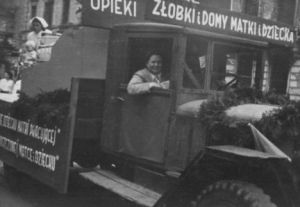
Sendler Truck
“Irena in a social welfare department truck in May 1948” H/T U.K. Daily Mail

She would travel there daily, and soon started to smuggle Jewish babies out in the bottom of a medical bag.  She’d place soiled bandages around and over sedated babies, to keep guards from looking too closely. She carried a burlap sack in the back of her truck. Sometimes she’d use that or even a coffin to smuggle larger children and even teenagers out of the ghetto, other times leading them out through cellars or sewers.

Sendler traveled with a small a dog she had trained to bark at Nazi soldiers letting her in and out of the gates. They wanted nothing to do with her small, yappy dog, and the barking would cover any sounds that the babies might make.

She would make as many as three runs a day, taking out as many as 6 children. Most of them were already orphans by this time, their parents murdered by the Nazi regime.  Many times, parents gave up their children in order to save them.

Irena coded the names of these children onto two slips of paper, including false and real names.  These she buried in glass jars under a tree in the yard of a friend. She obtained false papers for each of the kids, passing them along to nunneries, monasteries and to foster parents.

Sendler, youth
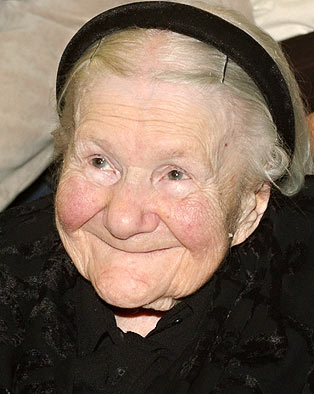
‘Angel of the Warsaw Ghetto”, Irena Sendler

Elzbieta Ficowska was smuggled out in a carpenter’s toolbox at the age of six months.  ‘When I was 17″, she said, “a friend said she’d heard I was Jewish. At that point, my Polish mum told me the truth, giving me a silver spoon engraved with my name and birth date, which my blood family had placed in the box with me.   Elzbieta later learned that her family wept on hearing she was to be baptized, but later signaled their understanding by sending a christening gown and tiny gold cross.  “I consider both my Polish mum and Irena to be a little pathological. It is a kind of insanity to overcome such fear. They were so alike, my mum and Irena – fantastic, strong women”.

Anna Mieszkowska, the author of Sendler’s Polish biography, tells a story.  ‘Irena told me not to put this story in the book. She was asked to save two children, a boy and a girl. The parents wanted them to go but the grandparents did not. Irena arrived at their address and found the whole family had committed suicide – grandparents, parents, children. She had nightmares about this for many years.’

Sendler was caught by the Gestapo in 1943, betrayed by a colleague under torture, and by a nosy landlady.  Nazi interrogators beat her savagely, but she never gave up any of those names.

Irena lasted 100 days in Pawiak prison, a place where average inmate survival was less than a month.  Finally she was returned to the Gestapo and stood against a wall for execution, too broken to care. An SS guard said “not you” and shoved her out into the street. He’d been bribed by her friends, and was himself later caught and executed. For now she was “officially” dead, which made it easier to escape detection for the remainder of the war.Sendlerowa, 1

After the war, Irena tried to reunite parents or surviving family members with the children she’d rescued. She was rarely successful.

All told, Irena Sendler saved about 2,400 Jewish children and infants and about 100 teenagers, who went into the forests to join partisan bands fighting the Nazis. The far better known Oskar Schindler is credited with saving less than half that number.

Today, Elzbieta Ficowska tries to keep her Jewish roots, but they seem foreign to her.  ‘When I enter a Catholic church, everything is mine. Sometimes I look in the mirror for traces of my real parents. I sent letters all around the world to try to find out about them.’  She has never seen so much as a photograph.

The Polish Government honored Irena Sendler with the Order of the White Eagle, its highest award. The Yad Vashem Remembrance Center in Jerusalem honored her as a “Righteous Gentile” in 1965. She received honorary citizenship in Israel in 1985, and the Polish and Israeli Governments nominated her for the Nobel Peace Prize in 2007.

SendlerowaThe Nobel Prize for Peace was awarded on October 12 in Oslo, Norway, to the Intergovernmental Panel on Climate Change (IPCC) and Albert Arnold Gore Jr. “for their efforts to build up and disseminate greater knowledge about man-made climate change, and to lay the foundations for the measures that are needed to counteract such change”.

Irena Sendler passed away on May 12, 2008 at the age of 98. This choice of 2007 Nobel prize recipients has been controversial, since Nobel by-laws prohibit posthumous award of the prize. Many felt that Sendler had more than earned it. Some have claimed that Nobel committee rules require qualifying work to have taken place within the two years immediately preceding nomination, but I think they’re making it up. I’ve read the Nobel statutes. You can do so yourself, HERE, if you’re so inclined   I find no such requirement.  Let me know if I missed it, the whole thing seems political, to me.

Irena Sendler always said that she wasn’t a hero, she only did what any normal person would do. I find in the story of this petite Polish nurse, some of the most magnificent courage of which our species is capable.  If that does not make her a hero, I don’t know what would.

May 10, 1941 Prisoner #7

The last of the other inmates had left by 1966, leaving #7 the prison’s only occupant. Warden Bird wrote a book in 1974, titled “The Loneliest Man in the World”, about his relationship with Hess during his 30 years’ confinement.

At the end of WWI, Rudolf Walter Richard Hess enrolled in the University of Munich.  He’d been wounded several times in the Great War, serving in the 7th Bavarian Field Artillery Regiment. As a student, Hess studied geopolitics under Karl Haushofer, an early proponent of “Lebensraum” (“living space”), the philosophy which later became a central plank in the Nazi Party political platform.

rudolf-hess-nazi rallyHess was an early and ardent proponent of Nazi ideology.  A True Believer. He was at Hitler’s side during the failed revolution of 1923, the “Beer Hall Putsch”. He served time with Hitler in prison, and helped him write his political opus “Mein Kampf” (My Struggle). Hess was appointed to Hitler’s cabinet when the National Socialist German Workers’ Party seized power in 1933, becoming Deputy Führer, #3 after Hermann Göring and Hitler himself. Hess signed many statutes into law, including the Nuremberg Laws of 1935, depriving the Jews of Germany of their rights and property.

Obsessed as he was with race theory, Hitler believed that, as fellow Anglo Saxons, the British people were meant to be natural allies to Germany.  If only they could get rid of Churchill, he believed, the two nations might be able to work things out. Churchill and Hitler deeply hated one another, but there were many in Great Britain, including much of the landowning aristocracy, London financiers and media moguls, who regarded the Soviet Union as the greater threat.rudolf-hess-plane

Rudolf Hess flew into Scotland on May 10, 1941, parachuting to earth as his Messerschmidt two-seat aircraft ran out of gas. It’s unclear whether the scheme was Hess’ own idea or if it had official sanction. It was a cockamamie scheme, in which he intended to arrange peace talks with Douglas Douglas-Hamilton, 14th Duke of Hamilton, believing him to be a prominent opponent of the British government. The Deputy Führer was immediately arrested, remaining in British custody until the end of the war, when he was returned to Germany for the 1946 Nuremberg Trials.

Hess mental state seems to have declined while under British custody and questions were raised about his sanity and fitness to stand trial.  Judges decided that he understood the charges against him and was capable of defending himself.  Hess did himself no good at trial, declaring his late Führer to be “the greatest son my Volk has brought forth in its thousand-year history”. He testified that he wouldn’t change a thing about having worked for the man, saying “I regret nothing.”Hess at Nuremberg

Nine months later, the court acquitted Hess of war crimes and crimes against humanity, apparently deciding that his earlier persecution of Jews to be insufficiently connected to their later annihilation.  Hess was convicted of conspiracy to wage aggressive war and of crimes against peace and sentenced to life in prison, transferred to Spandau Prison in West Berlin, and placed under the authority of the four major allied powers. Spandau had once housed as many as 600 prisoners.   There he was stripped of his name and given a number, #7, one of 8 former Nazi officials imprisoned there.  After July 18, 1947, those eight became the only inmates to occupy the facility.

Hess’ fellow convicts were gradually released from the prison, as their terms expired or on compassionate grounds. His main companion at this time was his jailer, warden Eugene K. Bird, with whom Hess became close friends. The last of the other inmates had left by 1966, leaving #7 the prison’s only occupant. Warden Bird wrote a book in 1974, titled “The Loneliest Man in the World”, about his relationship with Hess during his 30 years’ confinement.

Spandau
Changing the Guard at Spandau

Attempts by family members and prominent politicians to get him released were blocked by Soviet authorities, who believed him to be a principle architect of Barbarossa, the Nazi sneak attack on the Soviet Union in 1941. On August 17, 1987, #7 tied a lamp cord to a window latch and hanged himself with it. He was 93.

Spandau prison was demolished following the death of its final remaining prisoner, the rubble dumped into the North Sea to prevent the place from becoming a Neo-Nazi shrine,

May 5, 1945 Fire Balloon

In a forest near Bly, Oregon, a monument bears these words, cast in bronze: The “only place on the American continent where death resulted from enemy action in World War II”

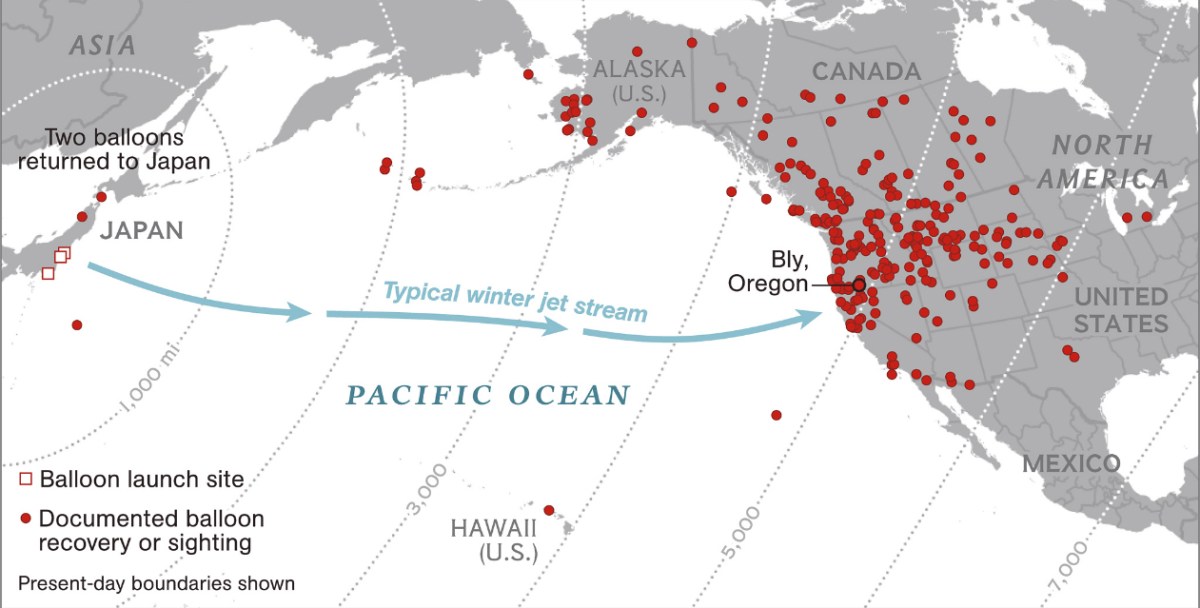
Following the 1883 eruption of the Krakatoa volcano, weather watchers described an eastbound, upper atmospheric air current described as the “equatorial smoke stream”.  In the 1920s, Japanese meteorologist Wasaburo Oishi tracked these upper level winds from a site near Mount Fuji, using pilot balloons. Oishi doomed his work to international obscurity when he published his findings in Esperanto. Inside Japan, there were those who took note, filing away this new-found knowledge of what we now call the “Jet Stream”.

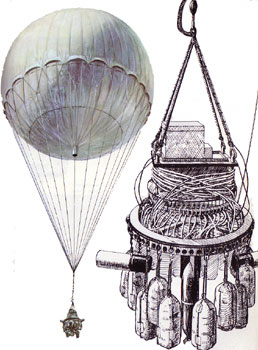
Japanese balloon bomb diagramIn the latter half of WWII, Imperial Japanese military thinkers conceived the fūsen bakudan or “fire balloon”, a hydrogen filled balloon device designed to ride the jet stream, using sand ballast and a valve system to navigate the weapon system onto the North American continent.
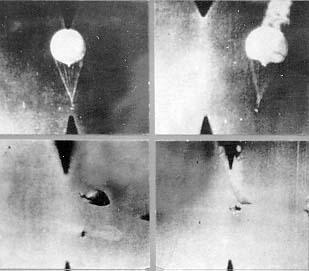
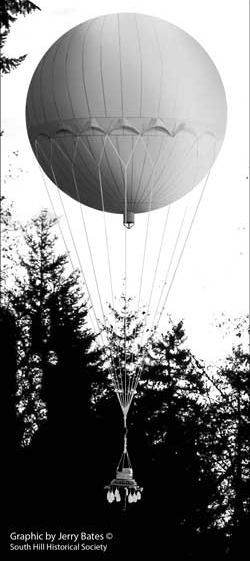
With sandbags, explosives, and the device which made the thing work, the total payload was about a thousand pounds on liftoff.  The first such device was released on November 3, 1944, beginning the crossing to the west coast of North America.  9,300 such balloons were released with military payloads, between late 1944 and April, 1945.

Such a long-range attack would not be duplicated until the 1982 Falklands War, and was near unimaginable at the time.  In 1945, intercontinental weapons were more in the realm of science fiction.  As these devices began to appear, American authorities theorized that they originated with submarine-based beach assaults, German POW camps, even the internment camps into which the Roosevelt administration herded Japanese Americans.

Japanese_fire_balloon_shotdown_gun
Fighters shot down fewer than 20

These “washi” paper balloons flew at high altitude and surprisingly quickly, completing the Pacific crossing in three days. Balloons landed from Alaska to Northern Mexico, and as far east as Detroit.

A P-38 Lightning fighter shot one down near Santa Rosa, California, while Yerington, Nevada cowboys cut one up to make hay tarps. Pieces of balloon were found in the streets of Los Angeles. A prospector near Elko Nevada delivered one to local authorities, on the back of a donkey.

Among US units assigned to fight fire balloons was the 555th Parachute Infantry Battalion, which suffered one fatality and 22 injuries fighting fires.

One of the last balloons came down on March 10 near Hanford Washington, shorting out power lines supplying electricity for Manhattan Project nuclear reactor cooling pumps. The war in the Pacific could have ended very differently, had not backup safety devices restored power, almost immediately.

Colonel Sigmund Poole, head of the U.S. Geological Survey military geology unit, asked, “Where’d the damned sand come from?”  Microscopic analysis of sand ballast identified diatoms and other microscopic sea life.  This and the mineral content of the sand itself proved to be definitive.  This stuff could only have come from the home islands of Japan, more specifically, one or two beaches on the island of Honshu.Japanese Balloon Bomb

American authorities were alarmed.  Anti-personnel and incendiary bombs were relatively low grade threats.  Not so the biological weapons Japanese military authorities were known to be developing at the infamous Unit 731, in northern China.

284 of these weapons are known to have completed the Pacific crossing to the United States, Mexico and Canada.  Experts estimate as many as 1,000 may have made it.  Sightings were reported in seventeen US states. Pilots were ordered to shoot them down on sight, but many devices escaped detection, altogether.

In an effort to deny valuable intelligence to their Japanese adversary, US military and government authorities did everything they could to keep these “Fire Bombs” out of the media.  Even though such secrecy put Americans at risk.

Japanese Authorities reported that the bombs were hitting key targets, thousands were dead or injured, and American morale was low.

On the morning of May 5, 1945, Pastor Archie Mitchell and his wife Elsie took their Sunday school class of five on a picnic to a forest area near Bly, Oregon.  Elsie and the kids came upon a large balloon with a strange looking device attached to it, as Pastor Mitchell parked the car. There was no way they could have known, what they had found was a Japanese weapon of war.  The device exploded, killing all six, instantly.

Several such devices exploded, igniting wildfires in the forests of California, Oregon and Washington, but the site near Bly is the only one known to have resulted in American casualties.Japanese balloon bomb shrapnel tree

Today there is a small picnic area located in the Fremont-Winema National Forest, in Lake County, Oregon.  It’s maintained by the US Forest Service, memorialized as the Mitchell Recreation Area and listed on the National Register of Historic Places.  A small stone marker points the way to a shrapnel scarred tree.

A second monument bears these words, cast in bronze:  The “only place on the American continent where death resulted from enemy action during World War II”.  There are six names above those words, those of five children and their teacher, who was pregnant at the time.  Elsie Mitchell, age 26.  Edward Engen, age 13.  Jay Gifford, age 13.  Joan Patzke, age 13.  Dick Patzke, age 14.  Sherman Shoemaker, age 11.

Mitchell Monument